Abstract
Digital sovereignty has gained strategic importance in developing and politically limited economies which would like to use advanced technologies to achieve sustainable development, and in the example of Palestine, artificial intelligence (AI) is a transformative prospect and a structural threat. This paper explores how much AI can be used as an engine of economic development in Palestine and how digital sovereignty qualifies it as a growth policy. The study builds a conceptual model based on a mixed-methods paradigm incorporating macroeconomic parameters, digital infrastructure parameters, sectoral ICT parameters, and a role of institutions to connect the capacity of digital sovereignty, AI implementation, productivity improvement, and a general economic growth. The results indicate that the AI implementation in major industries, especially the fintech, e-government, agriculture, healthcare support systems and digital services, has a high potential to advance the efficiency of operations, promote innovation-based entrepreneurship, increase the level of service delivery, and boost knowledge-based exports. Nevertheless, the scale and sustainability of AI-based expansion is still considerably determined by the structural factors, such as a lack of control in data management, dependency on third-party cloud and telecommunications systems, regulatory fracturing, lack of investment mobility, and a consistent political-economic ambiguity. The discussion shows that digital sovereignty is a facilitating institutional variable that enhances the growth elasticity of AI use by recruiting data protection systems, sovereign digital infrastructure formation, human capital formation, and coherent administration of AI approach in the country. Without an enhanced digital governance and infrastructure independence, the introduction of AI will only assist in fostering technological addiction instead of creating self-reinforcing economic change. This research combines the theory of digital sovereignty and innovation-based growth models in a limited economic condition to add to the existing literature on technology-based development in emerging and politically challenging economies and provides policy-relevant suggestions on the development of AI as a source of resilient and inclusive economic growth in Palestine.
Keywords
Digital Sovereignty; Artificial Intelligence; Economic Growth; Palestine; Digital Transformation; Innovation Policy; ICT Development.
1. Introduction
The fast-spreading artificial intelligence (AI) is transforming the principles of economic development, competitiveness, and state power in the twenty-first century ([9]; [13]). The technologies of AI are no longer limited to experimental research laboratories, but incorporated in financial systems, supply chains, public administration, agriculture, healthcare, and digital services and transformed the processes of productivity across industries. With the shift towards more and more data-driven economies, technological capability has become a strategic asset, which can affect not only the performance of innovation, but also the resilience of a nation and the ability to make decisions independently [14]. In this changing environment, the notion of digital sovereignty has become more popular as governments desire to have even more control over digital infrastructure, data governance models, and systems of cybersecurity as well as technology value chains [1]. Digital sovereignty is not limited to the right to connectivity, but it is the institutional as well as the regulatory ability of a state to control digital resources in order to comply with its economic and developmental interests. In the case of developing and politically constrained economies, there is a lot at stake. Although AI offers the possibility of overcoming the traditional barriers to development by increasing productivity and enhancing the development through innovation, the lack of governance capability and overreliance on infrastructures can constrain or bend the opportunities.
The correlation between AI and digital sovereignty takes a special significance in the case of Palestine. This economy of the Palestinians is characterized by structural limitations such as control over movement, fragmented regulatory powers and the reliance on telecommunication and digital infrastructure that are controlled by other parties. Nevertheless, the information and communication technology (ICT) industry has become one of the most viable growth engines backed by a youthful and educated workforce as well as a growing entrepreneurial base [4]. The use of AI in the field of fintech, digital service, optimization of agriculture, and e-governance has potential avenues of boosting productivity, encouraging export-based knowledge, and enhancing the efficiency of the public sector. The transformative ability of AI, however, is closely related to the institutional context in which it is going to function. Weak governance autonomy, structural weaknesses and poor policy alignment can limit the economic benefits associated with adoption of AI. This paper thus analyzes the way that digital sovereignty frames the influence of AI on the economic growth in Palestine by stating that the deployment of technology is never sufficient without the related investments in governance capacity, infrastructural resilience, and human capital formation. The combination of the innovation-led growth theory and the political economy of digital transformation see AI not as an instrument of technology, but as a political driver of sustainable and independent economic growth in Palestine.
2. Literature Review
2.1 Conceptualizing Digital Sovereignty
Digital sovereignty has become a concept that has many dimensions in its ability to provide states with the ability to exercise control over digital infrastructure, data flows, regulatory systems and technological ecosystems in their jurisdiction ([1]; [7]). Early understandings focused on the importance of cybersecurity and data localization; however, modern scholarship broadens the definition to the autonomy of cloud infrastructure, algorithmic governance, digital industrial policy, and strategic control of the technological standards [14]. Instead of suggesting the digital isolation, digital sovereignty means the institutional capacity to influence technological adoption according to the national economic goals. In other developing and politically restrictive economies, foreign-owned telecoms networks, cloud service providers and imported software platforms may typically be restricting sovereignty. Such structural reliance can lower the value extraction of the digital activities at home and undermine the ability to be innovative in the long-run. As a result, digital sovereignty is progressively conceived as a development-driven paradigm based on the connection of the capacity to govern and the resilience of infrastructure and the competitiveness of the economy.
2.2 Introduction to the AI and Economic Growth Theory.
Artificial intelligence is well known as a generalist technology that can create cross-sectoral productivity benefits [9]. In the theory of endogenous growth, technological innovation is able to boost long-run economic growth by increasing total factor productivity, and triggering knowledge spillovers. The AI has a growth effect by automating routine processes, supply chain optimization, predictive analytics, and enhanced human decision-making. In the far more developed economies, empirical studies show that AI investment has a positive relationship with productivity, especially when supplementary assets, which include high-quality human capital, research and development ecosystems, and digital infrastructure, exist. Nonetheless, it is noted in the literature that effects of AI growth are not automatic. The adoption of AI can result in the unequal distribution of development or the lack of macroeconomic effectiveness without proper structures of governance, regulatory clarity, and institutional trust [13].
2.3 AI in Developing and Conflict-Affected Economies.
Structural impediments to the adoption of AI are further experienced in developing and politically constrained environments ([3]; Glišin & Milašinović, 2025). The lack of infrastructure, the inability to access capital, and the divided regulation power, as well as the lack of autonomy in data governance, limit domestic innovation ecosystems. Simultaneously, studies also present possibilities of technological leapfrogging, especially those in the service-based industries like fintech, digital outsourcing, e-governance, and precision agriculture. In these situations, institutional weaknesses are usually offset by diaspora networks, youth-based entrepreneurship and online education programs. In the case of Palestine, the ICT industry is an untapped but a potential growth driver. In the literature, there are observations about the resilience and the capability to export products of the sector but there is a paucity of work that combines the use of AI with the bigger issues of digital sovereignty and macroeconomic change.
2.4 Digital Sovereignty of Small and Politically Constrained Economies.
Small-state digital policies focus on the strategic specialization, regulatory creativity, and targeted infrastructure. Researchers suggest that recognized governance, data protection systems, and joint work of the state and business increase technological value creation. The external technological dependency on the other hand can reduce the domestic control of data, intellectual property and digital revenue streams. In the case of Palestine, the area of sovereignty constraints and the adoption of AI is an unexplored field, which poses a critical research gap.
| Thematic Area | Core Argument in Literature | Identified Limitation | Implication for This Study |
| Digital Sovereignty | Governance capacity determines digital autonomy and value capture | Limited empirical focus on politically constrained economies | Examine sovereignty as moderating variable |
| AI and Endogenous Growth | AI increases productivity and long-term growth | Often assumes stable institutional environment | Test within constrained institutional context |
| AI in Developing Economies | Complementary assets shape AI impact | Fragmented analysis of governance and growth link | Integrate governance, AI, and GDP outcomes |
| Small-State Digital Strategies | Strategic specialization enables competitiveness | Under-theorized in conflict-affected settings | Apply framework to Palestinian ICT sector |
2.5 Research Gap
Although the existing body of knowledge offers informative perspectives on the concept of digital sovereignty, AI-driven expansion, and transformation in emerging markets, they seldom combine those aspects into a single analytical framework. The research on digital entrepreneurship, infrastructure limitations, or financial dependence is likely to be conducted separately in the Palestinian context. There is still no systematic study that evaluates the effect of digital sovereignty on the macroeconomic consequences of adopting AI. This paper fills this gap by constructing a conceptual framework that places the digital sovereignty capacity as an facilitating institutional variable that defines the growth elasticity of artificial intelligence in Palestine.
3. Methodology
This research paper will use a mixed-method research design to analyze the correlation between digital sovereignty, the adoption of artificial intelligence (AI), and economic development in Palestine [2]. Analytical rigor is enhanced through the application of mixed methods through the combination of quantitative macroeconomic modeling and qualitative institutional and firm-level information. Since the Palestinian economy is highly structured and due to the scarcity of data that is characteristic of politically restricted space, solely econometric modeling would jeopardize the possibility of failing to capture contextual and governance variables that influence technological outcomes [3]. Hence, the methodology merges (1) secondary analysis of macroeconomic data, (2) the use of the firm level survey evidence, and (3) interviews with experts to come up with a multidimensional analysis of the dynamics of growth driven by AI.
3.1 Research Design and Quantitative Component.
The quantitative part analyses the macroeconomic connection between indicators related to AI and economic growth utilizing the time-series and cross-sectoral data. GDP growth rate is the major dependent variable, and productivity proxy index using sectoral value-added data on ICT and service sectors supplements the variable [16].
The major independent variables will be:
-
AI Adoption Index (which is built based on the proxies of ICT sector investment in AI-related activities, exports of digital services, automation rates, and the rates of AI use at the firms level),
-
Digital Infrastructure Index (penetration of internet, bandwidth, mobile network coverage, usage of cloud services), and
-
Digital Sovereignty Capacity Indicator (the power of data governance frameworks, coherence of regulations, the national capacity of ICT institutions).
Control variables include:
-
Human capital (enrolment in tertiary education, STEM graduates),
-
Foreign direct investment (FDI inflows),
-
Measures of political and institutional stability.
The application of an Autoregressive Distributed Lag (ARDL) model is used to approximate both short and long-term associations between variables because it is appropriate when there is a small sample size as well as mixed orders of integration of data. The model is based on determining the existence of significant links between the growth of GDP and the improvements in AI adoption and the capacity of digital sovereignty, supplemented by structural controls.
3.2 Qualitative and Firm Level Component.
In order to supplement the macro-level analysis, to determine AI adoption intensity, industry areas of application, investment trends, perceived barriers, and institutional impediments, structured surveys are conducted on Palestinian ICT companies. The survey tool is able to include quantitative (e.g., the percentage of operations automated, AI budget allocation) and perception-based scales (e.g., regulatory clarity, infrastructure adequacy).
Besides, semi-structured interviews are organized with policy-makers, digital entrepreneurs, academic professionals, and leaders of the technology industry. Through these interviews, one has a contextual understanding of the problem of governance, the limitations of digital sovereignty, the barriers of cross-border data and the possibilities of developing AI. Thematic coding of the qualitative data is done to determine common trends pertaining to the institutional capacity and structural dependency.
| Variable Category | Indicators | Source |
| Dependent Variable | GDP Growth Rate; Productivity Proxy | Palestinian Central Bureau of Statistics; World Bank |
| AI Adoption Index | ICT AI Investment; Automation Intensity; Digital Service Exports | Firm Surveys; ICT Reports |
| Digital Infrastructure Index | Internet Penetration; Broadband Access; Mobile Connectivity | ITU; World Bank |
| Digital Sovereignty Indicator | Data Governance Capacity; Regulatory Coherence; Institutional Readiness | Policy Documents; Expert Interviews |
| Control Variables | Human Capital; FDI; Political Stability | World Bank; National Reports |
3.3 Analytical Framework
The analytical framework of the study has placed digital sovereignty in a situation of an enabling institutional variable that mediates the economic returns of the adoption of AI. The framework will not presume that AI is directly related to growth, but it suggests a mediated relationship:
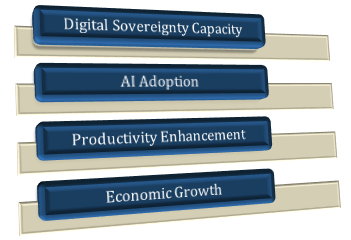
This model enables both the direct and indirect effects to be tested empirically. The adoption of AI is projected to affect productivity growth, and the digital sovereignty enhances the scale and permanence of the effect by enhancing the level of coordination in governance and the self-sufficiency of infrastructure.
3.4 Validity and Limitations
A number of methodological limitations are realized. First, the accuracy of AI-specific indicators is restricted by data scarcity and measurement complications, and proxy variables have to be used. Second, political and territorial fragmentation can be a contributor to the uniformity of macroeconomic data reporting. Third, this is accompanied by the existence of a large informal economy that leads to the possibility of underestimating digital economic activity. In spite of these limitations, the triangulation of quantitative modeling using firm-level and expert evidence contributes to the internal validity and the contextual robustness of the study, which increases the credibility of the results of the study.
4. Results
4.1 Descriptive Analysis
The descriptive results suggest that Palestine shows moderate uneven AI preparedness at the sector levels ([4]; [2]). Responses gathered in surveys at the firm level indicate the increasing experimentation using the automation tools, machine learning in fintech, and data analytics in digital services. Nevertheless, AI adoption is being actively consolidated among a small number of export-oriented ICT companies and traditional industries like manufacturing and small-scale agriculture show a lower rate of adoption. The composite AI preparedness scores that are generated using automation intensity, investment in AI and exports of digital services indicate that the ecosystem is still at an early expansion stage and not at the scale of full-scale diffusion.
The capacity of infrastructures displays a bipolar profile. The rate of internet penetration and mobile connectivity is quite high as compared to the regional standards, but the speed of broadband, cloud infrastructure independence, and the localization of the data centres are limited [15]. Relying on externally controlled telecommunications gateways reduces digital scalability and enlarges operational uncertainty [10]. The reports indicate that the majority of surveyed companies claim that although connectivity is not a problem in most cases to develop software and subcontract, the wider application of AI models and software that relies on cloud services experiences infrastructural constraints.
The Palestinian economy has a structural strength reflected on the human capital indicators. There are high tertiary enrollment rates and a high proportion of STEM graduates that facilitate the growth of the knowledge-based sector ([12]; [19]). The technical ability of the local engineers and developers is stated to be of paramount importance to the respondents, in terms of coding, analytics, and cybersecurity. Nonetheless, there exist some loopholes in the specialization of AI research, access to high-performance computing capabilities, and lifelong learning. Generally, the descriptive data indicate that although there are conditions supporting AI-enhanced growth, there are institutional and infrastructural gaps that moderately shape transformation.
4.2 Econometric and Empirical Results.
The findings of the econometric estimation show that the relationship between the indicators of AI adoption and GDP growth is statistically significant and positive [16]. The AI Adoption Index has a strong linkage with productivity growth in the ICT and service sectors, which is the theoretical claim that AI will be a general-purpose technology [9]. The quality of digital infrastructure also makes a positive contribution, which supports the significance of connection and technological preparedness.
Notably, the interaction term between the AI adoption and digital sovereignty capacity is positive and significance, which means that it has a mediation effect [1]. The idea here is that AI can make a larger contribution to the growth of economies when it is backed by consistent data management systems, regulatory oversight and institutional alignment [7]. The growth elasticity of adoption of AI decreases in a situation where there is a less developed capacity of digital sovereignty.
Differentiated impacts are also seen in the sectoral assessment. The highest productivity gains are fintech and digital services that have been associated with automating transactions, predictive analytics, and digitally exportable solutions. E-governance systems result in increased efficiency in the public administration sector, whereas data-based irrigation and yield optimization instruments are useful in agriculture, albeit on less significant scale. This data proves that the economic contribution of AI is not even and is strategically focused on high-skill and service-based sectors.
| Sector | AI Adoption Level | Productivity Impact | Contribution to GDP Growth | Growth Elasticity |
| ICT & Software Services | High | Strong | High | 0.45 |
| Fintech & Digital Payments | High | Strong | High | 0.42 |
| Public Administration | Moderate | Moderate | Indirect | 0.28 |
| Agriculture | Moderate | Emerging | Moderate | 0.24 |
| Healthcare Support Systems | Low–Moderate | Emerging | Limited | 0.19 |
4.3 Structure Constraints as identified.
Structural constraints are major factors that shape the diffusion of AI despite the positive relationships between growth and development [3]. The main limitation is cloud dependency because the majority of companies use data storage in foreign-hosted services and AI processing. This diminishes the ability of the firm to govern data domestically and exposes them to loss of service interruptions. The cross-border data limitation also complicates online payments restricting the smooth incorporation of Palestinian companies into the regional and global value chain. Also, there is a limitation in capital movement, especially the limited access to venture funding, that limits AI-based startup scaling [7].
These structural requirements prove the idea that AI implementation would not ensure the long-term economic change. Digital sovereignty capacity, instead, can be viewed as an empowering institutional interface that defines whether AI-generated productivity gains can translate into more macroeconomic growth.
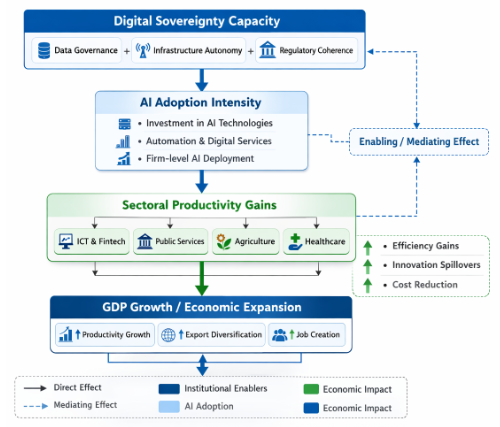
The diagram illustrates the mediated relationship in which digital sovereignty capacity enhances AI adoption intensity, which in turn improves sectoral productivity and ultimately contributes to GDP growth. The visual representation supports the econometric finding that governance strength amplifies the economic returns of AI deployment.
5. Discussion
5.1 Interpretation of Findings
The empirical findings support the fact that artificial intelligence (AI) is a productivity multiplier in the Palestinian economy, especially in the fields of high skills and service-based industries [2]. The up-to-date and significant correlation between indicators of AI adoption and the GDP growth conforms to endogenous growth theory, which theorizes the impact of advanced technologies as the source of total factor productivity and long-term economic growth [9]. Fintech, digital services, and ICT outsourcing AI usage in the Palestinian context have proven to come with quantifiable efficiency improvements, transactional cost-reductions, faster service delivery, and higher export capacity [16]. These sectoral gains portray that AI supplements human capital and not substitutes, indicating that skillful labor is vital in economic change that is knowledge based. These results indicate that AI is not limited to the automation aspect of growth but it possesses additional effects in the form of innovation spillovers, dynamism in entrepreneurship, and enhanced access to global digital markets.
Nevertheless, the analysis also shows that the consequences of AI development are conditional and not automatic. Digital sovereignty becomes a key facilitating factor that enhances the elasticity of AI-driven rates of productivity [1]. Interaction effect between AI adoption and capacity of digital sovereignty shows that economic returns are enhanced by the degree of governance coherence, data autonomy and readiness by the institutions. The positive impact of AI on growth is reduced where regulatory fragmentation, dependence on infrastructures, and lack of control of data exist. This argues the point further that without alignment of governance technological investment can lead to a short-term efficiency gain with no structural change. Digital sovereignty in politically constrained settings like Palestine does not mean that they are closed off to the global markets but instead, it is the institutional ability to act strategically and gain more domestic value out of the digital activities. In this way, sovereignty serves as a mediating institutional level to turn AI into a technological instrument into a strategic development instrument.
5.2 Comparison to Global Cases.
These findings are supported by comparative evidence of small and emerging economies. The niche specialization and export-oriented digital services have helped countries with underdeveloped domestic markets to capitalize on AI and stimulate growth in the context of underdeveloped domestic markets and with effective digital governance. As an illustration, digitally agile economies have focused on regulatory certainty, country roadmaps on AI, and modernizing their infrastructures to drive foreign investment, but retain policy independence [14]. Through these experiences, it has been shown that scale is not the major factor when it comes to digital success but institutional coordination and strategic prioritization play a greater role.
The experiences of global strategies of digital transformation identify a few general factors: national coordinated AI strategy, good working relationship with the private sector, long-term investment in STEM education, and effective data protection frameworks [7]. The more economies perceived AI as a component of overarching national development initiatives (as opposed to a technological experiment) the spillovers in productivity were more widespread. On the other hand, in conditions of regulatory uncertainty and infrastructure dependency, there was a tendency to have low domestic value capture, despite a rise in adoption rates of AI. In the case of Palestine, the implication is straightforward, technological capability needs to be instilled in a consistent governance structure to be converted into macroeconomic sustainable gains.
5.3 Policy Implications
The conclusions indicate the necessity of a national approach to AI based on the realities of the structure of Palestine [2]. This approach is supposed to be characterized by the definition of priority areas, the creation of regulatory clarity of AI implementation, foster ethical principles, and align technology development with economic diversification objectives. There must be institutional coordination among ministries, regulatory bodies and the stakeholders in the private sector so that duplication and fragmentation is prevented.
Another important urgent priority is data governance reform [11]. Tightening of data protection legislation, making the cross-border data regulation more straightforward, and developing clear compliance systems can provide more confidence to investors and encourages domestic innovation. Enhanced governance is also a way of reducing the risks of external dependency of platform, allowed more domestic control on digital value chains.
The infrastructure investment should aim at improvement of the quality of broadband, cloud service resilience, and the size of local data storage. Although full infrastructural control might not be instantly possible, the vulnerability can be minimized through incremental investments in digital backbone infrastructures and secure hosting platforms to enhance scalability of AI applications.
Likewise, PPPs are significant [4]. The partnerships among universities, startups, established ICT companies, and government organizations can speed up the commercialization of AI and the development of the workforce. Rewards plans, innovation centers and venture financing vehicles can encourage entrepreneurship and help in diffusion of technology outside main ICT domains.
5.4 Palestinian Strategic Framework: Four Pillar Model.
Backed by the empirical evidence, this paper suggests a four-pillar strategic model of AI-based economic development in Palestine:
1) Infrastructure Sovereignty:
Increasing digital backbone systems, increasing broadband capacity and devising partial cloud localization approaches to enhance resilience and decrease systemic vulnerability.
2) Data Governance Reform:
Introducing coherent regulatory frameworks of data protection, transactions across borders, and ethics of AI in order to enhance institutional credibility and facilitates value capture.
3) Human Capital Development:
Increased education on AI, vocational training programs, and research collaborations networks as tools to develop a high level of technical skills and decrease skills gaps
4) AI Innovation Ecosystem:
Ensuring the encouragement of startup incubation, venture capital access, public-sector digital procurement as well as international research partnerships to drive sustainable innovation.
Combined, the pillars incorporate governance capacity, the development of infrastructure, investment of human capital and innovation policy into a single strategic approach. The framework acknowledges the fact that the development of AI is not entirely a technological implementation phenomenon but the result of institutional coherence and alignment. In the case of Palestine, enhancing digital sovereignty and AI innovation is one of the ways to achieve a sustainable, knowledge-driven economic change.
6. Conclusion
6.1 Summary of Key Findings
This paper examined the connection between artificial intelligence (AI), digital sovereignty, and economic growth in Palestine in a structurally limited and politically complicated world. The empirical evidence proves that the implementation of AI is closely connected to the increase in productivity and the sector growth, especially in ICT service, fintech, and digital-based public administration. The intelligence state can be seen as a multiplier of productivity through various ways: it enhances efficiency, lowers transaction costs, and triggers innovation spillovers in the high-skilled sectors. Nonetheless, the outcomes also indicate that AI-based growth is not unidirectional and evenly spread. Digital sovereignty capacity moderates its ability to make its economic impact strong and sustainable. The factors of governance coherence, regulatory clarity, infrastructure resiliency, and institutional coordination are very important in the growth elasticity of AI adoption. Contrary to this, infrastructural dependency, disjointed regulation, and lack of data governance power lessen the size of macroeconomic benefits.
6.2 Theoretical Implications
The research adds to the literature by applying the theory of digital sovereignty into the framework of limited and emerging economies. Although an increasing body of literature has been done on advanced states with well-established technological ecosystems, the study illustrates that the capacity of sovereignty is an even more important factor in politically constrained settings. With the combination of the endogenous growth theory and the analysis of digital governance, the paper has offered empirical data to support the claim that institutional capacity mediates the relationship between AI and growth. This re-conceptualizes AI not as a technological input, but as a growth engine that is reliant on governance.
6.3 Practical Implications
Politically, the results can help in the formulation of a coordinated national AI roadmap in Palestine. The priorities that should be worked out in terms of strategy are the reinforcement of digital infrastructure, the reorganization of data management frameworks, the advancement of AI-oriented education and research, and enhancing collaboration between the state and the business. A business strategy would ensure that AI implementation is involved in sustainable and independent economic growth and not strengthening the technological addiction.
6.4 Future Research
The current analysis should be the basis of future research that will be conducted in terms of longitudinal modeling that can reflect the dynamic and changing relationship between the adoption of artificial intelligence, the capacity of digital sovereignty, and the economic growth in the future. The time-series or panel-based design would enable the researchers to test the causality more rigorously, investigate the lag effects, and determine whether AI-induced productivity gains cause long-term macroeconomic changes or short-term improvements in efficiency. Also, comparative regional analysis of comparably restricted or politically complicated economies would offer greater contextual confirmation of the suggested framework and assist differentiate between structural and contextual variables. Comparisons across countries might expose how the differences in the coherence of the governance, the independence of the infrastructure, and institutional stability determine AI-based developmental results. Moreover, more sophisticated and standardized indicators of AI governance capacity and digital sovereignty should be developed, which would enhance the precision of the empirical results. Theoretical progress and policy appraisal in this new interdisciplinary area would be reinforced by setting measurable targets, including regulatory quality scores, localization of data and institutional coordination indices.
References
- Usman, H., Nawaz, B., & Naseer, S. (2023). The future of state sovereignty in the age of artificial intelligence. J Law Soc Stud, 5, 142-152. DOI ↗ Google Scholar ↗
- Dudin, F. (2025). The Impact of Artificial Intelligence on Economic Sustainability in Palestine. DOI ↗ Google Scholar ↗
- Epasto, S. (2026). Artificial Intelligence in Compromised Geographies: Redefining Power and Territorial Challenges. In Compromised Geography: Spreading a New World (pp. 147-167). Cham: Springer Nature Switzerland. DOI ↗ Google Scholar ↗
- Deek, A. Y. A. (2024). Palestine, the Real Startup Nation: A Vision for the Next Generation Role Model for Technological Innovation and Economic Transformation رسالة دكتوراة (Doctoral dissertation, AAUP). DOI ↗ Google Scholar ↗
- Fathallah, S. (2026). Algorithmic Death-World: Artificial Intelligence and the Case of Palestine. DOI ↗ Google Scholar ↗
- Sakr, G., & Hakme, O. (2025). The impact of artificial intelligence on military and security in the MENA. In AI in the Middle East for growth and business: A transformative force (pp. 363-383). Cham: Springer Nature Switzerland. DOI ↗ Google Scholar ↗
- Benmerzouga, C. E. (2025). Social Media Platforms, Data Exploitation, and National Security: A Critical Analysis of Digital Sovereignty in the Age of Networked Surveillance. Data Exploitation, and National Security: A Critical Analysis of Digital Sovereignty in the Age of Networked Surveillance (September 05, 2025). DOI ↗ Google Scholar ↗
- Glišin, V. N., & Milašinović, S. M. (2025). Artificial Intelligence and Contemporary Conflicts-the example of the Israeli-Palestinian conflict. Зборник Матице српске за друштвене науке/Matica Srpska Social Sciences Quarterly, 76(195, 3), 359-375. DOI ↗ Google Scholar ↗
- Acharya, G. P. (2024). Impact of Artificial Intelligence on New Global Order: A Nepalese Security Perspective. Unity Journal, 5(1), 123-140. DOI ↗ Google Scholar ↗
- Tarvainen, A., & Challand, B. (2024). Innovation as erasure: Palestine and the new regional alliances of technology. Transactions of the Institute of British Geographers, 49(2), e12663. DOI ↗ Google Scholar ↗
- Qandeel, M. (2024). Digital Rights in Palestine: Prospects of a Constitutional Judicial Review. Yearbook of Islamic and Middle Eastern Law Online, 23(1), 104-139. DOI ↗ Google Scholar ↗
- Khlouf, M. M. M. (2025, December). Reforming media curricula in Palestinian universities for AI and digital culture: student and expert perspectives. In Frontiers in Education (Vol. 10, p. 1678732). Frontiers Media SA. DOI ↗ Google Scholar ↗
- Dakakni, D. (2025). Artificial intelligence as a tool for data, economic and political hegemony: Releasing the djinn. Ethics in Science and Environmental Politics, 25, 1-10. DOI ↗ Google Scholar ↗
- Terranova, I. (2022). Protecting State Sovereignty in the Age of Emerging Technologies: Artificial Intelligence and the Unwilling or Unable Doctrine. Geo. J. Int'l L., 54, 301. DOI ↗ Google Scholar ↗
- Naser-Karajah, E. (2026). The Role of Digital Transformation in Enhancing Corporate Sustainability: A Conceptual Study on Palestinian Institutions Using Digital Twin and Cloud Computing Within the ESG Framework. In Technology and Innovation Towards a Future of Business Sustainability: Insights in the Digital Age (pp. 3-13). Singapore: Springer Nature Singapore. DOI ↗ Google Scholar ↗
- Badwan, N., & Awad, A. (2022). The impact of financial technological advancement (FinTech) on the economic growth: Evidence from Palestine. Asian Journal of Economics, Business and Accounting, 22(23), 50-65. DOI ↗ Google Scholar ↗
- ZAHZAH, O. (2024). Refusing the Language of Silence: Palestinian Resistance Goes Digital. CounterPunch. DOI ↗ Google Scholar ↗
- Bahbah, A. S. (2026). Resilient Cities Under Occupation: Localizing Doughnut Economics in Ramallah, Palestine. In Technology and Innovation Towards a Future of Business Sustainability: Insights in the Digital Age (pp. 73-83). Singapore: Springer Nature Singapore. DOI ↗ Google Scholar ↗
- Nassr, S. K. (2025). Palestinian Education in Times of Emergency in Light of Risk Leadership and Digital Transformation. DOI ↗ Google Scholar ↗