Abstract
This paper examines the impact of customer engagement with influencers on influencer-generated impacts on their purchase intention on social media platforms. Although the engagement, perceived value, and trust have been researched individually, this study has incorporated these constructs within a single framework, examining their impact on purchase intention. Structural equation modeling (SEM) was used to analyze the data of 257 users of social media. The results indicate that engagement by the customers has a significant impact on perceived value, trust, and purchase intention. Interestingly, perceived value has been identified to have a positive impact on trust, implying that consumers use value perceptions to determine the level of credibility of the influencers. Both perceived value and trust further enhance purchase intention. Additionally, engagement exerts a direct effect on purchase intention, indicating both relational and immediate behavioral influences. These results contribute to the literature by clarifying the role of perceived value in trust formation and highlighting the dual impact of engagement. The study also provides practical insights for designing more effective influencer marketing strategies.
Keywords
Influencer marketing Customer engagement Trust perceived value purchase intention social media.
1. Introduction
The rapid expansion of digital technologies and the widespread adoption of social media platforms have fundamentally transformed contemporary marketing practices, giving rise to new forms of consumer–brand interactions. Among these developments, influencer marketing has emerged as a dominant strategy through which firms communicate with consumers, leveraging content creators to shape perceptions, stimulate interactions, and influence behavioral outcomes. As social media environments facilitate real-time, interactive, and highly personalized communication, consumers are increasingly exposed to influencer-generated content that blends information, entertainment, and social endorsement, thereby reshaping the processes underlying purchase decisions.
Within this evolving landscape, consumer engagement has become a central mechanism through which influencer marketing exerts its effectiveness. Social media platforms enable consumers to actively interact with influencer content through activities such as liking, commenting, sharing, and co-creating content, transforming passive audiences into active participants [1] [2]. These engagement behaviors not only reflect consumers’ involvement with the content but also amplify its reach and impact, enhancing the overall effectiveness of marketing communication. Prior research indicates that such engagement-driven interactions can significantly influence consumer attitudes, brand perceptions, and ultimately purchase intentions, particularly in digital environments characterized by high interactivity and immediacy [3] [4]. However, the extent to which engagement translates into actual purchase intention remains dependent to additional underlying mechanisms.
One of the critical factors shaping the effectiveness of engagement in influencer contexts is consumers’ evaluation of the value derived from the content. Influencer-generated content often combines informational, emotional, and experiential elements, allowing consumers to assess its usefulness, enjoyment, and overall benefits. These value perceptions play a decisive role in determining how consumers respond to influencer messages, influencing both their willingness to engage and their subsequent behavioral intentions [5] [6]. When consumers perceive influencer content as valuable, they are more likely to interact with it, develop favorable attitudes, and exhibit stronger purchase intentions. Conversely, low perceived value may limit the effectiveness of engagement, regardless of the level of interaction.
At the same time, the increasing commercialization of influencer marketing has raised concerns regarding credibility and authenticity, making trust a pivotal factor in shaping consumer responses. While influencer content can generate high levels of engagement, its persuasive impact may be undermined if consumers question the credibility of the source or the sincerity of the message. Trust, therefore, plays a crucial role in reducing skepticism, reinforcing confidence, and strengthening the relationship between consumers and influencers [7]. In this regard, trust not only directly influences purchase intention but also enhances the effectiveness of engagement by ensuring that interactions are perceived as meaningful and reliable.
Despite the growing prominence of influencer marketing, existing research remains fragmented in its examination of these key constructs. While prior studies have explored consumer engagement with influencer content [8] [9], others have focused on perceived value [10] or trust [11] as independent predictors of behavioral outcomes. Although these studies provide valuable insights, they offer a limited understanding of how engagement, perceived value, and trust jointly interact to influence purchase intention. This limitation is particularly evident in emerging research on virtual and social media influencers, where engagement levels are often high, yet their translation into purchase behavior remains inconsistent.
In addition, the causal relationship between perceived value and trust is still ambiguous. Although trust is commonly defined as the antecedent to value perception, recent research indicates that the consumer can be attracted to the positive aspects of a product and then develop trust in the originator that is marketing the product. This is of particular concern to influencer marketing, where a lack of credibility is often raised based on the growing commercialization.
It is against this background that the current study aims to fill such gaps by formulating and empirically testing a comprehensive model that studies the influence of customer interaction with influencer content on purchase intention, with perceived value and trust as the central intervening variables. The study will seek to enlighten on the mechanisms by which influencer marketing is able to influence consumer behavior in a more holistic manner by elucidating the connections between these constructs.
2. Literature review and hypothesis development
2.1 Customer engagement and trust
Customer engagement has become an issue of concern in modern marketing studies in general and in the wider context of transactional marketing, turning into the relationship-underlying marketing framework. The initial approach to marketing saw the need to focus on getting customers, but later relationship marketing portrayed the need to have a long-term relationship with those customers [12] [13]. Customer engagement in this case has been widely conceptualized as the behavioral expressions of the customers toward a brand or a firm that go beyond the purchase point [14]. Academic research conceptualize engagement as a multidimensional construct which entails cognitive, emotional, and behavioral aspect entailing the degree to which customers invest in the process of engaging with a brand [5] [15]. Such interactions can be participation in brand communities, experience sharing, or feedback provision, or other activities that are voluntary value creation that benefits the customers and firms [16] [17]. With digital technologies and the use of social networking sites making the interaction between companies and their customers more frequent, customer engagement has become a prominent feature as one of the means through which organizations strengthen their relationships with customers and establish a stronger connection with their audiences [18].
In this relational approach, trust represents a fundamental element in the development and maintenance of successful customer–brand relationships. Trust has been considered as a major factor in minimizing uncertainty in exchange relationships and stimulating customers to build confidence in firms and their products [19] [20]. Trust is even more important in an online setting, wherein one party cannot easily monitor the other firm, so it is better to define it as the readiness of one side to be vulnerable to another on the condition that the latter will conduct himself in a predictable and careful fashion [21]. According to the research that has been conducted before, interactive communication between the firms and their customers is considered important in building this trust. Specifically, interaction in the form of engagement, i.e., joining brand communities or engagement of collaboration, encourages emotional commitment and relational commitment, which subsequently promotes trust among customers and brands [15] [22]. The empirical research also shows that engaged customers become more prone to display the positive relationship outcomes, such as higher trust, satisfaction, and loyalty [23] [24]. Accordingly, customer engagement can be perceived as a significant relational process by which the firms can build trust and strengthen the long-term relationship with their customers, especially in a digital context, where interactive communication and user engagement can become the key contributors to the development of customer experiences. Based on these findings, we propose the following hypothesis:
2.2 Customer Engagement and perceived value
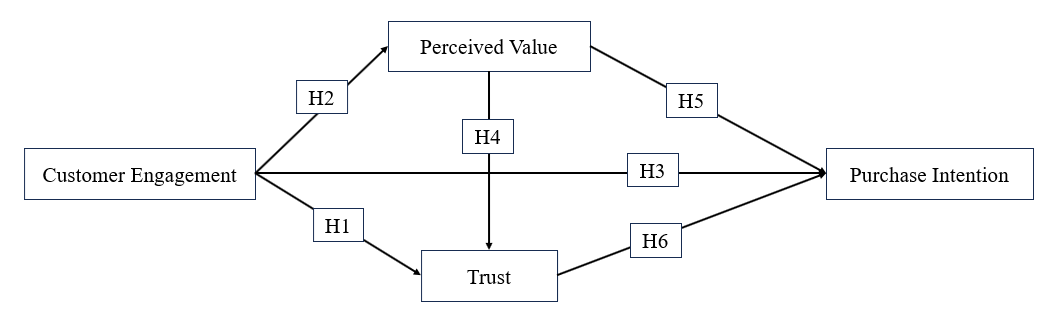
H1. Customer engagement has a significant impact on trust.
Customer engagement has been increasingly acknowledged as a significant process by which consumers get value through their experience with brands and digital platforms. Consumers actively engage in different forms of engagement in social media and online communities, as well as livestreams and other interactive spaces, such as browsing, interacting, creating, and sharing content [25]. Behaviors are more than mere consumption and enable consumers to participate in the co-creation of value with platforms and other users [26]. In this view, engagement is a very crucial process during which consumers create significant experiences that lead to their perceptions of overall value. Previous studies indicate that engagement behaviors help consumers to realize various types of value, such as emotional, functional, and social value [27]. As an example, engaging in content, posting comments, or getting involved in the online discussion may lead to feelings of enjoyment, entertainment, and connection with other people, which enhances the perception of emotional and social value in consumers [28] [29]. In the same kind of engagement activity can also contribute to functional value, as it allows consumers to obtain helpful information, gain knowledge, or exchange experiences with other users [30].
Service-dominant logic-based theoretical approaches also add more importance to the fact that value is not inherent in products or services when it is created but rather through relationships between firms and consumers [31]. In this respect, the engagement of customers has been key in the formation of the value perception since their involvement and active presence in the brands or platforms enable them to bring their own resources, which include time, attention, and knowledge, to the consumption process. As an example, the interaction in online communities and online trade has been demonstrated to create functional, social, and emotional values to consumers [32] [33]. It means that consumers can feel more deeply engaged in this consumption experience through commenting, sharing opinions, or interacting with other users, which increases their perception of both practical and hedonic advantages. Based on these findings, we propose the following hypothesis:
H2. Customer engagement has a significant impact on perceived value.
2.3 Customer Engagement and purchase intention
Existing literature has always shown that consumer involvement is a positive factor impacting purchase intention in a wide range of situations. The engagement leads to a better connection to the brand, an increase in awareness of the features, as well as a stronger attitude that, according to this, contributes to the desire to purchase the brand [5] [15] [34] [35]. When augmented reality (AR) is considered regarding the level of involvement in content, the presence of novelty, immersion, enjoyment, and increased consumer perception of benefits has been demonstrated to lead to a rise in consumer behavioral intention, such as there being a willingness to incur extra costs [36] [37]. In the same way, reading, liking, commenting, and sharing content created by influencers (including virtual), influence the intention of consumers to buy the presented products positively [38] [39]. Customer engagement can arouse the same reaction as those produced by human followers, even in contact with non-human followers, albeit at different levels [40] [41]. Based on these discussions, this study hypothesizes:
H3: Customer engagement has a significant impact on purchase intention.
2.4 Perceived value and trust
The studies on marketing and consumer behavior reveal a tight correlation between perceived value and trust in influencing the relationships of consumers, brands, and online resources. Perceived value usually defines the overall rating of the consumer on the gains received with a product or service against the returns [42]. In this sense, value can be economic or can be expressed in terms of quality, emotional experiences, and social benefits gained when utilizing a product [43]. Since such assessment affects the manner in which consumers perceive their encounters with a brand, the perceived value is very important in the formation of attitudes towards companies and their products.
It has also been claimed that previous studies often focus on the perceived value as one of the antecedents of trust in consumer relationships. Within the framework of brand interactions, the perceived value tends to be the overall perception of the meaning of a brand that is formed when a person has direct contact with the brand or anticipates using it [44]. Empirical literature has extensively used this concept to examine its effect on trust, and has shown that increased perceived value leads to increased trust in a brand and service provider [45] [46]. On the same vein, Chae et al. [47] note perceived value as a major defining element of brand trust and a mandatory element in long-term consumer-brand relationships development. Based on these findings, we propose the following hypothesis:
H4. Perceived value has a significant impact on trust.
2.5 Perceived value and purchase intention
Perceived value is a concept that has been regarded as key in marketing research since it exerts a great impact on consumer decision-making and the determination of consumer behavior. Overall, the perceived value can be described as the overall consideration made by the consumer on the benefits received after using a product or service based on the cost that it would cost or require, which in this case may be price, effort, or time [48]. This assessment procedure depicts the expectations and encounters of customers in acquisition and consumption processes. An increasing perception among consumers is that a product has met or surpassed their expectations, and in this instance, they will attach more value to that product [49]. As a result, the value has a significant role in the determination of the major marketing results, such as satisfaction, loyalty, and behavioral intentions. However, previous research shows that the perceived value has a positive effect on the purchase intentions of consumers in different scenarios [50] [6]. Especially, this association is more applicable in markets that have stronger prices, like luxury products, where the consumer needs to feel that there is adequate value in it to justify financial expenditure [51].
Moreover, the perception of the value can also be affected by the individual consumer characteristics. As an example, the perceived value of innovative offerings can be improved by consumer innovativeness, which is determined as the tendency to use and test new products [52]. New consumers are generally accepting new experiences and tolerating product features such as newness and originality, which can enhance the perceptions of usefulness and attractiveness of new products. Consequently, such consumers will be more inclined to appreciate the value of innovative products, and their value may be increased. Based on these findings, we propose the following hypothesis:
H5. Perceived value has a significant impact on purchase intention.
2.6 Trust and purchase intention
The aspect of trust has been known to be critical in consumer-company relations and a determining factor that creates behavioral intentions among consumers. In relationship marketing, trust is a special factor since it minimizes the sense of doubt and perceived vulnerability in the exchange relationships, thus motivating consumers to make transactions with a retailer [19] [53]. The commitment-trust theory suggests that trust is one of the main mechanisms reinforcing the relations between consumers and firms and leads to the establishment of long-term relations [19]. Consumers will turn out to show commitment to the retailer if they trust it; this, on the other hand, will lead to a rise in their intention to buy and remain in constant relations with the company [54].
Empirical studies have continuously proved that trust has a positive effect on the purchase intentions of consumers under different purchasing situations. As an example, research demonstrates that trust increases confidence of consumers towards retailers, perceived risks of transaction, and motivates the consumers to purchase [55] [56]. Trust is also more important in influencing consumers to buy products in digital and omnichannel settings, where they cannot monitor the retailer directly. Several studies affirm that consumer confidence in online merchants goes a long way in enhancing the consumer characteristics of purchasing goods or services using digital platforms [57] [58]. On the other hand, lack of trust can dishearten consumers from using online or omnichannel purchasing experiences, and the centrality of trust in enabling transactional relationships in digital commerce [59]. The general implication of all the existing materials is that trust is a decisive force in enhancing purchase intentions, with a greater level of trust at a lower perceived risk, and propels the consumers towards making purchasing decisions. Based on these findings, we propose the following hypothesis:
H6. Trust has a significant impact on purchase intention.
3. Method
3.1 Research design
The study relied on Structural Equation Modeling (SEM) as the main analytical approach to test the proposed hypotheses. This quantitative method was based on survey data which were examined through path analysis. Path analysis enables the estimation of the magnitude of relationships among variables while also identifying potential causal connections [60]. This technique has been widely applied in prior research on customer engagement [61] [62] [63]. In this research, SEM was specifically used to assess the hypothesized links, with particular attention to the influence of customer engagement on purchase intention.
3.2 Measurement Development
The measures used in this study were based on already proven and commonly used scales that appeared in the literature. Such measures were tailored to the Moroccan context and were modified with the specific objectives of this study. The constructs were all measured on a five-point Likert scale, with strongly disagree (1) to strongly agree (5).
The measurement of customer engagement was the scale constructed by Chen et al.,[64] and trust was evaluated according to the items, which were suggested by Hong et Cha [58]. Moreover, the perceived value was operationalized with the help of the instruments suggested by Ryu an Lee [65]. The measures of purchase intention were assessed based on the scales created by Hong and Cha [58], and the respondents were asked to give their ratings on a five-point scale.
3.3 Sample and data collection
The research focused on people who follow influencers on social media. A pilot test was done to ensure the questionnaire was not too complicated and that it could be easily understood. Based on respondents’ feedback, the changes were made, and the final version of the survey was administered online in a period of nine weeks through a convenience sampling method.
In order to refine and improve the data quality, screening questions based on the recommendations of Lee and Kim [66] were also added to the start of the questionnaire. These were created to target respondents who follow influencers on social media and have been exposed to influencer-created content, including product recommendations, reviews, or endorsements. Only participants who met these criteria were used for analysis.
293 responses were obtained, but 36 were set aside because some were either incomplete or had missing data. This gave a final sample of 257 valid responses, giving a response rate of 87.77%.
3.4 Data Analysis
To analyze the data, the IBM SPSS (version 25) was used in this research to include the exploratory phase, specifically, the principal component analysis (PCA). PCA is considered to be a good method of working with big data and is generally suggested as the first step to purify the measurement scales. It helps in the discovery of the latent dimensions, thus improving the reliability and validity of the instruments. This was necessary to reduce the data structure and identify the factors that accounted for the variance.
Structural equation modeling (SEM) was utilized after the exploratory phase to assess the measurement and structural models. SEM is a highly complex statistical methodology enabling the relationships between observed and latent variables to be studied simultaneously. Amos (version 25) was used to perform the analysis, and this is especially appropriate when it comes to path analysis and model validation. The combination of these approaches allowed conducting a comprehensive evaluation of the hypothesized theories and made the results more robust.
4. Results
4.1 Demographic information
The sample consists of 257 respondents, with a predominance of females (61.1%, n = 157) compared to males (38.9%, n = 100), indicating a relatively higher female participation in the study.
In terms of age distribution, the sample is largely composed of young individuals. A substantial majority of respondents fall within the 18–24 age group (67.3%, n = 173), followed by those aged 25–34 (23.0%, n = 59), while a smaller proportion belongs to the 35–44 category (9.7%, n = 25). This distribution highlights a strong representation of younger consumers.
Regarding educational attainment, the findings reveal a highly educated sample. More than half of the respondents hold a Master’s degree (51.0%, n = 131), followed by individuals with a Bachelor’s degree (28.0%, n = 72). Respondents with a Baccalaureate level represent 17.9% (n = 46), whereas a limited proportion holds a PhD (3.1%, n = 8).
With respect to occupational status, the sample is predominantly composed of students (63.0%, n = 162), which is consistent with the age distribution. Employees account for 27.6% (n = 71), while self-employed individuals represent 6.2% (n = 16), and other occupations account for 3.1% (n = 8).
Finally, the distribution of monthly allowance (in Moroccan Dirham) indicates relatively modest financial resources among respondents. A majority report a monthly allowance of less than 2,000 MAD (53.7%, n = 138). This is followed by 26.8% (n = 69) earning between 2,000 and 4,999 MAD, while 14.8% (n = 38) fall within the 5,000 to 9,999 MAD range. Only a small proportion (4.7%, n = 12) report a monthly allowance of 10,000 MAD or more. Table 1 represents the demographic characteristic of the sample.
| Item | Frequency | Percentage (%) |
| Gender | ||
| Male | 100 | 38.9 |
| Female | 157 | 61.1 |
| Age | ||
| 18–24 | 173 | 67.3 |
| 25–34 | 59 | 23.0 |
| 35 and more | 25 | 9.7 |
| Education Level | ||
| Baccalaureate | 46 | 17.9 |
| Bachelor (License) | 72 | 28.0 |
| Master’s Degree | 131 | 51.0 |
| PhD | 8 | 3.1 |
| Occupation | ||
| Student | 162 | 63.0 |
| Employee | 71 | 27.6 |
| Self-employed | 16 | 6.2 |
| Other | 8 | 3.1 |
| Monthly Allowance (MAD) | ||
| < 2,000 | 138 | 53.7 |
| 2,000 – 4,999 | 69 | 26.8 |
| 5,000 – 9,999 | 38 | 14.8 |
| ≥ 10,000 | 12 | 4.7 |
4.2 The Measurement Model
The analysis commenced with an evaluation of the measurement scales, focusing on their reliability as well as convergent and discriminant validity, prior to testing the proposed hypotheses.
4.2.1 Model fit and measurement indices
The validation of the measurement model was carried out through two successive stages of factor analysis, both of which yielded satisfactory fit indices. Initially, an exploratory factor analysis (EFA) was performed to assess the unidimensionality and internal consistency of the constructs, particularly because the measurement items were adapted from prior studies. Subsequently, a confirmatory factor analysis (CFA) was conducted to examine the relationships between observed indicators and their corresponding latent constructs, while ensuring an adequate overall model fit.
The reliability of the scales met the recommended standards, with Cronbach’s alpha coefficients ranging from 0.753 to 0.912, exceeding the commonly accepted threshold of 0.7 [67]. Similarly, composite reliability (CR) values for all constructs were above the suggested minimum of 0.7 [68], varying between 0.861 and 0.939 (see Table 2).
The CFA results further supported the adequacy of the measurement model. As presented in Table III, the fit indices indicate a strong model fit, with χ² = 90.450, GFI = 0.955, AGFI = 0.925, CFI = 0.984, TLI = 0.976, and RMSEA = 0.041, all falling within acceptable thresholds (see Table 3).
| Mean | Std. Deviation | Alpha | CR | Ave | |
| Engagement | 0.912 | 0.906 | 0.658 | ||
| Eng1 | 3.214 | 0.677 | |||
| Eng2 | 3.234 | 0.679 | |||
| Eng3 | 3.198 | 0.731 | |||
| Eng4 | 3.222 | 0.657 | |||
| Eng5 | 3.171 | 0.680 | |||
| Trust | 0.793 | 0.799 | 0.571 | ||
| TR1 | 3.230 | 0.598 | |||
| TR2 | 3.183 | 0.601 | |||
| TR3 | 3.315 | 0.611 | |||
| Perceived value | 0.755 | 0.760 | 0.515 | ||
| PV1 | 3.257 | 0.603 | |||
| PV2 | 3.241 | 0.641 | |||
| PV3 | 3.265 | 0.667 | |||
| Purchase intention | 0.753 | 0.755 | 0.508 | ||
| PI1 | 3.222 | 0.607 | |||
| PI2 | 3.125 | 0.606 | |||
| PI3 | 3.171 | 0.614 |
After the adequate measurement model was verified, the structural equation modeling stage followed. This was done to confirm the general structure of the model and to test the hypotheses that were put forward.
| χ2 | 90.450 |
| Df | 63 |
| GFI | 0.955 |
| AGFI | 0.925 |
| CFI | 0.984 |
| TLI | 0.976 |
| RMR | 0.016 |
| RMSEA | 0.041 |
4.2.2 Convergent and discriminant validity
Convergent validity was assessed through the average variance extracted (AVE), alongside an item-level examination to ensure that each scale accurately reflected its underlying construct. As reported in Table 2, all AVE values exceeded the recommended threshold of 0.50 established by Bagozzi and Yi [69]. This indicates that the items within each construct share a substantial proportion of variance, confirming adequate internal coherence.
To evaluate discriminant validity (see Table 4), the Fornell–Larcker criterion was applied in order to verify that each construct remains empirically distinct from the others. This involved comparing the square root of each construct’s AVE with the corresponding inter-construct correlations. The results show that, in all cases, the square root of the AVE is greater than the correlations with other constructs, in line with the guidelines proposed by Fornell and Larcker [70]. These findings demonstrate that the constructs are sufficiently differentiated and capture distinct conceptual domains.
| ENG | TR | PV | PI | |
| ENG | 0.811 | |||
| TR | 0.253 | 0.756 | ||
| PV | 0.335 | 0.344 | 0.718 | |
| PI | 0.448 | 0.423 | 0.475 | 0.713 |
4.3 Structural model
4.3.1 Hypothesis testing
These tested relationships were then developed as a structural model to test the relationships that have been given. Figure 1 describes the conceptual frame depicting the relationships between the constructs, specifically the role of the reliability of the AI chatbot in customer loyalty
Amos software was used to test the hypothesis, and the results are summed up in Table 5.
The regression results indicate that customer engagement exerts a positive and statistically significant effect on trust (β = 0.193; t = 3.404), thereby supporting H1. Similarly, the relationship between customer engagement and perceived value is both positive and significant (β = 0.208; t = 3.508), providing empirical support for H2. In addition, customer engagement demonstrates a meaningful positive influence on purchase intention (β = 0.209; t = 3.734) confirming H3.
Furthermore, the findings reveal that perceived value has a significant positive impact on trust (β = 0.286; t = 3.424). The analysis also confirms statistically significant relationships between perceived value and purchase intention (β = 0.273; t = 3.430), as well as between trust and purchase intention (β = 0.239; t = 3.117). Collectively, these results offer strong empirical support for hypotheses H4, H5, and H6.
| Hypothesized paths | β | Standard error | t-value | Decision | ||
| Engagement | → | Trust | 0.193*** | 0.057 | 3.404 | Supported |
| Engagement | → | Perceived value | 0.208*** | 0.059 | 3.508 | Supported |
| Engagement | → | Purchase Intention | 0.209*** | 0.056 | 3.734 | Supported |
| Perceived value | → | Trust | 0.286*** | 0.083 | 3.424 | Supported |
| Perceived value | → | Purchase Intention | 0.273*** | 0.079 | 3.430 | Supported |
| Trust | → | Purchase Intention | 0.239** | 0.077 | 3.117 | Supported |
| ***p<0.001 ; **p<0.01 |
5. Discussion And Conclusion
This paper seeks to explore the impact of influencer interaction with customers on social media on purchase intention. The paper evaluated perceptions of trust and perceived value in this relationship. Precisely, the study has examined the effects of customer exposure to influencer-created content on engagement, trust, and perceived value on purchase intention. This research paper helps in developing a more in-depth idea of how engagement based on influencers influences consumer decision-making in the social media world.
The findings of this research have some theoretical and managerial implications. These implications are stated below.
5.1 Implications for theoretical research
There are several research studies that have been conducted concerning the importance of customer engagement in shaping consumer behavior in the digital environment. Nevertheless, this paper contributes to the research since it evaluates engagement with influencers, particularly, and incorporates trust and perceived value as complementary mechanisms that determine the translation of engagement to purchase intention.
First, it advances existing research by proposing and empirically validating an integrated framework that connects customer engagement, perceived value, trust, and purchase intention within a unified model. While prior studies have typically examined these constructs in isolation or in partial combinations, this research demonstrates how they operate as an interconnected system. Specifically, it shows that engagement is not merely a behavioral outcome but a foundational mechanism that initiates a broader evaluative and relational process leading to purchase intention [61] [62] [63].
Second, the study contributes to theory by clarifying the causal direction between perceived value and trust [46] [71]. Contrary to dominant perspectives that conceptualize trust as an antecedent of value perception, the findings provide empirical support for the reverse relationship, whereby perceived value significantly enhances trust. This result suggests that consumers rely on their evaluation of product benefits as a cognitive basis for validating the credibility of influencers. In doing so, the study offers a refined understanding of trust formation in digital environments, positioning perceived value as a key antecedent rather than a consequence.
Third, the research enriches the literature on customer engagement by demonstrating its dual role. Engagement is shown to exert a direct effect on purchase intention [61] [72] [73]. This finding highlights that engagement operates not only as a relational process but also as an immediate driver of behavioral responses, potentially through emotional activation and social influence mechanisms. This dual pathway provides a more comprehensive conceptualization of engagement, extending beyond its traditional role in relationship marketing.
Finally, the study contributes contextually by examining these relationships within the setting of influencer marketing on social media, an environment characterized by high interactivity, information richness, and reduced opportunities for physical product evaluation. By doing so, it offers empirical insights into how digital interactions reshape the mechanisms underlying consumer decision-making, particularly in emerging markets and socially driven consumption contexts.
5.2 Practical implications
First, firms should move beyond passive exposure strategies and actively foster interactive engagement with influencer content. Encouraging behaviors such as commenting, sharing, and participation enhances consumers’ involvement and facilitates deeper cognitive and emotional processing of the content. This, in turn, strengthens perceived value and increases the likelihood of purchase.
Second, the results highlight that building trust should not rely solely on relational or symbolic communication strategies but also on delivering strong perceived value. Marketers should ensure that influencer content clearly communicates functional, emotional, and social benefits through authentic demonstrations, detailed product explanations, and real-life usage scenarios. By enhancing perceived value, firms can indirectly reinforce trust in both the influencer and the brand.
Third, influencer selection should be guided by credibility, authenticity, and consistency rather than popularity alone. As trust plays a critical role in reducing perceived risk, firms should prioritize long-term collaborations with influencers whose image aligns with the brand and whose communication style is perceived as genuine and transparent.
Fourth, given the strong presence of younger consumers in the sample, firms targeting similar segments should design content that is visually engaging, interactive, and adapted to limited financial resources. Strategies such as offering affordable product options, emphasizing value-for-money, and using entertaining formats can significantly enhance perceived value and purchase intention.
Finally, the results suggest that engagement can directly trigger purchase intention, indicating the presence of impulsive or emotionally driven responses. Therefore, marketers should integrate clear calls-to-action, limited-time offers, and interactive features within influencer content to capitalize on these immediate behavioral effects.
5.3 Limits
Although this research is rather informative regarding anticipating contact with influencers on social media, there are several limitations which are to be considered.
The study has limits since, first, the convenience sampling does not allow generalizing the study findings to the general population, as the sample might not be representative of the whole population.
Second, the use of self-reported statistics creates the risk of response biases such as social desirability bias.
Besides, the research targets consumers who are followers of influencers on social media, which can limit the generalization of the results to other environments or sectors.
Lastly, the cross-sectional character of the research renders the setting of cause-and-effect relations impossible. Such longitudinal designs of engaging in future studies would provide a better understanding of the way the engagement, trust, perceived value, and purchase intention change with time.
References
- Dessart Laurence Social media engagement: a model of antecedents and relational outcomes Journal of Marketing Management 33 DOI ↗ Google Scholar ↗
- Mishnick Nicole, Wise Dana Social Media Engagement: An Analysis of the Impact of Social Media Campaigns on Facebook, Instagram, and LinkedIn International Journal of Technology in Education 7 DOI ↗ Google Scholar ↗
- Brannon Barhorst Jennifer, McLean Graeme, Shah Esta, Mack Rhonda Blending the real world and the virtual world: Exploring the role of flow in augmented reality experiences Journal of Business Research 122 DOI ↗ Google Scholar ↗
- Gambetti Rossella C., Graffigna Guendalina The Concept of Engagement: A Systematic Analysis of the Ongoing Marketing Debate International Journal of Market Research SAGE Publications 52(6) DOI ↗ Google Scholar ↗
- Brodie R.J., Hollebeek Linda, Juric Biljana, Ilic Ana Customer engagement: Conceptual domain, fundamental propositions, and implications for research Journal of Service Research 17 2011 DOI ↗ Google Scholar ↗
- Chen Yu-Shan, Chang Ching-Hsun Enhance Green Purchase Intentions: The Roles of Green Perceived Value, Green Perceived Risk, and Green Trust Management Decision 50 DOI ↗ Google Scholar ↗
- Kosiba John Paul Basewe, Boateng Henry, Okoe Amartey Abednego Feehi, Boakye Robert Owusu, Hinson Robert Examining customer engagement and brand loyalty in retail banking: The trustworthiness influence International Journal of Retail & Distribution Management 46(8) DOI ↗ Google Scholar ↗
- Gu Chenyu, Duan Qiuting Exploring the dynamics of consumer engagement in social media influencer marketing: from the self-determination theory perspective Humanities and Social Sciences Communications Palgrave 11(1) DOI ↗ Google Scholar ↗
- Tafesse Wondwesen, Wood Bronwyn P. Followers' engagement with instagram influencers: The role of influencers’ content and engagement strategy Journal of Retailing and Consumer Services 58 DOI ↗ Google Scholar ↗
- Weisstein Fei, Asgari Mohammadreza, Siew Shir-Way Price presentation effects on green purchase intentions Journal of Product and Brand Management 23 DOI ↗ Google Scholar ↗
- Zhao Jing-Di, Huang Jin-Song, Su Song The effects of trust on consumers’ continuous purchase intentions in C2C social commerce: A trust transfer perspective Journal of Retailing and Consumer Services 50 DOI ↗ Google Scholar ↗
- Buttle F. Relationship Marketing: Theory and Practice SAGE Publications DOI ↗ Google Scholar ↗
- Day G.S. The Market Driven Organization: Understanding, Attracting, and Keeping Valuable Customers Free Press DOI ↗ Google Scholar ↗
- Doorn Jenny, Lemon Katherine, Mittal Vikas, Nass S., Pick Doreén, Pirner Peter, Verhoef Peter Customer Engagement Behavior: Theoretical Foundations and Research Directions Journal of Service Research - J SERV RES 13 DOI ↗ Google Scholar ↗
- Hollebeek Linda Demystifying Customer Brand Engagement: Exploring the Loyalty Nexus Journal of Marketing Management 27 DOI ↗ Google Scholar ↗
- Kumar V., Pansari Anita Customer Engagement - The Construct, Antecedents and Consequences Journal of the Academy of Marketing Science 45 DOI ↗ Google Scholar ↗
- Vivek Shiri, Beatty Sharon, Morgan Robert Customer engagement: Exploring customer relationships beyond purchase Faculty Scholarship - Marketing DOI ↗ Google Scholar ↗
- Hudson Simon, Thal Karen The Impact of Social Media on the Consumer Decision Process: Implications for Tourism Marketing Journal of Travel & Tourism Marketing 30 DOI ↗ Google Scholar ↗
- Morgan Robert, Hunt Shelby The Commitment-Trust Theory of Relationship Marketing the journal of marketing 58 DOI ↗ Google Scholar ↗
- Sichtmann Christina An analysis of antecedents and consequences of trust in a corporate brand European Journal of Marketing 41 DOI ↗ Google Scholar ↗
- Mayer Roger C., Davis James H., Schoorman F. David An Integrative Model of Organizational Trust The Academy of Management Review Academy of Management 20(3) DOI ↗ Google Scholar ↗
- Sashi C.M. Customer engagement, buyer-seller relationships, and social media Management Decision 50 DOI ↗ Google Scholar ↗
- Brodie Roderick J., Ilic Ana, Juric Biljana, Hollebeek Linda Consumer engagement in a virtual brand community: An exploratory analysis Journal of Business Research 66(1) DOI ↗ Google Scholar ↗
- Monferrer Tirado Diego, Segarra-Moliner Jose-Ramon, Estrada Marta, Moliner Miguel Service Quality and Customer Loyalty in a Post-Crisis Context. Prediction-Oriented Modeling to Enhance the Particular Importance of a Social and Sustainable Approach Sustainability 11 DOI ↗ Google Scholar ↗
- Wang Tien, Lee Fu-Yu Examining customer engagement and brand intimacy in social media context Journal of Retailing and Consumer Services 54 DOI ↗ Google Scholar ↗
- Yang Jialiang, Ren Jifan, Zhao Meihui, Chen Haoyu, Wang Huihan The impact of value co-creation on consumer citizenship behavior: Based on consumer perspective Frontiers in Psychology Frontiers 13 DOI ↗ Google Scholar ↗
- Chang Connie, Dibb Sally Reviewing and conceptualising customer-perceived value Marketing Review 12(3) 2012 DOI ↗ Google Scholar ↗
- Hsu Chin-Lung, Lin Judy Chuan-Chuan Effect of perceived value and social influences on mobile app stickiness and in-app purchase intention Technological Forecasting and Social Change 108 DOI ↗ Google Scholar ↗
- Wise Kevin, Alhabash Saleem, Park Hyojung Emotional responses during social information seeking on Facebook Cyberpsychology, Behavior and Social Networking 13(5) DOI ↗ Google Scholar ↗
- Lee Maria R., Yen David C., Hsiao C. Y. Understanding the perceived community value of Facebook users Computers in Human Behavior 35 DOI ↗ Google Scholar ↗
- Assiouras Ioannis, Skourtis George, Giannopoulos Antonios, Buhalis Dimitrios, Koniordos Michalis Value co-creation and customer citizenship behavior Annals of Tourism Research 78 DOI ↗ Google Scholar ↗
- Liu Pu, Li Mengqi, Dai Dong, Guo Lingyun The effects of social commerce environmental characteristics on customers’ purchase intentions: The chain mediating effect of customer-to-customer interaction and customer-perceived value Electron. Commer. Rec. Appl. 48(C) DOI ↗ Google Scholar ↗
- Wongkitrungrueng Apiradee, Assarut Nuttapol The role of live streaming in building consumer trust and engagement with social commerce sellers Journal of Business Research 117 DOI ↗ Google Scholar ↗
- Molinillo Sebastian, Aguilar-Illescas Rocío, Anaya-Sánchez Rafael, Liébana-Cabanillas Francisco Social commerce website design, perceived value and loyalty behavior intentions: The moderating roles of gender, age and frequency of use Journal of Retailing and Consumer Services 63 DOI ↗ Google Scholar ↗
- Wang Rebecca Jen-Hui Branded mobile application adoption and customer engagement behavior Computers in Human Behavior 106 DOI ↗ Google Scholar ↗
- Nikhashemi s.R, Knight Helena, Nusair Khaldoon, Cheng Boon Augmented reality in smart retailing: A (n) (A) Symmetric Approach to continuous intention to use retail brands’ mobile AR apps Journal of Retailing and Consumer Services 60 DOI ↗ Google Scholar ↗
- Yim Mark Yi-Cheon, Chu Shu-Chuan, Sauer Paul Is augmented reality technology an effective tool for e-commerce? An interactivity and vividness perspective Journal of Interactive Marketing 39 DOI ↗ Google Scholar ↗
- Lou Chen, Kiew Siu, Chen Tao, Lee Tze, Ong Jia, Phua ZhaoXi Authentically Fake? How Consumers Respond to the Influence of Virtual Influencers Journal of Advertising DOI ↗ Google Scholar ↗
- Zheng Run, Li Zhuyuan, Na Sanggyun How customer engagement in the live-streaming affects purchase intention and customer acquisition, E-tailer's perspective Journal of Retailing and Consumer Services 68 DOI ↗ Google Scholar ↗
- Wolff W.E.M. A trend or is the future of influencer marketing virtual? The effect of virtual influencers and sponsorship disclosure on purchase intention, brand trust, and consumer engagement. University of Twente Enschede DOI ↗ Google Scholar ↗
- Yi Mo, Lee Hae-soo A Study on the Regulatory Fit Effects of Influencer Types and Message Types International Journal of Human-Computer Interaction 40 DOI ↗ Google Scholar ↗
- Zeithaml Valarie Consumer Perceptions of Price, Quality and Value: A Means-End Model and Synthesis of Evidence Journal of Marketing 52 DOI ↗ Google Scholar ↗
- Sweeney Jillian C, Soutar Geoffrey N Consumer perceived value: The development of a multiple item scale Journal of Retailing 77(2) DOI ↗ Google Scholar ↗
- Cocosila Mihail, Igonor Andy How important is the “social” in social networking? A perceived value empirical investigation Information Technology & People 28 DOI ↗ Google Scholar ↗
- Uzir Md. Uzir Hossain, Al Halbusi Hussam, Thurasamy Ramayah, Thiam Hock Rodney Lim, Aljaberi Musheer A., Hasan Najmul, Hamid Mahmud The effects of service quality, perceived value and trust in home delivery service personnel on customer satisfaction: Evidence from a developing country Journal of Retailing and Consumer Services 63 DOI ↗ Google Scholar ↗
- Yum Kyeongmin, Kim Jongnam The Influence of Perceived Value, Customer Satisfaction, and Trust on Loyalty in Entertainment Platforms Applied Sciences Multidisciplinary Digital Publishing Institute 14(13) DOI ↗ Google Scholar ↗
- Chae Heeju, Kim Seunggwan, Lee Jungguk, Park Kyounghye Impact of product characteristics of limited edition shoes on perceived value, brand trust, and purchase intention; focused on the scarcity message frequency Journal of Business Research 120 DOI ↗ Google Scholar ↗
- Gallarza Martina, Saura Irene, Holbrook Morris The value of value: Further excursions on the meaning and role of customer value Journal of Consumer Behaviour 10 DOI ↗ Google Scholar ↗
- Bao Yongchuan, Bao Yeqing, Sheng Shibin Motivating purchase of private brands: Effects of store image, product signatureness, and quality variation Journal of Business Research 64(2) DOI ↗ Google Scholar ↗
- Bonsón Ponte Enrique, Carvajal-Trujillo Elena, Escobar-Rodríguez Tomás Influence of trust and perceived value on the intention to purchase travel online: Integrating the effects of assurance on trust antecedents Tourism Management 47 DOI ↗ Google Scholar ↗
- Tynan Caroline, McKechnie Sally, Chhuon Celine Co-creating value for luxury brands Journal of Business Research 63(11) DOI ↗ Google Scholar ↗
- Al-Jundi Salem, Shuhaiber Ahmed, Augustine Reshmi Effect of consumer innovativeness on new product purchase intentions through learning process and perceived value Cogent Business & Management 6 DOI ↗ Google Scholar ↗
- Oliveira Tiago, Alhinho Matilde, Rita Paulo, Dhillon Gurpreet Modelling and Testing Consumer Trust Dimensions in E-commerce Computers in Human Behavior 71 DOI ↗ Google Scholar ↗
- Eastlick Mary Ann, Lotz Sherry L., Warrington Patricia Understanding online B-to-C relationships: An integrated model of privacy concerns, trust, and commitment Journal of Business Research 59(8) DOI ↗ Google Scholar ↗
- Pengnate Supavich (Fone), Sarathy Rathindra An experimental investigation of the influence of website emotional design features on trust in unfamiliar online vendors Computers in Human Behavior 67 DOI ↗ Google Scholar ↗
- Zerbini Cristina, Bijmolt Tammo, Maestripieri Silvia, Luceri Beatrice Drivers of Consumer Adoption of e-Commerce: a Meta-Analysis International Journal of Research in Marketing 39 DOI ↗ Google Scholar ↗
- Chang Shu-Hao, Chih Wen-Hai, Liou Dah-Kwei, Yang Yu-Ting The mediation of cognitive attitude for online shopping Information Technology & People 29(3) DOI ↗ Google Scholar ↗
- Hong Ilyoo B., Cha Hoon S. The mediating role of consumer trust in an online merchant in predicting purchase intention International Journal of Information Management 33(6) DOI ↗ Google Scholar ↗
- Kazancoglu Ipek, Aydin Hatice An investigation of consumers’ purchase intentions towards omni-channel shopping: A qualitative exploratory study International Journal of Retail & Distribution Management 46(10) DOI ↗ Google Scholar ↗
- Lleras Christy Path analysis Encyclopedia of social measurement 3(1) 2005 DOI ↗ Google Scholar ↗
- Cao Ningyan, Isa Normalisa Md, Perumal Selvan, Chen Chuanmei Perceived Value, Consumer Engagement, and Purchase Intention in Virtual Influencer Marketing: The Role of Source Credibility and Generational Cohort Journal of Theoretical and Applied Electronic Commerce Research Multidisciplinary Digital Publishing Institute 20(2) DOI ↗ Google Scholar ↗
- Wongsansukcharoen Jedsada Effect of community relationship management, relationship marketing orientation, customer engagement, and brand trust on brand loyalty: The case of a commercial bank in Thailand Journal of Retailing and Consumer Services 64 DOI ↗ Google Scholar ↗
- Yang Jingyi, Lin Zhibin From screen to reality: How AR drives consumer engagement and purchase intention Journal of Digital Economy 3 DOI ↗ Google Scholar ↗
- Chen Kuan-Ju, Lin Jhih-Syuan (Elaine), Shan Yan Influencer marketing in China: The roles of parasocial identification, consumer engagement, and inferences of manipulative intent Journal of Consumer Behaviour 20(6) DOI ↗ Google Scholar ↗
- Ryu, Lee Jinsoo Examination of Restaurant Quality, Relationship Benefits, and Customer Reciprocity From the Perspective of Relationship Marketing Investments Journal of Hospitality & Tourism Research 41 DOI ↗ Google Scholar ↗
- Lee Hyun-Hwa, Kim Jihyun Investigating Dimensionality of Multichannel Retailer's Cross-Channel Integration Practices and Effectiveness: Shopping Orientation and Loyalty Intention Journal of Marketing Channels 17(4) DOI ↗ Google Scholar ↗
- Nunnally J.C., Bernstein I.H. Psychometric Theory McGraw-Hill Companies,Incorporated DOI ↗ Google Scholar ↗
- Hair Joseph F, Black William C, Babin Barry J, Anderson Rolph E, Black WC, Anderson RE Multivariate data analysis (Eighth) Cengage Learning EMEA 2019 DOI ↗ Google Scholar ↗
- Bagozzi Richard P., Yi Youjae On the evaluation of structural equation models Journal of the Academy of Marketing Science 16(1) DOI ↗ Google Scholar ↗
- Fornell Claes, Larcker David F. Evaluating structural equation models with unobservable variables and measurement error Journal of marketing research 18(1) 1981 DOI ↗ Google Scholar ↗
- Zeqiri Jusuf, Ramadani Veland, ALOULOU Wassim J. The effect of perceived convenience and perceived value on intention to repurchase in online shopping: the mediating effect of e-WOM and trust Economic Research-Ekonomska Istraživanja 36 DOI ↗ Google Scholar ↗
- Gani Mohammad Osman, Roy Hiran, Rahman Muhammad Sabbir, Faroque Anisur R., Gupta Vikas, Prova Humayra Tasnim Effect of social media influence on consumer’s purchase intention of organic beauty products: the role of customer’s engagement and generativity International Journal of Spa and Wellness Routledge 6(1) DOI ↗ Google Scholar ↗
- Habib Sufyan, Hamadneh Nawaf, Hassan Asif The Relationship between Digital Marketing, Customer Engagement, and Purchase Intention via OTT Platforms Journal of Mathematics 2022 DOI ↗ Google Scholar ↗
- [2]N. Mishnick and D. Wise, “Social Media Engagement: An Analysis of the Impact of Social Media Campaigns on Facebook, Instagram, and LinkedIn,” Int. J. Technol. Educ., vol. 7, pp. 535–549, May 2024, doi: . DOI ↗ Google Scholar ↗
- [3]J. Brannon Barhorst, G. McLean, E. Shah, and R. Mack, “Blending the real world and the virtual world: Exploring the role of flow in augmented reality experiences,” J. Bus. Res., vol. 122, pp. 423–436, Jan. 2021, doi: . DOI ↗ Google Scholar ↗
- [4]R. C. Gambetti and G. Graffigna, “The Concept of Engagement: A Systematic Analysis of the Ongoing Marketing Debate,” Int. J. Mark. Res., vol. 52, no. 6, pp. 801–826, Nov. 2010, doi: . DOI ↗ Google Scholar ↗
- [5]R. J. Brodie, L. Hollebeek, B. Juric, and A. Ilic, “Customer engagement: Conceptual domain, fundamental propositions, and implications for research,” J. Serv. Res., vol. 17, pp. 1–20, Jan. 2011. DOI ↗ Google Scholar ↗
- [6]Y.-S. Chen and C.-H. Chang, “Enhance Green Purchase Intentions: The Roles of Green Perceived Value, Green Perceived Risk, and Green Trust,” Manag. Decis., vol. 50, pp. 502–520, Mar. 2012, doi: . DOI ↗ Google Scholar ↗
- [7]J. P. B. Kosiba, H. Boateng, A. F. Okoe Amartey, R. O. Boakye, and R. Hinson, “Examining customer engagement and brand loyalty in retail banking: The trustworthiness influence,” Int. J. Retail Distrib. Manag., vol. 46, no. 8, pp. 764–779, Oct. 2018, doi: . DOI ↗ Google Scholar ↗
- [8]C. Gu and Q. Duan, “Exploring the dynamics of consumer engagement in social media influencer marketing: from the self-determination theory perspective,” Humanit. Soc. Sci. Commun., vol. 11, no. 1, p. 587, May 2024, doi: . DOI ↗ Google Scholar ↗
- [9]W. Tafesse and B. P. Wood, “Followers’ engagement with instagram influencers: The role of influencers’ content and engagement strategy,” J. Retail. Consum. Serv., vol. 58, p. 102303, Jan. 2021, doi: . DOI ↗ Google Scholar ↗
- [10]F. Weisstein, M. Asgari, and S.-W. Siew, “Price presentation effects on green purchase intentions,” J. Prod. Brand Manag., vol. 23, May 2014, doi: . DOI ↗ Google Scholar ↗
- [11]J.-D. Zhao, J.-S. Huang, and S. Su, “The effects of trust on consumers’ continuous purchase intentions in C2C social commerce: A trust transfer perspective,” J. Retail. Consum. Serv., vol. 50, pp. 42–49, Sep. 2019, doi: . DOI ↗ Google Scholar ↗
- [12]F. Buttle, Relationship Marketing: Theory and Practice. in Marketing Series. SAGE Publications, 1996. [Online]. Available: DOI ↗ Google Scholar ↗
- [13]G. S. Day, The Market Driven Organization: Understanding, Attracting, and Keeping Valuable Customers. in Business book summary. Free Press, 1999. [Online]. Available: DOI ↗ Google Scholar ↗
- [14]J. van Doorn et al., “Customer Engagement Behavior: Theoretical Foundations and Research Directions,” J. Serv. Res. - J SERV RES, vol. 13, pp. 253–266, Aug. 2010, doi: . DOI ↗ Google Scholar ↗
- [15]L. Hollebeek, “Demystifying Customer Brand Engagement: Exploring the Loyalty Nexus,” J. Mark. Manag., vol. 27, pp. 785–807, Jul. 2011, doi: . DOI ↗ Google Scholar ↗
- [16]V. Kumar and A. Pansari, “Customer Engagement - The Construct, Antecedents and Consequences,” J. Acad. Mark. Sci., vol. 45, May 2017, doi: . DOI ↗ Google Scholar ↗
- [17]S. Vivek, S. Beatty, and R. Morgan, “Customer engagement: Exploring customer relationships beyond purchase,” Fac. Scholarsh. - Mark., Jan. 2012, doi: %3Ca%20href=%22http://dx. DOI ↗ Google Scholar ↗
- [18]S. Hudson and K. Thal, “The Impact of Social Media on the Consumer Decision Process: Implications for Tourism Marketing,” J. Travel Tour. Mark., vol. 30, pp. 156–160, Jan. 2013, doi: . DOI ↗ Google Scholar ↗
- [19]R. Morgan and S. Hunt, “The Commitment-Trust Theory of Relationship Marketing,” J. Mark., vol. 58, pp. 20–38, Jul. 1994, doi: . DOI ↗ Google Scholar ↗
- [20]C. Sichtmann, “An analysis of antecedents and consequences of trust in a corporate brand,” Eur. J. Mark., vol. 41, pp. 999–1015, Sep. 2007, doi: . DOI ↗ Google Scholar ↗
- [21]R. C. Mayer, J. H. Davis, and F. D. Schoorman, “An Integrative Model of Organizational Trust,” Acad. Manage. Rev., vol. 20, no. 3, pp. 709–734, 1995, doi: . DOI ↗ Google Scholar ↗
- [22]C. M. Sashi, “Customer engagement, buyer-seller relationships, and social media,” Manag. Decis., vol. 50, pp. 253–272, Mar. 2012, doi: . DOI ↗ Google Scholar ↗
- [23]R. J. Brodie, A. Ilic, B. Juric, and L. Hollebeek, “Consumer engagement in a virtual brand community: An exploratory analysis,” J. Bus. Res., vol. 66, no. 1, pp. 105–114, Jan. 2013, doi: . DOI ↗ Google Scholar ↗
- [24]D. Monferrer Tirado, J.-R. Segarra-Moliner, M. Estrada, and M. Moliner, “Service Quality and Customer Loyalty in a Post-Crisis Context. Prediction-Oriented Modeling to Enhance the Particular Importance of a Social and Sustainable Approach,” Sustainability, vol. 11, p. 4930, Sep. 2019, doi: . DOI ↗ Google Scholar ↗
- [25]T. Wang and F.-Y. Lee, “Examining customer engagement and brand intimacy in social media context,” J. Retail. Consum. Serv., vol. 54, p. 102035, May 2020, doi: . DOI ↗ Google Scholar ↗
- [26]J. Yang, J. Ren, M. Zhao, H. Chen, and H. Wang, “The impact of value co-creation on consumer citizenship behavior: Based on consumer perspective,” Front. Psychol., vol. 13, Jan. 2023, doi: . DOI ↗ Google Scholar ↗
- [27]C. Chang and S. Dibb, “Reviewing and conceptualising customer-perceived value,” Mark. Rev., vol. 12, no. 3, pp. 253–274, 2012. DOI ↗ Google Scholar ↗
- [28]C.-L. Hsu and J. C.-C. Lin, “Effect of perceived value and social influences on mobile app stickiness and in-app purchase intention,” Technol. Forecast. Soc. Change, vol. 108, pp. 42–53, Jul. 2016, doi: . DOI ↗ Google Scholar ↗
- [29]K. Wise, S. Alhabash, and H. Park, “Emotional responses during social information seeking on Facebook,” Cyberpsychology Behav. Soc. Netw., vol. 13, no. 5, pp. 555–562, Oct. 2010, doi: . DOI ↗ Google Scholar ↗
- [30]M. R. Lee, D. C. Yen, and C. Y. Hsiao, “Understanding the perceived community value of Facebook users,” Comput. Hum. Behav., vol. 35, pp. 350–358, Jun. 2014, doi: . DOI ↗ Google Scholar ↗
- [31]I. Assiouras, G. Skourtis, A. Giannopoulos, D. Buhalis, and M. Koniordos, “Value co-creation and customer citizenship behavior,” Ann. Tour. Res., vol. 78, p. 102742, Sep. 2019, doi: . DOI ↗ Google Scholar ↗
- [32]P. Liu, M. Li, D. Dai, and L. Guo, “The effects of social commerce environmental characteristics on customers’ purchase intentions: The chain mediating effect of customer-to-customer interaction and customer-perceived value,” Electron Commer Rec Appl, vol. 48, no. C, juillet 2021, doi: . DOI ↗ Google Scholar ↗
- [33]A. Wongkitrungrueng and N. Assarut, “The role of live streaming in building consumer trust and engagement with social commerce sellers,” J. Bus. Res., vol. 117, pp. 543–556, Sep. 2020, doi: . DOI ↗ Google Scholar ↗
- [34]S. Molinillo, R. Aguilar-Illescas, R. Anaya-Sánchez, and F. Liébana-Cabanillas, “Social commerce website design, perceived value and loyalty behavior intentions: The moderating roles of gender, age and frequency of use,” J. Retail. Consum. Serv., vol. 63, p. 102404, Nov. 2021, doi: . DOI ↗ Google Scholar ↗
- [35]R. J.-H. Wang, “Branded mobile application adoption and customer engagement behavior,” Comput. Hum. Behav., vol. 106, p. 106245, May 2020, doi: . DOI ↗ Google Scholar ↗
- [36] s. R. Nikhashemi, H. Knight, K. Nusair, and B. Cheng, “Augmented reality in smart retailing: A (n) (A) Symmetric Approach to continuous intention to use retail brands’ mobile AR apps,” J. Retail. Consum. Serv., vol. 60, p. 102464, Jan. 2021, doi: . DOI ↗ Google Scholar ↗
- [37]M. Y.-C. Yim, S.-C. Chu, and P. Sauer, “Is augmented reality technology an effective tool for e-commerce? An interactivity and vividness perspective,” J. Interact. Mark., vol. 39, pp. 89–103, Aug. 2017, doi: . DOI ↗ Google Scholar ↗
- [38]C. Lou, S. Kiew, T. Chen, T. Lee, J. Ong, and Z. Phua, “Authentically Fake? How Consumers Respond to the Influence of Virtual Influencers,” J. Advert., Dec. 2022, doi: . DOI ↗ Google Scholar ↗
- [39]R. Zheng, Z. Li, and S. Na, “How customer engagement in the live-streaming affects purchase intention and customer acquisition, E-tailer’s perspective,” J. Retail. Consum. Serv., vol. 68, p. 103015, Sep. 2022, doi: . DOI ↗ Google Scholar ↗
- [40]W. E. M. Wolff, “A trend or is the future of influencer marketing virtual? The effect of virtual influencers and sponsorship disclosure on purchase intention, brand trust, and consumer engagement.,” Thesis, University of Twente, Enschede, 2022. [Online]. Available: DOI ↗ Google Scholar ↗
- [41]M. Yi and H. Lee, “A Study on the Regulatory Fit Effects of Influencer Types and Message Types,” Int. J. Hum.-Comput. Interact., vol. 40, pp. 1–13, Jul. 2023, doi: . DOI ↗ Google Scholar ↗
- [42]V. Zeithaml, “Consumer Perceptions of Price, Quality and Value: A Means-End Model and Synthesis of Evidence,” J. Mark., vol. 52, pp. 2–22, Jul. 1988, doi: . DOI ↗ Google Scholar ↗
- [43]J. C. Sweeney and G. N. Soutar, “Consumer perceived value: The development of a multiple item scale,” J. Retail., vol. 77, no. 2, pp. 203–220, Jun. 2001, doi: . DOI ↗ Google Scholar ↗
- [44]M. Cocosila and A. Igonor, “How important is the ‘social’ in social networking? A perceived value empirical investigation,” Inf. Technol. People, vol. 28, pp. 366–382, Jun. 2015, doi: . DOI ↗ Google Scholar ↗
- [45]Md. U. H. Uzir et al., “The effects of service quality, perceived value and trust in home delivery service personnel on customer satisfaction: Evidence from a developing country,” J. Retail. Consum. Serv., vol. 63, p. 102721, Nov. 2021, doi: . DOI ↗ Google Scholar ↗
- [46]K. Yum and J. Kim, “The Influence of Perceived Value, Customer Satisfaction, and Trust on Loyalty in Entertainment Platforms,” Appl. Sci., vol. 14, no. 13, p. 5763, Jan. 2024, doi: . DOI ↗ Google Scholar ↗
- [47]H. Chae, S. Kim, J. Lee, and K. Park, “Impact of product characteristics of limited edition shoes on perceived value, brand trust, and purchase intention; focused on the scarcity message frequency,” J. Bus. Res., vol. 120, pp. 398–406, Nov. 2020, doi: . DOI ↗ Google Scholar ↗
- [48]M. Gallarza, I. Saura, and M. Holbrook, “The value of value: Further excursions on the meaning and role of customer value,” J. Consum. Behav., vol. 10, Jul. 2011, doi: . DOI ↗ Google Scholar ↗
- [49]Y. Bao, Y. Bao, and S. Sheng, “Motivating purchase of private brands: Effects of store image, product signatureness, and quality variation,” J. Bus. Res., vol. 64, no. 2, pp. 220–226, Feb. 2011, doi: . DOI ↗ Google Scholar ↗
- [50]E. Bonsón Ponte, E. Carvajal-Trujillo, and T. Escobar-Rodríguez, “Influence of trust and perceived value on the intention to purchase travel online: Integrating the effects of assurance on trust antecedents,” Tour. Manag., vol. 47, pp. 286–302, Apr. 2015, doi: . DOI ↗ Google Scholar ↗
- [51]C. Tynan, S. McKechnie, and C. Chhuon, “Co-creating value for luxury brands,” J. Bus. Res., vol. 63, no. 11, pp. 1156–1163, Nov. 2010, doi: . DOI ↗ Google Scholar ↗
- [52]S. Al-Jundi, A. Shuhaiber, and R. Augustine, “Effect of consumer innovativeness on new product purchase intentions through learning process and perceived value,” Cogent Bus. Manag., vol. 6, Jan. 2019, doi: . DOI ↗ Google Scholar ↗
- [53]T. Oliveira, M. Alhinho, P. Rita, and G. Dhillon, “Modelling and Testing Consumer Trust Dimensions in E-commerce,” Comput. Hum. Behav., vol. 71, Jan. 2017, doi: . DOI ↗ Google Scholar ↗
- [54]M. A. Eastlick, S. L. Lotz, and P. Warrington, “Understanding online B-to-C relationships: An integrated model of privacy concerns, trust, and commitment,” J. Bus. Res., vol. 59, no. 8, pp. 877–886, Aug. 2006, doi: . DOI ↗ Google Scholar ↗
- [55]S. (Fone) Pengnate and R. Sarathy, “An experimental investigation of the influence of website emotional design features on trust in unfamiliar online vendors,” Comput. Hum. Behav., vol. 67, pp. 49–60, Feb. 2017, doi: . DOI ↗ Google Scholar ↗
- [56]C. Zerbini, T. Bijmolt, S. Maestripieri, and B. Luceri, “Drivers of Consumer Adoption of e-Commerce: a Meta-Analysis,” Int. J. Res. Mark., vol. 39, Apr. 2022, doi: . DOI ↗ Google Scholar ↗
- [57]S.-H. Chang, W.-H. Chih, D.-K. Liou, and Y.-T. Yang, “The mediation of cognitive attitude for online shopping,” Inf. Technol. People, vol. 29, no. 3, pp. 618–646, Aug. 2016, doi: . DOI ↗ Google Scholar ↗
- [58]I. B. Hong and H. S. Cha, “The mediating role of consumer trust in an online merchant in predicting purchase intention,” Int. J. Inf. Manag., vol. 33, no. 6, pp. 927–939, Dec. 2013, doi: . DOI ↗ Google Scholar ↗
- [59]I. Kazancoglu and H. Aydin, “An investigation of consumers’ purchase intentions towards omni-channel shopping: A qualitative exploratory study,” Int. J. Retail Distrib. Manag., vol. 46, no. 10, pp. 959–976, Oct. 2018, doi: . DOI ↗ Google Scholar ↗
- [60]C. Lleras, “Path analysis,” Encycl. Soc. Meas., vol. 3, no. 1, pp. 25–30, 2005. DOI ↗ Google Scholar ↗
- [61]N. Cao, N. M. Isa, S. Perumal, and C. Chen, “Perceived Value, Consumer Engagement, and Purchase Intention in Virtual Influencer Marketing: The Role of Source Credibility and Generational Cohort,” J. Theor. Appl. Electron. Commer. Res., vol. 20, no. 2, p. 150, Jun. 2025, doi: . DOI ↗ Google Scholar ↗
- [62]J. Wongsansukcharoen, “Effect of community relationship management, relationship marketing orientation, customer engagement, and brand trust on brand loyalty: The case of a commercial bank in Thailand,” J. Retail. Consum. Serv., vol. 64, p. 102826, Jan. 2022, doi: . DOI ↗ Google Scholar ↗
- [63]J. Yang and Z. Lin, “From screen to reality: How AR drives consumer engagement and purchase intention,” J. Digit. Econ., vol. 3, pp. 37–46, Dec. 2024, doi: . DOI ↗ Google Scholar ↗
- [64]K.-J. Chen, J.-S. (Elaine) Lin, and Y. Shan, “Influencer marketing in China: The roles of parasocial identification, consumer engagement, and inferences of manipulative intent,” J. Consum. Behav., vol. 20, no. 6, pp. 1436–1448, 2021, doi: . DOI ↗ Google Scholar ↗
- [65]I. B. Hong and H. S. Cha, “The mediating role of consumer trust in an online merchant in predicting purchase intention,” Int. J. Inf. Manag., vol. 33, no. 6, pp. 927–939, Dec. 2013, doi: . DOI ↗ Google Scholar ↗
- [66]Ryu and J. Lee, “Examination of Restaurant Quality, Relationship Benefits, and Customer Reciprocity From the Perspective of Relationship Marketing Investments,” J. Hosp. Tour. Res., vol. 41, Dec. 2013, doi: . DOI ↗ Google Scholar ↗
- [67]H.-H. Lee and J. Kim, “Investigating Dimensionality of Multichannel Retailer’s Cross-Channel Integration Practices and Effectiveness: Shopping Orientation and Loyalty Intention,” J. Mark. Channels, vol. 17, no. 4, pp. 281–312, Oct. 2010, doi: . DOI ↗ Google Scholar ↗
- [68]J. C. Nunnally and I. H. Bernstein, Psychometric Theory, no. n° 972. in McGraw-Hill series in psychology. McGraw-Hill Companies,Incorporated, 1994. [Online]. Available: DOI ↗ Google Scholar ↗
- [69]J. F. Hair, W. C. Black, B. J. Babin, R. E. Anderson, W. Black, and R. Anderson, “Multivariate data analysis (Eighth),” Cengage Learn. EMEA, 2019. DOI ↗ Google Scholar ↗
- [70]R. P. Bagozzi and Y. Yi, “On the evaluation of structural equation models,” J. Acad. Mark. Sci., vol. 16, no. 1, pp. 74–94, Mar. 1988, doi: . DOI ↗ Google Scholar ↗
- [71]C. Fornell and D. F. Larcker, “Evaluating structural equation models with unobservable variables and measurement error,” J. Mark. Res., vol. 18, no. 1, pp. 39–50, 1981. DOI ↗ Google Scholar ↗
- [72]J. Zeqiri, V. Ramadani, and W. J. ALOULOU, “The effect of perceived convenience and perceived value on intention to repurchase in online shopping: the mediating effect of e-WOM and trust,” Econ. Res.-Ekon. Istraživanja, vol. 36, pp. 1–21, Jan. 2023, doi: . DOI ↗ Google Scholar ↗
- [73]M. O. Gani, H. Roy, M. S. Rahman, A. R. Faroque, V. Gupta, and H. T. Prova, “Effect of social media influence on consumer’s purchase intention of organic beauty products: the role of customer’s engagement and generativity,” Int. J. Spa Wellness, vol. 6, no. 1, pp. 54–77, Jan. 2023, doi: . DOI ↗ Google Scholar ↗
- [74]S. Habib, N. Hamadneh, and A. Hassan, “The Relationship between Digital Marketing, Customer Engagement, and Purchase Intention via OTT Platforms,” J. Math., vol. 2022, pp. 1–12, Apr. 2022, doi: . DOI ↗ Google Scholar ↗