Abstract
Ergonomics, as a branch of applied science, requires a clear understanding of its principles. Human factors and ergonomics (HFE) is a multidisciplinary field dedicated to improving work system design and work culture by integrating theories, principles, and data from various disciplines. To provide a scientific explanation, ergonomics must collaborate with other relevant applied sciences. Professionals in ergonomics and human factors (EHF) play a vital role in designing and evaluating tasks, jobs, products, work systems, and work environments to ensure they align with human needs, capabilities, and limitations. The concept of ergonomics centres on the idea that humans (workers) should be the focal point in the planning and design of work systems. Human activities involve both external and internal factors that influence work behaviour and the development of work culture. A clear example of neuroscience’s impact on ergonomics is seen when ergonomists explore the reasons behind workers’ behaviours during their tasks. Throughout its history and culture, ergonomics has actively contributed, both directly and indirectly, to the development of a more humane civilisation. A review of the historical and cultural aspects of ergonomics demonstrates that the field continues to thrive, emphasising human values.
Keywords
ergonomics and human factors (EHF) multidisciplinary work culture work system design.
Introduction
Ergonomics is a branch of applied sciences that has faced developmental challenges compared to other fields. Over the past 60 years, the term “human factors,” has often been used interchangeably with ergonomics. Ergonomics and Human Factors (EHF) focus on understanding how humans interact with artefacts by an integrated approach that includes science, engineering, design, technology, and management. The aim is to create work systems that are compatible with human needs, whether these involve natural or artificial products within a living environment.
Professionals in ergonomics and human factors play a vital role in designing and evaluating tasks, jobs, products, work systems, and environments to ensure they align with human needs, capabilities, and limitations. Ergonomics and Human Factors (EHF) is a multidisciplinary field dedicated to improving user experience by integrating theories, principles, and data from various disciplines. Its goal is to design work systems that account for the complex interactions between individuals, tools, equipment, technology, work environments, and culture.
The concept of ergonomics centres on the idea that humans should be the focal point in the design and planning of work systems for work-culture development in the corporate environment. This focus ensures that individuals can perform their tasks as naturally as possible while remaining healthy, safe, and comfortable, ultimately leading to optimal productivity. It’s important to recognise that humans possess physical and mental (cognitive and spiritual) aspects and are social beings with unique thought patterns shaped by their living environments (cultural). Therefore, establishing generally applicable work standards should account for the average abilities and limitations of people. The text also highlights the need for alignment between humans, jobs, tasks, work tools, workplaces, and their environments. Here, “environment” encompasses not only the immediate surroundings in which a person works but also the overall organisation of work. This alignment is closely connected to human nature, including capabilities, capacities, and limitations. While not currently a primary focus within ergonomics, it is essential to consider the relationships individuals have with coworkers, supervisors, management, and families. These relationships can significantly impact problem-solving ergonomics. Given the complexity of humans and their social environments, implementing ergonomic work system design requires a holistic approach, including participatory ergonomics, to achieve work-life balance. Therefore, analysing work system design is crucial for developing an advanced culture in Human Factors and Ergonomics (HFE).
Research in ergonomics encompasses a variety of fields, including industry, hospitality, transportation, health, safety, services, tourism, and work system design. They identify at least four reasons for this lack of engagement, pointing out significant gaps in research within the HFE fields, which also neglects its work culture, that is, the root of worker behaviour. This represents an ergonomic challenge as we strive to create a better future in work behaviour and work culture development. The critical question is: how can we turn this perceived weakness into an opportunity that capitalises on our strengths? The answer lies in the diverse, multidisciplinary support available for ergonomics, positioning it as a solution to the complex and multifaceted problems facing humanity.
Method
The study involves reviewing library resources and conducting online searches to gather data from scientific publications as part of a desk research method. It is supported by publications from scientific researchers that enhance our understanding of ergonomics, which includes both multidisciplinary and interdisciplinary approaches. The analysis technique employed is a descriptive-qualitative analogy. Qualitative data analysis involves the classification and interpretation of linguistic or visual material to make statements about both implicit and explicit dimensions and structures of meaning within that material (Flick, 2013).
Ergonomics in Historical and Cultural
Ergonomics pertains to human activity; wherever there is human activity, ergonomic principles are at play. Historically, according to Karwowski (2012) and Stack (2016), Wojciech Bogumil Jastrzębowski, a Polish biologist, coined the word “ergonomics” as “the science of work” in 1857 in a philosophical narrative “based upon the truths drawn from the Science of Nature.” The term ergonomics – er⋅go⋅nom⋅ics \ûrg-go-’näm-iks\ is derived from two Greek words, Ergon meaning work and Nomos meaning principles or laws (Stack, 2016). This reflects a natural law that organises human activities, including work, in an instinctive manner. The IEA (2025) also revealed ergonomics as “the science of work,” reflecting the evolution and development. This statement clearly outlines the evolving nature of the study of principles related to work, encompassing both theoretical and practical aspects, and demonstrating its connections to other scientific fields.
Bernardino Ramazzini, a professor of medicine at the universities of Padua and Modena in Italy, published a groundbreaking book titled “The Diseases of Workers” in 1717 (Helander, 2006). This work documented the connections between various occupational hazards and the types of work performed. Similarly, the French philosopher La Mettrie published his controversial book “L’homme Machine” (translated as “Man, the Machine”) in 1748, during the early stages of the Industrial Revolution (Christensen, 1962). In this book, La Mettrie explored the similarities between humans and machines, ultimately concluding that they share many characteristics. Two important lessons can be drawn from La Mettrie’s analysis. First, the comparison between human capabilities and those of machines was already a sensitive topic in the 18th century. Second, understanding how machines operate can offer valuable insights into human behaviours. Both of these issues continue to spark debate in the field of ergonomics today. Therefore, when designing new products, it is crucial to follow the principle of “design for completeness” – avoiding the inclusion of any complex precision tasks. Interestingly, these same design principles also benefit human assembly operators. However, it often takes the introduction of robots to prompt designers to consider the needs of human workers (Helander, 2006). As a result, performance expectations for humans in these environments tend to increase. Furthermore, it is important to recognise that changes in work system can influence worker behaviours not only in the workplace, but also in their family dynamics, social interactions, and the sustainability of the worker environment.
Rosenbrock (1983) discusses the efforts made during the Industrial Revolution in England to implement the concept of “human-cantered design” in machinery like the Spinning Jenny and the Spinning Mule. The aim was to assign engaging tasks to human operators while allowing machines to manage repetitive tasks. This reasoning underlies the use of robotics today; it aims to eliminate monotonous and uninteresting tasks. In other words, tedious and potentially harmful work is being delegated to robots. This approach is advantageous; however, it is primarily applicable in technologically advanced countries.
Konz & Johnson (2016) revealed that Frank and Lillian Gilbreth developed the concept of the ‘time and motion’ study. After Frank’s death, Lillian continued their work on motion study by introducing the idea of breaking typical jobs into smaller elements, which she called “therbligs” (Konz & Johnson, 2016). Time and motion studies are still valuable today for measuring and predicting work activities, such as the amount of time required to perform a task (Helander, 1997). At that time, humans were seen only as production tools, and ‘time and motion’ studies were conducted solely to determine job compensation costs. Therefore, from a modern perspective, such methods are inhumane. However, it cannot be ignored that ‘time and motion’ study methods are still used in work design for better productivity.
Konz & Johnson (2016) revealed that Frank and Lillian Gilbreth developed the concept of the ‘time and motion’ study. After Frank’s death, Lillian continued their work on motion study by introducing the idea of breaking typical jobs into smaller elements, which she called “therbligs” (Konz & Johnson, 2016). Time and motion studies remain valuable today for assessing and predicting work activities, including the time needed to complete tasks (Helander, 1997). At that time, humans were seen only as production tools, and ‘time and motion’ studies were conducted solely to determine job compensation costs. Therefore, from a modern perspective, such methods are inhumane. However, it cannot be ignored that ‘time and motion’ study methods are still used in work design for better productivity.
Industrial psychology conducted extensive research at the beginning of the 20th century to identify the most effective principles for selecting operators suited to specific tasks. Research on accident propensity was prevalent during the 1920s. This concept suggested that certain individuals had enduring personality traits – considered innate and unchangeable – that made them more prone to accidents. These individuals were often labelled as having “bad personalities.” The assumption was that by understanding how these individuals differed from “normal” people, they could be excluded from activities where their risk of experiencing accidents was higher. Research has shown that accident proneness and certain personality traits are not permanent; they can change over time with age and experience (Shaw & Sichel, 1971). For example, a person has experienced numerous accidents in their youth, but after a decade, they could become a completely different individual who no longer has accidents. Recent ergonomics research emphasises that human error often stems from poor design rather than operator fault. The current goal is to create environments and artefacts that are safe for all users (Helander, 2006).
Helander (2006) describes the development of ergonomics in Europe as starting to be seriously implemented in industrial applications during the 1950s. This field employs knowledge from biomechanics, anthropometry, and work physiology, to design workstations and enhance industrial processes. The primary objective is to enhance manufacturing productivity while sustainably improving the workers’ well-being. Ergonomics was well established in the 1960s, particularly in the U.K., France, Germany, the Netherlands, Italy, and the Scandinavian countries (Helander, 2006). Therefore, good ergonomic design is commonly accepted as the norm. Even heavy machinery, such as construction equipment, is designed for maximum safety and comfort for operators. This progress is inspiring, particularly for developing countries, indicating that now is the time to implement meaningful changes.
After World War II, the field of human factors emerged as a distinct discipline in the United States. There were many challenges associated with the operation of the military supported by advanced equipment, such as aircraft, radar stations, sonar, and tanks. These challenges sometimes led to human errors with serious consequences. For example, during the Korean War, more pilots died in training than in actual combat operations (Nichols, 1976). This alarming discovery prompted a comprehensive review of aircraft design, operational procedures, and strategies. To address these issues, extensive research was conducted by human factors and ergonomics (HFE) experts, leading to significant improvements. One notable advancement was the development of the pilot’s joystick, which consolidated multiple control functions, making it easier for pilots to manage additional tasks on both regular and combat aircraft (Wiener & Nagel, 1988). As a result, thanks to these enhancements and new pilot training programs, the number of fatalities during pilot training has dropped to 5% of previous levels (Helander, 2006). However, according to Helander (2006), the introduction of computers in the workplace in the early 1980s changed this situation. The workplace became increasingly high-tech, leading to more funding being directed toward addressing human factors issues in civilian settings. Despite this progress, numerous developing countries still rely on basic technologies that were deeply rooted in their cultural practices.
Ergonomics has evolved since the 1950s across Asia, Africa, Latin America, and Australia (Luczak, 1997). In industrially developing countries (IDCs), ergonomic issues have become evident, particularly during this era of rapid industrialisation. A study conducted by Marhaendra (2016) in Bali, Indonesia, revealed that the Balinese people traditionally apply ergonomic principles in the construction of houses and temples while also striving to modernise their customary measurements (gegulak). However, the rapid shift from an agricultural to a rural-urban tourism industry has led to lifestyle changes in society and affected their culture. This has also resulted in soaring population growth, which has driven the agricultural land into expensive residential areas. Many people are moving away from traditional construction methods, since modern techniques can effectively utilise narrow land for compact housing.
Meanwhile, Helander (2006) noted that workers in Asian countries are often reluctant to report ergonomic problems, allowing these issues to go unnoticed. Consequently, the development of ergonomics in Asia, particularly in Southeast Asia, seems not to have progressed as it should. Contributing factors include the generally low economic status of the population, a low average level of education, and limited job opportunities. Most available jobs involve general labour, often found in the informal sector, which tend to be unsafe and easily replaceable. Many of these issues remain hidden, as official statistics that could illuminate the true situation are often unavailable. These four external factors remain unstable in developing countries. Before the COVID-19 pandemic, the International Labour Organisation (ILO) reported on the state of employment in its 2017 publication titled “World Employment and Social Outlook: Trends 2017” (ILO, 2017).
Result
The evolving contemporary history and culture of ergonomics reveal that certain disciplines may decline when they fail to meet human needs and goals, especially regarding innovation and progress. This trend is concerning, particularly in light of the neglect highlighted in the IEA’s 2021 Triennial Report. However, insights from de Winter & Eisma (2024) serve as a reminder to future researchers in ergonomics about the field’s resilience. An examination of the recent historical development of ergonomics reveals that the discipline continues to thrive, with a strong emphasis on human values. It is also essential to address the well-being of older individuals, particularly those suffering from occupational diseases after retirement. To tackle this issue, modern science has given rise to fields focused on the elderly, such as Gerontology and Geriatrics, which should incorporate ergonomic principles into their practices. Therefore, understanding ergonomics and its connections to other scientific disciplines is essential.
Ergonomics Discipline
The terms “ergonomics” and “human factors” are often used interchangeably or as a combined term (e.g., human factors/ergonomics – HF/E or E/HF), a practice supported by the International Ergonomics Association (IEA, 2021). Both fields focus on human performance, taking into account human capabilities and limitations when performing activities or tasks within a work system. They emphasise the importance of incorporating ergonomic principles into the design of work system, workplaces, and environments. There is essentially no significant difference between ergonomics and human factors; they can be referred to interchangeably as HFE, HF/E (Human Factors and Ergonomics), or EHF (Ergonomics and Human Factors).
Ergonomics, as a branch of applied science, requires a clear explanation of its principles. According to Karwowski (2005, 2012), Human Factors and Ergonomics (HFE) is the discipline that examines human-artefact interactions from a cohesive viewpoint, integrating aspects of science, engineering, design, technology, and management to create systems that are compatible with human needs. Human needs fundamentally include the pursuit of work-life balance, welfare, and well-being. Karwowski also outlines the various dimensions and correlations of the HFE discipline, which are represented in a schematic diagram. Figure 1 depicts the correlations with other sciences within the ergonomics discipline, as described by Karwowski (2005).
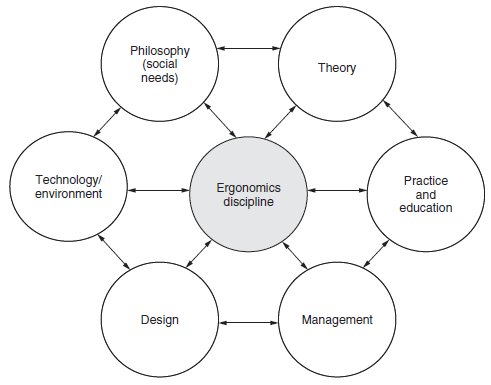
Ergonomics is defined by the Board of Certification for Professional Ergonomists (BCPE), as outlined by Stack (2016), as a field that emphasises human abilities, limitations, and characteristics relevant to design. In the context of system work design, ergonomics applies this knowledge to develop tools, machines, systems, tasks, jobs, and environments that prioritise safety, comfort, and effectiveness for human use (Stack, 2016). Notable scholars, such as Murrell (1965), Grandjean (1986), Sanders & McCormick (1993), Wilson & Corlett (1995), Chapanis (1996, 1999), Vicente (2004), Karwowski (2012), and Stanton et al. (2004), have defined the discipline of ergonomics. This field promotes a holistic, human-centred approach to designing work systems, considering factors such as physical, cognitive, social, organisational, environmental, and others (Salvendy, 2012). Ultimately, HFE aims to enhance human performance and well-being in the workplace (Wilson, 2000).
Dul et al. (2012) discussed the importance of ergonomics and human factors engineering (HFE) specialists, referencing the guidelines established by the International Ergonomics Association (IEA) in 2000 (see IEA, 2021, for more details). These guidelines are grounded in a comprehensive body of knowledge in ergonomics. However, to truly “optimise well-being,” it is essential to recognise that improving human welfare requires transforming the human environment to be more supportive and humane. Levi (1987) defines well-being as a dynamic state of mind characterised by a reasonable harmony between a worker’s abilities, needs, expectations, and the demands and opportunities presented by their environment. Humans have both physical and mental dimensions, including cognitive and spiritual aspects. Without considering spiritual values, humans can be understood only in biological terms (Marhaendra, 2016).
Furthermore, Dul et al. (2012) note that the potential of Human Factors and Ergonomics (HFE) remains underutilised. Recent updates on the scope of ergonomics studies have become more concise in their presentation. They continue to reference the International Ergonomics Association (IEA) report from the year 2000. As outlined in the IEA Triennial Report for 2018-2021 (IEA, 2021), ergonomics should collaborate or combine with other applied sciences to enhance human productivity while ensuring humane treatment of individuals. One challenge in this integration is distinguishing pure ergonomics from other disciplines, which is why ergonomics is classified as an applied science. As noted by Bridger (2018), systems analysis is the discipline that investigates the structure and function of work systems and explains how simpler systems can be combined to create more complex ones.
Murrel (1965) emphasised a significant milestone in our understanding of the multidisciplinary field of ergonomics by stating, “A number of scientific disciplines and technologies contribute to ergonomics. It is in these areas that the principal research efforts are concentrated, and the results, along with accumulated knowledge, form the basis of ergonomics.” However, for research findings to be meaningful, they should be applied and tested in real-world settings, especially within industrial contexts. Since ergonomics focuses on human work, it should also extend to human activities in general. As a result, ergonomics is recognised as an applied science. Although applying research findings is crucial for designing work systems, studying work processes, and informing the tasks of industrial medical personnel, architects, human resource officers, and managers. Close collaboration between researchers and practitioners is essential to enhance productivity and performance. Furthermore, ergonomics has significant applications in the military sector, particularly in aviation and space exploration.
However, the role of ergonomics often raises questions about its primary focus. A recent observational study by de Winter & Eisma (2024) in the field of Ergonomics and Human Factors (EHF) has revealed a concerning trend. They observed that an increasing number of articles published in EHF journals often take for granted the underlying assumptions, terminology, and value of experimental designs. Many of these articles lack a solid foundation in real-world problems and meaningful applications. The authors express concern that the EHF discipline is not being taken seriously and is losing its significance. Additionally, de Winter & Eisma (2024) identified five major issues within the field. Their findings are alarming; if their proposed solutions and suggestions are not implemented, there is a risk that ergonomics may lose its relevance.
About those issues, Singleton (1989) poses a pertinent inquiry: Who does the ergonomist truly serve – the employer or the worker? To whom is the ergonomist ultimately responsible – the state, the employer, the producer, or the consumer? Addressing this concern, Singleton (1989) asserts, “Fortunately, these issues can be resolved without adopting a specific political stance. Ergonomics can thrive equally well in both capitalist and socialist/communist systems; it can be effectively supported by both employers’ organizations and workers’ organizations.” This assertion should be an independent standpoint of the ergonomist when practising their profession. Although the results are not yet significant or beyond their expectations, they are not irrelevant either. And this will certainly be a valuable lesson for a better future. The question is: why do people resort to complex and complicated methods when simple ones can solve real-world problems and have a positive impact on society? Many people focus on complex and complicated methods that seem sophisticated, investing substantial time and money without any real benefit to society.
Ergonomics in Theories and Practices
To provide a scientific explanation, ergonomics must collaborate with other related applied sciences. This requires a proper mix of theory and practice. As noted by Arnold et al. (2005), the authors believe that a solid theory is essential for effective practice. A good theory effectively describes, explains, and predicts behaviours, thoughts, or emotions that have significant outcomes. In addition to theory and practice, there are established standards that must be followed for assessment and measurement. For example, ISO/AWI 10075-3:2004 sets forth principles and requirements for measuring and assessing mental workload, along with specifications for measurement instruments (ISO, 2025).
The ten principles of ergonomic work design proposed by Public Health Notes (2025) and MacLeod (2025) are essential in theory and practice within the field of physical ergonomics. Implementing these principles can significantly reduce the risk of ergonomic injuries, such as musculoskeletal disorders (MSDs), among workers. While the ten principles are explained from a medical and physiological perspective, it is also important to consider the rationale for individuals to incorporate them into their job activities. Each principle can be examined and analysed both theoretically and ergonomically to understand its impact.
The principles of ergonomics should be supported by scientific explanations from other disciplines as base-evidenced facts. For instance, when ergonomics recommends that workers maintain neutral postures, this can only be thoroughly understood through physiological explanations of what constitutes a neutral posture for the human body. Moreover, the concept of minimising excessive force can be supported by physiological insights into the effects of using excessive force during work activities. Furthermore, Bedny & Bedny (2019) have noted that any design solutions for equipment and tools that overlook an understanding of human behaviour should be considered purely engineering solutions and, therefore, not aligned with Ergonomics Human Factors (EHF).
Humans’ activity is related to both the external and internal components of activity. There is the systemic-structural theory of activity (SSAT), as revealed by Karwowski et al. (2012). Activity is understood as a unified system that encompasses both internal mental processes and external behaviours, along with the motivations that link them. These elements are organised through self-regulation mechanisms to achieve intentional goals. Self-regulation functions on both conscious and non-conscious levels (Bedny & Karwowski, 2006). According to Karwowski et al. (2012), these two levels of self-regulation are interdependent, and the relationship between them is dynamic. This dynamic relationship is influenced by human activity, which affects both external and internal factors, shaping individual behaviour. The components of these factors can be explained through physiological psychology, work psychology, and organisational behaviour. At this point, EHF appears to be overlooked in the context analysis or is integrated into other disciplines, despite its relevance to the ergonomics domain. Therefore, ergonomics is an applied science that is supported by other applied sciences (vice versa); it is multidisciplinary and interdisciplinary. Therefore, the construct of theory has many dimensions; what is more important is how the solution is consistently applied to ergonomic principles. According to Mullins & Christy (2016), the study of organisational behaviour cannot be approached from a single discipline alone. It is essential to acknowledge the influences of a multidisciplinary perspective rooted in behavioural science. Arnold et al. (2005) also supported that this applies to psychologists working in other applied contexts, such as education and health.
An excellent example of the role of neurosciences in ergonomics can be observed when ergonomists explore why workers behave in certain ways during their activities. Their inquiry suggests that specific brain activities guide these behaviours. To understand this, ergonomists turn to neuroscience, examining the brain activities associated with workplace behaviours. The field that encompasses this study is known as neuroergonomics. According to Parasuraman (2003), neuroergonomics is the study of the relationship between brain function and behaviours in the workplace. And Parasuraman & Rizzo (2007) describe neuroergonomics as an interdisciplinary field that integrates neuroscience and ergonomics (or human factors) to leverage the strengths of both fields. The objective is not only to examine brain structure and function, which falls under neuroscience, but also to understand these elements within the context of human cognition and behaviours across various settings, including work, home, transportation, and other everyday environments. Supported by data collected through advanced medical technologies from neuroscience, ergonomists can analyse information more accurately. This enhances their ability to make informed decisions for better ergonomic solutions. However, it noted that research on human-automation interaction has had little impact on practical applications. Many individuals cannot access the advanced automation tools and devices used in neuroscience, such as MRI (magnetic resonance imaging) or EEG (electroencephalography) scans. The analysis of scan results using artificial intelligence (AI) often generates specific data of persons that cannot be generalised. For ergonomists, it is crucial to have a deeper understanding of brain activity and its influence on behaviours, emotions, and overall brain health. Therefore, training, courses, and further education are necessary to interact effectively with these sophisticated medical devices.
Discussion
Ergonomics is closely related to various other fields, including management. This connection is outlined by Karwowski (2005), who references Griffin’s (2001) definition of management and highlights four key components that align with the three central aspects of ergonomics. Both fields share the common goal of achieving effective and efficient organisational outcomes. Management and ergonomics complement each other in accomplishing these goals. The question remains as to which of the two – ergonomics or management – should be considered the primary domain in a specific context. If ergonomics is the primary domain, then management acts as its supporting domain, and vice versa. For instance, when managers plan workplace processes, they use ergonomic principles to create work systems that benefit both workers and the environment. To achieve optimal results, managers should involve ergonomists early in the planning process to ensure alignment between the two. A relevant example is the work of Marhaendra et al. (2022), who supported micro, small, and medium enterprises (MSMEs) during the COVID-19 pandemic. Their simple intervention had a significant positive impact on business owners and helped enhance productivity through the implementation of ergonomic practices. Therefore, research in this area should not only offer academic insights but also provide tangible benefits to the research subjects, regardless of their size.
Ergonomics and Human Factors (EHF) in practice involves crucial factors, such as how assessments and measurements are engaged in field research related to human activity. Therefore, ergonomists should carefully use appropriate instruments and process data to attain accuracy in achieving goals. Similarly, for the assessment, it is advisable to use standards established by international standards organisations for comparison. Ergonomics is governed by international standards that provide guidelines for proper usage. Mistakes, unintentional, in the use of assessment and measurement instruments, as well as data misconduct, not only lead to significant deviations in results, but also invite interpretations that mislead about the constructs of theories.
Furthermore, we cannot overlook the traditional work culture, which is fundamentally in line with ergonomic principles regarding work attitudes and behaviour. In Indonesia, particularly in Java and Bali, there is a profession passed down through generations: Keris (heirloom) craftsmanship. Keris has even been recognised by UNESCO (2025) as the Intangible Cultural Heritage of Humanity. There has been no specific research into the ergonomics of keris-making, from the keris design to the workplace to the actual process. Producing the Keris heirloom involves many ergonomic principles that the craftsmen themselves are not aware of. Therefore, it seems that ergonomics has not developed or progressed as it should. While in the West, ergonomic work is studied in standing and sitting positions. On the other side, in Java, some keris craftsmen still utilise a squatting work position, which is also a neutral posture. This posture is often supported by a mini stool, approximately 20 cm high, known as a dingklik. Since the Western understanding of ergonomic work postures in standing and sitting positions does not mean that squatting work postures are not ergonomic. If this squatting work position is considered unergonomic, how could such work have been passed down through generations for centuries? It is a matter of choosing a comfortable and productive way of working. People often forget that comfortable working postures are not limited to standing and sitting, but also include squatting. Similarly, ergonomic design measurements, not just anthropometry, also include traditional measuring instruments, as Marhaendra (2016) points out. These tools, known as gegulak, were essential in the past for building houses and temples that are famous worldwide. The same principles apply to the design of the keris, ensuring it is comfortable and safe for the owner to use. Although the keris is no longer used practically, its production emphasises cultural significance, symbolism, and the owner’s status. Today, the keris is not only part of the cultural heritage embraced by local communities, but it has also attracted the interest of Western collectors.
Least developed countries (LDCs) have gone through various stages of development as they move towards becoming industrialised nations and are now fully integrated into a computerised global environment. What took the Western world over 200 years to achieve has been accomplished by these countries in around 20-30 years. This rapid development presents a new challenge in human factors and ergonomics (HFE): educating and training the workforce, which empowers them to identify and address potential hazards while improving productivity. Experts in human factors and ergonomics play a crucial role in tackling the training issues faced by workers and the broader community (Helander, 2006). This demand logically arises from the surge in technological advancement, which has outpaced the development of skilled human resources. While interest in studying ergonomics remains limited, resulting in a significant gap between the availability of professional ergonomists and the pace of industrial development.
Currently, a report on the implementation of Occupational Safety and Health (OSH) at Universitas Gadjah Mada (UGM) in Indonesia is available, conducted by Karim & Hariyono (2018). This report highlights issues related to work accidents involving UGM students, which are partly due to inadequate health and safety facilities. Specifically, some buildings, particularly older ones on the UGM campus, lack proper disaster management and fire hazard protocols (Karim & Hariyono, 2018). This situation should not have existed if relevant parties and stakeholders had understood the importance of ergonomics from the outset. Especially the work system design in disaster management for anticipating or handling hazards. However, in 2022, the Ministry of Manpower of the Republic of Indonesia published the profile of the Indonesian National Occupational Safety and Health (OSH). This National OSH Profile was developed in collaboration with various national stakeholders and received support from the International Labour Organisation (ILO) Office for Indonesia and Timor-Leste (Adiratna et al., 2022). The Indonesian Ergonomics Association (PEI) was also involved in this effort. And according to the International Ergonomics Association (IEA, 2021), a stakeholder is any individual or group that can affect, be affected by, or perceive themselves as impacted by a human factors and ergonomics (HF/E) decision or activity.
Mosier and Hiba (2019) explain that Human Factors and Ergonomics (HFE) plays a critical role in developing effective and sustainable work systems through three main intervention drivers: (1) adopting a systems approach, (2) focusing on design, and (3) prioritising the optimisation of two interconnected outcomes: performance and well-being. The philosophical foundation of HFE aligns with the principles of the International Labour Organisation (ILO), as practitioners recognise the importance of involving all stakeholder groups – known as participatory ergonomics (PE) – in the design of work systems. Applying HFE principles is essential for achieving a balance between work and personal life in the 21st century. If human factors and ergonomics are not integrated into the design of work systems, those systems may lack a human-centred approach and fail to support the sustainability of workers, organisations, and society as a whole. The practice of macroergonomics is conducted holistically with relevant parties involved in participatory ergonomics. These ergonomic approaches are expected to enhance workers’ lives, giving them more time to maintain their health and fitness, nurture their families and communities, and engage in meaningful activities (Marhaendra, 2023).
Conclusion
When we reflect on the contemporary history of ergonomics and human factors, we can see how they have examined human activities across various work sectors and other contexts, whether intentionally or not, and whether directly or indirectly. The contributions of ergonomics to the advancement of civilisation and technology are critical. Numerous studies have been conducted by researchers, involving various assessments and measurements with different tools and standards, leading to these improvements. However, in some fields, appropriate instruments and standards have yet to be developed to ensure that the data collected is accurate and aligns with research objectives. Researchers cannot rely solely on existing resources; they should work to meet the demands of their inquiries. This is particularly true when dealing with human subjects, whose complex behaviours are influenced by many factors, such as their culture. In this context, new methods of assessment and measurement are emerging, accompanied by instruments whose validity and reliability are rigorously tested through research, all while adhering to ethical guidelines. This also includes the proposal of new standards. It is through this process that scientific progress in ergonomics and human factors is achieved. If HFE is not considered in work design, work systems may fail to be human-centred and may not promote the sustainability of workers, organisations, or society as a whole. To create a better future in work system design and work-culture development, it is essential to learn from the past (historical and cultural). Ultimately, every human activity should be planned with ergonomics in mind.
Conflict of Interest: No conflicts declared.
Funding: The author received no financial support for the research, authorship, and/or publication of this article.
References
- Adiratna, Y., Astono, S., Fertiaz, M., Subhan, S. C., & Prayitno, H. (2022). The Indonesian National Occupational Safety and Health Profile in 2022. Ministry of ManPower of Indonesia, 1-267. DOI ↗ Google Scholar ↗
- Arnold, J., Silvester, J., Patterson, F., Robertson, I., Cooper, C., & Burnes, B. (2005). Work psychology: Understanding human behaviour in the workplace (4th ed.). Pearson Education Limited. DOI ↗ Google Scholar ↗
- Bedny, G. Z., & Bedny, I. S. (2019). Work Activity Studies Within the Framework of Ergonomics, Psychology, and Economics (1st ed.). CRC Press. DOI: DOI ↗ Google Scholar ↗
- Bedny, G. Z., & Karwowski, W. (2006). A systemic-structural theory of activity: Applications to human performance and work design. Taylor & Francis. DOI: DOI ↗ Google Scholar ↗
- Bridger, R. (2018). Introduction to human factors and ergonomics. CRC press. DOI: DOI ↗ Google Scholar ↗
- Chapanis, A. (1996). Human Factors in System Engineering. Wiley. DOI ↗ Google Scholar ↗
- Chapanis, A. (1999). The Chapanis Chronicles: 50 Years of Human Factors Research, Education, and Design. Aegean Publishing Co. DOI ↗ Google Scholar ↗
- Christensen, J. M. (1962). The evolution of the systems approach in human factors engineering: From the viewpoint of an engineering psychologist. Human Factors, 4(1), 7-16. DOI ↗ Google Scholar ↗
- de Winter, J. C. F., & Eisma, Y. B. (2024). Ergonomics & Human factors: fade of a discipline. Ergonomics, 1-9. DOI: DOI ↗ Google Scholar ↗
- Dul, J., Bruder, R., Buckle, P., Carayon, P., Falzon, P., Marras, W. S., ... & Van der Doelen, B. (2012). A strategy for human factors/ergonomics: developing the discipline and profession. Ergonomics, 55(4), 377-395. DOI: http://dx. DOI ↗ Google Scholar ↗
- Grandjean, E. (1986). Fitting the Task to the Man. Taylor & Francis. DOI ↗ Google Scholar ↗
- Griffin, R.W. (2001). Management (7th ed). Houghton Mifflin. DOI ↗ Google Scholar ↗
- Helander, M. (2006). A Guide to Human Factors and Ergonomics (2nd ed.). Taylor & Francis Group. DOI ↗ Google Scholar ↗
- Helander, M. G. (1997). Forty years of IEA: some reflections on the evolution of ergonomics. Ergonomics, 40(10), 952-961. DOI ↗ Google Scholar ↗
- IEA (International Ergonomics Association). (2021). IEA Triennial Report 2018-2021. IEA Press. DOI ↗ Google Scholar ↗
- IEA (International Ergonomics Association). (2025, June 25). What Is Ergonomics (HFE)? DOI ↗ Google Scholar ↗
- ILO (International Labour Organisation). (2017). World Employment and Social Outlook: Trend 2017. International Labour Office – Geneva. DOI ↗ Google Scholar ↗
- ISO (International Organisation for Standardisation). (2025, July 29). ISO/AWI 10075-3, Ergonomic principles related to mental workload. DOI ↗ Google Scholar ↗
- Karim, M. A., & Hariyono, W. (2018). Implementation of occupational safety and health (OSH) at Universitas Gadjah Mada Indonesia. International E-Journal of Advances in Education, 4(10), 93-99. DOI: DOI ↗ Google Scholar ↗
- Karwowski, W. (2005). Ergonomics and human factors: the paradigms for science, engineering, design, technology and management of human-compatible systems. Ergonomics, 48(5), 436-463. DOI: DOI ↗ Google Scholar ↗
- Karwowski, W. (2012). The Discipline of Human Factors and Ergonomics. In Salvendy, G. (Ed.). Handbook of Human Factors and Ergonomics (4th ed.). (pp. 3-37). John Wiley & Sons, Inc. DOI: DOI ↗ Google Scholar ↗
- Karwowski, W., Voskoboynikov, F., & Bedny, G. Z. (2012). On the relationship between external and internal components of activity. In Salvendy, G., & Karwowski, W. (Eds.). Advances in Human Factors and Ergonomics 2012-14 Volume Set: Proceedings of the 4th AHFE Conference 21-25 July 2012. (pp. 109-115). CRC Press. DOI: DOI ↗ Google Scholar ↗
- Konz, S. & Johnson, S. (2016). Work Design: Occupational Ergonomics (7th ed.). CRC Press. DOI: DOI ↗ Google Scholar ↗
- Levi, L. (1987). Definitions and the conceptual aspects of health in relation to work. In Kalimo, R., El-Batawi, M. A., & Cooper C. L. (Eds). Psychosocial factors at work and their relation to health. (pp. 9-14). World Health Organization Geneva DOI ↗ Google Scholar ↗
- Luczak, H. (1997). Task analysis. In Salvendy, G. (Ed.). Handbook of Human Factors and Ergonomics (2nd ed.). (pp. 340–416). John Wiley & Sons DOI ↗ Google Scholar ↗
- MacLeod, D. (2025, July 27). 10 Principles of Ergonomics. DOI ↗ Google Scholar ↗
- Marhaendra, T. B. P. (2016). Striving for Modernized Balinese Metrics (Gegulak). Journal of human ergology, 45(1), 1-10. DOI: DOI ↗ Google Scholar ↗
- Marhaendra, T. B. P., Komalasari, Y., Suryantari, E. P., & Krismawintari, N. P. D. (2022). Strategy to applied ergonomics on MSMEs during pandemic Covid-19. International Journal of Social Science Research and Review, 5(11), 1-13. DOI: http://dx. DOI ↗ Google Scholar ↗
- Marhaendra, T.B.P. (2023). Ergonomics strategy to create work-life balance. International Journal of Social Science Research and Review, 6(7), 575–585. DOI: http://dx. DOI ↗ Google Scholar ↗
- Mosier, K., & Hiba, J. C. (2019). The essential contribution of Human factors/ergonomics to the future of work we want. (p.1-3). ILO. DOI ↗ Google Scholar ↗
- Mullins, L. J., & Christy, G. (2016). Management and Organisational Behaviour (11th ed.). Pearson Education Limited. DOI ↗ Google Scholar ↗
- Murrell, K. F. H. (1965). Ergonomics: Man in his working environment. Chapman and Hall. DOI ↗ Google Scholar ↗
- Nichols, D. L. (1976). Mishap analysis. In Ferry, T. S., & Weaver, D. A. (Eds.). Directions in Safety. Charles C. Thomas. DOI ↗ Google Scholar ↗
- Public Health Notes. (2025, July 28). Ergonomics and Its 10 Principles! DOI ↗ Google Scholar ↗
- Rosenbrock, H. N. (1983). Seeking an appropriate technology. In Fleissner, P. K. (Ed.). Proceedings of IFAC Symposium on Systems Approach to Appropriate Technology Transfer: proceedings of the IFAC Symposium, Vienna, Austria, 21-23 March 1983. (pp.1-4). IFAC. DOI ↗ Google Scholar ↗
- Salvendy, G. (Ed.). (2012). Handbook of Human Factors and Ergonomics. (4th ed.). John Wiley & Sons, Inc. DOI ↗ Google Scholar ↗
- Sanders, M. M., & McCormick, E. J. (1993). Human Factors in Engineering & Design. (7th ed.). McGraw-Hill. DOI ↗ Google Scholar ↗
- Shaw, L., & Sichel, H. (1971). Accident Proneness: Research Occurrence, Causation and Prevention of Road Accidents. Pergamon Press. DOI ↗ Google Scholar ↗
- Singleton, W. T. (1989). The mind at work: Psychological ergonomics. Cambridge University Press. DOI: DOI ↗ Google Scholar ↗
- Stack, T. (2016). The Basics of Ergonomics. In Stack, T., Ostrom, L. T., & Wilhelmsen, C. A. (Eds.). Occupational Ergonomics: A Practical Approach. (pp. 5-19). John Wiley & Sons, Inc. DOI ↗ Google Scholar ↗
- Stanton, N., Hedge, A., Brookhuis, K., Salas, E., & Hendrick, H. W. (2004). Handbook of Human Factors and Ergonomics Methods. CRC Press. DOI ↗ Google Scholar ↗
- UNESCO. (2025, July 25). Indonesian Keris. DOI ↗ Google Scholar ↗
- Vicente, K. J. (2004). The Human Factor. Routledge. DOI ↗ Google Scholar ↗
- Wiener, E. L. & Nagel, D. C. (Eds.). (1988). Human factors in aviation. Academic Press. DOI ↗ Google Scholar ↗
- Wilson, J. R., & Corlett, E. N. (Eds.). (1995). Evaluation of Human Work: A Practical Ergonomics Methodology (2nd ed.). Taylor & Francis. DOI ↗ Google Scholar ↗
- Wilson, J. R. (2000). Fundamentals of ergonomics in theory and practice. Applied ergonomics, 31(6), 557-567. DOI: DOI ↗ Google Scholar ↗