Abstract
Despite the importance of scientific literacy as a crucial competency, connecting abstract chemistry concepts to real-world cultural contexts remains a significant challenge for secondary students in Indonesia. This study examines the effectiveness of ethnoscience-integrated STEM worksheets implemented through a Project-Based Learning (PjBL) approach in improving students’ scientific literacy in chemistry. A quasi-experimental pretest–posttest control group design was employed with 58 Grade 12 students (experimental group, n = 30; control group, n = 28) at MAN 1 Banjarmasin, Indonesia. The worksheets were validated by five experts and achieved a content validity index (CVI) of 0.95, while the scientific literacy instrument demonstrated high validity (Aiken’s V = 0.90). Data were analyzed using normalized gain scores, paired-samples t-tests, and independent-samples t-tests. Results indicate that the experimental group demonstrated significantly higher improvement in scientific literacy compared to the control group (p < 0.001), with a large effect size (Cohen’s d = 0.93). The overall N-gain score for the experimental group was 0.76 (high category), with the highest improvement observed in interpreting scientific evidence and data (N-gain = 0.81), followed by explaining scientific phenomena (N-gain = 0.75), and evaluating and designing scientific investigations (N-gain = 0.71). Furthermore, 93% of students in the experimental group achieved high scientific literacy levels after the intervention, compared to none at baseline. These findings demonstrate that ethnoscience-integrated STEM worksheets within a PjBL framework provide a contextually meaningful and empirically effective approach to enhancing scientific literacy in chemistry education.
Keywords
scientific literacy ethnoscience STEM education chemistry education culturally responsive pedagogy
Introduction
Chemistry is a branch of natural science that plays a vital role in education and is closely related to everyday life, making it an engaging subject to study. Chemistry learning generally involves an in-depth exploration of the properties, structure, composition, transformations, and energy of matter [1]. However, most students are only able to grasp basic chemical phenomena and still struggle to connect that understanding to broader scientific contexts. Despite its importance, Indonesian students consistently underperform in scientific literacy assessments. Scientific literacy refers to an individual’s ability to apply scientific knowledge, identify problems, and draw conclusions based on scientific evidence to understand and make decisions related to the natural world and the impacts of changes caused by human activity [2] [3].
According to the 2019 assessment conducted by the Center for Educational Assessment (Puspendik), Indonesian students’ scientific literacy skills remain below those of students in other ASEAN countries, ranked 74th out of 79 countries, with scientific literacy scores significantly below the OECD average [2]. This persistent gap suggests systemic issues in how science, particularly chemistry, is taught in Indonesian classrooms.
This indicates that the lack of scientific literacy skills is generally caused by learning activities that do not focus on enhancing scientific literacy. In addition, one of the common factors contributing to the low level of students’ scientific literacy skills is the choice of teaching methods and models by teachers, inadequate learning facilities and resources, and insufficient quality of instructional materials. Therefore, there is a need for engaging and appropriate instructional materials that align with students’ characteristics. One effective way to support students in connecting scientific concepts to real-world contexts is to integrate instructional materials with student-centered learning models [4].
Several factors contribute to this problem. First, chemistry instruction often emphasizes rote memorization of abstract concepts without connecting them to students’ lived experiences [5]. Students can recall chemical formulas but struggle to apply this knowledge to real-world problems—a core competency of scientific literacy. Second, traditional teaching materials rarely engage students as active problem-solvers; instead, they position learners as passive recipients of information [6]. Third, there is a cultural disconnect: Indonesian classrooms often adopt Western-centric science curricula that ignore the rich indigenous knowledge (ethnoscience) embedded in local practices [7]. This disconnect not only alienates students but also misses opportunities to demonstrate the relevance of chemistry in their cultural contexts.
Among the recent innovative learning models, Project-Based Learning (PjBL) addresses the passivity issue by engaging students in authentic, inquiry-driven projects [8]. In addition, this model involves students directly in the development and implementation of projects, thus enabling them to acquire knowledge and skills. The STEM (Science, Technology, Engineering, Mathematics) framework further enhances PjBL by integrating interdisciplinary thinking and problem-solving skills essential for 21st-century competencies. PjBL is one of the key characteristics of STEM-based instruction. Therefore, integrating STEM in PjBL guides students to become problem solvers and logical thinkers. This is due to the fact that, in STEM education, knowledge is constructed through collaboration and creativity, where students employ skills and learning processes from science, technology, engineering, and mathematics to think critically and solve problems. Moreover, the STEM approach equips students with a variety of skills essential for competing in the 21st century [9].
More recently, ethnoscience-integrated STEM (Ethno-STEM) has emerged as a culturally responsive approach that bridges indigenous knowledge with scientific inquiry, making science education more relevant and meaningful for diverse learners [4] [7]. The connection between culture, local wisdom, and science is referred to as ethnoscience. Ethnoscience encompasses indigenous knowledge rooted in local cultural traditions that are passed down through generations. Therefore, learning that connects local wisdom with scientific knowledge is crucial, as it transforms inherited traditional knowledge into reliable and accountable scientific understanding [7].
Previous research has shown that the application of the PjBL-Ethno-STEM model contributes to the development of 4C skills (critical thinking, creativity, collaboration, and communication) as well as conservation-related character traits [10]. Another research also reported that culture plays a positive role in science education in Indonesia [11]. However, few studies have empirically tested the integration of Ethno-STEM principles into student worksheets within a PjBL framework, particularly in chemistry education. Therefore, this study addresses this gap by investigating the effectiveness of Ethno-STEM-integrated worksheets in improving scientific literacy among secondary chemistry students, focusing on elemental chemistry as the content domain. This research provides both theoretical and practical insights. Theoretically, it enhances comprehension of the operationalisation of culturally responsive pedagogy via specific instructional materials. In practice, it offers empirical evidence for educators and curriculum developers pursuing scalable solutions to improve scientific literacy in culturally diverse settings.
Therefore, this study aims to examine the effectiveness of Ethnoscience-Integrated STEM Worksheets implemented through a Project-Based Learning approach in improving students’ scientific literacy in the topic of chemical elements. Specifically, this study investigates the extent to which the intervention enhances students’ competencies in explaining scientific phenomena, evaluating and designing scientific investigations, and interpreting scientific evidence and data.
Materials And Method
This study employed a quasi-experimental pretest–posttest control group design involving 58 Grade 12 science students from MAN 1 Banjarmasin, Indonesia, selected through purposive sampling. The participants were divided into an experimental group (n = 30) and a control group (n = 28).
The experimental group learned chemistry using Ethno-STEM-integrated worksheets on the topic of chemical elements, while the control group received conventional instruction. The intervention was conducted over an eight week instructional period under similar classroom conditions.
Prior to implementation, the worksheets were validated by five experts in chemistry education and science pedagogy, focusing on content accuracy, pedagogical appropriateness, and cultural relevance. The validation results indicated a very high level of validity, with a content validity index (CVI) of 0.95, suggesting that the worksheets were highly suitable for instructional use.
Data were collected using a scientific literacy test consisting of nine essay items aligned with three PISA competencies: explaining scientific phenomena, evaluating and designing scientific investigations, and interpreting scientific evidence and data. Each item was mapped to these competencies and scored using an analytical rubric. The validity of the instrument was assessed using Aiken’s V, resulting in a coefficient of 0.90, which indicates a high level of validity.
The effectiveness of the intervention was evaluated using normalized gain (N-gain), calculated as:
N-gain = [(Posttest score − Pretest score) / (Maximum score − Pretest score)] × 100%
Statistical analysis included paired-samples t-tests to examine within-group improvements and independent-samples t-tests to compare differences between groups (α = 0.05). The effectiveness criteria were interpreted based on N-gain categories adapted from Hake [12].
| N-gain (%) | Effectiveness Category |
| > 76 | Highly Effective |
| 56–75 | Quite Effective |
| 40–55 | Less Effective |
| < 40 | Ineffective |
Results And Discussion
The student worksheet used in this study consists of three main components. First, it incorporates ethnoscientific content related to the Banjar ethnic community of South Kalimantan, which is aligned with the topic of chemical elements. One example highlighted in this study issasirangan, a traditional textile originating from South Kalimantan. Second, the worksheet is structured based on the stages of the Project-Based Learning (PjBL) model, including reflection, research, discovery, application, and communication. Third, the approach integrates STEM (Science, Technology, Engineering, and Mathematics) to support interdisciplinary learning.
As part of the STEM framework embedded in this worksheet, students are presented with scientific issues and real-world problems supported by journal articles and videos, which function as learning resources to guide them in analyzing the issues and developing product-based solutions. One of the key issues addressed in this study concerns the use of synthetic dyes in the production of sasirangan fabric.
“In the production of sasirangan fabric, many artisans still rely on synthetic dyes due to their practical advantages, such as easy availability in the market, a wide and consistent range of colors, lower cost, and greater color stability. However, the major concern is that waste generated from the use of synthetic dyes is hazardous and toxic to the environment.”
Based on this issue, students were assigned a project focused on developing solutions to address the environmental impact of synthetic dye waste generated in the sasirangan production process. The improvement in students’ scientific literacy after the implementation of the Ethno-STEM–-integrated worksheet in both the experimental and control groups was analyzed using N-gain scores, as presented in Table 2.
| Competence | Q# | Scores | N-gain | N-gain Average | Category | ||||||
| EG Pre | EG Post | CG Pre | CG Post | EG | CG | EG | CG | EG | CG | ||
| Explain phenomena scientifically | 8 | 17 | 63 | 15 | 55 | 0.55 | 0.49 | 0.75 | 0.48 | High | Moderate |
| 3 | 33 | 80 | 30 | 62 | 0.70 | 0.54 | |||||
| 1 | 73.3 | 100 | 63 | 78 | 1.00 | 0.40 | |||||
| Evaluating and designing scientific investigations | 2 | 13.3 | 67 | 20 | 66 | 0.62 | 0.55 | 0.71 | 0.56 | High | Moderate |
| 5 | 23 | 67 | 25 | 53 | 0.571 | 0.47 | |||||
| 7 | 16.7 | 97 | 25 | 73 | 0.963 | 0.63 | |||||
| Interpreting scientific evidence and data | 9 | 16 | 97 | 20 | 67 | 0.960 | 0.52 | 0.81 | 0.46 | High | Moderate |
| 6 | 20 | 63 | 25 | 55 | 0.541 | 0.42 | |||||
| 4 | 47 | 90 | 45 | 70 | 0.811 | 0.45 |
A comparative analysis of students’ scientific literacy between the experimental group (EG) and the control group (CG) revealed that the experimental group experienced more significant improvements across all scientific literacy competencies. The N-gain scores in the experimental group were categorized as high, whereas those in the control group fell into the moderate category. These findings indicate that the implementation of Ethnoscience-Integrated STEM Worksheets through a Project-Based Learning (PjBL) approach is more effective in enhancing students’ scientific literacy in the topic of chemical elements compared to conventional instruction.
Statistical analysis further confirmed that the difference between the two groups was highly significant (p < 0.001). Moreover, the magnitude of this difference was substantial, as indicated by a large effect size (Cohen’s d = 0.93), suggesting that the intervention had a strong and practically meaningful impact on students’ scientific literacy. This study therefore contributes to the limited empirical evidence by demonstrating how Ethno-STEM–integrated worksheets, when implemented through a PjBL framework, can effectively enhance students’ scientific literacy in chemistry education.
Across the three competencies, the highest improvement was observed in interpreting scientific evidence and data (N-gain = 0.81), followed by explaining scientific phenomena (N-gain = 0.75) and evaluating and designing scientific investigations (N-gain = 0.71). These differences can be partially explained by the varying cognitive demands of each competency. Interpreting scientific evidence corresponds to higher-order thinking at the C4 (analysis) level, whereas evaluating and designing investigations involves more complex processes at the C6 (creation) level. Although evaluation and investigation design represent a higher cognitive level, the relatively lower gain in that competency compared to data interpretation is attributable to the greater complexity required for students to design experimental procedures from scratch. Despite these differences, all competencies showed substantial improvement, indicating that the learning approach effectively supports higher-order thinking development.
The effectiveness of this approach can be attributed to the integration of ethnoscience, STEM, and project-based learning within a meaningful learning context. By connecting chemical concepts to culturally relevant practices, students are able to construct knowledge in a more contextualized and relatable manner. At the same time, project-based activities engage students in authentic problem-solving processes that require data analysis, decision-making, and solution design—core elements of scientific literacy. This finding is in line with previous studies showing that inquiry- and project-based STEM learning significantly enhances scientific reasoning and students’ ability to interpret data in meaningful contexts [13] [14]. Furthermore, the integration of ethnoscience within the STEM framework strengthens students’ ability to relate scientific evidence to real-life situations, thereby improving the depth and relevance of their understanding [15].
In the competency of explaining scientific phenomena, the experimental group also demonstrated substantial improvement (N-gain = 0.75). This can be attributed to the integration of local cultural knowledge within the learning process, which helps students relate chemical concepts—such as the properties and reactivity of elements—to observable practices in their environment. The use of culturally contextualized examples, such as sasirangan fabric production, allows students to construct explanations that are not only scientifically accurate but also contextually meaningful. "This is consistent with studies on culturally responsive science teaching, which emphasize that contextual relevance enhances students' conceptual understanding and engagement [16] [17]."
Meanwhile, the competency of evaluating and designing scientific investigations, although showing a slightly lower N-gain (0.71), still falls within the high category. This competency involves more complex cognitive processes, including designing experimental procedures, evaluating variables, and making scientific decisions. The relatively lower gain compared to other competencies may be due to the higher cognitive demand associated with this skill, which aligns with the C6 level (creation) in Bloom’s taxonomy. Nevertheless, the project-based learning approach provides students with opportunities to engage in authentic inquiry processes, such as identifying problems, proposing solutions, and designing product-based outcomes [18]. This is supported by previous studies indicating that STEM-integrated PjBL significantly enhances students’ ability to design investigations and engage in higher-order thinking processes [19].
Taken together, these findings suggest that the Ethno-STEM–PjBL approach not only improves students’ overall scientific literacy but also differentially supports the development of specific competencies. The strongest impact on data interpretation reflects the effectiveness of contextual and inquiry-based learning environments, while improvements in explanation and investigation design highlight the role of cultural relevance and project-based activities in promoting deeper conceptual understanding and scientific reasoning.
Although the control group also demonstrated moderate improvement, the results suggest that conventional instruction is less effective in promoting comprehensive scientific literacy. Therefore, the findings highlight the relative effectiveness of Ethnoscience-Integrated STEM Worksheets implemented through a Project-Based Learning approach in supporting deeper and more meaningful learning outcomes.
In addition, based on the differences in students’ scientific literacy scores before and after the implementation, Figure 1 illustrates the improvement in scientific literacy among all students in the experimental group through a scatter plot.
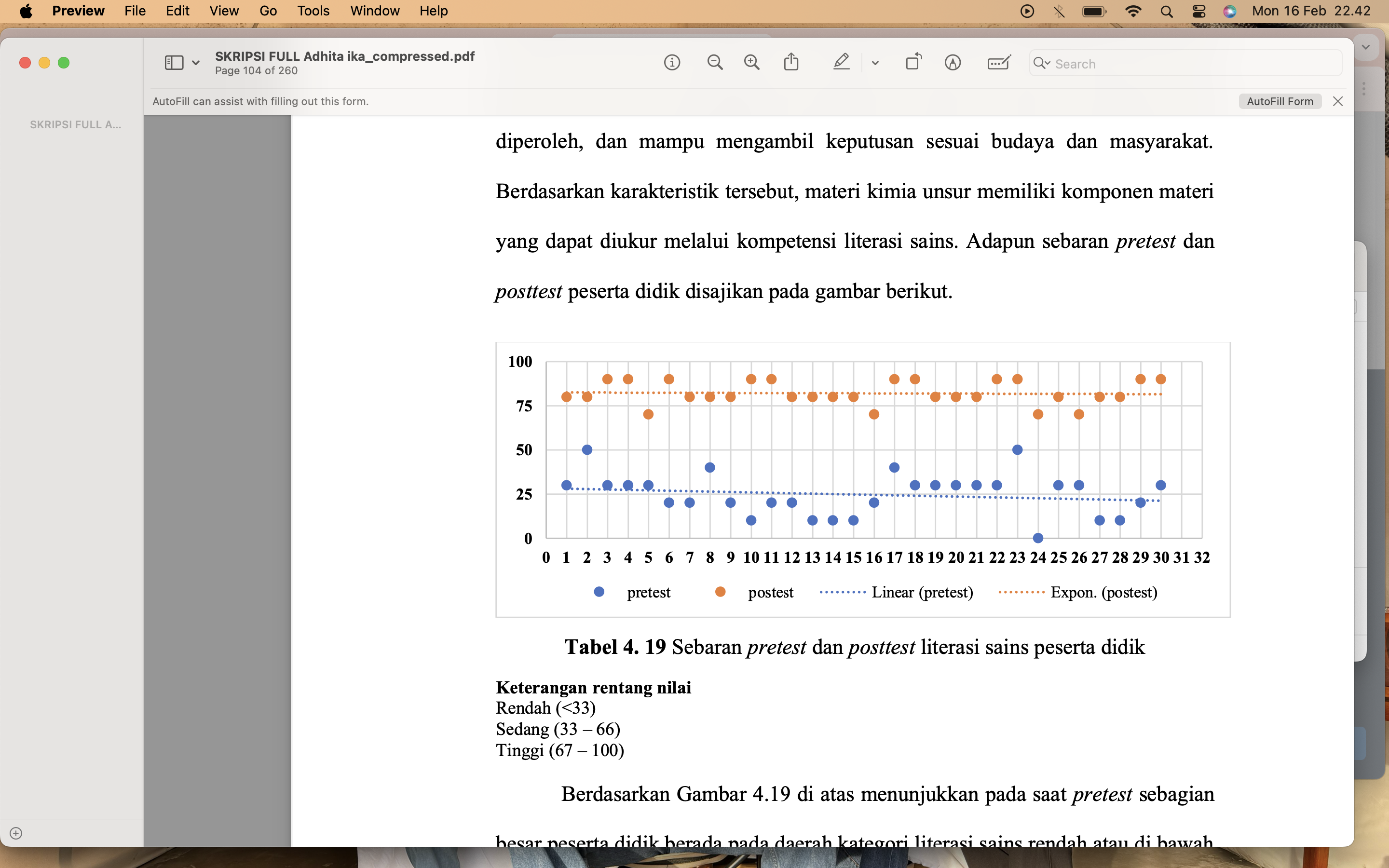
The pattern illustrated in Figure 1 provides further insight into the nature of students’ learning progression beyond the aggregate N-gain scores. The scatter plot shows a consistent upward shift in students’ scientific literacy scores from pretest to posttest, indicating that the improvement was not limited to a small group of high-achieving students but occurred across nearly the entire cohort. This pattern suggests that the Ethno-STEM–integrated worksheet approach has a broad and inclusive impact, supporting students with varying initial ability levels.
A notable feature of the distribution is the reduction in score dispersion after the intervention. While the pretest scores were widely spread within the low category, the posttest scores tend to cluster within the high category. This indicates not only an increase in average performance but also a more equitable learning outcome, where gaps between lower- and higher-performing students are reduced. Such findings are aligned with previous research showing that student-centered and project-based learning environments can promote more equitable learning gains across diverse student groups [18] [19]
In addition, the absence of students remaining in the low category after the intervention highlights the effectiveness of the learning design in addressing fundamental gaps in scientific literacy. This can be attributed to the structured learning process embedded in the worksheet, which guides students progressively from understanding real-world problems to analyzing data and developing solutions. The use of culturally relevant contexts, such as sasirangan production, likely plays a significant role in facilitating this shift, as it enables students to anchor abstract chemical concepts in familiar experiences. This is consistent with studies on culturally responsive science teaching, which emphasize that contextual relevance enhances students’ conceptual understanding and engagement [16] [17].
The upward trajectory observed in nearly all data points also indicates that the learning gains are systematic rather than incidental. This supports the argument that the integration of ethnoscience within a STEM–PjBL framework creates a learning environment that promotes sustained cognitive engagement. Students are not only exposed to scientific concepts but are also required to apply them in meaningful contexts, which strengthens retention and transfer of knowledge [13] [14].
Furthermore, the distribution pattern suggests that students with initially low scientific literacy benefited the most from the intervention. This aligns with findings indicating that inquiry-based and project-based STEM learning is particularly effective for students who struggle with conventional instruction, as it provides opportunities for active participation and knowledge construction [15] [20].
Overall, the analysis of Figure 1 reinforces the quantitative findings by demonstrating that the observed improvement in scientific literacy is both substantial and widely distributed across students. This strengthens the conclusion that the Ethno-STEM–PjBL approach is not only effective in increasing average performance but also in promoting more inclusive and meaningful learning outcomes.
In addition to the distribution pattern illustrated in Figure 1, Table 3 presents a categorical overview of students’ scientific literacy scores before and after the intervention. The table highlights the shift in the proportion of students across low, moderate, and high performance levels, providing a clearer picture of how students’ scientific literacy developed from pretest to posttest.
| Score | Category | Percentage of Students (%) | |
| Pretest | Posttest | ||
| 0 – 32 | Low | 83% | 0% |
| 33 – 66 | Moderate | 15% | 7% |
| 67 – 100 | High | 0% | 93% |
The distribution of students’ scientific literacy scores further supports these findings. As presented in Table 3 and Figure 1, prior to the intervention, 83% of students were categorized at a low level of scientific literacy. After the implementation, there was a substantial shift, with 93% of students achieving high scientific literacy levels and none remaining in the low category. The overall N-gain score of 0.76 for the experimental group confirms a significant and meaningful improvement in students’ scientific literacy.
The significant growth in students’ scientific literacy cannot be separated from the PjBL model used in this study. Projects involving complex tasks encourage students to design products, solve problems, make decisions, and create solutions by integrating ethnoscience-based STEM (Ethno-STEM) approaches [19] [21]. The Ethno-STEM-based learning process combines the four STEM domains with local cultural knowledge to foster critical, creative, and innovative thinking, scientific literacy, and collaborative skills [22]. Ethno-STEM is an educational innovation that integrates ethnoscience with Science, Technology, Engineering, and Mathematics. Through this integration, students can enhance their understanding of knowledge related to local wisdom by identifying elements that align with scientific principles. In addition, Ethno-STEM supports the development of students’ scientific literacy by involving them in activities such as reading, writing, observing, and engaging in scientific inquiry processes [23].
Conclusion
This study demonstrated that the use of Ethnoscience-Integrated STEM Worksheets implemented through a Project-Based Learning (PjBL) approach significantly improves students’ scientific literacy in the topic of chemical elements. Significant improvements were observed across all three PISA competencies: interpreting scientific evidence and data (N-gain = 0.81), explaining scientific phenomena (N-gain = 0.75), and evaluating and designing scientific investigations (N-gain = 0.71). The overall N-gain of 0.76 (high category), combined with a statistically significant group difference (p < 0.001) and a large effect size (Cohen’s d = 0.93), provides strong evidence for the effectiveness of the intervention. Furthermore, 93% of students in the experimental group achieved high scientific literacy levels after the intervention, compared to none at baseline.
These improvements indicate that the integration of ethnoscience and STEM not only enhances students’ conceptual understanding but also strengthens their ability to apply scientific knowledge in meaningful and contextually relevant ways. The results also emphasize the importance of culturally responsive and student-centered learning approaches in fostering more inclusive and equitable learning outcomes.
This study offers a novel contribution by demonstrating how ethnoscience can be operationalized within a PjBL framework through structured STEM worksheets to enhance scientific literacy in chemistry education. Future research is encouraged to replicate these findings across different cultural contexts, subject areas, and grade levels to further validate the generalizability of the Ethno-STEM–PjBL approach.
References
- Sevian, H., & Talanquer, V. (2014). Rethinking chemistry: A learning progression on chemical thinking. Chemistry Education Research and Practice, 15(1), 10–23. DOI ↗ Google Scholar ↗
- OECD. (2019). PISA 2018 assessment and analytical framework. OECD Publishing. DOI ↗ Google Scholar ↗
- Hidayati, P. W. N., & Afrizon, R. (2020). Analisis validasi modul fisika bermuatan literasi saintifik pada materi gerak lurus dan gerak parabola. Pillar of Education, 13(1), 185–192. DOI ↗ Google Scholar ↗
- Fikrina, A. Q., Sudarmin, S., & Priatmoko, S. (2023). Pengembangan E-LKPD kesetimbangan kuantitatif asam basa terintegrasi PjBL Etno-STEAM batik untuk meningkatkan literasi numerasi dan karakter konservasi siswa. Prosiding Seminar Nasional Pascasarjana, 6(1), 623–629. DOI ↗ Google Scholar ↗
- Wibowo, T., & Ariyatun, A. (2020). Kemampuan literasi sains pada siswa SMA menggunakan pembelajaran kimia berbasis etnosains. Edusains, 12(2), 214–222. DOI ↗ Google Scholar ↗
- Sutrisna, N. (2021). Analisis kemampuan literasi sains peserta didik SMA di Kota Sungai Penuh. Jurnal Inovasi Penelitian, 1(12), 2683–2694. DOI ↗ Google Scholar ↗
- Kiswanto, R. A., Wardani, S., Sudarmin, M. S., & Nurhayati, S. (2024). Pengembangan E-LKPD bermuatan STEM terintegrasi etnosains untuk meningkatkan keterampilan berpikir kritis siswa pada materi koloid. Jurnal Kajian Penelitian Pendidikan dan Kebudayaan, 2(1), 10–23. DOI ↗ Google Scholar ↗
- Rahayu, R., Sutikno, & Indriyanti, D. R. (2023). Ethnosains Based Project Based Learning Model with Flipped Classroom on Creative Thinking Skills. Jurnal Penelitian Pendidikan IPA, 9(8), 348–355. DOI ↗ Google Scholar ↗
- Sartika, S. B., Efendi, N., & Wulandari, F. E. (2022). Efektivitas pembelajaran IPA berbasis Etno-STEM dalam melatihkan keterampilan berpikir analisis. Jurnal Dimensi Pendidikan dan Pembelajaran, 10(1), 1–9. DOI ↗ Google Scholar ↗
- Sumarni, W., & Kadarwati, S. (2020). Ethno-STEM project-based learning: Its impact on critical and creative thinking skills. Jurnal Pendidikan IPA Indonesia, 9(1), 11–21. DOI ↗ Google Scholar ↗
- Syazali, M., & Umar, U. (2022). Peran kebudayaan dalam pembelajaran IPA di Indonesia: Studi literatur etnosains. Jurnal Educatio FKIP UNMA, 8(1), 344–354. DOI ↗ Google Scholar ↗
- Hake, R. (1999). Analyzing change/gain score. Educational Research Association’s Division. DOI ↗ Google Scholar ↗
- Margot, K. C., & Kettler, T. (2019). Teachers’ perceptions of STEM integration. International Journal of STEM Education, 6(1), 1–16. DOI ↗ Google Scholar ↗
- Pratama, H., Matsun, Puspitasari, Y., & Maduretno, T. (2025). Science literacy through STEM-based project-based learning model. Jurnal Penelitian Pendidikan IPA, 11, 320–330. DOI ↗ Google Scholar ↗
- Imron, E. M., Asri Nugraheni, F. S., Utami, B., Nursalsabila, Z., Mahardiani, L., Bramastia, & Tanghal, A. B. (2025). Effectiveness of Ethno-STEM-based science teaching with the project-based learning model on students’ scientific literacy. Jurnal Inovasi Pendidikan IPA, 11(2), 435–453. DOI ↗ Google Scholar ↗
- Boda, P. A., & Brown, B. A. (2020). Culturally responsive science teaching. Studies in Science Education, 56(2), 1–35. DOI ↗ Google Scholar ↗
- Suwandi, S., Sukarmin, S., Cahyaningrum, S., Satriawan, M., & Soraya, F. (2025). Ethnoscience approach to improve science literacy on chemical bonding: A thematic synthesis. Jurnal Pendidikan MIPA, 26, 1909–1931. DOI ↗ Google Scholar ↗
- Winarti, A., Iriani, R., Butakor, P. K., Meiliawati, R., & Syarpin, S. (2023). Transcript-based lesson analysis: The analysis of classroom communication in chemistry implementing case-based and project-based learning. Indonesian Journal on Learning and Advanced Education (IJOLAE), 6(1), 1–13. DOI ↗ Google Scholar ↗
- Han, S., Capraro, R., & Capraro, M. M. (2021). How science, technology, engineering, and mathematics project-based learning affects high-need students. Journal of Science Education and Technology, 30(2), 1–15. DOI ↗ Google Scholar ↗
- Wulandari, F., & Hanim, M. (2023). Model pembelajaran inkuiri terintegrasi Etno-STEM terhadap kemampuan literasi sains siswa. JIIP-Jurnal Ilmiah Ilmu Pendidikan, 6(12), 10779–10786. DOI ↗ Google Scholar ↗
- Thibaut, L., Ceuppens, S., De Loof, H., De Meester, J., Goovaerts, L., Struyf, A., Depaepe, F. (2018). Integrated STEM education: A systematic review of instructional practices in secondary education. European Journal of STEM Education. DOI ↗ Google Scholar ↗
- Wati, I. K., Masithoh, D. F., Salsabila, Z. N., Sari, M. W., Nugraheni, F. S. A., Suciati, Bramastia, & Antrakusuma, B. (2024). Student problems in EthnoSTEM PjBL-based science learning. In International Conference on Current Issues in Education (pp. 312–320). DOI ↗ Google Scholar ↗
- Bramastia, B., Suciati, S., Nugraheni, F. S. A., Sari, M. W., Wati, I. K., Antrakusuma, B., & Masithoh, D. F. (2023). Effectiveness of EthnoSTEM-based science learning to improve junior high school students’ science literacy ability. Jurnal Penelitian Pendidikan IPA, 9 (Special Issue), 332-337. DOI ↗ Google Scholar ↗