Abstract
This study investigates women’s autonomy in managing income and allocating household finances, while also exploring their perceptions, social recognition, and expectations as coffee farmers. The research was conducted in Sumber Jaya District, West Lampung Regency, a key smallholder coffee-producing area, using a descriptive qualitative design. Data were gathered through in-depth interviews, focus group discussions, and document review, and then analyzed with qualitative coding to identify thematic patterns. The results show that women contribute substantially to household financial management, either as primary managers or through shared arrangements with their spouses. Nevertheless, their financial independence remains constrained because major economic decisions typically depend on the husband’s consent. Women’s earnings are largely generated from activities outside the coffee sector, and their access to income from coffee production is comparatively limited. In terms of social dimensions, women receive considerable acknowledgment within the family context, but their engagement in community-level activities is still restricted. Their future aspirations mainly center on improving household welfare, achieving more stable coffee prices, and gaining broader recognition for their contributions. Overall, the findings indicate that role negotiation within coffee-farming households is fluid, yet still influenced by gender norms and social structures that hinder women’s full autonomy.
Keywords
women’s autonomy social recognition role negotiation coffee-farming households gender.
Introduction
The Coffee is an agricultural commodity that holds an important position in the international trade system while simultaneously serving as a primary economic foundation for millions of smallholder farmers in many developing countries. Indonesia is among the world’s leading coffee producers, and the majority of its production originates from smallholder plantations managed by farming households. Statistical data indicate that more than ninety percent of national coffee production comes from the smallholder plantation sector (BPS, 2023; ICO, 2022). Among the main producing regions, Lampung Province particularly West Lampung Regency is widely recognized as a major center of Robusta coffee production, where cultivation activities are predominantly organized through family-based farming systems. Table 1 presents supporting production data covering national coffee production, Lampung Province, and West Lampung Regency based on the most recent available statistical sources.
| Regional Level | Coffee Production (Tons) | Year/Data Source |
| Indonesia (National) | 794,800 | National Coffee Production 2022 (BPS) (Department of Communication, Informatics, and Statistics of Lampung Province) |
| Lampung Province | 124,500 | Lampung Coffee Production 2022 (BPS) (Department of Communication, Informatics, and Statistics of Lampung Province) |
| West Lampung Regency | 55,080 | West Lampung Coffee Production 2022 (Lampung Provincial Plantation Office) |
| West Lampung Regency | 62,980 | West Lampung Coffee Production 2024 (Plantation and Livestock Office) |
Source: Statistics Indonesia (BPS), 2022 and 2024.
Based on the table above, production data indicate that coffee remains a strategic commodity within the national plantation sector. In 2022, Indonesia’s coffee production reached 794,800 tons, reaffirming the country’s position as one of the world’s major producers. Of this total, Lampung Province contributed 124,500 tons, accounting for approximately 15.7% of national production. This contribution highlights Lampung’s substantial role in the national coffee production landscape, particularly for Robusta coffee. At the regency level, West Lampung produced 55,080 tons in 2022, representing about 44.2% of Lampung Province’s total coffee output in the same year. This means that nearly half of Lampung’s coffee production originated from this region, positioning West Lampung as a primary production center at the provincial level. These conditions suggest that the regional economic structure is highly dependent on the coffee plantation sector, which is largely managed by smallholder farming households.
Production trends over the past two years also demonstrate notable growth. In 2024, coffee production in West Lampung Regency was recorded at 62,980 tons. Compared with 2022, this reflects an increase of 7,900 tons, or approximately 14.3%. Such growth may indicate positive developments in productivity, expansion of cultivated areas, or improvements in farming practices. However, higher production levels also imply greater responsibility for farming households in managing both output and the income generated. The significant contribution of West Lampung to provincial coffee production further underscores the relevance of examining the dynamics of coffee-farming households in the region. The relatively large production scale confirms that coffee is not merely a supplementary commodity but rather a primary livelihood source for local communities. Consequently, income management, division of labor, and economic decision-making within households become critical aspects to investigate. As production volumes increase, the processes of resource management and the distribution of economic benefits at the household level tend to become more complex.
At the smallholder scale, households function not only as units of consumption but also as centers of production activities. Work arrangements within these households are commonly shaped by socially constructed gender norms that influence the division of tasks, responsibilities, and access to economic resources. In practice, women are actively involved not only in domestic roles but also across various stages of coffee production, ranging from crop maintenance to post-harvest handling and household financial management. Reports by the Food and Agriculture Organization (FAO, 2011; 2019) emphasize that women are key actors in the global agricultural sector. Nevertheless, their participation does not always correspond to equal access to productive assets, control over income, or authority in strategic decision-making. The range of women’s involvement in coffee production and the broader agricultural sector is presented in Table 2.
| No. | Data Scope | Statistical Indicator | Value/Figure | Source |
| 1 | Global | Women’s contribution to the coffee production workforce (upstream–downstream) | ±70% of the workforce | International Coffee Organization (ICO) |
| 2 | Global | Women’s involvement in coffee harvesting and post-harvest stages (picking, sorting, drying) | 60–80% in developing producer countries | FAO and ICO Gender in Coffee Reports |
| 3 | Indonesia | Number of women managing individual agricultural enterprises | 4,230,943 persons | BPS – Agricultural Census 2023 |
| 4 | Indonesia | Total individual agricultural enterprise managers | 29,341,033 persons | BPS Agricultural Census 2023 |
| 5 | Indonesia | Percentage of women in the agricultural sector workforce | ±30.57% | BPS Agricultural Labor Statistics |
| 6 | Indonesia (Rural) | Female labor force participation in the rural agricultural sector | 47.62% | BPS and Infopublik RI |
Source: Plantation Office of South Sumatra Province 2023.
The table above highlights that women play a central role in coffee production systems. International reports indicate that a substantial proportion of the labor force in the coffee sector particularly during harvesting and post-harvest stages is comprised of women. Their involvement spans activities such as cherry picking, bean sorting, drying, and preliminary processing. This evidence demonstrates that women’s participation in coffee enterprises extends beyond domestic responsibilities, contributing directly to production processes that influence both quality and economic value.
A growing body of research shows that women in coffee-based livelihoods often perform dual roles, functioning as both productive laborers and managers of household finances. Studies conducted in several coffee-producing regions of Indonesia reveal that women’s contributions are critical for sustaining farm operations and maintaining household financial stability ([9]; [13]). However, increased economic participation does not necessarily translate into stronger bargaining power in key household decision-making processes ([17]; [14]). According to Naila [11], empowerment fundamentally involves the capacity to make strategic life choices that were previously constrained by social structures and power relations.
Within coffee-farming households, women are often entrusted with managing routine expenditures and daily family needs. Nevertheless, decisions concerning strategic matters such as determining the timing and price of crop sales, allocating large financial resources, or planning long-term investments are frequently dominated by men or negotiated through decision-making arrangements that may not be entirely equitable. This situation reflects ongoing processes of role negotiation shaped by social norms, household economic structures, and gender-based power dynamics. From a feminist political ecology perspective, women’s contributions within agrarian systems are often recognized informally at the household level but remain insufficiently acknowledged within public and institutional agricultural domains (Lesley Elmhirst & Dewi Siscawati, 2018; Jeff Neilson et al., 2020).
Beyond economic autonomy, social recognition and public participation constitute important dimensions of gender equality in agriculture. Although women are frequently perceived as reliable household financial managers, their involvement in farmer groups, cooperatives, and decision-making forums remains relatively limited. Structural and cultural barriers continue to restrict women’s participation within agricultural institutions. The imbalance between their substantial economic contributions and the relatively low level of social recognition raises important questions regarding how women interpret their roles, the extent of their control over financial resources, and their expectations for improving their socio-economic status in the future.
Despite extensive scholarship on gender and agriculture, studies that simultaneously examine financial autonomy, social recognition, and the dynamics of role negotiation within coffee-farming households remain scarce. Much of the existing research has focused primarily on labor contributions or income generation, without deeply exploring the power relations and social legitimacy that shape women’s positions. In key coffee-producing areas such as Kecamatan Sumber Jaya, Kabupaten Lampung Barat, empirical investigations into women’s autonomy and social recognition are still limited. By integrating these three dimensions, this study seeks to enrich the literature on gender in smallholder agriculture and provide a more comprehensive understanding of women’s role negotiation processes within coffee-farming households. The findings are also expected to inform gender-responsive agricultural policies and contribute to more inclusive and sustainable rural development.
Research Objectives
Based on the foregoing discussion, this study is designed to achieve two main objectives:
(1) to examine the extent of women’s autonomy in managing income and allocating household financial resources; and
(2) to explore the perceptions, forms of recognition, and expectations of women coffee farmers within both family settings and their broader social environment.
The conceptual framework of this research is presented as follows.
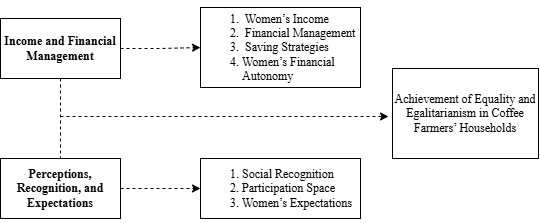
Research Method
This study employed a qualitative approach with a descriptive exploratory design to gain an in-depth understanding of women’s experiences, roles, and positions in coffee-related activities and household economic decision-making. This approach was selected because the research focuses on meanings, perceptions, and the dynamics of social relations experienced by women coffee farmers. The study was conducted in Pekon Sumber Jaya, located in West Lampung Regency, an important robusta coffee production area where most residents rely on coffee farming as their primary livelihood. The site was purposively selected based on regional characteristics, the presence of farmer groups, and research accessibility.
Data were collected through in-depth interviews, focus group discussions (FGDs), and field observations. Interviews were used to explore individual experiences related to women’s involvement in production, income management, and household decision-making. FGDs helped capture social dynamics as well as similarities and differences in participants’ perspectives. Observations were conducted to obtain contextual insights into labor division and interactions across coffee cultivation and post-harvest activities. To enhance data validity, source and method triangulation were applied.
Informants were selected purposively based on their direct involvement in coffee-related activities, both in production and output management. Variations in age, marital status, and levels of participation in decision-making were considered to ensure diverse perspectives. The number of participants was determined using the principle of data saturation, resulting in 20 women coffee farmers who were considered to represent the range of experiences within the study area. Data analysis followed a thematic approach to identify key patterns and themes emerging from interviews, FGDs, and observations. The coding and organization of qualitative data were supported by MAXQDA software to improve analytical rigor, transparency, and traceability.
Results And Discussion
1. Income and Financial Management
Income and financial management refers to the process of organizing, utilizing, and allocating household earnings in a planned manner to meet daily needs, savings, and the long-term economic sustainability of the family. Women’s involvement in managing household income among coffee-farming families in West Lampung Regency demonstrates considerable variation. The MAXQDA coding results under the category of Income and Financial Management indicate that most informants actively participate in household financial management. The findings of the MAXQDA analysis, based on subcodes related to income management among coffee-farming households, are presented in Table 3.
| Main Aspect | Subcode Categories and Number of Segments | Average Segment Percentage | Analytical Description |
| Women’s Income | Coffee-related activities (3) | 8.23% | Women’s income is more commonly derived from non-coffee activities, while involvement in coffee-related enterprises remains limited, and some women do not yet have personal income. |
| Non-coffee activities (14) | |||
| No personal income (5) | |||
| Financial Management | Managed by wife (9) | 7.86% | Financial management is generally handled by the wife or jointly with the husband, indicating women’s relatively dominant role in household economic arrangements. |
| Managed by husband (1) | |||
| Managed jointly (11) | |||
| Saving Strategies | Saving cash (14) | 5.16% | Saving practices are primarily dominated by cash storage, followed by the use of coffee beans as an alternative form of savings, while saving in gold remains limited. |
| Saving coffee beans (4) | |||
| Saving gold (2) | |||
| Stored with middlemen (1) | |||
| No savings (2) | |||
| Women’s Financial Autonomy | Requires husband’s permission (16) | 8.61% | Most economic decisions still require the husband’s approval, although some households show emerging patterns of discussion-based decision-making and limited independence. |
| Does not require permission (4) | |||
| Permission through discussion (3) |
Source: Primary data analysis using MAXQDA, 2026.
The analysis results indicate that the daily income of women coffee farmers is predominantly derived from non-coffee activities (14 segments) rather than from coffee-related work (3 segments). Meanwhile, a number of women reported having no personal income (5 segments), which is reflected in the relatively low average segment percentage of 8.23%. These findings are consistent with previous studies showing that women’s participation in agricultural production does not necessarily translate into direct access to primary income sources.
Household financial management is largely characterized by joint decision-making between spouses (11 segments) or management led by wives (9 segments), with an average segment percentage of 7.86%. This pattern highlights the strategic role of women in organizing daily household economic activities. Savings practices are generally carried out in the form of cash (14 segments), coffee bean storage (4 segments), and gold (2 segments), with an average segment percentage of 5.16%, reflecting farmers’ preference for liquid and easily accessible assets. However, women’s financial autonomy remains limited, as most economic decisions still require the husband’s approval (16 segments), with an average segment percentage of 8.61%. This condition suggests that gender dynamics continue to influence women’s position in household economic decision-making processes.
Overall, the findings demonstrate that women coffee farmers play an important role in maintaining household economic stability, particularly through financial management and livelihood coping strategies. Nevertheless, restricted access to primary income sources and limited financial autonomy indicate that strengthening women’s roles still requires both structural and cultural support. These results reinforce earlier research emphasizing the importance of improving women’s access to income opportunities and economic decision-making in order to enhance the resilience and sustainability of farming households.
A. Women’s Income
Within farming households, women’s income should not be viewed merely as supplementary earnings but as an integral component of household livelihood strategies. Such contributions often support consumption stability, finance children’s education, and strengthen overall family resilience. Women’s income therefore carries both economic and social dimensions, as it is closely linked to bargaining power, participation in decision-making, and the division of roles within the household. The distribution of income sources among women coffee farmers, based on the number and percentage of coded segments, illustrates the variation in women’s economic contributions from coffee-related activities, as presented in Table 4.
| Subcategory | Number of Segments | Segment Percentage (%) |
| Coffee-related activities | 3 | 13.64 |
| Non-coffee activities | 14 | 63.64 |
| No personal income | 5 | 22.73 |
| Total | 22 | 100.00 |
| Average segment percentage | – | 33.33 |
Source: Primary data analysis using MAXQDA, 2026.
The analysis indicates that the daily income sources of women in coffee-farming households are predominantly derived from non-coffee activities, accounting for 63.64% of the total 22 identified segments. Income generated directly from coffee farming is relatively limited, representing only 13.64%, while 22.73% of women reported having no personal income. These findings suggest that although women are actively involved in family coffee production, their economic contributions are more frequently obtained from activities outside the coffee sector, such as small household enterprises or informal employment.
The data further reveal that most coffee-farming households do not rely solely on income from coffee sales as their primary livelihood but also depend on supplementary earnings from non-coffee businesses, agricultural wage labor, or other side activities. This pattern is reinforced by interview results, in which informants explained that women’s income generally comes from additional work intended to meet daily household needs, as reflected in the following statements: “When it is not the coffee harvest season, we usually look for other work so that household needs can still be met.”“I have my own income from online selling.” (Informant interviews).
These accounts demonstrate the presence of household economic adaptation strategies in response to the uncertainty of agricultural production cycles. Such conditions reflect efforts to maintain income continuity when the primary source of earnings is not yet available. This finding is consistent with previous studies ([17]; [14]), which report that women farmers often contribute substantially to production processes, yet their access to the main income stream remains constrained. Therefore, the income structure of women in coffee-farming households continues to reflect gender-based economic role divisions within agricultural families.
B. Household Financial Management
Household Financial Management is the planning, organizing, and controlling of a household’s income, expenses, savings, and financial decisions. The following section presents the patterns of financial management within coffee-farming households, illustrating the relative roles of women, men, and joint decision making based on the frequency of coded segments obtained from the MAXQDA analysis, as shown in Table 5.
| Subcode Category | Number of Segments | Segment Percentage (%) |
| Managed by wife | 9 | 42.86 |
| Managed by husband | 1 | 4.76 |
| Managed jointly | 11 | 52.38 |
| Total | 21 | 100.00 |
| Average segment percentage | – | 33.33 |
Source: Primary data analysis using MAXQDA, 2026
The analysis results indicate that 52.38% of the 21 identified segments reported that household finances are managed jointly by husbands and wives, while 42.86% are primarily managed by wives, and only 4.76% are fully controlled by husbands. These findings suggest that women play a substantial role in household financial management, both as primary managers and as partners in financial decision-making processes. This is reflected in statements from individual interview participants: “Usually, I am the one who organizes the money for shopping and household needs.” “I hold all the money from the coffee sales, but we discuss together how it will be used.” (Interview participant).
These perspectives reinforce the MAXQDA analysis under the subcodes related to income management and household financial distribution, which demonstrate a participatory and collaborative pattern. Women are often entrusted with managing routine expenditures because they are perceived to have a better understanding of family needs. This participatory financial management pattern is consistent with previous studies (e.g., Wulandari & Lestari, 2022; [15]), which found that women farmers generally occupy central roles in domestic financial management, although major strategic decisions are still frequently discussed jointly or influenced by husbands. A similar pattern emerged in the following participant statement: “I decide when to sell the coffee, depending on our needs. The last sale was at IDR 65,000 per kilogram.” (Interview participant).
These data indicate that women possess a meaningful bargaining position in strategic economic decisions, particularly regarding pricing and sales strategies. Interview findings show that most participants sold coffee within the price range of IDR 65,000–67,000 per kilogram, considering household needs and favorable market timing. This strategy corresponds to MAXQDA subcodes related to economic adaptation and responses to income fluctuations.The findings further suggest that coffee is perceived as a flexible economic asset that can be mobilized when households encounter urgent needs, such as education expenses, healthcare costs, or daily consumption requirements. Therefore, decisions regarding coffee sales are not merely technical economic choices but are closely linked to household survival strategies in coping with price uncertainty and broader socio-economic conditions.
C. Household Saving Strategies
Household saving strategies can be understood as a set of planned decisions and actions undertaken by family members to allocate a portion of income for future needs, risk management, and the maintenance of economic stability. According to [3], within household consumption theory, savings function as an intertemporal adjustment mechanism, whereby households regulate present expenditures to anticipate uncertainty in future income. Based on the variety of saving strategies adopted by coffee-farming households, with particular emphasis on the dominant forms of savings preferred by women as reflected in the coded segment percentages, the results are presented in Table 6.
| Subcategory | Number of Segments | Segment Percentage (%) |
| Saving cash | 14 | 60.87 |
| Saving coffee beans | 4 | 17.39 |
| Saving gold | 2 | 8.70 |
| Storing with middlemen | 1 | 4.35 |
| No savings | 2 | 8.70 |
| Total | 23 | 100.00 |
| Average segment percentage | – | 20.00 |
Source: Primary data analysis using MAXQDA, 2026.
The analysis of household saving strategies indicates that cash savings represent the most prevalent practice, accounting for 60.87% of the 23 identified segments. In addition, alternative forms of saving were observed, including storing coffee beans (17.39%) and saving in gold (8.70%), reflecting farmers’ efforts to preserve economic value through diverse asset forms. Interview findings reveal that storing coffee is often used as a precautionary strategy when market prices are unfavorable, as expressed by one informant: “When coffee prices decline, we usually keep the beans for a while.”(Interview participant).
Nevertheless, 8.70% of the segments indicate that some households do not engage in any saving practices, suggesting the presence of economic vulnerability among certain coffee-farming families. The diversity of saving strategies identified in this study aligns with previous research ([19]; [14]), which emphasizes that farming households tend to adopt adaptive financial approaches to cope with income fluctuations, including storing harvest outputs or other valuable assets. One participant explained:“I do not save money, but I store coffee beans and sell them when prices increase.”
“I save independently in the form of gold jewelry.”(Interview participants).
These perspectives demonstrate that value storage within farming households is not always implemented through cash savings. Coffee harvests are perceived not merely as commodities for immediate sale but also as assets that can be retained and liquidated when conditions are more advantageous. This practice reflects an adaptive form of economic planning in response to market price dynamics. Postponing sales until prices improve, households attempt to maximize returns while reducing the risk associated with price volatility. Such strategies also indicate farmers’ capacity to interpret market conditions, even when based primarily on practical experience. These findings are consistent with Rahmawati et al. (2024), who identified the storage of agricultural outputs in non-cash forms as a common strategy among farming households to mitigate commodity price uncertainty. Overall, the integration analysis and interview data suggests that income management and financial practices within coffee-farming households are not solely economic matters but also reflect household role relations and need-based decision-making processes. Women contribute not only to production activities but also play a crucial role in sustaining household economic resilience.
D. Women’s Financial Autonomy
Women’s financial autonomy refers to their capacity and access to independently or equally manage, decide upon, and control the use of financial resources within the household without full dependence on others. The level of women’s financial autonomy in the use of household income is presented in Table 7.
| Subcode Category | Number of Segments | Segment Percentage (%) |
| Requires husband’s permission | 16 | 69.57 |
| Does not require permission | 4 | 17.39 |
| Permission through discussion | 3 | 13.04 |
| Total | 23 | 100.00 |
| Average segment percentage | – | 33.33 |
Source: Primary data analysis using MAXQDA, 2026.
In terms of financial autonomy, the analysis reveals that the majority of women 69.57 percent of the 23 identified segments still require their husband’s permission when using income or making financial decisions. Meanwhile, 17.39 percent reported that they do not need permission, and 13.04 percent indicated that approval is obtained through discussion. These findings suggest that although women are actively involved in household financial management, their level of financial independence remains constrained. Individual interview data further support this pattern, as one informant explained: “If I want to use money for major expenses, I still need to ask my husband first.” (Interview Informant).
The interview results indicate that the need for permission is often associated with prevailing social norms and established divisions of roles within the household. This observation is consistent with previous studies ([18]; [20]), which highlight that gender norms and power relations continue to shape women’s financial autonomy in farming households, even as their involvement in household economic management increases. The overall results of the MAXQDA-based primary data analysis covering income and financial management aspects are presented in Figure 2.
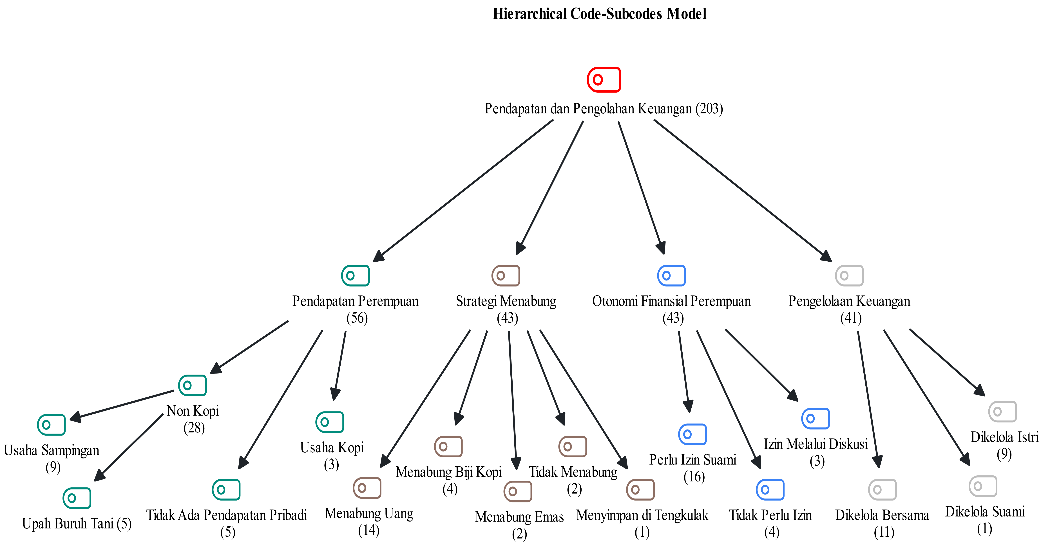
Source: Primary data analysis using MAXQDA, 2026.
2. Women’s Perceptions, Recognition, and Expectations
Women’s perceptions, recognition, and expectations refer to how women interpret their roles, the extent to which they receive acceptance and appreciation within family and social environments, and the aspirations they hold to improve their welfare and social position. Most women coffee farmers in West Lampung Regency demonstrate positive perceptions regarding the acknowledgment of their roles, both within the household and in the broader community. The distribution of women’s perceptions, recognition, and participation space, based on the MAXQDA analysis using subcodes, is presented in Table 8.
| Main Aspect | Subcode Category and Number of Segments | Average Segment Percentage | Description |
| Social Recognition (50) | Recognized within the family (15) | 14.70% | Women coffee farmers have obtained relatively strong recognition at the household level; however, recognition in broader social spaces remains uneven and tends to be limited. |
| Recognized by the community (10) | |||
| Appreciated as farmers (5) | |||
| Women’s Participation Space | Women’s roles considered important (20) | 7.05% | |
| No opportunity to voice opinions (9) | Women’s participation in decision-making processes and public forums remains relatively restricted, although some women have begun to express their views through informal mechanisms. | ||
| Have opportunities to voice opinions (3) | |||
| Expectations of Women Coffee Farmers | Improvement in household economic conditions (8) | 4.50% | Women coffee farmers’ expectations are primarily oriented toward improving family economic welfare, achieving stable coffee prices, and gaining greater social recognition and institutional support for women’s roles in coffee farming. |
| Access to training and assistance (2) | |||
| Strengthening women farmer groups/cooperatives (1) | |||
| Wage equality and recognition (1) | |||
| Stable/increasing coffee prices (5) | |||
| Greater appreciation for women (6) |
Source: Primary data analysis using MAXQDA, 2026.
The analysis above indicates that the social position of women coffee farmers tends to be stronger within the domestic sphere than in broader social contexts. Recognition of women’s contributions is most frequently observed within the family environment, whereas acknowledgment at the community level and as professional farmers remains perceived as uneven. The relatively high frequency of perspectives emphasizing women’s roles as essential to both household management and coffee farming activities suggests a gradual shift in perceptions regarding women’s contributions. However, this shift has not yet been fully accompanied by equal social legitimacy. The average segment percentage of 14.70% reflects that social recognition has begun to emerge, although it remains partial and context-dependent.
Regarding participation, the findings show that women’s involvement in decision-making arenas and public forums remains limited. Most experiences reported by participants illustrate restricted opportunities to express opinions openly, despite early indications that participation spaces may be developing through informal interactions within households or small community settings. The relatively low average segment percentage of 7.05% further confirms that expanding women’s participation opportunities continues to represent a major challenge within the social context of coffee-farming communities.
The aspirations of women coffee farmers are primarily oriented toward improving family welfare and ensuring the sustainability of coffee-based livelihoods. These expectations extend beyond economic concerns—such as income stability and price certainty to include the desire for greater social appreciation and stronger institutional support for women’s roles in coffee farming.
A. Social Recognition of Women’s Roles
The following section presents the distribution of segments related to social recognition among women coffee farmers, reflecting the level of acceptance and appreciation of women’s roles both within the household and in the wider community, as shown in Table 9.
| Subcode Category | Number of Segments | Segment Percentage (%) |
| Recognized within the family | 15 | 30.00 |
| Recognized by the community | 10 | 20.00 |
| Valued as farmers | 5 | 10.00 |
| Women’s roles considered important | 20 | 40.00 |
| Total | 50 | 100.00 |
| Average segment percentage | – | 25.00 |
Source: Primary data analysis using MAXQDA, 2026.
The analysis indicates that social recognition of women coffee farmers is relatively prominent, with a total of 50 segments identified. The category stating that women’s roles are considered important was the most dominant, accounting for 20 segments (40.00%). Recognition from the broader community represented 20.00%, whereas direct appreciation of women as farmers remained comparatively low at 10.00%. An average segment percentage of 25.00% suggests that social recognition has developed, particularly within the household context, but has not yet been fully institutionalized at the community level. These findings were supported by focus group discussions, in which participants noted that women’s contributions were acknowledged because their involvement helped accelerate the completion of work tasks.
This perspective illustrates that social recognition emerges largely from women’s everyday labor practices and their tangible contributions to family coffee farming activities. Despite the relatively high level of perceived recognition, the results also reveal that such acknowledgment is not consistently accompanied by the provision of formal participatory opportunities. Previous studies by Wulandari and Lestari (2022) and Sari et al. (2023) similarly reported that women’s agricultural contributions are often informally recognized but not fully valued as part of a professional farming identity.
B. Women’s Participation Space
According to [11], women’s participation is closely linked to the concept of empowerment, defined as the capacity to make strategic life choices in situations where such choices were previously constrained or unavailable. Participation space does not merely reflect formal involvement; it also indicates the extent to which women have access to resources, information, and legitimacy within decision-making processes. The conditions of women coffee farmers’ participation in expressing opinions and engaging in social and decision-making processes are presented in Table 10
| Subcode Category | Number of Segments | Segment Percentage (%) |
| No opportunity to voice opinions | 9 | 75.00 |
| Have opportunity to voice opinions | 3 | 25.00 |
| Total | 12 | 100.00 |
| Average segment percentage | – | 50.00 |
Source: Primary data analysis using MAXQDA, 2026.
In terms of women’s participation space, the analysis reveals a contrasting situation. Out of the 12 identified segments, the majority of women reported having no opportunity to express their opinions, accounting for 9 segments (75.00%), whereas only 25.00% perceived that they had a space to voice their views. Although the average segment percentage reached 50.00%, the dominance of the subcode indicating the absence of participation opportunities suggests that women’s involvement in public decision-making processes remains limitid,“There is no space for discussion because I am not involved in the women farmers’ group.”
(Interview with informant).
This condition restricts women’s engagement in the public sphere and highlights a gap between social recognition and institutional participation access. Conversely, women who were affiliated with local organizations, such as women farmer groups or community associations, tended to demonstrate more active participation. This finding indicates that women’s participation remains constrained, particularly in decision-making forums beyond the household level. Individual interview results further support this conclusion, as expressed by one informant:“Meetings or activities outside the home are usually attended by men.”
(Interview with informant).
C. Expectations of Women Coffee Farmers
The expectations of women coffee farmers reflect their aspirations and goals related to improving household welfare, sustaining coffee farming activities, and strengthening both their roles and social recognition within agricultural and household economic contexts. Various expectations expressed by women coffee farmers concerning welfare improvement, capacity development, and social acknowledgment are presented based on the qualitative coding results obtained through MAXQDA, as shown in Table 11.
| Subcode Category | Number of Segments | Segment Percentage (%) |
| Improvement in household economic conditions | 8 | 34.78 |
| Access to training and assistance | 2 | 8.70 |
| Strengthening of women farmer groups/cooperatives | 1 | 4.35 |
| Wage equality and recognition | 1 | 4.35 |
| Stable/increasing coffee prices | 5 | 21.74 |
| Greater appreciation of women | 6 | 26.09 |
| Total | 23 | 100.00 |
| Average segment percentage | – | 16.67 |
Source: Primary data analysis using MAXQDA, 2026.
In terms of the expectations of women coffee farmers, the analysis of 23 coded segments indicates that the most prominent aspirations relate to improving household economic conditions (34.78%) and gaining greater recognition for women’s contributions (26.09%). In contrast, expectations concerning wage equality and formal appreciation (4.35%) remain relatively limited. The average segment percentage of 16.67% suggests that women’s expectations are primarily oriented toward practical economic needs rather than institutional or structural concerns. This pattern is also reflected in the focus group discussion (FGD), where participants stated: “We hope that our family’s economic situation can improve and that women’s work will be more appreciated.”“I want my role in this coffee business to be acknowledged not only by my family but also by the wider community.” (Interview participant).
These statements illustrate a desire for broader social recognition within the community. While participants generally felt that their roles were acknowledged within the household, they perceived that recognition from the wider society was still insufficient. Previous studies have shown that social recognition of women farmers positively influences their motivation to participate more actively in farmer groups and other community organizations. Furthermore, data analysis using MAXQDA also revealed women farmers’ expectations for increased access to training and capacity-building programs. One participant expressed: “We need more training so we can process coffee properly.” (Interview participant).
This response indicates a strong interest in expanding educational opportunities, both in agricultural techniques and financial management. Such findings are consistent with prior research suggesting that women farmers tend to prioritize family welfare and social recognition as immediate goals before advocating for broader structural equality. The overall Hierarchical Code Subcodes Model illustrating perceptions, recognition, and participation spaces of women is presented in Figure 3.
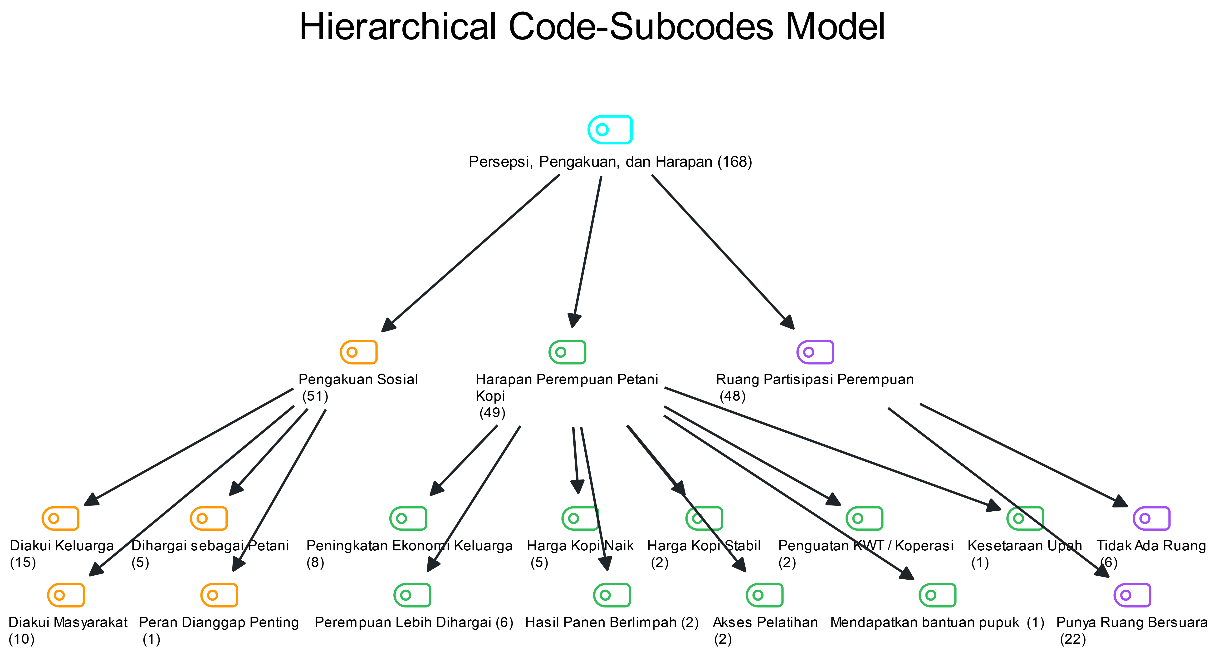
Source: Primary data analysis using MAXQDA, 2026.
Conclusion
Financial autonomy among women in coffee-farming households has not yet developed optimally, particularly in major economic decisions such as the purchase of high-value goods. Although women play a relatively dominant role in managing daily household finances and make tangible contributions to production activities, approximately 69.57% of women still need to obtain their husbands’ approval before using income. This condition indicates that control over economic resources remains influenced by power relations within the household, suggesting that the principle of equality has not been fully realized in strategic decision-making aspects.
On the other hand, women’s contributions to farming activities have received fairly positive recognition within the family environment. However, recognition at the broader social level and opportunities for participation in public spaces remain limited, accounting for 75.0%. Women’s expectations are generally oriented toward improving family welfare, gaining wider social recognition, and achieving coffee price stability to ensure household economic sustainability. These findings suggest that strengthening women’s roles requires not only support at the household level but also expanded access and participation within broader social and economic environments.
Recommendations
Strengthening women’s economic roles in coffee-farming households should be pursued through capacity building in financial management and greater involvement in economic decision-making processes to enhance their position in controlling resources. Such efforts can be implemented through family financial literacy training, education on separating business and household finances, and facilitating women’s access to cooperatives or microfinance services. Furthermore, women’s participation in strategic economic decisions and institutional spaces should be expanded through family-based and agricultural organizational approaches. These may include couple-based discussions in extension programs, women’s involvement in farmer group or cooperative management, and leadership training for women farmers. In addition, improving the welfare of coffee-farming households also requires support for coffee-based economic stability, such as strengthening collective marketing systems, providing transparent price information, and mentoring coffee-based business diversification to enhance household income resilience.
References
- Statistics Indonesia (Badan Pusat Statistik). (2023). Agricultural census 2023. DOI ↗ Google Scholar ↗
- Statistics Indonesia (Badan Pusat Statistik). (2024). Indonesian coffee plantation statistics. DOI ↗ Google Scholar ↗
- Deaton, A. (1992). The analysis of household surveys: A microeconometric approach to development policy. World Bank. DOI ↗ Google Scholar ↗
- Department of Communication, Informatics, and Statistics of Lampung Province. (2023). Coffee production of Lampung Province by regency/municipality. Provincial Government of Lampung. DOI ↗ Google Scholar ↗
- Plantation and Livestock Service of West Lampung Regency. (2024). Coffee production data of West Lampung Regency. Government of West Lampung Regency. DOI ↗ Google Scholar ↗
- Elmhirst, R., & Siscawati, M. (2018). Feminist political ecology in Indonesia: Gender, agrarian transformation and environmental governance. In S. Buckingham & V. Le Masson (Eds.), Routledge handbook of gender and environment. Routledge. DOI ↗ Google Scholar ↗
- Food and Agriculture Organization. (2011). The state of food and agriculture 2010–2011: Women in agriculture Closing the gender gap for development. FAO. DOI ↗ Google Scholar ↗
- Food and Agriculture Organization. (2019). Gender and rural employment in agriculture. FAO. DOI ↗ Google Scholar ↗
- Fadhel, M., Rahmawati, R., & Putri, D. (2023). Women’s contribution to household income in smallholder coffee farming systems. Journal of Rural Development, 38(2), 145–158. DOI ↗ Google Scholar ↗
- International Coffee Organization. (2022). Coffee development report 2022. DOI ↗ Google Scholar ↗
- Kabeer, N. (1999). Resources, agency, achievements: Reflections on the measurement of women’s empowerment. World Development, 30(3), 435–464. DOI ↗ Google Scholar ↗
- Neilson, J., Wright, J., & Aklimawati, L. (2020). Geographical indications and value capture in the Indonesian coffee sector. World Development, 134, 105045. DOI ↗ Google Scholar ↗
- Parmawati, R., Sari, M., & Nugroho, A. (2022). Gender roles in coffee farming households and implications for rural livelihoods. Agricultural Socio-Economics Journal, 22(1), 25–34. DOI ↗ Google Scholar ↗
- Putri, D., & Nugroho, A. (2024). Women’s economic participation and decision-making power in agricultural households. Journal of Agribusiness and Rural Development Research, 10(1), 55–67. DOI ↗ Google Scholar ↗
- Rahmawati, R., Wulandari, S., & Lestari, E. (2023). Household financial management patterns in smallholder farming families. Indonesian Journal of Agricultural Economics, 14(2), 89–101. DOI ↗ Google Scholar ↗
- Rahmawati, R., Utami, P., & Nugroho, A. (2024). Farmers’ saving strategies under commodity price fluctuations. Journal of Rural Finance, 9(1), 33–47. DOI ↗ Google Scholar ↗
- Sari, M., Nugroho, A., & Putri, D. (2021). Gender division of labor and income control in agricultural households. Journal of Agricultural Socio-Economics, 17(2), 101–112. DOI ↗ Google Scholar ↗
- Sari, M., Rahmawati, R., & Nugroho, A. (2023). Gender relations and women’s financial autonomy in rural farming communities. Journal of Gender Studies in Agriculture, 5(1), 1–12. DOI ↗ Google Scholar ↗
- Utami, P., Rahmawati, R., & Nugroho, A. (2025). Adaptive livelihood strategies of smallholder farmers facing income uncertainty. Journal of Rural Livelihoods, 12(1), 44–58. DOI ↗ Google Scholar ↗
- Wulandari, S., & Lestari, E. (2022). Women’s roles in household economic decision-making among farming communities. Indonesian Journal of Agricultural Economics, 20(1), 65–74. DOI ↗ Google Scholar ↗