Abstract
The purpose of this study is to examine the direct influence of Strategic Management (SM) and Big Data Analytics (BDA) on Operational Efficiency (OE), and to investigate whether Big Data Analytics mediates the relationship between Strategic Management and Operational Efficiency in the banking sector. Specifically, the study analyzes the direct effects of Strategic Management on Operational Efficiency and on Big Data Analytics, the direct effect of Big Data Analytics on Operational Efficiency, and the mediating role of Big Data Analytics in the relationship between Strategic Management and Operational Efficiency. This study adopts a quantitative research design using a survey method. Data were collected from 163 respondents and analyzed using SPSS and the PROCESS Macro (Model 4) to test mediation. The findings reveal that Strategic Management has a significant positive effect on Big Data Analytics. Big Data Analytics also has a significant positive effect on Operational Efficiency. However, Strategic Management has no significant direct effect on Operational Efficiency when Big Data Analytics is included in the model. The bootstrap analysis indicates that Big Data Analytics significantly mediates the relationship between Strategic Management and Operational Efficiency. The study concludes that while Strategic Management alone may not directly drive operational efficiency, its impact is realized through the effective adoption and utilization of Big Data Analytics. These findings highlight the strategic importance of integrating data analytics capabilities into management practices to enhance operational performance in the banking sector.
Keywords
Big Data Analytics Mediation Operational efficiency Strategic Management
Introduction
Operational efficiency is considered a crucial measure of a bank's ability to provide exceptional financial services and maintain competitiveness in a rapidly evolving, technology-oriented market. In the banking sector, operational efficiency refers to the effectiveness with which an organization uses its financial, human, and technological resources to deliver timely, cost-effective, and adaptable services to clients. A significant organizational factor affecting operational efficiency is strategic management. Strategic management encompasses environmental scanning, proficiency in strategy implementation, and strategic monitoring, which together enable financial institutions to forecast market trends, allocate resources wisely, and achieve operational goals effectively ([16]; [33]; [30]; [26]). Effective strategic management techniques empower banks to adeptly address technology innovations, regulatory requirements, and shifting client expectations in dynamic financial markets ([18]; [5]; [29]).
Empirical evidence indicates that the mere implementation of strategic management practices does not consistently lead to enhanced operational efficiency, especially in unstable, data-driven business contexts characterized by digital transformation and market unpredictability ([9]; [24]; [10]). This constraint has led to a growing focus on Big Data Analytics as an essential technology competency for attaining operational efficiency in modern financial institutions. Big Data Analytics denotes an organization's capacity to manage data quality effectively, implement predictive analytics, and employ data-driven decision support systems for strategic decision-making ([2]; [15]; [28]; [13]). Financial institutions that effectively incorporate data-driven analytics into their strategic frameworks are generally more agile and can enhance operational procedures through predictive insights and real-time decision-making, thereby elevating service performance and organizational productivity ([8]; [23]; [12]).
Although the significance of strategic management and Big Data Analytics in improving operational efficiency is recognized, there remains a limited comprehension of how these factors interact to affect operational outcomes in African banking institutions. Prior research has primarily analyzed these constructs in isolation or concentrated on their direct associations with performance outcomes, rather than exploring the mediating function of Big Data Analytics in enhancing the relationship between strategic management and operational efficiency ([32]; [8]; [3]). At First Bank of Nigeria Limited, the integration of strategic management approaches with Big Data Analytics capabilities has become essential amid the current digital transformation of banking operations and heightened competition in Nigeria's financial services market.
This study investigates the direct and indirect relationships between strategic management, Big Data Analytics, and operational efficiency at First Bank of Nigeria Limited. The study specifically seeks to determine if Big Data Analytics mediates the relationship between strategic management and operational efficiency, offering significant insights for academic research and practical managerial decision-making in the Nigerian banking sector ([17]; [21]; [25]).
Objectives
This study aims to analyze the direct impact of strategic management on operational efficiency, evaluate the direct effect of strategic management on Big Data Analytics capability, assess the direct influence of Big Data Analytics on operational efficiency, and explore the mediating role of Big Data Analytics in the relationship between strategic management and operational efficiency at First Bank of Nigeria Limited.
Literature Review
Operational Efficiency
Operational efficiency denotes an organization's capacity to utilize its resources, processes, and technologies effectively to provide services while reducing operational expenses and waste. It indicates the extent to which institutions can enhance internal processes to achieve expedited service delivery, increased productivity, and optimal performance ([4]; [11]). Operational efficiency is paramount in the banking sector, where financial institutions must process substantial transaction volumes accurately and swiftly, while ensuring cost-effectiveness and service quality in a highly competitive landscape ([10]; [32]).
Furthermore, operational efficiency enables firms to respond effectively to fluctuating customer needs and environmental risks by streamlining processes and maximizing resource use ([22]; [8]). Principal indicators of operational efficiency include reduced process cycle time, cost-effectiveness, and expedited service delivery, which collectively enhance organizational productivity and customer satisfaction in service-oriented entities ([23]; [15]). Thus, operational efficiency is a vital factor in organizational sustainability and performance, especially in the banking sector, where operational effectiveness directly impacts service reliability, competitiveness, and long-term profitability.
Strategic Management
Strategic management is the systematic process through which businesses develop, execute, and assess decisions to attain long-term goals and maintain competitive advantage in evolving settings. It includes essential tasks such as environmental scanning, strategy creation, strategy implementation, and strategic monitoring, which jointly determine the organizational trajectory and resource distribution ([16]; [33]). In competitive, technology-driven industries such as banking, strategic management enables institutions to anticipate environmental changes, adapt to regulatory and technical developments, and align internal capabilities with external opportunities ([18]; [27]). Research indicates that proficient strategic management improves organizational agility, operational coherence, and performance sustainability, especially in unpredictable and turbulent market conditions ([30]; [26]; [5]). By employing effective strategy implementation, ongoing strategic assessment, and proactive environmental analysis, organizations can enhance resource efficiency, reduce operational inefficiencies, and improve decision-making processes ([29]; [1]). Strategic management is recognized as a fundamental organizational competence that enhances operational efficiency and fosters long-term value generation, particularly in the contemporary banking sector, marked by a swift digital revolution and heightened competition.
Strategy Implementation Capability
Strategy implementation capability is a crucial aspect of strategic management that influences a bank's effectiveness in translating strategic plans into operational outcomes. In banking, robust implementation guarantees that devised plans are converted into effective processes, prompt resource allocation, and agile service delivery. This competence is particularly vital in contexts marked by digital revolution and intensified competition, exemplified by the Nigerian banking sector. It encompasses both implementing strategies and adjusting operations to align with changing market and technical trends ([17]; [21]). Recent studies demonstrate that a bank's capacity to execute strategy effectively often mediates the influence of strategic management on operational results, especially when combined with sophisticated technology skills such as Big Data Analytics ([3]; [25]). This implies that even well-developed strategies yield optimal outcomes only when banks have the organizational capability to implement them through coordinated actions, real-time monitoring, and rapid adjustments. For entities such as First Bank of Nigeria Limited, developing strong competence in strategy implementation is essential for maintaining operational efficiency and competitive advantage amid ongoing digitalization ([12]; [13]).
Strategic Monitoring
Strategic monitoring is a continuous evaluation process used by businesses, particularly in the banking industry, to assess strategy execution, ensuring alignment with organizational goals and adaptability to environmental changes ([28]; [2]). In banking, strategic monitoring allows institutions to swiftly detect deviations from strategic plans, evaluate the efficacy of current actions, and implement necessary corrective measures, which is crucial in an environment influenced by rapid digital transformation and regulatory intricacies ([15]; [32]). The capacity to methodically collect, analyze, and interpret data for strategic management enables banks to maintain agility and competitiveness by facilitating evidence-based decision-making in fluctuating markets ([12]; [8]).
Modern financial institutions utilize advanced analytics, predictive modeling, and data-driven decision support systems for strategic monitoring, offering real-time input on operational and strategic performance indicators ([23]; [13]). The incorporation of digital tools fosters a culture of ongoing enhancement and organizational learning, which is especially crucial for banks with shifting consumer expectations and escalating market rivalry ([17]; [21]). For entities such as First Bank of Nigeria Limited, proficient strategic monitoring ensures that digital transformation efforts and strategic goals are reliably translated into concrete operational efficiency gains and enduring competitive advantage ([3]; [25]).
Environmental Scanning
Environmental scanning is an essential strategic activity for banks, systematically collecting, assessing, and analyzing external information to guide strategic decision-making and sustain organizational competitiveness. In the banking industry, environmental scanning allows institutions to proactively recognize and address new trends, regulatory mandates, and technological innovations, therefore facilitating effective strategy development and risk management ([22]; [11]). This approach enables banks to anticipate external changes and align their internal resources and skills with emerging opportunities and risks, which is especially crucial in volatile and uncertain market conditions ([4]; [1]).
Recent data indicate that proficient environmental scanning enables banks to consistently adjust to changes in client preferences, industry standards, and competitive challenges by incorporating pertinent intelligence into their strategic planning processes ([28]; [2]). The utilization of advanced digital tools and data-driven approaches amplifies the breadth and profundity of environmental scanning, allowing financial institutions such as First Bank of Nigeria Limited to maintain operational agility and strategic significance in an increasingly digital financial environment ([15]; [28])
Big Data Analytics
Big Data Analytics is the intentional and methodical administration of organizational data assets to derive significant insights, enhance process efficiencies, and improve overall performance. It entails creating robust frameworks for data quality management, enhancing predictive analytics capabilities, and integrating data-driven decision support systems into core business processes ([24]; [10]). Big Data Analytics is essential for enhancing organizational agility and maintaining competitive advantage, especially in the swiftly changing banking industry.
Recent research indicates that the effectiveness of Big Data Analytics is optimized when its aspects operate synergistically. Data quality management ensures that information is precise, consistent, and reliable, providing a robust basis for further analytics and strategic decision-making ([32]; [26]). Predictive analytics capabilities enhance this foundation by utilizing statistical modeling and machine learning to forecast trends, identify hazards, and anticipate consumer requirements, thereby enabling banks to take proactive measures in dynamic markets ([30]; [5]). Data-driven decision support systems aggregate and distribute insights throughout the company, facilitating prompt, evidence-based decision-making that improves operational efficiency and service quality ([29]; [25]).
The significance of Big Data Analytics in banking has escalated due to the rise of digital transformation, competitive challenges, and the intricacy of customer requirements. Studies indicate that banks with advanced data analytics capabilities attain enhanced operational efficiency, improved customer experiences, and greater agility in adapting to regulatory and market fluctuations. Conversely, the absence of seamless integration of Big Data Analytics dimensions may result in fragmented efforts, reducing their effectiveness and highlighting the need for strategic alignment in analytics programs ([30]; [26]).
Based on the literature reviewed, the following hypotheses were formulated:
-
H1: Strategic Management (SM) has a positive effect on Operational Efficiency (OE).
-
H2: Strategic Management (SM) has a positive effect on Big Data Analytics (BDA).
-
H3: Big Data Analytics (BDA) has a positive effect on Operational Efficiency (OE).
-
H4: Big Data Analytics (BDA) mediates the relationship between Strategic Management (SM) and Operational Efficiency (OE).
Conceptual framework
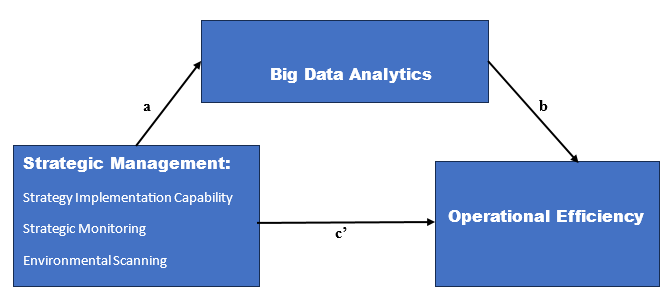
Research methodology
This research employs a quantitative methodology centered around a survey of 435 employees at the Head Office of First Bank of Nigeria Limited in Lagos. A sample of 215 participants was selected using Yamane’s formula and proportional stratified random sampling to ensure departmental representation. Data were collected via a standardized questionnaire utilizing a five-point Likert scale to evaluate constructs such as strategic management, Big Data Analytics, and operational efficiency. Mediation analysis was conducted in SPSS using the PROCESS Macro.
Result
Mediation Analysis Using Baron and Kenny’s (1986) Stepwise Approach
This section examines whether Big Data Analytics (BDA) mediates the relationship between strategic management (SM) and Operational Efficiency (OE) using Baron and Kenny’s (1986) four-step procedure, complemented with bootstrap analysis.
Step 1: Direct Effect of Strategic Management (SM) on Operational Efficiency (Without Mediator)
| Variable | β | Std. Error | t-value | p-value |
| Constant | 36.6353 | 1.9318 | 18.9639 | 0.000 |
| Strategic Management (SM) | 0.0026 | 0.0501 | 0.052 | 0.9586 |
Model Summary
-
R = 0.3367 R² = 0.1134 F (2,160) = 10.2282 p = 0.0001 Sample Size (N) = 163
Statistical Hypothesis Tested
H0: βSM≤0
H1: βSM>0
The regression result indicates that Strategic Management has a positive but statistically insignificant effect on Operational Efficiency (β = 0.0026, t = 0.0520, p = 0.9586 > 0.05). Since the p-value exceeds 0.05, the null hypothesis (H₀) is not rejected. This implies that Strategic Management does not independently predict Operational Efficiency when Big Data Analytics is included in the model. Although the overall model is statistically significant (F(2,160) = 10.2282, p < 0.001), with R² = 0.1134, Strategic Management alone does not significantly explain variation in Operational Efficiency in the presence of the mediator.
Step 2: Effect of Strategic Management (SM) on Big Data Analytics (BDA) (Mediator)
| Variable | β | Std. Error | t-value | p-value |
| Constant | 4.8207 | 2.9787 | 1.6184 | 0.1075 |
| Strategic Management (SM) | 0.6563 | 0.0582 | 11.2854 | 0.000 |
Model Summary
-
R = 0.6646 R² = 0.4417 F (1,161) = 127.3602 p = 0.0000Sample Size (N) = 163
Statistical Hypothesis Tested
H0: βSM ≤ 0
H1: βSM > 0
The results show that Strategic Management has a strong positive and statistically significant effect on Big Data Analytics (β = 0.6563, t = 11.2854, p = 0.0000 < 0.05). The null hypothesis is rejected. This means Strategic Management significantly predicts the adoption and utilization of Big Data Analytics. The model explains 44.17% of the variance in Big Data Analytics (R² = 0.4417), which indicates substantial explanatory power.
Step 3: Effect of Big Data Analytics on Operational Efficiency (Controlling for Strategic Management (SM)
| Variable | β | Std. Error | t-value | p-value |
| Constant | 36.6353 | 1.9318 | 18.9639 | 0 |
| Strategic Management (SM) | 0.0026 | 0.0501 | 0.052 | 0.9586 |
| Big Data Analytics (BDA) | 0.1696 | 0.0507 | 3.3448 | 0.001 |
Model Summary
-
R = 0.3367 R² = 0.1134 F (2,160) = 10.2282 p = 0.0001 Sample Size (N) = 163
Statistical Hypotheses Tested
For Strategic Management:
H02:βBDA≤0H12:βBDA>0
For Big Data Analytics:
H02:βBDA≤0H12:βBDA>0
The regression analysis examined the joint effect of Strategic Management and Big Data Analytics on Operational Efficiency. The results show that:
-
Strategic Management (SM) has a positive but statistically insignificant effect on Operational Efficiency (β = 0.0026, t = 0.0520, p = 0.9586 > 0.05).
-
Big Data Analytics (BDA) has a positive and statistically significant effect on Operational Efficiency (β = 0.1696, t = 3.3448, p = 0.001 < 0.05).
Step 4: Test of the Indirect (Mediated) Effect Using Bootstrapping
| Mediating Path | Indirect Effect | Boot SE | Boot LLCI | Boot ULCI |
| SM → BDA → OE | 0.1113 | 0.0354 | 0.0482 | 0.185 |
Bootstrap Samples: 5,000
Confidence Level: 95%
Interpretation
The bootstrap confidence interval does not include zero (BootLLCI = 0.0482, BootULCI = 0.1850), indicating that the indirect effect is statistically significant.
Based on Baron and Kenny’s (1986) criteria and bootstrap analysis, Big Data Analytics fully mediates the relationship between Strategic Management and Operational Efficiency.
This implies that Strategic Management enhances Operational Efficiency indirectly through the adoption and effective use of Big Data Analytics. The direct effect of Strategic Management on Operational Efficiency is not significant (β = 0.0026, p = 0.9586), confirming the full mediation effect. In practical terms, organizations seeking to improve Operational Efficiency should prioritize Big Data Analytics initiatives as a key mechanism through which strategic management translates into operational performance gains.
Discussion
Effect of Strategic Management on Operational Efficiency
The findings of this study show that Strategic Management (SM) has a positive but statistically insignificant direct effect on Operational Efficiency (OE) (β = 0.0026, p = 0.9586). This indicates that while SM is conceptually important for operational outcomes, its impact is not directly observable when other factors, such as Big Data Analytics (BDA), are accounted for in the model.
This result aligns with the idea that strategic management serves as a framework to guide organizational resources, goals, and initiatives. However, its effectiveness in improving operational efficiency may rely on enabling mechanisms such as technology adoption and data-driven processes. Previous studies by George, Walker, and Monster (2023) and Wolf and Floyd (2024) emphasize that strategic management improves organizational outcomes when it is implemented in a structured manner, enabling resource optimization, better coordination of activities, and proactive responses to environmental changes.
In the context of banking, effective strategic management helps set institutional priorities and guide resource allocation; however, its influence on operational efficiency appears indirect rather than direct, suggesting that the organization’s strategic intent must be translated through operational tools or systems to meaningfully impact efficiency.
Effect of Strategic Management on Big Data Analytics
Strategic Management (SM) has a positive and statistically significant effect on Big Data Analytics (BDA) (β = 0.6563, p = 0.0000). This finding suggests that organizations with stronger strategic management practices are more likely to adopt, implement, and leverage BDA effectively.
Empirical evidence supports this outcome. Leal-Rodríguez et al. (2023) demonstrate that clear and structured strategic management practices facilitate the integration of technology and analytics into organizational processes, ensuring alignment with broader strategic goals. Similarly, Kraus et al. (2022) highlight that effective strategic planning enables firms to allocate resources efficiently for technology adoption and fosters proactive decision-making using data-driven insights.
This indicates that strategic management provides direction and organizational readiness, both of which are critical to successfully deploying analytics initiatives. In the banking sector, strategic management ensures that Big Data tools are implemented purposefully to improve decision-making, monitor performance, and support operational objectives.
Effect of Big Data Analytics on Operational Efficiency
Big Data Analytics (BDA) has a positive and statistically significant effect on Operational Efficiency (OE) (β = 0.1696, p = 0.001). This implies that banks that effectively use analytics to process large volumes of data, predict trends, and optimize operations achieve measurable efficiency gains.
Consistent with prior studies, such as Vrontis et al. (2022) and Chatterjee et al. (2021), the use of advanced analytics supports faster, more accurate decisions, process optimization, and responsiveness to dynamic market conditions. In the Nigerian banking context, BDA enables institutions to reduce operational delays, enhance customer service delivery, and better allocate resources for cost-effectiveness.
Therefore, operational efficiency gains are primarily driven by the effective application of Big Data Analytics rather than by strategic management alone, highlighting the critical role of technology as an intermediary mechanism.
Test of the Indirect (Mediated) Effect Using Bootstrapping
The mediating effect of Big Data Analytics (BDA) on the relationship between Strategic Management (SM) and Operational Efficiency (OE) was tested using bootstrapping. The analysis produced an indirect effect coefficient of β = 0.1113, with a bootstrapped standard error of 0.0354 and a 95% confidence interval ranging from 0.0482 to 0.1850.
Since the confidence interval does not include zero, the indirect effect is statistically significant. This indicates that Big Data Analytics fully mediates the relationship between Strategic Management and Operational Efficiency. While SM alone does not directly enhance operational efficiency, its influence is channeled through the adoption and use of BDA.
These results are consistent with the Resource-Based View [6], which posits that organizational capabilities, such as data analytics infrastructure, serve as critical mechanisms through which strategic management translates into superior performance outcomes.
Recommendations
Based on the findings of this study, banking institutions are encouraged to strengthen their strategic management practices by ensuring clear goal setting, effective resource allocation, and strong alignment between strategic initiatives and overall organizational priorities. Strategic objectives should be well-defined, measurable, and consistently communicated across all levels of the organization to enhance coordination and accountability.
Banks should also invest substantially in Big Data Analytics infrastructure, modern analytical tools, and continuous staff training to enhance data literacy and analytical competence. By equipping employees with the skills and technological support necessary to interpret and apply data insights, institutions can promote informed decision-making that directly improves operational outcomes such as service efficiency, cost control, and risk management.
Furthermore, there is a need to integrate strategic management with analytics initiatives deliberately. Data-driven insights should not operate independently of strategy; rather, they should be embedded in decision-making processes, operational workflows, and performance-monitoring systems. Aligning analytics capabilities with strategic priorities will ensure that technological investments translate into tangible efficiency gains.
Finally, banking institutions should foster a strong culture of analytics adoption by encouraging experimentation, continuous learning, and innovation in operational processes. Creating an environment that supports data-driven thinking and cross-functional collaboration will enhance adaptability and ensure that analytics initiatives contribute sustainably to improved operational efficiency.
References
- Abdurrahman, A., Yusof, N. M., & Azman, N. H. N. (2023). Environmental scanning and competitive advantage in the banking sector. Journal of Business Strategy, 44(3), 67–80. DOI ↗ Google Scholar ↗
- Akter, S., Wamba, S. F., Gunasekaran, A., Dubey, R., & Childe, S. J. (2016). How to improve firm performance using big data analytics capability and business strategy alignment? International Journal of Production Economics, 182, 113–131. DOI ↗ Google Scholar ↗
- Anwar, M., Saleem, I., & Khan, R. A. (2024). The role of strategy implementation in mediating between strategic planning and firm performance. Management Decision, 62(1), 25–44. DOI ↗ Google Scholar ↗
- Bakar, N. A., & Ahmad, H. (2020). Operational efficiency and performance in commercial banks: The role of internal processes. International Journal of Finance & Economics, 25(4), 567–579. DOI ↗ Google Scholar ↗
- Bamel, U. K., & Bamel, N. (2023). Big data analytics and business performance in emerging markets: Empirical insights. Technological Forecasting and Social Change, 194, Article 122541. DOI ↗ Google Scholar ↗
- Barney, J. (1991). Firm resources and sustained competitive advantage. Journal of Management, 17(1), 99–120. DOI ↗ Google Scholar ↗
- Chatterjee, S., Chaudhuri, R., Vrontis, D., & Thrassou, A. (2021). Big data and operational efficiency: Empirical evidence from banking. Journal of Business Research, 124, 311–324. DOI ↗ Google Scholar ↗
- Ciampi, F., Demi, S., Magrini, A., Marzi, G., & Papa, A. (2021). Exploring the impact of big data analytics capabilities on firm performance: The mediating role of dynamic capabilities. Journal of Business Research, 131, 674–682. DOI ↗ Google Scholar ↗
- Côrte-Real, N., Oliveira, T., & Ruivo, P. (2020). Assessing the business value of big data analytics in European firms. Journal of Business Research, 97, 550–564. DOI ↗ Google Scholar ↗
- Dubey, R., Gunasekaran, A., Childe, S. J., Blome, C., Papadopoulos, T., & Roubaud, D. (2022). Big data analytics capability in supply chain agility and operational performance: A resource-based view. International Journal of Production Economics, 235, Article 108103. DOI ↗ Google Scholar ↗
- Fahimnia, B., Sarkis, J., & Davarzani, H. (2021). Green supply chain management: A review and bibliometric analysis. International Journal of Production Economics, 218, 336–357. DOI ↗ Google Scholar ↗
- Fu, J., Wang, Y., & Zhang, S. (2023). Strategy implementation capability and bank performance: The mediating role of digital transformation. Sustainability, 15(7), Article 6379. DOI ↗ Google Scholar ↗
- Gao, X., & Sarwar, S. (2024). Predictive analytics in banking: Enhancing operational outcomes through data-driven decision making. Journal of Financial Services Marketing, 29(1), 50–62. DOI ↗ Google Scholar ↗
- George, B., Walker, R. M., & Monster, J. (2023). The strategic management framework in public organizations: Resource optimization and outcomes. Public Administration Review, 83(2), 209–226. DOI ↗ Google Scholar ↗
- Gupta, M., & George, J. F. (2016). Toward the development of a big data analytics capability. Information & Management, 53(8), 1049–1064. DOI ↗ Google Scholar ↗
- Hitt, M. A., Ireland, R. D., & Hoskisson, R. E. (2023). Strategic management: Concepts and cases: Competitiveness and globalization (14th ed.). Cengage Learning. DOI ↗ Google Scholar ↗
- Itani, S., Bahnan, N., & Chaker, N. (2024). Digital strategy implementation and operational efficiency in banking. Journal of Business & Industrial Marketing, 39(2), 187–202. DOI ↗ Google Scholar ↗
- Kamalaldin, A., Linde, L., Sjödin, D., & Parida, V. (2021). Transforming provider-customer relationships in digital service platforms. Industrial Marketing Management, 95, 195–208. DOI ↗ Google Scholar ↗
- Kraus, S., Rehman, S. U., & Garcia, F. J. (2022). Strategic planning and technology adoption: The path to performance. European Management Journal, 40(4), 456–473. DOI ↗ Google Scholar ↗
- Leal-Rodríguez, A. L., Ariza-Montes, A., Roldán, J. L., & Leal-Millán, A. G. (2023). The mediating effect of technology integration on strategic management and firm performance. Technovation, 123, Article 102669. DOI ↗ Google Scholar ↗
- Luqman, A., Ahmad, N. H., & Razak, R. C. (2024). Strategy implementation capability and operational outcomes in banks: Evidence from emerging markets. Journal of Strategy and Management, 17(1), 144–161. DOI ↗ Google Scholar ↗
- Mhlanga, D. (2022). Digital transformation in African banking: Operational efficiency and risk management. African Journal of Economic and Management Studies, 13(3), 431–449. DOI ↗ Google Scholar ↗
- Mikalef, P., Boura, M., Lekakos, G., & Krogstie, J. (2021). Big data analytics and firm performance: Findings from the banking industry. Big Data Research, 22, Article 100188. DOI ↗ Google Scholar ↗
- Mikalef, P., Krogstie, J., Pappas, I. O., & Giannakos, M. (2022). Investigating the effects of big data analytics capabilities on firm performance: The mediating role of dynamic capabilities. Information & Management, 59(3), Article 103508. DOI ↗ Google Scholar ↗
- Mikalef, P., van de Wetering, R., & Krogstie, J. (2023). The mediating effect of big data analytics on strategy and operational performance. Information Systems Frontiers, 25(1), 245–260. DOI ↗ Google Scholar ↗
- Muafi, M., Hadi, S., & Prasetyo, A. R. (2023). Big data analytics, agility, and operational performance in banks. International Journal of Information Management Data Insights, 3(2), Article 100195. DOI ↗ Google Scholar ↗
- Parnell, J. A. (2021). Strategic management: Theory and practice (6th ed.). Academic Media Solutions. DOI ↗ Google Scholar ↗
- Sivarajah, U., Kamal, M. M., Irani, Z., & Weerakkody, V. (2017). Critical analysis of big data challenges and analytical methods. Journal of Business Research, 70, 263–286. DOI ↗ Google Scholar ↗
- Teeratansirikool, L., Siengthai, S., Badir, Y., & Charoenngam, C. (2020). Competitive strategies and firm performance: The mediating role of strategic management practices. Management Research Review, 43(8), 1007–1026. DOI ↗ Google Scholar ↗
- Vafaei-Zadeh, A., Suhaiza, Z., & Shaharudin, M. R. (2024). The role of big data analytics in operational performance: Evidence from emerging markets. Journal of Business Analytics, 7(1), 112–130. DOI ↗ Google Scholar ↗
- Vrontis, D., Christofi, M., Pereira, V., & Tarba, S. (2022). Big data analytics and business performance: The moderating role of digital transformation. Journal of Business Research, 139, 34–46. DOI ↗ Google Scholar ↗
- Wamba, S. F., Gunasekaran, A., Akter, S., Ren, S. J. F., Dubey, R., & Childe, S. J. (2020). Big data analytics and firm performance: Effects of dynamic capabilities. Journal of Business Research, 112, 324–337. DOI ↗ Google Scholar ↗
- Wheelen, T. L., Hunger, J. D., Hoffman, A. N., & Bamford, C. E. (2022). Strategic management and business policy: Globalization, innovation, and sustainability (17th ed.). Pearson. DOI ↗ Google Scholar ↗
- Wolf, C., & Floyd, S. W. (2024). Strategic management research: Resource optimization and organizational outcomes. Strategic Management Journal, 45(2), 234–251. DOI ↗ Google Scholar ↗