Abstract
This study aims to analyze the integration of the circular economy concept with the principle of maṣlaḥah in Islamic financial institutions through a Systematic Literature Review (SLR) approach. Literature sources were obtained from indexed databases Scopus, DOAJ, and Google Scholar with a publication range of the last ten years (2016–2026). The selection process was carried out systematically through identification, screening, and thematic synthesis to map the development of variables, integration models, and research gaps. The results of the study show that integration is still dominated by a normative-conceptual approach that emphasizes compatibility between maqāṣid al-sharī‘ah and sustainability principles. Practical implementation has begun to emerge through the development of green sukuk, environmentally friendly financing, and the integration of ESG frameworks into sharia governance, but it has not yet been institutionalized systematically. The literature also reveals limitations in operational models, maṣlaḥah-based performance indicators, and a lack of quantitative empirical evidence. These findings underscore the need for a measurable implementative and evaluative framework to realize the transformation of Islamic finance towards a sustainable circular economy.
Keywords
Circular Economy; Maṣlaḥah; Maqāṣid al-Sharī‘ah; Sharia Financial Institutions.
Introduction
The development of the circular economy concept over the past two decades has emerged as a strategic response to the global environmental crisis and the unsustainability of the linear economic model (take–make–dispose). [1] emphasizes that the circular economy is oriented toward resource efficiency, waste reduction, and the creation of sustainable economic value through closed-loop production cycles. Meanwhile, [2] demonstrate that the implementation of circular economy principles significantly contributes to the transformation of financial systems toward sustainable financing models. These findings indicate that the circular economy has evolved beyond an environmental paradigm and has increasingly penetrated policy frameworks and global financial systems.
Within the context of Islamic finance, sustainability principles inherently possess strong normative roots in Islamic values, particularly through the concepts of maqāṣid al-sharī‘ah and maṣlaḥah (public interest). [3] assert that the Islamic financial system exhibits inherent compatibility with the sustainability agenda due to its orientation toward justice, balance, and social responsibility. Furthermore, [4] reveal that the integration of ESG principles into Islamic finance strengthens the ethical and social legitimacy of Islamic financial institutions. [5] highlights the importance of adopting a maṣlaḥah-based approach in the innovation of modern financial products. In addition, [6] confirm that instruments such as green sukuk serve as a bridge between Sharia principles and sustainable financing. Conceptually, therefore, there is a significant intersection between the circular economy and the foundational values of Islamic finance.
Despite the strengthening sustainability discourse in academic and industrial spheres, the explicit integration of circular economy principles and maṣlaḥah within the operational framework of Islamic financial institutions remains partial and fragmented. Bibliometric evidence shows a substantial increase in circular economy publications over the past five years; however, most studies focus on manufacturing sectors, waste management, and public policy rather than Islamic financial systems [7]. At the same time, a conceptual gap persists between sustainability theory and the practical design of applicable Islamic financial instruments [3]. The transition toward green Islamic finance also faces regulatory, governance, and global standard harmonization challenges [8]. Moreover, an integrative framework grounded in maqāṣid al-sharī‘ah within the architecture of sustainable finance is required to move beyond normative discourse [9]. A value-based approach is considered a prerequisite for implementing circular economy principles in the financial sector [10]. Notably, global Islamic financial assets have surpassed USD 3 trillion, while global sustainable investment assets have exceeded USD 30 trillion in recent years. The disparity between industry growth and the depth of conceptual integration highlights a significant and relevant research gap that warrants systematic examination [11].
From a theoretical perspective, the concept of maṣlaḥah provides a robust and adaptive normative foundation to bridge this integration. Within the framework of maqāṣid al-sharī‘ah, public interest extends beyond individual protection to encompass collective welfare and intergenerational sustainability [12]. A systems-based approach within maqāṣid enables broader interpretations of Islamic law in addressing contemporary economic and financial issues [13]. Environmental protection (ḥifẓ al-bī’ah) has even been positioned as an integral component of the development of contemporary maqāṣid [14]. The institutional reorientation of Islamic financial institutions toward greater responsiveness to global challenges has long been emphasized in Islamic economic literature. Considering that Muslim-majority countries account for more than 15% of the world’s population and face significant environmental pressures, the integration of a maṣlaḥah-based circular economy becomes normatively and strategically imperative [15]. Therefore, a comprehensive synthesis of the literature through a Systematic Literature Review (SLR) approach is necessary to map conceptual constructions, empirical developments, and opportunities for developing integrative models between the circular economy and maṣlaḥah principles within the Islamic finance ecosystem.
Based on these conceptual and empirical dynamics, this study aims to conduct a comprehensive Systematic Literature Review (SLR) to identify, classify, and synthesize the development of research on the integration of circular economy concepts and maṣlaḥah principles in Islamic financial institutions over the past decade. Specifically, the study seeks to map publication trends, theoretical and methodological approaches employed, and forms of integrative implementation developed in the literature. Furthermore, this review aims to uncover conceptual and empirical gaps between the rapid growth of the Islamic finance industry and the strengthening of value-based sustainability paradigms, thereby formulating a more systematic and applicable conceptual framework. Ultimately, the findings of this synthesis are expected to contribute theoretically to the advancement of maqāṣid-based Islamic economic literature while offering strategic implications for enhancing the practices of Islamic financial institutions in supporting the circular economy agenda and sustainable development.
Methods
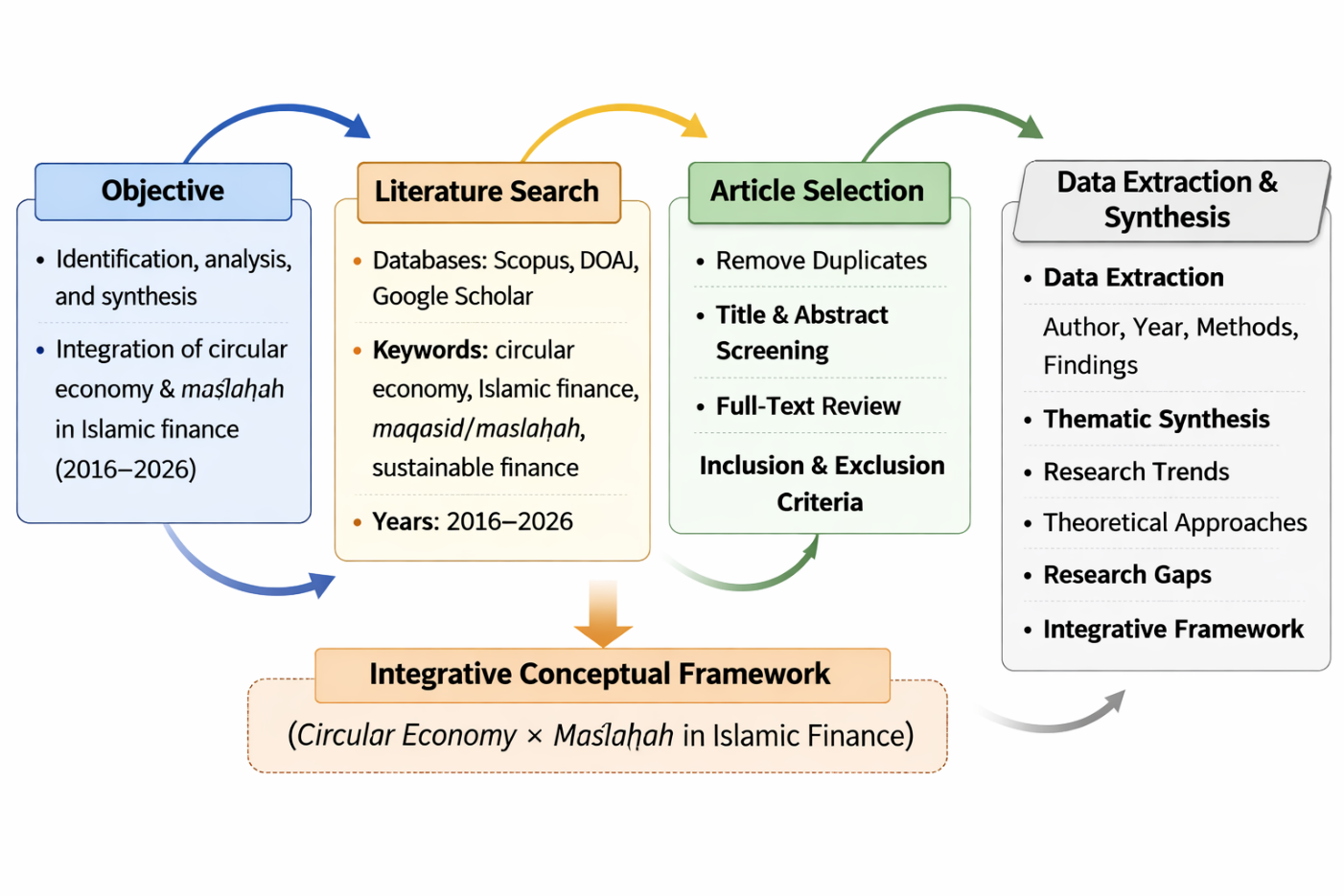
This study employs a qualitative approach using the Systematic Literature Review (SLR) method to comprehensively analyze and synthesize the literature on the integration of circular economy concepts with the principle of maṣlaḥah in Islamic financial institutions. The research purpose is to identify conceptual and empirical developments over the past decade, map research trends, classify the theoretical approaches employed, and uncover existing research gaps. The SLR approach is selected because it provides a systematic, transparent, and replicable synthesis of the literature, thereby generating a more structured knowledge mapping compared to traditional narrative reviews.
The literature search strategy was conducted systematically through several reputable academic databases, including Scopus and DOAJ, with Google Scholar used as a supporting database. The search keywords were combined using Boolean operators (AND, OR), including: “circular economy,” “Islamic finance,” “maqasid al-shariah,” “maslahah,” “sustainable finance,” “green sukuk,” and “Islamic financial institutions.” The search process was limited to articles published between 2016 and 2026 to ensure relevance and recency. Furthermore, only articles published in indexed scientific journals and subjected to peer-review were considered during the initial identification stage.
Inclusion and exclusion criteria were established to ensure the quality and relevance of the analyzed literature. The inclusion criteria comprised: (1) scholarly articles addressing circular economy, Islamic finance, or the integration of maqāṣid/maṣlaḥah with sustainability; (2) conceptual or empirical studies relevant to Islamic financial institutions; (3) articles published in English or Indonesian; and (4) publications within the last ten years. The exclusion criteria included: (1) non-scholarly works such as opinion pieces, non–peer-reviewed conference proceedings, and popular reports; (2) studies lacking direct relevance to the Islamic financial system; and (3) duplicate articles across databases. The screening process was conducted in stages through title, abstract, and full-text review.
The selection and data extraction stages were carried out by adopting a systematic workflow resembling the PRISMA protocol, beginning with identification, screening, eligibility assessment, and final inclusion. The selected articles were analyzed in depth to extract essential information, including authorship, year of publication, research objectives, methodology employed, main findings, and theoretical and practical implications. The extracted data were subsequently classified based on major themes, conceptual approaches, and contributions to the integration of circular economy principles and maṣlaḥah. The synthesis was conducted using a thematic synthesis approach to develop an integrative conceptual framework capable of enriching the theoretical and practical development of sustainability-based Islamic financial institutions, as illustrated in Figure 1.
Result and Discussions
As part of the synthesis stage in this Systematic Literature Review (SLR), all selected articles were analyzed and categorized based on similarities in research focus, conceptual orientation, and key variables examined. This classification process aims to map the research landscape in a more structured manner, thereby clearly identifying thematic tendencies, concentrations of discussion, and the contributions of each research cluster to the development of discourse on the integration of circular economy and maqāṣid-based Islamic finance. Through this mapping, it becomes possible to distinguish areas that have developed conceptually and practically, as well as domains that still require further scholarly investigation. Table 1 presents the results of the systematic thematic classification of the literature according to related fields or research focuses.
Table 1. Thematic Classification and Literature Synthesis on Circular Economy Integration, Maqāṣid al-Sharī‘ah, and Islamic Finance
| No | Field / Research Focus | Authors | Key Insights / Main Research Variables |
| 1 | Conceptualization and Circular Economy Paradigm | Mashadi (2024); Ayu et al. (2025); Fahmi et al. (2021) | Growth of circular economy literature; alternative paradigm to the linear economy; restorative–regenerative system; resource efficiency; integration of economic–social–environmental dimensions; transition in production and consumption models; policy and regulatory support for sustainable development. |
| 2 | Sustainability Integration in Islamic Finance | Kurniawan et al. (2025); Mintarsih (2025); Handayani & Batubara (2026) | Islamic social finance; Sharia-compliant green financing; compatibility of asset-backing and risk-sharing with sustainability; opportunities for real-sector financing; dominance of normative–conceptual approaches; need for operational circular economy models within Islamic financial institutions. |
| 3 | Strengthening Maqāṣid and Maṣlaḥah in Modern Economics | Ma’arif (2025); Mashadi (2025); Algifari & Andrini (2024) | Systemic reinterpretation of maqāṣid; expansion from protection of five essential necessities toward collective development; maqāṣid as an ethical–institutional foundation; distributive justice; efficiency and social stability; normative legitimacy of sustainable economics. |
| 4 | Ecological Dimension of Maqāṣid and Islamic Financial Ethics | Rusmiati & Mahmud (2025); Isnaeni (2025); Arjayanda et al. (2025) | Strengthening ecological dimension within maqāṣid; concept of khalīfah and environmental responsibility; integration of ethics, governance, and sustainability; circular economy as a practical manifestation of maṣlaḥah; resource sustainability and economic inclusivity. |
| 5 | Instruments and Implementative Practices (Green Finance & ESG) | Alsafy et al. (2025); SUADI (2018); Purwanto (2024) | Green sukuk; asset-based project financing; risk-sharing; ESG integration in Islamic banking; governance and accountability; sustainability instrument design; linkage between financial activities and the productive real sector. |
| 6 | Evaluation, Indicators, and Implementation Research Gaps | Majid (2025); Muallimah (2025); Kamal et al. (2026) | Absence of standardized maqāṣid-based indicators; separation between ESG and Sharia governance; weaknesses in quantitative evaluative methodology; need for integrative socio–ecological measurement frameworks; urgency of systemic maqāṣid-based implementation models. |
Development and Characteristics of Research on the Integration of Circular Economy in Islamic Finance
The development of the literature indicates that the circular economy has experienced significant growth as an alternative paradigm to the linear economic model, particularly within global sustainability discourse [16]. This increase is reflected not only in the number of scientific publications but also in the expansion of research domains encompassing public policy, supply chain management, and financial systems. Conceptually, the circular economy is understood as a restorative and regenerative system by design, aiming to minimize waste and maintain material value within closed loops [17]. The concept emphasizes a transition from the “take–make–dispose” pattern toward production and consumption models grounded in resource efficiency and sustainable design innovation. Within development policy frameworks, the circular economy is positioned as a strategic instrument for achieving long-term sustainability by integrating economic, social, and environmental dimensions . Thus, it is not merely a technical waste-management approach but a systemic transformation requiring regulatory frameworks, economic incentives, and behavioral changes among producers and consumers.
In the domain of Islamic finance, sustainability discourse has begun to integrate through Islamic social finance approaches and Sharia-compliant green financing mechanisms [18]. This integration is driven by the recognition that Islamic financial institutions carry ethical and social mandates beyond mere intermediation functions. Empirical studies suggest that Islamic financial instruments possess inherent compatibility with sustainability agendas due to their asset-backed structure and avoidance of speculation [19]. These characteristics create opportunities to finance productive real-sector activities, including environmentally friendly projects and circular economy-based enterprises. However, most existing studies remain normative and conceptual in nature and have not explicitly developed operational circular economy models within Islamic financial institutions [20]. This gap highlights the need for an integrative framework that not only affirms value compatibility but also formulates financing mechanisms, performance indicators, and governance structures capable of systemically internalizing circular economy principles into Islamic financial industry practices.
Interpretatively, the literature suggests that the integration of the circular economy into Islamic finance remains in its early developmental stage. The circular economy first evolved within industrial and public policy contexts, subsequently entered sustainable finance discourse, and only more recently became associated with Islamic finance. This trajectory indicates that integration has been largely responsive to global sustainability trends rather than grounded in an internally constructed theoretical framework of Islamic economics. From a research characteristics perspective, most studies remain normative and conceptual, emphasizing value alignment between maqāṣid al-sharī‘ah and sustainability principles. Nevertheless, the development of operational models, measurable performance indicators, and systemic implementation frameworks within Islamic financial institutions remains limited. Furthermore, the literature tends to be fragmented, addressing green finance, ESG, and Islamic social finance separately without an integrative synthesis. Consequently, research over the past decade has emphasized normative legitimacy more than institutional and operational strengthening.
Construction of Maṣlaḥah and Maqāṣid al-Sharī‘ah as Normative Foundations
The concept of maṣlaḥah within the framework of maqāṣid al-sharī‘ah has undergone significant development in contemporary literature and is increasingly positioned as an adaptive normative approach to modern socio-economic dynamics [21]. A systemic interpretation of maqāṣid enables a reinterpretation of Sharia objectives beyond the protection of the five essential necessities toward a broader framework of collective welfare and long-term sustainability [22]. In modern Islamic economic thought, maqāṣid is no longer narrowly perceived as a tool of legal justification but as an ethical and institutional foundation for an economic system emphasizing distributive justice, efficiency, and social stability [23]. Thus, maqāṣid functions as a normative framework bridging Sharia principles and the demands of global economic transformation.
Contemporary Islamic economic literature further demonstrates the strengthening of ecological dimensions within maqāṣid, particularly through the emphasis on humanity’s role as khalīfah in maintaining environmental balance [24]. The integration of ethical values, social responsibility, and sound governance in Islamic financial practice is viewed as a strategic instrument for realizing broader public welfare [25]. Within this framework, the circular economy can be interpreted as a practical manifestation of maṣlaḥah, emphasizing resource sustainability, environmental harm reduction, and inclusive economic value creation [26]. Accordingly, the literature synthesis indicates that the integration of the circular economy and maqāṣid extends beyond normative compatibility and holds epistemological potential to shape a more transformative and sustainability-oriented paradigm of Islamic finance.
The literature further reveals a shift in the construction of maqāṣid al-sharī‘ah from a legalistic toward a substantive and systemic approach, wherein maqāṣid is no longer merely used to legitimize existing financial products but is positioned as a paradigm guiding economic transformation. In the context of the circular economy, maṣlaḥah is interpreted as an effort to preserve resource sustainability and prevent intergenerational harm, thereby framing environmental sustainability as an inherent objective of Sharia rather than an externally adopted agenda. Nonetheless, the evaluation of the literature shows that this construction remains predominantly conceptual and argumentative. Most studies stop at affirming value compatibility between maqāṣid and sustainability without formulating operational models, measurable performance indicators, or standardized financing frameworks for Islamic financial institutions. As a result, maqāṣid often functions as a normative ethical reference rather than an applicable governance and evaluation instrument, leaving a gap between theoretical formulation and institutional implementation in supporting the circular economy.
Integration Models and Research Gaps in Implementation
Models of circular economy integration in Islamic finance have begun to take shape through the development of green sukuk instruments and asset-based financing for environmentally friendly projects, conceptually aligned with the real-sector financing principles of Islam . The characteristics of risk-sharing and asset-backing in Islamic finance are considered to provide a structural foundation for long-term sustainable project financing by encouraging direct linkages between financial activities and productive economic sectors [27]. Additionally, the integration of Environmental, Social, and Governance (ESG) frameworks within Islamic banking is viewed as a strategic step to strengthen governance, transparency, and accountability in supporting the transition toward a green economy [28]. Descriptively, these findings indicate that circular economy integration in Islamic finance has moved beyond normative discourse and entered the domain of instrument design and institutional practice.
However, the literature evaluation reveals several fundamental limitations. One major weakness is the absence of standardized and quantitatively applicable maqāṣid-based sustainability performance measurement instruments [29]. Existing indicators tend to separate global sustainability dimensions from Sharia governance, thereby failing to comprehensively integrate circular economy principles within Islamic normative frameworks . This condition reflects a gap between product innovation and methodological evaluation strengthening. Consequently, the literature underscores the urgency of developing integrative evaluation frameworks capable of bridging the normative values of maqāṣid with operational practices in Islamic financial institutions, ensuring that contributions to the circular economy are not merely declarative but measurable and systemic [30]. Future research should therefore focus on constructing implementative models that unify product design, governance mechanisms, and social–ecological impact indicators grounded in maqāṣid.
Based on the literature review, patterns of circular economy integration within Islamic financial institutions can be classified into two primary tendencies: instrumental and paradigmatic approaches. The instrumental approach positions the circular economy as an object of financing through product innovation and financial instruments supporting environmentally oriented projects. In contrast, the paradigmatic approach situates maṣlaḥah as a normative foundation for transforming governance structures and institutional orientations so that sustainability is systemically internalized within operational activities. Nevertheless, most identified implementations remain limited and sectoral, focusing more on expanding green financing portfolios than on restructuring business models and maqāṣid-based performance evaluation systems.
Critical analysis of the literature also reveals several research gaps, including the absence of a comprehensive and integrated implementation framework connecting circular economy principles with maqāṣid indicators within Islamic financial management systems; limited standardized maṣlaḥah-based instruments for measuring social and ecological impact; and the scarcity of quantitative empirical evidence on the effectiveness of circular financing in achieving economic and social sustainability outcomes. Furthermore, dimensions such as transition risk, regulatory support, institutional readiness, and multidisciplinary approaches integrating environmental economics, financial governance, and maqāṣid theory remain underexplored, thereby opening opportunities for more holistic and applicable future research. The evolution of research variables on maqāṣid-based circular economy integration in Islamic finance during the 2016–2026 period is illustrated in Figure 2.
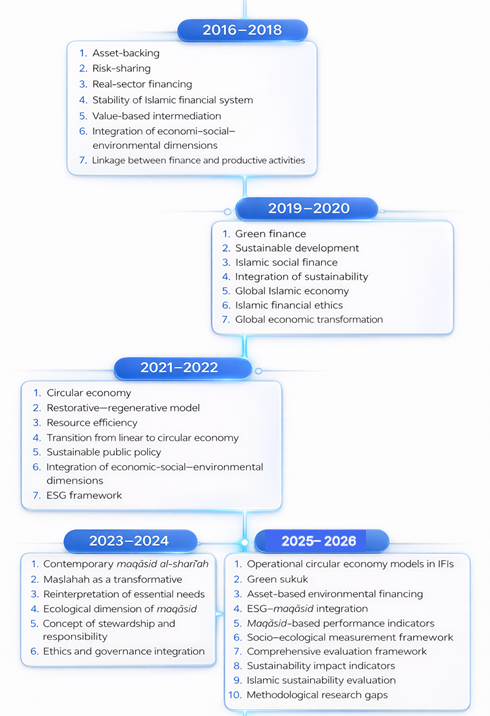
Figure 2 illustrates that the development of keywords and research variables reflects a gradual yet progressive conceptual evolution within the literature on Islamic finance and the circular economy. In the initial phase, scholarly attention remained concentrated on the structural foundations of Islamic finance, such as asset-backing, risk-sharing, real-sector financing, and anti-speculative principles, which emphasize ethical distinctiveness and systemic stability compared to conventional financial systems. In the subsequent phase, research variables began to shift toward the integration of sustainability issues, including green finance, Islamic social finance, and contributions to sustainable development. This transition marked an expansion of focus from financial stability toward broader social and environmental responsibility. Thereafter, the circular economy emerged as a central paradigm, emphasizing restorative–regenerative models, resource efficiency, and the integration of economic, social, and environmental dimensions. This development signified a transformation from a sectoral approach to a more systemic orientation. The progression was further reinforced by the reinterpretation of maqāṣid al-sharī‘ah and maṣlaḥah within the framework of sustainable development, including the strengthening of the ecological dimension and the concept of khalīfah (stewardship) as a normative foundation for environmental responsibility. In its most recent stage, research variables have advanced toward the construction of more operational and implementative models, such as green sukuk, ESG–maqāṣid integration, maqāṣid-based performance indicators, and standardized socio-ecological impact measurement. Overall, this dynamic trajectory indicates a shift from normative compatibility toward the necessity of systemic integration and measurable evaluative methodologies. Contemporary research no longer rests on conceptual justification alone, but increasingly focuses on institutional design and measurement instruments capable of operationalizing a maṣlaḥah-based circular economy in a sustainable and practical manner.
Conclusion
Based on the synthesis and evaluation of the literature, it can be concluded that the integration of the circular economy into Islamic finance possesses a strong conceptual and normative foundation grounded in the framework of maqāṣid al-sharī‘ah and the principle of maṣlaḥah. However, it remains at an early stage in terms of operational and institutional development. Over the past decade, the literature has predominantly emphasized value-based legitimacy and the ethical compatibility between sustainability and Sharia principles, while the development of implementative models, measurable performance indicators, and systemic governance mechanisms has remained relatively limited. Accordingly, future research should focus on constructing an integrated maqāṣid-based circular economy implementation framework embedded within the management of Islamic financial institutions. Further priorities include the development of quantitative evaluation instruments to measure maṣlaḥah-based socio-ecological impacts, as well as empirical testing of the effectiveness of circular financing in advancing sustainability objectives. A multidisciplinary approach—linking environmental economics, financial governance, and maqāṣid theory—is essential to ensure that the envisioned transformation does not remain confined to normative discourse, but is translated into measurable and sustainable institutional practices.
References
- Algifari, M. A., & Andrini, R. (2024). Maqasid Syariah dalam Pengembangan Ekonomi Islam (Analisis Komprehensif dan Implementasi). JoSES: Journal of Sharia Economics Scholar, 2(3), 95–100. DOI ↗ Google Scholar ↗
- Alsafy, M. A. M., Abd-Elhafeez, H. H., Rashwan, A. M., Erasha, A., Ali, S., El-Gendy, S. A. A., SaThierbach, K., Petrovic, S., Schilbach, S., Mayo, D. J., Perriches, T., Rundlet, E. J. E. J. E. J., Jeon, Y. E., Collins, L. N. L. N., Huber, F. M. F. M., Lin, D. D. H. D. H., Paduch, M., Koide, A., Lu, V. T., … Owlia, P. (2025). Pemikiran Seyyed Hossein Nasr Tentang Etika Lingkungan Dan Ekonomi Hijau Dalam Islam. Frontiers in Veterinary Science, 13(1), 1–16. DOI ↗ Google Scholar ↗
- Anisah, A., & Gucandra, Y. (2025). Strategi Meningkatkan Literasi Keuangan Syariah Melalui Pengajaran Pendidikan Agama Islam. Krigan: Journal of Management and Sharia Business, 3(2), 178–198. DOI ↗ Google Scholar ↗
- Arjayanda, M., Arifin, M., & Fahmi, C. (2025). Pertambangan Emas Di Kecamatan Sawang Dalam Perspektif Maqashid Al- Syari ’ Ah. Integrative Perspectives of Social and Science Journal (IPSSJ), 2(3), 6156–6168. DOI ↗ Google Scholar ↗
- Ayu, K. G., Harsono, D., Junaedi, J., Khoiri, S., & Riry, F. M. (2025). GreenXChange Sebagai Aplikasi Transformasi Digital Berbasis Chatbot AI Pada Bank Sampah Berlian. Jurnal Masyarakat Madani Indonesia, 4(4), 1132–1139. DOI ↗ Google Scholar ↗
- Cahya Oktaviana, T., & Abdurrahman Wahid Pekalongan, U. K. (2025). Potensi Industri Halal dalam Meningkatkan Ekonomi Digital: Studi Kasus pada Shopee Barokah. Jurnal Sahmiyya, 4(1), 133–140. DOI ↗ Google Scholar ↗
- Fahmi, R. A., Adi, A., Novianti, D., Fisman, T., & Manajemen, A. ". (2021). Integrasi Instrumen Islamic Social Finance Dalam Mendukung Ekonomi Sirkular: Analisis Literatur Dan Kerangka Konseptual. Ejurnal.Iainpare.Ac.Id, 04(01), 24–43. DOI ↗ Google Scholar ↗
- Handayani, N., & Batubara, S. (2026). Ekonomi makro islam menurut umar chapra: relevansi dalam mencapai pertumbuhan ekonomi yang inklusif dan berkelanjutan. AZ-ZAIDA JURNAL ILMU MULTIDISIPLIN, 2(1), 347–361. DOI ↗ Google Scholar ↗
- Isnaeni, F. (2025). Integrasi Hadits Nabi Tentang Konsep Budgeting Berbasis Maqāṣid Dalam Menyeimbangkan Efisiensi dan Tanggung Jawab Sosial. Hatta: Jurnal Pendidikan Ekonomi Dan Ilmu Ekonomi, 3(2), 113–123. DOI ↗ Google Scholar ↗
- Jasmin, S. P., HL, R., & Sultan, L. (2025). Logika Maqāṣid Al-Syarī‘ah Sebagai Paradigma Kritik Dalam Rekonstruksi Hukum Islam. Ekspose: Jurnal Penelitian Hukum Dan Pendidikan, 24(2), 349–362. DOI ↗ Google Scholar ↗
- Kamal, A. A., Habibullah, S., Karunianing, U. K., Nita, D. M., Islam, U., Raden, N., & Lampung, I. (2026). Pengembangan ekonomi dan lembaga keuangan melalui pendekatan filsafat ekonomi islam. JPSDa: Jurnal Perbankan Syariah Darussalam, 6(1), 152–168. DOI ↗ Google Scholar ↗
- Kurniawan, H., Gunawan, R., & Rahayu, S. (2025). Green Economy dalam Perspektif Ekonomi Syariah : Solusi untuk Pembangunan Berkelanjutan. Prosiding Seminar Nasional Teknologi Komputer Dan Sains, 3(1), 361–368. DOI ↗ Google Scholar ↗
- Majid, A. (2025). Analisis Konsep dan Aplikasi Maqashid Syariah Dalam Pengelolaan Keuangan Syariah. Syarikat: Jurnal Rumpun Ekonomi Syariah, 8(2), 442–453. DOI ↗ Google Scholar ↗
- Marunta, R. A., Arabia, N., & Bachtiar, I. A. (2025). Economics and Digital Business Review Membangun Pertumbuhan Ekonomi Berkelanjutan Berbasis. Economics and Digital Business Review, 7(1), 223–234. DOI ↗ Google Scholar ↗
- Mashadi, A. I. (2024). Ekonomi Sirkular Berbasis Syariah: Solusi untuk Pembangunan Berkelanjutan. FADZAT Jurnal Ekonomi Syariah, 5(1), 1–7. DOI ↗ Google Scholar ↗
- Mashadi, A. I. (2025). Teologi Islam Kontemporer dan Etika Lingkungan: Pendekatan Maqasid Dalam Mewujudkan Keberlanjutan. FADZAT: Jurnal Ekonomi Syariah, 5(2), 1–12. DOI ↗ Google Scholar ↗
- Masruroh, N. (2026). Maqāṣid al-Sharī ‘ah sebagai Landasan Paradigmatik Pengembangan Produk Keuangan Syariah. Journal of Shariah Law Review, 1(1), 51–59. DOI ↗ Google Scholar ↗
- Maydina, N., & Jannah, M. A. F. (2025). Green Sukuk dan Sustainable Finance: Potensi Pengembangan di Pasar Modal Syariah Indonesia. Jurnal Sahmiyya, 4(2), 488–499. DOI ↗ Google Scholar ↗
- Mimin Mintarsih. (2025). Tantangan Regulasi dalam Pengembangan Industri Keuangan Syariah di Indonesia. AL-AMWAL: Jurnal Ekonomi Dan Perbankan Syariah, 3(1), 19–24. DOI ↗ Google Scholar ↗
- Muallimah, S. (2025). Menyelaraskan Keuangan Hijau dengan Maqāṣid al-Syarī‘ah: Paradigma Islam untuk Pembangunan Berkelanjutan. Sanaamul Quran: Jurnal Wawasan Keislaman, 6(2), 75–96. DOI ↗ Google Scholar ↗
- Mulyawan, A. W., Hafid, A., & Majid, J. (2025). Konstruksi Filosofis dan Konseptual Sistem Keuangan Syariah: Menuju Tata Kelola Nilai dan Keberlanjutan di Indonesia. DIRASAH: Jurnal Kajian Islam, 2(4), 471–482. DOI ↗ Google Scholar ↗
- Nafis, A. W. (2026). Etika Lingkungan dalam Islam dan Implementasinya dalam Kebijakan Publik. Journal Syariah Law Review, 1(1), 41–50. DOI ↗ Google Scholar ↗
- Nurbaba, G. (2025). Penerapan Prinsip Maqāṣid Al-Sharī’ah Dalam Rancang Bangun Sistem Ekonomi Islam Di Indonesia: Rancang Bangun Ekonomi Islam. At-Tanmiyah Jurnal Ekonomi Dan Bisnis Islam, 4(2), 10–21. DOI ↗ Google Scholar ↗
- Purwanto, H. (2024). Integrasi Prinsip ESG (Environmental, Social, Governance) Dalam Perbankan Syariah. Studia Economica : Jurnal Ekonomi Islam, 10(2), 240–250. DOI ↗ Google Scholar ↗
- Raudah, E., Faizin, M., Akbar, M. R., Haqqi, M., & Setyanoor, E. (2025). Moneter Syariah dan Ekonomi Hijau: Integrasi untuk Keberlanjutan Ekonomi Islam. Ahsan: Jurnal Ilmiah Keislaman Dan Kemasyarakatan, 2(1), 141–151. DOI ↗ Google Scholar ↗
- Roifah, T. N. (2026). Integrasi Ekonomi Islam Dan Circular Economy Untuk Pembangunan. JSE: Jurnal Sharia Economica, 5(1), 266–283. DOI ↗ Google Scholar ↗
- Rusmiati, I. F., & Mahmud, H. (2025). Dakwah Ekologis Khalifah: Telaah Al-Baqarah Ayat 30 dan Relevansinya terhadap Sustainability Management. Journal of Da’wah, 4(1), 49–75. DOI ↗ Google Scholar ↗
- Savila, I. D., & Chariri, A. (2025). Optimalisasi Kinerja Inovasi: Mengungkap Pengaruh Intellectual Capital Terhadap Nilai Perusahaan. Owner, 9(2), 965–976. DOI ↗ Google Scholar ↗
- SUADI, A. (2018). Peluang Dan Tantangan Lembaga Keuangan Syariah Dalam Menghadapi Era Pasar Bebas / Opportunities and Challenges of Sharia Financial Institutions in Dealing With Free Market. Jurnal Hukum Dan Peradilan, 7(1), 1. DOI ↗ Google Scholar ↗
- Supria Wiguna, M., & Artikel, I. (2024). Bibliometric Analysis Integrating Halal Supply Chain and Circular Economy Principles. Islamic Economic, Accounting, and Management Journal, 5(2), 1–13. DOI ↗ Google Scholar ↗
- Toha Ma’arif. (2025). Relevansi Konsep Nafkah dalam Hukum Keluarga Islam terhadap Dinamika Kehidupan Modern. Al Fuadiy: Hukum Keluarga Islam, 7(2), 96–109. DOI ↗ Google Scholar ↗
- Wahyu Prihatanti, V., Ahsan, M., & Samsuri, A. (2025). Peran Perbankan Syariah Dalam Mendorong Pertumbuhan Ekonomi Umkm Berbasis Green Economy: Systematic Literature Review (SLR). Jurnal Ilmiah EDUNOMIKA, 09(04), 272–281. DOI ↗ Google Scholar ↗
- Wati, H., Rochmmah, H. N. A., & Huda, Q. (2025). Green Sukuk: Sinergi Pasar Modal Syariah dan Keuangan Berkelanjutan. UTILITY: Jurnal Ilmiah Pendidikan Dan Ekonomi, 8(2), 82–92. DOI ↗ Google Scholar ↗
- Yulianto, A., & Manurung, A. H. (2026). Analisis determinan integrasi keuangan islam dalam transisi keuangan islam berkelanjutan. Journal of Capital Markets and Banking, 14(1), 18–50. DOI ↗ Google Scholar ↗