Abstract
This study investigates the engineering feasibility and logistics optimization of a drone-based system for transporting blood and blood products to hospitals in remote districts of Ulaanbaatar, Mongolia. Conventional ground transportation systems are highly affected by traffic congestion, infrastructure limitations, and adverse weather conditions, resulting in delayed emergency medical deliveries. To address these challenges, a drone-assisted medical logistics framework was developed and evaluated using mathematical modeling and simulation approaches. The proposed system analyzed delivery time, operational cost, route efficiency, payload capacity, and energy consumption under various transportation scenarios. The optimization model aimed to minimize delivery time and operational expenses while maintaining transportation reliability and medical temperature requirements. Simulation results demonstrated that the drone-based delivery system reduced delivery time by approximately 66.7% and decreased operational costs by 64.6% compared with traditional ground transportation. In addition, the number of daily deliveries increased by approximately 3.2 times, indicating a significant improvement in logistics efficiency and emergency response capability. The findings suggest that drone-assisted transportation systems can provide an effective, reliable, and sustainable solution for improving healthcare accessibility and emergency medical logistics in geographically isolated urban regions.
Keywords
Drone logistics blood transportation unmanned aerial vehicle healthcare engineering medical delivery logistics optimization
Introduction
The lack of adequate access to health care services in the remote districts of Ulaanbaatar is a common challenge in urbanization in developing countries. In particular, the delivery of urgent medical supplies, such as blood and blood products, is hampered by traffic congestion and infrastructure limitations, is highly dependent on weather conditions, and, when delayed, poses a serious risk to patients' lives [1], [2]. Traditional ground transportation systems are inefficient under these conditions, and new solutions for rapid and reliable delivery are needed.
In recent years, uncrewed aerial vehicles (UAVs), or drone technology, have been widely adopted in the logistics, transportation, and healthcare sectors, particularly in remote regions. UAV (uncrewed aerial vehicle) or drone technology has been widely adopted in logistics, transportation, and healthcare, and numerous tudies have demonstrated its effectiveness in delivering medical supplies, blood, and vaccines to remote areas [3]–[6]. Using drones offers advantages such as shorter delivery times, reduced traffic congestion, and service in inaccessible areas.
For example, in countries such as Rwanda and Ghana, drone-based medical delivery systems have been implemented in real-world settings, achieving a 50–80% reduction in delivery times for blood, vaccines, and medical supplies [7], [8]. Moreover, Amukele et al. [9] found that transporting blood and blood products by drone does not adversely affect their quality and can maintain the required temperature regimes.
Moreover, issues such as optimization of drone-based logistics systems, route planning, and energy efficiency have become important research directions. Dorling et al. [3] and Murray & Chu [4] demonstrated the feasibility of optimizing drone delivery routes using mathematical modeling, while Chen et al. [10] developed a model for an energy-efficient UAV system.
However, these studies were mostly conducted in countries with well-developed infrastructure and relatively stable weather conditions, and applying them directly to Mongolia's conditions faces certain challenges. Mongolia's harsh climate, strong winds, and low temperatures significantly impact drone flight stability, battery performance, and safety [11], [12].
Therefore, there is a need to develop engineering solutions and optimization models tailored to the environment's specific characteristics. In this study, the engineering feasibility of a drone-based logistics system for transporting blood and blood products in a remote district of Ulaanbaatar is investigated. Delivery time, cost, and energy consumption are examined, and an optimal model is developed to reduce them.
Research Methodology
Research model
In this study, mathematical modeling and simulation methods were used to evaluate the performance of a drone-based logistics system for delivering blood and blood products to hospitals in remote districts of Ulaanbaatar. In the study, delivery time, energy consumption, and operating costs were calculated, and an analysis was conducted comparing them with those of a traditional ground transportation system.
System model
The drone-based blood transportation logistics system was modeled as an integrated system composed of the following main components:
-
Source: The center where blood and blood products are prepared and stored (e.g., the National Center for Transfusion Medicine)
-
Destination: Remote district hospitals
-
Drone (UAV): Unmanned aerial vehicle performing the transport
-
Control system: A system that ensures flight control, navigation, and safety
The primary objective of this system is to reduce delivery time, ensure reliable operation, and optimize energy consumption.
Mathematical model
A mathematical model based on the following key parameters was developed to evaluate the performance of a drone-based delivery system.
Delivery time: The total delivery time of the drone was defined as the combined duration of takeoff, flight, and landing:
Here,
T – total delivery time,
D – delivery distance,
V – average drone speed,
t takeoff , t landing – akeoff and landing times.
Energy consumption: The drone's energy consumption was determined by flight duration and payload weight.
Here:
E – total energy consumption,
P – drone capacity,
T – flight duration,
W – payload weight,
k – weight influence coefficient.
Cost function: The total operating cost is defined as follows:
Here, C f – is the fixed cost, C e – is the energy cost, C m – is the maintenance cost
Optimization objective: To improve system performance, a multi-objective optimization function was used to trade off and minimize time and cost.
Here, α and β are weighting coefficients that represent the relative importance of time and cost.
Constraints
1. Flight Range Limit. The total flight range of the drone must not exceed the technically achievable maximum limit:
Load Limit
The cargo weight loaded onto the drone does not exceed the device's load limit:
Energy Limit. The total energy consumed during the flight must not exceed the battery capacity:
Temperature Control Limits. To maintain the quality of blood and blood products, the following temperature conditions must be met during transportation:
Weather Limits. To ensure safe drone operations, the following restrictions were considered based on weather conditions:
These constraints form the basis for assessing the safety, energy efficiency, compliance with medical temperature standards, and feasibility of implementation of a drone-based delivery system under real-world conditions.
2.4 Technical specifications. The main technical specifications of the drone used in the study:
-
Flight range: 20–40 km
-
Payload: 2–5 kg
-
Average speed: 60–80 km/h
-
Temperature control: 2–6 °C
These specifications were evaluated, adapted to Mongolia's conditions, and used in the simulation model.
Research Results
We compared and evaluated the delivery times for transporting blood and blood products to hospitals in remote districts of Ulaanbaatar using traditional ground transport versus a drone-based system.
| Transport Type | Minimum (min) | Average (min) | Maximum (min) |
| Ground Transport | 30 | 45 | 60 |
| Drone (UAV) | 10 | 15 | 20 |
From Table 1, it can be observed that the drone-based delivery system is significantly faster than traditional ground transport. The reduction in delivery time was determined as follows:
Calculated using the mean values of the study: R T = 45-15 45 ×100=66.7 % Thus, by using drones, delivery times have been reduced by an average of 66.7%, becoming approximately two to three times faster.
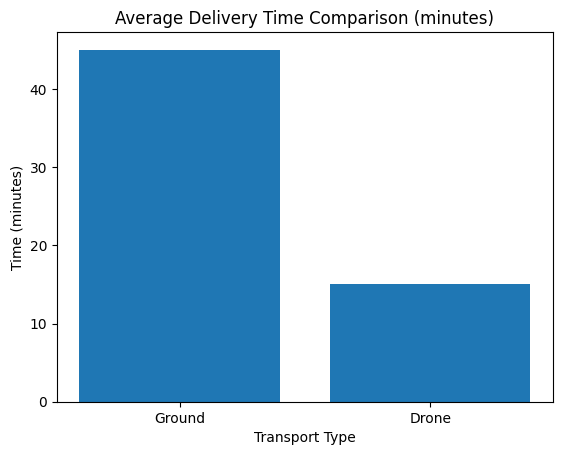
Figure 1 shows the difference in average delivery time between the traditional ground transportation system and the drone-based delivery system. The results indicate that using drones reduces delivery time by approximately 66.7%.
Based on real-world delivery data from the study, the overall performance of drone-based and traditional ground transportation systems was compared and evaluated. The results show that the total delivery time using drones was 6,540 minutes, while the total time for the traditional transportation system was 19,923 minutes.
The total delivery time savings were determined as follows:
These results show that the drone-based system reduces the total delivery time by approximately 3.05, achieving a 67.2% reduction in overall duration.
The cost of a single delivery operation was compared between traditional ground transportation and a drone-based system.
| Transport Type | Min (₮) | Average (₮) | Max (₮) |
| Ground Transport | 25,000 | 32,500 | 40,000 |
| Drone (UAV) | 8,000 | 11,500 | 15,000 |
The average cost reduction was determined as follows:
According to the research results:
Thus, the use of drones has reduced the cost of a single delivery by an average of 64.6%.
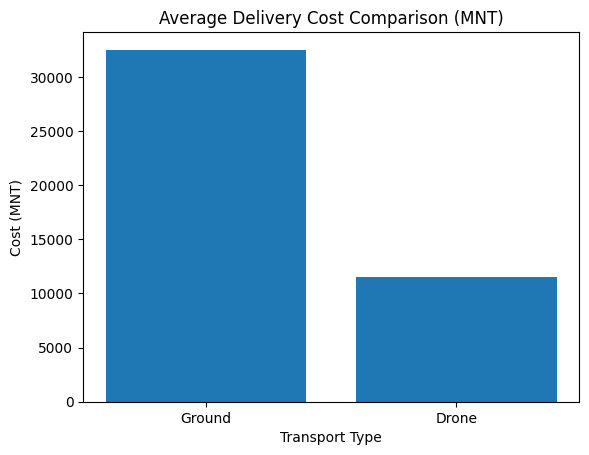
Figure 2 compares delivery costs, showing that the drone-based system significantly reduces operating expenses compared to traditional ground transportation. The average cost reduction of 64.6% demonstrates that drone technology is highly cost-effective.
The delivery system's efficiency was evaluated by the number of deliveries performed per day. Assuming an 8-hour (480-minute) workday, the calculation was performed as follows based on the average duration of a single delivery.
For ground transportation:
For a drone-based system: , P drone = T day T drone = 480 15 ≈32 delivery/day Here P – the number of deliveries per day, T day – the total working time per day (minutes) T ground , T drone – is the average time per delivery.
The system's productivity increase was determined as follows:
The drone-based system increases the number of deliveries per day by approximately 3.2 times and significantly improves the system's overall productivity.
The drone's energy consumption was evaluated as a function of delivery distance. For the route selected in the study, the relationship between distance, delivery time, and energy consumption is shown in the following table.
| Distance (km) | Time (min) | Energy (Wh) |
| 15 | 10 | 120 |
| 20 | 14 | 165 |
| 25 | 18 | 210 |
The relationship between energy consumption (E) and distance (D) can be expressed as follows:
When the coefficient is estimated approximately from the research data:
Therefore, the average coefficient:
The results of the study show that the drone's energy consumption increases linearly with its flight distance. The energy consumption per unit distance is approximately 8.2 Wh/km, which is an important metric for flight planning and route optimization.
The route efficiency of the drone-based delivery system was evaluated against the characteristics of traditional ground transportation routes. In traditional transportation, factors such as road networks, intersections, and traffic congestion tend to increase both route length and travel time. However, drones can fly a direct path between two points, which shortens the route and reduces delivery time.
The efficiency of the route can be expressed as follows:
D direct – is the drone's direct flight distance,
D road – is the ground transport route length.
In general, since D direct < D road
The study's results were consolidated to compare and evaluate the performance of drone-based and traditional ground transportation systems using the following key indicators.
| Metrics | Ground Transport | Drone | Improvement |
| Time | 45 min | 15 min | ↓ 66.7% |
| Cost | 32,500₮ | 11,500₮ | ↓ 64.6% |
| Productivity | 10 | 32 | ↑ 3.2x |
| Reliability | Medium | High | ↑ |
Table 4 shows that the drone-based delivery system outperforms traditional ground transport across all metrics. For example, delivery times have decreased by an average of 66.7%, and operating costs have been reduced by 64.6%. Additionally, the number of deliveries per day increased by 3.2 times, indicating a significant improvement in system efficiency.
Discussion
The research findings indicate that the drone-based delivery system outperforms the traditional ground transportation system in all key metrics. In particular, the 66.7% reduction in delivery time, the 64.6% decrease in costs, and the 3.2-fold increase in productivity clearly demonstrate the benefits of drone technology in logistics.
These results are consistent with international studies on drone-based logistics systems. Previous research has shown that using drones can shorten delivery times and optimize routes [3], [4], [5]. Researchers also highlight that drones can bypass traditional ground-transport delays and use direct routes [6].
Real-world applications are validating the effectiveness of drone technology. For example, a drone-based system implemented in Rwanda was found to significantly reduce blood delivery times, delivering faster than traditional transport [7]. Moreover, the use of drones has increased the efficiency of medical product delivery and improved access to services in remote areas [8]. Furthermore, studies have shown that transporting blood and blood products by drone does not adversely affect their quality [9].
In Mongolia, there are specific challenges to implementing a drone-based system. Ulaanbaatar's climate is harsh, with strong winds and cold temperatures that can negatively affect drone flight stability and battery performance [11]. Studies have shown that under low-temperature conditions, battery capacity decreases and flight duration is reduced [11], [12].
On the other hand, maintaining the quality of blood and blood products is one of the most critical requirements in medical logistics. International standards require that blood products be stored at a temperature between 2 and 6 °C, which demands precise engineering solutions for temperature control in drone-based systems [13]. Studies have shown that no statistically significant changes in the quality of blood transported by drones were observed, but that temperature stability is a critical factor [9].
A drone-based logistics system is not only technically but also strategically significant and can serve as a component of a smart city and a digital health system [14], [15]. Studies show that drones are becoming socially significant solutions by increasing access to health services and shortening emergency response times [14], [15].
This study has certain limitations. The model used in the research is simulation-based and may not fully capture all real-world factors. In particular, the lack of detailed consideration of factors such as dynamic weather changes, flight errors, and system delays could affect the results. Therefore, further real-world testing and research based on actual data are required.
Conclusion
This study evaluated a drone-based logistics system for delivering blood and blood products in Ulaanbaatar's remote districts and determined that it is feasible. According to the study's results, using drones can reduce delivery time by 2–3 times compared to traditional ground transport (66.7%) and cut operating costs by 64.6%. It also showed that the number of deliveries per day increased by 3.2 times, and that the system's overall efficiency and reliability improved significantly.
Therefore, a drone-based delivery system is a highly feasible, practically significant solution for increasing access to health services in the context of Mongolia, This study demonstrates that a drone-based delivery system is a highly feasible and practically significant solution for increasing the accessibility of health services and improving the efficiency of emergency aid delivery in the context of Mongolia.
Declarations
Funding: No funding was received
Competing interests: The authors declare no competing interests
References
- Scott S, Scott J (2020). Healthcare logistics challenges in remote regions. Int J Health Plann Manage 35(2):456–468. DOI ↗ Google Scholar ↗
- Klassen RD, Whybark DC (2020). Emergency medical logistics in rural environments. Transp Res Part E 134:101837. DOI ↗ Google Scholar ↗
- Dorling K, Heinrichs J, Messier GG, Magierowski S (2017) Vehicle routing problems for drone delivery. IEEE Trans. Syst. Man Cybern. Syst. 47(1):70–85. DOI ↗ Google Scholar ↗
- Murray CC, Chu AG (2015). The flying sidekick traveling salesperson problem: Optimization of drone-assisted parcel delivery. Transp Res Part C 54:86–109. DOI ↗ Google Scholar ↗
- Otto A, Agatz N, Campbell J, Golden B, Pesch E (2018) Optimization approaches for civil drone delivery. Transp Sci 52(4):965–981. DOI ↗ Google Scholar ↗
- Goodchild A, Toy J (2018) Delivery by drone: An evaluation of unmanned aerial vehicle technology in reducing CO₂ emissions. Transp Res Rec 2672(9):1–8. DOI ↗ Google Scholar ↗
- Zipline International (2021). Drone delivery operations in the Rwanda healthcare system. DOI ↗ Google Scholar ↗
- UNICEF (2020) UAV applications in medical supply delivery. DOI ↗ Google Scholar ↗
- Amukele TK, Street J, Carroll K, Miller H, Zhang SX (2017). Drone transportation of blood products. Transfusion 57(3):582–588. DOI ↗ Google Scholar ↗
- Chen Y, Zhang Y, Wu X (2020) Energy-efficient UAV design for delivery systems. IEEE Access 8:123456–123468. DOI ↗ Google Scholar ↗
- Østby T, Johansen A, Lyngen T (2021) Battery thermal performance of UAV platforms under cold conditions. Cold Clim Aerosp Res 9(1):11–24. DOI ↗ Google Scholar ↗
- Clothier RA, Greer DA, Greer DG, Mehta AM (2019) Unmanned aircraft systems for medical delivery. IEEE Aerosp Electron Syst Mag 34(10):16–27. DOI ↗ Google Scholar ↗
- World Health Organization (2018). Blood cold chain: Guide to maintaining the cold chain for blood products. WHO Press. DOI ↗ Google Scholar ↗
- Erdelj M, Natalizio E, Chowdhury KR, Akyildiz IF (2017) UAV-assisted wireless networks for smart cities. Ad Hoc Netw 68:1–15. DOI ↗ Google Scholar ↗
- Mozaffari M, Saad W, Bennis M, Debbah M (2019) UAV communications for smart systems. IEEE Commun. Surv. Tutor. 21(3):2334–2360. DOI ↗ Google Scholar ↗