Abstract
The rapid advancement of Artificial Intelligence (AI) is transforming governance practices across higher education institutions worldwide. Universities are increasingly adopting AI technologies to support strategic decision-making, institutional performance monitoring, risk management, resource allocation, and stakeholder engagement. While AI offers significant opportunities to enhance governance effectiveness, it also introduces complex challenges relating to accountability, transparency, privacy, algorithmic bias, and ethical responsibility. These challenges are particularly significant within the Asia-Pacific region, where higher education systems operate under diverse governance structures, regulatory environments, and levels of technological maturity. This review paper critically examines the opportunities, risks, and ethical considerations associated with AI-enabled university governance in the Asia-Pacific region. Drawing upon contemporary literature from higher education governance, artificial intelligence, digital transformation, and responsible AI governance, the paper synthesises current knowledge on the role of AI in supporting institutional governance processes. The review identifies key opportunities including enhanced strategic decision-making, improved institutional performance monitoring, strengthened risk management, increased operational efficiency, and greater stakeholder responsiveness. However, it also highlights significant risks associated with algorithmic bias, lack of transparency, privacy concerns, cybersecurity vulnerabilities, and accountability challenges. Ethical principles including fairness, transparency, accountability, human oversight, and stakeholder participation are identified as essential foundations for responsible AI adoption. Building upon these findings, the paper proposes an AI-Enabled University Governance Framework that integrates AI capabilities, governance functions, ethical principles, moderating factors, governance outcomes, and institutional impacts. The framework provides a conceptual foundation for understanding how universities can leverage AI while maintaining accountability and stakeholder trust. The study contributes to the emerging discourse on digital governance in higher education and offers practical recommendations for university leaders, policymakers, and regulators seeking to support responsible AI-enabled governance across the Asia-Pacific region.
Keywords
Artificial Intelligence University Governance Higher Education AI Governance Ethical AI Digital Transformation Asia-Pacific Higher Education Policy Governance Frameworks Responsible AI.
1. Introduction
The higher education sector is experiencing unprecedented transformation driven by technological innovation, globalization, increasing stakeholder expectations, and growing demands for institutional accountability. Universities are operating in increasingly complex environments characterized by financial pressures, evolving regulatory requirements, international competition, demographic shifts, and rapid digitalisation. In response to these challenges, higher education institutions are increasingly adopting Artificial Intelligence (AI) technologies to enhance decision-making, improve operational efficiency, strengthen risk management practices, and support strategic governance processes. As AI continues to evolve, its influence is extending beyond teaching, learning, and administrative functions into the core governance structures that guide institutional performance and accountability.
Artificial Intelligence refers to a range of technologies capable of performing tasks that typically require human intelligence, including learning, reasoning, prediction, problem-solving, and decision-making. Within higher education, AI applications have expanded rapidly in recent years and now include predictive analytics for student retention, automated administrative processes, institutional performance monitoring, strategic planning, resource allocation, risk assessment, and compliance management. The emergence of generative AI tools has further accelerated institutional interest in AI-driven solutions, prompting universities to reconsider existing governance frameworks and leadership practices. Consequently, AI is increasingly viewed as a strategic asset capable of supporting evidence-based governance and enhancing institutional effectiveness.
The Asia-Pacific region provides a particularly significant context for examining the governance implications of AI adoption. The region comprises some of the world's largest and fastest-growing higher education systems, including those in Australia, China, Singapore, Japan, South Korea, New Zealand, and emerging systems across Southeast Asia and the Pacific Islands. While many universities in the region are investing heavily in digital transformation initiatives and AI technologies, considerable variation exists in governance maturity, technological capability, regulatory environments, institutional autonomy, and resource availability. These differences create diverse opportunities and challenges for AI implementation and governance oversight. Furthermore, governments throughout the region are increasingly promoting AI development as a strategic national priority, placing additional pressure on universities to integrate AI into their operations while ensuring responsible and ethical use.
The growing adoption of AI within universities presents significant opportunities for governance improvement. AI-enabled systems can support governing boards and executive leaders by providing real-time data, predictive insights, and enhanced analytical capabilities that facilitate evidence-based decision-making. AI has the potential to strengthen institutional planning, improve accountability, identify emerging risks, enhance operational efficiency, and support more proactive governance practices. Through advanced data analytics, universities can better understand student outcomes, financial performance, research productivity, workforce requirements, and stakeholder expectations. These capabilities have the potential to transform traditional governance models by enabling more informed and agile decision-making processes.
Despite these opportunities, the integration of AI into university governance raises important concerns regarding accountability, transparency, fairness, privacy, and ethical responsibility. Governance decisions often involve complex social, educational, and ethical considerations that cannot be fully addressed through algorithmic processes alone. The use of AI in decision-making may introduce risks related to algorithmic bias, data security breaches, lack of transparency, diminished human oversight, and unequal outcomes for stakeholders. Questions regarding who is accountable for AI-assisted decisions, how algorithmic decisions can be explained, and how stakeholder trust can be maintained have become increasingly important governance issues. These concerns are particularly relevant in higher education institutions, where governance decisions have direct implications for students, academic staff, professional staff, governments, industry partners, and society more broadly.
Recent scholarship has extensively examined the use of AI in teaching and learning, student engagement, academic integrity, and educational technology. However, comparatively limited attention has been devoted to understanding the implications of AI for university governance, particularly within the Asia-Pacific context. Existing studies often focus on technological implementation rather than governance processes, board oversight, strategic leadership, accountability mechanisms, or ethical governance frameworks. Moreover, much of the current literature originates from North America and Europe, creating a gap in understanding how the unique governance environments of Asia-Pacific universities influence the adoption and governance of AI technologies. Given the diversity of higher education systems across the region and the increasing importance of AI in institutional management, there is a need for a comprehensive review that synthesises current knowledge and identifies emerging governance challenges and opportunities.
This review paper addresses this gap by critically examining the role of Artificial Intelligence in university governance across the Asia-Pacific region. Specifically, the paper explores the opportunities AI presents for enhancing governance effectiveness, the risks associated with AI-enabled decision-making, and the ethical considerations that should guide responsible implementation. Drawing on contemporary literature from higher education governance, technology management, AI ethics, and public sector governance, the review synthesises key themes and identifies emerging trends shaping the future of AI-enabled governance in universities.
The paper is guided by four research questions:
-
How is Artificial Intelligence transforming university governance across the Asia-Pacific region?
-
What opportunities does AI create for improving governance effectiveness and institutional performance?
-
What risks emerge from the use of AI in governance processes and decision-making?
-
What ethical considerations should guide the responsible adoption and governance of AI in universities?
By addressing these questions, the review contributes to the growing discourse on digital governance in higher education and provides insights for governing boards, university leaders, policymakers, and regulators seeking to balance technological innovation with transparency, accountability, and ethical responsibility. The paper further proposes a conceptual understanding of AI-enabled university governance that may inform future research, policy development, and institutional practice across the Asia-Pacific region.
2. Literature Review
2.1 University Governance in the Contemporary Higher Education Environment
University governance has evolved significantly over the past three decades in response to increased accountability requirements, market-oriented reforms, technological advancements, and growing stakeholder expectations. Traditionally, governance in higher education refers to the structures, processes, and relationships through which institutions are directed, controlled, and held accountable (Shattock, 2010). Governance mechanisms typically involve governing councils or boards, executive leadership teams, academic senates, and various committees responsible for strategic oversight, policy development, risk management, and institutional performance monitoring.
The increasing complexity of higher education environments has challenged traditional governance models. Universities are now expected to demonstrate greater transparency, efficiency, responsiveness, and accountability while simultaneously addressing issues such as internationalisation, digital transformation, financial sustainability, research competitiveness, and student success (Marginson, 2018). These pressures have prompted institutions to seek innovative approaches to governance and decision-making, with digital technologies increasingly viewed as critical enablers of governance effectiveness.
Within the Asia-Pacific region, governance structures vary considerably due to differences in political systems, regulatory frameworks, institutional autonomy, and cultural contexts. Universities in Australia and New Zealand generally operate under relatively autonomous governance arrangements, whereas institutions in countries such as China and Vietnam often experience stronger governmental influence over strategic decision-making. Despite these differences, universities across the region face similar governance challenges related to accountability, performance management, and technological adaptation. Consequently, the emergence of Artificial Intelligence (AI) presents both opportunities and challenges for governance systems seeking to enhance institutional effectiveness while maintaining stakeholder trust and legitimacy.
2.2 Artificial Intelligence in Higher Education
Artificial Intelligence refers to computational systems capable of performing tasks that typically require human intelligence, including learning, reasoning, pattern recognition, prediction, and decision-making. Recent advancements in machine learning, natural language processing, predictive analytics, and generative AI have accelerated the adoption of AI technologies across various sectors, including higher education.
The literature demonstrates that AI is increasingly being integrated into university operations. Early applications focused primarily on teaching and learning, including adaptive learning systems, intelligent tutoring systems, and student engagement platforms (Williamson & Eynon, 2020). More recently, universities have expanded AI adoption into administrative and strategic functions such as enrolment forecasting, resource allocation, student retention monitoring, institutional performance analysis, risk management, and strategic planning.
According to Southgate (2020), AI possesses significant potential to improve institutional efficiency and educational outcomes through enhanced data analysis and decision support capabilities. Similarly, Cox et al. (2024) argue that universities across Australia and New Zealand are increasingly leveraging AI and data governance systems to support institutional planning and accountability processes. These developments suggest that AI is no longer confined to operational functions but is becoming an important component of institutional governance and leadership.
The emergence of generative AI technologies has further accelerated institutional interest in AI applications. Universities are increasingly exploring AI-assisted decision-making systems capable of synthesising complex information, generating reports, supporting policy development, and informing strategic planning processes. As a result, AI is becoming embedded within governance activities that were previously dependent on human expertise and judgment.
2.3 Theoretical Perspectives on AI and Governance
Several theoretical perspectives provide a useful lens for understanding the relationship between AI and university governance.
Agency Theory
Agency Theory suggests that governance structures exist to minimise conflicts between organisational leaders and stakeholders by reducing information asymmetries and enhancing accountability (Jensen & Meckling, 1976). AI technologies can support governance objectives by providing real-time information, predictive insights, and enhanced monitoring capabilities. Through improved access to institutional data, governing boards may be better positioned to oversee executive decision-making and institutional performance.
However, Agency Theory also highlights concerns regarding accountability. As governance decisions increasingly rely on AI-generated recommendations, questions emerge regarding responsibility for decision outcomes and the extent to which accountability can be delegated to algorithmic systems.
Stewardship Theory
Stewardship Theory assumes that organisational leaders act in the best interests of their institutions and stakeholders (Davis et al., 1997). From this perspective, AI can serve as a tool that enhances leadership effectiveness by providing accurate information and supporting informed decision-making. Rather than replacing human judgment, AI may strengthen governance by enabling leaders to make more strategic and evidence-based decisions.
Institutional Theory
Institutional Theory suggests that organisations adopt practices perceived as legitimate within their external environments (DiMaggio & Powell, 1983). The increasing adoption of AI within higher education may therefore reflect institutional pressures to demonstrate innovation, competitiveness, and technological sophistication. Universities may implement AI systems not only for operational benefits but also to align with broader societal expectations regarding digital transformation.
These theoretical perspectives collectively suggest that AI adoption in governance is influenced by both functional considerations and institutional legitimacy concerns, highlighting the importance of balancing technological innovation with governance accountability.
2.4 Opportunities of AI in University Governance
The literature identifies several opportunities associated with AI-enabled governance.
Enhanced Decision-Making and Strategic Planning
One of the most frequently cited benefits of AI is its capacity to support evidence-based decision-making. AI systems can process large volumes of institutional data and generate predictive insights that assist governing boards and executive leaders in strategic planning. Universities can utilise AI to forecast student enrolments, identify emerging trends, assess financial sustainability, and evaluate institutional performance.
Oncioiu et al. (2025) argue that AI governance frameworks can significantly improve organisational decision-making by enhancing data quality and supporting knowledge-sharing processes. Such capabilities enable governance bodies to make more informed decisions while responding more effectively to rapidly changing environments.
Improved Risk Management
AI technologies have demonstrated considerable potential in identifying and mitigating institutional risks. Through predictive analytics, universities can identify students at risk of attrition, detect financial irregularities, monitor regulatory compliance, and anticipate operational challenges before they escalate into significant problems.
The literature suggests that AI-supported risk management systems can strengthen governance oversight by providing continuous monitoring capabilities and enabling proactive intervention strategies. Such systems may be particularly valuable for large universities managing complex and diverse operations.
Increased Efficiency and Accountability
AI can automate routine governance activities such as reporting, data analysis, compliance monitoring, and performance evaluation. This automation reduces administrative burdens and allows governance leaders to focus on strategic priorities.
Furthermore, AI-generated dashboards and reporting systems may enhance transparency and accountability by providing real-time access to institutional performance indicators. Improved access to governance information can strengthen stakeholder confidence and support evidence-based accountability mechanisms.
2.5 Risks Associated with AI in University Governance
Despite its potential benefits, the literature identifies several significant risks associated with AI adoption.
Algorithmic Bias and Discrimination
One of the most widely discussed concerns involves algorithmic bias. AI systems learn from historical data, which may contain embedded social, cultural, or institutional biases. Consequently, AI-assisted decisions may unintentionally reinforce existing inequalities or discriminatory practices.
García-López et al. (2025) argue that algorithmic bias remains one of the most significant ethical challenges facing educational institutions. In governance contexts, biased algorithms may influence decisions relating to admissions, scholarships, staff recruitment, resource allocation, or performance evaluation.
Transparency and Explainability Challenges
Many AI systems operate as "black boxes," making it difficult for users to understand how decisions are generated. This lack of explainability presents governance challenges, particularly where decisions affect stakeholders' rights, opportunities, or outcomes.
The literature suggests that governance bodies may struggle to justify decisions influenced by AI systems if underlying decision-making processes cannot be adequately explained. Transparency therefore remains a critical governance requirement for responsible AI implementation.
Privacy and Cybersecurity Risks
Universities manage substantial volumes of sensitive personal and institutional data. AI systems often require extensive data collection and analysis, increasing exposure to cybersecurity threats and privacy breaches.
Researchers have highlighted growing concerns regarding data ownership, surveillance, informed consent, and regulatory compliance. Failure to adequately protect institutional data may result in reputational damage, legal liability, and diminished stakeholder trust.
Accountability and Governance Responsibility
A recurring concern within the literature is the question of accountability. While AI may inform governance decisions, responsibility for those decisions ultimately remains with institutional leaders and governing boards. The diffusion of decision-making authority between humans and algorithms creates ambiguity regarding who should be held accountable when adverse outcomes occur.
This challenge is particularly relevant in higher education, where governance decisions often involve ethical considerations, stakeholder interests, and social responsibilities that extend beyond purely technical or operational concerns.
2.6 Ethical Considerations in AI-Enabled Governance
Ethics has emerged as a central theme within discussions of AI governance. The literature consistently identifies fairness, transparency, accountability, privacy, and human oversight as fundamental principles guiding responsible AI adoption.
Smith et al. (2025) argue that universities require comprehensive AI governance frameworks that incorporate ethical principles into decision-making processes. Similarly, Southgate (2020) emphasises the importance of ensuring that AI implementation aligns with institutional values of equity, inclusion, and social responsibility.
Ethical concerns become particularly significant when AI influences decisions affecting students and staff. Universities must ensure that AI systems do not disadvantage vulnerable groups or undermine principles of fairness and equal opportunity. Ethical governance therefore requires regular algorithm audits, stakeholder engagement, transparent decision-making processes, and clear accountability mechanisms.
The literature further emphasises the importance of maintaining meaningful human oversight. While AI can support decision-making, governance responsibility should remain with human actors capable of exercising ethical judgment and contextual understanding.
2.7 Research Gap and Future Directions
Although research on AI in higher education has expanded rapidly, the majority of studies focus on teaching, learning, assessment, and student engagement. Comparatively little attention has been devoted to examining AI's implications for governance structures, board decision-making, strategic oversight, and institutional accountability.
Furthermore, existing research remains heavily concentrated within North American and European contexts. There is limited understanding of how the diverse governance environments of the Asia-Pacific region shape the adoption, governance, and ethical management of AI technologies within universities.
Given increasing investment in AI across higher education systems throughout the Asia-Pacific region, there is a need for further research examining governance frameworks, leadership capabilities, regulatory approaches, and ethical oversight mechanisms. Future studies should explore how universities can balance technological innovation with accountability, transparency, and stakeholder trust while ensuring that AI supports, rather than undermines, the fundamental values of higher education governance.
3. Opportunities of Artificial Intelligence for University Governance in the Asia-Pacific
The increasing integration of Artificial Intelligence (AI) into higher education presents significant opportunities for enhancing governance effectiveness across universities in the Asia-Pacific region. As institutions face growing pressures to improve accountability, operational efficiency, strategic responsiveness, and stakeholder engagement, AI technologies offer innovative solutions capable of supporting evidence-based governance and informed decision-making. Unlike traditional governance approaches that often rely on retrospective reporting and fragmented information systems, AI enables governance bodies to access real-time insights, predictive analytics, and automated decision-support tools that enhance institutional oversight and performance management. Consequently, AI has emerged as a strategic enabler of governance transformation within contemporary higher education institutions.
3.1 Enhanced Strategic Decision-Making
One of the most significant opportunities presented by AI lies in its ability to strengthen strategic decision-making processes. Effective governance requires governing boards and executive leaders to make informed decisions regarding institutional priorities, financial sustainability, resource allocation, risk management, and long-term strategic direction. However, the complexity of contemporary higher education environments often makes it difficult for decision-makers to process the large volumes of information necessary to support strategic governance.
AI technologies can assist by analysing extensive datasets from multiple institutional sources and generating predictive insights that inform decision-making. Machine learning algorithms can identify patterns, trends, and relationships within student, financial, research, workforce, and operational data that may not be readily apparent through traditional analytical methods. Such capabilities enable university leaders to make more evidence-based decisions and improve the quality of strategic planning.
Within the Asia-Pacific region, where many universities operate in highly competitive and rapidly changing environments, AI-supported decision-making may provide a significant strategic advantage. Institutions can utilise predictive models to forecast enrolment trends, assess future workforce requirements, identify emerging educational demands, and evaluate the potential impacts of policy changes. These insights enable governance bodies to adopt more proactive rather than reactive approaches to institutional management.
Furthermore, AI has the potential to support scenario planning and strategic forecasting. Universities can model multiple future scenarios based on changing demographic, economic, and policy conditions, allowing governance leaders to make informed decisions regarding institutional investments, academic offerings, and infrastructure development. This capability is particularly relevant in the Asia-Pacific region, where higher education institutions face ongoing challenges related to population shifts, international student mobility, and evolving labour market demands.
3.2 Improved Institutional Performance Monitoring
Institutional performance monitoring represents a core governance responsibility within higher education. Governing boards are expected to oversee institutional performance across a range of indicators, including student success, research productivity, financial sustainability, workforce effectiveness, and regulatory compliance. Traditional performance monitoring approaches often rely on periodic reports that may not provide timely or comprehensive information for governance decision-making.
AI offers the potential to transform performance monitoring through the use of real-time analytics and intelligent reporting systems. Governance leaders can access dynamic dashboards that continuously track key performance indicators and provide early warning signals regarding emerging issues. Rather than relying solely on historical performance data, AI systems can identify developing trends and predict future outcomes, enabling earlier intervention and more effective governance oversight.
For example, predictive analytics can identify students at risk of attrition, allowing institutions to implement targeted support initiatives before students disengage from their studies. Similarly, AI can assist in monitoring research performance, financial management, and operational efficiency by detecting patterns and anomalies that may indicate areas requiring governance attention. These capabilities strengthen institutional accountability and support evidence-based governance practices.
In many Asia-Pacific universities, performance-based funding models are becoming increasingly common. AI-enabled performance monitoring systems can assist institutions in meeting accountability requirements by providing accurate and timely performance data that supports reporting to governments, regulators, and other stakeholders.
3.3 Strengthening Risk Management and Governance Oversight
Risk management has become an increasingly important component of university governance due to growing regulatory requirements, financial pressures, cybersecurity threats, and reputational risks. Universities must identify, assess, and manage a wide range of strategic, operational, financial, and compliance risks while maintaining institutional resilience and sustainability.
AI technologies offer significant opportunities to enhance governance oversight through advanced risk management capabilities. Predictive analytics can identify potential risks before they materialise, allowing institutions to implement preventative measures and reduce exposure to adverse outcomes. AI systems can continuously monitor institutional data and identify anomalies that may indicate emerging threats or compliance concerns.
Examples include the identification of declining student retention rates, detection of unusual financial transactions, monitoring of cybersecurity vulnerabilities, and analysis of stakeholder sentiment that may affect institutional reputation. By providing real-time risk intelligence, AI enables governance leaders to respond more effectively to emerging challenges and strengthens institutional resilience.
The importance of AI-enabled risk management is particularly evident in the Asia-Pacific region, where universities face diverse regulatory environments, increasing cybersecurity threats, and growing public scrutiny. Effective use of AI can enhance governance oversight by enabling institutions to anticipate risks and respond more strategically to complex challenges.
3.4 Enhancing Operational Efficiency and Administrative Effectiveness
Governance effectiveness is closely linked to institutional efficiency and administrative performance. Universities often manage large and complex administrative systems that generate significant workloads related to compliance reporting, policy implementation, resource management, and stakeholder communication. These demands can place considerable pressure on institutional resources and reduce the capacity of governance leaders to focus on strategic priorities.
AI technologies can improve operational efficiency by automating routine administrative tasks and streamlining governance processes. Automated reporting systems can generate governance reports, monitor policy compliance, analyse institutional performance, and support regulatory reporting requirements with minimal manual intervention. This reduces administrative burden and allows governance leaders to allocate greater attention to strategic decision-making.
Generative AI technologies may also support governance functions by assisting with document preparation, policy analysis, meeting summaries, and information synthesis. While human oversight remains essential, these technologies have the potential to improve governance efficiency and reduce administrative costs.
For universities operating in resource-constrained environments, particularly within developing nations of the Asia-Pacific region, AI-driven efficiency gains may provide opportunities to improve governance effectiveness without requiring substantial increases in administrative staffing or infrastructure investment.
3.5 Enhancing Stakeholder Engagement and Institutional Responsiveness
Effective governance requires meaningful engagement with a diverse range of stakeholders, including students, staff, alumni, governments, industry partners, and local communities. Stakeholder perspectives play a critical role in shaping governance decisions and ensuring institutional legitimacy.
AI technologies offer new opportunities to strengthen stakeholder engagement through advanced data collection and analysis capabilities. Natural language processing tools can analyse feedback from surveys, social media platforms, student evaluations, and community consultations to identify emerging concerns, priorities, and trends. Governance leaders can use these insights to better understand stakeholder expectations and respond more effectively to changing needs.
AI-enabled sentiment analysis can also provide valuable information regarding institutional reputation and stakeholder perceptions. By monitoring public discourse and stakeholder feedback, universities can identify issues that may require governance attention and develop more responsive communication strategies.
Within increasingly diverse and multicultural Asia-Pacific higher education systems, AI-supported stakeholder engagement may help institutions better understand and address the needs of varied stakeholder groups, thereby strengthening institutional trust and legitimacy.
3.6 Supporting Digital Transformation and Innovation
Universities across the Asia-Pacific region are undergoing significant digital transformation initiatives aimed at improving educational quality, operational efficiency, and institutional competitiveness. AI serves as a critical component of these transformation efforts by enabling institutions to leverage data more effectively and develop innovative governance practices.
Governance bodies play a crucial role in guiding institutional innovation and ensuring that technological investments align with strategic objectives. AI can support this role by providing evidence-based insights into emerging technologies, investment opportunities, and organisational capabilities. Through enhanced access to information and predictive analytics, governance leaders can make more informed decisions regarding digital transformation strategies.
Countries such as Singapore, Australia, China, Japan, and South Korea have invested heavily in AI innovation and digital infrastructure, positioning their universities to benefit from AI-enabled governance practices. These developments may contribute to enhanced institutional competitiveness and improved governance outcomes across the region.
3.7 Opportunities for Governance Reform in the Asia-Pacific
Beyond operational and strategic improvements, AI presents opportunities for broader governance reform within higher education institutions. Traditional governance systems often rely on hierarchical structures and periodic reporting mechanisms that may limit responsiveness and agility. AI technologies facilitate more adaptive and data-driven governance models capable of responding to rapidly changing environments.
AI-enabled governance has the potential to strengthen transparency, accountability, participation, and evidence-based decision-making. By improving access to information and enhancing analytical capabilities, AI may support governance reforms that align with contemporary expectations regarding institutional performance and stakeholder engagement.
For many universities in the Asia-Pacific region, AI adoption represents not merely a technological innovation but a catalyst for governance transformation. Institutions that successfully integrate AI into governance processes may achieve greater strategic agility, improved accountability, and enhanced institutional effectiveness while positioning themselves to meet the evolving demands of the twenty-first-century higher education environment.
3.8 Summary
The literature suggests that AI offers substantial opportunities for improving university governance across the Asia-Pacific region. Enhanced strategic decision-making, improved performance monitoring, strengthened risk management, greater operational efficiency, increased stakeholder engagement, and support for digital transformation represent key areas where AI can contribute to governance effectiveness. However, while these opportunities are significant, the implementation of AI within governance structures also introduces important challenges and risks. The following section examines the potential risks associated with AI-enabled governance and explores the implications of these challenges for higher education institutions across the region.
4. Risks of Artificial Intelligence in University Governance
While Artificial Intelligence (AI) offers considerable opportunities to enhance governance effectiveness, its adoption also introduces significant risks that may undermine institutional accountability, transparency, fairness, and stakeholder trust. As universities increasingly integrate AI into governance processes, decision-making systems, and strategic management practices, concerns have emerged regarding the unintended consequences of algorithmic decision-making and the ethical implications of delegating governance functions to intelligent technologies. These concerns are particularly relevant within the Asia-Pacific region, where varying levels of digital maturity, governance capacity, regulatory oversight, and technological infrastructure create diverse challenges for responsible AI implementation.
The literature suggests that although AI has the potential to improve governance efficiency and institutional performance, universities must carefully consider risks relating to algorithmic bias, transparency, accountability, privacy, cybersecurity, and overreliance on technology. Failure to adequately address these issues may compromise governance effectiveness and weaken institutional legitimacy. This section critically examines the key risks associated with AI-enabled university governance.
4.1 Algorithmic Bias and Discriminatory Decision-Making
One of the most significant risks associated with AI adoption is algorithmic bias. AI systems rely on historical data to identify patterns and generate predictions. However, when training datasets contain embedded biases, AI systems may reproduce and reinforce existing inequalities, resulting in unfair or discriminatory outcomes. This concern has attracted considerable attention within both governance and educational literature due to its implications for equity and institutional accountability.
In university governance contexts, algorithmic bias may influence decisions relating to student admissions, scholarship allocations, staff recruitment, performance evaluation, workload distribution, and resource allocation. AI systems trained on historical institutional data may inadvertently favour certain groups while disadvantaging others, particularly where historical inequalities exist. For example, admissions algorithms may disadvantage students from underrepresented communities if training data reflects historical patterns of unequal participation in higher education.
Within the Asia-Pacific region, concerns regarding algorithmic bias are particularly important given the cultural, linguistic, socioeconomic, and demographic diversity of higher education populations. Universities serving diverse student communities must ensure that AI systems do not perpetuate existing inequalities or undermine institutional commitments to equity and inclusion. Consequently, governance bodies must establish mechanisms for regular auditing and monitoring of AI systems to identify and address potential biases before they influence critical decisions.
The challenge for university governance lies not only in recognising algorithmic bias but also in determining who is responsible for identifying, mitigating, and correcting biased outcomes. This issue highlights broader concerns regarding governance accountability in AI-enabled environments.
4.2 Loss of Human Judgment and Overreliance on Technology
Another significant governance risk involves the potential erosion of human judgment in decision-making processes. Effective university governance requires the consideration of complex social, ethical, political, and contextual factors that cannot always be adequately captured through data-driven algorithms. While AI systems excel at processing large volumes of information and identifying statistical relationships, they lack the contextual understanding, ethical reasoning, and nuanced judgment that human decision-makers bring to governance processes.
The increasing availability of sophisticated AI technologies may encourage governance leaders to place excessive trust in algorithmic recommendations. Such overreliance can result in “automation bias,” whereby individuals accept AI-generated recommendations without sufficiently questioning their validity or considering alternative perspectives. In governance contexts, this may lead to reduced critical thinking and diminished oversight of important institutional decisions.
Universities frequently face governance challenges that involve competing stakeholder interests, ethical dilemmas, and strategic uncertainties. Decisions regarding academic priorities, resource allocation, organisational restructuring, or institutional values often require human judgment and deliberation that extend beyond purely analytical considerations. Consequently, governance frameworks must ensure that AI remains a decision-support tool rather than a replacement for human leadership and accountability.
The risk of overreliance on AI may be particularly pronounced in institutions seeking to improve efficiency or reduce administrative workloads. Without appropriate safeguards, governance processes may become increasingly dependent on technological systems, reducing opportunities for critical reflection and human intervention.
4.3 Transparency and Explainability Challenges
Transparency is widely regarded as a fundamental principle of good governance. Governing boards and executive leaders are expected to justify decisions, demonstrate accountability, and maintain stakeholder confidence through transparent decision-making processes. However, many AI systems, particularly those based on advanced machine learning techniques, operate as “black boxes,” making it difficult to understand how specific decisions or recommendations are generated.
This lack of explainability presents significant governance challenges. When stakeholders are unable to understand the rationale underlying AI-assisted decisions, trust in governance processes may be diminished. Furthermore, governance leaders may struggle to explain or defend decisions influenced by algorithms whose internal operations are not fully understood.
The challenge of explainability becomes particularly important when AI influences decisions affecting students and staff. Stakeholders may question the fairness or legitimacy of decisions if they cannot be adequately explained. This issue is closely linked to broader concerns regarding procedural justice and institutional accountability.
For universities in the Asia-Pacific region, transparency challenges may be compounded by varying levels of technological literacy among governance stakeholders. Governing board members, senior executives, academic leaders, and policymakers may possess differing levels of understanding regarding AI systems and their limitations. Consequently, institutions must invest in AI literacy and develop governance frameworks that prioritise explainable and transparent AI applications.
4.4 Data Privacy and Security Risks
The effectiveness of AI systems depends heavily on access to large volumes of data. Universities collect and manage extensive information relating to students, staff, research activities, financial operations, and institutional performance. While this data provides valuable opportunities for AI-driven analysis, it also creates significant privacy and cybersecurity risks.
Data privacy concerns have become increasingly prominent as universities adopt technologies capable of collecting, analysing, and monitoring personal information on an unprecedented scale. Student records, learning analytics, behavioural data, employment information, and research outputs may all be incorporated into AI systems. The use of such data raises important questions regarding informed consent, data ownership, ethical use, and privacy protection.
Cybersecurity threats represent an additional concern. Universities have become increasingly attractive targets for cybercriminals due to the volume and sensitivity of data they possess. AI systems may create new vulnerabilities if governance arrangements fail to adequately address data security requirements. Data breaches can result in financial losses, reputational damage, regulatory penalties, and diminished stakeholder trust.
These challenges are particularly significant within the Asia-Pacific region, where data protection legislation and cybersecurity capabilities vary considerably between jurisdictions. Universities operating across multiple countries may face complex regulatory requirements relating to data management and privacy compliance. Governance leaders must therefore ensure that AI implementation aligns with relevant legal and ethical obligations while safeguarding institutional information assets.
4.5 Accountability and Governance Responsibility
Accountability represents one of the most complex challenges associated with AI-enabled governance. Traditional governance systems rely upon clearly defined lines of responsibility, whereby decision-makers can be held accountable for the outcomes of their actions. However, AI introduces ambiguity regarding responsibility for decisions influenced by algorithmic recommendations.
When AI systems contribute to governance decisions, questions arise regarding who should be held accountable if adverse outcomes occur. Responsibility may potentially be shared among software developers, institutional leaders, governance committees, data analysts, and end-users. This diffusion of responsibility creates challenges for governance frameworks designed around traditional notions of human accountability.
In higher education, accountability concerns are particularly important because governance decisions frequently affect students, staff, external stakeholders, and broader communities. Universities cannot delegate ethical responsibility to technological systems. Governing boards remain ultimately accountable for institutional decisions regardless of the extent to which AI contributes to the decision-making process.
The accountability challenge highlights the importance of establishing clear governance frameworks that define roles, responsibilities, oversight mechanisms, and decision-making authority in relation to AI-enabled systems.
4.6 Digital Inequality and Governance Capacity Gaps
The Asia-Pacific region is characterised by substantial variation in technological infrastructure, digital capability, governance maturity, and financial resources. While universities in countries such as Australia, Singapore, Japan, and South Korea have invested heavily in AI development and digital transformation, many institutions in developing nations continue to face significant resource constraints.
These disparities create risks of digital inequality whereby some universities benefit substantially from AI-enabled governance while others struggle to access the technological resources necessary for effective implementation. Unequal access to AI technologies may exacerbate existing institutional disparities and create new forms of inequality within higher education systems.
Governance capacity also varies significantly across institutions. Effective AI implementation requires specialised expertise in data analytics, cybersecurity, ethics, risk management, and technology governance. Many universities lack sufficient expertise to effectively oversee AI systems, increasing the likelihood of implementation failures or governance weaknesses.
Without targeted investment in governance capability development, universities may struggle to realise the benefits of AI while simultaneously managing associated risks. This challenge is particularly relevant for smaller institutions and universities operating within resource-constrained environments.
4.7 Reputational and Institutional Trust Risks
Universities rely heavily on public trust and institutional legitimacy. Governance failures associated with AI implementation may significantly damage institutional reputation and undermine stakeholder confidence. Instances of biased decision-making, privacy breaches, unethical surveillance, or unexplained governance decisions may attract negative media attention and public scrutiny.
Trust is a critical component of effective governance. Students, staff, governments, and communities must have confidence that institutional decisions are fair, transparent, and aligned with organisational values. AI-related controversies have the potential to weaken trust by creating perceptions that decisions are being made by opaque technological systems rather than accountable human leaders.
For universities in the Asia-Pacific region, maintaining trust is particularly important given increasing competition for students, funding, research partnerships, and international recognition. Governance leaders must therefore consider not only the technical effectiveness of AI systems but also their broader implications for stakeholder perceptions and institutional reputation.
4.8 Summary
While AI offers substantial opportunities to enhance governance effectiveness, its adoption introduces significant risks that cannot be overlooked. Algorithmic bias, overreliance on technology, transparency challenges, privacy concerns, cybersecurity threats, accountability ambiguities, digital inequalities, and reputational risks all have the potential to undermine governance outcomes if not appropriately managed. These challenges are particularly relevant within the diverse higher education environments of the Asia-Pacific region, where governance capabilities and technological maturity vary considerably. The next chapter examines the ethical considerations associated with AI-enabled university governance and explores the principles that should guide responsible and accountable AI adoption in higher education institutions.
5. Ethical Considerations in AI-Enabled University Governance
The rapid adoption of Artificial Intelligence (AI) within higher education institutions has generated significant debate regarding the ethical implications of technology-enabled governance. While AI offers considerable opportunities to enhance decision-making, efficiency, and institutional performance, its integration into governance processes raises fundamental questions concerning fairness, transparency, accountability, privacy, autonomy, and human oversight. As universities increasingly utilise AI systems to support strategic planning, performance monitoring, risk management, and policy implementation, governance leaders must ensure that technological innovation aligns with the core values and social responsibilities of higher education institutions.
Universities occupy a unique position within society as institutions dedicated to knowledge creation, ethical inquiry, social development, and public good. Consequently, governance decisions influenced by AI technologies carry broader ethical implications than those associated with many other sectors. The ethical challenges surrounding AI are particularly significant in the Asia-Pacific region, where diverse cultural values, governance traditions, regulatory environments, and levels of technological maturity shape institutional approaches to technology adoption. Effective governance therefore requires not only technical competence but also a strong ethical framework capable of guiding responsible AI implementation.
This chapter examines the key ethical considerations associated with AI-enabled university governance, including fairness and equity, transparency, accountability, privacy and data protection, academic integrity, and ethical leadership.
5.1 Fairness and Equity
Fairness represents one of the most widely discussed ethical concerns within AI governance literature. Universities have a responsibility to ensure that governance decisions promote equitable outcomes and provide fair opportunities for all stakeholders. However, AI systems may unintentionally produce discriminatory outcomes when trained on biased historical data or designed using assumptions that fail to account for diverse social and cultural contexts.
Within university governance, AI technologies may influence decisions relating to student admissions, scholarship allocation, staff recruitment, promotion processes, performance assessment, and resource distribution. If algorithmic systems contain hidden biases, they may disadvantage particular groups based on socioeconomic background, ethnicity, gender, disability, language, or geographic location. Such outcomes are inconsistent with the principles of equity and inclusion that underpin higher education.
The ethical challenge extends beyond technical issues of algorithm design. Governance leaders must also consider broader questions regarding social justice and equal opportunity. Universities across the Asia-Pacific region serve increasingly diverse student populations and operate within societies characterised by varying levels of economic and social inequality. Consequently, governance frameworks must ensure that AI systems support rather than undermine institutional commitments to diversity, equity, and inclusion.
To address these concerns, universities should establish processes for regular algorithmic audits, bias testing, and impact assessments. Governance bodies should also ensure that AI-assisted decisions are subject to human review, particularly where outcomes have significant implications for individuals or stakeholder groups. Ethical AI governance requires a proactive commitment to fairness throughout the design, implementation, and evaluation of AI systems.
5.2 Transparency and Explainability
Transparency is a fundamental principle of good governance and is essential for maintaining stakeholder trust and institutional legitimacy. Governance decisions should be understandable, justifiable, and open to scrutiny. However, many AI systems operate using complex algorithms that make it difficult for users to understand how particular recommendations or decisions are generated.
The lack of explainability associated with some AI technologies presents a significant ethical challenge. Stakeholders affected by AI-assisted decisions may reasonably expect to understand how those decisions were reached and what factors influenced the outcome. When universities are unable to provide clear explanations, concerns regarding fairness, accountability, and legitimacy may arise.
From an ethical perspective, explainability is closely linked to procedural justice. Individuals are more likely to accept decisions when they understand the reasoning behind them, even if they disagree with the outcome. Consequently, universities must ensure that governance processes involving AI remain transparent and comprehensible to stakeholders.
In practical terms, this requires the adoption of explainable AI systems wherever possible. Universities should also develop policies that require disclosure when AI is used to support governance decisions and establish mechanisms through which stakeholders can challenge or appeal decisions influenced by algorithmic systems. Transparency not only enhances accountability but also strengthens trust in governance processes.
5.3 Accountability and Human Oversight
Accountability remains one of the most important ethical principles in university governance. Governing boards, executive leaders, and institutional decision-makers are entrusted with responsibility for the direction and performance of their institutions. The introduction of AI into governance processes should not diminish this responsibility.
A central ethical concern relates to the delegation of decision-making authority to technological systems. While AI can provide valuable insights and recommendations, it lacks moral agency and cannot be held accountable for the consequences of its actions. Ethical governance therefore requires that responsibility for decisions remains with human actors who possess the capacity for judgment, reflection, and ethical reasoning.
Human oversight is essential to ensure that AI systems are used appropriately and that decisions reflect institutional values rather than solely algorithmic outputs. Governance leaders must critically evaluate AI-generated recommendations and consider broader contextual factors that may not be captured within data-driven models. This is particularly important in higher education, where governance decisions often involve balancing competing stakeholder interests and addressing complex social and ethical issues.
The concept of “human-in-the-loop” governance has emerged as an important principle within responsible AI frameworks. This approach ensures that humans remain actively involved in decision-making processes and retain ultimate authority over governance outcomes. Universities adopting AI technologies should establish clear accountability structures that define roles, responsibilities, and oversight mechanisms to prevent the diffusion of responsibility associated with automated systems.
5.4 Privacy and Data Protection
Privacy is a fundamental ethical and legal concern in AI-enabled governance. Universities collect and manage extensive amounts of personal information relating to students, staff, researchers, alumni, and external stakeholders. AI systems often require access to large datasets in order to generate accurate predictions and recommendations, increasing the potential for privacy violations and misuse of personal information.
The ethical use of data requires careful consideration of consent, confidentiality, data ownership, and purpose limitation. Stakeholders should be informed about how their data is collected, stored, analysed, and utilised within AI systems. Universities must ensure that data collection practices are transparent and that personal information is used only for legitimate institutional purposes.
Privacy concerns are particularly relevant in the context of learning analytics, behavioural monitoring, and predictive modelling. While these technologies may offer benefits for institutional planning and student support, they also raise questions regarding surveillance, autonomy, and the boundaries of institutional oversight. Governance leaders must carefully balance the potential benefits of data-driven decision-making against the rights and expectations of individuals.
Within the Asia-Pacific region, data protection regulations vary significantly across jurisdictions. Universities operating internationally may be required to comply with multiple regulatory frameworks relating to privacy and data security. Ethical governance therefore requires a commitment to robust data management practices that exceed minimum legal requirements and prioritise stakeholder trust.
5.5 Academic Integrity and Ethical Use of Generative AI
The emergence of generative AI technologies has introduced new ethical challenges for higher education institutions. Tools capable of generating text, images, code, and analytical outputs have transformed the way information is produced and consumed. While these technologies offer opportunities for innovation and efficiency, they also raise concerns regarding academic integrity, authenticity, and responsible use.
From a governance perspective, universities must determine how generative AI should be integrated into institutional processes while maintaining academic standards and ethical principles. Governance bodies are increasingly required to develop policies that address issues such as plagiarism, authorship, intellectual property, and responsible AI use.
Generative AI also presents challenges for governance decision-making itself. AI-generated reports, recommendations, and analyses may contain inaccuracies, biases, or fabricated information. Governance leaders must therefore exercise caution when relying on AI-generated content and implement verification processes to ensure accuracy and reliability.
The ethical governance of generative AI requires a balanced approach that encourages innovation while protecting academic integrity and maintaining institutional credibility. Universities must develop clear guidelines regarding acceptable uses of AI technologies and provide stakeholders with appropriate training and support.
5.6 Ethical Leadership and Governance Culture
While technological safeguards are important, ethical AI governance ultimately depends upon leadership and organisational culture. University leaders play a critical role in shaping institutional values, establishing governance priorities, and promoting responsible technology adoption. Ethical leadership involves recognising that AI implementation is not merely a technical issue but a governance challenge with significant social and moral implications.
Effective leaders must ensure that decisions regarding AI adoption are guided by institutional missions and values rather than solely by considerations of efficiency or competitiveness. This requires engaging stakeholders, considering diverse perspectives, and evaluating the broader consequences of technology-enabled governance practices.
Ethical governance cultures encourage transparency, accountability, critical reflection, and continuous learning. Universities should foster environments in which ethical concerns can be openly discussed and where stakeholders feel empowered to raise questions regarding AI implementation. Such cultures contribute to responsible decision-making and help institutions navigate the uncertainties associated with emerging technologies.
Within the Asia-Pacific context, ethical leadership is particularly important given the diversity of cultural norms, governance traditions, and regulatory environments. Governance leaders must ensure that AI policies and practices reflect local contexts while adhering to internationally recognised ethical principles.
5.7 Principles for Responsible AI Governance in Universities
Drawing on the emerging literature on AI ethics and governance, several principles can guide responsible AI adoption within higher education institutions:
-
Fairness and Inclusion – AI systems should promote equitable outcomes and avoid discrimination.
-
Transparency and Explainability – Stakeholders should understand how AI-assisted decisions are made.
-
Accountability and Human Oversight – Responsibility for decisions must remain with human governance actors.
-
Privacy and Data Protection – Personal information should be managed ethically and securely.
-
Beneficence and Public Good – AI should support institutional missions and societal wellbeing.
-
Reliability and Safety – AI systems should be accurate, secure, and subject to ongoing evaluation.
-
Stakeholder Participation – Diverse stakeholders should be involved in governance discussions relating to AI implementation.
These principles provide a foundation for developing institutional AI governance frameworks that balance innovation with ethical responsibility.
5.8 Summary
The ethical implications of AI-enabled university governance extend far beyond technical considerations and require careful attention to issues of fairness, transparency, accountability, privacy, academic integrity, and leadership responsibility. As universities increasingly integrate AI into governance processes, ethical considerations must remain central to decision-making and policy development. Responsible AI governance requires a commitment to human oversight, stakeholder engagement, and institutional values that prioritise equity, trust, and social responsibility. While AI offers substantial opportunities for governance enhancement, its long-term success will depend on the ability of universities to implement technologies in ways that align with the ethical foundations of higher education. The next chapter examines AI governance frameworks and policy approaches emerging across the Asia-Pacific region and explores how institutions are responding to these challenges through formal governance structures and regulatory mechanisms.
6. AI Governance Frameworks in the Asia-Pacific
The growing adoption of Artificial Intelligence (AI) across higher education institutions has highlighted the need for comprehensive governance frameworks that ensure responsible, ethical, and accountable implementation. While AI offers substantial opportunities to improve institutional effectiveness and governance performance, the risks associated with algorithmic bias, privacy violations, lack of transparency, and accountability challenges require robust oversight mechanisms. Consequently, governments, regulators, and universities across the Asia-Pacific region have begun developing policies, principles, and governance frameworks designed to guide the responsible use of AI technologies.
AI governance refers to the structures, policies, processes, and oversight mechanisms established to ensure that AI systems operate in a manner that is ethical, transparent, accountable, and aligned with organisational objectives. Within higher education, AI governance encompasses the management of data, algorithms, decision-making processes, risk controls, ethical standards, and stakeholder engagement. Effective governance frameworks are particularly important within universities because AI systems increasingly influence decisions affecting students, staff, institutional performance, and public trust.
The Asia-Pacific region presents a diverse landscape of AI governance approaches. Differences in political systems, regulatory environments, technological capabilities, and governance traditions have resulted in varying approaches to AI oversight and implementation. While some countries have established comprehensive national AI strategies and governance frameworks, others remain in the early stages of policy development. This chapter examines emerging AI governance approaches across key jurisdictions in the region and explores their implications for university governance.
6.1 Australia and New Zealand: Responsible and Human-Centred AI Governance
Australia and New Zealand have emerged as regional leaders in promoting responsible AI adoption through principles-based governance frameworks. Both countries have emphasised transparency, accountability, fairness, and human oversight as foundational elements of AI governance.
Australia's national approach to AI governance has evolved through a combination of government policies, ethical guidelines, and sector-specific initiatives. The Australian Government's AI Ethics Principles promote eight key principles, including fairness, privacy protection, reliability, transparency, contestability, accountability, and human-centred values. These principles have influenced higher education institutions seeking to develop governance frameworks for AI implementation.
Within the university sector, institutions have increasingly adopted governance arrangements that focus on responsible AI use, ethical review processes, and stakeholder engagement. Universities are developing policies addressing generative AI, data governance, academic integrity, and institutional decision-making. The Australasian Council on Open, Distance and e-Learning (ACODE) has also highlighted the importance of governance structures capable of overseeing AI adoption and ensuring alignment with institutional objectives.
New Zealand has adopted a similar emphasis on ethical AI, focusing on transparency, trust, and public value. Universities are encouraged to integrate Māori perspectives, cultural considerations, and principles of equity into AI governance practices. This approach reflects a broader commitment to ensuring that technological innovation supports social inclusion and respects cultural diversity.
For universities in Australia and New Zealand, AI governance increasingly involves balancing innovation with accountability while ensuring that human oversight remains central to decision-making processes.
6.2 Singapore: A Model for AI Governance and Institutional Innovation
Singapore is widely recognised as one of the most advanced jurisdictions globally in the development of AI governance frameworks. The country's Model AI Governance Framework provides comprehensive guidance on responsible AI implementation and has become an influential reference point for organisations throughout the Asia-Pacific region.
The Singapore framework emphasises four key dimensions of AI governance:
-
Internal governance structures and accountability;
-
Human involvement in decision-making;
-
Operations management and risk controls;
-
Transparency and stakeholder communication.
This governance model seeks to promote trust and confidence in AI systems while enabling innovation and technological development. Importantly, the framework recognises that AI governance must be integrated into organisational decision-making structures rather than treated solely as a technical issue.
Singapore's universities have benefited from substantial government investment in AI research, innovation, and digital infrastructure. Institutions increasingly incorporate AI into administrative processes, student services, research management, and strategic planning activities. Governance frameworks within universities emphasise risk management, ethical oversight, and responsible innovation.
The Singaporean experience demonstrates how national AI strategies can support institutional governance by providing clear policy direction and encouraging the adoption of standardised governance principles. For universities across the Asia-Pacific region, Singapore provides a valuable example of how AI governance can facilitate both innovation and accountability.
6.3 China: State-Led AI Governance and Strategic Development
China has emerged as a global leader in AI development through significant government investment, strategic planning, and regulatory initiatives. The country's governance approach differs from many Western models due to its strong emphasis on state oversight and national strategic objectives.
China's AI governance framework is closely aligned with national development priorities and focuses on promoting technological leadership while maintaining social stability and regulatory control. Recent regulations governing generative AI, algorithmic recommendation systems, and data security demonstrate the government's commitment to overseeing AI development and deployment.
Within higher education, Chinese universities play a central role in AI research, innovation, and workforce development. Institutions have increasingly integrated AI technologies into teaching, administration, research management, and governance processes. Government support has enabled many universities to develop advanced AI capabilities and contribute to national innovation objectives.
However, the Chinese approach also raises important governance questions regarding data privacy, institutional autonomy, and transparency. While strong state coordination has facilitated rapid technological development, governance scholars continue to debate the implications of centralised oversight for accountability and stakeholder participation.
For universities across the Asia-Pacific region, China's experience illustrates both the opportunities and challenges associated with large-scale AI implementation supported by strong governmental leadership.
6.4 Japan and South Korea: Human-Centred and Trust-Based AI Governance
Japan and South Korea have adopted governance approaches that emphasise trust, human-centred innovation, and social responsibility. Both countries recognise the importance of balancing technological advancement with ethical considerations and public trust.
Japan's approach is influenced by the concept of "Society 5.0," which envisions the integration of advanced technologies to enhance societal wellbeing. AI governance frameworks emphasise transparency, accountability, privacy protection, and human oversight. Universities are encouraged to utilise AI technologies in ways that support educational quality and institutional effectiveness while safeguarding ethical standards.
Similarly, South Korea has invested heavily in AI research and innovation while promoting governance frameworks that prioritise trust and responsible use. National AI strategies emphasise ethical principles, stakeholder engagement, and risk management. Universities increasingly incorporate AI technologies into governance processes, but governance frameworks seek to ensure that decision-making remains accountable and transparent.
The experiences of Japan and South Korea highlight the importance of public trust in AI adoption. Their governance approaches demonstrate that technological innovation is more likely to succeed when supported by ethical safeguards and stakeholder confidence.
6.5 Pacific Island Universities: Emerging Opportunities and Governance Challenges
While much of the AI governance literature focuses on technologically advanced nations, the experiences of Pacific Island universities present a distinct perspective. Many institutions within the Pacific region face challenges relating to limited financial resources, infrastructure constraints, workforce shortages, and digital capability gaps. At the same time, these universities are increasingly seeking opportunities to leverage digital technologies to improve educational access, institutional performance, and governance effectiveness.
AI offers significant potential benefits for Pacific universities, particularly in areas such as administrative efficiency, student support, resource optimisation, and strategic planning. However, governance challenges remain substantial. Many institutions lack the technical expertise, infrastructure, and regulatory frameworks necessary to support large-scale AI implementation.
Data governance represents a particular challenge. Universities must ensure that AI adoption does not compromise data sovereignty, privacy rights, or cultural values. Governance frameworks must also account for local contexts and community expectations rather than relying solely on models developed in larger or more technologically advanced jurisdictions.
The Pacific experience highlights the importance of contextualising AI governance and recognising that governance frameworks must be adapted to local institutional capacities and cultural environments.
6.6 Emerging Themes Across the Asia-Pacific Region
Despite considerable variation in governance approaches, several common themes emerge across the Asia-Pacific region.
Human-Centred Governance
Most jurisdictions emphasise the importance of maintaining human oversight and accountability in AI-enabled decision-making. AI is generally viewed as a tool to support rather than replace human judgment.
Ethical Responsibility
Fairness, transparency, accountability, privacy protection, and stakeholder trust consistently appear as foundational principles within regional governance frameworks.
Risk-Based Approaches
Governments and universities increasingly recognise the need to assess and manage AI-related risks through governance mechanisms that identify, monitor, and mitigate potential harms.
Data Governance
Effective management of institutional data has emerged as a critical component of AI governance. Universities are increasingly developing policies addressing data quality, privacy, cybersecurity, and regulatory compliance.
Governance Capability Development
Many institutions face challenges relating to AI literacy, governance expertise, and organisational readiness. Capacity building has therefore become a key priority for universities seeking to implement AI responsibly.
6.7 Implications for University Governance
The analysis of AI governance frameworks across the Asia-Pacific region suggests that effective AI implementation requires more than technological capability. Successful adoption depends upon governance structures that promote accountability, transparency, ethical oversight, stakeholder engagement, and continuous monitoring.
Universities must recognise that AI governance is not solely a technical or operational issue but a strategic governance challenge requiring board-level oversight and institutional leadership. Governing bodies play a critical role in establishing governance principles, monitoring risks, ensuring ethical compliance, and aligning AI initiatives with institutional missions and values.
Furthermore, the diversity of governance approaches across the region highlights the importance of contextual adaptation. Universities should draw upon international best practices while ensuring that governance frameworks reflect local regulatory environments, institutional capacities, and stakeholder expectations.
6.8 Summary
AI governance frameworks across the Asia-Pacific region reflect a growing recognition of the need for responsible and accountable oversight of emerging technologies. While approaches vary between jurisdictions, common principles of transparency, accountability, fairness, privacy protection, and human oversight have emerged as central components of effective governance. The experiences of Australia, New Zealand, Singapore, China, Japan, South Korea, and Pacific Island universities demonstrate that successful AI adoption depends upon robust governance structures capable of balancing innovation with ethical responsibility. Building upon these regional insights, the following chapter proposes a conceptual framework for AI-enabled university governance that integrates the opportunities, risks, ethical considerations, and governance principles identified throughout this review.
7. Proposed Conceptual Framework for AI-Enabled University Governance in the Asia-Pacific
7.1 Introduction
The preceding chapters have demonstrated that Artificial Intelligence (AI) is increasingly influencing governance practices within higher education institutions across the Asia-Pacific region. The literature reveals substantial opportunities associated with AI-enabled governance, including enhanced decision-making, improved institutional performance monitoring, strengthened risk management, increased operational efficiency, and greater stakeholder engagement. At the same time, significant risks relating to algorithmic bias, transparency, accountability, privacy, cybersecurity, and institutional trust continue to challenge universities seeking to implement AI responsibly.
The review further highlights the growing importance of ethical governance frameworks that ensure AI technologies align with the values, responsibilities, and societal missions of higher education institutions. While numerous studies discuss AI adoption in education, relatively few have proposed integrated governance models that explain how AI capabilities, governance processes, ethical principles, and institutional outcomes interact within university environments. This gap is particularly evident within the Asia-Pacific context, where universities operate under diverse governance arrangements, regulatory systems, and technological capacities.
To address this gap, this chapter proposes a conceptual framework for AI-enabled university governance in the Asia-Pacific region. The framework integrates insights from governance theory, AI governance literature, institutional theory, stewardship theory, and responsible AI principles to provide a holistic understanding of how AI can be effectively incorporated into university governance systems.
7.2 Foundations of the Framework
The proposed framework is based upon four key assumptions.
First
AI is not a replacement for governance but a governance-enabling technology that supports institutional decision-making and oversight.
Second
Governance effectiveness depends not only on technological capability but also on ethical leadership, accountability mechanisms, and stakeholder trust.
Third
AI implementation outcomes are influenced by institutional and environmental factors, including governance maturity, regulatory frameworks, organisational culture, and digital capability.
Fourth
Successful AI adoption requires balancing opportunities for innovation with safeguards designed to manage ethical, operational, and governance risks.
These assumptions align with the principles of responsible AI and contemporary governance theory, which emphasise accountability, transparency, stakeholder participation, and evidence-based decision-making.
7.3 The AI-Enabled University Governance Framework
Based on the synthesis of the literature, a conceptual framework is proposed to explain how AI capabilities influence governance processes and institutional outcomes within universities across the Asia-Pacific region. The framework integrates technological, governance, ethical, and contextual dimensions to provide a holistic understanding of AI-enabled governance.
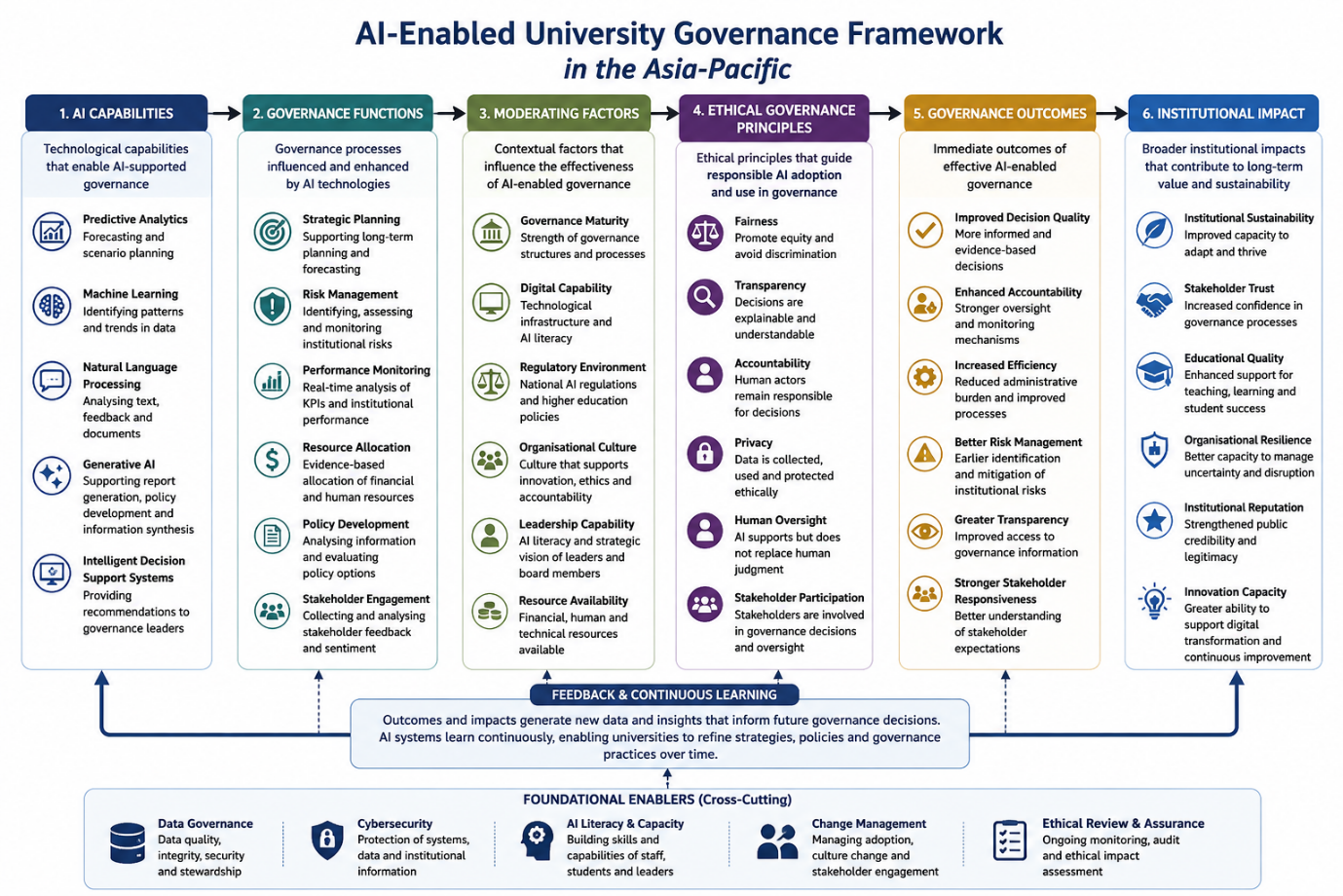
The proposed framework consists of six interconnected dimensions:
Dimension 1: AI Capabilities
↓
Dimension 2: Governance Functions
↓
Dimension 3: Moderating Factors
↓
Dimension 4: Ethical Governance Principles
↓
Dimension 5: Governance Outcomes
↓
Dimension 6: Institutional Impact
A continuous feedback loop links institutional outcomes back to governance processes, facilitating organisational learning and continuous improvement.
7.4 Dimension 1: AI Capabilities
The first dimension represents the technological capabilities that enable AI-supported governance.
These capabilities include:
Predictive Analytics
Supporting forecasting and scenario planning.
Machine Learning
Identifying patterns and trends in institutional data.
Natural Language Processing
Analysing stakeholder feedback and governance documentation.
Generative AI
Supporting report preparation, policy development, and information synthesis.
Intelligent Decision Support Systems
Providing recommendations to governance leaders.
These technologies create the analytical foundation upon which AI-enabled governance can operate.
Within universities, AI capabilities provide access to real-time information and evidence-based insights that enhance governance effectiveness.
7.5 Dimension 2: Governance Functions
The second dimension identifies the governance processes influenced by AI technologies.
Strategic Planning
AI supports long-term planning by forecasting enrolment trends, workforce requirements, and financial sustainability.
Risk Management
AI identifies emerging operational, compliance, financial, and reputational risks.
Performance Monitoring
AI provides real-time analysis of institutional performance indicators.
Resource Allocation
AI supports evidence-based allocation of financial and human resources.
Policy Development
AI assists governance leaders in analysing complex information and evaluating policy options.
Stakeholder Engagement
AI supports the collection and analysis of stakeholder feedback.
These governance functions represent the primary mechanisms through which AI influences university governance.
7.6 Dimension 3: Moderating Factors
The framework proposes that the relationship between AI capabilities and governance outcomes is influenced by several moderating factors.
Governance Maturity
Universities with mature governance systems are better positioned to manage AI risks and leverage opportunities.
Digital Capability
Institutional technological capacity influences implementation effectiveness.
Regulatory Environment
National AI regulations and higher education policies shape governance practices.
Organisational Culture
Cultures that support innovation and accountability facilitate successful AI adoption.
Leadership Capability
AI literacy among board members and executives influences governance effectiveness.
Resource Availability
Financial and human resources affect implementation capacity.
These moderating factors help explain why AI adoption outcomes differ across institutions and jurisdictions.
7.7 Dimension 4: Ethical Governance Principles
Ethical governance serves as the central balancing mechanism within the framework.
The review identified six key principles that guide responsible AI adoption.
Fairness
AI systems should promote equitable outcomes and avoid discrimination.
Transparency
Governance decisions should be explainable and understandable.
Accountability
Human actors remain responsible for governance decisions.
Privacy
Data should be collected and used ethically and securely.
Human Oversight
AI should support rather than replace human judgment.
Stakeholder Participation
Affected stakeholders should have opportunities to contribute to governance decisions.
These principles moderate how AI technologies are implemented and ensure that governance practices remain aligned with institutional values.
7.8 Dimension 5: Governance Outcomes
The framework proposes that successful implementation of AI-enabled governance leads to several governance outcomes.
Improved Decision Quality
More informed and evidence-based decisions.
Enhanced Accountability
Stronger oversight and monitoring mechanisms.
Increased Efficiency
Reduced administrative burden and improved governance processes.
Better Risk Management
Earlier identification and mitigation of institutional risks.
Greater Transparency
Improved access to governance information.
Stronger Stakeholder Responsiveness
Enhanced understanding of stakeholder expectations.
These outcomes represent immediate benefits generated by AI-supported governance systems.
7.9 Dimension 6: Institutional Impact
The final dimension captures broader institutional outcomes resulting from effective governance.
Institutional Sustainability
Improved capacity to adapt to changing environments.
Stakeholder Trust
Increased confidence in governance processes.
Educational Quality
Enhanced support for student success and academic outcomes.
Organisational Resilience
Improved capacity to manage uncertainty and disruption.
Institutional Reputation
Strengthened public credibility and legitimacy.
Innovation Capacity
Greater ability to support digital transformation and continuous improvement.
These outcomes align with the strategic objectives of universities throughout the Asia-Pacific region.
7.10 Feedback and Continuous Learning
An important feature of the framework is the inclusion of a feedback mechanism.
Governance outcomes and institutional impacts generate new data and experiences that inform future governance decisions. AI systems continuously learn from institutional performance, enabling governance leaders to refine strategies, policies, and governance practices over time.
This feedback process reflects principles of adaptive governance and continuous improvement, both of which are increasingly important within rapidly changing higher education environments.
7.11 Theoretical Contributions
The proposed framework contributes to the literature in several ways.
First, it extends governance theory by demonstrating how AI functions as a governance-enabling mechanism rather than merely a technological tool.
Second, it integrates governance, technology, ethics, and institutional perspectives into a single conceptual model.
Third, it explicitly recognises the role of ethical governance principles as mediating mechanisms between AI adoption and governance outcomes.
Fourth, it provides an Asia-Pacific perspective that acknowledges the diversity of governance systems, regulatory environments, and institutional capacities across the region.
Finally, the framework offers a foundation for future empirical research examining the relationship between AI adoption and governance effectiveness in universities.
7.12 Practical Implications
The framework offers several practical implications for university leaders and policymakers.
Governing Boards
Should establish AI oversight committees and strengthen governance capabilities.
University Executives
Should align AI initiatives with institutional strategy and governance objectives.
Policymakers
Should develop clear regulatory frameworks supporting responsible AI adoption.
Regulators
Should encourage transparency, accountability, and ethical oversight.
Universities
Should invest in AI literacy, governance capability development, and ethical review processes.
These recommendations support the development of governance systems capable of managing AI opportunities and risks effectively.
7.13 Summary
This chapter proposed an AI-Enabled University Governance Framework for the Asia-Pacific region that integrates technological capabilities, governance processes, ethical principles, organisational factors, governance outcomes, and institutional impacts. The framework responds to a significant gap in the existing literature by providing a holistic model that explains how AI can enhance governance effectiveness while maintaining accountability, transparency, and stakeholder trust. By recognising the importance of ethical governance and contextual factors, the framework offers both theoretical and practical insights for universities seeking to navigate the opportunities and challenges associated with AI adoption. The following chapter identifies future research directions and practical recommendations that can further support responsible AI-enabled governance within higher education institutions across the Asia-Pacific region.
8. Future Research Directions and Practical Implications
8.1 Introduction
The rapid emergence of Artificial Intelligence (AI) has created significant opportunities and challenges for university governance across the Asia-Pacific region. As demonstrated throughout this review, AI has the potential to transform governance processes by enhancing strategic decision-making, improving institutional performance monitoring, strengthening risk management, and increasing operational efficiency. However, the adoption of AI also introduces substantial ethical, governance, and regulatory challenges that require careful oversight and institutional preparedness.
Despite the growing body of literature examining AI in higher education, research remains fragmented and heavily concentrated on teaching, learning, and student engagement. Comparatively little attention has been devoted to understanding how AI influences governance structures, board decision-making, accountability mechanisms, and institutional leadership. Furthermore, limited empirical evidence exists regarding the long-term impact of AI on governance effectiveness within universities, particularly in the diverse higher education environments of the Asia-Pacific region.
This chapter identifies key areas requiring further scholarly investigation and outlines practical implications for governing boards, university leaders, policymakers, regulators, and higher education institutions seeking to implement AI responsibly and effectively.
8.2 Future Research Directions
8.2.1 Development of AI Governance Maturity Models
One of the most significant gaps in the literature relates to the absence of comprehensive models capable of assessing institutional readiness for AI-enabled governance. While various organisations have developed digital maturity frameworks, relatively few studies have explored governance maturity in the context of AI adoption.
Future research should focus on developing AI governance maturity models specifically tailored to higher education institutions. Such models could evaluate dimensions including:
-
Governance structures
-
Leadership capability
-
Ethical oversight
-
Data governance
-
Technological readiness
-
Regulatory compliance
-
Stakeholder engagement
A governance maturity framework would provide universities with practical tools for assessing their readiness to implement AI and identifying areas requiring improvement.
8.2.2 AI and Governing Board Decision-Making
The majority of existing studies focus on operational applications of AI rather than board-level governance processes. Consequently, limited understanding exists regarding how governing boards utilise AI-generated information in strategic decision-making.
Future studies should investigate:
-
How board members perceive AI-supported decision-making.
-
The extent to which AI influences governance outcomes.
-
The relationship between AI-generated insights and human judgment.
-
Board members' AI literacy and governance capability.
-
The role of AI in strategic planning and institutional oversight.
Such research would provide valuable insights into how AI is reshaping governance practices and leadership responsibilities.
8.2.3 Human-AI Collaboration in Governance
Current debates frequently focus on whether AI should replace human decision-making. However, the more relevant question concerns how humans and AI can collaborate effectively within governance systems.
Future research should examine:
-
Human-in-the-loop governance models.
-
Trust in AI-assisted decisions.
-
Decision quality in collaborative governance environments.
-
Appropriate levels of human oversight.
-
Governance processes that balance automation and accountability.
Understanding the dynamics of human-AI collaboration will be essential for designing governance frameworks that maximise the benefits of AI while preserving ethical responsibility and institutional legitimacy.
8.2.4 Comparative Studies Across the Asia-Pacific Region
The Asia-Pacific region encompasses highly diverse higher education systems characterised by different governance structures, regulatory environments, cultural values, and technological capabilities. However, comparative studies examining AI governance across countries remain limited.
Future research could compare:
-
Australia and New Zealand.
-
Singapore and South Korea.
-
China and Japan.
-
Pacific Island universities.
-
Emerging Southeast Asian higher education systems.
Comparative studies would enhance understanding of how contextual factors influence AI governance outcomes and help identify transferable best practices.
8.2.5 AI Governance in Pacific Island Universities
A notable gap in the literature relates to the experiences of Pacific Island universities. While substantial attention has been devoted to universities in technologically advanced nations, relatively little research has examined AI adoption within smaller and resource-constrained higher education environments.
Future studies should explore:
-
Governance readiness for AI adoption.
-
Infrastructure and capability challenges.
-
Data sovereignty concerns.
-
Ethical and cultural considerations.
-
Opportunities for regional collaboration.
Given the increasing importance of digital transformation across the Pacific region, this area represents a valuable opportunity for future research.
8.2.6 Longitudinal Studies on Governance Outcomes
Much of the current literature examines AI implementation at a single point in time. Consequently, limited evidence exists regarding the long-term effects of AI adoption on governance effectiveness and institutional performance.
Longitudinal research could investigate:
-
Changes in governance practices over time.
-
Institutional adaptation to AI technologies.
-
Long-term impacts on accountability and transparency.
-
Evolution of stakeholder trust.
-
Sustainability of AI-enabled governance systems.
Such studies would provide important evidence regarding the long-term value and effectiveness of AI adoption within universities.
8.3 Practical Implications
The findings of this review have important implications for higher education institutions, governance leaders, policymakers, and regulators throughout the Asia-Pacific region.
8.3.1 Implications for Governing Boards
University governing boards play a critical role in overseeing AI adoption and ensuring that technological innovation aligns with institutional values and strategic objectives.
Boards should:
-
Establish AI governance oversight mechanisms.
-
Develop AI governance policies and principles.
-
Monitor AI-related risks and ethical concerns.
-
Strengthen board-level AI literacy.
-
Ensure accountability for AI-supported decisions.
AI governance should be viewed as a strategic governance issue rather than merely a technical or operational matter.
8.3.2 Implications for University Executives
Executive leaders are responsible for translating governance principles into institutional practice.
University executives should:
-
Align AI initiatives with institutional strategy.
-
Promote ethical and responsible AI adoption.
-
Invest in staff capability development.
-
Establish cross-functional governance structures.
-
Monitor organisational readiness for AI implementation.
Strong leadership will be essential for managing the organisational changes associated with AI adoption.
8.3.3 Implications for Policymakers
Governments throughout the Asia-Pacific region are increasingly encouraging AI innovation while simultaneously seeking to address emerging risks.
Policymakers should:
-
Develop clear regulatory frameworks.
-
Encourage responsible AI practices.
-
Support institutional capacity-building initiatives.
-
Promote regional collaboration and knowledge sharing.
-
Establish national standards for AI governance.
Policy frameworks should balance innovation with public accountability and stakeholder protection.
8.3.4 Implications for Regulators
Higher education regulators will play an increasingly important role in ensuring that AI adoption occurs in a responsible and transparent manner.
Regulators should:
-
Provide guidance regarding ethical AI use.
-
Encourage transparency and explainability.
-
Monitor compliance with data protection requirements.
-
Promote accountability mechanisms.
-
Support governance capability development.
Regulatory frameworks should remain flexible enough to accommodate technological innovation while safeguarding stakeholder interests.
8.3.5 Implications for Universities
Universities must develop organisational capabilities that support responsible AI adoption.
Institutions should prioritise:
-
AI literacy and governance training.
-
Ethical review processes.
-
Data governance frameworks.
-
Cybersecurity capability.
-
Stakeholder engagement mechanisms.
-
Continuous monitoring and evaluation.
Universities that invest in governance capability development will be better positioned to realise the benefits of AI while managing associated risks.
8.4 Strategic Recommendations for the Asia-Pacific Region
Based on the findings of this review, five strategic recommendations are proposed:
Recommendation 1
Develop institution-wide AI governance frameworks that integrate ethics, risk management, and accountability principles.
Recommendation 2
Strengthen board and executive AI literacy through ongoing professional development and governance training.
Recommendation 3
Establish dedicated AI ethics and governance committees to oversee implementation and monitor emerging risks.
Recommendation 4
Promote regional collaboration among universities, governments, and regulators to share knowledge and develop best practices.
Recommendation 5
Invest in governance capability development within emerging and resource-constrained higher education systems, particularly in Pacific Island nations.
These recommendations support the development of responsible, transparent, and effective AI-enabled governance systems throughout the region.
8.5 Summary
The future of AI-enabled university governance will depend on the ability of institutions to balance technological innovation with ethical responsibility, transparency, and accountability. While AI presents substantial opportunities to improve governance effectiveness, significant challenges remain regarding governance capability, stakeholder trust, regulatory oversight, and ethical implementation. Future research should focus on governance maturity, human-AI collaboration, comparative regional studies, and long-term governance outcomes. At the same time, governing boards, university leaders, policymakers, and regulators must work collaboratively to develop governance frameworks capable of supporting responsible AI adoption. By investing in governance capability and ethical oversight, universities across the Asia-Pacific region can harness the benefits of AI while safeguarding the fundamental values and missions of higher education.
10. Recommendations for University Leaders and Policymakers
10.1 Introduction
The findings of this review indicate that Artificial Intelligence (AI) is becoming an increasingly important component of university governance across the Asia-Pacific region. While AI offers substantial opportunities to improve decision-making, governance effectiveness, institutional performance, and operational efficiency, its successful implementation requires careful oversight, ethical leadership, and robust governance structures. Universities must therefore adopt proactive strategies that balance technological innovation with accountability, transparency, and stakeholder trust.
Based on the literature reviewed and the proposed AI-Enabled University Governance Framework, this chapter presents practical recommendations for university governing boards, executive leaders, policymakers, regulators, and higher education institutions seeking to implement AI responsibly and effectively.
10.2 Recommendations for Governing Boards
University governing boards hold ultimate responsibility for institutional oversight and strategic direction. As AI increasingly influences governance processes, boards must develop the capability to oversee AI-related opportunities and risks.
Recommendation 1: Establish Board-Level AI Governance Oversight
Universities should establish dedicated AI governance committees or integrate AI oversight responsibilities into existing governance structures such as risk and audit committees. These bodies should monitor AI implementation, ethical compliance, risk exposure, and institutional performance.
Recommendation 2: Improve AI Literacy Among Board Members
Board members should receive ongoing professional development regarding AI technologies, governance implications, ethical risks, and regulatory developments. Improved AI literacy will enable governing boards to provide more effective oversight and strategic guidance.
Recommendation 3: Integrate AI into Institutional Risk Management Frameworks
AI-related risks should be incorporated into enterprise risk management systems. Governing boards should regularly review AI risks relating to privacy, cybersecurity, bias, transparency, and institutional reputation.
10.3 Recommendations for University Executives
University executives play a critical role in translating governance objectives into operational practice.
Recommendation 4: Align AI Initiatives with Institutional Strategy
AI projects should be linked directly to institutional goals and governance priorities. Technology adoption should support educational quality, student success, research performance, and organisational sustainability rather than being driven solely by technological trends.
Recommendation 5: Develop Institution-Wide AI Governance Policies
Universities should establish comprehensive AI governance policies covering:
-
Ethical use of AI
-
Data governance
-
Privacy protection
-
Accountability mechanisms
-
Human oversight requirements
-
AI procurement and vendor management
Clear policies will provide consistency and reduce governance uncertainty.
Recommendation 6: Invest in Governance Capability Development
Institutions should invest in staff development programs that strengthen AI literacy, governance capability, ethical decision-making, and risk management expertise across academic and professional workforce groups.
10.4 Recommendations for Policymakers
Governments throughout the Asia-Pacific region have an important role in supporting responsible AI adoption within higher education.
Recommendation 7: Develop National AI Governance Standards for Higher Education
Policymakers should establish sector-specific AI governance guidelines that provide universities with clear expectations regarding accountability, transparency, ethical use, and data management.
Recommendation 8: Promote Regional Collaboration
Governments should encourage collaboration among universities, regulators, and industry partners to facilitate knowledge sharing, policy development, and governance innovation.
Recommendation 9: Support AI Capacity Building
Funding initiatives should support institutional capability development, particularly for universities with limited resources or technological infrastructure.
10.5 Recommendations for Regulators
Higher education regulators will increasingly be required to oversee AI implementation and governance practices.
Recommendation 10: Develop Regulatory Guidance on Responsible AI
Regulators should provide practical guidance regarding:
-
Ethical AI use
-
Governance accountability
-
Data protection
-
Transparency requirements
-
Stakeholder rights
Recommendation 11: Encourage Explainable AI Practices
Universities should be encouraged to adopt AI systems that provide clear explanations for decisions and recommendations. Explainability is essential for maintaining accountability and stakeholder trust.
Recommendation 12: Strengthen Data Governance Requirements
Regulatory frameworks should ensure that universities maintain appropriate standards relating to privacy, cybersecurity, and data stewardship.
10.6 Recommendations for Universities Across the Asia-Pacific Region
The diversity of higher education systems across the Asia-Pacific region requires context-sensitive approaches to AI governance.
Recommendation 13: Adopt Human-Centred AI Governance
Universities should ensure that AI serves as a decision-support mechanism rather than a substitute for human judgment. Governance responsibility must remain with institutional leaders and governing bodies.
Recommendation 14: Establish AI Ethics Committees
Dedicated ethics committees can provide oversight of AI implementation, assess emerging risks, and ensure that institutional values are reflected in governance practices.
Recommendation 15: Conduct Regular AI Audits
Universities should periodically evaluate AI systems to identify:
-
Algorithmic bias
-
Data quality issues
-
Privacy concerns
-
Security vulnerabilities
-
Governance effectiveness
Regular auditing supports accountability and continuous improvement.
Recommendation 16: Strengthen Stakeholder Engagement
Universities should involve students, staff, industry partners, and community stakeholders in discussions regarding AI adoption and governance. Meaningful participation enhances legitimacy and trust.
10.7 Strategic Priorities for Pacific Island Universities
Particular attention should be given to Pacific Island universities, which often operate under significant resource constraints.
Priority areas include:
-
Digital infrastructure development
-
AI literacy and governance training
-
Regional governance partnerships
-
Data sovereignty protections
-
Context-specific governance frameworks
International collaboration and targeted funding support may assist these institutions in adopting AI responsibly while addressing local governance needs.
10.8 Concluding Remarks
The successful integration of AI into university governance requires more than technological capability. It demands strong leadership, effective governance structures, ethical oversight, stakeholder engagement, and ongoing organisational learning. Universities that adopt proactive and responsible governance approaches will be better positioned to harness the benefits of AI while mitigating associated risks. As AI continues to reshape higher education, governance systems must evolve to ensure that technological innovation remains aligned with the core values of accountability, transparency, equity, and public trust that underpin the mission of universities throughout the Asia-Pacific region.
9. Conclusion
9.1 Introduction
Artificial Intelligence (AI) is increasingly transforming the governance landscape of higher education institutions worldwide. As universities face growing pressures associated with accountability, financial sustainability, digital transformation, stakeholder expectations, and institutional performance, AI has emerged as a powerful tool capable of supporting governance processes and strategic decision-making. The rapid expansion of AI technologies across university operations has created new opportunities for enhancing governance effectiveness while simultaneously introducing complex ethical, organisational, and regulatory challenges.
This review paper examined the opportunities, risks, and ethical considerations associated with AI-enabled university governance in the Asia-Pacific region. Drawing upon contemporary literature from higher education governance, technology management, AI ethics, and public sector governance, the study explored how AI is influencing governance structures, decision-making processes, accountability mechanisms, and institutional outcomes. The review further examined emerging AI governance frameworks across the region and proposed a conceptual framework to guide responsible AI adoption within universities.
The purpose of this concluding chapter is to synthesise the key findings of the review, revisit the research questions, highlight the theoretical and practical contributions of the study, and identify broader implications for the future of university governance in the Asia-Pacific region.
9.2 Summary of Key Findings
The review demonstrates that AI possesses significant potential to enhance governance effectiveness within higher education institutions. AI technologies provide universities with advanced analytical capabilities that support strategic planning, performance monitoring, risk management, resource allocation, and stakeholder engagement. Through predictive analytics, machine learning, natural language processing, and generative AI applications, governance leaders can access real-time insights and evidence-based information that improve decision quality and organisational responsiveness.
The literature suggests that AI offers several important opportunities for university governance. These include enhanced strategic decision-making, improved institutional performance monitoring, strengthened risk management, increased operational efficiency, and greater stakeholder engagement. Such capabilities are particularly valuable in the Asia-Pacific region, where universities operate in increasingly competitive and rapidly changing environments characterised by technological disruption, demographic change, and growing accountability requirements.
However, the review also highlights significant risks associated with AI adoption. Algorithmic bias, lack of transparency, privacy concerns, cybersecurity vulnerabilities, accountability challenges, and overreliance on technology represent major governance concerns. These risks have the potential to undermine stakeholder trust, institutional legitimacy, and governance effectiveness if not appropriately managed.
The ethical dimensions of AI governance emerged as a central theme throughout the literature. Fairness, transparency, accountability, privacy protection, human oversight, and stakeholder participation were consistently identified as essential principles guiding responsible AI implementation. The review demonstrates that effective governance requires universities to balance technological innovation with ethical responsibility and institutional values.
Furthermore, the analysis of AI governance frameworks across the Asia-Pacific region revealed increasing recognition of the need for structured governance approaches capable of managing AI-related opportunities and risks. While governance approaches vary considerably across jurisdictions, common themes include the importance of human-centred governance, ethical oversight, transparency, accountability, and stakeholder trust.
9.3 Addressing the Research Questions
This review was guided by four research questions.
Research Question 1:
How is Artificial Intelligence transforming university governance across the Asia-Pacific region?
The review found that AI is transforming governance by enabling more data-driven, predictive, and evidence-based decision-making processes. Universities are increasingly integrating AI into strategic planning, institutional performance monitoring, risk management, resource allocation, and stakeholder engagement activities. AI is shifting governance from largely reactive approaches toward more proactive and adaptive models capable of responding to complex and dynamic environments.
Research Question 2:
What opportunities does AI create for improving governance effectiveness and institutional performance?
The findings indicate that AI creates opportunities for enhanced decision quality, improved efficiency, stronger risk management, increased transparency, and better organisational responsiveness. AI technologies enable universities to leverage large volumes of institutional data to support governance functions and improve strategic outcomes.
Research Question 3:
What risks emerge from the use of AI in governance processes and decision-making?
The review identified several significant risks, including algorithmic bias, transparency challenges, privacy concerns, cybersecurity threats, accountability ambiguities, and overdependence on technological systems. These risks highlight the importance of governance frameworks capable of ensuring responsible and ethical AI implementation.
Research Question 4:
What ethical considerations should guide the responsible adoption and governance of AI in universities?
The review found that ethical governance requires adherence to principles of fairness, transparency, accountability, privacy protection, human oversight, and stakeholder participation. These principles serve as safeguards that help ensure AI technologies support rather than undermine the values and social responsibilities of higher education institutions.
9.4 Theoretical Contributions
This review contributes to the emerging literature on AI and university governance in several important ways.
First, it extends existing governance scholarship by examining AI as a governance-enabling technology rather than merely an operational tool. The review demonstrates how AI influences strategic governance functions, institutional oversight, and organisational decision-making.
Second, the study integrates perspectives from governance theory, institutional theory, stewardship theory, and responsible AI literature to provide a multidisciplinary understanding of AI-enabled governance. This integration offers a more comprehensive perspective on how technological innovation interacts with governance processes and institutional environments.
Third, the paper addresses a notable gap in the literature by focusing specifically on the Asia-Pacific region. Existing research has largely concentrated on North American and European contexts, leaving limited understanding of how diverse governance environments within the Asia-Pacific region shape AI adoption and governance practices.
Most importantly, the review proposes an AI-Enabled University Governance Framework that integrates technological capabilities, governance functions, ethical principles, moderating factors, governance outcomes, and institutional impacts. The framework provides a conceptual foundation for future empirical research and offers a structured approach for understanding AI-enabled governance within higher education institutions.
9.5 Practical Contributions
The findings of this review have important implications for university leaders, governing boards, policymakers, and regulators.
For governing boards, the study emphasises the need to develop AI governance capabilities and strengthen oversight mechanisms. Boards must recognise that AI adoption is a strategic governance issue requiring ongoing monitoring and ethical scrutiny.
For university executives, the review highlights the importance of aligning AI initiatives with institutional missions, governance objectives, and organisational values. Successful implementation requires leadership commitment, organisational readiness, and stakeholder engagement.
For policymakers and regulators, the findings demonstrate the need for governance frameworks that promote innovation while safeguarding accountability, transparency, and public trust. Regulatory approaches should encourage responsible AI adoption while remaining flexible enough to accommodate technological developments.
For universities, the review underscores the importance of investing in AI literacy, governance capability development, ethical review processes, and data governance frameworks. Institutions that proactively address governance challenges will be better positioned to realise the benefits of AI while mitigating associated risks.
9.6 Implications for the Future of University Governance
The future of university governance will increasingly be shaped by advances in AI and digital technologies. As AI systems become more sophisticated, universities will face growing opportunities to improve governance effectiveness and institutional performance. However, technological capability alone will not determine success.
The sustainability of AI-enabled governance will depend upon the ability of institutions to maintain stakeholder trust, uphold ethical standards, and ensure accountability within increasingly complex decision-making environments. Universities must recognise that governance effectiveness is ultimately grounded in human judgment, institutional values, and social responsibility.
The Asia-Pacific region is likely to play a significant role in shaping the future of AI governance due to its diverse higher education systems, rapidly expanding digital capabilities, and growing investment in technological innovation. Universities that successfully integrate AI into governance processes while maintaining ethical oversight and accountability may emerge as leaders in the next generation of higher education governance.
9.7 Final Conclusion
Artificial Intelligence represents one of the most significant technological developments affecting higher education governance in the twenty-first century. Its capacity to enhance strategic decision-making, improve institutional performance, strengthen risk management, and support governance effectiveness presents substantial opportunities for universities throughout the Asia-Pacific region. At the same time, AI introduces complex ethical, organisational, and governance challenges that require careful oversight and responsible management.
This review has demonstrated that the successful adoption of AI within university governance depends not only on technological capability but also on robust governance structures, ethical leadership, transparency, accountability, and stakeholder trust. By integrating insights from governance theory, AI ethics, and higher education literature, the study provides a comprehensive understanding of the opportunities and challenges associated with AI-enabled governance.
The proposed AI-Enabled University Governance Framework offers a foundation for both future research and practical implementation. As universities continue to navigate the opportunities and uncertainties associated with digital transformation, governance systems must evolve to ensure that AI supports institutional missions, enhances organisational effectiveness, and contributes to the broader public good. Ultimately, the future of university governance in the Asia-Pacific region will depend upon the ability of institutions to harness the transformative potential of AI while preserving the fundamental values of higher education: accountability, integrity, equity, and trust.
References
- Floridi, L 2023, The Ethics of Artificial Intelligence: Principles, Challenges and Opportunities, Oxford University Press, Oxford. DOI ↗ Google Scholar ↗
- Floridi, L & Cowls, J 2022, ‘A unified framework of five principles for AI in society’, Harvard Data Science Review, vol. 4, no. 1. DOI ↗ Google Scholar ↗
- Fraser, N 2009, Scales of Justice: Reimagining Political Space in a Globalizing World, Columbia University Press, New York. Google Scholar ↗