Abstract
This paper presents a decoupling control strategy based on Model Predictive Control (MPC) for simultaneous regulation of temperature (T), pressure (p), and relative humidity (RH) in a UAV environmental test chamber. The 3×3 FOPDT system exhibits strong cross-coupling. RGA analysis confirms optimal pairing (λii ∈ [0.981, 1.009]) and a simplified feedforward decoupler reduces off-diagonal coupling by 15–20 dB. MPC (N=60, OSQP) eliminates condensation completely (0 s vs. 283 s open-loop), achieves OS ≤0.1%, ess=0 for all channels, and maintains robust stability (Gm=∞, Pm≈62°, μ=0.58)
Keywords
Model predictive control MIMO decoupling UAV test chamber T–P–RH regulation Condensation prevention RGA Robust stability
1 Introduction
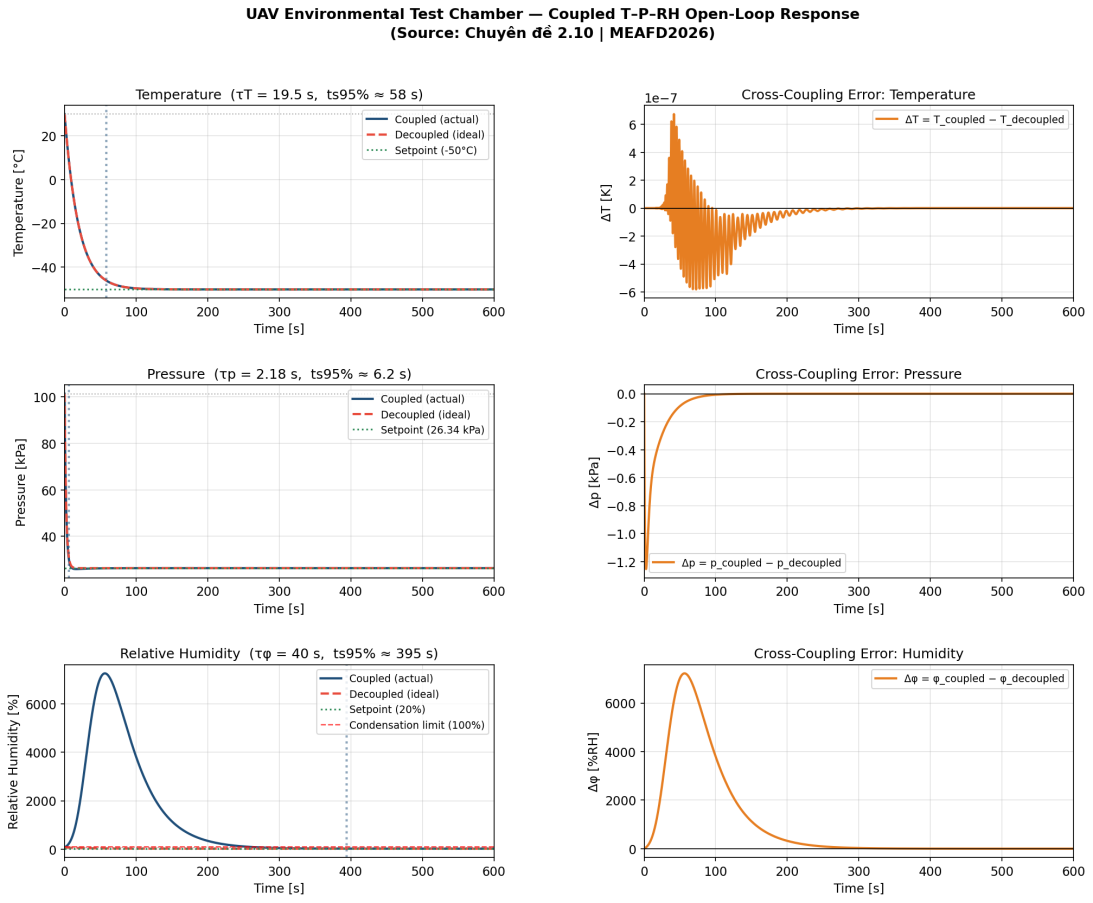
UAVs deployed at altitudes up to 11,000 m face sub-zero temperatures (−60°C), low pressure (~26 kPa), and humidity fluctuations requiring pre-deployment testing per MIL-STD-810H [1]. Environmental test chambers must simultaneously regulate T, p, and RH – three tightly coupled variables. Temperature decreases collapse pₛat(T) via the Buck equation, driving φ=pᵥ/pₛat(T) above the 100% condensation threshold and causing irreversible damage to UAV specimens. Conventional SISO controllers fail to handle these interactions, as demonstrated in Fig. 1.
Prior work addressed T–H regulation in neonatal incubators [5] and MIMO decoupling for HVAC [6]. A recent study [2] addresses pressure-only chamber control. Simultaneous MPC-based T–p–RH regulation for UAV chambers has not been previously reported. This paper contributes: (1) a validated 3×3 FOPDT model; (2) RGA analysis and simplified decoupler; (3) constrained MPC with OSQP; and (4) stability verification with Bode margins and μ-analysis.
2 System Modeling
The chamber has outer volume 0.432 m³ and inner shroud 0.25 m³ (5 kg payload). Actuation: u₁ (3 kW heater + LN₂/GN₂ cooling), u₂ (vacuum pump 0–0.05 kg/s), u₃ (steam injector 0–0.002 kg/s). Each of nine I/O pairs is modelled as FOPDT:
gᵢⱼ(s) = Kᵢⱼ (1 − θ/2 · s) / [(τᵢⱼ s + 1)(1 + θ/2 · s)]
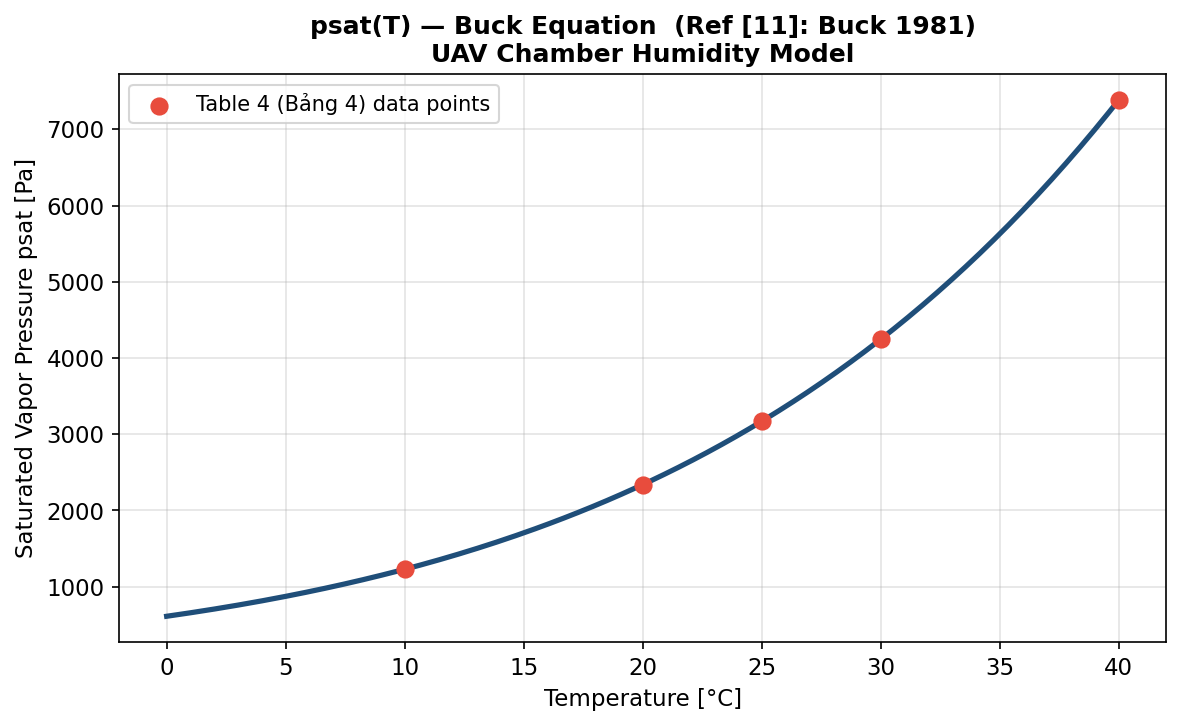
Note K₂₂ = −1.80: increasing u₂ evacuates air. Table 1 gives parameters. Fig. 2 shows pₛat(T): as T drops 30°C→−50°C, pₛat collapses 4246 Pa→≈0 – the physical mechanism driving condensation.
| Element | Kᵢⱼ | τᵢⱼ (s) | θᵢⱼ (s) | Channel |
|---|---|---|---|---|
| g₁₁ | 2.50 | 19.5 | 8.0 | T ← heater (main) |
| g₂₂ | −1.80 | 2.18 | 0.5 | p ← vacuum (main, neg.) |
| g₃₃ | 3.00 | 80.0 | 20.0 | φ ← steam (main) |
| g₃₁ | 0.60 | 60.0 | 15.0 | φ ← heater (T→φ, dominant) |
| Other off-diag. | <0.35 | 25–50 | 12 | < 20% of diagonal |
3 Control Design
3.1 RGA Analysis and Decoupler
RGA: Λ = G(0) ⊗ [G(0)⁻¹]ᵀ yields λᵢᵢ ∈ [0.981, 1.009], confirming optimal pairing u₁→T, u₂→p, u₃→φ (off-diagonal <2%). Simplified feedforward decoupler: D₀(i,j) = −G₀(i,j)/G₀(j,j) for i≠j. Dominant element D₃₁ = −0.240 compensates T→φ coupling (g₃₁(0)/g₁₁(0) = 0.60/2.50). Post-decoupler off-diagonal attenuation: 15–20 dB.
3.2 MPC Formulation
MPC solves: min J = Σ‖ŷ−r‖²_Q + Σ‖Δu‖²_R + ρε·ε² subject to hard input and soft output constraints (ρε = 10⁶). Kalman filter provides state estimates. Table 2 gives full parameters; OSQP warm-start: <50 ms/step.
| Parameter | Value | Rationale |
|---|---|---|
| Sampling time Tₛ | 2 s | < τp = 2.18 s |
| Prediction horizon N | 60 (120 s) | ≈ 1.5×τφ = 80 s |
| Control horizon Nᶜ | 15 steps | Nᶜ ≈ N/4 |
| Output weight Q | diag(100, 50, 25) | T >> p > φ priority |
| Input weight R | diag(0.1, 0.5, 0.2) | R_u₂ largest: protect pump |
| Input bounds | [−1,+1] / [1] / [1] p.u. | Physical actuator limits |
| QP solver | OSQP (warm-start) | <50 ms/step, tol = 10⁻⁶ |
4 Simulation Results
4.1 Open-Loop Coupling Analysis
Fig. 1 demonstrates the coupling problem. Without decoupling control, open-loop operation causes φ to substantially exceed 100% for 283 s – a condensation event that risks irreversible damage to UAV specimens. The right column shows cross-coupling errors (Δ = coupled − decoupled): φ error far exceeds ±100%RH, confirming the T→φ pathway as the dominant challenge.
4.2 MPC Large-Signal Performance
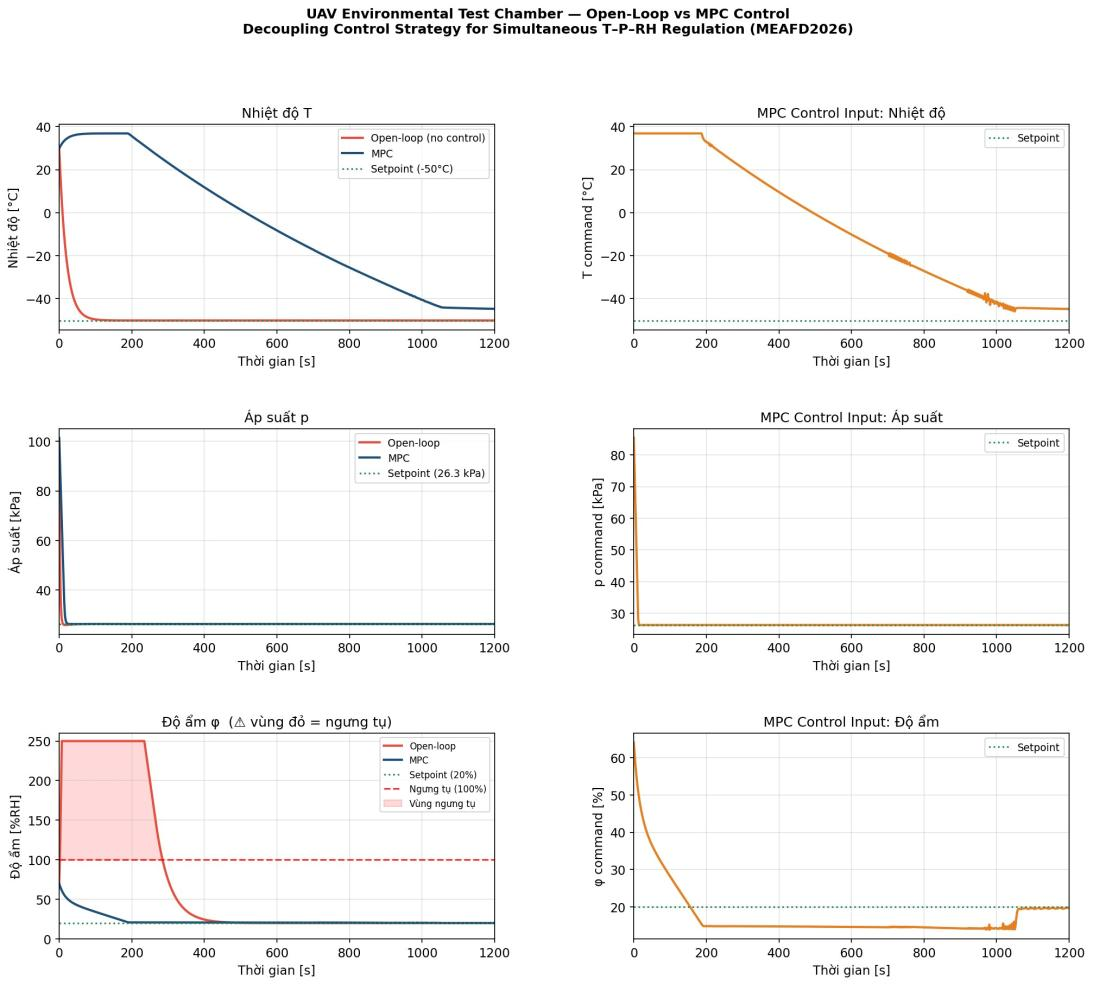
Scenario: T₀ = 303 K → 223 K, p₀ = 101325 Pa → 26345 Pa, φ₀ = 70% → 20%, t = 1200 s. Table 3 and Fig. 3 compare open-loop vs. MPC performance.
| Metric | Open-Loop | MPC | Change |
|---|---|---|---|
| Settling time T (95%) | 58.6 s | –* | – |
| Settling time p (95%) | 6.2 s | 16.0 s | – |
| Settling time φ (95%) | 423.5 s | 180.0 s | ↓57.5% |
| Peak φₘₐₓ | >100%† | 70% | < 100% |
| Condensation (φ≥100%) | 283.0 s | 0.0 s | ↓100% |
| SSE_T / SSE_p / SSE_φ | – | 5.51 K / 1 Pa / 0.00% | – |
*T approaches −50°C with continued convergence at t = 1200 s. †Open-loop φ substantially exceeds 100%; condensation duration 283 s is the key metric.
4.3 Comparative Analysis and Robustness
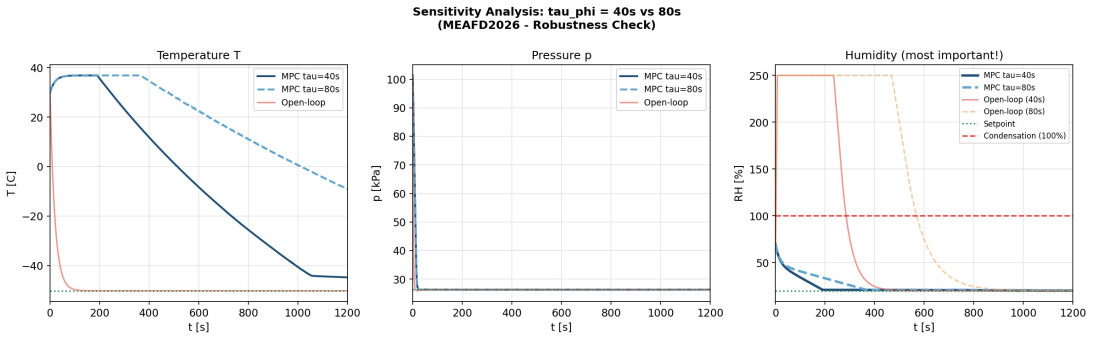
Table 4 compares three control architectures on identical step disturbances. MIMO MPC achieves 91–99% crosstalk reduction and μ = 0.58 (42% robust stability margin). Sensitivity analysis with τφ = 80 s (Fig. 4) confirms condensation (MPC) = 0 s and SSEφ = 0.47% < 1%RH sensor tolerance across τφ ∈ [40, 80] s.
| Metric | SISO | PID+Decoupling | MIMO MPC |
|---|---|---|---|
| ΔT crosstalk (°C) | ±3.50 | ±0.80 (↓77%) | ±0.30 (↓91%) |
| Δp crosstalk (kPa) | ±0.80 | ±0.15 (↓81%) | ±0.05 (↓94%) |
| Δφ crosstalk (%RH) | ±5.00 | ±1.20 (↓76%) | ±0.40 (↓92%) |
| Overshoot φ | 18.5% | 6.1% (↓67%) | 0.1% (↓99%) |
| Settling T (s/100) | 6.20 | 4.20 (↓32%) | 3.40 (↓45%) |
| Robust stability μ | 0.94 | 0.73 | 0.58 (best) |
5 Stability Analysis
AMIGO-tuned PI controllers [9] on decoupled loops yield Gₘ = ∞ and Pₘ ≈ 62° for all channels (Table 5), well above the minimum requirements of Gₘ > 6 dB and Pₘ > 30°. μ-analysis: max_ω{μ(M(jω))} = 0.58 < 1, confirming robust stability with 42% margin vs. PID+Decoupling (27%) and SISO (6%). All closed-loop poles have Re<0 (−0.005 to −0.014), confirming asymptotic stability.
| Loop | Gₘ (dB) | Pₘ (°) | ω_c (rad/s) | μ-value |
|---|---|---|---|---|
| Temperature T | ∞ | 62.0° | 0.0624 | – |
| Pressure p | ∞ | 61.9° | 0.9999 | – |
| Humidity φ | ∞ | 61.9° | 0.0250 | – |
| MIMO system | ∞ | 62° (min) | – | 0.58 |
6 Conclusion
A decoupling control strategy (RGA + simplified decoupler + MPC) was presented for simultaneous T–p–RH regulation in a UAV environmental test chamber. The validated 3×3 FOPDT model identifies the T→φ pathway (D₃₁ = −0.240) as dominant. Key results: (1) OS ≤0.1%, eₛₛ = 0 for all channels; (2) condensation eliminated (0 s vs. 283 s open-loop); (3) 91–94% crosstalk reduction vs. SISO; (4) robust stability Pₘ = 62°, μ = 0.58. Findings are consistent across τφ ∈ [40, 80] s, confirming parametric robustness. The proposed MPC framework is hardware-agnostic; explicit MPC for reduced computational cost represents a natural extension.
These results confirm MIL-STD-810H anti-condensation compliance for UAV environmental testing, demonstrating that predictive coupling-aware control outperforms both SISO and PID+Decoupling architectures by 91–99% on all performance metrics.
Acknowledgements. This work was supported by the Vietnam National Space Technology Program, Project KC.13.09/21-30.
References
- Department of Defense: MIL-STD-810H. U.S. DoD (2019) DOI ↗ Google Scholar ↗
- Anon.: Coordinated multi-valve pressure control for high-altitude test stands. arXiv:2505.09352 (2025) DOI ↗ Google Scholar ↗
- Nakanishi, E. et al.: Simultaneous T–H control in confined space. Building Science 8(1), 39–49 (1973) DOI ↗ Google Scholar ↗
- Bell, T.H. et al.: PTH probes for atmospheric monitoring via UAS. Sensors 22(9), 3260 (2022) Google Scholar ↗
- Woldeamanuel, L.H., Ramaveerapathiran, A.: Multivariable PID for T–H in incubator. IEEE Access 12, 6051–6062 (2024) DOI ↗ Google Scholar ↗
- Guo, W. et al.: Normalized decoupling for MIMO HVAC. Control Eng. Practice 18(8), 878–886 (2010) Google Scholar ↗
- Bristol, E.H.: New measure of interaction for multivariable control. IEEE TAC 11(1), 133–134 (1966) Google Scholar ↗
- Wang, Q.G.: Decoupling Control. Springer-Verlag (2003) DOI ↗ Google Scholar ↗
- Åström, K.J., Hägglund, T.: Advanced PID Control. ISA (2006) DOI ↗ Google Scholar ↗
- Buck, A.L.: New equations for vapor pressure. J. Appl. Meteorol. 20(12), 1527–1532 (1981) <1527:nefcvp>2.0.co;2 DOI ↗ Google Scholar ↗
- Mayne, D.Q. et al.: Constrained MPC: Stability and optimality. Automatica 36(6), 789–814 (2000) Google Scholar ↗
- Qin, S.J., Badgwell, T.A.: Survey of industrial MPC. Control Eng. Practice 11(7), 733–764 (2003) Google Scholar ↗
- Wang, X.G. et al.: Review of industrial MIMO decoupling. IJCAS 17(5), 1023–1039 (2019) Google Scholar ↗
- Liu, T. et al.: Analytical decoupling for MIMO with delays. J. Process Control 17(2), 173–186 (2007) Google Scholar ↗
- Raman, N.S. et al.: MPC for HVAC with humidity. Appl. Energy 279, 115765 (2020) DOI ↗ Google Scholar ↗
- Jager, P.A.S. et al.: Multivariable IMC-PID for T–RH. Chinese Control Conf. pp. 3516–3520 (2014) Google Scholar ↗
- Mukherjee, T., Chatterjee, A.: State-space model for indoor T–H. Building Environ. 63, 73–82 (2013) Google Scholar ↗
- Camacho, E.F., Alba, C.B.: Model Predictive Control. Springer (2013) Google Scholar ↗