Abstract
Background Despite the recognized vitality of effective communication in healthcare, a significant problem exists in rural primary health care centers, where poor attitudes of nurses towards patients, particularly in communication and care delivery, persist. This issue is evident in the dismissive, impatient, and sometimes disrespectful attitudes exhibited by nurses during patient interactions, as reported in recent studies. This study assessed the effect of Nurse led communication skills training on Nurses’ ability to effect interact with patients in rural primary health care centers in Imo State, Nigeria. Method One group pretest- posttest quasi experimental design was used for this study. The population of nurses in rural primary health care centers was 620. Multistage and purposive sampling techniques was used to select 326 nurses from selected setting in Imo State. Structured questionnaire was adapted from Hand book on communication to improve quality. Result The result reveals that before the intervention, a larger proportion of nurses, 209 (64.1%), demonstrated a high ability to clearly transmit messages to patients, while 117 (35.9%) had a low ability. Post-intervention, there was a substantial improvement, with the vast majority, 320 (98.2%), achieving a high ability to clearly transmit messages, whereas only 6 (1.8%) remained in the low category. Moreso, with regard to comprehend messages from patient, the finding showed a significant improvement after intervention, a larger proportion of nurses, 199(61.0%), had a high ability to understand messages from patients, while 127(39.0%) had a low ability. These findings highlight the effectiveness of the intervention in significantly enhancing nurses' communication competencies, a critical factor in patient care quality and professional collaboration. Conclusion; The substantial improvements across multiple communication domains suggest that targeted training can bridge existing gaps, fostering more precise message transmission, deeper patient understanding, and stronger interpersonal relationships.
Keywords
Communication Patients messages training transmission
1. Introduction
Effective communication lies at the heart of quality nursing care, serving as a fundamental component of the nurse-patient relationship and contributing significantly to patient outcomes and satisfaction worldwide. In every healthcare encounter, communication serves as the primary vehicle through which nurses convey information, provide support, and establish trust with patients (Kwame & Petrucka, 2021). Whether discussing treatment options, addressing concerns, or delivering difficult news, effective communication skills are essential for nurses to ensure that patients feel heard, understood, and involved in their care decisions (Gregory, 2024). This rapport-building process lays the foundation for therapeutic interactions and facilitates the exchange of information essential for delivering personalized and patient-centered care. Furthermore, effective communication enables nurses to gather accurate and comprehensive information from patients. Through attentive listening, skilled questioning, and keen observation, nurses can obtain vital details about patients' symptoms, medical history, and psychosocial needs. This information serves as the basis for formulating tailored care plans that address patients' unique circumstances and promote holistic well-being (Toney-Butler et al, 2024). In addition to gathering information, effective communication empowers nurses to provide clear and concise instructions to patients regarding their treatment plans, medications, and self-care practices. Clear communication minimizes the risk of misunderstandings, enhances patient compliance with prescribed therapies, and promotes safe and effective care delivery (ElShazly, et al., 2017).
However, ineffective communication between nurses and patients is a well-documented issue worldwide, with significant implications for patient outcomes, satisfaction, and the overall quality of care (Wieke et al., 2021). The World Health Organization (WHO) reports that poor communication is a significant contributor to medical errors, patient dissatisfaction, and inefficiencies in healthcare delivery (Tiwary et al., 2019). The consequences of inadequate communication between nurses and patients are significant, impacting patient safety, satisfaction, and overall healthcare quality. Patients may feel neglected, misunderstood, or dissatisfied with the care they receive especially long waiting time, leading to distrust in the healthcare system and reluctance to seek timely medical attention (Oche et al., 2020). This issue is exacerbated by trends such as staffing shortages and inadequate training, and is prevalent in resource-limited settings like those in Imo State. Due to this backdrop the researcher hereby seek to address this problem through intervention mapping strategies by assessing the effect of Nurse led communication skills training on Nurses’ ability to interact with patients in rural primary health care centers in Imo state, Nigeria.
The specific objectives are to:
-
assess pre and post intervention ability of nurses to clearly transmit messages to patients.
-
assess pre and post intervention ability of nurses to better comprehend from patients.
Furthermore, the study adds to the body of knowledge on nurse-patient communication in rural healthcare settings. By generating empirical evidence on the effectiveness of communication skills training programs, the study fills a critical gap in the literature and provides valuable insights for future research and practice. This knowledge can inform the design of tailored interventions to address communication challenges in similar contexts globally.
2. Conceptual Review
Communication Skills in Nursing
Effective communication lies at the heart of nursing practice, serving as a fundamental component of patient-centered care and interdisciplinary collaboration. Nurses, as frontline caregivers, rely on communication skills to establish rapport with patients, facilitate information exchange, and coordinate care delivery across healthcare teams.
Effective Communication on Patient Outcomes;
Effective communication plays a pivotal role in shaping patient outcomes and experiences within healthcare settings, exerting a profound impact on various aspects of care delivery and treatment effectiveness. The significance of effective communication in driving positive patient outcomes is underscored by a wealth of research evidence demonstrating its correlation with improved patient satisfaction, treatment adherence, and clinical outcomes (ElShazly et al., 2017). A cornerstone of effective communication is its association with enhanced patient satisfaction. Patients who perceive their healthcare providers as effective communicators are more likely to report higher levels of satisfaction with their care experiences (Street et al., 2009). This positive perception is rooted in the ability of effective communication to foster trust, empathy, and collaboration between patients and healthcare providers, thereby enhancing the overall quality of the patient-provider relationship.
Communication Skills Training in Nursing
Effective communication skills are fundamental to nursing practice, influencing patient care outcomes, inter-professional collaboration, and overall healthcare quality. Communication skills training programs are designed to equip nurses with the competencies necessary to communicate effectively with patients, families, colleagues, and other healthcare professionals.
Communication Challenges in Healthcare Settings
Effective communication is vital in healthcare settings, yet numerous challenges can hinder its effectiveness, thereby impacting patient care and outcomes. These challenges stem from a variety of factors, ranging from linguistic and cultural barriers to organizational dynamics and patient-related factors (Oche, Adamu, Samaila, & Obiako, 2014). One significant challenge in healthcare communication arises from language barriers, particularly in multicultural and multilingual environments. Patients who do not speak the same language as their healthcare providers may struggle to convey their symptoms, concerns, and preferences accurately, leading to misunderstandings and errors in diagnosis and treatment (Bodenheimer & Pham, 2010). Similarly, healthcare providers may encounter difficulties in understanding patients' needs and delivering information in a language that patients can comprehend, further exacerbating communication breakdowns.
Cultural differences also pose significant challenges to effective communication in healthcare. Cultural norms, beliefs, and values influence patients' perceptions of health and illness, as well as their attitudes towards healthcare providers and treatment modalities. Failure to acknowledge and respect cultural diversity can lead to misinterpretations, distrust, and non-adherence to treatment recommendations (Bramhall, 2014)
3. Methodology
One group pretest- posttest quasi experimental design was utilized for this study. This design was chosen to assess the effect of intervention mapping strategy on effective communication skills among nurses in rural primary health care centers in Imo State, Nigeria. Participants were assessed before intervention training package on effective communication was administered, and post-test after the intervention. The study involved 326 nurses working in different rural primary healthcare centers in Imo state, Nigeria. The multistage sampling technique was adopted to select the sample 326 nurses working in the 563 primary health centers in Imo state. The instruments used for this study included a standard questionnaire by Silverman et al (2005). The questionnaire was designed to elicit information from nurses at the Primary Healthcare Centers in Imo state. 30 copies of the instruments were share to participants at joint hospital Mbano Imo state.
The Cronbach’s alpha coefficient for the questionnaire was found to be 0.78, exceeding the acceptable threshold of 0.70. Based on this analysis, questions that were unclear or difficult to understand were rephrased, while those deemed irrelevant were removed. The researcher and six research assistants administered the instruments to the respondent by hand in order to achieve a high rate of return of completed questionnaire. The data was carried out by the use of instruments designed for this study. The researcher used three phases of procedure to conduct the exercise. The first phase is the pre-intervention phase called the Base line data phase, the intervention phase and the post intervention phase.
The post intervention is 12weeks after the intervention phase has been administered. Six research assistance were duly trained to assist with the data collection throughout the period of study. The collected data was reviewed, coded, and analyzed using SPSS version 28.0. Descriptive statistics was used to summarize demographic variables, baseline communication skills, and patient perceptions.
Pre-intervention phase.
This the period where need assessment is done to know the areas nurses at the rural primary health centers need improvement on their communication skills. The baseline information gotten here was used to plan needed interventions that will bring solution to the problem. Gap is identified and effort to bridge them planned by the researcher. After this phase, the real intervention package is administered.
The main intervention phase: Nursing intervention packages were done here. Mapping intervention strategies occurred here. The researcher based his training on the identified needs during the pre-intervention phase. The intervention raining package was adapted from the communicating to improve quality implementation handbook.
Mode of Intervention administration: The researcher and his six trained assistants facilitate the training exercise with the use of the training manual. Each of the session was organized at a time when participants at convince. Each training schedule is design to last 4 hours per module, per week, balancing both theoretical and practical learning. (introduction 30minutes, core communication competencies lecture 1hr, role play scenarios 2hrs and feedback reflection 30 minutes). This training lasted for six weeks.
Post intervention phase;
This data collection was done 12weeks after the intervention was done. The collected data was used to determine the effectiveness of the intervention on effective communication skills among nurses in rural primary health care centers in Imo state. This was done by comparing the pretest data scores with the post intervention scores.
| S/N | LOCAL GOVERNMENT AREAS IN IMO STAE. | NO OF PRIMARY HEALTH CARE CENTERS | NO OF NURSES SELECTED |
| 1 | Aboh Mbaise | 9 | 11 |
| 2 | Ahiazu Mbaise | 16 | 13 |
| 3 | Ehime Mbano | 7 | 12 |
| 4 | Ezinihite Mbaise | 15 | 13 |
| 5 | Ideato North | 6 | 10 |
| 6 | Ideato South | 15 | 11 |
| 7 | Ihitte/Uboma | 7 | 11 |
| 8 | Ikeduru | 17 | 14 |
| 9 | Isiala Mbano | 17 | 14 |
| 10 | Isu | 11 | 9 |
| 11 | Mbaitoli | 15 | 16 |
| 12 | Ngor- Okpala | 5 | 15 |
| 13 | Njaba | 16 | 12 |
| 14 | Nkwere | 15 | 12 |
| 15 | Nwangele | 6 | 11 |
| 16 | Obowo | 17 | 16 |
| 17 | Oguta | 5 | 12 |
| 18 | Ohaji/Egbema | 5 | 11 |
| 19 | Okigwe | 17 | 14 |
| 20 21 22 23 | Onuimo | 5 | 10 |
| Owerri North | 2 | 10 | |
| Orsu | 16 | 11 | |
| Orlu | 12 | 12 | |
| 24 | Oru East | 4 | 10 |
| 25 26 27 | Oru West | 10 | 6 |
| Owerri Municipal | 2 | 10 | |
| Owerri south | 10 | 10 | |
| Total | 282 | 326 |
| Yr | IM Steps | IM Tasks DONE | Development Deliverables |
| 1 | 1. Assess need and develop a logic model of the problem | Establish and work with a planning group. Describe the context for the intervention, including the population, setting, and community. Conduct a needs assessment to create a logic model of the problem. | Nurse at rural primary health care centers in Imo state Literature review – evidence Model |
| 2. Develop matrices of change objectives and a logic model of change | State expected outcomes for behavior and environment. Specify performance objectives for behavioral and environmental outcomes. Select determinants for behavioral and environmental outcomes. Create a logic model of change. Construct matrices one objectives. | Matrices for provider outcome behaviors comprising 1 performance objectives and 6 learning objectives. Conceptual model for the effective communication (model of change). | |
| 3. Identify theory based methods and practical applications for program design | Generate program themes, components, scope, and sequence. Choose theory- and evidence-based methods to create change. Select or design practical applications to deliver change methods. | • effective communication design document comprising specifications including: content, design features, functionality, language, logistics of use and implementation in the rural PHC setting, orientation needs, and evaluation specifications. | |
| 2 | 4. Produce program components and materials | Refine program structure and organization. Prepare plans for program materials. Draft messages, materials, and protocols. Pretest, refine, and produce materials. | webinars. review /literature Provider assessment and feedback reports. Provider continuing education module. Effective communication Best Practice Advisory for improve communication skills Handbook on communication to improve quality manual. Pilot test protocols and results: effective communication component feasibility testing. |
| 5. Plan for program adoption, implementation, and sustainability | Identify potential program implementers. State outcomes and performance objectives for implementation. Construct matrices of change objectives for implementation. Design implementation interventions. | Processes and channels for deployment of effective communication strategies. Matrix of key stakeholders for implementation. | |
| 6. Plan for evaluation | Write effect and process evaluation questions. Develop and measures for assessment. Specify evaluation design. | Evaluation Design Manual of Procedures, including: Study hypotheses and protocols. Measures for assessment. Baseline and follow-up surveys for nurses. |
4. Result
| Variables | Categories | n (%) |
| Age (in years) (Mean±SD = 44.94 ± 10.728) | 20-34 | 57 (17.5) |
| 35-49 | 144 (44.2) | |
| 50-64 | 115 (35.3) | |
| >64 | 10 (3.1) | |
| Gender | Male | 153 (46.9) |
| Female | 173 (53.1) | |
| Marital Status | Single | 52 (16.0) |
| Married | 221 (67.8) | |
| Divorced | 30 (9.2) | |
| Widowed | 23 (7.1) | |
| Nursing Qualification (RN) | Yes | 271 (83.1) |
| No | 55 (16.9) | |
| Registered Midwife (RM) | Yes | 166 (50.9) |
| No | 160 (49.1) | |
| Nurse Practitioner (NP) | Yes | 121 (37.1) |
| No | 205 (62.9) | |
| Other Qualifications (n=107) | BNSC | 39 (36.4) |
| RPHN | 68 (63.6) | |
| Years of Experience (Mean±SD = 20.99 ± 8.325) | <6 | 13 (4.0) |
| 6-15 | 59 (18.1) | |
| 16-25 | 179 (54.9) | |
| >25 | 75 (23.0) | |
| Previous Training in Communication Skills | Yes | 283 (86.8) |
| No | 43 (13.2) |
Source: Field Survey, 2024
Table 3 above presents the socio demographic characteristics of the respondents; the average age of participants was 44.94 years (standard deviation of 10.728), with the majority falling in the 35-49 age bracket at 144 (44.2%). The gender distribution showed a slight female majority, with 173 (53.1%) female participants. Regarding marital status, a significant majority were married at 221 (67.8%). In terms of professional qualifications, the majority 271 (83.1%) were registered nurses (RN), and exactly half of the participants, 166 (50.9%), were registered midwives (RM). Additionally, more than one-third 121 (37.1%) were nurse BNSC. Among the 107 respondents with other qualifications, majority 68 (63.6%) held RPHN qualifications, and 39 (36.4%) had BNSC credentials. The participants demonstrated extensive professional experience, with a mean of 20.99 years (standard deviation of 8.325). More than, 179 (54.9), had 16-25 years of experience. Notably, majority 283 (86.8%) of the participants reported inadequate training in communication skills.
Objective one:
The pre and post intervention ability of nurses to clearly transmit messages to patients.
| Items | Pre-Intervention | Mean±SD | Post-Intervention | Mean±SD | ||||||||
| SA n(%) | A n(%) | N n(%) | D n(%) | SD n(%) | SA n(%) | A n(%) | N n(%) | D n(%) | SD n(%) | |||
| I believe effective communication is essential for providing quality nursing care. | 247(75.8) | 61(18.7) | 12(3.7) | 6(1.8) | 0(0.0) | 4.68±0.63 | 326(100.0) | 0(0.0) | 0(0.0) | 0(0.0) | 0(0.0) | 5.00±0.00 |
| I use clear and simple language when explaining medical conditions and treatments to patients. | 216(66.3) | 104(31.9) | 6(1.8) | 0(0.0) | 0(0.0) | 4.64±0.52 | 326(100.0) | 0(0.0) | 0(0.0) | 0(0.0) | 0(0.0) | 5.00±0.00 |
| I verify that patients understand my instructions by asking them to repeat key information. | 174(53.4) | 147(45.1) | 5(1.5) | 0(0.0) | 0(0.0) | 4.52±0.53 | 246(75.5) | 80(24.5) | 0(0.0) | 0(0.0) | 0(0.0) | 4.75±0.43 |
| I use culturally appropriate communication strategies when speaking with patients from diverse backgrounds. | 141(43.3) | 180(55.2) | 5(1.5) | 0(0.0) | 0(0.0) | 4.40±0.58 | 243(74.5) | 83(25.5) | 0(0.0) | 0(0.0) | 0(0.0) | 4.75±0.44 |
| I provide patient education in a way that is easy to understand and remember. | 206(63.2) | 115(35.3) | 5(1.5) | 0(0.0) | 0(0.0) | 4.62±0.52 | 286(87.7) | 40(12.3) | 0(0.0) | 0(0.0) | 0(0.0) | 4.88±0.33 |
| I adapt my communication style based on the patient’s level of literacy and understanding. | 181(55.5) | 135(41.4) | 10(3.1) | 0(0.0) | 0(0.0) | 4.52±0.56 | 221(67.8) | 105(32.2) | 0(0.0) | 0(0.0) | 0(0.0) | 4.68±0.47 |
| I ensure my tone of voice, facial expr essions, and body language support the message I am conveying. | 185(56.7) | 137(42.0) | 4(1.2) | 0(0.0) | 0(0.0) | 4.55±0.52 | 283(86.8) | 43(13.2) | 0(0.0) | 0(0.0) | 0(0.0) | 4.87±0.34 |
| I encourage patients to ask questions about their health and treatment. | 194(59.5) | 116(35.6) | 16(4.9) | 0(0.0) | 0(0.0) | 4.55±0.59 | 285(87.4) | 41(12.6) | 0(0.0) | 0(0.0) | 0(0.0) | 4.87±0.33 |
| I use examples, stories, or real-life scenarios to explain complex medical concepts to patients. | 192(58.9) | 119(36.5) | 15(4.6) | 0(0.0) | 0(0.0) | 4.54±0.58 | 244(74.8) | 82(25.2) | 0(0.0) | 0(0.0) | 0(0.0) | 4.75±0.43 |
| I repeat or rephrase information if a patient does not understand my initial explanation. | 224(68.7) | 91(27.9) | 11(3.4) | 0(0.0) | 0(0.0) | 4.65±0.54 | 284(87.1) | 42(12.9) | 0(0.0) | 0(0.0) | 0(0.0) | 4.87±0.33 |
| I use written materials or visual aids to support verbal explanations. | 176(54.0) | 129(39.6) | 10(3.1) | 9(2.8) | 2(0.6) | 4.44±0.74 | 215(66.0) | 109(33.4) | 2(0.6) | 0(0.0) | 0(0.0) | 4.66±0.47 |
| I believe effective communication helps in reducing patient anxiety and improving adherence to treatment. | 177(54.3) | 134(41.1) | 4(1.2) | 10(3.1) | 1(0.3) | 4.46±0.70 | 277(85.0) | 42(12.9) | 6(1.8) | 1(0.3) | 0(0.0) | 4.85±0.33 |
| I modify my communication approach when dealing with patients with hearing, speech, or language difficulties. | 181(55.5) | 106(32.5) | 20(6.1) | 18(5.5) | 1(0.3) | 4.37±0.85 | 278(85.3) | 41(12.6) | 3(0.9) | 4(1.2) | 0(0.0) | 4.87±0.33 |
| I adapt my communication based on the patient’s cultural background, beliefs, and health literacy level. | 182(55.8) | 114(35.0) | 25(7.7) | 4(1.2) | 1(0.3) | 4.45±0.72 | 237(72.7) | 82(25.2) | 2(0.6) | 5(1.5) | 0(0.0) | 4.75±0.43 |
| I ask patients to repeat back my instructions to ensure they understand correctly. | 201(61.7) | 89(27.3) | 27(8.3) | 7(2.1) | 2(0.6) | 4.47±0.79 | 274(84.0) | 42(12.9) | 10(3.1) | 0(0.0) | 0(0.0) | 4.84±0.31 |
Table 4 indicate a significant improvement in nurses' ability to communicate effectively with patients following the intervention. Before the intervention, the majority, 247(75.8%), strongly agreed that effective communication is essential for quality nursing care, with a mean score of 4.68±0.63. After the intervention, all 326(100.0%) nurses strongly agreed, increasing the mean to 5.00±0.00. A similar pattern was observed in the use of clear and simple language, where 216(66.3%) strongly agreed pre-intervention, rising to 326(100.0%) post-intervention, with the mean increasing from 4.64±0.52 to 5.00±0.00. Verification of patient understanding through asking them to repeat key information improved, with 174(53.4%) strongly agreeing pre-intervention, increasing to 246(75.5%) post-intervention. The mean score rose from 4.52±0.53 to 4.75±0.43. Similarly, the use of culturally appropriate communication strategies increased, as 141(43.3%) strongly agreed before the intervention, which grew to 243(74.5%) after, leading to a mean rise from 4.40±0.58 to 4.75±0.44. A larger proportion of nurses, 206(63.2%), strongly agreed that they provided patient education in an easy-to-understand manner before the intervention, which significantly increased to 286(87.7%) post-intervention, with the mean improving from 4.62±0.52 to 4.88±0.33. Adapting communication to patients' literacy levels also improved, with 181(55.5%) strongly agreeing pre-intervention, rising to 221(67.8%) post-intervention, and the mean increasing from 4.52±0.56 to 4.68±0.47. Ensuring that tone of voice, facial expressions, and body language supported communication improved from 185(56.7%) strongly agreeing pre-intervention to 283(86.8%) post-intervention, with the mean rising from 4.55±0.52 to 4.87±0.34. Encouraging patients to ask questions also saw an increase from 194(59.5%) to 285(87.4%), improving the mean from 4.55±0.59 to 4.87±0.33. The use of examples or stories to explain complex medical concepts increased, with 192(58.9%) strongly agreeing pre-intervention and 244(74.8%) post-intervention, raising the mean from 4.54±0.58 to 4.75±0.43. Similarly, repeating or rephrasing information when patients did not understand saw an improvement, as 224(68.7%) strongly agreed pre-intervention, rising to 284(87.1%) post-intervention, with the mean increasing from 4.65±0.54 to 4.87±0.33. The use of written materials or visual aids to support verbal explanations improved, with 176(54.0%) strongly agreeing pre-intervention, increasing to 215(66.0%) post-intervention, with the mean rising from 4.44±0.74 to 4.66±0.47. Additionally, belief in the role of effective communication in reducing patient anxiety and improving adherence to treatment grew from 177(54.3%) strongly agreeing before the intervention to 277(85.0%) after, leading to a mean increase from 4.46±0.70 to 4.85±0.33.
Modifying communication when dealing with patients with hearing, speech, or language difficulties also showed improvement, as 181(55.5%) strongly agreed pre-intervention, increasing to 278(85.3%) post-intervention, with the mean rising from 4.37±0.85 to 4.87±0.33. Similarly, adapting communication to patients’ cultural backgrounds and health literacy levels improved from 182(55.8%) strongly agreeing before the intervention to 237(72.7%) after, with the mean increasing from 4.45±0.72 to 4.75±0.43. Finally, the proportion of nurses who asked patients to repeat instructions to ensure understanding increased from 201(61.7%) strongly agreeing pre-intervention to 274(84.0%) post-intervention, with the mean improving from 4.47±0.79 to 4.84±0.31. These results demonstrate a notable enhancement in nurses' communication abilities after the intervention.
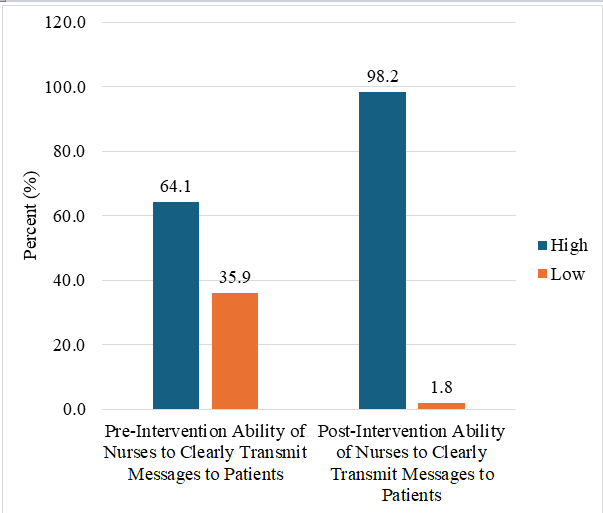
Figure 1 presents the ability of the nurses to clearly transmit messages to patients, the chart reveals that before the intervention, a larger proportion of nurses, 209 (64.1%), demonstrated a high ability to clearly transmit messages to patients, while 117 (35.9%) had a low ability. Post-intervention, there was a substantial improvement, with the vast majority, 320 (98.2%), achieving a high ability to clearly transmit messages, whereas only 6 (1.8%) remained in the low category.
Objective two:
Pre and post intervention ability of nurses to better comprehend from patients.
| Items | Pre-Intervention | Mean±SD | Post-Intervention | Mean±SD | ||||||||
| SA n(%) | A n(%) | N n(%) | D n(%) | SD n(%) | SA n(%) | A n(%) | N n(%) | D n(%) | SD n(%) | |||
| I practice active listening by fully concentrating on what the patient is saying. | 212(65.0) | 60(18.4) | 27(8.3) | 5(1.5) | 22(6.7) | 4.33±1.138 | 287(88.0) | 26(8.0) | 8(2.5) | 0(0.0) | 5(1.5) | 4.81±0.623 |
| I ask follow-up questions to clarify patient concerns before making clinical decisions. | 174(53.4) | 111(34.0) | 12(3.7) | 15(4.6) | 14(4.3) | 4.28±1.034 | 298(91.4) | 17(5.2) | 8(2.5) | 0(0.0) | 3(0.9) | 4.86±0.529 |
| I encourage patients to share their symptoms, experiences, and feelings openly with nurses. | 137(42.0) | 159(48.8) | 9(2.8) | 12(3.7) | 9(2.8) | 4.24±0.889 | 218(66.9) | 96(29.4) | 11(3.4) | 0(0.0) | 1(0.3) | 4.63±0.583 |
| I acknowledge and validate patients' feelings and concerns during conversations to understand patients. | 96(29.4) | 173(53.1) | 13(4.0) | 19(5.8) | 25(7.7) | 3.91±1.119 | 207(63.5) | 97(29.8) | 17(5.2) | 0(0.0) | 5(1.5) | 4.54±0.734 |
| I observe non-verbal cues to better understand patient emotions and concerns. | 132(40.5) | 125(38.3) | 48(14.7) | 0(0.0) | 21(6.4) | 4.06±1.064 | 256(78.5) | 56(17.2) | 11(3.4) | 0(0.0) | 3(0.9) | 4.73±0.565 |
| I repeat or summarize what a patient has said to ensure I have understood them correctly. | 133(40.8) | 144(44.2) | 27(8.3) | 0(0.0) | 22(6.7) | 4.12±1.042 | 179(54.9) | 135(41.4) | 8(2.5) | 0(0.0) | 4(1.2) | 4.50±0.611 |
| I maintain appropriate eye contact and body language. | 135(41.4) | 149(45.7) | 19(5.8) | 0(0.0) | 23(7.1) | 4.14±1.044 | 260(79.8) | 58(17.8) | 7(2.1) | 0(0.0) | 1(0.3) | 4.77±0.489 |
| I make an effort to understand and accommodate patients with communication difficulties. | 137(42.0) | 135(41.4) | 46(14.1) | 0(0.0) | 8(2.5) | 4.21±0.862 | 254(77.9) | 62(19.0) | 8(2.5) | 0(0.0) | 2(0.6) | 4.74±0.527 |
| I do not interrupt patients while they are speaking unless necessary. | 149(45.7) | 132(40.5) | 36(11.0) | 9(2.8) | 0(0.0) | 4.29±0.771 | 184(56.4) | 123(37.7) | 6(1.8) | 0(0.0) | 13(4.0) | 4.47±0.726 |
| I adjust my listening approach based on patient literacy and communication style. | 161(49.4) | 125(38.3) | 17(5.2) | 16(4.9) | 7(2.1) | 4.28±0.928 | 262(80.4) | 56(17.2) | 3(0.9) | 0(0.0) | 5(1.5) | 4.76±0.540 |
| I allow patients sufficient time to express their thoughts and concerns. | 146(44.8) | 135(41.4) | 18(5.5) | 20(6.1) | 7(2.1) | 4.21±0.950 | 189(58.0) | 117(35.9) | 11(3.4) | 0(0.0) | 9(2.8) | 4.49±0.696 |
| Understanding patient concerns improves healthcare outcomes and satisfaction. | 143(43.9) | 141(43.3) | 11(3.4) | 25(7.7) | 6(1.8) | 4.20±0.953 | 245(75.2) | 54(16.6) | 20(6.1) | 0(0.0) | 7(2.1) | 4.65±0.694 |
| I recognize when a patient is hesitant to communicate and ease their discomfort. | 151(46.3) | 103(31.6) | 26(8.0) | 39(12.0) | 7(2.1) | 4.08±1.101 | 271(83.1) | 41(12.6) | 7(2.1) | 0(0.0) | 6(1.8) | 4.76±0.610 |
| I use active listening techniques like nodding, paraphrasing, and summarizing to understand patients feelings. | 150(46.0) | 110(33.7) | 39(12.0) | 22(6.7) | 5(1.5) | 4.16±0.982 | 219(67.2) | 84(25.8) | 18(5.5) | 0(0.0) | 5(1.5) | 4.57±0.736 |
| I reassure patients by acknowledging feelings and responding with empathy. | 156(47.9) | 90(27.6) | 35(10.7) | 38(11.7) | 7(2.1) | 4.07±1.115 | 243(74.5) | 53(16.3) | 25(7.7) | 0(0.0) | 5(1.5) | 4.64±0.687 |
Table 5 presents the pre and post-intervention ability of nurses to better understand messages from patients. Findings reveal a substantial improvement in nurses' ability to understand messages from patients after the intervention, as reflected in both frequency distributions and mean scores. Before the intervention, a larger proportion of nurses, 212(65.0%), practiced active listening by fully concentrating on what the patient was saying, with a mean score of 4.33±1.138. This increased significantly to 287(88.0%) post-intervention, with a higher mean score of 4.81±0.623. Similarly, the proportion of nurses who asked follow-up questions to clarify patient concerns before making clinical decisions rose from 174(53.4%) to 298(91.4%), with the mean score improving from 4.28±1.034 to 4.86±0.529. Encouraging patients to share their symptoms, experiences, and feelings openly also showed significant improvement, rising from 137(42.0%) pre-intervention to 218(66.9%) post-intervention, with a corresponding increase in mean score from 4.24±0.889 to 4.63±0.583. More nurses acknowledged and validated patient concerns during conversations after the intervention, increasing from 96(29.4%) to 207(63.5%), while the mean score rose from 3.91±1.119 to 4.54±0.734. Similarly, observing non-verbal cues to understand patient emotions and concerns improved from 132(40.5%) to 256(78.5%), with the mean score increasing from 4.06±1.064 to 4.73±0.565.
The ability to repeat or summarize what a patient has said to ensure correct understanding improved from 133(40.8%) to 179(54.9%), with the mean score rising from 4.12±1.042 to 4.50±0.611. Maintaining appropriate eye contact and body language also saw a notable increase from 135(41.4%) to 260(79.8%), with an improvement in the mean score from 4.14±1.044 to 4.77±0.489. A larger proportion of nurses made efforts to accommodate patients with communication difficulties, increasing from 137(42.0%) to 254(77.9%), with the mean score rising from 4.21±0.862 to 4.74±0.527. More than half of the nurses, 149(45.7%), avoided interrupting patients unless necessary before the intervention, increasing to 184(56.4%) post-intervention, with the mean score improving from 4.29±0.771 to 4.47±0.726. Adjusting the listening approach based on patient literacy and communication style rose from 161(49.4%) to 262(80.4%), with the mean score increasing from 4.28±0.928 to 4.76±0.540. The ability to allow patients sufficient time to express their thoughts and concerns improved from 146(44.8%) to 189(58.0%), with a rise in mean score from 4.21±0.950 to 4.49±0.696.
Understanding that patient concerns improve healthcare outcomes and satisfaction increased from 143(43.9%) to 245(75.2%), with the mean score rising from 4.20±0.953 to 4.65±0.694. The ability to recognize hesitant patients and ease their discomfort showed a significant increase from 151(46.3%) to 271(83.1%), with an improvement in the mean score from 4.08±1.101 to 4.76±0.610. More nurses applied active listening techniques such as nodding and paraphrasing post-intervention, increasing from 150(46.0%) to 219(67.2%), with the mean score rising from 4.16±0.982 to 4.57±0.736. Similarly, the proportion of nurses who reassured patients by acknowledging their feelings and responding with empathy increased from 156(47.9%) to 243(74.5%), with the mean score improving from 4.07±1.115 to 4.64±0.687.
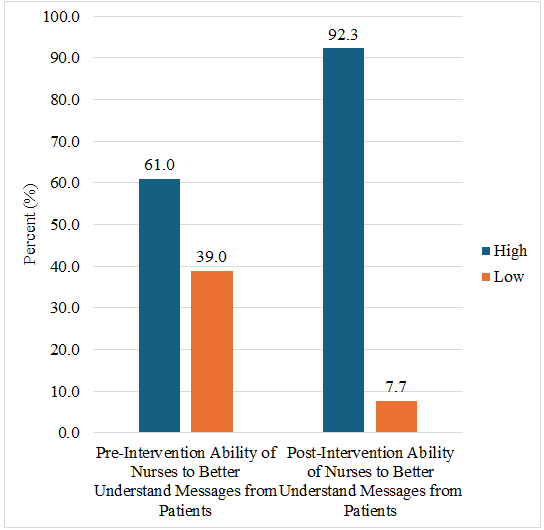
Figure 2 presents the pre and post intervention ability of nurses to better understand messages from patients; before the intervention, a larger proportion of nurses, 199(61.0%), had a high ability to understand messages from patients, while 127(39.0%) had a low ability. Following the intervention, there was a significant improvement, with the vast majority, 301(92.3%), demonstrating a high ability, while only 25(7.7%) remained in the low category.
Overall competency was scored based on 15 Likert-scale questions strongly agreed-5, agreed-4, neutral-3 disagreed-2, and strongly disagreed-1 for positive statements. The scoring of nurses' ability to better understand messages from patients was categorized using the pre-intervention mean score (63), participants were scored: low (15-62), and high (62-75).
5. Discussion of Finding
Objective One: The pre and post intervention ability of Nurses to Clearly Transmit Messages to Patients.
Finding from this study revealed that a larger proportion of nurses, (64.1%), demonstrated a high ability to clearly transmit messages to patients. Post-intervention, there was a substantial improvement, with the vast majority, (98.2%), achieving a high ability to clearly transmit messages, with a mean score increased from 67.88±3.64 (pre-intervention) to 72.21±2.44 (post-intervention), with a mean gain of 4.337. This is an obvious reason to show that the intervention is highly effective. Nurses can significantly transmit message clearly to patients. This finding is in agreement with the findings of Ared et al (2022) Wu et al. (2023) suggested that enhanced communication not only facilitates clearer transmission of information but also plays a vital role in reducing patient anxiety and improving treatment adherence. The improvements observed, in areas ranging from the clarity of language to the effective use of nonverbal cues, indicate that nurses are better equipped to tailor their communication strategies to diverse patient needs, including those with differing cultural backgrounds or literacy levels. This multidimensional improvement is critical in today’s healthcare environment, where effective communication is directly linked to patient satisfaction and overall care outcomes. The finding is consistent with that of Nikmanesh et al. (2018) found that communication skills training improved the quality of nurse-patient interactions and resulted in greater patient satisfaction. This finding is particularly relevant because the current study’s focus on clear messaging, appropriate nonverbal cues, and patient education is likely to have a positive impact on patient outcomes highlighting the practical benefits of such interventions. The gaps in the baseline findings as regards the communication skills aligns with Adeyemo et al. (2022) and Bekele et al. (2022) who identified notable gaps in communication skills among rural nurses, particularly in cultural competence. Also, Bekele et al. (2022) highlighted that rural nurses in Ethiopia had moderate communication knowledge but lacked practical application skills. Furthermore, Yakubu et al. (2023) found that while nurses in North-Central Nigeria were proficient in patient education, they struggled with fostering two-way communication. Adeyemo et al. (2022) similarly noted that rural nurses in Oyo State often delivered information in a one-way manner, reducing opportunities for patient participation. However, keeping in view with the findings of this study, Razi et al. (2016) demonstrated that a targeted communication training workshop using small group discussions significantly enhanced both verbal and nonverbal skills among nurses.
Objective Two: The pre and post intervention ability of nurses to better comprehend messages from patients
The findings from this study indicate a marked improvement in nurses’ ability to understand messages from patients after the intervention as a larger proportion of nurses, 199(61.0%), had a high ability to comprehend messages from patients. Following the intervention, there was a significant improvement, with the vast majority, 301(92.3%), demonstrating a high ability. supported this finding is Williams et al. (2022), who found that targeted communication skills training led to sustained improvements in nurses’ ability to engage in meaningful conversations with patients. the substantial increase in ability post intervention in this current study align with the research by Ali et al. (2020) demonstrating that communication skills training leads to sustained improvements in nurses’ self-rated abilities, reinforcing the importance of integrating such programs into both pre-service nursing education and in-service professional development. this study is also supported by Mohamed and Fashafsheh (2019) found that simulation-based training significantly improved communication skills, self-efficacy, and clinical competence which showed an increase in the mean communication skill score from 1.58 (SD = 0.55) to 2.64 (SD = 0.51), which was statistically significant (t = -32.64, p = 0.001). Blackmore et al. (2018) revealed that strong evidence that direct interventions improve nurses' skills in understanding the patients. The statistically significant improvement in nurses’ ability to comprehend patient messages highlights the effectiveness of targeted communication training. The findings highlight the need to explore sustained effects of communication training and its impact on patient outcomes, ensuring that improvements in communication translate into higher-quality healthcare and patient satisfaction.
6. Conclusion
These findings highlight the effectiveness of the intervention in significantly enhancing nurses' communication competencies, a critical factor in patient care quality and professional collaboration. The substantial improvements across multiple communication domains suggest that targeted training can bridge existing gaps, fostering more precise message transmission, deeper patient understanding, and stronger interpersonal relationships. Given the universal adoption of high-level communication skills post-intervention, integrating such training into standard nursing curricula and continuous professional development programs may be instrumental in sustaining these gains and further optimizing patient outcomes.
7. Recommendations
Education and Training: Healthcare administrators and nursing education institutions should implement regular, structured communication skills training programs for nurses, particularly those working in rural primary healthcare centers as the study demonstrated significant improvements in nurses' ability to convey and understand messages after targeted interventions. These programs should emphasize interactive learning methods, including group discussions and role-playing exercises, as these were identified as highly beneficial components. The training curriculum should be comprehensive, covering active listening, empathy, cultural competence, and non-verbal communication techniques. Nursing schools should also integrate dedicated communication skills modules into their core curriculum to ensure nurses are well-prepared before entering practice.
Healthcare Administration Assessments: Healthcare facility administrators should establish formal feedback mechanisms to regularly assess nurse-patient communication effectiveness. They should implement systematic evaluations of communication practices and create opportunities for continuous improvement. Additionally, administrators should develop clear protocols for handling patient complaints and concerns, ensuring that nurses have the necessary support and resources to maintain professional and empathetic responses in challenging situations.
Continuous Professional Development: Nursing regulatory bodies and professional associations should mandate continuing education credits specifically focused on communication skills as part of license renewal requirements. They should develop standardized assessment tools to evaluate nurses' communication competencies and establish benchmarks for professional practice. Furthermore, they should create mentorship programs where experienced nurses can guide their colleagues in developing effective communication strategies. Healthcare administrators should establish ongoing training programs to reinforce communication skills, given the observed improvements post-intervention. Regular workshops and refresher courses will help sustain these advancements, ensuring that nurses continue to engage in clear, patient-centered communication.
Cultural Competency: Healthcare organizations should invest in specialized cultural competency training programs for nurses working in diverse communities. These programs should focus on helping nurses adapt their communication styles to meet the needs of patients from different cultural backgrounds. Organizations should also develop culturally appropriate communication resources and tools that nurses can readily access during patient interactions.
Research and Evaluation: Academic institutions and healthcare research organizations should conduct longitudinal studies to assess the long-term impact of communication skills training on patient outcomes. They should investigate the effectiveness of different training methodologies and develop evidence-based best practices for communication skills development in nursing practice. Additionally, researchers should explore innovative approaches to measuring and evaluating communication competencies in healthcare settings.
Quality Assurance: Healthcare quality assurance departments should incorporate communication skills assessment into their regular monitoring and evaluation processes. They should develop specific metrics to measure communication effectiveness and integrate these measurements into overall quality improvement initiatives. Regular audits of patient feedback and communication-related incidents should be conducted to identify areas needing improvement.
References
- Adeyemo, M., Olawale, S., Adeniyi, N., Popoola, O.,& Bello, T. (2022). Spiritual nursing care knowledge, perception, and practice among nurses in secondary health care facilities in Osun State, Nigeria. Research and Education in Health Sciences, 10(3), . 10.4314/rejhs.v10i3.10 DOI ↗ Google Scholar ↗
- Ali, S., Jawed, Z., Umair, M., Khan, A. A., & Mirza, A. (2020). Effect of a 2-day hospital wide communication skills training on self-ratings of nursing staff. Clinical & Experimental Dermatology Research, 6(2). DOI ↗ Google Scholar ↗
- Ali,S., Umair, M., Jawed, Z., Khan, A.A., & Mirza, A. (2020). Effect of a 2-DayHospital Wide Communication Skills Training on Self-Ratings of Nursing Staff. DOI ↗ Google Scholar ↗
- Arad, M., Alilu, L., Habibzadeh, H., Khalkhali, H., & Goli, R. (2022). Effect of spiritual intelligence training on nurses’ skills for communicating with patients - an experimental study. Journal of Education and Health Promotion, 11, 127. DOI ↗ Google Scholar ↗
- Bekele, Y., Worku, T., Atnafe, G., Debella, A., Habte, S., Goshu, A. T., & Assebe, T. (2022). Patients' perceptions of nurses' communication in public hospitals of Harari Regional State, Eastern Ethiopia. SAGE Open Medicine, 10, 20503121221097270. DOI ↗ Google Scholar ↗
- Blackmore, A., Kasfiki, E. V., & Purva, M. (2018). Simulation-based education to improve communication skills: a systematic review and identification of current best practice. BMJ simulation & technology enhanced learning, 4(4), 159–164. DOI ↗ Google Scholar ↗
- ElShazly, H. M., & Hegazy, N. N. (2017). Socioeconomic determinants affecting the quality of life among diabetic and hypertensive patients in a rural area, Egypt. Journal of Family Medicine and Primary Care, 6(1), 141–145. DOI ↗ Google Scholar ↗
- ElShazly, M., El Taweel, A., El Menshawy, M., &El-Sayed, R. (2020). Assessing nurses’ communication skills: Self-reported questionnaire versus observation. Journal of Nursing Education and Practice, 7(9), 77-85. DOI ↗ Google Scholar ↗
- Kwame, A., & Petrucka, P. M. (2020a). Communication in nurse-patient interaction in healthcare settings: A scoping review. International Journal of Africa Nursing Sciences, 12, 100198. DOI ↗ Google Scholar ↗
- Mohamed, S. A., & Fashafsheh, I. H. (2019). The Effect of Simulation-Based Training on Nursing Students’ Communication Skill, Self-Efficacy and Clinical Competence for Nursing Practice. Open Journal of Nursing, 09(08), 855–869. DOI ↗ Google Scholar ↗
- Nikmanesh, P., Mohammadzadeh, B., Nobakht, S., & Yusefi, A. R. (2018). Nurses communication skills training and its effect on patients’ satisfaction in teaching hospitals of Shiraz University of Medical Sciences. Iranian Journal of Health Sciences, 6(4), 22–29. http://jhs.mazums.ac.ir DOI ↗ Google Scholar ↗
- Oche, M. O., Adamu, H., & Abubakar, M. B. (2020). Perceived competence and attitude of primary healthcare workers regarding communication with mentally ill patients in Maiduguri, North-Eastern Nigeria. Nigerian Journal of Clinical Practice, 17(4), 439-445. DOI ↗ Google Scholar ↗
- Street, R. L., Makoul, G., Arora, N. K., & Epstein, R. M. (2009). How does communication heal? Pathways linking clinician–patient communication to health outcomes. Patient Education and Counseling, 74(3), 295–301. DOI ↗ Google Scholar ↗
- Wieke Noviyanti, L., Ahsan, A., & Sudartya, T. S. (2021). Exploring the relationship between nurses' communication satisfaction and patient safety culture. Journal of Public Health Research, 10(2), 2225. DOI ↗ Google Scholar ↗
- Williams, S., et al. (2022). Sustainability of communication skills training effects: A longitudinal study. Journal of Nursing Care Quality, 37(1), 78-91. DOI ↗ Google Scholar ↗
- Wu, S. I., Liu, S. I., Wu, Y. J., Huang, L. L., Liu, T. J., Kao, K. L., & Lee, Y. H. (2023). The efficacy of applying the Interpersonal Effectiveness skills of dialectical behavior therapy into communication skills workshop for clinical nurses. Heliyon, 9(3), e14066. DOI ↗ Google Scholar ↗
- Yakubu, K., Shanthosh, J., Adebayo, K. O., Peiris, D., & Joshi, R. (2023). Scope of health worker migration governance and its impact on emigration intentions among skilled health workers in Nigeria. PLOS Global Public Health, 3(1), e0000717. DOI ↗ Google Scholar ↗