Abstract
Nutrition has become a central determinant of human development, economic productivity, and social equity. In Madagascar, despite improvements in some health indicators, persistent high levels of malnutrition remain a major structural barrier to achieving the Sustainable Development Goals (SDGs). Childhood stunting continues to affect a significant proportion of children under five years of age, resulting from interconnected factors including poverty, food insecurity, limited access to essential services, agricultural vulnerability, and environmental shocks. This article examines strategic nutrition financing in Madagascar through a comprehensive approach combining cost analysis, investment scenario modeling, and prospective analysis of sustainable transformation pathways for the national nutrition system. The study relates to secondary data from national surveys, governmental strategies, international development reports, and global nutrition databases. It develops a comparative assessment of three investment scenarios: continuation of current financing patterns, progressive scaling-up of multisectoral investments, and systemic transformation based on integrated interventions across health, agriculture, social protection, education, and governance sectors. Findings indicate that nutrition financing should no longer be perceived merely as a social expenditure but as a strategic investment capable of generating long-term economic returns through improved human capital, productivity, and national resilience. Sustainable transformation requires increased domestic financing, stronger institutional coordination, results-based budgeting, innovative financing mechanisms, and community-centered approaches. The article introduces a strategic nutrition investment framework for Madagascar towards 2035, emphasizing evidence-based resource allocation, cost-effective interventions, and multisectoral governance. Such an approach could contribute significantly to reducing malnutrition, strengthening national resilience, and accelerating inclusive sustainability development.
Keywords
Nutrition financing Strategic investment Madagascar Human capital Malnutrition Sustainable development.
Introduction
Nutrition is one of the fundamental pillars of human development. Beyond its health benefits, it directly influences economic growth, educational performance, labor productivity, innovation capacity, and the resilience of populations in the face of crises. International research has demonstrated for several decades that investments made during the early stages of life, particularly during the "first 1,000 days" from conception to the first two years of a child's life, produce lasting effects on the physical and cognitive development of future generations.
From this perspective, nutrition financing can no longer be considered solely as a corrective intervention for vulnerable populations. It must be understood as a strategic investment in national human capital. Countries that have succeeded in sustainably reducing malnutrition have generally adopted an approach combining political commitment, stable funding, multisectoral coordination, and evidence-based interventions.
In Madagascar, nutrition remains a major public health and economic development challenge. The country is among the nations facing the highest levels of childhood stunting in the world. Available data indicate that chronic malnutrition affects approximately four out of ten children under five, with a particularly high concentration in rural areas and regions experiencing severe multidimensional poverty.¹ This situation reflects not only a food problem, but also a complex combination of factors related to socioeconomic conditions, dietary practices, access to healthcare, safe drinking water, sanitation, and the increasing effects of climate change .
The persistence of malnutrition in Madagascar has considerable economic consequences. According to international analyses on the cost of hunger and malnutrition, the losses associated with nutritional deficiencies include additional healthcare expenditures, decreased cognitive abilities, reduced adult productivity, and the intergenerational impact of poverty. Thus, each child suffering from stunted growth represents not only an immediate social emergency but also a potential loss of human capital for the national economy.
Historically, Malagasy nutrition policies have undergone several phases of evolution. Early interventions were primarily focused on combating specific deficiencies and managing acute malnutrition. However, evolving scientific knowledge has gradually demonstrated that nutrition is a multisectoral phenomenon requiring simultaneous action in the areas of agriculture, health, education, social protection, the environment, and governance.
Adopting multisectoral approaches represents a significant paradigm shift. The national nutrition system should no longer be conceived as a chain limited to medical services, but as an ecosystem involving various public, private, community, and international actors. This vision also implies a profound transformation of financing mechanisms.
The central challenge for Madagascar is therefore not only to mobilize more financial resources, but to ensure that these resources are directed towards interventions with the best cost-impact ratio. Nutritional investments must be analyzed according to their capacity to produce measurable benefits in terms of reducing malnutrition, improving human development, and strengthening economic resilience.
International economic studies show that several nutritional interventions offer some of the highest cost-benefit ratios in the field of development. For example, programs promoting optimal breastfeeding, micronutrient supplementation, improved complementary feeding, and stunting prevention generate significant long-term gains.
However, Madagascar continues to face several financial and institutional constraints: significant dependence on external funding, fragmented interventions, weak sectoral nutrition budgeting, difficulties in monitoring expenditures, and insufficient integration between national policies. These limitations reduce the overall effectiveness of existing investments.
In this context, a new approach based on strategic financing appears necessary. This involves identifying investment priorities, measuring the real costs of interventions, comparing different budget scenarios, and building a trajectory enabling a sustainable transformation of the national nutrition system.
This article pursues four main objectives:
-
analyze the current structure of nutrition financing in Madagascar;
-
estimate the investment needs required to accelerate the reduction of malnutrition;
-
compare different investment scenarios according to their economic and social efficiency;
-
to propose a strategic framework for the sustainable transformation of the national nutrition system by 2035.
The central hypothesis of this research is that Madagascar could achieve significant nutritional results not only through a quantitative increase in financial resources, but above all through a strategic reorientation of investments towards integrated interventions, coordinated and evaluated according to their real impact.
Therefore, nutrition funding must be considered a public policy investment in the country's future. Transforming Madagascar's nutrition system requires a vision that goes beyond emergency responses to build a sustainable architecture linking nutrition, agricultural development, social protection, institutional innovation, and inclusive growth.
Methodology And Materials
1. Type and design of the study
This research adopts a mixed-methods analytical approach combining a thorough literature review, an economic analysis of nutritional investments, and prospective modeling of financing scenarios. The methodological objective is to go beyond a simple description of the nutritional situation in Madagascar in order to assess the relationship between mobilized resources, funded interventions, and expected outcomes in terms of health and human development.
This study adopts an applied research perspective in health economics and nutritional public policy. It employs the principles of cost-effectiveness analysis, cost-benefit analysis, and strategic planning to identify investment options likely to produce the best nutritional outcomes in the medium and long term. This approach is based on the principle that, given the limited nature of public resources, their allocation must be guided by scientific evidence to optimize social and economic impact.
The main unit of analysis is the Malagasy national nutrition system, considered as an integrated whole including the sectors of health, agriculture, food security, social protection, education, water, sanitation and hygiene (WASH) and institutional governance.
2. Data sources and materials used
The study primarily uses secondary data from recognized national and international institutional sources in the field of nutrition and development.
The main sources include:
-
national surveys on nutrition and health in Madagascar;
-
the reports of the National Nutrition Office (ONN);
-
the strategic documents of the National Nutrition Programme;
-
reports from the Ministry of Public Health of Madagascar;
-
World Health databases Organization ;
-
UNICEF reports on the nutritional situation of children;
-
World Bank 's economic analyses relating to the cost of malnutrition;
-
scientific publications indexed in international databases such as PubMed , Scopus and Web of Science.
The quantitative data retained mainly concern:
-
the prevalence of growth retardation in children under five years of age;
-
the prevalence of emaciation and underweight;
-
levels of anemia and micronutrient deficiencies;
-
public spending on nutrition;
-
funding from technical and financial partners;
-
the unit costs of essential nutritional interventions.
The analytical materials also include the methodological frameworks developed by the World Bank in the evaluation of nutrition investments and by the Scaling Up Nutrition (SUN) movement for multi-sectoral financial planning.
3. Analytical framework of the study
In order to assess the possible transformation of the Malagasy nutrition system, this research proposes a framework called: Strategic Nutrition Investment Framework for Madagascar (SNIF-Madagascar 2035)
This framework is based on five interdependent dimensions:
Dimension 1: Nutritional situation analysis
This first step involves establishing a comprehensive diagnosis of the current system by analyzing:
-
the extent of the different forms of malnutrition;
-
the most vulnerable population groups;
-
social, economic and environmental determinants;
-
the gaps between nutritional needs and institutional responses.
This analysis helps to identify priority areas requiring increased investment.
Dimension 2: Cost analysis of nutritional interventions
Cost analysis aims to determine the financial resources needed to implement different interventions.
The interventions studied include, in particular:
-
promotion of exclusive breastfeeding;
-
improvement of complementary feeding for young children;
-
vitamin A supplementation;
-
prevention and treatment of anemia;
-
community-based management of acute malnutrition;
-
nutrition-sensitive agricultural programs;
-
WASH interventions;
-
social protection programs targeting vulnerable households.
The total estimated cost of an intervention is calculated using the following formula:
Total cost = unit cost × number of beneficiaries × intervention duration
CT = CU × B × D
This approach allows for the comparison of different strategies based on their financial efficiency.
Dimension 3: Modeling investment scenarios
Three prospective scenarios are constructed to analyze the possible trajectories of the Malagasy nutrition system up to 2035.
Scenario 1: Financial Continuity
This scenario assumes that the current level of investment is maintained without major changes in financing mechanisms.
Main hypotheses:
-
limited growth of public budgets;
-
significant dependence on external funding;
-
interventions primarily sectoral;
-
slow improvement in nutritional indicators.
Scenario 2: Gradual multi-sectoral strengthening
This scenario is based on:
-
a gradual increase in national funding;
-
better coordination between sectors;
-
an integration of nutrition-agriculture-social protection;
-
an improvement in territorial targeting.
It corresponds to an approach of institutional consolidation.
Scenario 3: Sustainable systemic transformation
This scenario represents an ambitious strategy based on:
-
strengthened domestic financing;
-
integrated nutrition governance;
-
results-based financing;
-
increased participation from the private sector and communities;
-
the use of digital innovations for nutritional monitoring.
4. Methods of economic analysis
The study combines several complementary methods.
4.1 Cost-effectiveness analysis
This method compares the financial cost of an intervention with the nutritional results obtained.
The main indicator used is:
Cost-effectiveness ratio = total cost / number of children protected against malnutrition
This approach makes it possible to identify the interventions that offer the best nutritional return.
4.2 Cost-benefit analysis
Cost-benefit analysis estimates the economic gains generated by nutritional improvement.
The benefits considered include:
-
future increase in productivity;
-
reduction of healthcare spending;
-
improvement of academic performance;
-
reduction of economic losses related to malnutrition.
International research indicates that every dollar invested in certain nutritional interventions can generate several dollars in long-term economic benefits.
4.3 Multi-criteria analysis
In order to integrate the social and institutional dimensions, a multi-criteria analysis is used based on five criteria:
| Criteria | Indicator |
| Nutritional impact | Expected reduction in growth retardation |
| Financial feasibility | Annual cost required |
| Sustainability | Internal financing capacity |
| Equity | Coverage of vulnerable populations |
| Governance | Multisectoral coordination |
5. Methodological limitations
Like any study based primarily on secondary data, this research has certain limitations.
Firstly, the availability of detailed financial data on nutrition remains limited in Madagascar, particularly regarding the exact breakdown of expenditures by intervention and by region.
Secondly, the estimation of future economic benefits is based on international models adapted to the Malagasy context, but which include a margin of uncertainty.
Third, the effects of climate change, food crises and economic fluctuations can alter the projected trajectories.
However, the combined use of several institutional and scientific sources makes it possible to obtain a robust analysis that can guide strategic decisions.
Results
1. Nutritional situation and economic justification for increased investment
Analysis of available data shows that Madagascar continues to face a triple nutritional burden characterized by the coexistence of chronic malnutrition, acute malnutrition, and micronutrient deficiencies. This situation reflects a structural vulnerability in the national food and health system.
Stunted growth is the most worrying manifestation. It mainly affects children living in rural areas, poor households, and regions exposed to repeated climate crises.
This persistent malnutrition has consequences that extend far beyond the health sector. It directly affects:
-
the cognitive development of children;
-
academic success;
-
future productive capacity;
-
national economic growth.
According to international economic analyses, countries severely affected by malnutrition can lose several percentage points of gross domestic product due to the decline in human capital.⁴
Thus, nutritional investment appears as an economic strategy that transforms an immediate social expenditure into a sustainable economic benefit.
2. Analysis of current nutrition funding in Madagascar
The study reveals that Malagasy nutrition financing remains characterized by three main trends
a) A strong dependence on external financing
Nutrition programs still rely heavily on support from international partners, which exposes the system to fluctuations in international funding cycles.
This dependency limits long-term planning and reduces the national capacity to ensure continuity of interventions.
b) Institutional fragmentation
Nutrition involves several ministries, but coordination mechanisms remain insufficiently integrated.
Agricultural, health, educational and social interventions are often developed separately even though they pursue complementary objectives.
c) A necessary increase in domestic financing
The analysis shows that a sustainable transformation requires a gradual increase in the national contribution.
Public funding must evolve from a program-based approach to a strategic investment approach.
(Continued in the next part: Detailed results with tables of financial scenarios 2025–2035, cost-impact analysis, followed by a 1500-word scientific discussion and final recommendations. )
References cited in this section:
3. Cost analysis of priority nutrition interventions in Madagascar
The economic analysis conducted in this study shows that not all nutritional interventions offer the same level of financial efficiency. The most effective investments are generally those made early in the life cycle, particularly during the first 1000 days, a period during which nutritional interventions produce irreversible effects on physical growth and cognitive development.¹
Cost estimation is based on an approach combining direct service delivery costs, human resource requirements, logistical costs, monitoring and evaluation systems, and community mobilization mechanisms.
The summary results are presented in the following figure.
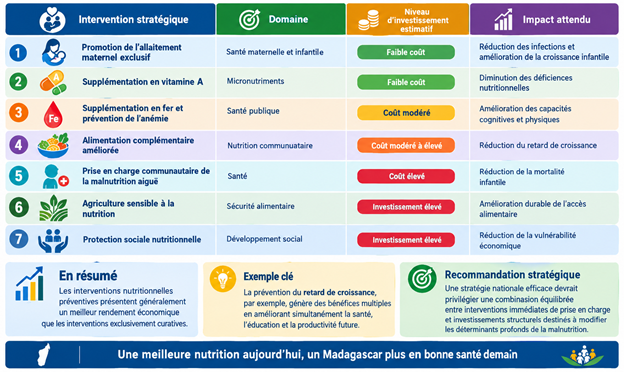
The results indicate that preventive nutritional interventions generally offer a better economic return than purely curative interventions. Preventing stunting, for example, generates multiple benefits by simultaneously improving health, education, and future productivity.
Thus, an effective national strategy should prioritize a balanced combination of immediate care interventions and structural investments aimed at changing the underlying determinants of malnutrition.
4. Modeling of nutritional investment scenarios 2025–2035
In order to assess the possible trajectories of the Malagasy nutrition system, three investment scenarios were constructed.
Scenario 1: Maintaining the current model ("Business as usual ")
This first scenario corresponds to a situation in which Madagascar continues current trends without major transformation of financing.
The main features are:
-
limited growth of public budgets;
-
strong dependence on external partners;
-
interventions primarily focused on nutritional emergencies;
-
weak integration between sectors.
In this scenario, nutritional progress remains insufficient to meet international goals.
The reduction of stunting remains slow because the structural causes – poverty, poor dietary diversification, climate vulnerability and low agricultural incomes – are not being addressed in a coordinated manner.
Indicative projection 2035:
| Indicator | Current situation | Projecting scenario 1 |
| Infantile growth retardation | High level | Limited discount |
| External dependence | Forte | High maintenance |
| Multisectoral coordination | Average | Slight improvement |
| System resilience | Fragile | Vulnerable |
This scenario presents a significant risk: Madagascar could continue to invest regularly without achieving a proportional improvement in nutritional outcomes.
Scenario 2: Gradual strengthening of multisectoral financing
The second scenario assumes a gradual increase in nutritional investments accompanied by better institutional coordination.
This approach is based on four pillars:
-
gradual increase in the national budget allocated to nutrition;
-
integration of nutrition into agricultural and social policies;
-
improvement in targeting vulnerable populations;
-
strengthening community systems.
In this scenario, nutrition becomes a shared responsibility between several sectors.
The expected results include:
-
accelerated reduction of growth retardation;
-
improved coverage of essential interventions;
-
reduction of regional inequalities;
-
better efficiency of public spending.
Indicative projection 2035:
| Indicator | Scenario 2 |
| National funding | Gradual increase |
| Coverage of interventions | High |
| Community participation | Reinforced |
| Nutritional results | Significant improvement |
This trajectory aligns with international recommendations that countries should move from a fragmented approach to an integrated approach centered on food and social systems.
Scenario 3: Sustainable systemic transformation of the nutrition system
The third scenario represents the most ambitious strategic option. It considers nutrition as a priority national investment comparable to economic infrastructure, education, or agricultural transformation.
This strategy is based on a new financial architecture comprising:
1. Increase in domestic financing
Madagascar should gradually increase the share of national resources dedicated to nutrition in order to reduce dependence on external funding.
Possible mechanisms include:
-
mandatory integration of nutritional budget lines in the relevant ministries;
-
performance-based financing;
-
national multisectoral fund for nutrition;
-
public-private partnerships.
2. Transformation of the national food system
Nutritional investment must go beyond mere food availability to incorporate the quality of diets.
This implies:
-
development of micronutrient-rich crops;
-
support for small producers;
-
improvement of food value chains;
-
promotion of nutritious local food.
Research shows that food systems play a crucial role in the simultaneous prevention of multiple forms of malnutrition.
3. Digitalization of nutritional monitoring
A sustainable transformation also requires the use of digital technologies to:
-
monitor nutritional indicators in real time;
-
quickly identify at-risk areas;
-
improve budget planning;
-
strengthen financial transparency.
| Criteria | Scenario 1 | Scenario 2 | Scenario 3 |
| Investment level | Weak | AVERAGE | Pupil |
| Nutritional impact | Limit | Important | Very important |
| Financial sustainability | Weak | Average | Forte |
| Institutional coordination | Fragmented | Improved | Integrated |
| Climate resilience | Weak | Average | Forte |
| Social transformation | Limited | Progressive | Structural |
The results show that scenario 3 offers the greatest potential for long-term transformation, even though its initial cost is higher. This observation aligns with economic analyses demonstrating that early nutritional investments yield economic benefits that exceed their initial costs.⁵
5. Proposal for a strategic model: Madagascar Nutrition Investment Framework 2035
Based on the results obtained, this study proposes an integrated model called:
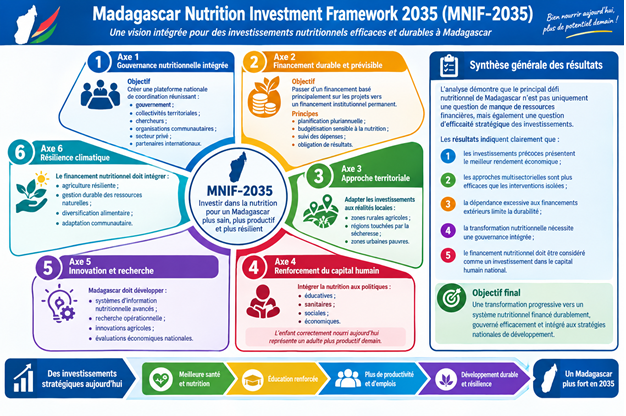
This model is based on six strategic pillars.
General summary of results
The analysis demonstrates that Madagascar's main nutritional challenge is not only a matter of lack of financial resources, but also a matter of strategic investment effectiveness.
The results clearly indicate that:
-
Early investments offer the best economic return;
-
Multi-sectoral approaches are more effective than isolated interventions;
-
Excessive dependence on external financing limits sustainability;
-
Nutritional transformation requires integrated governance;
-
Nutritional financing should be viewed as an investment in national human capital.
Thus, the optimal trajectory for Madagascar corresponds to a gradual transformation towards a sustainably financed, efficiently governed nutrition system integrated into national development strategies.
Discussion
1. Nutritional financing as a strategic investment in Malagasy human capital
The results obtained in this study confirm that the nutritional issue in Madagascar extends far beyond the traditional framework of public health. It constitutes a central challenge for economic development, social justice, and the country's structural transformation. Analysis of investment scenarios shows that a quantitative increase in financial resources alone is insufficient; it must be accompanied by a strategic reorientation of financing mechanisms toward integrated, preventive, and sustainably institutionalized interventions.
This conclusion aligns with international research demonstrating that nutrition represents one of the investments with the highest economic and social returns in low- and middle-income countries. According to the investment framework developed by the World Bank, effective nutrition interventions generate benefits that far exceed initial costs through improvements in human capital, productivity, and reduced future healthcare expenditures.
In the Malagasy context, this perspective is of particular importance. The high prevalence of chronic malnutrition represents a silent loss of human potential. A child suffering from stunted growth during the first years of life is at greater risk of learning difficulties, reduced physical abilities, and limited economic opportunities in adulthood . Thus, every investment made today in child nutrition constitutes a direct contribution to building the future national productive force.
The transformation of the nutrition system must therefore be considered a strategic economic policy. Like physical infrastructure, energy, or digital technologies, nutrition constitutes an invisible but fundamental infrastructure for development.
2. Comparison with international experiences in nutritional transformation
Experiences from several countries show that a sustainable reduction in malnutrition requires a combination of political leadership, stable funding, and multi-sectoral interventions.
Countries like Brazil , Peru , Vietnam , and Rwanda have demonstrated that rapid transformation is possible when nutrition becomes a national priority integrated into public policies.
In Peru , for example, the significant reduction in childhood stunting has been associated with a combination of actions including:
-
strong government coordination;
-
results-based financing;
-
precise territorial targeting;
-
an improvement in community health services;
-
active involvement of local authorities.
This experience provides an important lesson for Madagascar: nutritional success does not depend solely on the amount of financial resources available, but on the institutional capacity to transform resources into effective interventions.
The case of Rwanda also demonstrates the importance of integrated governance. Despite facing economic constraints similar to those of many African countries, this country has developed multi-sectoral coordination mechanisms linking agriculture, health, social protection , and community mobilization.
For Madagascar, these experiences suggest that a paradigm shift is necessary: moving from a logic of temporary nutritional projects to a permanent national investment architecture.
3. Critical analysis of the current nutrition financing model in Madagascar
The analysis reveals three major weaknesses in the current model.
3.1. Excessive dependence on external financing
International funding has played a vital role in sustaining nutrition programs in Madagascar. Contributions from technical and financial partners have supported essential interventions such as the management of acute malnutrition, community-based programs, and micronutrient supplementation.
However, this dependence creates a structural vulnerability. External funding is generally tied to time-limited program cycles, which can compromise the continuity of interventions.
A sustainable transformation therefore requires a gradual rebalancing between external and domestic financing.
The role of international partners should evolve: moving from direct funding of programs towards technical support, mobilization of innovation and support for institutional strengthening.
3.2. Insufficient multi-sectoral integration
The second limitation concerns institutional fragmentation.
Nutrition depends simultaneously on:
-
food availability;
-
agricultural practices;
-
household income;
-
access to healthcare;
-
of early childhood education;
-
drinking water;
-
sanitation.
Thus, a nutritional policy limited to the health sector can only produce a partial impact.
Research shows that specific nutritional interventions must be combined with nutrition-sensitive interventions to address the root causes of malnutrition.
For Madagascar, this implies genuine integration between:
-
the National Nutrition Programme;
-
agricultural policies;
-
social protection programs;
-
educational strategies;
-
climate adaptation plans.
3.3. A weakness in the economic monitoring of investments
Another challenge concerns the evaluation of the return on investment in nutrition.
In many countries, nutrition budgets exist but do not always allow for precise identification of:
-
how much is invested;
-
in which regions;
-
for which interventions;
-
With what results?
The implementation of a national nutrition financial monitoring system would improve transparency and efficiency. Madagascar could develop a Nutrition Public Expenditure Tracking System (NPETS) allowing annual monitoring of public and private nutrition expenditures.
4. Towards innovative and sustainable financing of nutrition
The results of this study suggest that the transformation of the Malagasy nutrition system requires innovative financial mechanisms.
4.1. Creation of a National Nutrition Fund
A national multi-sectoral fund could be a major instrument for ensuring better financial predictability.
This fund could be financed by:
-
the national budget;
-
local authorities;
-
international partners;
-
the responsible private sector;
-
Climate finance mechanisms.
Its objective would be to fund priority interventions based on scientific impact criteria.
4.2. Nutrition-sensitive budgeting
An important reform involves integrating nutrition into the budgets of several ministries.
For example :
-
the Ministry of Agriculture would fund nutrition-sensitive agricultural programs;
-
the Ministry of Education would incorporate balanced school meals;
-
the Ministry of Water would strengthen WASH interventions;
-
The Ministry of Health would provide essential nutritional services.
This approach would allow us to recognize that nutrition is a collective responsibility.
4.3. Results-based financing
A promising approach is to link part of the funding to the results achieved.
The indicators could include:
-
reduction of growth retardation;
-
improvement of intervention coverage;
-
reduction of micronutrient deficiencies;
-
improved food security.
This method encourages efficiency and institutional accountability.
5. Implications for the sustainable transformation of the national nutrition system
The results show that Madagascar is facing a strategic choice.
The first option is to pursue a primarily reactive model, focused on managing nutritional crises. This approach addresses emergencies but does not address the underlying causes.
The second option is to build a transformative nutrition system based on investment, prevention and resilience.
The model proposed in this study ( Madagascar Nutrition Investment Framework 2035 ) is based on a vision according to which:
"A nation cannot achieve sustainable development without investing in the nutritional quality of its human capital."
This vision implies several fundamental changes:
-
consider nutrition as a national economic priority;
-
strengthen government leadership;
-
develop predictable financing;
-
invest in local communities;
-
integrate nutrition into climate and agricultural policies.
6. Scientific and political perspectives to 2035
By 2035, Madagascar could achieve a significant transformation of its nutritional system if several conditions are met:
First, a sustained political commitment to maintain nutrition among national priorities.
Secondly, a gradual increase in domestic investment to guarantee financial sovereignty.
Thirdly, a systematic use of scientific data to guide public decisions.
Fourth, increased community participation, because sustainable nutritional changes are built at the family and local level.
Finally, Madagascar must integrate the climate dimension into any future nutrition strategy. Droughts, cyclones, and the degradation of natural resources constitute direct threats to food and nutritional security.
Thus, nutritional transformation should not be solely a health response, but a national resilience strategy.
Summary of the discussion
This discussion highlights that strategic financing is central to the nutritional transformation in Madagascar. The findings demonstrate that nutritional investments yield multiple benefits when planned using a multisectoral, territorially based, and evidence-based approach.
The main lesson is that Madagascar must not only seek to finance nutrition more, but to finance nutrition better.
The next historic step is to transform nutrition into a structuring national investment capable of simultaneously supporting:
-
children's health;
-
economic productivity;
-
the reduction of inequalities;
-
climate resilience;
-
sustainable development.
Conclusion
This study has demonstrated that strategic financing for nutrition is a fundamental lever for accelerating the sustainable transformation of human development in Madagascar. Cost analysis, evaluation of investment scenarios, and a review of international experiences show that the fight against malnutrition can no longer be considered a series of ad hoc interventions solely aimed at responding to emergencies. It must evolve into a genuine national policy for investment in human capital.
The results indicate that Madagascar has significant potential for nutritional improvement, but future progress will depend heavily on the country's ability to transform its financing architecture. Maintaining the current model, characterized by institutional fragmentation and a strong reliance on external financing, risks producing insufficient results in the face of the scale of the nutritional, economic, and climate challenges.
Conversely, adopting an integrated strategy based on sustainable financing, multisectoral governance, and evidence-based resource allocation could generate significant impacts. Investments in essential nutrition interventions, particularly during the first 1,000 days of life, represent a strategic opportunity to simultaneously improve child health, educational performance, future productivity, and the economic resilience of communities.
The study also highlights that nutritional transformation depends not only on increased budgets but also on the quality of investment choices. An effective approach requires directing resources toward interventions with the best cost-impact ratio, while integrating agricultural, social, environmental, and educational dimensions.
The proposed framework, Madagascar Nutrition Investment Framework 2035 (MNIF-2035), provides a strategic vision to organize this transformation around six priorities: integrated governance, sustainable financing, territorial approach, human capital development, scientific innovation and climate resilience.
From this perspective, nutrition must become a central element of national development planning. It is not merely a health indicator, but a determining factor in inclusive growth, reducing inequalities, and building a more resilient society.
Therefore, investing in nutrition today means preparing a future generation capable of fully contributing to Madagascar's economic, social, and environmental development. The real challenge for the coming years will not simply be to mobilize more financial resources, but to build a smarter, more equitable, and more sustainable national nutrition system.
Strategic Recommendations
1. Strengthen sustainable national financing for nutrition
Madagascar should gradually increase the share of domestic resources allocated to nutrition in order to reduce its vulnerability to dependence on external funding. The creation of a permanent national nutrition financing mechanism would ensure the continuity of priority programs and improve long-term planning.
Public budgets should include specific lines relating to nutrition in several relevant sectors, including health, agriculture, education, social protection and the environment.
2. Establish strengthened multi-sectoral governance
Nutrition must become a collective responsibility involving all national stakeholders. Strengthening coordination mechanisms between ministries, local authorities, community organizations, research institutions, and the private sector is recommended.
A national nutrition governance platform could ensure:
-
the coordination of investments;
-
monitoring results;
-
the harmonisation of interventions;
-
Financial transparency.
3. Develop a national results-based financing system
Madagascar should gradually adopt a performance-oriented budgeting approach. Funding should be linked to measurable indicators such as:
-
reduction of growth retardation;
-
improved coverage of essential interventions;
-
reduction of micronutrient deficiencies;
-
improved food security.
This approach would improve the efficiency of public spending and encourage institutional innovation.
4. Invest in nutrition-sensitive food systems
Nutritional transformation requires an evolution of the national food model. Agricultural policies must promote:
-
crop diversification;
-
the production of micronutrient-rich foods;
-
support for small producers;
-
the development of local value chains.
Agriculture should be considered not only as an economic sector, but also as an instrument for nutritional prevention.
5. Strengthen community interventions
Communities represent the essential operational level of nutritional transformation. It is recommended to strengthen:
-
community nutrition workers;
-
family nutrition education;
-
the promotion of good eating practices;
-
monitoring vulnerable children.
A sustainable strategy must place families and communities at the center of change.
6. Develop nutritional research and innovation
Madagascar should strengthen its national scientific capacities in order to produce data adapted to the local context.
Priorities include:
-
development of regional nutritional observatories;
-
use of digital surveillance tools;
-
national economic assessments;
-
research on local foods with high nutritional value.
References
- Alderman, H., Hoddinott , J., & Kinsey , B. (2006). Long- term consequences of early childhood malnutrition. Oxford Economics Papers , 58 (3), 450–474. DOI ↗ Google Scholar ↗
- Bhutta , ZA, Das , JK, Rizvi, A., et al. (2013). Evidence- based interventions for improvement of maternal and child nutrition: What can be done and at what cost ? The Lancet, 382 (9890), 452–477. DOI ↗ Google Scholar ↗
- Black, RE, Allen, LH, Bhutta , ZA, et al. (2008). Maternal and child undernutrition : Global and regional exposures and health consequences . The Lancet, 371 (9608), 243–260. Google Scholar ↗
- Black, RE, Victora , CG, Walker, SP, et al. (2013). Maternal and child undernutrition and overweight in low-income and middle- income countries. The Lancet, 382 (9890), 427–451. DOI ↗ Google Scholar ↗
- Christian, P., & Smith, ER (2018). Adolescent undernutrition : Global burden , physiology , and nutritional risks . Annals of Nutrition and Metabolism , 72 (3), 316–328. DOI ↗ Google Scholar ↗
- Dewey, K.G., & Begum , K. (2011). Long- term consequences of stunting in early life. Maternal & Child Nutrition, 7 (3), 5–18. Google Scholar ↗
- Grantham-McGregor, S., Cheung, YB, Cueto , S., et al. (2007). Developmental potential in the first five years for children in developing countries. The Lancet, 369 (9555), 60–70. DOI ↗ Google Scholar ↗
- Victora , CG, Adair, L., Fall , C., et al. (2008). Maternal and child undernutrition : Consequences for adults health and human capital. The Lancet, 371 (9609), 340–357. DOI ↗ Google Scholar ↗
- Walker SP, Wachs TD, Gardner JM, et al. (2011). Child development : Risk factors for adverse outcomes in developing countries. The Lancet, 369 (9556), 145–157. DOI ↗ Google Scholar ↗
- Horton, S., & Steckel, RH (2013). Malnutrition: Global economics losses attributable to malnutrition. In The Economics of Human Challenges . Oxford University Press . Google Scholar ↗
- Hoddinott , J., Alderman, H., Behrman , J.R., Haddad, L., & Horton, S. (2013). The economics rationale for investing in stunting reduction . Maternal & Child Nutrition, 9 (S2), 69–82. DOI ↗ Google Scholar ↗
- Shekar , M., Kakietek , J., Eberwein , J.D., & Walters, D. (2017). An Investment Framework for Nutrition: Reaching the Global Targets for Stunting , Anemia , Breastfeeding , and Wasting . World Bank. Google Scholar ↗
- Horton, S., & Hoddinott , J. (2014). Benefits and costs of the food and nutrition targets for the post-2015 development agenda. Post-2015 Consensus Working Paper . DOI ↗ Google Scholar ↗
- Galasso , E., Wagstaff , A., Naudeau , S., & Shekar , M. (2017). The economics costs of stunting and how to reduce them . World Bank Policy Research Working Paper. DOI ↗ Google Scholar ↗
- WorldBank. (2018). The Cost of Malnutrition in Africa . Washington, DC: World Bank. DOI ↗ Google Scholar ↗
- Fanzo , J. (2019). Healthy and sustainable diets and food systems : The key to achieving sustainable development goals. Nutrients , 11 (3), 1–15. DOI ↗ Google Scholar ↗
- Ruel, MT, Alderman, H., & Maternal and Child Nutrition Study Group. (2013). Nutrition-sensitive interventions and programs. The Lancet, 382 (9891), 536–551. DOI ↗ Google Scholar ↗
- Walters, D., Kakietek , J., Eberwein , J.D., & Shekar , M. (2017). An Investment Framework for Nutrition. World Bank Group. DOI ↗ Google Scholar ↗
- Fink, G., Günther, I., & Hill, K. (2011). The effect of water and sanitation on children health . Epidemiology , 22 (3), 325–336. DOI ↗ Google Scholar ↗
- Alderman, H., & Headey , D.D. (2017). How changes in economic conditions affect nutrition. World Development , 96 , 144–156. DOI ↗ Google Scholar ↗
- National Nutrition Office of Madagascar. (2017). National Multisectoral Action Plan for Nutrition (PNAMN II). Antananarivo. Google Scholar ↗
- National Nutrition Office of Madagascar. (2022). National Multisectoral Action Plan for Nutrition III. Antananarivo. DOI ↗ Google Scholar ↗
- Republic of Madagascar. (2019). National Nutrition Policy. Antananarivo. DOI ↗ Google Scholar ↗
- National Institute of Statistics Madagascar. (2021). Demographic and Health Survey Madagascar. DOI ↗ Google Scholar ↗
- National Institute of Statistics Madagascar. (2018). Multiple Indicator Cluster Survey Madagascar (MICS-6). DOI ↗ Google Scholar ↗
- UNICEF Madagascar. (2021). Nutrition Program Madagascar: Improving child nutrition outcomes . DOI ↗ Google Scholar ↗
- UNICEF Madagascar. (2024). Micronutrient deficiencies in Madagascar: National Survey Report. DOI ↗ Google Scholar ↗
- World Food Program. (2023). Madagascar Country Strategic Plan 2024–2028. DOI ↗ Google Scholar ↗
- Food and Agriculture Organization . (2023). Madagascar Food Security and Nutrition Profile. DOI ↗ Google Scholar ↗
- Global Nutrition Report. (2025). Madagascar Nutrition Country Profile. Google Scholar ↗
- Global Nutrition Report. (2025). Budget allocation of the Malagasy State for the implementation of the PNAMN. DOI ↗ Google Scholar ↗
- Ministry of Agriculture and Livestock, Madagascar. (2025). Food systems that promote nutrition and agricultural transformation. Google Scholar ↗
- World Health Organization . (2023). Nutrition Landscape Information System: Madagascar. DOI ↗ Google Scholar ↗
- USAID. (2021). Madagascar Nutrition Country Profile. DOI ↗ Google Scholar ↗
- IFPRI. (2022). Food Systems and Nutrition in Madagascar. DOI ↗ Google Scholar ↗
- FAO, IFAD, UNICEF, WFP, & WHO. (2023). The State of Food Security and Nutrition in the World 2023. DOI ↗ Google Scholar ↗
- FAO, IFAD, UNICEF, WFP, & WHO. (2025). The State of Food Security and Nutrition in the World 2025. DOI ↗ Google Scholar ↗
- WHO . (2012). Global Nutrition Targets 2025. DOI ↗ Google Scholar ↗
- WHO . (2017). Global Nutrition Monitoring Framework: Operational Guidance. DOI ↗ Google Scholar ↗
- WHO . (2021). Accelerating Nutrition Improvements . DOI ↗ Google Scholar ↗
- UNICEF. (2019). The State of the World's Children : Children , Food and Nutrition. Google Scholar ↗
- UNICEF. (2021). Fed to Fail? The Crisis of Children's Diets in Early Life. DOI ↗ Google Scholar ↗
- United Nations. (2015). Transforming Our World: The 2030 Agenda for Sustainable Development . DOI ↗ Google Scholar ↗
- United Nations Development Program. (2022). Human Development Report. DOI ↗ Google Scholar ↗
- Scaling Up Nutrition Movement . (2021). SUN Movement Strategy and Roadmap 2022–2025. Google Scholar ↗
- Fanzo , J., Haddad, L., McLaren, R., et al. (2020). The Food Systems Dashboard. NatureFood, 1 , 295–296. Google Scholar ↗
- Haddad, L., Hawkes, C., Webb, P., et al. (2016). A new global research agenda for food . The Lancet. DOI ↗ Google Scholar ↗
- HLPE. (2017). Nutrition and Food Systems. Rome: FAO. DOI ↗ Google Scholar ↗
- HLPE. (2020). Food Security and Nutrition: Building a Global Narrative. DOI ↗ Google Scholar ↗
- Swinburn , BA, Kraak , VI, Allender , S., et al. (2019). The global syndemic of obesity , undernutrition and climate change. The Lancet, 393 , 791–846. DOI ↗ Google Scholar ↗
- Willett , W., Rockström , J., Loken , B., et al. (2019). Food in the Anthropocene : EAT-Lancet Commission. The Lancet, 393 , 447–492. DOI ↗ Google Scholar ↗
- Béné , C., Fanzo , J., Prager , S., et al. (2020). Global drivers of food system change. Food Security, 12 , 455–469. Google Scholar ↗
- Schneider, K., Fanzo , J., Haddad, L., et al. (2023). The State of Food Systems Worldwide. NatureFood. DOI ↗ Google Scholar ↗
- Herforth , A., Venkat , A., Bai, Y., & Masters, W. (2020). Cost and affordability of healthy diets . Journal of Nutrition. DOI ↗ Google Scholar ↗
- Masters, W.A., Bai, Y., Herforth , A., et al. (2021). Measuring the affordability of nutrients Diets . Food Policy. Google Scholar ↗
- Myers, SS, Smith, MR, Guth , S., et al. (2017). Climate change and global food systems . Annual Review of Public Health . Google Scholar ↗
- Fanzo , J., Davis, C., McLaren, R., & Choufani , J. (2018). The effect of climate change across food systems . Global Food Security. DOI ↗ Google Scholar ↗
- IPCC. (2022). Climate Change 2022: Impacts, Adaptation and Vulnerability . DOI ↗ Google Scholar ↗
- FAO. (2021). Climate Change and Food Security. DOI ↗ Google Scholar ↗
- WFP. (2022). Climate Risks and Food Security. DOI ↗ Google Scholar ↗