Abstract
This research looked into how different factors in queuing models affect customer satisfaction at selected deposit money banks located in the Abuja Municipal Area Council, which is part of the Federal Capital Territory in Nigeria. The study specifically looked at how waiting time and the length of the queue impact customer satisfaction. A survey research design was used, and primary data were gathered using structured questionnaires given to customers of selected deposit money banks. Cochran's formula was used to calculate the sample size, resulting in a total of 422 respondents. Out of these, 384 questionnaires were valid and were used for the analysis. The data were examined using descriptive statistics and multiple regression analysis, and the analysis was conducted with the help of SPSS Version 27. The study found that waiting time has a significant negative impact on customer satisfaction (β = −0.523, p < .001), and similarly, the length of the queue also significantly reduces customer satisfaction (β = −0.411, p < .001). The regression model accounted for 63.7% of the variation in customer satisfaction, as indicated by an R-squared value of 0.637, which suggests it has significant explanatory power. The research findings emphasize that managing customer queues efficiently is still crucial for improving satisfaction levels among bank clients. The study suggests that deposit money banks should enhance their service efficiency by optimizing internal processes, implement advanced queue management systems, increase their service capacity during busy times, and improve customer flow management to minimize service delays and boost customer satisfaction.
Keywords
Queuing Model Waiting Time Queue Length Customer Satisfaction Deposit Money Banks.
Introduction
Globally, the banking sector has undergone significant transformation driven by technological advances, digitalization, and evolving customer expectations for service quality and responsiveness. Modern banking systems increasingly incorporate electronic queue management systems, automated teller technologies, internet banking platforms, mobile banking applications, and self-service technologies to improve operational efficiency and reduce customer wait times. Developed economies such as the United States, Canada, Germany, and the United Kingdom have integrated advanced customer management systems that regulate customer flow and minimize congestion within banking halls (Kotler & Keller, 2021). These innovations have significantly improved operational coordination and customer service delivery across many financial institutions. Despite these advancements, queue-related challenges remain prevalent in many developing economies, where rising customer traffic, inadequate service infrastructure, operational inefficiencies, and network instability continue to cause prolonged wait times and excessive queue congestion.
Customer satisfaction has become one of the most important indicators of organizational performance, competitiveness, and long-term sustainability in contemporary service-oriented economies. In the banking sector in particular, customer satisfaction occupies a central position because banking operations depend heavily on direct customer interaction, operational responsiveness, and service efficiency. Modern banking customers no longer evaluate financial institutions solely on the basis of financial products and services rendered, but also on the speed, convenience, reliability, and overall quality of service delivery experienced during banking transactions. Consequently, deposit money banks continuously seek operational strategies to improve the customer experience, enhance service quality, and sustain competitive advantage in an increasingly dynamic financial environment.
Historically, banking operations involved extensive physical interaction between customers and service personnel, resulting in substantial customer traffic within banking halls. As population growth, urbanization, and commercial activity increased globally, banks began experiencing operational challenges associated with overcrowding, prolonged waiting lines, service congestion, and delays in transaction processing. These operational inefficiencies gradually made queue management a critical aspect of banking operations management. Consequently, financial institutions worldwide adopted queue management systems, service optimization strategies, and technological innovations aimed at improving customer flow and reducing service delays within banking environments.
The concept of queue management originated from operations research and industrial engineering studies during the early twentieth century when organisations sought systematic approaches for managing customer traffic and improving service efficiency. Initially, queuing systems were applied mainly within manufacturing and telecommunication industries to regulate workflow and minimise operational bottlenecks. However, the rapid expansion of service-oriented sectors particularly banking, healthcare, transportation, and hospitality increased the relevance of queue management as a strategic operational tool. Over time, queue management evolved beyond a purely operational concern into a major determinant of service quality, customer experience, and organisational performance (Heizer, Render, & Munson, 2020). The development of Queuing models therefore provided organisations with analytical frameworks for examining waiting line systems, evaluating service mechanisms, and improving operational efficiency.
Queuing occurs when customer demand for service exceeds available service capacity at a particular time, thereby forcing customers to wait before receiving service. Within banking environments, queues commonly arise due to high customer arrival rates, inadequate staffing, insufficient service counters, fluctuations in transaction processing time, network failures, and operational inefficiencies. Although queues may be inevitable within service organisations, inefficient queue management frequently contributes to poor customer experience and dissatisfaction. Consequently, banks increasingly rely on queuing models as operational tools for analysing customer arrival patterns, service mechanisms, waiting lines, and service efficiency within banking operations.
Waiting Time and Queue Length have remained major indicators used in evaluating the effectiveness of queue management systems within service organisations. Excessive waiting periods and long queues often create frustration, inconvenience, dissatisfaction, and negative perceptions regarding service quality among customers. Customers generally prefer prompt service delivery and organised service environments; therefore, prolonged delays and overcrowded banking halls are frequently associated with poor operational efficiency and weak service coordination. Customer Satisfaction, on the other hand, reflects customers’ overall evaluation of service quality and operational efficiency based on their service experience. Within the banking sector, customer satisfaction remains a major determinant of customer retention, loyalty, organisational reputation, and long-term profitability.
Empirical studies conducted across different service sectors have consistently established that inefficient queue systems negatively affect customer satisfaction and organisational performance. Research findings within banking institutions revealed that prolonged waiting time, excessive congestion, poor queue coordination, and service delays significantly reduce customer satisfaction and weaken customer confidence in banking operations. Conversely, efficient queue management systems improve service delivery, operational efficiency, organisational image, and customer experience.
In Nigeria, the banking sector continues to experience considerable operational pressure arising from increasing customer traffic, inadequate service facilities, network instability, insufficient staffing, and inefficient queue management systems. Although many banks have introduced electronic banking platforms such as Automated Teller Machines (ATMs), mobile banking applications, internet banking systems, and cashless transaction services, physical queues within banking halls remain common. Customers frequently encounter prolonged waiting periods, overcrowded service environments, congestion, and delays during banking transactions, particularly during peak operational periods. These operational inefficiencies continue to generate dissatisfaction among customers and raise concerns regarding the quality and efficiency of banking services within Nigerian deposit money banks.
Within Abuja, particularly the Abuja Municipal Area Council (AMAC), deposit money banks experience substantial customer traffic due to the concentration of government institutions, business organisations, private establishments, and residential populations within the area. Consequently, customers regularly encounter long waiting lines, congestion, and delays during banking transactions. Despite technological innovations aimed at improving banking operations, many customers still depend heavily on physical banking services for cash transactions, account-related complaints, and customer support services, thereby increasing pressure on existing service systems. This situation has intensified the need to examine the effect of Waiting Time and Queue Length on Customer Satisfaction in the selected deposit money banks within AMAC, Abuja.
Statement of the Problem
Deposit money banks are expected to provide efficient and timely services that enhance customer satisfaction and strengthen customer confidence in the banking system. With the advancement of digital banking technologies and the adoption of various service automation systems, customers should ordinarily experience reduced waiting time, minimal congestion, and improved service delivery during banking transactions. However, despite these technological improvements, many deposit money banks in Nigeria continue to experience persistent operational challenges characterized by prolonged waiting time, excessive queue length, overcrowded banking halls, and delays in transaction processing. Customers frequently spend considerable time waiting to access basic banking services, particularly during peak operational periods, resulting in frustration, dissatisfaction, and negative perceptions regarding service quality. Within Abuja Municipal Area Council (AMAC), where commercial activities and population density generate substantial customer traffic, these queuing-related challenges appear to be increasingly prevalent across selected banking institutions, thereby raising concerns regarding the effectiveness of existing queue management systems and their implications for customer satisfaction.
Although previous studies have examined service quality and customer satisfaction within the banking sector, limited empirical attention has been given to the specific influence of queuing model variables particularly Waiting Time and Queue Length on customer satisfaction within deposit money banks in AMAC, Abuja. If these operational inefficiencies remain unresolved, banks may continue to experience declining customer satisfaction, weakened customer loyalty, increased complaints, and potential loss of competitive advantage. It is against this background that this study seeks to examine the effect of queuing model variables on Customer Satisfaction in selected deposit money banks within Abuja Municipal Area Council (AMAC), Federal Capital Territory, Abuja.
Research Questions
From the statement of problem, the following research questions were formulated:
-
What is the effect of waiting time on customer satisfaction in selected deposit money banks within AMAC, Abuja?
-
What is the effect of queue length on customer satisfaction in selected deposit money banks within AMAC, Abuja?
Research Objectives
The main objective of this study was to examine queuing model variables on customer satisfaction in selected deposit money banks within AMAC, Abuja.
The specific objectives were to:
-
examine the effect of waiting time on customer satisfaction in selected deposit money banks within AMAC, Abuja.
-
examine the effect of queue length on customer satisfaction in selected deposit money banks within AMAC, Abuja.
Research Hypotheses
H01: Waiting time has no significant effect on customer satisfaction in selected deposit money banks within AMAC, Abuja.
H02: Queue length has no significant effect on customer satisfaction in selected deposit money banks within AMAC, Abuja.
Literature Review
Concept of Queuing Model
To improve service delivery within organizations, queuing models involve the use of mathematical and operational frameworks to analyze waiting line systems. These models analyze the factors that impact customer arrival rates, service rates and waiting times (Heizer et al, 2020), as well as queue discipline and channel arrangements to optimize operational efficiency and enhance customer experience. The use of queuing models, as stated by Hillier and Lieberman (2021), enables organisations to identify the most effective service structures that can minimize congestion, delays, and customer dissatisfaction. In service-oriented economies, the relevance of queuing models has increased due to growing customer populations, technological advancements, and increasing demands for efficient service delivery. The significance of queuing models in banking operations is attributed to the direct involvement of customers with service systems, where delays and waiting experiences have a significant impact on customer satisfaction. Frequently, queue systems that are not efficient can lead to overcrowding and long waiting times; other times, they can cause frustration, dissatisfaction, and negative perceptions of service quality. Hence, many financial institutions adopt queue management methods such as electronic queue systems, appointment scheduling mechanisms, automated banking technologies, and staffing levels during peak periods to enhance customer flow and service efficiency.
Researchers have suggested that queuing models are a crucial aspect of operations management as they enable the efficient allocation of resources, service speed improvements, operational bottleneck reduction, and customer experience optimization (Stevenson, 2020). Banking systems offer a practical framework for comprehending the impact of operational variables like Waiting Time and queue length on Customer Satisfaction.
Waiting Time (WT)
The amount of time customers waits before being served is known as waiting time. It is a crucial measure of service efficiency in queuing systems. Waiting time is created when customer arrival rates exceed service capacity, resulting in customers having to wait in line before being served. The quality of service and operational efficiency of banking operations is significantly influenced by waiting time, which customers frequently consider. Despite their expectations for speedy and efficient banking services, customers frequently experience frustration or dissatisfaction while waiting for too long. The psychological and operational cost of waiting time to customers is emphasized by Fitzsimmons and Fitzsimmons (2020), as individuals view delays as indicators of inadequate service. Long waiting periods are believed by researchers to have a negative effect on customer loyalty, customer retention, and organisational image. The perception of banking institutions as inefficient and poorly managed can be influenced by the excessive delay of transactions, according to customers. Investigations have shown that customers are more likely to be emotionally invested in waiting experiences within service organizations where interactions between service encounters are highly dynamic, such as banking institutions. Defective staffing, inadequate service counters and queue coordination, high customer arrival rates (such as in the deposit money banks), system downtime or manual operational processes, etc. may also lead to waiting time within the deposits. Why? Customers are often faced with lengthy waiting periods due to the congestion in banking halls, particularly during busy pay day periods. Numerous factual investigations indicated that decreasing waiting time fosters greater customer content and enhances operational efficiency in financial institutions.
Queue Length (QL)
Queue length refers to the number of customers waiting in line for service at a particular time. It is a major operational indicator used to evaluate congestion levels and service efficiency within queuing systems. Long queues usually indicate that customer demand exceeds available service capacity, thereby resulting in congestion, overcrowding, and delays. In banking environments, queue length significantly affects customers’ emotional and psychological experiences during service encounters. Excessive queue length often creates discomfort, stress, impatience, and dissatisfaction among customers. According to Lovelock and Wirtz (2021), customers frequently associate long queues with poor operational management and low service quality. Queue length influences customer satisfaction because customers generally prefer efficient and less crowded service environments. Long queues may discourage customers from completing transactions, reduce customer confidence in the institution, and negatively affect customers’ willingness to continue patronising the bank.
Operational factors contributing to long queues in banks include inadequate service personnel, limited-service counters, inefficient service procedures, high transaction volumes, and fluctuations in customer arrival patterns. In many Nigerian banks, queue congestion remains prevalent despite the introduction of electronic banking systems and automated teller machines. Empirical studies revealed that effective management of queue length improves customer experience and operational performance. Banks that successfully regulate customer flow through queue management technologies and efficient staffing arrangements often experience higher levels of customer satisfaction and improved organisational image.
Concept of Customer Satisfaction
The degree to which a product or service has met or exceeded customer expectations is known as customer satisfaction. According to Kotler and Keller (2021), the perception of service quality as being on par with or better than customer expectations is considered a measure of customer satisfaction. The banking sector's customers' well-being has become a crucial factor in determining organisational competitiveness, customer retention, and long-term sustainability. Those who are satisfied customers tend to continue using banking services, recommend the business to others, and maintain positive relationships with the bank. However, unhappy customers may transfer their concerns to other financial institutions and express dissatisfaction with the service provided. Several operational and service-related factors contribute to customer satisfaction in banking operations: responsiveness, reliability, assurance, empathy; convenience; waiting time efficiency; queue management efficiency. Banks are being criticized by customers not only for financial products but also for their ability to provide efficient and timely services (Zeithaml, Bitner. & Gremler, 2020). The result is that service delays and the congestion in banking halls have a significant effect on customer attitudes and emotions.
Empirical evidence has shown that efficient queue management systems improve customer satisfaction by reducing frustration, minimizing service delays, and enhancing customer experience. Customers generally prefer banks capable of providing prompt and stress-free service delivery. Therefore, customer satisfaction remains a critical performance indicator within modern banking operations.
Conceptual Framework
The conceptual framework illustrates the presumed relationship between the independent variables (Waiting Time and Queue Length) and the dependent variable (Customer Satisfaction). The framework is based on the assumption that prolonged waiting time and excessive queue length negatively influence customers' perceptions of service quality and their overall satisfaction with banking services.
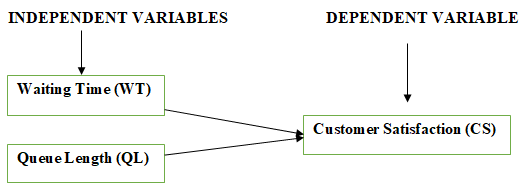
Source: Author's Conceptualisation (2026)
Theoretical Framework
The study was based on Queuing Theory by Agner Krarup Erlang (1909) and supported by the SERVQUAL Theory proposed by Parasuraman, Zeithaml, and Berry (1988). Within service settings with limited capacity due to customer demand, Queuing Theory elucidates the functioning of waiting line systems. To improve operational efficiency and minimize traffic congestion, the theory scrutinizes customer arrival rate, service rate, waiting time, and queue length to identify potential factors. The theory posits that queues are inevitable when customer demand exceeds the available service capacity; however, efficient management of service systems can reduce delays and enhance customer experience. SERVQUAL Theory elucidates the relationship between customer satisfaction and expectations, which is grounded in their perceptions of actual service delivery. SERVQUAL's responsiveness is one of the five dimensions of its success that this study focuses on, as customers demand prompt and efficient banking services. The relevance of both theories lies in their understanding of how Waiting Time and Queue Length, two operational variables, affect Customer Satisfaction in banking environments. Banks that are capable of reducing delays, streamlining traffic and improving service responsiveness are believed to be more likely to achieve better customer satisfaction and operational effectiveness according to these theories.
Empirical Review
In 2025, Bassey, Otiala, Abiji, and Chidubem conducted research on the impact of waiting-line management on customer satisfaction in particular banks located in Ogoja, Nigeria. The study included several chapters. The study sought to explore the impact of waiting-line management methods on customer satisfaction in banking. Survey research was conducted, and data from bank customers was collected through structured questionnaires. Multiple regression analysis was carried out on the data during analysis. According to the study, customer feedback and service perceptions are heavily influenced by various factors related to waiting times. According to the study, queue management systems should be improved and communication strategies implemented to reduce customer frustration during waiting periods. The study conducted in Ogoja, Cross River State, did not focus on deposit money banks within Abuja Municipal Area Council (AMAC).
Service quality dimensions and customer satisfaction were examined by Modupe (2021) in the Nigerian banking sector. Its study sought to determine how responsive, reliable and timely service delivery affects customer satisfaction. Survey research was conducted with information obtained from customers of particular banks. Statistical analyses, both descriptive and inferential, were conducted on the data. Findings indicate that prompt service delivery is highly predictive of customer satisfaction, with long-standing waiting times being viewed as indicative of substandard treatment. Continuous improvement of service delivery processes was recommended by the study to decrease delays. Despite this, the research concentrated on service quality dimensions rather than just queuing factors.
A study conducted by Omofowa, Nwachukwu, and Lê (2021) in 2021 analyzed the customer experience with electronic banking service and deposit money bank reliability in South-South Nigeria. They wanted to see how customer satisfaction is affected by service responsiveness and reliability. Regression methods were used to analyze customer responses in a quantitative survey design. According to the results, customer satisfaction is largely determined by responsiveness as it is believed that customers prefer prompt and efficient service. Even so, the study emphasized the use of electronic banking services over manual handling of the waiting lines in bank rooms.
Olowofela, Lisoyi, and Olaiya (2024) investigated the dimensions of electronic banking service quality and customer satisfaction in Nigeria. The study employed a cross-sectional survey design and analysed customer responses using multivariate statistical techniques. Findings showed that service efficiency, responsiveness, and timeliness significantly improve customer satisfaction. The researchers concluded that customers are more satisfied when services are delivered promptly and efficiently. Nevertheless, the study concentrated mainly on electronic service delivery and did not directly examine waiting time within traditional banking operations.
Bassey et al. (2025) also investigated the influence of queue congestion on customer satisfaction in selected banks. Using multiple regression analysis, the study found that increased queue congestion significantly reduces customer satisfaction and negatively affects customers’ overall banking experiences. The study recommended improved customer flow management and increased investment in queue management technologies. However, the study did not focus specifically on deposit money banks within Abuja Municipal Area Council.
In 2022 Awara, Anyadighibe, and Bassey analysed the service quality and customer satisfaction of Nigerian banking services. This study sought to determine factors that influence customer satisfaction and retention within the banking sector. The researchers utilized a survey research format and assessed customer feedback by means of statistical analysis. According to the findings, customer satisfaction is closely tied to operational efficiency. Congestion and service delays are among the factors that contribute to customer dissatisfaction with inefficient service processes, according to the study. Within the study, queue length was not considered an independent variable.
The Nigerian banking sector's service quality dimensions were examined by Kubeyinje and Omigie in 2022 to determine their impact on customer satisfaction. It used survey research and structured questionnaires to gather information from customers at banks. The analysis was carried out using regression techniques. The study found that customer satisfaction is significantly influenced by operational efficiency and responsiveness. Inefficient service processes and prolonged customer queues were found to have detrimental effects on the customers' perceptions of banking services. Despite this, the study concentrated on service quality dimensions rather than just measuring queue length directly.
The Nigerian banking industry's service efficiency is still a significant factor in customer satisfaction, as per Olowofela et al. (2024). Customers are more likely to attribute poor service quality, which includes delays and congestion as well as inefficient service processes. The researchers suggested that investing in technology-based service delivery systems could lead to better customer experience and more efficient service. Nevertheless, the research concentrated mainly on digital banking channels and not on physical queue management systems.
The literature still has many gaps despite the contributions of previous studies. Most current research concentrated on assessing service quality, responsiveness and customer satisfaction but not operationalizing waiting time or queue length as independent variables within a single predictive framework. Although Bassey et al. (2025) focused on studies on waiting-line management and customer satisfaction, only limited empirical work has been conducted to assess the impact of waiting time and queue length on customer happiness within deposit money banks in Abuja Municipal Area Council (AMAC).
Moreover, numerous studies concentrated on the quality of electronic banking service, its responsiveness, and operational efficiency rather than directly measuring physical queue variables within halls of banks. Most studies were conducted outside Abuja Municipal Area Council (AMAC), despite the high concentration of commercial banking activities in the area. Methodological studies in the past have primarily focused on queue-related issues, rather than exploring other dimensions of service quality. Instead, a focused multiple regression model has been utilized to evaluate the impact of waiting time and queue length on customer satisfaction. This methodological gap provides additional support for the present study.
Methodology
This study adopted a survey research design. The design was considered appropriate because it enabled the collection of quantitative data from bank customers in the selected deposit money banks regarding waiting time, queue length, and customer satisfaction without manipulating any of the variables. The study focused on selected deposit money banks within Abuja Municipal Area Council (AMAC), Federal Capital Territory, Abuja, due to the high customer traffic and persistent queue-related operational challenges within the area.
The population of the study comprised customers of selected deposit money banks operating within the Abuja Municipal Area Council (AMAC). These banks include Zenith Bank, Guaranty Trust Bank, Access Bank, and the United Bank for Africa (UBA). They were selected based on high customer traffic and queue-related challenges. The exact number of bank customers is large, dynamic, and not readily available, making it statistically appropriate to treat the population as infinite. Consequently, Cochran’s sample size formula was used to determine the appropriate sample size.
Sample Size Determination
Cochran’s formula is given as:
n = Z2pq
e2
Where:
n = required sample size
Z = 1.96 (95% confidence level)
p = 0.5 (estimated proportion)
q = 1 − p = 0.5
e = 0.05 (margin of error)
Substituting:
n = (1.96) ² (0.5) (0.5) / (0.05) ²n = 3.8416 × 0.25 / 0.0025n = 0.9604 / 0.0025n = 384.16 ≈ 384
To account for possible non-response and incomplete questionnaires, a 10% contingency allowance was added:
10% of 384 = 38
Adjusted sample size = 384 + 38 = 422 questionnaires
A total of 422 questionnaires were therefore distributed.
The study adopted purposive sampling to select deposit money banks within AMAC based on high customer traffic and queue-related challenges. Convenience sampling was used to administer questionnaires to customers who were available and willing to participate during banking hours in the selected deposit money banks within AMAC, Abuja. After obtaining the respondents' consent, copies of the questionnaire were given to them to complete while they were waiting for service or immediately after their transactions. Most questionnaires were collected on the spot after completion. This approach contributed to the high response rate recorded in the study.
Participation in the study was voluntary, and respondents were adequately informed about the purpose of the research before completing the questionnaire. Informed consent was obtained from all participants. Respondents were assured that their identities would remain anonymous and that the information provided would be treated with strict confidentiality and used solely for academic purposes. Participants were also informed that they could decline to participate or withdraw from the study at any time without any adverse consequences. Permission to administer the questionnaires was obtained from the management of the selected deposit money banks.
Primary data were collected using a structured questionnaire measured on a five-point Likert scale. The instrument covered demographic characteristics of respondents such as gender, age, educational qualification, and banking experience and items relating to the study variables including: Waiting Time, Queue Length, and Customer Satisfaction. Content validity was ensured through expert review, while reliability was evaluated using Cronbach’s Alpha.
| Variable | Number of Items | Cronbach's Alpha |
| Waiting Time | 5 | 0.81 |
| Queue Length | 5 | 0.79 |
| Customer Satisfaction | 5 | 0.84 |
| Overall Reliability | 15 | 0.81 |
Source: SPSS Version 27 Output (2026).
The reliability test results revealed Cronbach's Alpha coefficients of 0.81 for Waiting Time, 0.79 for Queue Length, and 0.84 for Customer Satisfaction. Since all coefficients exceeded the minimum acceptable threshold of 0.70, the instrument was considered reliable and suitable for data collection.
Data were analyzed using SPSS Version 27. Descriptive statistics were used to summarise responses, while Multiple Regression Analysis was used to test hypotheses at 0.05 significance level.
Results And Findings
This section presents the analysis of data collected from respondents concerning the Queuing Model variables specifically Waiting Time and Queue Length on Customer Satisfaction within selected deposit money banks in Abuja Municipal Area Council (AMAC), Federal Capital Territory, Abuja. Data collected through the questionnaire were analysed using Statistical Package for Social Sciences (SPSS) Version 27. Both descriptive and inferential statistical techniques were employed. Multiple Regression Analysis was specifically used to test the hypotheses formulated for the study.
Presentation of Data Analysis
| Questionnaires Distributed | 422 | 100% |
| Returned | 396 | 93.8% |
| Valid for Analysis | 384 | 90.9% |
| Not Usable | 12 | 2.8% |
Source: Field Survey, (2026).
Out of the 422 questionnaires distributed to respondents across selected deposit money banks within Abuja Municipal Area Council (AMAC), Abuja, a total of 396 questionnaires were successfully returned, representing a response rate of 93.8%. However, after data screening and validation, 384 questionnaires representing 90.9% were found suitable and valid for statistical analysis, while 12 questionnaires representing 2.8% were discarded due to incomplete responses and inconsistencies. The high response rate obtained indicates strong respondent participation and enhances the reliability and credibility of the study findings. Furthermore, the number of valid responses retained for analysis remained consistent with the minimum scientifically determined sample size, thereby ensuring adequacy for Multiple Regression Analysis and hypothesis testing.
Demographic Characteristics of Respondents
| Gender | Frequency | Percentage |
| Male | 221 | 57.6 |
| Female | 163 | 42.4 |
| Total | 384 | 100 |
Source: Field Survey, (2026).
The results indicate that 221 respondents representing 57.6% were male, while 163 respondents representing 42.4% were female. This suggests that both genders were adequately represented in the study.
| Age Group | Frequency | Percentage |
| 18–25 years | 72 | 18.8 |
| 26–35 years | 148 | 38.5 |
| 36–45 years | 102 | 26.6 |
| 46 years and above | 62 | 16.1 |
| Total | 384 | 100 |
Source: Field Survey, (2026).
The majority of respondents (38.5%) were between 26 and 35 years, indicating that most bank customers surveyed belonged to the economically active population.
Test of Regression Assumptions
Prior to conducting the Multiple Linear Regression analysis, diagnostic tests were performed to verify compliance with the key assumptions of regression analysis. Linearity was assessed through scatter plots, normality was evaluated using histogram and Normal P-P plots of standardized residuals, homoscedasticity was examined through residual scatterplots, while multicollinearity was tested using Variance Inflation Factor (VIF) and Tolerance statistics. The results are presented in Tables 5 to 8.
| Normality Indicator | Value | Acceptable Threshold | Remark |
| Mean of Standardized Residual | 0.000 | ≈ 0 | Accepted |
| Std. Deviation | 0.997 | ≈ 1 | Accepted |
| Skewness | -0.214 | ±1.0 | Accepted |
| Kurtosis | 0.531 | ±3.0 | Accepted |
| Histogram Distribution | Bell-Shaped | Bell-Shaped | Accepted |
| Normal P-P Plot | Points follow diagonal line | Diagonal Pattern | Accepted |
Source: SPSS Version 27 Output (2026).
The results indicate that the standardized residuals have a mean value of 0.000 and a standard deviation of 0.997, which are approximately equal to the expected values of 0 and 1 respectively. The skewness (-0.214) and kurtosis (0.531) values fall within the acceptable limits. Furthermore, the histogram displayed a bell-shaped distribution while the Normal P-P Plot showed points clustering around the diagonal line. Therefore, the residuals were normally distributed, satisfying the normality assumption.
| Variable | Tolerance | VIF | Decision Criterion | Remark |
| Waiting Time (WT) | 0.648 | 1.543 | Tolerance > 0.10 | Accepted |
| Queue Length (QL) | 0.648 | 1.543 | VIF < 10 | Accepted |
Source: SPSS Version 27 Output (2026).
The result revealed tolerance values of 0.648 for both Waiting Time and Queue Length, which exceeded the minimum threshold of 0.10. Similarly, the VIF values of 1.543 were far below the maximum threshold of 10. These results indicate that multicollinearity was not present among the predictor variables.
| Test Indicator | Observation | Decision |
| Residual Scatterplot | Random dispersion of points | Accepted |
| Funnel Shape | Not observed | Accepted |
| Curvilinear Pattern | Not observed | Accepted |
| Variance of Errors | Constant | Accepted |
Source: SPSS Version 27 Output (2026).
The scatterplot of standardized residuals against standardized predicted values showed a random spread of points around the zero line without any visible funnel-shaped or systematic pattern. This indicates that the variance of residuals remained constant throughout the model, confirming the assumption of homoscedasticity.
| Assumption | Statistical Test | Result | Status |
| Normality | Histogram & P-P Plot | Residuals normally distributed | Satisfied |
| Homoscedasticity | Residual Scatterplot | Constant variance observed | Satisfied |
| Multicollinearity | Tolerance & VIF | Tolerance > 0.10, VIF < 10 | Satisfied |
Source: SPSS Version 27 Output (2026).
Test of Hypotheses
H01: Waiting Time has no significant effect on Customer Satisfaction in selected deposit money banks within AMAC, Abuja.
H02: Queue Length has no significant effect on Customer Satisfaction in selected deposit money banks within AMAC, Abuja.
The multiple regression model for the study is specified as:
CS = β₀ + β₁WT + β₂QL + μ
Where:
CS = Customer Satisfaction
WT = Waiting Time
QL = Queue Length
β₀ = Constant
β₁ – β₂ = Regression coefficients
μ = Error term
| Model | R | R² | Adjusted R² | Std. Error of the Estimate |
| 1 | .801a | .637 | .635 | .298 |
a. Predictors: (Constant), Waiting Time (WT), Queue Length (QL).
Source: SPSS Version 27 Output (2026).
The model summary revealed a correlation coefficient (R) of 0.801, indicating a strong relationship between the independent variables and customer satisfaction. The coefficient of determination (R² = 0.637) implies that approximately 63.7% of the variation in customer satisfaction was jointly explained by Waiting Time and Queue Length, while the remaining 36.3% was attributable to other factors not captured in the model. The Adjusted R² value of 0.635 further confirms the robustness and explanatory power of the regression model.
| Model | Sum of Squares | df | Mean Square | F | Sig. |
| Regression | 59.214 | 2 | 29.607 | 333.920 | .000b |
| Residual | 33.781 | 381 | 0.089 | ||
| Total | 92.995 | 383 |
a. Dependent Variable: Customer Satisfaction (CS).b. Predictors: (Constant), Waiting Time (WT), Queue Length (QL).
Source: SPSS Version 27 Output (2026).
The ANOVA results revealed that the regression model was statistically significant with F = 333.920 and p < 0.001, which is below the 0.05 significance level. This indicates that Waiting Time and Queue Length jointly exerted a significant effect on Customer Satisfaction. The result further confirms the overall fitness and predictive capability of the regression model.
| Model | Unstandardized Coefficients (B) | Std. Error | Standardized Coefficients (Beta) | t | Sig. |
| (Constant) | 1.924 | .142 | 13.549 | .000 | |
| WT | -.481 | .041 | -.523 | -11.732 | .000 |
| QL | -.372 | .039 | -.411 | -9.538 | .000 |
a. Dependent Variable: Customer Satisfaction (CS).
Source: SPSS Version 27 Output (2026).
The regression coefficients revealed that Waiting Time had a significant negative effect on Customer Satisfaction (β = -0.523, p < 0.05). This implies that increases in customer waiting periods significantly reduced customer satisfaction levels within selected deposit money banks in AMAC, Abuja.
Similarly, Queue Length also exerted a significant negative effect on Customer Satisfaction (β = -0.411, p < 0.05), indicating that excessive queue congestion and overcrowding significantly reduced customers’ service experience and satisfaction.
The standardized beta coefficients further revealed that Waiting Time exerted a stronger negative influence on Customer Satisfaction than Queue Length. This finding suggests that customers are generally more sensitive to the amount of time spent waiting than to the physical number of customers in the queue, because a long queue that moves quickly may be perceived more favourably than a short queue that progresses slowly.
Decision Rule and Hypothesis Testing
H01: Waiting Time has no significant effect on Customer Satisfaction in selected deposit money banks within AMAC, Abuja.
From Table 11, Waiting Time recorded a significance value of p = .000 (p < .001) and a standardized coefficient of β = -0.523. Since the p-value is less than the 0.05 significance level, the null hypothesis (H01) was rejected. This implies that Waiting Time has a significant negative effect on Customer Satisfaction in selected deposit money banks within AMAC, Abuja.
H02: Queue Length has no significant effect on Customer Satisfaction in selected deposit money banks within AMAC, Abuja.
From Table 11, Queue Length recorded a significance value of p = .000 (p < .001) and a standardized coefficient of β = -0.411. Since the p-value is less than the 0.05 significance level, the null hypothesis (H02) was rejected. This implies that Queue Length has a significant negative effect on Customer Satisfaction in selected deposit money banks within AMAC, Abuja.
Discussion Of Findings
Waiting time has a significant negative impact on customer satisfaction at deposit money banks located in Abuja Municipal Area Council (AMAC), Abuja. According to the regression coefficient (= -0.523, no p .001) it seems that customer satisfaction declines significantly as waiting time increases. The conclusion is drawn that customers' perception of long-term service disruptions is a sign of subpar service quality, poor operational efficiency, and inefficient service delivery processes. In modern banking, customers are anticipating efficient and timely service; hence, prolonged delays result in frustration and adverse effects on their banking experience.
The conclusion is in line with the research conducted by Bassey, Otiala, Abiji, and Chidubem (2025), who found that waiting-line management plays a significant role in enhancing customer satisfaction within Nigerian banks. Modupe's (2021) findings, which found that prompt service delivery is still a significant factor in customer satisfaction in Nigerian banking, are also reinforced by the outcome. Responsiveness and service efficiency were also found to have a significant impact on customer satisfaction with banking services, as reported by Omofowa, Nwachukwu, and Lê (2021). The conclusion supports the notions of Queuing Theory, which suggests that inefficient service systems with excessive delays and inadequate service capacity can result in customer dissatisfaction and hinder organisational effectiveness. Additionally,
The research also revealed that the longer the queue, the greater the effect of queue length on customer satisfaction (p 0.401; +/-0.411). This research indicates that long queues and crowded banking environments lead customers to become increasingly unsatisfied. Queue length increases psychological discomfort, perceived waiting time, and adversely affects the perception of service quality and operational effectiveness. Inadequate service capacity and poor operational management are commonly cited by customers as reasons for overcrowding in banking halls.
This finding is consistent with Bassey et al. (2025), who found that queue jamming in Nigerian banking institutions leads to a significant decrease in customer satisfaction among bankers. This finding is also consistent with Awara, Anyajigibe and Bassey (2022), who found that customer satisfaction and customer retention are strongly influenced by operational efficiency. In the same way, Kubeyinje and Omigie (2022) found that customer satisfaction in the Nigerian banking sector is still largely dependent on "responsiveness" and operational efficiency. Moreover, the discovery supports SERVQUAL Theory, particularly in the realm of responsiveness, where service delivery and customer service are key factors for satisfying customers.
Furthermore, the model summary demonstrated that both waiting time and queue length were responsible for 63.7% of the variation in customer satisfaction (R2 =.637). The significant explanatory power demonstrates that queue management variables are crucial in the banking experiences of customers.' The ANOVA outcome (F = 333.920, p .001) demonstrated that the overall regression model was statistically significant. To improve service quality, customer loyalty, and organisational competitiveness, deposit money banks must prioritize the efficient management of waiting times and queue lengths as a strategic priority.
Overall, the findings demonstrate that customers place considerable value on timely service delivery and efficient queue management. Banks that successfully minimise waiting time and queue congestion are more likely to achieve higher levels of customer satisfaction, improved customer retention, and sustainable competitive advantage.
Conclusion And Recommendations
Conclusion
The satisfaction of customers in deposit money banks operated at Abuja Municipal Area Council (AMAC), as measured by queuing model variables was examined. According to the study, customer satisfaction is significantly impacted by waiting time and queue length. Specifically, customers who experience prolonged waiting times and excessive queue length may perceive reduced service quality as a negative effect on their banking experience. Waiting time, as the predictor of customer satisfaction, was found to be the most pronounced, suggesting that customers value prompt and efficient service.
Furthermore, the research discovered that both waiting time and queue length contribute significantly to the variation in customer satisfaction, emphasizing the importance of queue management in banking. This provides empirical evidence for the propositions of Queuing Theory and SERVQUAL Theory, which argue that customer satisfaction can be enhanced by optimizing both operational efficiency and service responsiveness. As a result, controlling queue length and waiting time will have measurable effects on the experience of customers; strengthen customer loyalty thus strengthening the competitiveness of deposit money banks in Nigeria.
Recommendations.
These findings led to the formulation of recommendations:
i Deposit money banks should aim to reduce customer waiting time by implementing staff optimization, process reformulations and employee training programs, as well as automate queue management systems, particularly during busy periods. The reduction of service delays will result in a more satisfying customer experience.
ii To prevent queue lengthening within deposit money banks, it is important to increase service capacity by implementing effective customer flow management systems, expanding service points where necessary, and maintaining adequate queue space. By controlling the queue length, customers can have a positive impression of their overall banking experience and service quality.
Limitations Of The Study.
Although the study was conducted exclusively at deposit money banks located in Abuja’s Municipal Area Council (AMAC), it may not be applicable to all regions beyond that region. In addition, the study used data from respondents' perceptions through structured questionnaire; hence, findings are subject to limitations of self-reported data. The use of convenience sampling may have resulted in sampling bias, as respondents were chosen by accessibility rather than a probability sampling method. Despite its limitations, this study offers practical and factual evidence of the relationship between queuing model variables and customer satisfaction in Nigerian banking.
Suggestions For Further Studies.
Future studies should also consider other queuing model variables such as service rate, service capacity, queue discipline, and customer arrival rate to better understand the role of queue management in banking operations. They also recommend comparative studies of Nigeria across multiple states and geopolitical zones to make the results more general. Furthermore, future scholars may explore how digital banking can modify or facilitate the relationship between queuing variables and customer satisfaction. Longitudinal studies can investigate how customers perceive waiting time and queue length over an extended period.
References
- Awara, N. F., Anyadighibe, J. A., & Bassey, F. O. (2022). Service quality and customer satisfaction of banking services in Nigeria. African Journal of Business and Economic Research, 17(4), 255–276. DOI ↗ Google Scholar ↗
- Bassey, J., Otiala, P. B., Abiji, E., & Chidubem, B. S. (2025). Effects of waiting line management on customer satisfaction: A study of selected banks in Ogoja, Nigeria. International Journal of Economics and Business Management, 1(2), 279–296. DOI ↗ Google Scholar ↗
- Fitzsimmons, J. A., & Fitzsimmons, M. J. (2020). Service management: Operations, strategy, information technology (9th ed.). McGraw-Hill Education. DOI ↗ Google Scholar ↗
- Heizer, J., Render, B., & Munson, C. (2020). Operations management: Sustainability and supply chain management (13th ed.). Pearson. Google Scholar ↗
- Hillier, F. S., & Lieberman, G. J. (2021). Introduction to operations research (11th ed.). McGraw-Hill Education. DOI ↗ Google Scholar ↗
- Kotler, P., & Keller, K. L. (2021). Marketing management (16th ed.). Pearson. Google Scholar ↗
- Kubeyinje, G. T., & Omigie, S. O. (2022). The influence of service quality dimensions on customer satisfaction in the Nigerian banking industry. Oradea Journal of Business and Economics, 7(Special Issue), 67–76. DOI ↗ Google Scholar ↗
- Lovelock, C., & Wirtz, J. (2021). Services marketing: People, technology, strategy (9th ed.). Pearson. DOI ↗ Google Scholar ↗
- Modupe, A. (2021). Perspectives on service quality dimensions and customer satisfaction in the Nigerian banking industry. Journal of Economics, Management and Trade, 27(12), 12–19. DOI ↗ Google Scholar ↗
- Olowofela, O. E., Lisoyi, B. O., & Olaiya, K. I. (2024). The dimensions of electronic banking service quality on customer satisfaction: Evidence from Nigeria. Modern Management Review, 29(2), 79–94. DOI ↗ Google Scholar ↗
- Omofowa, M. S., Nwachukwu, C. E., & Lê, V. (2021). E-banking service quality and customer satisfaction: Evidence from deposit money banks in South-South Nigeria. Webology, 18(Special Issue 04), 288–302. DOI ↗ Google Scholar ↗
- Parasuraman, A., Zeithaml, V. A., & Berry, L. L. (1988). SERVQUAL: A multiple-item scale for measuring consumer perceptions of service quality. Journal of Retailing, 64(1), 12–40. DOI ↗ Google Scholar ↗
- Stevenson, W. J. (2020). Operations management (14th ed.). McGraw-Hill Education. DOI ↗ Google Scholar ↗
- Zeithaml, V. A., Bitner, M. J., & Gremler, D. D. (2020). Services marketing: Integrating customer focus across the firm (8th ed.). McGraw-Hill Education. DOI ↗ Google Scholar ↗