Abstract
The rapid adoption of artificial intelligence and machine learning across critical sectors has introduced cybersecurity challenges that traditional security frameworks were never designed to address. As machine learning models increasingly shape decision-making in finance, healthcare, autonomous systems, and national security, they have become attractive targets for sophisticated adversaries. This paper examines the evolving threat landscape surrounding AI systems, with particular attention to vulnerabilities that arise at each stage of the machine learning lifecycle, including data poisoning, adversarial manipulation, model extraction, and inference-based privacy attacks. It explores how attackers exploit weaknesses in training data, model architectures, and deployment pipelines to manipulate model behavior or exfiltrate sensitive information, and it reviews the defense strategies that have emerged in response, from adversarial training and robust model design to secure deployment practices and privacy-preserving techniques such as differential privacy, federated learning, and homomorphic encryption. The discussion also situates these technical measures within the broader governance frameworks and secure-by-design principles that organizations are beginning to adopt across the AI development lifecycle. By synthesizing current research and practical defense approaches, this paper provides a comprehensive overview of how machine learning systems can be safeguarded against a threat landscape that continues to evolve as quickly as the technology itself. The overarching conclusion is that securing AI systems is not a task any single discipline can accomplish alone; it requires sustained collaboration between machine learning researchers, cybersecurity professionals, and policymakers if AI technologies are to remain reliable, trustworthy, and resilient in adversarial environments.
1. Introduction
1.1 Background of Artificial Intelligence and Machine Learning
Artificial intelligence has emerged as one of the most transformative technologies of the twenty-first century, encompassing the development of computer systems capable of performing tasks that typically require human intelligence, such as learning, reasoning, decision-making, and problem-solving. Machine learning, a major subfield of AI, focuses on enabling systems to learn patterns from data and improve their performance over time without being explicitly programmed for every scenario they might encounter. Rather than following a fixed set of rules written by a human engineer, a machine learning system infers its own rules from examples, which is precisely what makes it so powerful and, at the same time, so difficult to secure.
The rapid advancement of computational power, the growing availability of large datasets, and continual improvements in learning algorithms have accelerated the development and adoption of AI and machine learning technologies at a pace few other technologies have matched. These systems are now embedded across healthcare, finance, transportation, cybersecurity, and autonomous systems, quietly making or informing decisions that once required a human in the loop. Despite the very real benefits this brings, the same characteristics that make AI-driven systems powerful, their dependence on data, their opacity, and their capacity to generalize beyond what they were explicitly taught, also introduce new challenges around security, reliability, and ethics that traditional software engineering was never built to handle.
1.2 Importance of Security in AI Systems
As AI systems become further integrated into critical infrastructure and high-stakes decision-making, ensuring their security has moved from an academic concern to an operational necessity. AI models can be vulnerable to a range of attacks, including adversarial manipulation, data poisoning, model theft, and privacy breaches, and each of these vulnerabilities can translate into incorrect predictions, outright system manipulation, or unauthorized access to sensitive data. What makes this different from conventional software security is that the vulnerability often lives inside the statistical behavior of the model itself, not in a discrete line of exploitable code.
Security in this context is essential not only for protecting the underlying data but also for preserving trust in automated decision-making more broadly. If an AI model is compromised, the consequences can be severe, particularly in safety-critical applications such as healthcare diagnostics, autonomous vehicles, and financial fraud detection, where a single manipulated prediction can cascade into real-world harm. Robust security mechanisms are therefore required not as an afterthought bolted on after deployment, but as a foundational requirement for any AI system expected to operate reliably in the real world.
1.3 Problem Statement
Despite the rapid growth and adoption of AI technologies, many AI systems are still designed primarily with performance and accuracy in mind, often relegating security considerations to a secondary concern addressed late in development, if at all. This imbalance creates vulnerabilities that attackers can exploit to manipulate AI models or compromise the sensitive data on which they depend. The absence of comprehensive, widely adopted security frameworks for AI systems raises legitimate concerns about their safe deployment in real-world environments, since without proper safeguards, AI systems may produce unreliable results that carry outsized risk in critical applications. Addressing the security challenges associated with AI and machine learning models is therefore not a niche research interest but an urgent, practical problem facing every organization that deploys these systems.
1.4 Research Objectives and Scope
The central objective of this research is to examine the security challenges associated with artificial intelligence and machine learning systems and to explore practical approaches for mitigating the risks those challenges create. In pursuit of that goal, the paper analyzes the common security threats and vulnerabilities present in AI and ML systems, investigates the specific types of attacks that target machine learning models throughout their lifecycle, evaluates the security mechanisms and defense techniques currently used to counter those attacks, and draws together recommendations for improving the security and robustness of AI models going forward.
The scope of the study is deliberately focused on the security dimension of artificial intelligence and machine learning systems. It examines common vulnerabilities in ML models, the range of attack methods that exploit them, and the defense mechanisms available to secure AI systems in practice, concentrating primarily on adversarial attacks, data poisoning, and model extraction. While the discussion inevitably touches on broader questions of AI ethics, governance, and regulation where they intersect with security, a full treatment of those topics falls outside the boundaries of this paper.
1.5 Structure of the Paper
The remainder of this paper is organized to build a comprehensive picture of AI security from the ground up. It begins with an overview of machine learning systems and the lifecycle that produces them, before turning to the cybersecurity threats that target each stage of that lifecycle and the specific vulnerabilities present in modern ML pipelines. It then surveys the techniques available for securing machine learning models, including privacy-preserving approaches, and situates these technical measures within the frameworks and standards that governments and industry bodies are developing to guide responsible AI deployment. Real-world case studies of AI security incidents follow, drawing out the practical lessons they offer, before the paper closes with a discussion of open challenges and future research directions and a set of concluding recommendations.
2. Overview of Machine Learning Systems
2.1 Fundamentals of Machine Learning
Machine learning is a subfield of artificial intelligence focused on developing algorithms and statistical models that allow computers to learn from data and make decisions without being explicitly programmed for every case. Instead of relying on predefined rules, ML systems analyze patterns within large datasets to generate predictions or classifications, refining their internal parameters as more data becomes available. The fundamental concept underlying this process is learning from experience: by processing large volumes of historical data, ML algorithms identify hidden patterns and relationships that may not be easily detected by humans, and as more data becomes available, these models continue to improve.
This learning process depends on several components working in concert. The data supplies the raw information used to train the model; the algorithm provides the mathematical technique used to learn patterns within that data; the training process adjusts the model's internal parameters to minimize prediction error; and the evaluation stage measures how well the resulting model performs against data it has not seen before. Together, these components allow a system to move from raw information to genuine predictive capability, supporting tasks such as prediction, classification, recommendation, and anomaly detection across a wide range of domains.
2.2 Types of Machine Learning Models
Machine learning models are generally categorized according to how they learn from data. In supervised learning, a model is trained using labeled data, where each input is paired with a correct output, and the model learns the relationship between the two well enough to make predictions on new, unseen data. This approach underlies common tasks such as spam detection, a classification problem, and house price prediction, a regression problem, and is implemented through algorithms ranging from linear regression and decision trees to support vector machines and neural networks.
Unsupervised learning, by contrast, works with unlabeled data, requiring the algorithm to identify patterns or structures on its own without any predefined output to guide it. This approach is commonly used for customer segmentation, market analysis, and anomaly detection, and is typically implemented through algorithms such as k-means clustering, hierarchical clustering, and principal component analysis. Reinforcement learning takes a different approach still: an agent interacts with an environment and learns by receiving rewards or penalties based on its actions, with the goal of maximizing cumulative reward over time. This method underlies much of the progress in robotics, autonomous vehicles, and game-playing systems, most famously in DeepMind's AlphaGo, which used reinforcement learning to defeat professional human players at the board game Go.
2.3 The Machine Learning Lifecycle
The development of a machine learning system follows a structured lifecycle designed to ensure that models are properly built, evaluated, and deployed, and it is precisely this lifecycle that defines where security risks can be introduced. Every stage, from the moment data is first collected to the point at which a model quietly serves predictions in production, carries its own distinct set of vulnerabilities, which is why security thinking has to run alongside the entire pipeline rather than being applied only at the end.
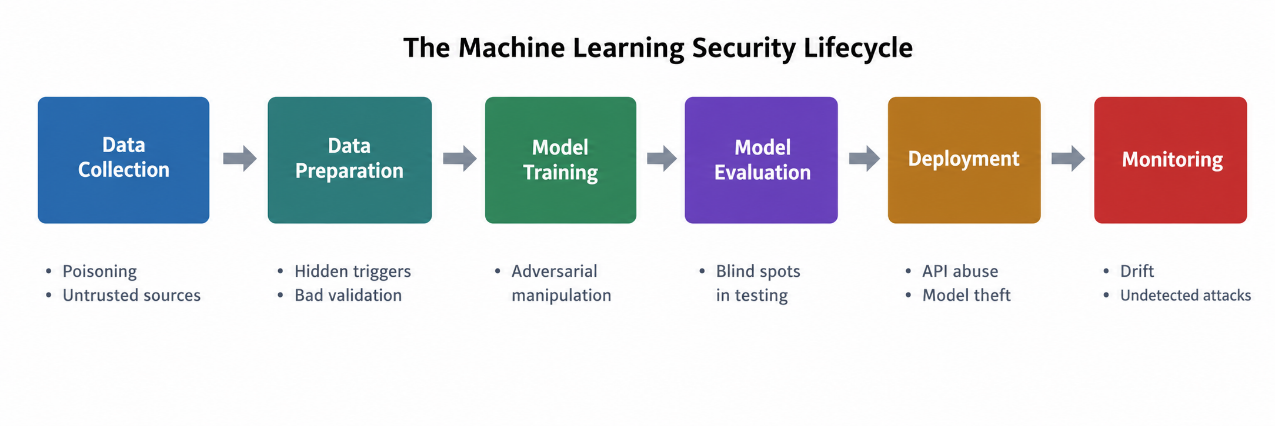
The first stage, data collection, involves gathering relevant information from databases, sensors, online platforms, and user interactions, and because a model's performance is only ever as good as the data it learns from, the quality of this stage sets a ceiling on everything that follows. Once collected, the data must be cleaned and preprocessed, a stage that includes removing missing values, normalizing features, and selecting the attributes most relevant to the task at hand, before the model is trained using a chosen algorithm that adjusts internal parameters to minimize prediction error against the training data.
After training, the model is evaluated using a separate dataset it has not seen before, with metrics such as accuracy, precision, recall, and F1-score used to judge whether it is reliable enough to move forward. Only after this evaluation does the model reach deployment, where it is integrated into applications, cloud platforms, or enterprise systems and begins to make real predictions or automate real decisions. Deployment is rarely the end of the story, however, since continuous monitoring is required afterward to ensure the model maintains its accuracy as the data it encounters in the real world inevitably drifts from the data it was trained on.
2.4 Applications of AI Across Modern Industries
Artificial intelligence and machine learning technologies are transforming a wide range of industries by enabling automation, predictive analytics, and intelligent decision-making at a scale that would be impossible for human analysts alone. In healthcare, AI systems assist doctors in diagnosing disease, analyzing medical images, and predicting patient outcomes, with machine learning models increasingly able to detect patterns in medical imaging that flag conditions such as cancer at an early stage. Financial institutions rely on similar techniques for fraud detection, algorithmic trading, and risk assessment, using models that analyze transaction patterns to spot suspicious activity before it causes harm.
Transportation has been reshaped by AI's role in autonomous vehicles and smart traffic management, with companies such as Tesla and Waymo relying on machine learning to interpret the visual and sensor data that self-driving systems depend on. Retail and e-commerce platforms use similar techniques to power personalized recommendations, manage inventory, and optimize supply chains, with Amazon's product recommendation systems standing as one of the most visible examples of machine learning at commercial scale. Cybersecurity itself has become one of AI's most important application domains, with machine learning models used to detect threats, analyze network activity, and identify the unusual behavior patterns that signal a potential attack in progress, an application whose importance becomes especially clear once one recognizes that the very systems performing this defensive work are themselves potential targets.
3. Cybersecurity Threats in AI Systems
3.1 Overview of AI Security Risks
As artificial intelligence and machine learning systems become increasingly integrated into critical applications, they introduce a category of cybersecurity risk that traditional software security was not designed to address. Unlike conventional software, AI models rely heavily on data and complex, often opaque algorithms, which makes them vulnerable to attack methods that have no real analogue in classical systems. These threats can surface at any stage of the machine learning lifecycle, from the moment training data is first gathered through to the point at which a trained model is queried by real users, and attackers may attempt to manipulate training data, exploit architectural weaknesses, or extract sensitive information from a model that was never meant to reveal it.
The consequences of a successful attack can be significant and, in some cases, difficult to detect until real damage has already occurred. A compromised AI system may produce incorrect predictions that go unnoticed for weeks, reveal confidential information embedded in its training data, or allow unauthorized access to services that were meant to be tightly controlled. As AI technologies continue to evolve, addressing these risks has become an essential, non-negotiable aspect of building AI systems that organizations and the public can actually trust.
3.2 Adversarial Attacks
Adversarial attacks are among the most widely studied security threats facing machine learning systems. In this style of attack, an adversary intentionally modifies input data in a subtle way to cause a model to produce an incorrect result, and these modifications are often so small that they are nearly invisible to a human observer even as they dramatically change the model's output. A slight, carefully calculated change to an image, for instance, can cause a computer vision system to misclassify the object it depicts entirely.
This kind of manipulation is particularly dangerous in applications where the model's output has real-world consequences, including autonomous vehicles, facial recognition systems, medical image analysis, and biometric authentication. Researchers at organizations such as OpenAI and Google DeepMind have studied adversarial examples extensively, both to understand how machine learning models can be manipulated in this way and to design more robust defenses capable of resisting it.
3.3 Data Poisoning Attacks
Data poisoning attacks occur when an attacker intentionally injects malicious or misleading data into the dataset used to train a machine learning model. Because ML models rely so heavily on training data to shape their internal understanding of a problem, corrupted data can quietly degrade a model's performance and reliability long before anyone notices something is wrong. In a typical poisoning attack, the attacker manipulates training data so the model learns incorrect patterns, with the result that once deployed, the model produces biased or simply wrong predictions, seemingly for no reason its operators can identify.
These attacks tend to occur where data collection practices are weakest, particularly when datasets are gathered from external sources, crowdsourced platforms, or open data repositories without rigorous vetting. An attacker might, for example, insert carefully manipulated samples into a dataset used to train a spam detection model, teaching the system to classify malicious emails as safe, an outcome that would only become apparent once the damage was already done.
3.4 Model Extraction and Model Theft
Model extraction, sometimes called model stealing, occurs when an attacker attempts to replicate a machine learning model by repeatedly querying it and analyzing its outputs. By observing how the model responds to a wide range of inputs, an attacker can approximate its internal logic closely enough to recreate a functionally similar model without ever having direct access to its parameters or training data. This kind of attack is particularly common against machine learning services offered through cloud-based APIs, where organizations that expose models through online platforms risk exposing their intellectual property and proprietary algorithms in the process.
Companies such as Amazon, Google, and Microsoft provide AI-powered services through public APIs, and these services can become attractive targets for model extraction if proper security controls are not in place. The consequences of a successful extraction attack extend beyond simple technical inconvenience, potentially resulting in the loss of intellectual property, a reduced competitive advantage for the organization that built the original model, and the possibility that the stolen model could itself be repurposed for malicious ends.
3.5 Membership Inference Attacks
Membership inference attacks aim to determine whether a particular data sample was included in the training dataset of a machine learning model. These attacks exploit a subtle but consistent tendency of many models to behave differently when presented with data they were trained on compared to genuinely new, unseen data. By carefully analyzing a model's output probabilities, an attacker may be able to infer whether specific, sensitive data records were used during training, which can constitute a serious privacy violation, particularly when the underlying model was trained on confidential information.
The risk posed by membership inference is especially acute in fields such as healthcare data analysis, financial recordkeeping, personal user data, and biometric information systems, where simply confirming that someone's record was part of a training set can itself reveal sensitive facts about them. Protecting against these attacks requires stronger privacy-preserving techniques and considerably more careful model design than many organizations currently apply.
3.6 Backdoor and Trojan Attacks
Backdoor attacks, also known as trojan attacks, involve inserting hidden triggers into a machine learning model during the training process. These triggers cause the model to behave entirely normally under most circumstances while producing incorrect, attacker-chosen outputs whenever a specific pattern or trigger is present in the input. An attacker might, for example, manipulate training data so that a facial recognition system consistently misidentifies a particular person whenever a specific symbol or accessory appears in the image, an outcome that would remain invisible during normal use.
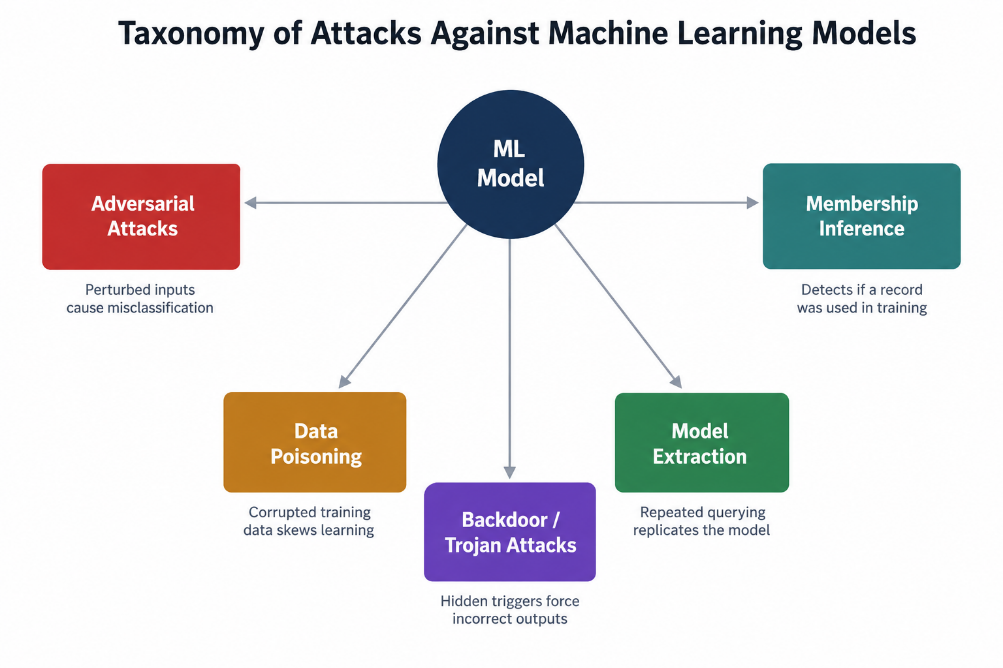
Backdoor attacks are particularly dangerous precisely because they remain dormant during normal operation and activate only under conditions chosen by the attacker, making them extraordinarily difficult to detect through conventional testing. Potential impacts range from unauthorized system access and manipulated AI decisions to fully compromised authentication systems, which is why researchers are actively developing techniques such as secure data validation, systematic model auditing, and anomaly detection specifically designed to surface hidden triggers before a model is ever deployed.
4. Vulnerabilities in Machine Learning Pipelines
4.1 Data Collection and Preprocessing Vulnerabilities
The machine learning pipeline begins with data collection and preprocessing, stages that are as critical to a model's eventual reliability as they are vulnerable to manipulation. Because ML models depend so heavily on data quality, any compromise introduced at this early stage can significantly affect the model's performance and trustworthiness long after the fact. Vulnerabilities often arise when datasets are gathered from untrusted or external sources, where attackers may intentionally introduce malicious or misleading data that skews the learning process and leads to biased predictions or unpredictable model behavior downstream.
During preprocessing, data undergoes cleaning, transformation, and feature selection, and if these processes are not properly secured, attackers may exploit them to insert hidden triggers or subtly alter data features in ways that are difficult to detect through casual inspection. Poor preprocessing practices, such as insufficient validation or improper normalization, can introduce further weaknesses that compromise the integrity of the resulting model even in the absence of an active attacker. Secure data validation, robust verification techniques, and a firm commitment to trusted data sources are essential steps toward reducing vulnerability at this stage.
4.2 Training Phase Risks
The training phase, where a model learns patterns from its dataset and adjusts its parameters to improve predictive accuracy, presents several distinct security risks capable of compromising the effectiveness of the resulting system. Poisoned training data can cause a model to learn incorrect patterns from the outset, while attackers may also attempt to manipulate the training process itself by altering training parameters or injecting malicious code into the training environment, a risk that grows as training pipelines become more automated and less closely supervised.
A related risk involves adversarial manipulation during training, in which carefully crafted data points are inserted to influence the model's decision boundaries in ways that are invisible during standard testing. Models compromised in this way may behave entirely normally under evaluation while producing incorrect predictions only when specific, attacker-chosen inputs are presented later, in production. Organizations such as OpenAI and Google DeepMind continue to conduct extensive research aimed at improving the robustness and security of machine learning training processes precisely because these risks are so difficult to catch through conventional testing alone.
4.3 Model Deployment and API Vulnerabilities
Once a machine learning model has been trained, it is typically deployed into a production environment where it interacts directly with users or applications, often through a web service or API, and this transition introduces an entirely new category of security risk. Attackers may exploit exposed APIs to perform model extraction attacks, repeatedly querying a system to replicate its functionality, while insufficient authentication or access control mechanisms can allow unauthorized users to access or manipulate the model in ways its operators never intended.
A further vulnerability arises from adversarial inputs submitted directly to deployed models, where malicious queries can intentionally trigger incorrect predictions, potentially leading to system failures or broader security breaches. Major technology companies such as Amazon, Microsoft, and Google deploy AI services through cloud-based APIs at enormous scale, which makes strict security mechanisms not merely advisable but essential. Organizations typically reduce deployment risk through a combination of API rate limiting, rigorous input validation, continuous monitoring, and secure authentication protocols, layered together rather than relied on individually.
4.4 Supply Chain Risks in AI Development
Supply chain risk represents another critical vulnerability in the machine learning pipeline, one that has grown more pressing as AI development has come to depend on an expanding web of external components, including open-source libraries, pretrained models, public datasets, and third-party frameworks. If any single component within this supply chain is compromised, the resulting vulnerability can propagate into every application built on top of it, and malicious code embedded in a widely used machine learning library could quietly affect a vast number of downstream systems.
Many developers rely on popular open-source frameworks such as TensorFlow and PyTorch to build AI models, and while these tools are powerful and extensively used, they must be carefully managed to prevent security risks arising from outdated versions or compromised dependencies slipping unnoticed into a production pipeline. Supply chain attacks can also occur when pretrained models are downloaded from untrusted repositories, since these models may contain hidden backdoors or malicious behaviors that only manifest after deployment. Mitigating this class of risk requires strict security policies, regular code audits, careful verification of external dependencies, and a consistent preference for trusted sources whenever third-party components are integrated into an AI system.
5. Techniques for Securing Machine Learning Models
5.1 Adversarial Training Methods
Adversarial training is one of the most effective methods available for improving the security and robustness of machine learning models. The technique involves intentionally introducing adversarial examples, inputs that have been slightly modified to mislead the model, into the training dataset itself, so that by repeated exposure to these malicious examples during training, the model gradually learns to recognize and resist similar manipulation once deployed. The underlying goal is to improve the model's ability to correctly classify both normal and adversarial inputs, strengthening its decision boundaries and reducing its overall susceptibility to manipulation.
Research groups at OpenAI and Google DeepMind have explored adversarial training extensively as a way to enhance the robustness of AI systems used in sensitive applications such as autonomous vehicles and biometric authentication, where the cost of a successful attack is measured in more than just inconvenience. That said, adversarial training is not free: it can meaningfully increase computational cost and requires careful, often painstaking tuning of training parameters to achieve the intended balance between robustness and accuracy.
5.2 Robust Model Design
Robust model design focuses on building machine learning models that are inherently resistant to attack and to unexpected input, emphasizing algorithms and architectures capable of maintaining stable performance even when confronted with noisy or deliberately manipulated data. This philosophy tends to combine several complementary strategies: regularization techniques that guard against overfitting, ensemble models that combine predictions from multiple algorithms to reduce the impact of any single model's blind spots, noise reduction and feature filtering techniques that limit an attacker's ability to exploit subtle input perturbations, and anomaly detection mechanisms capable of flagging inputs that look unlike anything the model has encountered before.
Deep learning frameworks such as TensorFlow and PyTorch provide the tools developers need to build more robust and secure AI models, supporting advanced training techniques and the security-focused research aimed at strengthening AI system reliability more broadly. Designing security into a model from the very beginning of development, rather than attempting to bolt it on afterward, significantly reduces the likelihood that an attack will succeed once the model reaches production.
5.3 Secure Data Management
Secure data management is a foundational requirement for protecting machine learning systems, since these systems depend so heavily on large datasets that maintaining data integrity, confidentiality, and availability becomes a security concern in its own right rather than a purely operational one. Effective practice in this area typically includes rigorous data validation and sanitization before training begins, encryption of sensitive datasets both at rest and in transit, access control mechanisms that restrict who can use particular data, and secure storage and transmission protocols throughout the data's lifecycle.
Organizations must also implement clear data governance policies to ensure that training datasets are obtained from trusted, verifiable sources, while sensitive information should be anonymized or otherwise protected using privacy-preserving techniques wherever it is used to train a model. Strong data management practices of this kind directly reduce the risk of data poisoning attacks while protecting the broader integrity of the machine learning system that depends on that data.
5.4 Model Encryption and Secure Inference
Model encryption is an important technique for protecting machine learning systems from theft and unauthorized access, ensuring that a model's parameters and architecture remain confidential even when the model is deployed in external environments such as public cloud platforms. Secure inference techniques extend this protection further, allowing a model to perform predictions on encrypted data without ever exposing the underlying information, protecting both the model itself and the user's data throughout the inference process.
Advanced approaches used in secure inference include homomorphic encryption, secure multiparty computation, and trusted execution environments, each offering a different balance of security guarantees and computational cost. Major technology providers such as Microsoft, Google, and Amazon have integrated secure computing technologies of this kind into their cloud AI services specifically to protect sensitive models and datasets, an investment that reflects how important these approaches have become in sectors such as healthcare and finance, where protecting sensitive data is not optional.
5.5 Access Control and Monitoring Systems
Access control and monitoring systems play a vital role in protecting deployed machine learning models from unauthorized access and misuse, ensuring that only authorized users and applications can interact with a model in the first place. Common strategies in this area include authentication and authorization protocols, careful API key management, role-based access control, and rate limiting designed to prevent the kind of excessive querying that often signals a model extraction attempt in progress.
Monitoring systems complement these access controls by continuously analyzing interactions with a deployed model to detect unusual or suspicious behavior, identifying patterns that may indicate model extraction attempts or adversarial attacks before they succeed. Cloud service providers such as Amazon, Google, and Microsoft offer integrated monitoring and security services that help organizations detect and respond to threats targeting their AI systems, and by combining strong access control with real-time monitoring, organizations can meaningfully improve the security and resilience of their machine learning deployments.
6. Privacy-Preserving Machine Learning
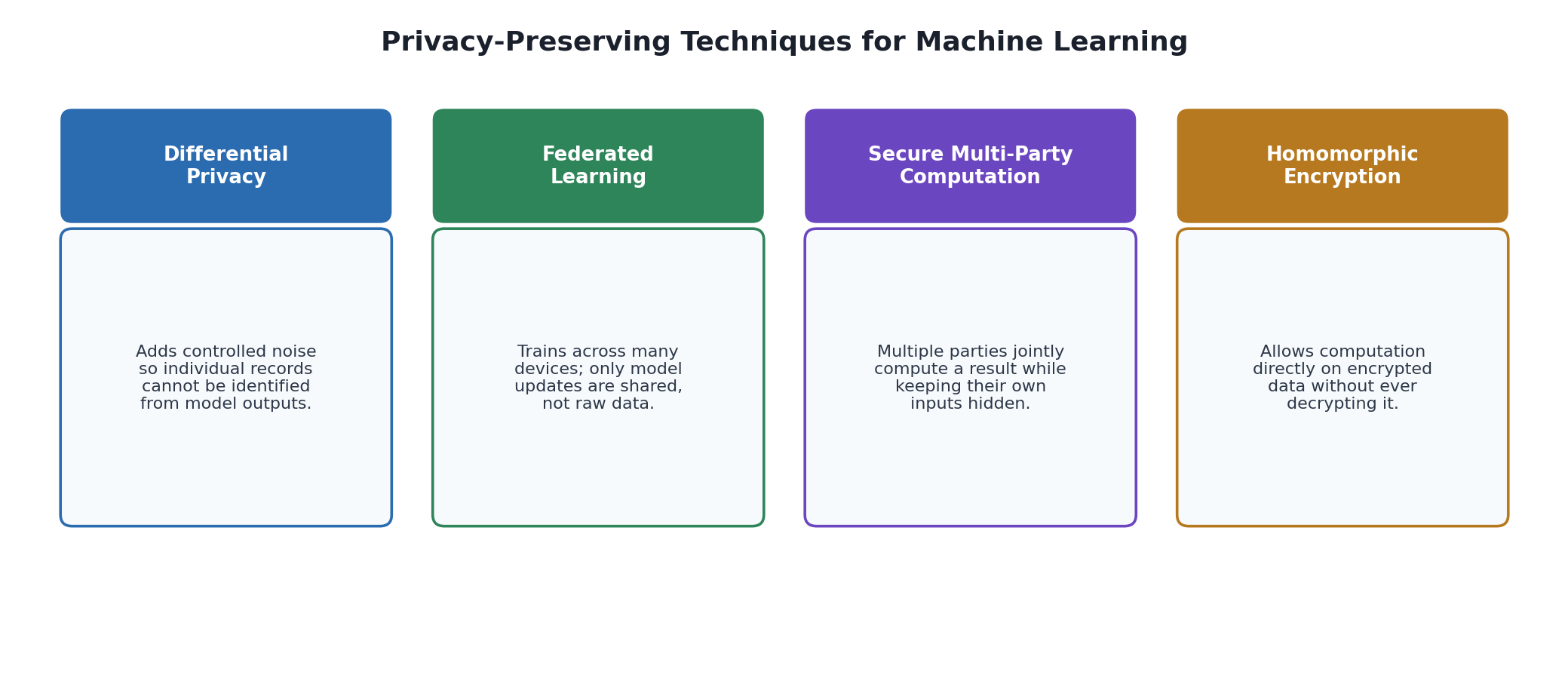
Privacy-preserving techniques are essential for protecting sensitive information used in machine learning systems, since many models rely on large datasets that may contain personal or confidential data. Without proper safeguards, these datasets can expose private information to attackers or unauthorized users, sometimes in ways that are difficult to anticipate in advance. Privacy-preserving machine learning aims to ensure that useful insights can still be drawn from data while minimizing the risk of exposing individual data records, an objective pursued through several distinct but complementary techniques.
6.1 Differential Privacy
Differential privacy is a mathematical framework designed to protect individual data points within a dataset while still allowing useful statistical analysis to be performed on that dataset as a whole. The core idea is to introduce carefully controlled noise into the data or the model's outputs, making it difficult to determine whether any specific individual's data was included in the underlying dataset. In machine learning applications, this ensures that the presence or absence of a single data record does not significantly affect the model's output, which reduces the risk of privacy attacks such as membership inference.
Several technology companies have adopted differential privacy in production systems; Apple, for example, has implemented differential privacy techniques to collect usage statistics while protecting individual user privacy. Although differential privacy provides strong, mathematically provable privacy guarantees, it must be carefully balanced against model accuracy, since excessive noise can meaningfully reduce the usefulness of the resulting model.
6.2 Federated Learning
Federated learning is a distributed machine learning approach that allows multiple devices or organizations to collaboratively train a shared model without ever sharing their raw data with one another. Instead of sending data to a central server, each participant trains the model locally and shares only model updates or parameters, a design that significantly improves data privacy because sensitive data remains on local devices rather than being aggregated into a centralized database. A central server then aggregates the updates it receives from multiple participants to improve the global model over successive rounds.
Federated learning has been widely adopted in mobile and cloud-based applications; Google, for instance, uses federated learning in its mobile keyboard systems to improve language prediction without ever collecting users' personal typing data directly. The approach is not without its own security challenges, however, since malicious participants can send manipulated updates designed to poison the shared model, which is why additional security mechanisms are required to ensure the reliability of the overall training process.
6.3 Secure Multi-Party Computation
Secure multi-party computation is a cryptographic technique that allows multiple parties to jointly compute a function over their combined data while keeping each party's individual inputs private from the others. In machine learning contexts, this enables organizations to collaboratively train models using their combined datasets without ever exposing their confidential data to one another directly, with each participant instead contributing encrypted information that is processed in a way that prevents the underlying data from ever being disclosed.
This approach is particularly valuable in industries where privacy regulations are strict, such as healthcare, banking, and government, where the ability to collaborate without directly sharing sensitive data can unlock analyses that would otherwise be impossible. While secure multi-party computation offers strong privacy protection, it typically requires significant computational resources and communication overhead, which can make large-scale implementation genuinely challenging in practice.
6.4 Homomorphic Encryption
Homomorphic encryption is an advanced cryptographic technique that allows computations to be performed directly on encrypted data, meaning a machine learning model can process encrypted inputs and produce encrypted outputs without ever needing to decrypt the underlying information at any point in the process. This provides strong privacy protection because sensitive information remains encrypted throughout the entire computation, so that even if the system performing the computation is itself compromised, the original data remains protected.
Homomorphic encryption is particularly valuable in cloud computing environments where users may not fully trust the infrastructure performing the computation on their behalf. Companies such as Microsoft have actively researched and developed homomorphic encryption frameworks to support secure machine learning operations, though despite its strong privacy guarantees, the technique remains computationally intensive and often requires careful optimization to be practical for large-scale machine learning tasks.
7. Frameworks and Standards for AI Security
As artificial intelligence systems become increasingly integrated into critical infrastructure and decision-making processes, organizations must adopt structured frameworks and standards to ensure security, reliability, and accountability across their AI deployments. These frameworks provide guidelines for developing, deploying, and managing secure AI systems while addressing risks related to data privacy, system integrity, and broader ethical concerns. Several international organizations, including the National Institute of Standards and Technology and the International Organization for Standardization, have proposed frameworks that help organizations manage AI risk and pursue the responsible deployment of AI technologies.
7.1 Secure AI Development Lifecycle
The secure AI development lifecycle refers to a structured process that integrates security considerations into every stage of AI system development, mirroring the way secure software development practices ensure that risks are identified and mitigated throughout a project rather than discovered only after release. This begins with data acquisition and validation, ensuring that data used to train machine learning models is collected from trusted sources and verified to prevent poisoning or manipulation, and continues through secure model design, where developers incorporate mechanisms such as adversarial robustness and privacy-preserving techniques from the earliest stages of design rather than retrofitting them later.
During secure training and testing, models are evaluated against potential threats such as adversarial attacks and data leakage, with security testing helping to surface vulnerabilities before a model ever reaches production. Secure deployment then calls for strong authentication, access control, and monitoring mechanisms to prevent unauthorized access or exploitation once the system is live, while continuous monitoring and updates ensure that deployed models are watched for unusual behavior, security breaches, or the gradual performance degradation that can signal an attack in progress. Adopting this kind of lifecycle approach ensures that security is woven into the entire development process rather than addressed only as an afterthought once a system is already in production.
7.2 AI Governance and Risk Management
AI governance refers to the policies, procedures, and organizational structures that guide the responsible development and use of AI systems, and effective governance frameworks help organizations identify, assess, and manage the risks associated with AI technologies in a consistent, repeatable way. One particularly notable example is the AI Risk Management Framework published by the National Institute of Standards and Technology, which provides guidelines for identifying and mitigating risks associated with AI systems and has since become a widely referenced benchmark across industry, structured around four core functions: governing, mapping, measuring, and managing AI-related risk.
Effective AI governance rests on risk assessment processes capable of identifying potential threats and vulnerabilities before they are exploited, meaningful transparency and accountability in AI decision-making, careful compliance with relevant regulatory and ethical standards, and dedicated attention to the security and privacy of the sensitive data these systems depend on. Organizations implementing AI technologies must establish governance policies that ensure their systems remain safe, reliable, and aligned with both organizational goals and broader societal expectations, rather than treating governance as a compliance checkbox disconnected from day-to-day engineering decisions.
7.3 Regulatory and Ethical Considerations
As AI technologies continue to advance, governments and international organizations are developing regulatory frameworks intended to ensure their responsible and ethical use. One of the most significant recent initiatives is the European Union's Artificial Intelligence Act, which establishes a comprehensive set of rules governing the development and deployment of AI technologies within the EU, classifying AI systems according to their level of risk and imposing stricter requirements on applications deemed high-risk.
Ethical considerations sit alongside regulatory compliance as a central concern in AI development. Developers are increasingly expected to ensure that their systems avoid bias and discrimination in decision-making, protect user privacy and sensitive data, maintain transparency in how algorithmic decisions are reached, and remain accountable for the outcomes those decisions produce. Organizations such as UNESCO have promoted ethical AI principles centered on fairness, transparency, and human-centered design, and by combining regulatory compliance, ethical principles, and strong technical security frameworks, organizations can work toward AI systems that are developed and deployed responsibly while minimizing risk to individuals and society at large.
8. Case Studies of AI Security Incidents
The growing adoption of artificial intelligence and machine learning systems has brought clear benefits across industries, but a number of real-world incidents have also demonstrated just how vulnerable these systems can be to attack and misuse. Studying these incidents in detail offers concrete, practical insight into the risks associated with AI technologies and helps organizations design more secure systems going forward, grounding abstract security principles in events that actually happened.
8.1 Real-World Adversarial Attack Examples
One of the most widely cited adversarial attack demonstrations involved researchers manipulating traffic sign images used by autonomous vehicle systems. By placing small, carefully positioned stickers on a stop sign, researchers were able to cause a machine learning model to misclassify it as a speed limit sign, an outcome that starkly illustrates the vulnerability of computer vision models used in autonomous driving. Companies developing self-driving technology, including Tesla and Waymo, rely heavily on machine learning algorithms to interpret visual data from the surrounding environment, and if adversarial inputs of this kind were introduced into such systems in the real world, they could plausibly lead to dangerous decisions by an autonomous vehicle.
A second, equally instructive example involves adversarial attacks against facial recognition systems, where researchers have shown that specially designed patterns or physical accessories can cause a facial recognition model to misidentify the person wearing them. These findings raise legitimate concerns about the reliability of AI-based biometric authentication in security-sensitive contexts. Researchers at institutions such as MIT and Stanford have conducted extensive studies on adversarial attacks more broadly, consistently demonstrating how subtle, often visually imperceptible modifications to input data can significantly affect a model's predictions.
8.2 Lessons Learned from AI Security Breaches
AI security incidents have surfaced several recurring lessons for organizations developing and deploying machine learning systems. Perhaps the most fundamental is that AI models should never be assumed to be inherently secure simply because they perform well on a benchmark; like traditional software systems, they must undergo rigorous security testing and evaluation before deployment, and organizations should test their models against adversarial examples, data manipulation, and model extraction attempts as a matter of routine practice rather than an occasional audit.
A second lesson concerns the integrity of training data itself: many AI vulnerabilities trace back to compromised datasets or poorly validated data sources, and ensuring that training data comes from trusted, verified sources can significantly reduce the risk of data poisoning. A third lesson is the importance of continuous monitoring, since AI systems operating in production must be watched for abnormal behavior, suspicious query patterns, or unexpected outputs that might otherwise go unnoticed for weeks or months. Finally, these incidents consistently point to the value of collaboration between researchers, industry professionals, and policymakers, with organizations such as OpenAI and NIST playing an active role in developing the guidelines and research initiatives that help translate hard-won lessons into practical guidance for the wider field.
8.3 Industry Best Practices
In response to these lessons, many organizations have converged on a broadly similar set of best practices for developing and deploying secure AI systems. Strong data governance policies ensure that datasets are collected, stored, and processed securely from the outset, while robust model testing subjects AI models to adversarial inputs and realistic attack scenarios before they are ever allowed near production. Strict access control mechanisms limit who can reach a model or its training data in the first place, paired with continuous monitoring systems capable of detecting suspicious activity as it happens rather than after the fact.
Secure deployment infrastructure, typically built on trusted cloud platforms provided by companies such as Microsoft, Google, and Amazon, provides another layer of protection, while regular security audits and vulnerability assessments help organizations identify and address weaknesses in their AI systems before an attacker finds them first. Taken together, and combined with the lessons drawn from past incidents, these practices give organizations a practical, achievable path toward strengthening the security and reliability of the AI technologies they depend on.
9. Challenges and Future Research Directions
As artificial intelligence and machine learning systems become increasingly critical to society, ensuring their security remains a genuinely difficult, ongoing challenge. Despite real advances in defense mechanisms, many vulnerabilities persist, and new threats continue to emerge as fast as, or faster than, defenses can be developed to counter them. This section examines the current limitations of AI security approaches, identifies threats that are only now becoming visible, and outlines the directions in which secure AI research appears to be heading.
9.1 Limitations of Current Security Approaches
Existing security techniques, including adversarial training, differential privacy, federated learning, and model encryption, have meaningfully improved the robustness of AI systems, yet significant limitations remain. Many defenses, adversarial training included, are effective primarily against known attack patterns, leaving novel or adaptive attacks capable of bypassing them entirely. Techniques such as differential privacy or homomorphic encryption often reduce a model's accuracy or efficiency because of the noise or computational overhead they introduce, forcing organizations into an uncomfortable trade-off between security and performance.
Compounding these technical limitations is the absence of any universally accepted framework for AI security, with practices varying considerably across organizations and making consistent protection difficult to guarantee across an industry as fragmented as this one currently is. Integrating security measures into large-scale AI pipelines also requires specialized expertise that many organizations simply do not yet have in-house, introducing operational complexity on top of the underlying technical challenge. Taken together, these limitations indicate that AI security remains a genuinely unsettled field, one that will require continuous research and innovation rather than a single definitive solution.
9.2 Emerging Threats in AI Systems
New threats continue to emerge as AI technologies grow more sophisticated and more widely deployed. Adaptive adversarial attacks, in which attackers develop strategies that dynamically respond to a model's defenses, are making traditional static protections progressively less effective over time. At the same time, malicious actors are beginning to use AI itself to automate and optimize attacks against other AI systems, a development that threatens to accelerate the pace of the arms race between attackers and defenders considerably.
Supply chain exploits represent another growing concern, as increasing reliance on third-party libraries, pretrained models, and cloud services introduces vulnerabilities that can compromise an AI model long before it ever reaches production. Privacy violations achieved through model inference also remain a persistent threat, with techniques such as membership inference and model inversion continuing to endanger sensitive data, particularly in collaborative learning scenarios such as federated learning where multiple parties' data effectively converges into a single shared model. These emerging threats collectively point to the need for proactive research and genuinely adaptive security mechanisms capable of defending against attack vectors that have not yet been fully characterized, let alone defended against.
9.3 Future Trends in Secure AI
To address these evolving challenges, research in AI security is moving in several promising directions at once. Enhancing model interpretability through explainable and transparent AI techniques will allow developers to understand why a model reached a particular decision, making it easier to detect anomalies or attacks that would otherwise remain hidden inside an opaque system. Hybrid security approaches that combine multiple strategies, such as adversarial training, encryption, and anomaly detection, working together rather than in isolation, are likely to offer stronger overall resilience than any single technique applied alone.
Regulatory-driven security standards are also likely to play a growing role, as regulations such as the EU Artificial Intelligence Act push organizations toward standardized security practices and more robust governance frameworks than many currently maintain voluntarily. Privacy-preserving collaborative learning, combining federated learning with differential privacy and secure multi-party computation, promises to enable safe collaboration across organizations without ever exposing the sensitive data those organizations hold. Meanwhile, the development of standardized AI security benchmarks will allow researchers and organizations to measure model robustness consistently and compare security techniques on equal footing, and the ongoing integration of security considerations across the entire AI lifecycle, from initial design and data collection through deployment and continuous monitoring, is likely to become the default expectation rather than a differentiator. Taken together, these research directions point toward AI systems that are more resilient, more trustworthy, and better equipped to withstand a threat landscape that shows no sign of slowing down.
10. Conclusion
Artificial intelligence and machine learning technologies are transforming industries and society by enabling automation, predictive analytics, and intelligent decision-making at a scale that was simply not possible a decade ago. But the adoption of AI systems also introduces significant security and privacy challenges that cannot be treated as secondary to performance and accuracy. This paper has examined the vulnerabilities, threats, and defense mechanisms associated with AI, underscoring throughout the importance of building systems that are robust, secure, and genuinely trustworthy rather than merely accurate on a benchmark.
Across the preceding sections, several themes recur consistently. Adversarial attacks, data poisoning, model extraction, membership inference, and backdoor attacks all present real, demonstrated risks to AI systems, capable of compromising the accuracy, reliability, and confidentiality of the models they target. These threats are not confined to a single stage of development; weaknesses in data collection, training, model deployment, and supply chain dependencies can each be exploited independently, which is precisely why end-to-end security measures matter more than any single point solution. Defense mechanisms such as adversarial training, robust model design, secure data management, model encryption, access control, and continuous monitoring each help mitigate specific risks and, taken together, meaningfully improve the resilience of an AI system as a whole.
Privacy-preserving approaches, including differential privacy, federated learning, secure multi-party computation, and homomorphic encryption, allow organizations to use sensitive data for model training while maintaining confidentiality and complying with an increasingly demanding regulatory landscape. Secure AI development lifecycles, governance frameworks, and regulatory and ethical guidelines provide the structured approaches organizations need to manage AI risk and pursue responsible deployment rather than treating security as an afterthought. Real-world case studies of adversarial attacks and AI security breaches reinforce the need for proactive monitoring, rigorous testing, and the consistent adoption of industry best practices, while the emerging threats and evolving regulatory landscape discussed throughout this paper make clear that AI security is a continuously moving target that will require ongoing research, innovation, and collaboration for the foreseeable future.
The security of AI systems cannot be treated as an afterthought bolted on once a model already works. Organizations must integrate security and privacy considerations throughout the entire AI lifecycle, from data collection and model design through deployment and monitoring, if they want the systems they build to be not only effective but also secure, trustworthy, and ethically sound. As AI technologies continue to advance, ongoing research, standardized security frameworks, and genuine collaboration among industry, academia, and policymakers will remain essential to ensuring that AI systems can be deployed safely and reliably across every sector of society that comes to depend on them.
Section
References
- Verma, Harsh. (2025). Explainable AI (XAI) for Software Engineering Decision-Making. . DOI ↗ Google Scholar ↗
- Islam, M. S., Verma, H., Khan, L., & Kantarcioglu, M. (2019, December). Secure real-time heterogeneous iot data management system. In 2019 first IEEE international conference on trust, privacy and security in intelligent systems and applications (TPS-ISA) (pp. 228-235). IEEE. Google Scholar ↗
- Amershi, S., Begel, A., Bird, C., DeLine, R., Gall, H., Kamar, E., Nagappan, N., Nushi, B., & Zimmermann, T. (2019). Software engineering for machine learning: A case study. In Proceedings of the 41st International Conference on Software Engineering: Software Engineering in Practice (pp. 291–300). IEEE. Google Scholar ↗
- Arrieta, A. B., Díaz-Rodríguez, N., Del Ser, J., Bennetot, A., Tabik, S., Barbado, A., García, S., Gil-López, S., Molina, D., Benjamins, R., Chatila, R., & Herrera, F. (2020). Explainable Artificial Intelligence (XAI): Concepts, taxonomies, opportunities and challenges toward responsible AI. Information Fusion, 58, 82–115. Shrestha, A. K., Singha, S., Sural, S., Sutton, S., Tahiri, S., Tipper, D., ... & Yu, L. Yu, Xiaoyuan 46 Zhao, Zhilong 236 Zou, Xukai 46. Google Scholar ↗
- Verma, Harsh. (2025). AI-driven cybersecurity in software engineering. World Journal of Advanced Research and Reviews. 27. 2012-2025. . DOI ↗ Google Scholar ↗
- Verma, Harsh. (2025). Ethical challenges and bias mitigation in Artificial Intelligence systems. World Journal of Advanced Research and Reviews. 28. 2364-2373. . DOI ↗ Google Scholar ↗
- Verma, H. (2025). Future Trends in AI, Machine Learning, and Big Data: Implications for Technical Leadership. International Journal of Engineering & Extended Technologies Research (IJEETR), 7(4), 10448-10460. Google Scholar ↗
- Verma, H. (2019). Secure Real-Time Heterogeneous IoT Data Management System. Available at SSRN 6573879. Verma, H., & Krishnan, A. Analytics Performance Load Test. International Journal of Computer Applications, 975, 8887. Google Scholar ↗
- Doshi-Velez, F., & Kim, B. (2017). Towards a rigorous science of interpretable machine learning. arXiv preprint arXiv:1702.08608. Google Scholar ↗
- Ribeiro, M. T., Singh, S., & Guestrin, C. (2016). "Why should I trust you?": Explaining the predictions of any classifier. In Proceedings of the 22nd ACM SIGKDD International Conference on Knowledge Discovery and Data Mining (pp. 1135–1144). Google Scholar ↗
- Lundberg, S. M., & Lee, S. I. (2017). A unified approach to interpreting model predictions. In Advances in Neural Information Processing Systems (Vol. 30). Google Scholar ↗
- Guidotti, R., Monreale, A., Ruggieri, S., Turini, F., Giannotti, F., & Pedreschi, D. (2018). A survey of methods for explaining black box models. ACM Computing Surveys, 51(5), 1–42. Google Scholar ↗
- Verma, H. (2024). AI Agentic Architectures for Autonomous Data Engineering Pipelines. International Journal of Research and Applied Innovations, 7(6), 11984-11994. Google Scholar ↗
- Verma, H. (2024). Autonomous Multi-Agent Systems for Enterprise Decision-Making. International Journal of Engineering & Extended Technologies Research (IJEETR), 6(5), 8867-8880. Google Scholar ↗
- Verma, H. (2025). Clean Attacks: Formalizing Semantically Valid Adversarial Behavior in Autonomous AI Agent Systems. International Journal of Scientific Research and Management (IJSRM), 13(10), 2623-2633. Google Scholar ↗
- Sculley, D., Holt, G., Golovin, D., Davydov, E., Phillips, T., Ebner, D., Chaudhary, V., Young, M., Crespo, J. F., & Dennison, D. (2015). Hidden technical debt in machine learning systems. In Advances in Neural Information Processing Systems (pp. 2503–2511). Google Scholar ↗
- Breck, E., Cai, S., Nielsen, E., Salib, M., & Sculley, D. (2017). The ML test score: A rubric for ML production readiness and technical debt reduction. In Proceedings of the IEEE International Conference on Big Data (pp. 1123–1132). Google Scholar ↗
- Russell, S., & Norvig, P. (2021). Artificial Intelligence: A Modern Approach (4th ed.). Pearson. Google Scholar ↗
- Verma, H. (2025). Policy Drift in Learning AI Agents: A Dynamical Systems Perspective on Security Degradation. International Journal of Scientific Research and Management (IJSRM), 13(07), 2457-2464. Google Scholar ↗
- Verma, H. (2025). Economic impact and productivity modeling of AI agents. Google Scholar ↗
- Verma, H. (2025). Agentic workflows for end-to-end software engineering automation. Google Scholar ↗
- Verma, Harsh. (2025). Economic impact and productivity modeling of AI agents. World Journal of Advanced Research and Reviews. 26. 14. . DOI ↗ Google Scholar ↗
- Verma, Harsh. (2025). Agentic workflows for end-to-end software engineering automation. World Journal of Advanced Research and Reviews. 25. 20. . DOI ↗ Google Scholar ↗