Abstract
This paper reviews integrity in African voluntary carbon markets. The review uses the Kariba REDD+ project as an anchor case, articulating safeguards across five pillars which entail additionality and baselines, leakage, permanence and buffer, benefit sharing, and governance and transparency. The researcher applies a structured thematic review of peer reviewed literature, standards and registry documents from 2016 to 2025, analyzes Kariba disclosures against the five pillars, and contrasts findings with selected projects across East, Southern, and Central Africa. Results indicate inflated baselines, underrecognized leakage, undercapitalized buffers that ignore correlated risks, opaque and uneven benefit sharing, and limited transparency, while comparator initiatives demonstrate conservative adaptive baselines, stratified monitoring beyond boundaries, jurisdictional nesting, audited community agreements, and stronger buyer due diligence. The study concludes that integrity is a system property requiring conservative accounting, social legitimacy, and radical transparency, operationalized through the Integrity by Design and Discipline model and supported by targeted research on baselines, leakage, permanence, and social outcomes.
Keywords
Voluntary carbon markets; REDD+; Kariba; additionality; baselines; leakage; permanence; buffer; benefit sharing; governance; transparency
1. Background
African voluntary carbon markets expanded rapidly over the last decade as corporate climate commitments deepened and natural climate solutions grew more central to mitigation strategies. The continent’s forest estates, savanna woodlands, peatlands, and agricultural mosaics hold significant potential for emissions reductions and removals when interventions are credible and socially legitimate, a point underlined by Griscom et al. who quantified the mitigation opportunity while cautioning that robust integrity is indispensable for durable climate impact in such landscapes [8]. During the same period, avoided deforestation and forest degradation projects accounted for a large share of African credits listed on registries, even as researchers and watchdogs questioned additionality assumptions, baseline construction, leakage handling, permanence claims, and social safeguards, warning that many credits may not represent real, additional, and durable emissions reductions relative to credible counterfactuals, with implications for climate outcomes and public trust in market instruments, as synthesized by Schneider et al. and by Badgley et al. in their respective analyses of integrity risks in carbon crediting systems ([18]; [1]).
The Kariba REDD plus project in Zimbabwe was launched to avoid deforestation and improve rural livelihoods across a vast landscape on Lake Kariba’s southern shore. Kariba generated tens of millions of credits that entered global corporate portfolios and featured in high profile net zero narratives, even as disquiet grew among analysts and civil society about overcrediting risk, the suitability of baselines, the transparency of benefit sharing, and the adequacy of risk buffers in the face of coupled ecological and socio political shocks. A larger voluntary carbon market transition preceded Kariba's problem. The Integrity Council for the Voluntary Carbon Market announced its Core Carbon Principles, and independent experts found baseline inflation and permanence shortcomings in forest offset schemes. These insights apply to Africa, where opportunity costs, deforestation drivers, and institutional capacities vary over time and geography. Kreibich and Hermwille emphasize voluntary markets and Paris governance, while Badgley et al. explain forest offset system overcrediting and buffer insufficiency (Kreibich and Hermwille, 2021; [1]).
This context defines integrity as technical accounting, social safeguards, institutional design, and information governance. Schneider et al. (2019) define environmental integrity as the extent to which credited emissions reductions match actual, additional, and permanent reductions without leakage, with high measurement and verification confidence and transparency that allows external scrutiny and adaptive improvement. This review operationalizes integrity in Africa using this definition. The socioeconomic and regional causes of global forest loss are shown by Curtis et al. Integrity frameworks must account for smallholder clearing, fuelwood extraction, and commodity expansion, which might change baselines and leakage risks [5]. Kariba offers a unique viewpoint on Africa's integrity pillars and realistic and rigorous reform.
2. Research problem
This analysis focuses on the apparent disparity between high-volume African REDD+ initiatives' carbon reductions and social co-benefits [18]. There is also growing evidence that baseline setting, leakage accounting, permanence risk management, benefit sharing, and openness may not meet integrity standards [18]. The disparity has harmed local legitimacy and buyer trust, potentially diverting financing from additional and durable activities. Kariba’s protracted controversy illustrates a system level integrity challenge rather than a single point failure. The specific problem is to identify what integrity should mean in African voluntary carbon markets across five pillars, to map Kariba’s design and performance onto those pillars, to compare Kariba with other African cases that demonstrate either course correction or alternative approaches, and to translate cross case lessons into practical safeguards tailored for African projects, buyers, standards bodies, and regulators. The problem is compounded by heterogeneous African contexts where deforestation drivers span agricultural expansion, fuelwood collection, artisanal mining, and infrastructure, and where land tenure, customary rights, and administrative capacity intersect to shape feasibility and risk profiles. Existing scholarship provides analytic tools to interrogate additionality, leakage, and permanence and to outline governance features for markets to uphold environmental integrity, yet there remains a need to consolidate these insights specifically for African REDD plus projects in light of the Kariba experience and associated debates ([18]; [1]; Kreibich and Hermwille, 2021).
3. Methods and materials
This critical review synthesizes peer reviewed literature on voluntary carbon market integrity, REDD plus design and outcomes, permanence science, and social safeguards, supplemented by standards documentation and registry rules where relevant to illuminate the technical and governance architecture of African projects. The evidence base includes comparative evaluations of forest offset methodologies, empirical studies on overcrediting and leakage, analyses of buffer pool design and reversal risks, and assessments of social co benefits and benefit sharing outcomes in forest conservation and community forestry interventions. The review employs a structured thematic analysis along five pillars of integrity. The analysis proceeds in three steps. First, the review distills integrity criteria from the literature for each pillar, drawing on consensus statements where available, for example Schneider et al. on environmental integrity under the Paris Agreement, Kreibich and Hermwille on the interaction of voluntary markets with Article 6 governance, and Badgley et al. on systematic overcrediting risks in forest offsets ([18]; Kreibich and Hermwille, 2021; [1]). Second, the review examines Kariba’s public disclosures and independent analyses to infer how the project’s baseline, leakage measures, permanence provisions, social design, and transparency aligned with or diverged from those criteria. Third, the review contrasts Kariba with a small set of African projects that exhibit distinct approaches or course corrections, for example long running Kenyan projects with community conservation roots, Tanzanian projects using conservative reference regions and strong community agreements, and jurisdictional programs in Central or West Africa that attempt to align project accounting with national reference levels, as discussed in the comparative REDD plus literature on Africa’s governance and outcome diversity ([8]; [18]).
The review limits its scope to studies and documents published between 2016 and 2025 to reflect the current state of knowledge and the policy landscape relevant to contemporary African voluntary carbon markets. Sources are evaluated for methodological rigor and traceability, privileging peer reviewed articles with clear methods and standards publications that have undergone public consultation or independent expert review. The synthesis is interpretive and integrative rather than meta analytic because the heterogeneity of methods and contexts across African REDD plus projects precludes single effect size estimates for integrity dimensions. Nevertheless, the review seeks convergence by triangulating multiple studies and by explicitly noting where evidence is uncertain, contested, or context dependent. In keeping with best practice for critical reviews, the paper uses frequent in text citations situated throughout the discussion to enable readers to trace claims to their sources and to invite further scrutiny and debate in a rapidly evolving field of practice and research ([18]; Kreibich and Hermwille, 2021).
4. Results and discussion
4.1 Defining integrity across five pillars for African voluntary carbon markets
Integrity in African voluntary carbon markets is not only a question of whether a methodology is nominally approved by a registry. Integrity emerges when the interaction of project design choices, measurement and monitoring strategies, risk management instruments, social processes, and governance arrangements produce emissions reductions that are additional, conservatively quantified, unlikely to be negated by displacement or reversal, and embedded in legitimate and equitable benefit sharing with transparent information flows and accountability. Schneider et al. emphasized that environmental integrity demands credible baselines and addresses both leakage and permanence in a coherent accounting system, while also stressing the centrality of transparency for external verification and trust [18]. Kreibich and Hermwille framed voluntary markets as complementary instruments whose legitimacy depends on alignment with Paris Agreement rules and robust governance that prevents double counting and other integrity shortfalls (Kreibich and Hermwille, 2021). Badgley et al. illustrated how technical details in baseline algorithms and reference regions can cascade into systematic overcrediting, thereby undermining effective climate mitigation if left uncorrected [1].
In African contexts, integrity also requires sensitivity to local deforestation drivers and to the political economy of land and resource rights. The role of community forestry, customary authority, and decentralized governance is vital for designing interventions that are both socially legitimate and effective in changing behavior at scale. As Griscom et al. recognized, natural climate solutions in low and middle income countries depend on sustained finance matched to activities that alter land use trajectories in a durable manner, which implies that integrity is interdependent with social license and benefit sharing that enable local co production of conservation outcomes [8]. Against this definitional backdrop, the five pillars can be summarized as follows. First, additionality and baselines concern the counterfactual emissions trajectory and whether credited reductions truly exceed what would have occurred in the absence of the project. Second, leakage concerns the spatial displacement of deforestation pressure or emissions to areas outside the project boundary due to market or activity shifts. Third, permanence and risk buffers involve the probability and management of carbon reversal through fire, pests, legal changes, or other socio ecological shocks, and the design of buffer pools and insurance to protect issued credits over time. Fourth, social co benefits and benefit sharing involve the distribution of monetary and non monetary benefits, participatory processes, safeguards to protect rights, and grievance redress mechanisms. Fifth, governance and transparency involve data disclosure, independent oversight, contract clarity, financial transparency, and due diligence by buyers and intermediaries. Each pillar has evidence based criteria that can be operationalized through specific safeguards that respond to African realities.
4.2 Kariba as an anchor case across the five pillars
Kariba’s experience can be analyzed through the five pillars to understand where integrity was upheld and where it was vulnerable. On additionality and baselines, concerns centered on whether the reference scenario appropriately reflected deforestation risk and whether downward adjustments for existing policies, economic trends, and protected status were sufficiently conservative. The broader literature shows that baselines are susceptible to overestimation, particularly when project developers have latitude in defining reference regions and when deforestation is spatially heterogeneous and episodic, as Badgley et al. documented in the context of forest carbon programs that used statistically permissive baselines [1]. In African landscapes like Kariba’s mosaic of communal land, conservation areas, and agricultural frontiers, the counterfactual trajectory depends on multiple interacting drivers including fuelwood extraction, smallholder agricultural expansion, and wildlife economy dynamics. Without a learning system that iteratively updates baselines against independent satellite monitoring and subnational trends, baseline inflation risk remains high. Schneider et al. argued that standard setters should create high integrity default rules for baselines and restrict developer discretion to reduce asymmetric information and moral hazard, a principle that resonates with Kariba’s baseline concerns [18].
On leakage, Kariba faced the inherent challenge that interventions contained within a project boundary can displace pressures to adjacent areas, particularly when livelihoods depend on mobile labor and market access that is not spatially confined. The literature recommends dynamic leakage accounting that uses stratified control areas and market monitoring to detect displacement and adjust crediting conservatively when leakage is plausible or observed. Since leakage risk is particularly salient where deforestation drivers are diffuse and decentralized, as in fuelwood and smallholder clearing common in parts of southern Africa, conservative debit approaches and nested accounting aligned with subnational reference levels are considered better practice to mitigate overcrediting from unobserved displacement. The conceptual position that leakage can be material and persistent aligns with findings in multiple offset contexts that displacement can account for a substantial fraction of observed reductions when not managed with nested and jurisdictional frameworks and market level analyses ([18]; Kreibich and Hermwille, 2021).
On permanence and risk buffers, Kariba highlighted the vulnerability of forest carbon to socio political and biophysical risks that can trigger reversals. Research on forest offset permanence underscores that buffer pools need to be calibrated to spatially correlated risks such as regional drought and fire, as well as to governance shocks that can increase deforestation pressures and weaken enforcement. Badgley et al. found that buffer designs that ignore correlation and tail risks understate the capital needed to insure permanence over multi decade horizons, a finding that applies to African projects exposed to increasing climate extremes and economic volatility [1]. The emerging consensus is that liability should be shared across a portfolio level buffer that is capitalized in a risk proportionate manner and that permanence claims must be conservative, time bound, and accompanied by transparent reporting of reversals and retirements. In African contexts where baseline risk can shift rapidly due to macroeconomic changes, the standard practice of static buffers set at registration can be insufficient to preserve integrity over time.
On social co benefits and benefit sharing, Kariba brought attention to how revenues were distributed, how communities perceived the fairness and reliability of transfers and in kind benefits, and how grievance mechanisms functioned. Scholars studying REDD plus in diverse contexts have established that social legitimacy depends on transparent benefit sharing agreements, clarity on land and carbon rights, and participatory monitoring and evaluation that community members can trust. Where rights are contested or poorly documented, or where intermediaries lack robust accountability, benefit sharing can become a flashpoint that undermines collaboration and the durability of conservation outcomes. The literature further notes that empowering community based institutions and codifying rights and responsibilities in legally enforceable agreements helps align incentives and manage expectations, which is essential in rural African settings where livelihoods are precarious and where opportunity costs of avoided deforestation can be high without reliable alternative income streams or services [8].
On governance and transparency, Kariba demonstrated how limited public access to data and contracts, opaque financial flows, and fragmented verification narratives can combine to erode trust. Integrity scholarship emphasizes that transparency is foundational because it enables third party scrutiny, reproducibility of claims, discovery of errors, and course correction. Schneider et al. recommended that registries and standard setters require disclosure of project documentation, including baseline methods, activity data, monitoring scripts, and benefit sharing arrangements, to raise the cost of misrepresentation and to facilitate evidence based debate and learning [18]. In practice, many voluntary market stakeholders in Africa have been reluctant to disclose commercial terms or detailed monitoring data, yet the Kariba case suggests that secrecy magnifies reputational and systemic risk. Kreibich and Hermwille also argued that alignment with national reporting systems and Article 6 cooperation can enhance transparency and accountability by nesting projects in jurisdictional frameworks that are subject to international review (Kreibich and Hermwille, 2021).
4.3 Comparator African cases and lessons that generalize
While Kariba dramatized pitfalls, other African projects and programs show pathways for improvement. Long running projects in East Africa have evolved toward more conservative baselines anchored in independently determined regional deforestation rates, with periodic baseline updates that reduce the scope for overcrediting when trends diverge from initial projections. These projects have increased investments in community agreements that codify benefit sharing percentages, published annual community development reports, and adopted grievance redress systems that operate independently of project developers. Such course corrections align with the literature that stresses conservative accounting and social legitimacy as mutually reinforcing features of high integrity interventions ([18]; Kreibich and Hermwille, 2021).
In Tanzania, projects implemented by conservation organizations and social enterprises have piloted stratified monitoring that uses high resolution satellite imagery and field verification to track activity shifts at the boundary and in surrounding buffer areas, with conservative leakage deductions applied when displacement indicators increase. This approach acknowledges the difficulty of fully eliminating leakage at the project level and uses nested logic to share accounting responsibilities with district or regional authorities. Such practice resonates with calls for jurisdictional nesting to ensure that project credits align with subnational or national reference levels and that leakage is addressed at the appropriate scale, particularly in countries with substantial informal fuel and timber markets [18].
Central African jurisdictional initiatives in provinces of the Congo Basin have attempted to harmonize project baselines with jurisdictional reference levels that are developed through national processes and public consultations. Although these programs face capacity constraints and high monitoring costs, they illustrate how aligning project accounting with jurisdictional targets can reduce the risk of double counting and strengthen both transparency and leakage management. Scholars advocate such nested approaches to integrate voluntary project activities with national mitigation strategies under the Paris Agreement, thereby reinforcing governance and improving integrity outcomes when resources and political will can be mobilized (Kreibich and Hermwille, 2021).
Across these comparators, three cross cutting lessons emerge. First, conservative and adaptive baselines that are regularly recalibrated to independent data streams reduce the probability of overcrediting and create a discipline that aligns credit issuance with observed performance rather than ex ante projections. Second, leakage is more credibly managed when projects collaborate with jurisdictional authorities and when crediting rules incorporate default deductions and ex post adjustments when displacement is detected, thereby accelerating the shift toward nested systems in African countries. Third, benefit sharing agreements that are transparent, legally enforceable, and backed by independent grievance systems increase community trust and improve the feasibility of maintaining avoided deforestation activities over long horizons, especially when revenue volatility is managed through contingency funds or floor price arrangements negotiated with buyers. These lessons cohere with the literature’s insistence that voluntary markets cannot be insulated from broader governance and development realities and that integrity requires aligning financial incentives with durable social contracts and institutions ([8]; [18]).
4.4 Actionable safeguards for projects
Many safeguards can be used to turn the five pillars into operational procedures at the project level. For replication and critique of baselines and additionality, Kreibich and Hermwille (2021) recommend a conservative baseline setting with transparent algorithms, publicly available code and data, and independently determined reference regions for African project proponents. Baselines should be dynamically updated on a fixed schedule using externally curated datasets and independent reviewers, with automatic downward adjustments when deforestation trends are lower than projected, in keeping with the conservative guidance recommended by integrity scholars to minimize type one errors in crediting additionality [18]. On leakage, projects should plan for displacement by incorporating buffer zone activities, collaborating with local authorities in surrounding areas, and using stratified monitoring to detect shifts in pressure. When indicators of leakage rise, projects should apply conservative deductions to crediting and report the evidence and calculations openly to maintain trust.
On permanence, risk buffers should be calibrated to spatially correlated risks using probabilistic risk models that incorporate climate projections, political risk assessments, and land tenure vulnerability analyses specific to the project area, with buffer contributions increasing when risk indicators deteriorate. Importantly, permanence claims should be time bound and conservative, with clear rules for reporting and remedying reversals. In African contexts where tenure insecurity is a key risk, projects should invest in tenure clarification and conflict resolution mechanisms as part of permanence management, since tenure stability is a strong predictor of durable conservation behavior. On social co benefits and benefit sharing, projects should co design benefit sharing rules with communities through participatory processes that are documented, published, and legally recognized by local authorities. Funds should be disbursed through transparent mechanisms with third party audits, and both monetary and non monetary benefits should be balanced to address immediate needs and long term investments such as education, health, and livelihood diversification. Effective grievance mechanisms that are accessible, independent, and timely are essential to maintain legitimacy.
On governance and transparency, projects should commit to radical transparency with public disclosure of baseline methods, monitoring data, contracts with buyers that detail pricing and revenue sharing, and annual reports that include financial statements and social performance indicators. Projects should publish methodologies, code, and datasets where privacy and safety allow, thereby enabling external replication and critique. During verification, projects should engage independent experts rather than relying solely on verifier reports to identify risks and to validate claims. Such transparency practices echo recommendations in integrity scholarship that emphasize the role of open information in improving market discipline and public trust ([18]; Kreibich and Hermwille, 2021).
4.5 Actionable safeguards for buyers
Buyers of African credits play a pivotal role in shaping market incentives. Due diligence should move from a narrow focus on registry labels to a pillar based assessment that interrogates baselines, leakage management, permanence provisions, benefit sharing, and transparency. Buyers should require disclosure of contracts and benefit sharing terms as a condition of purchase, insist on independent reviews of baseline setting and leakage accounting, and favor credits from projects nested within jurisdictional frameworks to reduce leakage and double counting risk. Portfolio level risk management should be used to adjust purchases when new information suggests overcrediting or elevated reversal risk, with buyers committing to top up buffer pools or to retire additional credits to maintain environmental claims when integrity gaps are discovered ex post. Such buyer practices align with the literature’s emphasis on shared responsibility for integrity and with the emerging standards that seek to operationalize principles into purchasing guidance (Kreibich and Hermwille, 2021).
Buyers should also support fair pricing that reflects the cost of conservative crediting, robust social safeguards, and open transparency. Underpricing erodes the ability of projects to invest in integrity enhancing activities and creates incentives for cutting corners. In African settings where transaction costs and governance investments are significant, buyers that commit to longer term offtake contracts with price floors and that share downside risks can stabilize revenue for communities and reduce pressure to inflate baselines or overissue credits. Buyers should publish their due diligence processes and annual reports detailing the environmental performance of purchased credits to reinforce transparency and market learning. This approach comports with the notion that integrity is a system property and that buyers must internalize part of the integrity cost to ensure credible climate impact [18].
4.6 Actionable safeguards for standards bodies
Standard setters influence integrity through methodologies, verification rules, and disclosure requirements. In light of Kariba and related controversies, standards should require dynamic baselines with independent data and code sharing, restrict developer discretion in reference region selection, and establish default conservative adjustments when data are uncertain or noisy. Standard setters should require projects to implement leakage monitoring beyond the project boundary and to apply mandatory leakage deductions unless jurisdictions provide robust evidence to the contrary. Permanence rules should be strengthened by requiring probabilistic risk assessment and by setting portfolio level buffers that account for correlated risks across projects in similar biomes or regions. Buffer pools should be transparently capitalized and managed, with regular public reporting on contributions, withdrawals, and reversible events.
On social safeguards, standards should demand transparent benefit sharing agreements with legally recognized community consent and effective grievance mechanisms that are regularly audited by independent parties. Standards should require disclosure of project contracts and revenue flows to right holders, recognizing that commercial confidentiality should not extend to information materially relevant to integrity. Registry platforms should be upgraded to host open data on baselines, monitoring results, and social performance indicators to enable reproducibility, in line with scholarly recommendations that push for greater transparency as a prerequisite for integrity ([18]; Kreibich and Hermwille, 2021). Finally, standard setters should accelerate nesting with jurisdictional frameworks and harmonize with national reporting and Article 6 cooperation to ensure that project credits are aligned with national climate accounting and do not undermine country commitments.
4.7 Actionable safeguards for African regulators
National and subnational regulators in Africa can anchor integrity by clarifying legal frameworks for carbon rights, benefit sharing, and project approval processes. Clear recognition of community land and resource rights, coupled with standardized templates for benefit sharing plans, can reduce conflict and improve legitimacy. Regulators should establish national reference levels for deforestation and require projects to harmonize baselines with these levels. National registries or data portals can host geospatial data, project documentation, and performance reports to facilitate transparency and coordination. Regulators should also set minimum grievance redress standards and require independent audits of social safeguards for projects operating within their jurisdictions.
Integration with nationally determined contributions is crucial. Regulators should articulate rules for corresponding adjustments when credits are transferred internationally, ensuring that there is no double claiming and that projects contribute to national mitigation strategies. Kreibich and Hermwille argued that such alignment strengthens legitimacy and prevents fragmentation between voluntary and compliance realms, a conclusion that is highly relevant for African regulators seeking to leverage voluntary finance while protecting integrity and national interests (Kreibich and Hermwille, 2021). Finally, regulators can convene multi stakeholder platforms to monitor market evolution, share lessons, and update guidance as evidence accumulates, thereby institutionalizing learning and adaptive governance.
4.8 Translating Kariba’s lessons into cross pillar safeguards
Kariba illustrates how failures across pillars can be mutually reinforcing. If baselines are inflated, leakage is insufficiently monitored, and buffers are undercapitalized, then even modest reversals or disputes over benefit sharing can trigger cascading trust failures and credit devaluation. Conversely, safeguards that address multiple pillars together can create positive reinforcement. Conservative baselines reduce pressure on buffers by aligning credits with real performance, which in turn frees buffer capital to handle genuine reversals. Transparent benefit sharing and grievance systems increase community collaboration, reducing leakage and improving permanence by building durable social contracts. Radical transparency reduces due diligence costs for buyers and enables peer review that strengthens methodologies over time. Schneider et al. emphasized the importance of integrated approaches to environmental integrity, and this review reinforces that integration by showing how the five pillars interlock in practice [18].
A practical implication is that reforms should be staged and sequenced to maximize complementarities. For example, a standards body might first mandate dynamic baselines and open code to reduce overcrediting, then introduce stronger leakage deductions alongside jurisdictional nesting, and finally require enhanced buffer capitalization funded partly by buyers through price premiums tied to verified integrity features. Projects can sequence community consultations to co design benefit sharing before finalizing baseline and activity plans, then implement pilot monitoring with third party review to validate assumptions before large scale issuance. Regulators can first clarify carbon rights and benefit sharing templates, then launch national data portals to host project information, and later implement Article 6 aligned reporting. Such sequencing recognizes capacity constraints while building toward a coherent integrity architecture.
4.9 Limitations and research needs
While the review identifies actionable safeguards, several limitations deserve attention. First, empirical evaluation of African REDD plus projects remains uneven across regions and methodologies, and access to granular data is limited, which constrains definitive causal inference on additionality and leakage in specific cases. Second, permanence risk modeling in African biomes is less developed than in temperate forest programs, particularly with respect to compounding climate risks and socio political shocks. Third, social co benefit measurement often relies on self-reported indicators that can be subject to reporting bias and lacks longitudinal follow up to assess durability. Addressing these gaps will require more open data, independent replication of baseline and monitoring methods, and comparative studies across African contexts with rigorous causal designs such as matched controls and synthetic counterfactuals, consistent with the integrity literature’s call for stronger evidence to guide governance improvements ([18]; [1]; Kreibich and Hermwille, 2021).
4.10 Development of an Integrity by Design and Discipline model
To consolidate the lessons into an operational tool, the review proposes an Integrity by Design and Discipline model suitable for African voluntary carbon market projects and programs. The model integrates the five pillars into an iterative cycle with four stages that embed conservative design choices and continuous oversight. Figure 1 below is a visual depiction of the model.
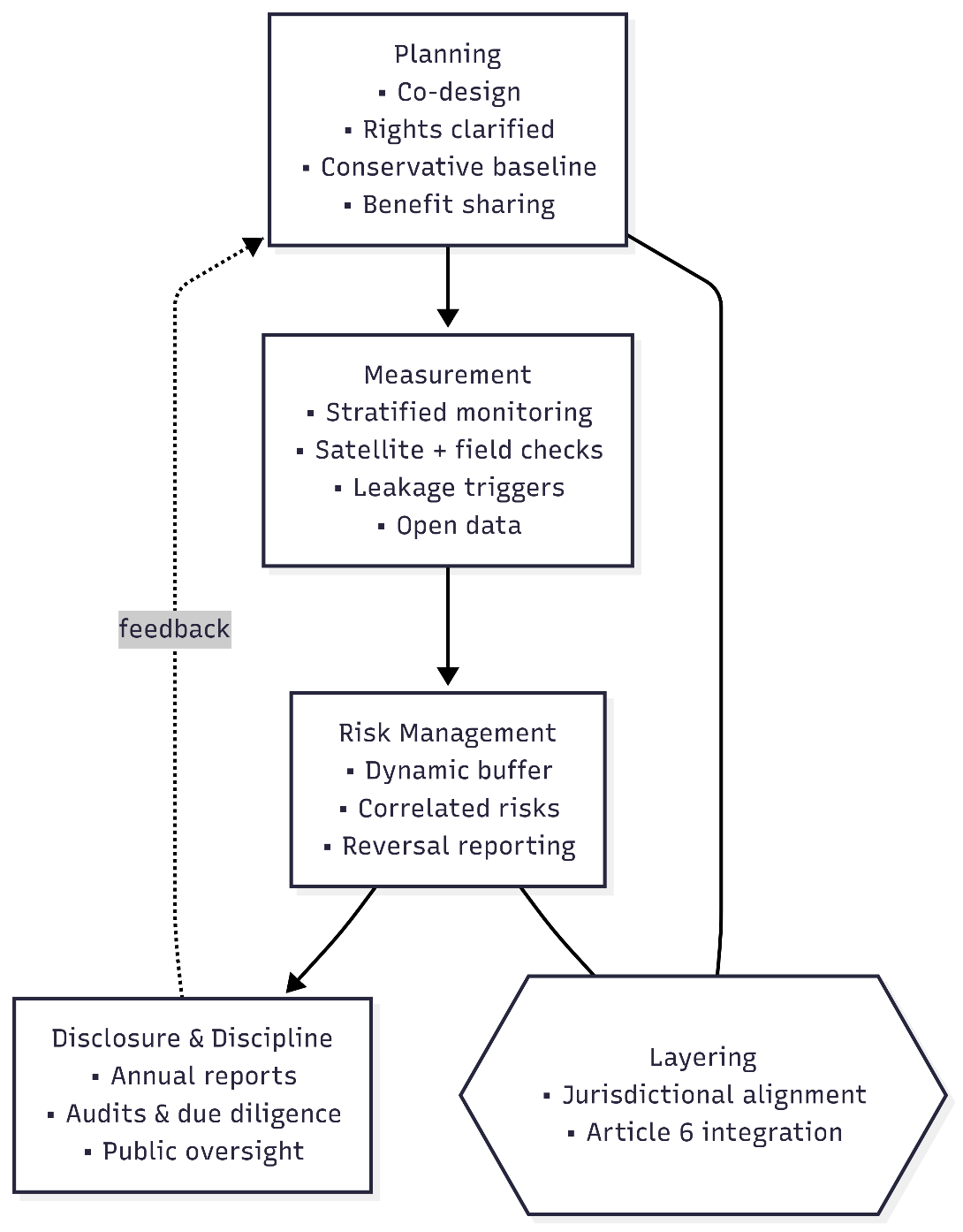
In the Planning stage, proponents co design interventions with right holders and local authorities, clarify land and carbon rights, and define a conservative baseline using independently determined reference regions and open algorithms. Baseline scenarios are stress tested against recent trends and policy developments, and a social impact and benefit sharing plan is codified in legally recognized agreements. This planning stage aligns with Schneider et al.’s call for conservative and transparent baseline design to safeguard environmental integrity from the outset [18].
In the Measurement stage, projects deploy stratified monitoring within and beyond project boundaries using satellite data and field verification to track both emissions reductions and indicators of displacement. Leakage proxies are defined ex ante and monitored, with triggers for conservative debit application when thresholds are crossed. Social performance metrics are tracked through participatory monitoring and independent audits. Measurement systems are documented with open code and data where feasible to enable replication by third parties and to reduce information asymmetry, consistent with transparency principles advocated in the integrity literature (Kreibich and Hermwille, 2021).
In the Risk Management stage, permanence is managed through a dynamic buffer mechanism that updates contributions based on probabilistic risk assessments of climate, ecological, political, and tenure risks. Buffer policies account for correlated risks across projects in similar regions, and reversal events are promptly reported with automatic buffer retirements. The stage also includes financial contingency planning for communities, such as stabilization funds to manage revenue volatility, thereby linking permanence with social resilience to shocks. Badgley et al. underscored the insufficiency of static buffers and the need for rigorous risk modeling, and this stage operationalizes that guidance in African contexts where risk profiles evolve rapidly [1].
In the Disclosure and Discipline stage, projects publish annual reports with detailed environmental and social performance data, baseline recalibrations, leakage deductions, buffer accounts, and financial flows including benefit sharing disbursements and contract terms. Buyers disclose due diligence processes and any corrective actions taken. Standard setters enforce compliance through independent audits and public notices, while regulators update national data portals and align project information with national reporting. The discipline element comes from the market and public response to disclosures, as transparency allows civil society, researchers, and peers to identify issues and encourage corrections. Kreibich and Hermwille emphasized that governance alignment and transparency are central to market legitimacy, and this stage relies on those features to sustain integrity over time (Kreibich and Hermwille, 2021).
The model is iterative. Findings from Measurement and Disclosure feed back into Planning through adaptive management, with baseline updates, activity redesign, and benefit sharing adjustments undertaken through participatory processes. The model is also layered to accommodate nested accounting, allowing projects to integrate with jurisdictional reference levels and national Article 6 frameworks as they mature. In practical terms, the model can be implemented through checklists and templates that guide proponents, buyers, and standard setters in applying the five pillars consistently, accompanied by capacity building initiatives led by African regulators and academic partners to strengthen technical skills in baseline modeling, geospatial monitoring, risk analysis, and social auditing.
5. Conclusion
Kariba’s collapse as a trusted source of African REDD plus credits transformed a diffuse set of concerns into a pressing agenda for reform. The central conclusion is that integrity is a system property arising from the interplay of conservative baselines and additionality tests, dynamic leakage accounting, rigorous permanence risk management with portfolio buffers, equitable and transparent benefit sharing with robust grievance systems, and radical transparency in methods, data, contracts, and financial flows. Technical fixes to any single pillar will not suffice if other pillars remain weak, and in practice, failures and strengths can be mutually reinforcing across pillars.
Actionable safeguards are available for each actor. Projects can adopt dynamic conservative baselines, stratified leakage monitoring, probabilistic buffer management, legally codified benefit sharing, and radical transparency. Buyers can move beyond reliance on registry labels toward pillar based due diligence, fair pricing that funds integrity, portfolio risk management, and public reporting. Standard setters can tighten methodologies, mandate dynamic baselines, strengthen leakage and permanence rules, require open data and contracts, and accelerate nesting with jurisdictional frameworks. African regulators can clarify carbon rights and benefit sharing, set national reference levels and transparency requirements, and align voluntary projects with national reporting and Article 6 cooperation. The proposed Integrity by Design and Discipline model operationalizes these safeguards in an iterative cycle tailored to African contexts, emphasizing planning, measurement, risk management, and disclosure as a coherent practice that aligns incentives and enables learning.
The review underscores priority research needs in African voluntary carbon markets. Baseline methods require further validation with independent data and causal designs, leakage dynamics need better empirical characterization in mosaic landscapes, permanence risk models must incorporate correlated and compounding risks, and social outcomes require more rigorous and longitudinal evaluation. Progress on these fronts will depend on opening data and methods, enhancing capacity among African practitioners and regulators, and cultivating a culture of transparency and critical inquiry that embraces course correction as evidence evolves. If Kariba’s lesson is to be learned rather than repeated, integrity must be treated not as a static label but as a disciplined practice performed in public, allowing African landscapes and communities to benefit from climate finance that delivers real and lasting climate mitigation with social legitimacy and shared prosperity ([18]; [1]; Kreibich and Hermwille, 2021; [8]).
References
- Badgley, G., Freeman, J., Hamman, J., Haya, B., Trugman, A. T. and Anderegg, W. R. L., 2022. Systematic overcrediting in California’s forest carbon offsets program. Global Change Biology, 28 (13), 4385-4403. DOI ↗ Google Scholar ↗
- Blackman, A. and Veit, P., 2018. Titled Amazon indigenous communities cut forest carbon emissions. Proceedings of the National Academy of Sciences, 115 (27), 7095-7100. DOI ↗ Google Scholar ↗
- Boyd, W., Stickler, C., Duchelle, A. E., Seymour, F., Nepstad, D., Bahar, N. H. A. and Rodriguez Ward, D., 2019. Jurisdictional approaches to REDD plus and low emissions development. Progress prospects and challenges. Annual Review of Environment and Resources, 44 (1), 625-659. DOI ↗ Google Scholar ↗
- Busch, J. and Ferretti Gallon, K., 2017. What drives deforestation and what stops it. A meta analysis of spatially explicit econometric studies. Environmental Research Letters, 12 (4), 043001. DOI ↗ Google Scholar ↗
- Curtis, P. G., Slay, C. M., Harris, N. L., Tyukavina, A. and Hansen, M. C., 2018. Classifying drivers of global forest loss. Science, 361 (6407), 1108-1111. DOI ↗ Google Scholar ↗
- Duchelle, A. E., Simonet, G., Sunderlin, W. D. and Wunder, S., 2020. What is REDD plus achieving on the ground. Current state of evidence from a global comparative study. Global Environmental Change, 63, 102096. DOI ↗ Google Scholar ↗
- Goldstein, A., Turner, W. R., Spawn, S. A., Anderson Teixeira, K. J., Cook Patton, S., Fargione, J. and Gibbs, H. K., 2020. Protecting irrecoverable carbon in Earth’s ecosystems. Nature Climate Change, 10 (4), 287-295. DOI ↗ Google Scholar ↗
- Griscom, B. W., Adams, J., Ellis, P. W., Houghton, R. A., Lomax, G., Miteva, D. A., Schlesinger, W. H., Shoch, D., Siikamäki, J. V., Smith, P., Woodbury, P., Zganjar, C., Blackman, A., Campari, J., Conant, R. T., Delgado, C., Elias, P., Gopalakrishna, T., Hamsik, M. R., Herrero, M., Kiesecker, J., Landis, E., Laestadius, L., Leavitt, S. M., Minnemeyer, S., Polasky, S., Potapov, P., Putz, F. E., Sanderman, J., Silvius, M., Wollenberg, E. and Fargione, J., 2017. Natural climate solutions. Proceedings of the National Academy of Sciences, 114 (44), 11645-11650. DOI ↗ Google Scholar ↗
- Green, J. F. and Brand, U., 2021. Credible carbon offsets are not easy. One Earth, 4 (12), 1569-1574. DOI ↗ Google Scholar ↗
- Houghton, R. A. and Nassikas, A. A., 2018. Negative emissions from stopping deforestation and forest degradation globally. Biogeosciences, 15 (2), 1157-1167. DOI ↗ Google Scholar ↗
- Hubau, W., Lewis, S. L., Phillips, O. L., Affum Baffoe, K., Beeckman, H., Cuní Sanchez, A., Daniels, A. K., Ewango, C. E. N., Fauset, S., Mukinzi, J. M., Sheil, D., Sonké, B., Sullivan, M. J. P., Sunderland, T. C. H., Taedoumg, H., Thomas, S. C., White, L. J. T., Abernethy, K. A., Adu Bredu, S., Amani, C. A., Baker, T. R., Banin, L. F., Baya, F., Begne, S. K., Bennett, A. C., Benedet, F., Bitariho, R., Bocko, Y., Boeckx, P., Boundja, P., Brienen, R. J. W., Brncic, T., Chezeaux, E., Chuyong, G. B., Clark, C. J., Collins, M., Comiskey, J. A., Coomes, D. A., Dargie, G. C., de Haulleville, T., Kamdem, M. N. D., Doucet, J. L., Esquivel Muelbert, A., Feldpausch, T. R., Fofanah, A., Foli, E. G., Gilpin, M., Gloor, E., Gonmadje, C., Gourlet Fleury, S., Hall, J. S., Hamilton, A. C., Harris, D. J., Hart, T. B., Hockemba, M. B. N., Hladik, A., Ifo, S. A., Jeffery, K. J., Jucker, T., Yakusu, E. K., Kearsley, E., Kenfack, D., Koch, A., Leal, M. E., Levesley, A., Lindsell, J. A., Lisingo, J., Lopez Gonzales, G., Lovett, J. C., Makana, J. R., Malhi, Y., Marshall, A. R., Martin, E. H., Martin, J., Ojo, L., Nagy, L., Ntoh, M. L., Ojo, L., Onana, J. M., Peh, K. S. H., Pickavance, G. C., Poulsen, J. R., Reitsma, J., Rovero, F., Swaine, M. D., Talbot, J., Taplin, J., Taylor, D. M., Thomas, D. W., Toirambe, B., Mukendi, J. T., Umunay, P. M., van der Heijden, G. M. F., Verbeeck, H., Vleminckx, J., White, L., Willcock, S., Woell, H., Woods, J. T., Zemagho, L., 2020. Asynchronous carbon sink saturation in African and Amazonian tropical forests. Nature, 579 (7797), 80-87. DOI ↗ Google Scholar ↗
- Intergovernmental Panel on Climate Change, 2022. Climate Change 2022. Mitigation of Climate Change. Contribution of Working Group Three to the Sixth Assessment Report of the Intergovernmental Panel on Climate Change. Cambridge University Press, Cambridge and New York. DOI ↗ Google Scholar ↗
- Jayachandran, S., de Laat, J., Lambin, E. F., Stanton, C. Y., Audy, R. and Thomas, N. E., 2017. Cash for carbon. A randomized trial of payments for ecosystem services to reduce deforestation. Science, 357 (6348), 267-273. DOI ↗ Google Scholar ↗
- Kreibich, N. and Hermwille, L., 2021. Caught in between or complementary instruments. The governance of carbon markets in light of the Paris Agreement. Climate Policy, 21 (9), 1161-1174. DOI ↗ Google Scholar ↗
- Larson, A. M., Brockhaus, M., Djoudi, H., Duchelle, A. E., Atmadja, S., Dokken, T. and Pham, T. T., 2019. Gender lessons for climate initiatives. A comparative study of REDD plus implementation. World Development, 121, 48-61. DOI ↗ Google Scholar ↗
- Loft, L., Pham, T. T., Wong, G. Y., Brockhaus, M., Le, D. N. and Tjajadi, J. S., 2017. Risks to REDD plus safeguards in Laos. A qualitative analysis of implementation in pilot projects. World Development, 95, 27-42. DOI ↗ Google Scholar ↗
- Pailler, S., Naidu, S. C., Msangi, S. and Karlan, D., 2020. Social protection and deforestation. Evidence from Mexico’s Oportunidades and Mexico’s national payments for ecosystem services program. World Development, 135, 105064. DOI ↗ Google Scholar ↗
- Schneider, L., Kollmuss, A. and La Hoz Theuer, S., 2019. Environmental integrity of international carbon market mechanisms under the Paris Agreement. Climate Policy, 19 (3), 386-400. DOI ↗ Google Scholar ↗
- Seddon, N., Chausson, A., Berry, P., Girardin, C. A. J., Smith, A. and Turner, B., 2021. Understanding the value and limits of nature based solutions to climate change and other global challenges. Philosophical Transactions of the Royal Society B, 376 (1829), 20200183. DOI ↗ Google Scholar ↗
- Tyukavina, A., Hansen, M. C., Potapov, P. V., Parker, D., Okpa, C., Stehman, S. V., Kommareddy, I., Turubanova, S., Adusei, B., Adonu, K., 2018. Congo Basin forest loss dominated by increasing smallholder clearing. Science Advances, 4 (11), eaat2993. DOI ↗ Google Scholar ↗
- Wehkamp, J., Aquino, A., Fuss, S. and Reed, E., 2018. Analyzing the performance of pay for performance forest conservation. Evidence from the literature. Environmental Research Letters, 13 (12), 125013. DOI ↗ Google Scholar ↗
- Bastin, J. F., Finegold, Y., Garcia, C., Mollicone, D., Rezende, M., Routh, D., Zohner, C. M. and Crowther, T. W., 2019. The global tree restoration potential. Science, 365 (6448), 76-79. DOI ↗ Google Scholar ↗
- Harris, N. L., Gibbs, D. A., Baccini, A., Birdsey, R. A., de Bruin, S., Farina, M., Fatoyinbo, L., Hansen, M. C., Herold, M., Houghton, R. A., Potapov, P. V. and Turubanova, S., 2021. Global maps of twenty first century forest carbon fluxes. Nature Climate Change, 11, 234-240. DOI ↗ Google Scholar ↗
- Melo, J. E., Meyfroidt, P., Celentano, D., Sanchez, A., Solórzano, L. A. and Börner, J., 2021. Effectiveness of forest conservation instruments in the tropics under the Paris Agreement. Nature Climate Change, 11, 1084-1094. DOI ↗ Google Scholar ↗
- Noon, M. L., Goldstein, A., Ledezma, J. C., Roehrdanz, P. R., Cook Patton, S. C., Spawn Le, S. S., Turner, W. R., Wright, T. M. and Rockström, J., 2021. Mapping the irrecoverable carbon in Earth’s ecosystems. Nature Sustainability, 5 (1), 37-46. DOI ↗ Google Scholar ↗
- Roe, S., Streck, C., Beach, R., Busch, J., Chapman, M., Daioglou, V., Deppermann, A., Doelman, J., Domke, G., Engelmann, J., Fricko, O., Frischmann, C., Gusti, M., Habermann, M., Humpenöder, F., Landholm, D., Linder, T., Olsson, O., Popp, A., Robertson, N., Sandstad, M., Sohngen, B., Tabeau, A., Valin, H., Walker, W., van der Werf, G. and Griscom, B., 2021. Land based measures to mitigate climate change. Potential and feasibility by country. Global Change Biology, 27 (23), 6025-6058. DOI ↗ Google Scholar ↗
- Seymour, F. and Busch, J., 2016. Why forests. Why now. The science economics and politics of tropical forests and climate change. Brookings Institution Press and Center for Global Development. DOI ↗ Google Scholar ↗
- Smith, P., Adams, J., Beerling, D. J., Beringer, T., Calvin, K. V., Fuss, S., Griscom, B. W., Hagemann, N., Kammann, C., Kraxner, F., Minx, J. C., Popp, A., Rogelj, J., Rose, S. K., Sonntag, S., Stehfest, E., Tavoni, M., van Vuuren, D. and Williamson, P., 2019. Land management options for greenhouse gas removal and their impacts on ecosystem services and the sustainable development goals. Annual Review of Environment and Resources, 44, 255-286. DOI ↗ Google Scholar ↗
- Streck, C., 2021. Who owns REDD plus. Carbon rights under national legal frameworks. Climate Policy, 21 (7), 851-867. DOI ↗ Google Scholar ↗
- West, T. A. P., Börner, J., Sills, E. O. and Kontoleon, A., 2020. Overstated carbon emission reductions from voluntary REDD plus projects in the Brazilian Amazon. Proceedings of the National Academy of Sciences, 117 (39), 24188-24194. DOI ↗ Google Scholar ↗
- West, T. A. P., Sills, E. O., Börner, J. and Kontoleon, A., 2023. Projecting deforestation in voluntary carbon offset projects. Dynamic baselines and hidden biases. Global Environmental Change, 81, 102696. DOI ↗ Google Scholar ↗
- Zhang, Y., Joglekar, A., He, F. and Guan, D., 2021. Economic and social impact of carbon offsets. A systematic review. Journal of Environmental Management, 292, 112758. DOI ↗ Google Scholar ↗
- Zizka, A., Antonelli, A., Silvestro, D., Biggs, D., Vymazalová, M., Kusumoto, B., van Zonneveld, M., Sanda, R., Schubert, M., Pyšek, P. and Novoa, A., 2020. Understanding community benefits and social safeguards in nature based climate solutions. Philosophical Transactions of the Royal Society B, 375 (1794), 20190128. DOI ↗ Google Scholar ↗