Abstract
Abstract Financial literacy and financial inclusion are important factors in improving the sustainability and competitiveness of micro and small enterprises. However, many micro and small business actors still have limited knowledge and access to financial services. This study aims to analyze the level of financial literacy and financial inclusion of micro and small industry entrepreneurs in East Jakarta and to formulate strategies to improve financial literacy and financial inclusion. This study uses a survey method with a quantitative descriptive approach. Data were collected from 92 respondents who are micro and small industry entrepreneurs in East Jakarta through questionnaires and interviews. The data were analyzed using descriptive analysis to describe the level of financial literacy and financial inclusion of respondents. The results show that most respondents have a moderate level of financial literacy, particularly in basic financial knowledge. However, the implementation of financial management practices such as financial recording and cash flow management is still limited. In terms of financial inclusion, some entrepreneurs have accessed formal financial services such as banking services, but the utilization of these services has not been optimal. Therefore, strategies such as financial education, business mentoring, and improving access to financial services are needed to enhance financial literacy and financial inclusion among micro and small industry entrepreneurs.
Keywords
Financial Literacy Financial Inclusion Micro and Small Enterprises Financial Management
Introduction
This research uses a survey method with a quantitative descriptive approach. The study was conducted among micro and small business owners in East Jakarta. The population comprised micro and small business owners operating in East Jakarta. Purposive sampling was used, selecting 92 respondents. The data used in this study consists of primary data and secondary data. Primary data was obtained through questionnaires and interviews with respondents, while secondary data was obtained from various sources such as research reports, scientific journals, and official publications. Data analysis was conducted using descriptive analysis to illustrate the level of financial literacy and financial inclusion among micro and small business actors.
Results And Discussion
Respondent Characteristics
Respondents in this study were small industrial business actors in East Jakarta. totaling 92 people. Respondent characteristics consist of age, length of business, type ofRespondents in this study were small industrial business actors in East Jakarta. totaling 92 people. Respondent characteristics consist of age, length of business, type of business and income level. The characteristics of respondents in this study are described as follows:
1) Respondent Characteristics Based on Age
Age in this study is the time elapsed from the respondent's birth to the time the study was conducted. Respondent characteristics by age group can be seen in Table 1
| Class interval (year) | Respondents | |
| Number of (people) | Percentage (%) | |
| 19 - 35 | 57 | 61,96 |
| 36 - 51 | 29 | 31,52 |
| 52 - 67 | 6 | 6,52 |
| total | 92 | 100 |
Source: Results of Primary Data Analysis,2026
Based on Table 1, it is known that the majority of respondents in this study were in the age range of 19 - 35 years, as many as 57 people with a percentage of 61.96 percent. The respondents in this study were within their productive age groups. According to [6], a person's productive age can be divided into three groups: pre-productive age (0-14 years), productive age (15-64 years), and less productive age (>64 years). The number of respondents in the productive age group indicates that most entrepreneurs are still economically active and have significant potential for business development. Those of productive age generally have high work ethic and the ability to adapt to change.
2) Respondent Characteristics Based on Length of Business
Length of business is the period of time that indicates how long a person or business actor has been operating their business since its inception until the time of the research. Respondent characteristics based on length of business can be seen in Table 2.
| Class interval (year) | Respondents | |
| Number of (people) | Percentage (%) | |
| 2 – 8 | 82 | 89,13 |
| 8 – 14 | 7 | 7,61 |
| 14 – 20 | 3 | 3,26 |
| total | 92 | 100 |
Source: Results of Primary Data Analysis,2026
Based on Table 2, it is known that the majority of respondents have been running a business for 2 to 8 years with a total of 82 people with a percentage of 89.13. percent. This condition indicates that the majority of business actors are still classified as new to medium sized businesses. This reflects the need for mentoring, training, and capital and marketing support from stakeholders to ensure sustainable business growth. Business actors with relatively little experience generally still face various obstacles in business management and access to resources.
3) Respondent Characteristics Based on Income
Income is the amount of income earned by an individual or business actor from economic activities within a specific time period, whether from the sale of goods or services, after conducting business activities. Respondent characteristics based on length of business experience can be seen in Table 3.
| Class interval (year) | Respondents | |
| Number of (people) | Percentage (%) | |
| Rp1.000.000 – Rp4.666.667 | 43 | 46,74 |
| Rp4.666.667 – Rp8.333.333 | 41 | 44,57 |
| Rp8.333.333 – Rp12.000.000 | 8 | 8,70 |
| total | 92 | 100 |
Source: Results of Primary Data Analysis,2026
Based on Table 3, it is known that the majority of respondents have an income ranging from Rp1,000,000 to Rp4,666,667, with a total of 43 people, representing 46.74 percent. This income distribution indicates that the majority of business owners are at the low to middle income level. Meanwhile, only a small proportion of respondents have achieved a high income level. This indicates that business empowerment still needs to be improved, particularly in terms of increasing productivity, market access, and strengthening business capacity to encourage sustainable income growth.
Financial Literacy Profile of Micro and Small Industry Business Actors.
The financial literacy profile of micro, small, and medium-sized business owners in this study is presented to address the first research objective, which is to determine and describe the level of financial literacy of micro, small, and medium-sized business owners in East Jakarta. Financial literacy is not only related to knowledge of financial concepts but also encompasses an individual's skills, beliefs, attitudes, and behaviors in managing finances effectively and sustainably. According to the Financial Services Authority (2022), financial literacy is a combination of knowledge, skills, and beliefs that influence an individual's attitudes and behaviors in improving the quality of financial decision-making to achieve financial well-being.
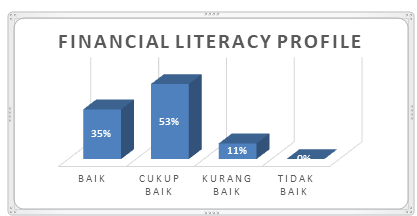
Based on the results of the research data analysis, the financial literacy level of micro, small, and medium-sized business owners in East Jakarta is generally considered to be "sufficiently literate." This indicates that most business owners have a basic understanding of financial services institutions and the various financial products and services available. Furthermore, business owners have demonstrated a fairly good level of confidence in formal financial institutions in supporting their business activities. Furthermore, the research findings indicate that skills in optimally utilizing financial products and services still need improvement. This is evident in the limited implementation of systematic business financial management practices, such as consistent financial record keeping, cash flow planning, and the use of financing products for business development.
These findings indicate that improving financial literacy among micro, small, and medium-sized business owners requires ongoing efforts, particularly in the form of practical education and mentoring. Financial literacy programs should focus not only on increasing knowledge but also on strengthening practical skills in business financial management. Thus, business owners are expected to not only understand financial concepts but also be able to implement more effective financial management practices oriented towards business sustainability. This is in line with the opinion of Lusardi and Mitchell (2014) who stated that a suboptimal level of financial literacy can influence the quality of individual financial decision-making, especially in managing investments and business financing.
Financial Inclusion Profile of Micro, Small and Medium Enterprises
The level of financial inclusion in this study illustrates the extent to which micro and small business owners have access to, use of, and utilization of formal financial services to support their business activities. Financial inclusion is a crucial aspect in strengthening the micro and small business sector because it relates to the ease with which business owners can obtain safe, affordable, and tailored financial services to their business needs.
According to the Financial Services Authority (2022), financial inclusion is a condition in which every individual and business owner has access to a variety of quality, timely, smooth, and affordable formal financial products and services that meet the needs and capabilities of the community. A high level of financial inclusion can encourage increased business capacity, expand access to financing, and enhance the sustainability of micro and small businesses.
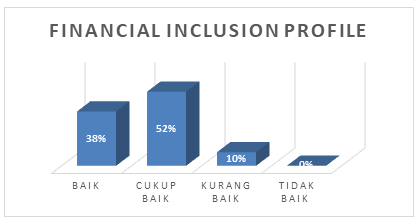
Based on the results of processing questionnaire data obtained from respondents in this study, the level of financial inclusion among micro, small, and medium-sized business owners is generally in the fairly good category. This indicates that most business owners have access to formal financial services such as savings, business financing, and other financial transaction services. The increasingly accessible presence of formal financial institutions and the development of digital financial services have also made it easier for business owners to conduct various financial activities. However, the level of financial inclusion, which is not yet fully in the high category, indicates that several obstacles remain for business owners in optimally utilizing financial services. These obstacles can include limited information about financial products, administrative requirements that are considered quite complex, or limited understanding of how to utilize formal financial services productively for business development. Therefore, the analysis of the level of financial inclusion in this study is not only viewed in general terms but also analyzed based on several key indicators that describe aspects of access, use, and utilization of financial services by business owners.
Strategies for Strengthening Financial Literacy and Inclusion of Micro, Small, and Medium Enterprises
Strategies for strengthening financial literacy and inclusion of micro, small, and medium enterprises are presented to answer the third research objective. The qualitative approach in this study aims to describe strategies for strengthening financial literacy and inclusion of micro, small, and medium enterprises. Data collection was conducted through in-depth interviews with key informants from the Financial Services Authority (OJK), the institution mandated to implement financial education and increase access to formal financial services. Based on the in-depth interviews, the strategies implemented are not only oriented towards increasing knowledge but also towards changing financial behavior and expanding access to formal financial services.
The first strategy is implemented through improving education on business financial management for micro, and small enterprises. This education focuses not only on understanding financial concepts but also on practical skills in managing business cash flow, maintaining financial records, and planning the effective use of business capital. Informants from the OJK explained that the educational materials provided to MSMEs cover various basic aspects of financial management. As an informant explained:
"The Financial Services Authority (OJK) provides education and outreach with materials covering financial planning, namely how MSMEs understand and understand the life cycle... Financial management, MSMEs are taught not only about money but also how to manage finances to achieve goals... Needs and wants, MSMEs are taught the difference between needs and wants." (OJK informant interview, 2026)
This demonstrates that strengthening financial literacy aims not only to increase knowledge but also to shape the financial mindset of entrepreneurs so they can make more rational and planned financial decisions.
The second strategy is aimed at increasing the utilization of formal financing products by micro and small businesses. Research shows that some entrepreneurs still do not optimally utilize banking financing services, even though access to financial institutions is relatively available. Therefore, the financial literacy program is also aimed at increasing entrepreneurs' understanding of various financing products that can be used for business development. The informant explained that one of the financing products focused on in education is the People's Business Credit (KUR).
"In educational materials for MSMEs, financing through banking is a priority, particularly People's Business Credit (KUR), because this program is intended to support the development of small businesses." (Interview with OJK informant, 2026)
This demonstrates the importance of this strategy, as increasing the use of formal financing can help businesses expand production capacity, increase working capital, and strengthen business sustainability. Theoretically, Lusardi and Mitchell (2014) emphasized that good financial literacy contributes to the quality of financing decisions and business sustainability.
The next strategy is implemented through the implementation of financial education programs that are more flexible and easily accessible to businesses. Given the vast territory and limited resources for direct assistance, the OJK utilizes various educational methods, such as face-to-face training and digital media. As an informant explained:
"Not all regions can receive direct assistance due to Indonesia's vast territory, so direct training and the use of video media are considered effective methods for providing financial education." (Interview with OJK informant, 2026)
This approach demonstrates that the use of digital technology can expand the reach of financial literacy programs, enabling more business owners to gain access to financial education.
Another strategy to increase financial inclusion is strengthening collaboration between financial institutions, local governments, and various other stakeholders. The OJK has developed collaborative programs through the GENJARKAN (National Financial Intelligence Movement) program and in collaboration with the Regional Financial Access Acceleration Team (TPKAD) to expand access to financial services at the regional level. As an informant explained:
"The Gencarkan program is implemented in collaboration with local governments and TPKAD to develop programs to improve financial access tailored to the needs of communities in each region."
This collaboration aims to bring financial services closer to the public and increase business access to various formal financial products and services. The final strategy is to encourage the use of digital financial technology to expand access to financial services for micro and small businesses. Developments in financial technology enable businesses to conduct various financial transactions more quickly and efficiently. As an informant stated:
"With technological developments such as QRIS, digital wallets, and various electronic payment services, financial access has become easier and faster, so businesses can utilize them to support their business activities." (Interview with OJK informant, 2026)
Furthermore, education is also provided to businesses to raise awareness of the risks of illegal investments and illegal online loans.
"The OJK also continues to educate the public to be wary of illegal investments and illegal online loans so that businesses do not fall victim to detrimental financial practices." (Interview with OJK informant, 2026)
Therefore, strategies to strengthen financial literacy and inclusion need to be implemented in an integrated manner through improving financial education, expanding access to formal financing, strengthening institutional collaboration, and utilizing digital financial technology. This strategy is expected to improve the ability of business actors to utilize financial services optimally so as to encourage the growth and sustainability of micro and small businesses.
Conclusion
This study shows that the financial literacy level of micro and small business owners in East Jakarta is quite good, but still needs improvement, especially in terms of business financial management practices. In terms of financial inclusion, some business owners have access to formal financial services, but their utilization is still suboptimal. Therefore, various efforts are needed, such as improving financial education, business mentoring, and increasing access to financial services to improve financial literacy and inclusion among micro and small business owners.
References
- East Jakarta City Statistics Office. 2022. Profile of Micro and Small Industries in East Jakarta City 2022.Central Statistics Agency of East Jakarta City. Jakarta Google Scholar ↗
- Central Bureau of Statistics. 2025. East Jakarta in Figures 2025. Central Bureau of Statistics. Google Scholar ↗
- Statistics. East Jakarta City. Google Scholar ↗
- Beck, T., Demirgüç-Kunt, A., & Levine, R. (2007). Finance, inequality and the poor. Journal of Economic Growth, 12(1), 27–49. DOI ↗ Google Scholar ↗
- Kusuma, M., Narulitasari, D., Nurohman, YA, Economy, F., Islam, B., Raden, U., Said, M., Business, A., Small, M., Raya, S., Raya, S., Square, PL, Raya, S., Raya, S., Umkm, P., Social, P., Large, B., Restrictions, P., Society, K., … Umkm, K. 2021. Financial Inclusion and Financial Literacy on the Performance and Sustainability of MSMEs in Solo Raya. Among Makarti Journal, 14(2), 62–7 Google Scholar ↗
- Mantra, IB 2004. General Demography. Student Library. Yogyakarta Google Scholar ↗
- Nugroho, AS 2016. E-commerce Theory and Implementation (CEKUILIBRI). Google Scholar ↗
- Financial Services Authority (OJK). 2022. National Survey of Financial Literacy and Inclusion. OJK.Central Jakarta Google Scholar ↗
- Pohan, M., Gunawan, A., Arif, M., and Jufrizen, J. 2021. Testing the Construct of Student Financial Literacy. Scientific Journal of Management and Business, 22(2), 291–303. Google Scholar ↗
- Sanistasya, PA, Rahardjo, K., and Iqbal, M. 2019. The Influence of Financial Literacy and Financial Inclusion on Small Business Performance in East Kalimantan. Jurnal Economia, 14(1), 48–59. Google Scholar ↗
- Sastiono, P. 2019. Financial Inclusion Through the Digital Financial Services Program Pandai, and Laku Pandai Financial Inclusion: Case Study of LKD and Laku Indonesia., Program. Google Scholar ↗
- Journal of Economics and Development. Google Scholar ↗
- Sekarwati, MA, and Susanti. 2020. The Influence of Financial Literacy, Financial Inclusion and Individual Modernity on Savings Behavior of Students at State Universities in Surabaya. Journal of Financial Economics and Management, 16(2), 268–275. Google Scholar ↗
- Siswa, I., and Agustin, G. 2020. Analysis of the Influence of Financial Inclusion on the Index Human Development in Indonesia 2015-2018. Scientific Journal of Economics and Business, 17(2), 121-130. Google Scholar ↗
- Thaha, S. 2022. The Importance of Financial Literacy in Personal Financial Management (A Google Scholar ↗
- Literature Study). Edueco Journal, 4(1), 57–73. Google Scholar ↗
- Utami, LP, and Marpaung, NN 2022. The Influence of Financial Literacy and Lifestyle. Google Scholar ↗
- On Employee Financial Management (Study at PT. Mulia Boga Raya Tbk).Parameters, 7(1), 98–108.MSEJ, xx(x) 201x: xx-xx Google Scholar ↗
- Yunita, N. 2020. The Influence of Gender and Academic Ability on Financial Literacy in Financial Management Behavior of Accounting Students. Prisma (Accounting Student Research Google Scholar ↗
- Platform), 01(02), 1–12. Google Scholar ↗
- Yuwan Lestari, S. 2020. The Influence of Financial Management Education in the Family, Socioeconomic Status, Locus of Control on Financial Literacy (Subang High School Students). Google Scholar ↗
- Prisma (Accounting Student Research Platform), 01(02), 69–78 Google Scholar ↗