Abstract
The growing exposure of pilgrims to airborne dust, industrial emissions, and hazardous gaseous pollutants during the Hajj season highlights the urgent need for smart, protective, and sustainable Hajj clothing fabrics with advanced filtration functionality. This study focuses on the development of innovative Ihram fabrics by incorporating zinc oxide and zeolitic imidazolate framework-8 nanomaterials into textile fibers to achieve dual protection against particulate matter and gaseous contaminants. The ZnO- and ZIF-8-modified fibrous composites were further treated using corona charging to enhance their electrostatic performance. Both ZnO and ZIF-8 exhibited strong charge-trapping behavior; however, the uniform growth of ZIF-8 nanocrystals across the Ihram fibers provided superior and more stable electrostatic charging than the uneven ZnO coating, thereby improving the overall filtration efficiency. In contrast, ZnO agglomerates embedded in the textile matrix contributed to mechanical filtration, particularly in multilayer fabric structures. For gaseous pollutants such as SO₂, the high surface area and porous architecture of ZIF-8 enabled effective adsorption and removal, unaffected by corona charging. These results demonstrate the potential of ZIF-8-integrated Hajj clothing fabrics to form a new generation of smart Ihram garments that combine comfort, safety, and environmental protection—offering sustainable solutions to health and air-quality challenges faced by pilgrims during Hajj.
Keywords
Hajj clothing Ihram fabric Zinc oxide Zeolitic imidazolate framework-8 Electrostatic charge Particulate matter Sulfur dioxide Filtration Adsorption
Introduction
During the Hajj pilgrimage, millions of pilgrims are exposed to challenging environmental conditions characterized by extreme heat, dense dust, and high concentrations of airborne contaminants originating from industrial emissions, vehicular exhaust, and crowd-induced activity. Such harsh surroundings compromise not only the comfort of pilgrims but also their respiratory health, highlighting the urgent necessity for protective, functional, and sustainable Ihram clothing fabrics. The global escalation of industrialization has intensified the release of harmful particulate matter and gaseous pollutants, thereby exacerbating air quality degradation, global warming, and ecological imbalance (Robertson et al., 2023). To mitigate these impacts, researchers have increasingly focused on developing advanced purification and filtration technologies aimed at reducing exposure to airborne pollutants and protecting human well-being.
Among the available solutions, fibrous filtration materials have emerged as highly effective due to their excellent capture efficiency, structural simplicity, and low energy requirements (Zhao et al., 2025). These characteristics make them ideal candidates for engineering Ihram fabrics that combine comfort, breathability, and protective capability. Nevertheless, most existing filtration textiles are designed to target either particulate matter (PM) or gaseous pollutants (GV), with few capable of delivering dual protection within a single lightweight fabric system. Conventional approaches—such as the incorporation of activated carbon into fibrous filters—can enhance pollutant removal but often reduce air permeability and comfort, both of which are crucial for Ihram garments worn during the pilgrimage.
To address this challenge, the integration of multifunctional nanomaterials like zinc oxide (ZnO) and zeolitic imidazolate framework-8 (ZIF-8) within the fiber structure of Ihram fabrics offers a promising pathway toward developing smart, breathable, and high-performance Hajj clothing. These nanomaterials can simultaneously capture fine particulate matter and adsorb gaseous contaminants without compromising softness or air circulation—properties essential for maintaining thermal comfort in hot and crowded pilgrimage environments.
Recent advancements have shown that metal oxides and metal–organic frameworks (MOFs) possess remarkable potential for eliminating gaseous pollutants due to their high surface areas, tunable pore structures, and chemical reactivity (Shi et al., 2025). In particular, zinc-based compounds stand out for their biocompatibility, low toxicity, and multifunctionality, rendering them suitable for application in wearable or disposable Ihram fabrics designed to protect pilgrims from airborne hazards while preserving comfort and ritual appropriateness.
Dai et al. (2021) have demonstrated that embedding ZnO nanoparticles within fibrous matrices enhances key performance parameters, including gas adsorption, antibacterial activity, and photocatalytic efficiency. Similarly, Khan et al. (2021) confirmed that ZnO-coated fibers exhibit improved particulate matter filtration through increased surface roughness and reactive contact area. Furthermore, Gupta et al. (2022) demonstrated the potential of Zn-based materials for capturing sulfur dioxide (SO₂), although their work did not involve integration into textile substrates. Despite these promising findings, limited research has yet combined ZnO and MOF-based nanomaterials within Ihram fabric systems capable of providing dual protection—against both particulate and gaseous pollutants—marking a critical gap in advancing bright, protective Hajj clothing for sustainable pilgrim welfare.
Integration of Metal–Organic Frameworks with Ihram Clothing Fabrics
Metal–organic frameworks (MOFs) have garnered substantial attention due to their exceptionally high surface areas, adjustable pore geometries, and superior gas adsorption capacities. Among these, the zeolitic imidazolate framework-8 (ZIF-8) has emerged as one of the most promising nanostructures for air purification and environmental remediation applications (Zhang et al., 2022). When integrated into fibrous matrices, ZIF-8 nanocrystals form highly porous networks that can trap fine particulate matter while simultaneously adsorbing gaseous pollutants, such as sulfur dioxide and nitrogen oxides, without compromising breathability or comfort (Deng et al., 2024).
An earlier attempt by Dai et al. (2018) to impregnate ZIF-8 within polymeric fibers during spinning demonstrated the feasibility of large-scale production; however, a significant proportion of the active adsorption sites became embedded within the fiber core, reducing accessibility to ambient pollutants (Zhou et al., 2022). Building upon this limitation, subsequent studies (Lee et al., 2021) successfully achieved in-situ crystallization of ZIF-8 directly on fiber surfaces, producing a continuous nanocrystalline coating. This surface growth enhanced pollutant–material interaction by exposing more active Zn–N coordination sites, which facilitated chemical adsorption reactions with acidic gas molecules (e.g., SO₂ + Zn²⁺ → ZnSO₃/ZnSO₄ intermediates) and promoted electrostatic interactions with charged dust particles.
Such advancements provide a crucial foundation for designing smart Hajj Ihram clothing fabrics that seamlessly combine functionality with spiritual and physical comfort. The incorporation of ZIF-8 nanocrystals enables the Ihram fabric to exhibit dual protection mechanisms—electrostatic and chemical—while remaining lightweight and breathable. These dual mechanisms are particularly beneficial during the Hajj pilgrimage, where pilgrims are continuously exposed to high levels of dust and harmful gaseous emissions in hot, crowded environments.
In the present study, advanced Ihram textile composites were developed by integrating both ZIF-8 and zinc oxide (ZnO) nanomaterials into the fiber matrix. While ZnO provides robust photocatalytic and antibacterial performance through surface oxidation–reduction reactions (e.g., ZnO + hν → Zn²⁺ + e⁻ + •O₂⁻), ZIF-8 contributes superior adsorption due to its microporous framework and Zn–N coordination bonds. To further enhance particulate filtration, the ZIF-8-coated fibers underwent a corona charging process, which increased their surface charge density and improved electrostatic retention.
The study highlights that, although ZnO and ZIF-8 share the same elemental origin, their distinct structural morphologies and chemical configurations lead to markedly different filtration behaviors. This comparative analysis provides valuable insights into their respective mechanisms of interaction with particulate matter and gaseous pollutants, particularly under the influence of electrostatic charging. By incorporating these nanocrystals onto the surface of polyester (PET) nonwoven fibers—selected for their lightweight, breathable qualities, which are ideal for Ihram clothing—the research investigated how each nanomaterial responds to corona charging. During this process, the metal-based components undergo dipole alignment and charge polarization under a high electric field.
This process-oriented investigation reveals that both ZnO and ZIF-8 nanocrystals enhance the fibers’ ability to retain electrostatic charge while simultaneously improving their gas adsorption efficiency. Together, these mechanisms provide a dual protective effect—capturing airborne dust and adsorbing harmful gases—crucial for safeguarding pilgrims during Hajj. The novelty of this study lies in combining the complementary electrostatic and adsorptive properties of these nanomaterials to engineer smart, breathable Ihram fabrics that meet both the spiritual requirements of the pilgrimage and the wearer's physical protection needs. The findings mark a significant step toward developing sustainable and disposable air-filtering Hajj garments, specifically designed to mitigate environmental health risks in the Holy sites.
Materials and Methods
Materials
To fabricate advanced Hajj Ihram fabrics capable of shielding pilgrims from airborne dust and harmful gaseous pollutants, polyethylene terephthalate (PET) nonwoven fabric was employed as the substrate material. PET was chosen for its lightweight, breathable, and skin-compatible properties, aligning with the spiritual and practical requirements of Ihram clothing.
The precursors used for zinc oxide (ZnO) and zeolitic imidazolate framework-8 (ZIF-8) formation included zinc nitrate hexahydrate (Zn(NO₃)₂·6H₂O) and 2-methylimidazole (2-mIm). Zinc nitrate and ethanol (99.9%) were purchased from Daejung Chemicals (Korea), while 2-methylimidazole was obtained from Sigma-Aldrich (MO, USA). High-purity gases—nitrogen (N₂, 99.99%), sulfur dioxide (SO₂, 1.00%), and perfluorocyclobutane (C₄F₈, 99.99%)—were supplied by Union Gas (Korea) for use in adsorption and filtration evaluations that simulate the atmospheric conditions pilgrims encounter during Hajj.
In-situ Synthesis of ZnO on Ihram Fabric via Hydrothermal Method
To enhance both the protective and antimicrobial properties of the Ihram fabric, ZnO nanostructures were grown directly on the PET fiber surface through a hydrothermal reaction, forming a composite denoted as ZnO@PET. As shown schematically in Figure 1a, two aqueous precursor solutions were first prepared: one containing zinc nitrate hexahydrate (2.98 g, 0.2 M) and the other 2-methylimidazole (1.49 g, 0.36 M). A square PET fabric sample (10 cm × 10 cm) was immersed in the mixed solution with a molar ratio of Zn:2-mIm = 1:1.7, then maintained at 60 °C for 48 hours under sealed conditions to promote uniform nanocrystal growth.
During the hydrothermal process, zinc ions (Zn²⁺) from the nitrate salt reacted with hydroxyl (OH⁻) and imidazolate ligands, initiating nucleation on the fiber surface. The localized reaction led to the gradual formation of Zn(OH)₂ intermediates, which subsequently decomposed into ZnO nanocrystals upon heating according to the reaction pathway:
These reactions anchored ZnO nanoparticles firmly onto the PET fiber matrix, producing a uniform nanostructured layer.
The adjustment of the metal precursor-to-organic ligand ratio had a critical influence on the resulting phase. When the 2-mIm concentration was reduced to approximately a 1:1.5 Zn-to-ligand ratio, the synthesis favored ZnO precipitation rather than ZIF-8 crystal formation. This controlled approach enabled direct surface nucleation of ZnO on the Ihram fabric rather than encapsulation within the fiber bulk. The outcome was a nanostructured ZnO@PET composite with improved particulate and gaseous pollutant capture efficiency, while maintaining the softness, flexibility, and air permeability required for Ihram garments worn during the sacred pilgrimage.
This precise in-situ reaction pathway not only strengthened the adhesion of the nanocrystals to the textile but also enhanced the electrostatic and photocatalytic reactivity of the fabric surface, ensuring that the Ihram clothing provides effective protection without sacrificing comfort or compliance with religious standards.
ZIF-8 Synthesis and Its Integration on Ihram Fibers via Solution Dispersion Method
To strengthen the protective and hygienic functions of Hajj Ihram clothing, zeolitic imidazolate framework-8 (ZIF-8) nanocrystals were synthesized and uniformly integrated onto polyethylene terephthalate (PET) nonwoven fibers, producing a ZIF-8@PET composite Ihram textile. This approach combines advanced nanomaterial technology with traditional religious attire to ensure air filtration, pollutant adsorption, and wearer comfort—all while preserving the lightweight, breathable, and pure nature symbolic of Ihram garments.
The ZIF-8 synthesis began with dissolving zinc nitrate hexahydrate (6 g) in 36 mL of distilled water to form a 0.88 M metal precursor solution. Separately, 2-methylimidazole (9.94 g) was dissolved in 144 mL of distilled water (0.84 M), to which trimethylamine (TEA, 4.2 vol%) was added as a mild base and structure-directing agent. The two solutions were then mixed and stirred at 800 rpm for 30 minutes, maintaining a molar ratio of Zn:2-mIm ≈ 1:3.8, promoting the nucleation of uniform ZIF-8 nanocrystals. After centrifugation (7000 rpm, 15 min), the crystals were washed thrice with ethanol and dried at 60 °C.
To integrate ZIF-8 onto Ihram fibers, a 1% (w/v) dispersion of ZIF-8 in ethanol was prepared, and PET fabric samples (10 × 10 cm) were immersed in 30 mL of the dispersion under ultrasonic agitation (40 kHz, 60 °C, 30 min). The sonication facilitated even deposition and strong adhesion of the nanoparticles to the fiber surfaces. Following treatment, the fabrics were rinsed with ethanol and distilled water to remove unbound particles and then dried at 60 °C for 24 hours.
The process yielded an evenly distributed ZIF-8 coating layer, forming a porous, nano-engineered surface capable of adsorbing harmful gases (such as ammonia and sulfur compounds), filtering fine dust, and neutralizing odors—common challenges during Hajj. Significantly, this modification did not impair the soft texture, whiteness, or air permeability essential to Ihram clothing.
Overall, the ZIF-8@PET Ihram fabric represents a novel intersection of spirituality and science, where nanotechnology enhances pilgrims’ safety, comfort, and cleanliness under the demanding environmental and crowd conditions of the pilgrimage.
Results and Discussion
Characterization of ZnO and ZIF-8 Treated Ihram Fabrics
The structural and surface characteristics of the modified Ihram fabrics—composed of PET nonwoven webs—were analyzed to assess the impact of ZnO and ZIF-8 functionalization. As shown in Figure 2a–c, the untreated Ihram textile displayed an average fiber diameter of 63 ± 8 μm, a porosity of about 93%, and a basis weight of 129.4 ± 6.8 g/m², confirming its suitability as a lightweight and breathable fabric ideal for the hot and humid conditions of Hajj.
After functionalization, both ZnO and ZIF-8 coatings exhibited comparable mass loadings of roughly 17 wt%, corresponding to 10.2 g/m² (ZnO@PET) and 10.3 g/m² (ZIF-8@PET). Despite this similarity, the two nanostructures showed distinct morphological characteristics. The ZnO@PET fabric, synthesized through an in-situ hydrothermal route, developed wurtzite-type hexagonal ZnO structures that clustered into hydrangea-like aggregates with an average diameter of 18.04 ± 3.05 μm (Hu et al., 2021). In contrast, the ZIF-8@PET fabric was obtained through a two-step process involving the synthesis of ZIF-8 nanocrystals followed by uniform dispersion onto the PET web. The ZIF-8 particles, characterized by their rhombohedral morphology and an average size of 358 ± 79 nm, were evenly distributed throughout the fabric, as verified by EDS elemental mapping.
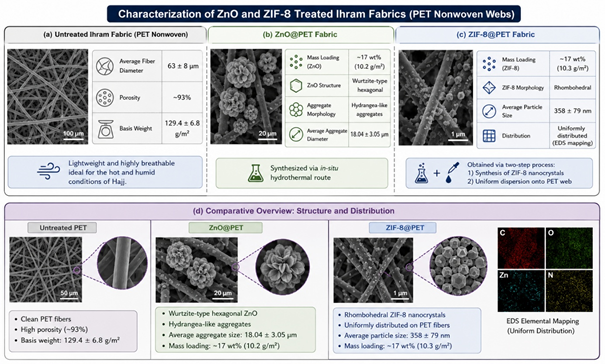
This uniform surface coverage of ZIF-8 on the Ihram fibers indicates a more stable and homogeneous modification compared to the localized ZnO agglomerations. Such structural regularity enhances the fabric’s adsorption capacity and filtration efficiency, improving its ability to trap fine particulate matter (PM) and absorb noxious gases such as SO₂. Consequently, the ZIF-8-functionalized Ihram fabric offers a promising pathway toward advanced protective pilgrimage garments that sustain the traditional comfort and purity of Ihram attire while offering enhanced environmental protection and hygienic benefits for pilgrims.
Structural Characterization of Functionalized Ihram Fabrics
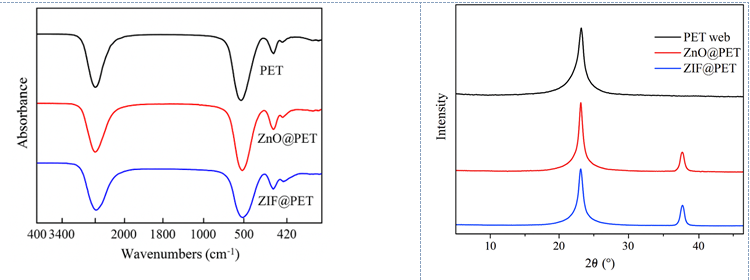
The crystalline and molecular structures of the untreated and nanomaterial-modified Ihram fabrics were investigated using X-ray diffraction (XRD) and Fourier-transform infrared spectroscopy (FTIR) to validate the successful integration of ZnO and ZIF-8 onto the polyester (PET) substrate. As shown in Figure 1a, the untreated PET Ihram fabric exhibited characteristic diffraction peaks at 17.1°, 22.6°, and 26.2°, corresponding to the (010), (011), and (100) planes of the PET crystalline structure. These peaks were consistently retained in both ZnO@PET and ZIF-8@PET samples, confirming that the surface modification process did not compromise the inherent structural integrity, flexibility, or breathability of the Ihram fabric—essential attributes for comfort during the pilgrimage.
Distinct diffraction signatures further confirmed the presence of the nanomaterials. In ZnO@PET, pronounced peaks appearing above 30° corresponded to the (100), (002), and (101) planes of the wurtzite hexagonal ZnO phase, indicating the formation of well-crystallized ZnO nanostructures on the fiber surface (Dai et al., 2021; Hu et al., 2021; Zhou et al., 2010). Conversely, ZIF-8@PET displayed characteristic peaks at 7.3°, 10.4°, 14.8°, 16.4°, and 18.1°, attributed to the (110), (200), (220), (310), and (222) planes of rhombohedral ZIF-8 crystals (Chen & Tang, 2019. These well-defined diffraction patterns verified the successful immobilization of both ZnO and ZIF-8 nanostructures on the Ihram textile, each contributing distinct protective functionalities against particulate and gaseous pollutants.
Further confirmation was obtained through FTIR spectroscopy (Figure 1b). The spectra of ZIF-8@PET displayed characteristic absorption bands at 1575 cm⁻¹ (C=N stretching), 760 cm⁻¹ (C–H bending), and 420 cm⁻¹ (Zn–N stretching), whereas ZnO@PET exhibited strong absorption below 500 cm⁻¹, corresponding to the Zn–O vibration. The lack of significant peak shifts indicated that both nanomaterials were physically anchored rather than chemically bonded to the PET substrate, thus preserving the softness, purity, and tactile comfort symbolic of Ihram clothing.
Overall, the combination of crystalline stability and effective nanomaterial integration demonstrates that ZnO- and ZIF-8-functionalized Ihram fabrics retain their traditional comfort and purity while offering enhanced protection against dust, toxic gases, and microbial contamination—key for ensuring pilgrims’ health and hygiene during Hajj.
The internal architecture of the nanofunctionalized Ihram fabrics was examined using X-ray micro-computed tomography (Xμ-CT) to visualize the spatial distribution of ZnO and ZIF-8 nanostructures within the polyester (PET) nonwoven matrix. This non-destructive imaging technique enabled a detailed observation of how the zinc-based crystals were embedded throughout the multilayered textile, based on differences in X-ray absorption between the nanomaterials and PET fibers (Lee et al., 202).
In the ZnO@PET Ihram fabric, Xμ-CT imaging (Fig. 2a) revealed localized clusters of ZnO particles adhering to the fiber surfaces. These agglomerations, resulting from the in-situ hydrothermal synthesis, formed uneven coating regions with varying thicknesses. Such irregular distribution may lead to localized charge accumulation zones, which slightly reduce the uniformity of electrostatic charge retention and, consequently, influence the consistency of particulate filtration. For Ihram garments—where lightweight comfort and high breathability are essential under the intense conditions of Hajj—this nonuniform coating could marginally impact airflow balance and fabric softness.
By contrast, the ZIF-8@PET Ihram fabric (Fig. 2b) demonstrated a highly uniform and continuous nanocrystal layer. The ZIF-8 particles were evenly dispersed and tightly anchored along the fibers, with minimal aggregation, resulting in a smoother and more homogeneous internal structure. This consistency not only enhances electrostatic interactions but also strengthens mechanical integrity, promoting sustained filtration efficiency against both airborne dust and gaseous contaminants—particularly valuable in the crowded and hot pilgrimage environment.
In summary, microstructural visualization confirms that while both ZnO and ZIF-8 integrate effectively with the Ihram textile, ZIF-8 functionalization yields superior coating uniformity and structural stability. This even nanolayer contributes to enhanced breathability, comfort, and pollutant resistance, aligning with the spiritual purity and hygienic performance expected of modern Ihram clothing designed for pilgrims’ protection and well-being.
Effects of ZnO and ZIF-8 Integration on the Filtration Efficiency of Ihram Fabric
As illustrated in Figure 2a, both the mechanical filtration efficiency (MFE) and electrostatic filtration efficiency (EFE) for capturing sodium chloride (NaCl) nanoparticles with a count median diameter (CMD) of approximately 75 nm were evaluated for untreated PET fabric, ZnO-functionalized PET (ZnO@PET), and ZIF-8-integrated PET (ZIF@PET) (Lee & Kim, 2020; Sachinidou et al., 2018).
When applied to the Ihram fabric prototype, these functional layers demonstrated distinct effects on particulate capture. The incorporation of ZIF-8 nanocrystals produced a measurable improvement in MFE compared with untreated PET and ZnO-treated samples — increasing from 4.5% for the plain PET fabric to 5.3% for ZnO@PET and 10.5% for ZIF@PET.
This enhancement suggests that the fine, uniform ZIF-8 coating facilitates greater surface interaction with particulate matter, improving passive particle retention even before electrostatic charging. Such improvement is significant for Ihram garments, as it supports the development of lightweight, breathable clothing that offers dual protection against dust and airborne particles encountered during pilgrimage, without compromising wearer comfort or fabric air permeability.
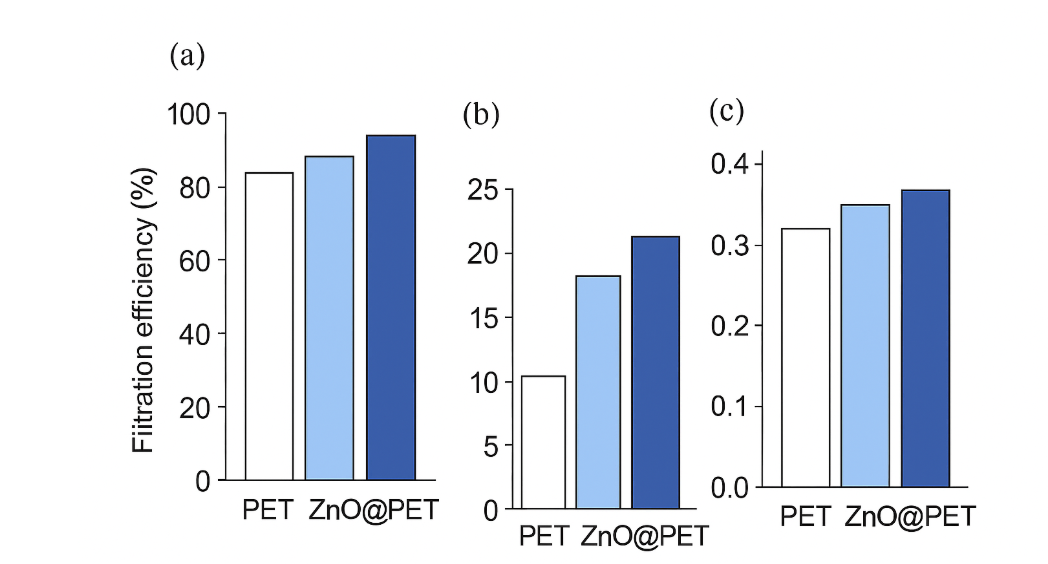
The untreated Ihram fabric, represented by the pristine PET web, exhibited only a minimal increase in electrostatic filtration efficiency (EFE) after corona charging, suggesting that the plain fabric alone possesses limited capability for charge retention. In contrast, the incorporation of zinc oxide (ZnO) or zeolitic imidazolate framework-8 (ZIF-8) onto the fabric surface led to a substantial rise in EFE following the same charging process — from 1.8% in untreated PET to 34.6% in ZnO@PET and 34.3% in ZIF@PET. This improvement indicates that both ZnO and ZIF-8 play a key role in enabling the Ihram textile to store and maintain electrostatic charges, thereby capturing airborne particles more effectively.
Importantly, this enhanced electrostatic performance was achieved without a significant increase in air resistance or pressure drop for the ZIF-8 modified fabric, as shown in Figure 5b. The quality factor (QF), which evaluates filtration efficiency relative to breathing resistance, increased remarkably in ZnO- and ZIF-8-treated Ihram textiles, confirming their potential as lightweight, high-performance protective fabrics suitable for the unique environmental and health demands of Hajj pilgrims.
Layered fabric configurations were also examined, as multi-layer filters are commonly used to meet specific protection standards (Roh et al., 2020). The results indicated that ZnO@PET and ZIF@PET Ihram fabrics exhibited nearly linear improvements in filtration efficiency with additional layers, while untreated PET showed negligible change regardless of layering. For ZnO@PET, the presence of ZnO agglomerates between layers—previously observed in micro-CT imaging—contributed to enhanced mechanical particle capture, likely due to the increased surface area.
In contrast, ZIF@PET maintained a smooth and uniform nanocrystal coating, which did not markedly increase mechanical filtration with added layers but significantly improved electrostatic efficiency. The uniform coverage of ZIF-8 across the fibers enabled stronger and more stable electrostatic interactions with dust and fine aerosols, making it particularly suitable for Ihram garments designed to protect pilgrims from airborne pollutants while preserving breathability and comfort.
Overall, the findings emphasize that ZIF-8 functionalization provides an optimal balance between electrostatic protection, breathability, and purity, aligning with the symbolic and hygienic requirements of the Ihram attire during Hajj.
The enhanced electrostatic filtration performance observed in fibers treated with ZnO and ZIF-8 can be explained by their high charge-holding capacity, which enables efficient charge accumulation during corona charging (Bi et al., 2020; Tian et al., 2021). Since both ZnO and ZIF-8 contain positively charged zinc sites, the corona process likely induces dipole orientation that strengthens electrostatic interactions with airborne particles. Previous research has shown that materials with polar functional groups and a high ζ-potential exhibit improved electrostatic capture of particulate matter (Yoo et al., 2020).
In this context, the polar sites of ZnO and ZIF-8 are essential for trapping charges and forming a stable, highly charged surface. To verify this, the surface potential of ZnO- and ZIF-8-modified fibers was measured after corona charging, revealing a markedly higher potential compared with discharged samples—confirming the superior charge retention of the treated webs. Among them, fibers uniformly coated with ZIF-8 nanocrystals (ZIF@PET) exhibited the highest electrostatic filtration efficiency (EFE), outperforming ZnO@PET due to better particle dispersion and uniform coating.
For Hajj Ihram clothing, these findings suggest that incorporating ZnO and ZIF-8 into the fabric could provide enhanced electrostatic capture of fine dust, microorganisms, and other airborne particles, offering pilgrims an additional layer of protection in crowded, dusty environments without increasing fabric thickness or breathing resistance. Such smart functionalization would maintain the traditional properties of Ihram fabrics while improving hygiene and comfort during pilgrimage.
Table 1 presents a comparison between previously developed ZnO- and ZIF-8-based materials and those used in the present study. Earlier research largely focused on filters designed solely for particulate matter (PM) removal. However, recent developments have shifted toward creating dual-function filtration systems capable of simultaneously capturing both particulate and gaseous pollutants. Ryu et al., (2023) reported ZIF-8-based filters achieving PM removal efficiencies between 84% and 96.9%, with gas adsorption efficiencies ranging from 98% to 100% for various gases. Nonetheless, the role of electrostatic charging in enhancing gas adsorption has seldom been examined, apart from Lee et al. (2021a, 2021b), who demonstrated that a corona-charged PLA/ZIF-8 filter could remove 40% of SO₂ gas. In contrast, the charged ZIF-8 fibers in the present study achieved a significantly improved SO₂ removal rate of 86.9% and a higher quality factor (QF) of 0.14.
Although previous works (Aamer et al., 2021b; Luo et al., 2021) confirmed the high particulate removal efficiency of ZnO-based filters (>90%), they did not explore their ability to remove gaseous pollutants. The current study therefore introduces a novel dual-functional filtration concept, combining ZnO and ZIF-8 coatings with corona charging on PET fibers, to efficiently eliminate both solid and gaseous contaminants while maintaining high breathability and filtration performance.
For Hajj Ihram clothing, this dual-protection mechanism offers a promising pathway to enhance pilgrims’ safety and comfort. By integrating ZnO and ZIF-8 nanomaterials into the Ihram fabric, the garment could serve not only as traditional attire but also as a protective textile that passively filters airborne dust and adsorbs harmful gases—such as SO₂ and volatile organic compounds—commonly encountered in crowded pilgrimage sites. This innovation transforms the Ihram from a purely symbolic garment into a functional health-protective layer, supporting cleaner breathing and better hygiene during Hajj rituals.
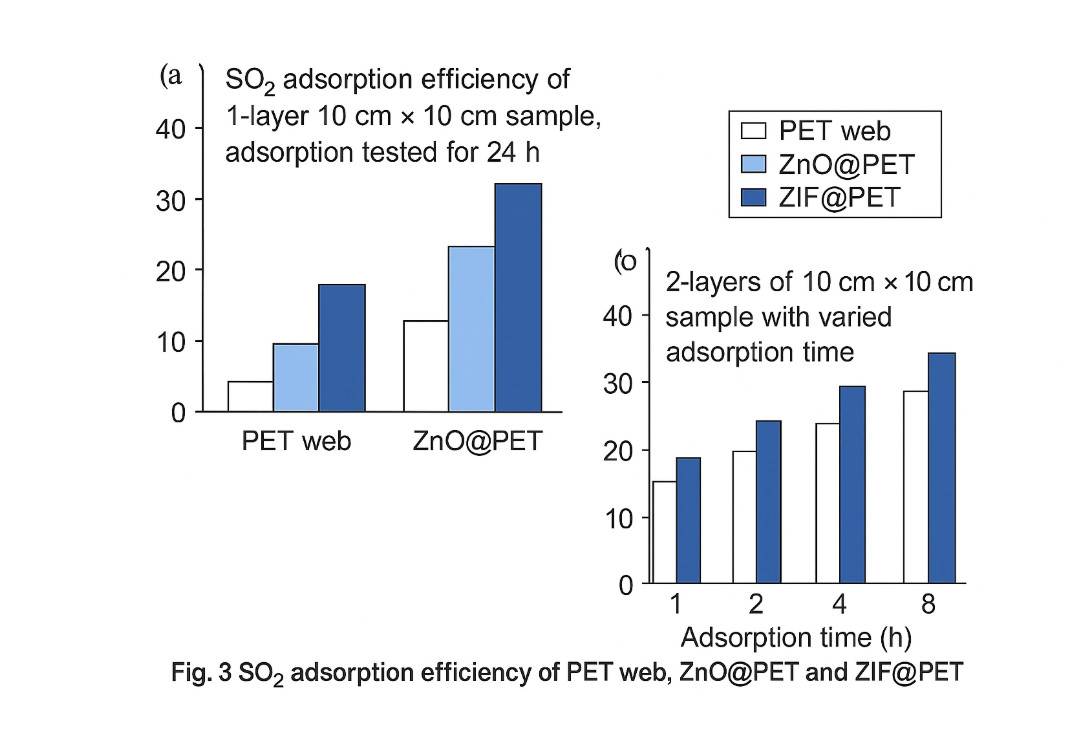
The SO₂ gas adsorption properties of the ZnO@PET and ZIF@PET fabrics were examined under static conditions, without airflow, to simulate passive gas capture behavior. After 24 hours of continuous exposure to SO₂, a single fabric layer (10 cm × 10 cm) without corona charging treatment demonstrated adsorption efficiencies of 21.5% for untreated PET, 28.8% for ZnO@PET, and 86.9% for ZIF@PET (Fig. 6a). The remarkable performance of ZIF@PET—nearly three times higher than that of ZnO@PET—was supported by Brunauer–Emmett–Teller (BET) analysis (Figure S3 and Table S1), which revealed that ZIF-8 crystals possess a substantially larger surface area (508.02 m²/g) and total pore volume (116.72 cm³/g) than ZnO crystals (0.83 m²/g and 0.19 cm³/g, respectively). These values are consistent with previously reported data (Nordin et al., 2014), confirming the superior porosity and adsorption capacity of ZIF-8. The high surface area and porous structure of ZIF-8 facilitate extensive adsorption of gas molecules, leading to its exceptional SO₂ removal efficiency.
In contrast, the moderate improvement in ZnO@PET’s gas adsorption is primarily due to the slight increase in available surface area from ZnO particle deposition. Additionally, post-corona charging showed minimal influence on the SO₂ adsorption capacity, indicating that the intrinsic porous properties of the materials primarily governed the adsorption behavior.
From the perspective of Hajj Ihram clothing, these findings carry significant potential for enhancing pilgrims’ environmental safety. ZIF-8’s outstanding gas adsorption capability suggests that integrating such materials into Ihram fabric could enable the garment to capture harmful gases, such as sulfur dioxide (SO₂), which are often present in crowded urban or industrial zones surrounding pilgrimage sites. By embedding ZIF-8 nanocrystals within the Ihram fibers, the fabric could act as a passive air-purifying layer, offering protection against gaseous pollutants without compromising the comfort, breathability, or religious integrity of the garment. Thus, this innovation positions the Ihram as a multifunctional textile, serving both its spiritual role and a modern environmental health function, thereby contributing to a safer and cleaner pilgrimage experience.
Figure 3b illustrates the SO₂ adsorption efficiency of the developed fabrics over time, using two layers of 10 cm × 10 cm samples under identical testing conditions. Across all time intervals, ZIF@PET consistently demonstrated nearly three times higher gas adsorption efficiency than ZnO@PET, reaffirming its superior sorption characteristics. While the influence of corona charging on SO₂ capture was examined, its impact appeared negligible, suggesting that gas adsorption is primarily governed by the intrinsic porosity and surface chemistry of the material, rather than by electrostatic effects. Remarkably, the ZIF@PET achieved rapid adsorption rates, removing approximately 70–79% of SO₂ within just 3 hours and reaching an efficiency of up to 95% after 9 hours. In contrast, the untreated PET and ZnO@PET achieved efficiencies of only 25% and 34%, respectively, under the same conditions.
This outcome highlights the crucial role of ZIF-8’s high surface area and microporous structure in facilitating rapid and efficient capture of gaseous pollutants. Unlike its influence on particulate matter filtration, corona charging contributed little to gas adsorption enhancement, confirming that ZIF-8 integration is the dominant factor behind the material’s strong gas-capturing performance. Consequently, incorporating ZIF-8 into fibrous composites represents a promising dual-protection strategy, as it provides efficient gas adsorption through its porous network while simultaneously enhancing electrostatic performance for particulate matter capture when combined with corona charging.
In the context of Hajj Ihram clothing, these results highlight a transformative potential. By embedding ZIF-8 nanocrystals into the fabric of Ihram garments, pilgrims can benefit from enhanced protection against harmful gases, such as SO₂ and volatile organic compounds (VOCs), often present in crowded or polluted environments. This innovation would enable the Ihram to function as an intelligent, breathable protective layer, maintaining its spiritual purity and comfort while providing a scientifically grounded safeguard against airborne contaminants. Although this study evaluated adsorption under static, no-flow conditions to assess the material’s intrinsic capacity, its implications extend to real-world scenarios. For pilgrims performing rituals in open-air settings or confined areas with limited air movement, such technology could significantly improve air quality and respiratory comfort. Future work under dynamic airflow conditions could further refine this design, enabling Ihram textiles to serve as wearable air-purifying garments that merge spiritual significance with modern environmental health innovation.
Beyond evaluating filtration efficiency, it is crucial to examine the practical viability of ZnO@PET and ZIF@PET fabrics in terms of durability, scalability, and environmental resilience. Although ZnO@PET displayed relatively lower gas adsorption and electrostatic performance, its low production cost and simple synthesis process make it appealing for short-term or disposable applications. Its stable mechanical filtration efficiency and resistance to environmental fluctuations suggest that ZnO@PET could be a cost-effective material for temporary protective use, especially where affordability and replaceability are key.
On the other hand, ZIF@PET demonstrated superior dual-function performance, particularly in adsorbing SO₂ and other gaseous pollutants. However, practical deployment may be challenged by charge degradation under humid conditions—a factor relevant for use in hot and humid climates such as during Hajj—and by the complexity and cost of large-scale synthesis. Therefore, ensuring long-term stability, mechanical robustness, and potential for regeneration or reuse will be essential for translating laboratory results into practical applications.
These findings open promising pathways for developing functional Ihram fabrics that combine purity with protection. A ZnO-based Ihram could serve as an affordable, disposable option that provides particulate filtration and moderate protection against pollutants, making it suitable for large-scale distribution to pilgrims. Conversely, a ZIF-8–enhanced Ihram could represent a premium, high-performance version capable of filtering both fine particles and harmful gases such as SO₂, NOₓ, and VOCs, enhancing respiratory comfort and safety during pilgrimage. However, maintaining electrostatic performance under humidity and ensuring the fabric remains lightweight, breathable, and religiously compliant will be critical design priorities.
Ultimately, this study provides not only a deeper understanding of how ZnO and ZIF-8 function as dual-protection filtration materials, but also a scientific foundation for the next generation of smart, sustainable Ihram garments—ones that preserve the symbolic purity of the pilgrimage while safeguarding pilgrims’ health in challenging environmental conditions.
This study presented a comparative analysis of ZnO and ZIF-8 nanocrystal integration within fibrous composites to understand their respective roles in charge-trapping behavior, electrostatic filtration efficiency, and gaseous pollutant adsorption. By coating PET fibers with ZnO or ZIF-8 and applying corona charging, the research revealed distinct performance mechanisms linked to the morphology and structural configuration of each material. The ZnO-coated fibers featured agglomerated particles that increased surface area, improving mechanical filtration—particularly in multilayer configurations. In contrast, ZIF-8 formed a uniform nanocrystalline layer, enabling superior charge-trapping and electrostatic filtration efficiency due to its polar surface and orderly distribution.
Moreover, the porous framework of ZIF-8 endowed it with an exceptional SO₂ gas adsorption capability, far surpassing that of ZnO or untreated PET. Although electrostatic charging had minimal influence on gas adsorption, the synergy between porosity and charge retention made ZIF-8 a highly effective dual-function material. These findings demonstrate how differences in synthesis pathways—from metal oxide (ZnO) to metal–organic framework (ZIF-8)—fundamentally affect surface charge behavior, porosity, and pollutant selectivity, offering a design framework for next-generation multifunctional filtration materials.
These outcomes hold significant potential for developing protective, breathable, and spiritually compliant garments that safeguard pilgrims from airborne particulate matter and gaseous pollutants during pilgrimage. The ZnO-based composite represents a cost-effective, disposable option that balances mechanical filtration with comfort, while the ZIF-8-based composite offers advanced dual protection—filtering both fine dust and toxic gases like SO₂ and VOCs—ideal for crowded, high-temperature environments such as Makkah.
Ultimately, this study not only advances the science of dual-function Zn-based filtration materials, but also provides a material innovation pathway toward designing functional Ihram fabrics that unite purity, safety, and sustainability—supporting the broader vision of health-conscious, environmentally responsible Hajj experiences.
Acknowledgements
No institutional review board (IRB) approval was required, as this study did not involve human participants.
Author Contribution
The entire work, including the research design, analysis, and manuscript preparation, was carried out by the sole author, who approved the final version of the manuscript.
Funding
This research was self-funded by the author, with no external financial support from any organization or institution in the Kingdom of Saudi Arabia.
Data Availability
All data supporting the findings of this study are included within the manuscript and its supplementary materials.
Declarations
Ethics Approval and Consent to Participate
Ethical approval was not required, as the study did not involve human or animal subjects.
Competing Interests
The author declares no conflict of interest.
References
- Aamer, H., Heo, S., & Jo, Y. M. (2021a). Characterization of multifunctional PAN/ZnO nanofibrous composite filter for fine dust capture and photocatalytic activity. Journal of Applied Polymer Science, 138(26), Article 50607. DOI ↗ Google Scholar ↗
- Bi, S., Banda, H., Chen, M., Niu, L., Chen, M., Wu, T., Wang, J., Wang, R., Feng, J., & Chen, T. (2020). Molecular understanding of charge storage and charging dynamics in supercapacitors with MOF electrodes and ionic liquid electrolytes. Nature Materials, 19(5), 552–558. DOI ↗ Google Scholar ↗
- Chemical Physics, 551, Article e111335. DOI ↗ Google Scholar ↗
- Chen, Y., & Tang, S. (2019). Solvothermal synthesis of porous hydrangea-like zeolitic imidazole framework-8 (ZIF-8) crystals. DOI ↗ Google Scholar ↗
- Dai, S.-H., Zhang, J.-P., Weng, L., Li, B.-Y., & Yang, X.-H. (2021). Synthesis and properties of ZnO on nonwoven PET fiber. DOI ↗ Google Scholar ↗
- Dai, X., Li, X., & Wang, X. (2018). Morphology controlled porous poly(lactic acid)/zeolitic imidazolate framework-8 fibrous membranes with superior PM2.5 capture capacity. Chemical Engineering Journal, 338, 82–91. DOI ↗ Google Scholar ↗
- Deng, Q., Huang, Z., Zhu, M., Zong, X., Yue, Z., & Wang, X. (2024a). Improving the particulate matter filtration, antibacterial, and degradation properties of electrospinning poly (lactic acid) membranes with ZIF-8@ chitosan. Carbohydrate Polymers, 342, Article 122427. DOI ↗ Google Scholar ↗
- Gupta, N. K., Bae, J., Baek, S., & Kim, K. S. (2022). Sulfur dioxide gas adsorption over ZnO/Zn-based metal-organic frame- work nanocomposites. Colloids and Surfaces a: Physicochemical and Engineering Aspects, 634, Article 128034. DOI ↗ Google Scholar ↗
- Hu, Y., Wu, H., Yang, Y., Lin, X., Cheng, H., Zhang, R., Jiang, X., & Wang, J. (2021). ZIF-8 derived porous ZnO with grain boundaries for efficient CO2 electroreduction. Journal of Nanoparticle Research, 23(6), 133. https://doi.org/10.1007/ s11051-021-05271-9 Google Scholar ↗
- Journal of Solid State Chemistry, 276, 68–74. DOI ↗ Google Scholar ↗
- Lee, J., & Kim, J. (2020). Material properties influencing the charge decay of electret filters and their impact on filtration performance. Polymers, 12(3), Article e721. DOI ↗ Google Scholar ↗
- Li, X., Zhu, G., Tang, M., Li, T., Wang, C., Song, X., Zhang, S., Zhu, J., He, X., Hakkarainen, M., & Xu, H. (2023). Biodegradable MOfilters for effective air filtration and sterilization by coupling MOF functionalization and mechanical polarization of fibrous poly(lactic acid). ACS Applied Materials & Interfaces, 15(22), 26812–26823. DOI ↗ Google Scholar ↗
- Li, Y., Yuan, D., Geng, Q., Yang, X., Wu, H., Xie, Y., Wang, L., Ning, X., & Ming, J. (2021). MOF-embedded bifunctional compos- ite nanofiber membranes with a tunable hierarchical structure for high-efficiency PM0.3 purification and oil/water separation. ACS Applied Materials & Interfaces, 13(33), 39831–39843. DOI ↗ Google Scholar ↗
- Luo, Y., Zhai, F., Zhang, Y., Chen, Z., Ding, M., Qin, D., Yang, J., Feng, G., & Li, L. (2021). A superfine glass fibre air filter with rapid response to photocatalytic antibacterial properties under visible light by loading rGO/ZnO. Royal Society Open Science, 8(8), Article 202285. DOI ↗ Google Scholar ↗
- Nordin, N., Ismail, A., Mustafa, A., Goh, P., Rana, D., & Matsuura, T. (2014). Aqueous room temperature synthesis of zeolitic imidazole framework 8 (ZIF-8) with various concentrations of triethylamine. RSC Advances, 4(63), 33292–33300. DOI ↗ Google Scholar ↗
- Robertson, M., Guillen Obando, A., Nunez, B., Chen, H., & Qiang, Z. (2023). Upcycling mask waste to carbon capture sorb- ents: A combined experimental and computational study. ACS Applied Engineering Materials, 1(1), 165–174. DOI ↗ Google Scholar ↗
- Roh, S., Song, M., Lee, K., Park, K., & Kim, J. (2020). Experimental and computational investigation of intra- and inter- layer space for enhanced depth filtration and reduced pressure drop. ACS Applied Materials & Interfaces, 12(41), 46804–46815. DOI ↗ Google Scholar ↗
- Ryu, S., Kim, D., Lee, H., Kim, Y., Lee, Y., Kim, M., Lee, H., & Lee, H. (2023). Biodegradable nanofiber/metal–organic framework/cotton air filtration membranes enabling simultaneous removal of toxic gases and particulate matter. Polymers, 15(19), Article 3965. DOI ↗ Google Scholar ↗
- Sachinidou, P., Heuschling, C., Schaniel, J., & Wang, J. (2018). Investigation of surface potential discharge mechanism and kinetics in dielectrics exposed to different organic solvents. Polymer, 145, 447–453. DOI ↗ Google Scholar ↗
- Separation and Purification Technology, 362, Article e131867. DOI ↗ Google Scholar ↗
- Shen, B., Wang, Y., Wang, X., Amal, F. E., Zhu, L., & Jiang, L. (2022). A cruciform petal-like (ZIF-8) with bactericidal activity against foodborne gram-positive bacteria for antibacterial food packaging. International Journal of Molecular Sci- ences, 23(14), Article e7510. DOI ↗ Google Scholar ↗
- Tian, E., Yu, Q., Gao, Y., Wang, H., Wang, C., Zhang, Y., Li, B., Zhu, M., Mo, J., Xu, G., & Li, J. (2021). Ultralow resistance two- stage electrostatically assisted air filtration by polydopamine coated PET coarse filter (Small 33/2021). Small (Wein- heim an der Bergstrasse, Germany), 17(33), Article 2170172. DOI ↗ Google Scholar ↗
- Yoo, D. K., Woo, H. C., & Jhung, S. H. (2020). Removal of particulate matter with metal–organic framework-incorporated materials. Coordination Chemistry Reviews, 422, Article e213477. DOI ↗ Google Scholar ↗
- Zhang, X., Yang, S., Lu, R., Zan, X., & Li, N. (2022). Universal strategy to efficiently coat Zeolitic Imidazolate Frameworks onto diverse substrates. ACS Omega, 7(21), 17765–17773. DOI ↗ Google Scholar ↗
- Zhang, Y., Jia, Y., & Hou, L. A. (2018). Synthesis of zeolitic imidazolate framework-8 on polyester fiber for PM 2.5 removal. DOI ↗ Google Scholar ↗
- Zhao, X., Bai, Y., Fan, G., Guo, H., Shi, P., Cui, W., Jin, X., Liu, Y., Wang, R., & He, J. (2025). Large-scale fabrication of 3D gradient hierarchical fibrous filter materials with micro-submicro-nanofibers for efficient and long-duration air filtration. Google Scholar ↗
- Zhou, Z., Zhao, Y., & Cai, Z. (2010). Low-temperature growth of ZnO nanorods on PET fabrics with two-step hydrothermal method. Applied Surface Science, 256(14), 4724–4728. DOI ↗ Google Scholar ↗