Abstract
Artificial intelligence (AI) is rapidly reshaping higher education by influencing teaching, learning, assessment, research and institutional governance (UNESCO, 2023; OECD, 2024). While universities across the world are increasingly integrating AI into academic and administrative processes, regulatory responses have not advanced at the same pace, particularly in many developing countries (European Commission, 2022; UNESCO, 2023). Existing scholarship has focused largely on institutional adoption and pedagogical applications, with comparatively little attention given to the readiness of national higher education regulatory systems to govern AI responsibly (UNESCO, 2023; INQAAHE, 2024). This study addresses that gap by examining the legal, policy and quality assurance framework governing higher education in The Gambia. The study adopts a qualitative doctrinal and policy research design based on documentary analysis of legislation, national policies, accreditation standards and quality assurance instruments (Creswell & Creswell, 2023; Yin, 2018). These documents are analysed alongside international guidance from UNESCO, the OECD, the International Network for Quality Assurance Agencies in Higher Education (INQAAHE) and selected comparative literature on AI governance. To provide a systematic basis for evaluation, the paper develops the Artificial Intelligence Readiness Index for Higher Education Regulation (AIRI-HER), a twelve-dimension framework that assesses regulatory preparedness across governance, strategic policy, curriculum, teaching and learning, assessment, academic integrity, research governance, ethics, data governance, staff capability, graduate capability and quality assurance (UNESCO, 2021; OECD, 2024; INQAAHE, 2024). The findings indicate that The Gambia possesses a coherent and well-established higher education regulatory framework, but one that remains largely technology-neutral (Government of The Gambia, 2016, 2021a, 2021b). Existing legislation and accreditation standards support institutional autonomy and quality assurance but provide limited direction on AI governance, AI-assisted assessment, research integrity, institutional accountability, data governance and AI literacy (Government of The Gambia, 2016; Government of The Gambia, 2021a; NAQAA, 2022). Consequently, institutions retain considerable flexibility to adopt AI, yet operate without a consistent national framework to guide responsible implementation. The paper argues that the principal regulatory challenge is not the absence of legal authority but the absence of explicit regulatory preparedness. It proposes targeted reforms that embed AI governance within higher education legislation, national policy and accreditation standards while preserving academic autonomy, educational quality and public trust (UNESCO, 2021; OECD, 2024; INQAAHE, 2024). By introducing AIRI-HER, the study contributes a practical analytical framework that may assist policymakers, regulators and quality assurance agencies in evaluating AI readiness within higher education systems in The Gambia and comparable jurisdictions.
Keywords
Keywords: Artificial intelligence higher education regulation AI governance regulatory readiness quality assurance accreditation higher education policy The Gambia AIRI-HER.
1. Introduction
Artificial intelligence (AI) has emerged as one of the most transformative technologies shaping contemporary higher education (UNESCO, 2023; OECD, 2024). Within a relatively short period, generative AI applications have evolved from experimental innovations into mainstream academic tools that influence teaching, learning, assessment, research, student support and institutional administration (UNESCO, 2023; European Commission, 2022). Universities across the world are increasingly integrating AI to enhance educational delivery, improve research productivity, automate administrative processes and support evidence-informed decision-making (European Commission, 2022; OECD, 2024). While these developments present significant opportunities for innovation, they also raise important questions relating to governance, academic integrity, transparency, accountability, ethics and regulatory oversight (UNESCO, 2021, 2023).
Recognising these challenges, international organisations have increasingly emphasised that AI should be governed not merely as a technological innovation but as a strategic policy and institutional governance issue (UNESCO, 2021; OECD, 2019; Council of Europe, 2024). Recent guidance issued by UNESCO, the Organisation for Economic Co-operation and Development (OECD) and the International Network for Quality Assurance Agencies in Higher Education (INQAAHE) highlights the need for coherent legal, policy and quality assurance frameworks capable of supporting responsible AI adoption while safeguarding educational quality, human rights, academic freedom and public trust (UNESCO, 2021, 2023; OECD, 2024; INQAAHE, 2024). Consequently, higher education regulators are increasingly expected to provide clear guidance on AI-enabled teaching and learning, assessment, research integrity, institutional accountability, ethical governance, data protection and graduate competencies (European Commission, 2022; INQAAHE, 2024).
Despite this growing international attention, research examining AI governance in Sub-Saharan Africa remains relatively limited (UNESCO, 2023). Existing scholarship has focused predominantly on institutional adoption, digital infrastructure and pedagogical innovation, while comparatively little attention has been given to the readiness of national higher education regulatory systems to govern AI responsibly (UNESCO, 2023; INQAAHE, 2024). This gap is particularly evident in The Gambia, where recent reforms have strengthened institutional governance and quality assurance but where the implications of artificial intelligence for legislation, accreditation and higher education policy have not yet been systematically examined (Government of The Gambia, 2016, 2021a, 2021b).
This study critically evaluates the extent to which The Gambia's higher education regulatory framework is prepared to support the responsible integration of artificial intelligence. Rather than assessing institutional AI implementation, the paper examines the legal and policy environment that shapes institutional decision-making. Specifically, it analyses the Tertiary and Higher Education Act, 2016, the National Accreditation and Quality Assurance Authority Act, 2021, the National Tertiary and Higher Education Policy, relevant accreditation standards and associated quality assurance instruments against internationally recognised principles of AI governance in higher education (Government of The Gambia, 2016; Government of The Gambia, 2021a, 2021b; NAQAA, 2022; UNESCO, 2021, 2023; OECD, 2024; INQAAHE, 2024).
A central contribution of this study is the development of the Artificial Intelligence Readiness Index for Higher Education Regulation (AIRI-HER). Unlike existing AI readiness models, which primarily assess institutional technological capacity or organisational maturity, AIRI-HER evaluates the preparedness of national regulatory systems to support responsible AI adoption. The framework provides a structured analytical instrument for assessing whether legislation, national policy and quality assurance mechanisms collectively enable higher education institutions to integrate AI while maintaining educational quality, institutional autonomy, accountability and public trust (UNESCO, 2021; OECD, 2024; INQAAHE, 2024).
Accordingly, this paper makes three principal contributions to the emerging literature. First, it provides the first comprehensive assessment of AI readiness within The Gambia's higher education regulatory framework. Second, it extends existing scholarship by shifting the focus of AI readiness from institutional implementation to national regulatory preparedness. Third, it introduces AIRI-HER as a practical and transferable framework that can be applied to comparative assessments of higher education regulatory systems across African countries and other developing jurisdictions
2. Literature Review
2.1 Artificial Intelligence and the Transformation of Higher Education
Artificial intelligence has rapidly evolved from a specialist technological innovation into a central component of higher education worldwide (UNESCO, 2023; European Commission, 2022). The emergence of generative AI has accelerated this transformation, enabling universities to integrate AI into teaching, learning, research, student support and institutional administration (UNESCO, 2023). Consequently, AI is no longer viewed solely as an educational technology but increasingly as a strategic enabler of institutional innovation and digital transformation (OECD, 2024).
Recent scholarship identifies three interrelated developments. First, AI is reshaping pedagogical practice through personalised learning, adaptive instruction, automated feedback, intelligent tutoring systems and AI-assisted content creation (UNESCO, 2023; European Commission, 2022). Second, AI is transforming research by supporting literature synthesis, data analysis, programming assistance and scientific writing (UNESCO, 2023). Third, universities are increasingly adopting AI to improve administrative efficiency, institutional planning and evidence-based decision-making (OECD, 2024). Collectively, these developments demonstrate that AI has become embedded across the core functions of higher education rather than remaining confined to isolated technological applications.
However, alongside these opportunities, AI presents significant challenges relating to academic integrity, transparency, accountability, data governance, bias and ethical decision-making (UNESCO, 2021; Council of Europe, 2024). These concerns have shifted scholarly attention from questions of technological adoption towards broader issues of governance and regulatory preparedness.
2.2 AI Governance in Higher Education
The growing integration of AI has fundamentally altered the governance responsibilities of higher education institutions (UNESCO, 2021; INQAAHE, 2024). Earlier discussions focused primarily on preventing academic misconduct associated with digital technologies. Contemporary scholarship adopts a much broader perspective, recognising AI governance as encompassing institutional accountability, ethical oversight, procurement practices, algorithmic transparency, risk management, data protection and organisational leadership (OECD, 2024; Council of Europe, 2024).
International guidance increasingly argues that effective AI governance should enable innovation while protecting educational quality and public trust (UNESCO, 2021). Rather than restricting AI use, governance frameworks are expected to establish clear institutional responsibilities, define acceptable practices and ensure meaningful human oversight (European Commission, 2022). Universities that have implemented comprehensive AI governance policies generally demonstrate greater consistency in institutional practice and higher levels of confidence among academic staff and students (INQAAHE, 2024).
These developments illustrate that AI governance extends beyond technological regulation and has become an integral component of institutional governance and strategic management within higher education.
2.3 International Regulatory and Quality Assurance Frameworks
International organisations have played a leading role in shaping principles for responsible AI adoption in education. UNESCO advocates a human-centred approach founded on transparency, accountability, equity, inclusion and the protection of human rights (UNESCO, 2021). Similarly, the OECD emphasises that successful AI integration depends not only on technological capability but also on regulatory clarity, institutional leadership and organisational readiness (OECD, 2019, 2024).
Within quality assurance, the International Network for Quality Assurance Agencies in Higher Education (INQAAHE) and related international guidance increasingly encourage regulators to incorporate AI governance into accreditation standards and institutional quality assurance systems (INQAAHE, 2022, 2024). Contemporary quality assurance therefore extends beyond traditional measures of curriculum and institutional performance to include AI governance, assessment integrity, staff capability, ethical safeguards and institutional readiness for digital transformation (INQAAHE, 2024).
Collectively, these international frameworks demonstrate an important conceptual shift. AI governance is increasingly regarded as a fundamental dimension of higher education quality rather than an optional technological consideration.
2.4 Regulatory Readiness and Higher Education Policy
Despite significant advances in international guidance, legal scholarship consistently shows that most higher education legislation remains technology-neutral (UNESCO, 2023; OECD, 2024). Existing legal frameworks generally neither prohibit nor actively regulate artificial intelligence, thereby allowing institutions considerable discretion in determining how AI is adopted and governed.
While technology-neutral legislation provides flexibility for innovation, it often lacks explicit guidance on issues such as AI-assisted assessment, institutional accountability, research integrity, ethical governance and algorithmic transparency (Council of Europe, 2024; UNESCO, 2021). As a consequence, universities operating under similar legislative frameworks may develop markedly different institutional policies, resulting in inconsistent approaches to responsible AI implementation (INQAAHE, 2024).
These observations suggest that regulatory readiness cannot be assessed solely by examining institutional technological capacity. Instead, attention must also be given to the extent to which national legislation, public policy and quality assurance systems provide coherent governance arrangements capable of supporting responsible AI integration.
2.5 Research Gap and Contribution of the Study
Although scholarship on artificial intelligence in higher education has expanded rapidly, several important gaps remain (UNESCO, 2023; INQAAHE, 2024).
First, the existing literature is dominated by studies from Europe, North America and East Asia, with comparatively limited evidence from Sub-Saharan Africa (UNESCO, 2023). Second, most published research examines institutional AI adoption, digital infrastructure or pedagogical innovation, while relatively few studies investigate whether national higher education regulatory systems are prepared to govern AI responsibly (OECD, 2024; INQAAHE, 2024). Third, legislation, public policy and accreditation standards are rarely analysed as interconnected components of regulatory readiness.
These gaps are particularly evident in The Gambia, where significant reforms have strengthened higher education governance and quality assurance but where no comprehensive evaluation of regulatory preparedness for artificial intelligence has been undertaken (Government of The Gambia, 2016, 2021a, 2021b).
This study addresses these gaps by examining AI readiness from a national regulatory perspective rather than an institutional implementation perspective. It introduces the Artificial Intelligence Readiness Index for Higher Education Regulation (AIRI-HER) as a structured analytical framework for evaluating whether legislation, national policy and accreditation systems collectively provide an enabling environment for responsible AI integration. In doing so, the study contributes an original conceptual and evaluative framework that may also support comparative research across African and other developing higher education systems.
3. Theoretical Framework
This study is underpinned by an interdisciplinary theoretical framework that integrates Regulatory Governance Theory, Diffusion of Innovation Theory, Socio-Technical Systems Theory, and Quality Assurance Theory. Together, these complementary perspectives provide a coherent basis for examining how legislation, public policy and quality assurance mechanisms shape the responsible integration of artificial intelligence (AI) within higher education (Rogers, 2003; Kuhlmann & Rip, 2018; UNESCO, 2021).
Regulatory Governance Theory provides the principal analytical lens for the study. It conceptualises regulation not merely as a mechanism for legal compliance but as a means of enabling innovation while safeguarding public interests (Kuhlmann & Rip, 2018). Within higher education, regulatory governance extends beyond legislation to include accreditation systems, institutional oversight and quality assurance. Applied to AI, the theory suggests that effective regulation should encourage technological innovation while protecting academic integrity, educational quality, ethical standards and institutional accountability (UNESCO, 2021; OECD, 2024). This perspective is particularly relevant in assessing whether existing regulatory instruments in The Gambia provide an enabling environment for responsible AI adoption.
Diffusion of Innovation Theory complements this perspective by explaining how new technologies are adopted within organisations. The theory proposes that innovation is influenced by perceived usefulness, compatibility with existing systems, organisational readiness and the availability of supportive institutional environments (Rogers, 2003). In higher education, regulatory clarity reduces uncertainty and provides institutions with greater confidence to integrate AI into teaching, learning, research and administration (OECD, 2024). Consequently, national regulatory frameworks play an important role in facilitating or constraining institutional innovation.
Socio-Technical Systems Theory further recognises that successful AI implementation depends on the interaction between technology, people and organisational structures. AI adoption therefore requires more than technological infrastructure; it also depends on governance arrangements, leadership, institutional culture, staff capability and appropriate regulatory frameworks (UNESCO, 2023). This perspective reinforces the argument that AI readiness should be understood as a systemic characteristic of higher education governance rather than simply a measure of technological capacity.
Finally, Quality Assurance Theory provides the framework through which institutional quality is assessed and continuously improved. Traditional quality assurance emphasises governance, curriculum, teaching, assessment and institutional effectiveness. However, the emergence of AI requires quality assurance systems to evolve by incorporating considerations such as AI governance, ethical use, assessment redesign, staff capability, graduate AI literacy and institutional risk management (INQAAHE, 2022, 2024). From this perspective, responsible AI integration becomes an integral component of educational quality rather than a separate technological initiative.
Drawing on these complementary perspectives, this study conceptualises regulatory readiness as the extent to which legislation, national policy and quality assurance frameworks collectively enable higher education institutions to adopt AI responsibly while maintaining educational quality, institutional autonomy, transparency and public trust (UNESCO, 2021; OECD, 2024; INQAAHE, 2024). These theoretical foundations also informed the development of the Artificial Intelligence Readiness Index for Higher Education Regulation (AIRI-HER), which is introduced in the following methodology section.
4. Methodology
4.1 Research Design
This study adopts a qualitative doctrinal and policy research design based on documentary analysis (Creswell & Creswell, 2023; Yin, 2018). The research focuses on evaluating the regulatory framework governing higher education in The Gambia rather than institutional behaviour or stakeholder perceptions. A qualitative documentary approach is appropriate because it facilitates systematic examination of legislation, public policy, accreditation standards and quality assurance instruments within their legal and institutional context (Creswell & Creswell, 2023).
The primary sources comprise the Tertiary and Higher Education Act, 2016, the National Accreditation and Quality Assurance Authority (NAQAA) Act, 2021, the National Tertiary and Higher Education Policy, the Gambia National Qualifications Framework, relevant NAQAA accreditation standards, quality assurance guidelines and associated regulatory documents (Government of The Gambia, 2016, 2020, 2021a, 2021b; NAQAA, 2022). These documents are complemented by contemporary international guidance published by UNESCO, the OECD and INQAAHE, together with recent literature on AI governance in higher education (UNESCO, 2021, 2023; OECD, 2024; INQAAHE, 2024).
4.2 Analytical Framework
The analysis was undertaken in three sequential stages.
First, doctrinal legal analysis was used to examine the objectives, institutional mandates and regulatory provisions contained within the principal legislative and policy instruments (Yin, 2018).
Second, qualitative content analysis identified provisions relevant to AI governance, including institutional governance, curriculum, teaching and learning, assessment, research governance, ethics, academic integrity, data governance, staff capability, graduate capability and quality assurance (Saldaña, 2021).
Third, comparative policy analysis evaluated the extent to which the Gambian regulatory framework aligns with internationally recognised principles for responsible AI governance in higher education (UNESCO, 2021; OECD, 2024; INQAAHE, 2024).
To ensure consistency and transparency throughout the evaluation, this study develops the Artificial Intelligence Readiness Index for Higher Education Regulation (AIRI-HER).
4.3 Development of the AIRI-HER Framework
The Artificial Intelligence Readiness Index for Higher Education Regulation (AIRI-HER) constitutes the principal methodological contribution of this study. Unlike existing AI readiness models, which primarily evaluate institutional technological capacity or organisational maturity, AIRI-HER assesses the preparedness of national regulatory systems to support responsible AI integration within higher education (UNESCO, 2023; OECD, 2024).
The framework comprises twelve dimensions because these themes consistently recur across contemporary international literature on AI governance in higher education, particularly within the guidance developed by UNESCO, the OECD and INQAAHE (UNESCO, 2021, 2023; OECD, 2024; INQAAHE, 2024). Collectively, the dimensions capture the principal regulatory functions through which governments and quality assurance agencies influence responsible AI adoption. The framework therefore provides a comprehensive yet manageable basis for evaluating regulatory readiness.
| Dimension | Evaluation Focus |
|---|---|
| Governance | Institutional AI governance provisions |
| Strategic Policy | National AI policy direction |
| Curriculum | AI integration into curriculum |
| Teaching and Learning | Recognition of AI-enabled pedagogy |
| Assessment | Regulation of AI-assisted assessment |
| Academic Integrity | Guidance on responsible AI use |
| Research Governance | AI in research and publication |
| Ethics | Ethical AI principles |
| Data Governance | Privacy, transparency and accountability |
| Staff Capability | AI competencies for academic staff |
| Graduate Capability | Graduate AI literacy |
| Quality Assurance | AI incorporated into accreditation |
Table 1 operationalises the AIRI-HER framework by translating internationally recognised AI governance principles into measurable regulatory dimensions that can be applied consistently across legislative, policy and quality assurance instruments (UNESCO, 2021; OECD, 2024; INQAAHE, 2024).
4.4 AIRI-HER Scoring Procedure
Each AIRI-HER dimension is assessed using a five-point ordinal scale ranging from 1 (Highly AI-Constraining) to 5 (Fully AI-Ready).
A five-point scale was adopted because it is widely used in governance evaluation, policy analysis and quality assurance research, providing sufficient discrimination between different levels of regulatory preparedness while maintaining consistency, transparency and ease of interpretation (Creswell & Creswell, 2023). Increasing the number of categories would add complexity without substantially improving analytical precision.
| Score | Interpretation | Description |
|---|---|---|
| 1 | Highly AI-Constraining | Regulation significantly restricts or prevents responsible AI adoption. |
| 2 | AI-Constraining | Limited regulatory recognition of AI with substantial governance gaps. |
| 3 | AI-Neutral | Regulation neither promotes nor constrains AI but provides limited explicit guidance. |
| 4 | AI-Ready | Regulation substantially supports responsible AI adoption with identifiable areas for improvement. |
| 5 | Fully AI-Ready | Regulation comprehensively integrates AI governance, ethics, quality assurance and institutional accountability. |
Aggregate scores provide an overall indication of regulatory preparedness while enabling meaningful comparison between legislative, policy and quality assurance instruments.
4.5 Conceptual Framework
The analytical relationship underpinning this study is illustrated in Figure 1. The figure demonstrates how legislation, national policy and quality assurance frameworks collectively influence regulatory readiness, which in turn shapes institutional AI governance and the responsible adoption of AI within higher education (UNESCO, 2021; OECD, 2024).
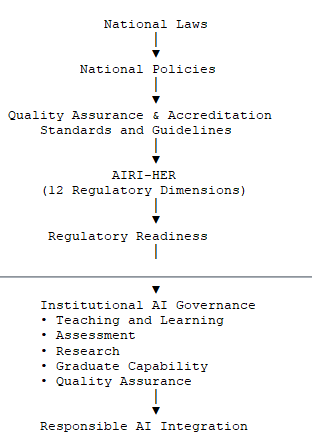
Figure 1 illustrates the conceptual pathway through which legislation, national policy and quality assurance frameworks collectively influence institutional AI governance and ultimately support responsible AI integration within higher education. It also positions AIRI-HER as the analytical mechanism linking national regulatory frameworks with institutional implementation.
4.6 Trustworthiness of the Study
The credibility of the analysis was enhanced through methodological triangulation by examining legislation, national policy, accreditation standards and international guidance rather than relying on a single source of evidence (Creswell & Creswell, 2023). Consistency was further strengthened by applying the AIRI-HER framework systematically across all regulatory instruments, thereby reducing subjective interpretation and improving analytical transparency (Yin, 2018).
5. Findings and Discussion
5.1 Overview of the Regulatory Framework
The documentary analysis indicates that The Gambia has established a coherent higher education regulatory framework comprising legislation, national policy, accreditation standards and quality assurance mechanisms (Government of The Gambia, 2016, 2020, 2021a, 2021b; NAQAA, 2022). Collectively, these instruments provide the legal and institutional foundation for higher education governance, programme accreditation, institutional oversight and continuous quality improvement. The framework has played an important role in expanding tertiary education, strengthening institutional accountability and promoting public confidence in higher education.
However, the analysis also demonstrates that the framework was largely developed before the widespread emergence of generative artificial intelligence. Consequently, while the existing regulatory architecture provides a stable foundation for governing conventional higher education, it offers limited explicit guidance on AI governance, AI-assisted assessment, research integrity, algorithmic accountability, ethical AI use and institutional preparedness for AI-enabled teaching and learning (UNESCO, 2023; INQAAHE, 2024).
The principal regulatory challenge is therefore not the absence of legal authority but the absence of explicit AI-responsive regulatory provisions. Existing legislation and quality assurance mechanisms provide institutions with considerable autonomy to adopt AI, yet they do so without a consistent national framework to guide responsible implementation (Government of The Gambia, 2016; Government of The Gambia, 2021a; NAQAA, 2022).
5.2 AIRI-HER Assessment of the Tertiary and Higher Education Act, 2016
Application of the AIRI-HER framework demonstrates that the Tertiary and Higher Education Act, 2016 continues to provide a strong legal foundation for higher education governance (Government of The Gambia, 2016). The Act effectively supports institutional autonomy, research, quality improvement and academic governance, thereby creating an enabling environment within which universities may introduce emerging technologies.
Nevertheless, the legislation reflects a regulatory environment that predates the widespread adoption of generative AI. It contains no explicit provisions addressing AI governance, ethical AI use, AI-assisted assessment, institutional accountability for AI deployment, algorithmic transparency or graduate AI capability (Government of The Gambia, 2016; UNESCO, 2021). Similarly, although research is recognised as a core institutional function, the Act provides no guidance on the responsible use of AI in research, publication or scholarly communication.
The AIRI-HER assessment therefore indicates that the legislation is AI-neutral. It neither inhibits nor actively promotes responsible AI integration. Rather than requiring comprehensive legislative reform, targeted amendments recognising AI governance, institutional accountability, ethical principles and graduate AI capability would substantially strengthen its responsiveness while preserving the existing legislative architecture (OECD, 2024; INQAAHE, 2024).
| Dimension | Score |
|---|---|
| Governance | 2 |
| Strategic Policy | 3 |
| Curriculum | 4 |
| Teaching and Learning | 3 |
| Assessment | 2 |
| Academic Integrity | 2 |
| Research Governance | 2 |
| Ethics | 3 |
| Data Governance | 2 |
| Staff Capability | 2 |
| Graduate Capability | 2 |
| Quality Assurance | 4 |
| Total Score | 31/60 |
| Classification | AI-Neutral |
Table 3 demonstrates that the Act performs relatively well in supporting curriculum flexibility and quality assurance but scores lower across dimensions requiring explicit AI governance. These findings reinforce the conclusion that the legislation provides an enabling foundation but requires targeted modernisation to respond to contemporary technological developments.
5.3 Assessment of the National Accreditation and Quality Assurance Authority (NAQAA) Framework
The National Accreditation and Quality Assurance Authority Act, 2021, together with the associated accreditation standards, provides the most adaptable component of The Gambia's higher education regulatory system (Government of The Gambia, 2021a; NAQAA, 2022). Unlike legislation, accreditation standards can generally be revised more frequently, allowing quality assurance agencies to respond more rapidly to technological developments.
The analysis indicates that the existing accreditation framework performs strongly in relation to institutional governance, curriculum design, continuous quality improvement and academic standards (NAQAA, 2022). These strengths create favourable conditions for integrating AI governance into future accreditation processes.
However, important regulatory gaps remain. Current standards provide limited guidance on AI-assisted assessment, institutional AI governance, ethical AI use, academic integrity in AI-rich learning environments, staff AI capability and graduate AI literacy (INQAAHE, 2024; UNESCO, 2023). Consequently, institutions may adopt significantly different approaches to AI governance, resulting in inconsistent implementation across the sector.
These findings suggest that revising accreditation standards represents the most practical and immediate mechanism for strengthening AI governance within Gambian higher education.
5.4 Assessment of the National Tertiary and Higher Education Policy
The National Tertiary and Higher Education Policy establishes a clear strategic vision for improving access, educational quality, research capacity and institutional development (Government of The Gambia, 2021b). Its emphasis on innovation and continuous improvement provides a strong foundation for future digital transformation.
Nevertheless, the policy reflects a period during which digital transformation was primarily associated with information and communication technologies rather than artificial intelligence. It does not identify AI as a strategic priority for higher education, nor does it address AI governance, ethical AI use, institutional capability, graduate AI literacy or workforce preparedness (Government of The Gambia, 2021b; UNESCO, 2023).
Rather than requiring an entirely new policy framework, targeted policy revisions incorporating AI governance principles, digital capability development and responsible innovation would substantially improve strategic preparedness while maintaining policy continuity (OECD, 2024).
5.5 Comparative Analysis with International Frameworks
Comparison with international guidance demonstrates that The Gambia's higher education regulatory framework shares many of the foundational principles promoted by UNESCO, the OECD and INQAAHE, including institutional autonomy, quality assurance, continuous improvement and public accountability (UNESCO, 2021; OECD, 2024; INQAAHE, 2024).
The principal divergence lies in the explicit treatment of artificial intelligence. International frameworks increasingly incorporate AI governance, ethical oversight, assessment reform, institutional accountability and AI literacy as integral components of higher education quality assurance (UNESCO, 2023; INQAAHE, 2024). By contrast, the Gambian framework remains largely technology-neutral, addressing digital transformation in general terms without establishing specific governance arrangements for AI (Government of The Gambia, 2016, 2021b).
| Regulatory Area | The Gambia | UNESCO | OECD | INQAAHE |
|---|---|---|---|---|
| AI Governance | Limited | Strong | Strong | Strong |
| AI Ethics | Limited | Strong | Strong | Strong |
| AI Literacy | Limited | Comprehensive | Comprehensive | Comprehensive |
| Assessment Reform | Limited | Recommended | Recommended | Recommended |
| Research Governance | Limited | Strong | Strong | Strong |
| Data Governance | Limited | Strong | Strong | Strong |
| Quality Assurance | Moderate | Strong | Strong | Strong |
Table 4 indicates that The Gambia already possesses a sound regulatory foundation but requires explicit AI-responsive reforms to achieve closer alignment with evolving international practice. Importantly, these differences reflect the timing of regulatory development rather than deficiencies in the overall quality of the national higher education framework.
6. Policy Implications and Recommendations
The findings demonstrate that The Gambia possesses a sound legal and institutional foundation for higher education governance but requires targeted regulatory modernisation to respond effectively to the opportunities and challenges presented by artificial intelligence (Government of The Gambia, 2016, 2021a, 2021b; UNESCO, 2023). Rather than introducing entirely new legislative instruments, the analysis suggests that incremental reforms to existing laws, policies and quality assurance mechanisms would provide a more practical and sustainable approach to strengthening regulatory preparedness (OECD, 2024).
The first priority is the development of a national AI governance framework for higher education. Such a framework should establish guiding principles for the responsible use of AI across teaching, learning, assessment, research and institutional administration while safeguarding academic integrity, transparency, accountability and human oversight (UNESCO, 2021; Council of Europe, 2024). A national framework would also provide greater regulatory consistency across higher education institutions and reduce uncertainty regarding acceptable institutional practice (INQAAHE, 2024).
Second, the National Tertiary and Higher Education Policy should be updated to recognise AI as a strategic component of higher education development (Government of The Gambia, 2021b). Policy revision should incorporate objectives relating to AI literacy, staff development, digital research capability, ethical AI use and institutional readiness. Aligning national policy with emerging international standards would provide a coherent strategic direction for universities while supporting national digital transformation objectives (OECD, 2024; UNESCO, 2023).
Third, the National Accreditation and Quality Assurance Authority (NAQAA) should progressively integrate AI governance into accreditation standards and external quality assurance processes (NAQAA, 2022; INQAAHE, 2024). Accreditation criteria should encourage institutions to establish AI governance policies, strengthen academic integrity frameworks, redesign assessment for AI-rich learning environments, enhance staff capability and promote graduate AI literacy (UNESCO, 2023; INQAAHE, 2024). As accreditation standards can generally be revised more frequently than legislation, they provide the most immediate mechanism for improving regulatory responsiveness.
At the institutional level, universities should develop comprehensive AI governance policies that define acceptable uses of AI in teaching, research and administration (European Commission, 2022; UNESCO, 2021). These policies should include provisions relating to ethical AI use, disclosure requirements, research integrity, data governance, staff training and mechanisms for monitoring institutional implementation. Institution-specific governance arrangements would complement national regulatory reforms while preserving institutional autonomy.
Finally, successful implementation will depend upon continuous collaboration between government, regulators, higher education institutions, professional bodies and international partners (OECD, 2024; UNESCO, 2023). AI governance should therefore be viewed as an evolving process requiring periodic review to ensure that regulatory frameworks remain responsive to technological developments while continuing to protect educational quality, public confidence and academic freedom.
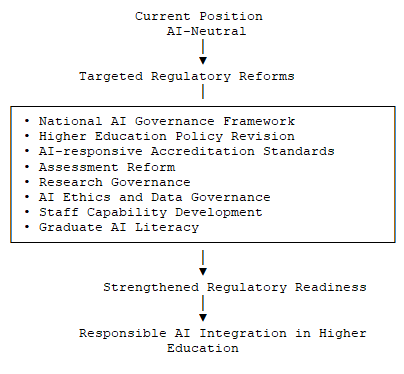
Figure 2 illustrates the proposed progression from the current AI-neutral regulatory environment towards a more AI-ready higher education system through coordinated legislative, policy and quality assurance reforms. Unlike comprehensive legislative restructuring, the proposed pathway emphasises incremental regulatory enhancement, thereby preserving the strengths of the existing higher education framework while addressing emerging governance requirements.
7. Limitations of the Study
This study has several limitations that should be considered when interpreting its findings. The research is based on a qualitative doctrinal and policy analysis of legislation, national policies, accreditation standards and quality assurance documents. While this approach provides a comprehensive assessment of the regulatory framework, it does not examine how these instruments are interpreted or implemented by policymakers, regulators, higher education institutions, academic staff or students. As a result, the study evaluates regulatory preparedness rather than institutional practice.
Another limitation relates to the Artificial Intelligence Readiness Index for Higher Education Regulation (AIRI-HER). Although the framework was developed from internationally recognised principles of AI governance and higher education quality assurance, it is presented as a new analytical framework. Further empirical testing in different higher education systems would help establish its reliability and wider applicability.
Finally, the governance of artificial intelligence is developing rapidly at both national and international levels. New legislation, policy reforms and quality assurance standards may influence future assessments of regulatory readiness. The findings presented in this study should therefore be understood within the policy context that existed at the time the research was undertaken.
8. Future Research Directions
This study provides an initial framework for assessing regulatory readiness for artificial intelligence in higher education. Further research is needed to refine and test the AIRI-HER framework in different contexts.
Comparative studies involving ECOWAS member states and other African higher education systems would improve understanding of regional approaches to AI governance and help identify emerging good practices.
Future research should also examine how individual universities are responding to AI within existing regulatory environments. Such studies would complement the present analysis by exploring institutional policies, governance arrangements and implementation practices.
Empirical research involving policymakers, quality assurance agencies, university leaders, academic staff and students would also strengthen understanding of how AIRI-HER performs in practice. Testing the framework across multiple jurisdictions would provide valuable evidence of its consistency, reliability and usefulness as a regulatory assessment tool.
Longitudinal studies could further examine how changes in legislation, public policy and accreditation standards influence AI readiness over time, particularly as higher education systems continue to adapt to rapid technological change.
9. Conclusion
Artificial intelligence is changing higher education in ways that extend well beyond the use of new technologies. Its growing influence on teaching, learning, assessment, research and institutional management requires regulatory systems that support innovation while maintaining educational quality, academic integrity and public confidence.
This study examined the readiness of The Gambia's higher education regulatory framework to support the responsible integration of artificial intelligence through an analysis of legislation, national policy and quality assurance instruments. The findings show that the country has a well-established regulatory system that provides a solid foundation for higher education governance. However, the framework remains largely technology-neutral and contains limited provisions that address AI governance, ethical oversight, AI-assisted assessment, research integrity, data governance and graduate AI capability.
The study finds that the main challenge is not the absence of regulatory authority, but the absence of explicit provisions that guide the responsible use of artificial intelligence across the higher education sector. Existing legislation and policies provide institutions with sufficient flexibility to innovate, but they do not yet offer a coherent national approach to AI governance.
A key contribution of this paper is the development of the Artificial Intelligence Readiness Index for Higher Education Regulation (AIRI-HER). The framework offers a practical method for assessing how well national legal, policy and quality assurance systems are prepared to support responsible AI integration in higher education. Although developed using the Gambian context, the framework has potential application in comparative studies involving other developing and emerging higher education systems.
The study concludes that targeted revisions to legislation, national policy and accreditation standards would significantly strengthen regulatory readiness without requiring fundamental changes to the existing higher education system. Incorporating AI governance into established regulatory structures would enable The Gambia to support innovation while safeguarding educational quality, institutional autonomy and public trust.
10. Declarations
Conflict of Interest
The author declares that there are no financial or non-financial conflicts of interest related to this research.
Funding
This research did not receive any specific funding from public, commercial or not-for-profit organisations.
Author Contributions
Dr. Abdoulie Bojang conceived the study, designed the research methodology, conducted the documentary analysis, developed the Artificial Intelligence Readiness Index for Higher Education Regulation (AIRI-HER), analysed and interpreted the findings, and prepared the manuscript.
Acknowledgements
The author acknowledges the publicly available legislation, policy documents, quality assurance standards and international guidance that informed this study. Responsibility for the interpretation of these materials, and for any remaining errors or omissions, rests entirely with the author.
References
- Bates, T. (2022). Teaching in a digital age: Guidelines for designing teaching and learning (3rd ed.). Tony Bates Associates. DOI ↗ Google Scholar ↗
- Council of Europe. (2024). Framework convention on artificial intelligence and human rights, democracy and the rule of law. Council of Europe. DOI ↗ Google Scholar ↗
- Creswell, J. W., & Creswell, J. D. (2023). Research design: Qualitative, quantitative, and mixed methods approaches (6th ed.). SAGE Publications. Google Scholar ↗
- European Commission. (2021). Digital Education Action Plan (2021–2027): Resetting education and training for the digital age. Publications Office of the European Union. DOI ↗ Google Scholar ↗
- European Commission. (2022). Ethical guidelines on the use of artificial intelligence and data in teaching and learning for educators. Publications Office of the European Union. Google Scholar ↗
- Government of The Gambia. (2016). Tertiary and Higher Education Act, 2016. Government Printer. Google Scholar ↗
- Government of The Gambia. (2020). The Gambia National Qualifications Framework. Ministry of Higher Education, Research, Science and Technology. Google Scholar ↗
- Government of The Gambia. (2021a). National Accreditation and Quality Assurance Authority Act, 2021. Government Printer. Google Scholar ↗
- Government of The Gambia. (2021b). National Tertiary and Higher Education Policy (2021–2030). Ministry of Higher Education, Research, Science and Technology. Google Scholar ↗
- Holmes, W., Bialik, M., & Fadel, C. (2019). Artificial intelligence in education: Promises and implications for teaching and learning. Center for Curriculum Redesign. Google Scholar ↗
- International Network for Quality Assurance Agencies in Higher Education. (2022). International standards and guidelines for quality assurance in tertiary education. INQAAHE. Google Scholar ↗
- International Network for Quality Assurance Agencies in Higher Education. (2024). Artificial intelligence and quality assurance in higher education: Emerging international perspectives. INQAAHE. Google Scholar ↗
- Kasneci, E., Sessler, K., Küchemann, S., Bannert, M., Dementieva, D., Fischer, F., Gasser, U., Groh, G., Günnemann, S., Hüllermeier, E., Krusche, S., Kutyniok, G., Michaeli, T., Nerdel, C., Pfeiffer, F., Poquet, O., Sailer, M., Schmidt, A., Seidel, T., ... Kasneci, G. (2023). ChatGPT for good? On opportunities and challenges of large language models for education. Learning and Individual Differences, 103, 102274. Google Scholar ↗
- Kuhlmann, S., & Rip, A. (2018). Next-generation innovation policy and grand challenges. Science and Public Policy, 45(4), 448–454. Google Scholar ↗
- Luckin, R. (2018). Machine learning and human intelligence: The future of education for the 21st century. UCL IOE Press. Google Scholar ↗
- National Accreditation and Quality Assurance Authority. (2022). Institutional accreditation standards and guidelines. NAQAA. Google Scholar ↗
- Organisation for Economic Co-operation and Development. (2019). OECD principles on artificial intelligence. OECD Publishing. DOI ↗ Google Scholar ↗
- Organisation for Economic Co-operation and Development. (2021). OECD digital education outlook 2021: Pushing the frontiers with AI, blockchain and robots. OECD Publishing. Google Scholar ↗
- Organisation for Economic Co-operation and Development. (2024). OECD digital economy outlook 2024. OECD Publishing. Google Scholar ↗
- QAA. (2023). The use of artificial intelligence in assessment: The current state of play. Quality Assurance Agency for Higher Education. Google Scholar ↗
- Rogers, E. M. (2003). Diffusion of innovations (5th ed.). Free Press. Google Scholar ↗
- Russell, S., & Norvig, P. (2021). Artificial intelligence: A modern approach (4th ed.). Pearson. Google Scholar ↗
- Saldaña, J. (2021). The coding manual for qualitative researchers (4th ed.). SAGE Publications. Google Scholar ↗
- Selwyn, N. (2019). Should robots replace teachers? AI and the future of education. Polity Press. Google Scholar ↗
- United Nations Educational, Scientific and Cultural Organization. (2021). Recommendation on the ethics of artificial intelligence. UNESCO. Google Scholar ↗
- United Nations Educational, Scientific and Cultural Organization. (2022). K-12 AI curricula: A mapping of government-endorsed AI curricula. UNESCO. Google Scholar ↗
- United Nations Educational, Scientific and Cultural Organization. (2023). Guidance for generative AI in education and research. UNESCO. Google Scholar ↗
- United Nations Educational, Scientific and Cultural Organization. (2024). Global education monitoring report 2024/25: Leadership in education. UNESCO. Google Scholar ↗
- Williamson, B., & Eynon, R. (2020). Historical threads, missing links and future directions in AI in education. Learning, Media and Technology, 45(3), 223–235. Google Scholar ↗
- Williamson, B., Bayne, S., & Shay, S. (2020). The datafication of teaching in higher education: Critical issues and perspectives. Teaching in Higher Education, 25(4), 351–365. Google Scholar ↗
- World Bank. (2020). The COVID-19 pandemic: Shocks to education and policy responses. World Bank. Google Scholar ↗
- World Bank. (2023). World development report 2023: Migrants, refugees and societies. World Bank. Google Scholar ↗
- Yin, R. K. (2018). Case study research and applications: Design and methods (6th ed.). SAGE Publications. Google Scholar ↗
- Zawacki-Richter, O., Marín, V. I., Bond, M., & Gouverneur, F. (2019). Systematic review of research on artificial intelligence applications in higher education. International Journal of Educational Technology in Higher Education, 16(39). Google Scholar ↗