Abstract
This study evaluated the anthropometric compatibility of control components on a two-wheel tractor prototype developed by Politeknik Manufaktur Bandung using anthropometric data from the Indonesian population. A descriptive quantitative approach was employed using eight measured dimensions of the handlebar, handle grip, main clutch lever, and steering clutch lever. Primary compatibility was assessed using the 50th percentile for standing elbow height and shoulder breadth and the 5th percentile for grip and reach-related dimensions. To deepen the interpretation, absolute and relative dimensional differences were calculated, and the 95th percentile was used as a sensitivity check for the dimensions initially assessed against the 50th percentile. Four dimensions were classified as incompatible and four as compatible. The handlebar and main clutch lever height exceeded the P50 standing elbow height by 60.7% and remained 30.6% above the P95 value. Handlebar width exceeded the P50 shoulder breadth by 76.2% and remained 33.9% above P95. The main clutch lever reach was compatible but only 3.0% below the P5 reach limit, whereas the maximum steering clutch lever distance exceeded the P5 functional finger span by 29.5%. These findings show that anthropometric compatibility varies not only by classification but also by the magnitude of mismatch or remaining dimensional margin.
Keywords
Anthropometry Dimensional compatibility Two-wheel tractor prototype Control system
1. Introduction
Agricultural mechanization supports more efficient land preparation and reduces reliance on manual labor. In paddy-field preparation, two-wheel tractors or hand tractors are used to support soil-working operations and require direct interaction between the operator and the handle-and-control system, as reported by Sulnawati et al. [1]. Their effective use therefore depends not only on mechanical performance but also on how well the control dimensions correspond to the physical characteristics of the operator. This operator-machine fit can be examined through anthropometry, which provides a dimensional basis for evaluating whether controls can be reached and handled by the intended users.
Abouee-Mehrizi et al. [2] described anthropometry as a practical basis for matching machine dimensions to human body characteristics in product design and evaluation. In agricultural machinery, anthropometric data are used to evaluate control heights, widths, grip diameters, and component positions so that controls can be reached and operated by the intended user population. Because body dimensions vary among populations, data representing the intended user group are important when evaluating agricultural machinery, as discussed by Abouee-Mehrizi et al. [2] and Sulnawati et al. [1]. Using anthropometric data that do not represent the target population may result in controls that are poorly matched to the operator's physical characteristics.
Anthropometric compatibility in tractor design has been examined across various types and models. Sulnawati et al. [1] reported that several dimensions of a hand tractor, including handle height and the distance between grips, were not fully compatible with the operators' body dimensions. Yadav et al. [4] likewise emphasized that tractor-control placement needs to take the anthropometric characteristics of the target operator population into account. Monarca et al. [5] evaluated the internal dimensions of tractor driving cabs against anthropometric requirements and identified several dimensional incompatibilities. In a study specifically involving a walking tractor, Mirzakhani Nafchi et al. [6] assessed the locations of controls in relation to the anthropometric suitability of operators before evaluating an improved workplace layout. Together, these studies show that anthropometric evaluation can consider not only whether a dimension meets a selected reference, but also how large the difference is and how the component functions during operation.
Politeknik Manufaktur Bandung has developed a two-wheel tractor prototype that is currently at the pre-production stage. At this stage, dimensional evaluation is important because the control components can still be reviewed before further development. Initial observation identified a potential
mismatch at the steering clutch lever: the maximum distance from the handle grip was 15.8 cm, whereas the 5th-percentile maximum functional finger span used in this study was 12.2 cm. This 3.6 cm difference provides an indication of possible dimensional incompatibility, but a single observation is not sufficient to represent the overall anthropometric compatibility of the control system. A more complete assessment is therefore required across the relevant handlebar, grip, and lever dimensions to determine whether the initial indication is isolated or part of a broader pattern of mismatch.
Accordingly, this study aimed to evaluate the compatibility of the control-component dimensions of the two-wheel tractor prototype developed by Politeknik Manufaktur Bandung with anthropometric data from the Indonesian population. The analysis focused on handlebar height and width, handle grip diameter, main clutch lever position, and the distance between the steering clutch lever and the handle grip. Each prototype dimension was compared with the relevant body or hand dimension using a percentile selected according to the function of the component. The results provide a measurable description of dimensions that are compatible and incompatible with the anthropometric characteristics of Indonesian users. The scope of the study was limited to dimensional compatibility and did not include working-posture assessment or the development of design improvements.
2. Research Methodology
2.1 Research Approach and Object of Study
This study employed a descriptive quantitative approach to provide a measurable assessment of the prototype's dimensional compatibility without examining causal relationships. The object of the study was a two-wheel tractor prototype developed by Politeknik Manufaktur Bandung. The analysis was limited to components that directly interact with the operator, namely the handlebar, handle grip, main clutch lever, and steering clutch lever.
2.2 Data and Data Collection
Primary data were obtained through direct measurement of the prototype's actual dimensions and a review of its technical documentation. The measured dimensions included handlebar height from the ground, distance between handlebars, handle grip diameter, main clutch lever height, distance between the main clutch lever and the handle grip, main clutch lever reach, and the minimum and maximum distances between the steering clutch lever and the handle grip. Data collection was conducted at the Manufacturing Engineering Laboratory of Politeknik Manufaktur Bandung from January to April 2026.
Secondary data were obtained from the Indonesian Anthropometry database and relevant supporting literature. The anthropometric dimensions used in the analysis included standing elbow height (D4), shoulder breadth (D17), forward arm reach (D24), shoulder-to-hand grip length (D25), maximum grip diameter, maximum hand span, and maximum functional finger span.
2.3 Data Analysis
The analysis was conducted by comparing each actual prototype dimension with the corresponding anthropometric dimension. The 50th percentile was used as the primary reference for standing elbow height and shoulder breadth, whereas the 5th percentile was used to assess whether users with smaller body or hand dimensions could adequately grip and reach the control components. The primary result was expressed as a binary classification of compatible or incompatible. To provide a deeper interpretation without changing the original classification criteria, a supplementary analysis was performed by calculating the absolute dimensional difference and the relative difference with respect to the reference value. For handlebar height, main clutch lever height, and handlebar width, the 95th-percentile values from the same Indonesian anthropometric dataset were additionally used as a sensitivity check to determine whether the observed mismatch persisted for users with larger body dimensions. For dimensions evaluated against the 5th percentile, the remaining dimensional margin or excess relative to the reference was quantified. This supplementary use of median, lower-percentile, and upper-percentile values was intended to reflect population variability rather than relying on an average body dimension alone, an issue also emphasized by Agrawal et al. [3] and Arya and Ramana [7].
3. Results and Discussion
3.1 Actual Prototype Dimensions
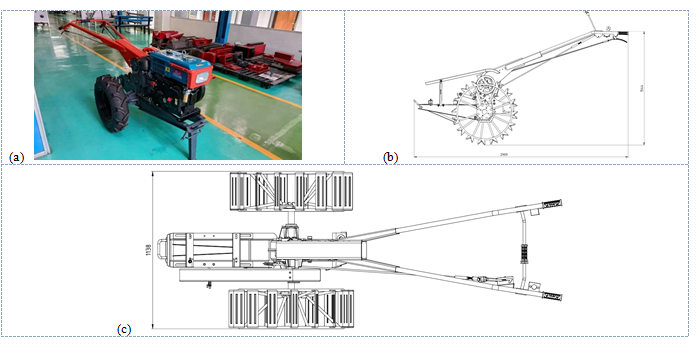
Figure 1 presents the two-wheel tractor prototype together with its side- and top-view technical drawings. Measurements focused on eight dimensions of the control components that define the interaction area between the operator and the prototype. A summary of the actual prototype dimensions is presented in Table 1.
| Prototype Dimension | Measurement (cm) |
|---|---|
| Handlebar height from the ground | 154.4 |
| Distance between handlebars | 68.75 |
| Handle grip diameter | 4.0 |
| Main clutch lever height from the ground | 154.4 |
| Distance between the main clutch lever and the handle grip | 40.0 |
| Main clutch lever reach | 47.5 |
| Minimum distance between the steering clutch lever and the handle grip | 13.5 |
| Maximum distance between the steering clutch lever and the handle grip | 15.8 |
3.2 Anthropometric Reference Data
The anthropometric dimensions were selected according to the function of each component. Standing elbow height and shoulder breadth were used to evaluate the positions of the handlebar and control levers, while hand dimensions and reach measurements were used to assess the handle grip and accessibility of the control levers. The anthropometric reference data used in this study are presented in Table 2.
| Anthropometric Dimension | Percentile | Value (cm) | Evaluation Purpose |
|---|---|---|---|
| D4 - Standing elbow height | P50 | 96.06 | Handlebar and lever height |
| D17 - Shoulder breadth | P50 | 39.01 | Distance between handlebars |
| Maximum grip diameter | P5 | 4.50 | Handle grip diameter |
| D25 - Shoulder-to-hand grip length | P5 | 43.69 | Main clutch lever distance |
| D24 - Forward arm reach | P5 | 48.95 | Main clutch lever reach |
| Maximum thumb-to-little-finger span | P5 | 17.70 | Minimum steering clutch lever distance |
| Maximum functional finger span | P5 | 12.20 | Maximum steering clutch lever distance |
3.3 Dimensional Compatibility Assessment
Comparison of the actual prototype dimensions with the anthropometric data identified four compatible dimensions and four incompatible dimensions based on the primary evaluation criteria. Because this binary classification does not indicate the magnitude of the difference from the reference, a supplementary dimensional analysis was also conducted. The primary classifications are summarized in Table 3, while the magnitude and remaining margin of each comparison are presented in Table 4.
| Dimension | Prototype (cm) | Anthropometric Reference | Percentile | Reference (cm) | Classification |
|---|---|---|---|---|---|
| Handlebar height | 154.4 | D4 standing elbow height | P50 | 96.06 | Incompatible |
| Handlebar width | 68.75 | D17 shoulder breadth | P50 | 39.01 | Incompatible |
| Handle grip diameter | 4.0 | Maximum grip diameter | P5 | 4.50 | Compatible |
| Main clutch lever height | 154.4 | D4 standing elbow height | P50 | 96.06 | Incompatible |
| Main lever-to-grip distance | 40.0 | D25 shoulder-to-grip length | P5 | 43.69 | Compatible |
| Main clutch lever reach | 47.5 | D24 forward arm reach | P5 | 48.95 | Compatible |
| Minimum steering lever distance | 13.5 | Maximum hand span | P5 | 17.70 | Compatible |
| Maximum steering lever distance | 15.8 | Functional finger span | P5 | 12.20 | Incompatible |
3.3.1 Supplementary Difference and Margin Analysis
The supplementary analysis was used to distinguish clear dimensional mismatches from dimensions that were technically compatible but close to their selected limits. Positive differences indicate that the prototype dimension exceeded the reference, whereas values described as below the reference indicate the remaining dimensional margin. The P95 comparison was used only as a sensitivity check for the dimensions originally evaluated against P50 and did not replace the primary classification criterion.
| Dimension | Difference from primary reference | Relative difference | Additional interpretation |
|---|---|---|---|
| Handlebar height | 58.34 cm above P50 | 60.7% above | Still 36.15 cm (30.6%) above P95 D4 = 118.25 cm |
| Handlebar width | 29.74 cm above P50 | 76.2% above | Still 17.41 cm (33.9%) above P95 D17 = 51.34 cm |
| Handle grip diameter | 0.50 cm below P5 limit | 11.1% below | Compatible with a measurable grip-size margin |
| Main clutch lever height | 58.34 cm above P50 | 60.7% above | Same height result as the handlebar; remains above P95 D4 |
| Main lever-to-grip distance | 3.69 cm below P5 limit | 8.4% below | Compatible with a moderate reach margin |
| Main clutch lever reach | 1.45 cm below P5 limit | 3.0% below | Compatible, but close to the selected reach limit |
| Minimum steering lever distance | 4.20 cm below P5 limit | 23.7% below | Compatible with the maximum hand-span reference |
| Maximum steering lever distance | 3.60 cm above P5 limit | 29.5% above | Exceeds the functional finger-span reference |
3.4 Discussion
3.4.1 Handlebar Height and Width
The handlebar height of 154.4 cm exceeded the P50 standing elbow height of 96.06 cm by 58.34 cm, corresponding to a relative difference of 60.7%. The magnitude of this difference indicates that the mismatch was not a small deviation around the median reference. When the same prototype dimension was compared with the P95 standing elbow height of 118.25 cm, the handlebar remained 36.15 cm, or 30.6%, higher. Therefore, the difference persisted even when a substantially larger body dimension was considered.
The P95 sensitivity check is important for interpreting the result because a comparison against P50 alone could suggest that the mismatch is mainly associated with users close to the average body size. In this case, however, the handlebar remained above the reference even at the upper percentile. The result therefore indicates a broad dimensional mismatch across the reference range rather than a condition affecting only users represented by the median value. This interpretation is consistent with the general use of anthropometric ranges in agricultural equipment design, where population variability is considered in addition to average dimensions, as discussed by Agrawal et al. [3] and Arya and Ramana [7].
The distance between the handlebars showed a similar pattern. The measured width of 68.75 cm exceeded the P50 shoulder breadth of 39.01 cm by 29.74 cm, or 76.2%. When compared with the P95 shoulder breadth of 51.34 cm, the handlebar remained 17.41 cm, or 33.9%, wider. Similar to the height result, the additional P95 comparison shows that the dimensional difference remains substantial even when a larger shoulder breadth is considered.
Previous agricultural machinery studies support evaluating control locations against the anthropometric characteristics of the intended population. Sulnawati et al. [1] identified incompatibilities in hand-tractor dimensions, including dimensions related to the handle area. Yadav et al. [4] evaluated tractor workplace configurations by relating control locations to anthropometric and biomechanical characteristics of the target operators. Agrawal et al. [3] likewise emphasized that agricultural tools and machinery need to be developed or modified using anthropometric data that represent the intended users. In the present prototype, the large differences in both handlebar height and width therefore provide stronger evidence of dimensional incompatibility than a binary classification alone.
3.4.2 Handle Grip Diameter
The handle grip diameter of 4.0 cm was 0.50 cm below the P5 maximum grip diameter of 4.5 cm, corresponding to an 11.1% dimensional margin, and was therefore classified as compatible with the selected anthropometric criterion. The use of the 5th percentile in this comparison is intended to ensure that a user with a relatively small hand can still accommodate the grip diameter. Compared with the height and width dimensions, the grip result therefore represents a different condition: the prototype dimension remains within the selected limit rather than exceeding it.
The interpretation of grip diameter can also be supported by experimental evidence on cylindrical handles. Grant et al. [8] demonstrated that relatively small changes in handle diameter can affect manual effort, grip strength, and forearm muscle activity, and concluded that handle size needs to be matched to user hand size rather than treated as a fixed dimension for all users. Their study also discussed prior evidence indicating efficient or preferred cylindrical-handle diameters around the 3.8 cm range under specific laboratory tasks. The 4.0 cm grip on the present prototype is close to this range, but this comparison is treated only as supporting context because the experimental task, population, and loading conditions differed from tractor operation.
Accordingly, the present finding can be interpreted as evidence of anthropometric accommodation, not as proof that the grip diameter is biomechanically optimal. Grip performance during actual tractor use may also depend on applied force, hand posture, surface material, vibration, duration of operation, and individual hand characteristics. These factors were outside the scope of this study. This distinction is important because a dimension can satisfy a static anthropometric criterion while still requiring further functional evaluation before its overall ergonomic performance is established.
3.4.3 Main Clutch Lever Accessibility
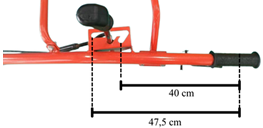
The main clutch lever was positioned at the same height as the handlebar, at 154.4 cm from the ground. Consequently, it showed the same height mismatch: 58.34 cm (60.7%) above the P50 standing elbow height and 36.15 cm (30.6%) above the P95 value. In contrast, the two reach-related dimensions of the same component were within their respective P5 references. The distance from the handle grip was 40.0 cm, which was 3.69 cm below the P5 shoulder-to-hand grip length of 43.69 cm, while the maximum lever reach of 47.5 cm was 1.45 cm below the P5 forward arm reach of 48.95 cm.
These differences correspond to margins of approximately 8.4% for the lever-to-grip distance and only 3.0% for the maximum lever reach. Although both dimensions were classified as compatible, the available margins are not equivalent. The 8.4% margin provides a larger allowance below the selected P5 reference, whereas the 3.0% margin places the maximum lever reach close to the selected anthropometric boundary. Describing both dimensions simply as compatible would therefore conceal an important difference in the degree of accommodation.
This finding illustrates why dimensional compatibility can be interpreted component by component and direction by direction. The main clutch lever is not uniformly compatible or incompatible: its height shows a clear mismatch, while its reach-related dimensions remain within the selected limits. Yadav et al. [4] similarly treated hand-operated tractor controls as a function of anthropometric link lengths and control location rather than evaluating the machine using one overall dimension. This supports an interpretation in which each control dimension is linked to the specific human dimension required to access it.
The narrow 1.45 cm margin for maximum lever reach also warrants cautious interpretation. The present analysis is based on static linear dimensions and does not include dynamic movement, clothing, grip changes, or body movement during field operation. Therefore, the result does not demonstrate that the lever is difficult to operate; rather, it indicates that the dimension has less anthropometric allowance than the other compatible reach-related dimensions and may be more sensitive to variation among users.
3.4.4 Steering Clutch Lever and Functional Finger Reach
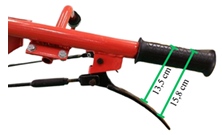
The steering clutch lever showed the clearest contrast between two positions of the same control. The minimum distance from the handle grip was 13.5 cm, which was 4.2 cm below the P5 maximum thumb-to-little-finger span of 17.7 cm. This represents a 23.7% margin below the selected maximum hand-span reference and was classified as compatible. In contrast, the maximum lever distance of 15.8 cm exceeded the P5 maximum functional finger span of 12.2 cm by 3.6 cm, or approximately 29.5%, and was classified as incompatible.
The different classifications of the two positions highlight the distinction between maximum anatomical span and functional reach. The maximum hand span represents the overall distance that can be covered between the thumb and little finger, whereas the functional finger span is a more restrictive reference for operating a control while the hand remains engaged with the handle. Consequently, a control may lie within the overall physical span of the hand but still be outside the functional range available to the fingers during the intended interaction.
This distinction is particularly relevant for a steering clutch lever because the lever is operated in close interaction with the handle grip rather than as an isolated control. Lee and Jung [9] noted that hand function is influenced by the interaction among anthropometry, kinematics, kinetics, and muscle activity. Although the present study does not measure these biomechanical variables, the use of a functional finger reference provides a more task-specific interpretation than relying on maximum hand span alone.
Evidence from walking-tractor research further supports considering the location of controls relative to operator anthropometry. Mirzakhani Nafchi et al. [6] evaluated control locations on a walking tractor with respect to anthropometric suitability and used those findings when examining an improved steering arrangement. Their work emphasizes that the physical location of controls is an important element of operator-machine compatibility. In the present study, the 29.5% excess at the farthest steering clutch position therefore represents a substantial departure from the selected functional-finger reference, even though the nearest position remains within the maximum hand-span criterion.
3.4.5 Percentile Selection and User Accommodation
Percentile selection influences how anthropometric compatibility is interpreted. In this study, P50 was used as the primary reference for standing elbow height and shoulder breadth because these dimensions were used to describe the central body size for the position of the handlebar and lever system. By contrast, P5 was used for grip and reach-related dimensions so that the assessment considered users with relatively small hand or reach dimensions. These choices reflect different design functions: a central-position reference is not equivalent to a reach or clearance criterion.
The supplementary P95 analysis was not used to replace the original classification criteria but to test whether the height and width mismatches disappeared when larger body dimensions were considered. They did not. Handlebar and main clutch lever height remained 30.6% above P95 standing elbow height, while handlebar width remained 33.9% above P95 shoulder breadth. This strengthens the finding because the mismatch is robust to a wider anthropometric reference range rather than being dependent on P50 alone.
Agricultural anthropometric research also shows why relying only on an average value can be insufficient. Agrawal et al. [3] documented substantial anthropometric variation among agricultural workers and emphasized the need for population-relevant data in tool and machinery design. More recently, Arya and Ramana [7] compared male and female agricultural workers using percentile distributions and noted that differences between the 5th and 95th percentiles are useful for defining the accommodation requirements of agricultural equipment. In this context, the present combination of P5, P50, and supplementary P95 comparisons provides a more informative description of accommodation than a single average value.
3.4.6 Overall Interpretation of Dimensional Compatibility
Overall, the results indicate that anthropometric compatibility of the prototype cannot be fully represented by a simple count of four compatible and four incompatible dimensions. The magnitude of the differences, the percentile against which each dimension was evaluated, and the remaining margin to the reference boundary provide additional information about the severity and robustness of each result. Three patterns can be distinguished from the eight evaluated dimensions.
First, handlebar height, handlebar width, main clutch lever height, and the maximum steering clutch lever distance showed clear incompatibility. The height and width mismatches remained substantial even in the P95 sensitivity analysis, while the farthest steering clutch lever position exceeded the functional finger reference by 29.5%. These dimensions therefore represent more than borderline deviations from the selected anthropometric criteria.
Second, the handle grip diameter, the main lever-to-grip distance, and the minimum steering clutch lever distance were compatible with measurable margins of 11.1%, 8.4%, and 23.7%, respectively. Third, the maximum main clutch lever reach was also classified as compatible, but its margin was only 3.0%. This third condition is important because it shows that dimensions within the same compatibility category can offer very different levels of accommodation. A binary classification is useful for screening, but margin analysis provides a more graduated interpretation of how close a dimension lies to its reference limit.
The pattern across components also demonstrates that the evaluation does not assign one overall compatibility label to an entire control assembly. The main clutch lever, for example, is incompatible in height but compatible in reach. The steering clutch lever is compatible at its nearest position but incompatible at its farthest position when a functional finger criterion is used. This component-specific interpretation is consistent with tractor-workplace research by Yadav et al. [4], Monarca et al. [5], and Mirzakhani Nafchi et al. [6], in which individual control locations are evaluated against the anthropometric variables most relevant to their operation.
3.4.7 Comparison with Previous Agricultural Machinery Studies
The present findings can be interpreted more clearly when placed alongside previous anthropometric studies of tractors and agricultural machinery. Sulnawati et al. [1] reported that several dimensions of a hand tractor were not fully compatible with operator anthropometry, including dimensions associated with the handle area. That result is directionally similar to the present finding for handlebar height and width. However, the current analysis extends the comparison by quantifying both the absolute difference and the relative difference from the selected reference and by checking whether the mismatch persists at P95. This allows the present study to distinguish between a small departure from the reference and a dimensional gap that remains substantial across a broader portion of the anthropometric range.
Yadav et al. [4] evaluated the workplace configuration of five tractors and determined control locations using anthropometric and biomechanical characteristics of the target operator population. Their study illustrates a broader design principle that is also relevant here: control dimensions can be interpreted in relation to the human dimensions required to reach and operate them. The present two-wheel tractor differs from the seated tractors examined by Yadav et al., but the same principle applies to the handlebar and hand-operated levers. In particular, the current results show that a single component can be acceptable for one anthropometric relationship but not for another, as observed for the main clutch lever. This reinforces the need to map each control dimension to the specific anthropometric variable that governs its accessibility.
Monarca et al. [5] examined anthropometric compatibility in tractor driving cabs by comparing measured machine dimensions with anthropometric limits derived from relevant standards. Although their object was an enclosed tractor cab rather than a walking tractor, the methodological logic is comparable: machine dimensions are evaluated against human dimensional boundaries to identify where accommodation may be insufficient. The present study applies that logic to a more localized operator-control interface. Instead of assessing internal cab clearance, it examines handlebar position, grip diameter, and lever reach. The similarity in approach supports the use of anthropometric boundary comparisons as an initial screening method across different tractor configurations, while the differences in machine type explain why the specific reference dimensions are not interchangeable.
The walking-tractor study by Mirzakhani Nafchi et al. [6] is particularly relevant to the steering-control findings because it examined control locations in relation to operator anthropometry on a machine with a similar mode of operator interaction. Their work proceeded toward rearranging the steering system, whereas the present article intentionally stops at evaluating the existing dimensions. This difference in scope is important. The current study does not claim that a particular alternative lever position would solve the identified mismatch. Instead, it establishes that the farthest steering clutch position exceeds the selected functional finger reference by 29.5%, thereby providing a quantitative basis for deciding whether that control deserves further design investigation.
Taken together, these previous studies and the present results indicate that anthropometric evaluation is most useful when it moves beyond a generic statement that a machine is or is not ergonomic. Population-specific data, component-specific reference dimensions, percentile selection, and the magnitude of dimensional difference all influence the interpretation. Agrawal et al. [3] emphasized the importance of using anthropometric data that represent the intended agricultural population, while Arya and Ramana [7] demonstrated how percentile variation can expose differences that are not visible from average values alone. The present study contributes to this line of work by applying these principles to a pre-production two-wheel tractor prototype and by separating clear mismatches from dimensions that remain within the selected limit but offer different amounts of anthropometric margin.
3.5 Study Implications
The expanded analysis provides an anthropometric basis for prioritizing dimensional issues during subsequent prototype development without prescribing a specific redesign. Dimensions that remain substantially outside the reference range after the P95 sensitivity check can be distinguished from dimensions that are compatible with a reasonable margin and from dimensions that are technically compatible but close to the limit. This prioritization is useful at the pre-production stage because it identifies where additional design review or user testing would provide the greatest value.
The findings also show the value of combining body dimensions and hand-specific dimensions when evaluating a manually controlled agricultural machine. Handlebar height and width describe the broader operator-control relationship, while grip diameter and lever reach describe the local hand-control interface. Agricultural equipment studies have similarly emphasized, as noted by Agrawal et al. [3], that different anthropometric indicators need to be selected according to the component and function being evaluated. Thus, anthropometric assessment is most informative when it is linked to the actual interaction required by each component rather than applying one generalized body-size criterion to the entire machine.
For future prototype evaluation, the dimensional results can also serve as a baseline for functional testing. For example, dimensions with narrow margins can be examined with users representing different body sizes, whereas dimensions with large mismatches can be reviewed before further validation. Such follow-up would extend the current static compatibility assessment toward a more complete evaluation of operator accommodation while preserving the present study as a dimensional analysis rather than a redesign study.
4. Conclusion
Based on the anthropometric analysis of eight control-component dimensions, four dimensions were classified as incompatible and four as compatible using the original criteria. However, the expanded analysis showed that the classifications differed considerably in magnitude. Handlebar height and main clutch lever height were 60.7% above the P50 standing elbow-height reference and remained 30.6% above P95, while handlebar width was 76.2% above P50 shoulder breadth and remained 33.9% above P95. The maximum steering clutch lever distance exceeded the P5 functional finger span by 29.5%. Among the compatible dimensions, the handle grip diameter, main lever-to-grip distance, and minimum steering clutch lever distance retained margins of 11.1%, 8.4%, and 23.7%, respectively, whereas the maximum main clutch lever reach was only 3.0% below its P5 reach limit. These findings demonstrate that anthropometric compatibility can be interpreted not only through a binary classification but also through the magnitude of mismatch, percentile sensitivity, and remaining dimensional margin. The study remains limited to the evaluation of existing dimensions and does not prescribe or validate a redesigned configuration.
These findings can be interpreted within the limitations of the study. The assessment used population-level anthropometric reference data rather than direct measurements of representative tractor operators and was limited to static linear dimensions; dynamic reach, joint angles, grip force, control-operating force, vibration, and changes in hand position during actual operation were not measured. The supplementary P95 comparisons were used only as sensitivity checks for the height and width dimensions and were not intended to establish redesign dimensions. Accordingly, compatibility in this study refers to dimensional accommodation rather than overall ergonomic performance, and the study does not prescribe or validate a redesigned control configuration. Future work may combine the present dimensional findings with direct anthropometric measurement, functional reach testing, control-force measurement, and prototype validation.
References
- Sulnawati E, Abdullah SH, Priyati A. Analisis teknis dan kajian ergonomika berdasarkan antropometri pada penggunaan traktor tangan untuk lahan sawah [Anthropometry based technical analysis and ergonomic studies on utilization of hand tractor for farm field]. J Ilm Rekayasa Pertan Biosist. 2016;4(2):239-47. DOI ↗ Google Scholar ↗
- Abouee-Mehrizi A, Saed-Moucheshi S, Dianat I. Review of anthropometric considerations for agricultural equipment design: a systematic review. Int J Syst Assur Eng Manag. 2022;13(2):571-81. doi:. DOI ↗ Google Scholar ↗
- Agrawal KN, Singh RKP, Satapathy KK. Anthropometric considerations of farm tools/machinery design for tribal workers of northeastern India. Agric Eng Int CIGR J. 2010;12(1):143-50. DOI ↗ Google Scholar ↗
- Yadav R, Budhrani BP, Balani PC, Pund S. Anthropometric and ergonomic compatibility of tractor workplace design. J Ergon. 2017;S6:1-7. doi:. DOI ↗ Google Scholar ↗
- Monarca D, Cecchini M, Santi M, Colantoni A. Analysis of anthropometric compatibility of agricultural tractor cabs. Agric Eng Int CIGR Ejournal. 2009;11:Manuscript MES 1121. Google Scholar ↗
- Mirzakhani Nafchi A, Mirzakhani Nafchi H, Abdollahi Demneh I. Improving steering system for walking tractor-trailer combination to increase operator's comfort and ease of control. Agric Eng Int CIGR J. 2011;13(3):1-8. DOI ↗ Google Scholar ↗
- Arya KT, Ramana C. Anthropometric data analysis and constraints faced by women in operating agricultural machinery. Agric Eng Int CIGR J. 2023;25(3):159-69. Google Scholar ↗
- Grant KA, Habes DJ, Steward LL. An analysis of handle designs for reducing manual effort: the influence of grip diameter. Int J Ind Ergon. 1992;10(3):199-206. doi:. DOI ↗ Google Scholar ↗
- Lee KS, Jung MC. Ergonomic evaluation of biomechanical hand function. Saf Health Work. 2015;6(1):9-17. doi:. DOI ↗ Google Scholar ↗