Abstract
Predictive maintenance (PdM) has emerged as a key enabler of intelligent manufacturing by facilitating early fault detection and reducing unplanned downtime. In Malaysia, the Printed Circuit Board (PCB) manufacturing industry is a critical component of the electrical and electronics (E&E) sector, yet the adoption of advanced data-driven maintenance strategies remains limited, particularly among small and medium enterprises (SMEs). Existing predictive maintenance approaches often lack contextual adaptation to specific industrial environments and fail to address constraints related to data availability, system integration, and cybersecurity. This study proposes a context-aware predictive maintenance framework based on Artificial Neural Networks (ANN), with a focus on Long Short-Term Memory (LSTM) models for time-series analysis. The framework integrates data acquisition, preprocessing, model inference, decision support, and cybersecurity considerations into a unified architecture tailored for the Malaysian PCB manufacturing ecosystem. The proposed framework is theoretically justified through a synthesis of existing literature and industrial requirements. The study contributes by bridging the gap between advanced AI techniques and practical implementation challenges, providing a scalable and industry-relevant solution for predictive maintenance.
Keywords
Predictive Maintenance Artificial Neural Network Long Short-Term Memory PCB Manufacturing Time-Series Analysis Malaysia
Introduction
Printed Circuit Board (PCB) manufacturing is fundamental to the electronics industry, supporting applications in healthcare, transportation, telecommunications, and consumer electronics . Growing demand for compact, high-performance devices has driven the adoption of high-density interconnect (HDI) designs and multi-layered PCB architectures, increasing manufacturing complexity while making product quality and reliability more critical . However, the trend toward miniaturization and higher component density presents significant production challenges by requiring greater manufacturing precision and stricter quality control . Environmental concerns related to material consumption and electronic waste have also encouraged the adoption of sustainable manufacturing approaches, including additive manufacturing and digital fabrication technologies . Furthermore, manufacturers face increasing global competition, requiring improvements in product quality, operational efficiency, and cost-effectiveness to remain competitive . Maintaining equipment reliability is equally important, as PCB production requires flexible manufacturing systems capable of rapid retooling and minimal downtime . Consequently, predictive maintenance strategies have become increasingly important for optimizing maintenance schedules, improving equipment reliability, and preventing unexpected production interruptions .
The integration of Artificial Intelligence (AI) has significantly transformed PCB manufacturing by improving defect detection, production optimization, and maintenance decision-making. AI-powered techniques, including convolutional neural networks (CNNs) and edge computing, have enhanced defect detection accuracy, while AI-based optimization methods have improved production scheduling, component placement, and PCB routing efficiency . Nevertheless, challenges such as limited data infrastructure, resistance to technological adoption, and the need for domain-specific AI models continue to restrict wider implementation . Among AI applications, predictive maintenance has emerged as a promising solution for assessing equipment reliability, forecasting failures, and minimizing unplanned downtime through machine learning and surrogate modelling techniques . These developments demonstrate the growing potential of AI-driven predictive maintenance to improve operational efficiency and manufacturing performance, while highlighting the need for more robust, scalable, and intelligent maintenance solutions for modern PCB manufacturing environments .
Theoretical Framework
This section establishes the theoretical foundation for the proposed predictive maintenance framework by synthesising existing knowledge related to PCB manufacturing, predictive maintenance, and Artificial Neural Networks (ANNs). It first discusses the characteristics of PCB manufacturing and the importance of equipment reliability, followed by current predictive maintenance practices within manufacturing environments. Subsequently, ANN approaches, particularly Long Short-Term Memory (LSTM) networks, are reviewed to justify their suitability for machine health prediction. Finally, the research gaps identified from the literature are discussed to motivate the development of the proposed conceptual framework.
PCB Manufacturing And Maintenance
Printed Circuit Board (PCB) manufacturing comprises several highly specialized processes that ensure the reliability and functionality of electronic products. The fabrication stage traditionally relies on electroless copper deposition for primary metallization, although emerging carbon and graphite-based direct metallization techniques offer improved reliability and environmental performance . Another critical fabrication process is super-roughening, where corrosion inhibitors such as 2-aminobenzimidazole (2-AB) enhance copper-resin adhesion by increasing surface roughness and mechanical interlocking . PCB assembly subsequently involves stencil printing, component placement, and reflow soldering, with quality assurance achieved through solder paste inspection (SPI), automated optical inspection (AOI), and in-circuit testing (ICT) . Recent advances have introduced intelligent assembly systems that incorporate clustering and optimization techniques to improve production yield and process efficiency . Furthermore, AI-driven inspection systems employing deep ensemble convolutional neural networks have demonstrated high defect detection accuracy and adaptability across production lines, while integrated inspection platforms combine predictive and prescriptive intelligence to enhance defect management and decision-making .
Despite these technological developments, PCB manufacturing continues to face significant challenges associated with increasing product complexity, customization, and sustainability. Highly specialized production workflows and tailored enterprise resource planning (ERP) systems are often required because each PCB design may differ substantially . Environmental concerns, including excessive water consumption and metal-contaminated wastewater, have encouraged the implementation of Zero Liquid Discharge (ZLD) systems and the adoption of low-melting-point solder alloys to reduce pollution and energy consumption . Conventional inspection methods also remain largely reactive, resulting in production waste and costly rework, thereby highlighting the need for more proactive quality management systems . Moreover, integrating Industrial Internet of Things (IIoT) platforms and real-time optimization remains challenging due to rigid and isolated manufacturing systems . Industry 4.0 technologies, including modular smart factory frameworks and cloud manufacturing systems (CMS), have improved production flexibility, planning, and scheduling while significantly reducing lead times and work-in-progress . In addition, Generative AI, Optical Character Recognition (OCR), and hybrid AI models have enhanced inspection accuracy and digital transformation efforts, whereas eco-friendly materials and printed electronics continue to promote more sustainable PCB manufacturing practices with lower energy consumption and emissions .
ANN-Based Predictive Maintenance
Artificial Neural Networks (ANNs) and their variants have become increasingly important in predictive maintenance (PdM) applications for PCB, electronics, and semiconductor manufacturing due to their ability to analyse complex sensor data and identify patterns associated with equipment degradation. Conventional ANNs effectively model non-linear relationships, making them suitable for general fault diagnosis and predictive maintenance tasks . However, industrial equipment continuously generates time-series sensor data, such as vibration, temperature, pressure, and rotational speed, which require models capable of capturing temporal dependencies over extended periods . To address this requirement, several deep learning architectures have been adopted, each offering unique strengths and limitations depending on the characteristics of the manufacturing data. Table 1 summarizes the comparison of the most commonly used neural network models in predictive maintenance.
| Model | Strengths | Limitations |
| ANN (Artificial Neural Network) | Captures complex non-linear relationships and performs well in general predictive maintenance tasks . | Limited ability to model sequential and temporal dependencies in time-series data |
| CNN (Convolutional Neural Network) | Excellent feature extraction capability with high computational efficiency, particularly for structured sensor data . | Less effective in learning long-term temporal relationships . |
| RNN (Recurrent Neural Network) | Designed to process sequential data and capture temporal relationships . | Suffers from vanishing gradient problems, limiting its ability to learn long-term dependencies . |
| LSTM (Long Short-Term Memory) | Captures long-term temporal dependencies and provides superior performance in time-series forecasting . | Higher computational complexity and requires careful hyperparameter tuning . |
As shown in Table 1, each neural network architecture offers distinct capabilities for predictive maintenance. CNNs are highly effective in extracting features from structured sensor data and have been successfully applied to applications such as fault classification and Remaining Useful Life (RUL) estimation, although their ability to capture long-term temporal relationships is limited . RNNs were introduced to model sequential data more effectively, but their performance is often constrained by the vanishing gradient problem, which reduces their capability to learn from long data sequences . In contrast, Long Short-Term Memory (LSTM) networks overcome this limitation through memory cells and gating mechanisms that retain relevant historical information over extended periods . Consequently, LSTM consistently outperforms ANN, CNN, and conventional RNN models in equipment failure prediction and semiconductor yield forecasting, demonstrating superior accuracy for complex time-series prediction tasks . Although hybrid CNN-LSTM architectures further improve predictive performance by combining feature extraction and temporal modelling capabilities , they require greater computational resources and more complex training procedures, making deployment more challenging in industrial environments . Overall, the literature identifies LSTM as the most suitable neural network architecture for predictive maintenance using time-series sensor data because it effectively captures long-term dependencies while providing robust prediction performance. These advantages justify the selection of LSTM as the underlying predictive model for this study.
Research Gaps and Proposed Framework
Despite the growing adoption of Artificial Intelligence (AI) for predictive maintenance in PCB manufacturing, several research gaps remain that limit the practical implementation of existing Artificial Neural Network (ANN) and Long Short-Term Memory (LSTM) models. One of the primary challenges is the ability to process high-dimensional and dynamic manufacturing data. Existing LSTM and deep neural network (DNN) approaches often experience reduced prediction performance and overfitting when dealing with complex sensor data generated in PCB manufacturing environments . Furthermore, most current frameworks lack mechanisms for adapting to continuously changing operational conditions, making real-time fault prediction difficult in dynamic manufacturing systems . Another significant limitation is the dependence of ANN and LSTM models on large volumes of high-quality training data, which are frequently unavailable in real industrial settings due to limited sensor deployment, incomplete records, and noisy datasets . In addition, current predictive maintenance frameworks often struggle to integrate seamlessly with existing manufacturing systems and remain difficult to scale across production lines operating under different environmental conditions and machine configurations . The increasing complexity of integrating feature selection, real-time analytics, and predictive models further complicates the deployment of intelligent maintenance systems in practical manufacturing environments .
Several opportunities have been identified to improve future predictive maintenance frameworks. Recent studies suggest that adaptive feature extraction techniques, such as Adaptive Temporal Feature Mapping (ATFM), can improve LSTM performance by reducing overfitting and enhancing real-time fault detection, while hybrid approaches integrating LSTM with algorithms such as XGBoost provide better handling of high-dimensional manufacturing data . In addition, digital twin technology has demonstrated promising results for thermal behaviour monitoring in PCB manufacturing, although its application to predictive maintenance remains limited . Other studies recommend combining Physics-of-Failure (PoF) models with LSTM to improve Remaining Useful Life (RUL) prediction, while edge computing offers opportunities for low-latency monitoring and real-time predictive analytics without excessive data transmission . Existing research also demonstrates the effectiveness of LSTM in predicting equipment failures, PCB thermal behaviour, and solder joint reliability, with Bi-directional LSTM (BiLSTM) achieving superior prediction performance compared with traditional machine learning methods such as Support Vector Machine (SVM) . Moreover, several studies have successfully validated LSTM-based predictive maintenance frameworks using real industrial datasets, reporting improved prediction accuracy and reduced equipment downtime . These findings support the development of a more comprehensive LSTM-based predictive maintenance framework that integrates adaptive learning, robust feature engineering, and practical deployment considerations for PCB manufacturing.
| Aspect | Summary of Findings |
| Research Gaps | Limited capability to handle high-dimensional data, inadequate system integration, poor scalability, and dependency on high-quality datasets . |
| Limitations of Existing ANN/LSTM Models | Susceptible to overfitting, dependent on large labelled datasets, and lacking real-time adaptation mechanisms . |
| Missing Framework Components | Limited incorporation of adaptive learning, digital twin technology, hybrid modelling approaches, and edge computing capabilities . |
| Research Opportunities | Development of adaptive LSTM models, hybrid AI frameworks, digital twin integration, and edge-based predictive maintenance systems . |
| Support for the Proposed Framework | Proven effectiveness of LSTM and BiLSTM, successful integration with advanced optimization techniques, and validation using real-world industrial datasets . |
Methodology
This study adopts a conceptual research methodology to develop a predictive maintenance framework for the Printed Circuit Board (PCB) manufacturing industry. Unlike empirical research, which evaluates models using experimental data, conceptual research aims to establish a theoretical foundation by synthesising existing knowledge and identifying opportunities for framework development. This approach is appropriate because the objective of this study is to propose a context-aware predictive maintenance framework rather than validate a prediction model experimentally .
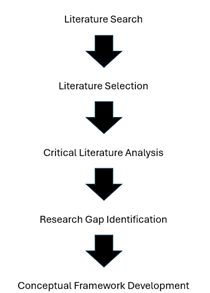
The framework was developed through a structured literature synthesis of peer-reviewed journal articles published between 2018 and 2025. Relevant studies related to PCB manufacturing, predictive maintenance, Artificial Neural Networks (ANN), Long Short-Term Memory (LSTM), and Industry 4.0 were identified and critically analysed. The analysis focused on extracting common predictive maintenance components, implementation challenges, AI techniques, and limitations reported in previous studies. Rather than summarising individual publications, the findings were synthesised to establish the theoretical basis for the proposed framework .
Subsequently, a research gap analysis was conducted to identify limitations in existing predictive maintenance approaches for PCB manufacturing. The identified gaps were used to guide the development of a conceptual framework integrating data acquisition, data preprocessing, LSTM-based prediction, decision support, and maintenance planning. The framework was formulated by combining evidence from previous studies with theory-building principles commonly adopted in conceptual engineering research, ensuring that each framework component is supported by the existing literature while addressing the identified research gaps . Figure 1 shows the research methodology for conceptual framework development.
Results And Discussion
The proposed framework incorporates five interconnected components, namely data acquisition, data preprocessing, LSTM-based predictive modelling, decision support, and maintenance planning. These components are consistent with recent AI-based predictive maintenance frameworks that emphasise intelligent data processing and integrated maintenance decision-making for electronics manufacturing .
The inclusion of data preprocessing improves the quality of sensor information before predictive analysis, while the LSTM prediction layer enables sequential learning from machine condition data. Decision support transforms prediction outputs into maintenance recommendations, allowing maintenance activities to be scheduled proactively rather than reactively. Similar framework structures have been adopted in previous AI-enabled maintenance systems to improve equipment reliability and operational efficiency .
Despite these advantages, implementing AI-based predictive maintenance in PCB manufacturing remains challenging. Previous studies highlight issues related to integrating AI with existing manufacturing systems, increasing framework complexity, and ensuring interoperability among multiple intelligent technologies . These challenges indicate that future research should focus on improving framework scalability and facilitating integration with smart manufacturing environments.
Conclusion
This study proposed a conceptual LSTM-based predictive maintenance framework for Printed Circuit Board (PCB) manufacturing by synthesising recent literature on Artificial Intelligence (AI), predictive maintenance, and Industry 4.0 technologies. Through a structured analysis of studies published between 2018 and 2025, key research gaps were identified, including challenges related to high-dimensional sensor data, dependency on high-quality datasets, limited real-time adaptability, and integration with existing manufacturing systems. To address these limitations, the proposed framework integrates five core components: data acquisition, data preprocessing, LSTM-based predictive modelling, decision support, and maintenance planning. These components provide a systematic approach for improving equipment monitoring, failure prediction, and maintenance decision-making within PCB manufacturing environments.
The findings suggest that LSTM is particularly well suited for predictive maintenance because of its ability to model long-term temporal dependencies in time-series sensor data, making it more effective than conventional ANN, CNN, and RNN models for complex manufacturing applications. Although the proposed framework has not been experimentally validated, it establishes a theoretical foundation for future AI-driven predictive maintenance research in PCB manufacturing. Future work should focus on validating the framework using real industrial datasets, integrating emerging technologies such as digital twins and edge computing, and evaluating its scalability and effectiveness in smart manufacturing environments. Such developments have the potential to enhance equipment reliability, reduce unplanned downtime, and support the digital transformation of PCB manufacturing under the Industry 4.0 paradigm.
References
- M. Łyczek and W. Skarka, “DESIGN AND CONSTRUCTION OF A BENCH FOR PCB PANEL TESTING AND DEPANELIZATION,” International Journal of Modern Manufacturing Technologies, vol. 17, no. 3 Special Issue, pp. 151–167, 2025, doi: . DOI ↗ Google Scholar ↗
- J. Flumerfelt and T. Schleisman, “Black Pad and revisiting methodologies,” in IPC - IPC Printed Circuits Expo, APEX and the Designers Summit 2007, 2007, pp. 73–95. [Online]. Available: DOI ↗ Google Scholar ↗
- X. Zhiyuan et al., “Printed circuit board defect detection based on LightRT-DETR algorithm,” Guangdian Gongcheng/Opto-Electronic Engineering, vol. 53, no. 2, 2026, doi: . DOI ↗ Google Scholar ↗
- G. B. Raja, “Advancements in Contemporary Circuit Design: Exploring Alternatives to CMOS for Enhanced Performance,” in Circuit Design for Modern Applications, CRC Press, 2025, pp. 48–73. doi: . DOI ↗ Google Scholar ↗
- C.-F. Chien, Y.-C. Tai, and Y.-S. Lin, “Decision-Based Virtual Metrology Framework to Improve the Efficiency of Solder Resist Opening Qualify Control and an Empirical Study in Printed Circuit Board Manufacturing,” in Proceedings of Technical Papers - International Microsystems, Packaging, Assembly, and Circuits Technology Conference, IMPACT, IEEE Computer Society, 2023, pp. 330–333. doi: . DOI ↗ Google Scholar ↗
- D. M. Spitz, “Design for Manufacturability Best Practices for PCBs and PCBAs,” in Proceedings - Annual Reliability and Maintainability Symposium, Institute of Electrical and Electronics Engineers Inc., 2022. doi: . DOI ↗ Google Scholar ↗
- Z. Yan, “Sustainable in-house PCB prototyping,” in UIST Adjunct 2024 - Proceedings of the 37th Annual ACM Symposium on User Interface Software and Technology, Association for Computing Machinery, Inc, 2024. doi: . DOI ↗ Google Scholar ↗
- L. Hlinenko, V. Fast, and Y. Zanichkovskyy, “3D Printing of PCBs in Biomedical Device,” in Conference Proceedings - 2024 IEEE 17th International Conference on Advanced Trends in Radioelectronics, Telecommunications and Computer Engineering, TCSET 2024, Institute of Electrical and Electronics Engineers Inc., 2024, pp. 544–547. doi: . DOI ↗ Google Scholar ↗
- M. Dave, “Building a profitable niche,” Printed Circuit Design and Fab, vol. 25, no. 10, pp. 40–41, 2008, [Online]. Available: DOI ↗ Google Scholar ↗
- M. K. Weinhold, “European printed circuit board (PCB) technology and environmental trends: Their impact on PCB supply from China,” Circuit World, vol. 32, no. 4, pp. 25–27, 2006, doi: . DOI ↗ Google Scholar ↗
- P. Bollinger and V. Cook, “Evaluating capital equipment,” Circuits Assembly, vol. 15, no. 6, p. 48, 2004, [Online]. Available: DOI ↗ Google Scholar ↗
- S. R. Sabapathi, “The Future of PCB Diagnostics and Trouble-shooting,” in AUTOTESTCON (Proceedings), Institute of Electrical and Electronics Engineers Inc., 2018. doi: . DOI ↗ Google Scholar ↗
- M. Sharifi, S. Taghipour, and A. Abhari, “General Transitions Probabilities and Maintenance Inspection Interval Optimization of a Weighted k-out-of-n System,” in Proceedings - Annual Reliability and Maintainability Symposium, Institute of Electrical and Electronics Engineers Inc., 2022. doi: . DOI ↗ Google Scholar ↗
- A. Goel and R. J. Graves, “Assessing the assumptions used in reliability prediction modeling,” in ESTC 2006 - 1st Electronics Systemintegration Technology Conference, Institute of Electrical and Electronics Engineers Inc., 2006, pp. 1143–1148. doi: . DOI ↗ Google Scholar ↗
- P. Reid, “Thermal cycletesting of pcbs: Over time, the feedback loop of testing, adjusting and retesting can significantly improve PCB reliability,” Printed Circuit Design and Fab, vol. 26, no. 7, p. 13, 2009, [Online]. Available: DOI ↗ Google Scholar ↗
- W. Zhang et al., “Enhancing AOI with AI for Printed Circuit Board Assembly - A Comprehensive Industry Study,” in Proceedings of the IEEE/CPMT International Electronics Manufacturing Technology (IEMT) Symposium, Institute of Electrical and Electronics Engineers Inc., 2024. doi: . DOI ↗ Google Scholar ↗
- L. J. Le and H. S. Jo, “Real-Time Vision Inspection with AI-Based Edge Processor for Printed Circuit Board Assembly Quality Control,” in IEEE Region 10 Annual International Conference, Proceedings/TENCON, Institute of Electrical and Electronics Engineers Inc., 2025, pp. 1078–1082. doi: . DOI ↗ Google Scholar ↗
- A. M. M. Ali, S. Sahlan, N. Khamis, X. Ziyi, and F. L. N. Rashid, “Transparency in Detecting Defects of a Printed Circuit Board: Harnessing XAI for Improved Quality Control in Electronic Manufacturing Industries,” in Proceeding of the IEEE International Conference on Smart Instrumentation, Measurement and Applications, ICSIMA, Institute of Electrical and Electronics Engineers Inc., 2024, pp. 287–292. doi: . DOI ↗ Google Scholar ↗
- M. Barroso, D. Hinjos, P. A. Martin, M. Gonzalez-Mallo, V. Gimenez-Abalos, and S. Alvarez-Napagao, “Boosting AutoML and XAI in manufacturing: AI model generation framework,” in Artificial Intelligence in Manufacturing: Enabling Intelligent, Flexible and Cost-Effective Production Through AI, Springer Nature, 2024, pp. 333–350. doi: . DOI ↗ Google Scholar ↗
- P. Sathyaraj, S. Arulkumar, A. Ajina, K. Beshir, L. Umasankar, and A. N. Arularasan, “AI-Optimized Placement and Routing for PCB Design,” in Proceedings of 9th International Conference on Science, Technology, Engineering and Mathematics: The Role of Emerging Technologies in Digital Transformation, ICONSTEM 2024, Institute of Electrical and Electronics Engineers Inc., 2024. doi: . DOI ↗ Google Scholar ↗
- Z. Hu, S. Zhang, and H. Liao, “Application of synergistic integration of generative AI and optical character recognition in printed circuit board intelligent manufacturing,” in Proceedings of SPIE - The International Society for Optical Engineering, X. Wang and W. Liang, Eds., SPIE, 2025. doi: . DOI ↗ Google Scholar ↗
- Q. Yu, V. G. Kamble, D. P. Gruber, P. F. Fuchs, K. Fendt, and T. Krivec, “Literature Review: Global Criticality Assessment Based on Feature Surrogates at the PCBA Levels,” in 2024 25th International Conference on Thermal, Mechanical and Multi-Physics Simulation and Experiments in Microelectronics and Microsystems, EuroSimE 2024, Institute of Electrical and Electronics Engineers Inc., 2024. doi: . DOI ↗ Google Scholar ↗
- C. Gugliotti et al., “Direct Metallization Technology Advancements,” in Proceedings of Technical Papers - International Microsystems, Packaging, Assembly, and Circuits Technology Conference, IMPACT, IEEE Computer Society, 2025, pp. 118–121. doi: . DOI ↗ Google Scholar ↗
- Y. Yuan and Y. Shen, “Application of 2-Aminobenzimidazole in Micro-etching Super-roughening and Analysis of Its Action Mechanism,” Surface Technology, vol. 54, no. 20, pp. 135–145, 2025, doi: . DOI ↗ Google Scholar ↗
- V. W. C. Fung and K. C. Yung, “An intelligent approach for improving printed circuit board assembly process performance in smart manufacturing,” International Journal of Engineering Business Management, vol. 12, 2020, doi: . DOI ↗ Google Scholar ↗
- Y.-T. Li, P. Kuo, and J.-I. Guo, “Automatic Industry PCB Board DIP Process Defect Detection System Based on Deep Ensemble Self-Adaption Method,” IEEE Trans. Compon. Packaging Manuf. Technol., vol. 11, no. 2, pp. 312–323, 2021, doi: . DOI ↗ Google Scholar ↗
- Y. Wang, J. Wang, Y. Cao, S. Li, and O. Kwan, “Integrated Inspection on PCB Manufacturing in Cyber-Physical-Social Systems,” IEEE Trans. Syst. Man Cybern. Syst., vol. 53, no. 4, pp. 2098–2106, 2023, doi: . DOI ↗ Google Scholar ↗
- O. Sviszt, P. Martinek, and B. Szikora, “Typical features of printed circuit board production enterprise resource planning systems,” in 28th International Spring Seminar on Electronics Technology: Meeting the Challenges of Electronics Technology Progress, 2005, 2005, pp. 298–301. doi: . DOI ↗ Google Scholar ↗
- G. Ramos, R. Nichols, D. Lovejoy, and M. Girard, “Innovative Approaches to Sustainable Manufacturing: Solvent-Free Copper Extraction And Zero Liquid Discharge Implementation,” in Proceedings of Technical Papers - International Microsystems, Packaging, Assembly, and Circuits Technology Conference, IMPACT, IEEE Computer Society, 2024, pp. 84–87. doi: . DOI ↗ Google Scholar ↗
- T. C. Cucu, I. Plotog, P. Svasta, and M. Branzei, “Low silver, lead free solder paste, new alloy developments,” in 2010 IEEE 16th International Symposium for Design and Technology of Electronics Packages, SIITME 2010, 2010, pp. 39–42. doi: . DOI ↗ Google Scholar ↗
- M. Huang, “Closed-Loop IIoT Control for Sustainable and Intelligent PCB Manufacturing: A Data-Driven Approach Integrating Domain Expertise (IMPACT 2025),” in Proceedings of Technical Papers - International Microsystems, Packaging, Assembly, and Circuits Technology Conference, IMPACT, IEEE Computer Society, 2025, pp. 290–293. doi: . DOI ↗ Google Scholar ↗
- H. S. Sim, “A study on the development and effect of smart manufacturing system in PCB line,” Journal of Information Processing Systems, vol. 15, no. 1, pp. 181–188, 2019, doi: . DOI ↗ Google Scholar ↗
- M. Jabir, G. Zailin, R. Mudassar, Y. Lei, H. Cong, and W. Hao, “A conceptual framework of smart manufacturing for PCB industries,” in Proceedings of International Conference on Computers and Industrial Engineering, CIE, X. Xu, R. Y. Zhong, and M. I. Dessouky, Eds., Curran Associates Inc., 2018. [Online]. Available: DOI ↗ Google Scholar ↗
- N. Zhang and H. Lu, “Application progress in electronic textile manufacturing based on printing technology,” Fangzhi Xuebao/Journal of Textile Research, vol. 46, no. 7, pp. 244–252, 2025, doi: . DOI ↗ Google Scholar ↗
- H.-M. Yu et al., “AI-Driven Optimization of Thin Film and CMP Processes in 3-D NAND Manufacturing,” IEEE Transactions on Semiconductor Manufacturing, vol. 39, no. 2, pp. 214–221, 2026, doi: . DOI ↗ Google Scholar ↗
- S. Phongmoo, C. Suedumrong, C. Kuensaen, R. Sinthavalai, and K. Leksakul, “Predictive maintenance in semiconductor manufacturing: Comparative analysis of machine learning models for downtime reduction,” Comput. Ind. Eng., vol. 205, 2025, doi: . DOI ↗ Google Scholar ↗
- R. de Souza Lima, L. A. Scardua, and G. M. de Almeida, “Predicting Temperatures Inside a Steel Slab Reheating Furnace Using Neural Networks,” IEEE Trans. Ind. Appl., vol. 61, no. 3, pp. 5273–5282, 2025, doi: . DOI ↗ Google Scholar ↗
- J.-H. Yoo, Y.-K. Park, and S.-S. Han, “Predictive Maintenance System for Wafer Transport Robot Using K-Means Algorithm and Neural Network Model,” Electronics (Switzerland), vol. 11, no. 9, 2022, doi: . DOI ↗ Google Scholar ↗
- K. N. Tuan, V. M. Tri, and D. T. Anh, “The Performance of 1D-CNN and LSTM in Forecasting Financial Time Series,” in Communications in Computer and Information Science, N. T. Nguyen, A. Le, T. Tran, T. T. P, H. T.-P., Y. Manolopoulos, L. K. N. A, and H. V.-N., Eds., Springer Science and Business Media Deutschland GmbH, 2026, pp. 158–171. doi: . DOI ↗ Google Scholar ↗
- J. Wan and S. McLoone, “Remaining Useful Life Estimation of Lenses for an Ion Beam Etching Tool in Semiconductor Manufacturing Using Deep Convolutional Neural Networks,” in Frontiers in Artificial Intelligence and Applications, 2024, pp. 68–74. doi: . DOI ↗ Google Scholar ↗
- N. Van Hung, L. K. Loc, N. T. T. Huong, N. Van Dung, and N. M. Quy, “Applied Machine Learning and Deep Learning to Predict Oil and Gas Production,” in Lecture Notes in Civil Engineering, D. V Huynh, A. M. Tang, D. H. Doan, and P. Watson, Eds., Springer Science and Business Media Deutschland GmbH, 2022, pp. 451–458. doi: . DOI ↗ Google Scholar ↗
- R. Khandelwal, P. Marfatia, S. Shah, V. Joshi, P. Kamath, and K. Chavan, “Financial Data Time Series Forecasting Using Neural Networks and a Comparative Study,” in 2022 International Conference for Advancement in Technology, ICONAT 2022, Institute of Electrical and Electronics Engineers Inc., 2022. doi: . DOI ↗ Google Scholar ↗
- M. A. Akbar, A. Jazlan, A. M. Ibrahim, and A. Ahmad, “Deep Learning-Based Yield Prediction for the Die Bonding Semiconductor Manufacturing Process,” in Lecture Notes in Electrical Engineering, Md. Z. Z, N. Sulaiman, M. Mustafa, M. N. Shakib, and A. W. Jabbar, Eds., Springer Science and Business Media Deutschland GmbH, 2024, pp. 75–82. doi: . DOI ↗ Google Scholar ↗
- Z. Zainudin, S. M. Shamsuddin, and S. Hasan, “Convolutional neural network long short-term memory (CNN + LSTM) for histopathology cancer image classification,” in Advances in Intelligent Systems and Computing, S. Agarwal, S. Verma, and D. P. Agrawal, Eds., Springer, 2020, pp. 235–245. doi: . DOI ↗ Google Scholar ↗
- D. Kovalenko and D. Marcek, “Comparing the performance of deep learning neural network architectures for predicting economic time series,” in Proceedings of the 15th International Conference on Strategic Management and its Support by Information Systems, SMSIS 2023, R. Nemec and L. Chytilova, Eds., VSB-Technical University of Ostrava, 2023, pp. 192–199. [Online]. Available: DOI ↗ Google Scholar ↗
- C.-Y. Cheng, C.-M. Chien, T.-L. Chen, C. Yuangyai, and P.-L. Kong, “Innovative Anomaly Detection in PCB Hot-Air Ovens Using Adaptive Temporal Feature Mapping,” Applied Sciences (Switzerland), vol. 15, no. 19, 2025, doi: . DOI ↗ Google Scholar ↗
- T. Zhou, Y. Zhou, Y. Ma, F. Qin, K. Yan, and J. Lan, “Research on Remaining Life Prediction Method of Nuclear Power Instrument Control Circuit Board Based on PoF and Data-driven Fusion Algorithm,” Yuanzineng Kexue Jishu/Atomic Energy Science and Technology, vol. 57, pp. 148–156, 2023, doi: . DOI ↗ Google Scholar ↗
- A. Zippelius, A. Hanß, M. Schmid, J. Pérez-Velázquez, and G. Elger, “Reliability analysis and condition monitoring of SAC+ solder joints under high thermomechanical stress conditions using neuronal networks,” Microelectronics Reliability, vol. 129, 2022, doi: . DOI ↗ Google Scholar ↗
- F. Abbruzzese et al., “AI-enabled Predictive Maintenance in engineer to order CNC machining: An Architectural Framework for Enabling ESG Alignment,” in Procedia Computer Science, A. Bruzzone, C. Frydman, and F. Longo, Eds., Elsevier B.V., 2025, pp. 1169–1176. doi: . DOI ↗ Google Scholar ↗
- K. Saritha, G. Venkatesan, P. R. Babu, Z. A. Salami, A. Padmapriya, and M. Niranjanamurthy, “Predictive Maintenance powered by Artificial Intelligence using Models of Bayesian Inference in Manufacturing,” in 2025 International Conference on Computational Innovations and Engineering Sustainability, ICCIES 2025, Institute of Electrical and Electronics Engineers Inc., 2025. doi: . DOI ↗ Google Scholar ↗
- S. Kumar and M. Shrivastav, “Smart embedded systems for predictive maintenance: AI at the edge,” in AIP Conference Proceedings, N. Sidnal, V. Ramamoorthy, A. K. V, P. Bhatt, T. M. Nithya, and K. R. C. of E. Department of Computer Science and Engineering Kariyamanickam Rd Tamil Nadu Samayapuram, Eds., American Institute of Physics, 2026. doi: . DOI ↗ Google Scholar ↗
- J. A. Gorakh, D. S. Asudani, V. T. Pokale, M. Aggarwal, A. V Pise, and R. V Patil, “AI-Powered Predictive Maintenance for Industrial Machinery Using Deep Learning Models,” in 2026 International Conference on Emerging Smart Computing and Informatics, ESCI 2026, Institute of Electrical and Electronics Engineers Inc., 2026. doi: . DOI ↗ Google Scholar ↗
- S. Kayalvizhi, S. Manoharan, P. K. Muthukamatchi, R. Nagendran, S. Srithar, and G. Nagalalli, “Integrating Machine Learning and IoT for Real-Time PdM in Industrial Ecosystems: A Case Study Analysis,” International Journal of Research in Industrial Engineering, vol. 14, no. 2, pp. 385–409, 2025, doi: . DOI ↗ Google Scholar ↗
- S. P. S. Rathore, B. Kumawat, G. Chamundeswari, V. Goyal, S. K. Rathore, and Y. Choudhary, “Autonomous CNC Machine Tools Powered by AI for Proactive Maintenance and Self-Restoration,” in Proceedings of the 4th IEEE International Conference on Interdisciplinary Approaches in Technology and Management for Social Innovation, IATMSI 2026, Institute of Electrical and Electronics Engineers Inc., 2026. doi: . DOI ↗ Google Scholar ↗
- J. Korta, K. Holon, and G. Wyszynski, “An ANN-based Digital Twin for PCB Temperature Monitoring: Development and Validation,” in Proceedings - 2026 27th International Conference on Thermal, Mechanical and Multi-Physics Simulation and Experiments in Microelectronics and Microsystems, EuroSimE 2026, Institute of Electrical and Electronics Engineers Inc., 2026. doi: . DOI ↗ Google Scholar ↗
- P. Vij and A. Nayak, “AI DRIVEN PREDICTIVE MAINTENANCE FRAMEWORK FOR MULTI-SENSOR INDUSTRIAL ROBOTS IN SMART MANUFACTURING,” Archives for Technical Sciences, vol. 3, no. 34, pp. 147–156, 2025, doi: . DOI ↗ Google Scholar ↗
- J. Choi, Z. Xiong, and K. Kang, “Long Short-Term Memory-Based Computerized Numerical Control Machining Center Failure Prediction Model,” Mathematics, vol. 13, no. 7, 2025, doi: . DOI ↗ Google Scholar ↗
- E. M. Grames, D. Schwartz, and C. S. Elphick, “A systematic method for hypothesis synthesis and conceptual model development,” Methods Ecol. Evol., vol. 13, no. 9, pp. 2078–2087, 2022, doi: . DOI ↗ Google Scholar ↗
- K. Wotela, “Conceptualising conceptual frameworks in public and business management research,” in Proceedings of the European Conference on Research Methods in Business and Management Studies, K. Lawlor and A. P. Buckley, Eds., Academic Conferences Limited, 2017, pp. 370–379. [Online]. Available: DOI ↗ Google Scholar ↗
- W. Chakabwata and V. McKay, “Applying theoretical and conceptual frameworks to doctoral research in education,” in Navigating Theory, Methodology, and Researcher Development in Doctoral Research, IGI Global, 2025, pp. 1–27. doi: . DOI ↗ Google Scholar ↗
- D.-J. Van Der Zee, “Embedding simulation use in industrial engineering projects - Towards an integrated framework for conceptual modelling,” in 2012 Operational Research Society Simulation Workshop, SW 2012, C. Heavey, van der Z. D.-J., F. of E. and B. University of Groningen Nettelbosje 2 Groningen, B. Tjahjono, S. Onggo, and B. Lancaster University Management School Lancaster, Eds., Operational Research Society, 2012, pp. 200–210. [Online]. Available: DOI ↗ Google Scholar ↗
- F. Ahmed, S. Robinson, and A. A. Tako, “Using the structred analysis and design technique (SADT) in simulation conceptual modeling,” in Proceedings - Winter Simulation Conference, A. Tolk, L. Yilmaz, S. Y. Diallo, and I. O. Ryzhov, Eds., Institute of Electrical and Electronics Engineers Inc., 2015, pp. 1038–1049. doi: . DOI ↗ Google Scholar ↗
- J. Storberg-Walker, “Understanding the conceptual development phase of applied theory-building research: A grounded approach,” Hum. Resour. Dev. Q., vol. 18, no. 1, pp. 63–90, 2007, doi: . DOI ↗ Google Scholar ↗
- M. Mangukiya and H. Miyani, “Ai-Driven Process Optimization in Electronic Manufacturing: From Pcb Assembly to System Integration,” in 2025 IEEE 5th International Conference on ICT in Business Industry and Government, ICTBIG 2025, Institute of Electrical and Electronics Engineers Inc., 2025. doi: . DOI ↗ Google Scholar ↗
- C. Janani, R. Banu Priya, G. Ganesh Kumar, P. Alekhya, S. P. Santhoshkumar, and B. Balakrishna, “A Hybrid CNN-LSTM Framework for Intelligent Fault Diagnosis and Predictive Maintenance of Electronic Systems,” in Proceedings of the 4th International Conference on Intelligent Data Communication Technologies and Internet of Things, IDCioT 2026, Institute of Electrical and Electronics Engineers Inc., 2026, pp. 418–423. doi: . DOI ↗ Google Scholar ↗
- J. Cheng, D. Yang, and S. Wang, “Unsupervised Learning Applications for Predictive Maintenance in Consumer Electronics and Intelligent Energy Networks,” IEEE Transactions on Consumer Electronics, vol. 71, no. 3, pp. 8347–8354, 2025, doi: . DOI ↗ Google Scholar ↗