Abstract
Cowpea (Vigna unguiculata) is a nutritionally and agriculturally important legume with the capacity to establish beneficial symbiotic relationships whit nitrogen-fixing bacteria and arbuscular mycorrhizal fungi (AMF). It’s adaptability to variable environmental condition, nutritional value, and biological nitrogen fixation capacity make cowpea an important crop for substantiable agriculture systems (Burgos Arzola 2017; Abebe and Alemayehu 2022). Nevertheless, water availability remains an important factor affecting plant growth, symbiotic interaction, grain yield and nutritional quality. Bio inoculation with Rhizobium and AMF represents a biological for improving nutrient acquisition and nitrogen fixation, whereas AMF can enhance root colonization and the acquisition of phosphorus, water and other nutrients (Tu 1981; Tilak et al. 2006; Caldera et al. 2013a; Thoker and Patel 2020). Furthermore, co-inoculation with rhizobia and mycorrhizal fungi has been associated with increased cowpea yield and crude protein under drought stress (Pereira et al. 2021). Water deficient and waterlogging, however, impose different physiological constraints on cowpea. Soil moisture and temperature can alter microbial activity (Ramos and Zúñiga 2008). While waterlogging cab reduce cowpea growth, seed yield and quality with responses varying according can to genotype and development stage (Olorunwa et al. 2023). Consequently, microbial benefits observed under optimal condition cannot necessarily be extrapolated to contrasting water environments This review critically examines current evidence concerning cowpea interactions with Rhizobium and AMF under contrasting water condition, emphasizing nodulation, nutrient acquisition, physiological performance, soil fertility, yield and grain nutritional quality. The available evidence supports the development of integrated plant microbe water research frameworks capable of identifying biological strategies got increasing the susceptibility and resilience of cowpea production under environmental variability.
Keywords
Keywords: Vigna unguiculata Rhizobium arbuscular mycorrhizal fungi bio inoculation drought waterlogging biological nitrogen fixation soil fertility sustainable agriculture
1. Introduction
Agricultural production faces increasing challenge associated with soil degradation, intensive use of chemical fertilizers and environmental conditions capable of limiting crop productivity. Prolonged dependence on chemical inputs can soil physical, chemical, biological characteristics and affect microbial activity creating a need for management strategies capable of maintain crop production while reducing dependence on external chemical inputs (Zahran 1999; Mansor and Tahathaher 2020; Kumar K and Pindi 2021; Ramírez-Jaramillo et al. 2022).
Biotechnology and microbial management provide potential alternatives for developing more sustainable production system. Beneficial microorganisms can promote plant growth, increase nutrient a viability and establish symbiotic relationships whit agricultural crops (Caldera et al. 2013b; SH et al. 2024). Among legumins association with nitrogen fixing bacteria are particularly important because they provide a biological pathway for incorporation atmospheric nitrogen into plant soil systems.
Cowpea (Vigan unguiculata) is an important agricultural and nutritional legume because of adaption to relatively adverse environmental condition, nutritional characteristics and capacity to establish symbiotic relationship with nitrogen fixing bacteria (Burgos Arzola 2017; Abebe and Alemayehu 2022; SH et al. 2024).
Nevertheless, environmental adaptation does not imply immunity to water stress. Variation in soil water availability can expose cowpea to both water deficit and excessive water. Soil moisture can altered microbial activity (Ramos and Zúñiga 2008), while waterlogging reduces oxygen availability in the root environmental and can affect planta processes (Olorunwa et al. 2023) demonstrate reduction in cowpea growth seed yield and quality fallowing waterlogging at different developmental stages.
2. Cowpea as an agriculture and nutritional resource.
Cowpea is cultivated for its agronomic and nutritional value and has relevance in agricultural environments characterizes by limitation in soil fertility and water availability. It’s nutritional includes it’s utilization as a source of plant protein for human and animal diets (Abebe and Alemayehu 2022).
The species also provide potential agroecological benefits through it’s capacity to establish nitrogen fixing symbioses. Biological nitrogen fixation can contribute nitrogen to plant and potentially decrease reliance on synthetic N fertilizers when an efficient plant bacteria association is established.
3. Water Availability as a Determinant of Cowpea Performance.
3.1 Water deficits
Water deficit influence plant physiological processes and can simultaneously effected soil microorganisms. Soil moisture, temperature and pH ere important determination of microbial activity (Ramos and Zúñiga 2008).
This interaction is particularly relevant for legumes because plant productivity depends partly on functioning symbiotic relationships. Environmental stresses such as drought and elevator temperature ca interfere with plant microbe associations (Tu 1981; Ramos and Zúñiga 2008; Romero et al. 2017; Mansor and Tahathaher 2020).
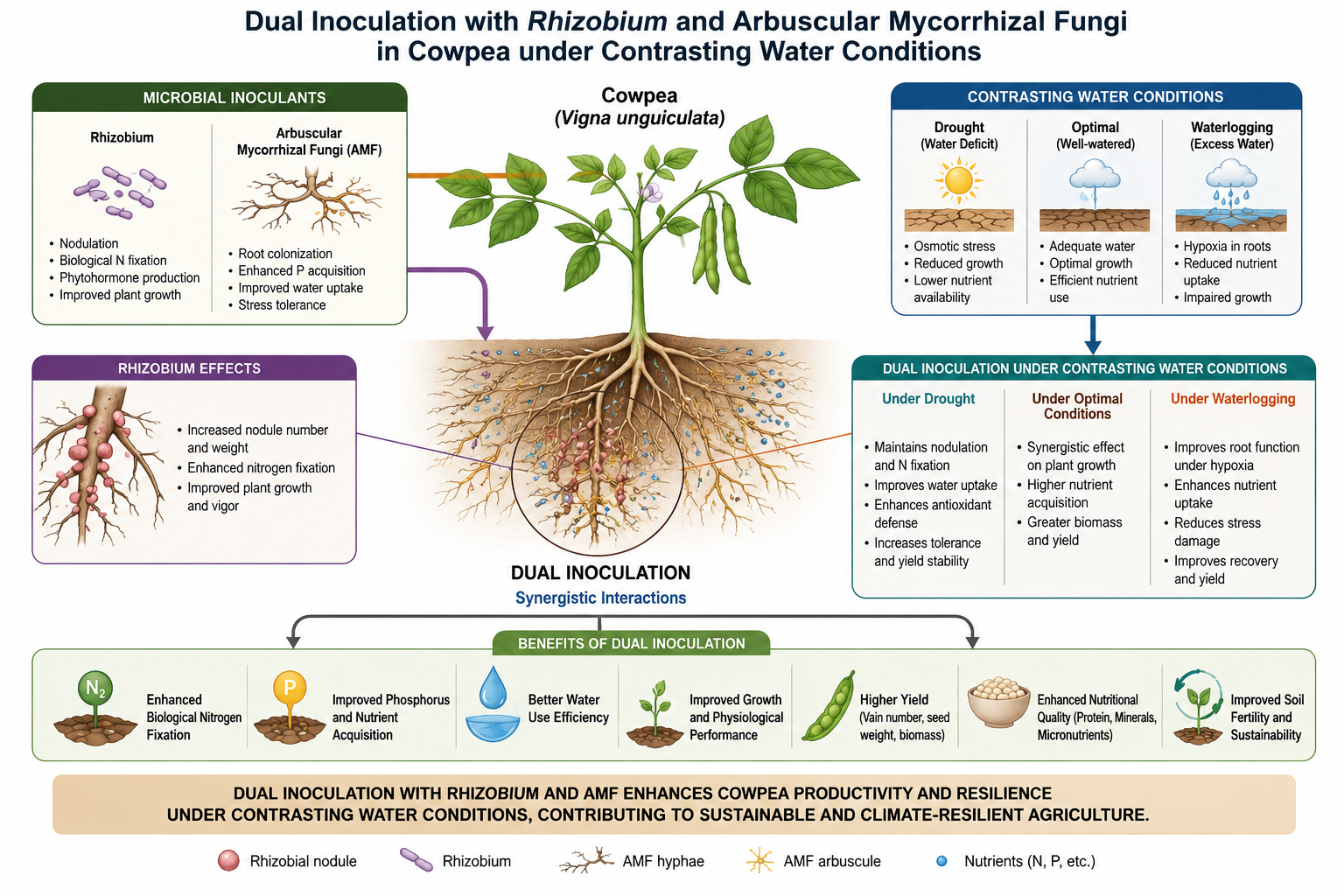
Evidence from cowpea indicates that microbial treatments can modify responses to drought (Pereira et al. 2021). Reported that co inoculation whit rhizobia and mycorrhizal fungi increased cowpea yield and crude protein content under drought stress (Pereira et al. 2021).
Bio inoculation Drought response Yield/ nutritional quality.
3.2 Excess water and waterlogging
Excessive water represents a physiologically different form of stress. Water saturation decreases oxygen availability in the root zone and can therefore interfere with root metabolism, nutrient uptake, growth and productive performance; an investigation waterlogging at different cowpea growth stages and reported reduction in growth, seed yield and quality (Olorunwa et al. 2023).
Water Deficit optimal water availability Excess Water
1. Rhizobium Cowpea symbiosis
The symbiotic relation between legumes and rhizobia begins the through molecular communication between plant roots and compatible bacteria. Flavonoids released by the plant participate in activation bacterial nodulation pathways, leading to root infection and development of specialized nodules. The molecular and cellular mechanisms regulation nodulation have been extensively investing (Laane et al. 1978; Dusha et al. 1986; Lloret and Martínez-Romero 2005; Tilak et al. 2006; Kawaharada et al. 2015; Rachwał et al. 2016).
2. Arbuscular Mycorrhizal Fungi in Cowpea
Arbuscular mycorrhizal fungi establish mutualistic association with plant roots. Hyphae colonize the root and develop specialized structures that facilitate resource exchange between the fungal symbiotic and planta (Caldera et al. 2013).
AMF are particular relevant to nutrient acquisition because their hypha network can increase soil exploration and contribution to the acquisition of nutrient with relatively low mobility, especially prosphoras (Thoker and Patel 2020).
3. Dual inoculation with Rhizobium and AMF
Dual inoculation with Rhizobium and AMF represents a promising biological strategy for improving cowpea performance through complementary symbiosis functions. Rhizobia bacterial contribute to de biological nitrogen fixation through the establishment of root nodules, whereas AMF colonize the root system and can enhance soil exploration and the acquisition of relatively immobile nutrients, phosphorous (Nápoles et al. 2007; Arumugam et al. 2011; Caldera et al. 2013b; Thoker and Patel 2020).
4. Plant Establishment and in vitro germination
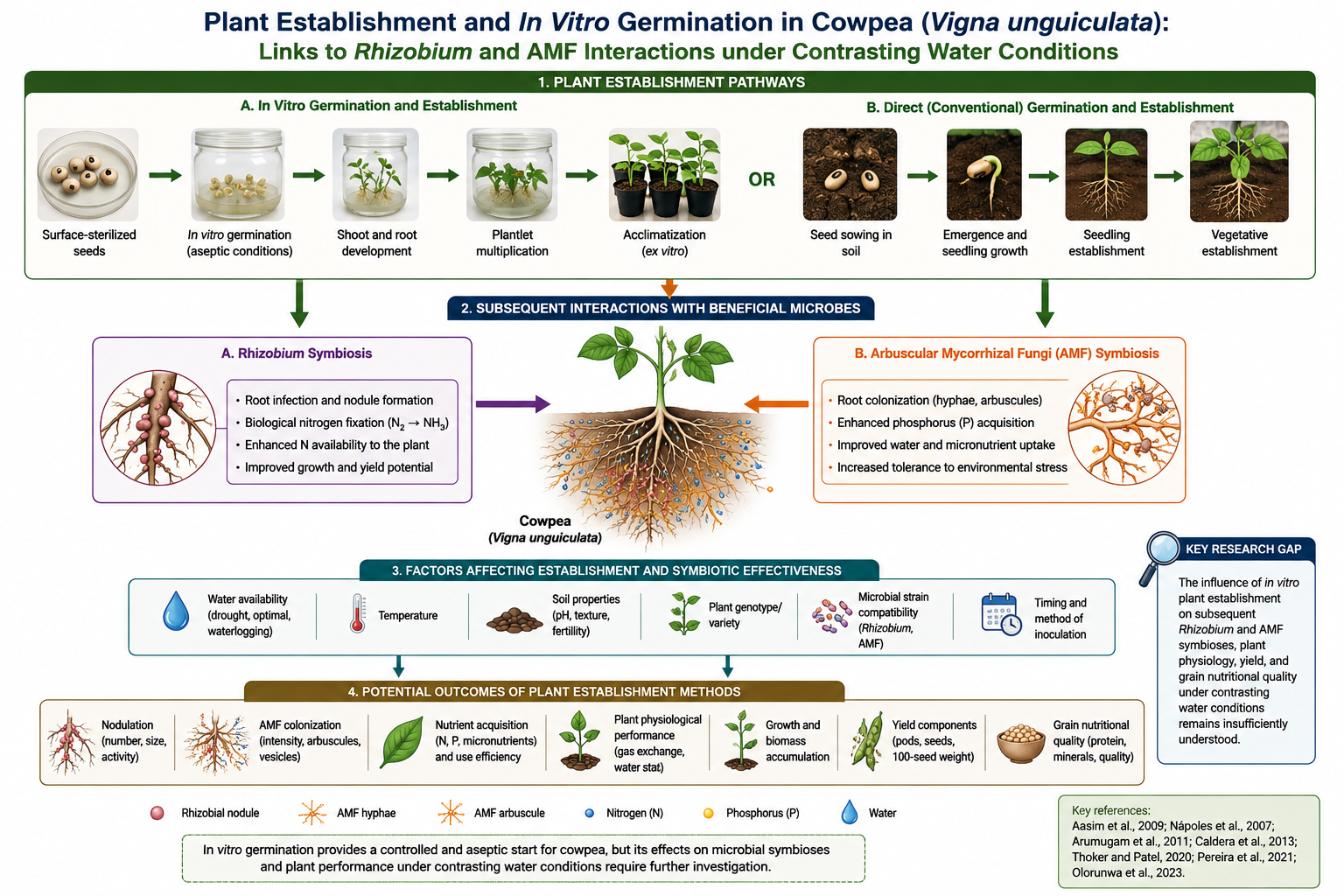
Plant establishment is an important stage in cowpea (Vigna unguiculata) production because early plant development can influence subsequent growth and the establishment of root-associated symbioses. In vitro culture provides a controlled and aseptic environment for plant establishment and has been successfully applied to cowpea for plant regeneration and propagation. Aasim et al. (2009) demonstrated the feasibility of in vitro regeneration of V. unguiculata using plumula apices, supporting the use of controlled tissue-culture conditions for cowpea establishment. Following establishment and acclimatization, plants may subsequently interact with beneficial soil microorganisms such as rhizobia and arbuscular mycorrhizal fungi, which contribute to biological nitrogen fixation and nutrient acquisition, respectively (Nápoles et al. 2007; Arumugam et al. 2011; Caldera et al. 2013; Thoker and Patel 2020).
However, the available evidence does not establish that in vitro germination directly enhances subsequent nodula the donde eres tion, AMF colonization, or plant performance under water stress. Therefore, the influence of plant establishment method on subsequent Rhizobium–AMF symbioses under contrasting water conditions represents an important area for future research.
5. Knowledge Gaps gaps emerge.
First, substantial evidence exists separately for rhizobial symbiosis, AMF colonization, drought effects, and waterlogging effects, but fewer studies integrate these processes within the same experimental framework.
Second, Pereira et al. (2021) provides evidence for rhizobia–AMF coinoculation under drought, while Olorunwa et al. (2023) demonstrates the importance of waterlogging. The intersection between those two research lines appears particularly important: dual bio inoculation under excessive water conditions.
Third, the influence of direct versus in vitro establishment on subsequent microbial symbiosis remains insufficiently established.
Fourth, many studies focus on one response category. Future experiments should simultaneously integrate agronomic + physiological + symbiotic + edaphic + nutritional variables, which is also the multidimensional structure you have developed in your doctoral proposal.
6. Conclusion
Cowpea (Vigna unguiculata) represents an important model for integrating biological nutrient management with adaptation to variable water environments. Existing evidence (Burgos Arzola 2017; Thoker and Patel 2020; Olorunwa et al. 2023)supports important roles for rhizobial symbiosis and arbuscular mycorrhizal fungi (AMF) in plant nutrition and demonstrates that water availability can substantially alter cowpea performance (Nápoles et al. 2007; Caldera et al. 2013b; Burgos Arzola 2017; Thoker and Patel 2020; Olorunwa et al. 2023)
Rhizobia inoculation contributes to biological nitrogen fixation through root nodulation, whereas AMF can improve soil exploration and the acquisition of relatively immobile nutrients, particularly phosphorus. The complementary functions of these microorganisms provide a biological basis for dual inoculation as a potential strategy for improving cowpea performance, and previous evidence indicates that co-inoculation can increase yield and crude protein content under drought stress (Pereira et al. 2021)
However, the effectiveness of these symbiotic associations should not be assumed to remain constant across contrasting water environments. Water deficit and waterlogging impose different constraints on plant and root functioning, and waterlogging can substantially reduce cowpea growth, seed yield, and quality (Olorunwa et al. 2023); Although microbial inoculation under drought has received increasing attention, the response of Rhizobium–AMF associations under excessive water conditions remains insufficiently understood. This represents an important knowledge gap for developing biologically based strategies capable of maintaining cowpea productivity under increasing environmental variability.
Plant establishment represents an additional research dimension. In vitro regeneration and establishment of cowpea have been demonstrated under controlled conditions (Aasim et al. 2009) however, the available evidence does not establish whether in vitro establishment subsequently enhances rhizobial nodulation, AMF colonization, or plant performance under water stress. Therefore, direct and in vitro establishment should be considered as potentially important experimental factors rather than assuming that either method provides superior subsequent symbiotic performance.
Overall, future research should integrate plant establishment method, rhizobial inoculation, AMF inoculation, and contrasting water conditions within multifactorial experimental frameworks. Simultaneous evaluation of nodulation, mycorrhizal colonization, nutrient acquisition, plant physiological responses, soil fertility, yield, and grain nutritional quality could provide a more comprehensive understanding of cowpea–microbe–water interactions. Such an integrated approach may contribute to the development of more sustainable and climate-resilient cowpea production systems while identifying the environmental conditions under which microbial bio inoculation provides the greatest agronomic and ecological benefits
References
- Aasim M, Khawar KM, Özcan S. 2009. In vitro micropropagation from plumular apices of Turkish cowpea (Vigna unguiculata L.) cultivar Akkiz. Sci Hortic. 122(3):468–471 [accessed 2025 May 17]. DOI ↗ Google Scholar ↗
- Abebe BK, Alemayehu MT. 2022. A review of the nutritional use of cowpea (Vigna unguiculata L. Walp) for human and animal diets. J Agric Food Res. 10:100383 [accessed 2025 Apr 29]. DOI ↗ Google Scholar ↗
- Arumugam R, Rajasekaran S, Nagarajan S. 2011. Response of Arbuscular mycorrhizal fungi and Rhizobium inoculation on growth and chlorophyll content of Vigna unguiculata (L) Walp Var. Pusa 151. J Appl Sci Environ Manag. 14. DOI ↗ Google Scholar ↗
- Burgos Arzola BA. 2017. EFECTO DE LA INOCULACIÓN CON Rhizobium spp. SOBRE LA COSECHA DE GRANOS DEL FRIJOL Vigna unguiculata. [accessed 2025 Apr 29]. DOI ↗ Google Scholar ↗
- Caldera E et al. 2013a. RESPUESTA DEL CULTIVO FRÍJOL (Vigna unguiculata L. Walp) VARIEDAD CATATUMBO A LA INOCULACIÓN CON MICORRIZAS NATIVAS Y COMERCIALES BAJO CONDICIONES CONTROLADAS Response of a Catatumbo Variety Bean Crop (Vigna unguiculata L. Walp) to Native and Commercial Mycorrhizal Inoculants under Controlled Conditions. REDIELUZ. 3:157–164 DOI ↗ Google Scholar ↗
- Caldera E et al. 2013b. RESPUESTA DEL CULTIVO FRÍJOL (Vigna unguiculata L. Walp) VARIEDAD CATATUMBO A LA INOCULACIÓN CON MICORRIZAS NATIVAS Y COMERCIALES BAJO CONDICIONES CONTROLADAS Response of a Catatumbo Variety Bean Crop (Vigna unguiculata L. Walp) to Native and Commercial Mycorrhizal Inoculants under Controlled Conditions. REDIELUZ. 3:157–164 DOI ↗ Google Scholar ↗
- Dusha I et al. 1986. A cell-free system from Rhizobium meliloti to study the specific expression of nodulation genes. Eur J Biochem. 160(1):69–75. DOI ↗ Google Scholar ↗
- Kawaharada Y et al. 2015. Receptor-mediated exopolysaccharide perception controls bacterial infection. Nature. 523(7560):308–312. DOI ↗ Google Scholar ↗
- Kumar K S, Pindi PK. 2021. Data on host specificity and symbiotic association between indigenous Rhizobium BD1 strain and Vigna radiata (green gram). Data Brief. 39:107520 [accessed 2025 Oct 15]. DOI ↗ Google Scholar ↗
- Laane C, Haaker H, Veeger C. 1978. Involvement of the Cytoplasmic Membrane in Nitrogen Fixation by Rhizobium leguminosarum Bacteroids. Eur J Biochem. 87(1):147–153 [accessed 2025 Apr 29]. DOI ↗ Google Scholar ↗
- Lloret L, Martínez-Romero E. 2005. Evolución y filogenia de Rhizobium. Rev Latinoam Microbiol. [published online ahead of print] DOI ↗ Google Scholar ↗
- Mansor KJAA-, Tahathaher AZ. 2020. IMPROVED COWPEA (Vigna unguiculata L. WALP.) RHIZOBIUM TOLERATE TO DROUGHT AND SALINITY CONDITIONS USING CO-INCULATION. PLANT CELL Biotechnol Mol Biol. 78–85 [accessed 2025 Oct 16]. https://ikprress.org/index.php/PCBMB/article/view/5611 Google Scholar ↗
- Nápoles MC, Gómez G, Costales D. 2007. FACTORES DE NODULACIÓN. EXPERIENCIA EN CUBA. Cultiv Trop. 28(4):71–80 DOI ↗ Google Scholar ↗
- Olorunwa OJ et al. 2023. Waterlogging stress reduces cowpea (Vigna unguiculata L.) genotypes growth, seed yield, and quality at different growth stages: Implications for developing tolerant cultivars under field conditions. Agric Water Manag. 284:108336 [accessed 2026 Aug 19]. DOI ↗ Google Scholar ↗
- Pereira S et al. 2021. Co-inoculation with rhizobia and mycorrhizal fungi increases yield and crude protein content of cowpea (Vigna unguiculata (L.) Walp.) under drought stress. DOI ↗ Google Scholar ↗
- Rachwał K et al. 2016. The Regulatory Protein RosR Affects Rhizobium leguminosarum bv. trifolii Protein Profiles, Cell Surface Properties, and Symbiosis with Clover. Front Microbiol. 7. DOI ↗ Google Scholar ↗
- Ramírez-Jaramillo G, Ruelas AC, Ramírez-Silva JH, Lozano-Contreras MG. 2022. Productive Potential of Vigna unguiculata L., under Mexican Rainfed Conditions. Open Access Libr J. 9(12):1–14 [accessed 2025 Oct 15]. DOI ↗ Google Scholar ↗
- Ramos E, Zúñiga D. 2008. EFECTO DE LA HUMEDAD, TEMPERATURA Y PH DEL SUELO EN LA ACTIVIDAD MICROBIANA A NIVEL DE LABORATORIO. Ecol Apl. 7(1–2):123 [accessed 2025 Apr 29]. http://revistas.lamolina.edu.pe/index.php/eau/article/view/367. DOI ↗ Google Scholar ↗
- Romero YLC, Baños YS, Miranda E. 2017. Efecto de la inoculación de Rhizobium sobre el crecimiento de Phaseolus vulgaris (frijol) en condiciones semicontroladas. DOI ↗ Google Scholar ↗
- SH P, DHANORKAR M, PATIL Y, RALE V. 2024. Agriculturally important functioning of beneficial microorganisms for healthy ecosystem maintenance. In: The Potential of Microbes for a Circular Economy. Academic Press; p 149–183 [accessed 2026 Apr 24]. DOI ↗ Google Scholar ↗
- Thoker SA, Patel S. 2020. Effect of Arbuscular Mycorrhizal Fungi on Growth and Nutrient Status of Vigna unguiculata (L.). Adv Zool Bot. 8(5):461–467 [accessed 2026 Apr 24]. http://www.hrpub.org/journals/article_info.php?aid=9621. DOI ↗ Google Scholar ↗
- Tilak K, Nandanavanam R, Manoharachari C. 2006. Synergistic effects of plant-growth promoting rhizobacteria and Rhizobium on nodulation and nitrogen fixation by pigeonpea (Cajanus cajan). Eur J Soil Sci. 57. DOI ↗ Google Scholar ↗
- Tu JC. 1981. EFFECT OF SALINITY ON RHIZOBIUM-ROOT-HAIR INTERACTION, NODULATION AND GROWTH OF SOYBEAN. Can J Plant Sci. 61(2):231–239 [accessed 2025 June 10]. http://www.nrcresearchpress.com/doi/. DOI ↗ Google Scholar ↗
- Zahran HH. 1999. Rhizobium-Legume Symbiosis and Nitrogen Fixation under Severe Conditions and in an Arid Climate. Microbiol Mol Biol Rev. 63(4):968–989 [accessed 2025 Oct 15]. DOI ↗ Google Scholar ↗