Abstract
Developing Arabic speaking skills among non-native learners remains a complex area of language education due to the interaction of linguistic, psychological, pedagogical, sociolinguistic, and contextual factors. This study systematically reviews the existing literature to examine the major challenges associated with Arabic speaking-skill development among non-native learners, while also identifying methodological patterns, population and sampling characteristics, dominant research aims, influential scholarly contributions, key findings, and future research directions. A systematic literature review was conducted using the Scopus database, covering English-language journal articles published between 2000 and 2025. The review followed a structured screening and selection process guided by the PRISMA framework. Following database filtering, 939 records were retained for title, abstract, and full-text screening, after which studies meeting the predefined inclusion criteria were selected for final synthesis. Data were organised and analysed using Scopus and Microsoft Excel, and the findings were synthesised through descriptive and thematic analysis. The review indicates that non-native learners experience multiple challenges in developing Arabic speaking competence, including pronunciation and phonological difficulties, limited vocabulary, grammatical complexity, first-language interference, speaking anxiety, lack of confidence, insufficient opportunities for authentic oral communication, instructional limitations, and difficulties associated with Arabic diglossia. The reviewed literature also highlights the importance of communicative and learner-centred instructional approaches, meaningful oral practice, supportive learning environments, and appropriate use of technology in strengthening speaking development. The study concludes that Arabic speaking competence is multidimensional and requires an integrated approach that combines linguistic development, psychological support, communicative practice, and sociolinguistic awareness. Future research should employ more rigorous and diverse research designs, including broader learner populations, investigate emerging technologies, and develop more consistent measures of Arabic speaking competence.
Keywords
Arabic speaking skills non-native learners Arabic language learning speaking challenges systematic literature review oral proficiency
1 Background And Literature Review
Arabic is learned across increasingly diverse linguistic, educational, cultural, and religious environments, creating growing interest in how the language can be taught effectively to non-native speakers. Learners approach Arabic with different motivations and expectations, and these differences can shape both engagement and achievement. Ajape et al. (2015), for example, demonstrated the importance of learner motivation and attitudes toward Arabic among university students in Nigeria. Akmaliyah et al. (2021) showed that the instructional environment itself also matters, particularly when Arabic teaching is designed around learner-friendly pedagogical principles. From an institutional perspective, Alandejani and Sayed (2024) illustrated how high-impact educational practices can be integrated with Arabic communication competency, while Alsaied (2024) drew attention to the broader challenges of teaching Arabic under contemporary global conditions. Eldin (2015) further emphasised that language education cannot be separated from cultural learning. Taken together, these studies position Arabic acquisition as a multifaceted educational process in which communicative proficiency depends on more than formal mastery of linguistic rules.
The diversity of non-native Arabic learners further complicates the development of effective language programmes. Hussien (2018) demonstrated that learners' perceptions of communicative traits are relevant to Arabic language education, highlighting the importance of how communication is conceptualised within instruction. Kamal (2025) similarly identified contemporary challenges, strategies, and opportunities surrounding Arabic teaching in higher education. Focusing specifically on learner requirements, Khasawneh (2022) showed that Arabic-as-a-foreign-language students possess identifiable needs that should inform programme planning. Khasawneh and Khasawneh (2022) likewise demonstrated that the linguistic needs of non-native students require systematic attention within university settings. Mohammad Lotfie et al. (2013), examining students' perceptions of an Arabic course, further showed the value of understanding learners' experiences when evaluating instructional effectiveness. These studies collectively indicate that Arabic programmes need to respond to who the learners are, why they are learning Arabic, and how they expect to use the language; these considerations become particularly important when the primary goal is oral communication.
Speaking represents one of the most demanding dimensions of Arabic acquisition because learners must transform linguistic knowledge into real-time communication. Haron (2013) found that learners themselves viewed teaching methodology as a central factor in the development of Arabic speaking skills. Yaakub et al. (2012) demonstrated that role-play provides opportunities for learners to practise speaking through active and contextualised language use. Samah et al. (2013), in their examination of Arabic debate instruction, similarly highlighted the pedagogical value of structured speaking activities. Marpuah and Sulton (2019) showed that communicative-active methods can contribute to greater mastery of Arabic communication. Al-Khresheh et al. (2020) further demonstrated the effectiveness of pictures as instructional stimuli for beginner non-native learners developing speaking skills. Collectively, this evidence suggests that spoken competence develops most effectively when learners are required to actively produce Arabic rather than merely study its structures.
Contemporary research has extended this communicative orientation by experimenting with more varied instructional designs. Aburezeq (2020) reported that flipped-classroom instruction could contribute to the development of Arabic speaking skills by reorganising how learners interact with course content and classroom activities. Alhajya et al. (2018) demonstrated that virtual trips could provide contextualised opportunities for developing oral Arabic among school learners. Harrathi et al. (2024) investigated cognitive activation strategies and their potential to strengthen oral Classical Arabic communication competency. Hasaniyah et al. (2023) approached the issue from the perspective of teaching-material development, illustrating how contextually grounded materials can be designed specifically for Arabic speaking instruction. Koderi et al. (2023) similarly incorporated local cultural content into materials intended to strengthen Arabic communication skills. Although these interventions differ substantially, they share a common pedagogical implication: effective speaking instruction requires environments, tasks, and materials that prompt meaningful language production.
Linguistic knowledge nevertheless remains fundamental to successful oral production. Alawfi (2024) argued for the importance of functional morphology in Arabic programmes for non-native learners, indicating that learners require structural knowledge that can be applied communicatively. Jarrah (2022) illustrated the complexity involved in acquiring Arabic syntactic structures through the study of relative clauses among second-language learners. Syihabuddin et al. (2024) drew attention to nominal gender agreement and the role of teaching materials in supporting grammatical acquisition. At the lexical level, Masrai and Milton (2019) demonstrated the importance of vocabulary size for functional Arabic ability by asking how many words learners need in order to use the language. Azaz (2019) further showed that first-language transfer can affect the production of Arabic grammatical structures. These findings suggest that oral fluency depends not merely on willingness to speak but also on the learner's ability to retrieve and manipulate lexical and grammatical knowledge rapidly during communication.
Pronunciation adds another substantial layer of difficulty because the Arabic sound system contains patterns that may be unfamiliar to non-native learners. Huneety et al. (2020) demonstrated first-language influence on Arabic stress production among Cebuano learners. Mohd Rifain et al. (2024) identified the need for targeted Arabic phonetics instruction to support accurate articulation of Arabic letters. The issue is further complicated by Arabic's diglossic structure. Saiegh-Haddad (2003) showed that linguistic distance between spoken Arabic and standard forms can affect language development, while Oueini et al. (2020) demonstrated consequences of diglossia for the development of Classical Arabic among bilingual learners. At a more specific phonological level, Aldossari et al. (2025) identified language-specific and orthographic influences on the production of Arabic geminates by advanced Japanese- and English-speaking learners. Together, these studies indicate that speaking difficulties may emerge from the interaction of first-language phonology, Arabic-specific sound contrasts, orthographic influences, and the coexistence of different Arabic varieties.
Recent work on pronunciation has consequently moved beyond identifying errors toward examining how instruction can improve speech perception and production. Shehata (2024a) demonstrated that pronunciation instruction can affect learners' cognition and speech comprehensibility, indicating that explicit attention to pronunciation has communicative consequences. In a complementary investigation, Shehata (2024b) showed that learners' perception of Arabic consonant contrasts varies according to factors such as learning context. Smith et al. (2022) provided further evidence that perceptual training can help English-speaking learners discriminate Arabic consonants absent from their first-language system. Technology has also entered this area: Aljojo et al. (2019) developed an Arabic pronunciation application designed to support pronunciation learning, while Alkhatib et al. (2017) integrated Arabic speech recognition into a mobile pronunciation-learning application. These developments indicate a growing shift from pronunciation as an incidental classroom concern toward pronunciation as a teachable and technologically supportable component of oral proficiency.
Automated speech technologies have accelerated this shift. Maqsood et al. (2019) developed a system for detecting mispronunciation of Arabic consonants using acoustic-phonetic features, demonstrating the potential of computational methods for learner feedback. Necibi and Bahi (2015) similarly investigated statistical approaches to Arabic pronunciation assessment. More recently, Çalık et al. (2023) used audio-oriented transformer models to develop an automated framework for detecting Arabic phoneme mispronunciation. Alrashoudi et al. (2025) extended this work by focusing specifically on improving mispronunciation detection and diagnosis for non-native Arabic learners. Fanoush et al. (2025) applied transfer-learning techniques to mispronunciation detection among younger Arabic learners. Such studies show that pronunciation instruction is increasingly intersecting with artificial intelligence and speech-processing research; however, accurate phoneme production remains only one component of broader communicative competence.
Psychological and motivational conditions also shape learners' willingness and ability to speak Arabic. Abdelhalim and Alqubayshi (2020) demonstrated that motivation and language acculturation interact within the experiences of English-speaking adults learning Arabic in Saudi Arabia. Alhamami and Almosa (2023) further showed that Arabic learners may be influenced by distinctive motivational orientations, including religious motivations. Recognising the need for rigorous measurement, Alshammari et al. (2024) examined instruments designed to assess motivation in Arabic as a second language. Belnap et al. (2025) extended the discussion of individual differences by examining physiological and personality-related predictors of Arabic proficiency during study abroad. At the classroom level, Ismail et al. (2020) found that motivation mediates relationships between teachers' non-verbal communication and learners' outcomes. Ismail et al. (2023) specifically linked oral-language anxiety with Arabic learning outcomes. These findings demonstrate that learners' oral performance cannot be understood solely through linguistic ability; affective states, individual characteristics, teacher behaviour, and motivation influence whether available linguistic knowledge is actually used.
Research focusing specifically on oral Arabic provides even stronger evidence of this affective dimension. Nassif (2019) demonstrated a relationship between language anxiety, noticing, and oral production among beginning learners of Arabic. Selim and Abdalla (2022) showed that motivation and engagement among adolescent non-Arab Muslim learners are embedded within distinctive educational and identity-related experiences. Yusri et al. (2011) documented test anxiety among students taking oral Arabic courses, showing that evaluative settings themselves can generate psychological pressure. Yusri et al. (2012b) found differences in oral-Arabic motivation according to learners' previous experience and gender, while Yusri et al. (2012a) demonstrated that attitudes toward learning oral Arabic also vary between learner groups. Yusri et al. (2012c) further linked oral Arabic practice with learners' resource-management strategies. These studies indicate that speaking development involves an ongoing relationship between opportunity, motivation, self-regulation, confidence, and anxiety, making affective conditions central to any synthesis of speaking challenges.
Oral proficiency is also developed through interaction rather than through isolated production. Al Masaeed (2016) showed that judicious use of learners' first language can support Arabic speaking-practice sessions, challenging assumptions that effective L2 interaction must always be strictly monolingual. Al Masaeed (2020) subsequently demonstrated how multidialectal and multilingual translanguaging naturally occurs during Arabic study-abroad interactions. In a longitudinal investigation, Al Masaeed (2023) showed how collaborative repair during dyadic conversations creates opportunities for learning new language forms. Pragmatic development is equally important: Al Masaeed et al. (2018) demonstrated developmental patterns in learners' production of Arabic apology strategies. Al-Gahtani and Roever (2014) similarly showed that Arabic learners at different proficiency levels vary in their ability to participate in extended request interactions. These studies reveal that speaking proficiency encompasses far more than sentence-level accuracy; it includes managing breakdowns, selecting linguistic resources strategically, and producing socially appropriate language during interaction.
Feedback, multidialectal practices, and immersion further shape this interactional development. Brosh (2024) found that learners hold identifiable preferences regarding oral corrective feedback in Arabic as a foreign language, underscoring the importance of how teachers respond to spoken errors. Kawafha and Al Masaeed (2023) demonstrated that actual Arabic classroom practices may involve multidialectal and multilingual translanguaging even when teacher beliefs or institutional expectations favour narrower language choices. Mahmoud (2025) provided evidence that cultural immersion can support advanced second-language Arabic speaking development. Trentman (2017), examining learners studying abroad in Egypt, showed that oral fluency and sociolinguistic competence are related to language contact. Esmaili and Rakati (2022) directly investigated students' experiences of challenges in creating an Arabic-speaking learning environment. Collectively, these studies show that oral proficiency emerges through interaction with people, dialects, feedback, communities, and opportunities for authentic use.
Digital learning environments can expand such opportunities beyond conventional classroom boundaries. Mahmoud et al. (2013) demonstrated the feasibility of integrating an interactive virtual tutor into Arabic instruction for non-native speakers. Mohammed (2022) designed an e-course specifically for Arabic speaking and listening skills, showing how digital resources and activities can be organised around oral-language development. Ritonga et al. (2022) examined Duolingo as a platform for developing Arabic speaking skills among adult learners. Ghani and Daud (2023) demonstrated that digital game-based learning can contribute to Arabic language communication. Rahimi et al. (2015) reported learners' responses to the use of Facebook in Arabic learning, illustrating the potential of familiar social platforms to extend language engagement. These findings indicate that technology can increase access to language practice, although its value depends on whether learners are required to communicate meaningfully rather than merely complete digital exercises.
Technology-mediated Arabic learning has subsequently diversified considerably. Kassim et al. (2023) showed that learner readiness is a significant consideration in virtual second-language environments, suggesting that technology cannot be assumed to benefit all learners equally. Shehab and Zeki (2015) examined web-assisted Arabic learning and illustrated how digital systems may support instruction through linguistic connections such as cognates. Solimando (2025) explored computer-mediated communication and exposure to authentic forms of digital Arabic, broadening the communicative contexts available to learners. Wan Daud et al. (2021) developed augmented-reality materials to support Arabic vocabulary learning, demonstrating how emerging technologies can enrich lexical learning. Abazoglu and Alhourani (2025) further showed the potential of computational linguistics and language corpora in Arabic instruction for Turkish speakers. These developments position technology not as a single intervention but as an increasingly diverse ecosystem of tools with potential implications for vocabulary, exposure, interaction, and speaking.
Artificial intelligence represents the newest stage of this development. Al-Jamali and Abdalla (2025) investigated behavioural factors influencing AI-driven Arabic language learning, showing that successful adoption depends partly on learner perceptions and intentions. Al-Shaboul et al. (2025) examined the broader role of AI in Arabic learning, translation, and speech recognition, highlighting both opportunities and challenges. Abu-Qtaish (2024) showed that learning applications can also intersect with cultural intelligence and acculturation among non-native Arabic learners. Antar and Elsayed (2025) demonstrated how social-media environments such as TikTok may be used to strengthen university students' Arabic language skills. Aljenobi (2025), meanwhile, linked the challenges experienced by non-native Arabic learners during pandemic-era education with digital skills and oral-expression abilities. Together, these studies indicate that digital transformation is changing both the opportunities and the challenges surrounding Arabic speaking development.
Nevertheless, technological solutions operate within broader pedagogical and sociocultural conditions. Almelhes (2024) identified strategies for addressing the challenges experienced by non-native Arabic learners and emphasised the need for responsive instructional approaches. Alqbailat et al. (2025) demonstrated that religious, cultural, and literary rhetorical elements form part of the language experience of non-native learners, showing that Arabic proficiency is embedded within cultural discourse. Amat and Ab Hadi (2024) highlighted extralinguistic factors affecting mastery of oral Arabic skills, thereby extending the discussion beyond grammar and pronunciation. Asli-Badarneh (2025) showed that Arabic diglossia can have broader developmental implications, reinforcing the significance of the relationship between language varieties. Brosh (2019) further identified patterns in learners' language-learning strategy preferences. These findings indicate that speaking challenges arise not from one deficiency but from the interaction of linguistic, strategic, cultural, psychological, and environmental factors.
Speaking competence is also closely connected to other language skills, and this interdependence must be recognised when interpreting oral difficulties. Al Khateeb and Hassan (2022), while examining peer feedback in telecollaborative foreign-language learning, demonstrated how interaction with peers can contribute to language development across geographical contexts. Izzuddin et al. (2020) showed that Arabic curricula can be purposefully developed to improve writing, illustrating how instructional design shapes productive language skills. Khasawneh (2021) demonstrated that specialised modelling can improve handwriting performance among learners of Arabic as another language, showing that different productive competencies may require targeted intervention. Midhwah and Alhawary (2020) found that Arabic diacritics influence reading accuracy and comprehension among English-speaking L2 learners, while Rahimi et al. (2013) highlighted misconceptions surrounding Arabic listening instruction. Although these studies focus on different skills, they demonstrate that oral communication develops within a broader system of listening, literacy, vocabulary, and productive-language competence.
Contextual disruptions and learner differences further complicate this system. Rahmawati and Febriani (2021) documented problems encountered in Arabic learning in Islamic universities during the COVID-19 pandemic, showing how external educational conditions can reshape language-learning experiences. Russak and Fragman (2014) demonstrated cross-linguistic influences in Arabic spelling development among Hebrew-speaking learners, reinforcing the importance of first-language background. Safian et al. (2025) identified both problems and strategies associated with using literary texts in teaching Arabic to non-native speakers. Safrullah et al. (2022) demonstrated the importance of explicit support for Arabic syntactic understanding among school learners. Sala (2025), drawing on the experiences of foreign students in Tunis, showed how diglossia shapes Arabic learning in authentic sociolinguistic settings. Such findings confirm that the challenges experienced by learners vary according to educational disruption, first-language background, instructional material, linguistic focus, and social environment.
Research into language development also demonstrates the importance of age, cultural content, extracurricular learning, and learner strategies. Tallas-Mahajna and Dromi (2024) developed a measure of morphological development in spoken Arabic, illustrating the complexity of analysing language production even among native child populations and providing a useful reminder that spoken-language development itself is structurally multidimensional. Tayyara (2022) demonstrated that culturally rich materials such as Arabic proverbs can stimulate language and intercultural learning. Wicaksono et al. (2023) showed how Arabic communication development can also occur through extracurricular programmes and how such programmes can be systematically evaluated. Yusri et al. (2013) found that cognitive and metacognitive strategies are important components of oral Arabic learning. Lubis and Widiawati (2021) approached Arabic teaching phenomenologically, drawing attention to learners' and educators' lived experiences. These different perspectives demonstrate that oral-language development can be studied through linguistic, pedagogical, evaluative, strategic, and experiential lenses.
Despite the richness of this scholarship, the evidence concerning Arabic speaking development remains fragmented. Daud and Pisal (2014) directly identified speaking problems among learners of Arabic as a second language, yet the broader database shows that relevant challenges are distributed across studies of pronunciation, anxiety, instructional methodology, diglossia, interaction, motivation, digital learning, linguistic structure, and learner strategy. Ritonga et al. (2024), for example, demonstrated the increasing role of online learning and evaluation platforms in higher education, while Tibi (2010) showed that Arabic phonological awareness itself follows a developmental hierarchy. When such strands are considered separately, it becomes difficult to determine which challenges consistently affect non-native Arabic learners and how the different factors interact. A systematic synthesis is therefore needed to connect the linguistic, psychological, pedagogical, technological, sociolinguistic, and contextual evidence into a coherent account of Arabic speaking development.
Accordingly, this systematic literature review examines the challenges associated with developing Arabic speaking skills among non-native learners. Rather than treating speaking problems as a single linguistic deficit, the review considers pronunciation and phonology, vocabulary and grammar, first-language transfer, diglossia, affective conditions, learner motivation, instructional approaches, opportunities for interaction, digital technologies, sociocultural context, and learner characteristics collectively shape oral development. The review further examines the methodological characteristics of existing studies, their principal areas of knowledge, populations and sampling approaches, dominant research aims, influential scholarly contributions, key findings, and recommendations for future research. By integrating evidence that has previously been distributed across multiple strands of Arabic language research, the review aims to provide a more coherent evidence base for Arabic-speaking pedagogy, learner support, curriculum development, assessment, and future scholarship.
2. Research Aims
The study aims to provide a comprehensive bibliometric and evidence-based synthesis of research on the development of Arabic speaking skills among non-native learners. Specifically, the study seeks to:
-
Examine the methodological characteristics of existing studies on Arabic speaking-skill development among non-native learners;
-
Map the intellectual and conceptual structure of the literature and identify the principal knowledge clusters shaping the field;
-
Analyze the population characteristics and sampling approaches employed in previous studies;
-
Identify and synthesize the major challenges encountered by non-native learners in developing Arabic speaking skills;
-
Examine the dominant research aims and thematic orientations represented in the literature;
-
Identify the most influential authors and publications based on citation impact;
-
Synthesize the principal findings reported across the existing body of research; and
-
Identify research gaps and formulate recommendations for future research, pedagogical practice, and Arabic language education.
3. Methodology
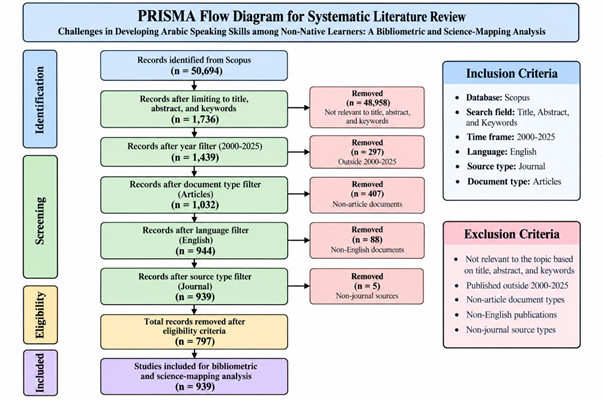
This study employed a systematic literature review approach to identify, evaluate, and synthesise existing research on the challenges associated with developing Arabic speaking skills among non-native learners. A systematic review was considered appropriate because it provides a structured and transparent process for locating relevant studies, applying predefined eligibility criteria, extracting comparable information, and synthesising findings across literature. The methodological process involved database selection, development of the search strategy, application of inclusion and exclusion criteria, screening and study selection, data extraction, and systematic analysis of the selected studies. Scopus was used as the main database for identifying relevant literature, while Microsoft Excel was used to organise, classify, and analyse the extracted information. The study-selection process was documented using a PRISMA-style flow diagram to ensure transparency and reproducibility.
3.1 Research Design
This study adopted a systematic literature review design to examine the challenges involved in developing Arabic speaking skills among non-native learners. A systematic review approach was selected because it provides a transparent and structured method for identifying, screening, evaluating, and synthesising relevant studies. The review was designed to identify recurring challenges, methodological patterns, contextual factors, and research gaps reported in the literature on Arabic speaking-skill development among non-native learners.
3.2 Database And Search Strategy
The literature search was conducted using the Scopus database. The search covered studies published between 2000 and 2025 and focused on research related to Arabic speaking, oral proficiency, oral communication, pronunciation, conversation, and speaking-skill development among non-native, foreign-language, or second-language learners. The search was conducted on 29 September 2026. The database search was limited to English-language journal articles to ensure consistency in the selected literature and to facilitate systematic comparison across studies.
3.3 Inclusion And Exclusion Criteria
Studies were included if they were indexed in Scopus, published between 2000 and 2025, written in English, published as journal articles, and directly related to Arabic speaking-skill development among non-native learners. Eligible studies were required to address speaking, oral communication, pronunciation, oral proficiency, conversation, or closely related dimensions of Arabic language learning. Studies were excluded if they were published outside the selected period, written in languages other than English, classified as non-journal or non-article publications, focused mainly on native Arabic speakers, or did not address issues directly related to speaking-skill development. Studies that lacked sufficient relevance based on title, abstract, or full-text assessment were also excluded.
3.4 Study Screening And Selection
The study-selection process followed a structured sequence of identification, screening, eligibility assessment, and final inclusion. Records retrieved from Scopus were first screened based on their titles and abstracts. Studies that appeared relevant were then examined in greater detail through full-text assessment. During this stage, the inclusion and exclusion criteria were applied consistently to determine whether each study directly addressed the challenges associated with developing Arabic speaking skills among non-native learners. The final number of studies included in the systematic review was based on this detailed screening process. The study-selection process was documented using a PRISMA-style flow diagram to ensure transparency and reproducibility.
3.5 Data Extraction
Data from the selected studies were extracted systematically and entered Microsoft Excel. The extraction framework included information on author, year of publication, country or research context, study purpose, research design, participant characteristics, type of learner, speaking skill examined, reported challenges, key findings, and recommendations. The use of a structured extraction framework helped ensure consistency across the selected studies and supported comparison of findings across different research contexts.
3.6 Data Analysis And Synthesis
The systematic review data were analysed using Scopus and Microsoft Excel. Scopus was used to retrieve and verify the selected literature, while Microsoft Excel was used to organise, classify, and compare the extracted information. The findings were synthesised thematically by grouping similar challenges and findings into broader categories. Particular attention was given to recurring issues such as linguistic difficulties, pronunciation problems, vocabulary limitations, speaking anxiety, lack of confidence, limited opportunities for oral practice, instructional challenges, and contextual factors. The thematic synthesis was used to identify dominant patterns in the literature and to highlight areas requiring further research.
3.7 Prisma Reporting
The study-selection process was presented using a PRISMA-style flow diagram showing the number of records identified, screened, excluded, assessed for eligibility, and finally included in the review. The use of PRISMA-based reporting strengthened the transparency of the review process and provided a clear account of how the final body of literature was selected.
3.4 Data Screening And Selection Process
The retrieved records were subjected to a systematic screening and selection process to ensure that only studies directly relevant to the challenges of developing Arabic speaking skills among non-native learners were included in the review. Following the application of the predefined database filters, 939 records were retained as the initial pool for systematic screening. The bibliographic information was exported from Scopus to Microsoft Excel, where the records were organised and screened systematically.
The screening process was conducted in sequential stages. First, the titles of the retrieved articles were examined to remove studies that were clearly unrelated to Arabic language learning, speaking skills, oral communication, or non-native learners. The abstracts of the remaining studies were then reviewed to determine their alignment with the objectives and inclusion criteria of the review. Studies that focused exclusively on native Arabic speakers, unrelated language skills, or contexts outside the scope of the review were excluded at this stage.
Following title and abstract screening, the full texts of the potentially eligible articles were assessed in greater detail. Particular attention was given to whether the studies addressed Arabic speaking, oral proficiency, pronunciation, oral communication, conversation, speaking-related challenges, or factors influencing speaking-skill development among non-native learners. Studies that did not provide sufficient evidence relevant to these dimensions were excluded during the full-text assessment.
The screening and selection procedure was guided by the PRISMA framework to enhance transparency, methodological consistency, and reproducibility. The number of records identified, screened, excluded, assessed for eligibility, and finally included in the systematic review was documented at each stage and presented in the PRISMA flow diagram. Following the completion of the screening and eligibility assessment, [n = 939] studies that satisfied all inclusion criteria were retained for the final systematic review and synthesis.
4. Results
This section presents the findings of the systematic literature review according to eight major analytical dimensions. The results include the methodological characteristics of the reviewed studies, the major areas of knowledge represented in the literature, population and sampling characteristics, challenges associated with developing Arabic speaking skills, the principal aims of previous studies, influential authors and publications based on citation impact, key findings reported across the literature, and recommendations for future research and practice. The findings are presented through descriptive and thematic synthesis in order to provide a comprehensive understanding of the current state of research on Arabic speaking-skill development among non-native learners.
4.1 Methodological Characteristics Of The Reviewed Studies
The first area of analysis concerns the methodological characteristics of the studies included in the systematic review. This analysis examines how previous researchers have investigated Arabic speaking-skill development among non-native learners and identifies the dominant methodological approaches within the field. The studies should be classified according to their research design, including quantitative, qualitative, mixed-methods, experimental, quasi-experimental, descriptive, correlational, case-study, and other relevant approaches.
The analysis should also consider the principal methods used for data collection. These may include questionnaires, interviews, classroom observations, oral proficiency assessments, speaking tests, achievement tests, learner reflections, focus-group discussions, and experimental tasks. Identifying the commonly used instruments provides insight into how Arabic speaking competence has been operationalised and measured across different studies.
The findings should further examine the analytical techniques employed. Quantitative studies may use descriptive statistics, inferential tests, correlation, regression, or comparison of experimental and control groups, while qualitative studies may employ thematic analysis, content analysis, discourse analysis, or interpretive approaches. Mixed-methods studies may integrate quantitative and qualitative evidence to provide a more comprehensive understanding of learners' experiences.
The interpretation of methodological patterns should extend beyond simple frequency counts. Particular attention should be given to whether the field is dominated by cross-sectional and descriptive research or whether there is sufficient use of experimental, longitudinal, and mixed methods designs. This assessment will help determine the methodological maturity of the field and identify areas requiring stronger research designs.
4.2 Intellectual And Knowledge Structure Of The Literature
The second area of analysis examines the major bodies of knowledge, conceptual themes, and theoretical orientations represented in the reviewed literature. In the context of a systematic literature review, the intellectual structure should be identified through the substantive content of the selected studies rather than through network mapping.
The reviewed studies should be grouped according to their principal areas of scholarly focus. These may include Arabic language pedagogy, oral proficiency, communicative competence, pronunciation and phonological development, vocabulary acquisition, speaking anxiety, motivation, second-language acquisition, classroom interaction, technology-supported language learning, and sociolinguistic dimensions of Arabic.
This section should identify which areas have received substantial scholarly attention and which remain comparatively underdeveloped. For example, a large proportion of studies may focus on instructional strategies or pronunciation, whereas relatively fewer may examine interactional competence, spontaneous communication, sociocultural influences, or long-term speaking development.
The analysis should also consider the theoretical perspectives underpinning the studies. These may include communicative language teaching, second-language acquisition theories, sociocultural perspectives, affective theories of language learning, constructivist learning approaches, or technology-mediated learning frameworks. Examining these theoretical orientations can reveal how researchers have conceptualised Arabic speaking development and whether the field is theoretically diverse or concentrated around a limited number of perspectives.
Overall, this section should provide a structured account of the main knowledge domains shaping research on Arabic speaking skills among non-native learners and identify conceptual gaps requiring further scholarly attention.
4.3 Population Characteristics And Sampling Approaches
This section examines the characteristics of the participants included in previous studies and the sampling techniques used to recruit them. Population characteristics should be analysed in relation to learners' educational level, age, country, linguistic background, Arabic proficiency level, institutional setting, and learning context.
The review should determine whether the existing evidence is concentrated primarily among university students, school learners, adult learners, international students, or learners enrolled in Arabic as a foreign or second language programmes. The geographical distribution of participants should also be examined to determine whether research has been concentrated in particular countries or regions.
An important consideration is learners' first-language background. Arabic speaking development may be influenced by the phonological, grammatical, and lexical characteristics of learners' first languages. Therefore, identifying which linguistic groups have been most frequently studied can reveal whether current knowledge is sufficiently representative of the wider population of non-native Arabic learners.
The sampling strategies used in the reviewed studies should also be evaluated. These may include convenience sampling, purposive sampling, simple random sampling, stratified sampling, cluster sampling, or total-population sampling. Sample sizes should be reported and compared where sufficient information is available.
The analysis should critically consider the implications of these sampling practices. Heavy reliance on small convenience samples from single institutions may limit the generalisability of the existing findings, whereas larger and more diverse samples can provide stronger evidence regarding the factors influencing Arabic speaking development.
4.4 Major Challenges In Developing Arabic Speaking Skills
This section represents a central component of the systematic review and synthesises the major challenges reported across the selected studies. Rather than presenting the challenges as isolated findings, they should be grouped into broader thematic categories to demonstrate the multidimensional nature of Arabic speaking development.
Linguistic Challenges
Linguistic difficulties may include problems related to pronunciation, phonological awareness, vocabulary, grammatical accuracy, sentence construction, morphology, and fluency. Non-native learners may experience particular difficulty producing Arabic sounds that do not exist in their first language. Differences between Arabic and learners' native languages may also contribute to pronunciation errors, grammatical interference, and difficulties in spontaneous speech production.
Psychological And Affective Challenges
A second major category concerns psychological and affective factors. Learners may experience speaking anxiety, fear of making mistakes, lack of confidence, embarrassment, communication apprehension, and reluctance to participate in classroom discussions. These factors can reduce learners' willingness to communicate even when they possess adequate linguistic knowledge.
Instructional And Pedagogical Challenges
Instructional challenges may include teacher-centred teaching methods, excessive emphasis on grammar, limited communicative activities, insufficient oral practice, inadequate corrective feedback, and limited opportunities for spontaneous interaction. Traditional teaching practices may improve learners' knowledge of Arabic structures without necessarily developing functional speaking competence.
Limited Exposure And Opportunities For Practice
Many non-native learners study Arabic in environments where opportunities to use the language outside the classroom are limited. Insufficient interaction with native or proficient Arabic speakers may restrict the development of fluency, spontaneous communication, and pragmatic competence. Limited exposure to authentic spoken Arabic may also reduce learners' ability to understand and participate in naturally occurring conversations.
Sociolinguistic Challenges
Arabic presents distinctive sociolinguistic challenges because of the coexistence of Modern Standard Arabic and multiple regional spoken varieties. Learners may encounter difficulties determining which variety to use in particular contexts and may struggle to transfer formal classroom knowledge to everyday spoken communication. Differences in pronunciation, vocabulary, and grammatical usage between varieties may further complicate speaking development.
Technology And Learning-Resource Challenges
Technology has increasingly been incorporated into Arabic language learning; however, learners and teachers may encounter limitations such as inadequate digital resources, insufficient interactive speaking tools, limited technological competence, and unequal access to technology. The quality and pedagogical suitability of available Arabic-speaking applications may also vary considerably.
The synthesis should demonstrate that difficulties in Arabic speaking development are not attributable to a single factor but emerge through interactions among linguistic, psychological, pedagogical, sociolinguistic, environmental, and technological conditions.
4.5 Principal Aims Of Previous Studies
This section examines the main purposes and research orientations of the studies included in the review. The aims of individual studies should be coded and grouped into broader categories in order to identify dominant research priorities within the field.
One group of studies may aim to identify factors influencing Arabic speaking competence, including pronunciation, vocabulary, grammatical knowledge, motivation, anxiety, confidence, learning strategies, and exposure to Arabic. Another group may focus on evaluating teaching strategies or interventions intended to improve learners' oral communication.
Intervention-oriented studies may investigate communicative language teaching, task-based learning, collaborative learning, role-play, peer interaction, mobile-assisted language learning, multimedia resources, or other technology-supported approaches. These studies provide evidence regarding instructional techniques that may facilitate speaking development.
A further category may include studies designed to assess Arabic oral proficiency. These studies may examine pronunciation accuracy, fluency, vocabulary use, grammatical accuracy, interactional competence, comprehension, or communicative effectiveness.
Other studies may focus primarily on learners' perceptions, experiences, attitudes, confidence, motivation, or difficulties in speaking Arabic. Such investigations are particularly valuable for understanding the effective and contextual dimensions of speaking development.
The analysis of research aims should identify areas that have been extensively investigated as well as topics that remain insufficiently explored. This can reveal the direction in which the field has developed and provide a basis for defining future research priorities.
4.6 Influential Authors And Publications Based On Citation Impact
This section identifies influential scholarly contributions within the reviewed literature using citation information obtained from Scopus. Citation counts can provide an indication of the academic visibility and impact of individual publications; however, citation impact should be interpreted carefully because highly cited publications may address broader aspects of Arabic language learning rather than specifically focusing on speaking development.
Accordingly, the analysis should consider both citation impact and direct relevance to the research topic. The most highly cited relevant studies should be identified and discussed in terms of their substantive contribution to Arabic language learning, oral proficiency, pronunciation, communication, second-language acquisition, or other areas directly connected to speaking development.
The analysis should distinguish between author productivity and citation influence. An author may have produced several publications within the field but may not necessarily have the highest citation impact. Conversely, an author with only one or two highly influential studies may have played an important role in shaping subsequent research.
The discussion should therefore focus on how influential studies have contributed to knowledge development, including the theories, methods, findings, or pedagogical implications that have attracted subsequent scholarly attention. This approach provides a more meaningful interpretation of academic influence than relying solely on citation rankings.
4.7 Key Findings Across The Reviewed Studies
This section synthesises the main empirical findings reported across the reviewed studies. The purpose is to determine where literature demonstrates convergence, variation, or inconsistency regarding the development of Arabic speaking skills among non-native learners.
One recurring finding may be that linguistic knowledge alone is insufficient to ensure successful oral communication. Learners may demonstrate knowledge of Arabic grammar and vocabulary but remain unable to communicate fluently when opportunities for meaningful oral interaction are limited.
Another important finding may relate to pronunciation and phonological competence. Arabic contains several phonetic features that can be difficult for non-native learners, particularly when equivalent sounds are absent from their first language. First-language interference may therefore influence pronunciation accuracy and intelligibility.
Literature may also consistently identify psychological factors as important predictors of speaking participation. Speaking anxiety, lack of confidence, fear of negative evaluation, and fear of making errors can discourage learners from participating in oral activities and reduce opportunities for speaking development.
Pedagogical approaches also appear likely to play an important role. Studies may report that communicative, interactive, learner-centred, and task-based activities provide more opportunities for oral practice than methods dominated by grammatical explanation, memorisation, and teacher-led instruction.
The findings should also consider the influence of authentic exposure to Arabic. Interaction with native speakers, participation in real communicative situations, access to spoken Arabic media, and regular opportunities to practise may contribute positively to fluency and communicative competence.
The systematic synthesis should therefore demonstrate how linguistic, psychological, instructional, sociolinguistic, and contextual factors collectively shape the development of Arabic speaking competence.
4.8 Recommendations And Future Research Directions
The final section should synthesise the gaps identified in the reviewed literature and provide evidence-based recommendations for future research and pedagogical practice.
Future studies should consider more rigorous research designs, including longitudinal studies, experimental and quasi-experimental research, mixed-methods investigations, and multi-institutional studies. Such approaches would strengthen the ability of researchers to examine causal mechanisms and changes in speaking competence over time.
Greater attention should also be given to population diversity. Future research should include learners from different age groups, educational levels, geographical regions, linguistic backgrounds, and proficiency levels. Cross-cultural and cross-linguistic comparisons could provide greater understanding of how learners' first languages and educational environments influence Arabic speaking development.
Further research should examine multiple influencing factors simultaneously rather than investigating individual variables in isolation. Relationships among pronunciation, vocabulary, anxiety, motivation, confidence, exposure, instructional strategies, and sociocultural factors require more integrated investigation.
In pedagogical practice, greater emphasis should be placed on authentic communication, learner interaction, pronunciation practice, task-based speaking, immediate and constructive feedback, and opportunities to communicate with proficient Arabic speakers. Teachers should also be supported in addressing the challenges arising from Arabic diglossia and determining appropriate roles for Modern Standard Arabic and spoken varieties within language programmes.
Future research should additionally examine emerging technologies that may support oral communication, including artificial intelligence, automatic speech recognition, conversational agents, mobile applications, virtual environments, and adaptive learning systems. However, such technologies should be evaluated through rigorous empirical research rather than assumed to be effective.
Finally, there is a need for greater consistency in the assessment of Arabic speaking competence. Future researchers should develop and validate reliable instruments that assess key components of speaking performance, including pronunciation, fluency, accuracy, vocabulary use, interactional competence, and overall communicative effectiveness. Greater standardisatio n would improve comparability across studies and contribute to stronger cumulative knowledge within the field.
5.1 Implications
The findings of this systematic literature review have several important implications for Arabic language education, particularly for programmes designed for non-native learners. The review indicates that the development of Arabic speaking skills is influenced by a combination of linguistic, psychological, instructional, sociolinguistic, and contextual factors. This suggests that speaking difficulties should not be treated as isolated language problems. Instead, Arabic language programmes should adopt a more integrated approach that addresses pronunciation, vocabulary, grammatical accuracy, confidence, anxiety, exposure to authentic communication, and opportunities for meaningful interaction.
From a pedagogical perspective, the findings highlight the importance of moving beyond teacher-centred and grammar-dominated instruction towards more communicative and learner-centred approaches. Teachers should provide learners with regular opportunities to participate in pair work, role-play, group discussion, problem-solving activities, presentations, and authentic speaking tasks. Greater attention should also be given to pronunciation practice and oral fluency, particularly where learners encounter Arabic sounds that are absent from their first languages. Continuous and constructive feedback may further support learners in improving accuracy while reducing fear of making mistakes.
The findings also have implications for curriculum developers and educational institutions. Arabic language curricula for non-native learners should provide a stronger balance between formal linguistic knowledge and practical communication. Speaking activities should be systematically integrated across different proficiency levels rather than being treated as supplementary activities. The coexistence of Modern Standard Arabic and spoken varieties should also be addressed carefully in curriculum design, as learners may experience difficulty transferring formal classroom knowledge to real-life communication. Clear instructional decisions regarding when and how different varieties of Arabic are introduced may help learners develop more functional communicative competence.
The review further suggests that educational institutions should create environments in which learners have more opportunities to use Arabic beyond formal classroom lessons. Language clubs, conversation sessions, peer interaction, cultural activities, interaction with proficient speakers, and technology-supported speaking activities may help increase learners' exposure to authentic language use. Digital learning resources may also support pronunciation, vocabulary development, and oral practice when appropriately integrated into teaching. However, technology should complement rather than replace meaningful human interaction.
At the policy and institutional level, greater investment in teacher professional development is required. Teachers working with non-native Arabic learners should be equipped with knowledge of second-language acquisition, communicative language teaching, pronunciation instruction, learner anxiety, and culturally responsive pedagogy. Institutions should also support the development of reliable assessment procedures that evaluate speaking competence in terms of pronunciation, fluency, accuracy, vocabulary use, interaction, and communicative effectiveness. These measures may contribute to the development of more effective and inclusive Arabic language programmes for non-native learners.
5.2 Limitations
This systematic literature review has several limitations that should be considered when interpreting its findings. First, the review relied exclusively on the Scopus database. Although Scopus provides extensive coverage of peer-reviewed academic literature, relevant studies indexed in other databases may not have been captured. Consequently, the findings may not represent the complete body of research available on Arabic speaking-skill development among non-native learners.
Second, the review was restricted to studies published in English. This limitation is particularly important in the context of Arabic language education, as relevant research may have been published in Arabic or other languages. Excluding non-English publications may therefore have resulted in the omission of studies conducted in Arabic-speaking countries or local educational contexts where important evidence on Arabic speaking development may exist.
Third, the review included only journal articles published within the specified time period. Other potentially valuable sources, such as conference proceedings, book chapters, theses, dissertations, and institutional reports, were excluded. Although this decision helped maintain consistency in the quality and type of included literature, it may have limited the breadth of evidence considered.
Another limitation relates to variation in the methodological quality of the reviewed studies. The studies differed in research design, sample size, participant characteristics, measurement instruments, learning contexts, and methods of data analysis. Such variation makes direct comparison across studies difficult and limits the extent to which the findings can be generalised to all non-native Arabic learners.
In addition, literature used different definitions and measures of speaking competence. Some studies focused primarily on pronunciation, while others examined fluency, vocabulary, oral proficiency, communicative competence, anxiety, or classroom participation. This methodological and conceptual diversity restricted the possibility of making direct comparisons across all studies and prevented the use of a uniform quantitative synthesis.
Finally, the review was limited by the information reported in the original studies. In some cases, details regarding sampling procedures, participant proficiency, research instruments, or contextual factors may have been insufficiently reported. These limitations should therefore be considered when interpreting the patterns and conclusions identified in this review.
5.3 Future Research
Future research should address the methodological and conceptual gaps identified in this review. Greater use of longitudinal, experimental, quasi-experimental, and mixed-methods designs is needed to provide stronger evidence regarding how Arabic speaking skills develop over time and which instructional approaches are most effective. Many existing studies appear to provide cross-sectional evidence, whereas longitudinal research could offer deeper understanding of progression in pronunciation, fluency, confidence, and communicative competence.
Future studies should also include more diverse learner populations. Research should extend beyond single institutions and university-level samples to include school learners, adult learners, professionals, migrants, and learners from different linguistic and cultural backgrounds. Comparative studies involving learners with different first languages may provide valuable evidence regarding how phonological, grammatical, and linguistic differences influence Arabic speaking development.
Further research is also required on the relationship between Modern Standard Arabic and spoken Arabic varieties. The sociolinguistic complexity of Arabic creates particular challenges for non-native learners, yet greater empirical evidence is needed regarding how different varieties should be introduced and balanced within language programmes. Comparative studies examining different instructional models may help identify approaches that support both formal proficiency and practical communication.
Another important area for future research concerns psychological factors. Speaking anxiety, confidence, willingness to communicate, motivation, and fear of negative evaluation should be examined more systematically in Arabic language learning contexts. Future studies could investigate how these factors interact with teaching strategies, classroom environments, proficiency levels, and learner backgrounds.
Emerging technologies also require greater scholarly attention. Artificial intelligence, conversational agents, automatic speech recognition, mobile learning, virtual reality, and adaptive language-learning systems may provide new opportunities for pronunciation practice, immediate feedback, and interactive speaking. However, future research should evaluate their effectiveness through rigorous empirical designs rather than relying primarily on learner perceptions or short-term interventions.
Future research should also focus on developing and validating standardised instruments for measuring Arabic speaking competence among non-native learners. Reliable assessment frameworks should consider multiple dimensions, including pronunciation, fluency, grammatical accuracy, vocabulary, interactional competence, and communicative effectiveness. Greater consistency in measurement would improve comparability across studies and support the accumulation of stronger evidence in the field.
Finally, future systematic reviews may expand the database coverage beyond Scopus and include studies published in Arabic and other languages. Such an approach would provide a more internationally representative understanding of the research field and reduce the potential influence of language and database restrictions.
5.4 Conclusion
In conclusion, this systematic literature review provides a comprehensive synthesis of research on the challenges associated with developing Arabic speaking skills among non-native learners. The review demonstrates that speaking development is shaped by multiple and interconnected factors, including linguistic difficulties, pronunciation problems, vocabulary and grammatical limitations, psychological barriers, limited opportunities for oral practice, instructional practices, sociolinguistic complexities, and contextual conditions.
The findings suggest that the development of Arabic speaking competence requires more than knowledge of grammar and vocabulary. Learners need sustained opportunities to use Arabic in meaningful communicative situations, receive appropriate feedback, develop confidence, and gain exposure to authentic spoken language. Effective instruction should therefore combine linguistic development with communicative practice and provide supportive learning environments that encourage learners to participate actively in oral interaction.
The review also highlights the distinctive challenge created by the relationship between Modern Standard Arabic and spoken varieties. This feature of Arabic requires greater pedagogical attention because learners may develop formal linguistic knowledge without gaining sufficient ability to communicate effectively in everyday contexts. Curriculum designers and teachers should therefore consider how different varieties of Arabic can be incorporated in ways that support learners' academic and communicative needs.
Overall, the reviewed literature indicates that Arabic speaking-skill development among non-native learners is a multidimensional process that requires integrated pedagogical, psychological, linguistic, and technological support. The findings provide a foundation for improving Arabic language programmes, strengthening instructional practices, and guiding future research. Addressing the identified methodological and research gaps may contribute to the development of more effective, inclusive, and evidence-based approaches to teaching Arabic speaking skills to non-native learners.
References
- Abazoglu, M., & Alhourani, M. I. (2025). The use of language corpora in teaching Arabic to Turkish speakers within the framework of computational linguistics. Social Sciences and Humanities Open, 12, 101947. DOI ↗ Google Scholar ↗
- Abdelhalim, S. M., & Alqubayshi, H. A. (2020). Motivational orientation and language acculturation experienced by English speaking adults learning Arabic in Saudi Arabia. Theory and Practice in Language Studies, 10(9), 1032–1043. DOI ↗ Google Scholar ↗
- Abu-Qtaish, H. (2024). Cultural intelligence and acculturation among non-native Arabic learners: The impact of learning apps. F1000Research, 13, 499. DOI ↗ Google Scholar ↗
- Aburezeq, I. M. (2020). The impact of flipped classroom on developing Arabic speaking skills. Asia-Pacific Education Researcher, 29(4), 295–306. DOI ↗ Google Scholar ↗
- Ajape, K. O., Mamat, A., & Azeez, Y. A. (2015). Students’ motivation and attitude towards the learning of Arabic language: A case study of Arabic students in Nigerian universities. International Journal of Economics and Financial Issues, 5, 122–127. DOI ↗ Google Scholar ↗
- Akmaliyah, Hudzaifah, Y., Ulfah, N., & Pamungkas, M. I. (2021). Child-friendly teaching approach for Arabic language in an Indonesian Islamic boarding school. International Journal of Language Education, 5(1), 501–514. DOI ↗ Google Scholar ↗
- Al Khateeb, A., & Hassan, M. (2022). Peer feedback among learners of English and Arabic as a foreign language in a telecollaborative language learning program. JALT CALL Journal, 18(2), 164–184. DOI ↗ Google Scholar ↗
- Al Masaeed, K. (2020). Translanguaging in L2 Arabic study abroad: Beyond monolingual practices in institutional talk. Modern Language Journal, 104(1), 250–266. DOI ↗ Google Scholar ↗
- Al Masaeed, K. (2016). Judicious use of L1 in L2 Arabic speaking practice sessions. Foreign Language Annals, 49(4), 716–728. DOI ↗ Google Scholar ↗
- Al Masaeed, K. (2023). Tracking learnables and teachables in L2 Arabic dyadic conversations-for-learning. Modern Language Journal, 107(3), 782–801. DOI ↗ Google Scholar ↗
- Al Masaeed, K., Waugh, L. R., & Burns, K. E. (2018). The development of interlanguage pragmatics in L2 Arabic: The production of apology strategies. System, 74, 98–108. DOI ↗ Google Scholar ↗
- Al-Gahtani, S., & Roever, C. (2014). Insert and post-expansion in L2 Arabic requests. System, 42(1), 189–206. DOI ↗ Google Scholar ↗
- Al-Jamali, S., & Abdalla, S. Z. S. (2025). Behavioral determinants of AI-driven Arabic language learning: Insights from the extended UTAUT2 model. Educational Process: International Journal, 16, e2025282. DOI ↗ Google Scholar ↗
- Al-Khresheh, M. H., Khaerurrozikin, A., & Zaid, A. H. (2020). The efficiency of using pictures in teaching speaking skills of non-native Arabic beginner students. Universal Journal of Educational Research, 8(3), 872–878. DOI ↗ Google Scholar ↗
- Al-Shaboul, I. A., Ali, A. A., Kariem, A.-I. A., Zarovna, I., Glushchenko, T., & Khasawneh, M. A. S. (2025). Bridging the gap: The role of artificial intelligence in enhancing Arabic language learning, translation, and speech recognition. Research Journal in Advanced Humanities, 6(2). DOI ↗ Google Scholar ↗
- Alandejani, J. A., & Sayed, G. (2024). The implementation of high-impact practices and communication competency using the Arabic language. Cogent Education, 11(1), 2401253. DOI ↗ Google Scholar ↗
- Alawfi, I. M. (2024). Teaching functional morphology to non-native Arabic learners: A proposed conceptualization. Theory and Practice in Language Studies, 14(11), 3515–3524. DOI ↗ Google Scholar ↗
- Aldossari, A., Stevenson, R. A., & Rafat, Y. (2025). An investigation of language-specific and orthographic effects in L2 Arabic geminate production by advanced Japanese- and English-speaking learners. Language and Speech, 68(2), 365–390. DOI ↗ Google Scholar ↗
- Alhajya, N. M., Alzaghamim, S. S., & Arouri, Y. M. (2018). The impact of virtual trips on the development of Arabic language oral skills among third grade students in Jordan. Journal of Technology and Science Education, 8(1), 72–85. DOI ↗ Google Scholar ↗
- Alhamami, M., & Almosa, A. (2023). Learning Arabic as a second language in Saudi universities: Ajzen’s theory and religious motivations. Language, Culture and Curriculum, 36(4), 509–532. DOI ↗ Google Scholar ↗
- Aljenobi, A. A. (2025). Challenges faced by non-native Arabic learners during the COVID-19 pandemic and their relationship with digital technology skills and oral expression skills. Theory and Practice in Language Studies, 15(4), 1156–1165. DOI ↗ Google Scholar ↗
- Aljojo, N., Munshi, A., Almukadi, W., Zainol, A., Alanaya, I., Albalawi, H., Alharbi, G., Almadani, N., Almohammadi, E., Kadu, A., & Abdulghaffar, N. A. (2019). The design and implementation of an Arabic pronunciation application for early childhood. Journal of Technology and Science Education, 9(2), 136–152. DOI ↗ Google Scholar ↗
- Alkhatib, B., Kawas, M., Alnahhas, A., Bondok, R., & Kannous, R. (2017). Building an assistant mobile application for teaching Arabic pronunciation using a new approach for Arabic speech recognition. Journal of Theoretical and Applied Information Technology, 95(3), 478–489. DOI ↗ Google Scholar ↗
- Almelhes, S. (2024). Enhancing Arabic language acquisition: Effective strategies for addressing non-native learners’ challenges. Education Sciences, 14(10), 1116. DOI ↗ Google Scholar ↗
- Alqbailat, N. M., Alqubelat, E. F., Al Kaabi, M. H., & Almaamari, A. S. (2025). Patterns of religious, cultural, and literary rhetorical elements usage among non-native Arabic learners: A case study at Mohamed bin Zayed University for Humanities. Theory and Practice in Language Studies, 15(3), 898–909. DOI ↗ Google Scholar ↗
- Alrashoudi, N., Al-Khalifa, H., & Alotaibi, Y. (2025). Improving mispronunciation detection and diagnosis for non-native learners of the Arabic language. Discover Computing, 28(1), 1. DOI ↗ Google Scholar ↗
- Alsaied, M. A. (2024). Teaching the Arabic language between the challenges of globalization and the enhancement of national identity. Journal of Ecohumanism, 3(8), 3968–3977. DOI ↗ Google Scholar ↗
- Alshammari, A., Shaalan, D., & Al-onazi, B. (2024). Instruments measuring motivation to learn Arabic as a second language: Evidence of validity and reliability. Humanities and Social Sciences Communications, 11(1), 887. DOI ↗ Google Scholar ↗
- Amat, M. F., & Ab Hadi, S. N. I. (2024). Extralinguistic factors against the mastery of oral skills in teaching and learning Arabic. Global Journal Al-Thaqafah, 14(1), 63–78. DOI ↗ Google Scholar ↗
- Antar, D., & Elsayed, H. (2025). Enhancing university students’ Arabic language skills through social media: A case study of TikTok. Theory and Practice in Language Studies, 15(8), 2683–2692. DOI ↗ Google Scholar ↗
- Asli-Badarneh, A. (2025). The impact of Arabic diglossia on social-emotional skills in the fifth and seventh grades. Journal of Psycholinguistic Research, 54(6), 62. DOI ↗ Google Scholar ↗
- Azaz, M. (2019). L1 transfer effects in the production of generic plurals in L2 Arabic. Modern Language Journal, 103(1), 275–290. DOI ↗ Google Scholar ↗
- Belnap, K., Dewey, D. P., Steffen, P., Bickmore, A. B., & Yousef, K. (2025). Heart rate variability and personality traits as predictors of Arabic language proficiency and gains during study abroad in Jordan. Studies in Second Language Learning and Teaching, 15(4), 857–884. DOI ↗ Google Scholar ↗
- Brosh, H. (2024). Exploring undergraduate students’ preferences for oral corrective feedback in Arabic as a foreign language. Al-'Arabiyya, 57, 1–31. DOI ↗ Google Scholar ↗
- Brosh, H. Y. (2019). Arabic language-learning strategy preferences among undergraduate students. Studies in Second Language Learning and Teaching, 9(2), 351–377. DOI ↗ Google Scholar ↗
- Daud, N., & Pisal, N. A. (2014). Speaking problems in Arabic as a second language. GEMA Online Journal of Language Studies, 14(1), 117–133. DOI ↗ Google Scholar ↗
- Eldin, A. A. T. S. (2015). Teaching culture in the classroom to Arabic language students. International Education Studies, 8(2), 113–120. DOI ↗ Google Scholar ↗
- Esmaili, S., & Rakati, D. M. (2022). Phenomenology of challenges in creating Arabic speaking learning environment from students' perspective. Language Related Research, 13(1), 261–298. DOI ↗ Google Scholar ↗
- Fanoush, T., Al-Khatib, W. G., Amro, M., Alzahrani, A., & Elshafei, M. (2025). Mispronunciation detection and diagnosis for young Arabic learners using transfer learning. IEEE Access, 13, 175047–175068. DOI ↗ Google Scholar ↗
- Ghani, M. T. A., & Daud, W. A. A. W. (2023). The impact of digital game-based learning towards Arabic language communication. Jurnal Komunikasi: Malaysian Journal of Communication, 39(1), 407–424. DOI ↗ Google Scholar ↗
- Haron, S. C. (2013). The teaching methodology of Arabic speaking skills: Learners' perspectives. International Education Studies, 6(2), 55–62. DOI ↗ Google Scholar ↗
- Harrathi, H., Hached, S., Zerai, Z., Khasawneh, M. A. S., & Tashtoush, M. A. (2024). The effectiveness of cognitive activation strategy in developing oral Classical Arabic communication competency among Omani students’ courses. Journal of Statistics Applications and Probability, 13(5), 1431–1445. DOI ↗ Google Scholar ↗
- Hasaniyah, N., Hula, I. R. N., Arif, M., Bahri, R., Miolo, M. I., Sarif, S., & Mariana, A. (2023). Development of Arabic speaking teaching materials based on tourism anthropology: A validator's assessment. International Journal of Membrane Science and Technology, 10(2), 1130–1143. DOI ↗ Google Scholar ↗
- Huneety, A., Mashaqba, B., Al-Quran, M., & Hishma, J. (2020). Stress production by Cebuano learners of Arabic: A metrical analysis. Indonesian Journal of Applied Linguistics, 9(3), 517–525. DOI ↗ Google Scholar ↗
- Hussien, A. M. (2018). Culture of traits in Arabic language education: Students' perception of the Communicative Traits Model. International Journal of Instruction, 11(4), 467–484. DOI ↗ Google Scholar ↗
- Ismail, Z., Halias, N., Saad, R. M., & Mohamed, M. F. (2020). Motivation as the mediator in relationship between non-verbal communication of Arabic language teachers and student learning outcomes. Universal Journal of Educational Research, 8(2), 700–708. DOI ↗ Google Scholar ↗
- Ismail, Z., Rasit, N., & Supriyatno, T. (2023). Relationship between oral language anxiety and students’ Arabic language learning outcomes in Malaysian secondary schools. International Journal of Language Education, 7(1), 143–161. DOI ↗ Google Scholar ↗
- Izzuddin, Maulana, A., Ma'mun, T. N., & Mannaa, H. S. (2020). The curriculum development of Arabic instruction to improve student's writing skills. Universal Journal of Educational Research, 8(9), 4261–4272. DOI ↗ Google Scholar ↗
- Jarrah, R. A. M. (2022). The acquisition of Arabic and English relative clauses by L2 English and Arabic learners. Dirasat: Human and Social Sciences, 49(5), 534–548. DOI ↗ Google Scholar ↗
- Kamal, H. (2025). Teaching Arabic today: Challenges, strategies, and opportunities in Islamic higher education. International Journal of Learning, Teaching and Educational Research, 24(10), 644–659. DOI ↗ Google Scholar ↗
- Kassim, N., Sahrir, M. S., & Ahmad, T. B. T. (2023). Malaysian non-Arabic speaking learners’ readiness in a virtual second language learning environment. Indonesian Journal of Applied Linguistics, 13(1), 114–130. DOI ↗ Google Scholar ↗
- Kawafha, H., & Al Masaeed, K. (2023). Multidialectal and multilingual translanguaging in L2 Arabic classrooms: Teachers’ beliefs vs. actual practices. Frontiers in Education, 8, 1060196. DOI ↗ Google Scholar ↗
- Khasawneh, N. (2022). An analysis of learners’ needs of Arabic as a foreign language at Jordanian universities. Jordan Journal of Modern Languages and Literatures, 14(3), 535–549. DOI ↗ Google Scholar ↗
- Khasawneh, N. A. S. (2021). The effect of letter modelling on developing the skills of handwriting performance among learners of Arabic speaking other languages. Cypriot Journal of Educational Sciences, 16(5), 2223–2235. DOI ↗ Google Scholar ↗
- Khasawneh, N. A. S., & Khasawneh, M. A. S. (2022). Linguistic needs of non-native students of Arabic language at Saudi universities. International Journal of Language Education, 6(3), 245–253. DOI ↗ Google Scholar ↗
- Koderi, Sufian, M., & Erlina. (2023). Developing Lampung local wisdom film of Arabic communication skills for Madrasah Tsanawiyah students. International Journal of Information and Education Technology, 13(12), 2004–2013. DOI ↗ Google Scholar ↗
- Lubis, M., & Widiawati, N. (2021). Phenomenology approach to Arabic language teaching. Miqot: Jurnal Ilmu-ilmu Keislaman, 45(2), 248–263. DOI ↗ Google Scholar ↗
- Mahmoud, A. R. A., Sahrir, M. S., & Osman, R. A. H. (2013). Integration of an interactive program in learning Arabic language for non-native speakers via virtual tutor. GEMA Online Journal of Language Studies, 13(3), 117–131. DOI ↗ Google Scholar ↗
- Mahmoud, B. D. (2025). Cultural immersion and advanced L2 Arabic speaking: A CEFR-aligned quasi-experimental study. Traduction et Langues, 24(2), 104–135. DOI ↗ Google Scholar ↗
- Maqsood, M., Habib, A., & Nawaz, T. (2019). An efficient mispronunciation detection system using discriminative acoustic phonetic features for Arabic consonants. International Arab Journal of Information Technology, 16(2), 242–250. Google Scholar ↗
- Marpuah, S., & Sulton. (2019). The mastery of Arabic language communication with communicative active method. Humanities and Social Sciences Reviews, 7(3), 484–490. DOI ↗ Google Scholar ↗
- Masrai, A., & Milton, J. (2019). How many words do you need to speak Arabic? An Arabic vocabulary size test. Language Learning Journal, 47(5), 519–536. DOI ↗ Google Scholar ↗
- Midhwah, A. A., & Alhawary, M. T. (2020). Arabic diacritics and their role in facilitating reading speed, accuracy, and comprehension by English L2 learners of Arabic. Modern Language Journal, 104(2), 418–438. DOI ↗ Google Scholar ↗
- Mohammad Lotfie, M., Najib Zubir, B., & Md Ghalib, M. F. (2013). Students' perception of an Arabic language course in Humanities degree programmes at the International Islamic University Malaysia. World Applied Sciences Journal, 21, 36–43. DOI ↗ Google Scholar ↗
- Mohammed, T. (2022). Designing an Arabic speaking and listening skills e-course: Resources, activities and students’ perceptions. Electronic Journal of e-Learning, 20(1), 53–68. DOI ↗ Google Scholar ↗
- Mohd Rifain, S. R., Sapar, A. A., Hussin, M., & Shahidi, A. H. (2024). A need analysis for developing Arabic phonetics: A strategy for mastering the pronunciation of Arabic letters. Forum for Linguistic Studies, 6(6), 742–752. DOI ↗ Google Scholar ↗
- Nassif, L. (2019). The relationship of language anxiety with noticing and oral production of L2 forms: A study of beginning learners of Arabic. System, 80, 304–317. DOI ↗ Google Scholar ↗
- Necibi, K., & Bahi, H. (2015). A statistical-based decision for Arabic pronunciation assessment. International Journal of Speech Technology, 18(1), 37–44. DOI ↗ Google Scholar ↗
- Oueini, A., Awada, G., & Kaissi, F. S. (2020). Effects of diglossia on Classical Arabic: Language developments in bilingual learners. GEMA Online Journal of Language Studies, 20(2), 188–202. DOI ↗ Google Scholar ↗
- Rahimi, N. M., Azhan, N., Normeza, W., & Baharudin, H. (2015). Students’ feedback towards using Facebook in learning Arabic language. Asian Social Science, 11(28), 170–174. DOI ↗ Google Scholar ↗
- Rahimi, N. S., Kamis, M. S., & Normeza, W. (2013). Misconception of Arabic language listening skills among teachers. Social Sciences, 8(4), 347–350. DOI ↗ Google Scholar ↗
- Rahmawati, & Febriani, S. R. (2021). Investigating the problems of learning Arabic for Islamic universities in the era of COVID-19 pandemic. International Journal of Language Education, 5(4), 324–336. DOI ↗ Google Scholar ↗
- Ritonga, M., Febriani, S. R., Kustati, M., Khaef, E., Ritonga, A. W., & Yasmar, R. (2022). Duolingo: An Arabic speaking skills’ learning platform for andragogy education. Education Research International, 2022, 7090752. DOI ↗ Google Scholar ↗
- Ritonga, M., Mudinillah, A., Ardinal, E., Tauhid, & Nurdianto, T. (2024). Enhancing Arabic language learning in higher education: Leveraging e-campus as an online learning and evaluation platform. Jurnal Ilmiah Peuradeun, 12(2), 491–516. DOI ↗ Google Scholar ↗
- Russak, S., & Fragman, A. (2014). Spelling development in Arabic as a foreign language among native Hebrew speaking pupils. Reading and Writing, 27(2), 359–381. DOI ↗ Google Scholar ↗
- Safian, N. L., Zainol, N. F. M., Ashari, M. Z. A. H., & Al-Qudah, M. A. (2025). The use of novel in learning and teaching Arabic language to non-native speakers: Problems and strategies. Islamiyyat, 47(1), 258–267. DOI ↗ Google Scholar ↗
- Safrullah, D. Y., Sari, N. S. A., Julia, J., Ali, E. Y., & Widiawati, N. (2022). Enhancing students’ understanding of Arabic syntax on high school students in Indonesia. Cypriot Journal of Educational Sciences, 17(3), 702–718. DOI ↗ Google Scholar ↗
- Saiegh-Haddad, E. (2003). Linguistic distance and initial reading acquisition: The case of Arabic diglossia. Applied Psycholinguistics, 24(3), 431–451. DOI ↗ Google Scholar ↗
- Sala, M. (2025). Diglossia in Arabic language learning: Insights from foreign students in Tunis. RomanoArabica, 25(1), 115–126. DOI ↗ Google Scholar ↗
- Samah, R., Abdul Hamid, M. F., Hafes Sha'ari, S., & Helmi Mohamad, A. (2013). The activities of teaching Arabic speaking skills among debate coaches. GEMA Online Journal of Language Studies, 13(2), 99–116. Google Scholar ↗
- Selim, N., & Abdalla, M. (2022). Exploring motivation and engagement: Voices of adolescent non-Arab Muslim learners of Arabic at Australian Islamic schools. Religions, 13(6), 560. DOI ↗ Google Scholar ↗
- Shehab, R., & Zeki, A. M. (2015). Web assisted language learning system for enhancing Arabic language learning using cognates. Jurnal Teknologi, 77(19), 107–112. DOI ↗ Google Scholar ↗
- Shehata, A. (2024a). Arabic pronunciation instruction: Learner cognition and speech comprehensibility. Journal of Second Language Pronunciation, 10(2), 179–203. DOI ↗ Google Scholar ↗
- Shehata, A. (2024b). Learners’ perceptions of Arabic consonant contrasts: Gender and learning-context effects. Languages, 9(3), 77. DOI ↗ Google Scholar ↗
- Smith, A. A., Medina, A. M., & Rangarathnam, B. (2022). Perceptual training of Arabic consonants in English-speaking learners of the Quran. Journal of Monolingual and Bilingual Speech, 4(2), 164–184. DOI ↗ Google Scholar ↗
- Solimando, C. (2025). CMC practice in teaching Arabic as foreign language. Rivista degli Studi Orientali, 98(4), 157–166. DOI ↗ Google Scholar ↗
- Syihabuddin, S., Murtadho, N., Baso, Y. S., Maulani, H., & Khalid, S. M. (2024). The acquisition of nominal gender agreement: Praxeology analysis of Arabic second language textbook “Silsilah Al-Lisaan”. Journal of Applied Research in Higher Education, 16(4), 1055–1068. DOI ↗ Google Scholar ↗
- Tallas-Mahajna, N., & Dromi, E. (2024). Arabic morpheme per utterance: A morphological measure of child language development in spoken Arabic. Language Acquisition, 31(2), 130–144. DOI ↗ Google Scholar ↗
- Tayyara, A. E.-R. (2022). The practicability of proverbs in teaching Arabic language and culture. Language Teaching Research, 26(4), 799–819. DOI ↗ Google Scholar ↗
- Tibi, S. (2010). Developmental hierarchy of Arabic phonological awareness skills. International Journal of Special Education, 25(1), 27–33. Google Scholar ↗
- Trentman, E. (2017). Oral fluency, sociolinguistic competence, and language contact: Arabic learners studying abroad in Egypt. System, 69, 54–64. DOI ↗ Google Scholar ↗
- Wan Daud, W. A. A., Ghani, M. T. A., Rahman, A. A., Bin Mohamad Yusof, M. A., & Amiruddin, A. Z. (2021). ARabic-Kafa: Design and development of educational material for Arabic vocabulary with augmented reality technology. Journal of Language and Linguistic Studies, 17(4), 1760–1772. DOI ↗ Google Scholar ↗
- Wicaksono, T., Anam, S., & Maulana, A. (2023). Effectiveness of CIPP-based evaluation management in Arabic language communication extracurriculars. Munaddhomah, 4(4), 1026–1037. DOI ↗ Google Scholar ↗
- Yaakub, A. I., Mat, A. C., & Pa Taib, M. (2012). Developing speaking skills through implementation of role play activities in teaching Arabic. GEMA Online Journal of Language Studies, 12(1), 325–337. Google Scholar ↗
- Yusri, G., Rahimi, N. M., Shah, P. M., & Wah, W. H. (2013). Cognitive and metacognitive learning strategies among Arabic language students. Interactive Learning Environments, 21(3), 290–300. DOI ↗ Google Scholar ↗
- Yusri, G., Rahimi, N. M., Shah, P. M., & Wah, W. H. (2011). Test anxiety among Arabic language course students. International Journal of Learning, 18(1), 73–86. Google Scholar ↗
- Yusri, G., Rahimi, N. M., Shah, P. M., & Wan Haslina, W. (2012b). Motivation in learning oral Arabic among students with different prior experiences and gender. Pertanika Journal of Social Science and Humanities, 20(3), 669–681. DOI ↗ Google Scholar ↗
- Yusri, G., Rahimi, N. M., Shah, P. M., & Wan Haslina, W. (2012a). Attitude towards learning oral Arabic as a foreign language among Malaysian students. Pertanika Journal of Social Science and Humanities, 20(3), 765–779. Google Scholar ↗
- Yusri, G., Rahimi, N. M., Shah, P. M., Wah, W. H., & Sahrir, M. S. (2012c). Oral Arabic practice and its relationship with resource management strategies. GEMA Online Journal of Language Studies, 12(2), 505–520. DOI ↗ Google Scholar ↗
- Çalık, Ş. S., Küçükmanisa, A., & Kilimci, Z. H. (2023). A novel framework for mispronunciation detection of Arabic phonemes using audio-oriented transformer models. Applied Acoustics, 215, 109711. DOI ↗ Google Scholar ↗