Abstract
Abstract This study examines the relationship between audit committee attributes and Sustainability reporting quality in firms listed on the Nairobi Securities Exchange. The analysis is grounded in Agency Theory and utilizes secondary panel data comprising 220 firm-year observations covering the period 2022–2025. The findings reveal that audit committee independence and financial expertise significantly enhance corporate sustainability reporting quality. Audit committee independence strengthens objective oversight, accountability and transparency, while financial expertise improves the committee's capacity to assess the credibility, reliability and completeness of sustainability disclosures. These findings underscore the importance of independent and financially competent audit committees in promoting high-quality corporate sustainability reporting. Based on these findings, the study recommends policy reforms aimed at strengthening audit committee independence and enhancing the financial expertise of committee members to improve corporate sustainability reporting quality. In addition, regulatory frameworks should establish clear requirements for audit committee composition, professional competence and effective oversight of sustainability-related disclosures. This study contributes to the growing body of literature on corporate governance and sustainability in emerging economies, particularly among firms listed on the Nairobi Securities Exchange, by highlighting the critical role of audit committee characteristics in promoting credible, transparent and high-quality corporate sustainability reporting
Keywords
Sustainability Reporting quality Audit committee attributes Nairobi Securities Exchange
Introduction
Corporate sustainability reporting has evolved from a voluntary, specialized practice into a mainstream expectation for organizations worldwide(KPMG, 2024). Unlike traditional financial reporting, which primarily communicates financial performance, sustainability reporting provides information on an organization’s environmental, social, and governance (ESG) performance, impacts, and commitment to long-term value creation (Erin, O. A., & Ackers, 2024). This shift is driven by increasing stakeholder demand for non-financial information to support investment decisions, assess organizational risks and evaluate corporate accountability(Ayuni et al., 2022). Consequently, high-quality sustainability reporting is essential for providing reliable, comparable and decision-useful information on corporate sustainability practices and performance(Pucheta-Martínez, M. C., & Gallego-Álvarez, 2020). However, inadequate disclosures, selective reporting, and greenwashing compromise information credibility, undermine stakeholder trust, and weaken corporate accountability(Abdulai, 2026).
Globally, corporate sustainability reporting has gained momentum, driven by increasing investor demand for ESG information and growing regulatory expectations. In the United States, approximately 92% of S&P 500 companies publish annual sustainability reports, compared to 20% in 2011 (Lakshman, K., Buhukya, S., & Swamy, 2025). Similarly, Europe has strengthened mandatory sustainability disclosures through the Corporate Sustainability Reporting Directive (CSRD), while major stock exchanges have increasingly embedded sustainability reporting into corporate disclosure requirements( European Commission., 2023) . In Africa, South Africa has taken a leading role in sustainability reporting through the Johannesburg Stock Exchange (JSE), which has promoted integrated reporting among listed companies since 2010 under the King Code of Corporate Governance (Abdulai, 2026). In East Africa, sustainability reporting is gradually gaining prominence as regulators and investors increasingly demand ESG accountability (PwC Tanzania, 2025). Tanzania has reinforced these expectations through the Dar es Salaam Stock Exchange (DSE) Rules 2022 and its Sustainability Reporting Guidelines (Dar es Salaam Stock Exchange, 2024). Similarly, Kenya has strengthened its reporting framework through the Capital Markets Authority's sustainability reporting guidance and the Nairobi Securities Exchange's ESG disclosure guidelines (Capital Markets Authority, 2020; Nairobi Securities Exchange, 2023). Although these developments have increased sustainability disclosures among NSE-listed firms (Injeni et al., 2021), concerns remain regarding their completeness, accuracy, and credibility.
Corporate governance mechanisms are widely recognised as important instruments for enhancing corporate reporting quality (Defond et al., 2005) . These mechanisms are broadly classified into internal and external controls (Gillan, 2006). Internal mechanisms comprise organisational structures and processes designed to align management interests with those of shareholders, including the board of directors, ownership structure, executive compensation and audit committees. Among these mechanisms, the audit committee plays a critical oversight role in strengthening corporate accountability, monitoring management, safeguarding stakeholders' interests and ensuring the integrity of corporate disclosures (Endrawes et al., 2020). From an agency theory perspective, its effectiveness is largely dependent on its independence and financial expertise, which enhance its capacity to exercise objective judgement and provide competent oversight (Oussii et al., 2018).
Audit committee independence enables members to scrutinise management decisions objectively, resist undue influence and minimise opportunities for selective or misleading corporate disclosures (Dao et al., 2015; Kallamu et al., 2015). This is particularly important when the majority of committee members, including the chairperson, are independent of management and free from personal, employment or economic relationships that could compromise their judgement (Nekhili et al., 2016) . Equally, financial expertise equips audit committee members with the technical competence to evaluate reporting processes, assess disclosure reliability and identify weaknesses in internal controls(Abad, C. and Bravo, 2018) . However, the effectiveness of these attributes may be constrained by compromised independence, excessive external commitments and endogeneity arising from the possibility that firms with stronger reporting systems attract financially competent committee members (Tanyi, and Smith, 2015) . In the context of corporate sustainability reporting, audit committee independence and financial expertise are therefore essential in strengthening oversight of environmental, social and governance disclosures, challenging selective reporting and enhancing the completeness, credibility and transparency of sustainability information.
The quality of corporate sustainability reporting remains a challenge in emerging economies, where weak corporate governance structures and limited regulatory enforcement may create opportunities for inadequate, selective and misleading disclosures(Tohang et al., 2024) . Existing studies identify audit committee attributes as important determinants of sustainability reporting quality, highlighting their role in strengthening corporate oversight and disclosure credibility (Biswas et al., 2023) . However, research on corporate sustainability reporting remains predominantly concentrated in developed economies, with limited empirical attention to emerging markets, particularly Africa. This geographical imbalance creates a contextual gap in understanding how corporate governance mechanisms influence sustainability reporting quality within different institutional environments (Arkoh, P., Costantini, & Scarpa, 2024; Owusu Acheampong, O., Tauringana, V., Asare, N., & Okyere, 2026). In this regard, the Nairobi Securities Exchange (NSE) provides a relevant empirical setting because of its ESG disclosure guidelines, diverse listed firms and evolving corporate governance requirements(NSE, 2021). Beyond the geographical limitation, a conceptual gap also exists. Previous studies have largely examined audit committee attributes in relation to financial reporting quality and the extent of sustainability disclosures, with comparatively limited attention to their influence on the actual quality of sustainability reporting, particularly in terms of completeness, reliability, credibility and transparency (Arslan et al., 2024). Consequently, the extent to which audit committee independence and financial expertise contribute to improving corporate sustainability reporting quality remains insufficiently understood within the Kenyan context. This study therefore seeks to address these contextual and conceptual gaps by examining the relationship between audit committee independence, financial expertise and corporate sustainability reporting quality among firms listed on the Nairobi Securities Exchange.
This study makes important theoretical, empirical and practical contributions by examining the relationship between audit committee attributes, specifically independence and financial expertise, and corporate sustainability reporting quality among non-financial firms listed on the Nairobi Securities Exchange (NSE). The findings provide empirical evidence on how audit committee characteristics influence the completeness, reliability, credibility and transparency of sustainability disclosures, thereby extending the literature on corporate governance and sustainability reporting in emerging economies. Theoretically, the study contributes to agency theory by demonstrating the relevance of independent oversight and financial competence in strengthening corporate accountability and monitoring. Practically, the findings provide insights to listed firms on strengthening audit committee composition and oversight practices to improve sustainability reporting quality. Investors and shareholders can use the findings to assess the effectiveness of corporate governance structures and the credibility of sustainability information when making investment decisions. Furthermore, regulators, particularly the Capital Markets Authority and the NSE, may draw on the findings to strengthen corporate governance requirements, enhance ESG disclosure oversight and promote consistent, credible and transparent sustainability reporting practices.
This study focuses on all firms listed on the Nairobi Securities Exchange (NSE) for several key reasons. First, listed firms operate across diverse economic sectors, providing a broad empirical context for examining variations in corporate sustainability reporting quality. Second, these firms are subject to corporate governance and disclosure requirements, making them appropriate for assessing how audit committee attributes influence sustainability reporting practices. Third, the NSE has introduced ESG disclosure guidelines to promote transparency, accountability and consistency in sustainability reporting among listed companies. Finally, examining firms across all sectors provides a broader understanding of the relationship between audit committee independence, financial expertise, and the quality of corporate sustainability reporting in Kenya's capital market.
Theoretical Foundation
The study is anchored in Agency Theory, which explains the relationship between audit committee attributes, particularly independence and financial expertise, and corporate sustainability reporting quality. The theory is discussed in the following section.
Agency Theory
This study is grounded in Agency Theory, as advanced by Jensen and Meckling(1976) , which explains the relationship between principals (shareholders) and agents (managers) arising from the separation of ownership and control. This separation creates potential conflicts of interest because managers may pursue personal objectives at the expense of shareholders' interests, resulting in agency costs. To mitigate these conflicts, firms establish corporate governance mechanisms that strengthen managerial monitoring, accountability, and transparency (Biswas et al., 2023). One such mechanism is the audit committee, which provides independent oversight of management practices, internal controls, external audits, and corporate reporting processes (Mohammadi, 2021). Beyond its traditional financial oversight responsibilities, the audit committee's mandate increasingly encompasses the monitoring of non-financial disclosures and the environmental and social impacts of corporate activities(Naciti et al., 2021) . Its effectiveness is therefore essential in promoting responsible corporate decisions and ensuring that sustainability information reflects organisational performance accurately and transparently (Pozzoli et al., 2022). In this regard, audit committee independence strengthens objective monitoring and reduces management influence, while financial expertise enhances the committee's capacity to scrutinise complex financial and sustainability-related information. Agency Theory therefore provides a relevant foundation for this study by explaining how audit committee independence and financial expertise can constrain managerial opportunism, strengthen corporate accountability and enhance corporate sustainability reporting quality.
Conceptual Framework
This paper presents a conceptual framework outlining the key variables under investigation. Audit Committee attributes serve as the predictor variable, comprising audit committee independence and audit committee financial expertise, while corporate sustainability reporting quality represents the outcome variable.
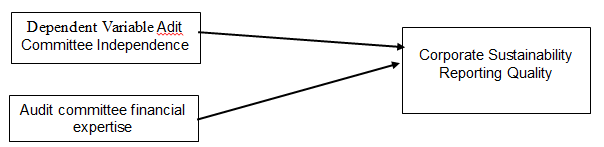
Source: Research author (2026)
Audit committee independence ensures objectivity, impartiality, and autonomy in overseeing management decisions, enabling members to challenge managerial actions, minimize conflicts of interest, and promote transparent, credible, and reliable corporate sustainability reporting Chatterjee, & Rakshit 2023). Similarly, financial expertise equips audit committee members with the technical knowledge required to interpret reporting standards, scrutinize sustainability information and assess the accuracy and reliability of ESG disclosures, thereby strengthening stakeholder confidence in reported information(Nyamongo, E., Ndwiga, P., & Omwenga, 20222).Consistent with Agency Theory, both attributes strengthen the audit committee's monitoring capacity, constrain managerial opportunism and enhance accountability, ultimately contributing to improved corporate sustainability reporting quality.
Methods and Materials
The study adopted a positivist research philosophy and an explanatory research design to examine the relationship between audit committee attributes and corporate sustainability reporting quality. A longitudinal approach was employed to analyse changes in the study variables over time. The target population comprised 67 firms listed on the Nairobi Securities Exchange (NSE), distributed across 13 market segments: Banking (13), Commercial and Services (11), Manufacturing and Allied (10), Insurance (6), Agricultural (6), Investment and Investment Services (6), Energy and Petroleum (5), Construction and Allied (4), Exchange Traded Funds (2), Real Estate Investment Trusts (2), Telecommunications and Technology (1), and Automobiles and Accessories (1). The study employed purposive sampling based on two inclusion criteria: firms had to have operated throughout the study period and have complete data for the study variables. Data were secondary in nature and obtained from audited annual reports published on the respective companies' websites and the African Financials database. Based on these criteria, 55 firms were retained, yielding a balanced panel of 220 firm-year observations covering the period 2022–2025. The operational definitions, measurements, and abbreviations of the study variables are presented in Table I.
The measurements and abbreviations for the research variables are presented in Table I.
| Variable | Abbreviation | Measurement | Reference/s |
| Dependent: Corporate Sustainability Reporting quality | CSRQ | In GRI-G4 Guidelines | (Permatasari & Gunawan, 2020) |
| Independent Variables: Audit Committee Independence Audit Committee Financial expertise | ACI ACFE | The proportion of non-executive AC members to total audit committee members The proportion of members with financial experience to total audit committee members | (Afenya et al., 2022), (Alodat et al., 2022), |
The study applied the following regression model to estimate the relationship between audit committee characteristics and corporate sustainability reporting quality.
SRQ = β₀ + β₁(ACI)it + β₂(ACFE) it+ ε
Where:
SRQ: Sustainability Reporting Quality
β₀: Constant term
β₁ – β2: Regression coefficients
ACI: Audit Committee Independence
ACFE: Audit Committee Financial Expertise
ε: Error term
i: firm
t : time
Findings
Before hypothesis testing, several diagnostic tests were conducted to ensure the data met the assumptions of regression analysis.
Panel Unit Root Test
The study tested for unit roots to establish whether the variables were stationary with the aid of employed the Fisher-type panel unit root test proposed by Maddala & Wu, (1999) . The Fisher test combines the results based on Philips-Perron tests. The test was conducted at the 5% level of significance, where a p-value less than 0.05 indicates rejection of the null hypothesis, suggesting that the variable is stationary.
The hypotheses tested were:
H₀: All panels contain a unit root (the variables are non-stationary).
H₁: At least one panel is stationary (the variables do not contain a unit root).
| Variables | Fisher χ² (P) Statistic | p-value | Decision |
| SRQ | 665.7998 | 0.0000 | Stationary |
| ACI | 715.7815 | 0.0000 | Stationary |
| ACFE | 565.3638 | 0.0000 | Stationary |
Source: Research Author (2026)
Based on the p-values presented in Table 2, all were found to be less than 0.05. Consequently, the null hypothesis of a unit root was rejected, indicating that the time series for all variables is stationary. These results primarily indicate the absence of a unit root in the longitudinal dataset under investigation.
Normality Assumption
The Shapiro–Wilk test was employed to assess the normality of the regression residuals. Normality assumes that the residuals are approximately normally distributed around zero, indicating that deviations between observed and predicted values follow a normal distribution(Wilk, 1965).The results presented in Table 3 indicate that all p-values exceeded the 0.05 significance level. Consequently, the null hypothesis of normally distributed residuals was not rejected, suggesting that there was insufficient evidence of significant deviations from normality. Therefore, the normality assumption of the regression residuals was considered satisfied.
| Test | Test statistics | P-value | Decision |
| Shapiro–Wilk | W = 0.9940 | 0.56884 | Residuals are normally distributed |
Source: Data Analysis, 2026
Serial Correlation
The Wooldridge test was employed to examine the presence of first-order serial correlation in the panel data. The results presented in Table 4 (F = 0.269, p = 0.6063) indicate that the null hypothesis of no first-order autocorrelation cannot be rejected at the 5% significance level. This suggests that there is insufficient evidence of serial correlation in the model residuals, implying that the serial correlation assumption is satisfied.
| Wooldridge test for autocorrelation in panel data |
| H0: no first-order autocorrelation |
| F (1, 54) = 0.269 |
| Prob > F = 0.6063 |
Source: Research Study, 2026
Test for Heteroskedasticity
Heteroskedasticity was tested using the Breusch-Pagan test to check whether the variance of error terms was constant. The null hypothesis assumes homoscedasticity. The results (Chi²(1) = 1.52, p = 0.2808) indicate that the null cannot be rejected, confirming constant variance. The findings are summarized in Table5
| chi2(1) = 0.07 Prob > chi2 = 0.7889 |
Source: Research Study, 2026
Hausman Test
The Hausman specification test was conducted to determine the appropriate estimator between the Fixed Effects and Random Effects models. The null hypothesis states that the Random Effects estimator is consistent and efficient, while the alternative hypothesis suggests that the Fixed Effects estimator is more appropriate. The results indicate a chi-square statistic of 2.08 and a p-value of 0.3530. Since the p-value exceeds the 5% significance level, the null hypothesis cannot be rejected. This suggests that the Random Effects estimator is appropriate for analysing the panel data and was therefore adopted for hypothesis testing.
Descriptive statistics
Descriptive statistics for the independent and dependent variables are presented in Table 6. The study used 55 firms listed on the Nairobi Securities Exchange and 220 firm -year observations from 2022 to 2025. The results indicate that the Sustainability Reporting Quality (SRQ) index had a mean score of 0.629, implying that, on average, firms attained 62.9% of the maximum possible sustainability reporting quality score. This suggests a moderate level of sustainability reporting quality among firms listed on the NSE. The SRQI ranged from 0.200 to 1.000, indicating considerable variation in sustainability reporting quality among firms listed on the Nairobi Securities Exchange. This variation suggests differing levels of commitment to transparent sustainability reporting, consistent with Bae et al., (2018). The standard deviation of 0.188 further indicates moderate dispersion in SRQI scores, implying that while some firms provided limited sustainability disclosures, others reported more comprehensively. Audit committee independence recorded a mean score of 0.504, indicating that, on average, independent directors constituted 50.4% of audit committee membership among the sampled firms. The variable ranged from 0.111 to 1.000, reflecting considerable variation in the audit committee’s independence across firms, while the standard deviation of 0.156 indicates moderate dispersion. The relatively high proportion of independent directors is consistent with the Capital Markets Authority's Guidelines on Corporate Governance Practices, which emphasize that audit committees should comprise independent non-executive directors to strengthen objectivity, enhance oversight, and improve the credibility of corporate reporting(CMA, 2015). Audit committee financial expertise recorded a mean score of 0.748, indicating that, on average, 74.8% of audit committee members possessed financial expertise. This suggests that most firms have appointed financially competent members to effectively oversee financial and sustainability reporting. The finding is consistent with the Capital Markets Authority's Code of Corporate Governance Practices and the Public Finance Management Regulations (2015), which require audit committees to comprise members with appropriate financial knowledge and professional competence, including at least two members drawn from recognized professional bodies (Treasury, 2015).
| Variables | Obs | Min | Max | Mean | Std. Dev. |
| SRQ | 220 | 0.200 | 1.000 | 0.629 | 0.188 |
| ACI | 220 | 0.110 | 1.000 | 0.504 | 0.156 |
| ACFE | 220 | 0 .360 | 1.000 | 0.748 | 0.118 |
Source: Researcher, 2026
Correlation Analysis
The study used correlation to examine the nature of the statistical relationship between corporate sustainability reporting quality and audit committee attributes: audit committee independence and financial expertise. The correlation matrix is illustrated in Table 7, and the results showed that
audit committee independence had the strongest positive correlation with sustainability reporting quality (r = 0.51), while audit committee members with financial expertise (r = 0.43.
| SRQ | ACI | ACFE | |
| SRQ | 1.000 | ||
| ACI | 0.5075* | 1.0000 | |
| ACFE | 0.4320* | -0.0803 | 1.0000 |
| SRQ: Sustainability Reporting Quality, ACI: Audit Committee Independence, ACFE: Audit Committee financial expertise | |||
| *Correlation is significant at the 0.05 level(2-tailed). |
Source: Researcher, 2026
Regression Analysis
The null hypothesis was tested using random-effects GLS regression. It stated that audit committee independence has no significant effect on corporate sustainability reporting quality among firms listed on the NSE, Kenya. The findings indicate that audit committee independence has a positive and statistically significant effect on corporate sustainability reporting quality (β = 0.6454, p < 0.001). The 95% confidence interval, ranging from 0.5303 to 0.7605, does not include zero, providing further evidence of the statistical significance of the relationship. The positive coefficient implies that a one-unit increase in audit committee independence is associated with a 0.6454-unit increase in corporate sustainability reporting quality, holding other factors constant. This suggests that firms with more independent audit committees are more likely to produce high-quality sustainability reports, as independent committee members are better positioned to provide objective oversight, strengthen corporate governance and enhance the credibility, transparency and reliability of sustainability disclosures.The finding is consistent with Agency Theory, which emphasizes the role of independent monitoring in reducing agency conflicts arising from the separation of ownership and control. The result is also consistent with (Boateng & Okafor, 2026), who found that greater audit committee independence strengthens oversight and limits managerial opportunism. However, the finding contrasts with Ali et al. (2021), who reported that audit committee independence may be influenced by insider ownership, potentially weakening its monitoring effectiveness.
Similarly, audit committee financial expertise was found to have a positive and statistically significant effect on corporate sustainability reporting quality (β = 0.7596, p < 0.001). The 95% confidence interval, ranging from 0.6085 to 0.9107, does not include zero, further confirming the statistical significance of the relationship. The positive coefficient indicates that a one-unit increase in audit committee financial expertise is associated with a 0.7596-unit increase in corporate sustainability reporting quality, holding other factors constant. This finding suggests that firms listed on the NSE with audit committees possessing greater financial expertise are more likely to produce high-quality sustainability reports, as financially knowledgeable members strengthen oversight and enhance the credibility and reliability of sustainability disclosures. This concurs with findings of Abdulwasiu, et al (2026) that audit committee members with strong financial expertise are better equipped to scrutinize financial and sustainability information, assess reporting quality, and ensure that disclosures meet stakeholders’ information needs. However, this finding differs from Al-Musali et al.(2019), who argued that audit committee independence can be affected by the ownership structure. Agency Theory further suggests that the independence of committee members may be compromised by employment, personal, or business relationships with management or controlling shareholders. Such relationships may weaken objective oversight and limit the audit committee’s ability to effectively monitor management and safeguard the quality of corporate reporting.
| Random-effects GLS regression | |||||
|---|---|---|---|---|---|
| Group variable: firm | Number of obs = 220 | ||||
| R-sq: within = 0.4738 | Number of groups = 55 | ||||
| between = 0.5062 | Obs per group: min = 4 | ||||
| overall = 0.4824 | avg = 4.0 | ||||
| max = 4 | |||||
| corr(u_i, X) = 0 (assumed) | Wald chi2(2) = 200.55 | ||||
| Prob > chi2 = 0.0000 | |||||
| SRQ | Coef. | Std. Err. | z | P>|z| | [95% Conf. Interval] |
| ACI | 0.6454024 | 0.0587447 | 10.99 | 0.000 | 0.5302649, 0.7605399 |
| ACFE | 0.759598 | 0.0770853 | 9.85 | 0.000 | 0.6085136, 0.9106824 |
| _cons | -0.2648527 | 0.0678616 | -3.90 | 0.000 | -0.397859, -0.1318463 |
| sigma_u | 0.0422005 | ||||
| sigma_e | 0.12930718 | ||||
| rho | 0.09625749 | (fraction of variance due to u_i) |
Source: Researcher, 2026
Conclusion and Recommendations
The study concludes that audit committee independence and financial expertise positively and significantly influence corporate sustainability reporting quality among firms listed on the NSE. Independent audit committee members strengthen objective oversight, accountability and transparency, while financial expertise enhances the committee's capacity to assess the credibility and reliability of sustainability disclosures. The study therefore recommends that listed firms strengthen audit committee independence and prioritise members with relevant accounting, finance and auditing qualifications. The Capital Markets Authority and NSE should reinforce corporate governance requirements and promote effective audit committee oversight of sustainability disclosures to enhance reporting quality, transparency and stakeholder confidence.
References
- Abad, C. and Bravo, F. (2018). “Audit committee accounting expertise and forward-looking disclosures: a study of the US companies”,. Management Research Review, 41(2), . 166-185. DOI ↗ Google Scholar ↗
- Abdulai, A. R. (2026). Corporate governance mechanisms and regulatory quality improve ESG disclosure quality in an emerging market. DOI ↗ Google Scholar ↗
- Abdulwasiu, M. I., Tauhid, S., Okpanachi, J., Agbi, S. E., & Ibiamke, A. (2026). Effect Of Audit Committee Size and Audit Committee Gender Diversity on Financial Reporting Quality of Listed Manufacturing Firms in Nigeria. KASU Journal of Accounting Research & Practice, 11(1), 461-482. DOI ↗ Google Scholar ↗
- Afenya, M. S., Arthur, B., Kwarteng, W., & Opoku, P. (2022). The impact of audit committee characteristics on audit fees; evidence from Ghana. Cogent Business and Management, 9(1). DOI ↗ Google Scholar ↗
- Al-Matari, Y. A. T. (2013). Board of directors, audit committee characteristics and the performance of public listed companies in Saudi Arabia,. DOI ↗ Google Scholar ↗
- Al-Musali, M. A., M. H. Qeshta, M. A. Al- Attafi, and A. M. A.-E. 2019. (2019). Owner- ship Structure and Audit Committee Effectiveness: Evidence from Top GCC Capitalized Firms. International Journal of Islamic and Middle Eastern Finance and Management. Google Scholar ↗
- Ali, H., Meah, M. R., Ali, H., & Meah, M. R. (2021). Cogent Business & Management Factors of audit committee independence : An empirical study from an emerging economy Factors of audit committee independence : An empirical study from an emerging economy. Cogent Business & Management, 8(1). DOI ↗ Google Scholar ↗
- Alkdai, H. K. H., & Hanefah, M. M. (2012). Audit committee characteristics and earnings management in Malaysian Shariah-compliant companies. Business & Management Review, 2(2), 52–61. Google Scholar ↗
- Alodat, A. Y., Salleh, Z., Hashim, H. A., & Sulong, F. (2022). Corporate governance and firm performance: empirical evidence from Jordan. Journal of Financial Reporting and Accounting, 20(5), 866–896. DOI ↗ Google Scholar ↗
- Arkoh, P., Costantini, A., & Scarpa, F. (2024). (2024). Determinants of sustainability reporting: A systematic literature review. Corporate Social Responsibility and Environmental Management, 31((3)), 1578–1597. Google Scholar ↗
- Arslan, H. M., Mubeen, M., & Chen, S. (2024). Audit Committee Characteristics and Sustainability Disclosures – A Meta-Analytical Perspective. Pakistan Journal of Commerce and Social Sciences 2024, 18(4), 1032–1064. Google Scholar ↗
- Avison, & L., & Cowton, C. J. (2012). UK audit committees and the revised code. Corporate Governance. The International Journal of Business in Society, 12(1), 42-53. Google Scholar ↗
- Ayuni, K., Kharuddin, M., & Basioudis, I. G. (2022). On the Interrelation between Corporate Governance , Audit and Earnings Quality : A Review of the Underpinning Theories On the Interrelation between Corporate Governance , Audit and Earnings Quality : A Review of the Underpinning Theories. International Journal of Academic Research in Accounting Finance and Management Sciences, 12(3), 1(3), 626–640. DOI ↗ Google Scholar ↗
- Bae, S. M., Masud, A. K., & Kim, J. D. (2018). A Cross-Country Investigation of Corporate Governance and Corporate Sustainability Disclosure : A Signaling Theory Perspective. A Signaling Theory Perspective. Sustainability, 10((8),), 2611. DOI ↗ Google Scholar ↗
- Biswas, P. K., Bala, S. K., & Mandal, P. (2023). Audit committee diligence: do independent directors matter? Accounting Research Journal, 36(2–3), 274–289. DOI ↗ Google Scholar ↗
- Boateng, K. A., & Okafor, N. I. (2026). Audit Committee Effectiveness , Internal Control Quality , and Financial Reporting Reliability : Evidence from Listed Non-Financial Firms in. Journal of Accounting, Business, Governance and Sustainability, 1(2), 36–75. Google Scholar ↗
- Chatterjee, R., & Rakshit, D. (2023). Association between earnings management and corporate governance mechanisms: A study based on select firms in India. Global Business Review, 24(1), 152-170. Google Scholar ↗
- Chemingui, S., Omri, M.A.B., & and Waked, S. (2023). The influence of audit committee on the relationship between corporate social responsibility disclosure and tax aggressiveness: Evidence from French context. Journal of Management, 5(1), 2-28. Google Scholar ↗
- CMA. (2015). Guidelines on Corporate Governance Practices by Public Listed Companies in Kenya. Nairobi, Kenya: Capital Markets Authority. Google Scholar ↗
- Commission., E. (2023). Commission Delegated Regulation (EU) 2023/2772 of 31 July 2023 supplementing Directive 2013/34/EU as regards sustainability reporting standards. Official Journal of the European Union. Google Scholar ↗
- Dao, M., Hassab, Elnaby, & H. R., & Said, A. (2015). The impact of audit committee and shareholder activism on the association between audit-firm tenure and accounting conservatism. No Title. Accounting & Finance Research, 4(1), 112–128. Google Scholar ↗
- Defond, M. L., Hann, R. N., Xuesong, H. U., & Engel, E. (2005). Does the market value financial expertise on audit committees of boards of directors? Journal of Accounting Research, 43(2), 153–193. DOI ↗ Google Scholar ↗
- Elghuweel, M.I., Ntim, C.G., Opong, A, K. K., & nd Avison, L. (2017). “Corporate governance, Islamic governance and earnings management in Oman”,. Journal of Accounting in Emerging Economies, 7(2), 190–244. Google Scholar ↗
- Endrawes, M., Feng, Z., Lu, M., & Shan, Y. (2020). Audit committee characteristics and financial statement comparability. Accounting and Finance, 60(3), 2361–2395. DOI ↗ Google Scholar ↗
- Erin, O. A., & Ackers, B. (2024). Corporate board, assurance and sustainability reporting practices: a focus on selected African countries. Ournal of Accounting & Organizational Change, 20(6), 85-118. Google Scholar ↗
- Gillan, S. L. (2006). Recent Developments in Corporate Governance: An Overview. Journal of Corporate Finance, 12(3), 381–402. DOI ↗ Google Scholar ↗
- Jensen& Meckling. (1976). Theory of the firm. Journal of Financial Crime, 3, 305–360. DOI ↗ Google Scholar ↗
- Kallamu, S., B., & & Saat, N. A. M. (2015). Audit committee attributes and firm performance: Evidence from Malaysian finance companies. Asian Review of Accounting, 23(3). Google Scholar ↗
- KPMG. (2024). The move to mandatory reporting: Survey of sustainability reporting 2024. Google Scholar ↗
- Lakshman, K., Buhukya, S., & Swamy, A. K. (2025). CORPORATE GOVERNANCE AND PUBLIC POLICY: A CROSS-SECTORAL ANALYSIS OF ACCOUNTABILITY MECHANISMS Dr. Kothapeta Lakshman 1 , Dr. Sammaiah Buhukya 2 , Dr A. Kumara Swamy 3 1. JOURNAL OF LOCAL SELF-GOVERNMENT, 5, 330–339. Google Scholar ↗
- Larry, M., A., &, & Taylor, D. W. (2012). Governance characteristics and role effectiveness of audit committes. Manegerial Auditing Journal, 27(4), 336–354. Google Scholar ↗
- Maddala, G. S., & Wu, S. (1999). A comparative study of unit root tests with panel data and a new simple test. Oxford Bulletin of Economics and Statistics, 61(SUPPL.), 631–652. DOI ↗ Google Scholar ↗
- Mohammadi, S. (2021). The impact of board and audit committee characteristics on corporate social responsibility : evidence from the Iranian stock exchange. International Journal of Productivity and Performance Management, 70(8), 2207–2236. DOI ↗ Google Scholar ↗
- Naciti, V., Cesaroni, F., & Pulejo, L. (2021). Corporate governance and sustainability : a review of the existing literature. Journal of Management and Governance, 0123456789. Google Scholar ↗
- Nekhili, M., Fakhfakh, I., Amar, B., Chtioui, T., & Lakhal, F. (2016). Free cash flow and earnings management:The moderating role of governance and ownership. The Journal of AppliedBusiness Research, 32(1), 255–268. DOI ↗ Google Scholar ↗
- NSE. (2021). ESG Disclosures Guidance Manual. Nairobi Securities Exchange. Google Scholar ↗
- Nyamongo, E., Ndwiga, P., & Omwenga, A. (20222). Audit committee financial expertise and its impact on corporate disclosure practices in East Africa. Accounting and Auditing Review, 10(1), 15-29. Google Scholar ↗
- Oussii, A.A., & and Boulila Taktak, N. (2018). “The impact of internal audit function characteristics on internal control quality”,. Managerial Auditing Journal, 33(5), 450-469. DOI ↗ Google Scholar ↗
- Owusu Acheampong, O., Tauringana, V., Asare, N., & Okyere, G. A. (2026). Sustainability reporting determinants: A systematic review of trends, challenges, and opportunities. Journal of African Business, 27((1)), 200–232. DOI ↗ Google Scholar ↗
- Permatasari, P., & Gunawan, J. (2020). A Comprehensive Measurement for Sustainability Reporting Quality : Principles-Based Approach. Indonesian Journal of Sustainability Accounting and Management, 4(2), 249–265. DOI ↗ Google Scholar ↗
- Pozzoli, M., Pagani, A., & Paolone, F. (2022). The impact of audit committee characteristics on ESG performance in the European Union member states : Empirical evidence before and during the COVID-19 pandemic. Journal of Cleaner Production, 371(August), 133411. DOI ↗ Google Scholar ↗
- Pucheta-Martínez, M. C., & Gallego-Álvarez, I. (2020). (2020). Do board characteristics drive firm performance? An international perspective: Review of Managerial Science, 14((6),), 1251-1297. Google Scholar ↗
- Stewart, J., L., & Munro. (2007). The impact of audit committee existence and audit committee meeting frequency on the external audit,. International Journal of Auditing, 11, 51–69. Google Scholar ↗
- Tanyi, P.N. and Smith, D. B. (2015). ), “Busyness, expertise and financial reporting quality of audit committee chairs and financial experts”, Auditing. A Journal of Practice and Theory, 34(2), . 59-89. Google Scholar ↗
- Tohang, V., Hutagaol-Martowidjojo, Y., & Pirzada, K. (2024). The Link Between ESG Performance and Earnings Quality. Australasian Accounting, Business and Finance Journal, 18(1), 187–204. DOI ↗ Google Scholar ↗
- Treasury, N. (2015). Public Finance Management (National Government) Regulations, 2015. Nairobi, Kenya: Google Scholar ↗
- Wilk, S. S. S. and M. B. (1965). An Analysis of Variance Test for Normality. 52(3), 591–611. Google Scholar ↗