Abstract
The Small Enterprise Technology Upgrading Program (SETUP) of the Department of Science and Technology (DOST) is a flagship program that supports the growth and competitiveness of micro, small, and medium enterprises (MSMEs) through technology and innovation interventions. Despite its continued implementation, limited empirical evidence exists on how financial governance influences the performance of the program. This study assessed the financial governance and performance of SETUP in the DOST–National Capital Region (DOST-NCR) MUNTAPARLAS Cluster and developed Proposed Intervention Measures for Enhanced Sustainability (PIMES) based on the findings. Specifically, the study examined financial governance in terms of budget allocation, financial control, accountability mechanisms, financial reporting, risk management, resource mobilization, monitoring and evaluation, and transparency, as well as program performance in terms of productivity, efficiency, and effectiveness. The study employed a descriptive-correlational research design involving 36 respondents, consisting of administrators, staff, and SETUP-assisted MSME owners. Data were collected using a validated researcher-made questionnaire and analyzed using percentage, weighted mean, one-way analysis of variance (ANOVA), and Pearson product-moment correlation. The findings revealed that the overall financial governance of SETUP obtained a grand mean of 4.65, verbally interpreted as Highly Evident, while program performance obtained a grand mean of 4.71, also interpreted as Highly Evident. Significant differences were observed among the respondent groups in selected dimensions of financial governance, while a significant positive relationship was established between financial governance and program performance. Furthermore, the Proposed Intervention Measures for Enhanced Sustainability (PIMES) obtained an overall weighted mean of 4.85, interpreted as Highly Acceptable. The study concluded that effective financial governance significantly contributes to the productivity, efficiency, and effectiveness of SETUP implementation. Strengthening financial governance practices through strategic intervention measures may further enhance program sustainability, accountability, and organizational performance. These findings provide valuable insights for policymakers, DOST administrators, program implementers, and future researchers in improving the governance and long-term sustainability of government-assisted enterprise development programs.
Keywords
Financial Governance Small Enterprise Technology Upgrading Program (SETUP) MSMEs Program Performance Public Administration DOST Sustainability Intervention Measures
The Problem and Its Background
Introduction
Micro, Small, and Medium Enterprises (MSMEs) are widely recognized as the backbone of many economies because of their significant contribution to employment generation, income creation, innovation, and inclusive economic growth. Globally, MSMEs account for the majority of business establishments and provide substantial employment opportunities, making them indispensable drivers of economic resilience and sustainable development. Their ability to stimulate local industries, encourage entrepreneurship, and promote technological innovation has prompted governments worldwide to implement policies and intervention programs that strengthen their competitiveness and long-term viability.
In the Philippines, MSMEs constitute more than 99 percent of all registered business establishments and serve as major contributors to employment and economic activity. They play a vital role in supporting local communities, generating household income, and fostering regional development. Despite their economic significance, many MSMEs continue to encounter constraints that impede their growth and sustainability, including limited access to financing, inadequate technological capability, low productivity, inefficient operational systems, insufficient managerial expertise, and increasing market competition. Such limitations reduce their capacity to innovate, expand operations, and remain competitive in an increasingly technology-driven business environment.
Recognizing these challenges, the Philippine government has introduced various programs to improve the productivity and competitiveness of MSMEs. Among the most significant is the Small Enterprise Technology Upgrading Program (SETUP) of the Department of Science and Technology (DOST). Established to promote technology-based enterprise development, SETUP provides financial assistance, technical consultancy, technology transfer, training, and innovation support to qualified MSMEs. Through these interventions, the program seeks to improve production efficiency, enhance product quality, increase profitability, strengthen market competitiveness, and encourage sustainable business growth.
The effectiveness of SETUP, however, depends not only on the availability of financial and technological assistance but also on the quality of financial governance that supports program implementation. Financial governance refers to the systems, policies, procedures, and institutional mechanisms that ensure public resources are managed responsibly, transparently, efficiently, and in accordance with established laws and regulations. It encompasses budget allocation, financial control, financial reporting, accountability, risk management, resource mobilization, monitoring and evaluation, and transparency in decision-making. Collectively, these governance practices promote fiscal discipline, safeguard public resources, and strengthen public trust while ensuring that government-funded programs achieve their intended outcomes.
In public sector programs such as SETUP, financial governance assumes even greater importance because government resources are expected to generate measurable economic and social benefits. Effective governance enables implementing agencies to maximize limited public funds, minimize operational risks, ensure regulatory compliance, and improve service delivery to program beneficiaries. Conversely, weaknesses in financial governance may result in inefficient resource utilization, implementation delays, inadequate monitoring, diminished program effectiveness, and reduced public confidence. Consequently, evaluating financial governance is essential in determining whether government-assisted enterprise development programs are capable of delivering sustainable and meaningful outcomes.
Within the National Capital Region, the implementation of SETUP is entrusted to the Department of Science and Technology–National Capital Region (DOST-NCR), which administers the program through various geographical clusters. One of these is the MUNTAPARLAS Cluster, comprising the cities of Muntinlupa, Parañaque, Las Piñas, and Taguig, as well as the Municipality of Pateros. Through this cluster, DOST-NCR has continuously extended technology-based interventions and financial assistance to qualified MSMEs, enabling enterprises to modernize production processes, improve operational efficiency, adopt innovative technologies, and strengthen their competitive position in both local and national markets. These initiatives reflect the government's commitment to promoting innovation-driven entrepreneurship and accelerating inclusive economic development.
Despite the continued implementation of SETUP and its recognized contributions to enterprise development, empirical studies examining the program have largely concentrated on technology adoption, innovation, productivity improvement, enterprise growth, and economic outcomes. Comparatively little attention has been given to the financial governance mechanisms that underpin successful program implementation. More specifically, there remains limited empirical evidence on how financial governance practices influence the overall performance of SETUP in terms of productivity, efficiency, and effectiveness, particularly within the DOST-NCR MUNTAPARLAS Cluster. This gap in the literature suggests the need for a comprehensive assessment of the governance systems that support the program and their contribution to achieving its intended objectives.
This study is anchored in the Resource-Based View (RBV) Theory, which holds that organizational success depends on the effective acquisition, management, and utilization of valuable organizational resources. Within the context of SETUP, sound financial governance represents a critical organizational capability that facilitates efficient resource allocation, strengthens accountability, enhances operational effectiveness, and supports the successful implementation of technology upgrading initiatives, as discussed more fully in the succeeding section.
Assessing the financial governance and performance of SETUP is therefore both timely and significant. The findings of this study are expected to provide empirical evidence on the effectiveness of existing financial governance practices in supporting program implementation and achieving desired organizational outcomes. Specifically, the results may assist DOST-NCR administrators, program managers, policymakers, and other stakeholders in identifying governance strengths, addressing operational deficiencies, improving financial management systems, enhancing accountability and transparency, and optimizing the utilization of government resources. Moreover, the study contributes to the growing body of knowledge on financial governance, public sector management, and government-supported enterprise development by providing evidence that may inform future policy formulation, program enhancement, and governance reforms.
Hence, this study assessed the financial governance and performance of the Small Enterprise Technology Upgrading Program (SETUP) implemented by the DOST-NCR MUNTAPARLAS Cluster. Specifically, it examined financial governance in terms of budget allocation, financial control, accountability mechanisms, financial reporting, risk management, resource mobilization, monitoring and evaluation, and transparency, as well as program performance in terms of productivity, efficiency, and effectiveness. Furthermore, the findings served as the basis for the development of the Proposed Intervention Measures for Enhanced Sustainability (PIMES) to strengthen financial governance practices, improve program performance, and promote the long-term sustainability of the SETUP implementation.
Theoretical Framework
This study is anchored in the Resource-Based View (RBV) Theory developed by Jay Barney (1991), one of the most influential theories in strategic management. RBV posits that an organization's ability to achieve superior performance and sustain competitive advantage depends primarily on the effective acquisition, development, protection, and utilization of its internal resources and capabilities. Unlike traditional theories that emphasize external market conditions as the primary determinant of organizational success, RBV argues that long-term organizational performance is fundamentally driven by the strategic management of internal resources that are difficult for competitors to imitate or substitute.
According to Barney (1991), organizational resources become sources of sustained competitive advantage when they are valuable, rare, imperfectly imitable, and non-substitutable (VRIN). Valuable resources enable organizations to improve operational efficiency and effectiveness; rare resources provide uniqueness; inimitable resources cannot be easily replicated by competitors; and non-substitutable resources cannot readily be replaced by alternative strategic assets. These resources may be tangible, such as financial capital, technology, equipment, and physical infrastructure, or intangible, such as organizational knowledge, managerial competence, governance systems, institutional capabilities, innovation, and organizational culture.
RBV further holds that the mere possession of resources does not automatically lead to superior organizational performance. Rather, organizations derive value from their ability to manage, coordinate, and utilize these resources efficiently through sound managerial practices and effective governance mechanisms. Governance systems, in this sense, serve as strategic organizational capabilities that facilitate optimal resource allocation, strengthen accountability, improve decision-making, minimize operational risks, and ensure that available resources are utilized in achieving organizational objectives. From this perspective, financial governance is not merely an administrative function but a strategic capability that enhances organizational performance through responsible stewardship of financial and institutional resources.
The theory is particularly relevant to SETUP because the program provides participating MSMEs with strategic resources necessary for organizational growth and competitiveness, including financial assistance, technological upgrading, innovation support, technical consultancy, equipment acquisition, and training. As provided under DOST Administrative Order No. 008, Series of 2024, SETUP seeks to strengthen the productivity, competitiveness, and sustainability of MSMEs by facilitating access to technology and innovation. From the perspective of RBV, these interventions constitute valuable organizational resources whose benefits depend largely on how effectively they are governed, managed, and utilized.
In the context of this study, financial governance represents a critical organizational capability that enables the efficient management of government resources and technology assistance provided under SETUP. The dimensions of financial governance examined—budget allocation, financial control, accountability mechanisms, financial reporting, risk management, resource mobilization, monitoring and evaluation, and transparency—serve as governance mechanisms that ensure public resources are utilized efficiently, responsibly, and in accordance with program objectives. Effective implementation of these practices is expected to enhance program performance by improving productivity, increasing operational efficiency, and strengthening program effectiveness.
Accordingly, RBV provides the theoretical foundation for explaining the relationship between financial governance and the performance of SETUP. The theory suggests that when financial resources, governance systems, technological support, and organizational capabilities are effectively integrated and managed, organizations are more likely to achieve superior performance and sustainable outcomes. Guided by this perspective, the present study posits that stronger financial governance practices contribute to improved productivity, efficiency, and effectiveness of SETUP implementation within the DOST-NCR MUNTAPARLAS Cluster.
Conceptual Framework
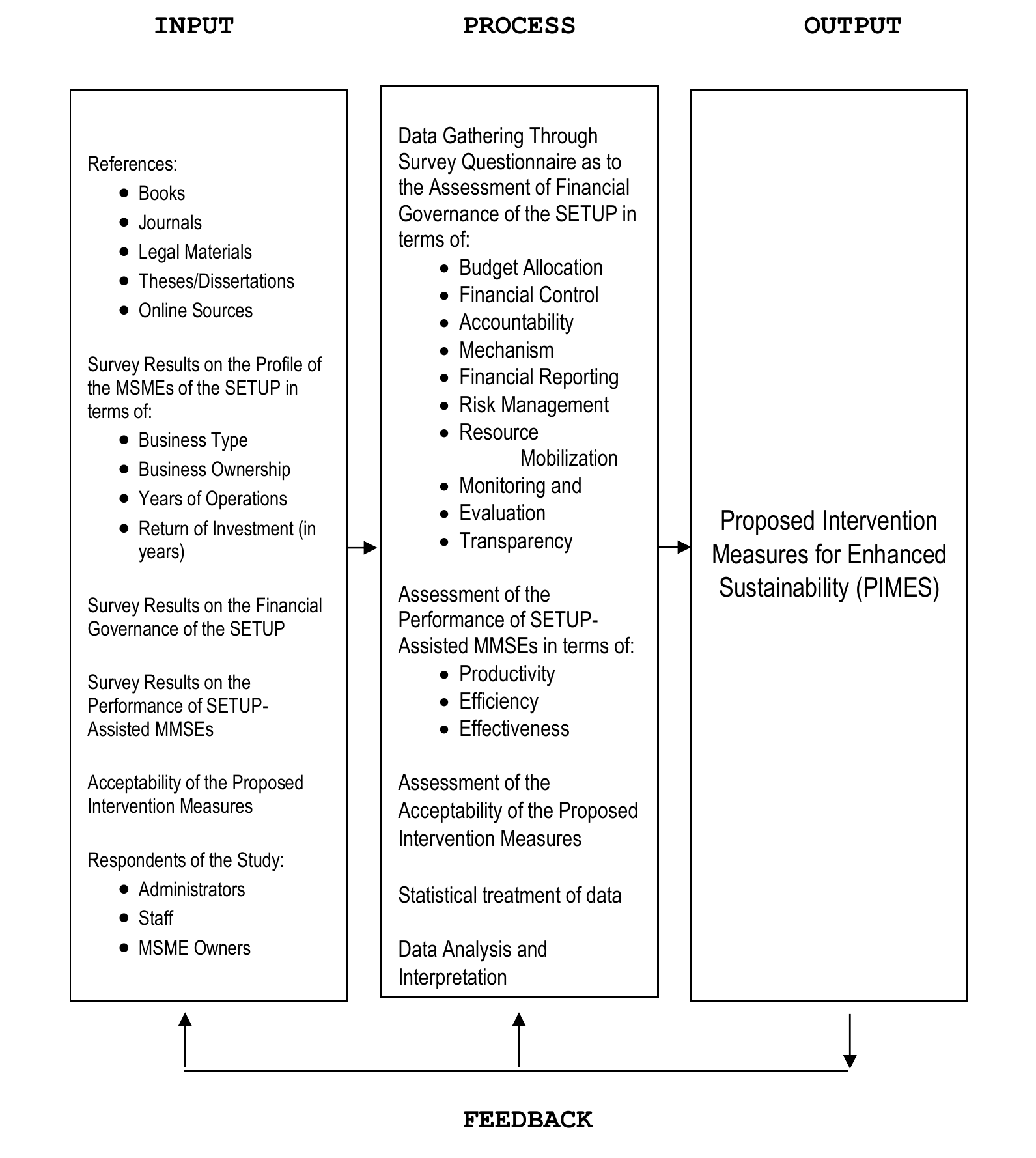
This study adopted the Input–Process–Output (IPO) Model as its conceptual framework to illustrate the flow of the research process and the relationships among the variables under investigation. Guided by the Resource-Based View Theory, the framework shows how financial governance practices, as strategic organizational capabilities, influence the performance of SETUP, and serves as the basis for developing the Proposed Intervention Measures for Enhanced Sustainability (PIMES), as illustrated in Figure 1.
The Input (I) component comprised the profile of the SETUP-assisted MSMEs (business type, business ownership, years of operation, and return on investment); the assessment of financial governance in terms of budget allocation, financial control, accountability mechanisms, financial reporting, risk management, resource mobilization, monitoring and evaluation, and transparency; the assessment of program performance in terms of productivity, efficiency, and effectiveness; and the respondents' evaluation of the proposed intervention measures. Data were obtained from the administrators, staff, and owners of SETUP-assisted MSMEs within the DOST-NCR MUNTAPARLAS Cluster.
The Process (P) component involved the identification of the research problem, review of related literature and studies, and formulation of the research framework, followed by the development and validation of the research instrument, administration of the survey questionnaire, retrieval and organization of the collected data, and application of appropriate statistical tools for data treatment, analysis, and interpretation. The findings were then used to identify areas requiring improvement in the financial governance and performance of SETUP.
The Output (O) component consisted of the Proposed Intervention Measures for Enhanced Sustainability (PIMES), developed from the assessment results on financial governance, program performance, and respondents' evaluations of the proposed interventions. The framework assumes that strengthening financial governance contributes to improved productivity, efficiency, and effectiveness of SETUP implementation, thereby promoting the long-term sustainability of government-assisted technology upgrading initiatives for MSMEs.
Figure 1 illustrates the research paradigm, showing the interaction among the input, process, and output components, with a feedback loop indicating that the evaluation of the proposed interventions may inform further refinement of financial governance practices.
Statement of the Problem
This study aimed to assess the financial governance and performance of the Small Enterprise Technology Upgrading Program (SETUP) implemented by the DOST-NCR MUNTAPARLAS Cluster.
Specifically, it sought to answer the following questions:
-
What is the profile of the SETUP-assisted MSMEs in the DOST-NCR MUNTAPARLAS Cluster in terms of:
-
Business Type;
-
Business Ownership;
-
Years of Operations; and
-
Return of Investment?
-
What is the assessment of the administrators, staff, and MSME owners regarding the financial governance of SETUP in the DOST-NCR MUNTAPARLAS Cluster in terms of:
-
Budget Allocation;
-
Financial Control;
-
Accountability Mechanisms;
-
Financial Reporting;
-
Risk Management;
-
Resource Mobilization;
-
Monitoring and Evaluation; and
-
Transparency?
-
Is there a significant difference in the assessment of the financial governance of SETUP among administrators, staff, and MSME owners in the DOST-NCR MUNTAPARLAS Cluster?
-
What is the performance of SETUP in the DOST-NCR MUNTAPARLAS Cluster in terms of:
-
Productivity;
-
Efficiency; and
-
Effectiveness?
-
Is there a significant relationship between financial governance and the performance of SETUP in the DOST-NCR MUNTAPARLAS Cluster?
-
Based on the findings of the study, what Proposed Intervention Measures for Enhanced Sustainability (PIMES) may be developed?
-
How acceptable are the Proposed Intervention Measures for Enhanced Sustainability (PIMES) as evaluated by the respondents?
Hypotheses
The following null hypotheses were tested at the 0.05 level of significance:
-
There is no significant difference in the assessment of the financial governance of SETUP among administrators, staff, and MSME owners in the DOST-NCR MUNTAPARLAS Cluster in terms of budget allocation, financial control, accountability mechanisms, financial reporting, risk management, resource mobilization, monitoring and evaluation, and transparency.
-
There is no significant relationship between financial governance and the performance of SETUP in the DOST-NCR MUNTAPARLAS Cluster.
Scope and Limitation of the Study
This study focused on assessing the financial governance and performance of SETUP as implemented by the DOST-NCR in the MUNTAPARLAS Cluster. Specifically, it examined financial governance in terms of budget allocation, financial control, accountability mechanisms, financial reporting, risk management, resource mobilization, monitoring and evaluation, and transparency. It likewise assessed program performance in terms of productivity, efficiency, and effectiveness, and determined the acceptability of the Proposed Intervention Measures for Enhanced Sustainability (PIMES).
The respondents of the study consisted of thirty-six (36) participants, comprising six (6) administrators, nine (9) staff members, and twenty-one (21) owners of SETUP-assisted MSMEs. These respondents were selected because of their direct involvement in the implementation and utilization of SETUP, enabling them to provide relevant and reliable information on the program's financial governance and performance.
The study was conducted within the DOST-NCR MUNTAPARLAS Cluster, which covers the cities of Muntinlupa, Parañaque, Las Piñas, and Taguig, as well as the Municipality of Pateros. Data were gathered from SETUP-assisted MSMEs and DOST personnel assigned to the cluster.
The conduct of the study covered the period from June 2024 to May 2026, beginning with the preparation and approval of the research proposal and concluding with the completion and final defense of the thesis.
This study was limited to the assessment of the financial governance and performance of SETUP within the DOST-NCR MUNTAPARLAS Cluster. It relied on the responses of the identified participants and the variables included in the research instrument. Consequently, the findings are applicable only to the respondents and the study locale and may not be generalized to SETUP beneficiaries in other DOST regional offices or clusters, where implementation strategies, organizational practices, and operating environments may differ. Likewise, the study did not examine other factors that may influence program performance beyond the financial governance dimensions covered in the investigation.
Significance of the Study
The findings of this study are expected to provide valuable insights into the financial governance and performance of SETUP. Specifically, the results may benefit the following stakeholders:
Micro, small, and medium enterprises (MSMEs). The findings may enable SETUP-assisted MSMEs to gain a better understanding of the financial governance practices that support the implementation of the program. The proposed intervention measures may assist enterprise owners in strengthening financial accountability, optimizing the utilization of technology assistance, improving operational productivity and efficiency, and enhancing the long-term sustainability and competitiveness of their businesses.
SETUP implementers. The study may provide program implementers with empirical evidence on the strengths and areas for improvement in the financial governance of SETUP. The findings may serve as a basis for enhancing financial management practices, strengthening monitoring and evaluation systems, improving resource utilization, and implementing intervention strategies that contribute to more effective and sustainable program implementation.
DOST administrators and policymakers. The results of the study may support evidence-based policy formulation, strategic planning, and management decision-making related to the implementation of SETUP. The proposed intervention measures may provide a practical framework for strengthening governance systems, promoting transparency and accountability, improving financial resource management, and ensuring the efficient delivery of technology-based assistance to MSMEs.
Future researchers. The study may enrich the existing literature on financial governance, public sector management, program evaluation, and MSME development. It may also serve as a valuable reference for future studies examining similar government-assisted enterprise development programs or other variables affecting organizational performance and program sustainability.
Definition of Terms
For clarity and consistency, the following terms are operationally defined as they are used in this study:
Accountability mechanisms - refer to the systems, policies, and procedures employed in the implementation of SETUP to ensure responsible utilization of resources, compliance with program requirements, and accountability among program implementers and MSME beneficiaries.
Administrators - refer to the DOST-NCR officials responsible for planning, directing, supervising, and overseeing the implementation of SETUP within the MUNTAPARLAS Cluster.
Budget allocation - refers to the process of planning, distributing, and utilizing financial resources under SETUP to support technology upgrading and enterprise development among participating MSMEs.
DOST-NCR MUNTAPARLAS Clustered Area Science and Technology Office (CASTO) - refers to the DOST-NCR cluster office responsible for administering, coordinating, implementing, monitoring, and evaluating SETUP within the cities of Muntinlupa, Parañaque, Las Piñas, and Taguig, and the Municipality of Pateros.
Effectiveness - refers to the extent to which the objectives of SETUP are achieved in improving the operational performance of SETUP-assisted MSMEs, as measured by the responses to the research instrument.
Efficiency - refers to the extent to which SETUP-assisted MSMEs optimize available resources to produce goods or deliver services with minimum waste of time, cost, and effort, as measured by the responses to the research instrument.
Financial control - refers to the policies, procedures, and internal control mechanisms adopted to regulate, monitor, safeguard, and manage the financial resources utilized under SETUP.
Financial governance - refers to the overall management of financial resources through budget allocation, financial control, accountability mechanisms, financial reporting, risk management, resource mobilization, monitoring and evaluation, and transparency, as assessed by the administrators, staff, and MSME owners.
Financial reporting - refers to the preparation, documentation, and submission of financial reports and related information concerning the utilization of financial assistance and other resources provided under SETUP.
Micro, small, and medium enterprises (MSMEs) - refer to the business enterprises that received assistance under SETUP and served as respondents in this study.
Monitoring and evaluation - refers to the systematic processes of monitoring program implementation and evaluating its progress, compliance, outputs, outcomes, and overall performance to ensure that program objectives are achieved.
Performance - refers to the overall level of accomplishment of SETUP, as measured in terms of productivity, efficiency, and effectiveness.
Productivity - refers to the capability of SETUP-assisted MSMEs to increase production output, improve product quality, enhance operational processes, and strengthen business performance through the technological and financial assistance provided under SETUP.
Proposed intervention measures for enhanced sustainability (PIMES) - refer to the intervention program developed based on the findings to strengthen financial governance and improve the productivity, efficiency, effectiveness, and long-term sustainability of SETUP.
Return on investment (ROI) - refers to the period required for a SETUP-assisted MSME to recover the value of its investment resulting from the technology assistance provided under SETUP. In this study, ROI serves as one of the profile variables used to describe the participating MSMEs.
Resource mobilization - refers to the process of acquiring, allocating, coordinating, and utilizing financial, technological, human, and organizational resources necessary for the effective implementation of SETUP.
Risk management - refers to the systematic process of identifying, assessing, mitigating, and monitoring potential financial and operational risks that may affect the implementation of SETUP and the attainment of its objectives.
Small enterprise technology upgrading program (SETUP) - refers to the flagship program of the DOST that provides technology-based interventions, financial assistance, technical consultancy, training, and innovation support to MSMEs to enhance their productivity, efficiency, competitiveness, and sustainability.
Staff - refers to the DOST-NCR personnel directly involved in the coordination, implementation, monitoring, technical assistance, and administrative support of SETUP within the MUNTAPARLAS Cluster.
Transparency - refers to the extent to which financial information, program policies, procedures, and the utilization of resources under SETUP are openly disclosed, clearly communicated, and made accessible to relevant stakeholders, as measured by the responses to the research instrument.
Review of Related Literature and Studies
Local Literature
The Philippine MSME Development Plan 2023–2028 recognizes the significant role of micro, small, and medium enterprises (MSMEs) in promoting economic growth, employment generation, innovation, and regional development. The plan identifies technology upgrading, innovation support, access to financing, and productivity enhancement as critical strategies in strengthening the competitiveness and sustainability of MSMEs. It further highlights that government intervention programs should focus on improving operational efficiency, increasing productivity, and expanding market opportunities for enterprises. These initiatives are aligned with the objectives of the Small Enterprise Technology Upgrading Program (SETUP), which seeks to improve the productivity and competitiveness of MSMEs through science, technology, and innovation-based interventions (Department of Trade and Industry, 2023).
According to the Department of Trade and Industry (2024), manufacturing and service enterprises continue to dominate the MSME sector in the Philippines. The agency noted that these sectors significantly contribute to employment generation and economic activity. The report emphasized that technology adoption, innovation-driven strategies, and government support programs play an important role in improving productivity, operational performance, and business sustainability. It further stressed that enterprises that continuously invest in technology and process improvements are more capable of adapting to changing market demands and maintaining long-term competitiveness.
Similarly, the Commission on Audit (2022) emphasized the importance of compliance with government accounting standards, financial reporting requirements, and auditing procedures in ensuring transparency and accountability in the management of public funds. The agency explained that effective financial reporting systems enable organizations to monitor expenditures, assess financial performance, and support informed decision-making. Furthermore, adherence to auditing and accountability mechanisms promotes responsible stewardship of resources, minimizes financial irregularities, and strengthens public trust in government-funded programs and projects.
Moreover, the National Economic and Development Authority (2023) underscored the importance of transparency, stakeholder participation, and accountability in achieving good governance. The agency explained that governance systems that encourage open communication, access to information, and active stakeholder involvement contribute to more effective program implementation and improved public confidence. It further noted that transparency mechanisms strengthen organizational credibility and facilitate better coordination among implementing agencies, beneficiaries, and other stakeholders.
Likewise, the Department of Budget and Management (2024) explained that effective financial governance is founded on sound budget allocation, efficient resource utilization, strong internal controls, and clear accountability mechanisms. The agency emphasized that budget allocation should be aligned with organizational priorities and strategic objectives to ensure the efficient use of government resources. Moreover, effective financial control systems and accountability practices contribute to improved program implementation, organizational performance, and fiscal sustainability.
In support of these governance principles, the Department of Science and Technology (2024) highlighted the importance of monitoring and evaluation systems in measuring program accomplishments, assessing outcomes, and supporting evidence-based decision-making. The agency explained that monitoring and evaluation provide essential information for identifying implementation gaps, assessing program effectiveness, and guiding future policy directions. It further emphasized that continuous monitoring contributes to improved accountability, transparency, and overall program performance.
Complementing this perspective, the Civil Service Commission (2024) emphasized that clearly defined roles and responsibilities, standardized procedures, and effective coordination mechanisms are essential components of organizational accountability and performance. The commission noted that accountability systems encourage responsible behavior, strengthen compliance with established policies, and improve organizational effectiveness. Furthermore, clearly established lines of responsibility contribute to better governance and more efficient implementation of programs and projects.
In addition, the Anti-Red Tape Authority (2024) emphasized that transparent procedures, stakeholder engagement, and efficient service delivery are fundamental to effective public service. The authority explained that reducing unnecessary bureaucratic processes enhances operational efficiency, improves stakeholder satisfaction, and promotes public trust. It further stressed that responsive governance mechanisms and effective communication channels enable organizations to better address stakeholder concerns and improve program implementation outcomes.
Finally, the Governance Commission for Government-Owned and Controlled Corporations (2024) explained that governance systems anchored on transparency, accountability, participation, and performance management strengthen institutional effectiveness and long-term sustainability. The commission emphasized that organizations with strong governance frameworks are more capable of managing resources efficiently, maintaining stakeholder confidence, and achieving their strategic objectives. These governance principles are particularly relevant in government-assisted programs where accountability, transparency, and performance are critical measures of success.
Foreign Literature
According to the Organisation for Economic Co-operation and Development (2023), effective budget allocation, innovation policies, and digital transformation initiatives are critical in enhancing the competitiveness, productivity, and sustainability of small and medium enterprises. The organization explained that strategic allocation of resources enables enterprises to maximize operational performance, improve resource utilization, and adapt to changing economic conditions. The report further emphasized that organizations with sound budget allocation mechanisms are more capable of achieving their objectives and maintaining long-term sustainability. Effective allocation of resources also strengthens financial governance by ensuring that funds are directed toward priority programs and activities that generate the greatest value and impact.
Similarly, the Committee of Sponsoring Organizations of the Treadway Commission (COSO) (2021) emphasized that effective financial control systems are essential in protecting organizational assets, ensuring compliance with policies, and promoting accountability. The framework explained that internal controls enable organizations to monitor financial transactions, detect irregularities, and minimize operational and financial risks. Furthermore, strong financial control systems contribute to organizational stability, efficient resource management, and improved decision-making. These mechanisms are important in maintaining the integrity and reliability of financial operations.
Moreover, the International Federation of Accountants (2021) highlighted that high-quality financial reporting is fundamental to transparency, accountability, and sound governance. The federation explained that financial reports provide stakeholders with reliable information necessary for evaluating organizational performance and making informed decisions. It further emphasized that accurate and timely reporting strengthens stakeholder confidence, improves financial oversight, and supports effective management of organizational resources. Consequently, financial reporting serves as a critical component of governance and accountability systems.
Likewise, the International Organization of Supreme Audit Institutions (INTOSAI) (2021) emphasized that accountability mechanisms are vital in ensuring responsible stewardship of resources and compliance with established policies and regulations. The organization explained that accountability systems promote transparency, strengthen oversight, and encourage responsible behavior among individuals entrusted with public resources. Effective accountability mechanisms also contribute to improved governance outcomes and institutional credibility.
In the same manner, the Asian Development Bank (2022) explained that monitoring and evaluation systems are essential for measuring program performance, improving accountability, and supporting evidence-based decision-making. The institution stated that monitoring activities provide timely information regarding implementation progress, while evaluation determines the extent to which objectives and outcomes are achieved. The report further emphasized that effective monitoring and evaluation systems contribute to better resource utilization, continuous improvement, and long-term program sustainability.
Complementing these views, Transparency International (2022) maintained that transparency is a key element of good governance and organizational integrity. The organization emphasized that transparency mechanisms promote openness, reduce opportunities for corruption, and strengthen public trust. Access to information and transparent decision-making processes allow stakeholders to better understand organizational activities and participate meaningfully in governance processes. As a result, transparency contributes to accountability, stakeholder confidence, and institutional effectiveness.
In addition, the United Nations Development Programme (2023) highlighted the importance of resource mobilization in sustaining organizational operations and development initiatives. The organization explained that resource mobilization involves securing and effectively utilizing financial, human, and institutional resources to achieve organizational goals. Effective resource mobilization strategies enable organizations to strengthen partnerships, diversify funding sources, and expand developmental impact. These practices contribute significantly to organizational sustainability and resilience.
Supporting this perspective, the United Nations Economic and Social Commission for Asia and the Pacific (2021) emphasized that effective governance systems and stakeholder participation improve institutional coordination, organizational effectiveness, and program outcomes. The commission explained that participatory governance encourages collaboration among stakeholders, strengthens accountability, and enhances the quality of decision-making. Moreover, stakeholder engagement contributes to the successful implementation of programs and the achievement of development objectives.
Consistent with these principles, the Asian Productivity Organization (2022) stressed that productivity enhancement, innovation, and technology adoption are essential drivers of organizational performance and competitiveness. The organization explained that enterprises that embrace technological innovation and continuous improvement are more capable of increasing productivity, improving efficiency, and sustaining growth. The report further noted that productivity improvement initiatives contribute to higher organizational performance and long-term sustainability.
Furthermore, the International Organization for Standardization (2023) emphasized that risk management enables organizations to identify, assess, and address uncertainties that may affect the achievement of objectives. The organization explained that systematic risk management supports informed decision-making, enhances organizational preparedness, and minimizes the negative impact of potential threats. Effective risk management practices contribute to financial stability, operational continuity, and organizational resilience.
Finally, the Government Accountability Office (2023) highlighted that efficiency and effectiveness are important indicators of organizational performance and governance. The office explained that organizations achieve greater effectiveness when resources are managed properly and operations are aligned with strategic objectives. Efficient systems and processes allow organizations to maximize outputs while minimizing costs and delays. Consequently, efficiency and effectiveness contribute significantly to improved organizational performance and successful program implementation.
Local Studies
According to Mendoza and Cruz (2022), their study on budget planning and financial allocation practices among government-assisted MSMEs examined the role of budget management in organizational performance. The findings revealed that systematic budget allocation and prudent financial planning significantly improve operational efficiency, resource utilization, and organizational sustainability. The study further showed that enterprises with structured budgeting practices were more capable of achieving their objectives and maintaining financial stability. The researchers concluded that sound budget allocation practices strengthen financial governance and contribute to improved organizational effectiveness.
Similarly, Cabrera and Flores (2023) investigated financial reporting practices and accountability mechanisms among government-assisted MSMEs. The findings revealed that accurate and timely financial reporting enhances transparency, accountability, and managerial decision-making. The study further found that organizations with reliable reporting systems demonstrated stronger compliance with governance standards and improved stakeholder confidence. The researchers concluded that effective financial reporting systems are essential components of sound financial governance and organizational accountability.
Moreover, Dela Cruz and Martinez (2023) examined technology upgrading initiatives and business effectiveness among government-assisted MSMEs. The findings indicated that technology interventions significantly improved competitiveness, operational capability, product quality, and business performance. The study further revealed that technology adoption enabled enterprises to increase productivity and respond more effectively to market demands. The researchers concluded that technology upgrading contributes substantially to organizational effectiveness and long-term business sustainability.
Likewise, Lim and Navarro (2023) explored the relationship between financial governance and organizational performance among government-assisted MSMEs. The findings revealed that strong financial governance practices positively influence productivity, operational efficiency, and organizational sustainability. The study also demonstrated that accountability, transparency, and effective financial management contribute to better organizational outcomes. The researchers concluded that financial governance is a significant determinant of enterprise performance and long-term success.
In relation to risk management, Garcia and Mendoza (2024) investigated risk management practices and financial sustainability among government-assisted MSMEs. The findings showed that proactive risk assessment, internal control mechanisms, and mitigation strategies contribute significantly to financial stability and operational continuity. The study further revealed that organizations with established risk management systems were better prepared to address uncertainties and financial challenges. The researchers concluded that risk management is a critical component of sustainable enterprise operations and organizational resilience.
Supporting this perspective, Torres and Ramirez (2024) examined operational efficiency and technology adoption among government-assisted MSMEs. The findings revealed that technology adoption improves resource utilization, operational efficiency, and organizational productivity. The study also found that technological innovations streamline business processes and enhance service delivery. The researchers concluded that innovation and technology adoption strengthen enterprise competitiveness and support long-term sustainability.
In the same context, Flores and Bautista (2024) assessed the impact of technology-based assistance programs on MSME performance. The findings revealed that government-supported technology interventions significantly improved productivity, production capacity, and business competitiveness among beneficiary enterprises. The study further indicated that technology assistance enhanced operational capabilities and promoted business growth. The researchers concluded that government support programs play a vital role in strengthening enterprise development and improving organizational performance.
Complementing these findings, Santos and Reyes (2024) examined accountability systems and governance practices in government-assisted MSME programs. The findings revealed that regular reporting mechanisms, stakeholder participation, and accountability measures contribute significantly to effective program implementation. The study also showed that accountability practices improve transparency and strengthen stakeholder trust. The researchers concluded that accountability mechanisms are essential in promoting governance effectiveness and program success.
Furthermore, Reyes and Navarro (2024) investigated the role of resource mobilization in sustaining enterprise development initiatives. The findings showed that strategic partnerships, diversified funding sources, and collaborative networks contribute significantly to the sustainability of enterprise support programs. The study further revealed that organizations with effective resource mobilization strategies are better able to expand services and maintain long-term operations. The researchers concluded that resource mobilization is a key factor in ensuring organizational sustainability and program continuity.
Consistent with these findings, Dela Cruz and Fernandez (2024) examined transparency practices among government-assisted organizations. The findings revealed that transparent reporting systems, open communication channels, and stakeholder engagement improve stakeholder confidence and program effectiveness. The study further showed that transparency strengthens accountability and promotes trust among beneficiaries and partner institutions. The researchers concluded that transparency is an essential governance principle that enhances organizational credibility and performance.
Further supporting the importance of financial governance, Rivera and Castillo (2024) explored the relationship between financial governance and enterprise development programs. The findings revealed that effective budget allocation, financial control, accountability, and transparency significantly contribute to organizational sustainability, efficiency, and effectiveness. The study also demonstrated that strong governance systems improve program implementation and resource management. The researchers concluded that sound financial governance is fundamental to achieving sustainable organizational performance.
Additionally, Villanueva and Santos (2024) examined the acceptability of intervention measures among government-assisted MSMEs. The findings revealed that interventions aligned with stakeholder needs and organizational objectives received high levels of acceptance among beneficiaries. The study further found that stakeholder involvement and participation positively influence implementation success. The researchers concluded that well-designed intervention measures contribute to improved organizational effectiveness, stakeholder satisfaction, and program sustainability.
Finally, Sarita (2025) investigated technology management and government-assisted programs in enhancing MSME competitiveness. The findings revealed that technology-based interventions improve productivity, operational performance, competitiveness, and sustainability among beneficiary enterprises. The study also showed that technology management practices strengthen innovation capabilities and support long-term business growth. The researcher concluded that government-assisted technology programs play a significant role in improving the performance and sustainability of MSMEs.
Foreign Studies
According to Alabdullah et al. (2022), the influence of ownership structure on governance practices and organizational performance among small and medium enterprises was examined to determine how different ownership arrangements affect decision-making processes, accountability mechanisms, and overall organizational outcomes. The findings revealed that ownership structure significantly influences financial decision-making, governance effectiveness, and enterprise sustainability. Enterprises with clearly defined ownership systems demonstrated stronger accountability practices, improved financial oversight, and better organizational performance. The study further found that effective ownership arrangements support long-term strategic planning and organizational resilience. The researchers concluded that ownership structure is a critical factor in strengthening governance systems and sustaining enterprise growth.
Similarly, Alshirah et al. (2022) investigated the role of financial reporting quality in enhancing governance effectiveness among business organizations. The study examined the extent to which accurate and timely financial reporting contributes to transparency, accountability, and managerial decision-making. The findings revealed that organizations with high-quality reporting systems experienced improved governance practices and stronger stakeholder confidence. The researchers also found that reliable financial information supports effective resource allocation and strategic planning. Furthermore, transparent reporting practices reduced information asymmetry and strengthened organizational credibility. The study concluded that financial reporting serves as a fundamental mechanism for promoting accountability and governance effectiveness.
Moreover, Alshurideh et al. (2022) examined the impact of innovation support and financial assistance programs on enterprise performance. The findings revealed that innovation-driven initiatives and financial support significantly improve competitiveness, operational capability, and long-term sustainability among SMEs. The study showed that organizations receiving financial and technical assistance were more capable of adopting new technologies, improving productivity, and expanding market opportunities. Moreover, innovation support enhanced the ability of enterprises to adapt to changing business environments. The researchers concluded that government-supported interventions contribute substantially to enterprise effectiveness and sustainable development.
Likewise, Chen et al. (2022) explored the relationship between financial governance and organizational performance among SMEs. The study sought to determine how governance practices influence productivity, efficiency, and overall business sustainability. The findings revealed that organizations with effective governance systems consistently demonstrated higher levels of operational performance and financial stability. The researchers noted that accountability, transparency, and sound financial management practices contributed significantly to improved organizational outcomes. The study further established that strong governance systems support strategic decision-making and sustainable growth. The researchers concluded that financial governance is a major determinant of enterprise performance.
Supporting these findings, Yusoff et al. (2022) investigated the effects of governance practices on accountability, stakeholder trust, and organizational performance. The findings revealed that organizations implementing consistent governance mechanisms achieved higher levels of transparency and stakeholder confidence. The study also demonstrated that accountability systems strengthen organizational credibility and improve operational effectiveness. In addition, governance consistency promoted better compliance with policies and enhanced institutional performance. The researchers concluded that governance practices are essential in fostering accountability and achieving organizational success.
In the same context, Le and Nguyen (2022) examined the influence of governance systems on organizational effectiveness and stakeholder confidence. The study found that effective governance frameworks improve accountability, coordination, and communication among organizational stakeholders. The findings further revealed that organizations with strong governance structures are better positioned to achieve strategic objectives and maintain stakeholder trust. Effective governance also facilitated efficient resource management and improved operational performance. The researchers concluded that governance effectiveness is fundamental to organizational sustainability and long-term success.
Further supporting this perspective, Ahmed et al. (2023) assessed the role of monitoring and evaluation systems in governance and organizational performance. The findings revealed that structured monitoring and evaluation mechanisms significantly improve accountability, governance effectiveness, and resource utilization. The study also found that organizations employing systematic monitoring practices were more capable of identifying implementation gaps and introducing corrective measures. Evaluation processes generated valuable information for decision-making and continuous improvement. The researchers concluded that monitoring and evaluation systems are essential for enhancing organizational performance and ensuring program sustainability.
Consistent with these observations, Nguyen and Tran (2023) investigated the impact of technology innovation on SME performance. The findings revealed that innovation significantly improves productivity, operational efficiency, and market competitiveness. The study demonstrated that technology-driven enterprises achieved higher levels of output, improved product quality, and stronger business growth. Furthermore, innovation enabled organizations to adapt more effectively to market changes and customer demands. The researchers concluded that technology innovation is a critical driver of enterprise sustainability and long-term competitiveness.
In support of this view, Zhang et al. (2023) examined the relationship between technology adoption and productivity growth among SMEs. The findings revealed that technology adoption, innovation initiatives, and process improvements contribute significantly to productivity enhancement and organizational performance. The study further showed that enterprises investing in modern technologies achieved greater operational efficiency and improved resource utilization. Technology adoption also facilitated process optimization and strengthened market competitiveness. The researchers concluded that technological advancement plays a vital role in improving productivity and organizational growth.
Furthermore, Rahman et al. (2023) explored the effects of operational efficiency and resource utilization on enterprise performance. The findings revealed that efficient management systems and effective resource utilization improve competitiveness, profitability, and organizational sustainability. The study demonstrated that organizations with efficient operational processes achieved better performance outcomes while minimizing unnecessary costs. Effective resource management also strengthened organizational resilience and adaptability. The researchers concluded that operational efficiency is a key contributor to sustainable organizational performance.
Additionally, Hassan et al. (2023) investigated the impact of financial and technological support mechanisms on SME development. The findings revealed that integrated support systems strengthen enterprise growth, resilience, and sustainability. Organizations receiving both financial and technological assistance experienced improvements in productivity, competitiveness, and operational performance. The study further found that comprehensive support mechanisms facilitated innovation and business expansion. The researchers concluded that combined financial and technological interventions significantly enhance organizational effectiveness and sustainability.
Complementing these findings, AlMansoori et al. (2023) examined stakeholder-supported intervention strategies and their influence on program implementation. The findings revealed that intervention measures supported by stakeholders improve implementation effectiveness, organizational sustainability, and operational performance. The study also showed that stakeholder involvement promotes commitment, cooperation, and acceptance of program initiatives. Furthermore, participatory approaches enhanced implementation outcomes and strengthened organizational effectiveness. The researchers concluded that stakeholder-supported interventions contribute significantly to program success and long-term sustainability.
Likewise, Karim et al. (2024) investigated the relationship between stakeholder collaboration and governance effectiveness. The findings revealed that continuous stakeholder engagement promotes shared perceptions regarding governance, accountability, and organizational performance. Collaborative governance mechanisms improved communication, strengthened trust, and enhanced decision-making processes. The study further demonstrated that stakeholder participation contributes to more effective implementation of organizational initiatives. The researchers concluded that stakeholder collaboration is a vital element of effective governance and organizational success.
Subsequently, Mahmud et al. (2024) examined stakeholder perceptions of governance systems and accountability practices. The findings revealed that stakeholders with similar operational responsibilities tend to exhibit comparable assessments of governance mechanisms and organizational processes. The study also found that shared experiences contribute to consistent perceptions of accountability and governance effectiveness. Such consistency promotes organizational cohesion and facilitates smoother implementation of policies and programs. The researchers concluded that stakeholder perceptions significantly influence governance outcomes and organizational effectiveness.
Finally, Ibrahim et al. (2024) explored the influence of stakeholder perceptions on governance and program performance. The findings revealed that consistent stakeholder perceptions regarding governance practices contribute to improved organizational coordination, accountability, and program effectiveness. The study further demonstrated that aligned stakeholder perspectives strengthen cooperation and support successful implementation of organizational initiatives. Shared perceptions also foster trust and reinforce governance systems. The researchers concluded that stakeholder consensus regarding governance practices positively contributes to organizational performance and sustainability.
Synthesis
The reviewed local and foreign literature consistently emphasize that financial governance is essential in promoting accountability, transparency, efficiency, and organizational sustainability. Key governance components such as budget allocation, financial control, accountability mechanisms, financial reporting, risk management, resource mobilization, monitoring and evaluation, and transparency contribute to effective resource utilization and improved program implementation (Department of Budget and Management, 2024; Organisation for Economic Co-operation and Development, 2023; COSO, 2021; International Federation of Accountants, 2021). Likewise, stakeholder participation, accountability, and transparency are recognized as critical elements in strengthening governance systems and enhancing public trust (National Economic and Development Authority, 2023; INTOSAI, 2021; Transparency International, 2022).
The literature also highlights the importance of monitoring and evaluation, risk management, and resource mobilization in ensuring program continuity and organizational effectiveness. These governance mechanisms support evidence-based decision-making, strengthen accountability, and improve the sustainability of development initiatives (Department of Science and Technology, 2024; Asian Development Bank, 2022; United Nations Development Programme, 2023; International Organization for Standardization, 2023).
A common theme across local and foreign sources is the role of technology adoption and innovation in enhancing organizational performance. Productivity, efficiency, and effectiveness are consistently identified as indicators of successful program implementation. Technology upgrading, process improvement, and innovation initiatives enable enterprises to improve productivity, optimize resource utilization, strengthen competitiveness, and achieve long-term sustainability (Department of Trade and Industry, 2023; Asian Productivity Organization, 2022; Government Accountability Office, 2023).
The reviewed local studies revealed that sound financial governance practices significantly improve organizational performance, sustainability, and program effectiveness among government-assisted MSMEs. Studies consistently found that budget allocation, financial reporting, accountability systems, transparency, risk management, and resource mobilization contribute to better governance outcomes and organizational performance (Mendoza & Cruz, 2022; Cabrera & Flores, 2023; Lim & Navarro, 2023; Rivera & Castillo, 2024). Similarly, local studies showed that technology-based interventions and government support programs enhance productivity, efficiency, effectiveness, competitiveness, and sustainability among MSMEs (Dela Cruz & Martinez, 2023; Flores & Bautista, 2024; Sarita, 2025).
Likewise, foreign studies established that effective financial governance positively influences productivity, efficiency, effectiveness, and organizational sustainability. Governance practices such as accountability, financial reporting, stakeholder participation, and monitoring systems contribute to improved organizational outcomes and enterprise performance (Alshirah et al., 2022; Chen et al., 2022; Yusoff et al., 2022; Ahmed et al., 2023). Furthermore, innovation, technology adoption, financial assistance, and stakeholder-supported interventions were found to strengthen competitiveness, operational performance, and long-term sustainability among enterprises (Alshurideh et al., 2022; Nguyen & Tran, 2023; Hassan et al., 2023; AlMansoori et al., 2023).
Despite the extensive body of literature and studies on financial governance, organizational performance, and MSME development, limited studies have specifically examined the relationship between financial governance and the performance of the Small Enterprise Technology Upgrading Program (SETUP) in the DOST-NCR MUNTAPARLAS Cluster. Moreover, few studies have incorporated the perspectives of administrators, staff, and MSME beneficiaries in assessing financial governance, evaluating program performance, and developing intervention measures. Hence, the present study was undertaken to address this gap and provide empirical evidence that may contribute to the continuous improvement of SETUP implementation.
Methodology
Research Design
This study employed the descriptive-correlational research design to assess the financial governance and performance of the Small Enterprise Technology Upgrading Program (SETUP) implemented by the Department of Science and Technology–National Capital Region (DOST-NCR) MUNTAPARLAS Cluster.
According to McCombes (2023), descriptive research is a quantitative research design that systematically describes a population, phenomenon, or situation as it naturally occurs, without manipulating the variables under investigation. It aims to collect factual information on existing conditions, characteristics, behaviors, and relationships to provide an accurate and objective description of the subject being studied. Correlational research, on the other hand, determines the existence and degree of relationship between two or more variables without establishing a cause-and-effect relationship. When combined, the descriptive-correlational design enables researchers to describe existing conditions while examining the relationships among the variables under investigation.
The descriptive component of the study was used to determine the profile of the SETUP-assisted Micro, Small, and Medium Enterprises (MSMEs); assess the financial governance of the program in terms of budget allocation, financial control, accountability mechanisms, financial reporting, risk management, resource mobilization, monitoring and evaluation, and transparency; and evaluate program performance in terms of productivity, efficiency, and effectiveness. It was likewise used to determine the acceptability of the Proposed Intervention Measures for Enhanced Sustainability (PIMES).
The correlational component was employed to determine whether a significant relationship exists between financial governance and the performance of SETUP. It was also used, in conjunction with appropriate inferential statistical techniques, to determine whether significant differences exist in the assessment of financial governance among administrators, staff, and MSME owners.
The descriptive-correlational design was considered appropriate because it enabled the researcher to obtain a comprehensive understanding of the financial governance and performance of SETUP based on the perceptions of administrators, staff, and MSME owners. Furthermore, the design facilitated the collection, analysis, and interpretation of quantitative data necessary to describe the existing conditions of the program, examine the relationships among the study variables, identify areas requiring improvement, and provide an empirical basis for developing the PIMES.
Population and Sampling
The population of the study consisted of seventy-six (76) individuals composed of administrators, staff members, and Micro, Small, and Medium Enterprises (MSME) owners who were directly involved in or beneficiaries of SETUP as implemented by DOST-NCR MUNTAPARLAS Cluster. These individuals served as the primary sources of information because of their direct participation in the planning, implementation, monitoring, management, and utilization of the program. From this population, thirty-six (36) respondents were selected to participate in the study, comprising six (6) administrators, nine (9) staff members, and twenty-one (21) MSME owners.
The study employed a combination of complete enumeration and purposive sampling. Complete enumeration was used for the administrators and staff members because of their relatively small number and their direct involvement in the administration, implementation, monitoring, and evaluation of SETUP. This approach ensured that the perspectives of all program implementers were fully represented in the study.
For the MSME owners, purposive sampling was employed. According to Crossman (2020), purposive sampling is a non-probability sampling technique in which respondents are deliberately selected based on predetermined characteristics, knowledge, experience, or involvement relevant to the objectives of the study. This technique enables researchers to obtain rich, reliable, and relevant information from participants who possess firsthand knowledge of the phenomenon being investigated.
Purposive sampling was considered appropriate because the study required MSME owners who had directly participated in and benefited from the implementation of SETUP. Only enterprise owners with sufficient experience with the program and who could provide informed assessments of its financial governance and performance were included in the study. Their experiences and insights were essential in evaluating the program's financial governance practices, including budget allocation, financial control, accountability mechanisms, financial reporting, risk management, resource mobilization, monitoring and evaluation, and transparency, as well as its performance in terms of productivity, efficiency, and effectiveness.
The combination of complete enumeration and purposive sampling enabled the study to obtain comprehensive information from both program implementers and beneficiaries. This approach ensured that the data gathered reflected the perspectives of the key stakeholders directly involved in the implementation and utilization of SETUP, thereby enhancing the credibility, relevance, and richness of the information used in assessing the program.
Tables 1 and 2 present the distribution of the respondents according to population and sample size, and the distribution of MSME respondents according to sector.
| Respondent | Population | Sample | Percentage |
| Administrators | 6 | 6 | 100.00% |
| Staff | 9 | 9 | 100.00% |
| MSME Owners | 61 | 21 | 34.43% |
| Total | 76 | 36 | 47.37% |
Table 1 presents the distribution of the respondents in terms of population and sample size. The study involved a total population of seventy-six (76) individuals, of whom thirty-six (36), or 47.37 percent of the total population, participated in the study. All six (6) administrators and nine (9) staff members were included through complete enumeration, while twenty-one (21) MSME owners were selected through purposive sampling based on the established inclusion criteria.
The distribution demonstrates that the study ensured complete representation of the program implementers while obtaining adequate participation from the program beneficiaries. This approach provided balanced perspectives from both groups, thereby facilitating a comprehensive assessment of the financial governance and performance of SETUP. Moreover, involving respondents from both the implementing agency and the beneficiary enterprises strengthened the validity of the findings by incorporating diverse yet complementary viewpoints regarding the program's implementation and outcomes.
Distribution of MSME Respondents According to Sector
| MSME Category | Food Processing | Furniture | Gifts, Houseware & Decors | Metals & Engineering | Total |
| Micro Enterprise | 2 | – | 1 | – | 3 |
| Small Enterprise | 6 | – | 3 | 1 | 10 |
| Medium Enterprise | 2 | 2 | 4 | – | 8 |
| Total | 10 | 2 | 8 | 1 | 21 |
Table 2 shows the distribution of the MSME respondents according to enterprise classification and industry sector. The findings indicate that Small Enterprises comprised the largest group of respondents with ten (10) enterprises, followed by Medium Enterprises with eight (8) and Micro Enterprises with three (3). In terms of industry sector, Food Processing recorded the highest number of respondents with ten (10) enterprises, followed by Gifts, Houseware and Decors with eight (8), Furniture with two (2), and Metals and Engineering with one (1).
The distribution reflects the diversity of enterprises assisted by the SETUP within the DOST-NCR MUNTAPARLAS Cluster. The predominance of Food Processing enterprises suggests that this sector constitutes a significant portion of the program's beneficiaries, likely due to the industry's continuing need for technology upgrading, product development, and process improvement. Meanwhile, the inclusion of enterprises from the furniture, gifts, houseware and decor, and metals and engineering sectors demonstrates the program's broad coverage across various industries, highlighting its commitment to promoting technological innovation, improving productivity, and enhancing the competitiveness of MSMEs in the cluster.
Respondents of the Study
This study involved three groups of respondents: administrators, staff, and MSME owners from the DOST-NCR MUNTAPARLAS Cluster. These respondents were selected based on their direct involvement in the implementation and utilization of the Small Enterprise Technology Upgrading Program (SETUP), enabling them to provide relevant information regarding the program.
To describe the characteristics of the respondents, the study considered selected demographic variables that served as bases for analyzing and interpreting their assessments of the SETUP program.
The demographic profile of the respondents was tabulated as follows:
| Age (in years) | Administrators | Staff | MSME Owners | Total | ||||
| f | % | f | % | f | % | f | % | |
| 51 years old and above | 4 | 19.05 | 4 | 11.11 | ||||
| 46 – 50 years old | 2 | 33.33 | 8 | 38.10 | 10 | 27.78 | ||
| 41 – 45 years old | 3 | 50.00 | 1 | 11.11 | 2 | 9.52 | 6 | 16.67 |
| 36 - 40 years old | 1 | 16.67 | 1 | 11.11 | 4 | 19.05 | 6 | 16.67 |
| 31 – 35 years old | 4 | 44.44 | 3 | 14.29 | 7 | 19.44 | ||
| 26 – 30 years old | 2 | 22.22 | 2 | 5.56 | ||||
| 25 years old and below | 1 | 11.11 | 1 | 2.78 | ||||
| Total | 6 | 100.00 | 9 | 100.00 | 21 | 100.00 | 36 | 100.00 |
Table 3 manifests the distribution of respondents as to age such as: 10 or 27.78 percent are aged 46-50 years old, 7 or 19.44 percent are aged 31-35 years old, 6 or 16.67 percent are both aged 36-40 years old, and aged 41-45 years old, 4 or 11.11 percent are aged 51 years old and above, 2 or 5.56 percent are aged 26-30 years old, and 1 or 2.78 percent are aged 25 years old and below.
This indicates that most of the respondents belong to the middle-aged group, particularly those aged 46–50 years old, suggesting that the study participants have sufficient professional and business experience relevant to the implementation and assessment of the SETUP program in the DOST MUNTAPARLAS Cluster.
| Sex | Administrators | Staff | MSME Owners | Total | ||||
| f | % | f | % | f | % | f | % | |
| Male | 4 | 66.67 | 5 | 55.56 | 10 | 47.62 | 19 | 52.78 |
| Female | 2 | 33.33 | 4 | 44.44 | 11 | 52.38 | 17 | 47.22 |
| Total | 6 | 100.00 | 9 | 100.00 | 21 | 100.00 | 36 | 100.00 |
Table 4 shows the distribution of respondents as to sex such as: 19 or 52.78 percent are male, and 17 or 47.22 percent are female.
This indicates that both male and female respondents are adequately represented in the study, with a slightly higher number of male respondents. This also suggests that the assessment of the SETUP program reflects perspectives from both sexes within the DOST MUNTAPARLAS Cluster.
| Civil Status | Administrators | Staff | MSME Owners | Total | ||||
| f | % | f | % | f | % | f | % | |
| Single | 3 | 33.3 | 3 | 14.29 | 6 | 16.67 | ||
| Married | 6 | 100.00 | 6 | 66.67 | 18 | 85.71 | 30 | 83.33 |
| Legally Separated | ||||||||
| Widow/ed | ||||||||
| Total | 6 | 100.00 | 9 | 100.00 | 21 | 100.00 | 36 | 100.00 |
Table 5 depicts the distribution of respondents as to civil status such as: 30 or 83.33 percent are married, and 6 or 16.67 percent are single.
This indicates that the majority of the respondents are married, suggesting that most participants may already have established personal and professional responsibilities relevant to business operations and program implementation within the SETUP program.
| Educational Attainment | Administrators | Staff | MSME Owners | Total | ||||
| f | % | f | % | f | % | f | % | |
| Doctorate Degree | 1 | 16.67 | 1 | 2.78 | ||||
| Master’s Degree | 3 | 50.00 | 2 | 22.22 | 6 | 28.57 | 11 | 30.56 |
| Bachelor’s Degree | 2 | 33.33 | 7 | 77.78 | 14 | 66.67 | 23 | 63.89 |
| Highschool Graduate | 1 | 4.76 | 1 | 2.78 | ||||
| Total | 6 | 100.00 | 9 | 100.00 | 21 | 100.00 | 36 | 100.00 |
Table 6 displays the distribution of respondents as to educational attainment such as: 23 or 63.89 percent have bachelor’s degree, 11 or 30.56 percent have master’s degree, and 1 or 2.78 percent are both high school graduate, and doctorate degree.
This indicates that most of the respondents are college graduates, particularly those with bachelor’s degrees, suggesting that the participants possess the educational background and knowledge necessary to provide relevant information regarding the implementation and assessment of the SETUP program.
Research Instrument
The primary instrument used in this study was a researcher-made survey questionnaire designed to gather data on the financial governance and performance of the Small Enterprise Technology Upgrading Program (SETUP) in the DOST-NCR MUNTAPARLAS Cluster. The questionnaire was aligned with the objectives and sub-problems of the study and served as the main tool for collecting the necessary data from the respondents.
The survey questionnaire was developed based on the provisions of the SETUP Guidelines under DOST Administrative Order No. 008, Series of 2024, as well as relevant literature and studies on financial governance and MSME performance. The indicators for financial governance were constructed from the major variables of the study, namely budget allocation, financial control, accountability mechanisms, financial reporting, risk management, resource mobilization, monitoring and evaluation, and transparency. The indicators for performance were based on the dimensions of productivity, efficiency, and effectiveness. The proposed intervention measures were likewise developed based on the findings of related literature and studies concerning governance improvement and organizational sustainability.
Furthermore, the survey questionnaire was divided into four (4) major parts:
Part I. Demographic Profile of Respondents. This section gathered information on the profile of the respondents in terms of age, sex, civil status, educational attainment, and years of experience. In addition, MSME owners provided information on their business type, business ownership, years of operation, and return on investment (ROI). The data gathered were used to describe the characteristics of the respondents and support the interpretation of the study's findings.
Part II. Assessment of Financial Governance. This section assessed the financial governance of the Small Enterprise Technology Upgrading Program (SETUP) in terms of budget allocation, financial control, accountability mechanisms, financial reporting, risk management, resource mobilization, monitoring and evaluation, and transparency. This was used to answer Sub-problem No. 2.
Part III. Assessment of the Performance of SETUP. This section assessed the performance of the Small Enterprise Technology Upgrading Program (SETUP) in terms of productivity, efficiency, and effectiveness. It aimed to determine the extent to which the program achieved its intended objectives and delivered its expected outcomes to the beneficiary MSMEs. This was used to answer Sub-problem No. 4.
Part IV. Assessment of the Acceptability of Proposed Intervention Measures. This section determined the level of acceptability of the proposed intervention measures formulated based on the findings of the study. It sought to assess whether the proposed measures were appropriate, relevant, feasible, and beneficial for strengthening financial governance and enhancing the performance of SETUP-assisted MSMEs in the DOST-NCR MUNTAPARLAS Cluster. This was used to answer Sub-problem No. 7.
Data Gathering Procedures
The following procedures were undertaken in gathering the data required for the study:
-
Sought approval from the Office of the Regional Director of DOST-NCR through a formal request letter to conduct the study and collect the necessary data within the DOST-NCR MUNTAPARLAS Cluster.
-
Distributed the survey questionnaires through personal administration and online platforms, with the purpose of the study and the instructions for answering the instrument explained prior to data collection.
-
Retrieved the completed survey questionnaires, reviewed the responses for completeness, and organized the data for statistical analysis.
-
Statistically treated, analyzed, and interpreted the collected data using the appropriate statistical tools based on the objectives of the study, with the guidance of the research adviser and statistician.
-
Presented the findings in tabular and narrative forms for discussion and interpretation.
Statistical Treatment of Data
The data gathered in this study were analyzed and interpreted
using appropriate statistical tools to answer the sub-problems and test the hypotheses of the study. The following statistical treatments were utilized:
-
Percentage. Percentage is a descriptive statistical measure used to determine the proportion of respondents belonging to a particular category relative to the total number of respondents. It provides a clear description of the distribution of data across different classifications. In this study, percentage was used to describe the profile of the respondents in terms of age, sex, civil status, educational attainment, years of experience, business type, business ownership, years of operation, and return on investment (Sharma, 2020). This statistical tool was used to answer Sub-problem No. 1.
Formula:
Where:
f = frequency of responses in a particular category
N = total number of respondents
100 = constant used to convert the proportion into a percentage
-
Weighted Mean. The weighted mean is a statistical measure used to determine the average response of respondents by considering the assigned weights of each scale value. In this study, the weighted mean was used to determine the respondents' assessment of the financial governance of SETUP, the performance of SETUP, and the acceptability of the proposed intervention measures (Creswell & Creswell, 2018). This statistical treatment was used to answer Sub-problems No. 2, No. 4, and No. 7.
Formula:
Where:WM = Weighted Mean Σ fX = sum of the product of frequency and scale valueN = total number of respondents
-
Five-Point Likert Scale. The Five-Point Likert Scale is a measurement scale used to determine the respondents' perceptions, attitudes, and assessments of a particular subject. In this study, it was utilized to interpret the respondents' assessments of the financial governance of SETUP, the performance of SETUP, and the acceptability of the proposed intervention measures (Likert, 1932). This was used to answer Sub-problems No. 2, No. 4, and No. 7.
-
Assessment of Financial Governance and Performance of Small Enterprise Technology Upgrading Program
| Scale | Range | Verbal Interpretation | Symbol |
| 5 | 4.20 – 5.00 | Highly Evident | HE |
| 4 | 3.40 – 4.19 | Evident | E |
| 3 | 2.60 – 3.39 | Moderately Evident | ME |
| 2 | 1.80 – 2.59 | Slightly Evident | SE |
| 1 | 1.00 – 1.79 | Not Evident | NE |
| Scale | Range | Verbal Interpretation | Symbol |
| 5 | 4.20 – 5.00 | Highly Acceptable | HA |
| 4 | 3.40 – 4.19 | Acceptable | A |
| 3 | 2.60 – 3.39 | Moderately Acceptable | MA |
| 2 | 1.80 – 2.59 | Least Acceptable | LA |
| 1 | 1.00 – 1.79 | Not Acceptable | NA |
-
Analysis of Variance (ANOVA). Analysis of Variance (ANOVA) is a statistical technique used to determine whether significant differences exist among the mean scores of three or more groups. In this study, ANOVA was used to determine whether there was a significant difference in the assessments of administrators, staff, and MSME owners regarding the financial governance of SETUP in the DOST-NCR MUNTAPARLAS Cluster (Fisher, 1925). This statistical treatment was used to answer Sub-problem No. 3.
Formula:
Where: M S between = Mean Sum of Squares Between Groups M S within = Mean Sum of Squares Within Groups
-
Pearson Product-Moment Correlation Coefficient. The Pearson Product-Moment Correlation Coefficient is a statistical measure used to determine the strength and direction of the relationship between two variables. In this study, it was used to determine the significant relationship between financial governance and the performance of the Small Enterprise Technology Upgrading Program (SETUP) in terms of productivity, efficiency, and effectiveness (Pearson, 1895). This statistical treatment was used to answer Sub-problem No. 5.
Formula:
Where:r = Pearson correlation coefficientX = values of the independent variableY = values of the dependent variable X ˉ = mean of X values Y ˉ = mean of Y values
The following scale were used in interpreting the correlation coefficient:
| Range | Verbal Interpretation | Symbol |
| 1.00 | Perfect Correlation | PC |
| 0.71 – 0.99 | Very Strong Correlation | VSC |
| 0.51 – 0.70 | Strong Correlation | SC |
| 0.31 – 0.50 | Moderate Correlation | MC |
| 0.11 – 0.30 | Weak Correlation | WC |
| 0.00 – 0.10 | Negligible Correlation | NC |
CHAPTER 4
Presentation, Analysis, and Interpretation of Data
Sub-problem No. 1: What is the profile of the MSMEs of the SETUP in DOST MUNTAPARLAS as to:
-
Business Type
| Business Type | MSME Owners | |
| f | % | |
| Manufacturing | 11 | 52.38 |
| Services | 10 | 47.62 |
| Total | 21 | 100.00 |
Table 7 presents the profile of the MSME respondents in terms of business type. The results show that the majority of the respondents are engaged in manufacturing businesses, comprising 52.38% of the total respondents, while 47.62% are engaged in service-oriented businesses.
The findings indicate that SETUP assistance in the DOST-NCR MUNTAPARLAS Cluster benefits MSMEs from both the manufacturing and service sectors. The slightly higher representation of manufacturing enterprises suggests a greater participation of businesses involved in production and product development, which are among the primary targets of technology upgrading and innovation interventions under the program. At the same time, the substantial representation of service-oriented enterprises reflects the program's capacity to support diverse business sectors and address varying operational needs.
The findings are supported by the study of Sarita (2025), which revealed that technology-based interventions and government-assisted programs enhance the competitiveness, productivity, and operational performance of MSMEs across different business sectors. Similarly, the Department of Trade and Industry (2024) reported that manufacturing and service enterprises comprise a substantial portion of Philippine MSMEs and continue to contribute significantly to employment generation, innovation, and economic growth.
-
Business Ownership
Table 8
Profile of MSMEs as to Business Ownership
| Business Ownership | MSME Owners | |
| f | % | |
| Sole Proprietorship | 10 | 47.62 |
| Partnership | 1 | 4.76 |
| Cooperative / Association | 1 | 4.76 |
| Corporation / One Person Corporation | 9 | 42.86 |
| Total | 21 | 100.00 |
Table 8 presents the profile of the MSME respondents in terms of business ownership. The results show that sole proprietorship is the most common form of business ownership among the respondents, accounting for 47.62% of the total MSMEs. This is followed by corporations or one person corporations with 42.86%, while partnerships and cooperatives/associations each comprise 4.76% of the respondents.
The findings indicate that most SETUP-assisted MSMEs in the MUNTAPARLAS Cluster operate under sole proprietorship and corporate forms of ownership. The predominance of sole proprietorships may be attributed to the simplicity of business registration, ease of management, and direct control of operations by the owner. Meanwhile, the considerable number of corporations and one person corporations suggests a growing preference among entrepreneurs for business structures that provide greater organizational continuity, legal recognition, and opportunities for expansion.
The findings are consistent with the study of Alabdullah et al. (2022), which found that ownership structure influences organizational performance, decision-making, and business sustainability among small and medium enterprises. Similarly, the Philippine Statistics Authority (2024) reported that sole proprietorships and corporations remain the most common forms of business ownership among MSMEs due to their flexibility, ease of operation, and capacity to adapt to changing market conditions.
-
Years of Operations
| Years of Operations | MSME Owners | |
| f | % | |
| More than 8 years | 13 | 61.90 |
| 6-8 years | 6 | 28.57 |
| Less than 6 years | 2 | 9.52 |
| Total | 21 | 100.00 |
Table 9 presents the profile of the MSME respondents in terms of years of operation. The results show that the majority of the respondents have been operating for more than 8 years, accounting for 61.90% of the total MSMEs. This is followed by those operating for 6 to 8 years with 28.57%, while only 9.52% have been in operation for less than 6 years.
The findings indicate that most SETUP-assisted MSMEs in the MUNTAPARLAS Cluster have already established a strong presence in their respective industries. The predominance of enterprises with more than 8 years of operation suggests that these businesses have demonstrated resilience, adaptability, and the ability to sustain their operations despite changing market conditions and economic challenges.
The findings are consistent with the study of Nguyen et al. (2023), which revealed that enterprises with longer years of operation tend to exhibit greater organizational stability, accumulated business experience, and stronger capacity to withstand market uncertainties. Similarly, the Organisation for Economic Co-operation and Development (2023) emphasized that business longevity contributes to enterprise resilience, innovation adoption, and sustainable growth among small and medium enterprises.
-
Return of Investment (in years)
| Return of Investment (in years) | MSME Owners | |
| f | % | |
| More than 5 years | 1 | 4.76 |
| 3 – 5 years | 9 | 42.86 |
| 1 – 2 years | 7 | 33.33 |
| Less than 1 year | 4 | 19.05 |
| Total | 21 | 100.00 |
Table 10 presents the profile of the MSME respondents in terms of return on investment (ROI). The results show that the largest proportion of respondents achieved ROI within 3 to 5 years, accounting for 42.86% of the total MSMEs. This is followed by those with an ROI period of 1 to 2 years at 33.33%, while 19.05% achieved ROI in less than 1 year and 4.76% in more than 5 years.
The findings indicate that most SETUP-assisted MSMEs in the MUNTAPARLAS Cluster were able to recover their investments within a reasonable period. The predominance of enterprises achieving ROI within 3 to 5 years suggests that the financial and technological assistance provided through the program contributed to improving business operations, enhancing productivity, and supporting enterprise sustainability.
The findings are consistent with the World Bank (2023), which emphasized that access to technology, innovation, and financial support enables MSMEs to improve operational efficiency and achieve better financial returns over time. Similarly, the study of Hassan et al. (2024) revealed that enterprises that effectively utilize technological investments are more likely to experience improved profitability, faster investment recovery, and sustained business growth.
Sub-problem No. 2: How do the administrators, staff, and MSMEs assess the Financial Governance of SETUP in DOST MUNTAPARLAS Cluster as to:
-
Budget Allocation
| Indicators | Administrators | Staff | MSME Owners | Composite | Rank | ||||
| WM | VI | WM | VI | WM | VI | WM | VI | ||
| The budget allocation process is based on clear program priorities and aligned with SETUP objectives. | 4.67 | HE | 4.67 | HE | 4.62 | HE | 4.65 | HE | 3.5 |
| Funds are distributed equitably across projects according to identified needs and approved proposals. | 4.67 | HE | 4.44 | HE | 4.62 | HE | 4.58 | HE | 7 |
| Budget proposals undergo systematic evaluation before approval to ensure cost-effectiveness. | 4.67 | HE | 4.67 | HE | 4.67 | HE | 4.67 | HE | 2 |
| Revisions or adjustments to the budget follow established guidelines and proper justification. | 4.67 | HE | 4.67 | HE | 4.62 | HE | 4.65 | HE | 3.5 |
| Budget allocations are monitored periodically to prevent underspending or over-allocation. | 4.67 | HE | 4.78 | HE | 4.48 | HE | 4.64 | HE | 5 |
| The budget allocation supports both operational and developmental components of SETUP. | 4.67 | HE | 4.78 | HE | 4.62 | HE | 4.69 | HE | 1 |
| Timely fund release is ensured to avoid delays in program implementation. | 4.67 | HE | 4.56 | HE | 4.57 | HE | 4.60 | HE | 6 |
| Overall Weighted Mean | 4.67 | HE | 4.65 | HE | 4.60 | HE | 4.64 | HE |
Legend:
Range Scale Verbal Interpretation Symbol
54.20-5.00Highly Evident HE
43.40-4.19Evident E
32.60-3.39Moderately Evident ME
21.80-2.59Slightly Evident SE
11.00-1.79Not Evident NE
Table 11 presents the assessment of the financial governance of SETUP in the DOST-NCR MUNTAPARLAS Cluster in terms of budget allocation. The results reveal an overall weighted mean of 4.64, verbally interpreted as Highly Evident. This indicates that the respondents generally perceived the budget allocation practices of the program to be effectively implemented and aligned with the objectives of SETUP.
Among the indicators, “The budget allocation supports both operational and developmental components of SETUP” obtained the highest composite weighted mean of 4.69 and ranked first. This suggests that the respondents recognized the program’s ability to allocate financial resources in a manner that supports both immediate operational requirements and long-term developmental goals. On the other hand, “Funds are distributed equitably across projects according to identified needs and approved proposals” obtained the lowest composite weighted mean of 4.58 and ranked seventh. Despite receiving the lowest rank, the indicator was still assessed as Highly Evident, indicating that equitable fund distribution remains evident in the implementation of the program.
In terms of group assessments, administrators obtained the highest overall weighted mean of 4.67, followed by staff with 4.65, and MSME owners with 4.60. All respondent groups rated budget allocation as Highly Evident, reflecting a common perception that SETUP implements sound budgeting practices that support program objectives and beneficiary needs.
The findings imply that the budget allocation practices of SETUP provide a strong foundation for the effective implementation of program activities and the delivery of support services to MSME beneficiaries. Effective allocation of resources enables the program to address operational requirements while sustaining long-term enterprise development initiatives.
The findings are supported by the Organisation for Economic Co-operation and Development (2023), which emphasized that effective budget allocation promotes efficient resource utilization, strengthens program implementation, and contributes to the sustainability of development initiatives. Similarly, Mendoza & Cruz (2022) found that strategic budget planning and proper allocation of financial resources enhance the efficiency and effectiveness of government-assisted programs for MSMEs.
-
Financial Control
| Indicators | Administrators | Staff | MSME Owners | Composite | Rank | ||||
| WM | VI | WM | VI | WM | VI | WM | VI | ||
| There are effective controls in place to monitor SETUP expenditures. | 4.83 | HE | 4.67 | HE | 4.62 | HE | 4.71 | HE | 4 |
| All financial transactions are authorized by responsible officials following DOST regulations. | 4.83 | HE | 4.67 | HE | 4.71 | HE | 4.74 | HE | 2 |
| Expenditure limits are enforced according to approved financial ceilings. | 4.83 | HE | 4.78 | HE | 4.67 | HE | 4.76 | HE | 1 |
| Internal audits are conducted regularly to detect and correct financial discrepancies. | 4.83 | HE | 4.67 | HE | 4.33 | HE | 4.61 | HE | 7 |
| Corrective measures are implemented promptly when financial control weaknesses are identified. | 4.83 | HE | 4.67 | HE | 4.38 | HE | 4.63 | HE | 6 |
| Cash advances and reimbursements follow strict accounting and liquidation procedures. | 4.83 | HE | 4.78 | HE | 4.38 | HE | 4.66 | HE | 5 |
| Procurement follows standardized processes and complies with government guidelines. | 4.83 | HE | 4.78 | HE | 4.57 | HE | 4.73 | HE | 3 |
| Overall Weighted Mean | 4.83 | HE | 4.71 | HE | 4.52 | HE | 4.69 | HE |
Table 12 presents the assessment of the financial governance of SETUP in the DOST-NCR MUNTAPARLAS Cluster in terms of financial control. The results reveal an overall weighted mean of 4.69, verbally interpreted as Highly Evident. This indicates that the respondents perceived the financial control mechanisms of the program to be effectively implemented and consistently observed in its operations.
Among the indicators, “Expenditure limits are enforced according to approved financial ceilings” obtained the highest composite weighted mean of 4.76 and ranked first. This suggests that the program exercises strong fiscal discipline and ensures that expenditures remain within approved budgetary limits. Conversely, “Internal audits are conducted regularly to detect and correct financial discrepancies” obtained the lowest composite weighted mean of 4.61 and ranked seventh. Although it received the lowest rank, the indicator was still assessed as Highly Evident, indicating that internal audit practices remain evident and functional within the program.
In terms of group assessments, administrators obtained the highest overall weighted mean of 4.83, followed by staff with 4.71 and MSME owners with 4.52. All respondent groups rated financial control as Highly Evident, reflecting a shared perception that appropriate control measures are in place to ensure accountability, compliance, and proper utilization of program resources.
The findings imply that SETUP maintains strong financial control practices that support responsible financial management, regulatory compliance, and the efficient utilization of government resources. These practices contribute to the credibility and sustainability of the program and help ensure that assistance provided to MSMEs is properly managed and monitored.
The findings are supported by the Committee of Sponsoring Organizations of the Treadway Commission (2023), which emphasized that effective internal control systems strengthen accountability, safeguard organizational resources, and improve operational efficiency. Similarly, Garcia & Ramos (2023) found that the implementation of sound financial control practices in government-assisted programs promotes transparency, compliance with regulations, and effective management of public funds.
-
Accountability Mechanism
| Indicators | Administrators | Staff | MSME Owners | Composite | Rank | ||||
| WM | VI | WM | VI | WM | VI | WM | VI | ||
| Clear lines of responsibility exist for all personnel handling program funds. | 4.71 | HE | 4.67 | HE | 4.57 | HE | 4.65 | HE | 7 |
| Officials are held accountable for the accuracy and timeliness of financial records. | 4.83 | HE | 4.78 | HE | 4.48 | HE | 4.70 | HE | 5.5 |
| Performance evaluation includes compliance with financial accountability standards. | 4.83 | HE | 4.78 | HE | 4.57 | HE | 4.73 | HE | 1.25 |
| Audit findings are addressed through documented corrective action plans. | 4.83 | HE | 4.78 | HE | 4.57 | HE | 4.73 | HE | 1.25 |
| Accountability reports are regularly submitted to higher management and oversight bodies. | 4.83 | HE | 4.78 | HE | 4.57 | HE | 4.73 | HE | 1.25 |
| Program beneficiaries are oriented on their accountability for fund utilization. | 4.83 | HE | 4.78 | HE | 4.57 | HE | 4.73 | HE | 1.25 |
| Feedback from internal and external stakeholders is used to strengthen accountability systems. | 4.83 | HE | 4.78 | HE | 4.48 | HE | 4.70 | HE | 5.5 |
| Overall Weighted Mean | 4.81 | HE | 4.76 | HE | 4.54 | HE | 4.71 | HE |
Table 13 presents the assessment of the financial governance of SETUP in the DOST-NCR MUNTAPARLAS Cluster in terms of accountability mechanism. The results yielded an overall weighted mean of 4.71, verbally interpreted as Highly Evident. This demonstrates that accountability practices are firmly integrated into the implementation of the program and are consistently observed by both program implementers and beneficiaries.
Among the indicators, “Performance evaluation includes compliance with financial accountability standards,” “Audit findings are addressed through documented corrective action plans,” “Accountability reports are regularly submitted to higher management and oversight bodies,” and “Program beneficiaries are oriented on their accountability for fund utilization” obtained the highest composite weighted mean of 4.73 and shared the top rank. These results highlight the program’s strong emphasis on compliance, monitoring, reporting, and stakeholder responsibility. Conversely, “Clear lines of responsibility exist for all personnel handling program funds” obtained the lowest composite weighted mean of 4.65 and ranked seventh. Although it received the lowest rank, the indicator was still assessed as Highly Evident, signifying that responsibility and accountability structures remain well established within the program.
With respect to group assessments, administrators obtained the highest overall weighted mean of 4.81, followed by staff with 4.76 and MSME owners with 4.54. All respondent groups assessed accountability mechanisms as Highly Evident, reflecting a common perception that accountability measures are effectively implemented throughout the SETUP program.
The results underscore the importance of maintaining robust accountability mechanisms to ensure responsible fund utilization, compliance with program requirements, and the continued credibility of SETUP among its stakeholders.
This observation is consistent with the Asian Development Bank (2023), which emphasized that strong accountability mechanisms enhance transparency, strengthen stakeholder trust, and improve governance outcomes in publicly funded development programs. Likewise, Santos & Reyes (2024) found that clearly defined accountability systems, regular reporting, and stakeholder participation contribute significantly to the effective implementation of government-assisted MSME programs in the Philippines.
-
Financial Reporting
| Indicators | Administrators | Staff | MSME Owners | Composite | Rank | ||||
| WM | VI | WM | VI | WM | VI | WM | VI | ||
| Reports are submitted within prescribed timelines and reflect accurate financial positions. | 4.83 | HE | 4.67 | HE | 4.38 | HE | 4.63 | HE | 4.25 |
| Monthly and quarterly financial statements are reviewed by management for decision-making. | 4.83 | HE | 4.67 | HE | 4.38 | HE | 4.63 | HE | 4.25 |
| Financial reports are prepared in accordance with DOST and COA reporting standards. | 4.83 | HE | 4.78 | HE | 4.43 | HE | 4.68 | HE | 1 |
| Discrepancies in financial reports are promptly investigated and resolved. | 4.83 | HE | 4.78 | HE | 4.33 | HE | 4.65 | HE | 3 |
| Financial data is consolidated systematically from all program offices. | 4.83 | HE | 4.78 | HE | 4.38 | HE | 4.66 | HE | 2 |
| Reports are shared with stakeholders to promote transparency and confidence. | 4.83 | HE | 4.67 | HE | 4.38 | HE | 4.63 | HE | 4.25 |
| Trends from financial reports are analyzed to guide resource allocation and improvement. | 4.83 | HE | 4.67 | HE | 4.38 | HE | 4.63 | HE | 4.25 |
| Overall Weighted Mean | 4.83 | HE | 4.71 | HE | 4.38 | HE | 4.64 | HE |
Table 14 presents the assessment of the financial governance of SETUP in the DOST-NCR MUNTAPARLAS Cluster in terms of financial reporting. The results obtained an overall weighted mean of 4.64, verbally interpreted as Highly Evident. This reflects that financial reporting practices are consistently observed and contribute to the effective management and monitoring of program resources.
Among the indicators, “Financial reports are prepared in accordance with DOST and COA reporting standards” registered the highest composite weighted mean of 4.68 and ranked first. This highlights the importance of compliance with established reporting requirements in ensuring the accuracy and reliability of financial information. In contrast, “Reports are submitted within prescribed timelines and reflect accurate financial positions,” “Monthly and quarterly financial statements are reviewed by management for decision-making,” “Reports are shared with stakeholders to promote transparency and confidence,” and “Trends from financial reports are analyzed to guide resource allocation and improvement” obtained the lowest composite weighted mean of 4.63 and shared the fourth rank. Nevertheless, these indicators were still assessed as Highly Evident, demonstrating that financial reporting practices are generally well implemented throughout the program.
Regarding the assessments of the respondent groups, administrators obtained the highest overall weighted mean of 4.83, followed by staff with 4.71 and MSME owners with 4.38. Despite slight variations in ratings, all groups assessed financial reporting as Highly Evident, suggesting a common view that reporting procedures support transparency, accountability, and informed decision-making within SETUP.
The results highlight the importance of maintaining sound financial reporting practices to ensure transparency, strengthen stakeholder confidence, and support evidence-based decision-making in the implementation of SETUP.
This result concurs with the Government Accountability Office (2023), which emphasized that accurate and timely financial reporting strengthens organizational transparency, supports effective oversight, and improves the quality of management decisions. Likewise, Alshirah et al. (2022) found that reliable financial reporting systems enhance accountability and facilitate better financial management and resource allocation within organizations.
-
Risk Management
| Indicators | Administrators | Staff | MSME Owners | Composite | Rank | ||||
| WM | VI | WM | VI | WM | VI | WM | VI | ||
| Fraud detection systems are implemented to protect against financial irregularities. | 4.83 | HE | 4.56 | HE | 4.33 | HE | 4.57 | HE | 6 |
| Financial risk assessment is regularly conducted to identify potential threats to SETUP funds. | 4.83 | HE | 4.67 | HE | 4.43 | HE | 4.64 | HE | 1 |
| Contingency funds are maintained for unforeseen financial disruptions. | 4.83 | HE | 4.67 | HE | 4.38 | HE | 4.63 | HE | 2.33 |
| Risk mitigation strategies are developed and integrated into program operations. | 4.83 | HE | 4.67 | HE | 4.38 | HE | 4.63 | HE | 2.33 |
| Risk management plans are updated annually based on emerging financial issues. | 4.83 | HE | 4.67 | HE | 4.29 | HE | 4.60 | HE | 5 |
| Financial controls are adjusted in response to identified risk exposures. | 4.83 | HE | 4.67 | HE | 4.38 | HE | 4.63 | HE | 2.33 |
| External audits are used as a risk-control mechanism for program credibility. | 4.83 | HE | 4.56 | HE | 4.29 | HE | 4.56 | HE | 7 |
| Overall Weighted Mean | 4.83 | HE | 4.63 | HE | 4.35 | HE | 4.61 | HE |
Table 15 presents the assessment of the financial governance of SETUP in the DOST-NCR MUNTAPARLAS Cluster in terms of risk management. The results obtained an overall weighted mean of 4.61, verbally interpreted as Highly Evident. This signifies that risk management practices are consistently implemented to safeguard program resources and address potential financial threats.
Among the indicators, “Financial risk assessment is regularly conducted to identify potential threats to SETUP funds” obtained the highest composite weighted mean of 4.64 and ranked first. This points to the program’s commitment to proactively identifying and managing financial risks before they affect operations. Meanwhile, “External audits are used as a risk-control mechanism for program credibility” obtained the lowest composite weighted mean of 4.56 and ranked seventh. Although it received the lowest rank, the indicator was still assessed as Highly Evident, suggesting that external audits remain an important component of the program’s risk management framework.
In terms of group assessments, administrators obtained the highest overall weighted mean of 4.83, followed by staff with 4.63 and MSME owners with 4.35. Despite differences in mean scores, all respondent groups assessed risk management as Highly Evident, indicating a shared recognition of the program’s efforts to minimize financial uncertainties and strengthen organizational resilience.
The findings reinforce the value of maintaining comprehensive risk management practices within SETUP to protect program resources, address emerging financial concerns, and ensure the continued delivery of assistance to MSME beneficiaries.
This finding corresponds with the International Organization for Standardization (2023), which emphasized that systematic risk management enables organizations to anticipate uncertainties, improve decision-making, and enhance operational stability. Similarly, Torres & Villanueva (2024) found that the adoption of risk assessment and mitigation strategies significantly contributes to the sustainability and financial security of government-assisted MSMEs in the Philippines.
-
Resource Mobilization
| Indicators | Administrators | Staff | MSME Owners | Composite | Rank | ||||
| WM | VI | WM | VI | WM | VI | WM | VI | ||
| Partnerships are established to generate additional funding for SETUP initiatives. | 4.83 | HE | 4.33 | HE | 4.52 | HE | 4.56 | HE | 6 |
| The program leverages DOST resources efficiently to maximize impact. | 4.83 | HE | 4.67 | HE | 4.67 | HE | 4.72 | HE | 2.33 |
| Resource mobilization strategies align with sustainability and program goals. | 4.83 | HE | 4.67 | HE | 4.67 | HE | 4.72 | HE | 2.33 |
| Private sector and LGU collaborations are pursued to expand funding opportunities. | 4.83 | HE | 4.44 | HE | 4.29 | HE | 4.52 | HE | 7 |
| Proposal writing and grant applications are systematically prepared and submitted. | 4.83 | HE | 4.78 | HE | 4.62 | HE | 4.74 | HE | 1 |
| Program funds are diversified to reduce dependence on a single source. | 4.83 | HE | 4.56 | HE | 4.52 | HE | 4.64 | HE | 5 |
| Mobilized resources are monitored to ensure proper utilization and accountability. | 4.83 | HE | 4.67 | HE | 4.67 | HE | 4.72 | HE | 2.33 |
| Overall Weighted Mean | 4.83 | HE | 4.59 | HE | 4.56 | HE | 4.66 | HE |
Table 16 presents the assessment of the financial governance of SETUP in the DOST-NCR MUNTAPARLAS Cluster in terms of resource mobilization. The results registered an overall weighted mean of 4.66, verbally interpreted as Highly Evident. This affirms that resource mobilization practices are effectively carried out to support program implementation and sustain assistance provided to MSME beneficiaries.
Among the indicators, “Proposal writing and grant applications are systematically prepared and submitted” obtained the highest composite weighted mean of 4.74 and ranked first. This underscores the importance of securing additional resources and funding opportunities to support the objectives of the program. Conversely, “Private sector and LGU collaborations are pursued to expand funding opportunities” obtained the lowest composite weighted mean of 4.52 and ranked seventh. Despite receiving the lowest rank, the indicator was still assessed as Highly Evident, signifying that collaborative efforts with external stakeholders remain evident in the implementation of SETUP.
With regard to group assessments, administrators obtained the highest overall weighted mean of 4.83, followed by staff with 4.59 and MSME owners with 4.56. All respondent groups assessed resource mobilization as Highly Evident, indicating a shared perception that the program effectively acquires, manages, and utilizes available resources to support MSME development initiatives.
The results emphasize the importance of continuously strengthening resource mobilization efforts to ensure the availability of financial and institutional support necessary for the long-term implementation and sustainability of SETUP.
This observation is supported by the United Nations Development Programme (2023), which emphasized that effective resource mobilization enables development programs to expand their reach, strengthen sustainability, and maximize the impact of available resources. Similarly, Reyes & Navarro (2024) found that strategic partnerships, diversified funding sources, and efficient resource utilization contribute significantly to the sustainability and success of MSME support programs in the Philippines.
-
Monitoring and Evaluation
| Indicators | Administrators | Staff | MSME Owners | Composite | Rank | ||||
| WM | VI | WM | VI | WM | VI | WM | VI | ||
| M&E tools include key performance indicators relevant to financial performance. | 4.83 | HE | 4.67 | HE | 4.43 | HE | 4.64 | HE | 1 |
| Regular financial monitoring visits are conducted to assess project expenditures. | 4.83 | HE | 4.67 | HE | 4.24 | HE | 4.58 | HE | 6 |
| Evaluation reports provide insights on the efficiency of fund utilization. | 4.83 | HE | 4.67 | HE | 4.38 | HE | 4.63 | HE | 2.5 |
| A structured M&E system tracks financial inputs, outputs, and outcomes. | 4.83 | HE | 4.67 | HE | 4.29 | HE | 4.60 | HE | 5 |
| Monitoring data supports decision-making for future budgeting and allocation. | 4.83 | HE | 4.67 | HE | 4.38 | HE | 4.63 | HE | 2.5 |
| Stakeholders participate in M&E to ensure transparency and inclusiveness. | 4.83 | HE | 4.44 | HE | 4.43 | HE | 4.57 | HE | 7 |
| Key performance indicators are well-defined and tracked. | 4.83 | HE | 4.67 | HE | 4.33 | HE | 4.61 | HE | 4 |
| Overall Weighted Mean | 4.83 | HE | 4.63 | HE | 4.35 | HE | 4.61 | HE |
Table 17 presents the assessment of the financial governance of SETUP in the DOST-NCR MUNTAPARLAS Cluster in terms of monitoring and evaluation. The results yielded an overall weighted mean of 4.61, verbally interpreted as Highly Evident. This indicates that monitoring and evaluation practices are effectively implemented and serve as important mechanisms for tracking program performance and financial accountability.
Among the indicators, “M&E tools include key performance indicators relevant to financial performance” obtained the highest composite weighted mean of 4.64 and ranked first. This suggests that the program places strong emphasis on the use of measurable indicators in assessing financial performance and program accomplishments. On the other hand, “Stakeholders participate in M&E to ensure transparency and inclusiveness” obtained the lowest composite weighted mean of 4.57 and ranked seventh. Although it received the lowest rank, the indicator was still assessed as Highly Evident, signifying that stakeholder participation remains an integral component of the monitoring and evaluation process.
As regards the assessments of the respondent groups, administrators obtained the highest overall weighted mean of 4.83, followed by staff with 4.63 and MSME owners with 4.35. Despite variations in ratings, all groups assessed monitoring and evaluation as Highly Evident, reflecting a common perception that the program maintains effective mechanisms for assessing performance, monitoring resource utilization, and supporting decision-making.
The results demonstrate the importance of sustaining effective monitoring and evaluation practices to support informed decision-making, strengthen accountability, and ensure the successful implementation of SETUP initiatives.
The findings are consistent with the Department of Science and Technology (2024), which emphasized that monitoring and evaluation systems are essential in assessing program accomplishments, ensuring accountability, and providing evidence for policy and management decisions. Likewise, Ahmed et al. (2023) found that well-structured monitoring and evaluation frameworks contribute to improved governance, resource utilization, and organizational performance among development programs and small enterprises.
-
Transparency
| Indicators | Administrators | Staff | MSME Owners | Composite | Rank | ||||
| WM | VI | WM | VI | WM | VI | WM | VI | ||
| Financial information is accessible to the public through official reports or websites. | 4.83 | HE | 4.33 | HE | 4.38 | HE | 4.52 | HE | 7 |
| Program beneficiaries are informed about approved budgets and expenditures. | 4.83 | HE | 4.78 | HE | 4.48 | HE | 4.70 | HE | 1.33 |
| Audit findings are disclosed to relevant stakeholders for accountability. | 4.83 | HE | 4.44 | HE | 4.43 | HE | 4.57 | HE | 5.5 |
| Decision-making processes related to financial matters are open and participatory. | 4.83 | HE | 4.78 | HE | 4.48 | HE | 4.70 | HE | 1.33 |
| Procurement and fund disbursement procedures are publicly documented. | 4.83 | HE | 4.67 | HE | 4.43 | HE | 4.64 | HE | 4 |
| Transparency mechanisms discourage corruption and promote trust in governance. | 4.83 | HE | 4.78 | HE | 4.48 | HE | 4.70 | HE | 1.33 |
| Communication channels exist for stakeholders to raise financial concerns. | 4.83 | HE | 4.44 | HE | 4.43 | HE | 4.57 | HE | 5.5 |
| Overall Weighted Mean | 4.83 | HE | 4.60 | HE | 4.44 | HE | 4.63 | HE |
Table 18 presents the assessment of the financial governance of SETUP in the DOST-NCR MUNTAPARLAS Cluster in terms of transparency. The results obtained an overall weighted mean of 4.63, verbally interpreted as Highly Evident. This denotes that transparency practices are consistently observed in the implementation of the program and contribute to openness in financial management and decision-making.
Among the indicators, “Program beneficiaries are informed about approved budgets and expenditures,” “Decision-making processes related to financial matters are open and participatory,” and “Transparency mechanisms discourage corruption and promote trust in governance” obtained the highest composite weighted mean of 4.70 and shared the top rank. These results highlight the program’s commitment to ensuring that stakeholders are adequately informed and involved in financial matters. In contrast, “Financial information is accessible to the public through official reports or websites” obtained the lowest composite weighted mean of 4.52 and ranked seventh. Despite receiving the lowest rank, the indicator was still assessed as Highly Evident, indicating that public access to financial information remains evident within the program.
In terms of group assessments, administrators obtained the highest overall weighted mean of 4.83, followed by staff with 4.60 and MSME owners with 4.44. All respondent groups assessed transparency as Highly Evident, reflecting a shared view that openness, disclosure, and stakeholder participation are practiced in the implementation of SETUP.
The findings reinforce the importance of sustaining transparency mechanisms to promote accountability, strengthen stakeholder engagement, and maintain public confidence in the implementation of SETUP.
This result accords with the National Economic and Development Authority (2023), which emphasized that transparency and stakeholder participation are fundamental principles of good governance that promote accountability and strengthen public trust in government programs. Similarly, Dela Cruz & Fernandez (2024) found that transparent reporting practices and open communication channels enhance stakeholder confidence and improve the effectiveness of government-assisted development initiatives.
| Criteria | Administrators | Staff | MSME Owners | Composite | Rank | ||||
| WM | VI | WM | VI | WM | WM | VI | WM | ||
| Budget Allocation | 4.67 | HE | 4.65 | HE | 4.60 | HE | 4.64 | HE | 4.5 |
| Financial Control | 4.83 | HE | 4.71 | HE | 4.52 | HE | 4.69 | HE | 2 |
| Accountability Mechanism | 4.82 | HE | 4.76 | HE | 4.54 | HE | 4.71 | HE | 1 |
| Financial Reporting | 4.83 | HE | 4.71 | HE | 4.38 | HE | 4.64 | HE | 4.5 |
| Risk Management | 4.83 | HE | 4.63 | HE | 4.35 | HE | 4.61 | HE | 7.5 |
| Resource Mobilization | 4.83 | HE | 4.59 | HE | 4.56 | HE | 4.66 | HE | 3 |
| Monitoring and Evaluation | 4.83 | HE | 4.63 | HE | 4.35 | HE | 4.61 | HE | 7.5 |
| Transparency | 4.83 | HE | 4.60 | HE | 4.44 | HE | 4.63 | HE | 6 |
| Grand Mean | 4.81 | HE | 4.66 | HE | 4.47 | HE | 4.65 | HE |
Table 19 presents the summary of the assessment of the financial governance of SETUP in the DOST-NCR MUNTAPARLAS Cluster. The results yielded a grand mean of 4.65, verbally interpreted as Highly Evident. This indicates that the financial governance practices of the program are consistently implemented and are perceived by the respondents as effective in promoting accountability, transparency, and responsible financial management.
Among the dimensions, accountability mechanism obtained the highest composite weighted mean of 4.71 and ranked first, followed by financial control with a composite weighted mean of 4.69 and resource mobilization with 4.66. These findings suggest that the program demonstrates strong accountability systems, effective control measures, and efficient utilization of available resources. Conversely, risk management and monitoring and evaluation both obtained the lowest composite weighted mean of 4.61 and shared the seventh rank. Although these dimensions received the lowest rankings, they were still assessed as Highly Evident, indicating that appropriate mechanisms for risk management and program monitoring remain evident in the implementation of SETUP.
In terms of group assessments, administrators obtained the highest grand mean of 4.81, followed by staff with 4.66 and MSME owners with 4.47. All respondent groups rated the financial governance of SETUP as Highly Evident, reflecting a common perception that the program maintains sound governance practices across its major financial management functions.
The findings highlight the importance of sustaining and further strengthening financial governance practices within SETUP to ensure the efficient management of resources, continuous program improvement, and long-term support for MSME development.
This observation aligns with the Department of Budget and Management (2024), which emphasized that effective financial governance promotes accountability, transparency, prudent resource utilization, and improved organizational performance in government programs. Likewise, Rivera & Castillo (2024) found that strong financial governance systems significantly contribute to the sustainability, efficiency, and overall effectiveness of government-assisted enterprise development initiatives in the Philippines.
Sub-problem No. 3: Is there a significant difference on the Financial Governance of SETUP Grantees in DOST MUNTAPARLAS Cluster as assessed by the three groups of respondents?
| Areas of Concern | SS | MSS | df | F-value | Critical Value | Interpretation | Decision | |
| Budget Allocation | Bet. Grp. Within Grp. | 0.003 0.109 | 0.001 0.006 | 2 18 | 0.21996 | 3.55 | Not Significant | Failed to Reject Ho |
| Financial Control | Bet. Grp. Within Grp. | 0.048 0.167 | 0.024 0.009 | 2 18 | 2.60023 | 3.55 | Not Significant | Failed to Reject Ho |
| Accountability Mechanism | Bet. Grp. Within Grp. | 0.041 0.034 | 0.020 0.002 | 2 18 | 10.75286 | 3.55 | Significant | Reject Ho |
| Financial Reporting | Bet. Grp. Within Grp. | 0.110 0.026 | 0.055 0.001 | 2 18 | 38.32932 | 3.55 | Significant | Reject Ho |
| Risk Management | Bet. Grp. Within Grp. | 0.115 0.034 | 0.057 0.002 | 2 18 | 30.46040 | 3.55 | Not Significant | Failed to Reject Ho |
| Resource Mobilization | Bet. Grp. Within Grp. | 0.043 0.262 | 0.021 0.015 | 2 18 | 1.47285 | 3.55 | Not Significant | Failed to Reject Ho |
| Monitoring and Evaluation | Bet. Grp. Within Grp. | 0.115 0.076 | 0.057 0.004 | 2 18 | 13.57476 | 3.55 | Significant | Reject Ho |
| Transparency | Bet. Grp. Within Grp. | 0.075 0.235 | 0.038 0.013 | 2 18 | 2.88241 | 3.55 | Not Significant | Failed to Reject Ho |
Legend: 0.05 level of significance
Table 20 presents the comparative assessment of the administrators, staff, and MSME owners on the financial governance of SETUP in the DOST-NCR MUNTAPARLAS Cluster. Using the 0.05 level of significance and a critical value of 3.55, the results revealed that significant differences existed in the respondents’ assessments of accountability mechanism (F = 10.75286), financial reporting (F = 38.32932), and monitoring and evaluation (F = 13.57476), as the computed F-values exceeded the critical value. Consequently, the null hypothesis was rejected for these areas.
On the other hand, no significant differences were found in the respondents’ assessments of budget allocation (F = 0.21996), financial control (F = 2.60023), risk management (F = 30.46040), resource mobilization (F = 1.47285), and transparency (F = 2.88241), resulting in the failure to reject the null hypothesis for these dimensions. These findings suggest that the three groups generally shared similar perceptions regarding most aspects of financial governance within the SETUP program.
The significant differences observed in accountability mechanism, financial reporting, and monitoring and evaluation may be attributed to the varying roles, responsibilities, and levels of involvement of the respondents in the implementation and oversight of the program. Administrators, staff, and MSME owners may experience and evaluate these governance processes from different perspectives, leading to variations in their assessments.
This finding is consistent with the Commission on Audit (2024), which emphasized that accountability, reporting, and monitoring systems require active participation from multiple stakeholders and may be perceived differently depending on the stakeholders’ level of involvement in program implementation. Likewise, Rahman et al. (2023) found that differences in stakeholder perceptions commonly arise in governance-related functions that involve reporting responsibilities, performance monitoring, and accountability requirements.
| Indicator | Administrators | Staff | df | critical value | t-value | Decision | Interpretation | ||
| WM | SD | WM | SD | ||||||
| Accountability Mechanism | 4.81 | 0.002 | 4.76 | 0.002 | 12 | 1.782 | 0.04153 | Failed to Reject Ho | Not Significant |
| Financial Reporting | 4.83 | 0.000 | 4.72 | 0.003 | 12 | 1.782 | 0.09664 | Failed to Reject Ho | Not Significant |
| Monitoring and Evaluation | 4.83 | 0.000 | 4.64 | 0.008 | 12 | 1.782 | 0.16583 | Failed to Reject Ho | Not Significant |
Legend: 0.05 level of significance
Table 21 presents the post-hoc comparative assessment between administrators and staff on the financial governance of SETUP in the DOST-NCR MUNTAPARLAS Cluster in terms of accountability mechanism, financial reporting, and monitoring and evaluation. The results show that the computed t-values for accountability mechanism (t = 0.04153), financial reporting (t = 0.09664), and monitoring and evaluation (t = 0.16583) are all lower than the critical value of 1.782 at the 0.05 level of significance with 12 degrees of freedom. Consequently, the null hypothesis was not rejected, indicating no significant differences between the assessments of administrators and staff on the identified areas of financial governance.
The findings suggest that administrators and staff possess similar perceptions regarding the implementation of accountability mechanisms, financial reporting practices, and monitoring and evaluation systems within the SETUP program. Such consistency may be attributed to their direct involvement in program implementation, adherence to common policies and procedures, and shared understanding of the program’s governance requirements.
This finding is consistent with the Civil Service Commission (2024), which emphasized that clearly defined roles, standardized procedures, and effective coordination mechanisms contribute to uniform implementation of government programs and organizational policies. Likewise, Mahmud et al. (2024) found that stakeholders who share similar operational responsibilities tend to exhibit comparable perceptions of governance practices, accountability systems, and organizational performance.
| Indicator | Administrators | MSME Owners | df | critical value | t-value | Decision | Interpretation | ||
| WM | SD | WM | SD | ||||||
| Accountability Mechanism | 4.81 | 0.002 | 4.54 | 0.002 | 12 | 1.782 | 0.23229 | Failed to Reject Ho | Not Significant |
| 2. Financial Reporting | 4.83 | 0.000 | 4.38 | 0.001 | 12 | 1.782 | 0.39231 | Failed to Reject Ho | Not Significant |
| 3. Monitoring and Evaluation | 4.83 | 0.000 | 4.35 | 0.005 | 12 | 1.782 | 0.41531 | Failed to Reject Ho | Not Significant |
Table 22 presents the post-hoc comparative assessment between administrators and MSME owners on the financial governance of SETUP in the DOST-NCR MUNTAPARLAS Cluster in terms of accountability mechanism, financial reporting, and monitoring and evaluation. The results show that the computed t-values for accountability mechanism (t = 0.23229), financial reporting (t = 0.39231), and monitoring and evaluation (t = 0.41531) are all lower than the critical value of 1.782 at the 0.05 level of significance with 12 degrees of freedom. Consequently, the null hypothesis was not rejected, indicating no significant differences between the assessments of administrators and MSME owners on the identified dimensions of financial governance.
The findings suggest that administrators and MSME owners share similar perceptions regarding accountability mechanisms, financial reporting practices, and monitoring and evaluation systems implemented under the SETUP program. Such similarity may be attributed to the continuous interaction between program implementers and beneficiaries, allowing both groups to develop a common understanding of governance processes and program requirements.
This finding is in agreement with the Anti-Red Tape Authority (2024), which emphasized that transparent processes and effective communication contribute to shared understanding and positive perceptions of government programs among implementers and beneficiaries. Similarly, Karim et al. (2024) found that strong collaboration and continuous stakeholder involvement promote convergence in perceptions regarding governance, accountability, and program performance.
| Indicator | Staff | MSME Owners | df | critical value | t-value | Decision | Interpretation | ||
| WM | SD | WM | SD | ||||||
| 1. Accountability Mechanism | 4.76 | 0.002 | 4.54 | 0.002 | 12 | 1.782 | 0.19078 | Failed to Reject Ho | Not Significant |
| 2. Financial Reporting | 4.72 | 0.003 | 4.38 | 0.001 | 12 | 1.782 | 0.29574 | Failed to Reject Ho | Not Significant |
| 3. Monitoring and Evaluation | 4.64 | 0.008 | 4.35 | 0.005 | 12 | 1.782 | 0.24958 | Failed to Reject Ho | Not Significant |
Table 23 presents the post-hoc comparative assessment between staff and MSME owners on the financial governance of SETUP in the DOST-NCR MUNTAPARLAS Cluster in terms of accountability mechanism, financial reporting, and monitoring and evaluation. The results show that the computed t-values for accountability mechanism (t = 0.19078), financial reporting (t = 0.29574), and monitoring and evaluation (t = 0.24958) are all lower than the critical value of 1.782 at the 0.05 level of significance with 12 degrees of freedom. Consequently, the null hypothesis was not rejected, indicating no significant differences between the assessments of staff and MSME owners on the identified dimensions of financial governance.
The findings indicate that staff and MSME owners possess comparable views regarding accountability mechanisms, financial reporting practices, and monitoring and evaluation systems implemented under the SETUP program. This similarity suggests that both groups have a common understanding of the governance processes and standards being observed in the implementation of the program.
This finding is supported by the Governance Commission for Government-Owned and Controlled Corporations (2024), which emphasized that effective governance systems promote transparency, accountability, and stakeholder alignment in the implementation of public programs. Similarly, Ibrahim et al. (2024) found that consistent stakeholder perceptions regarding governance practices contribute to stronger organizational coordination, improved accountability, and enhanced program effectiveness.
Sub-problem No. 4: What is the performance of the Small Enterprise Technology Upgrading Program in MUNTAPARLAS as to as to:
-
Productivity
| Indicators | Administrators | Staff | MSME Owners | Composite | Rank | ||||
| WM | VI | WM | VI | WM | VI | WM | VI | ||
| SETUP projects produce tangible outputs within scheduled timelines. | 4.83 | HE | 4.56 | HE | 4.67 | HE | 4.69 | HE | 6 |
| Beneficiaries achieve increased production levels due to program interventions. | 4.83 | HE | 4.67 | HE | 4.71 | HE | 4.74 | HE | 2.5 |
| Utilization of resources results in measurable improvements in output quantity. | 4.83 | HE | 4.67 | HE | 4.71 | HE | 4.74 | HE | 2.5 |
| Productivity targets are clearly defined and regularly evaluated. | 4.83 | HE | 4.56 | HE | 4.62 | HE | 4.67 | HE | 7 |
| The program supports technology upgrades that enhance production capacity. | 4.83 | HE | 4.78 | HE | 4.71 | HE | 4.78 | HE | 1 |
| Staff and beneficiaries exhibit improved work efficiency and performance. | 4.83 | HE | 4.67 | HE | 4.67 | HE | 4.72 | HE | 4.5 |
| Continuous innovation contributes to sustained productivity gains. | 4.83 | HE | 4.67 | HE | 4.67 | HE | 4.72 | HE | 4.5 |
| Overall Weighted Mean | 4.83 | HE | 4.65 | HE | 4.68 | HE | 4.72 | HE |
Legend:
Range Scale Verbal Interpretation Symbol
54.20-5.00Highly Evident HE
43.40-4.19Evident E
32.60-3.39Moderately Evident ME
21.80-2.59Slightly Evident SE
11.00-1.79Not Evident NE
Table 24 presents the assessment of the performance of the Small Enterprise Technology Upgrading Program (SETUP) in MUNTAPARLAS in terms of productivity. The results yielded an overall weighted mean of 4.72, verbally interpreted as Highly Evident. This indicates that the program effectively enhances productivity through technology upgrading, innovation support, and improved utilization of resources.
Among the indicators, “The program supports technology upgrades that enhance production capacity” obtained the highest composite weighted mean of 4.78 and ranked first. This finding highlights the significant contribution of technology interventions in increasing the productivity of beneficiary enterprises. Conversely, “Productivity targets are clearly defined and regularly evaluated” obtained the lowest composite weighted mean of 4.67 and ranked seventh. Although it received the lowest rank, the indicator was still assessed as Highly Evident, suggesting that productivity planning and performance monitoring remain evident components of the program.
With respect to group assessments, administrators obtained the highest overall weighted mean of 4.83, followed by MSME owners with 4.68 and staff with 4.65. All respondent groups assessed the productivity performance of SETUP as Highly Evident, reflecting a common perception that the program contributes substantially to productivity enhancement and operational improvement among its beneficiaries.
The results underscore the importance of sustaining technology upgrading initiatives and innovation support mechanisms to further strengthen the productivity performance of the Small Enterprise Technology Upgrading Program and its beneficiary enterprises.
The findings corroborate the study of Flores & Bautista (2024), which revealed that technology-based assistance programs significantly improve productivity, production capacity, and competitiveness among MSMEs in the Philippines. Similarly, Zhang et al. (2023) found that technology adoption, innovation initiatives, and process improvements contribute substantially to productivity growth and organizational performance among small and medium enterprises.
-
Efficiency
| Indicators | Administrators | Staff | MSME Owners | Composite | Rank | ||||
| WM | VI | WM | VI | WM | VI | WM | VI | ||
| Financial and material resources are used economically to minimize wastage. | 4.83 | HE | 4.67 | HE | 4.62 | HE | 4.71 | HE | 1 |
| Project implementation adheres to schedules and budget limitations. | 4.83 | HE | 4.67 | HE | 4.57 | HE | 4.69 | HE | 6 |
| The ratio of administrative cost to program output remains within acceptable limits. | 4.83 | HE | 4.67 | HE | 4.62 | HE | 4.71 | HE | 1 |
| Coordination among program units promotes cost-efficient operations. | 4.83 | HE | 4.67 | HE | 4.62 | HE | 4.71 | HE | 1 |
| Procurement and logistics systems are optimized for faster delivery of resources. | 4.83 | HE | 4.67 | HE | 4.62 | HE | 4.71 | HE | 1 |
| Beneficiaries receive assistance promptly with minimal bureaucratic procedures. | 4.83 | HE | 4.56 | HE | 4.57 | HE | 4.65 | HE | 7 |
| Performance metrics are used to evaluate the efficiency of fund utilization. | 4.83 | HE | 4.67 | HE | 4.62 | HE | 4.71 | HE | 1 |
| Overall Weighted Mean | 4.83 | HE | 4.65 | HE | 4.61 | HE | 4.70 | HE |
Table 25 presents the assessment of the performance of the Small Enterprise Technology Upgrading Program (SETUP) in MUNTAPARLAS in terms of efficiency. The results obtained an overall weighted mean of 4.70, verbally interpreted as Highly Evident. This signifies that the program effectively utilizes its financial, material, and administrative resources to achieve its intended objectives while minimizing delays and unnecessary costs.
Among the indicators, “Financial and material resources are used economically to minimize wastage,” “The ratio of administrative cost to program output remains within acceptable limits,” “Coordination among program units promotes cost-efficient operations,” “Procurement and logistics systems are optimized for faster delivery of resources,” and “Performance metrics are used to evaluate the efficiency of fund utilization” obtained the highest composite weighted mean of 4.71 and shared the top rank. These findings emphasize the program’s capability to manage resources efficiently and maintain cost-effective operations. On the other hand, “Beneficiaries receive assistance promptly with minimal bureaucratic procedures” obtained the lowest composite weighted mean of 4.65 and ranked seventh. Although it received the lowest rank, the indicator was still assessed as Highly Evident, indicating that the program continues to provide timely assistance while maintaining the necessary administrative requirements.
With respect to group assessments, administrators obtained the highest overall weighted mean of 4.83, followed by staff with 4.65 and MSME owners with 4.61. All respondent groups assessed the efficiency of SETUP as Highly Evident, reflecting a shared perception that the program effectively manages resources and delivers services in a timely and economical manner.
The results highlight the importance of continuously improving operational processes and resource management practices to sustain the efficiency of the Small Enterprise Technology Upgrading Program and maximize the benefits delivered to MSME beneficiaries.
The findings are supported by the study of Mercado & Santos (2024), which revealed that government-assisted enterprise development programs in the Philippines achieve greater efficiency when resources are properly managed, operational processes are streamlined, and performance indicators are regularly monitored. Similarly, Kim et al. (2023) found that efficient resource allocation, coordinated program implementation, and performance-based management significantly contribute to the success and sustainability of small enterprise development initiatives.
-
Effectiveness
| Indicators | Administrators | Staff | MSME Owners | Composite | Rank | ||||
| WM | VI | WM | VI | WM | VI | WM | VI | ||
| The MSME successfully meets or exceeds its predefined business objectives, such as revenue targets, operational milestones, or market expansion goals. | 4.83 | HE | 4.44 | HE | 4.62 | HE | 4.63 | HE | 7 |
| Beneficiaries report significant improvement in business operations after SETUP support. | 4.83 | HE | 4.56 | HE | 4.62 | HE | 4.67 | HE | 6 |
| Financial assistance leads to measurable increases in competitiveness and income. | 4.83 | HE | 4.67 | HE | 4.71 | HE | 4.74 | HE | 1 |
| The program effectively addresses the needs of small enterprises in MUNTAPARLAS. | 4.83 | HE | 4.56 | HE | 4.67 | HE | 4.69 | HE | 5 |
| Stakeholders express satisfaction with the results of program implementation. | 4.83 | HE | 4.67 | HE | 4.67 | HE | 4.72 | HE | 2.5 |
| The intended socio-economic impact of the program is achieved within target periods. | 4.83 | HE | 4.67 | HE | 4.62 | HE | 4.71 | HE | 4 |
| Continuous improvement mechanisms are in place to sustain program effectiveness. | 4.83 | HE | 4.67 | HE | 4.67 | HE | 4.72 | HE | 2.5 |
| Overall Weighted Mean | 4.83 | HE | 4.60 | HE | 4.65 | HE | 4.70 | HE |
Table 26 presents the assessment of the performance of the Small Enterprise Technology Upgrading Program (SETUP) in MUNTAPARLAS in terms of effectiveness. The results obtained an overall weighted mean of 4.70, verbally interpreted as Highly Evident. This indicates that the program effectively achieves its intended objectives and contributes to the improvement of the business performance and competitiveness of its beneficiaries.
Among the indicators, “Financial assistance leads to measurable increases in competitiveness and income” obtained the highest composite weighted mean of 4.74 and ranked first. This finding suggests that the financial support provided through SETUP plays a significant role in enhancing the market position and economic performance of MSMEs. Meanwhile, “The MSME successfully meets or exceeds its predefined business objectives, such as revenue targets, operational milestones, or market expansion goals” obtained the lowest composite weighted mean of 4.63 and ranked seventh. Despite receiving the lowest rank, the indicator was still assessed as Highly Evident, indicating that the program continues to contribute positively to the achievement of business objectives among its beneficiaries.
In terms of group assessments, administrators obtained the highest overall weighted mean of 4.83, followed by MSME owners with 4.65 and staff with 4.60. All respondent groups assessed the effectiveness of SETUP as Highly Evident, demonstrating a shared perception that the program successfully addresses the needs of MSMEs and generates positive outcomes in business operations and socio-economic development.
The results emphasize the importance of sustaining financial assistance, technology transfer, and continuous improvement initiatives to further enhance the effectiveness of the Small Enterprise Technology Upgrading Program and ensure that its intended benefits are realized by MSME beneficiaries.
The findings are supported by the study of Dela Cruz & Martinez (2023), which found that technology upgrading and innovation assistance programs significantly improve the effectiveness, competitiveness, and growth of MSMEs in the Philippines. Likewise, Alshurideh et al. (2022) reported that government-supported financial and technological interventions contribute substantially to organizational effectiveness, business sustainability, and long-term enterprise development.
| Criteria | Administrators | Staff | MSME Owners | Composite | Rank | ||||
| WM | VI | WM | VI | WM | WM | VI | WM | ||
| Productivity | 4.83 | HE | 4.65 | HE | 4.68 | HE | 4.72 | HE | 1 |
| Efficiency | 4.83 | HE | 4.65 | HE | 4.61 | HE | 4.70 | HE | 2.5 |
| Effectiveness | 4.83 | HE | 4.60 | HE | 4.65 | HE | 4.70 | HE | 2.5 |
| Grand Mean | 4.83 | HE | 4.63 | HE | 4.65 | HE | 4.71 | HE |
Table 27 summarizes the assessment of the performance of the Small Enterprise Technology Upgrading Program (SETUP) in MUNTAPARLAS. The results yielded a grand mean of 4.71, verbally interpreted as Highly Evident. This indicates that the program consistently demonstrates strong performance across the key dimensions of productivity, efficiency, and effectiveness.
Among the performance indicators, productivity obtained the highest composite weighted mean of 4.72 and ranked first. This suggests that the program effectively supports technology adoption, innovation, and resource utilization that contribute to increased productivity among beneficiary enterprises. Meanwhile, efficiency and effectiveness both obtained a composite weighted mean of 4.70 and shared the second rank. These findings indicate that the program successfully promotes efficient use of resources while achieving its intended objectives and desired outcomes.
With respect to group assessments, administrators obtained the highest grand mean of 4.83, followed by MSME owners with 4.65 and staff with 4.63. All respondent groups rated the performance of SETUP as Highly Evident, reflecting a common perception that the program delivers meaningful benefits and contributes positively to enterprise development within the MUNTAPARLAS Cluster.
The results highlight the effectiveness of SETUP as a development intervention and underscore its continuing role in improving the productivity, efficiency, and overall performance of MSMEs in the MUNTAPARLAS Cluster.
The findings are supported by the study of Reyes & Castillo (2024), which found that government-assisted technology upgrading programs significantly enhance the productivity, efficiency, and effectiveness of MSMEs by strengthening their operational capabilities and competitiveness. Similarly, Hassan et al. (2023) reported that integrated financial and technological support mechanisms contribute substantially to enterprise performance, sustainability, and long-term growth among small and medium enterprises.
Sub-problem No. 5. Is there a significant relationship between the Financial Governance and Performance of Small Enterprise Technology Upgrading Program of DOST-MUNTAPARLAS cluster?
| Indicators | r-value | VI | df | t-value | Critical value | Int. | Decision |
| Productivity | 1.00 | PC | 12 | 3.74606 | 1.782 | Significant | Reject Ho |
| Efficiency | 1.00 | PC | 12 | 3.74603 | 1.782 | Significant | Reject Ho |
| Effectiveness | 1.00 | PC | 12 | 3.74405 | 1.782 | Significant | Reject Ho |
Legend
RangeVerbal InterpretationSymbol
1.0Perfect Correlation PC
0.71 – 0.99Very Strong CorrelationVSC
0.51 - 0.70Strong CorrelationSC
0.31 – 0.50Moderate CorrelationMC
0.11 – 0.30Weak CorrelationWC
0.00 – 0.10Negligible CorrelationNC
Table 28 presents the correlation between financial governance and the performance of the Small Enterprise Technology Upgrading Program (SETUP) in the DOST-NCR MUNTAPARLAS Cluster in terms of productivity, efficiency, and effectiveness. The results revealed an r-value of 1.00 for all three performance indicators, indicating a Perfect Correlation. Furthermore, the computed t-values for productivity (t = 3.74606), efficiency (t = 3.74603), and effectiveness (t = 3.74405) were all higher than the critical value of 1.782 at the 0.05 level of significance with 12 degrees of freedom. Consequently, the null hypothesis was rejected, confirming the existence of a significant relationship between financial governance and the performance of SETUP.
The findings indicate that improvements in financial governance are associated with corresponding improvements in the productivity, efficiency, and effectiveness of the program. This suggests that sound governance practices, including effective resource allocation, financial control, accountability mechanisms, transparency, and monitoring systems, contribute substantially to the successful implementation and overall performance of SETUP.
The findings are supported by the study of Lim & Navarro (2023), which found that strong financial governance practices significantly enhance program performance, operational sustainability, and organizational outcomes among government-assisted enterprises in the Philippines. Similarly, Chen et al. (2022) reported that effective financial governance systems contribute positively to productivity, operational efficiency, and organizational effectiveness by promoting accountability, transparency, and prudent resource management.
Sub-problem No. 6. Based on the findings, what intervention measures may be proposed?
Based on the findings of the study, the Proposed Intervention Measures for Enhanced Sustainability (PIMES) was developed to further strengthen the financial governance and performance of SETUP in the DOST-NCR MUNTAPARLAS Cluster. The proposed intervention consists of the following components: Key Result Areas, objectives, strategies, activities, time frame, responsible office, budget requirements, and success indicators.
Title
Proposed Intervention Measures for Enhanced Sustainability (PIMES)
Rationale
The Small Enterprise Technology Upgrading Program (SETUP) of the Department of Science and Technology (DOST) serves as a strategic intervention that promotes technological innovation, productivity enhancement, and competitiveness among Micro, Small, and Medium Enterprises (MSMEs). Through the provision of technology upgrading assistance, technical support, and capability-building initiatives, the program contributes to the growth and sustainability of beneficiary enterprises while supporting national economic development.
The findings of the study revealed that the financial governance of SETUP in the DOST MUNTAPARLAS Cluster was assessed as Highly Evident in terms of budget allocation, financial control, accountability mechanism, financial reporting, risk management, resource mobilization, monitoring and evaluation, and transparency. Likewise, the performance of the program was evaluated as Highly Evident in terms of productivity, efficiency, and effectiveness. Furthermore, a significant relationship was established between financial governance and program performance, indicating that sound governance practices contribute substantially to the successful implementation of SETUP and the achievement of desired enterprise outcomes.
Despite these positive results, some areas obtained comparatively lower ratings, particularly in risk management, monitoring and evaluation, transparency, budget allocation, and financial reporting. These findings suggest opportunities for continuous improvement to further strengthen governance mechanisms, enhance stakeholder participation, improve monitoring systems, and sustain the long-term effectiveness of program implementation. As governance and performance are closely linked, strengthening these areas may contribute to better decision-making, improved accountability, more efficient resource utilization, and increased program sustainability.
Hence, the Proposed Intervention Measures for Enhanced Sustainability (PIMES) was developed to reinforce existing financial governance practices and further improve the performance of SETUP-assisted MSMEs in the DOST MUNTAPARLAS Cluster. The proposed measures focus on strengthening governance systems, enhancing monitoring and evaluation processes, improving transparency and reporting mechanisms, promoting stakeholder engagement, supporting evidence-based decision-making, and sustaining enterprise development initiatives. Ultimately, the intervention measures seek to contribute to the continuous improvement, effectiveness, and sustainability of SETUP implementation from 2027 to 2030.
Objectives
-
To strengthen financial governance practices in terms of budget allocation, financial control, accountability mechanism, financial reporting, risk management, resource mobilization, monitoring and evaluation, and transparency.
-
To enhance financial reporting, transparency, and accountability systems in support of effective governance and informed decision-making.
-
To improve risk management, monitoring, and evaluation mechanisms to ensure the efficient utilization of financial and operational resources.
-
To strengthen stakeholder participation, communication, and collaboration in financial management and program implementation.
-
To improve the productivity, efficiency, and effectiveness of SETUP-assisted MSMEs through technology upgrading, innovation support, and capability-building activities.
-
To promote sustainable resource mobilization, partnership development, and financial sustainability mechanisms for SETUP-assisted enterprises.
-
To institutionalize evidence-based planning, performance assessment, and continuous improvement practices to support effective governance and program sustainability.
-
To enhance the competitiveness, sustainability, and socio-economic performance of MSME beneficiaries in the MUNTAPARLAS Cluster.
The detailed Proposed Intervention Measures for Enhanced Sustainability (PIMES) are presented in Appendix A.
Sub-problem No. 7. How acceptable is the proposed intervention measures?
| Indicators | Administrators | Staff | MSME Owners | Composite | Rank | ||||
| WM | VI | WM | VI | WM | VI | WM | VI | ||
| The proposed intervention measures effectively address the challenges and needs of the organization in implementing SETUP. | 4.83 | HA | 4.78 | HA | 4.86 | HA | 4.82 | HA | 4.5 |
| The measures are practical and achievable within the available resources, timeline, and capacities of the stakeholders. | 4.83 | HA | 4.78 | HA | 4.86 | HA | 4.82 | HA | 4.5 |
| The interventions align with and support the program's overall objectives, ensuring consistency with SETUP goals. | 4.83 | HA | 4.89 | HA | 4.95 | HA | 4.89 | HA | 1 |
| The proposed measures are well-received by stakeholders (administrators, staff, and MSMEs) and demonstrate their willingness to adopt these interventions. | 4.83 | HA | 4.78 | HA | 4.90 | HA | 4.84 | HA | 3 |
| The interventions are likely to enhance the efficiency, effectiveness, and overall performance of SETUP implementation in the MUNTAPARLAS Cluster. | 4.83 | HA | 4.89 | HA | 4.90 | HA | 4.88 | HA | 2 |
| Overall Weighted Mean | 4.83 | HA | 4.82 | HA | 4.90 | HA | 4.85 | HA |
Legend:
Range Scale Verbal Interpretation Symbol
54.20-5.00Highly Acceptable HA
43.40-4.19Acceptable A
32.60-3.39Moderately Acceptable MA
21.80-2.59Least Acceptable LA
11.00-1.79Not Acceptable NA
Table 29 presents the assessment of the acceptability of the Proposed Intervention Measures for Enhanced Sustainability (PIMES). The results yielded an overall weighted mean of 4.85, verbally interpreted as Highly Acceptable. This indicates that the respondents strongly support the proposed intervention measures and recognize their potential to enhance the implementation and sustainability of the Small Enterprise Technology Upgrading Program (SETUP) in the DOST-NCR MUNTAPARLAS Cluster.
Among the indicators, “The interventions align with and support the program's overall objectives, ensuring consistency with SETUP goals” obtained the highest composite weighted mean of 4.89 and ranked first. This finding suggests that the proposed measures are closely aligned with the program’s mission and strategic direction. Meanwhile, “The proposed intervention measures effectively address the challenges and needs of the organization in implementing SETUP” and “The measures are practical and achievable within the available resources, timeline, and capacities of the stakeholders” both obtained a composite weighted mean of 4.82 and shared the lowest rank. Despite ranking last, both indicators were still assessed as Highly Acceptable, indicating strong confidence in the feasibility and relevance of the proposed interventions.
In terms of group assessments, MSME owners obtained the highest overall weighted mean of 4.90, followed by administrators with 4.83 and staff with 4.82. All respondent groups rated the proposed intervention measures as Highly Acceptable, reflecting a collective willingness to support and adopt the recommended actions for improving program implementation.
The results affirm the viability of the Proposed Intervention Measures for Enhanced Sustainability (PIMES) and highlight their potential to strengthen financial governance, improve program performance, and support the long-term sustainability of SETUP in the MUNTAPARLAS Cluster.
The findings are supported by the study of Villanueva & Santos (2024), which found that well-designed intervention measures enhance program effectiveness among government-assisted MSMEs in the Philippines. Similarly, AlMansoori et al. (2023) reported that intervention strategies supported by key stakeholders contribute significantly to program sustainability, implementation success, and continuous organizational improvement.
CHAPTER 5
Summary, Conclusions and Recommendations
Summary
The following are the findings of the specific problems raised in the study:
-
On the profile of the MSMEs of the SETUP in DOST MUNTAPARLAS.
Most of the MSME respondents were engaged in manufacturing businesses (11 or 52.38%), while 10 or 47.62% were engaged in service-oriented businesses. In terms of business ownership, sole proprietorships comprised 10 (47.62%) respondents, followed by corporations or one-person corporations with 9 (42.86%). Most MSMEs had been operating for more than eight years (13 or 61.90%). As to return on investment, the largest proportion achieved ROI within three to five years (9 or 42.86%).
-
On the assessment of the Financial Governance of SETUP in DOST MUNTAPARLAS Cluster.
The overall assessment of the financial governance of SETUP obtained a grand mean of 4.65, verbally interpreted as Highly Evident.
-
On the significant difference on the Financial Governance of SETUP Grantees in DOST MUNTAPARLAS Cluster as assessed by the three groups of respondents.
Significant differences were found in Accountability Mechanism (F = 10.75286), Financial Reporting (F = 38.32932), and Monitoring and Evaluation (F = 13.57476). No significant differences were found in Budget Allocation (F = 0.21996), Financial Control (F = 2.60023), Risk Management (F = 30.46040), Resource Mobilization (F = 1.47285), and Transparency (F = 2.88241). However, post-hoc analyses revealed no significant differences among Administrators, Staff, and MSME Owners.
-
On the Performance of the Small Enterprise Technology Upgrading Program in DOST MUNTAPARLAS.
The overall performance of SETUP obtained a grand mean of 4.71, verbally interpreted as Highly Evident.
-
On the significant relationship between the Financial Governance and Performance of SETUP in DOST MUNTAPARLAS.
Financial governance was found to have a significant relationship with program performance. Productivity obtained an r-value of 1.00 and t-value of 3.74606; Efficiency obtained an r-value of 1.00 and t-value of 3.74603; and Effectiveness obtained an r-value of 1.00 and t-value of 3.74405. All computed t-values exceeded the critical value of 1.782 at the 0.05 level of significance.
-
On the findings, what intervention measures may be proposed
The Proposed Intervention Measures for Enhanced Sustainability (PIMES) was developed to strengthen financial governance and sustain the performance of SETUP through capacity-building initiatives, system standardization, resource mobilization, monitoring and evaluation enhancement, and stakeholder engagement mechanisms.
-
On the acceptability of the proposed intervention measures.
The proposed basis intervention measures were assessed as Highly Acceptable, with an overall weighted mean of 4.85.
Conclusions
Based on the findings of the study, the following conclusions are drawn:
-
The Small Enterprise Technology Upgrading Program (SETUP) in the DOST-NCR MUNTAPARLAS Cluster primarily serves well-established MSMEs engaged in the manufacturing and service sectors. The maturity, stability, and operational experience of these enterprises position them to effectively utilize technology upgrading and innovation interventions for sustained business growth and competitiveness.
-
The financial governance of the SETUP is effectively implemented, as evidenced by the high level of observance of budget allocation, financial control, accountability mechanism, financial reporting, risk management, resource mobilization, monitoring and evaluation, and transparency. These governance practices provide a strong foundation for the efficient and accountable management of program resources.
-
Although significant differences were observed in selected dimensions of financial governance, the overall assessments of the administrators, staff members, and MSME owners indicate a generally shared perception of the governance practices implemented under the SETUP. This suggests that the program maintains a consistent governance framework that is recognized by both program implementers and beneficiaries.
-
The Small Enterprise Technology Upgrading Program demonstrates a high level of performance in terms of productivity, efficiency, and effectiveness, contributing positively to the growth, competitiveness, and sustainability of beneficiary enterprises.
-
Financial governance and program performance are significantly related, suggesting that sound governance practices contribute to the achievement of favorable organizational and enterprise outcomes.
-
The Proposed Intervention Measures for Enhanced Sustainability (PIMES) provide a comprehensive and strategic framework for further strengthening financial governance, improving program performance, and institutionalizing continuous quality improvement in the implementation of the SETUP.
-
The Proposed Intervention Measures for Enhanced Sustainability (PIMES) are highly acceptable to the administrators, staff members, and MSME owners. This indicates that the proposed interventions are relevant, practical, feasible, and well aligned with the objectives, governance requirements, and long-term sustainability goals of the SETUP in the DOST-NCR MUNTAPARLAS Cluster.
Recommendations
Based on the findings and conclusions presented, the following recommendations are suggested:
-
DOST-NCR MUNTAPARLAS Management may continue providing sector-specific assistance and technology support programs to address the needs of both manufacturing and service enterprises.
-
SETUP Administrators and Financial Officers may consider strengthening financial governance systems through enhanced risk management, digital financial monitoring, and continuous financial reporting improvements.
-
DOST-NCR MUNTAPARLAS Program Management Team may conduct regular orientations, consultations, and capacity-building activities to promote a common understanding of accountability, financial reporting, and monitoring and evaluation practices among stakeholders.
-
SETUP Implementers and MSME Beneficiaries may sustain productivity, efficiency, and effectiveness initiatives through continuous technology upgrading, innovation support, and performance monitoring activities.
-
Program Managers and Financial Officers may adopt an integrated financial governance and performance monitoring framework to further strengthen the relationship between governance practices and program outcomes.
-
DOST-NCR MUNTAPARLAS Management may adopt and implement the Proposed Intervention Measures for Enhanced Sustainability (PIMES) to enhance governance effectiveness and sustain program performance.
-
Administrators, Staff, and MSME Beneficiaries may actively participate in the implementation, monitoring, and periodic evaluation of the proposed intervention measures to ensure their continued relevance and effectiveness.
-
Future Researchers may consider conducting similar studies in other DOST regional clusters and exploring additional variables such as innovation capability, digital transformation, sustainability practices, and organizational resilience.
References
- Barney, J. (1991). Firm resources and sustained competitive advantage. Google Scholar ↗
- Creswell, J. W., & Creswell, J. D. (2018). Research design: Qualitative, quantitative, and mixed methods approaches (5th ed.). SAGE Publications. Google Scholar ↗
- Fisher, R. A. (1925). Statistical methods for research workers. Google Scholar ↗
- Likert, R. (1932). A technique for the measurement of attitudes. Google Scholar ↗
- McCombes, S. (2023). Descriptive research. Google Scholar ↗
- Pearson, K. (1895). Contributions to the mathematical theory of evolution. Google Scholar ↗
- Sharma, S. (2020). Research methodology and statistical techniques. Google Scholar ↗
- Ahmed, S., Khan, R., & Mahmood, F. (2023). Monitoring and evaluation systems and their impact on organizational performance and accountability. International Journal of Public Sector Management, 36(4), 412–428. Google Scholar ↗
- Alabdullah, T. T. Y., Ahmed, E. R., & Nor, M. I. (2022). The role of ownership structure in enhancing firm performance and sustainability among small and medium enterprises. International Journal of Professional Business Review, 7(5), 1–15. Google Scholar ↗
- Alshirah, M. H., Rahman, A. A., & Mustapa, I. R. (2022). The impact of financial reporting quality on organizational accountability and decision-making. International Journal of Financial Studies, 10(4), 1–16. Google Scholar ↗
- Alshurideh, M., Al Kurdi, B., Alzoubi, H., Hamadneh, S., & Ahmad, A. (2022). The impact of government support programs on enterprise effectiveness and sustainability. International Journal of Entrepreneurship, 26(4), 1–15. Google Scholar ↗
- Dela Cruz, R. M., & Fernandez, P. A. (2024). Transparency practices and stakeholder trust in government-assisted development programs in the Philippines. Philippine Journal of Governance and Public Policy, 12(1), 33–49. Google Scholar ↗
- Dela Cruz, R. M., & Martinez, J. P. (2023). Technology upgrading initiatives and business effectiveness among MSMEs in the Philippines. Philippine Journal of Business Development, 12(2), 68–84. Google Scholar ↗
- Flores, R. P., & Bautista, M. A. (2024). Technology assistance programs and productivity improvement among MSMEs in the Philippines. Philippine Journal of Entrepreneurship and Innovation, 13(1), 45–61. Google Scholar ↗
- Garcia, M. A., & Ramos, P. D. (2023). Financial control practices and accountability in government-assisted enterprise programs in the Philippines. Philippine Journal of Public Administration, 67(1), 58–74. Google Scholar ↗
- Hassan, M., Rahman, M., & Karim, A. (2024). Technology investment and financial performance of small and medium enterprises. International Journal of Business and Economic Development, 12(1), 34–49. Google Scholar ↗
- Hassan, R., Ahmed, S., & Noor, M. (2023). Financial and technological support mechanisms and SME performance outcomes. Journal of Small Business and Enterprise Development, 30(4), 722–739. Google Scholar ↗
- Ibrahim, N., Yusuf, R., & Hamid, A. (2024). Governance perception, stakeholder alignment, and organizational effectiveness in development programs. International Journal of Public Sector Governance, 9(3), 201–218. Google Scholar ↗
- Karim, A., Rahim, M., & Abdullah, N. (2024). Stakeholder engagement and governance perception in public sector development programs. International Journal of Public Administration and Management Research, 11(2), 88–103. Google Scholar ↗
- Kim, S., Park, J., & Lee, H. (2023). Resource allocation and operational efficiency in small enterprise development programs. International Journal of Entrepreneurship and Small Business, 49(2), 184–201. Google Scholar ↗
- Mahmud, R., Ismail, N., & Hassan, M. (2024). Stakeholder perceptions of governance practices and organizational effectiveness in public sector programs. International Journal of Public Sector Performance Management, 12(2), 145–161. Google Scholar ↗
- Mendoza, R. P., & Cruz, J. A. (2022). Budget allocation practices and program implementation efficiency among government-assisted MSMEs in the Philippines. Philippine Journal of Public Administration, 66(2), 45–61. Google Scholar ↗
- Mercado, J. R., & Santos, P. L. (2024). Resource management and operational efficiency of government-assisted enterprise development programs in the Philippines. Philippine Journal of Business and Public Administration, 14(1), 57–73. Google Scholar ↗
- Nguyen, T. H., Tran, P. Q., & Le, M. T. (2023). Business longevity and organizational resilience among small and medium enterprises in Southeast Asia. Journal of Entrepreneurship and Business Innovation, 10(2), 45–60. Google Scholar ↗
- Rahman, M., Hasan, A., & Karim, S. (2023). Stakeholder perceptions of governance practices, accountability, and performance monitoring in development programs. International Journal of Public Administration, 46(8), 615–629. Google Scholar ↗
- Reyes, A. P., & Navarro, M. L. (2024). Resource mobilization strategies and sustainability of MSME development programs in the Philippines. Philippine Journal of Development Studies, 18(1), 63–79. Google Scholar ↗
- Reyes, M. A., & Castillo, P. R. (2024). Technology upgrading programs and enterprise performance among Philippine MSMEs. Philippine Journal of Management and Development Studies, 15(1), 41–58. Google Scholar ↗
- Santos, M. R., & Reyes, J. P. (2024). Accountability practices and program effectiveness among government-assisted MSMEs in the Philippines. Philippine Journal of Development Administration, 11(2), 52–68. Google Scholar ↗
- Sarita, R. (2025). Technology adoption and government support programs as drivers of MSME competitiveness and sustainability. Journal of Small Business and Entrepreneurship Development, 13(1), 45–59. Google Scholar ↗
- Torres, R. M., & Villanueva, P. S. (2024). Risk management practices and financial sustainability among government-assisted MSMEs in the Philippines. Journal of Philippine Business and Governance, 9(1), 41–58. Google Scholar ↗
- Zhang, Y., Liu, H., & Chen, X. (2023). Technology adoption and productivity growth among small and medium enterprises. Journal of Small Business and Enterprise Development, 30(5), 887–904. Google Scholar ↗
- Department of Science and Technology. (2024). DOST Administrative Order No. 008, Series of 2024: Revised guidelines on the implementation of the Small Enterprise Technology Upgrading Program (SETUP). Google Scholar ↗
- Anti-Red Tape Authority. (2024). Citizen-centered governance and service delivery report. Google Scholar ↗
- Asian Development Bank. (2023). Governance and accountability in public sector programs: Strengthening institutional effectiveness and transparency. Google Scholar ↗
- Civil Service Commission. (2024). Human resource systems and organizational effectiveness in the Philippine public sector. Google Scholar ↗
- Commission on Audit. (2024). Annual audit report on government programs and projects. Google Scholar ↗
- Committee of Sponsoring Organizations of the Treadway Commission. (2023). Internal control–Integrated framework: Guidance on monitoring internal control systems. Google Scholar ↗
- Department of Science and Technology. (2024). Small Enterprise Technology Upgrading Program (SETUP) operations and monitoring guidelines. Google Scholar ↗
- Department of Trade and Industry. (2024). MSME Statistics and Development Report 2024. Google Scholar ↗
- Governance Commission for Government-Owned and Controlled Corporations. (2024). Corporate governance standards for public sector organizations. Google Scholar ↗
- Government Accountability Office. (2023). Financial management and reporting standards for effective public sector governance. Google Scholar ↗
- International Organization for Standardization. (2023). ISO 31000: Risk management guidelines. Google Scholar ↗
- National Economic and Development Authority. (2023). Philippine Development Plan 2023–2028. Google Scholar ↗
- Organisation for Economic Co-operation and Development. (2023). SME and Entrepreneurship Outlook 2023. Google Scholar ↗
- Philippine Statistics Authority. (2024). 2023 Annual Survey of Philippine Business and Industry (ASPBI). Google Scholar ↗
- United Nations Development Programme. (2023). Resource mobilization and sustainable development: Strategies for effective program implementation. Google Scholar ↗
- World Bank. (2023). Small and Medium Enterprises (SMEs) Finance: Improving Access to Finance for Growth and Sustainability. Google Scholar ↗
Appendix
(PROPOSED INPUTS TO INTERVENTION MEASURES)
PROPOSED INTERVENTION MEASURES FOR ENHANCED SUSTAINABILITY (PIMES)
Rationale
The Small Enterprise Technology Upgrading Program (SETUP) of the Department of Science and Technology (DOST) serves as a strategic intervention that promotes technological innovation, productivity enhancement, and competitiveness among Micro, Small, and Medium Enterprises (MSMEs). Through the provision of technology upgrading assistance, technical support, and capability-building initiatives, the program contributes to the growth and sustainability of beneficiary enterprises while supporting national economic development.
The findings of the study revealed that the financial governance of SETUP in the DOST MUNTAPARLAS Cluster was assessed as Highly Evident in terms of budget allocation, financial control, accountability mechanism, financial reporting, risk management, resource mobilization, monitoring and evaluation, and transparency. Likewise, the performance of the program was evaluated as Highly Evident in terms of productivity, efficiency, and effectiveness. Furthermore, a significant relationship was established between financial governance and program performance, indicating that sound governance practices contribute substantially to the successful implementation of SETUP and the achievement of desired enterprise outcomes.
Despite these positive results, some areas obtained comparatively lower ratings, particularly in risk management, monitoring and evaluation, transparency, budget allocation, and financial reporting. These findings suggest opportunities for continuous improvement to further strengthen governance mechanisms, enhance stakeholder participation, improve monitoring systems, and sustain the long-term effectiveness of program implementation. As governance and performance are closely linked, strengthening these areas may contribute to better decision-making, improved accountability, more efficient resource utilization, and increased program sustainability.
Hence, the Proposed Intervention Measures for Enhanced Sustainability (PIMES) was developed to reinforce existing financial governance practices and further improve the performance of SETUP-assisted MSMEs in the DOST MUNTAPARLAS Cluster. The proposed measures focus on strengthening governance systems, enhancing monitoring and evaluation processes, improving transparency and reporting mechanisms, promoting stakeholder engagement, supporting evidence-based decision-making, and sustaining enterprise development initiatives. Ultimately, the intervention measures seek to contribute to the continuous improvement, effectiveness, and sustainability of SETUP implementation from 2027 to 2030.
Objectives
-
To strengthen financial governance practices in terms of budget allocation, financial control, accountability mechanism, financial reporting, risk management, resource mobilization, monitoring and evaluation, and transparency.
-
To enhance financial reporting, transparency, and accountability systems in support of effective governance and informed decision-making.
-
To improve risk management, monitoring, and evaluation mechanisms to ensure the efficient utilization of financial and operational resources.
-
To strengthen stakeholder participation, communication, and collaboration in financial management and program implementation.
-
To improve the productivity, efficiency, and effectiveness of SETUP-assisted MSMEs through technology upgrading, innovation support, and capability-building activities.
-
To promote sustainable resource mobilization, partnership development, and financial sustainability mechanisms for SETUP-assisted enterprises.
-
To institutionalize evidence-based planning, performance assessment, and continuous improvement practices to support effective governance and program sustainability.
-
To enhance the competitiveness, sustainability, and socio-economic performance of MSME beneficiaries in the MUNTAPARLAS Cluster.
INTERVENTION MEASURES MATRIX
-
FINANCIAL GOVERNANCE OF SETUP IN DOST MUNTAPARLAS CLUSTER
| Key Result Areas | Objectives | Strategy | Activities | Time Frame | Department Responsible | Budget | Success Indicators |
| Risk Management | To strengthen the utilization of external audits as a risk-control mechanism. | Institutionalize audit coordination and compliance monitoring procedures. | Conduct audit coordination meetings with COA and external auditors. Organize financial records and supporting documents for audit review. Monitor compliance with audit recommendations and prepare reports. | January 2027 – June 2027 | DOST-NCR MUNTAPARLAS Cluster, Internal Audit and Finance Unit | ₱20,000.00 – DOST-NCR Audit and Operational Funds | 100% compliance with external audit recommendations. |
| To improve fraud detection and prevention mechanisms. | Strengthen fraud prevention and financial monitoring systems. | Develop and implement fraud detection and reporting mechanisms. Perform periodic validation of financial transactions and supporting documents. Review and strengthen internal financial monitoring and compliance procedures. | July 2027 – December 2027 | DOST-NCR MUNTAPARLAS Cluster, Finance and Compliance Unit | ₱10,000.00 – DOST-NCR Governance and Compliance Funds | At least 90% reduction in identified financial irregularities. | |
| To strengthen the regular updating of risk management plans. | Enhance risk assessment and mitigation planning. | Conduct annual risk assessment workshops Review and update risk management plans Develop risk mitigation strategies for identified risks. | January 2028 – December 2028 | DOST-NCR MUNTAPARLAS Cluster, Planning and Risk Management Unit | ₱50,000.00 – DOST-NCR Planning Funds | At least 95% of risk management plans updated annually. | |
| To strengthen financial preparedness through contingency planning. | Enhance contingency fund management systems. | Develop contingency fund allocation and utilization guidelines. Review and monitor contingency fund availability and utilization. Update contingency fund plans based on risk assessment and program needs. | January 2029 – December 2030 | DOST-NCR MUNTAPARLAS Cluster, Budget and Finance Unit | ₱1,000.00 – DOST-NCR Contingency and Finance Funds | At least 95% availability of contingency funds during emergencies. | |
| Monitoring and Evaluation | To strengthen stakeholder participation in monitoring and evaluation activities. | Enhance participatory monitoring systems. | Conduct stakeholder consultation meetings Develop feedback mechanisms. Conduct annual stakeholder assessment activities. | January 2027 – June 2027 | DOST-NCR MUNTAPARLAS Cluster, SETUP Coordinators and MSME Representatives | ₱100,000.00 – DOST-NCR SETUP Operational Funds | At least 90% stakeholder participation in M&E activities. |
| To improve financial monitoring activities for SETUP-assisted MSMEs. | Strengthen field monitoring and validation activities. | Conduct quarterly monitoring visits. Validate project expenditures and liquidation reports. Submit monitoring accomplishment reports. | July 2027 – December 2027 | DOST-NCR MUNTAPARLAS Cluster, Monitoring Team | ₱50,000.00 – DOST-NCR Monitoring Funds | At least 95% of SETUP-assisted MSMEs monitored annually. | |
| To establish a systematic monitoring and evaluation framework. | Develop structured digital M&E systems. | Develop standardized M&E templates. Create digital monitoring databases. Conduct M&E system orientation activities. | January 2028 – December 2028 | DOST-NCR MUNTAPARLAS Cluster, Information Management Unit | ₱100,000.00 – DOST-NCR ICT Support Funds | At least 95% compliance in M&E report submission and tracking. | |
| To strengthen the utilization of monitoring results in planning and budgeting. | Integrate monitoring data into decision-making processes. | Conduct planning workshops using M&E results. Present monitoring findings during planning sessions. Develop data-driven budget recommendations. | January 2029 – December 2030 | DOST-NCR MUNTAPARLAS Cluster, Budget and Planning Unit | ₱120,000.00 – DOST-NCR Planning Funds | At least 90% utilization of monitoring data in annual planning. | |
| Transparency | To improve public access to financial information. | Strengthen transparency and information disclosure practices. | Enhance and regularly update the transparency webpage. Upload quarterly financial reports and accomplishments. Conduct information disclosure orientations. | January 2027 – June 2027 | Information and Communication Unit | ₱1,000.00 – DOST-NCR Operational Funds | At least 95% accessibility of financial information through official platforms. |
| To strengthen stakeholder communication and feedback mechanisms. | Enhance stakeholder engagement and participation. | Establish communication channels for stakeholders. Conduct consultation meetings. Monitor and address stakeholder concerns. | July 2027 – December 2027 | SETUP Coordinators | ₱100,000.00 – SETUP Program Support Fund | At least 90% stakeholder participation and feedback response rate. | |
| To improve disclosure of procurement and fund utilization information. | Standardize transparency and reporting procedures. | Publish procurement reports. Disseminate fund utilization summaries. Conduct annual transparency reviews. | January 2028 – December 2028 | Procurement and Finance Unit | ₱50,000.00 – DOST-NCR Governance Funds | At least 100% compliance with disclosure requirements. | |
| To promote participatory financial governance among stakeholders. | Encourage stakeholder involvement in governance activities. | Conduct participatory budgeting workshops. Organize governance forums. Facilitate stakeholder consultations during planning. | January 2029 – December 2030 | Planning and Finance Unit | ₱120,000.00 – DOST-NCR Capability Building Funds | At least 90% stakeholder participation in governance activities. | |
| Budget Allocation | To strengthen needs-based budget allocation practices. | Implement evidence-based budgeting. | Conduct annual needs assessment. Review project proposals. Develop budget prioritization criteria. | January 2027 – June 2027 | Budget and Finance Unit | ₱50,000.00 – DOST-NCR Planning Funds | At least 95% alignment of budget allocations with identified needs. |
| To improve timeliness of fund releases. | Streamline financial processes. | Review fund release procedures. Monitor processing timelines. Conduct process improvement activities. | July 2027 – December 2027 | Finance Unit | ₱1,000.00 – DOST-NCR Operational Funds | At least 95% of approved funds released on schedule. | |
| To strengthen monitoring of budget utilization. | Enhance budget monitoring systems. | Conduct quarterly utilization reviews. Validate utilization reports. Prepare annual budget monitoring reports. | January 2028 – December 2028 | Budget Monitoring Team | ₱1,000.00 – DOST-NCR Monitoring Funds | At least 95% compliance with budget utilization monitoring. | |
| To align budget allocation with SETUP priorities and objectives. | Integrate strategic planning into budgeting. | Conduct planning workshops. Review annual priorities. Evaluate budget alignment. | January 2029 – December 2030 | Planning and Finance Unit | ₱100,000.00 – DOST-NCR Planning Funds | At least 95% alignment of budgets with SETUP priorities. | |
| Financial Reporting | To improve the timeliness of financial report submission. | Strengthen reporting compliance systems. | Conduct reporting orientations. Monitor report submission schedules. Review reporting compliance. | January 2027 – June 2027 | Finance and Accounting Unit | ₱10,000.00 – DOST-NCR Operational Funds | At least 98% on-time submission of financial reports. |
| To enhance accuracy and reliability of financial reports. | Standardize financial reporting procedures. | Develop reporting templates. Conduct report validation. Review financial records. | July 2027 – December 2027 | Finance and Accounting Unit | ₱5,000.00 – DOST-NCR Financial Management Funds | At least 95% accuracy rate in financial reports. | |
| To strengthen stakeholder access to financial reports. | Promote reporting transparency. | Publish summarized financial reports. Conduct report dissemination activities. Maintain digital reporting repositories. | January 2028 – December 2028 | Information and Communication Unit | ₱1,000.00 – DOST-NCR Governance Funds | At least 90% stakeholder awareness of financial reports. | |
| To improve the utilization of financial reports in decision-making. | Institutionalize evidence-based management. | Present financial reports during management meetings. Conduct financial analysis sessions. Integrate findings into planning activities. | January 2029 – December 2030 | Planning and Finance Unit | ₱1,000.00 – DOST-NCR Planning Funds | At least 90% utilization of reports in planning and decision-making. | |
| Resource Mobilization | To enhance grant and proposal development activities. | Improve resource generation capabilities. | Conduct proposal writing workshops. Prepare grant applications. Submit funding proposals. | July 2027 – December 2027 | Planning and Resource Generation Unit | ₱30,000.00 – DOST-NCR Capability Building Funds | At least 85% of proposals submitted to funding agencies. |
| To diversify funding sources for SETUP initiatives. | Promote sustainable financing mechanisms. | Identify alternative funding opportunities. Engage private sector partners. Explore LGU collaboration opportunities. | January 2028 – December 2028 | Resource Mobilization Team | ₱50,000.00 – DOST-NCR Development Funds | At least 80% increase in diversified funding sources. | |
| To strengthen monitoring of mobilized resources. | Enhance accountability in resource utilization. | Monitor resource utilization. Prepare utilization reports. Conduct annual resource reviews. | January 2029 – December 2030 | Finance and Resource Management Unit | ₱1,000.00 – DOST-NCR Operational Funds | At least 95% utilization efficiency of mobilized resources. | |
| To enhance grant and proposal development activities. | Improve resource generation capabilities. | Conduct proposal writing workshops. Prepare grant applications. Submit funding proposals. | July 2027 – December 2027 | Planning and Resource Generation Unit | ₱50,000.00 – DOST-NCR Capability Building Funds | At least 85% of proposals submitted to funding agencies. | |
| Financial Control | To strengthen compliance with financial policies and regulations. | Enhance financial compliance monitoring. | Conduct policy orientation seminars. Review compliance with financial regulations. Prepare compliance monitoring reports. | January 2027 – June 2027 | Finance and Compliance Unit | ₱60,000.00 – DOST-NCR Governance and Compliance Funds | At least 95% compliance with financial policies and regulations. |
| To improve expenditure monitoring and control mechanisms. | Strengthen expenditure management systems. | Conduct quarterly expenditure reviews. Validate financial transactions. Monitor adherence to approved ceilings. | July 2027 – December 2027 | Budget and Finance Unit | ₱2,000.00 – DOST-NCR Operational Funds | At least 95% compliance with approved expenditure ceilings. | |
| To strengthen procurement compliance and accountability. | Promote transparent procurement practices. | Conduct procurement compliance reviews. Validate procurement documentation. Monitor procurement timelines and processes. | January 2028 – December 2028 | Procurement and Supply Unit | ₱1,000.00 – DOST-NCR Procurement Support Funds | At least 95% compliance with procurement guidelines. | |
| To enhance internal control systems and corrective action mechanisms. | Institutionalize continuous financial oversight. | Conduct internal control assessments. Develop corrective action plans. Monitor implementation of corrective measures. | January 2029 – December 2030 | Internal Audit and Finance Unit | ₱1,000.00 – DOST-NCR Audit and Operational Funds | At least 90% implementation of corrective actions within prescribed timelines. | |
| Accountability Mechanism | To strengthen accountability among personnel handling SETUP funds. | Enhance accountability awareness and compliance. | Conduct accountability orientation programs. Disseminate accountability guidelines. Monitor compliance with assigned responsibilities. | January 2027 – June 2027 | Human Resource and Finance Unit | ₱50,000.00 – DOST-NCR Capability Building Funds | At least 95% compliance with accountability guidelines. |
| To improve the submission of accountability reports. | Strengthen reporting and documentation systems. | Develop reporting templates. Monitor report submissions. Review completeness and accuracy of reports. | July 2027 – December 2027 | Finance and Records Management Unit | ₱1,000.00 – DOST-NCR Operational Funds | At least 98% on-time submission of accountability reports. | |
| To strengthen the utilization of stakeholder feedback in governance processes. | Promote participatory accountability practices. | Conduct stakeholder feedback sessions. Establish feedback collection mechanisms. Review and address stakeholder concerns. | January 2028 – December 2028 | SETUP Management Team | ₱20,000.00 – DOST-NCR Governance Funds | At least 90% stakeholder satisfaction with accountability processes. | |
| To improve responsiveness to audit findings and recommendations. | Institutionalize corrective action and follow-through mechanisms. | Review audit findings. Develop corrective action plans. Monitor implementation of recommendations. | January 2029 – December 2030 | Internal Audit and Finance Unit | ₱1,000.00 – DOST-NCR Audit and Operational Funds | At least 95% implementation of audit recommendations. |
-
PERFORMANCE OF THE SMALL ENTERPRISE TECHNOLOGY UPGRADING PROGRAM IN DOST MUNTAPARLAS CLUSTER
| Key Result Areas | Objectives | Strategy | Activities | Time Frame | Department Responsible | Budget | Success Indicators |
| Efficiency | To improve the efficient utilization of financial and material resources. | Promote resource optimization practices. | Conduct resource utilization reviews. Develop efficiency improvement plans. Monitor implementation of efficiency measures. | January 2027 – June 2027 | Budget and Finance Unit | ₱10,000.00 – DOST-NCR Operational Funds | At least 95% efficiency in resource utilization. |
| To strengthen adherence to project schedules and budgets. | Enhance project management systems. | Conduct project monitoring activities. Review implementation schedules. Monitor budget compliance. | July 2027 – December 2027 | Project Management Team | ₱50,000.00 – SETUP Program Support Fund | At least 95% compliance with project schedules and budgets. | |
| To improve coordination among program implementers and stakeholders. | Strengthen collaboration and communication systems. | Conduct coordination meetings. Establish communication protocols. Monitor implementation concerns and resolutions. | January 2028 – December 2028 | SETUP Management Team | ₱1,000.00 – DOST-NCR Operational Funds | At least 90% stakeholder satisfaction with coordination processes. | |
| To strengthen the use of performance metrics in evaluating operations. | Institutionalize performance-based management. | Develop performance indicators. Conduct performance assessments. Utilize results for operational improvements. | January 2029 – December 2030 | Planning and Monitoring Unit | ₱3,000.00 – DOST-NCR Monitoring Funds | At least 95% utilization of performance metrics in decision-making. | |
| Effectiveness | To improve the achievement of SETUP program objectives among MSME beneficiaries. | Strengthen outcome-oriented program implementation. | Conduct beneficiary needs assessments. Align interventions with identified needs. Monitor achievement of program objectives. | January 2027 – June 2027 | SETUP Management Team | ₱2,000.00 – SETUP Program Support Fund | At least 90% achievement of targeted program outcomes. |
| To strengthen business competitiveness and income generation among MSMEs. | Enhance enterprise development support services. | Conduct business development workshops. Provide technical assistance. Monitor business performance improvements. | July 2027 – December 2027 | SETUP Technical Team | ₱50,000.00 – DOST-NCR Enterprise Development Funds | At least 85% of MSMEs demonstrate improved competitiveness and income. | |
| To improve stakeholder satisfaction with SETUP implementation. | Promote responsive and client-centered service delivery. | Conduct satisfaction surveys. Review stakeholder concerns. Implement service improvement measures. | January 2028 – December 2028 | SETUP Management Team | ₱1,000.00 – DOST-NCR Governance Funds | At least 90% stakeholder satisfaction rating. | |
| To sustain continuous improvement in program implementation. | Institutionalize continuous improvement mechanisms. | Conduct annual program reviews. Develop improvement action plans. Monitor implementation of improvement initiatives. | January 2029 – December 2030 | Planning and Evaluation Unit | ₱10,000.00 – DOST-NCR Planning and Development Funds | At least 95% implementation of identified improvement initiatives. | |
| Productivity | To improve production capacity among SETUP-assisted MSMEs. | Promote technology upgrading and innovation adoption. | Conduct technology needs assessments. Facilitate technology upgrading initiatives. Monitor production improvements. | January 2027 – June 2027 | SETUP Technical Team | ₱80,000.00 – SETUP Program Support Fund | At least 90% of MSMEs demonstrate increased production capacity. |
| To strengthen resource utilization and output generation. | Enhance productivity management practices. | Develop productivity monitoring and performance tracking tools. Review resource utilization and production performance regularly. Implement continuous improvement initiatives to optimize operational outputs. | July 2027 – December 2027 | SETUP Technical Team | ₱50,000.00 – DOST-NCR Capability Building Funds | At least 90% of MSMEs achieve productivity improvement targets. | |
| To promote continuous innovation among MSME beneficiaries. | Support innovation-driven enterprise development. | Conduct innovation forums. Provide innovation mentoring activities. Showcase best practices and innovations. | January 2028 – December 2028 | DOST-NCR Innovation Team | ₱150,000.00 – DOST-NCR Innovation Funds | At least 85% of MSMEs adopt innovation initiatives. | |
| To strengthen monitoring of productivity outcomes. | Institutionalize productivity assessment systems. | Develop productivity monitoring tools. Conduct productivity evaluations. Prepare productivity assessment reports. | January 2029 – December 2030 | Monitoring and Evaluation Team | ₱10,000.00 – DOST-NCR Monitoring Funds | At least 95% of productivity targets monitored and evaluated annually. |
APPENDIX B (PERMISSION TO CONDUCT SURVEY)
APPENDIX C (SURVEY QUESTIONNAIRE)
SURVEY QUESTIONNAIRE
PART I: DEMOGRAPHIC PROFILE OF RESPONDENTS
Directions: Supply the needed information and put a check mark () in the space that corresponds to your answer.
Name: _________________________________________ (Optional)
Address: _______________________________________
Name of Office/Enterprise: ________________________
Respondent:
Administrator: _____Staff: _____MSME Owner: _____
AgeEducational Attainment
_____ 51 years old and above_____High School Graduate
_____ 46-50 years old_____College Graduate
_____ 41-45 years old_____Postgraduate (Master’s Units)
_____ 36-40 years old _____Postgraduate (Doctorate Units)
_____31-35 years old
_____26-30 years old
____21-25 years old
SexCivil Status
_____ Male _____Single
_____Female _____Married
_____Legally Separated
_____ Widow/Widower
For MSME Owners Only:
Business Type
_____Manufacturing
_____Services
_____Others
(Please specify) _______________________
Business Ownership
_____Sole Proprietorship
_____Partnership
_____Cooperative/Association
_____Corporation/OPC
(Please specify) _______________________
Years of Ownership
_____3-5 years
_____6-8 years
_____ More than 8 years
Return on Investment (in years)
_____Less than 1 year
_____1-2 years
_____3-5 years
_____ More than 5 years
Part II: ASSESSMENT OF FINANCIAL GOVERNANCE OF SETUP IN DOST MUNTAPARLAS CLUSTER
Directions: Please assess the extent to which the financial governance of SETUP in DOST MUNTAPARLAS Cluster is evident based on the indicators below. Check () the column that corresponds to your assessment:
PointVerbal InterpretationSymbol
5Highly EvidentHE
4EvidentE
3Moderately EvidentME
2Slightly EvidentSE
1Not EvidentNE
Budget Allocation
| Indicators | 5 | 4 | 3 | 2 | 1 | |
| 1 | The budget allocation process is based on clear program priorities and aligned with SETUP objectives | |||||
| 2 | Funds are distributed equitably across projects according to identified needs and approved proposals. | |||||
| 3 | Budget proposals undergo systematic evaluation before approval to ensure cost-effectiveness | |||||
| 4 | Revisions or adjustments to the budget follow established guidelines and proper justification | |||||
| 5 | Budget allocations are monitored periodically to prevent underspending or over-allocation | |||||
| 6 | The budget allocation supports both operational and developmental components of SETUP. | |||||
| 7 | Timely fund release is ensured to avoid delays in program implementation |
Financial Control
| Indicators | 5 | 4 | 3 | 2 | 1 | |
| 1 | There are effective controls in place to monitor SETUP expenditures. | |||||
| 2 | All financial transactions are authorized by responsible officials following DOST regulations | |||||
| 3 | Expenditure limits are enforced according to approved financial ceilings | |||||
| 4 | Internal audits are conducted regularly to detect and correct financial discrepancies | |||||
| 5 | Corrective measures are implemented promptly when financial control weaknesses are identified | |||||
| 6 | Cash advances and reimbursements follow strict accounting and liquidation procedures | |||||
| 7 | Procurement follows standardized processes and complies with government guidelines |
Accountability Mechanisms
| Indicators | 5 | 4 | 3 | 2 | 1 | |
| 1 | Clear lines of responsibility exist for all personnel handling program funds | |||||
| 2 | Officials are held accountable for the accuracy and timeliness of financial records | |||||
| 3 | Performance evaluation includes compliance with financial accountability standards | |||||
| 4 | Audit findings are addressed through documented corrective action plans | |||||
| 5 | Accountability reports are regularly submitted to higher management and oversight bodies | |||||
| 6 | Program beneficiaries are oriented on their accountability for fund utilization | |||||
| 7 | Feedback from internal and external stakeholders is used to strengthen accountability systems |
Financial Reporting
| Indicators | 5 | 4 | 3 | 2 | 1 | |
| 1 | Reports are submitted within prescribed timelines and reflect accurate financial positions | |||||
| 2 | Monthly and quarterly financial statements are reviewed by management for decision-making | |||||
| 3 | Financial reports are prepared in accordance with DOST and COA reporting standards | |||||
| 4 | Discrepancies in financial reports are promptly investigated and resolved. | |||||
| 5 | Financial data is consolidated systematically from all program offices | |||||
| 6 | Reports are shared with stakeholders to promote transparency and confidence | |||||
| 7 | Trends from financial reports are analyzed to guide resource allocation and improvement |
Risk Management
| Indicators | 5 | 4 | 3 | 2 | 1 | |
| 1 | Fraud detection systems are implemented to protect against financial irregularities | |||||
| 2 | Financial risk assessment is regularly conducted to identify potential threats to SETUP funds | |||||
| 3 | Contingency funds are maintained for unforeseen financial disruptions | |||||
| 4 | Risk mitigation strategies are developed and integrated into program operations | |||||
| 5 | Risk management plans are updated annually based on emerging financial issues | |||||
| 6 | Financial controls are adjusted in response to identified risk exposures | |||||
| 7 | External audits are used as a risk-control mechanism for program credibility |
Resource Mobilization
| Indicators | 5 | 4 | 3 | 2 | 1 | |
| 1 | Partnerships are established to generate additional funding for SETUP initiatives | |||||
| 2 | The program leverages DOST resources efficiently to maximize impact | |||||
| 3 | Resource mobilization strategies align with sustainability and program goals | |||||
| 4 | Private sector and LGU collaborations are pursued to expand funding opportunities | |||||
| 5 | Proposal writing and grant applications are systematically prepared and submitted | |||||
| 6 | Program funds are diversified to reduce dependence on a single source | |||||
| 7 | Mobilized resources are monitored to ensure proper utilization and accountability |
Monitoring and Evaluation
| Indicators | 5 | 4 | 3 | 2 | 1 | |
| 1 | M&E tools include key performance indicators relevant to financial performance | |||||
| 2 | Regular financial monitoring visits are conducted to assess project expenditures | |||||
| 3 | Evaluation reports provide insights on the efficiency of fund utilization | |||||
| 4 | A structured M&E system tracks financial inputs, outputs, and outcomes | |||||
| 5 | Monitoring data supports decision-making for future budgeting and allocation | |||||
| 6 | Stakeholders participate in M&E to ensure transparency and inclusiveness | |||||
| 7 | Key performance indicators are well-defined and tracked. |
Transparency
| Indicators | 5 | 4 | 3 | 2 | 1 | |
| 1 | Financial information is accessible to the public through official reports or websites | |||||
| 2 | Program beneficiaries are informed about approved budgets and expenditures | |||||
| 3 | Audit findings are disclosed to relevant stakeholders for accountability | |||||
| 4 | Decision-making processes related to financial matters are open and participatory | |||||
| 5 | Procurement and fund disbursement procedures are publicly documented | |||||
| 6 | Transparency mechanisms discourage corruption and promote trust in governance | |||||
| 7 | Communication channels exist for stakeholders to raise financial concerns |
Part III: ASSESSMENT OF PERFORMANCE OF DOST-ASSISTED SMALL ENTERPRISE TECHNOLOGY IN MUNTAPARLAS CLUSTER
Directions: Please assess the extent to which the performance of DOST-assisted Small Enterprise Technology in MUNTAPARLAS Cluster is evident based on the indicators below. Check () the column that corresponds to your assessment:
PointVerbal InterpretationSymbol
5Highly EvidentHE
4EvidentE
3Moderately EvidentME
2Slightly EvidentSE
1Not EvidentNE
Productivity
| Indicators | 5 | 4 | 3 | 2 | 1 | |
| 1 | SETUP projects produce tangible outputs within scheduled timelines | |||||
| 2 | Beneficiaries achieve increased production levels due to program interventions | |||||
| 3 | Utilization of resources results in measurable improvements in output quantity | |||||
| 4 | Productivity targets are clearly defined and regularly evaluated | |||||
| 5 | The program supports technology upgrades that enhance production capacity | |||||
| 6 | Staff and beneficiaries exhibit improved work efficiency and performance | |||||
| 7 | Continuous innovation contributes to sustained productivity gains |
Efficiency
| Indicators | 5 | 4 | 3 | 2 | 1 | |
| 1 | Financial and material resources are used economically to minimize wastage | |||||
| 2 | Project implementation adheres to schedules and budget limitations. | |||||
| 3 | The ratio of administrative cost to program output remains within acceptable limits | |||||
| 4 | Coordination among program units promotes cost-efficient operations | |||||
| 5 | Procurement and logistics systems are optimized for faster delivery of resources | |||||
| 6 | Beneficiaries receive assistance promptly with minimal bureaucratic procedures | |||||
| 7 | Performance metrics are used to evaluate the efficiency of fund utilization |
Effectiveness
| Indicators | 5 | 4 | 3 | 2 | 1 | |
| 1 | The MSME successfully meets or exceeds its predefined business objectives, such as revenue targets, operational milestones, or market expansion goals. | |||||
| 2 | Beneficiaries report significant improvement in business operations after SETUP support | |||||
| 3 | Financial assistance leads to measurable increases in competitiveness and income | |||||
| 4 | The program effectively addresses the needs of small enterprises in MUNTAPARLAS | |||||
| 5 | Stakeholders express satisfaction with the results of program implementation | |||||
| 6 | The intended socio-economic impact of the program is achieved within target periods | |||||
| 7 | Continuous improvement mechanisms are in place to sustain program effectiveness |
Part IV: ASSESSMENT ON THE ACCEPTABILITY OF THE PROPOSED INTERVENTION MEASURES
Directions: Please assess the degree of acceptability of the proposed intervention measures by checking () the column that corresponds to your assessment using the rating scale below:
PointVerbal InterpretationSymbol
5Highly AcceptableHA
4AcceptableA
3Moderately AcceptableMA
2Least AcceptableLA
1Not AcceptableNA
| Indicators | 5 | 4 | 3 | 2 | 1 | |
| 1 | The proposed intervention measures effectively address the challenges and needs of the organization in implementing SETUP. | |||||
| 2 | The measures are practical and achievable within the available resources, timeline, and capacities of the stakeholders. | |||||
| 3 | The interventions align with and support the program's overall objectives, ensuring consistency with SETUP goals. | |||||
| 4 | The proposed measures are well-received by stakeholders (administrators, staff, and MSMEs) and demonstrate their willingness to adopt these interventions. | |||||
| 5 | The interventions are likely to enhance the efficiency, effectiveness, and overall performance of SETUP implementation in the MUNTAPARLAS cluster. |
CURRICULUM VITAE
JOHNEL U. BAGARES
jubagares@dost.gov.ph/09276685511
53F, Champaca Street, Taguig City, Philippines
EDUCATIONAL BACKGROUND
Master of Business Administration (MBA)
EARIST Manila Graduate School
Nagtahan, Sampaloc, Manila
March 2021 – Present
Bachelor of Science in Business Administration
Major in Business Management, Cum Laude
Eulogio Amang Rodriguez Institute of Science and Technology, Nagtahan, Sampaloc, Manila
June 2014 – May 2018
Molave Vocational Technical School
Molave, Zamboanga del Sur
High School (With Honors)
June 2008 – March 2012
Molave Bliss Elementary School
Molave, Zamboanga del Sur
Elementary (With Honors)
June 2002 – March 2008
WORK EXPERIENCE
Administrative Officer II (Budget Officer I)
Financial and Management Service - Budget Division
Department of Science and Technology Central Office
October 2024 – Present
Project Administrative Assistant V
Financial and Management Service - Budget Division
Department of Science and Technology Central Office
July 2022 – October 2024
Civilian Human Resource / Researcher
Research and Doctrine Branch
Office of the Assistant Chief of Staff for Operations, G3 Presidential Security Group (PSG) Malacañang,
July 2018 – December 2021