Abstract
As artificial intelligence becomes woven into critical applications such as healthcare, finance, autonomous systems, and cybersecurity, adversarial threats to machine learning models have grown into one of the most pressing concerns in the field. Adversarial machine learning studies how attackers exploit weaknesses in model architectures and data pipelines, manipulating inputs to trigger misclassification, extract sensitive information, or quietly degrade system performance. This article offers a detailed overview of the security risks associated with adversarial attacks, including evasion attacks carried out at inference time, data poisoning that corrupts the training process, backdoor insertion that hides dormant triggers inside a model, and model inversion that leaks private information back out of a trained system. In response to these threats, the discussion evaluates a wide range of defense strategies designed to strengthen the robustness and reliability of AI systems, including adversarial training, robust optimization, defensive distillation, anomaly detection, and privacy-preserving techniques such as differential privacy and federated learning. Particular emphasis is placed on weaving these defenses into every stage of the AI development lifecycle and on cultivating a threat-aware mindset before models are ever deployed into real-world environments. By drawing together current research, mathematical foundations, and practical implementation experience, this article traces the evolving landscape of adversarial machine learning and offers actionable guidance for developers, researchers, and policymakers who are working to secure AI-driven applications against increasingly sophisticated attacks.
Keywords
Adversarial Machine Learning
1. Introduction
1.1 Background on AI and Machine Learning
Artificial Intelligence (AI) refers to the development of computer systems capable of performing tasks that typically require human intelligence, such as learning, reasoning, and decision-making. Machine Learning (ML), a critical subfield of AI, focuses on algorithms that allow systems to learn patterns from data and improve their performance without being explicitly programmed for every scenario they might encounter.
Advances in computational power, the availability of large datasets, and steady improvements in algorithmic methods have accelerated the adoption of AI and ML across industries such as healthcare, finance, transportation, and cybersecurity. While these technologies offer substantial benefits — faster diagnoses, more accurate fraud detection, safer roads — they also introduce risks that are unique to systems whose behavior is learned from data rather than hand-coded, because the very data and algorithms that make them powerful also make them exploitable.
1.2 Importance of Security in AI-Driven Applications
AI systems frequently handle sensitive data and perform tasks with real consequences, which makes security a foundational requirement rather than an afterthought. Left unprotected, AI models are vulnerable to adversarial manipulation, data poisoning, and outright model theft, any of which can lead to incorrect predictions or compromised decisions being made on a user's behalf.
Ensuring the security of AI-driven applications is vital for maintaining public trust, protecting individual privacy, and safeguarding the critical infrastructure that increasingly depends on automated decision-making. Without robust security measures in place, even a highly accurate AI system can become unreliable, or in some cases outright dangerous, the moment it faces an adversary rather than a benign user.
1.3 Problem Statement
Despite rapid advancements in AI and ML, many systems are still developed with performance as the primary goal, leaving security as a secondary concern addressed only after deployment, if at all. Vulnerabilities in training data, in the design of the model itself, and in the pipelines used to deploy it leave AI systems exposed to attacks capable of compromising both the integrity of their outputs and the privacy of the data they process. This creates an urgent need to understand these risks systematically and to identify practical strategies for mitigating them, so that AI can be deployed safely and with justified trust.
1.4 Research Objectives
This article pursues four interconnected objectives. First, it seeks to identify the common security threats and vulnerabilities present in AI and ML systems across the data, model, and deployment layers. Second, it examines the different families of attacks that specifically target machine learning models, from subtle evasion techniques to outright model theft. Third, it explores the techniques and frameworks available for securing AI systems, ranging from training-time defenses to deployment-time monitoring. Finally, it offers practical recommendations for designing AI applications that are both robust to adversarial manipulation and respectful of the privacy of the data on which they are built.
1.5 Scope of the Study
This study concentrates on the security and privacy challenges associated with AI and ML systems. It covers prevalent attack types such as adversarial inputs, data poisoning, model theft, and privacy breaches, alongside the defense mechanisms designed to counter them, including adversarial training, robust model design, privacy-preserving techniques, and secure deployment practices. Ethical and regulatory considerations are discussed where relevant, but the emphasis throughout remains on technical security measures rather than on policy analysis.
1.6 Structure of the Paper
The remainder of this article is organized to move from foundational concepts toward practical application. Section 2 introduces the vocabulary and taxonomy of adversarial machine learning, including the main categories of attack and the motivations that drive them. Section 3 examines the vulnerabilities present in machine learning pipelines, from data collection through deployment and the software supply chain. Section 4 dives into the mathematics and mechanics behind adversarial attack generation, covering gradient-based, black-box, and physical-world techniques. Section 5 surveys the leading defense strategies used to counter these attacks, and Section 6 discusses how robustness itself is measured and benchmarked. Section 7 grounds the discussion in real-world case studies drawn from autonomous vehicles, finance, and healthcare, while Section 8 looks ahead to emerging threats, the limitations of current defenses, and open research questions. Section 9 closes with a synthesis of the key findings and recommendations.
2. Overview of Adversarial Machine Learning
Adversarial machine learning is an emerging subfield of artificial intelligence that studies the vulnerabilities of machine learning models to maliciously crafted inputs. As AI systems are deployed ever more widely in critical applications, understanding these adversarial threats has become essential to ensuring that such systems remain reliable and secure once they leave the controlled conditions of a research lab.
2.1 Definition and Key Concepts
Adversarial machine learning refers to the study and design of techniques that intentionally exploit weaknesses in machine learning models, manipulating either the inputs a model receives or the process by which it was trained so that the model produces incorrect outputs or behaves in unintended ways. Grasping this field requires familiarity with three foundational concepts.
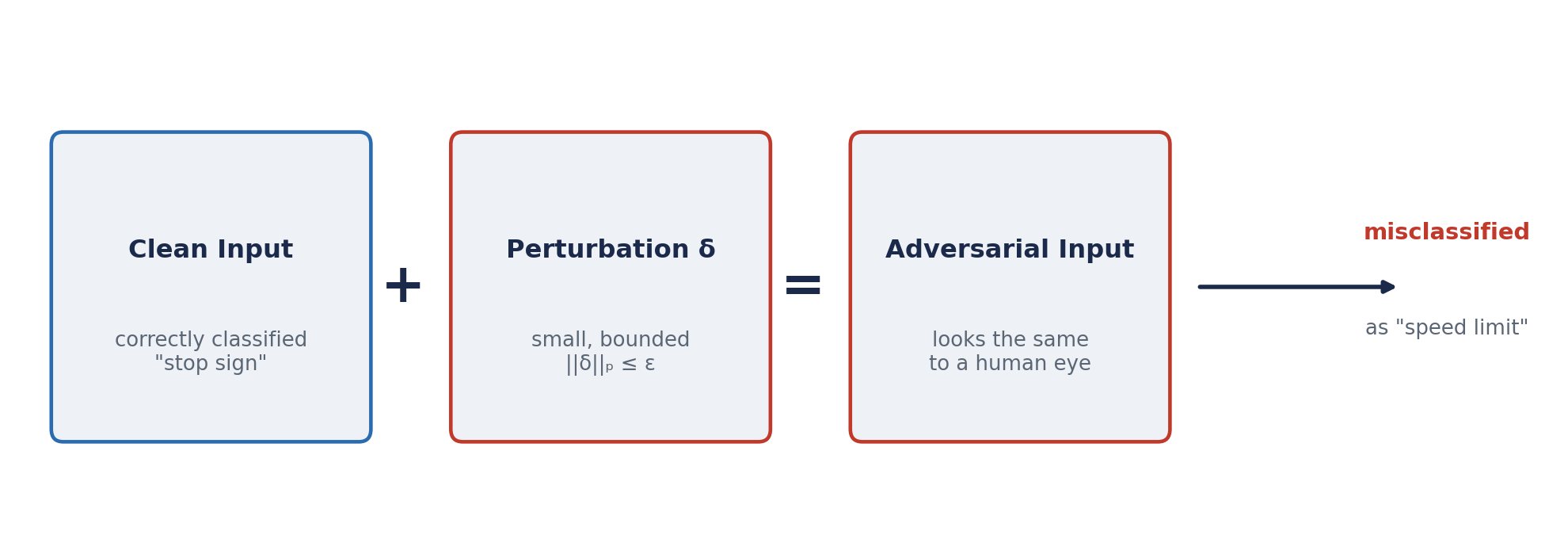
The first is the adversarial example itself: an input that has been specifically crafted to mislead a machine learning model while still appearing completely normal to a human observer. The second is the attack surface, which describes every component of a model or its surrounding pipeline that could be exploited, including the training data, the model's internal parameters, and any APIs through which the model is exposed to the outside world. The third is the threat model, a framework that defines what an attacker knows, what they are capable of doing, and what they are ultimately trying to achieve. Together, these three concepts give researchers and practitioners a shared vocabulary for reasoning about how a model might be attacked and, in turn, how it might be defended.
2.2 Types of Adversarial Attacks
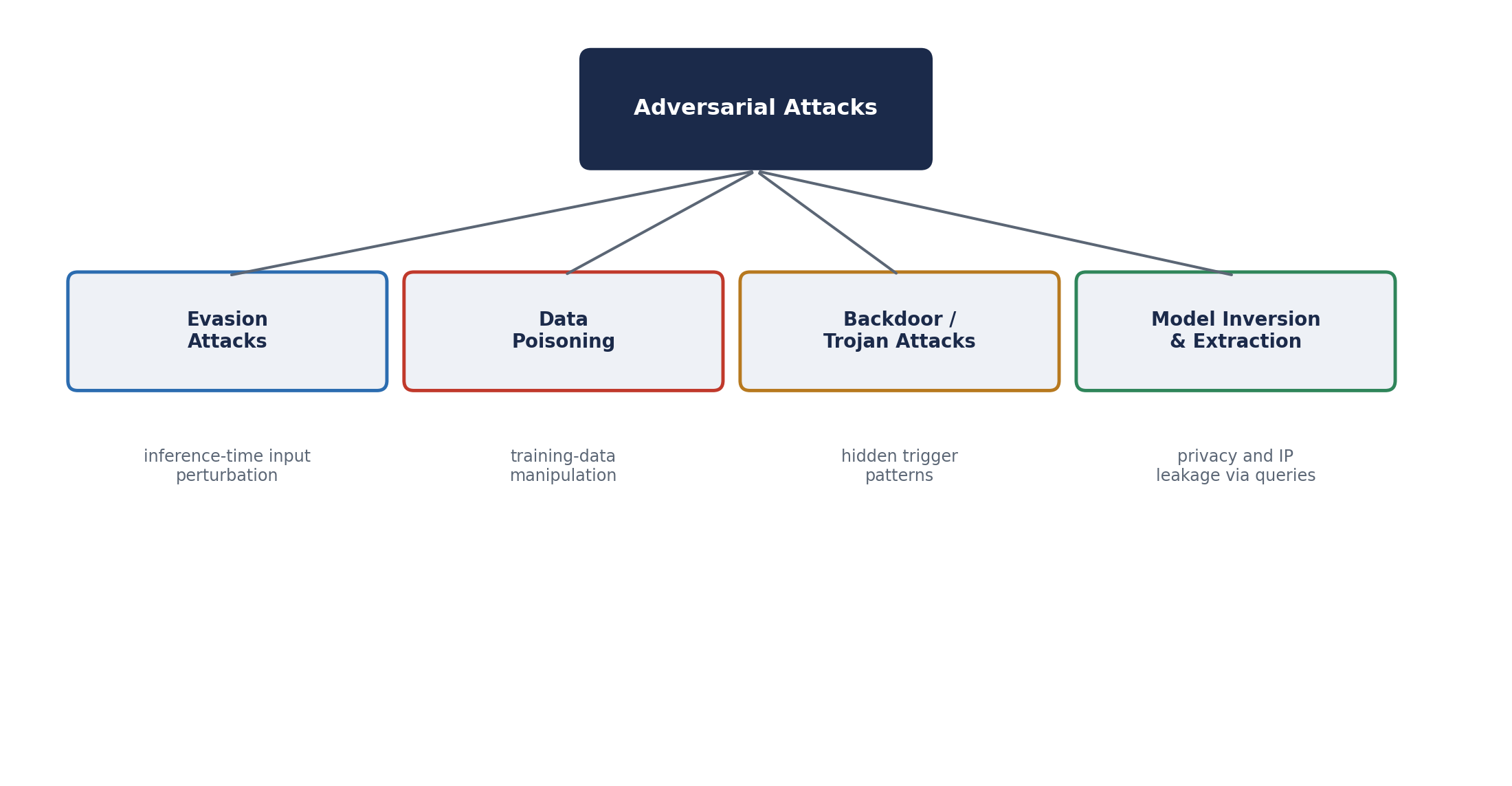
Adversarial attacks on machine learning systems generally fall into four broad categories, each of which targets a different stage of the model's lifecycle and requires a different defensive posture.
Evasion attacks occur when an attacker modifies input data at inference time in order to bypass detection or cause a misclassification. These attacks tend to be subtle, often imperceptible to a human observer, yet highly effective against models such as image classifiers, spam filters, and fraud-detection systems. A well-known illustration involves slightly altering the pixels in an image of a stop sign so that an autonomous vehicle's vision system misclassifies it as a different sign entirely, with potentially dangerous consequences on the road.
Data poisoning attacks target the training phase rather than inference, injecting malicious or mislabeled data into the training dataset itself. A model trained on poisoned data may learn incorrect patterns from the outset, resulting in compromised predictions once it is deployed. In a medical setting, for instance, an attacker might introduce carefully manipulated samples into a diagnostic dataset in order to bias the model's eventual outcomes in a particular direction.
Backdoor, or trojan, attacks involve embedding a hidden trigger into the training data or the model architecture itself. Under normal conditions the model behaves exactly as expected, but the moment it encounters an input containing the specific trigger, it misclassifies that input in a way chosen by the attacker. A facial recognition system, for example, might be manipulated so that any individual wearing a particular accessory is misidentified, effectively granting that person a hidden means of evading detection.
Model inversion and extraction attacks target the confidentiality of the model and its training data rather than the correctness of its predictions. In a model inversion attack, the attacker uses a trained model to infer sensitive information about the underlying training dataset, potentially exposing private records that were never meant to be recoverable. In a model extraction, or theft, attack, the attacker queries a model repeatedly and uses the resulting input-output pairs to reconstruct a close approximation of its functionality, effectively stealing the intellectual property embedded in the model. Both variants are especially concerning for cloud-based AI services and public APIs, where a model may be queried freely by anyone with an internet connection.
2.3 Motivations for Adversarial Attacks
Attackers pursue adversarial techniques for a range of reasons that mirror the incentives found in traditional cybersecurity. Financial gain is often the driving motive, as manipulating a model used in finance or e-commerce can allow an attacker to profit fraudulently, whether by evading a fraud detector or gaming an automated pricing system. Privacy breaches represent a second motive, where the goal is to extract sensitive personal or confidential information from a model that was trained on it. A third motive is competitive advantage, pursued through model extraction attacks that allow a rival to replicate a proprietary model without the cost of developing it independently. Finally, some attackers are motivated simply by disruption, aiming to cause AI-driven systems such as autonomous vehicles or security infrastructure to fail or behave unpredictably. Understanding which of these motives is most relevant to a given deployment helps organizations prioritize their security investments and anticipate the threats most likely to materialize.
2.4 Real-World Examples in AI-Driven Applications
Adversarial attacks are no longer purely theoretical; they have been demonstrated across a wide range of real-world applications. In autonomous vehicles, subtle modifications to traffic signs have been shown to cause misclassification by onboard vision systems, potentially leading to unsafe driving decisions. In facial recognition, carefully designed accessories or makeup patterns have been used to bypass identity verification systems. In healthcare diagnostics, poisoned medical images have the potential to influence AI-assisted diagnoses in ways that are difficult to detect after the fact. And in cloud AI services, model extraction attacks against publicly accessible APIs have allowed attackers to replicate proprietary algorithms without authorization. Taken together, these examples underscore the importance of embedding security measures throughout the entire AI lifecycle, from the moment data is first collected through to the moment a model is deployed, rather than treating security as a concern that can be bolted on after the fact.
3. Vulnerabilities in Machine Learning Systems
Machine learning systems are increasingly integrated into critical applications, yet they remain vulnerable at multiple stages of their lifecycle. These vulnerabilities arise from flaws in data collection, weaknesses in model design, gaps in deployment practices, and an increasing reliance on external components whose trustworthiness cannot always be verified. Understanding each of these weaknesses in turn is essential for building AI systems that are secure by design rather than by accident.
3.1 Weaknesses in Data Collection and Preprocessing
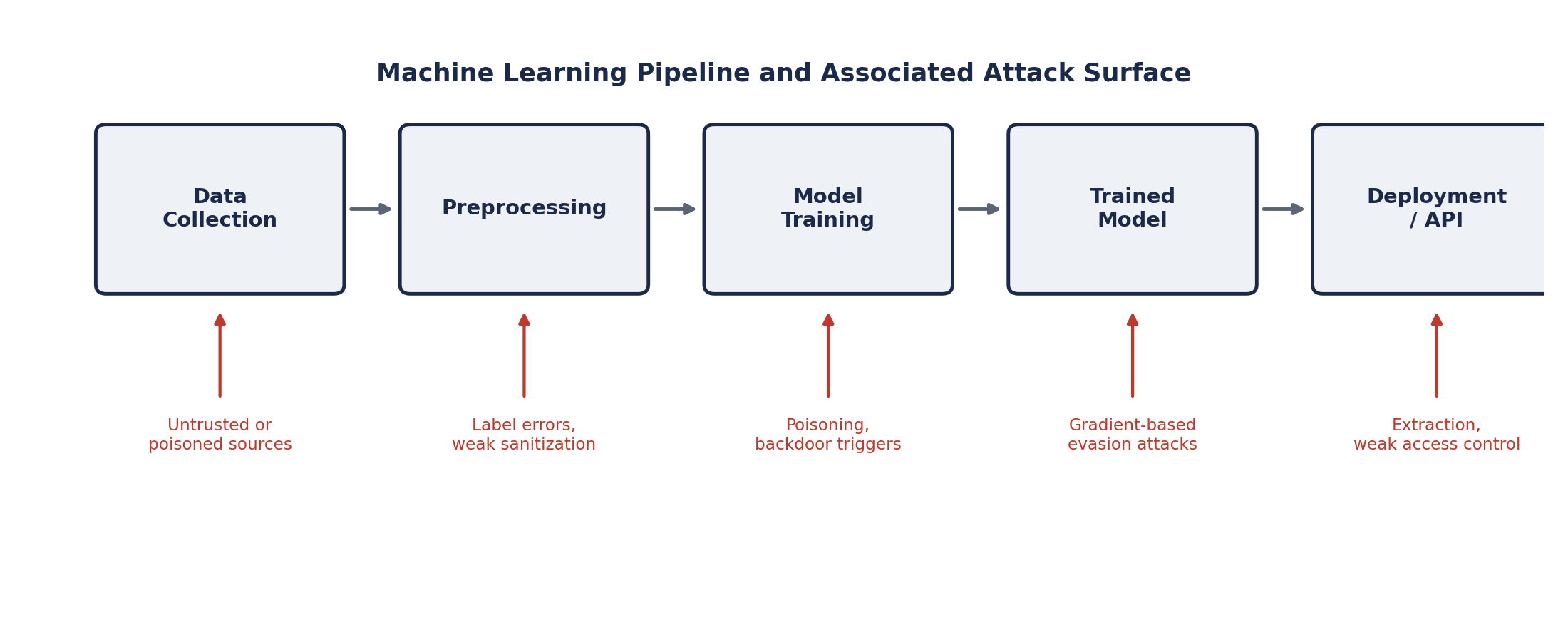
The reliability of a machine learning model depends heavily on the quality and integrity of the data it is trained on, which means that weaknesses introduced during data collection and preprocessing can quietly become vulnerabilities that attackers later exploit. Data collected from untrusted or unverified sources may contain malicious or biased entries from the outset. Attackers may deliberately inject poisoned examples into a dataset in order to manipulate a model's behavior once training is complete. Even in the absence of deliberate malice, inadequate preprocessing — errors in cleaning, normalization, or feature selection — can amplify existing vulnerabilities and reduce a model's overall robustness. Securing the data pipeline through rigorous validation, sanitization, and reliance on trusted sources is therefore one of the most fundamental steps an organization can take to mitigate these risks.
3.2 Model Architecture Vulnerabilities
The design and architecture of a model introduce a further set of attack surfaces that exist independently of the data used to train it. Models that are overly complex relative to the amount of available training data may memorize that data outright, a phenomenon known as overfitting, which in turn increases their susceptibility to attacks such as membership inference. Certain neural network architectures are particularly exposed to gradient-based adversarial attacks, which exploit the very mathematics that make gradient descent an effective training method in order to force misclassification. Poorly regularized models may also exhibit unstable behavior when exposed to inputs that fall outside the distribution they were trained on. Robust design principles — including careful regularization, the use of ensemble learning, and the integration of anomaly detection mechanisms directly into the model — can meaningfully reduce these architectural vulnerabilities.
3.3 Deployment and API Vulnerabilities
Once a model is deployed, particularly through a cloud service or a public-facing API, an entirely new set of vulnerabilities emerges that has little to do with the model's internal design. Attackers can query a deployed model repeatedly in order to reconstruct or steal its underlying parameters through model extraction. Deployed models are also continuously exposed to adversarial inputs crafted to cause incorrect predictions in production, often with real financial or safety consequences. Compounding both of these risks, insufficient access control — weak authentication or authorization mechanisms — can allow unauthorized parties to access or manipulate an AI system in the first place. Effective mitigation strategies include enforcing secure authentication, validating inputs before they ever reach the model, monitoring continuously for unusual query patterns, and rate-limiting access to production APIs.
3.4 Supply Chain and Third-Party Risks
Modern AI systems rarely stand alone; they typically rely on numerous third-party components, including open-source libraries, pretrained models, and cloud infrastructure maintained by outside vendors. Each of these dependencies introduces its own supply chain risk. Malicious code or unpatched vulnerabilities in a third-party library can propagate directly into an AI system that depends on it. Pretrained models downloaded from unverified sources may contain hidden backdoors or triggers that were never disclosed to the organization reusing them. And AI models hosted on cloud platforms remain exposed to infrastructure failures and insider threats that are largely outside the model owner's direct control. Reducing supply chain risk requires organizations to perform rigorous code audits, rely on trusted and well-vetted sources, verify the provenance of every dependency, and continuously monitor third-party components for signs of compromise.
4. Adversarial Attack Mechanisms
Understanding how adversarial attacks are generated in practice is crucial for designing machine learning models that can withstand them. At their core, adversarial attacks exploit the vulnerabilities of a model by introducing carefully crafted perturbations to its input data, perturbations that are engineered to cause misclassification or otherwise undesired behavior while remaining as inconspicuous as possible. This section walks through the mathematical foundations of adversarial examples, the most widely used attack algorithms, and the growing body of evidence that these attacks work in the physical world and not merely inside a simulation.
4.1 Mathematical Formulation of Adversarial Examples
An adversarial example can be formally defined as a perturbed input derived from an original input such that the perturbation remains bounded within a small, predefined budget:
x′ = x + δ, subject to ‖δ‖ₚ ≤ ε
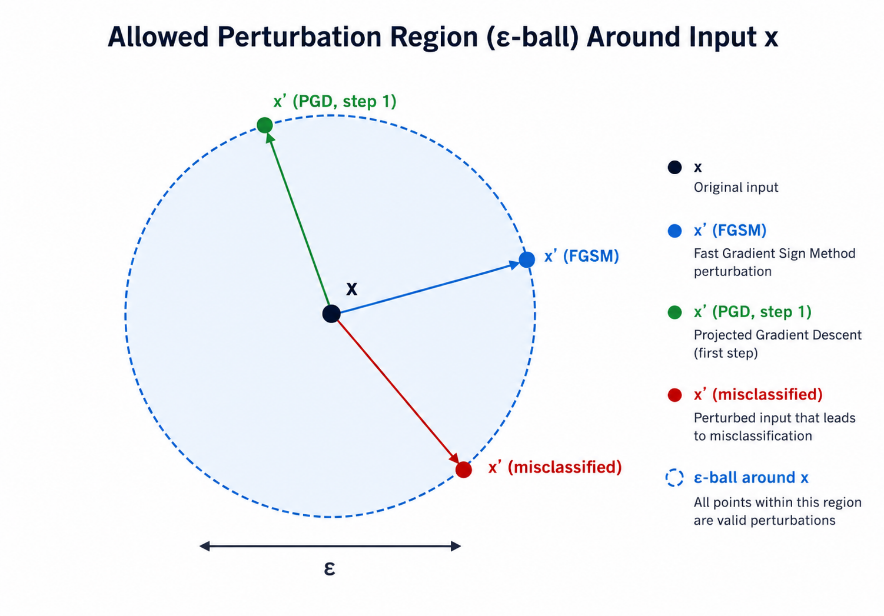
Here, δ denotes the perturbation added to the original input, ‖δ‖ₚ denotes the norm of that perturbation (commonly the L2 or L∞ norm), and ε represents the maximum perturbation magnitude the attacker is permitted to introduce. The attacker's goal is to find a value of δ that maximizes the model's loss function J(θ, x′, y) such that the model's predicted output diverges from the true label y, all while ensuring that x′ remains visually or functionally indistinguishable from the original input x. This simple but powerful mathematical framework underlies the vast majority of adversarial attack algorithms developed to date.
4.2 Gradient-Based Attack Methods
Gradient-based attacks are among the most widely used adversarial techniques precisely because they leverage the model's own gradients to identify the perturbations that will maximally affect its predictions, turning the same mathematics that makes training efficient into a tool for attack.
The Fast Gradient Sign Method, or FGSM, is a one-step attack that generates adversarial examples by adjusting the input in the direction of the gradient of the loss function:
x′ = x + ε · sign(∇ₓ J(θ, x, y))
FGSM is computationally cheap to compute and remains effective against a wide range of neural network models, which is part of why it is often used as a first benchmark when evaluating a new defense.
Projected Gradient Descent, or PGD, extends FGSM into an iterative attack. Rather than taking a single large step, PGD applies a sequence of smaller perturbations, projecting the result back into the allowable ε-ball around the original input after each step:
x^(t+1) = Proj_(x,ε){ x^t + α · sign(∇ₓ J(θ, x^t, y)) }
Because of this iterative refinement, PGD is widely regarded as one of the most powerful white-box attacks available and is frequently used as the gold-standard benchmark for evaluating adversarial robustness.
DeepFool takes a different approach entirely, framing the search for an adversarial example as an optimization problem that seeks the minimal perturbation required to change a classifier's output. It does this by iteratively linearizing the model's decision boundaries and computing the perturbation needed to push an input across the nearest one, which tends to produce adversarial examples that are smaller and more precise than those generated by FGSM or PGD.
4.3 Black-Box and Query-Based Attacks
Unlike gradient-based, white-box attacks, black-box attacks assume the attacker has no direct knowledge of the model's architecture or internal parameters. Instead, the attacker relies solely on the model's outputs, or the confidence scores that accompany them, to generate an effective adversarial example. Query-based attacks operate by sending a sequence of inputs to the model and observing the resulting predictions, using this feedback to approximate the model's gradients or decision boundaries without ever seeing them directly. Transfer-based attacks take a related but distinct approach: an adversarial example is generated against a surrogate model that the attacker controls and then applied to the actual target model, exploiting the well-documented tendency of adversarial inputs to generalize across architecturally different models. Black-box attacks are especially relevant to AI services deployed through public APIs, where the internal details of the model are deliberately hidden from the outside world but its outputs are freely available to anyone who queries it.
4.4 Physical World Adversarial Attacks
Adversarial attacks are not confined to the digital realm; they can also be constructed directly in the physical world. A physical adversarial attack involves crafting a perturbation on a real-world object such that it remains effective even after being captured by a camera or other sensor, surviving the transformations introduced by lighting, angle, and distance. Researchers have demonstrated that stickers or graffiti placed on stop signs can cause an autonomous vehicle's vision system to misclassify them, that printed adversarial images can fool facial recognition or object detection systems even when photographed from different angles or under varying lighting conditions, and that specially designed clothing or accessories can allow a person to evade detection by a surveillance camera's person-detection model. These physical demonstrations make clear that adversarial robustness cannot be treated as a purely digital concern; any defense that only holds up in simulation offers little protection once a system is deployed into the physical world.
5. Defense Strategies Against Adversarial Attacks
As adversarial attacks continue to evolve in sophistication, it becomes increasingly important to develop defense strategies that genuinely enhance the robustness and reliability of machine learning models rather than offering only superficial protection. This section explores the defense mechanisms most commonly used in practice today, spanning training techniques, model design choices, input processing methods, and privacy-preserving strategies that reduce what an attacker stands to gain in the first place.
5.1 Adversarial Training
Adversarial training is among the most widely used defense strategies available and works by augmenting the training dataset with adversarial examples, teaching the model to correctly classify both clean and maliciously perturbed inputs alike. The training objective is modified so that the model minimizes its loss on the worst-case perturbation of every training example, rather than on the clean example alone:
min_θ E₍ₓ,y₎∼D [ max_{‖δ‖≤ε} J(θ, x + δ, y) ]
Adversarial training measurably improves a model's resilience against known attack patterns, but this improvement does not come for free: it can increase computational cost substantially during training, and if not carefully tuned, it can also reduce the model's accuracy on entirely clean, unperturbed inputs.
5.2 Robust Optimization Techniques
Robust optimization techniques generalize the idea behind adversarial training by explicitly accounting for worst-case adversarial perturbations throughout the training process, formulating training itself as a min-max optimization problem:
min_θ max_{δ∈S} J(θ, x + δ, y)
Here S defines the full set of perturbations the model must be robust against. Techniques built around Projected Gradient Descent-based training fall squarely under this category, and robust optimization more broadly helps ensure that a model maintains acceptable performance even when it is placed under sustained, strong adversarial pressure rather than facing only isolated attack attempts.
5.3 Defensive Distillation
Defensive distillation is a model-hardening technique that leverages knowledge transfer between two neural networks. A teacher model is first trained to produce softened, temperature-scaled output probabilities rather than hard class labels. A student model is then trained not on the original hard labels but on the teacher's softened outputs. The effect of this two-stage process is to reduce the model's sensitivity to small input perturbations, which in turn makes gradient-based attacks considerably less effective, since the smoothed decision surface produced by distillation offers fewer sharp gradients for an attacker to exploit.
5.4 Input Transformation and Anomaly Detection
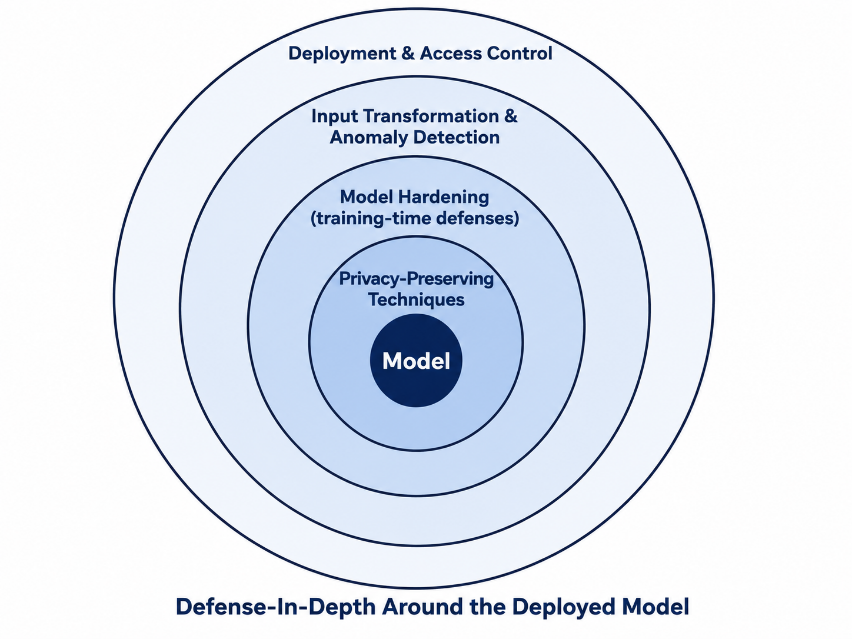
A complementary line of defense focuses not on the model itself but on the inputs it receives, either by modifying them before they reach the model or by flagging suspicious inputs outright. Input transformation techniques such as image compression, feature squeezing, and controlled randomization can meaningfully reduce the effectiveness of adversarial perturbations by disrupting the precise structure an attacker relied on when crafting them. Anomaly detection takes a different approach, using the model itself or a separate detector trained alongside it to flag inputs that deviate significantly from the distribution seen during training, preventing malicious inputs from ever influencing a prediction in the first place. Because these techniques operate independently of how the underlying model was trained, they are frequently combined with other defenses discussed in this section to provide layered, overlapping protection.
5.5 Ensemble Methods and Model Hardening
Ensemble methods improve robustness by combining the predictions of multiple models rather than relying on any single one. Aggregating outputs from several independently trained models reduces the system's overall vulnerability to an attack crafted against just one of them, since an adversarial example that fools one model in the ensemble may fail to fool the others. Introducing deliberate variability into model parameters or architectures, sometimes called randomized model architectures, further increases the difficulty an attacker faces when trying to craft a single input that reliably fools the system. These ensemble-level defenses are typically paired with model-hardening techniques such as weight regularization, dropout, and adversarial regularization, all of which improve a model's resilience against manipulation at the level of the individual network.
5.6 Privacy-Preserving Techniques
Privacy-preserving machine learning methods can also strengthen security more broadly, by limiting the exposure of sensitive information that an attacker might otherwise be able to extract from a trained model.
Differential privacy works by adding carefully controlled noise to data or to a model's outputs, preventing an attacker from confidently inferring whether any single individual's data was part of the training set. This directly protects against membership inference attacks while still allowing useful, statistically meaningful model training to take place.
Federated learning takes a complementary approach, enabling collaborative model training across multiple devices or organizations without ever requiring raw data to leave its original location. Participants share only model updates rather than the underlying data itself, substantially reducing the risk of exposing sensitive datasets to any single party, including the organization coordinating the training process. When federated learning is combined with differential privacy, the resulting system offers meaningfully stronger security and privacy guarantees, which is part of why this combination has become particularly popular in applications involving sensitive personal data, such as healthcare and finance.
6. Evaluation and Metrics
Evaluating the robustness of machine learning models against adversarial attacks is essential for understanding their true security and reliability, since a model's reported accuracy on clean data reveals very little about how it will behave once an adversary is actively trying to fool it. This section discusses the key metrics, benchmark datasets, and trade-offs involved in assessing adversarial resilience in practice.
6.1 Measuring Robustness of Models
Robustness evaluation seeks to quantify how well a model resists adversarial perturbations, and several metrics have become standard for this purpose. Adversarial accuracy measures the percentage of inputs a model continues to classify correctly once adversarial perturbations have been applied to them. Robustness margin captures the minimum perturbation magnitude required to induce a misclassification, offering a finer-grained sense of how close a model sits to its own decision boundaries. Attack success rate measures the fraction of adversarial inputs that successfully induce an incorrect prediction, essentially viewing robustness from the attacker's perspective. Certified robustness goes a step further, offering formal, mathematically provable guarantees that a model's output will remain unchanged for any perturbation within a predefined bound, rather than relying solely on empirical testing against known attacks. Together, these metrics allow researchers to compare models under controlled attack scenarios and to make informed decisions about which defense strategy is best suited to a given deployment.
6.2 Benchmark Datasets for Adversarial Testing
Benchmark datasets play a critical role in evaluating model robustness in a way that is comparable across studies. MNIST, a dataset of handwritten digits, remains widely used for initial adversarial research owing to its simplicity and the speed with which experiments can be run against it. CIFAR-10 and CIFAR-100 offer small-scale image classification tasks with meaningfully increased complexity, making them a popular middle ground for evaluating robustness. ImageNet extends this testing to large-scale, high-resolution, real-world images, closer to the conditions a deployed system would actually face. Beyond vision, speech and text datasets such as LibriSpeech and IMDB reviews are used to test adversarial attacks and defenses in audio and natural language processing models, respectively. Collectively, these datasets provide standardized environments in which the effectiveness of adversarial defenses can be evaluated and compared consistently across independent research studies.
6.3 Trade-offs: Accuracy, Robustness, and Computational Cost
Designing a genuinely robust model requires balancing three factors that frequently pull in opposite directions. Overly aggressive defense strategies, strong adversarial training in particular, can measurably reduce accuracy on clean, unperturbed data, meaning that a more robust model may perform slightly worse for ordinary, non-adversarial users. Enhancing robustness also tends to increase model complexity and often requires additional training iterations or data augmentation, extending both development time and cost. Finally, techniques such as adversarial training, certified defenses, and privacy-preserving methods like differential privacy and federated learning can significantly increase memory usage and computation time, both during training and at inference. Evaluating these trade-offs carefully is critical for deploying AI systems that maintain strong performance while remaining resilient against adversarial threats; in practice, most deployments involve finding a workable compromise between robustness and efficiency that fits within real operational constraints rather than chasing maximum robustness at any cost.
7. Case Studies and Applications
Adversarial attacks and the vulnerabilities that enable them are not merely theoretical constructs confined to research papers; they have been observed repeatedly in real-world applications across multiple industries. Studying these cases in detail offers valuable insight into the practical risks organizations face and highlights concrete strategies for mitigating threats once a system has already been deployed.
7.1 Autonomous Vehicles and Computer Vision Systems
Autonomous vehicles rely heavily on computer vision models for perception, navigation, and safety, which makes adversarial attacks in this domain especially consequential. Researchers have repeatedly demonstrated that small stickers or graffiti applied to stop signs can cause misclassification by a vehicle's vision system, a manipulation with the potential to contribute directly to accidents. Subtle perturbations introduced into road markings or obstacles can similarly mislead the AI systems responsible for real-time driving decisions. In response, companies such as Tesla and Waymo have invested heavily in robust training methods and sensor fusion, combining data from multiple independent sensors so that an attack successful against one input modality is far less likely to compromise the vehicle's overall perception of its surroundings.
7.2 Financial and Fraud Detection Models
Financial institutions increasingly rely on machine learning for credit scoring, fraud detection, and algorithmic trading, and the vulnerabilities present in these systems can be exploited directly for financial gain. Attackers may design adversarial transactions specifically engineered to bypass a fraud detection model, or attempt data poisoning aimed at influencing a training dataset in order to manipulate scoring models or investment strategies over time. Robust model design, continuous monitoring of live predictions, and anomaly detection layered on top of the core model are all essential components of mitigating risk in financial AI applications, where the cost of a successful attack is measured directly in monetary terms.
7.3 Healthcare and Medical AI Applications
Healthcare AI systems are particularly sensitive, both because of the privacy concerns inherent to medical data and because of the direct impact these systems can have on human lives. Adversarial attacks in this sector include slight perturbations introduced into X-rays or MRI scans, which can cause misdiagnosis by AI-assisted diagnostic tools, as well as data privacy attacks such as membership inference and model inversion, which can expose sensitive patient information embedded in a trained model. Privacy-preserving techniques such as differential privacy and federated learning are increasingly being adopted across the healthcare sector specifically because they allow institutions to protect patient data while still enabling collaborative AI model development across multiple hospitals and research centers.
7.4 Lessons Learned from Real-World Incidents
Analyzing real-world adversarial incidents across these domains points toward several consistent takeaways. AI systems are vulnerable at multiple stages simultaneously, since attacks can target data collection, model training, or deployment, which means that comprehensive security strategies are necessary rather than optional. Continuous monitoring and anomaly detection prove crucial in practice, as surveillance of model inputs and outputs over time helps organizations detect suspicious activity early, before it can cause significant harm. There is also an unavoidable trade-off between security and performance, since implementing robust defenses may reduce model accuracy or increase computational cost, requiring careful and ongoing balancing rather than a one-time decision. Finally, cross-industry collaboration matters: sharing knowledge about attacks and defense strategies across sectors strengthens the overall security posture of AI systems more broadly than any single organization could achieve on its own. These lessons collectively underscore the importance of adopting defense-in-depth strategies, integrating security into every stage of the AI lifecycle, and preparing for both digital and physical adversarial threats rather than just one or the other.
8. Challenges and Future Directions
As AI and machine learning systems become more widely deployed, the security landscape surrounding them continues to evolve just as quickly. Despite genuine advances in defense mechanisms, emerging threats, evolving adversarial techniques, and persistent limitations in current approaches all point toward the need for ongoing research and greater standardization in AI security.
8.1 Emerging Threats and Advanced Adversarial Techniques
Adversarial attacks are becoming increasingly sophisticated, and increasingly capable of targeting both digital and physical AI systems at once. Adaptive attacks now design adversarial inputs specifically to adapt to a model's known defenses, bypassing protections such as adversarial training that would have stopped an earlier generation of attack. AI-powered attacks take this a step further, using AI itself to automatically generate optimized adversarial examples at scale, removing much of the manual effort an attacker previously needed to invest. Multi-modal attacks are no longer confined to images or text; they now target speech, video, and sensor data within complex, multi-input AI systems. Supply chain exploits round out this list, since growing dependence on third-party libraries, pretrained models, and cloud services introduces additional risk, including hidden backdoors or vulnerabilities that an organization may never discover until it is too late. Taken together, these evolving threats demonstrate just how dynamic AI security has become, and underscore the need for defense mechanisms that are proactive and adaptive rather than static.
8.2 Limitations of Current Defense Methods
Current defense strategies, while genuinely effective in some contexts, carry notable limitations that are important to acknowledge rather than gloss over. Techniques such as adversarial training often defend well against known attack patterns but fail against novel or adaptive adversaries who were not accounted for during training. Robustness enhancements frequently come at the cost of reduced accuracy on clean data or increased computational and memory requirements, a trade-off discussed at length in Section 6. Defense methods and evaluation metrics also vary considerably across research studies, making it difficult to compare effectiveness or to ensure consistent security practices across an industry that has not yet converged on shared standards. Finally, implementing advanced defenses in real-world systems can prove complex in practice, particularly in resource-constrained environments or across distributed AI infrastructures where computational headroom is limited. Recognizing these limitations honestly is crucial for guiding future research and for improving AI security practices in a way that is grounded in reality rather than in idealized laboratory conditions.
8.3 Need for Standardized Security Protocols in AI
Standardized protocols and frameworks are essential for consistent and reliable AI security across organizations and industries. Regulatory frameworks such as the European Union's Artificial Intelligence Act aim to classify AI systems by risk and to enforce compliance with security and ethical standards, providing an external forcing function where market incentives alone might not suffice. Industry best practices, established through guidelines for secure model development, data management, and deployment, help ensure that AI systems maintain integrity across different sectors even in the absence of formal regulation. Standardized evaluation benchmarks, including shared adversarial testing datasets and robustness metrics, allow organizations to assess security uniformly and to compare defensive strategies on equal footing. Taken together, this kind of standardization will help facilitate broader trust in AI systems and will allow organizations to adopt security measures systematically, rather than piecing together ad-hoc protections after the fact.
8.4 Opportunities for AI Security Research
Despite these challenges, a number of promising research opportunities remain open in AI security. Hybrid defense strategies that combine adversarial training, robust optimization, anomaly detection, and privacy-preserving methods offer the possibility of multi-layered protection that no single technique could achieve on its own. Explainable AI for security is another promising direction, developing interpretable models that reveal their own vulnerabilities and help detect attacks in real time rather than only after the fact. Efficient privacy-preserving techniques remain an active area of optimization, as differential privacy, federated learning, and secure computation all still carry meaningful computational overhead that limits large-scale deployment. Cross-domain security research, exploring attacks and defenses across images, text, audio, and multi-sensor data simultaneously, will help ensure that defenses developed for one modality generalize to others rather than remaining siloed. Finally, adaptive and self-healing AI systems, designed to dynamically detect, adapt to, and recover from attacks without requiring manual intervention, represent perhaps the most ambitious long-term direction for the field. Research pursued across these areas will play a critical role in ensuring that AI systems remain not only powerful, but also safe, robust, and genuinely trustworthy.
9. Conclusion
Artificial Intelligence and Machine Learning are increasingly integrated into critical applications across industries, from autonomous vehicles and finance to healthcare and security systems. While these technologies offer transformative capabilities, they also introduce significant security and privacy challenges that cannot be treated as an afterthought. This article has examined adversarial threats, the vulnerabilities that enable them, the defense mechanisms available to counter them, the ways in which robustness can be evaluated, and a set of real-world case studies, together offering a comprehensive understanding of AI security as it stands today.
Several key insights emerge from this discussion. Machine learning models remain susceptible to a range of adversarial vulnerabilities, including evasion, data poisoning, backdoor insertion, and model inversion or extraction, all of which can compromise the accuracy, integrity, and confidentiality of an AI system in different ways. A correspondingly wide range of defense strategies, including adversarial training, robust optimization, defensive distillation, input transformation, ensemble methods, and privacy-preserving approaches such as differential privacy and federated learning, can meaningfully improve a model's resilience against these threats when applied thoughtfully and in combination. Measuring robustness through adversarial accuracy, attack success rate, and certified guarantees is essential to knowing whether a given defense is actually working, and implementing security measures in practice almost always involves balancing robustness, accuracy, and computational cost rather than optimizing for any one of them in isolation. Real-world case studies drawn from autonomous vehicles, finance, and healthcare demonstrate that these are not abstract concerns, and that proactive security measures pay for themselves the moment a system faces a genuine adversary. Looking forward, emerging threats, adaptive attacks, and supply chain vulnerabilities all point toward the need for continued research, greater standardization of security protocols, and the development of hybrid and self-healing defense mechanisms capable of keeping pace with attackers rather than perpetually reacting to them.
In conclusion, securing AI systems is not optional; it is fundamental to their safe deployment and their long-term trustworthiness. Organizations must integrate security and privacy considerations throughout the entire AI lifecycle, from data collection and model design through to deployment and continuous monitoring, rather than treating any one of these stages in isolation. By adopting multi-layered defense strategies, adhering to standardized protocols as they mature, and continuing to invest in research on emerging threats, AI systems can be made progressively more robust, more reliable, and more ethically responsible over time.
Ultimately, the findings of this study highlight that AI security is an ongoing challenge rather than a problem that can be solved once and then forgotten. It requires sustained collaboration between researchers, industry practitioners, and policymakers to ensure that the very real benefits of AI can be realized safely and responsibly, for the organizations that deploy these systems and for the people whose lives they increasingly touch.
References
- Verma, Harsh. (2025). Explainable AI (XAI) for Software Engineering Decision-Making. . DOI ↗ Google Scholar ↗
- Islam, M. S., Verma, H., Khan, L., & Kantarcioglu, M. (2019, December). Secure real-time heterogeneous iot data management system. In 2019 first IEEE international conference on trust, privacy and security in intelligent systems and applications (TPS-ISA) (pp. 228-235). IEEE. Shrestha, A. K., Singha, S., Sural, S., Sutton, S., Tahiri, S., Tipper, D., ... & Yu, L. Yu, Xiaoyuan 46 Zhao, Zhilong 236 Zou, Xukai 46. DOI ↗ Google Scholar ↗
- Verma, H. (2025). Future Trends in AI, Machine Learning, and Big Data: Implications for Technical Leadership. International Journal of Engineering & Extended Technologies Research (IJEETR), 7(4), 10448-10460. DOI ↗ Google Scholar ↗
- Verma, H. (2025). Policy Drift in Learning AI Agents: A Dynamical Systems Perspective on Security Degradation. International Journal of Scientific Research and Management (IJSRM), 13(07), 2457-2464. DOI ↗ Google Scholar ↗
- Verma, H. (2025). Economic impact and productivity modeling of AI agents. DOI ↗ Google Scholar ↗
- Verma, H. (2025). Agentic workflows for end-to-end software engineering automation. DOI ↗ Google Scholar ↗
- Verma, Harsh. (2025). Economic impact and productivity modeling of AI agents. World Journal of Advanced Research and Reviews. 26. 14. . DOI ↗ Google Scholar ↗
- Verma, Harsh. (2025). Agentic workflows for end-to-end software engineering automation. World Journal of Advanced Research and Reviews. 25. 20. . DOI ↗ Google Scholar ↗
- Verma, Harsh. (2025). AI-driven cybersecurity in software engineering. World Journal of Advanced Research and Reviews. 27. 2012-2025. . DOI ↗ Google Scholar ↗
- Verma, Harsh. (2025). Ethical challenges and bias mitigation in Artificial Intelligence systems. World Journal of Advanced Research and Reviews. 28. 2364-2373. . DOI ↗ Google Scholar ↗
- Verma, Harsh. (2026). Cloud-based AI systems for scalable and intelligent software applications. World Journal of Advanced Research and Reviews. 29. 2041-2051. . DOI ↗ Google Scholar ↗
- Verma, H. (2019). Secure Real-Time Heterogeneous IoT Data Management System. DOI ↗ Google Scholar ↗
- Verma, H. (2024). AI Agentic Architectures for Autonomous Data Engineering Pipelines. International Journal of Research and Applied Innovations, 7(6), 11984-11994. DOI ↗ Google Scholar ↗
- Verma, H. (2024). Autonomous Multi-Agent Systems for Enterprise Decision-Making. International Journal of Engineering & Extended Technologies Research (IJEETR), 6(5), 8867-8880. DOI ↗ Google Scholar ↗
- Verma, H. (2026). Security in Multi-Agent AI Systems: Modeling Emergent Vulnerabilities via Trust Graphs. International Journal of Scientific Research and Management (IJSRM), 14(04), 2863-2874. DOI ↗ Google Scholar ↗
- Verma, H. (2025). Clean Attacks: Formalizing Semantically Valid Adversarial Behavior in Autonomous AI Agent Systems. International Journal of Scientific Research and Management (IJSRM), 13(10), 2623-2633. DOI ↗ Google Scholar ↗
- Verma, H. (2026). Designing Self-Healing AI Agentic Systems: A Framework for Autonomous Detection and Response. International Journal of Scientific Research and Management (IJSRM), 14(06), 2912-2919. DOI ↗ Google Scholar ↗
- Verma, H. (2026). Intent-Based Security: Replacing Identity-Centric Trust in Autonomous AI Agentic Systems. International Journal of Scientific Research and Management (IJSRM), 14(02), 2771-2778. DOI ↗ Google Scholar ↗