Abstract
This study seeks to explore the relationship between digital skills and growth in Small Medium Enterprises in Africa, making comparisons with some global studies where necessary. This is through a PRISMA guided systematic literature review of empirical evidence and concepts around how digital literacy, digital capability, and technology skills affect the competitiveness, resilience, innovation and inclusive economic growth of SMEs. The study will review selected studies in various sectors of the economy that include agriculture, manufacturing, creative industries, retail, traditional markets and women-owned SMEs. Digital skills emerge to be key enablers for sales growth, market growth, efficiency, and continuity, and contribute to wider societal impacts of financial inclusion, youth entrepreneurship and poverty alleviation. The findings show, however, differences in the results because of variations in infrastructure, policy environment, financial capacity and digital skills among other factors. The contribution of the study is in offering a conceptual framework for digital skills development, digital capabilities, SME growth and inclusive economic development. It also proposes policies on digital infrastructure, training of SMEs, educational partnerships and inclusive digital ecosystem. Comparative and longitudinal studies in African SMEs should be considered in future.
Keywords
digital skills SMEs digital transformation inclusive economic development SME growth
1.1 Introduction
The fast development of digital technology has brought about a complete revolution of how SMEs and MSMEs do business, innovate, compete, and contribute to socioeconomic development. Digital transformation has become an important strategy that developing and emerging market businesses can use to boost their productivity, increase competitiveness, enter new markets, and be part of regional and global value chains. Digital competencies like digital literacy, data analytics, cloud computing, artificial intelligence (AI), e-commerce adoption, use of fintech, digital marketing, and platform integration have become essential instruments for business growth and sustainability.
The importance of digital transformation in Africa and other developing regions has been increased due to the fact that SMEs form the base of almost all economies. SMEs are very important in terms of job creation, reduction of poverty, development of entrepreneurship, innovation, and inclusive growth. As pointed out by Mugano (2024), the majority of SMEs in Sub-Saharan Africa (SSA) make up for no less than 50% of GDP and roughly 80% of employment and, therefore, become an important instrument of socioeconomic development. However, despite their importance, many SMEs face different problems, such as lack of proper infrastructure, poor digital literacy, inadequate legislative support, limited financial access, and lack of integration into digital ecosystems.
A number of recent studies have confirmed the potential for digital transformation to contribute greatly towards inclusive growth, provided there are supportive digital skills, institutions and favourable policy environment. In his comparative study that covered Indonesia, Kenya and Colombia, Solehudin, (2025) found out that digital capabilities considerably contribute to inclusive growth for technology-enabled MSMEs. Digital financial inclusion, to some degree, mediates the influence of digital capabilities on inclusive growth while digital public infrastructure and pro-inclusive policies positively affect business performance. This finding suggests that digital transformation is not only about technology but also about institutions and development and, hence, requires coordinating efforts and policies.
Similar findings were made by Huang et al. (2026) who argue that entrepreneurship and digitalization go hand in hand in creating conditions for equitable and sustainable growth in African countries. Based on their long-term panel analysis that involved 45 African countries, they state that institutional quality complements the benefits of digital transformation while entrepreneurship mediates the influence of digitalization on sustainable outcomes. The report states that digital infrastructure, regulatory effectiveness and governance quality are essential preconditions for transforming digital adoption into development outcomes.
The relevance of digital transformation can also be seen through the widespread use of fintech systems, mobile money systems, cloud computing, artificial intelligence, e-commerce platforms and digital marketing among SMEs. The research by Mathibe and Oppong, (2025), Mushoni, (2025), (Motadi, 2026), and (Oukouomi Noutchie, (2025) shows that digitalization increases the level of financial inclusion, operational efficiency, customer engagement, innovation, access to markets and entrepreneurship involvement. At the same time, the following challenges were identified: poor broadband infrastructure, high cost of Internet services, lack of digital literacy, gender disparity, rural – urban differences, regulatory fragmentation and poor awareness of digital technologies.
In the context of South Africa, the relevance of digital transformation technologies has increased because of 4IR, corporate development and economic inclusion. It was found out by Bengu & Beharry-Ramraj (2025) that digital transformation technologies like Software-as-a-Service (SaaS), cloud computing, analytics, automation, blockchain, artificial intelligence (AI) and chatbots can increase the SME resilience, reduce costs of operation and expand the market reach. At the same time, such challenges as poor infrastructure, poor Internet access, poor digital awareness and digital capability are preventing SMEs from inclusive integration into corporate supply chains.
Digital inequality remains a substantial developmental problem in both townships and rural settings. According to Mahlatji and Mahlatji (2024), many SMMEs based in townships in the province of Limpopo are reluctant to use digital technologies owing to concerns regarding finance, poor awareness of the benefits of using digital technology, and insufficient government support for acquiring digital skills. Similarly, Nyika et al. (2024) observed that poor infrastructure, poor connectivity to the internet, financial constraints, poor digital competences, and poor market access remain barriers to the development of rural SMMEs in Africa.
The literature further reflects on how digital capabilities have increasingly been linked to innovation, sustainability, ESG performance, and competitiveness at a global level. According to Mehmood et al. (2026), data-driven decisions, ESG performance, and innovation performance are positively influenced by digital capabilities in manufacturing SMEs of China. Likewise, Dung et al. (2025) found out that the export performance of manufacturing SMEs in Vietnam is enhanced by digital capabilities through transformational leadership and digital transformation.
All these studies confirm that, in the contemporary digital economy, digital transformation and digital capabilities play an important role as a vital strategic resource for survival, growth, competitiveness, sustainability, and inclusion of SMEs. Nevertheless, at the same time, the contextual gaps are evident between urban and rural businesses, between formal and informal SMEs, between developed and developing countries, between digitally capable and digitally incapable people. Therefore, there is a growing need for context-driven research of the impact of digital capabilities on the performance, inclusiveness, and sustainability of SMEs in Africa and other developing countries.
1.2 Background to the Study
The rise of the digital economy has changed completely the definition of entrepreneurship, operations of business, client interactions, and economic activity. Cloud computing, artificial intelligence, fintech technology, mobile applications, blockchain, e-commerce systems, digital marketing systems, big data analysis, and mobile money have changed the traditional way of doing business and allowed small and medium enterprises to expand their operations and compete on the domestic and international levels.
Across the world, governments and development agencies are starting to understand digital transformation as the engine of competitiveness, sustainable development, and inclusive economic growth. Digitalization enhances the productivity, innovation, efficiency, resilience, and integration in the global value chains of small and medium enterprises, Mugano (2024) writes. Along these lines, Bulagi (2025) expected that through the digital transformation of fintech, e-commerce, and artificial intelligence, the GDP of Africa could be increased by more than $180 billion in 2025.
However, despite all these benefits, there remain substantial institutional and structural challenges that hinder effective implementation of digital transformation in emerging economies. According to Motadi (2026), fragmented regulation, poor rural connectivity, socioeconomic disparity, low digital literacy levels, and poor governance of public-private partnerships continue to hinder inclusive digital transformation, despite strategically investing in broadband, cloud computing, mobile money, and e-commerce, which could boost the power of SMEs and marginalized groups.
In Sub-Saharan Africa, digital technologies have come to be recognized as tools for enhancing financial inclusion and entrepreneurship development. Mathibe and Oppong (2025) noted that mobile banking, financial technologies, and digital financial services significantly boost entrepreneurial behavior and financial inclusion in 30 Sub-Saharan African (SSA) countries. However, regional disparities, poor digital literacy levels, inadequate infrastructure, and inconsistent regulation policies remain hindrances towards achieving inclusive results.
Disparities between urban and rural environments constitute yet another characteristic of the African digital transformation environment. As per Nyika et al. (2024), rural SMEs continue to remain unempowered due to inadequate digital infrastructure, poor connectivity, lack of funds, and insufficient digital skills. In addition, Rampaul (2025) asserted that geographical disparities play a major role in determining the outcomes of SME digital adoption, with enterprises in disadvantaged and rural areas experiencing more barriers to digital engagement.
Digital exclusion has a greater impact on women businesses, young businesses, informal firms, and other disadvantaged groups. Major digital competency deficiencies were identified among African NEET young people by Gala et al. (2025), particularly intermediate and advanced digital competencies. As per the survey, participation in the digital economy remains constrained due to infrastructure shortcomings, gender discrimination, economic problems, and lack of education. The importance of inclusive digital policies and targeted digital literacy programs for women, youth, and rural residents was also highlighted by Solehudin (2025) and Motadi (2026).
Shortcomings in ICT readiness and absence of advanced digital capabilities make the issue of digital exclusion more difficult. According to the research by Mutula and Van Brakel (2007), the SMEs had low digital literacy level and suffered from severe shortage of ICT experts with high level of qualification. The study remains valid despite being conducted some time ago since many African SMEs continue to face insufficient access to advanced digital skills and competencies.
However, through several initiatives concerning Fourth Industrial Revolution (4IR), Enterprise and Supplier Development (ESD), and Broad-Based Black Economic Empowerment (B-BBEE), the South African government has fostered the adoption of digital technology. Yet, as Bengu and Beharry-Ramraj (2025) argue, many SMMEs still face challenges associated with connectivity, poor digital awareness, and inadequate infrastructures required to digitally integrate into supply chains of corporations.
Strategic importance of digital skills is increasing due to growing attention to sustainability and ESG results globally. As noted by Mehmood et al. (2026), digital skills contribute to sustainable performance through fostering creativity and data-informed decision making. The same conclusions were reached by Huang et al. (2026), who discovered that the combination of digitalization and strong institutional framework and entrepreneurship ecosystem ensure green growth and environmental sustainability.
Additionally, the increasing relevance of internationalization and export performance has made the issue of organizational digital capabilities very important. Dung et al., (2025) proved that digital transformation fully mediates the link between digital capabilities and export performance of Vietnamese SMEs. This evidence implies that besides the technologies, SMEs should have their organizational learning and strategy as well as digital transformation process.
Thus, it can be seen that digital transformation has become a complex issue which includes the policy, innovation, infrastructure, institutions, technology, digital skills, entrepreneurship, and sustainability aspects. Thus, it becomes increasingly important for the decision-makers to understand how the digital capabilities affect the SME performance and inclusion.
1.3 Problem Statement
There is still very little adoption of digital technology, inadequate digital capability, poor competitiveness, and limited engagement in the digital economy despite the increase in investment in digital technologies and digital transformation processes by many SMEs in developing countries. Based on existing information, digital transformation may contribute to the improvement of productivity, financial inclusion, market access, innovation, sustainability, and inclusive growth of SMEs. However, there has been no equal distribution of the benefits of digitalization due to poor infrastructure, unaffordability, institutional weaknesses, digital illiteracy, policy fragmentation, and socioeconomic differences.
A wide range of researches reveals the positive correlation between performance results of SMEs and digital capability. According to Solehudin (2025), digital capability greatly contributes to inclusive growth of MSMEs depending on technology. In a similar way, Mathibe and Oppong (2025) revealed that digital technologies contribute to entrepreneurship and financial inclusion in SSA. On the other hand, Dung et al. (2025) showed the positive contribution of digital capability to the export performance of SMEs through digital transformation, while Mehmood et al. (2026) showed the contribution of digital capability to sustainability performance through ESG and innovation mechanisms.
Despite all these positive findings, many SMEs in the developing countries experience various persistent problems with their digital transformation. Inadequate connectivity, infrastructural deficiencies, low level of digital awareness and lack of finances were identified as the primary barriers to digital integration among SMMEs in SA by Bengu and Beharry-Ramraj (2025). Rural SMEs keep being denied access to digital opportunities due to poor infrastructural conditions, absence of regulatory measures, financial constraints and poor digital competencies according to Nyika et al. (2024). Moreover, Mahlatji and Mahlatji (2024) state that township SMMEs do not realize the importance of digital literacy for their business development and competitive advantage.
There are several gaps in the existing literature. First of all, many recent studies that have been conducted suffer from a lack of empirical firm-level evidence provided by the SMEs in Africa. Works by Motadi (2026), Bulagi (2025), Mugano (2024) and Oukouomi Noutchie (2025) recognize the gap in terms of lack of empirical examination of digital capabilities and their influence on SME outcomes.
Secondly, most studies focus on generic issues that pertain to digital transformation without adequately examining the specific digital capabilities that affect SME success, sustainability, and inclusion. It remains unknown how SMEs’ performance and success is affected by issues such as digital literacy, digital financial literacy, cloud computing capabilities, analytics capabilities, e-commerce capabilities, digital marketing capabilities, and AI capabilities.
Thirdly, there remain limited understandings about the mediating and moderating effects that affect the outcomes of digital transformation. Recent studies suggest that the link between digital capabilities and SME success is moderated by digital financial inclusion, digital transformation, innovation capabilities, institutional quality, entrepreneurial orientation, and governance. However, in most parts of Africa, the connection is still unclear.
Lastly, there are significant differences in context between SMEs located in urban versus rural settings, formal versus informal firms, men-owned versus women-owned enterprises, and digitally connected versus disconnected firms. The continued existence of the digital divide based on geography, gender, affordability, and institutional issues is still evident from past studies.
Therefore, it is essential that additional research be conducted in order to explore the ways in which digital competencies impact the performance, growth, competitiveness, sustainability, and inclusion of SMEs in developing countries. This type of research will help policymakers and initiatives aimed at developing digital skills, among others.
1.4 Research Aim
The aim of this study is to examine the influence of digital capabilities on SME performance, inclusion, competitiveness, and sustainability within the context of digital transformation and the evolving digital economy.
1.5 Research Objectives
The objectives of the study are:
-
To examine the influence of digital capabilities on SME performance and competitiveness.
-
To investigate the role of digital transformation in enhancing SME growth, innovation, and sustainability.
-
To assess the influence of digital infrastructure, institutional support, and policy frameworks on SME digital adoption.
-
To examine the mediating and moderating factors influencing the relationship between digital capabilities and SME outcomes.
-
To explore barriers affecting SME digital transformation and inclusive participation in the digital economy.
-
To propose strategies for strengthening digital inclusion, digital skills development, and SME competitiveness.
1.7 Significance of the Study
This study is important because it is a contribution to the increasing literature on digital transformation, development of SMEs, digital inclusion and sustainable economic development. Empirical and theoretical insights on how digital capabilities affect competitiveness, innovations, sustainability and inclusive growth will be made in this study.
There will be policy implications in the form of evidence-based recommendations on how to invest in digital infrastructure, digital literacy training and inclusive policies. This is because of the emphasis of studies such as Motadi, (2026), Nyika et al., (2024) and Solehudin, (2025) on the need for an integrated policy approach that entails investments in digital infrastructure, digital skills and inclusive governance framework.
This study will also contribute to SMEs and entrepreneurs in terms of establishing the digital capabilities needed to be competitive, expand markets, engage customers and sustain operations. According to studies conducted by Al Buraiki and Nofal (2026), Dung et al. (2025), and Mehmood et al. (2026), digital capabilities contribute to innovations, sustainability performance, competitiveness in export and marketing.
The research also addresses some of the general development objectives related to poverty alleviation, entrepreneurship development, youth empowerment, financial inclusion, gender equality, and sustainable development. The current research relates to many of the Sustainable Development Goals (SDGs) such as No Poverty (SDG 1), Quality Education (SDG 4), Gender Equality (SDG 5), Decent Work and Economic Growth (SDG 8), Industry, Innovation, and Infrastructure (SDG 9), Reduced Inequalities (SDG 10), Responsible Consumption and Production (SDG 12), Climate Action (SDG 13), and Partnerships for the Goals (SDG 17).
1.8 Scope of the Study
In the wider context of digital transformation, the study examines digital capabilities and their effects on the performance, competitiveness, inclusiveness, and sustainability of SMEs. This includes digital literacy, digital marketing, cloud computing, e-commerce, financial technology, artificial intelligence, analytics, digital entrepreneurship, institutional support, infrastructure development, and inclusive digital transformation.
The study employs data from emerging and developing countries, paying particular attention to SMEs and digital transformation ecosystems in Africa. To enhance contextual understanding, the study takes into account results from comparative research conducted across the world, especially in Asia and Latin America.
1.9 Organization of the Study
The first chapter covers the introduction, background to the study, statement of the problem, research objectives, research questions, significance of the study, and the scope of the study.
The second chapter highlights the literature review on digital capabilities, digital transformation, SME performance, inclusive growth, sustainability, and digital entrepreneurship.
The third chapter covers the research methodology including research design, population, sampling process, data gathering tools and techniques and data analysis tools and techniques.
The fourth chapter discusses data analysis, results and interpretation of the results.
The fifth chapter concludes with summary of findings, conclusions, recommendations, limitations of the study, and suggestions for future research.
2. Systematic Review Methodology
2.1 Research Philosophy and Review Approach
2.1.1 Research Philosophy
A pragmatic approach was used in this review and involved a combination of positivist and interpretivist research philosophies. Positivism was used to guide the systematic identification, screening and synthesis of empirical studies through structured and replicable processes. In this case, positivism was very helpful in examining quantifiable relationships between digital skills and SME performance including growth, competitiveness, innovation, efficiency, financial inclusion and digital transformation.
However, interpretivist aspects were used to enable interpretation of the context within which digital transformation is taking place for SMEs. Interpretivism helped to interpret qualitative data related to organizational learning, social capital, digital inclusion, collaborative ecosystems, digital culture and stakeholder supports mechanisms.
Combination of positivism and interpretivism was proper in this study because the existing literature on digital skills and SMEs involves both qualitative and quantitative research methods including cross-sectional surveys, case studies, structural equation modeling (SEM), partial least squares structural equation modeling (PLS-SEM), grounded theory methodology, thematic analysis, systematic literature review, comparative and interpretive qualitative studies.
2.1.2 Systematic Literature Review (SLR)
This study employs Systematic Literature Review (SLR) approach to identify, evaluate, and synthesize data on the relationship between digital skills and performance outcomes of SMEs. The rationale behind choosing this approach is that an SLR provides for transparency and replicability of the review process, comprehensive coverage of existing body of literature, minimal reviewer bias, systematic synthesis of evidence, recognition of research gaps, and enhanced theoretical grounding. To enhance conceptual understanding of digital transformation paths, digital competencies, digital maturity, and capability building within organizations, the focus was made primarily on the SME literature from Africa.
2.1.3 PRISMA Framework Justification
Preferred Reporting Items for Systematic Reviews and Meta-analyses (PRISMA) was used to guide the systematic review process. PRISMA was adopted as it ensures improved methodological clarity and provides consistent procedures for searching for literature, appraising literature, establishing eligibility criteria, and including completed studies. Due to the fact that the literature about digital skills and SMEs cuts across several fields of academia including entrepreneurship, information systems, management, innovation studies, digital transformation, development studies, and sustainability studies among others, PRISMA was considered suitable for use. Furthermore, the PRISMA ensured that the research was objectively selected based on predefined criteria.
2.2 Review Protocol
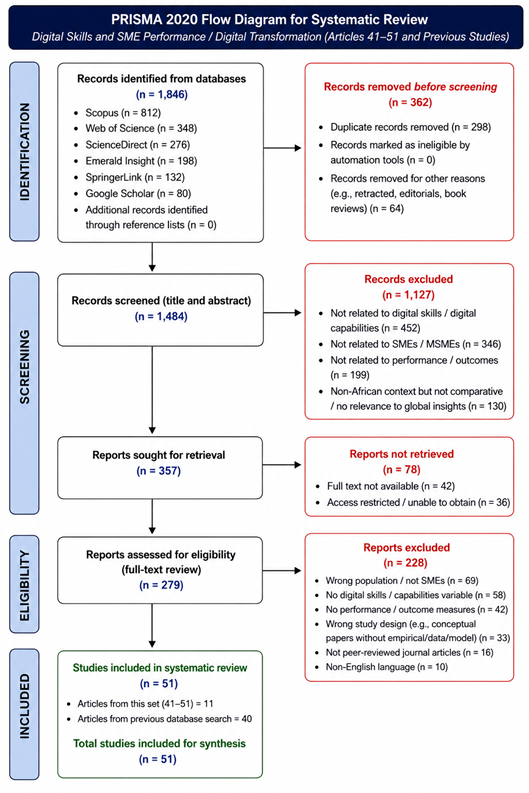
The review process followed the following four PRISMA protocol phases among which include identification; screening; eligibility and inclusion. Under the identification phase, relevant literature was sought from searches carried out in different academic databases. Search terms were formulated by combining the following keywords: digital skills; SMEs; digital transformation; entrepreneurship; digital literacy; ICT capability; and SME performance. The identification phase led to the identification of a wide array of studies from peer reviewed journals, indexed databases and scholarly literature. The screening phase entailed reviewing the title and abstracts of the identified articles to gauge whether they were relevant to the research objectives. In this stage, all duplicate literature was removed. Literature was then screened for relevance to SMEs; whether it dealt with digital skills and digital capabilities; empirical or systematic review orientation; and relevance to SME performance or outcomes. Full-text articles were evaluated in the final step to establish whether they met the eligibility requirements and could be included. The evaluation process sought to evaluate the methodology; relevance to digital skills and SMEs; relevance of findings; contextual relevance; and alignment with the research objective. The inclusion criteria mark the end of the review process since they help in determining that the final studies used in the review are peer-reviewed journal articles dealing with digital skills, digital transformation, digital literacy, digital competencies and SME-related outcomes. While the primary focus was on African SME studies, some international studies were included for comparative and theoretical purposes. The studies offered key insights into digital maturity models; industry 4.0 readiness; social media capability development; digital ecosystem participation; digital human resource management (DHRM); financial digital literacy; women entrepreneurship and digital inclusion; collaborative innovation ecosystems; and crisis driven digital transformation. Examples of the international studies included those carried out in China; Indonesia; Peru; Germany; and Canada.
2.2 Search Strategy
The process of conducting a literature search involved the utilization of the following databases: Scopus, Web of Science, Google Scholar, ScienceDirect, Emerald Insight, and Springer Link. These particular databases were selected because they provide highly relevant and reliable literature related to management, entrepreneurship, information systems, digital transformation, and the development of small enterprises. The search was carried out through the use of keywords and Boolean logic operators. Examples of the search terms include: (“digital skills” AND SMEs AND Africa), (“digital capabilities” AND SMEs growth), (“digital literacy” AND entrepreneurship), (“ICT skills” AND small business performance), (“digital transformation” AND African SMEs), (“digital competencies” AND SMEs sustainability), (“Industry 4.0 readiness” AND SMEs), (“digital innovation” AND SMEs competitiveness).
2.3 Inclusion and Exclusion Criteria
Guiding criteria for study selection included peer-reviewed journal articles; empirical studies and well-developed systematic reviews; studies dealing with SMEs, MSMEs, startups, and small businesses; studies studying digital skills, digital literacy, digital capabilities, and digital competencies; studies on SME performance outcomes like growth, innovation, competitiveness, resilience, sustainability, and digital transformation; studies written in English; studies from 2020 to 2026 to cover recent developments in digital transformation; African studies preferred for synthesis; and selective international studies included for theory building, comparison purposes, digital transformation models, digital maturity, capability perspective, and emerging digital ecosystems. Excluded studies included conference abstracts without papers; non-peer-reviewed articles; studies not related to SMEs; studies not involving digital skills variables; studies on large firms only; studies having unclear methods; opinion articles without any empirical evidence; and studies not written in English language. Although international studies were not normally included in the main African evidence synthesis, selective high impact international studies were included if they made significant contributions to theory building; comparisons; digital transformation models; digital maturity; capability approach; and emerging digital ecosystems.
2.4 Study Selection Process
A PRISMA methodology was adopted in order to conduct the study. First, title and abstract screenings were conducted in order to capture all the possible studies relevant for the research. Studies not related to the topic on digital literacy of SMEs were excluded from the study. Those that qualified to be screened at the abstract level were later scrutinized to assess their relevance, methodological validity, and applicability to the study objectives. The same applied to duplicate studies identified from all the databases used. A PRISMA flow diagram captured the total number of records; number of duplicates eliminated; number of screened studies; number of studies excluded; number of studies assessed at the full-text article level; and the total number of studies selected.
3. Thematic Analysis And Findings
3.1 Conceptualization of Digital Skills in SMEs
3.1.1 Digital Literacy as a Foundational Capability
The literature reveals that digital literacy has been regarded as the primary factor of digital skills in small to medium enterprises. Digital literacy is often understood as the competence of businesses owners, managers, and employees to access, comprehend and apply digital technology in business activities.
Based on the research conducted in less developed countries, digital literacy is viewed as the pillar which facilitates the process of digital transformation in greater extent. For instance, Mang'ana and Nade (2026) explain digital literacy as the competence of Tanzanian Agri-SME managers to employ digital financial information system, online payment and mobile banking systems in order to improve business performance. Likewise, Hastalona et al. (2026) identify digital literacy as the competence of MSMEs in Indonesia to employ digital technology strategically for expanding the market, innovations, and competitiveness.
Moreover, it is highly important to emphasize that digital literacy plays a very significant role in those cases when SMEs largely depend on mobile phones for conducting their business. Such importance of digital literacy has been highlighted in earlier African studies considered in this review.
3.1.2 ICT Skills and Operational Competencies
ICT skills are another significant concept of digital competence, alongside digital literacy. Practical application of computers, internet-based technologies, software applications, and communication technology within organizational processes falls under the definition of ICT skills. As per Njah et al. (2026), for the successful transformation of Canadian manufacturing small- and medium-sized enterprises towards Industry 4.0 operations, there is a need for digital competencies in terms of IT technologies, cybersecurity, and data management. In the same way, Proksch et al. (2024) have found out that in the case of German startups, digital strategy-corporate digitalization nexus is mainly determined by digital IT skills. This information suggests that ICT skills are highly important for SMEs in linking online service delivery platforms, digital workflows, and automation of business processes.
3.1.3 Emerging Digital Skills: AI, Blockchain, and Data Analytics
As revealed by recent studies, the meaning of digital skills has evolved and now includes the use of advanced technologies such as data analytics, blockchain, and artificial intelligence. According to Xin et al. (2025), having knowledge of blockchain technology, the ability to manage digital information, and artificial intelligence-based learning are increasingly required by SMEs engaged in digital supply chain financing in China. Likewise, in their study, Espina-Romero et al. (2026) discovered that skills such as data management, virtual teamwork, and the use of AI for organizational agility are crucial for transforming SMEs in Peru. This means that digital skills are evolving from basic ICT proficiency to strategic skills allowing participation in digital ecosystems.
3.2 Digital Skills Development Mechanisms
The literature identifies multiple pathways through which SMEs acquire digital skills and capabilities.
3.2.1 Formal Training Programs
The most commonly used approach for acquiring digital skills in SMEs is formal training. This kind of training includes institutional training, digital entrepreneurship programs, workshop by government, and vocational training. As reported by Xin et al. (2025), banks that have provided financial support in employee digital training have improved the SME financing results and participation in the digital supply chain finance system of China. The authors emphasize that provision of technology hardware was not as effective as the provision of digital training. Likewise, Wahyuningtyas and Puspitasari (2026) found that SMEs from Indonesia increased their digital transformation through collaboration with universities.
3.2.2 Government and Institutional Support
Government support plays an important role in promoting the development of digital skills. The findings from the work of Hastalona et al. (2026) demonstrated the impact of government intervention on the development of digital skills through digital literacy projects, investments in infrastructure and multi-stakeholder collaboration in order to promote MSME growth within the Medan Go Creative Economy model. Similar information is provided by the reviewed African studies regarding the development of SME skills.
3.2.3 Self-Learning and Experiential Adaptation
There have been many studies to show how SMEs develop their digital skills informally. For instance, Priyono et al. (2020) claim that Indonesia-based SMEs developed their digital skills through experimentation, learning by doing, and collaboration with tech-savvy partners during the pandemic period. Financially constrained firms which found it difficult to undergo formal training had the tendency to opt for informal learning.
3.3 Digital Skills and SME Growth Outcomes
The reviewed studies consistently demonstrate that digital skills positively influence various dimensions of SME growth.
3.3.1 Sales Growth and Market Expansion
From literature review, there is a unanimous consensus that digital skills enhance market reach and sales. As stated by Sholihin et al. (2026), the digital skills helped increase consumer engagement and branding on social media, which contributed significantly to business success among the MSMEs operating in the food and beverages industry in Indonesia. Similarly, as per Hastalona et al. (2026), digital innovation played a key role in increasing revenue growth, export readiness, and market reach for MSMEs operating in the creative industries. Digital marketing and e-commerce skills were positively related to market reach in African studies as well.
3.3.2 Operational Efficiency and Productivity
Moreover, digital skills can help raise the efficiency of businesses operations. Mang’ana & Nade (2026) have found out that Agri-SME Performance in Tanzania and financial management processes were largely mediated by digital skills. Visibility of transactions, financial coordination, and quality of decision-making were positively affected by digital skills. Also, Xin et al. (2025) state that digital skills helped to boost competitiveness of SMEs and their access to finance through participation in digital finance ecosystems.
3.3.3 Innovation Capability and Business Survival
In addition, research findings show that digital literacy enhances innovations and the capacity of organizations to cope with difficulties. According to Priyono et al., (2020), businesses which have high levels of digital skills were capable of reengineering their models and continuing their operations during the pandemic caused by Coronavirus. Also, Proksch et al., (2024) reveal that digital strategy and digital skills led to process digitalization.
3.4 Mediators and Moderators
The link between digital skills and SME development is affected by some mediating factors. Several mediating variables like organizational agility, digital innovation, digital transformation, and competitive advantage, to name a few, have been highlighted by the examined articles. For example, according to Espina-Romero et al. (2026), digital competencies were found to partially mediate the relationship between digital transformation and digital human resource management in small to medium-sized enterprises operating in Peru. In the same vein, Hastalona et al. (2026) illustrated that digital innovation was a mediator in the relationship between MSME development and digital literacy. Likewise, Sholihin et al. (2026) revealed that competitive advantage was a mediator between firm success and entrepreneurial inclination.
Several moderators like infrastructure availability, financial resources, firm size, social capital, and governmental support were also identified. According to Suyatna et al. (2026), social capital played two roles in the process of digitization of the conventional markets in Indonesia. Trust and collective networks facilitated the digital adoption; however, they impeded innovation if collective responsibility was lacking. In the same vein, Njah et al. (2026) noted that organizational readiness, budget constraints, and regulatory environment were important moderators of SME digital maturity.
3.5 Digital Inclusion and Inclusive Economic Development
A major theme emerging from the literature is the role of digital skills in promoting inclusive development.
3.5.1 Women-Owned SMEs
Empowerment of women economically has been found to be significantly helped by digital literacy. As stated by Ramirez-Lozano & Portuguez-Castro (2026), the programs for social responsibility from the universities in Peru increased the digital literacy, creativity, and marketing skills of women micro-entrepreneurs. The research demonstrates that practical digital training can reduce the gender gap in entrepreneurship.
3.5.2 Rural and Agricultural SMEs
Digital skills are equally important to firms in agriculture. According to Mang’ana and Nade (2026), digital literacy has been beneficial to the competitiveness, financial inclusion, and sustainability of small and medium-sized agricultural enterprises in Tanzania.
3.5.3 Poverty Reduction and Job Creation
It is evident from the analysis of the African studies that digital entrepreneurship plays an important role in generating employment, earning revenues, and reducing poverty. This is because the digital competencies help increase markets and efficiency of the SMEs.
3.6 Theoretical Perspectives in Existing Studies
Several frameworks are used in the reviewed studies. The most widely used framework among all studies is the Dynamic Capability Theory. This framework is adopted by Priyono et al., (2020), Espina-Romero et al., (2026), and Mang’ana and Nade (2026). In particular, the framework highlights the adaptability and flexibility of small enterprises in changing the configuration of resources due to digital transformation. Furthermore, Resource Based View (RBV) represents digital skills as strategic resources that provide competitive advantage. Both Mang’ana and Nade (2026) and Sholihin et al., (2026) adopt this framework. In addition, the Technology Acceptance Model (TAM) is mostly used in research on digital inclusion and users' adoption.
3.7 SDGs Addressed in the Literature
The literature is highly related to the Sustainable Development Goals. With regards to SDG 1 (No Poverty), digital skills have the potential of poverty alleviation through increased survivability and earnings capacity (Mang’ana & Nade, 2026). The focus is on lifelong learning, digital skills, and education that is one of the indicators for SDG4 (Wahyuningtyas & Puspitasari, 2026; Xin et al., 2025). The literature focusing on women includes gender inclusion and entrepreneurship development which relates to SDG 5 (Ramirez-Lozano & Portuguez-Castro, 2026). SDG 8 (Decent Work and Economic Growth) is the most common SDG found within the selected articles (Hastalona et al., 2026; Njah et al., 2026). Digital transformation and infrastructure developments are highly linked with SDG 9 (Proksch et al., 2024; Xin et al., 2025). It is also highly related to SGD 10 (digital inclusion among marginalized groups can lead to reduced inequalities) (Ramirez-Lozano & Portuguez-Castro, 2026; Suyatna et al., 2026).
4. Discussion
4.1 Interpretation of Major Findings
4.1.1 Relationship between Digital Skills and SME Growth
All the reviewed studies clearly show that digital skills are an important factor in the development of SMEs. From the literature review, digital skills are known to improve the firm's capacity to absorb digital technology, increase competitiveness, improve market reach, and improve efficiency. It is evident that digital skills help SMEs grow through improved productivity, innovations, customer engagement, and firm resiliency. Mang'ana & Nade (2026) discovered that the connection between financial management practices and Agri-SME performance in Tanzania was significantly moderated by digital literacy; firms having more digital skills were capable of translating financial management practices to business outcomes.
Similarly, Hastalona et al. (2026) have illustrated how digital literacy helped MSME growth by digital innovation resulting in improved revenues, sustainability, readiness for exportation, and market competitiveness. All this helps one conclude that digital skills are strategic competencies which affect the growth patterns of organizations and not simply technical resources. It is assumed that digital skills are enablers that will help SMEs adjust to the ever-changing digital environment of the markets of Africa.
4.1.2 Differences Across African Regions and Sectors
The review indicates significant differences in the impact of digital skills on SME growth in terms of regions and sectors. Such differences can be attributed to the differences in the level of development of digital infrastructure, policy, economy, and industries.
Digital skills are associated with social media marketing, electronic payment, e-commerce, and customer relationship management in highly industrialized sectors such as retail, fintech, and services. In contrast, digital skills in rural and agricultural sectors are concerned with practical aspects of technology such as digital accounting, mobile banking, and market information systems.
For instance, according to the Tanzanian Agri-SME study by Mang'ana and Nade (2026), even though the manufacturing SMEs in Canada discussed by Njah et al. (2026) concentrated on advanced skills such as cybersecurity, readiness for Industry 4.0, and smart manufacturing, agricultural companies were dependent on the applied digital skills related to financial systems. It means that there should not be any universal strategy for digital skill intervention in Africa. They should reflect peculiarities of industries such as manufacturing, services, agriculture, and informal trade.
4.1.3 Digital Readiness Disparities
Conclusion that can be drawn from the research findings include that the level of digital preparedness among SMEs is different. "Digital preparedness" refers to the capacity of an enterprise to embrace, integrate, and adopt digital technology. Enterprises with limited capability to develop foundational capabilities will not be able to benefit from digitization as compared to SMEs who have been exposed to digital systems earlier.
According to Priyono et al., (2020), there were three different pathways to digital transformation including companies relying on partnerships, highly mature companies, and those that are partially digitized. Such classification highlights the differences in digital transformation processes in urban and rural enterprises in many SMEs of Africa. It means that in Africa, where there are unequal developments in infrastructure and training, digital readiness is very crucial in the growth of SMEs.
4.2 Discussion of Theoretical Implications
4.2.1 Relevance of Dynamic Capabilities
The concept of Dynamic Capability Theory constitutes the leading theoretical approach adopted in all the considered researches. It refers to how organizations respond to their changing environment by means of combining, building, and reconfiguring capabilities. The results presented offer strong arguments in support of the theory. Organizational entities equipped with digital capabilities can recognize opportunities, capitalize on the latest digital innovations, and restructure their operations. Digital capabilities are defined as dynamic capabilities that contribute to digital transformation of organizations, as argued by Espina-Romero et al. (2026), among others. That is to say that digital capabilities are adaptive capabilities that help African SMEs thrive in the fast-changing digital environment.
4.2.2 Human Capital and Technological Adaptation
The review is also supportive of the application of the theory of human capital. The impact of the digital transformation is highly improved through the spending of human capital on education, training, and competence development. As Xin et al. (2025) have pointed out, the banks which help SMEs to be trained digitally are much more successful compared to those providing equipment to them. This means that the development of the necessary skills matters more than simply possessing certain devices.
4.2.3 Digital Entrepreneurship Perspectives
Further evidence in support of theories about digital entrepreneurship viewing digital technologies as enablers for innovation-driven entrepreneurship is provided by the review. As stated by Proksch et al. (2024), digital strategy had a huge positive impact on venture digitalization if there was digital culture and digital IT competencies behind it. Innovation, rapid growth, and market responsiveness can all be facilitated by digital competencies in African ventures, similar to their counterparts elsewhere.
4.3 Discussion of Practical Implications
-
For SME Owners
Training SME staff in digital technology must remain a key focus of attention for SME owners. One of the most effective methods to improve productivity mentioned in the literature is digital training. As shown by research, combining business transformation and digital skills development results in SME growth. This can be achieved through the use of e-commerce websites, finance technologies, developing skills in digital marketing, making decisions based on data, and implementing AI-based business systems. According to the research by Wahyuningtyas and Puspitasari (2026), SMEs, which used digital innovations, AI technologies, and social networks, were more resilient and competitive.
-
For Policymakers
The need for public funding for digital infrastructure development and digital policies targeting SMEs has been emphasized frequently in the literature. Broadband rollout, low-cost internet, incentives to digital entrepreneurship, financing of digitalization of SMEs, digital literacy in regions, and subsidies for digital transformation should be the key objectives of policies in this area. For example, the Chinese study by Xin et al. (2025) calls for the use of subsidized bank-SME digital collaboration, while the Tanzanian study by Mang'ana and Nade (2026) recommends integration of digital literacy in agriculture extension programs.
4.3.2 For Educational Institutions
University and technical training institutes also contribute to digital capability development. It has been found that partnerships with educational institutions have significantly helped with the digital transformation of SMEs. For instance, Ramirez-Lozano and Portuguez-Castro (2026) found that the capabilities of female entrepreneurs in digital and STEM fields increased due to training by universities. Hence, SME incubators, entrepreneurship laboratories, AI and data analytics training, digitization courses related to specific industries, and digital literacy outreach efforts need to be scaled up by African institutions.
-
Discussion on Inclusive Economic Development
According to literature, digital skills have an enormous impact on inclusive economic development through their ability to enhance the participation of marginalized groups. Rural entrepreneurship, women’s empowerment, employment of young people, financial inclusion, poverty reduction, and social mobility are some of the inclusive outcomes. According to the study done by Ramirez-Lozano and Portuguez-Castro among women in Peru in 2026, digital skills can be used to narrow the gender gap through increased market participation and business confidence.
Traditional market research done by Suyatna et al. in 2026 in Indonesia also confirm that digital inclusion reduces exclusion among informal traders. It therefore means that digital skills are necessary for inclusive growth and social development of Africa.
4.5 Challenges Identified in the Literature
A number of recurring issues emerged, including: Infrastructural problems (inadequate internet connection and electricity pose serious challenges); high cost of digital technology (expensive digital devices and internet cost hinder the adoption of digital technology by SMEs); low levels of digital literacy (absence of digital skills among many SMEs); cyber security risks and policy coordination weakness. These challenges have been emphasized in previous research works such as (Njah et al., 2026; Suyatna et al., 2026; Wahyuningtyas & Puspitasari, 2026).
4.6 Research Gaps Identified
The analysis shows some weaknesses including: (i) Few Longitudinal Studies: majority of studies utilize cross-sectional study design, (ii) No Cross-National Comparisons: lack of comparative studies from Africa is evident, (iii) Absence of Countries with Fragile Institutions: countries facing challenges due to civil strife or weak institutions are not included in most of the research works, (iv) Limited Studies on Women’s SMEs: gender aspect of digital skills for African women-owned SMEs is under researched, and (v) Lack of AI Skills in Digital Economy.
5.Conclusion And Recommendations
5.1 Summary of the Study
This review highlights the impact of digital skills on SME growth in Africa, focusing on the importance of digital skills in fostering innovations, productivity, competitiveness, and inclusive economic development. In conducting the review, a systematic literature review method was used, guided by PRISMA guidelines. Peer-reviewed articles relevant to the research were obtained from several major databases, such as Scopus, Web of Science, Google Scholar, Science Direct, Emerald Insight, and Springer Link.
The review consolidates data from the articles, ranging from various sectors such as agricultural sector, manufacturing sector, creative industry, traditional market, digital finance, micro-enterprises owned by women and startups. Thematic analysis indicates that digital skills are seen as necessary competencies for SMEs in technologically advancing environments. The findings indicate that the skills contribute to SME growth through increased sales, innovations, efficiency, market access, resilience and sustainability.
5.2 Conclusion
The evidence reviewed in this study leads to three major conclusions.
(i) Digital Skills Are Critical Drivers of SME Competitiveness and Resilience in Africa
The reviewed studies convincingly confirm that digital skills have been turned into crucial factors influencing competitiveness of SMEs. The firms having better digital skills can be better prepared to respond to any market disturbance, reach wider customer segments, and continue functioning in unpredictable situations.
For instance, it was proven by Mang’ana and Nade (2026), where digital literacy positively affected Agri-SMEs in Tanzania, and Priyono et al. (2020), who revealed how more developed digital maturity helped SMEs survive in times of pandemic of COVID-19. That means that in Africa, digital skills are no longer a luxury but a strategically important resource.
(ii) Digital Capability Development Supports Innovation, Productivity, and Inclusive Growth
Another equally important finding that comes from this study is that digital capability development helps to enhance the innovation, productivity, and economic growth of SMEs in general. According to several research studies like Hastalona et al. (2026), it was determined that digital innovation acted as an intermediary between digital literacy and the growth of MSMEs, whereas according to Espina-Romero et al. (2026) digital capabilities played a crucial role in digital transformation. Thus, digital capability development helps to generate positive impacts on society in terms of job creation, financial inclusion, regional development, poverty alleviation, youth entrepreneurship, and women empowerment.
For African economies, strengthening digital skills among SMEs can therefore accelerate progress toward inclusive development and several United Nations Sustainable Development Goals.
(iii) Contextual Factors Significantly Influence Digital Transformation Outcomes
In addition, this review highlights that digital transformation success depends largely on context. Digital transformation and business growth do not have a natural association; their association depends on the context such as institutions, infrastructure, social and economic variables. Contextual variables highlighted in the literature include infrastructures, financial support, size of firms, sectors, levels of digital transformation, government, social capital and gender.
As an example, Suyatna et al., (2026) highlighted that social capital was an enabler and a barrier to digital transformation of informal traders while Xin et al., (2025) revealed that cooperation of banks and SMEs considerably lessened the challenges to digital transformation. This means that digital transformation in Africa should be supported at the entire ecosystem level and not firm level only.
5.3 Recommendations
(i) For Governments
African governments need to concentrate on the creation of digital environments conducive for SMEs, which would entail:
-
Boosting Digital Infrastructures: The government needs to invest more in areas such as broadband, internet connection in rural areas, electricity provision, and digital gadgets.
-
SME Digital Training Subsidies: There is a need for digital skills scholarships, subsidized training courses, digital literacy programs specific to each industry, and digital entrepreneurship programs.
-
Better Digital Policy Environments: Governments need to develop national digitalization policies, data governance regimes, clear digital taxes and innovations financing mechanisms.
(ii) For SMEs
SMEs need to embrace proactive measures for building digital capability and this involves:
-
Continuous Digital Upgrading: The business owners need to upgrade their employees through training in digital marketing, online selling, cloud technology, fintech, data analysis, and AI tools.
-
Learning Culture: It is clear from the review that firms that have learning orientation are more flexible during digital transformation. The SMEs should encourage peer learning, experimentation, mentorship, and knowledge management.
-
Digital Strategy Integration into Business Processes: The digital tools must be embedded into the business processes such as customer engagement, supply chain management, finance, production, logistics, and innovation management..
(iii) For Development Agencies
Development agencies play a critical role in fostering the development of inclusive SME ecosystems. These should:
-
Promote Digital Inclusion Programs: Programs should focus on rural SMEs, female entrepreneurs, youth businesses and informal SMEs
-
Provide Funding for SME Digital Ecosystems: This should cover innovation centers, digital incubators, training institutions, market access platforms and entrepreneurship regional networks.
(iv) For Educational Institutions
Educational institutions are important for digital skills development in the long term. Educational institutions need to:
-
Foster Industry Collaboration: Colleges must work with small and medium-sized enterprises through collaborative training, consultancy schemes, internship arrangements and technology transfers.
-
Educate in Applied Digital Entrepreneurship: Academic programs should focus more on teaching practical digital business skills, AI, e-commerce, digital financing and innovation management.
5.4 Contribution to Knowledge
The review contributes to the existing body of knowledge in several important ways.
-
Synthesis of Digital Skills Evidence in an African Context: It offers an African-oriented synthesis of the body of research on digital skills evidence that is fragmented at present.
-
Combination of SME Growth and Inclusive Development Approaches: It combines SME growth with other aspects of development, showing that digital skills affect not only firm performance but also economic and social inclusion.
-
Ideas for Further Research: It highlights gaps in the field, including AI skills, fragile situations, and digitalization of the informal sector.
5.5 Limitations of the Study
Notwithstanding its contribution, there are several shortcomings in this review.
-
Reliance on Published Literature: This literature review was based on published peer-reviewed articles and neglected all unpublished works.
-
Language and Database Shortcomings: This review only considered works in English, thus missing some of the literature in French, Portuguese, or even Arabic, especially in relation to Africa.
-
Differences in Definition of SMEs: There were significant differences in the definition of SMEs among different countries and studies..
5.6 Suggestions for Future Research
The review outlines some key areas for further research in the field:
-
Longitudinal and Multi-Method Approaches: Future research should investigate how digital literacy affects the development of SMEs over time.
-
African Regional Comparisons: A need for comparison studies in relation to Southern Africa, West Africa, East Africa, Central Africa, and North Africa.
-
AI and Sophisticated Digital Skills in SMEs: Areas that warrant more attention include generative AI, automation, machine learning, big data analysis and cybersecurity.
-
Informal Sector SMEs and Digitalization: Many African firms are informal sector, but there are very few studies focusing on this area.
-
Women, Youth and Digital Entrepreneurship: Research on women-owned SMEs, youth entrepreneurship, disability issues, and youth from rural areas.
Declaration
Conflicts of Interest: The authors declare no conflict of interest.
Funding: This research has received no funding
Use of AI tools: The study has used ChatGPT in designing the PRISMA flow Diagram.
Author Contributions: Conceptualization- A.O; methodology- A.O, T. A; validation, A. O.; writing original draft preparation, A.O. E. P; writing, review and editing, A.O; T. A.
References
- Al Buraiki, W., & Nofal, R. (2026). Entrepreneurial orientation and marketing performance in SMEs: The mediating roles of digital marketing capabilities and digital marketing implementation in Oman. Sustainability, 18(4), 1925. DOI ↗ Google Scholar ↗
- Bengu, S. P., & Beharry-Ramraj, A. (2025). Digital transformation driving small, medium and micro enterprises integration into corporate supply chain in South Africa. TWIST, 20(2), 193–207. DOI ↗ Google Scholar ↗
- Bulagi, M. (2025). Digital transformation and economic growth in Africa: Harnessing fintech, e-commerce, and AI for inclusive growth. Development Finance Agenda, 10(5), 12–13. DOI ↗ Google Scholar ↗
- Dung, L. T., Tien, H. T., Linh, T. M., Diep, N. T. N., Hieu, H. V., & Chon, L. V. (2025). Going international by going digital: Digital capabilities, transformation, and leadership in export performance. Global Business and Organizational Excellence, 45(3), 280–302. DOI ↗ Google Scholar ↗
- Espina-Romero, L., Chafloque-Céspedes, R., Gutiérrez Hurtado, H., Nava-Chirinos, Á. A., Ramírez Corzo, J., & Ochoa-Díaz, A. (2026). Digital human resource management and digital competencies: Keys to sustainable digital transformation in SMEs. Discover Sustainability, 7(1), 445. DOI ↗ Google Scholar ↗
- Gala, P. M., Namit, K., & Kidwai, H. (2025). Strategies for Enhancing Digital Skills among Africa’s NEET Youth. www.worldbank.org/en/topic/education Google Scholar ↗
- Hastalona, D., Hasibuan, E. H., & Lazuardi, D. (2026). A digital innovation-based creative economy model for MSMEs growth: Theoretical integration and practical insights from an emerging economy. Theoretical and Practical Research in Economic Fields, 17(1), 98–111. DOI ↗ Google Scholar ↗
- Huang, T., I. L. Ridwan, and A. A. Almulhim. 2026. “The Institutional Trilemma of Sustainable Development in Africa: Reconciling Digitalization, Entrepreneurship and Green and Inclusive Growth.” Sustainable Development,1–24. DOI ↗ Google Scholar ↗
- Mahlatji, K. D., & Mahlatji, M. R. (2024). Adoption of digital literacy for South Africa’s small township businesses’ growth: A case of Mankweng Township in Limpopo Province. Journal of Global Business and Technology, 20(1), 110-122. https://gbata.org/wp-content/uploads/2024/07/JGBAT-Volume-20-Number-1.pdf Google Scholar ↗
- Mang’ana, K. M., & Nade, P. B. (2026). Enhancing Agri-SME performance in Tanzania: The role of financial management practices and digital literacy. Sustainable Futures, 11, 101868. DOI ↗ Google Scholar ↗
- Mathibe, M. S., & Oppong, C. (2025). Enhancing financial inclusion and entrepreneurship drive in Africa: Do digital technologies matter? Business Strategy & Development, 8(3), e70202, 1–13. DOI ↗ Google Scholar ↗
- Mehmood, K., Ali, N., Usman, M., Suhail, A., & Siddiqui, K. (2026). Empowering sustainable entrepreneurship through data-driven innovation: A pathway to ESG performance in SMEs. International Entrepreneurship and Management Journal. DOI ↗ Google Scholar ↗
- Motadi, M. S. (2026). Harnessing digital infrastructure for inclusive economic transformation in Africa. International Journal of Studies in Inclusive Education, 1(1), 36–41. DOI ↗ Google Scholar ↗
- Mugano, G. (2024). SMEs and economic development: Global and African perspectives. In G. Mugano & N. Dorasamy (Eds.), SMEs perspective in Africa: Creating sustainable and resilient economies (pp. 9–26). Palgrave Macmillan. DOI ↗ Google Scholar ↗
- Mutula, S. M., & Van Brakel, P. (2007). ICT skills readiness for the emerging global digital economy among small businesses in developing countries: Case study of Botswana. Library Hi Tech, 25(2), 231–245. DOI ↗ Google Scholar ↗
- Njah, S., Danjou, C., Armellini, F., Beaudry, C., & Mosconi, E. (2026). A digital maturity model for assessing SMEs in the manufacturing sector. Digital Engineering, 9, 100084. DOI ↗ Google Scholar ↗
- Nyika, F., Muzekenyi, M., Akbar, K., Moodley, M., & Nzimande, S. (2024). Economic inclusion of rural small businesses in policy formulation: Strategies for sustainable development in Africa. International Journal of Development and Sustainability, 13(1), 51–67. DOI ↗ Google Scholar ↗
- Oukouomi Noutchie, S. C. (2025). Unlocking SME potential through digital platforms: Insights from three African digital economies. International Journal of Business Ecosystem & Strategy, 7(4), 106–112. DOI ↗ Google Scholar ↗
- Priyono, A., Moin, A., & Putri, V. N. A. O. (2020). Identifying digital transformation paths in the business model of SMEs during the COVID-19 pandemic. Journal of Open Innovation: Technology, Market, and Complexity, 6(4), 104. DOI ↗ Google Scholar ↗
- Proksch, D., Rosin, A. F., Stubner, S., & Pinkwart, A. (2024). The influence of a digital strategy on the digitalization of new ventures: The mediating effect of digital capabilities and a digital culture. Journal of Small Business Management, 62(1), 1–29. DOI ↗ Google Scholar ↗
- Ramirez-Lozano, J. P., & Portuguez-Castro, M. (2026). STEM enabling digital skills for women microentrepreneurs in Peru. Discover Sustainability, 7(1). DOI ↗ Google Scholar ↗
- Rampaul, K. (2025). Digital transformation and SME growth in emerging markets. Journal of Emerging Markets and Management, 1(1), 15–25. DOI ↗ Google Scholar ↗
- Sholihin, U., Sudarmiatin, Soetjipto, B. E., Djatmika, E. T., Ayuanti, R. N., Selviasari, R., & Arida, R. W. (2026). Enhancing business performance of micro, small, and medium enterprises (MSMEs): The role of market orientation, entrepreneurial orientation, knowledge management, competitive advantage, and social media. Multidisciplinary Reviews, 9(10), 2026474. DOI ↗ Google Scholar ↗
- Solehudin, S. (2025). Techno-entrepreneurship in developing countries: Bridging innovation and inclusive growth. Jurnal Ekonomi Teknologi dan Bisnis (JETBIS), 4(4). DOI ↗ Google Scholar ↗
- Suyatna, H., Kafaa, K. A., Budiono, M. F., Firdaus, R. S. M., & Wibowo, I. A. (2026). Digitalising traditional markets: Challenges and opportunities for micro, small, and medium enterprises (MSMEs) in Indonesia. Jurnal Ilmu Sosial dan Ilmu Politik, 29(3), 265–277. DOI ↗ Google Scholar ↗
- Wahyuningtyas, E., & Puspitasari, I. (2026). How small medium enterprises (SMEs) in Indonesia implement their digital transformation: A literature review. AIP Conference Proceedings, 3326(1), 070004. DOI ↗ Google Scholar ↗
- Xin, L., Yiming, W., & Bonaglia, M. (2025). How to motivate enterprises to use new technologies: From the perspective of digitalization cost in digital supply chain finance. R&D Management, 56: 385-409.. DOI ↗ Google Scholar ↗