Abstract
This case study examines a major biotic disruption observed during the greenhouse component of a previously published cowpea (Vigna unguiculata) experiment evaluating Rhizobium spp. inoculation and inorganic fertilization. The primary agronomic outcomes of the parent investigation have already been published and are not presented here as a new efficacy trial. Instead, the present report focuses on the severe Aphis craccivora infestation, concurrent fungal disease, unequal plant loss, and the implications of these events for experimental performance and interpretation. Four original treatment groups were included: untreated control, inorganic fertilizer, inorganic fertilizer + Rhizobium spp., and Rhizobium spp. alone. Before harvest interpretation was compromised, greenhouse plant height differed among treatments (F = 8.881, p < 0.001), whereas basal diameter did not (F = 1.735, p = 0.174). Active nodules were recorded descriptively in the inoculated groups. Following the biotic disruption, only 3, 10, 14, and 21 plants remained at final harvest in the control, inorganic fertilizer, inorganic fertilizer + Rhizobium spp., and Rhizobium spp.-only groups, respectively. Because aphid abundance, infestation duration, and fungal etiology were not experimentally controlled or quantified, these unequal survivor counts cannot be interpreted as evidence of treatment-mediated resistance to aphid infestation or fungal disease. This case illustrates how an unplanned pest–disease episode can confound greenhouse biofertilization experiments and emphasizes the need for systematic pest surveillance, predefined intervention criteria, disease diagnosis, and transparent reporting of compromised endpoints.
Keywords
Keywords: cowpea Vigna unguiculata Aphis craccivora fungal disease greenhouse Rhizobium spp. experimental integrity biotic stress.
1. Introduction
Cowpea (Vigna unguiculata) is an agronomically important legume in tropical and subtropical production system. Its capacity to associate with nitrogen-fixing rhizobia makes it particularly relevant to studies of biological fertilization and reduce dependence on inorganic nitrogen (Pérez et al. 2008; Villanueva Tarazona and Quintana Díaz. 2012). The original master Thesis from which this manuscript is derided evaluated the response of cowpea cultivar Gorda to Rhizobium spp. inoculation and inorganic fertilization under greenhouse ex vitro condition.
Biotic stress can obscure treatment effected in controlled agronomic experiments. The cowpea aphid, Aphis craccivora. Is a recognized pest of V. unguiculata. Earlier work included in the Thesis biography documented its biology on cowpea (Obopile and Ositile 2010; Pava and Sepulveda-Cano 2015). Controlled infection studies have also shown that aphid feeding can deduce cowpea growth and yield, with the magnitude of damage influenced by infestation during and host susceptivity (Annan et al. 1995; Annan 1997). More recent multi environment triarch reported grain-yield losses of 3.8-32.8% in susceptible cowpea materials under aphid infection (Kusi et al. 2020).
Current evidence further supports the importance of A. craccivora as a production constraint. Severe aphid pressure is associated with loss of plant vigor and yield, while aphid honeydew can favor the development of sooty mold on susceptible plants. Recent phenotypic screening of cowpea germplasm has documented high aphid populations, severe plant damage, and dense sooty mold in susceptible materials, reinforcing the need for effective aphid management in experimental and production settings (Gaonosi et al. 2025). Biological control research has likewise evaluated entomopathogenic fungi as components of integrated A. craccivora management (Mweke et al. 2020).
The greenhouse component considered here was not designed as a factorial test of aphid infection or fungal disease. These biotic stresses arose during an experiment primary factor were Rhizobium spp. inoculation and inorganic fertilization. The primary agronomic study has since been published as (Burgos Arzola 2017; Burgos Arzola 2026)The present case study is deliberately narrower: it does not represent the parent investigation as a new treatment efficacy study but analyzes the greenhouse pest and disease episode as an experimental constraint. Its objective is to document the sequence oof biotic disruption, quantify the unequal number of remaining at harvest, place the observation in the contest of cowpea aphid literature and identify metrological lessons for future greenhouse biofertilization experiments.
Greenhouse resistance studies provide a particular relevant comparison for the present case, (Abdou et al. 2013) screened q05 cultivated and 92 wild cowpea accessions against. Aphis craccivora and documented large differences in aphid abundance and seedling survival. Siyunda et al. (2022) likewise used greenhouse no choice infection tests and reported marked differences in plant vigor and survival 21 days after infestation. Together these studies demonstrate that aphid pressure can strongly alter cowpea performance under greenhouse conditions and reinforces the need to distinguish pest driven effects from the agronomic treatments being evaluated.
At the mechanistic level MacWilliams et al. (2023) showed that cowpea aphid feeding modifies developmental and signaling responses in cowpea and that the responses depends on host resistance and duration of feeding. This contemporary evidence provides biological context for the severe experimental disruption documented in there master Thesis (Burgos Arzola 2017; Burgos Arzola 2026), while not implying that the present experiment measured aphid resistance mechanisms.
2. Materials and Methods
2.1 Experimental context
This case is derived from the greenhouse component of the master Thesis “Efecto de la inoculación con Rhizobium spp. sobre la cosecha de granos de frijol Vigna unguiculata”, which formed the basis of published parent article on Rhizobium inoculation cowpea growth and gran yield (Burgos Arzola 2017; Burgos Arzola 2026). The original greenhouse phases included four nutrient/inoculation groups: (1) untreated, (2) inorganic fertilizer, (3) inorganic fertilizer + Rhizobium and (4) Rhizobium spp. alone. The present report uses only the greenhouse interpretation. It does not treat previously report agronomic outcomes as a new independent experiment.
2.2 Rhizobium inoculation and plant measurements
Rhizobium spp. inoculum was prepared from active using YEMA and YEMB culture media. Inoculated seeds were exposed to 100 mL of inoculum for 1 h 45 min, whereas not inoculated seed were treated with distilled water. Plant heigt and DAB were measured and active nodules were recorded insulted group. Ther Thesis used Anova and Tukey procedures at α = 0.05 for treatment comparisons.
2.3 Documentation of the biotic disruption.
During the greenhouse experiment the Thesis documented a severe Aphis craccivira infection and subsequent fungal infection. Final number of pants remaining a harvest were recorded for each treatment. Because neither aphid density, infestation onset, duration nor fungal pathogen identity was established as an experimental factor, no inferential test of aphid or fungal effects was. reconstrued for this article.
3. Results
3.1 Experimental status before the biotic disruption.
| Treatment | Height (m) | DAB (cm) | Active nodules | Plants remaining |
| Control | 0.60 ± 0.17 | 0.58 ± 0.18 | 0 | 3 |
| Inorganic fertilizer | 0.89 ± 0.15 | 0.77 ± 0.23 | 0 | 10 |
| Fertilizer + Rhizobium spp. | 0.97 ± 0.15 | 0.92 ± 0.32 | 15 | 14 |
| Rhizobium spp. | 1.03 ± 0.13 | 0.89 ± 0.24 | 25 | 21 |
For context, before harvest interpretation became unreliable, final greenhouse height differed among the four original nutrient/inoculation groups (F = 8.881, p < 0.001), whereas basal diameter (DAB) did not (F = 1.735, p = 0.174). Active nodules were recorded descriptively only in inoculated treatments, with values of 15 in the fertilizer + Rhizobium group and 25 in the Rhizobium-only group. These measurements are included solely to establish the experimental condition preceding the pest-disease episode; treatment efficacy is addressed in the previously published parent investigation (Burgos Arzola 2017; Burgos Arzola 2026).
3.2. Aphid infestation, fungal infection and plant loss.
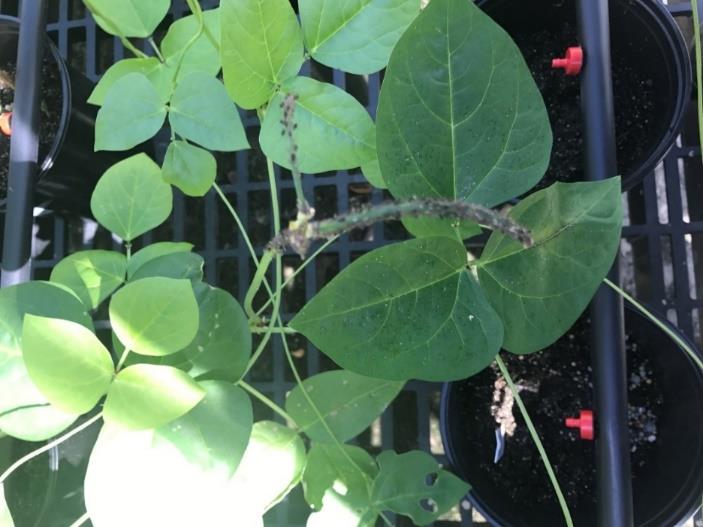
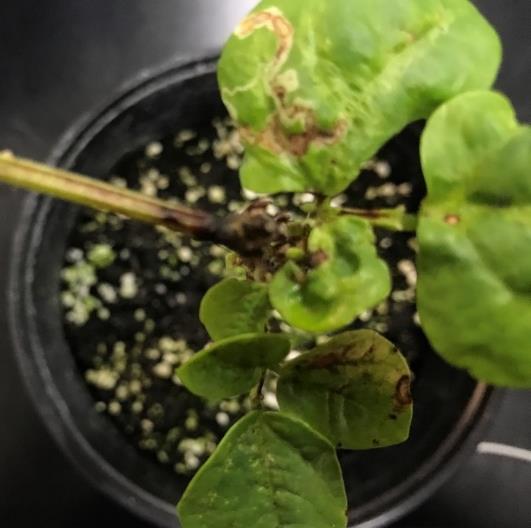
The greenhouse phase was subsequently affected by a severe Aphis craccivora infestation accompanied by visible fungal disease, both of which were documented photographically. By the final harvest stage, only 3 control plants, 10 inorganic-fertilizer plants, 14 inorganic fertilizer + Rhizobium spp. plants, and 21 Rhizobium spp.-only plants remained. The original study explicitly considered the greenhouse harvest data unreliable for inferring agronomic superiority among treatments because of this biotic disruption. The survivor counts are therefore reported descriptively as evidence of unequal experimental attrition and should not be interpreted as a test of aphid or fungal resistance.
4. Discussion
The central contribution of this case study is methodological rather than a second demonstration of fertilizer or Rhizobium efficacy. The parent investigation reported the agronomic outcomes of the broader experiment (Burgos Arzola 2017; Burgos Arzola 2026). Here, the greenhouse episode is examined separately to address a different question: how should an unplanned severe biotic disturbance be interpreted when it occurs after experimental treatments have been established? The combination of aphid infestation, visible fungal disease, and unequal plant attrition altered the composition of the treatment groups and undermined straightforward interpretation of greenhouse harvest endpoints.
The magnitude of the observed disruption is biologically plausible considering the cowpea aphid literature. Previous studies have demonstrated that the duration of Aphis craccivora infestation can significantly affect cowpea growth and yield (Annan et al. 1995) and that aphid infestation can interact with fertilizer application and cultivar selection to influence plant performance (Annan et al. 1995; Annan 1997). Yield losses ranging from 3.8% to 32.8% have also been reported across cowpea materials under aphid infestation (Kusi et al. 2020). Recent resistance-screening studies have further documented severe reductions in plant vigor and the development of dense sooty mold in susceptible cowpea genotypes under high aphid populations (Gaonosi et al. 2025). Collectively, these external studies support the interpretation that severe aphid pressure can materially compromise cowpea performance (Annan et al. 1995; Annan 1997; Abdou et al. 2013; Kusi et al. 2020; MacWilliams et al. 2023; Gaonosi et al. 2025). However, they do not demonstrate that the plant losses and reduced experimental performance observed in the present study were caused exclusively by aphid infestation.
Although recent cowpea aphid research has reported dense sooty mold development on susceptible plants under high aphid populations (Gaonosi et al. 2025), that observation cannot be used to identify the fungal condition observed in the present study. Because no etiological or molecular identification of the fungal agent was performed, the appropriate interpretation is limited to a documented fungal disease episode occurring concurrently with the aphid infestation during the disrupted greenhouse experiment.
Future greenhouse studies of cowpea biofertilization should incorporate systematic pest scouting from seedling emergence, standardized aphid scoring or counts, predefined intervention thresholds, and documentation of the timing and duration of infestation. When disease symptoms occur, diagnostic identification should be attempted before attributing effects to a specific pathogen. Integrated pest management approaches, including biological strategies, have been evaluated for the management of A. craccivora in cowpea (Mweke et al. 2020). Equally important, statistical analysis plans should define in advance how mortality, missing plants, and compromised experimental units will be handled before outcome data are interpreted.
Limitations
This case study has important limitations. Aphid infestation and fungal disease were unplanned events rather than randomized experimental factors; aphid abundance and infestation duration were not quantified sufficiently for dose–response analysis; the fungal causal organism was not identified; and mortality was unequal among the original treatment groups. Consequently, the study cannot determine whether inorganic fertilization or Rhizobium spp. inoculation altered susceptibility to Aphis craccivora infestation or fungal disease. It also cannot disentangle the direct effects of aphid infestation, fungal disease, experimental treatments, or their possible interactions. The survivor counts and photographic evidence should therefore be interpreted as documentation of experimental disruption rather than as evidence of treatment-mediated resistance.
5. Conclusions
This case study documents how a severe Aphis craccivora infestation and a concurrent fungal disease episode compromised the greenhouse component of a previously published cowpea biofertilization experiment. Unequal plant attrition left 3, 10, 14, and 21 plants in the control, inorganic fertilizer, inorganic fertilizer + Rhizobium spp., and Rhizobium spp.-only groups, respectively, making greenhouse harvest comparisons unreliable. Because aphid pressure and fungal disease were not controlled experimental factors, these differences must not be interpreted as evidence of treatment-mediated resistance. The principal value of this case is therefore methodological: greenhouse inoculation studies should incorporate systematic pest surveillance, standardized aphid scoring or counts, predefined intervention thresholds, diagnostic assessment of disease symptoms, and explicit criteria for handling endpoints compromised by biotic stress. Transparent reporting of such disruptions can improve reproducibility and reduce the risk of overinterpreting confounded observations.
References
- Abdou S, Aken’Ova M, Fatokun C, Alabi O. 2013. Screening for resistance to cowpea aphids (Aphis craccivora KOCH) in wild and cultivated cowpea (Vigna unguiculata L. Walp) accessions. DOI ↗ Google Scholar ↗
- Annan IB. 1997. Interactions of fertilizer, cultivar selection, and infestation by cowpea aphid (Aphididae) on growth and yield of cowpeas. Int J Pest Manag. 43(4):307–312 [accessed 2026 Sept 7]. DOI ↗ Google Scholar ↗
- Annan IB, Schaefers GA, Tingey WM. 1995. Influence of duration of infestation by cowpea aphid (Aphididae) on growth and yield of resistant and susceptible cowpeas. Crop Prot. 14(7):533–538 [accessed 2026 Sept 8]. DOI ↗ Google Scholar ↗
- Burgos Arzola BA. 2017. EFECTO DE LA INOCULACIÓN CON Rhizobium spp. SOBRE LA COSECHA DE GRANOS DEL FRIJOL Vigna unguiculata. [accessed 2025 Apr 29]. DOI ↗ Google Scholar ↗
- Burgos Arzola BA. 2026. Effect of Rhizobium spp. Inoculation on Growth and Grain Yield of Cowpea (Vigna unguiculata) Under Greenhouse and Ex Vitro Conditions. Int J Sci Res Manag IJSRM. 14(09):231–238 [accessed 2026 Sept 7]. DOI ↗ Google Scholar ↗
- Gaonosi GG et al. 2025. Phenotypic Screening and Marker-Assisted Validation of Sources of Aphis craccivora Koch Resistance in Cowpea (Vigna unguiculata L.). Int J Mol Sci. 26(9):4406 [accessed 2026 Sept 7]. DOI ↗ Google Scholar ↗
- Kusi F et al. 2020. Stability of Sources of Resistance to Cowpea Aphid ( Aphis craccivora Koch, Hemiptera: Aphididae) across Major Cowpea Production Zones in Ghana. Int J Agron. 2020:1–8 [accessed 2026 Sept 7]. DOI ↗ Google Scholar ↗
- MacWilliams JR, D. Nabity P, Mauck KE, Kaloshian I. 2023. Transcriptome analysis of aphid-resistant and susceptible near isogenic lines reveals candidate resistance genes in cowpea (Vigna unguiculata). BMC Plant Biol. 23:22 [accessed 2026 Sept 7]. DOI ↗ Google Scholar ↗
- Mweke A et al. 2020. Integrated Management of Aphis craccivora in Cowpea Using Intercropping and Entomopathogenic Fungi under Field Conditions. J Fungi. 6(2):60. DOI ↗ Google Scholar ↗
- Obopile M, Ositile B. 2010. Life table and population parameters of cowpea aphid, Aphis craccivora Koch (Homoptera: Aphididae) on five cowpea Vigna unguiculata (L. Walp.) varieties. Anz Für Schäadlingskunde. 83:9–14. DOI ↗ Google Scholar ↗
- de la pava N, Sepulveda-Cano P. 2015. Biología del áfido negro (Aphis craccivora: Aphididae) sobre fríjol caupi (Vigna unguiculata, Fabaceae). Acta Biol Colomb. 20:93–97 DOI ↗ Google Scholar ↗
- Pérez G, Nápoles García M, Gómez G, Morales B. 2008. Aislamiento y caracterización de cepas de rizobios aisladas de diferentes leguminosas en la región de Cascajal, Villa Clara. Pastos Forrajes. 31:151–159 DOI ↗ Google Scholar ↗
- Siyunda A et al. 2022. Screening for resistance to cowpea aphids (Aphis craccivora Koch.) In mutation derived and cultivated cowpea (Vigna unguiculata L. Walp.) genotypes. 13:15–26. DOI ↗ Google Scholar ↗
- Villanueva Tarazona I, Quintana Díaz. A. 2012. Aislamiento y selección de bacterias nativas de rizobios fijadores de nitrógeno, a partir de nódulos radiculares de Phaseolus vulgaris. Científica Fac Cienc Biológicas Univ Nac Perú Trujillo. 32 DOI ↗ Google Scholar ↗