Abstract
This study aims to analyze the candidate image impact on voters' intention to vote in the Aceh regional head election, both directly and through voting attitude and public trust. The research population consisted of eligible voters in Aceh, with a sample of 278 respondents selected through purposive sampling. Data were collected using a structured questionnaire. The data were analyzed using Structural Equation Modeling-Partial Least Squares (SEM-PLS) with SmartPLS. The findings reveal that candidate image positively significantly affects voting intention, voting attitude, and public trust. Public trust also positively significantly affects voting intention. However, voting attitude does not have a significant direct effect on voting intention. The mediation analysis indicates that voting attitude significantly mediates the candidate image and voting intention relationship, whereas public trust does not significantly mediate this relationship. These findings suggest that establishing a positive candidate image is a crucial factor in enhancing voters' intention to vote, both directly and indirectly through the development of voting attitudes, while public trust plays a more prominent role as a direct predictor of voting intention rather than as a mediating variable.
Keywords
candidate image voting intention voting attitude public trust regional head election.
1. Introduction
Regional head elections, in Indonesia commonly known as “Pilkada”, serve as a democratic mechanism through which citizens directly elect governors, regents, and mayors. Since the enactment of the regulation concerning Regional Government, these elections have become a tangible expression of political decentralization, granting communities the authority to choose their own local leaders. Pilkada is conducted simultaneously across the nation under the oversight of the General Elections Commission (KPU) and the Elections Supervisory Agency (Bawaslu), ensuring transparency, accountability, and the integrity of the electoral process. In practice, these elections represent a battleground for political parties and independent candidates vying for public support through campaigns, debates, and policy platforms. A candidate’s success hinges not solely on the strength of their political machinery or party backing, but equally on their personal image and their capacity to resonate with voters and cultivate public trust.
Regional elections in Aceh carry a distinct character that sets them apart from other parts of Indonesia. The province enjoys special autonomy status under the regulation concerning Aceh Governance, which grants extensive authority over local administration, including the conduct of regional elections. One notable feature is the allowance for independent candidates to run without political party sponsorship, a provision mandated by the 2005 Helsinki Peace Accord between the Indonesian government and the Gerakan Aceh Merdeka (GAM/Free Aceh Movement). Aceh local political dynamics are also deeply shaped by historical, ideological, religious, and cultural factors, resulting in voter behavior that often differs markedly from other regions. In this context, candidate image and levels of public trust play a pivotal role in shaping the attitudes and voting intentions of Acehnese citizens in every electoral cycle.
The regional head election in Aceh is not only a battle for political influence; it is also a local competition filled with meaning. This competition reflects the cultural identity of Aceh, the level of trust in its government, and how people communicate in a very dynamic society. With increased democratic awareness, the way that people in Aceh decide who to vote for has changed. People are no longer voting based on their feelings about the candidates or loyalty to their families. People now make rational choices about who to vote for. They look at the candidates' past records, what the candidates plan to do if elected, and how the candidates present themselves. Because of this change, political marketing campaigns that are based on local values are becoming important. These campaigns will help voters connect with the candidates emotionally and socially. They will also improve the success of campaigns, and build long-lasting support for politicians.
The way that people vote in Aceh for the office of governor will depend upon how they think about the candidate, i.e., what type of perception they have of the candidate and what type of psychological factors are involved in making up the mind of the voter. These two types of factors are very important in the field of political marketing. The voter is viewed as a "political consumer" who makes choices among candidates based on his/her evaluation of each candidate. According to the Attitude Theory, when the voter decides to vote for a particular candidate, it represents an expression of the voter's attitude towards the candidate. The attitude of the voter towards the candidate develops through three distinct components (cognitive, affective, and conative). The voter develops an attitude towards a candidate through evaluating the candidate's vision, program, track record, and consistency in terms of policies. If the voter develops a positive attitude towards the candidate, then this will increase the likelihood that the voter will actually vote for that candidate. In addition to developing an attitude towards a candidate, the voter's perception of the candidate's image can also significantly affect the voter's preference for a particular candidate. In political marketing, the candidate functions as a "political brand." As a political brand, the candidate is evaluated on several dimensions including integrity, competence, leadership ability, and closeness to the community. A positive and consistently portrayed image of the candidate can help to build confidence in the candidate and lead to increased voter support for the candidate.
Every candidate endeavors to project a robust and favorable image to win public sympathy. For instance, the Illiza-Afdhal (candidate pair) ticket cultivated an image rooted in Islamic values and collaborative governance, emphasizing religious principles alongside cross-sector cooperation. Meanwhile, the Mualem-Fadh (candidate pair) positioned themselves as firm, strong-willed leaders with deep Acehnese character, foregrounding local values, decisiveness, and a commitment to regional autonomy while drawing on cultural symbols and the historical narrative of Aceh's struggle. These strategies reveal that in Aceh's political arena, candidate image is built not only through rational messaging but also through emotional and cultural approaches that mirror the identity and aspirations of the Acehnese people.
The official recapitulation of Aceh's 2024 gubernatorial election showed the Mualem-Fadh ticket securing victory with 1,492,846 votes (53.27%), outpacing Bustami-Fadhil (candidate pair), who garnered 1,309,375 votes (46.73%). Valid votes totaled 2,802,221 (95.71%) out of 2,927,814 registered voters (detik.com, 2024). This win was inseparable from the strong localist appeal championed by Mualem, a central figure in the Aceh Party with deep historical ties to GAM, alongside a strategic coalition with the Gerindra Party. However, internal dynamics within the Aceh Party revealed a decline in legislative seats from 33 in 2009 to 29 in 2014, with further erosion in 2019 suggesting that Mualem's victory was driven more by personal appeal and coalition strategy than by the party's structural strength.
Previous studies have shown that voting intention is influenced by various factors such as political campaigns, social media, and political communication. Yet, most of this research treats voting intention as a final outcome variable without tracing the psychological processes linking it to candidate image. Earlier work has also tended to focus on voter perceptions or demographic characteristics, without specifically examining how candidate image affects voting intention through attitudes and public trust. Furthermore, these studies have generally been conducted outside the specific context of Acehnese local politics, meaning their findings do not fully capture the region's distinctive social, cultural, and political dynamics. This study aims to address that gap by investigating the candidate image effect on voting intention through the mediating roles of attitude and public trust in Aceh's regional head elections. It is expected to make a theoretical contribution to the literature on voter behavior, while also offering practical insights for developing political strategies aligned with the local values of Acehnese society.
2. Literature
2.1 Voting Intention
Voting behavior refers to the act of casting a vote, involving a decision-making process regarding whether or not to participate in an election. Three approaches can be used to explain voting behavior (Asfar, 2006): the sociological (traditional) approach, the critical-rational approach, and the economic-rational approach. The intention to vote for a regional head represents a form of political behavior reflecting a citizen's conscious decision to cast their vote for a specific candidate in a regional head election (*Pilkada*). In this context, voters consider various factors, such as the candidate’s vision and mission, social background, performance, self-image (candidate image), and the level of trust in both the candidate and their supporting party. Voter decision-making is the political process by which an individual selects a candidate based on the alignment between the prospective leader’s characteristics and the voter’s ideal criteria. This phenomenon is a significant subject of study in political science, particularly for understanding public electoral behavior within the context of elections. In this study, voting intention is measured using public programs/policies, social image, and emotional feelings (Meliala, 2020).
2.2 Candidate Image
Candidate image refers to the perceptions and beliefs held by consumers (voters) that are reflected in associations within their memory. Candidate image also serves as a distinguishing image generated and utilized for comparison purposes in a marketing context (Weiser, 2020). In this study, candidate image is measured using public trust, credibility, concern for the community, and problem-solving ability (Nuramalina et al., 2026).
2.3 Attitude
An attitude is an individual's tendency to respond to an object consistently-whether through feelings, thoughts, or actions. According to (Azwar, 2016), an attitude relates to a form of evaluation or reaction toward an object, manifesting as either support or opposition. Attitudes not only reflect a person view of a specific object but also indicate an individual readiness to act in accordance with that evaluation. Meanwhile, (Robbins & Judge, 2022) explain that attitudes consist of cognitive, affective, and conative components, representing aspects of knowledge, feelings, and behavioral tendencies toward an object or social phenomenon, respectively. For example, voters' attitudes represent the degree to which they have positive or negative evaluations of regional head candidates and therefore influence their voting decisions. In this research, attitudes were evaluated based on the three components: cognitive, affective, and conative (Azwar, 2016).
2.4 Public Trust
The term public trust refers to the level of confidence that the general public has in the ability of the government to develop and implement policies that will benefit society. In general, public trust is divided into two categories: political trust and social trust. According to Agus Dwiyanto, political trust develops when the public recognizes that the government and its leaders have delivered on their promises, demonstrated effectiveness in providing services to the public, and operated in a manner consistent with ethics (Dwiyanto, 2011). Trust is often defined as a situation where the public has positive attitudes toward the government and its officials; the public also believes that the government is capable of protecting the public's interests and meeting the public's needs (Dwiyanto, 2011). Therefore, public trust represents how individuals or the public perceive government agencies and their ability to provide public services based upon individual preferences and societal needs. Public trust is an important element of effective governance because it encourages individuals to act in accordance with principles of honesty, integrity, merit-based decision-making, democratic processes, efficient enforcement of laws, and the philosophy of public service (Robbins & Judge, 2022). Meanwhile, the "public" is defined as a group of interconnected individuals who communicate with an organization, whether internally or externally. (Nurtjahjanti, 2010) views the public as the specific group of individuals targeted by public relations efforts. In other words, every organization has its own distinct public capable of influencing it. In this study, public trust is measured using the dimensions of Exhibiting Trust, Achieving Results, and Acting with Integrity (Nurrizkiana et al., 2017).
2.5 Candidate Image Relationship with Voting Intention, Attitudes, and Public Trust
(Badu & Djafri, 2017) stated that the candidate image cultivated by President J (an initial) as the incumbent during his first term (2014–2018) significantly influenced voting intentions in the 2019 presidential election. (Arenggoasih, 2017) demonstrated that elements such as brand personality, brand communication, and service quality regarding elected council members could shape brand trust, which subsequently contributed to voter loyalty. Research by (Zulkifli & Santoso, 2018) on the impact of the political marketing mix on the decision to vote for the Gerindra Party in Semarang City found that promotional elements (which build the party image) significantly influenced voter tendencies. Although this study focused on the political marketing mix, its implications suggest that a positive image is a crucial factor in shaping public perceptions and attitudes. Meanwhile, research by (Norhabiba, 2018), examining gubernatorial candidate advertisements through the Elaboration Likelihood Model, showed that visual aspects creating a positive impression could attract the attention of voters who had not yet formed a preference; this indicates an effectively communicated image can shape voters' initial attitudes toward a candidate.
(Arenggoasih, 2017) found that the brand communication, brand personality, and service quality of elected council members significantly influenced brand trust (a form of public trust) demonstrating that a favorable image can enhance voter trust in a candidate. Similar research by (Zulkifli & Santoso, 2018)regarding the political marketing mix and the decision to vote for the Gerindra Party in Semarang City also showed that promotions effective in shaping the party image influenced voter trust in the party. Furthermore, findings by (Norhabiba, 2018), utilizing the Elaboration Likelihood Model, indicated that visual messages creating a positive impression could strengthen voter confidence in a candidate, indirectly reflecting increased public trust resulting from the formation of a positive image.
2.6 Voting Attitude and Voting Intention Relationship
Research by (Putra et al., 2013) found that components of political marketing communication can influence how millennials view political candidates and, in turn, affect the way they plan on voting. Similar findings were presented by (Elmitiara & Anom, 2023), who demonstrated the same components of political marketing communication that affect how people see political candidates can simultaneously affect how people perceive and feel about political candidates, thus influencing the probability of voting for a particular candidate or the intent to vote for a legislative candidate.
2.7 Public Trust and Voting Intention Relationship
As noted by Mangum in (Ramadhanil et al., 2015), individuals' political psychology is based upon three variables: political trust, political efficacy, and political engagement. From a social standpoint, this variable relationship can be observed through the fact that individuals base their behavior on what they perceive to be the "political" action; consequently, their political trust will direct their behavior towards participating politically (Saad & Salman, 2013). Thus, it has been shown that those individuals who have a higher level of political trust are more likely to take chances with the consequences of their preferred choices in the political process. It is apparent then that an individual's willingness to take chances with the consequences of participating in the political process is dependent on the variable of trust. Public trust is considered to be a crucial component for maintaining stability and for publicly justifying the authority of the current political system (Haryanto et al., 2015). This is further supported by (M. S. Noor et al., 2025), who found that political trust is positively related to first-time voter participation in Samarinda City.
2.8 Candidate Image Influences Voting Intention Through Attitude and Public Trust
Previous research has also demonstrated a similar relationship. Research by (Arenggoasih, 2017) found that brand communication, service quality, and brand personality have an impact on brand trust (a measurement of public trust), and consequently voter loyalty. Meanwhile, research by Laras (Weninggalih & Fuady, 2021) stated that political campaigns on social media create a positive attitude and therefore increase voting decisions; thus, there is a connection between attitude and voting decisions. Research by (Zulkifli & Santoso, 2018) regarding political marketing mix indicated that promoting activities created a positive image for the party and influenced trust and voting decision.
2.9 Developed Hypothesis
From the discussion above, this study develops the hypothesis to be tested as follows.
H1 : Candidate image influences voting intention.
H2 : Candidate image influences voting attitude.
H3 : Candidate image influences public trust.
H4 : Voting attitude influences voting intention.
H5 : Public trust influences voting intention.
H6 : Candidate image influences voting intention through the mediation of voting attitude.
H7 : Candidate image influences voting intention through the mediation of public trust.
3. Method
3.1 Research Location and Object
This research was conducted in Aceh Province, focusing on consumers engaged in the regional head election process. The objects of this study encompass Candidate Image, Voting attitude, Public Trust, and Voting Intention for the Regional Head. The research sites cover four regional zones across Aceh Province, specifically in the context of the Aceh gubernatorial election. The selection of Aceh Province as the research location, particularly for the gubernatorial race, was driven by the region’s distinctive political dynamics.
3.2 Population and Sampling
The population consists of a well-defined and quantifiable group; all eligible voters who took part in the Aceh regional head elections. This study followed the recommendations for determining the size of the sample as recommended by (Hair et al., 2021). The sampling technique used was a form of probability sampling, where the use of purposive (or judgmental) sampling helped ensure that each participant satisfied the researcher's established criteria. Eligibility requirements for participation in the sample drawn from the population consisted of having an Aceh identification card (KTP), being 17 years old or older, living within one of the following four regions: (a) Barjasan, (b) Barsela, (c) East Coast, and (d) Gayo Highlands, and having voted for the gubernatorial candidates Mualem-Fadh.
3.3 Data Collection Technique
Data were gathered through questionnaires containing a list of questions, which were then distributed to respondents who met the predetermined criteria. The questionnaires were administered online via Google Forms to active voters who supported and voted for the Aceh gubernatorial pair. The population in this research comprised all registered active voters in the Aceh regional head election, totaling 2,826,743 voters based on data from the Aceh Independent Election Commission (KIP) for the year 2020. The sample size was determined using the Slovin formula with a 6% margin of error, yielding a sample of 278 respondents. Sample distribution was carried out proportionally across 10 electoral districts spread throughout Aceh Province.
3.4 Measurement Scale
This study employs a Likert scale to measure the indicators of the research variables in order to obtain ordinal data, particularly for assessing respondents' attitudes, opinions, and perceptions regarding the social phenomena under investigation (Sugiyono, 2022). The Likert scale instrument used features a 1–5 interval with the following response categories: Strongly Disagree (1), Disagree (2), Neutral/Undecided (3), Agree (4), and Strongly Agree (5) (J. Noor, 2017). The collected data were then analyzed using descriptive statistics with mean values. The class interval was determined by calculating the difference between the highest and lowest scores 5 minus 1 equals 4 which was then divided by the number of categories, which is 5, yielding an interval value of 0.80. Based on these calculations, the class interval categories consist of: 1.00–1.79 (Very Poor), 1.80–2.59 (Poor), 2.60–3.39 (Fair), 3.40–4.19 (Good), and 4.20–5.00 (Very Good) (J. Noor, 2017).
3.5 Variable Operationalization
Variable operationalization refers to the elaboration of values attached to individuals, activities, or objects that possess certain variations, as defined by the researcher for the purpose of study and drawing conclusions (Sugiyono, 2022). All variables were measured using a Likert scale. This research comprises four measured variables: Candidate Image, Public Trust, Voting Attitude, and Voting Intention for Regional Head. Candidate Image is defined as the public perception, impression, and evaluation of a candidate within a political context (Priyowidodo & Indrayani, 2024), measured through indicators such as public trust, credibility, concern for the community, and problem-solving ability (Nuramalina et al., 2026). Public Trust is defined as voters' confidence in the candidate competence, integrity, and goodwill to act in the public interest (Taufik & Warsono, 2020), measured through indicators of exhibiting trust, achieving results, and acting with integrity (Nurrizkiana et al., 2017). Voting Attitude refers to voters' overall evaluation of a candidate, reflecting cognitive, affective, and conative dimensions (Azwar, 2016). Voting Intention for Regional Head is defined as an individual subjective tendency to cast their vote for a particular candidate, measured through indicators of public policy/programs, social image, and emotional feelings (Meliala, 2020).
3.6 Data Analysis Tools
This study used Partial Least Squares (PLS-SEM) to analyze the data. It is typically employed to confirm established theories, whereas PLS-SEM is more suitable in the context of theory development and prediction, particularly when dealing with data that do not satisfy normal distribution assumptions or when sample sizes are limited (Hair et al., 2021).
3.7 Analysis Stages Using PLS-SEM
This research used the Partial Least Square-Structural Equation Modeling (PLS-SEM) to explore the relationships between the variables. In accordance with the steps outlined by (Hair et al., 2021), the data was processed in five distinct phases. In the first phase, we developed our conceptual framework for the study, constructing the theoretical basis of the research model from the existing body of literature and prior research by defining each construct and categorizing it as either reflective or formative. Additionally, we formulated three path equations representing the relationships between Candidate Image, Public Trust, Voting Attitude, and Voting Intention for the Regional Head. During the second phase, we selected an appropriate algorithm analysis technique for estimating the parameters of the model. We used the path weighting scheme because it provides the best estimate of the parameters with a minimal sample size of 5–10 times the number of indicators. In the third phase, we determined an acceptable resampling method for evaluating whether the parameter estimates were statistically significant. We chose bootstrapping techniques. In the fourth phase, we produced a path diagram to visually represent the structural and measurement models. Finally, in the fifth phase, we evaluated the model in terms of its fit. Model evaluation includes assessing the validity of the measurement model (outer model) and evaluating the structural model (inner model).
4. Results And Discussion
4.1 Respondent Characteristics
Characteristics of respondents in this study are described based on some demographic categories. From the aspect of sex, respondents were divided into 78 men (28,1%) and 200 women (71,9%). Based on the aspect of age, the largest number of respondents was in the age range of 26-30 years old, as many as 148 people (53,2%); then, in the age range of 31-35 years old, as many as 112 people (40,3%); and in the age range of 21-25 years old, as many as 18 people (6,5%). From the aspect of education, most respondents had completed a Bachelor Degree (S1), as many as 210 people (75,5%); followed by a Postgraduate Degree (S2), as many as 44 people (15,9%); and a Diploma Degree (D3), as many as 24 people (8,6%). Based on the aspect of place of residence, respondents came from several areas in Aceh, namely: East Coast, as many as 82 people (29,5%); Barjasan, as many as 74 people (26,6%); Barsela, as many as 68 people (24,5%); and Gayo Highlands, as many as 54 people (19,4%). From the aspect of occupation, most respondents worked as non-civil servants, as many as 118 people (42,4%); civil servants, as many as 86 people (30,9%); entrepreneurs, as many as 48 people (17,3%); and others, as many as 26 people (9,4%). All respondents in this study support the Mualem-Fadh pair, as many as 278 people (100%). These demographic characteristics indicate that the respondents were mostly female, productive age, highly educated, came from various regions throughout Aceh, and most of them were employed as non-civil servants - things that can affect how the respondents assess the image of candidates, form attitudes, and build public trust in connection with regional head elections in Aceh.
4.2 Descriptive Analysis of Respondent Responses
To provide an initial overview of respondents' perceptions of each research variable, the following presents the results of the descriptive analysis of respondent responses for each indicator. The Candidate Image variable comprises 4 indicators. The descriptive statistics of the responses from 278 respondents for these 4 indicators are shown in Table 1.
| No. | Statements | SD (Freq. %) | D (Freq. %) | N (Freq. %) | A (Freq. %) | SA (Freq. %) | Mean |
|---|---|---|---|---|---|---|---|
| 1 | The candidate has a good reputation among the community. | 31 (11.2%) | 46 (16.5%) | 67 (24.1%) | 76 (27.3%) | 58 (20.9%) | 3.493 |
| 2 | The candidate is known to possess personal credibility and integrity. | 22 (7.9%) | 42 (15.1%) | 65 (23.4%) | 82 (29.5%) | 67 (24.1%) | 3.619 |
| 3 | The moral values embodied by the candidate align with public expectations. | 18 (6.5%) | 36 (12.9%) | 62 (22.3%) | 75 (27.0%) | 87 (31.3%) | 3.773 |
| 4 | The candidate demonstrates convincing leadership and candidate image. | 25 (9.0%) | 41 (14.7%) | 60 (21.6%) | 84 (30.2%) | 68 (24.5%) | 3.608 |
Source : Survey Data (2026)
The Public Trust variable comprises 4 indicators. The descriptive statistics of the responses from 278 respondents for these 4 dimensions are shown in Table 2 below.
| No. | Statements | SD (Freq. %) | D (Freq. %) | N (Freq. %) | A (Freq. %) | SA (Freq. %) | Mean |
|---|---|---|---|---|---|---|---|
| 1 | The programs offered by the candidate are communicated transparently. | 34 (12.2%) | 48 (17.3%) | 66 (23.7%) | 76 (27.3%) | 54 (19.4%) | 3.388 |
| 2 | The candidate is consistent between words and actions. | 35 (12.6%) | 49 (17.6%) | 65 (23.4%) | 76 (27.3%) | 53 (19.1%) | 3.331 |
| 3 | The candidate has a good reputation based on experience. | 34 (12.2%) | 52 (18.7%) | 67 (24.1%) | 74 (26.6%) | 51 (18.3%) | 3.277 |
| 4 | The candidate is responsive to the needs of the community. | 36 (12.9%) | 47 (16.9%) | 63 (22.7%) | 75 (27.0%) | 57 (20.5%) | 3.335 |
Source : Survey Data (2026)
The Voting Attitude variable comprises 4 indicators. The descriptive statistics of the responses from 278 respondents for these 4 indicators are shown in Table 3.
| No. | Statements | SD (Freq. %) | D (Freq. %) | N (Freq. %) | A (Freq. %) | SA (Freq. %) | Mean |
|---|---|---|---|---|---|---|---|
| 1 | The campaign team works together cohesively. | 29 (10.4%) | 46 (16.5%) | 68 (24.5%) | 78 (28.1%) | 57 (20.5%) | 3.489 |
| 2 | Loyalty among team members is high. | 31 (11.2%) | 45 (16.2%) | 68 (24.5%) | 79 (28.4%) | 55 (19.8%) | 3.432 |
| 3 | Communication between team members is effective. | 24 (8.6%) | 42 (15.1%) | 69 (24.8%) | 77 (27.7%) | 66 (23.7%) | 3.540 |
| 4 | Care for shared goals is evident. | 22 (7.9%) | 40 (14.4%) | 70 (25.2%) | 80 (28.8%) | 66 (23.7%) | 3.540 |
Source : Survey Data (2026)
The Voting Intention for Regional Head variable comprises 4 indicators. The descriptive statistics of the responses from 278 respondents for these 4 indicators are shown in Table 4.
| No. | Statements | SD (Freq. %) | D (Freq. %) | N (Freq. %) | A (Freq. %) | SA (Freq. %) | Mean |
|---|---|---|---|---|---|---|---|
| 1 | Voting based on political loyalty. | 27 (9.7%) | 44 (15.8%) | 68 (24.5%) | 79 (28.4%) | 60 (21.6%) | 3.529 |
| 2 | Voting due to alignment of values. | 28 (10.1%) | 44 (15.8%) | 67 (24.1%) | 80 (28.8%) | 59 (21.2%) | 3.525 |
| 3 | Considering previous performance. | 27 (9.7%) | 43 (15.5%) | 68 (24.5%) | 79 (28.4%) | 61 (21.9%) | 3.532 |
| 4 | Influenced by family and social environment. | 18 (6.5%) | 36 (12.9%) | 64 (23.0%) | 76 (27.3%) | 84 (30.2%) | 3.748 |
Source : Survey Data (2026)
4.2 Outer Model Testing
Convergent Validity Testing
In testing the validity of this study, the SmartPLS 3.2.9 application was utilized. To assess the validity of an indicator, convergent validity was employed.
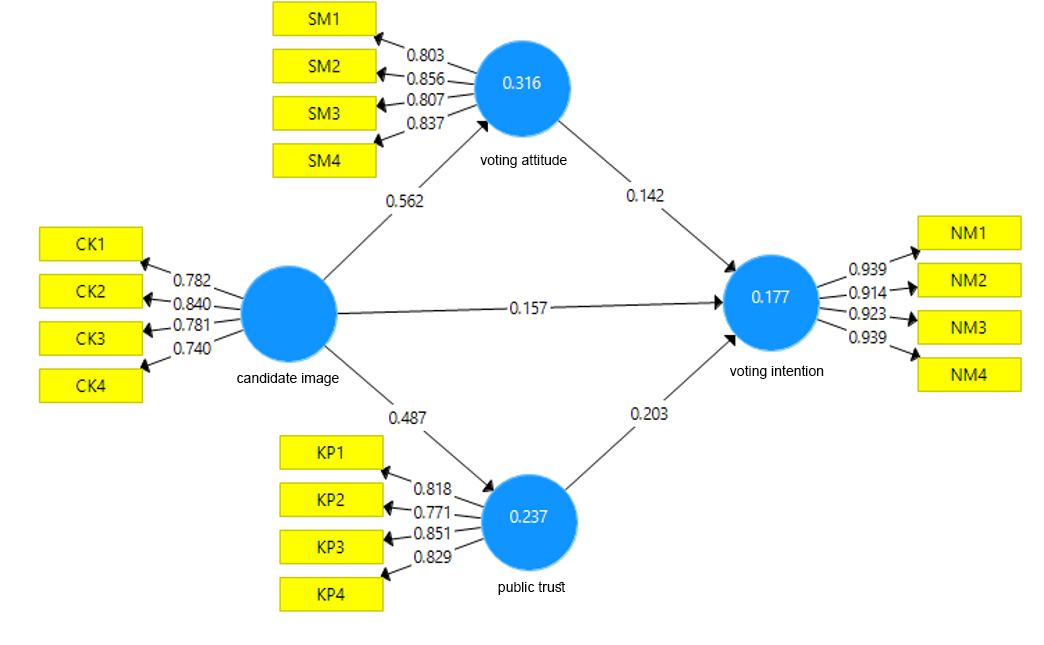
Source: SmartPLS 3.2.9 (2026)
| Candidate Image | Public Trust | Voting Intention | Voting Attitude | |
|---|---|---|---|---|
| CK1 | 0.782 | |||
| CK2 | 0.840 | |||
| CK3 | 0.781 | |||
| CK4 | 0.740 | |||
| KP1 | 0.818 | |||
| KP2 | 0.771 | |||
| KP3 | 0.851 | |||
| KP4 | 0.829 | |||
| NM1 | 0.939 | |||
| NM2 | 0.914 | |||
| NM3 | 0.923 | |||
| NM4 | 0.939 | |||
| SM1 | 0.803 | |||
| SM2 | 0.856 | |||
| SM3 | 0.807 | |||
| SM4 | 0.837 |
Source: SmartPLS 3.2.9 (2026)
Based on the outer model testing results presented in Table 5, all indicators for each variable exhibited loading factors > 0.6. The Candidate Image variable had loading factors ranging from 0.740 to 0.840, the Public Trust variable from 0.771 to 0.851, the Voting Intention variable from 0.914 to 0.939, and the Voting Attitude variable from 0.803 to 0.856. These results indicate that all indicators have met the criteria for convergent validity, as loading factors> 0.6 demonstrate that each indicator adequately reflects its respective latent construct. Consequently, no indicators needed to be eliminated from the research model, and all indicators were declared valid for use in subsequent analyses.
Discriminant Validity
To assess discriminant validity, one approach is to compare the Average Variance Extracted (AVE) values with the relationships among other constructs in the model. When the square root of AVE exceeds 0.50, it indicates that discriminant validity has been achieved (Pratama et al., 2018).
| Cronbach Alpha | rho_A | Composite Reliability | AVE | |
| Candidate Image | 0.794 | 0.799 | 0.866 | 0.619 |
| Public Trust | 0.836 | 0.849 | 0.890 | 0.669 |
| Voting Intention | 0.947 | 0.948 | 0.962 | 0.863 |
| Voting Attitude | 0.846 | 0.853 | 0.896 | 0.683 |
Source: SmartPLS 3.2.9 (2026)
Based on Table 6, all variables exhibited AVE values above 0.50 (Candidate Image 0.619; Public Trust 0.669; Voting Intention 0.863; Voting Attitude 0.683), Cronbach Alphas> 0.70, and Composite Reliabilities> 0.70. This indicates that the measurement model has met the criteria for convergent validity and reliability, thereby confirming that all constructs are suitable for further analysis.
In addition, discriminant validity can also be assessed using the Fornell-Larcker criterion in relation to the constructs. If the correlation of a construct with its own indicators exceeds its correlations with other constructs, this indicates that the latent construct is able to predict its indicators better than other constructs do (Pratama et al., 2018).
| Candidate Image | Public Trust | Voting Intention | Voting Attitude | |
| Candidate Image | 0.787 | |||
| Public Trust | 0.487 | 0.818 | ||
| Voting Intention | 0.336 | 0.366 | 0.929 | |
| Voting Attitude | 0.562 | 0.607 | 0.354 | 0.826 |
Source: SmartPLS 3.2.9 (2026)
Based on Table 7, the square root of the AVE for each variable is greater than its correlation with other variables. This indicates that all constructs have met the criteria for discriminant validity.
Beyond the AVE, another method that can be used to assess discriminant validity is through cross-loading measurements. An indicator is considered to have met discriminant validity if its cross-loading is 0.70 or higher (Pratama et al., 2018).
| Candidate Image | Public Trust | Voting Intention | Voting Attitude | |
|---|---|---|---|---|
| CK1 | 0.782 | 0.319 | 0.265 | 0.433 |
| CK2 | 0.840 | 0.445 | 0.237 | 0.504 |
| CK3 | 0.781 | 0.370 | 0.175 | 0.439 |
| CK4 | 0.740 | 0.387 | 0.377 | 0.387 |
| KP1 | 0.488 | 0.818 | 0.303 | 0.582 |
| KP2 | 0.340 | 0.771 | 0.240 | 0.422 |
| KP3 | 0.422 | 0.851 | 0.344 | 0.454 |
| KP4 | 0.306 | 0.829 | 0.297 | 0.513 |
| NM1 | 0.328 | 0.334 | 0.939 | 0.336 |
| NM2 | 0.318 | 0.339 | 0.914 | 0.336 |
| NM3 | 0.327 | 0.348 | 0.923 | 0.318 |
| NM4 | 0.273 | 0.337 | 0.939 | 0.324 |
| SM1 | 0.430 | 0.492 | 0.252 | 0.803 |
| SM2 | 0.531 | 0.522 | 0.244 | 0.856 |
| SM3 | 0.486 | 0.485 | 0.394 | 0.807 |
| SM4 | 0.388 | 0.506 | 0.259 | 0.837 |
Source: SmartPLS 3.2.9 (2026)
Based on the Cross Loading in Table 8, each indicator exhibits its highest loading value on its respective latent construct compared to other constructs. All indicators for the Candidate Image, Public Trust, Voting Intention, and Voting Attitude variables demonstrate cross-loading values that are greater on their own constructs, with the majority exceeding 0.7. This indicates that each latent construct has met the criteria for good discriminant validity, meaning the indicators employed are able to accurately measure their intended constructs without overlap among constructs.
Reliability Testing
The reliability test aims to assess the trustworthiness of the instrument in collecting data (Hardani et al., 2020). An instrument is considered reliable if it yields Cronbach Alphas and Composite Reliabilities of ≥ 0.70 (Hair et al., 2021).
| Cronbach Alpha | rho_A | Composite Reliability | AVE | |
| Candidate Image | 0.794 | 0.799 | 0.866 | 0.619 |
| Public Trust | 0.836 | 0.849 | 0.890 | 0.669 |
| Voting Intention | 0.947 | 0.948 | 0.962 | 0.863 |
| Voting Attitude | 0.846 | 0.853 | 0.896 | 0.683 |
Source: SmartPLS 3.2.9 (2026)
Table 9 shows all variables exhibit Cronbach Alpha and Composite Reliability values > 0.70, as well as AVE > 0.50. These results demonstrate that the variables evaluated in this study met the criteria for reliability; therefore, it reveals that the indicators used in this research have sufficient internal consistency to allow for stable measurement of the constructs being analyzed and, consequently, can be included in subsequent analyses.
4.3 Inner Model Testing
The initial step in testing the structural model is to examine the R Square values by selecting the R Square menu option provided at the bottom. The results of the R Square test are presented below.
R Square Values
The R-square (R²) value is used to measure the extent to which the variation in endogenous variables can be explained by exogenous variables. This study employs adjusted R² due to the presence of more than two independent variables. The criteria for R² are classified as strong (0.67), moderate (0.33), and weak (0.19) (Hudin & Riyanto, 2024).
| Variable | R Square | R Square Adjusted |
|---|---|---|
| Public Trust | 0.873 | 0.872 |
| Voting Intention | 0.682 | 0.672 |
| Voting Attitude | 0.858 | 0.855 |
Source: SmartPLS 3.2.9 (2026)
Based on Table 10, the R² values indicate that Candidate Image exerts a strong influence on Public Trust (0.873) and Voting Attitude (0.858), as well as a moderate influence on Voting Intention (0.682).
Effect Size (F Square)
The f-square value is tested to measure the contribution of exogenous variables to endogenous variables, classified as small (0.02), moderate (0.15), and large (0.35) (Hair et al., 2021).
| Candidate Image | Public Trust | Voting Intention | Voting Attitude | |
| Candidate Image | 0.873 | 0.682 | 0.858 | |
| Public Trust | 0.366 | 0.607 | ||
| Voting Intention | 0.354 | |||
| Voting Attitude |
Source: SmartPLS 3.2.9 (2026)
Based on Table 11, the Candidate Image variable exerts a very strong influence on Public Trust (f² = 0.873), Voting Intention (f² = 0.682), and Voting Attitude (f² = 0.858). The Public Trust variable exerts a large influence on Voting Intention (f² = 0.366) and Voting Attitude (f² = 0.607). Meanwhile, Voting Intention exerts a large influence on Voting Attitude (f² = 0.354). All of these f² values are above the large category threshold (> 0.35), thus it can be concluded that each exogenous variable makes a significant and dominant contribution to explaining the endogenous variables in the structural model of this study (Hair et al., 2021).
Goodness Of Fit
The results of the overall model fit testing is shown in Table 12 below.
| Saturated Model | Estimated Model | |
|---|---|---|
| SRMR | 0.071 | 0.071 |
| d_ULS | 1.284 | 1.284 |
| d_G | 1.932 | 1.932 |
| Chi-Square | 1854.227 | 1854.227 |
| NFI | 0.738 | 0.738 |
Source: SmartPLS 3.2.9 (2026)
Based on Table 12, the research model demonstrates a good level of fit, with an SRMR of 0.071 (below 0.10). The d_ULS of 1.284 and d_G of 1.932 indicate acceptable covariance matrix differences. The Chi-Square of 1854.227 for both the saturated and estimated models suggests good structural stability. The NFI value of 0.738 (above 0.70) indicates adequate model fit. Accordingly, the research model is declared suitable for use in hypothesis testing and analyzing the relationships among variables.
4.4 Hypothesis Testing
Hypothesis testing in this study was conducted after the model was declared fit, using the bootstrapping method within the SmartPLS application. The purpose of employing bootstrapping was to deal with non-normally distributed data and to create more stable estimates of parameters. Hypothesis testing produces output that includes inner weights, which can then be used to determine whether the results meet the criteria of being statistically significant. If a hypothesis has a p-value less than or equal to 0.05 and the t-statistic is larger than the t-table value (2.104), then the hypothesis will be found to be statistically significant at a 5% level of significance (Hair et al., 2021). The results of the bootstrapping tests for each hypothesis are included in the table below.
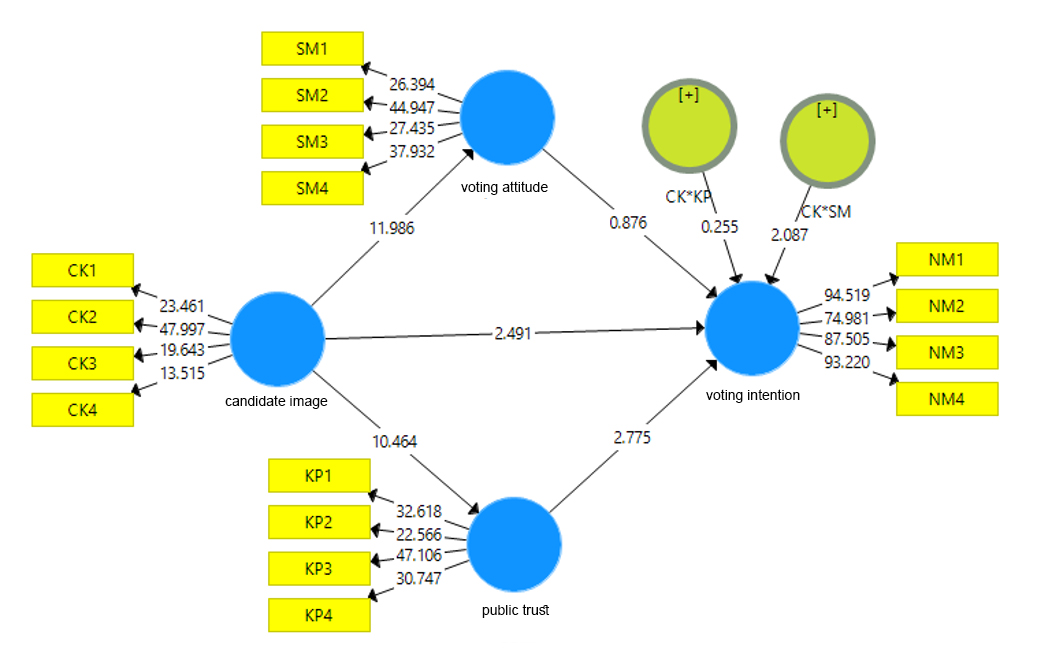
Source: SmartPLS 3.2.9 (2026)
| Path Coeff. | T | P | ||
|---|---|---|---|---|
| H1 | Candidate Image → Voting Intention | 0.064 | 2.491 | 0.013 |
| H2 | Candidate Image → Voting Attitude | 0.047 | 11.986 | 0.000 |
| H3 | Candidate Image → Public Trust | 0.046 | 10.464 | 0.000 |
| H4 | Voting Attitude → Voting Intention | 0.080 | 0.876 | 0.381 |
| H5 | Public Trust → Voting Intention | 0.072 | 2.775 | 0.006 |
Source: SmartPLS 3.2.9 (2026)
Direct Hypothesis Testing
The hypotheses in this study were tested by referring to the path coefficient output and examining the significance parameters. Hypothesis acceptance was determined based on the criteria of a p-value below 0.05 and a t-statistic exceeding 1.96. If the data analysis yielded a p-value exceeding 5% (0.05), the influence of the variable was considered insignificant and the hypothesis was rejected.
The first hypothesis test revealed a positive path coefficient, a t of 2.491 > 1.96, and a p meeting the criterion at 0.013 < 0.05. This proves Ha1 is supported, showing that candidate image significantly influences voting intention in regional head elections in Aceh.
The second hypothesis revealed a positive path coefficient, a t of 11.986 > 1.96, and a p meeting the criterion at 0.000 < 0.05. This proves Ha2 is supported, explaining that candidate image significantly influences voting attitude in regional head elections in Aceh.
The second hypothesis revealed a positive path coefficient, a t of 10.464 > 1.96, and a p meeting the criterion at 0.000 < 0.05. This proves Ha2 is supported, explaining that candidate image significantly influences public trust in regional head elections in Aceh.
The third hypothesis revealed a positive path coefficient, a t of 0.876 < 1.96, and a p that does not meet the criterion at 0.381 > 0.05. This proves Ha3 is not supported, showing that voting attitude does not significantly influence voting intention in regional head elections in Aceh.
The fourth hypothesis revealed a positive path coefficient, a t of 2.775 > 1.96, and a p meeting the criterion at 0.006 < 0.05. This proves Ha4 is supported, describing that public trust significantly influences voting intention in regional head elections in Aceh.
Indirect Hypothesis Testing (Mediation)
| Path Coefesien | T | P | ||
| H7 | Candidate Image → Voting Attitude → Voting Intention | 0.057 | 2.087 | 0.037 |
| H6 | Candidate Image → Public Trust → Voting Intention | 0.063 | 0.255 | 0.799 |
Source: SmartPLS 3.2.9 (2026)
The sixth hypothesis resulted a positive path coefficient, a t of 0.255 < 1.96, and a p that does not meet the criterion at 0.799 > 0.05. This proves Ha6 in this study is not supported, showing that candidate image does not significantly influence voting intention through the mediation of public trust in regional head elections in Aceh.
The fifth hypothesis resulted a positive path coefficient, a t of 2.087 > 1.96, and a p meeting the criterion at 0.037 < 0.05. This proves Ha5 in this study is supported, explaining that candidate image significantly influences voting intention through the mediation of voting attitude in regional head elections in Aceh.
4.5 Discussion
Candidate Image on Voting Intention in Regional Head Elections in Aceh (H1)
Candidate image positively significantly affects public voting intention in regional head elections in Aceh (t = 2.491; p = 0.013). This result indicates that the better the image constructed by a candidate through reputation, integrity, and leadership ability, the higher the public's tendency to vote for them. Through campaigns, track records, and social interactions, candidate image serves as an effective political communication instrument in shaping public perception (Firmanzah, 2007). Furthermore, (Wulandari & Nurcahya, 2015) and (Kotler et al., 2022) affirm that a positive image is capable of influencing individual decisions in choosing, whether in the context of products or political figures.
Candidate Image on Public Trust in Regional Head Elections in Aceh (H2)
Candidate image positively significantly affects public trust (t = 11.986; p = 0.000). This result indicates that candidates with a good track record, consistency in their actions, and strong competence are more likely to gain voting attitude. This is in line with (Zulkifli & Santoso, 2018) and (Norhabiba, 2018), who stated that an effectively communicated image can shape voters' initial attitudes toward a candidate.
Candidate Image on Public Trust in Regional Head Elections in Aceh (H3)
Candidate image positively significantly affects public trust (t = 10.464; p = 0.000). This result indicates that candidates with a good track record, consistency in their actions, and strong competence are more likely to gain public trust. (Schoorman et al., 2007) explain trust is built upon ability, integrity, and benevolence, while (Elrado, 2014) and (Kotler & Armstrong, 2018) affirm that positive perceptions enhance trust in an entity.
Voting Attitude on Voting Intention in Regional Head Elections in Aceh (H4)
Voting attitude has a positive relationship with voting intention (t = 0.876; p = 0.381), however, this relationship is not statistically significant. Therefore, the findings suggest that individuals' attitudes toward candidates do not always lead to actual voting behaviors due to other variables, such as social environments, families, and current political climates, that influence the final decision. The findings are contrary to (Schiffman & Wisenblit, 2019) claim that attitudes influence intentions and behaviors. On the other hand, (Campbell et al., 1960) explained that voting behavior is influenced by external variables like social groups and political environments.
Public Trust on Voting Intention in Regional Head Elections in Aceh (H5)
Public trust positively significantly affects voting intention (t = 2.775; p = 0.006). This result indicates that Acehnese voters tend to choose candidates they trust, because trust is associated with expectations of future candidate performance. This is consistent with (Uzir et al., 2021) and (Putra et al., 2013), who explain that trust influences individual intentions and decisions, as well as (Devulapalli, 2024), who affirm that trust is a crucial factor in voting behavior.
Candidate Image on Voting Intention through Voting Attitude in Regional Head Elections in Aceh (H6)
Voting attitude is a significant mediator of the relationship between candidate image and voting intention (t = 2.087; p = 0.037). The results show that a voter's positive image of a candidate may lead to a more positive attitude toward the candidate, leading to the intention to vote for the candidate. These findings are supported by (Baron & Kenny, 1986), as they indicate that mediating variables can explain the relationship between variables, and (Maima, 2012), as he found that attitudes could act as mediators of individuals' decision making.
Candidate Image on Voting Intention through Public Trust in Regional Head Elections in Aceh (H7)
The relationship between candidate image and voting intention is not moderated by public trust (t=0.255, p=.799). It appears that candidate image can increase public trust, however; increased public trust may not lead to greater voter intentions. Voters are influenced by many different variables when they decide who to vote for. Some of those include their own interest, social influence, political conditions, etc. This finding is not in line with (Schoorman et al., 2007), but is supported by (Kulachai et al., 2023), who state that voting decisions are shaped by various complex factors that do not depend solely on trust.
5. Conclusion
Drawing from the findings presented in the discussion section, it explains that candidate image significantly affects voting intention in regional head elections in Aceh, thus H1 is accepted. Furthermore, candidate image also affects voting attitude and public trust, so H2 and H3 are accepted. However, voting attitude does not influence voting intention, hence H4 is rejected. Conversely, public trust is proven to affect voting intention, therefore H5 is accepted. Additionally, voting attitude is able to mediate the candidate image and voting intention relationship, so H6 is accepted. Meanwhile, public trust is unable to mediate the candidate image and voting intention relationship, thus H7 is rejected. Accordingly, candidate image emerges as the primary factor influencing Acehnese voters' intentions to vote, both directly and through the mediation of voting attitude, while public trust plays a more direct role than a mediating one in the context of regional head elections in Aceh.
With reference to the research conclusions presented above, several suggestions can be offered. For candidates or campaign teams, it is recommended to further enhance candidate image through effective political communication strategies, transparency, and consistency between words and actions in order to increase public trust and voting intention among the community. In addition, future researchers should include other variables such as social aspects, media influences, environmental influences, etc., which could possibly have an effect on voting intentions as either mediating or moderating variables, so that the results of studies can better illustrate the factors that determine voting behavior in regional head elections in Aceh.
Several limitations for this study need to be acknowledged. First, there are limitations in the research instrument design, such as the length and complexity of the questionnaire items, which may affect respondents' comprehension and the quality of their answers. Second, time and resource constraints meant that this study was conducted only within a specific time frame, thus it was unable to capture dynamic changes in voter behavior over the long term. Nonetheless, the results of this study still offer meaningful contributions to the understanding of the influence of candidate image on voting intention in regional head elections in Aceh.
References
Arenggoasih, W. (2017). Pengaruh Brand Communication, Service Quality Dan Brand Personality Anggota Dewan Terpilih Melalui Brand Trust Terhadap Brand Loyalty Pemilih (Studi Partai Politik Gerindra). Interaksi Jurnal Ilmu Komunikasi, 5(2), 123–135. https://doi.org/https://doi.org/10.14710/interaksi.5.2.123-135
Asfar, M. (2006). Pemilu dan perilaku memilih 1955-2004. Pustaka Eureka.
Azwar, S. (2016). Sikap Manusia : Teori dan Pengukurannya (2nd ed.). Pustaka Pelajar.
Badu, S. Q., & Djafri, N. (2017). Kepemimpinan dan PerilakuOrganisasi. Ideas Publishing.
Baron, R. M., & Kenny, D. A. (1986). The moderator-mediator variable distinction in social psychological research: Conceptual, strategic, and statistical considerations. Journal of Personality and Social Psychology, 51(6), 1173–1182. https://doi.org/10.1037//0022-3514.51.6.1173
Campbell, A., Converse, P. E., Miller, W. E., & Stokes, D. E. (1960). The American Voter. The University of Chicago Press.
Devulapalli, A. (2024). The Deccan Powerplay: Reddy, Naidu and the Realpolitik of Andhra Pradesh. Rupa Publications India.
Dwiyanto, A. (2011). Mengembalikan kepercayaan publik melalui reformasi birokrasi. PT Gramedia Pustaka Utama.
Elmitiara, I., & Anom, E. (2023). Komunikasi Pemasaran Politik terhadap Keputusan Memilih Calon Legilastif DPRD Kota Tangerang Selatan pada Pemilu Legislatif 2019. Journal of Management and Bussines, 5(1), 11–19. https://doi.org/https://doi.org/10.31539/jomb.v5i1.5103
Elrado, M. (2014). Pengaruh Kualitas Pelayanan Terhadap Kepuasan, Kepercayaan Dan Loyalitas (Survei pada Pelanggan yang Menginap di Jambuluwuk Batu Resort Kota Batu). Jurnal Administrasi Bisnis, 15(2).
Firmanzah. (2007). Marketing politik: Antara pemahaman dan realitas. Yayasan Pustaka Obor Indonesia.
Hair, J. F., Hult, G. T. M., Ringle, C. M., Sarstedt, M., Danks, N. P., & Ray, S. (2021). An Introduction to Structural Equation Modeling : Partial Least Squares Structural Equation Modeling (PLS-SEM) Using R. https://doi.org/10.1007/978-3-030-80519-7_5
Hardani, Auliya, N. H., Andriani, H., Fardani, R. A., Ustiawaty, J., Utami, E. F., Sukmana, D. J., & Istiqomah, R. R. (2020). Metode Penelitian Kualitatif & Kuantitatif. CV. Pustaka Ilmu Group Yogyakarta.
Haryanto, H. C., Rahmania, T., Mubarok, A. R., Dopo, A. B., Fauzi, H., & Fajri, E. (2015). Bagaimanakah Persepsi Keterpercayaan Masyarakat terhadap Elit Politik? Jurnal Psikologi, 42(3), 243–258. https://doi.org/https://doi.org/10.22146/jpsi.9913
Hudin, J. M., & Riyanto, A. (2024). Inovasi dalam Pengelolaan Stock : Menerapkan Metode FIFO Melalui Prototype Sistem Informasi. INTERNAL (Information System Journal), 7(1), 30–46. https://doi.org/10.32627/internal.v7i1.940
Kotler, P., & Armstrong, G. (2018). Principles of Marketing (17th ed.). Pearson Education.
Kotler, P., Keller, K. L., & Chernev, A. (2022). Marketing Management (16th ed.). Pearson Education.
Kulachai, W., Lerdtomornsakul, U., & Homyamyen, P. (2023). Factors Influencing Voting Decision: A Comprehensive Literature Review. Social Sciences, 12, 469. https://doi.org/https://doi.org/10.3390/socsci14010016
Maima, R. (2012). Analisis Pengaruh Kepercayaan Pelanggan dan Kualitas Pelayanan terhadap Sikap Pelanggan dan Implikasinya terhadap Keputusan Pembelian Ulang (Studi Kasus Pada CV. Mukti Manunggal Semarang). Universitas Diponegoro.
Meliala, W. (2020). Menuju “Good Governance” Dengan Reinventing Government. Citizen Education, Media Kajian Pancasila Dan Kewarganegaraan, 2(1), 1–11.
Noor, J. (2017). Metodologi Penelitian: Skripsi, Tesis, Disertasi, dan Karya Ilmiah (Cet. 7). Kencana.
Noor, M. S., Munawarah, & Baihaqi, A. (2025). Pengaruh Kualitas Pelayanan Terhadap Kepuasan Masyarakat Pada Kantor Kelurahan Paringin Kota Kecamatan Paringin Kabupaten Balangan. Al’iidara Balad Jurnal Administrasi Negara, 7(1), 161–173. https://doi.org/https://doi.org/10.36658/aliidarabalad.7.1.1327
Norhabiba, F. (2018). Aplikasi Elaboration Likelihood Model Theory dalam Iklan Calon Gubernur 2018 terhadap Perilaku Memilih. KANAL: Jurnal Ilmu Komunikasi, 6(2), 101–110. https://doi.org/https://doi.org/10.21070/kanal.v6i2.1932
Nuramalina, A. S., Leiliyanti, E., & Anwar, M. (2026). Multimodal Visual Social Semiotic Analysis of Political Campaigns Media: A Case Study of the Amin Banner in the 2024 Indonesian Presidential Election. Eduvest – Journal of Universal Studies, 6(2), 1315–1326.
Nurrizkiana, B., Handayani, L., & Widiastuty, E. (2017). Determinan Transparansi dan Akuntabilitas Pengelolaan Keuangan Daerah dan Implikasinya Terhadap Kepercayaan Public-Stakeholders. Jurnal Akuntansi Dan Investasi, 18(1), 28–47. https://doi.org/https://doi.org/10.18196/jai.18159
Nurtjahjanti, H. (2010). Hubungan Antara Persepsi Terhadap Kompensasi Dan Semangat Kerja Pada Karyawan Operasional PT Kai (Persero) Purwokerto. Jurnal Psikologi Undip, 8(2), 97–101.
Pratama, N. D., Abdurahim, A., & Sofyani, H. (2018). Determinan Efektivitas Implementasi Anggaran Berbasis Kinerja Dan Penyerapan Anggaran Di Pemerintah Daerah. Jurnal Reviu Akuntansi Dan Keuangan, 8(1), 9–24. https://doi.org/https://doi.org/10.22219/jrak.v8i1.23
Priyowidodo, G., & Indrayani, I. I. (2024). Strategic Communication and Political Candidate’s Image in Digital Campaigns. Jurnal Ilmu Komunikasi, 21(2), 157–174. https://doi.org/https://doi.org/10.24002/jik.v21i2.7779
Putra, F. S. D., BS, D. A., Susila, Y., Hartati, A., Amane, A. P. O., Hanika, I. M., Yusanto, Y., & Nugroho, H. (2013). Marketing Politik (Teori & Konsep). Penerbit Widina.
Ramadhanil, F., Junaidi, V., & Ibrohim. (2015). Desain Partisipasi Masyarakat dalam Pemantauan Pemilu (S. Pramono & R. Widyastuti (eds.)). Kemitraan bagi Pembaruan Tata Pemerintahan di Indonesia.
Robbins, S. P., & Judge, T. A. (2022). Organizational Behavior (19th ed.). Pearson.
Saad, S., & Salman, A. (2013). The Role of Values and Attitudes in Political Participation. Asian Social Science, 9(8), 9–16. https://doi.org/10.5539/ass.v9n8p9
Schiffman, L., & Wisenblit, J. L. (2019). Consumer Behavior (12th ed.). Pearson.
Schoorman, F. D., Mayer, R. C., & Davis, J. H. (2007). An integrative model of organizational trust: Past, present, and future. Academy of Management Review, 32(2), 344–354.
Sugiyono. (2022). Metode penelitian kuantitatif, kualitatif, dan R&D. Alfabeta.
Taufik, & Warsono, H. (2020). Birokrasi Baru Untuk New Normal: Tinjauan Model Perubahan Birokrasi Dalam Pelayanan Publik Di Era Covid-19. Dialogue Jurnal Ilmu Administrasi Publik, 2(5), 1–18. https://doi.org/https://doi.org/10.14710/dialogue.v2i1.8182
Uzir, M. U. H., Al Halbusi, H., Thurasamy, R., Thiam Hock, R. L., Aljaberi, M. A., Hasan, N., & Hamid, M. (2021). The effects of service quality, perceived value and trust in home delivery service personnel on customer satisfaction: Evidence from a developing country. Journal of Retailing and Consumer Services, 63(August), 102721. https://doi.org/10.1016/j.jretconser.2021.102721
Weiser, P. (2020). Democratic Party. Https://Ballotpedia.Org/Phil_Weiser. https://ballotpedia.org/Phil_Weiser
Weninggalih, L., & Fuady, M. . (2021). Hubungan Kampanye Politik Calon Presiden 2019 melalui Media Sosial Instagram dengan Keputusan Memilih Mahasiswa Indonesia di Thailand. Jurnal Riset Public Relations, 1(1), 22–32. https://doi.org/https://doi.org/10.29313/.v0i0.7106
Wulandari, N. M. R., & Nurcahya, I. K. (2015). Pengaruh Celebrity Endorser, Brand Image, Brand Trust terhadap Keputusan Pembelian Clear Shampoo di Kota Denpasar. E-Jurnal Manajemen Universitas Udayana, 4(11), 3909–3935.
Zulkifli, & Santoso, J. (2018). Pengaruh Political Marketing Mix Terhadap Niat memilih Partai Gerindra Di Kota Semarang. Seminar Nasional Multidisiplin 2018, 59–65.
References
- Arenggoasih, W. (2017). Pengaruh Brand Communication, Service Quality Dan Brand Personality Anggota Dewan Terpilih Melalui Brand Trust Terhadap Brand Loyalty Pemilih (Studi Partai Politik Gerindra). Interaksi Jurnal Ilmu Komunikasi, 5(2), 123–135. https://doi.org/https://doi.org/10.14710/interaksi.5.2.123-135 Google Scholar ↗
- Asfar, M. (2006). Pemilu dan perilaku memilih 1955-2004. Pustaka Eureka. Google Scholar ↗
- Azwar, S. (2016). Sikap Manusia : Teori dan Pengukurannya (2nd ed.). Pustaka Pelajar. Google Scholar ↗
- Badu, S. Q., & Djafri, N. (2017). Kepemimpinan dan PerilakuOrganisasi. Ideas Publishing. Google Scholar ↗
- Baron, R. M., & Kenny, D. A. (1986). The moderator-mediator variable distinction in social psychological research: Conceptual, strategic, and statistical considerations. Journal of Personality and Social Psychology, 51(6), 1173–1182. https://doi.org/10.1037//0022-3514.51.6.1173 Google Scholar ↗
- Campbell, A., Converse, P. E., Miller, W. E., & Stokes, D. E. (1960). The American Voter. The University of Chicago Press. Google Scholar ↗
- Devulapalli, A. (2024). The Deccan Powerplay: Reddy, Naidu and the Realpolitik of Andhra Pradesh. Rupa Publications India. Google Scholar ↗
- Dwiyanto, A. (2011). Mengembalikan kepercayaan publik melalui reformasi birokrasi. PT Gramedia Pustaka Utama. Google Scholar ↗
- Elmitiara, I., & Anom, E. (2023). Komunikasi Pemasaran Politik terhadap Keputusan Memilih Calon Legilastif DPRD Kota Tangerang Selatan pada Pemilu Legislatif 2019. Journal of Management and Bussines, 5(1), 11–19. https://doi.org/https://doi.org/10.31539/jomb.v5i1.5103 Google Scholar ↗
- Elrado, M. (2014). Pengaruh Kualitas Pelayanan Terhadap Kepuasan, Kepercayaan Dan Loyalitas (Survei pada Pelanggan yang Menginap di Jambuluwuk Batu Resort Kota Batu). Jurnal Administrasi Bisnis, 15(2). Google Scholar ↗
- Firmanzah. (2007). Marketing politik: Antara pemahaman dan realitas. Yayasan Pustaka Obor Indonesia. Google Scholar ↗
- Hair, J. F., Hult, G. T. M., Ringle, C. M., Sarstedt, M., Danks, N. P., & Ray, S. (2021). An Introduction to Structural Equation Modeling : Partial Least Squares Structural Equation Modeling (PLS-SEM) Using R. https://doi.org/10.1007/978-3-030-80519-7_5 Google Scholar ↗
- Hardani, Auliya, N. H., Andriani, H., Fardani, R. A., Ustiawaty, J., Utami, E. F., Sukmana, D. J., & Istiqomah, R. R. (2020). Metode Penelitian Kualitatif & Kuantitatif. CV. Pustaka Ilmu Group Yogyakarta. Google Scholar ↗
- Haryanto, H. C., Rahmania, T., Mubarok, A. R., Dopo, A. B., Fauzi, H., & Fajri, E. (2015). Bagaimanakah Persepsi Keterpercayaan Masyarakat terhadap Elit Politik? Jurnal Psikologi, 42(3), 243–258. https://doi.org/https://doi.org/10.22146/jpsi.9913 Google Scholar ↗
- Hudin, J. M., & Riyanto, A. (2024). Inovasi dalam Pengelolaan Stock : Menerapkan Metode FIFO Melalui Prototype Sistem Informasi. INTERNAL (Information System Journal), 7(1), 30–46. https://doi.org/10.32627/internal.v7i1.940 Google Scholar ↗
- Kotler, P., & Armstrong, G. (2018). Principles of Marketing (17th ed.). Pearson Education. Google Scholar ↗
- Kotler, P., Keller, K. L., & Chernev, A. (2022). Marketing Management (16th ed.). Pearson Education. Google Scholar ↗
- Kulachai, W., Lerdtomornsakul, U., & Homyamyen, P. (2023). Factors Influencing Voting Decision: A Comprehensive Literature Review. Social Sciences, 12, 469. https://doi.org/https://doi.org/10.3390/socsci14010016 Google Scholar ↗
- Maima, R. (2012). Analisis Pengaruh Kepercayaan Pelanggan dan Kualitas Pelayanan terhadap Sikap Pelanggan dan Implikasinya terhadap Keputusan Pembelian Ulang (Studi Kasus Pada CV. Mukti Manunggal Semarang). Universitas Diponegoro. Google Scholar ↗
- Meliala, W. (2020). Menuju “Good Governance” Dengan Reinventing Government. Citizen Education, Media Kajian Pancasila Dan Kewarganegaraan, 2(1), 1–11. Google Scholar ↗
- Noor, J. (2017). Metodologi Penelitian: Skripsi, Tesis, Disertasi, dan Karya Ilmiah (Cet. 7). Kencana. Google Scholar ↗
- Noor, M. S., Munawarah, & Baihaqi, A. (2025). Pengaruh Kualitas Pelayanan Terhadap Kepuasan Masyarakat Pada Kantor Kelurahan Paringin Kota Kecamatan Paringin Kabupaten Balangan. Al’iidara Balad Jurnal Administrasi Negara, 7(1), 161–173. https://doi.org/https://doi.org/10.36658/aliidarabalad.7.1.1327 Google Scholar ↗
- Norhabiba, F. (2018). Aplikasi Elaboration Likelihood Model Theory dalam Iklan Calon Gubernur 2018 terhadap Perilaku Memilih. KANAL: Jurnal Ilmu Komunikasi, 6(2), 101–110. https://doi.org/https://doi.org/10.21070/kanal.v6i2.1932 Google Scholar ↗
- Nuramalina, A. S., Leiliyanti, E., & Anwar, M. (2026). Multimodal Visual Social Semiotic Analysis of Political Campaigns Media: A Case Study of the Amin Banner in the 2024 Indonesian Presidential Election. Eduvest – Journal of Universal Studies, 6(2), 1315–1326. Google Scholar ↗
- Nurrizkiana, B., Handayani, L., & Widiastuty, E. (2017). Determinan Transparansi dan Akuntabilitas Pengelolaan Keuangan Daerah dan Implikasinya Terhadap Kepercayaan Public-Stakeholders. Jurnal Akuntansi Dan Investasi, 18(1), 28–47. https://doi.org/https://doi.org/10.18196/jai.18159 Google Scholar ↗
- Nurtjahjanti, H. (2010). Hubungan Antara Persepsi Terhadap Kompensasi Dan Semangat Kerja Pada Karyawan Operasional PT Kai (Persero) Purwokerto. Jurnal Psikologi Undip, 8(2), 97–101. Google Scholar ↗
- Pratama, N. D., Abdurahim, A., & Sofyani, H. (2018). Determinan Efektivitas Implementasi Anggaran Berbasis Kinerja Dan Penyerapan Anggaran Di Pemerintah Daerah. Jurnal Reviu Akuntansi Dan Keuangan, 8(1), 9–24. https://doi.org/https://doi.org/10.22219/jrak.v8i1.23 Google Scholar ↗
- Priyowidodo, G., & Indrayani, I. I. (2024). Strategic Communication and Political Candidate’s Image in Digital Campaigns. Jurnal Ilmu Komunikasi, 21(2), 157–174. https://doi.org/https://doi.org/10.24002/jik.v21i2.7779 Google Scholar ↗
- Putra, F. S. D., BS, D. A., Susila, Y., Hartati, A., Amane, A. P. O., Hanika, I. M., Yusanto, Y., & Nugroho, H. (2013). Marketing Politik (Teori & Konsep). Penerbit Widina. Google Scholar ↗
- Ramadhanil, F., Junaidi, V., & Ibrohim. (2015). Desain Partisipasi Masyarakat dalam Pemantauan Pemilu (S. Pramono & R. Widyastuti (eds.)). Kemitraan bagi Pembaruan Tata Pemerintahan di Indonesia. Google Scholar ↗
- Robbins, S. P., & Judge, T. A. (2022). Organizational Behavior (19th ed.). Pearson. Google Scholar ↗
- Saad, S., & Salman, A. (2013). The Role of Values and Attitudes in Political Participation. Asian Social Science, 9(8), 9–16. https://doi.org/10.5539/ass.v9n8p9 Google Scholar ↗
- Schiffman, L., & Wisenblit, J. L. (2019). Consumer Behavior (12th ed.). Pearson. Google Scholar ↗
- Schoorman, F. D., Mayer, R. C., & Davis, J. H. (2007). An integrative model of organizational trust: Past, present, and future. Academy of Management Review, 32(2), 344–354. Google Scholar ↗
- Sugiyono. (2022). Metode penelitian kuantitatif, kualitatif, dan R&D. Alfabeta. Google Scholar ↗
- Taufik, & Warsono, H. (2020). Birokrasi Baru Untuk New Normal: Tinjauan Model Perubahan Birokrasi Dalam Pelayanan Publik Di Era Covid-19. Dialogue Jurnal Ilmu Administrasi Publik, 2(5), 1–18. https://doi.org/https://doi.org/10.14710/dialogue.v2i1.8182 Google Scholar ↗
- Uzir, M. U. H., Al Halbusi, H., Thurasamy, R., Thiam Hock, R. L., Aljaberi, M. A., Hasan, N., & Hamid, M. (2021). The effects of service quality, perceived value and trust in home delivery service personnel on customer satisfaction: Evidence from a developing country. Journal of Retailing and Consumer Services, 63(August), 102721. https://doi.org/10.1016/j.jretconser.2021.102721 Google Scholar ↗
- Weiser, P. (2020). Democratic Party. Https://Ballotpedia.Org/Phil_Weiser. https://ballotpedia.org/Phil_Weiser Google Scholar ↗
- Weninggalih, L., & Fuady, M. . (2021). Hubungan Kampanye Politik Calon Presiden 2019 melalui Media Sosial Instagram dengan Keputusan Memilih Mahasiswa Indonesia di Thailand. Jurnal Riset Public Relations, 1(1), 22–32. https://doi.org/https://doi.org/10.29313/.v0i0.7106 Google Scholar ↗
- Wulandari, N. M. R., & Nurcahya, I. K. (2015). Pengaruh Celebrity Endorser, Brand Image, Brand Trust terhadap Keputusan Pembelian Clear Shampoo di Kota Denpasar. E-Jurnal Manajemen Universitas Udayana, 4(11), 3909–3935. Google Scholar ↗
- Zulkifli, & Santoso, J. (2018). Pengaruh Political Marketing Mix Terhadap Niat memilih Partai Gerindra Di Kota Semarang. Seminar Nasional Multidisiplin 2018, 59–65. Google Scholar ↗