Abstract
The implementation of community service in Karang Anyar Village, Jati Agung District, South Lampung Regency was carried out in stages and systematically according to management functions with a focus on improving the competence of POSYANDU cadres through an educational and participatory approach. Activities included outreach to the village government, KUPTD Puskesmas, related officials, and cadre groups, as well as education for 30 health cadres. The briefing materials included the basic principles of breast milk management, the benefits of breast milk for babies, the role of breast milk in brain growth and development, and the role of cadres in promoting breast milk. The methods included a pre-test, delivery of materials by a team of lecturers together with village midwives and officials, a question and answer session, a post-test, and the formulation of follow-up actions and joint commitments. The evaluation showed an increase in cadre knowledge: 93% (28/30) on the principles of breast milk management, 90% (27/30) on the benefits of breast milk for babies, 83% (25/30) on the role of breast milk in brain development, and 97% (29/30) on the role of cadres in promoting breast milk. Activity outputs include the implementation of briefings, the development of educational media (leaflets and short modules), increased understanding of the importance of exclusive breastfeeding among cadres, and a commitment to implementing breastfeeding promotion and support in their respective regions. Regular monitoring, follow-up training, and practical support are recommended to maintain the program's impact.
Keywords
Optimization Cadres Promotion Breastfeeding
Introduction
Breast milk is the best source of nutrition for infants because it contains complete nutrients, antibodies, and various bioactive components that play a vital role in supporting growth, development, and protection against infection. Exclusive breastfeeding for the first six months of life, as recommended by the World Health Organization (WHO), followed by breastfeeding along with adequate complementary foods until the age of two years or beyond, has been shown to reduce infant morbidity and mortality, particularly from respiratory infections and diarrhea. Furthermore, breast milk contributes to the formation of gut microbiota and the maturation of the immune system, as well as providing essential growth factors and nutrients that support brain development during the golden period of child development.
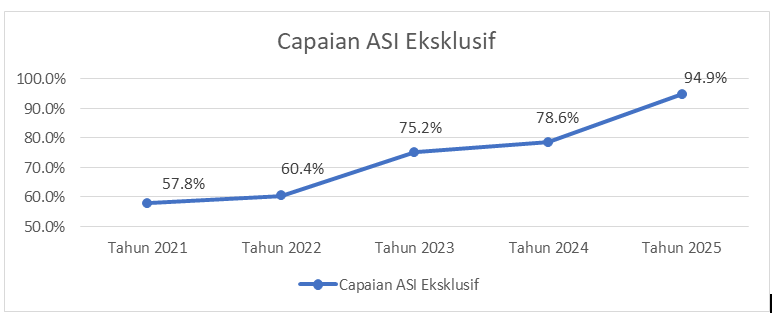
Although the benefits of exclusive breastfeeding have been widely documented, the achievement of exclusive breastfeeding remains suboptimal. Data from the 2023 Indonesian Nutritional Status Survey (SSGI) shows national coverage of 70.1%, below the ideal target of 80%. In Lampung Province, coverage was recorded at 76.20%, while in South Lampung Regency it was 76.5% (17,345 infants), with variations between regions indicating the need for contextual interventions to improve the consistency and coverage of exclusive breastfeeding. Meanwhile, in South Lampung Regency, the percentage of infants aged 0–6 months who received exclusive breastfeeding in the same year reached 76.5% (17,345 infants), this figure is slightly higher than the provincial average. In 2025, exclusive breastfeeding coverage in the Karang Anyar PKM working area had reached 94.9%, although this achievement figure still shows fluctuations between hamlets and is not evenly distributed.
The success of an exclusive breastfeeding program is influenced by multidimensional factors, including the mother's ability to maintain breast milk production, family support, especially from her husband, support from health workers, the role of community health workers, and policies and a social environment that support breastfeeding practices. Evidence shows that husband support through participation in household chores and emotional support increases breastfeeding success. Furthermore, the role of community health workers in accompanying mothers during the breastfeeding period is very effective in maintaining exclusive breastfeeding. Therefore, community empowerment, including strengthening the capacity of community health workers, is a key strategy to increase exclusive breastfeeding coverage and educate the public about the importance of breast milk in optimizing the growth and brain development of infants and children.
Since 2020, the Center of Excellence (CoE) of the Midwifery Department of the Tanjung Karang Health Polytechnic, Ministry of Health, which focuses on lactation management, has collaborated with the Karang Anyar Community Health Center to develop Karang Anyar Village as a Resilient Breastfeeding Village, which was launched on September 17, 2021. This program aims to become a model for lactation management through the establishment of Breastfeeding Support Groups (KP-ASI), the Breastfeeding Fathers movement, and strengthening the role of health cadres. Various educational, promotive, and preventive activities have been implemented, including cadre training and nutrition education for mothers of toddlers. However, practical challenges, such as the vast working area of the Community Health Center, have led to disparities in the distribution of activities and the delivery of messages/information. Therefore, providing briefings to health cadres is an effective strategy to disseminate information to breastfeeding mothers in the area under their supervision.
Based on these conditions, this Community Service activity is themed "Optimizing the Competence of Posyandu Cadres in Promoting Breastfeeding to Support Children's Brain Development in the Karang Anyar Assisted Village, Jati Agung District, South Lampung Regency". This activity is an implementation of the Tri Dharma of Higher Education, especially community service by lecturers from the Midwifery Department of the Tanjung Karang Ministry of Health Polytechnic. The main objective of the activity is to improve the knowledge and skills of health cadres in promoting the importance of breastfeeding to pregnant and breastfeeding mothers so that they are able to support the practice of exclusive breastfeeding to optimize the brain health of babies/children and encourage the creation of a community environment that supports the success of exclusive breastfeeding in the working area of the Karang Anyar Community Health Center and other areas in South Lampung Regency.
Situation And Problem Analysis
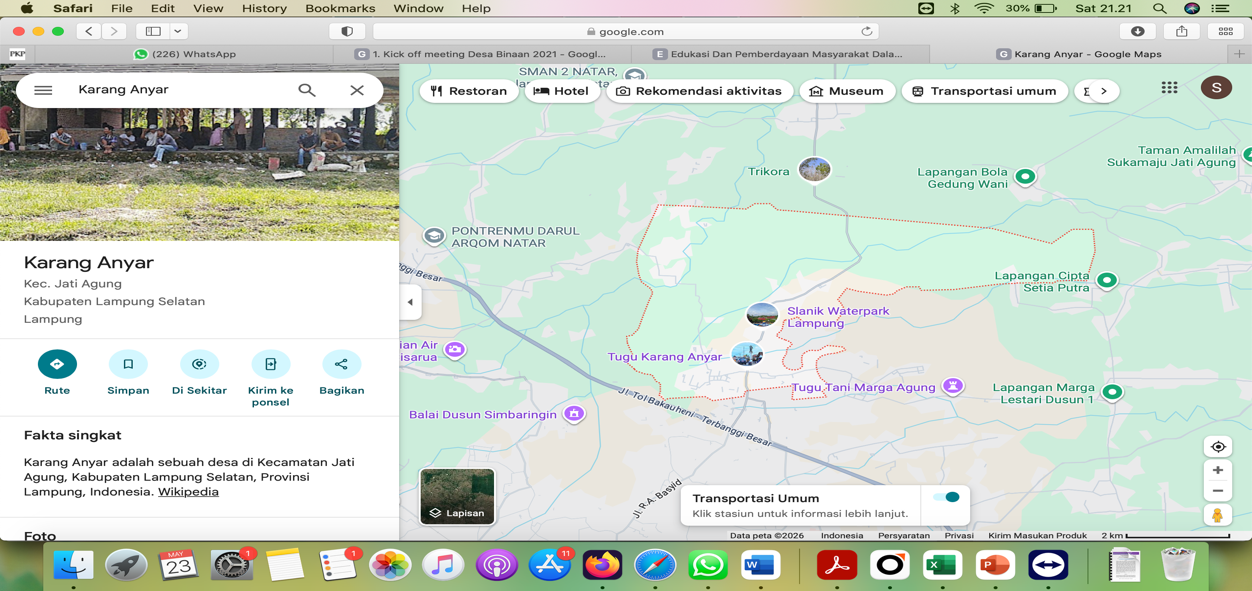
The working area of the Karang Anyar Community Health Center is located in Jati Agung District, South Lampung Regency, with an area of 109.85 km² consisting of 12 villages and 80 hamlets. One of the villages that is the location of the activity is Karang Anyar Village, this village since 2020 has become a Foster Village of the Midwifery Department of the Ministry of Health Polytechnic of Tanjungkarang with the theme "Resilient Breastfeeding Village". This village has a fairly large area, consisting of 17 hamlets, and is the village closest to the health service facility, namely the Karang Anyar Community Health Center. Based on village data, the population has currently reached 19,576 people with 5,697 heads of families. The map of the Karang Anyar Community Health Center working area can be seen in the following map:
Health Analysis
Health care facilities in Karang Anyar Village are considered adequate. In addition to the Community Health Center (Puskesmas), there are also several private clinics providing maternal and child health services. There are 10 active integrated health posts (Posyandu) in the village with a total of 50 health cadres, with five active cadres per Posyandu. Posyandu activities are also running well, as evidenced by the high number of monthly visits. In addition to Posyandu, there are also community groups such as the Family Welfare Movement (PKK) and farmer groups that serve as forums for community participation in various social and health activities.
Karang Anyar Community Health Center routinely conducts health promotion activities, both periodically and incidentally, covering maternal and infant health topics both inside and outside the health service building. In 2021, to equip cadres in promoting exclusive breastfeeding, training was conducted for Posyandu cadres on the role of exclusive breastfeeding and complementary feeding for children's health. Following the training, health promotion activities, specifically exclusive breastfeeding promotion, were actively implemented by Posyandu cadres in their respective work areas, through practical breastfeeding counseling and education activities for pregnant and breastfeeding mothers.
The coverage of exclusive breastfeeding in Karang Anyar Village in 2024 was recorded at 70.1%, this figure is still below the average achievement of the Karang Anyar Community Health Center work area which reached 78.6% in the same year. Although there has been an increase in the achievement of exclusive breastfeeding from year to year, the increase in Karang Anyar Village is still lower than other villages in the Karang Anyar Community Health Center work area. In 2025, there were 656 breastfeeding mothers and 326 babies aged 0–12 months in this village, who are the target group for exclusive breastfeeding promotion.
The coverage of exclusive breastfeeding in the Karang Anyar Community Health Center (PUSKESMAS) work area increased from 57.8% in 2021 to 94.9% in 2025. For more details on the development of exclusive breastfeeding coverage from 2021 to 2025 in the Karang Anyar Community Health Center (PKM) work area, please see the graph below.
Data Source: Karang Anyar PKM Work Report
Activity Implementation Method
The method of implementing community service activities to optimize competency in the form of providing education to health cadres about the promotion of exclusive breastfeeding in optimizing the growth and development of the brains of infants and children. Educational activities were carried out on Monday, May 18, 2026, at the Karang Anyar Community Health Center hall. Participants were 30 Health cadres who were representatives of 10 villages in the Karang Anyar PKM work area, each village was represented by three cadres, resulting in 30 participants. The provision material focused on increasing knowledge about the importance of exclusive breastfeeding for the growth and development of the brains of infants and children including: Basic principles of breast milk management, Benefits of breast milk for infants, The role of breast milk in optimal growth and development of the brains of infants and children and The role of Posyandu cadres in promoting breast milk to mothers. as well as the strategic role of Posyandu cadres in encouraging the practice of exclusive breastfeeding in the community. Educational methods with lectures, questions and answers, brainstorming and practice of techniques for delivering Effective Breast Milk Promotion. As a follow-up to the activity, a hands-on training session for breastfeeding mothers will be conducted in August 2026, along with field monitoring of breastfeeding promotion activities by health cadres, assisted by village midwives and lecturers from the Tanjungkarang Ministry of Health Polytechnic of Health. These mentoring activities are planned to continue in several villages within the Karang Anyar Community Health Center's coverage area as a continuous effort to strengthen exclusive breastfeeding outcomes at the community level.
Implementation of Activities
An overview of the implementation of thematic community service activities in the form of briefings for Posyandu cadres on promoting exclusive breastfeeding in optimizing the growth and development of infants and children's brains. This was implemented by following the stages of activity management. According to Fried & O'Fallon (2021), management is a process consisting of planning, organizing, mobilizing, and monitoring steps carried out systematically to determine goals and achieve predetermined targets through optimal utilization of human resources and other resources.
Activity Planning
Based on the results of the situation analysis and problem identification, the initial stage of community service activities is planning. According to Kaakinen et al. (2020), planning is the process of determining goals to be achieved in the future and determining the stages to be taken to achieve the goals. The main objective of this community service activity is to improve the knowledge and skills of health cadres in promoting the importance of breastfeeding to pregnant and breastfeeding mothers so that they are able to support the practice of exclusive breastfeeding for optimizing the brain health of babies/children. Indicators of the success of this activity include increasing knowledge and attitudes of cadres in mobilizing and empowering the community, especially pregnant and breastfeeding mothers, to be able to provide optimal exclusive breastfeeding to their babies.
Implementation of Community Service Activities
This community service activity is implemented in stages and systematically in accordance with management functions, with the focus of activities (actuating) on improving the competency of Posyandu cadres in supporting the success of exclusive breastfeeding through an educational and participatory approach. The types of activities carried out include:
a. Community Service Socialization
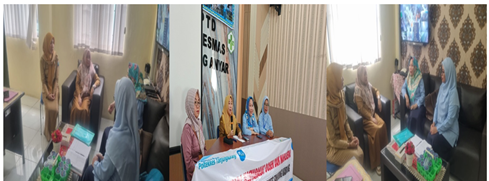
The activity began with outreach to the village government, the KUPTD PUSKESMAS and its staff, and the Posyandu cadre group. The outreach determined the objectives to be achieved in the implementation of community service activities, implementation techniques, targets to be aimed at, benefits, division of tasks for each team, infrastructure to be used, and the activity implementation plan. Photos of the outreach activities can be seen in the image.
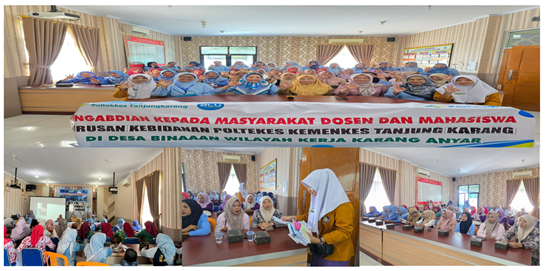
Educational activities to improve competency for 30 health cadres in the Karang Anyar Village area, Jati Agung District, South Lampung Regency. The briefing material focused on increasing knowledge about (Basic principles of management, benefits of breast milk for infants and children, benefits of breast milk in optimal growth and development of the brain of infants and children and the role of POSYANDU cadres in promoting breastfeeding to mothers). The steps of the briefing activity began with: 1. Pre-test, each participant did a pre-test by filling out a questionnaire from the material to be delivered. The education was carried out by a group of community service lecturers from the Department of Midwifery, Poltekkes Tanjungkarang, involving village midwives, and Karang Anyar Village government officials. The education process began with identifying problems, existing potentials and obstacles encountered in the community related to the practice of exclusive breastfeeding. Continued with the provision of updated material related to Exclusive Breastfeeding interspersed with questions and answers. After completing the education, to measure the level of understanding of the cadres of the material delivered, a post-test was conducted by filling out a prepared questionnaire. The final step is formulating follow-up actions and a joint commitment to solutions that can be implemented by Posyandu cadres in promoting exclusive breastfeeding and supporting breastfeeding mothers in their respective areas. A photo of the cadre briefing activity can be seen in Figure 2.
Evaluation
Activity Impact Results and Follow-up Plans
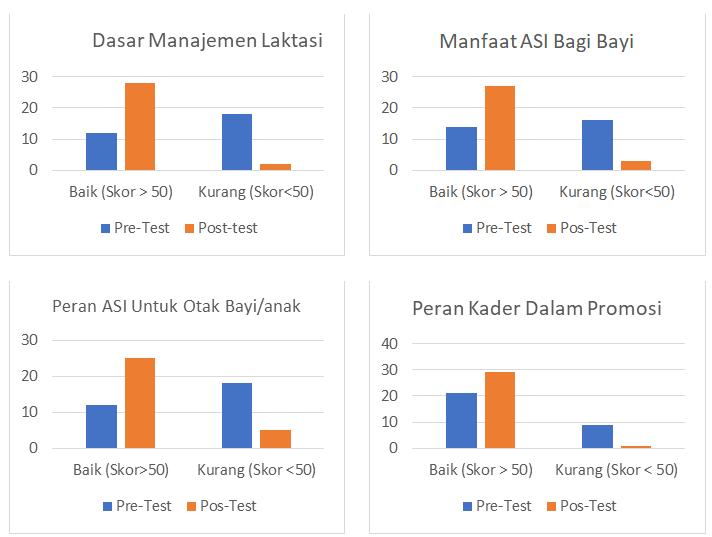
The results of the pre- and post-test evaluation showed an increase in the knowledge of health cadres about the importance of exclusive breastfeeding for the growth and development of the brains of infants and children, covering four core materials: 1. Basic principles of breast milk management in the good category of 28 cadres (93%), Benefits of breast milk for babies in the good category of 27 cadres (90%), The role of breast milk in optimal growth and development of the brains of infants and children in the good category of 25 cadres (83%) and The role of health cadres in promoting breast milk to mothers as many as 29 cadres (97%). For more details, please see the following graphic image:
The results (outputs) of community service activities are: 1) Implementation of knowledge provision activities for health cadres about the role of breast milk for the health of infants and children's brains, 2) Preparation of educational media in the form of leaflets and short modules for cadres about the advantages of breast milk for the health of infants/children's brains, and 3) Increased knowledge of cadres about the importance of exclusive breastfeeding for the growth and development of infants and children's brains. 4). Preparation of a joint commitment to solutions that can be implemented by posyandu cadres in exclusive breastfeeding promotion activities and assistance to breastfeeding mothers in their respective areas.
Conclusion
The community service program is implemented in stages and systematically, following management functions, with a focus on improving the competency of Posyandu (POSYANDU) cadres (Actuating) through an educational and participatory approach. Activities include outreach to village governments, KUPTD Puskesmas (Community Health Center) officials, village midwives, and cadre groups; as well as conducting competency education for 30 cadres in Karang Anyar Village, Jati Agung District, South Lampung Regency.
The evaluation results showed an increase in cadre knowledge after the educational intervention. The percentage of cadres who were in the good category on four core materials after training were: basic principles of breast milk management 93% (28/30), benefits of breast milk for babies 90% (27/30), the role of breast milk in the growth and development of the baby/child brain 83% (25/30), and the role of cadres in promoting breastfeeding for mothers 97% (29/30). This indicates the effectiveness of the educational methods (pre-test, updated materials, Q&A, post-test) and the involvement of local stakeholders.
The outputs of the activities include: 1) the implementation of knowledge provision for cadres about the role of breast milk for the brain health of babies/children; 2) the preparation of educational media (leaflets and short modules) for cadres; 3) increasing cadres' knowledge about the importance of exclusive breastfeeding for brain growth and development; and 4) the preparation of a joint commitment to solutions that can be implemented by POSYANDU cadres in promoting exclusive breastfeeding and assisting breastfeeding mothers.
Brief suggestion: to maintain and increase the impact, it is recommended to carry out regular monitoring, advanced training (refreshing), field practice assistance, and regular distribution and use of educational media at integrated health posts (posyandu).
Thank-You Note
We extend our highest appreciation to the Tanjungkarang Ministry of Health Polytechnic for their support and facilitation of this community service. We extend our gratitude to the leadership of the Karang Anyar Community Health Center and all its staff, the Way Dadi Sub-district Head, and the Karang Anyar Village Head and staff for their collaboration, involvement, and on-the-ground support, which greatly assisted in the smooth running of this community service activity.
References
- Central Statistics Agency of Lampung Province. (2024, June 30). 76.20% of infants aged 0–5 months in Lampung Province received exclusive breastfeeding in 2023. Bandar Lampung: BPS Lampung Province. DOI ↗ Google Scholar ↗
- Bloom, B.R., & Atun, R. (2020). Frameworks for health systems management and governance: A global perspective on public health leadership. Oxford University Press DOI ↗ Google Scholar ↗
- South Lampung District Health Office. (2025). South Lampung District Health Profile Book 2023. South Lampung: South Lampung District Health Office. DOI ↗ Google Scholar ↗
- Lampung Provincial Health Office. (2025). Health profile in 2024. Bandar Lampung: Lampung Provincial Health Office. DOI ↗ Google Scholar ↗
- Fried, L. E., & O'Fallon, L. R. (2021). Public health management: Principles and practice (2nd ed.). Jones & Bartlett Learning. DOI ↗ Google Scholar ↗
- Kaakinen, J.R., Coehlo, D.P., Steele, R., & Robinson, T. (2020). Community and public health nursing: Promoting the public's health (10th ed.). F.A. Davis Company. DOI ↗ Google Scholar ↗
- Ministry of Health of the Republic of Indonesia. (2021). Guidelines for public health management in community health centers. Ministry of Health of the Republic of Indonesia. DOI ↗ Google Scholar ↗
- Lasena, ZA, & Arifin, ND (2023). Planning, organizing, mobilizing, and controlling human resources. Proceedings of the National Seminar on Educational Sciences, 1(2). DOI ↗ Google Scholar ↗
- Lutfin, N., Fansury, AH, Januarty, R., & Angreani, AV (2022). Community empowerment through a non-MSG ASI booster program based on Moringa leaves in Barembeng Village, Gowa Regency. TONGKONAN: Journal of Community Service, 1(1), 35–41. DOI ↗ Google Scholar ↗
- Government Regulation of the Republic of Indonesia Number 28 of 2024 concerning the Implementation of Law Number 17 of 2023 concerning Health. DOI ↗ Google Scholar ↗
- Notoatmodjo, S. (2019). Health promotion and health behavioral science. Rineka Cipta. DOI ↗ Google Scholar ↗
- Sudarmi S., Asih Y., Purwaningsih D., R. Pranajaya (2025) Book. The Key to Success in Exclusive Breastfeeding with ASI-EKS SELF-FEEDING MOMENTS (Holistic Lactation Management Model, Motivation, and Self-Efficacy). Yogyakarta Publisher; Nuha Medika DOI ↗ Google Scholar ↗
- Sudarmi, S., Purwaningsih, D., & Rudiyanti, N. (2025). Optimizing the Role of Health Cadres to Achieve Exclusive Breastfeeding Success in the Karang Anyar Assisted Village Area.Beguai Jejama Health Service Journal, 6(3), 95-101. DOI ↗ Google Scholar ↗
- Sudarmi, S., Asih, Y., Purwaningsih, D., & Pranajaya, R. (2025). Education and Community Empowerment in Providing Exclusive Breastfeeding.Malahayati Silver Journal: Community Service, 7(2), 57-67. DOI ↗ Google Scholar ↗
- Wardiyah, A., Lathifah, NS, Sari, NN, Sutiyoko, A., Syakilah, S., & Dora, MD (2025). Empowering Cadres and Families as Breastfeeding Motivators (Kemasi) for Early Stunting Prevention.Malahayati Silver Journal: Community Service,7(1), 178-188. DOI ↗ Google Scholar ↗