Abstract
The green transition has changed the meaning of foreign direct investment. Host economies no longer compete only for capital volume, technology transfer, or export capacity. They also seek investment that supports lower-carbon production, renewable energy, resource efficiency, and green technology diffusion. This study examines whether institutional quality helps attract sustainable foreign direct investment and whether this effect is stronger when environmental policy capacity is higher. The study adopts a quantitative panel design using a balanced country-year dataset. The empirical specification estimates country and year fixed-effects models with cluster-robust standard errors. The results show a positive and statistically significant association between institutional quality and sustainable FDI. Environmental policy capacity and green innovation are also positively related to sustainable FDI. The interaction between institutional quality and environmental policy capacity is positive, suggesting that investors respond not only to formal environmental ambition but also to the credibility and predictability of the institutional setting in which such policies operate. The findings support the argument that the green transition is institutional as well as technological. Policy reforms that improve regulatory quality, reduce arbitrary decision-making, and strengthen enforcement may improve the capacity of host economies to attract investment aligned with sustainable development.
Keywords
sustainable foreign direct investment institutional quality green transition environmental policy green innovation fixed effects
1. Introduction
The global shift toward lower-carbon development has altered the way governments evaluate foreign direct investment. For many years, FDI was treated mainly as an external source of capital, employment, exports, and technological upgrading. These channels remain important, but the policy question has become more selective. Host economies increasingly ask whether foreign investment supports a cleaner production structure, strengthens green technology capability, and improves the long-term resilience of development. In this context, sustainable FDI refers to foreign investment that contributes to lower-carbon activities, renewable energy, resource efficiency, environmental technology, and cleaner industrial upgrading. It is not simply ordinary investment relabelled in environmental terms. It requires firms to commit capital in sectors and processes where policy stability, credible regulation, and institutional predictability are especially important.
This study focuses on the role of institutional quality in attracting sustainable FDI. The argument is straightforward. Green investment is often asset-specific, regulation-sensitive, and exposed to long payback periods. Investors in renewable energy, environmental technology, and cleaner production systems must evaluate not only market size and cost conditions but also whether contracts will be enforced, whether permits will be processed predictably, whether environmental rules will be stable, and whether public agencies will implement policy without arbitrary discretion. The institutional environment therefore shapes the perceived risk-adjusted return of sustainable investment. Studies on FDI attraction show that regulations and the wider business environment influence investment decisions, while recent work gives more direct attention to institutional quality as a determinant of FDI inflows (Contractor et al., 2020; Gökçeli, 2023). Evidence from South and Southeast Asia also indicates that institutional quality is relevant for FDI inflows in emerging economies, where differences in enforcement capacity can be substantial (Bhujabal et al., 2024).
The question is also important because the environmental consequences of FDI are not uniform. Some foreign investment may accelerate cleaner technology diffusion, while other investment may reinforce pollution-intensive production if weak institutions lower compliance costs. The literature has therefore moved beyond the simple question of whether FDI is good or bad for development. Research on the institution-FDI-environment relationship suggests that institutional conditions can influence whether FDI contributes to cleaner or more harmful outcomes (Ha & Nguyen, 2021; Qamruzzaman, 2023). Similar arguments appear in studies of financial development, institutional quality, and environmental degradation, which show that institutional settings condition the environmental implications of economic and financial activity (Ahmed et al., 2020; Hunjra et al., 2020).
The present study contributes to this discussion in three ways. First, it places sustainable FDI at the centre of the analysis rather than using aggregate FDI alone. This distinction matters because the nature of FDI can influence its economic and environmental consequences. Chaudhury et al. (2020) argue that the type of FDI matters for economic growth in South Asia, and this logic can be extended to the green transition. Second, the study treats institutional quality not only as a background control variable but as the main explanatory factor. Third, it examines whether environmental policy capacity strengthens the institutional effect. A policy framework may signal national commitment to green transition, but the signal becomes credible only when supported by institutions that can implement rules consistently.
The empirical analysis uses a balanced panel structure and fixed-effects estimation. This design is appropriate because sustainable FDI is likely to vary both across countries and over time. Country fixed effects control for time-invariant features such as geography, long-run legal traditions, and structural position in global value chains. Year fixed effects control for common shocks affecting investment conditions. The analysis also includes controls for green innovation, trade openness, market size, financial development, renewable energy share, and carbon intensity. These controls reflect the broader literature linking FDI, growth, institutions, and environmental outcomes (Baiashvili & Gattini, 2020; Duong et al., 2022; Tran et al., 2023).
2. Literature Review
2.1. Foreign Direct Investment and Development Outcomes
FDI can support growth through capital accumulation, employment generation, knowledge transfer, export expansion, and productivity improvement. However, the size and direction of these effects depend on domestic absorptive capacity and institutional conditions. Baiashvili and Gattini (2020) show that the growth effects of FDI depend on country income levels and institutional strength. This finding is important because it suggests that FDI does not operate independently from the host environment. Capital inflows may create stronger development gains when the institutional setting can protect property rights, support contract enforcement, and reduce uncertainty.
The broader development literature also shows that external capital flows differ in their effects. Bird and Choi (2020) examine remittances, foreign aid, and FDI and find that these flows have different implications for economic growth. This distinction is relevant for sustainable FDI because not every external financial flow supports long-term productive upgrading. The quality, sectoral composition, and institutional embeddedness of investment matter. Chibalamula et al. (2023) similarly examine FDI and trade openness in African countries and show that external integration can matter for growth, but its effects must be interpreted in relation to domestic conditions. The implication is that FDI attraction should not be evaluated only by volume. It should also be assessed by its developmental content.
Research in Asia and middle-income economies reinforces this view. Duong et al. (2022) find that FDI, trade openness, and productivity are relevant for growth in middle-income countries, while Nguyen (2022) discusses the effect of FDI on economic growth in Vietnam. Provincial and local studies also show that FDI can be associated with growth, but the strength of the relationship varies across places. Duong (2021) examines provinces and cities in the South East region of Vietnam, and Meivitawanli (2021) studies provincial FDI and growth in Indonesia. These studies support a central idea of this study: the impact and attraction of FDI are partly local and institutional, not merely macroeconomic.
Vietnamese and local-government evidence is useful because it highlights subnational institutional variation. Tran et al. (2023) examine whether FDI and institutional quality affect local government economic growth in Vietnam using Bayesian modelling. Their work suggests that institutional quality should be treated as a substantive factor in development analysis. Ngo et al. (2022), in a study of Phu Tho province, also emphasize the effectiveness of provincial FDI attraction. Tran et al. (2020) identify factors affecting FDI in Tay Ninh province, while Ngo and Nguyen (2025) examine the mediating role of institutional quality in FDI attractiveness in Tay Ninh. Together, these studies suggest that investment attractiveness depends on local governance, administrative capacity, and the credibility of implementation.
2.2 Institutional Quality and FDI Attractiveness
Institutional quality has become a central theme in international business research because investors face costs that are not captured by simple market indicators. Contractor et al. (2020) show that country regulations and business environment conditions influence FDI inflows. Chen and Jiang (2023) examine institutional quality and FDI through mediating and moderating effects, indicating that institutions can operate through more than one channel. Gökçeli (2023) provides evidence from OECD countries and shows that institutional quality is relevant even among relatively advanced economies. This is important because institutional quality is not only a concern for low-income settings. Even in mature economies, predictable rules and credible public institutions shape investment decisions.
The relationship between institutions and investment can be understood through risk, transaction costs, and asset specificity. Tan et al. (2023) connect institutional quality, asset specificity, and FDI, which is particularly relevant for green investment. Many sustainable investments require fixed assets that cannot be easily moved after installation, such as renewable energy facilities, grid infrastructure, waste management systems, or specialized production lines. When assets are specific, investors are more exposed to policy reversal, licensing delays, and weak enforcement. Strong institutions reduce these risks by providing clearer rules and more predictable dispute resolution. Moussavou (2022), in the context of CEMAC, also shows that FDI attractiveness is shaped by institutional and macroeconomic determinants, supporting the need to examine governance alongside economic variables.
2.3 Institutions, Environmental Quality, and the Green Transition
Institutions also matter for environmental outcomes. Haldar and Sethi (2020) find that institutional quality and renewable energy consumption are linked to carbon emissions in developing countries. Sah (2021) examines environmental protection in CEMAC and emphasizes the role of institutional quality. Wawrzyniak and Doryń (2020) show that institutional quality can modify the relationship between economic growth and carbon dioxide emissions. These studies indicate that institutions affect not only the quantity of economic activity but also its environmental consequences. In weak institutional contexts, environmental rules may exist formally but remain unevenly enforced. In stronger institutional contexts, regulatory commitments are more likely to shape actual firm behaviour.
The FDI-environment literature provides further motivation. Ha and Nguyen (2021) examine the role of institutions in the FDI-environmental pollution nexus and show that institutional conditions influence whether FDI is associated with environmental damage. Tran et al. (2023) study FDI, economic growth, and environmental degradation across middle-income countries, suggesting that foreign investment and growth can have environmental consequences that require policy attention. Xaisongkham and Liu (2024) examine institutional quality, employment, FDI, and environmental degradation using a balanced panel GMM estimator in developing countries. Their results are relevant for this study because they show that institutions can affect both investment and environmental outcomes in dynamic settings.
2.4 Green Innovation, Sustainable Energy, and Domestic Capabilities
Recent studies also connect institutional quality with green technology and sustainable energy. Dang and Nguyen (2025) examine FDI inflows and green technology innovation and explicitly consider the role of institutional quality. Halldén et al. (2025) investigate institutional quality and public renewable energy investment, indicating that credible institutions are important not only for private foreign investment but also for public green investment. Yan et al. (2024) examine FDI, economic progress, institutional quality, and sustainable energy efficiency in BRICS economies. These studies point to a common mechanism: the green transition requires investment, but investment depends on credible rules, policy continuity, and institutional capacity.
The literature on institutional change also supports this argument. Keller and Shiue (2020) link market integration and institutional change, implying that market expansion and institutions can evolve together. Corradini (2021) examines local institutional quality and economic growth through a panel-VAR analysis, showing that institutions can have dynamic effects over time. Qiu and Chen (2020) investigate natural resource endowment, institutional quality, and regional growth in China, which is relevant because resource-dependent regions may face different incentives regarding green investment. Saad (2021) discusses institutional change in the global economy and shows that reform can have welfare implications that depend on context. Maruta et al. (2020), in their work on foreign aid, institutional quality, and growth, further support the idea that external resources produce better outcomes when domestic institutions can use them effectively.
Financial and macroeconomic conditions remain important but should not displace institutional analysis. Silva et al. (2021) examine global imbalances, institutions, financial development, and FDI in the context of financial crises. Nguyen and Duong (2021) study the shadow economy, corruption, and economic growth in BRICS countries, showing that informal and corrupt practices can affect development outcomes. These studies suggest that institutional weaknesses can distort both financial flows and investment incentives. For sustainable FDI, corruption and informality may be especially damaging because green investment often requires permits, environmental compliance, and coordination with public agencies.
2.5 Hypotheses Development
The first hypothesis follows directly from institutional theory and FDI evidence. Stronger institutions are expected to attract more sustainable FDI because they reduce the uncertainty associated with long-term and regulation-sensitive green investment. Investors are more likely to commit capital when property rights, contract enforcement, licensing procedures, and policy implementation are credible. This argument is consistent with research showing that institutional quality matters for FDI inflows across different country groups and institutional settings (Bhujabal et al., 2024; Chen & Jiang, 2023; Gökçeli, 2023). Thus, the first hypothesis is:
H1. Institutional quality is positively associated with sustainable foreign direct investment.
The second hypothesis concerns environmental policy capacity. Sustainable FDI should be more likely when host economies have policy frameworks that support renewable energy, cleaner production, and environmental upgrading. However, environmental policy capacity is not sufficient if it exists only on paper. It must be supported by administrative competence and credible enforcement. Studies of institutional quality and environmental protection suggest that environmental policy becomes more effective when institutions can implement and monitor rules (Haldar & Sethi, 2020; Sah, 2021). The second hypothesis is:
H2. Environmental policy capacity is positively associated with sustainable foreign direct investment.
The third hypothesis concerns complementarity. Institutional quality and environmental policy capacity should reinforce each other. Strong environmental policy can signal green transition commitment, but investors may discount that signal if the institutional environment is unpredictable. Conversely, strong institutions may attract investment in general, but their effect on sustainable FDI should be larger when the policy environment clearly supports green investment. This logic is consistent with the idea that institutions moderate economic and environmental relationships (Hunjra et al., 2020; Wawrzyniak & Doryń, 2020). The third hypothesis is:
H3. Institutional quality and environmental policy capacity interact positively in attracting sustainable foreign direct investment.
The fourth hypothesis concerns green innovation. Sustainable FDI is likely to flow toward economies where foreign firms can connect to emerging green capabilities, suppliers, skills, and technology ecosystems. Green innovation can signal absorptive capacity and the presence of complementary assets. Dang and Nguyen (2025) connect FDI inflows, green technology innovation, and institutional quality, which supports the view that green investment and domestic innovation capability are linked. The fourth hypothesis is:
H4. Green innovation is positively associated with sustainable foreign direct investment.
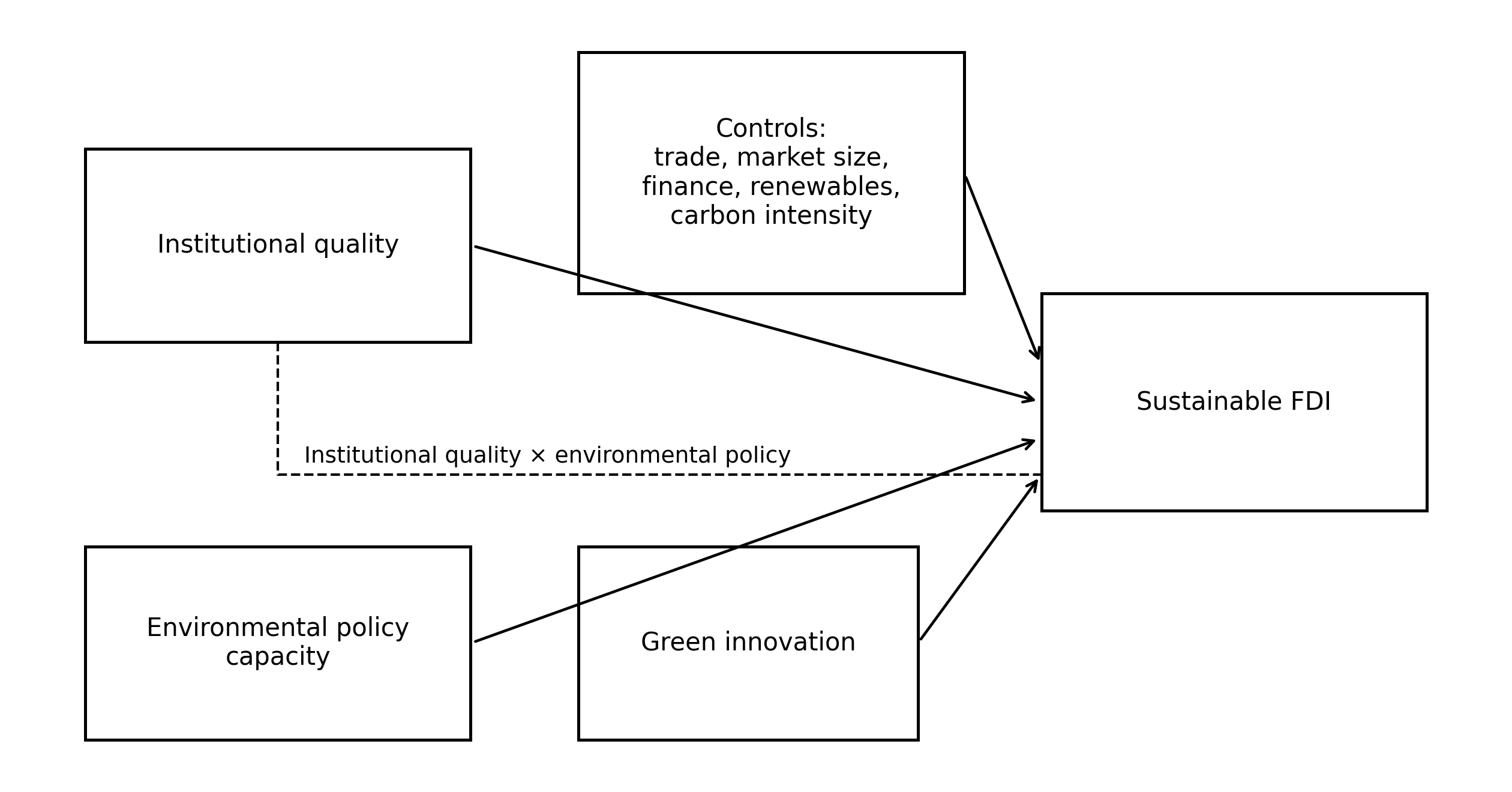
The framework positions institutional quality as the main condition shaping sustainable FDI attraction. Environmental policy capacity has both a direct role and a moderating role because green policy sends a clearer investment signal when it is implemented through credible institutions. Green innovation and the control variables capture the broader economic and technological setting in which sustainable investment decisions are made.
3. Methodology
The study adopts a quantitative panel design. The unit of analysis is the country-year observation. The accompanying empirical file contains a balanced panel of 30 emerging and developing economies observed annually from 2015 to 2025, producing 330 observations. The panel structure allows the analysis to examine within-country changes over time while controlling for stable differences across countries. It also allows the model to include year fixed effects, which account for common shocks that may influence global investment patterns. The design is suitable for the research question because sustainable FDI is shaped by both structural country features and changing policy conditions.
The dependent variable is sustainable foreign direct investment, measured as SFDI as a percentage of GDP. Conceptually, the variable captures foreign investment aligned with renewable energy, lower-carbon production, environmental technology, resource efficiency, and green industrial upgrading. The logarithmic transformation, Log_SFDI, is used in the regression models to reduce skewness and to interpret changes in proportional terms. The transformation is calculated as the natural logarithm of SFDI_GDP plus one. This approach avoids losing observations with low but positive values and makes the distribution more suitable for linear estimation.
The main explanatory variable is institutional quality. It is specified as a composite index in which higher values indicate stronger institutional performance. In substantive terms, the variable represents the predictability of rules, administrative quality, regulatory credibility, control of arbitrary discretion, and the reliability of contract enforcement. These dimensions correspond to the mechanisms identified in the FDI literature, where institutions affect investment decisions by shaping transaction costs and policy risk (Contractor et al., 2020; Tan et al., 2023). For estimation, institutional quality is standardized to have a mean of zero and a standard deviation of one.
Environmental policy capacity is the second central explanatory variable. It captures the ability of a host economy to provide a policy environment supportive of green transition. The variable is not treated as a simple measure of environmental ambition. It reflects the practical policy capacity needed to implement green regulation, support renewable energy deployment, and encourage cleaner production. This distinction is important because environmental rules may not affect investment if they are not implemented consistently. The variable is also standardized before estimation.
Green innovation is included as a key control and substantive predictor. It represents the domestic capability for green technology activity, including the ability to absorb and complement foreign green investment. Trade openness is included because economies more integrated into global markets may attract investment seeking access to export networks or supply chains. Market size is included because larger markets can attract investment through demand potential. Financial development is included because green investment often depends on domestic financing systems and risk-sharing capacity. Renewable energy share is included to capture existing energy transition conditions. Carbon intensity is included because a high-carbon production structure may either attract transition-oriented investment or signal structural barriers to sustainable upgrading.
The baseline empirical model estimates the association between institutional quality and Log_SFDI using country and year fixed effects. The extended model adds environmental policy capacity, green innovation, and the full set of controls. The interaction model includes the product of standardized institutional quality and standardized environmental policy capacity. The general specification can be written as:
log(SFDI)it = α + β1InstitutionalQualityit + β2EnvironmentalPolicyit +β3(InstitutionalQualityit ×EnvironmentalPolicyit ) + γControlsit +μi +λt +ϵit
Where country fixed effects are represented by μi, year fixed effects by λt , and ϵit is the error term.
The fixed-effects approach is chosen for theoretical as well as statistical reasons. Countries differ in many stable characteristics that may influence sustainable FDI, including geography, historical legal systems, long-run industrial structures, and regional market position. If these factors are omitted, the institutional quality coefficient may capture structural differences rather than within-country institutional changes. Country fixed effects reduce this concern by comparing each country mainly with itself over time. Year fixed effects are also important because global investment conditions change with energy prices, financial cycles, climate policy expectations, and major shocks affecting capital mobility.
The interaction term is specified after standardization to reduce scaling problems and to make the coefficient easier to interpret. A positive interaction means that the association between institutional quality and sustainable FDI becomes stronger as environmental policy capacity increases. This interpretation is substantively meaningful because it reflects a credibility mechanism. Environmental policy capacity indicates a green direction, while institutional quality indicates whether that direction is likely to be implemented in a predictable way. The interaction is therefore not only a statistical addition but also a direct test of the study's theoretical argument.
The control variables are included to reduce omitted-variable bias and to locate the institutional effect within a broader investment-attraction framework. Trade openness captures integration into international markets. Market size captures demand potential. Financial development captures the capacity of the domestic system to support investment and risk sharing. Renewable energy share captures the existing position of the energy transition. Carbon intensity captures the underlying environmental structure of production. Green innovation captures technological capability. Including these variables helps distinguish the institutional effect from other plausible determinants of sustainable FDI.
Standard errors are clustered at the country level. This is appropriate because observations from the same country may be serially correlated across time. Clustered standard errors reduce the risk of overstating statistical significance. The estimation strategy is conservative in the sense that it absorbs time-invariant country characteristics and common annual shocks. Although the design cannot fully eliminate endogeneity, it reduces bias from omitted stable country characteristics and global time shocks. Robustness checks compare the baseline model with sequentially expanded specifications.
The variable processing follows four steps. First, the raw dataset is checked for completeness across the 2015-2025 panel. The constructed panel contains no missing country-year observations, so all 330 observations are retained. Second, SFDI_GDP is transformed into Log_SFDI. Third, institutional quality and the explanatory controls are standardized. Fourth, the interaction term IQxPolicy is calculated as the product of standardized institutional quality and standardized environmental policy capacity.
| Variable | Role | Meaning | Processing |
| SFDI_GDP | Dependent variable | Sustainable FDI inflows as percentage of GDP | Raw value; Log_SFDI = ln(SFDI_GDP + 1) |
| Institutional_Quality | Main predictor | Composite quality of institutional setting | Standardized before estimation |
| Environmental_Policy | Predictor and moderator | Capacity of green policy environment | Standardized before estimation |
| Green_Innovation | Control and predictor | Green technology and innovation activity | Standardized before estimation |
| Trade_Openness | Control | International market integration | Standardized before estimation |
| Market_Size | Control | Log market size indicator | Standardized before estimation |
| Financial_Development | Control | Domestic financial capacity | Standardized before estimation |
| Renewable_Share | Control | Renewable share in energy system | Standardized before estimation |
| Carbon_Intensity | Control | Carbon intensity of production | Standardized before estimation |
4. Results
| Variable | N | Mean | Std. dev. | Min. | Max. |
| SFDI (% GDP) | 330 | 4.647 | 4.032 | 0.335 | 28.268 |
| Institutional quality | 330 | -0.067 | 0.467 | -1.011 | 1.246 |
| Environmental policy | 330 | 48.765 | 9.504 | 20.0 | 73.541 |
| Green innovation | 330 | 3.345 | 1.316 | 0.104 | 6.586 |
| Trade openness | 330 | 73.875 | 32.568 | 20.0 | 182.328 |
| Market size | 330 | 26.739 | 1.465 | 23.903 | 30.927 |
| Financial development | 330 | 65.561 | 16.128 | 27.881 | 104.629 |
| Renewable share | 330 | 20.614 | 10.333 | 2.0 | 54.513 |
| Carbon intensity | 330 | 0.681 | 0.283 | 0.12 | 1.522 |
| Log SFDI | 330 | 1.55 | 0.574 | 0.289 | 3.376 |
The descriptive statistics show that the panel contains sufficient variation for quantitative analysis. The mean value of sustainable FDI is 4.647 percent of GDP, but the maximum reaches 28.268 percent, indicating that sustainable investment is concentrated in some country-year observations. Institutional quality and environmental policy capacity also show broad dispersion, which is important because the study tests whether differences in governance and policy capacity explain differences in sustainable FDI. The distribution of carbon intensity and renewable energy share further suggests that the sample includes economies at different stages of the green transition.
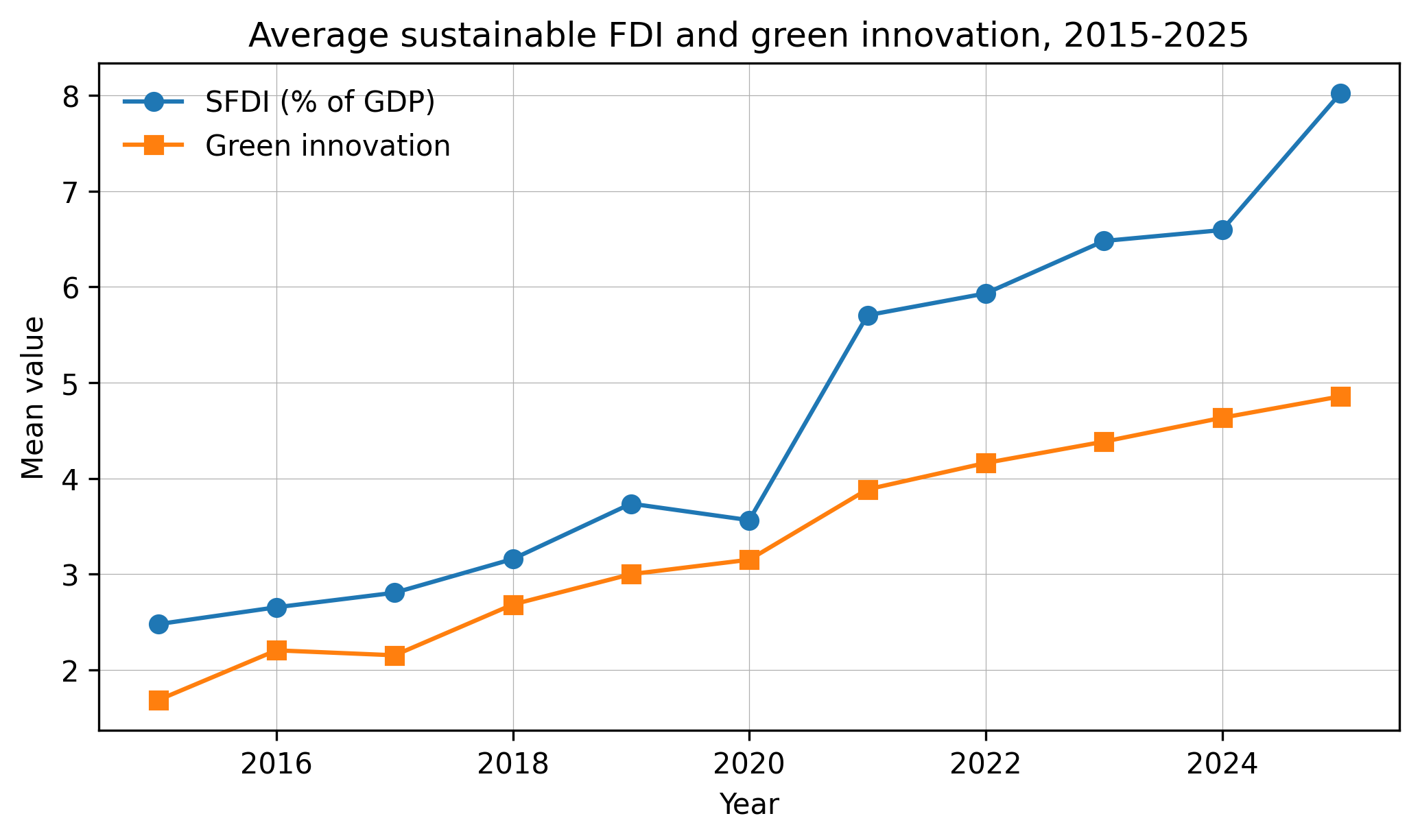
Figure 2 shows that both sustainable FDI and green innovation generally increase over the 2015-2025 period. The upward movement is not perfectly smooth, but the post-2020 increase is clear, especially for sustainable FDI. This pattern is consistent with the idea that the green transition became a stronger investment theme during the later years of the panel. The co-movement between sustainable FDI and green innovation also supports the argument that foreign green investment is more likely where domestic technology capacity is improving.
| Variable | Log SFDI | Inst. quality | Env. policy | Green innovation | Trade openness | Carbon intensity |
| Log SFDI | 1.0 | 0.817 | 0.805 | 0.656 | 0.469 | -0.386 |
| Inst. quality | 0.817 | 1.0 | 0.741 | 0.454 | 0.519 | -0.307 |
| Env. policy | 0.805 | 0.741 | 1.0 | 0.652 | 0.374 | -0.339 |
| Green innovation | 0.656 | 0.454 | 0.652 | 1.0 | 0.186 | -0.294 |
| Trade openness | 0.469 | 0.519 | 0.374 | 0.186 | 1.0 | -0.117 |
| Carbon intensity | -0.386 | -0.307 | -0.339 | -0.294 | -0.117 | 1.0 |
The correlation matrix gives preliminary support to the expected relationships. Log SFDI is strongly and positively correlated with institutional quality, environmental policy capacity, and green innovation, while it is negatively correlated with carbon intensity. These patterns are consistent with the argument that sustainable FDI is more likely in economies with credible institutions, stronger green policy capacity, and better innovation conditions. At the same time, the correlations should be interpreted only as descriptive evidence because they do not control for country-specific characteristics, common year shocks, or other determinants included in the fixed-effects models.
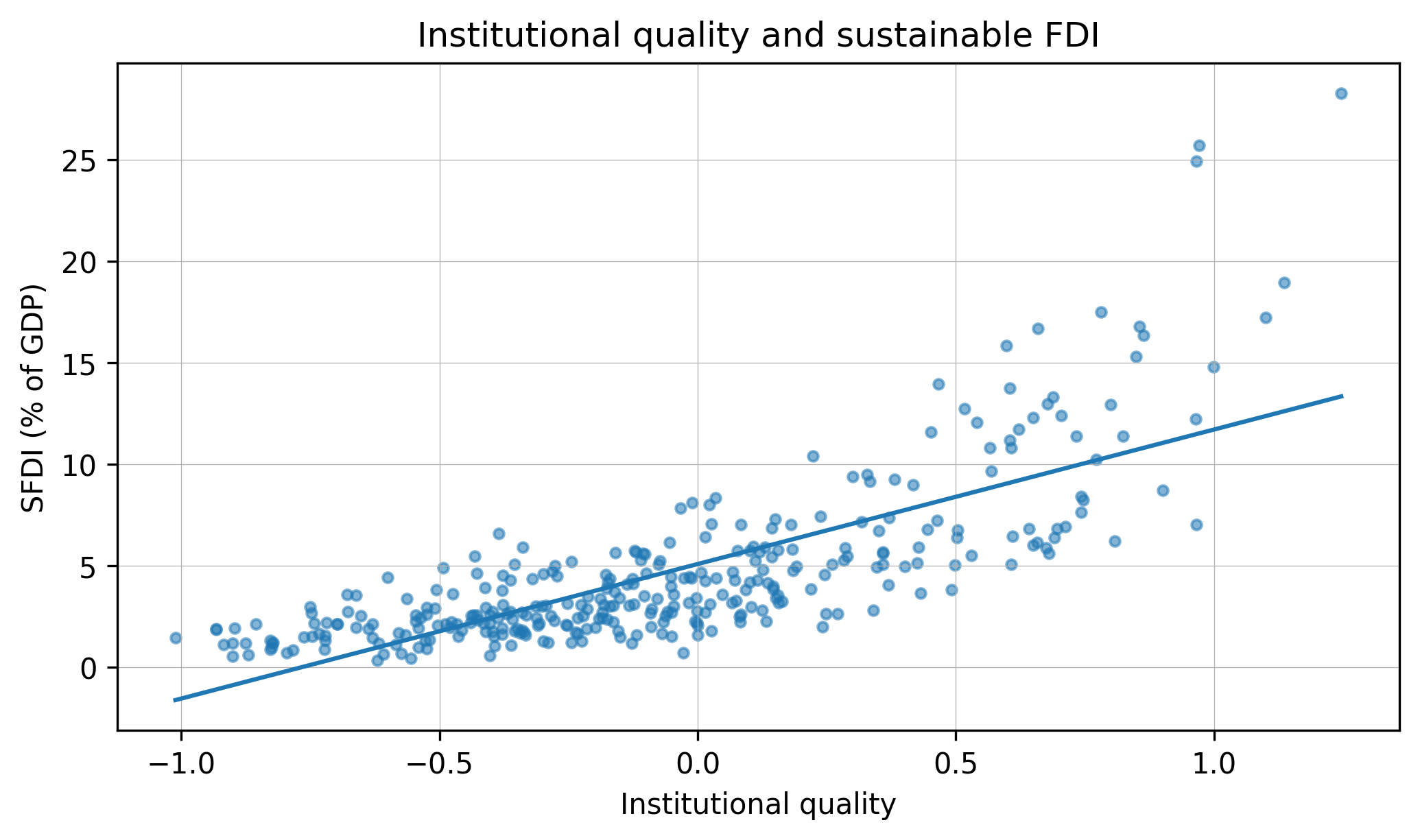
Figure 3 provides a visual check of the main bivariate relationship. The fitted line slopes upward, indicating that higher institutional quality is associated with higher sustainable FDI across country-year observations. The dispersion around the fitted line is also important. It shows that institutional quality is not the only determinant of sustainable FDI and justifies the inclusion of environmental policy capacity, green innovation, macroeconomic controls, and fixed effects in the regression models.
| Variable | M1 | SE | M2 | SE | M3 | SE | M4 | SE |
| Institutional quality | 0.241*** | (0.053) | 0.217*** | (0.048) | 0.224*** | (0.052) | 0.215*** | (0.047) |
| Environmental policy | 0.108*** | (0.028) | 0.108*** | (0.026) | 0.138*** | (0.018) | ||
| Green innovation | 0.110*** | (0.024) | 0.124*** | (0.019) | ||||
| Trade openness | 0.003 | (0.046) | -0.007 | (0.034) | ||||
| Market size | -0.087 | (0.161) | -0.043 | (0.127) | ||||
| Financial development | 0.073** | (0.029) | 0.067** | (0.027) | ||||
| Renewable share | 0.046** | (0.023) | 0.060*** | (0.019) | ||||
| Carbon intensity | 0.032 | (0.047) | 0.003 | (0.039) | ||||
| Institutional quality × Environmental policy | 0.086*** | (0.009) |
The regression results provide the main empirical evidence for the study. Institutional quality remains positive and statistically significant across all four models, which supports H1 and shows that the institutional effect is stable after adding environmental policy capacity, green innovation, and macroeconomic controls. Environmental policy capacity is also positive and significant, supporting H2. Green innovation becomes significant in the full models, supporting H4. Most importantly, the interaction term in Model 4 is positive and significant, supporting H3 and indicating that institutional quality has a stronger association with sustainable FDI when environmental policy capacity is higher.
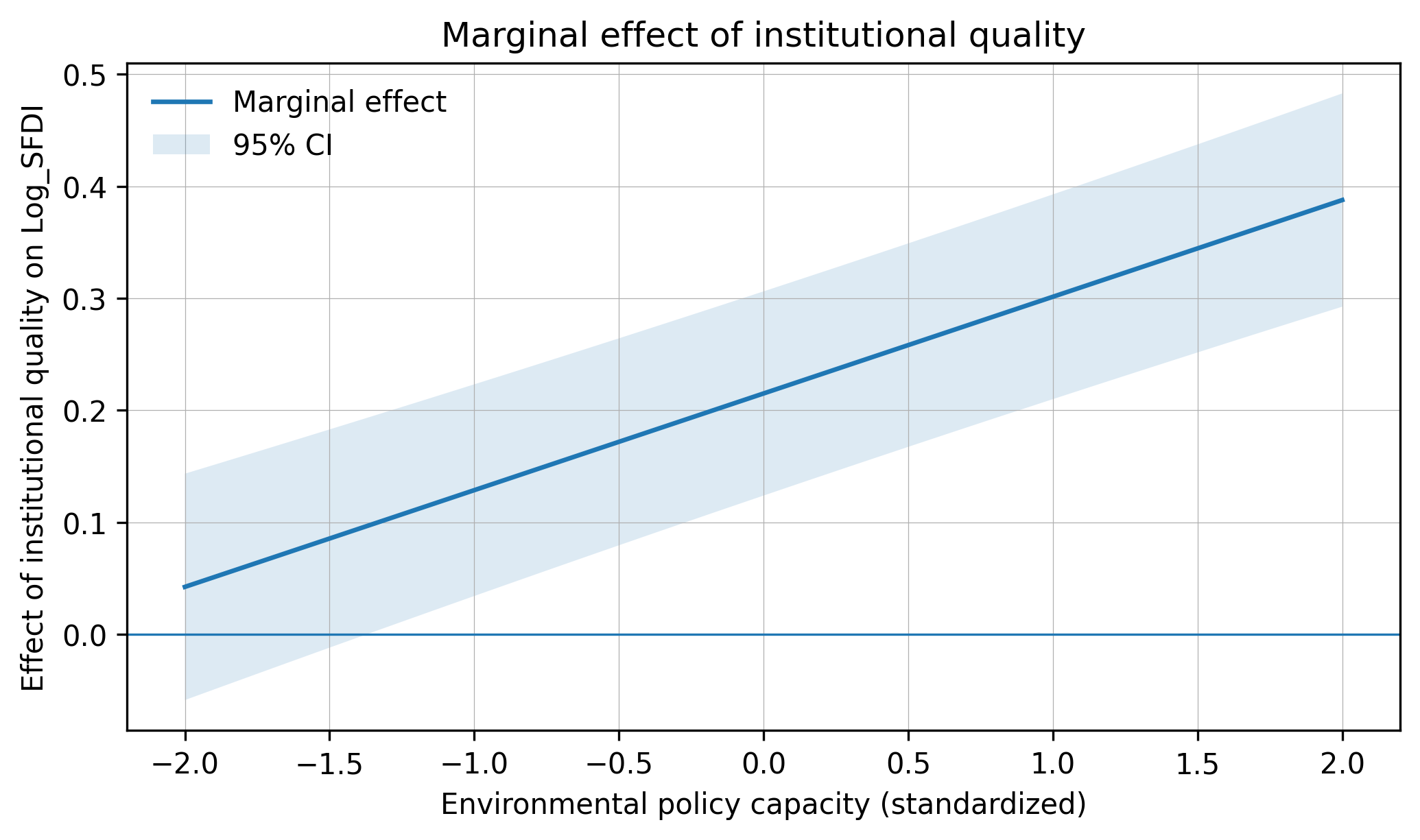
Figure 4 clarifies the interaction effect reported in Table 4. The marginal effect of institutional quality rises as environmental policy capacity increases, which means that institutional credibility becomes more valuable when the host economy has stronger green policy capacity. At low levels of environmental policy capacity, the institutional effect is weaker and less precisely estimated. At average and high levels of policy capacity, the effect becomes stronger, supporting the interpretation that green policy and institutional quality operate as complementary conditions for sustainable FDI attraction.
| Statistic | M1 | M2 | M3 | M4 |
| Observations | 330 | 330 | 330 | 330 |
| Countries | 30 | 30 | 30 | 30 |
| Years | 2015-2025 | 2015-2025 | 2015-2025 | 2015-2025 |
| Country fixed effects | Yes | Yes | Yes | Yes |
| Year fixed effects | Yes | Yes | Yes | Yes |
| Adjusted R-squared | 0.881 | 0.890 | 0.902 | 0.920 |
The diagnostic information confirms that the estimates are based on a consistent balanced panel. Each model uses the same 330 observations, 30 countries, and the full 2015-2025 period, so differences across models are not driven by changes in sample size. The inclusion of both country and year fixed effects strengthens the design by controlling for stable country characteristics and common annual shocks. The adjusted R-squared increases from 0.881 in Model 1 to 0.920 in Model 4, suggesting that environmental policy capacity, green innovation, controls, and the interaction term add explanatory power to the baseline institutional-quality model.
5. Discussion
The findings provide a clear message for the green transition. Sustainable FDI is not attracted only by natural resource endowments, low production costs, or market expansion. It also depends on whether investors believe that the institutional setting can support long-term and regulation-sensitive commitments. This is consistent with the broader literature showing that institutional quality affects FDI inflows and business conditions (Chen & Jiang, 2023; Contractor et al., 2020; Gökçeli, 2023). The contribution of this study is to apply that logic to sustainable FDI, where the need for credible institutions may be even stronger because projects are often asset-specific and policy-dependent.
The positive institutional quality coefficient is also consistent with the asset specificity argument. Sustainable investment often involves fixed infrastructure, specialized equipment, and regulatory compliance systems. Once these assets are installed, investors may have limited ability to redeploy them if policy conditions deteriorate. Tan et al. (2023) show that asset specificity is relevant to the relationship between institutional quality and FDI. The results of this study fit that perspective. Strong institutions reduce the risk that investors will face arbitrary policy shifts, weak contract enforcement, or unpredictable administrative procedures after committing capital.
The positive effect of environmental policy capacity should be interpreted carefully. Green policy alone does not automatically attract sustainable FDI. Investors may view ambitious environmental targets as opportunities, but they may also view them as compliance risks if implementation is unclear. The results suggest that environmental policy capacity is beneficial when it operates within a credible institutional setting. This is consistent with research showing that institutions shape environmental protection and the environmental consequences of economic activity (Haldar & Sethi, 2020; Sah, 2021; Wawrzyniak & Doryń, 2020).
The interaction between institutional quality and environmental policy capacity is therefore the most important result. It indicates that the two conditions are complementary. Strong institutions without a green policy direction may attract general FDI but not necessarily sustainable FDI. Green policy without institutional credibility may create formal ambition without investor confidence. When both conditions are present, sustainable FDI becomes more likely. This finding is consistent with studies showing that institutional quality can moderate economic and environmental relationships (Hunjra et al., 2020; Xaisongkham & Liu, 2024).
The result also clarifies why sustainable FDI should not be treated as a simple extension of aggregate FDI. Aggregate FDI may flow toward natural resources, market access, or cost advantages even where institutions are weak. Sustainable FDI is more dependent on regulatory credibility, environmental policy implementation, and long-term coordination between public and private actors. This distinction aligns with Chaudhury et al. (2020), who argue that the nature of FDI matters. It also aligns with research linking FDI and green technology innovation (Dang & Nguyen, 2025). A host economy seeking sustainable investment must therefore focus on the type and quality of investment, not only the total amount.
The positive association between green innovation and sustainable FDI supports the role of domestic capabilities. Foreign investors often seek locations where they can access skilled labour, suppliers, research capacity, and complementary knowledge. Green innovation can signal that the host economy is not only a passive recipient of capital but also an active participant in green technology upgrading. This finding is consistent with the broader idea that FDI and domestic productivity or technology conditions interact in shaping growth outcomes (Duong et al., 2022). It also reinforces the argument that green transition policy should connect investment attraction with innovation policy.
The mixed results for some controls should not be read as evidence that market size, finance, renewable energy share, or carbon intensity are irrelevant. Rather, their effects may be indirect, sector-specific, or absorbed by fixed effects in the panel model. For example, financial development may support green investment by improving access to local credit, but its effect may depend on institutional quality and policy credibility. Silva et al. (2021) show that institutions, financial development, and FDI interact in complex ways, especially under conditions of financial instability. Future research should examine these channels more directly.
The policy implication is that sustainable FDI strategy should not rely on incentives alone. Tax holidays, subsidies, or special zones may attract some investment, but they do not substitute for predictable institutions. Investors in sustainable sectors need confidence that regulations will be implemented consistently, contracts will be respected, and administrative decisions will not be arbitrary. This is especially relevant for economies competing for renewable energy projects, cleaner manufacturing, and green technology activities. Institutional reform is therefore part of green industrial policy.
A second policy implication concerns environmental policy design. Governments should avoid treating environmental rules as symbolic signals. Policies must be credible, administratively feasible, and aligned with investment procedures. Clear permitting systems, transparent standards, predictable tariff or support schemes, and reliable monitoring can reduce investor uncertainty. The literature on institutional quality and public renewable energy investment suggests that public investment also depends on institutional credibility (Halldén et al., 2025). The same logic applies to private foreign investment in sustainable sectors.
A third implication concerns subnational governance. Evidence from Vietnam and other local contexts indicates that investment attractiveness can vary across provinces and local governments (Duong, 2021; Ngo et al., 2022; Ngo & Nguyen, 2025; Tran et al., 2020). National-level green transition policies may fail to attract sustainable FDI if local implementation is slow, inconsistent, or unpredictable. Administrative quality at the local level therefore matters for the practical experience of investors. Future studies should examine sustainable FDI using provincial or city-level data where available.
The findings also connect to the literature on institutional change. Green transition requires changes in markets, regulations, and public-private coordination. Keller and Shiue (2020) show that market integration and institutional change can be connected, while Saad (2021) cautions that institutional reforms can have context-dependent welfare effects. This suggests that institutional reform should be gradual, credible, and aligned with domestic capacity. Reforms designed only to satisfy external investors may not be sustainable if they do not fit domestic administrative and social conditions.
For investment promotion, the findings suggest a shift from promotional language to institutional performance. Many governments present green sectors as strategic priorities, but investors also assess whether agencies have the capacity to turn those priorities into bankable projects. A credible pipeline of sustainable investment requires transparent procurement, clear environmental assessment procedures, reliable public information, and coordination among ministries and local authorities. Institutional quality lowers the cost of this coordination. Without it, investors may perceive green projects as administratively complex even when the market opportunity is attractive.
For environmental policy, the findings suggest that stringency and credibility should be considered together. Strict environmental rules may encourage cleaner investment when enforcement is fair and predictable. The same rules may discourage investment if enforcement is arbitrary or if firms expect sudden changes in compliance requirements. The issue is not whether environmental policy should be weak or strong. The issue is whether environmental policy is coherent, stable, and institutionally supported. Sustainable FDI is more likely when investors can understand the rules and when domestic firms face similar obligations.
For development strategy, the findings imply that sustainable FDI should be linked to domestic capability building. Attracting a foreign renewable energy firm or green manufacturing project is useful, but the developmental impact depends on whether domestic suppliers, workers, and institutions can learn from and support that investment. Green innovation policy, education, supplier development, and financial instruments should therefore be coordinated with FDI policy. This coordination is difficult in weak institutional settings because agencies may pursue fragmented objectives. Stronger institutions can improve policy coherence across investment, environment, finance, and technology domains.
The study has limitations. The most important limitation is that the dependent variable captures sustainable FDI in aggregate terms. Future research should distinguish among renewable energy, green manufacturing, environmental services, and low-carbon infrastructure. These categories may respond differently to institutions and policy capacity. A second limitation concerns endogeneity. Although fixed effects reduce bias from time-invariant country characteristics and common time shocks, institutional quality may still be jointly determined with investment patterns. More advanced research could use dynamic panel models, instrumental variables, or natural experiments if credible identification strategies are available. Xaisongkham and Liu (2024) use a balanced panel GMM estimator in a related environmental context, showing one possible direction for future empirical work. However, such methods require careful justification and valid instruments. A third limitation concerns the concept of institutional quality. Institutions are multidimensional. Regulatory quality, government effectiveness, control of corruption, rule of law, and political stability may not affect sustainable FDI in identical ways. Nguyen and Duong (2021) show that corruption and the shadow economy are relevant to growth, suggesting that specific institutional weaknesses may matter. Future research should disaggregate institutional quality to identify which institutional dimensions are most important for sustainable investment.
6. Conclusion
This study examined the role of institutional quality in attracting sustainable foreign direct investment. The central argument was that the green transition increases the importance of credible institutions because sustainable investment is often long-term, asset-specific, and regulation-sensitive. Investors in renewable energy, cleaner production, environmental technology, and green industrial upgrading need more than market opportunities. They need confidence that public rules will be stable, contracts will be enforced, and environmental policies will be implemented predictably.
The empirical results support this argument. Institutional quality is positively associated with sustainable FDI across fixed-effects specifications. Environmental policy capacity is also positively associated with sustainable FDI. The positive interaction between institutional quality and environmental policy capacity suggests that these two factors reinforce each other. Green policy sends a stronger signal when institutions are credible, and strong institutions are more relevant for sustainable investment when the policy environment clearly supports green transition. Green innovation also shows a positive association with sustainable FDI, indicating that domestic capabilities matter.
The study contributes to the literature by shifting attention from aggregate FDI to sustainable FDI. It also integrates research on institutions, FDI attraction, environmental quality, and green technology. Prior studies show that FDI can support growth, that institutional quality influences investment, and that institutions shape environmental outcomes. This study connects these insights by arguing that sustainable FDI depends on the institutional credibility of the green transition. In doing so, it provides a framework that can be applied to emerging and developing economies where investment needs are large but institutional capacities differ.
For policy, the findings imply that sustainable FDI attraction should be embedded in institutional reform. Investment promotion agencies may advertise green opportunities, but investors will evaluate the reliability of the administrative and regulatory system. Governments seeking sustainable FDI should improve transparency, reduce arbitrary discretion, strengthen contract enforcement, simplify licensing procedures, and align environmental regulation with investment policy. They should also support domestic green innovation, because foreign investment is more likely to generate development gains when local capabilities can absorb and complement it.
The study also has implications for how researchers measure green transition investment. If sustainable FDI is measured too broadly, the analysis may reproduce the limitations of aggregate FDI research. If it is measured too narrowly, the analysis may miss investment that supports cleaner production through supply chains or process upgrading. Future empirical work should therefore be transparent about classification rules and should test whether results are robust across alternative definitions of sustainable FDI. This is particularly important because green investment categories can change as technologies mature and as governments revise transition taxonomies.
Another methodological implication concerns time. Institutional reforms may not influence sustainable FDI immediately. Investors may wait to observe whether reforms survive political cycles and whether agencies implement them consistently. For that reason, future studies should consider lagged institutional variables, dynamic specifications, and project-level timing where data are available. The present fixed-effects design provides a useful starting point, but a more complete research design would examine how long it takes for institutional improvements to be reflected in sustainable investment decisions.
In sum, the green transition is not only a technological and financial process. It is also an institutional process. Host economies that improve the credibility, predictability, and implementation capacity of their institutions are better positioned to attract foreign investment that supports sustainable development. The task is not to attract any FDI at any cost, but to build the institutional conditions under which foreign investment can contribute to a cleaner and more resilient development path.
References
- Ahmed, F., Kousar, S., Pervaiz, A., & Ramos-Requena, J. P. (2020). Financial development, institutional quality, and environmental degradation nexus: New evidence from asymmetric ARDL co-integration approach. Sustainability, 12(18), 7812. DOI ↗ Google Scholar ↗
- Baiashvili, T., & Gattini, L. (2020). Impact of FDI on economic growth: The role of country income levels and institutional strength (EIB Working Papers). European Investment Bank. Google Scholar ↗
- Bhujabal, P., Sethi, N., & Padhan, P. C. (2024). Effect of institutional quality on FDI inflows in South Asian and Southeast Asian countries. Heliyon, 10(5), Article e27060. DOI ↗ Google Scholar ↗
- Bird, G., & Choi, Y. (2020). The effects of remittances, foreign direct investment, and foreign aid on economic growth: An empirical analysis. Review of Development Economics, 24(1), 1–30. DOI ↗ Google Scholar ↗
- Chaudhury, S., Nanda, N., & Tyagi, B. (2020). Impact of FDI on economic growth in South Asia: Does nature of FDI matter? Review of Market Integration, 12(1-2), 51–69. DOI ↗ Google Scholar ↗
- Chen, F., & Jiang, G. (2023). The impact of institutional quality on foreign direct investment: Empirical analysis based on mediating and moderating effects. Economic Research-Ekonomska Istraživanja, 36(2). DOI ↗ Google Scholar ↗
- Chibalamula, H. C., Evans, Y., Kachelo, M., & Bamwesigye, D. (2023). The effect of foreign direct investment and trade openness on economic growth: Evidence from five African countries. AGRIS On-line Papers in Economics and Informatics, 15(1), 35–46. DOI ↗ Google Scholar ↗
- Contractor, F. J., Dangol, R., Nuruzzaman, N., & Raghunath, S. (2020). How do country regulations and business environment impact foreign direct investment (FDI) inflows? International Business Review, 29(2), 101640. DOI ↗ Google Scholar ↗
- Corradini, C. (2021). Local institutional quality and economic growth: A panel–VAR analysis of Italian NUTS–3 regions. Economics Letters, 198, Article 109659. DOI ↗ Google Scholar ↗
- Dang, T. T. G., & Nguyen, T. D. (2025). Foreign direct investment inflows and green technology innovation: The role of institutional quality. International Journal of Sustainable Development and Planning, 20(12), 5031–5042. DOI ↗ Google Scholar ↗
- Duong, K. D., Nguyen, S. D., Phan, P. T. T., & Luong, L. K. (2022). How foreign direct investment, trade openness, and productivity affect economic growth: Evidence from 90 middle-income countries. Scientific Papers of the University of Pardubice - Series D: Faculty of Economics and Administration, 30(3), Article 1615. DOI ↗ Google Scholar ↗
- Duong, N. M. H. (2021). FDI and growth: Evidence from provinces and cities in South East region of Vietnam. The University of Danang - Journal of Science and Technology, 19(6.1), 54–57. DOI ↗ Google Scholar ↗
- Gökçeli, E. (2023). Institutional quality and foreign direct investment: Evidence from OECD countries. Ekonomický časopis, 71(3), 222–257. DOI ↗ Google Scholar ↗
- Ha, T. C., & Nguyen, H. N. (2021). The role of institution on FDI and environmental pollution nexus: Evidence from developing countries. Journal of Asian Finance, Economics and Business, 8(6), 609–620. DOI ↗ Google Scholar ↗
- Haldar, A., & Sethi, N. (2020). Effect of institutional quality and renewable energy consumption on CO2 emissions—An empirical investigation for developing countries. Environmental Science and Pollution Research, 28(12), 15485–15503. DOI ↗ Google Scholar ↗
- Halldén, F., Hultberg, A., Ahmed, A., Uddin, G. S., Yahya, M., & Troster, V. (2025). The role of institutional quality on public renewable energy investments. Renewable and Sustainable Energy Reviews, 215, Article 115585. DOI ↗ Google Scholar ↗
- Hunjra, A. I., Tayachi, T., Chani, M. I., Verhoeven, P., & Mehmood, A. (2020). The moderating effect of institutional quality on the financial development and environmental quality nexus. Sustainability, 12(9), 3805. DOI ↗ Google Scholar ↗
- Keller, W., & Shiue, C. H. (2020). Market integration and institutional change. Review of World Economics, 156(2), 251–285. DOI ↗ Google Scholar ↗
- Maruta, A. A., Banerjee, R., & Cavoli, T. (2020). Foreign aid, institutional quality and economic growth: Evidence from the developing world. Economic Modelling, 89, 444–463. DOI ↗ Google Scholar ↗
- Meivitawanli, B. (2021). Research on the relationship between provincial FDI and economic growth: An empirical study in Indonesia. Journal of International Studies, 14(1), 241–257. DOI ↗ Google Scholar ↗
- Moussavou, F. (2022). Determinants of the attractiveness of foreign direct investments in CEMAC: An empirical panel analysis over the period from 1985 to 2019. Review of Economics and Development Studies, 8(3), 233–249. DOI ↗ Google Scholar ↗
- Ngo, D. V., Nguyen, T. V., & Pham, N. T. (2022). Đánh giá hiệu quả thu hút vốn đầu tư trực tiếp nước ngoài của cấp tỉnh ở Việt Nam qua ví dụ nghiên cứu trường hợp tỉnh Phú Thọ [Evaluating the effectiveness of attracting foreign direct investment at the provincial level in Vietnam: A case study of Phu Tho province]. Tạp chí Khoa học và Công nghệ Trường Đại học Hùng Vương, 28, 3–12. Google Scholar ↗
- Ngo, Q. C., & Nguyen, T. X. H. (2025). The mediating role of institutional quality in FDI attractiveness: Evidence from Tay Ninh, Vietnam. Journal of Business and Economic Development, 10(3), 135. DOI ↗ Google Scholar ↗
- Nguyen, D. V., & Duong, M. T. H. (2021). Shadow economy, corruption and economic growth: An analysis of BRICS countries. The Journal of Asian Finance, Economics and Business, 8(4), 665–672. DOI ↗ Google Scholar ↗
- Nguyen, L. T. H. (2022). Impacts of foreign direct investment on economic growth in Vietnam. Journal of Economic and Banking Studies, 4, 1–15. Google Scholar ↗
- Qamruzzaman, M. (2023). Nexus between environmental qualities, institutional quality and FDI inflows in lower-income countries. World Journal of Advanced Research and Reviews, 18(3), 321–345. DOI ↗ Google Scholar ↗
- Qiu, Q., & Chen, J. (2020). Natural resource endowment, institutional quality and China’s regional economic growth. Resources Policy, 66, Article 101644. DOI ↗ Google Scholar ↗
- Saad, A. F. (2021). Institutional change in the global economy: How trade reform can be detrimental to welfare. Economic Modelling, 95, 97–110. DOI ↗ Google Scholar ↗
- Sah, M. R. (2021). Effects of institutional quality on environmental protection in CEMAC countries. Modern Economy, 12(5), 903–918. DOI ↗ Google Scholar ↗
- Silva, C. A., Ordeñana, X., Vera-Gilces, P., & Jiménez, A. (2021). Global imbalances: The role of institutions, financial development and FDI in the context of financial crises. Sustainability, 13(1), 356. DOI ↗ Google Scholar ↗
- Tan, M., Yang, D., & Yang, Q. (2023). Institutional quality, asset specificity, and foreign direct investment. Journal of International Money and Finance, 134, Article 102845. DOI ↗ Google Scholar ↗
- Tran, O. K. T., Mai, D. B., Chu, T. T. T., & Nguyen, D. V. (2023). Do FDI and institutional quality affect the economic growth of local governments across Vietnam? Insights from Bayesian modeling. Scientific Papers of the University of Pardubice - Series D: Faculty of Economics and Administration, 31(2), 1–11. DOI ↗ Google Scholar ↗
- Tran, T. T., Dang, T. T., & Tran, N. T. (2020). Factors affecting foreign direct investment: Evidence on Tay Ninh province. Journal of Asian Finance, Economics and Business, 7(9), 263–269. DOI ↗ Google Scholar ↗
- Tran, V. H., Lu, N. P., Le, N. T. P., & Duong, K. D. (2023). How do foreign direct investment and economic growth affect environmental degradation? Evidence from 47 middle-income countries. Scientific Papers of the University of Pardubice - Series D: Faculty of Economics and Administration, 31(1), Article 1671. DOI ↗ Google Scholar ↗
- Wawrzyniak, D., & Doryń, W. (2020). Does the quality of institutions modify the economic growth-carbon dioxide emissions nexus? Evidence from a group of emerging and developing countries. Economic Research-Ekonomska Istraživanja, 33(1), 124–144. DOI ↗ Google Scholar ↗
- Xaisongkham, S., & Liu, X. (2024). Institutional quality, employment, FDI and environmental degradation in developing countries: Evidence from the balanced panel GMM estimator. International Journal of Emerging Markets, 19(7), 1920–1939. DOI ↗ Google Scholar ↗
- Yan, C., Ahmed, S., Solangi, Y. A., Alyamani, R., & Khoso, W. M. (2024). The nexus between foreign direct investment, economic progress, and quality of institutions in fostering sustainable energy efficiency: Evidence from BRICS economies. Heliyon, 10(14), e34222. DOI ↗ Google Scholar ↗