Abstract
This study was conducted to determine the impact of organizational culture and employee engagement on employee performance at the Aceh Regional Secretariat, with job satisfaction functioning as a mediating variable. The research population included all 516 permanent employees of the Aceh Regional Secretariat. Based on the census technique, 210 respondents were selected as the sample. Partial Least Squares (PLS) was used as the analytical method. The results show that organizational culture has a positive effect on job satisfaction, and employee engagement also has a positive effect on job satisfaction. Moreover, organizational culture positively affects employee performance, and employee engagement likewise has a positive effect on employee performance. Job satisfaction is also shown to positively influence employee performance. In addition, the mediation test indicates that job satisfaction partially mediates the relationships between organizational culture and employee engagement, and employee performance at the Aceh Regional Secretariat
Keywords
Organizational Culture Employee Engagement Job Satisfaction Employee Performance
1. Introduction
Skilled and high-quality human resources are more than just the main support for an organization to carry out its duties and functions they also play a crucial role in helping respond to global challenges that are becoming more and more complicated. When employees have strong technical capabilities, a professional attitude, high commitment, and good integrity, they are able to work effectively and efficiently. In addition to this, good human resources have the capability to adapt easily to any shifts in regulations, technology, and the increasing demands of society. For all these reasons, the development of human resources should definitely become an important strategic agenda for implementation through a structured approach.
The personnel working at the Aceh Regional Secretariat play a critical role in ensuring smooth operations within the government office. This is because apart from the administrative functions they perform, they also engage in other activities such as coordination of activities across sectors, policy-making processes, among others. As such, there are a number of attributes required for effective performance by employees such as the need for analysis and attention to details. It should also be noted that employee performance has significant implications on the extent to which organizational objectives can be realized over time. Hence, building employee capacity remains a critical priority.
However, upon closer consideration of how the work proceeds from one day to another, one cannot but notice certain differences between the performance of different workers. On the one hand, some workers always manage to present high-quality work on time. On the other hand, some workers still find it rather challenging to accomplish such tasks as being attentive enough, completing the task later than expected, and adjusting well to the changes in the work system. In this way, it becomes obvious that more attention should be paid to human resource training and development. In order to make sure that this goal is achieved, it is crucial to implement appropriate training, perform performance evaluation objectively, and provide relevant feedback.
According to the results obtained through the pilot study regarding the performance level of workers, there was an average score of 3.82, which falls under the category. Generally, the results show that workers can perform their duties efficiently. Nevertheless, a closer look shows that some aspects have low scores, specifically concerning accomplishing substantial tasks within given time periods. There is likely to be inconsistency in the level of performance in various areas, thus making the process of accomplishment less efficient. Failure to solve this issue may affect the productivity levels of organizations, thus lowering the quality of public services and limiting the achievement of strategic objectives in the region. It would therefore be imperative to conduct a thorough study in order to understand the factors contributing to worker performance.
One of the key factors influencing performance is job satisfaction. Job satisfaction, in this case, relates to how comfortable or positive one is regarding their occupation due to many aspects, including the level of fairness regarding remuneration, working environment, social relations within the workplace, and recognition of their efforts. According to the findings of the pre-survey, employees expressed an average level of job satisfaction of 3.76, which means that overall they were quite content with their positions. Nonetheless, it was evident that there were cases of dissatisfaction with regard to pay; employees were uncertain whether the levels of their salaries were appropriate. In other words, although employees have adapted appropriately to their present working conditions, they need to improve financially. Moreover, the gap between employees' expectations and reality regarding pay may progressively undermine their motivation and dedication.
On the contrary, another crucial element that impacts employees’ performance is engagement. Engagement refers to the emotional connection, commitment, and involvement of individuals at work and within an organization. High levels of engagement usually mean that employees are characterized by enthusiasm, dedication, and a desire to perform more than what is expected of them. Nonetheless, previous studies have mostly concentrated on the private sector, which implies that further investigations are needed when applying such results to the public sector, particularly local government organizations such as the Aceh Regional Secretariat.
Moreover, previous studies have tended to focus on the independent examination of variable relationships instead of putting together key variables such as organizational culture, employees' engagement level, job satisfaction, and productivity within an integrated analysis framework. Such limitations underscore the need for further holistic studies examining variable interaction.
2. Literature Review
2.1. Employee Performance
According to (Bintoro & Daryanto, 2017), performance represents how willing an individual or group is to carry out tasks according to their responsibilities and to deliver the expected results. As a result, employee performance can be seen as the extent to which someone is able to produce high-quality work, submit it on time, and ensure it is consistent with the organization’s objectives.
Employee performance indicators can be assessed using several dimensions that capture both the results of the work and the way the work is carried out. (Robbins & Judge, 2023) state that important indicators include quality, quantity, timeliness, cost-effectiveness, autonomy, and initiative. In addition, (Yansen & Situmorang, 2022) emphasize factors such as attendance, work facilities, and the work environment as key influences on performance. Similarly, (Nugraha & Handayani, 2024) suggest further indicators, including productivity, work quality, target achievement, work motivation, the work environment, and management suppor.
2.2. Job Satisfaction
Job satisfaction is essentially an attitude or, as (Luthans & Doh, 2020) put it, a psychological state that shows how much comfort, enjoyment, and fulfillment employees feel while doing their job. It develops from how workers assess different parts of their work, such as whether their workload matches their abilities, how fair and effective the pay system is, their relationships with supervisors and coworkers, and the quality of the overall work environment. When employees feel that their job is meeting their needs and expectations, they tend to form positive feelings that lead to a healthier attitude toward work. On the other hand, when there is a gap between what employees expect and what actually happens, dissatisfaction can follow often reducing motivation, increasing absenteeism, and sometimes even pushing employees to look for a different job.
2.3 Organizational Culture
(Robbins & Judge, 2023) define organizational culture as the system of values and norms embraced by members of an organization. Organizational culture can be assessed through various dimensions. (Robbins & Judge, 2023) identify indicators such as innovation and risk-taking, attention to detail, results orientation, people orientation, teamwork, and stability. Denison (2012) adds engagement, consistency, adaptability, and mission as key elements of organizational culture. Meanwhile, (Hofstede et al., 2010) examines organizational culture from perspectives including process versus outcome orientation, focus on employees versus work, the level of system openness, and organizational control. All these measures imply that organizational culture involves values, actions, and work systems that can be tailored to fit within an organization. This can be seen from the case study of the Aceh Regional Secretariat where integrity, professionalism, cooperation, and public service are important aspects.
2.4. Employee Engagement
It can be defined as a psychological state that manifests itself through the energy, dedication, and enthusiasm of an employee in his/her work. (Bakker & Albrecht, 2018) point out that engaged workers are characterized by high morale, sincere interest in their work and ability to focus on their job effectively. They regard their duties as significant and useful and are ready to deal with challenges that will help them develop and improve themselves. According to (Saks, 2011), employee engagement is associated with emotional, cognitive, and behavioral components that encourage workers to be proactive and creative and demonstrate higher devotion to their duties. In line with the above definitions, (Schaufeli & Bakker, 2004) define engagement as a state wherein people have a close relationship with their activities and remain positive despite changing work demands.
Another way by which an employee can become attached to his company is by being provided with substantial support within the workplace environment. This may include such factors as adequate appreciation of their work, appropriate workplace resources, and positive social relations. On the other hand, opportunities for professional growth and work-life balance should not be ignored.
Employee engagement may be measured using three major indices presented by (Schaufeli & Bakker, 2004). The first index is vigor, which reflects the amount of energy and vitality that employees show during work and their enthusiasm and determination to complete assigned tasks. The second index, dedication, highlights the feelings of pride, devotion, and importance of work for employees. Finally, absorption describes the degree to which people concentrate on their tasks. It shows that employees become so involved in their activities that they forget about time passing and concentrate all their efforts. All these three measures are significant for finding out whether employees' engagement is at its best.
3. Research Design
3.1 Data Analysis
This research was conducted at the Aceh Provincial Secretariat. This study explores the relationship between organizational culture and employee engagement, job satisfaction, and employee performance at the Secretariat. The total population included all 516 employees working at the Aceh Provincial Secretariat.
For the Structural Equation Modeling (SEM) analysis, the sample size was calculated using a guideline that requires a minimum sample of 5 times the number of indicators and a maximum of 10 times the number of indicators. In this research, the maximum multiplier of 10 times the number of indicators was used. Since there were 21 indicator variables (Ferdinand, 2014), the sample size determined was 210.
The study employed proportional sampling. Data were collected through a questionnaire that was shared with respondents via Google Forms (https://forms.gle/mMZuy1ezGaLmPj7q9). Responses were measured using a Likert scale and then analyzed with SEM-PLS.
4. Results and Discussion
4.1. Hypothesis Testing
The results of the full model hypothesis testing using PLS are shown below
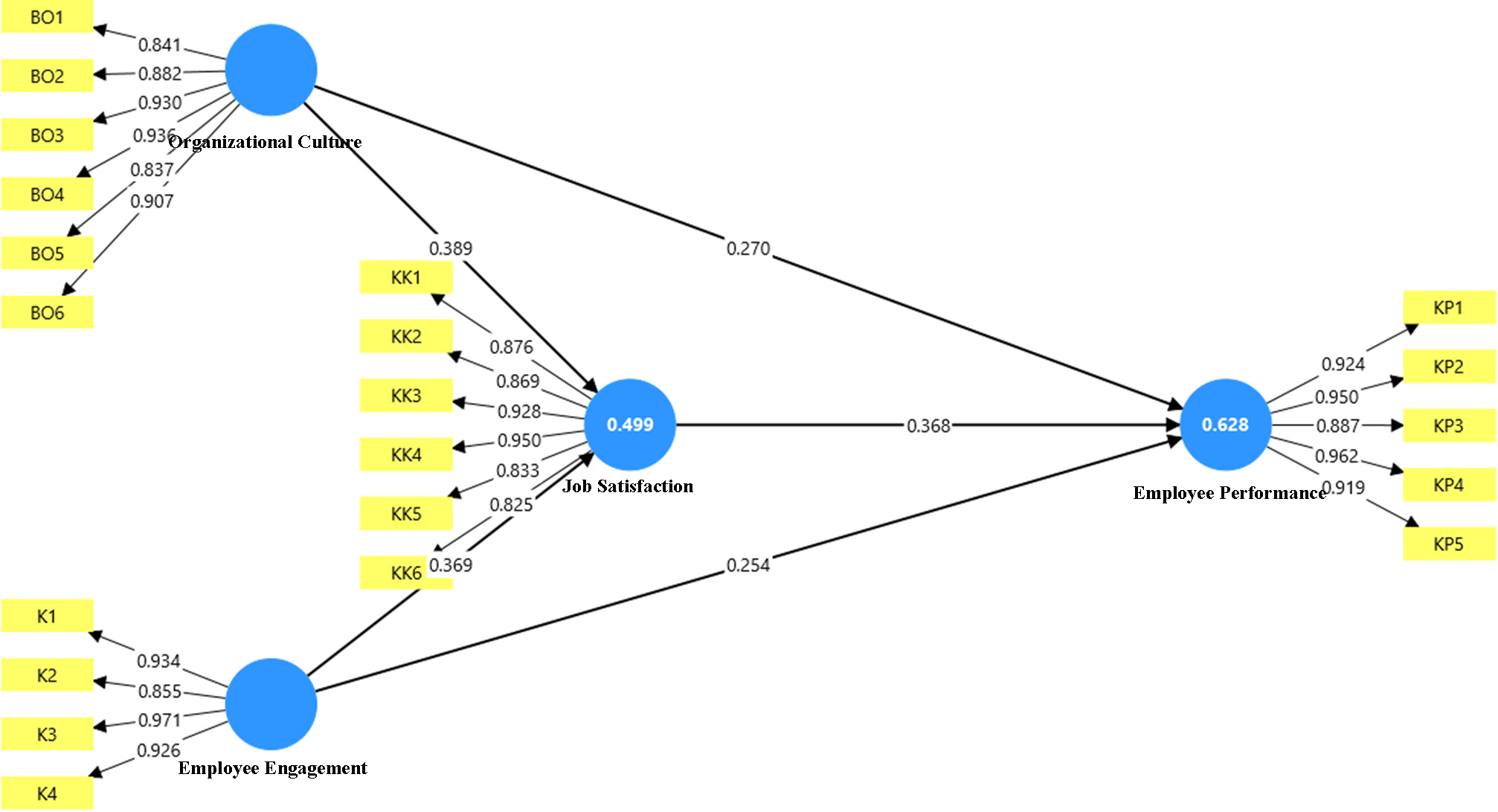
The hypothesis testing for this study is presented in Table 1 below.
| Original sample (O) | Sample mean (M) | Standard deviation (STDEV) | T statistics (|O/STDEV|) | P values | |
| Organizational Culture -> Job Satisfaction | 0.389 | 0.384 | 0.068 | 5.738 | 0.001 |
| Organizational Culture -> Employee Performance | 0.270 | 0.266 | 0.069 | 3.917 | 0.001 |
| Job Satisfaction -> Employee Performance | 0.368 | 0.364 | 0.068 | 5.381 | 0.001 |
| Employee Engagement -> Job Satisfaction | 0.369 | 0.373 | 0.064 | 5.750 | 0.001 |
| Employee Engagement -> Employee Performance | 0.254 | 0.258 | 0.071 | 3.597 | 0.001 |
Source : Processed Primary Data, (2026)
4.1.1. Direct Hypothesis Testing
The path coefficient analysis shows that all relationships among the variables in this study are positive and statistically significant, with p-values less than 0.05. These results confirm that each of the proposed direct hypotheses is supported, indicating that the research model adequately accounts for the relationships among the variables being studied. More specifically, organizational culture and employee engagement both have a positive effect on job satisfaction. The above assertion means that the stronger the values and norms within the organization, the greater the engagement of the workers, the higher will be the job satisfaction. Besides, job satisfaction also has a positive relationship with employee performance, which means that employees who experience high job satisfaction tend to demonstrate better performance.
Other than job satisfaction, organizational culture and employee engagement also affect performance directly. This means that organizational culture and employee engagement do not only contribute to better performance indirectly by way of job satisfaction, but they also contribute to improving employee performance directly. Therefore, one of the ways to boost employee performance at the Aceh Regional Secretariat is by creating a good organizational culture and increasing employee engagement
4.1.2. Testing the Mediation Hypothesis
Test of Mediation Hypothesis as Presented in Table 2 Below.
| Original sample (O) | Sample mean (M) | Standard deviation (STDEV) | T statistics (|O/STDEV|) | P values | |
| Organizational Culture -> Job Satisfaction -> Employee Performance | 0.143 | 0.140 | 0.038 | 3.808 | 0.001 |
| Employee Engagement -> Job Satisfaction -> Employee Performance | 0.136 | 0.136 | 0.035 | 3.896 | 0.001 |
Source : Processed Primary Data, (2026)
From the findings of the bootstrapping test, it can be concluded that job satisfaction was found to act as a mediator in the relationship between organizational culture and engagement on performance of employees. It is evident from the values for p which were less than 0.05 in both mediation pathways. In conclusion, the mediation effect found in this study is positive and significant.
In addition, the organizational culture influences performance indirectly through its positive impact on job satisfaction. This means that, when the organization enhances its culture in terms of the values held and maintains a good working atmosphere, there is a likelihood of the employees being satisfied, thus leading to improved performance. Similarly, when the employees are engaged, job satisfaction levels are increased, hence improving performance.
However, since the effects of organizational culture and employee engagement on performance were found to be significant, job satisfaction was viewed as only a partial mediator. Therefore, job satisfaction mediates the effects while enhancing the impact of both variables on performance.
4.2. Discussion
A strong organizational culture that prioritizes integrity, collaboration, honest Good communication, as well as equitable recognition of employees' contributions, can contribute to the development of a comfortable and encouraging workplace. Employees will feel included when the values of the organization resonate with their values and be proud of their organization. As a result, job satisfaction can increase. These findings confirm the research carried out by (Indriani et al., 2023) and (Kustinah, 2024). Both these researchers emphasize the importance of organizational culture on job satisfaction.
Furthermore, the analysis of previous literature shows that there is a positive correlation between employee engagement and job satisfaction. Highly engaged employees usually feel enthusiastic about work, committed to it, and responsible. They believe that what they do has its meaning and purpose, thus making them satisfied with what they are doing. It corroborates the results of (Jimoh, 2025), as well as those obtained by (Noercahyo et al., 2021).
The organizational culture also has a direct effect on the performance of employees. The healthy organizational culture promotes discipline among employees and helps them be responsible in their work and achieve their goals. For instance, a public organization should adopt a professional culture in its work since it will help enhance efficiency in delivering services. This corresponds to the findings of (Mekka et al., 2021) and (Wua et al., 2022) who suggest that organizational culture is a key factor that influences productivity and performance quality.
Employee engagement can be associated with improved performance. In this case, engaged employees work energetically and are committed to ensuring that they achieve excellent performance. They not only follow performance criteria set for them but strive to surpass the expected levels. These findings are consistent with those of (Purwati et al., 2025) and (Rifai et al., 2024) who assert that engagement plays a crucial role in enhancing performance.
5. Conclusion and Recommendation
5.1 Conclusion
Based on the results of this study, it can be said that organizational culture and employee engagement play a significant role in enhancing the level of job satisfaction at the Aceh Regional Secretariat. It indicates that if there is an effective organizational culture and norms in an organization and employees are highly engaged in their tasks, then it will lead to an increase in the level of job satisfaction among workers.
Additionally, organizational culture and employee engagement are directly linked to performance. Moreover, job satisfaction contributes significantly to improving employee performance. Thus, job satisfaction becomes an integral component that can help improve the overall work performance of employees.
Furthermore, job satisfaction acts as a mediator in this regard. Therefore, organizational culture and employee engagement impact performance both directly and indirectly through job satisfaction.
-
Recommendation
-
Firms must improve the implementation of work quality standards by ensuring all employees adhere to standard operating procedures (SOPs) in carrying out tasks. Employees should be educated continuously regarding work practices to help them understand standard operating procedures, thus following them diligently. Giving constructive criticism to employees according to their performance is vital, as it enables them to be aware of their shortcomings and therefore makes improvements.
-
Employee assignment needs to better align with the competencies, skills, and educational qualifications of the workers. Where there exists disparity between the responsibilities assigned and those which the employee is capable of performing, then job satisfaction levels decline, thus leading to underperformance. In such a case, companies must constantly evaluate task allocation and provide employee development chances via training and education.
-
A cooperative working environment must be cultivated by instilling a sense of better teamwork in accomplishing organizational activities. Teamwork can be facilitated by organizing effective work teams, coordinating departmentally, and promoting healthy interactions within the team. As a result, there will be greater work efficiency and productivity.
-
The organizations must encourage an assessment process that is clearly defined and based on objective measures, which means every employee would receive a fair evaluation based on predetermined performance indicators. Not only would this help employees know what is expected of them, but it would also spur them to better their performance.
-
Competence building among workers also needs to be prioritized in order to ensure the effectiveness of training. Training must be not just focused on developing the skills of employees but should also encompass soft skills like communicating, collaborating, and critical thinking. With the development of these skills, the employees will feel confident in their jobs and make greater contributions to the firm.
-
The performance management system within organizations also needs improvements to ensure proper appreciation for the employees’ hard work. The rewards for employees’ contributions are not always monetary and may involve promotion and recognition. In this way, employee engagement and motivation will grow.
-
Organizations are advised to cultivate a healthy culture at the workplace by repeatedly emphasizing the common values, behavior norms, and professionalism in work. This process may be achieved through constant efforts on emphasizing the organizational values, conducting training programs based on the organizational culture, and demonstrating through managers how they themselves conduct themselves at the workplace. The presence of a healthy organizational culture enables employees to feel comfortable at the workplace and develop a stronger bond with the company, thus increasing their job satisfaction and improving their performance.
-
Organizations should focus on enhancing employee engagement through providing more options to employees for participating in decision-making processes, fostering open dialogue, and recognizing their contributions. Organizations may use such techniques for enhancing employee engagement as discussing issues through forums, conducting participative performance evaluations, and developing.
-
The organization should also consider job satisfaction as a strategic enabler of employee performance. The processes that should be considered involve improving the system of rewards and compensation, ensuring a conducive and positive working environment, and assisting the employees in handling their tasks efficiently without overloading them. Moreover, providing opportunities for skill development through learning and training will play a key role in helping the employees perceive themselves as being empowered and at the same time, have a clear perception regarding their career prospects.
-
The researchers are urged to take a deeper look into this study by incorporating other related variables, including the leadership approach, motivation at work, or characteristics of the work environment, in order to get a comprehensive understanding of factors affecting employee performance. Besides, changing the research design, such as utilizing qualitative or mixed methods of analysis, may yield new insights in the findings.
References
- Bakker, A. B., & Albrecht, S. (2018). Work engagement: current trends. Career Development International, 23(1), 4–11. DOI ↗ Google Scholar ↗
- Bintoro, & Daryanto. (2017). Manajemen Penilaian Kinerja Karyawan. Gava Media. DOI ↗ Google Scholar ↗
- Ferdinand, A. (2014). Structural Equation Modeling dalam Penelitian Manajemen (5th ed.). Badan Penerbit Universitas Diponegoro. DOI ↗ Google Scholar ↗
- Hofstede, G., Hofstede, G. J., & Minkov, M. (2010). Culture and organizations: Software of the mind (Intercultural Cooperationand Its Importancefor Survival) (Third Edit). Mc Graw Hill. DOI ↗ Google Scholar ↗
- Indriani, Y., Joesyiana, K., & Lussianda, E. O. (2023). The Influence of Work Discipline and Workload on the Performance of Employees in the Credit Division of PT. Bank Negara Indonesia (Persero) Hangtuah Cash Office. Jurnal Ekonomi Utama, 2(3), 287–297. DOI ↗ Google Scholar ↗
- Jimoh, A. L. (2025). The effect of employee engagement and job satisfaction on job performance: the role of perceived organizational support. Journal of Management Development, 44(5), 700–710. DOI ↗ Google Scholar ↗
- Kustinah, L. (2024). The influence of organizational culture on work productivity through employee job satisfaction. Jurnal Ilmu Manajemen, 12(4), 929–941. DOI ↗ Google Scholar ↗
- Luthans, F., & Doh, J. P. (2020). International Management: Culture, Strategy, and Behavior. McGraw-Hill. DOI ↗ Google Scholar ↗
- Mekka, S., Hamid, W., Zainal, H., & Aksa. (2021). he Influence of Organizational Culture on Employee Performance at Bappeda and Statistics of Bone Regency. Pinisi Business Administration Review, 2(2), 117–122. DOI ↗ Google Scholar ↗
- Noercahyo, U. S., Maarif, M. S., & Sumertajaya, I. M. (2021). The Role of Employee Engagement on Job Satisfaction and Its Effect on Organizational Performance. Journal of Applied Management, 19(2), 296–309. DOI ↗ Google Scholar ↗
- Nugraha, R. N., & Handayani, D. (2024). Employee Performance Indicators at PT. Idea Indonesia Tbk. West Science Social and Humanities Studies, 2(3), 518–525. DOI ↗ Google Scholar ↗
- Purwati, H. K. I., Kuswandi, Rahayu, S., & Fitrianty, R. (2025). The Effect of Supervision, Employee Engagement, and Work Experience on Employee Performance in a Government Tax Office. Journal of Management, Accounting, General Finance and International Economic Issues, 4(4), 995–1009. DOI ↗ Google Scholar ↗
- Rifai, M. A., Wibowo, A., & Sosidah. (2024). The Influence of Job Satisfaction, Employee Engagement and Organizational Culture on Employee Performance. Co-Value Jurnal Ekonomi Koperasi Dan Kewirausahaan, 15(3), 1–12. DOI ↗ Google Scholar ↗
- Robbins, S. P., & Judge, T. A. (2023). Organizational Behavior (19th ed.). Pearson. DOI ↗ Google Scholar ↗
- Saks, A. M. (2011). Workplace spirituality and employee engagement. Journal of Management, Spirituality & Religion, 8(4), 317–340. DOI ↗ Google Scholar ↗
- Schaufeli, W. B., & Bakker, A. B. (2004). Job demands, job resources, and their relationship with burnout and engagement: A multi‐sample study. Journal of Organizational Behavior, 25(3), 293–315. DOI ↗ Google Scholar ↗
- Wua, I. W. G., Noermijati, & Yuniarinto, A. (2022). The Influence of Organizational Culture on Employees’ Performance Mediated by Organizational Commitment. Jurnal Aplikasi Manajemen, 20(3), 542–551. DOI ↗ Google Scholar ↗
- Yansen, A., & Situmorang, D. M. (2022). The Effect of Attendance, Work Facilities, and Work Environment on Employee Performance. Management and Sustainable Development Journal, 4(2), 103–118. DOI ↗ Google Scholar ↗