Abstract
In Somaliland, livestock exports account for more than 80% of total export earnings. Despite this enormous economic importance, this area is highly understudied. This study examines the effect of livestock exports on the economic growth of Somaliland, using time-series data from 2012 to 2024 sourced from the Ministry of Planning and National Development (MOPND) and employing an Autoregressive Distributed Lag (ARDL). The study used livestock export as the main explanatory variable and Real Gross Domestic Product as the dependent variable, while controlling for gross fixed capital formation and government final consumption. The findings from the analysis show that livestock export had a positive, statistically significant short-term association with Somaliland's economic growth (0.102, 0.03). The result also showed that domestic investment had a positive, significant short-run effect (0.144, 0.014) and government final consumption had a positive but insignificant effect. The bounds test indicated no cointegration, suggesting no long-run relationship among the variables. As a result, the findings should be interpreted as a short-run association rather than evidence of long-run causation. Finally, the study recommends enhancing value addition in the livestock sector, diversifying exports, strengthening the sector's resilience, boosting sustainable domestic investment, and further research using additional data sets and the ARDL model. The research contributes to the scarce evidence base by providing the first ARDL study on the livestock export-economic growth nexus in Somaliland.
Keywords
Livestock export Real GDP Domestic Investment government consumption ARDL
1. Introduction
For many developing economies, particularly those in the Horn of Africa, livestock exports are crucial (Leonard, 2007). It is estimated that the value of annual livestock exports, including cross-border trade between Horn of Africa countries, is US$1 billion (Musa et al., 2020). Similarly, livestock are the primary source of protein for humans and generate revenue, jobs, and foreign exchange for the nation. In addition to being a mode of transportation and a source of organic fertiliser for agricultural production, livestock is a source of revenue for many farmers and families. They also contribute to social functioning. The world has seen a sharp rise in the consumption of animal products. Low-income families have the opportunity to improve their everyday lives and means of subsistence through this sectoral empowerment . Livestock systems significantly bolster global economies. Livestock production accounts for 40% of total agricultural output value in developed countries and 20% in developing ones. While industry discussions long emphasised sustainable production growth, the UN's 2030 Agenda for Sustainable Development reframes priorities toward enhancing the sector's role in broader sustainability goals (
Similarly, the livestock sector supports rural households' assets for livelihoods, generates income, and creates jobs. It ensures reliable supplies of meat, milk, eggs, and dairy while aiding child development, women's empowerment, and efficient resource use (. Likewise, Livestock promotes access to sustainable growth, fiscal revenues, foreign exchange, value-added processing, entrepreneurship, and reduced inequities. It fosters resilient production-consumption patterns, climate adaptation for households, and multi-stakeholder collaboration (). In the Republic of Somaliland, a partially recognised democratic state in the Horn of Africa, Livestock production remains the backbone of the economy, which is predominantly pastoral and agropastoral, employing over 70% of the population .
According to the Ministry of Planning and National Development , Somaliland exported 3,802,903 heads (three million eight hundred thousand two thousand and nine hundred three heads) of livestock, including sheep and goats (3,455842 heads), cattle (202,331), and camels (144,730), via Berbera Port to Gulf Countries, mainly Saudi Arabia, in 2024. These account for the largest share of Somaliland's exports, ranging from 75% to 90% of total export earnings. Livestock has continued to dominate Somaliland exports, despite its share falling from 90 per cent in 2013 to 67 per cent in 2023. However, in 2024, its share rebounded to 75 per cent. Between 2012 and 2020, the export volume fell by 35 per cent, largely due to the Saudi-imposed ban on live animal exports and the effects of the 2015–2017 drought . Livestock export from Somaliland to the Arabian Peninsula countries is an important economic activity and the main source of Somaliland’s foreign exchange earnings
In addition, livestock not only serves as a source of income, food, and employment for the people of Somaliland, but also functions as a store of wealth, a means of social security, and a source of cultural identity. Somaliland pastoralists rear goats, sheep, camels, and cattle, which contribute to the country’s Gross Domestic Product (GDP) through domestic markets and international trade.
Further, the Somaliland livestock sector faces many challenges, including recurrent droughts, disease outbreaks, weak institutional coordination frameworks, and vulnerability to trade embargoes. These risks not only undermine the sustainability and competitiveness of Somaliland livestock exports in foreign markets but also threaten the sector's broader contribution to economic growth. Somaliland has had a long history of exporting live animals to the Arabian Gulf states through the port of Berbera. These exports have faced a series of trade embargoes due to suspicions of diseases such as Rift Valley Fever, Peste des Petits Ruminants (PPR), and the suspected presence of rinderpest. The bans have adversely affected the income and livelihoods of pastoralist families and the national economy in general.
Despite the significant contribution of livestock to Somaliland's economy and being the largest export earnings, which comprise 75-90% of the total export earnings for the country, this sector remains highly under-researched, with only descriptive reports available. Rigorous assessment of econometric models for short- and long-term analysis of livestock's contribution to economic growth is lacking. Further, studies that were conducted in the neighbouring countries of Somalia and Ethiopia show mixed results. For instance, , while employing the Vector Error Correction Model (VECM), found a positive effect of sheep and goats and an insignificant positive effect of cattle and camels. Similarly, using a VECM, Temesgen (2022) found a short-run negative effect of live animals. These mixed results are tied to specific contexts, models, and livestock species, but none of those studies employed ARDL analysis or any other model in Somaliland. Therefore, by applying ARDL to Somaliland's livestock exports, this study fills this gap by investigating the short- and long-term effects of livestock exports on Somaliland's economic growth, using time-series data ranging from 2012-2024, sourced from the Ministry of Planning and National Development (MOPND). The research employs Real GDP Growth as a proxy for economic growth, while gross capital formation and government final consumption are used as control variables.
The rest of the paper is organised as follows: Section two discusses the literature review pertinent to the topic, Section three presents the methodology of the study, including sources, types of data and model specification; the fourth section presents the findings and discussion, and the last section provides a conclusion and recommendations of the study.
2. Literature Review
2.1 Theoretical Foundation of Economic Growth
Economic growth represents an expansion in an economy's productive capacity, which is essential for broader development. It has been explained through various theoretical schools, including classical theory, Keynesian and Neoclassical perspectives, and Endogenous Growth and Trade Theories. .
The first school of thought on economic growth is the Classical economists, like Adam Smith (1776), who viewed growth as driven by savings, population dynamics, and factors of production (labour, capital, land, technology), alongside institutions, political stability, education, and customs, within a class-based capitalist structure (workers, capitalists, landowners). The second theory of economic growth, the Keynesian theory, posits that savings transform into investment for growth (Harrod, 1939; Domar, 1946). Neoclassical models, notably Solow-Swan (1956), incorporate constant returns to scale production with diminishing marginal returns to labour and capital, treating steady-state growth as exogenously determined. The last theory of economic growth, endogenous growth theory, emphasises innovation, human capital, and technology as internal growth drivers, informed by East Asian successes. International trade, via absolute (Smith) and comparative advantage principles, promotes specialisation—developing countries in raw materials, developed in manufactures—to maximise gains (Salvatore, 1998)
2.2 Export-Led Growth Theory
The export-led growth theory (ELG) posits that exports promote economic growth by boosting aggregate demand, leading to higher employment, income, technology transfer, and an appreciating domestic currency. While empirical support for the ELG theory is abundant, there are divergent findings regarding the direction of causality. For instance, Orhan et al. (2022) investigated export-led or growth-led export theories in Turkey from 1999 to 2021, using the Granger Causality Test. The study found a bidirectional relationship between exports and growth. From 1999 to 2013, the growth-led export hypothesis was valid, indicating that economic growth spurred exports. However, from 2014 to 2021, both the export-led growth and growth-led export hypotheses were valid (Orhan et al., 2022). Similarly, Islam et al. (2022) studied the export-led growth hypothesis in Bangladesh, China, India, and Myanmar, employing the ARDL bounds testing approach and the MWALD Granger causality test. The result supported both the export-led growth hypothesis and the growth-led export hypothesis for Bangladesh and India, suggesting a bidirectional relationship. For China, export-led growth was supported, while in Myanmar, growth-led export was valid. This indicates that the direction of causality running from export to GDP or from GDP to export could be context-driven.
However, ample literature has confirmed a unidirectional relationship from exports to economic growth, indicating that exports are the growth driver. For instance, Kristjanpoller & Olson (2014) studied export-led growth theory (ELG), growth-led export theory (GLE) and import-led growth theory (ILG) for Latin American countries employing the Error Correction Model. Their findings indicated that exports drive the GDP growth of Latin American countries. In Sub-Saharan Africa, exports positively correlate with economic growth, supporting the ELG hypothesis. Conversely, in China, higher export shares are linked to lower growth, possibly due to inefficient trade practices or reduced trade with high-income nations (Zimmerman & Wheaton, 2021). In the same vein, Bashir and Ibrahim (2024) confirmed the ELG hypothesis in their study, suggesting that exports are a significant driver of growth in Sudan. In Kenya, Muhoro and Otieno (2014) found unidirectional causality from exports to economic growth, supporting the Export-Led Growth Hypothesis in the short run. While the ELG theory is highly applicable, its relevance varies across regions depending on their economic contexts, as evidenced by the aforementioned studies.
Furthermore, according to Sharma and Panagiotidis (2004), export expansion drives technological progress through foreign competition, which is crucial for improving factor productivity and the efficient use of resources. Export may benefit economic growth by generating positive externalities for non-export sectors, increasing economies of scale, improving allocative efficiency, and enhancing the ability to generate dynamic comparative advantage (Sharma & Panagiotidis, 2004). Exports ease foreign exchange constraints and thereby provide greater access to international markets. Foreign exchange earnings from exports enable the import of high-quality intermediate inputs, primarily capital goods, for domestic production and exports, thereby expanding the economy’s production possibilities (McKinnon, 1964).
2.3 Livestock Export and Economic Growth in the Horn of Africa
While ample literature exists on the relationship between aggregate agricultural exports and economic growth, little attention has been paid to the role of livestock exports in economic growth. Moreover, studies on the livestock export-economic growth nexus remain inclusive (Ahmed & Jie, 2019; Temesgen, 2022). This gap is crucial for countries in the Horn of Africa, where livestock production and exports constitute a major source of foreign exchange earnings, employment, and rural livelihoods.
One of the few studies concerning the livestock export economic growth nexus in the HoA includes Ahmed and Jie (2019), who studied the impact of livestock export on the economic growth in Somalia using the Vector Error Correction Model (VECM) using time series data from 1990 to 2015. They found that sheep and goat exports had a positive and significant effect on economic growth, whereas cattle and camel exports had a positive but insignificant effect on Somalia's economic growth. Similarly, researched the effect of agricultural export on economic growth employing the Co-integration Model with time series data ranging from 197 to 2018, focusing on live animal, meat and leather products in Ethiopia, and the result showed that livestock export negatively affects real GDP in the short run, indicating an unfavourable impact on economic growth. In contrast, meat exports, the exchange rate, total labour, and gross fixed capital formation positively influence real GDP. The research highlights unidirectional causality between livestock exports and real GDP, suggesting that while livestock exports do not contribute positively to economic growth, other factors, such as meat exports, play a significant role in enhancing it.
These studies show divergent results, which may be due to the type of livestock, location, model employed, climatic vulnerability, institutional capacity and the economic orientation of the country in question. Although previous studies support the export-led growth hypothesis, empirical findings on livestock exports from developing economies, particularly those in the HoA, are mixed. Specifically, Somaliland differs from its neighbouring countries in its heavy reliance on live animal exports and its frequent trade bans. Similarly, a significant gap exists in the literature, despite the enormous importance of livestock exports to economic growth. Further, no previous study on the effect of livestock on economic growth, using time series data or employing an ARDL, has ever been conducted in the Republic of Somaliland- a country mostly overlooked by the literature, characterised by a resource-constrained and post-conflict nature. Hence, this research will shed light on the gap in the literature regarding the effects of live livestock exports on Somaliland's economic growth.
3. Methodology
3.1 Data Type and Sources
The study aims to investigate the impact of live livestock export, such as sheep and goats, cattle and camels, on the economic growth of Somaliland. Real Gross Domestic Product (GDP) was used as a proxy for economic growth (in constant 2017 USD), and it is the dependent variable of the Study. The total number of livestock exported, converted to their market price in US dollars, is the study's main independent variable. Domestic investment, proxied by gross capital formation (GCF), and government final consumption (GFC), are the control variables.
The study utilised secondary time-series data from 2012 to 2024, sourced from the Ministry of Planning and National Development (MOPND). The reason for choosing this range is that, to the best of my knowledge, no time-series data of this kind is available before 2012.
3.2 Description of Study Variables
1. Livestock export: First, livestock is meant here, the live animals reared by the rural people of Somaliland, such as sheep, goats, cattle and camels. Moreover, livestock export means the annual value of the total number of exported heads via the Berbera Port to Gulf states, mainly Saudi Arabia. According to Live animals are based on data collected by the Customs Authority. Data are collected on quantities and unit prices; thus, current and constant prices are estimated by multiplying quantities by unit prices for each year for current prices and by the base-year unit price for constant prices. Livestock export is the study's main independent variable.
2. Gross fixed capital formation (GFCF): Gross capital formation (formerly gross domestic investment) consists of outlays on additions to the fixed assets of the economy plus net changes in the level of inventories. Fixed assets include land improvements (fences, ditches, drains, and so on); purchases of plant, machinery, and equipment; and the construction of roads, railways, and the like, including schools, offices, hospitals, private residential dwellings, and commercial and industrial buildings. Inventories are stocks of goods held by firms to meet temporary or unexpected fluctuations in production or sales, and "work in progress”.
According to Gross fixed capital formation amounted to 369 million USD in 2024, reflecting an increase over 2023, when it was 359 million USD. The majority of investment was directed toward buildings and structures (78 per cent), followed by transport equipment (16 per cent) and machinery and other equipment (6 per cent).
3. General government final consumption expenditure (formerly general government consumption) includes all government current expenditures for purchases of goods and services (including compensation of employees). It also includes most expenditures on national defence and security.
According to , in 2024, the government spent 291 million USD on final consumption, with the central government responsible for 89 per cent and the local government for 11 per cent. The expenditure volume surged by 182 per cent from 2012 to 2024.
4. Real Gross Domestic Product: it is the total goods and services produced in Somaliland in the period of study at 2017 constant prices, expressed in USD. It is the dependent variable of the study.
To reduce heteroscedasticity, achieve stationarity, and interpret coefficients, all variables were transformed into natural logarithms. Table 1 summarises the variables under study.
| Variable Code | Description | Period | Source |
| lnGDP | Real GDP (constant, 2017 prices) in log form | 2012-2024 | MOPND |
| lnLEXP | Livestock export in log form | 2012-2024 | MOPND |
| lnGFCF | Gross fixed capital formation in log form | 2012-2024 | MOPND |
| lnGFC | Government final consumption in log form | 2012-2024 | MOPND |
3.3 Model Specification
This study employed an autoregressive distributed lag (ARDL) model to examine the short- and long-term relationship between livestock exports and economic growth in Somaliland. The ARDL approach was preferred for this study because it can be applied to small sample sizes, yielding more robust and consistent results. The ARDL approach is not restricted by the order of integration among the variables, as it can be applied whether the variables under study are not integrated or of the same order. Finally, different numbers of lags are plausible for different variables under the ARDL approach.
Pesaran and Shin (1999) and Pesaran et al. (2001) developed the ARDL method, and the ARDL specification for the study is as follows:
Where:
-
ln(GDP)ₜ = Natural log of Real GDP at time t
-
ln(LEX)ₜ = Natural log of Livestock Export at time t
-
ln(GFCF)ₜ = Natural log of Gross Fixed Capital Formation at time t
-
ln(GFC)ₜ = Natural log of Government Final Consumption at time t
-
α₀ = Constant term
-
φᵢ, βᵢⱼ = Coefficients to be estimated
-
p = Optimal lag order for the dependent variable
-
qᵢ = Optimal lag order for each independent variable
-
p, q₁, q₂, q₃ = Optimal lag lengths (determined by information criteria: AIC, BIC, or HQ)
-
εₜ = Error term assumed to be independently and identically distributed
The ARDL model is reformulated into an Error Correction Model (ECM) to test for cointegration:
Where:
-
Δ = First difference operator (Δln(X)ₜ = ln(X)ₜ - ln(X)ₜ₋₁)
-
λ₁, λ₂, λ₃, λ₄ = Long-run coefficients
The coefficients on the differenced variables capture the short-run dynamics, and the coefficients on the lagged level variables capture the long-run relationships.
The ARDL bounds test approach determines whether to accept or reject the null hypothesis H₀: λ₁ = λ₂ = λ₃ = λ₄ = 0 based on the F-statistic. If the F-statistic exceeds the upper bound value, the null hypothesis is rejected, indicating a long-run relationship among the variables. Conversely, if the F-statistic is below the lower bound, it indicates no long-run relationship between the variables (Pesaran et al., 2001).
Lastly, the ARDL model is typically estimated in error-correction form to capture both short-term dynamics and long-term equilibrium. The ECM representation of the ARDL model is:
All other variables were defined in Eqs. 1 and 2, except the following variables:
-
ECₜ₋₁: is the lagged error correction term derived from the long-run equilibrium relationship.
-
γ : The coefficient of the error correction term is expected to be negative and statistically significant (shows speed of adjustment).
3.4 Method of Data Analysis
The study employed both descriptive and econometric analyses to investigate the effect of livestock exports on Somaliland's economic growth. The descriptive analysis was used to show the trend of livestock export. The econometric analysis was applied to assess the effect of livestock export on the economic growth of Somaliland with pre-estimation tests for unit roots (ADF, Dicky Fuller), and post estimation tests, such serial correlation (Breusch-Godfrey), heteroskedasticity (Breusch-Pagan), and stability (CUSUM, cumulative sum). In particular, the ARDL model was employed to examine the short- and long-term relationship between livestock exports and Somaliland's economic growth.
4. Results
4.1 Descriptive Statistics4.1.1 Summary of Descriptive Variables
Table two presents a comprehensive summary of the variables pertinent to the study. The study's observation period spans 13 years, from 2012 to 2024. The mean value of the gross domestic product (adjusted to 2017 constant prices and expressed in USD) is 2259.308 million over these years, with a standard deviation of 194.605 million, indicating low variability and steady growth. The peak real GDP attained by Somaliland is 2607 million, recorded in the most recent year, 2024, while the lowest real GDP experienced by Somaliland is 1966 million, recorded in 2012, when the dataset was captured. In a similar vein, the average for livestock exports is 239.615 million USD, with a standard deviation of 78.553 million USD, indicating high volatility, possibly due to export seasonality, trade bans, and droughts. The maximum value of livestock exported from Somaliland via Berbera Port was 353 million USD in 2024, while the minimum recorded export value was 142 million USD. Regarding domestic investment, the average gross fixed capital formation is reported at 343.615 million USD, with a substantial variability of 117.705 million USD. The highest level of local investment was 552 million in 2024, while the lowest recorded was 159 million. Concerning government expenditure, from 2012 to 2024, the government of Somaliland registered an average of 182.462 million USD in final consumption, with the maximum and minimum levels of government consumption recorded at 223 million and 104 million USD, respectively. The variability of government consumption is moderate (42.414 million), showing consistent government spending throughout these periods.
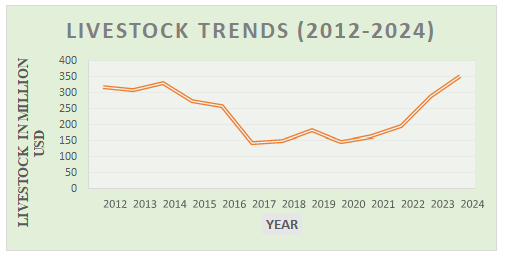
Moreover, Figure 1 illustrates trends in livestock exports from 2012 to 2024, specifically those shipped through Berbera Port. As depicted in the graph, livestock exports declined moderately from 2012 to 2016; however, a significant downturn began in 2017, culminating in exports of 142 million USD. This particular year was marked by a devastating drought that afflicted a substantial portion of the country, which precipitated this pronounced decline in livestock exports. From 2017 to 2019, there was a modest recovery in livestock exports; however, in 2020, exports contracted sharply due to the COVID-19 pandemic in Somaliland. From 2021 to 2024, livestock exports showed a marked upward trend, reaching an unprecedented high of 353 million USD in 2024.
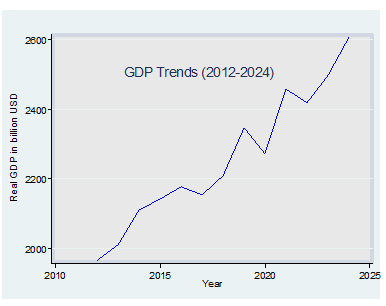
Similarly, Figure 2 illustrates the trend of real GDP in Somaliland from 2012 to 2024. As indicated in the graph, GDP exhibited variability, with certain years showing an upward trajectory, others a downward trend, and some modest growth. For example, from 2012 to 2016, the GDP experienced a favorable upward trend, characterized by an average growth rate of 2.6 when the base year (2012) is excluded. Conversely, in 2017, real GDP contracted, with a growth rate of -1.06. This decline can be attributed to a severe drought that transpired in 2017, which adversely impacted both livestock exports and domestic investment. Between 2018 and 2019, economic growth surged; however, in 2020, a pronounced downturn emerged, attributed to the COVID-19 pandemic. In 2021, the economy experienced significant growth, attaining the highest growth rate of 8.2; yet in 2022, another decline was recorded. From 2023 to 2024, robust positive growth resumed, with growth rates of 3.3% and 4.4%, respectively.
| Variable | Obs | Mean | Std. Dev. | Min | Max |
| Gdp | 13 | 2259.308 | 194.605 | 1966 | 2607 |
| Lex | 13 | 239.615 | 78.553 | 142 | 353 |
| Gfcf | 13 | 343.615 | 117.705 | 159 | 552 |
| Gfc | 13 | 184.462 | 42.414 | 104 | 223 |
Source: Researcher’s computation 2025
Source: Own Analysis 2025
From the descriptive analysis, the largest livestock export was 353 million USD via Berbera Port in 2024. Conversely, the lowest livestock export value from 2012 to 2024 was 142 million USD, recorded in 2017 – due to the severe drought that affected rural communities in Somaliland. Most importantly, in 2017, the lowest Real GDP growth rate was recorded due to a severe decline in livestock exports and a dramatic reduction in domestic investment. So, this elucidates the correlation between livestock exports and economic growth, as well as between domestic investment and economic growth. The next section will further shed light on the extent of the association between livestock exports and economic growth, as well as between domestic investment and economic growth, using the ARDL model.
4.2 Econometric Analysis
4.2.1 Unit Root Tests
Achieving stationarity for the variables under investigation is essential. The researcher used the Augmented Dickey-Fuller test to determine whether the variables had unit roots. As illustrated in Table 3, a majority of the variables exhibited stationarity at levels, denoted as 1(0), whereas only one variable demonstrated stationarity at the first difference, represented as 1(1). Specifically, the log of real GDP (lngdp), the log of gross fixed capital formation (lngfcf), and the logarithm of governmental final consumption (lngfc) were found to be stationary in levels, while the logarithm of livestock exports (lnlex) was stationary in first differences. This finding is consistent with the assumptions of the Autoregressive Distributed Lag (ARDL) model, which posits that the variables under study must be stationary either at levels or at first differences to fit the ARDL regression framework adequately.
The optimal lag length for the variables under study was determined to be 1, in accordance with the Final Prediction Error (FPE) criterion.
| Variables | Test Statistic at 1(0) | 5% Critical Value at 1(0) | Test Statistic at 1(1) | 5% Critical Value at 1(1) |
| Lngdp | -4.455 | -3.600 | ||
| Lnlex | -0.336 | -3.600 | ||
| Lngfcf | -2.227 | -1.812 | ||
| Lngfc | -2.840 | -1.812 | ||
| D_lnlex | -2.644 | -1.950 |
4.2.2 Short-run ARDL Estimates
According to Table 4, the Autoregressive Distributed Lag (ARDL) regression demonstrates an exceptionally robust overall model fit, characterised by an R-Squared value of 0.99, indicating that the model accounts for all variation in log Real GDP over the 2012-2024 period.
In a similar vein, lagged values of real GDP have a positive and statistically significant effect on real GDP growth, indicating that a 1% variation in preceding real GDP is associated with a 1.138% increase in current real GDP (p = 0.007). This finding suggests that historical economic performance is a determinant of contemporary economic growth.
Livestock exports (lnlex) show a positive (0.102) and statistically significant (p = 0.03) association with Somaliland's real GDP; but, the lagged value of livestock exports (L1) exerts a negative (-0.111) and statistically significant (p = 0.026) association with real GDP. A 1% contemporaneous increase in livestock exports raises real GDP by 0.102%, suggesting a partial reversal in the subsequent period, plausibly due to an export ban by Saudi Arabia, droughts, seasonality, or capacity limits. This echoes the findings of , who examined the influence of livestock exports on economic growth in Somalia employing VECM and identified a positive short-term effect of livestock exports on Somalia's economic growth, albeit noting that camel and goat exports exhibited an insignificant positive effect, while cattle and sheep exports had a significant positive effect on economic growth. Furthermore, the study established a short-run relationship between livestock exports and real GDP, which aligns with the results presented by .
Domestic investment (lngfcf) shows a positive and statistically significant short-run association with real GDP (coef. 0.144, p=0.014), although its first lag is negative and statistically significant (-0.151, p=0.03). A 1% contemporaneous rise associates with 0.144% higher lngdp this year, but last year's 1% rise links to -0.151% this year—suggesting investment 'accelerator' cycles common in low-income economies with capacity constraints. This indicates that due to the low gross fixed capital formation of Somaliland, the domestic investment shows a volatile short-run dynamics but not a sustained growth driver, which fits Somaliland’s investment atmosphere.
Government final consumption (lngfc) exhibited an insignificant effect on Somaliland's real GDP, both in current and lagged forms.
| lngdp | Coef. | Std.Err. | T | P>t | [95%Conf. | Interval] |
| lngdp | ||||||
| L1. | 1.138 | 0.222 | 5.120 | 0.007 | 0.521 | 1.756 |
| lnlex | ||||||
| --. | 0.102 | 0.031 | 3.280 | 0.030 | 0.016 | 0.189 |
| L1. | -0.111 | 0.032 | -3.460 | 0.026 | -0.200 | -0.022 |
| lngfcf | ||||||
| --. | 0.144 | 0.034 | 4.200 | 0.014 | 0.049 | 0.240 |
| L1. | -0.151 | 0.049 | -3.080 | 0.037 | -0.287 | -0.015 |
| lngfc | ||||||
| --. | 0.095 | 0.067 | 1.430 | 0.225 | -0.089 | 0.280 |
| L1. | -0.083 | 0.068 | -1.220 | 0.288 | -0.272 | 0.106 |
| _cons | -1.035 | 1.138 | -0.910 | 0.414 | -4.194 | 2.123 |
| Prob > F = 0.0007 R-squared = 0.9903 |
Source: Own Analysis (2026)
4.2.3 Long-run Cointegration - Bounds Test
According to Table 5, the adjustment (ADJ) coefficient of 0.138 (t=0.620, p=0.568) is positive and insignificant, implying weak or no mean reversion—shocks to GDP growth dissipate slowly (half-life >5 years if valid), or no stable long-run relation exists.
All long-run (LR) coefficients lack significance: livestock export (lnlex)= 0.063 (p=0.832), gross fixed capital formation (lngfcf)= 0.046 (p=0.894), government final consumption (lngfc)= -0.089 (p=0.895)
The short-run dynamics result of the model is as follows:
Livestock Exports (D.lnlex): The coefficient for the lagged change in livestock exports (D.lnlex) is 0.111, with a p-value of 0.026, which indicates a statistically significant positive effect - a 1% increase in livestock exports in the previous period is associated with a 0.111% boost in the current period's GDP growth. This suggests an immediate stimulus from exports.
Gross Fixed Capital Formation (D.lngfcf): Similarly, the lagged change in gross fixed capital formation (D.lngfcf) has a coefficient of 0.151 and a p-value of 0.037, which also shows a significant positive effect, implying that a 1% increase in capital formation in the prior period accelerates current GDP growth by 0.151%. This is termed a 'capital accelerator' effect.
Government Consumption (D.lngfc): The lagged change in government consumption (D.lngfc) shows a coefficient of 0.083, but its p-value is 0.288. This p-value exceeds conventional significance levels (e.g., 0.05 or 0.10), indicating that the effect of government spending on current GDP growth is not statistically significant in this model.
4.2.3.1 Why No Cointegration
The Pesaran/Shin/Smith bounds F-statistic of 1.109 falls below all the critical values as shown in Table 6, which implies accepting the null hypothesis of no level relationship. The t-statistic (0.621) also stays above I(0) bounds (-2.57), reinforcing this conclusion. Furthermore, the adjustment (ADJ) coefficient of 0.138 (t=0.620, p=0.568) is positive and insignificant, implying weak or no mean reversion—shocks to GDP growth dissipate slowly, or no stable long-run relation exists. Without cointegration, long-run (LR) coefficients and the error correction term do not have validity for long-run equilibrium analysis. Hence, the bounds test indicates a lack of cointegration among the variables in the ARDL model, implying that no long-run equilibrium relationship exists.
As a result, the model's findings should be interpreted as a short association rather than long-run causation. This absence of cointegration suggests that the livestock export-Real GDP nexus is only transitory rather than sustained growth, and one plausible explanation could be number of structural shocks, including the export trade ban on livestock that occurred several times in the past, imposed by Saudi Arabia, which may have prevented the establishment of long-run cointegration.
The recurrent climate shocks, mainly the frequent and severe droughts that engulfed the pastoral communities of Somaliland in the past, as the severe drought occurred in 2017, is another factor that constrains livestock exports and, in turn, the Real GDP. Inh the same vein, according to Table 2 of the descriptive statistics, Somaliland recorded the lowest livestock export in 2017, at 142 million USD, due to the severe drought that affected the entire pastoral communities of Somaliland. In the same year, the Real GDP plummeted to its lowest growth rate of (-1.06%) – a clear demonstration that climatic shocks negatively influence livestock exports and, in turn, the Real GDP.
Another plausible explanation for the lack of cointegration could be the data limitation- while ARDL fits for small samples, the possible loss of degrees of freedom inherent in the short timeframe (2012-2024), which requires lags in the multiple variables of study, significantly constrains the power of the model to detect a long-run relationship.
| D.lngdp | Coef. | Std. Err. | T | P>t | [95%Conf. | Interval] |
| ADJ | ||||||
| lngdp | ||||||
| L1. | 0.138 | 0.222 | 0.620 | 0.568 | -0.479 | 0.756 |
| LR | ||||||
| lnlex | 0.063 | 0.278 | 0.230 | 0.832 | -0.708 | 0.834 |
| lngfcf | 0.046 | 0.327 | 0.140 | 0.894 | -0.863 | 0.955 |
| lngfc | -0.089 | 0.636 | -0.140 | 0.895 | -1.854 | 1.676 |
| SR | ||||||
| lnlex | ||||||
| D1. | 0.111 | 0.032 | 3.460 | 0.026 | 0.022 | 0.200 |
| lngfcf | ||||||
| D1. | 0.151 | 0.049 | 3.080 | 0.037 | 0.015 | 0.287 |
| lngfc | ||||||
| D1. | 0.083 | 0.068 | 1.220 | 0.288 | -0.106 | 0.272 |
| _cons | -1.035 | 1.138 | -0.910 | 0.414 | -4.194 | 2.123 |
Table 6 ARDL Bounds Test
H0: no levels relationship F = 1.109 t = 0.621
Critical Values (0.1-0.01), F-statistic, Case 3
| [I_0] | [I_1] | [I_0] | [I_1] | [I_0] | [I_1] | [I_0] | [I_1] | |
| L_1 | L_1 | L_05 | L_05 | L_025 | L_025 | L_01 | L_01 | |
| K_3 | 2.72 | 3.77 | 3.23 | 4.35 | 3.69 | 4.89 | 4.29 | 5.61 |
accept if F < critical value for I(0) regressors
reject if F > critical value for I(1) regressors
4.2.4 Diagnostic Tests
According to Table A1, the model does not exhibit heteroskedasticity, as the null hypothesis could not be rejected (Prob > chi2 = 0.74). Likewise, Table A2 confirms that the residuals follow a normal distribution, since the null hypothesis of normality is not rejected—Prob > chi2 exceeds 0.05 at the 5% significance level.
In terms of serial correlation, the model shows no signs of autocorrelation, as the null hypothesis remains valid with a Prob > chi2 greater than 0.05, as indicated in Table A3
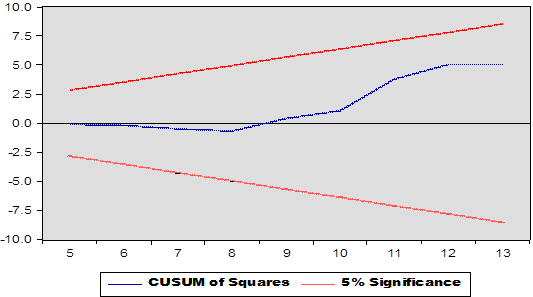
Regarding model stability, the Cumulative Sum of Squares (CUSUMSQ) test was used. As shown in Figure A1, the model satisfies the stability condition, with the CUSUMSQ plot remaining within the 5% significance bounds. This indicates that the estimated results are both stable and dependable.
5. Conclusion
This is the first study to empirically investigate the relationship between livestock exports and the economic growth of the Republic of Somaliland, employing the ARDL Model on time-series data from 2012 to 2024, sourced from the Ministry of Planning and National Development (MOPND). The study's analysis provides vital insights into the short- and long-term dynamics between livestock exports and economic growth.
The results show that livestock exports have a statistically significant and positive short-term association with Somaliland’s economic growth. underscoring the livestock sector's immediate contribution to the national economy and supporting the ELG hypothesis. Similarly, domestic investment, proxied by gross fixed capital formation, shows a significant short-run positive effect on economic growth. Government final consumption, although positively correlated with GDP, does not have a statistically significant effect on GDP.
The lagged values of both livestock exports and domestic investment show a statistically significant negative association with economic growth, which may reflect adjustment dynamics or delayed responses to market conditions, policy shocks, climatic events, or export seasonality.
Importantly, the ARDL bounds test fails to confirm long-run cointegration among the variables, indicating that the contributions of livestock exports, investment, and government spending to economic growth are only transitory. This implies that while livestock exports are vital in the short term, they do not sustain long-term economic growth, likely due to external shocks such as recurrent droughts (2017) and trade bans.
5.1 Policy Recommendation
Based on the findings of the study, the author put forward the following policy suggestions:
-
Enhance Value Addition in the Livestock Sector: Since the impact of livestock exports is only significant in the short term, the government should promote meat processing, dairy production, and leather industries to increase value addition and long-term economic contribution.
-
Diversify exports other than livestock: According to the results, livestock exports show a volatile short-run correlation with the real GDP due to seasonal shocks and capacity limits. Therefore, the government should diversify the economy by investing in other productive sectors, including agriculture, fisheries, and manufacturing, to reduce overreliance on livestock production in general and on livestock exports in particular.
-
Strengthen livestock sector resilience: the government should improve vet infrastructure facilities, disease surveillance, animal feed reserves, and drought-resistant breeds, and certification schemes- ISO/TS 34700:2016 in particular to prevent trade bans, increase drought resilience, and meet international specifications.
-
Boost domestic investment through sustainable domestic investment to create jobs and boost economic growth. The government should devise policies to attract long-term investment across vital sectors, including industry, agriculture, and fisheries. The government should also encourage investment through public-private partnership schemes.
5.2 Research Limitations and Future Direction
The study faced several limitations, including a gap in the literature and short data timeframes. The study employed time-series data sourced from the Ministry of Planning and National Development. However, the country's entire data set, including the most important economic indicators, began in 2012, and no data were available beyond that year. Although the ARDL allows both small and large sample sizes, the researcher was concerned about the loss of degrees of freedom (DF), which could further reduce the number of observations, constrain statistical power, and, in turn, limit the model's ability to detect long-run relationships.
Therefore, potential researchers should further research the livestock export-Real GDP nexus using longer datasets, as datasets become available. Similarly, potential researchers should disaggregate livestock species (sheep, goats, cattle, and camels) to assess the individual effects of each species on Somaliland's economic growth.
Disclosure Statement
The author declares no conflict of interest
Data Availability Statement
The data used in the study will be available upon request by email to the corresponding author.
References
- Ahmed, N. M., & Jie, L. (2019). A Vector Error Correction Model (VECM) Approach in Explaining the Impact of Livestock Export on Economic Growth in Somalia. IOSR Journal of Economics and Finance, 10(3 Ser. II), 47–54. DOI ↗ Google Scholar ↗
- Bashir, M. S., & Ibrahim, A. A. A. (2024). Modelling Export-led Growth Hypothesis: An Empirical Evidence from Sudan. In An Overview on Business, Management and Economics Research Vol. 8 (pp. 28–61). B P International. DOI ↗ Google Scholar ↗
- Domar, E. D. (1946). Capital expansion, rate of growth, and employment. Econometrica, Journal of the Econometric Society, 137–147. DOI ↗ Google Scholar ↗
- FAO. (2018). World livestock : transforming the livestock sector through the Sustainable Development Goals. http://hdl.handle.net/11159/2459 DOI ↗ Google Scholar ↗
- Harrod, R. F. (1939). An essay in dynamic economics. Economic Journal, 49, 14–33. DOI ↗ Google Scholar ↗
- Islam, M. M., Tareque, M., Moniruzzaman, M., & Ali, M. I. (2022). ASSESSMENT OF EXPORT-LED GROWTH HYPOTHESIS: THE CASE OF BANGLADESH, CHINA, INDIA AND MYANMAR1. Economy of Regions, 18(3), 910–925. DOI ↗ Google Scholar ↗
- Kristjanpoller, W., & Olson, J. E. (2014). Economic Growth in Latin American Countries: Is It Based on Export-Led or Import-Led Growth? Emerging Markets Finance & Trade, 50, 6–20. http://www.jstor.org/stable/24475677 DOI ↗ Google Scholar ↗
- Leonard, D. K. (2007). IGAD Livestock Policy Initiative: The Political Economy of Livestock Policy Among the Somalis. DOI ↗ Google Scholar ↗
- Matandare, M. A., Masego Makepe, P., Setlhare, L., & Bajaki Tlhalefang, J. (2021). Crop Production, Livestock Production and Economic Growth in Botswana (1990-2017): An Application of the ARDL Model. Turkish Journal of Agriculture - Food Science and Technology, 9(8), 1500–1508. DOI ↗ Google Scholar ↗
- McKinnon, R. I. (1964). Foreign exchange constraints in economic development and efficient aid allocation. The Economic Journal, 74(294), 388–409. DOI ↗ Google Scholar ↗
- MoL. (2006). Somaliland LIVESTOCK DEVELOPMENT POLICIES Document Ministry of Livestock DOI ↗ Google Scholar ↗
- MOPND. (2025). Somaliland Gross Domestic Product (GDP) Report, 2024 Central Statistics Department (CSD) Ministry of Planning and National Development Ministry of Planning and National Development. DOI ↗ Google Scholar ↗
- Muhoro, G. (2014). Export-Led Growth Hypothesis: Evidence from Kenya. Journal of World Economic Research, 3(4), 37. DOI ↗ Google Scholar ↗
- Musa, A. M., Wasonga, O. V., & Mtimet, N. (2020). Factors influencing livestock export in Somaliland’s terminal markets. Pastoralism, 10(1). DOI ↗ Google Scholar ↗
- Orhan, A., Emikönel, M., Emikönel, M., & Castanho, R. A. (2022). Reflections of the “Export-Led Growth” or “Growth-Led Exports” Hypothesis on the Turkish Economy in the 1999–2021 Period. Economies, 10(11). DOI ↗ Google Scholar ↗
- Sharma, A., & Panagiotidis, T. (2005). An analysis of exports and growth in India: cointegration and causality evidence (1971–2001). Review of Development Economics, 9(2), 232–248. DOI ↗ Google Scholar ↗
- Salvatore, D. (1998). International Economics, Prentice Hall International, Inc., 6th ed. DOI ↗ Google Scholar ↗
- Temesgen, Y. (2022). Agricultural Export and Economic Growth with Application of Co-integration Model: The Case of Live Animal, Meat and Leather Products in Ethiopia. European Journal of Business and Management. DOI ↗ Google Scholar ↗
- Zimmerman, J., & Wheaton, B. (2021). Examining Export-Led Growth in Sub-Saharan Africa and China. Journal of Student Research, 10(2). DOI ↗ Google Scholar ↗
Appendix
Table A1 Heteroskedasticity Test
Breusch-Pagan / Cook-Weisberg test for heteroskedasticity Ho: Constant variance Variables: fitted values of lngdp chi2(1) = 0.11 Prob > chi2 = 0.7438
| Variable | Obs | Pr(Skewness) | Pr(Kurtosis) | adj_chi2(2) | Prob>chi2 |
| resid | 12 | 0.814 | 0.142 | 2.610 | 0.271 |
| Breusch-Godfrey LM test for autocorrelation chi2 | Df | Prob>Chi2 |
| 5.593 | 1 | 0.18 |
H0: no serial correlation