Abstract
This study focused on evaluating Job-Embedded Capacity Building Programs in HRM-related courses for teachers and administrative staff in public junior high schools in Manila. The main goal was to use the findings as a basis for a proposed continuous learning and development initiative. The research looked at how supervisors, school administrators, and teachers view these programs in terms of nine areas: program relevance, integration with teaching practice, instructional design, mode of delivery, trainer competence, learning resources, collaboration, assessment and feedback, and sustainability. The study also compared the assessments from the three groups, examined the level of administrative support in leadership, management, operations, resource provision, and professional growth, and explored whether there is a significant relationship between the capacity-building programs and administrative support. Lastly, it identified the challenges respondents faced with these programs and supports, which helped shape and assess the proposed continuous learning and development initiative.
Keywords
Job Embedded Capacity Building Programs HRM Related Courses Administrative Support
Introduction
The Philippine educational system aims to enhance the quality of education and prepare students for higher education, employment, and future opportunities. The K to 12 Basic Education Program provides students with knowledge, skills, and values to support their development as productive members of society. Technology and Livelihood Education (TLE), a key component of the curriculum, emphasizes the development of practical skills relevant to daily life and future careers.
Hotel and Restaurant Management (HRM)-related courses are included within TLE. These courses equip junior high school students with foundational knowledge and skills in food preparation, food service, housekeeping, and other hospitality-related activities. Given the practical nature of these courses, teachers are required to demonstrate competencies in both theoretical instruction and hands-on application. Schools are likewise responsible for providing adequate resources and support to facilitate effective teaching.
The implementation of HRM-related courses is mandated by Republic Act No. 10533, known as the Enhanced Basic Education Act of 2013. This legislation reinforced the Philippine basic education system through the K to 12 Program and emphasized the significance of developing students' skills and enhancing teaching quality. To achieve these objectives, the Department of Education promotes ongoing professional development for teachers and school personnel through a range of learning and development initiatives.
Despite these initiatives, challenges persist in implementing HRM-related courses in public junior high schools. Teachers require ongoing opportunities to enhance their knowledge and skills, especially in hospitality and restaurant services. Training programs are sometimes infrequent and may not offer sufficient opportunities for teachers to apply acquired knowledge in classroom settings. Additionally, schools may encounter limitations in resources, facilities, and support necessary for effective training and instruction. These issues can negatively impact the delivery of HRM-related courses and the quality of students' learning experiences.
Job-embedded capacity building offers a potential solution to these challenges. This approach to professional development takes place within the workplace and is directly linked to teachers' daily responsibilities. Rather than relying solely on external seminars, teachers enhance their competencies through activities such as coaching, mentoring, classroom observation, collaborative planning, and school-based training while performing their regular duties.
Job-embedded capacity-building programs enable teachers to refine their instructional practices within their own school environments. These programs facilitate the immediate application of new knowledge and skills in classroom settings. For teachers of HRM-related courses, this approach can enhance both technical and pedagogical competencies, thereby improving overall instructional effectiveness.
The successful implementation of job-embedded capacity-building programs relies on support from school administrators. Administrative support encompasses assistance from school leaders in planning, organizing, implementing, and monitoring professional development activities. This support may involve providing resources, allocating time for training, encouraging teacher participation, monitoring progress, and ensuring alignment of professional development initiatives with school objectives.
While existing literature addresses professional development and administrative support in education, few studies specifically examine job-embedded capacity-building programs for teachers of HRM-related courses in public junior high schools. Similarly, there is limited research on how administrative support influences the implementation of these programs within the Division of Manila. Therefore, further investigation is required to understand the current context and identify areas for improvement.
This study aims to evaluate job-embedded capacity-building programs and administrative support for teachers of HRM-related courses in public junior high schools in the Division of Manila. Specifically, the study seeks to determine the extent of program implementation, assess the level of administrative support, identify challenges encountered by teachers, and use the findings to inform a proposed intervention plan to enhance professional development and support systems in schools.
Theoretical Framework
This study is anchored in the Situated Learning Theory developed by Jean Lave and Etienne Wenger (1991). This theory posits that learning occurs most effectively when it is situated within authentic contexts and real-life activities. Knowledge is constructed through participation, interaction, and engagement in actual work practices rather than through abstract instruction. In the context of this study, Situated Learning Theory supports the concept of job-embedded capacity building, where teachers and administrative personnel develop their competencies while performing their daily tasks. This is particularly relevant to HRM-related courses, which require hands-on skills and practical application. The theory is appropriate to the study as it emphasizes experiential and workplace-based learning, aligning with the need for continuous, relevant, and practice-oriented professional development.
Likewise, Instructional Leadership Theory by Philip Hallinger (2003) is anchored to this theory which highlights the critical role of school leaders in improving teaching and learning through supervision, support, and effective management of school resources. Instructional leaders are responsible for providing direction, monitoring instruction, and creating an environment that supports teacher development. In this study, this theory explains the role of administrative support as a key factor in the successful implementation of job-embedded capacity-building programs. School heads, supervisors, and master teachers contribute by providing guidance, resources, and continuous monitoring. The theory is appropriate as it directly relates to the administrative support variable, emphasizing how leadership practices influence teachers’ performance and professional growth.
Along with these theories, this study is based on DepEd Order No. 42, s. 2017, known as the National Adoption and Implementation of the Philippine Professional Standards for Teachers (PPST). The PPST guides teacher quality, professional growth, and learning programs in the Department of Education. It values ongoing professional development and encourages teachers to keep learning to improve their skills. The policy also highlights the role of school leaders in supporting, monitoring, and creating opportunities for teacher growth. This is relevant to the study because it backs job-embedded capacity-building programs and shows how important administrative support is for helping teachers improve their skills and teaching methods.
Overall, these theories and legal basis are appropriate to the study because they explain how professional development and administrative support contribute to the improvement of teachers' competencies. Situated Learning Theory explains how learning occurs within real-world work settings and everyday professional practice. Instructional Leadership Theory highlights the role of school administrators in supporting teacher development through leadership, supervision, and resource provision. Meanwhile, DepEd Order No. 42, s. 2017 reinforces the importance of continuous professional development and institutional support for teachers. Together, these frameworks guide the study in assessing job-embedded capacity-building programs and administrative support for teachers handling HRM-related courses in public junior high schools in the Division of Manila and serve as the basis for the proposed intervention plan.
Conceptual Framework
The conceptual framework utilized in this study is depicted in Figure 1, showing the relationship between INPUT, PROCESS, and OUTPUT.
The Input consist of reading materials and references such as books, journals, theses and dissertations, legal materials, and online sources, survey result on assessment of Job-embedded capacity building programs in HRM-related Courses for Teachers and administrative support in public junior high schools, problems encountered, acceptability of the proposed intervention program, and respondents of the study such as supervisor, school administrators, and teachers.
The Process consists of the gathering of data through a survey questionnaire on the assessment of the Job-embedded capacity building programs in hrm-related courses for teachers in in terms of program relevance and contextual alignment, integration with teaching practice and school functions, instructional design and learning strategies, mode of delivery and technology integration, trainer competence and instructional support, learning resources and technical support, collaboration, professional learning community, and peer support, survey results, assessment, monitoring, and feedback mechanism, and sustainability, transfer of learning, and long-term impact; administrative support in terms of leadership and policy support, program implementation and management support, technical and operational support, resource provision and utilization, participation, engagement, and work integration, application of hrm-related skills, communication, and coordination support, monitoring, evaluation, and sustainability support, and professional growth, accountability, and ethical practice; assessment of the problems encountered; assessment of the acceptability of proposed intervention plan, statistical treatment of data, analysis and interpretation of data.
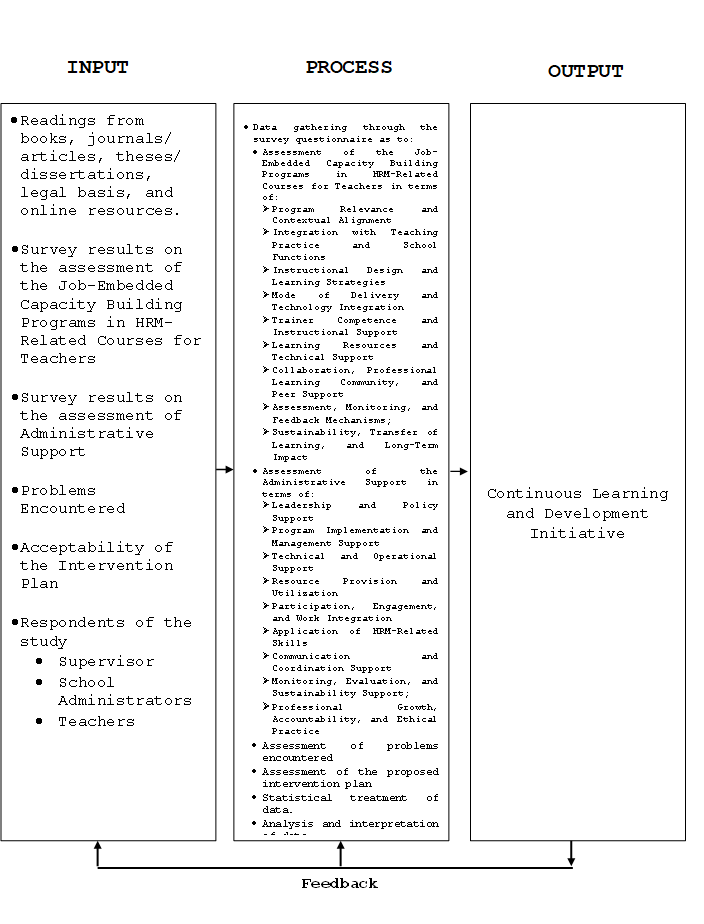
Finally, the Output of the study is the Continous Learning Development Initiative.
Statement of the Problem
The study aimed to assess the Job-Embedded Capacity Building Programs in HRM-Related Courses for Teachers and Administrative Support in Public Junior High Schools in the Division of Manila as a basis for a proposed intervention plan.
Specifically, it sought to answer the following problems:
-
How do the supervisors, school administrators, and teachers assess the Job-Embedded Capacity Building Programs in HRM-Related Courses for Teachers in Public Junior High Schools in the Division of Manila in terms of:
-
Program Relevance and Contextual Alignment;
-
Integration with Teaching Practice and School Functions;
-
Instructional Design and Learning Strategies;
-
Mode of Delivery and Technology Integration;
-
Trainer Competence and Instructional Support;
-
Learning Resources and Technical Support;
-
Collaboration, Professional Learning Community, and Peer Support;
-
Assessment, Monitoring, and Feedback Mechanisms;
-
Sustainability, Transfer of Learning, and Long-Term Impact
-
Is there a significant difference in the assessment of the three groups of respondents using the above-mentioned variables?
-
How do the three groups of respondents assess the Administrative Support in terms of:
-
Leadership and Policy Support;
-
Program Implementation and Management Support;
-
Technical and Operational Support;
-
Resource Provision and Utilization;
-
Participation, Engagement, and Work Integration;
-
Application of HRM-Related Skills;
-
Communication and Coordination Support;
-
Monitoring, Evaluation, and Sustainability Support; and
-
Professional Growth, Accountability, and Ethical Practice?
-
Is there a significant relationship between Job-embedded Capacity Building Programs in HRM-Related Courses for Teachers and Administrative Support?
-
What are the problems encountered by the respondents relative to Job-Embedded Capacity Building Programs in HRM-Related Courses for Teachers and Administrative Support?
-
Based on the findings, what intervention plan may be proposed?
-
How acceptable is the proposed intervention plan?
Hypothesis
This study hypothesized that:
1. There is no significant difference in the assessments of the three groups of respondents as to the Job-Embedded Capacity Building Program in HRM-Related Courses for Teachers in Public Junior High Schools in the Division of Manila.
2. There is no significant relationship between Job-Embedded Capacity Building Programs in HRM-Related Courses for Teachers and Administrative Support.
Scope and Limitation of the Study
The study is primary focused on assessing job-embedded capacity building programs in HRM-related courses for teachers in terms of program relevance and contextual alignment; integration with teaching practice and school functions; instructional design and learning strategies; mode of delivery and technology integration; trainer competence and instructional support; learning resources and technical support Collaboration; professional learning community, and peer support; assessment, monitoring, and feedback mechanisms and sustainability, transfer of learning, and long-term impact and administration support in terms of leadership and policy support; program implementation and management support; technical and operational support; resource provision and utilization; participation, engagement, and work integration; application of HRM-related skills; communication and coordination support; monitoring, evaluation, and sustainability support and professional growth, accountability, and ethical practice; problems encountered; and the acceptability of the proposed intervention plan. The study involved a total of 142 respondents, composed of 3 supervisors, 17 school administrators, and 122 teachers from the selected Public Junior High School in the Division of Manila, namely Dr. Juan G. Nolasco High School, Tondo High School, Timoteo Paez Integrated School, President Sergio Osmena Sr. High School, Jose P. Laurel High School, Florentino Torres High School, Cayetano Arellano High School, Jose Abad Santos High School, Teodora Alonzo High School, Antonio Maceda Integrated School, Claro M. Recto High School, Esteban Abada High School, Ignacio Villamor High School, Manuel Roxas High School, Emilio Aguinaldo Integrated School, Eulogio Rodriguez Vocational School, and Carlos P. Garcia High School in the division of Manila.
This targeted sample did not constitute 100 percent of the population due to operational field realities and specific scheduling constraints during data collection. The education supervisors are division-level personnel who are not permanently stationed at individual school campuses, limiting their availability. For school administrators, several target coordinators and school heads were engaged in external division meetings, field duties, or urgent administrative operations during the researcher's school visits. Furthermore, data collection among the teachers took place during the month of March, which is an exceptionally busy period in public school calendars due to end-of-school-year closing preparations, final grading, and student clearance processes. Consequently, the final sample represents the available personnel who voluntarily completed the survey instruments within these operational constraints.
The time-frame of the study is from November 2025 to April 2026.
Significance of the Study
The study is beneficial in the following:
Teachers. The study will help teachers, especially those teaching HRM-related courses, by giving them information about how on-the-job training programs are being used and the amount of support they get from school leaders. The findings may help them find areas to grow professionally and improve their skills, teaching methods, organization, and overall effectiveness. The suggested plan may also offer chances for ongoing learning and growth that can improve teaching quality and student learning.
Supervisor. The study will provide supervisors with information on the current state of on-the-job training programs and the support teachers need. The findings can help them plan, track, and review professional development activities. Also, the results may help supervisors create strategies and programs that meet teachers’ needs and support the successful teaching of HRM-related courses.
School administrators. This study can improve HRM practices and organizational behavior among staff, help administrators manage schools more effectively, and foster a harmonious and productive work environment.
Learners. They will gain from a more organized, efficient, and supportive school environment that ensures uninterrupted, high-quality instruction and better learning experiences.
Future researchers. The study can serve as a reference for further research related to HRM, organizational behavior, and capacity-building programs in the education sector.
Definition of Terms
The following terms are defined conceptually and operationally for a better understanding of the study:
Administrative Support – refers to the comprehensive assistance provided by school leaders, support staff, and institutional systems to help teachers carry out their roles effectively in the form of providing access to resources, ensuring clear communication channels, offering technical and organizational support, facilitating professional development, and creating conditions that enable teachers to focus on high-quality instruction, student engagement, and classroom management. (Schleicher, 2020).
Application of HRM-related skills - refers to teachers’ ability to apply HRM-related competencies such as organization, communication, and service management. In this study, it refers to the practical application of HRM skills in instruction and school tasks.
Assessment, monitoring, and feedback mechanisms – refers to processes used to evaluate professional development effectiveness and provide guidance for improvement. Continuous feedback helps teachers refine their practices and sustain learning outcomes. (Guskey and Yoon, 2024)
Capacity building program. is a structured initiative that enhances the abilities, skills, knowledge, and resources of individuals or organizations to improve their performance and achieve sustainable development outcomes. (United Nations, 2020)
Collaboration, professional learning community, and peer support - refers to opportunities for teachers to learn together through collaboration, peer mentoring, and shared reflection. Professional learning communities promote collective problem-solving and shared accountability. In this study, it refers to structured collaboration among teachers and school personnel to support job-embedded capacity building. (Rivera, 2024)
Communication and coordination support – refers to clear information flow and coordination among administrators and teachers. In this study, it refers to administrative communication that supports job-embedded learning. (Watson, 2021)
HRM-Related Course - is a program that focuses on developing students’ practical training and theoretical knowledge (competencies) that prepare learners for careers in the hospitality sector. (Walker, 2021).
Instructional design and learning strategies - refers to how training content is organized and given to encourage active learning. Good professional development uses methods such as hands-on activities, collaboration, reflection, and problem-solving rather than just lectures. These approaches help adults learn more effectively and make it more likely that teachers will remember and use new skills. In this study, this variable means the methods and learning activities used in on-the-job skill-building programs. (Desimone & Garet, 2022)
Integration with teaching practice and school functions - refers to the extent to which professional development is embedded in teachers’ daily instructional tasks and school responsibilities. (Kraft et al. 2020)
Intervention Plan - is the output of the study where a systematic strategy is designed to address identified needs, performance gaps, or challenges by outlining specific actions, resources, and timelines to achieve improved outcomes in an organization or educational setting. (Wong et al.2021).
Job–embedded capacity–building program - refers to the professional development activities experienced by teachers and administrative personnel. This professional learning is integrated into educators’ daily work, emphasizing continuous, experiential learning that directly improves instructional practice. (Marsick & Watkins 2018).
Leadership and policy support - refers to administrative actions that guide, prioritize, and sustain professional development initiatives. (Lui & Hallinger 2023)
Learning resources and technical support - refers to the availability of instructional materials, equipment, facilities, and technical assistance needed to support professional development. (Ocampo & Lucasan 2022)
Mode of delivery and technology integration - refers to how professional development is given, including in-person, online, mixed, or school-based methods. Using technology makes learning easier to access, more flexible, and ongoing, especially for programs that happen during work. (Trust et al. 2022)
Monitoring, evaluation, and sustainability support - refers to administrative efforts to assess program effectiveness and ensure continuity. (Lopez 2025)
Participation, engagement, and work integration - refers to the extent to which teachers actively participate in professional development and integrate learning into their work. (Montebon, 2021)
Professional growth, accountability, and ethical practice - refers to teachers’ continuous improvement, responsibility, and adherence to ethical standards. (DepEd, 2020)
Program implementation and management support - refers to how administrators plan, organize, and oversee professional development programs. (Bush, 2024).
Program relevance and contextual alignment – refers on how well professional development activities meet the actual needs, roles, and work situations of teachers. This means learning is based on real situations, not a one-size-fits-all approach, but instead responds to the challenges teachers face in their schools. (Desimone & Garet 2021).
Resource provision and utilization - refers to the sufficiency of physical and digital teaching aids in proportion to the number of students. (Garcia & Molina, 2022)
Sustainability, transfer of learning, and long-term impact - refers to the extent to which professional development leads to lasting changes in teachers’ practices. (Timperley, 2023)
Technical and operational support - refers to assistance related to facilities, equipment, and logistics needed to implement training programs. (Schleicher, 2020)
Trainer competence and instructional support - refers to the expertise, preparedness, and guidance provided by trainers, coaches, or facilitators during professional development activities. (Sancar et. Al. 2021)
Review of Related Literature and Studies
Local Literature
According to the Department of Education (2020), professional development programs in public schools should be closely aligned with teachers’ actual teaching situations, learners’ needs, and school goals. When training is relevant to real classroom and administrative tasks, teachers become more engaged and can better apply Human Resource Management (HRM) related skills. Ultimately, this purposeful alignment leads to long-term improvement in schools rather than mere short-term compliance.
Similarly, Montebon (2021) explains that teachers learn best when professional development is directly embedded into their daily teaching work and aligned with school operations. This localized approach helps teachers apply newly acquired skills right away, offering a distinct advantage over traditional, off-site training sessions. Furthermore, when closely supported by school administrators, this method significantly improves both teaching effectiveness and professional accountability.
Furthermore, Santos & De Guzman (2023), explain that the ultimate success of teacher training depends heavily on how the program is designed and the specific teaching methods used. They highlight that for training to be meaningful, it must utilize adult learning principles, such as working together on tasks, reflecting on personal experiences, and solving real-life problems. The authors argue that training should move away from passive, lecture-based formats and instead involve active learning that reflects the actual challenges teachers face at work, thereby ensuring better retention and easier application to classroom and office tasks.
On the other hand, Ocampo & Lucasan (2022), point out that using technology is now a massive part of teacher training in the Philippines, especially since schools transitioned to blended learning. They explain that using online platforms and virtual groups makes it easier for more teachers to access training and continue learning continuously. These digital tools are highly beneficial because they allow teachers to learn at their own pace without leaving their school duties; however, the authors also warn that for technology to really work, the school must provide technical support, clear rules, and strong administrative support.
However, Magsambol (2024) highlights critical systemic challenges, noting that Filipino teachers often struggle to participate due to overburdening office tasks. Aside from this heavy workload, many training programs still fail because there is a persistent lack of alignment between the selected topics and what teachers actually need in their classrooms. Furthermore, without proper technical and operational support, such as reliable internet or working equipment, teachers find it incredibly difficult to successfully finish their training.
Foreign Literature
Darling-Hammond et al. (2020) explain that professional development is most effective when it aligns with teachers’ actual classroom practices and school goals. Generic training is often ineffective and unengaging, while context-based, job-embedded programs help teachers see learning as meaningful. As a result, teachers stay motivated and are better able to apply new skills in their daily teaching responsibilities.
Similarly, Kraft, et al. (2020), state that teachers improve more when professional development is part of their daily teaching instead of just attending workshops. Activities like coaching and planning with colleagues let teachers use new strategies right away in the classroom. When school leaders support this kind of learning, teachers become more engaged, responsible, and able to connect what they learn with their actual teaching.
Also, Hairon & Dimmock (2021), found that professional learning communities (PLCs) help teachers work together, share knowledge, and improve their teaching. They showed that ongoing peer interaction and collaborative learning lead to continuous professional growth and better school results. These findings support the current study, which also shows that collaboration, PLCs, and peer support are common and important for the success of the job-embedded capacity-building program.
Furthermore, Timperley (2023), explains that teachers grow best when they work together in professional learning communities. When they reflect and learn together, they can improve their teaching, try out new ideas, and help one another. Working together also builds trust and accountability, which helps teachers use what they learn in their classrooms.
On the other hand, [OECD] (2021), pointed out that when examining modern delivery methods, the Organization for Economic Co-operation and Development [OECD] (2021) explains that using technology in professional development helps teachers learn flexibly and continuously without disrupting their teaching. Digital tools and online collaboration let teachers access resources, get feedback, and join learning communities as part of their daily work. However, for these technology-based programs to succeed, schools need strong administrative support, adequate infrastructure, and technical support, without which they may not be effective.
Lastly, Honig & Rainey (2020) emphasize that strong administrative systems, clear role definition, and well-coordinated management practices are essential for effective program implementation in schools. Their research demonstrates that clearly structured responsibilities, timelines, and procedures enable more efficient program execution and enhance responsiveness to emerging needs.
Local Studies
According to Reyes (2021), his study revealed that job-embedded capacity-building programs are effective in improving teachers’ performance in public secondary schools in Metro Manila. The findings showed that teachers who participated in school-based training developed better instructional strategies, classroom management skills, and stronger collaboration with colleagues. Teachers also found these programs more relevant and useful than traditional seminar-workshops. Based on these results, the study concluded that capacity-building programs that are contextualized and integrated into daily teaching practices greatly improve the application of learning and overall teaching effectiveness.
Similarly, the study by Ancho (2021) found that professional standards help Filipino teachers understand their responsibilities and adhere to the Code of Ethics. The research findings showed that when teachers have clear chances to grow and learn, they feel more responsible for their students' success and their own behavior at work. The study concludes that training is not just about learning new ways to teach; it is also a very important way to build honesty and professional integrity within the school.
Moreover, Gloria & Molina (2022), found that administrative support is very important for successful professional development in public junior high schools. Their study found that when school leaders provide guidance, resources, and time for teachers, teachers' engagement in job-embedded learning programs increases. Teachers also feel more motivated and committed when administrators actively support capacity-building activities. The study concludes that active managerial involvement is a primary driver of teacher commitment in localized training initiatives.
Also, Villanueva (2023) found that technology-integrated capacity-building programs help public school teachers improve their HRM-related skills, such as communication, collaboration, and leadership. The study findings showed that online and blended training led to significant skill improvements, while also providing flexibility and easier access to learning. It concluded that technology-based, job-embedded training supports continuous professional development when schools provide proper technical resources.
Furthermore, Philipsen et al. (2021) emphasized that effective professional development incorporates well-structured instructional design, active learning strategies, collaboration, and reflection. The study findings emphasized that programs grounded in adult learning principles and real-world problem solving enhance teachers' engagement and improve learning outcomes. The study concludes that the careful structural design of a program directly dictates how deeply an educator will engage with the material.
Correspondingly, Desimone & Garet (2022) explain that professional development is most successful when it is well-designed and uses effective learning strategies. Their findings indicate that programs should include active learning, collaboration, and alignment with teaching goals, as teachers learn best through experiences and reflection that help them analyze their own practice. Ultimately, the study concludes that professional development is vastly more effective when it is job-embedded, mirroring real classroom challenges to encourage problem-solving and support long-term professional growth.
Likewise, the study by Cruz et al. (2024), found that professional learning communities help teachers work together, reflect on their practices, and support each other through mentoring. The findings revealed that this collaboration increased teachers’ confidence in using new skills and made capacity-building programs more sustainable. The study concluded that professional learning communities are an effective way to maintain job-embedded professional development over time.
However, Echave (2024) emphasizes that the effectiveness of modern training programs, including those that focus on digital tools, relies significantly on the expertise of the trainers. The findings show that individuals facilitating the training must possess strong technical skills and the capacity to assist teachers with varying levels of experience. The study concludes that without skilled and knowledgeable trainers to offer continuous instructional support, teachers may become frustrated, preventing them from using the tools successfully in teaching.
Additionally, Lopez (2025) found that regular monitoring and feedback help teachers continue using the skills they learned in professional development programs. The study findings showed that evaluation practices and ongoing support from the school encourage teachers to apply their new competencies effectively over the long term. The study concludes that training cannot be a one-time event; rather, structured follow-up monitoring is required to ensure long-term competency application.
Lastly, regarding the acceptability of a plan, De Vera et. al. (2022) found that a plan is only feasible if it is practical and does not require excessive effort from teachers. Their study findings revealed that stakeholders are much more likely to support a plan that is aligned with the specific goals of the school and the division. Consequently, they concluded that for any intervention to be successful, it must prove that it helps the school reach its official targets, as this creates a sense of shared purpose among the staff.
Foreign Studies
According to Lui and Hallinger (2023), school leadership profoundly influences teachers’ professional development, since when leaders provide robust support, communicate transparently, and articulate a shared vision, teachers exhibit significantly higher engagement in capacity-building programs, meaning that leadership and administrative support are essential for successful job-embedded professional development.
Similarly, Hallinger and Kulophas (2020) established that leadership and policy alignment are critical to fostering effective professional learning, as leaders who support teacher development and match school policies with professional standards help create an environment where continuous learning can happen and remain sustained.
In addition, Spillane et al. (2021) noted that coherent policies, structural clarity, and shared routines promote alignment and a unified perspective on goals, which builds a necessary sense of accountability among school staff.
Furthermore, Leithwood et al. (2020) emphasize that effective school leadership depends heavily on clear communication structures and stronger coordination systems to enhance overall school functioning and program implementation.
Concurrently, Ehrich et al. (2020) found that ethical leadership and strong accountability systems are vital for professional growth and integrity in schools, showing that when leaders set a good example and have clear rules, teachers are more likely to act professionally and keep improving.
Moreover, Sobolweski et al. (2024) discovered that teachers perceive professional development as far more effective when it is seamlessly integrated into their daily teaching duties and school responsibilities, highlighting that relevance and contextual alignment strengthen engagement and classroom implementation.
Accordingly, Kennedy (2023) posits that for a program to be successful, it must support both teacher and administrative development through a realistic, practical framework that offers mutual benefits and clear advantages for everyone in the school community.
Correspondingly, Rogers’ (2021) explains that a program's ultimate success hinges entirely on its perceived utility and relevance, as stakeholders are far more willing to support and adopt programs they view as practical and helpful.
Also, Borko et al. (2021) demonstrated that professional learning communities allow teachers to work together, reflect on their teaching, and solve problems collectively, which significantly increases an educator's willingness to experiment with novel methodologies in the classroom.
Additionally, the PlayMatters Project (2023) highlights that professional development thrives under multi-sectoral support systems where teachers, administrators, and local government actors maintain open, clear communication regarding school objectives to ensure training activities become long-lasting practices rather than one-time events.
However, Tadesse and Meaza (2023) identified inadequate resources, substandard facilities, weak teacher collaboration, and a lack of follow-up from bosses as the primary reasons teachers cannot use what they learned, leading directly to program sustainability issues.
Likewise, UNESCO (2021) stressed that sustained investment, equitable access to educational materials, and effective resource provisioning are absolutely crucial to the overall success and growth of capacity-building initiatives.
Besides, Koehler et al. (2022) found that the effective deployment of technology and learning resources directly helps teachers understand and apply knowledge, indicating that having relevant materials and timely technical support makes job-embedded programs succeed.
Indeed, Garone et al. (2022) demonstrated that stable technical systems, reliable digital resources, and active institutional support significantly encourage educators to engage in training and collaborative programs.
Subsequently, Sims et al. (2021) emphasized that ongoing, job-based learning transfers most effectively when teachers use new skills regularly in the workplace, warning that a lack of sustained follow-up, adequate resources, and consistent monitoring limits the transfer of learning and reduces long-term impact.
Therefore, Wisniewski et al. (2020) conducted a meta-analysis showing that effective, timely feedback, assessment, and monitoring are indispensable tools that guide learners, encourage critical reflection, and drive ongoing improvement.
Consequently, Datnow and Park (2020) demonstrated that integrating data into these monitoring and evaluation processes enhances administrative decision-making and removes guesswork, thereby anchoring the long-term viability and sustainability of school training programs.
Ultimately, Guskey and Yoon (2024) affirm that professional development programs achieve lasting success only when they imbed regular monitoring, feedback, and robust evaluation systems into their architecture, ensuring that teachers steadily improve their skills over time.
Synthesis
The literature shows a major shift in educational administration, with traditional, stand-alone seminar-workshops now seen as outdated and less effective for long-term growth. Recent studies highlight that professional development works best when it is tailored to teachers’ daily work and specific classroom needs. According to the Department of Education (2020), Darling-Hammond et al. (2020), and Reyes (2021), professional growth is most useful when it directly addresses classroom realities, student diversity, and local school goals. When schools make capacity-building part of teachers’ everyday routines instead of separate, off-site events, they can quickly apply new HRM practices and teaching skills in the classroom. This approach helps shift the school culture from simply meeting requirements to making lasting improvements (Kraft et al., 2020; Montebon, 2021; Sobolweski et al., 2024).
A key part of making job-embedded professional development effective is using instructional design based on adult learning theories. Philipsen et al. (2021), Desimone and Garet (2022), and Santos and De Guzman (2023) agree that professional development should move away from passive lectures. Instead, adults learn best through teamwork, solving real problems, and reflecting on their own classroom experiences. The research shows that this hands-on approach works best when schools set up Professional Learning Communities (PLCs). Studies by Hairon and Dimmock (2021), Timperley (2023), and Cruz et al. (2024) show that PLCs encourage peer mentoring, sharing knowledge, and working together to solve problems. This not only builds teachers’ confidence but also helps make professional development efforts last.
The literature also points out that challenges in modern professional development depends on both technology and strong administrative support. Moving to online and blended formats has made training more accessible by giving teachers more flexibility (Ocampo & Lucasan, 2022; Villanueva, 2023; OECD, 2021). However, technology alone does not ensure better teaching. Studies by Koehler et al. (2022), Garone et al. (2022), and Magsambol (2024) warn that poor infrastructure, like unreliable internet and outdated equipment, can frustrate teachers and make them resistant to change. To address these issues, strong school leadership and solid administrative systems are essential. Leaders need to communicate clearly, set clear timelines, align policies, and provide technical support (Lui & Hallinger, 2023; Leithwood et al., 2020; Honig & Rainey, 2020; Gloria & Molina, 2022). The human side is also important; as Echave (2024) notes, skilled trainers are key to helping teachers adapt to digital changes.
In the end, the literature finds that for capacity-building programs to last and be accepted, they need clear accountability and real value for stakeholders. Programs often struggle when there is no follow-up or when teachers are overloaded with work (Magsambol, 2024; Tadesse & Meaza, 2023). Wisniewski et al. (2020), Datnow and Park (2020), Lopez (2025), and Guskey and Yoon (2024) all stress the need for ongoing monitoring, using data to evaluate progress, and giving timely feedback to keep teachers accountable and maintain high standards (Ancho, 2021; Ehrich et al., 2020). When stakeholders see that a program is practical, realistic, and helps meet official goals, it builds a sense of shared purpose and ownership, which leads to success and acceptance (Kennedy, 2023; Rogers, 2021; De Vera et al., 2022).
Although research from around the world and in the Philippines shows that leadership, resource allocation, and collaborative learning each affect teacher development, there is still little evidence on how these factors interact in highly centralized, resource-limited settings such as Philippine public schools. Most studies examine these elements separately rather than as part of a single system. There is also a lack of local research on how job-embedded HRM capacity-building leads to the achievement of specific division performance goals, especially under post-pandemic policies. This study aims to address these gaps by examining how leadership, infrastructure, and accountability systems collectively influence the long-term success and acceptance of teacher training programs within the local division.
Methodology
Research Design
This study used a descriptive research method in investigating the relationship between Job-embedded capacity building programs in HRM-related courses for Teachers and Administrative Support in Public Junior High School in the Division of Manila: Basis for Intervention Plan.
The descriptive method is used to describe the characteristics of a population or phenomenon being studied. (Babbie, 2021). This research design is appropriate for this study because it aims to describe and examine the current practices, challenges, and factors affecting teacher professional development. The study does not intend to manipulate variables but instead seeks to gather information about teachers’ experiences, perceptions, and existing training programs. By using a descriptive design, the study can clearly present how professional development is implemented in schools and identify areas that need improvement.
Population and Sampling
This study included 142 respondents: 3 supervisors, 17 school administrators, and 122 teachers from selected public junior high schools in the Division of Manila. Purposive sampling will be used to select respondents because the study requires participants with firsthand knowledge of administrative support systems and job-embedded capacity-building programs in their schools.
The study used purposive sampling to select the respondents. According to Patton (2015), purposive sampling allows the researchers to focus on participants with direct experience or exposure to the topic. This approach is appropriate for this study because the teachers are the ones directly participating in professional development.
Purposive sampling was appropriate for this study because it focuses on participants directly involved in job-embedded capacity-building programs and administrative support. These participants include supervisors, school administrators, and teachers who teach HRM-related courses. By targeting these groups, the study ensures that the data collected is relevant and represents the perspectives of key stakeholders in teaching and administration.
Purposive sampling is also appropriate because the study seeks to generate findings that will serve as the basis for an intervention plan. Developing a meaningful and responsive intervention plan requires insights from individuals who are actively involved in implementing, managing, and utilizing job-embedded capacity-building programs.
| Respondent | N | f | % |
| Supervisors | 6 | 3 | 2.11 |
| School Administrators | 26 | 17 | 11.97 |
| Teachers | 173 | 122 | 85.92 |
| Total | 205 | 142 | 100.00 |
Table 1 presents the study's respondents, among 142 total respondents, divided into three groups: 122 (85.92%) are teachers, 17 (11.97%) are school administrators, and 3 (2.11%) are supervisors.
This implies that the high participation levels ensure that the sample closely mirrors the actual population of public junior high school personnel in the Division of Manila, effectively minimizing sampling bias and maximizing the representativeness of the data.
| School | Supervisors | School Administrators | Teachers | Total | ||||
| f | % | f | % | f | % | f | % | |
| Antonio Maceda High School | 33.33 | 2 | 11.76 | 5 | 4.10 | 7 | 4.93 | |
| Carlos P. Garcia High School | 1 | 33.33 | 1 | 5.88 | 6 | 4.92 | 8 | 5.63 |
| Cayetano Arellano High School | 1 | 33.33 | 1 | 5.88 | 9 | 7.38 | 11 | 7.75 |
| Claro M. Recto High School | 2 | 11.76 | 7 | 5.73 | 9 | 6.33 | ||
| Dr. Juan G. Nolasco High School | 1 | 5.88 | 8 | 6.56 | 9 | 6.33 | ||
| Esteban Abada High School | 1 | 5.88 | 7 | 5.73 | 8 | 5.63 | ||
| Eulogio Rodriguez Vocational School | 2 | 11.76 | 9 | 7.38 | 11 | 7.75 | ||
| Florentino Tores High School | 1 | 5.88 | 5 | 4.10 | 6 | 4.23 | ||
| Gen. Emilio Aguinaldo Integrated School | 1 | 5.88 | 7 | 5.73 | 8 | 5.63 | ||
| Ignacio Villamor High School | 9 | 7.38 | 9 | 6.33 | ||||
| Jose Abad Santos High School | 1 | 5.88 | 8 | 6.56 | 9 | 6.33 | ||
| Jose P. Laurel High School | 3 | 2.45 | 3 | 2.11 | ||||
| Manuel Roxas High School | 1 | 7 | 5.73 | 7 | 4.93 | |||
| Pres. Sergio Osmena Jr. High School | 2 | 11.76 | 9 | 7.38 | 11 | 7.75 | ||
| Teodora Alonzo High School | 1 | 5.88 | 8 | 6.56 | 9 | 6.33 | ||
| Timoteo Paez Integrated School | 8 | 6.56 | 8 | 5.63 | ||||
| Tondo High School | 7 | 5.73 | 7 | 4.93 | ||||
| Total | 3 | 100.00 | 17 | 100.00 | 122 | 100.00 | 142 | 100.00 |
As presented in Table 2, the distribution of respondents by school is as follows: Antonio Maceda High School has 7 or 4.93 percent; Carlos P. Garcia High School, 8 or 5.63 percent; Cayetano Arellano High School, 11 or 7.75 percent; Claro M. Recto High School, 9 or 6.33 percent; Dr. Juan G. Nolasco High School, 9 or 6.33 percent; Esteban Abada High School, 8 or 5.63 percent; Eulogio Rodriguez Vocational School, 11 or 7.75 percent; Florentino Torres High School, 6 or 4.23 percent; Gen. Emilio Aguinaldo Integrated School, 8 or 5.63 percent; Ignacio Villamor High School, 9 or 6.33 percent; Jose Abad Santos High School, 9 or 6.33 percent; Jose P. Laurel High School, 3 or 2.11 percent; Manuel Roxas High School, 7 or 4.93 percent; Pres. Sergio Osmeña Jr. High School, 11 or 7.75 percent; Teodora Alonzo High School, 9 or 6.33 percent; Timoteo Paez Integrated School, 8 or 5.63 percent; and Tondo High School, 7 or 4.93 percent, with a total of 142 or 100.00 percent respondents.
This implies that the high participation levels ensure that the sample closely mirrors the actual population of public junior high school personnel in the Division of Manila, effectively minimizing sampling bias and maximizing the representativeness of the data.
Respondents of the Study
The respondents of the study, were the supervisors, school administrators, and teachers from selected public junior high schools in the Division of Manila. They were categorized according to their demographic profile, such as age, sex, civil status, educational attainment, and length of service.
| Age (in years) | Supervisors | School Administrators | Teachers | Total | ||||
| f | % | f | % | f | % | f | % | |
| 51 years old and above | 3 | 2.46 | 3 | 2.11 | ||||
| 46 – 50 years old | 1 | 33.33 | 7 | 41.18 | 7 | 5.74 | 15 | 10.56 |
| 41 – 45 years old | 2 | 66.67 | 6 | 35.29 | 6 | 4.92 | 14 | 9.86 |
| 36 – 40 years old | 3 | 17.65 | 11 | 9.02 | 14 | 9.86 | ||
| 31 - 35 years old | 1 | 5.88 | 41 | 33.61 | 42 | 29.58 | ||
| 26 – 30 years old | 54 | 44.26 | 54 | 38.03 | ||||
| Total | 3 | 100.00 | 17 | 100.00 | 122 | 100.00 | 142 | 100.00 |
Table 3 manifests the distribution of respondents as to age such as: 54 or 38.03 percent are aged 26-30 years old, 42 or 29.58 percent are aged 31-35 years old, 15 or 10.56 percent are aged 46-50 years old, 14 or 9.86 percent are both aged 36-40 years old, and aged 41-45 years old, and 3 or 2.11 percent are aged 51 years old and above.
This implies that the division benefits from a strong mix of young teachers and experienced leaders. Most teachers are early- to mid-career educators who bring energy, adaptability, and strong technology skills, making them open to modern teaching methods for HRM courses. Supervisors and administrators are generally 41 or older and offer valuable leadership experience. This generational mix works well: young teachers bring fresh ideas to the classroom, while older leaders provide guidance and mentorship that help turn that energy into lasting professional growth.
| Sex | Supervisors | School Administrators | Teachers | Total | ||||
| F | % | f | % | f | % | f | % | |
| Male | 1 | 33.33 | 2 | 11.76 | 8 | 6.56 | 11 | 7.75 |
| Female | 2 | 66.67 | 15 | 88.24 | 114 | 93.44 | 131 | 92.25 |
| Total | 3 | 100.00 | 17 | 100.00 | 122 | 100.00 | 142 | 100.00 |
Table 4 shows the distribution of respondents as to sex such as: 131 or 92.25 percent are female, and 11 or 7.75 percent are male.
This implies that women make up most of the teaching and leadership roles, especially in specialized vocational courses. Because of this, support systems, policies, and professional development should be designed to fit the career paths, teamwork styles, and needs of a mainly female workforce.
| Civil Status | Supervisors | School Administrators | Teachers | Total | ||||
| f | % | F | % | f | % | f | % | |
| Single | 2 | 11.76 | 35 | 28.69 | 37 | 26.06 | ||
| Married | 3 | 100.00 | 15 | 88.24 | 84 | 68.85 | 102 | 71.83 |
| Widow/ed | 3 | 2.46 | 3 | 2.11 | ||||
| Total | 3 | 100.00 | 17 | 100.00 | 122 | 100.00 | 142 | 100.00 |
Table 5 depicts the distribution of respondents as to civil status, such as 102 or 71.83 percent are married, 37 or 26.06 percent are single, and 3 or 2.11 percent are widow/ed.
This implies that many staff members in the division are married, which means their work and family responsibilities often overlap. To help prevent conflicts between these areas and keep job performance strong, the division should avoid scheduling off-site training outside of regular hours. Instead, offering professional development during normal school hours and as part of daily routines will better fit staff members’ lives, encourage more participation, and support their well-being.
| Educational Attainment | Supervisors | School Administrators | Teachers | Total | ||||
| f | % | f | % | f | % | f | % | |
| Doctorate Degree | 3 | 100.00 | 11 | 64.71 | 11 | 9.02 | 25 | 17.61 |
| Doctorate with earned units | 6 | 35.29 | 5 | 4.10 | 11 | 7.75 | ||
| Master’s Degree | 21 | 17.21 | 21 | 14.79 | ||||
| Masters with earned units | 37 | 30.33 | 37 | 26.06 | ||||
| Bachelor’s Degree | 48 | 39.34 | 48 | 33.80 | ||||
| Total | 3 | 100.00 | 17 | 100.00 | 122 | 100.00 | 142 | 100.00 |
As presented in Table 6, the distribution of respondents as to educational attainment is as follows: 14 or 9.86 percent have a doctorate; 11 or 7.75 percent have a unit in a doctorate; 23 or 16.10 percent have a master’s degree; 46 or 32.39 percent have a master’s unit; and 48 or 33.81 percent have a bachelor’s degree.
This implies that the faculty and leadership hold advanced postgraduate qualifications, indicating that the academic community is highly skilled in educational research, theory, and advanced methods. With this expertise, the division can move beyond basic training and focus on complex instructional designs, thorough program evaluations, and action research projects.
Research Instrument
Survey Questionnaire This researcher-designed questionnaire was designed to collect data on the problems presented in Chapter 1. The questionnaire was created regarding the recognized sub-variables in this study such as the assessment of job-embedded capacity building programs in hrm-related courses for teachers as to program relevance and contextual alignment; integration with teaching practice and school functions; instructional design and learning strategies; mode of delivery and technology integration; trainer competence and instructional support; learning resources and technical support Collaboration; professional learning community, and peer support; assessment, monitoring, and feedback mechanisms and sustainability, transfer of learning, and long-term impact and administration support as to leadership and policy support; program implementation and management support; technical and operational support; resource provision and utilization; participation, engagement, and work integration; application of HRM-related skills; communication and coordination support; monitoring, evaluation, and sustainability support and professional growth, accountability, and ethical practice as the basis for an intervention plan.
The questionnaire was created by the researcher and submitted to the adviser for checking to ensure it directly answers the study’s specific objectives. To make the tool more effective, it underwent validation by a group of research experts who reviewed and corrected the content. The insights and recommendations from these experts were incorporated into the final version of the questionnaire, making it more relevant and useful for data collection.
The survey questionnaire is composed of the following parts:
Part I. Demographic Profile of the Respondents. This will be used to collect data regarding the demographic profile of the respondents in terms of age, sex, civil status, and educational attainment.
Part II. Assessment of Job-Embedded Capacity Building Programs in HRM-Related Courses for Teachers in Public Junior High School, Division of Manila. This was utilized to gather data on the Job-Embedded Capacity Building Programs in HRM-Related Courses for Teachers in terms of program relevance and contextual alignment; integration with teaching practice and school functions; instructional design and learning strategies; mode of delivery and technology integration; trainer competence and instructional support; learning resources and technical support; collaboration and professional learning community; assessment, monitoring, and feedback mechanisms; and sustainability and transfer of learning.
Part III. Assessment on Administrative Support in Public Junior High School, Division of Manila. This was used to collect information as to Administrative Support in terms of leadership and policy support; program implementation and management support; technical and operational support; resource provision and utilization; participation and engagement; support for application of HRM-related skills; communication and coordination support; monitoring, evaluation, and sustainability support; and professional growth, accountability, and ethical practice.
Part IV. Assessment of Problems Encountered by the Respondents. This was used to identify problems encountered that affect job-embedded capacity-building programs in HRR-related courses and Administrative Supports, forming the basis for a proposed intervention plan.
Part V. Assessment of the Acceptability of the Intervention Plan. This part was used to gather information as to the Acceptability of the Intervention Plan.
Data Gathering Procedure
The following procedures were undertaken by the researcher in the collection of the data:
1. Sought permission the dean of the Graduate Schools and Supervisor of Division Office of Manila.
2. Distributed the survey questionnaire via email, google forms and personal visit to the selected respondents.
3. Retrieved the survey questionnaire and tabulated the data.
4. Statistically treated, interpreted, and analyzed the results with the assistance of the statistician and the adviser.
5. Presented the data in tabular and textual form.
Statistical Treatment of Data
This study employed the following statistical tools in the treatment of the data gathered:
1. Percentages. This is used to identify respondents' demographic profiles and their satisfaction with job-embedded capacity-building programs and the administrative support they received. (Smith et al. (2020). It was used to determine the profile of the respondents in terms of satisfaction with job-embedded capacity building programs and level of administrative support.
2. Weighted Mean It is used to determine the average response for each item in the survey to identify the general level for each variable. Weighted mean is a type of mean that is calculated by multiplying the weight associated with a particular event or outcome by its associated quantitative outcome and then summing all the products together (Johnson, 2019). This was used to answer sub-problems Nos. 1, 3, 5 and 7.
Formula:
_ Σfx
X = N
Where:
_
X = Weighted Mean
∑ = Summation of the product of frequency
fx = Weight score
N = Number of Cases
The Five-point Likert Scale. Is a type of scale used in survey research that measures respondents’ attitudes towards a certain subject (Elliot, 2021).
Below is used to interpret the ratings of respondents as to the extent of job-embedded capacity building programs in HRM-related courses for teachers and the level of administrative support as perceived by the teachers.
A. Assessment on Job-Embedded Capacity Building Programs for HRM-Related Courses for Teachers in Public Junior High Schools, Division of Manila.
| Scale | Range | Verbal Interpretation | Symbol |
| 5 | 4.20 – 5.00 | Highly Evident | HE |
| 4 | 3.40 – 4.19 | Evident | E |
| 3 | 2.60 – 3.39 | Moderately Evident | ME |
| 2 | 1.80 – 2.59 | Least Evident | LE |
| 1 | 1.00 - 1.79 | Very Least Evident | VLE |
B. Assessment of Administrative Support in Public Junior High Schools, Division of Manila
| Scale | Range | Verbal Interpretation | Symbol |
| 5 | 4.20 – 5.00 | Always Supported | AS |
| 4 | 3.40 – 4.19 | Often Supported | OS |
| 3 | 2.60 – 3.39 | Sometimes Supported | SS |
| 2 | 1.80 – 2.59 | Rarely Supported | RS |
| 1 | 1.00 - 1.79 | Never Supported | NS |
C. Assessment on the Problems Encountered by the Respondents Relative to Job-Embedded Capacity Building Programs for HRM-Related Courses for Teachers and Administrative Support
| Scale | Range | Verbal Interpretation | Symbol |
| 5 | 4.20 – 5.00 | Highly Encountered | HE |
| 4 | 3.40 – 4.19 | Encountered | E |
| 3 | 2.60 – 3.39 | Moderately Encountered | ME |
| 2 | 1.80 – 2.59 | Least Encountered | LE |
| 1 | 1.00 - 1.79 | Very Least Encountered | VLE |
D. Acceptability of the Intervention Plan
| Scale | Range | Verbal Interpretation | Symbol |
| 5 | 4.20 – 5.00 | Highly Acceptable | HA |
| 4 | 3.40 – 4.19 | Acceptable | A |
| 3 | 2.60 – 3.39 | Moderately Acceptable | MA |
| 2 | 1.80 – 2.59 | Least Acceptable | LA |
| 1 | 1.00 - 1.79 | Very Least Acceptable | VLA |
3. Analysis of Variance (F-test). Is a statistical tool that is appropriate when comparing the mean responses of three or more groups in determining the significant differences (Field, 2018), ANOVA will be utilized to examine whether the views of the different groups differ significantly. A significant level of 0.05 will be applied, and if the p-value is less than 0.05 it indicates that the differences observed are statistically significant and not due to chance. This was used in sub-problem no. 2
ANOVA uses the F-statistic to compare groups. While the calculation is complex and usually done via software, the formula for the F-ratio is:
-
Where:
F = F-value/F-ratio
MS between = Mean Square between groups (variance caused by the different categories)4
MS within = Mean Square within groups (variance within each specific category)
4. Pearson Correlation (r). Is a type of correlation coefficient that represents the relationship between two variables that are measured on the same interval or ratio scale. The Pearson correlation coefficient measures the strength of the association between two continuous variables (Kenton, 2022). This was used to determine if there is a significant relationship between Crisis Management and Organizational Preparedness. This was utilized to answer sub problem No. 4
Formula:
ΣXY
r = √ΣX2ΣY2
Where:
N = number of paired scores
∑XY = sum of the product of paired scores
∑X = sum of the x scores
∑Y = sum of the Y scores
∑X² = sum of the squared x scores
∑Y² = sum of the squared Y scores
5. t- test of significance for the coefficient of Correlation. The “significance of the correlation coefficient” is used to decide whether the linear relationship in the sample data is strong enough to use to model the relationship in the population. This was utilized to solve sub-problem no. 4.
Formula:
Where:
r = correlation coefficient
n = total number of observations
Degree of freedom, df = n-2
Presentation, Analysis, and Interpretation of the Data
Sub Problem No. 1. How do the school administrator, supervisors, and teachers assess the Job-Embedded Capacity Building Programs in HRM-Related Courses for Teachers in Public Schools in the Division of Manila in terms of:
1.1. Program Relevance and Contextual Alignment
As presented in Table 7, the assessment of job-embedded capacity building programs in HRM-related courses for teachers as to program relevance and contextual alignment is rated as Highly Evident with an overall weighted mean of 4.67. All items rated as Highly Evident, namely: program objectives align with school improvement priorities; and activities reflect the realities of public junior high school settings with both the composite weighted mean of 4.83 as rank 1.5, respectively; learning goals address current challenges in school human resource management with a composite weighted mean of 4.67 as rank 3; program design considers teachers’ workload and time constraints; and content aligns with DepEd standards and professional competencies with both the composite weighted mean of 4.63 as rank 4.5, respectively; program relevance is evident in teachers’ daily work experiences with a composite weighted mean of 4.59 as rank 6;
| Indicators | Supervisors | School Administrators | Teachers | Composite | Rank | ||||
| WM | VI | WM | VI | WM | VI | WM | VI | ||
| Training content responds to teachers’ actual HRM-related classroom and school needs. | 4.67 | HE | 4.53 | HE | 4.51 | HE | 4.57 | HE | 7.5 |
| Program objectives align with school improvement priorities. | 5.00 | HE | 4.82 | HE | 4.68 | HE | 4.83 | HE | 1.5 |
| Activities reflect the realities of public junior high school settings. | 5.00 | HE | 4.76 | HE | 4.74 | HE | 4.83 | HE | 1.5 |
| Training topics support teachers’ multiple roles and responsibilities. | 4.67 | HE | 4.47 | HE | 4.57 | HE | 4.57 | HE | 7.5 |
| Program design considers teachers’ workload and time constraints. | 4.67 | HE | 4.53 | HE | 4.70 | HE | 4.63 | HE | 4.5 |
| Content aligns with DepEd standards and professional competencies. | 4.67 | HE | 4.76 | HE | 4.47 | HE | 4.63 | HE | 4.5 |
| Learning goals address current challenges in school human resource management. | 5.00 | HE | 4.53 | HE | 4.49 | HE | 4.67 | HE | 3 |
| Program relevance is evident in teachers’ daily work experiences. | 5.00 | HE | 4.47 | HE | 4.31 | HE | 4.59 | HE | 6 |
| Overall Weighted Mean | 4.83 | HE | 4.61 | HE | 4.56 | HE | 4.67 | HE |
Legend:
Range Scale Verbal Interpretation Symbol
54.20-5.00Highly Evident HE
43.40-4.19Evident E
32.60-3.39Moderately Evident ME
21.80-2.59Least Evident LE
11.00-1.79Very Least Evident VLE
training content responds to teachers’ actual HRM-related classroom and school needs; and training topics support teachers’ multiple roles and responsibilities with both the composite weighted mean of 4.57 and a rank of 7.5, respectively.
It implies that the job-embedded capacity building program is relevant, practical, and well-aligned with the context of public junior high schools. The findings show that the program supports school improvement priorities, addresses real HRM challenges, and takes into account teachers’ workload, professional standards, and daily responsibilities.
The ratings of the respondent groups also show strong agreement. Supervisors', school administrators', and teachers’ assessments indicate that all groups recognize the program’s relevance and alignment, with supervisors showing the strongest support.
The result shows that the capacity-building program is well-designed and responsive to the needs of schools and teachers. It should be sustained, monitored, and improved based on the lower-ranked areas, especially teachers’ actual HRM-related needs and multiple roles.
It is supported by the study of Sobolewski et al. (2024), which found that teachers continue professional development more effectively when it is connected to their daily teaching responsibilities and school functions. It also emphasizes the relevance and contextual alignment to increase teachers' engagement and improve the implementation of the learned skills in the classroom.
1.2. Integration with Teaching Practice and School Functions
As manifested in Table 8, the assessment of job-embedded capacity building programs in HRM-related courses for teachers as to integration with teaching practice and school functions is rated as Highly Evident with an overall weighted mean of 4.68. All items rated as Highly Evident, these are: program tasks are embedded within regular teaching responsibilities with a composite weighted mean of 4.86 as rank 1; training activities are directly connected to teachers’ classroom practices with a composite weighted mean of 4.79 as rank 2; teachers apply learning outcomes to actual school functions with a composite weighted mean of 4.77 as rank 3; learning experiences support both teaching and non-teaching functions with a composite weighted mean of 4.76 as rank 4;training outputs contribute to improved school operations with a composite weighted mean of 4.75 as rank 5; program implementation complements existing school systems with a composite weighted mean of 4.63 as rank 6;
| Indicators | Supervisors | School Administrators | Teachers | Composite | Rank | ||||
| WM | VI | WM | VI | WM | VI | WM | VI | ||
| Training activities are directly connected to teachers’ classroom practices. | 5.00 | HE | 4.76 | HE | 4.60 | HE | 4.79 | HE | 2 |
| Teachers apply learning outcomes to actual school functions. | 4.67 | HE | 4.82 | HE | 4.81 | HE | 4.77 | HE | 3 |
| Program tasks are embedded within regular teaching responsibilities. | 5.00 | HE | 4.88 | HE | 4.70 | HE | 4.86 | HE | 1 |
| Learning activities support instructional and administrative roles. | 4.00 | E | 4.53 | HE | 4.66 | HE | 4.40 | HE | 8 |
| Teachers integrate HRM concepts into school-based initiatives. | 4.67 | HE | 4.18 | E | 4.59 | HE | 4.48 | HE | 7 |
| Training outputs contribute to improved school operations. | 5.00 | HE | 4.76 | HE | 4.48 | HE | 4.75 | HE | 5 |
| Program implementation complements existing school systems. | 4.67 | HE | 4.59 | HE | 4.62 | HE | 4.63 | HE | 6 |
| Learning experiences support both teaching and non-teaching functions. | 5.00 | HE | 4.71 | HE | 4.58 | HE | 4.76 | HE | 4 |
| Overall Weighted Mean | 4.75 | HE | 4.65 | HE | 4.63 | HE | 4.68 | HE |
teachers integrate HRM concepts into school-based initiatives with a composite weighted mean of 4.48 as rank 7; and learning activities support instructional and administrative roles with a composite weighted mean of 4.40 as rank 8.
It implies that a job-embedded capacity-building program is highly effective in bringing professional learning into teachers’ actual classroom work and school activities. The high ratings across all areas show that the program is not a separate or isolated effort, but part of teachers’ daily work.
This result is supported by the study of Darlin-Hammond et al. (2020), which explains that professional development is most effective when it connects to teachers’ real classroom experiences and school objectives. Generic training sessions often do not engage teachers, but programs based on their actual work help them find learning meaningful. This approach keeps teachers motivated and makes it easier for them to use new skills in their daily teaching.
1.3. Instructional Design and Learning Strategies
As shown in Table 9, the assessment of job-embedded capacity building programs in HRM-related courses for teachers as to instructional design and learning strategies is rated as Highly Evident with an overall weighted mean of 4.71. All items rated as Highly Evident, such as: learning activities promote active engagement and reflection with a composite weighted mean of 4.88 as rank 1; learning tasks are structured and clearly aligned with objectives with a composite weighted mean of 4.81 as rank 2; sessions allow the sharing of best practices among teachers with a composite weighted mean of 4.79 as rank 3; instructional flow supports gradual skill development with a composite weighted mean of 4.75 as rank 4; instructional design supports adult learning principles with a composite weighted mean of 4.74 as rank 5; activities encourage problem-solving in real school contexts with a composite weighted mean of 4.70 as rank 6; training sessions use practical and experience-based strategies with a composite weighted mean of 4.53 as rank 7; and training strategies accommodate diverse learning styles with a composite weighted mean of 4.46 as rank 8.
The results imply that the job-embedded capacity-building program uses effective instructional design and learning strategies that help teachers learn in meaningful ways. High ratings show that the program encourages teachers to engage, reflect, and work together, which are key parts of good professional development.
The findings also show that the program follows adult learning principles by including activities based on real experiences, problem-solving, and relevant situations. This approach helps teachers take an active role in their learning instead of just receiving information. Giving teachers a chance to share best practices also supports teamwork and professional growth.
| Indicators | Supervisors | School Administrators | Teachers | Composite | Rank | ||||
| WM | VI | WM | VI | WM | VI | WM | VI | ||
| Learning activities promote active engagement and reflection. | 5.00 | HE | 4.82 | HE | 4.80 | HE | 4.88 | HE | 1 |
| Training sessions use practical and experience-based strategies. | 4.67 | HE | 4.35 | HE | 4.56 | HE | 4.53 | HE | 7 |
| Instructional design supports adult learning principles. | 5.00 | HE | 4.41 | HE | 4.80 | HE | 4.74 | HE | 5 |
| Activities encourage problem-solving in real school contexts. | 5.00 | HE | 4.47 | HE | 4.64 | HE | 4.70 | HE | 6 |
| Learning tasks are structured and clearly aligned with objectives. | 5.00 | HE | 4.65 | HE | 4.80 | HE | 4.81 | HE | 2 |
| Training strategies accommodate diverse learning styles. | 4.67 | HE | 4.29 | HE | 4.43 | HE | 4.46 | HE | 8 |
| Sessions allow the sharing of best practices among teachers. | 5.00 | HE | 4.65 | HE | 4.73 | HE | 4.79 | HE | 3 |
| Instructional flow supports gradual skill development. | 5.00 | HE | 4.71 | HE | 4.56 | HE | 4.75 | HE | 4 |
| Overall Weighted Mean | 4.92 | HE | 4.54 | HE | 4.66 | HE | 4.71 | HE |
However, the lower scores for meeting different learning styles and using practical strategies point to areas that could be improved. Making training more flexible and using a wider range of teaching methods could make the program even better. Overall, the results show that the program’s design is relevant, engaging, and meets teachers’ needs, which helps improve teaching.
This result is supported by the study of Philipsen et al. (2021), who emphasized that effective professional development incorporates well-structured instructional design, active learning strategies, collaboration, and reflection. Their study demonstrated that programs grounded in adult learning principles and real-world problem-solving enhance teacher engagement and improve learning outcomes. This alignment reinforces the present results, which indicate that the job-embedded capacity-building program exhibits clear instructional design and learning strategies through active engagement, structured tasks, collaborative learning, and context-based activities.
1.4. Mode of Delivery and Technology Integration
As depicted in Table 10, the assessment of job-embedded capacity building programs in HRM-related courses for teachers as to mode of delivery and technology integration is rated as Highly Evident with an overall weighted mean of 4.69. All items rated as Highly Evident, namely: technical platforms align with DepEd-approved systems with a composite weighted mean of 4.96 as rank 1; training delivery modes suit teachers’ schedules and availability with a composite weighted mean of 4.92 as rank 2; technology is used to enhance learning experiences with a composite weighted mean of 4.85 as rank 3;
| Indicators | Supervisors | School Administrators | Teachers | Composite | Rank | ||||
| WM | VI | WM | VI | WM | VI | WM | VI | ||
| Training delivery modes suit teachers’ schedules and availability. | 5.00 | HE | 5.00 | HE | 4.75 | HE | 4.92 | HE | 2 |
| Technology is used to enhance learning experiences. | 5.00 | HE | 4.88 | HE | 4.68 | HE | 4.85 | HE | 3 |
| Online platforms support continuous engagement. | 4.67 | HE | 4.76 | HE | 4.40 | HE | 4.61 | HE | 6 |
| Digital tools are easy to access and use. | 4.67 | HE | 4.47 | HE | 4.38 | HE | 4.50 | HE | 7 |
| Training sessions combine synchronous and asynchronous activities. | 4.33 | HE | 4.35 | HE | 4.24 | HE | 4.31 | HE | 8 |
| Technology supports collaboration and communication. | 5.00 | HE | 4.53 | HE | 4.59 | HE | 4.71 | HE | 4 |
| Delivery methods promote flexibility and accessibility. | 5.00 | HE | 4.47 | HE | 4.46 | HE | 4.64 | HE | 5 |
| Technical platforms align with DepEd-approved systems. | 5.00 | HE | 5.00 | HE | 4.87 | HE | 4.96 | HE | 1 |
| Overall Weighted Mean | 4.83 | HE | 4.68 | HE | 4.55 | HE | 4.69 | HE |
technology supports collaboration and communication with a composite weighted mean of 4.71 as rank 4; delivery methods promote flexibility and accessibility with a composite weighted mean of 4.64 as rank 5; online platforms support continuous engagement with a composite weighted mean of 4.61 as rank 6; digital tools are easy to access and use with a composite weighted mean of 4.50 as rank 7; and training sessions combine synchronous and asynchronous activities with a composite weighted mean of 4.31 as rank 8.
It implies that the high ratings show that the job-embedded program makes good use of DepEd-approved digital platforms. These platforms offer flexible, self-paced, and interactive professional development that fits well into teachers' schedules. Technology has helped teachers work together and communicate better. However, the lower scores suggest there is still a need to make digital tools easier to access and to find a better balance between live and self-paced sessions. Improving these areas can help keep teachers engaged and make the program more effective in the long run.
It is supported by the study of Trust et al. (2022), which found that professional development that is technology-supported enhances the learning of teachers by providing flexible, accessible, and collaborative environment. It emphasizes that the use of digital platforms, blended learning approach, and online engagement tools enhances the participation and continuous learning for teachers. This supports the present findings, which indicate that the job-embedded capacity-building program effectively uses appropriate delivery modes and integrates technology, making learning more flexible, accessible, and responsive to teachers’ needs.
1.5. Trainer Competence and Instructional Support
| Indicators | Supervisors | School Administrators | Teachers | Composite | Rank | ||||
| WM | VI | WM | VI | WM | VI | WM | VI | ||
| Trainers demonstrate expertise in HRM and education contexts. | 5.00 | HE | 4.71 | HE | 4.66 | HE | 4.79 | HE | 3 |
| Facilitators provide clear and relevant explanations. | 5.00 | HE | 4.88 | HE | 4.59 | HE | 4.82 | HE | 2 |
| Trainers respond effectively to participants’ questions. | 4.67 | HE | 4.59 | HE | 4.78 | HE | 4.68 | HE | 6 |
| Instructional support is consistent throughout the program. | 4.67 | HE | 4.59 | HE | 4.61 | HE | 4.62 | HE | 7 |
| Trainers model professional and ethical practices. | 5.00 | HE | 4.88 | HE | 4.84 | HE | 4.91 | HE | 1 |
| Facilitators use appropriate strategies for adult learners. | 4.33 | HE | 4.82 | HE | 4.64 | HE | 4.60 | HE | 8 |
| Trainers provide guidance during practical applications. | 4.67 | HE | 4.82 | HE | 4.74 | HE | 4.74 | HE | 5 |
| Participants feel supported during learning activities. | 4.67 | HE | 4.88 | HE | 4.77 | HE | 4.77 | HE | 4 |
| Overall Weighted Mean | 4.75 | HE | 4.77 | HE | 4.70 | HE | 4.74 | HE |
As displayed in Table 11, the assessment of job-embedded capacity building programs in HRM-related courses for teachers as to trainer competence and instructional support is rated as Highly Evident with an overall weighted mean of 4.74. All items rated as Highly Evident, these are: trainers model professional and ethical practices with a composite weighted mean of 4.91 as rank 1; facilitators provide clear and relevant explanations with a composite weighted mean of 4.82 as rank 2; trainers demonstrate expertise in HRM and education contexts with a composite weighted mean of 4.79 as rank 3; participants feel supported during learning activities with a composite weighted mean of 4.77 as rank 4; trainers provide guidance during practical applications with a composite weighted mean of 4.74 as rank 5; trainers respond effectively to participants’ questions with a composite weighted mean of 4.68 as rank 6; instructional support is consistent throughout the program with a composite weighted mean of 4.62 as rank 7; and facilitators use appropriate strategies for adult learners with a composite weighted mean of 4.60 as rank 8.
It implies that the the high ratings and strong agreement among respondents show that skilled trainers and supportive facilitation are key strengths of the program. These qualities help make learning clearer, more engaging, and practical for adults. At the same time, the slightly lower ratings suggest we should use a wider range of teaching methods and provide more consistent support to further improve the program’s impact.
This result is supported by Kraft et al. (2020), which found that teacher practice and student outcomes improved significantly with effective coaching and instructional support. Their study highlights that skilled facilitators who provide clear guidance, feedback, and ongoing support enhance the effectiveness of professional development. This supports the present findings, which emphasized the strong role of trainer competence and instructional support to ensure successful implementation of job-embedded capacity building programs.
1.6. Learning Resources and Technical Support
As represented in Table 12, the assessment of job-embedded capacity building programs in HRM-related courses for teachers as to learning resources and technical support is rated as Highly Evident with an overall weighted mean of 4.72. All items rated as Highly Evident, such as: technical support is available when needed with a composite weighted mean of 4.83 as rank 1; Resources enhance understanding of training content with a composite weighted mean of 4.79 as rank 2; learning materials are relevant and easy to understand with a composite weighted mean of 4.76 as rank 3; technical support is available when needed; and learning resources are updated and contextualized with both the composite weighted mean of 4.71 as rank 4.5, respectively;
| Indicators | Supervisors | School Administrators | Teachers | Composite | Rank | ||||
| WM | VI | WM | VI | WM | VI | WM | VI | ||
| Learning materials are relevant and easy to understand. | 5.00 | HE | 4.76 | HE | 4.51 | HE | 4.76 | HE | 3 |
| Resources support practical application of HRM concepts. | 4.67 | HE | 4.88 | HE | 4.56 | HE | 4.70 | HE | 6 |
| Technical support is available when needed. | 5.00 | HE | 4.76 | HE | 4.74 | HE | 4.83 | HE | 1 |
| Technical support is available when needed. | 5.00 | HE | 4.53 | HE | 4.60 | HE | 4.71 | HE | 4.5 |
| Learning resources are updated and contextualized. | 4.67 | HE | 4.65 | HE | 4.82 | HE | 4.71 | HE | 4.5 |
| Materials support independent and collaborative learning. | 5.00 | HE | 4.53 | HE | 4.50 | HE | 4.68 | HE | 7 |
| Technical issues are addressed promptly. | 4.67 | HE | 4.53 | HE | 4.49 | HE | 4.56 | HE | 8 |
| Resources enhance understanding of training content. | 5.00 | HE | 5.00 | HE | 4.37 | HE | 4.79 | HE | 2 |
| Overall Weighted Mean | 4.88 | HE | 4.71 | HE | 4.57 | HE | 4.72 | HE |
resources support practical application of HRM concepts with a composite weighted mean of 4.70 as rank 6; materials support independent and collaborative learning with a composite weighted mean of 4.68 as rank 7; and technical issues are addressed promptly with a composite weighted mean of 4.56 as rank 8.
The result implies that All respondent groups agree that offering relevant, current, and practical learning resources, along with easy-to-access technical support, is essential for boosting learning engagement, minimizing instructional interruptions, and helping students apply HRM concepts in real school settings. However, slower technical troubleshooting remains a clear problem that needs to be fixed to avoid disruptions and keep the learning experience running smoothly.
The findings are supported by the study of Koehler et al. (2022), who emphasized that teachers’ understanding and application of knowledge can be enhanced using the effective integration of technology and learning resources. Their study emphasized that the successful implementation and meaningful learning in professional development programs required access to appropriate materials and technical support.
1.7. Collaboration, Professional Learning Community, and Peer Support
As revealed in Table 13, the assessment of job-embedded capacity building programs in HRM-related courses for teachers as to collaboration, professional learning community, and peer supports is rated as Highly Evident with an overall weighted mean of 4.76. All items rated as Highly Evident, such as: the program strengthens school-based professional learning communities with a composite weighted mean of 4.87 as rank 1; participants share experiences and best practices; and the program strengthens school-based professional learning communities with both the composite weighted mean of 4.86 as rank 2.5, respectively;
| Indicators | Supervisors | School Administrators | Teachers | Composite | Rank | ||||
| WM | VI | WM | VI | WM | VI | WM | VI | ||
| Training encourages collaboration among teachers. | 5.00 | HE | 4.53 | HE | 4.24 | HE | 4.59 | HE | 7 |
| Participants share experiences and best practices. | 5.00 | HE | 5.00 | HE | 4.59 | HE | 4.86 | HE | 2.5 |
| Peer discussions support a deeper understanding of topics. | 4.67 | HE | 4.59 | HE | 4.46 | HE | 4.57 | HE | 8 |
| Learning activities strengthen professional relationships. | 4.67 | HE | 4.88 | HE | 4.87 | HE | 4.81 | HE | 5 |
| Collaboration continues beyond formal training sessions. | 4.33 | HE | 4.82 | HE | 4.84 | HE | 4.67 | HE | 6 |
| Teachers feel supported by their peers. | 5.00 | HE | 4.82 | HE | 4.64 | HE | 4.82 | HE | 4 |
| The program strengthens school-based professional learning communities. | 5.00 | HE | 4.88 | HE | 4.74 | HE | 4.87 | HE | 1 |
| The program strengthens school-based professional learning communities. | 5.00 | HE | 4.82 | HE | 4.77 | HE | 4.86 | HE | 2.5 |
| Overall Weighted Mean | 4.83 | HE | 4.79 | HE | 4.64 | HE | 4.76 | HE |
teachers feel supported by their peers with a composite weighted mean of 4.82 as rank 4; learning activities strengthen professional relationships with a composite weighted mean of 4.81 as rank 5; collaboration continues beyond formal training sessions with a composite weighted mean of 4.67 as rank 6; training encourages collaboration among teachers with a composite weighted mean of 4.59 as rank 7; and peer discussions support a deeper understanding of topics with a composite weighted mean of 4.57 as rank 8.
The results imply that the consistent ratings from all respondent groups show that the program helps create collaborative environments and lasting, school-based Professional Learning Communities (PLCs). In these communities, teachers regularly share best practices to support each other's professional growth. At the same time, the slightly lower scores suggest there is room to strengthen peer discussions and set up structures for ongoing, long-term collaboration. This will help keep improving teaching practices and support the achievement of school goals.
This is supported by the study of Hairon & Dimmock (2021), who found that professional learning communities significantly enhance teachers’ collaboration, knowledge sharing, and instructional improvement. They also emphasized that sustained peer interaction and collaborative learning contribute to the continuous professional growth and improved school outcomes. This supported the findings which show collaboration, professional learning communities, and peer support are highly evident and play important role in the effectiveness of the job-embedded capacity building programs.
1.8. Assessment, Monitoring, and Feedback Mechanisms
| Indicators | Supervisors | School Administrators | Teachers | Composite | Rank | ||||
| WM | VI | WM | VI | WM | VI | WM | VI | ||
| Assessment tools measure learning progress effectively. | 4.67 | HE | 4.76 | HE | 4.68 | HE | 4.70 | HE | 5 |
| Feedback is timely and constructive. | 5.00 | HE | 4.76 | HE | 4.52 | HE | 4.76 | HE | 2 |
| Monitoring systems track participation and performance. | 5.00 | HE | 4.47 | HE | 4.27 | HE | 4.58 | HE | 6 |
| Assessment methods align with training objectives. | 5.00 | HE | 4.88 | HE | 4.53 | HE | 4.81 | HE | 1 |
| Teachers receive guidance based on assessment results. | 5.00 | HE | 4.59 | HE | 4.60 | HE | 4.73 | HE | 4 |
| Feedback supports improvement and reflection. | 5.00 | HE | 4.82 | HE | 4.41 | HE | 4.74 | HE | 3 |
| Monitoring data inform program adjustments. | 4.67 | HE | 4.47 | HE | 4.57 | HE | 4.57 | HE | 7 |
| Assessment practices promote continuous learning. | 4.67 | HE | 4.24 | HE | 4.34 | HE | 4.41 | HE | 8 |
| Overall Weighted Mean | 4.88 | HE | 4.63 | HE | 4.49 | HE | 4.66 | HE |
As established in Table 14, the assessment of job-embedded capacity building programs in HRM-related courses for teachers as to assessment, monitoring, and feedback mechanisms is rated as Highly Evident with an overall weighted mean of 4.66. All items rated as Highly Evident, namely: assessment methods align with training objectives with a composite weighted mean of 4.81 as rank 1; feedback is timely and constructive with a composite weighted mean of 4.76 as rank 2; feedback supports improvement and reflection with a composite weighted mean of 4.74 as rank 3; teachers receive guidance based on assessment results with a composite weighted mean of 4.73 as rank 4; assessment tools measure learning progress effectively with a composite weighted mean of 4.70 as rank 5; monitoring systems track participation and performance with a composite weighted mean of 4.58 as rank 6; monitoring data inform program adjustments with a composite weighted mean of 4.57 as rank 7; and assessment practices promote continuous learning with a composite weighted mean of 4.41 as rank 8.
The result implies that all stakeholder groups agree that the program uses data-driven monitoring and assessment tools well to track teacher progress and improve how the program responds. Timely feedback helps teachers reflect and improve their performance. However, the lower score for promoting continuous learning shows there is a gap in long-term follow-up and ongoing feedback. Addressing this issue is important for achieving lasting educational results.
This is supported by the study of Wisniewski et al. (2020), which found that learning outcomes and performance improve through effective and timely feedback. Their study accentuated that feedback plays an important role in guiding learners, promoting reflection, and enhancing continuous improvement. This supports the recent finding, which emphasizes the strong role of assessment, monitoring, and feedback mechanisms in ensuring effective implementation of job-embedded capacity building programs.
1.9. Sustainability and Transfer of Learning
| Indicators | Supervisors | School Administrators | Teachers | Composite | Rank | ||||
| WM | VI | WM | VI | WM | VI | WM | VI | ||
| Teachers apply learned skills in their daily work. | 5.00 | HE | 5.00 | HE | 4.70 | HE | 4.90 | HE | 1 |
| Learning outcomes support long-term professional growth. | 4.67 | HE | 4.53 | HE | 4.71 | HE | 4.64 | HE | 5.5 |
| Training results contribute to school improvement initiatives. | 4.67 | HE | 4.82 | HE | 4.77 | HE | 4.75 | HE | 2 |
| Skills gained are shared with other teachers. | 4.67 | HE | 4.76 | HE | 4.76 | HE | 4.73 | HE | 3.5 |
| Program design supports continuous application of learning. | 4.67 | HE | 4.88 | HE | 4.66 | HE | 4.73 | HE | 3.5 |
| School leadership supports sustained implementation. | 4.00 | HE | 4.47 | HE | 4.76 | HE | 4.41 | HE | 7 |
| Learning transfer is evident in improved practices. | 4.00 | HE | 4.59 | HE | 4.52 | HE | 4.37 | HE | 8 |
| Capacity building efforts lead to lasting change. | 4.33 | HE | 4.82 | HE | 4.75 | HE | 4.64 | HE | 5.5 |
| Overall Weighted Mean | 4.50 | HE | 4.74 | HE | 4.70 | HE | 4.65 | HE |
As exhibited in Table 15, the assessment of job-embedded capacity building programs in HRM-related courses for teachers as to sustainability and transfer of learning is rated as Highly Evident with an overall weighted mean of 4.65. All items rated as Highly Evident, these are: teachers apply learned skills in their daily work with a composite weighted mean of 4.90 as rank 1; training results contribute to school improvement initiatives with a composite weighted mean of 4.75 as rank 2; skills gained are shared with other teachers; and program design supports continuous application of learning with the composite weighted mean of 4.73 as rank 3.5, respectively; learning outcomes support long-term professional growth; and capacity building efforts lead to lasting change with both the composite weighted mean of 4.64 as rank 5.5, respectively; school leadership supports sustained implementation with a composite weighted mean of 4.41 as rank 7; and learning transfer is evident in improved practices with a composite weighted mean of 4.37 as rank 8.
This implies that all stakeholder groups agree that the job-embedded program helps connect theory with practice, allowing teachers to use and share new skills in their daily work to improve schools. Still, lower scores in leadership support and ongoing implementation show important weaknesses. These issues need steady support from administrators to make sure the teaching improvements last and lead to lasting results for the school.
This is supported by the study of Sims et al. (2021), who found that ongoing, job-embedded professional development with chances to practice and follow up leads to better teaching and student results. Their study showed that teachers transfer learning more effectively when they use new skills regularly at work. These findings support the current results, which show that the program helps teachers keep using what they learn in real school settings.
Table 16 summarizes the assessment of job-embedded capacity building programs support rated as Highly Evident with the grand mean of 4.70. All items rated as Highly Evident, such as: collaboration, professional learning community, and peer support with a composite weighted mean of 4.76 as rank 1; trainer competence and instructional support with a composite weighted mean of 4.74 as rank 2; learning resources and technical support with a composite weighted mean of 4.72 as rank 3;
| Criteria | Supervisors | School Administrators | Teachers | Composite | Rank | ||||
| WM | VI | WM | VI | WM | WM | VI | WM | ||
| Program Relevance and Contextual Alignment | 4.83 | HE | 4.61 | HE | 4.56 | HE | 4.67 | HE | 7 |
| Integration with Teaching Practice and School Functions | 4.75 | HE | 4.65 | HE | 4.63 | HE | 4.68 | HE | 6 |
| Instructional Design and Learning Strategies | 4.92 | HE | 4.54 | HE | 4.66 | HE | 4.71 | HE | 4 |
| Mode of Delivery and Technology Integration | 4.83 | HE | 4.68 | HE | 4.55 | HE | 4.69 | HE | 5 |
| Trainer Competence and Instructional Support | 4.75 | HE | 4.77 | HE | 4.70 | HE | 4.74 | HE | 2 |
| Learning Resources and Technical Support | 4.88 | HE | 4.71 | HE | 4.57 | HE | 4.72 | HE | 3 |
| Collaboration, Professional Learning Community, and Peer Support | 4.83 | HE | 4.79 | HE | 4.64 | HE | 4.76 | HE | 1 |
| Assessment, Monitoring, and Feedback Mechanisms | 4.88 | HE | 4.63 | HE | 4.49 | HE | 4.66 | HE | 8 |
| Sustainability and Transfer of Learning | 4.50 | HE | 4.74 | HE | 4.70 | HE | 4.65 | HE | 9 |
| Grand Mean | 4.80 | HE | 4.68 | HE | 4.61 | HE | 4.70 | HE |
instructional design and learning strategies with a composite weighted mean of 4.71 as rank 4; mode of delivery and technology integration with a composite weighted mean of 4.69 as rank 5; integration with teaching practice and school functions with a composite weighted mean of 4.68 as rank 6; program relevance and contextual alignment with a composite weighted mean of 4.67 as rank 7; assessment, monitoring, and feedback mechanisms with a composite weighted mean of 4.66 as rank 8; and sustainability and transfer of learning with a composite weighted mean of 4.65 as rank 9.
The result implies that The strong overall rating and agreement among different groups show that the job-embedded program brings together collaboration, instructional support, practical resources, and technology in a way that meets teachers' needs. School-based Professional Learning Communities (PLCs) and peer collaboration are the main strengths of the program. However, lower scores in assessment, monitoring, and sustainability reveal a key weakness in how the program is managed. This highlights the need to improve post-training evaluation and follow-up to ensure lasting impact.
This is supported by the study of Desimone & Garet (2021), which found that effective professional development programs are comprehensive, collaborative, and ongoing. These programs include active learning, coherence, and collective participation. Their research shows that well-designed programs improve teacher practices and lead to better educational results. This aligns with the current findings, which show that the job-embedded capacity-building program offers strong support in different areas and contributes to its overall effectiveness.
Sub Problem No. 2. Is there a significant difference in the assessment of the three groups of respondents as to Job Embedded Capacity Building Programs for HRM-Related Courses for Teachers using the above-mentioned variables?
| Areas of Concern | SS | MSS | df | F-value | Critical Value | Interpretation | Decision | |
| 1. Program Relevance and Contextual Alignment | Bet. Grp. Within Grp | 0.043 0.510 | 0.022 0.024 | 2 21 | 0.89257 | 3.47 | Not Significant | Failed to Reject Ho |
| Integration with Teaching Practice and School Functions | Bet. Grp. Within Grp. | 0.008 1.246 | 0.004 0.059 | 2 21 | 0.06959 | 3.47 | Not Significant | Failed to Reject Ho |
| Instructional Design and Learning Strategies | Bet. Grp. Within Grp. | 0.073 0.552 | 0.036 0.026 | 2 21 | 1.38333 | 3.47 | Not Significant | Failed to Reject Ho |
| Mode of Delivery and Technology Integration | Bet. Grp. Within Grp. | 0.041 1.233 | 0.021 0.059 | 2 21 | 0.35234 | 3.47 | Not Significant | Failed to Reject Ho |
| Trainer Competence and Instructional Support | Bet. Grp. Within Grp. | 0.002 0.557 | 0.001 0.027 | 2 21 | 0.04532 | 3.47 | Not Significant | Failed to Reject Ho |
| Learning Resources and Technical Support | Bet. Grp. Within Grp. | 0.046 0.570 | 0.023 0.027 | 2 21 | 0.84777 | 3.47 | Not Significant | Failed to Reject Ho |
| Collaboration, Professional Learning Community, and Peer Support | Bet. Grp. Within Grp. | 0.020 0.931 | 0.010 0.044 | 2 21 | 0.22536 | 3.47 | Not Significant | Failed to Reject Ho |
| Assessment, Monitoring, and Feedback Mechanisms | Bet. Grp. Within Grp. | 0.077 0.676 | 0.038 0.032 | 2 21 | 1.19590 | 3.47 | Not Significant | Failed to Reject Ho |
| Sustainability and Transfer of Learning | Bet. Grp. Within Grp. | 0.032 1.183 | 0.016 0.056 | 2 21 | 0.28399 | 3.47 | Not Significant | Failed to Reject Ho |
Level of Significance: 0.05
Table 17 reveals that there is no statistically significant difference in the comparative assessment of job-embedded capacity building programs in HRM-related courses for teachers among Supervisors, School Administrators, and Teachers. Across all areas of concern—Program Relevance and Contextual Alignment (F = 0.89257; df = 2,21; CV = 3.47), Integration with Teaching Practice and School Functions (F = 0.06959), Instructional Design and Learning Strategies (F = 1.38333), Mode of Delivery and Technology Integration (F = 0.35234), Trainer Competence and Instructional Support (F = 0.04532), Learning Resources and Technical Support (F = 0.84777), Collaboration, Professional Learning Community, and Peer Support (F = 0.22536), Assessment, Monitoring, and Feedback Mechanisms (F = 1.19590), and Sustainability and Transfer of Learning (F = 0.28399)—all computed F-values are lower than the corresponding critical value at the 0.05 level of significance. Consequently, the null hypothesis is consistently not rejected, indicating that the three groups have comparable assessments across all measured areas.
This implies that the supervisors, school administrators, and teachers all agree that the job-embedded capacity-building program is carried out consistently and clearly at every level. This shared view shows that the program’s goals and methods match what the institution expects. As a result, staff work together more easily, understand the program in the same way, and face fewer obstacles when putting it into practice.
The findings are supported by Spillane et al. (2021), who found that shared organizational routines and clear structures promote alignment in understanding and practices among school stakeholders. Their study emphasizes that when policies, communication, and implementation processes are coherent, stakeholders develop a common perspective on program goals and effectiveness. This supports the present findings, which indicate strong agreement among supervisors, school administrators, and teachers, reflecting a shared understanding and consistent experience of job-embedded capacity-building programs.
Sub Problem No. 3. How do the three groups of respondents assess the Administrative Support in terms of:
3.1. Leadership and Policy Support
As explained in Table 18, the assessment of administrative support as to leadership and policy support is rated as Always Supported with an overall weighted mean of 4.73. All items rated as Always Supported, namely: school policies align with DepEd standards on professional learning with a composite weighted mean of 4.89 as rank 1;
| Indicators | Supervisors | School Administrators | Teachers | Composite | Rank | ||||
| WM | VI | WM | VI | WM | VI | WM | VI | ||
| School leaders actively endorse job-embedded capacity-building programs. | 4.67 | AS | 4.53 | AS | 3.81 | OS | 4.34 | AS | 8 |
| Administrative decisions support continuous teacher development. | 5.00 | AS | 4.88 | AS | 4.07 | OS | 4.65 | AS | 7 |
| School policies align with DepEd standards on professional learning. | 5.00 | AS | 5.00 | AS | 4.67 | AS | 4.89 | AS | 1 |
| Leaders model commitment to ethical and effective HRM practices. | 5.00 | AS | 4.88 | AS | 4.77 | AS | 4.88 | AS | 2 |
| Program goals are clearly communicated by school leadership. | 5.00 | AS | 4.76 | AS | 4.28 | AS | 4.68 | AS | 6 |
| Administrators prioritize teacher development in school plans. | 5.00 | AS | 4.88 | AS | 4.50 | AS | 4.79 | AS | 4 |
| Leadership support encourages teacher participation in training. | 5.00 | AS | 4.94 | AS | 4.58 | AS | 4.84 | AS | 3 |
| Policies promote accountability and professional growth. | 5.00 | AS | 5.00 | AS | 4.35 | AS | 4.78 | AS | 5 |
| Overall Weighted Mean | 4.96 | AS | 4.86 | AS | 4.38 | AS | 4.73 | AS |
Legend:
Range Scale Verbal Interpretation Symbol
54.20-5.00Always Supported AS
43.40-4.19Often Supported OS
32.60-3.39Sometimes Supported SS
21.80-2.59Rarely Supported RS
11.00-1.79Never Supported NS
leaders model commitment to ethical and effective HRM practices with a composite weighted mean of 4.88 as rank 2; leadership support encourages teacher participation in training with a composite weighted mean of 4.84 as rank 3; administrators prioritize teacher development in school plans with a composite weighted mean of 4.79 as rank 4; policies promote accountability and professional growth with a composite weighted mean of 4.78 as rank 5; program goals are clearly communicated by school leadership with a composite weighted mean of 4.68 as rank 6; administrative decisions support continuous teacher development with a composite weighted mean of 4.65 as rank 7; and school leaders actively endorse job-embedded capacity-building programs with a composite weighted mean of 4.34 as rank 8.
The result implies that all stakeholder groups agree that strong, proactive school leadership and well-aligned policies are key to making job-embedded capacity-building programs successful and accountable. When administrators focus on professional development, match local efforts with national standards, and keep communication clear, they set the direction and provide the guidance that encourages teachers to take part and helps schools keep improving.
The findings are supported by the study of Hallinger & Kulophas (2020), who found that the leadership and policy alignment are important in promoting effective professional learning in schools. They emphasize that leaders who actively support teachers' development and align policies with the professional standards make the environment conducive and continuous learning.
3.2. Program Implementation and Management Support
| Indicators | Supervisors | School Administrators | Teachers | Composite | Rank | ||||
| WM | VI | WM | VI | WM | VI | WM | VI | ||
| Program activities are well-coordinated by school administrators. | 4.67 | AS | 4.53 | AS | 4.65 | AS | 4.61 | AS | 7 |
| Administrative procedures support smooth program implementation. | 5.00 | AS | 5.00 | AS | 4.52 | AS | 4.84 | AS | 1 |
| Program timelines are managed effectively. | 5.00 | AS | 4.59 | AS | 4.27 | AS | 4.62 | AS | 6 |
| Administrators provide guidance throughout program execution. | 4.67 | AS | 4.88 | AS | 4.53 | AS | 4.69 | AS | 4 |
| Implementation plans align with school operations. | 5.00 | AS | 4.82 | AS | 4.61 | AS | 4.81 | AS | 3 |
| Management support addresses emerging program concerns. | 4.67 | AS | 4.82 | AS | 4.51 | AS | 4.67 | AS | 5 |
| Program roles and responsibilities are clearly defined. | 5.00 | AS | 4.88 | AS | 4.60 | AS | 4.83 | AS | 2 |
| Administrative support ensures program continuity. | 4.67 | AS | 4.82 | AS | 4.30 | AS | 4.60 | AS | 8 |
| Overall Weighted Mean | 4.83 | AS | 4.79 | AS | 4.50 | AS | 4.71 | AS |
As identified in Table 19, the assessment of administrative support as to program implementation and management support is rated as Always Supported with an overall weighted mean of 4.71. All items rated as Always Supported, these are: administrative procedures support smooth program implementation with a composite weighted mean of 4.84 as rank 1; program roles and responsibilities are clearly defined with a composite weighted mean of 4.83 as rank 2; implementation plans align with school operations with a composite weighted mean of 4.81 as rank 3; administrators provide guidance throughout program execution with a composite weighted mean of 4.69 as rank 4; management support addresses emerging program concerns with a composite weighted mean of 4.67 as rank 5; program timelines are managed effectively with a composite weighted mean of 4.62 as rank 6; program activities are well-coordinated by school administrators with a composite weighted mean of 4.61 as rank 7; and administrative support ensures program continuity with a composite weighted mean of 4.60 as rank 8.
This implies that most respondents agree that having strong administrative systems, clear institutional roles, and organized management is essential for running job-embedded capacity-building programs smoothly and efficiently. Careful planning and alignment with daily school routines help the division handle new challenges, avoid scheduling problems, and improve the long-term success and quality of professional development.
Honig & Rainey (2020) found that strong administrative systems, clear roles, and coordinated management are key for effective program implementation in schools. They showed that when responsibilities, timelines, and procedures are well defined, programs run more smoothly and can adapt to new needs. These results align with the current findings, which also show that organized management and strong administrative support help job-embedded capacity-building programs succeed.
3.3. Technical and Operational Support
As illustrated in Table 20, the assessment of administrative support as to technical and operational support is rated as Always Supported with an overall weighted mean of 4.63. All items rated as Always Supported, such as: technical assistance is available during training and development activities with a composite weighted mean of 4.82 as rank 1; operational issues are addressed promptly by administrators with a composite weighted mean of 4.75 as rank 2;
| Indicators | Supervisors | School Administrators | Teachers | Composite | Rank | ||||
| WM | VI | WM | VI | WM | VI | WM | VI | ||
| Technical assistance is available during training and development activities. | 5.00 | AS | 4.76 | AS | 4.70 | AS | 4.82 | AS | 1 |
| Operational issues are addressed promptly by administrators. | 4.67 | AS | 4.88 | AS | 4.71 | AS | 4.75 | AS | 2 |
| Support systems minimize disruptions during implementation. | 4.33 | AS | 4.76 | AS | 4.68 | AS | 4.59 | AS | 5 |
| Technical resources are properly maintained. | 4.33 | AS | 4.65 | AS | 4.76 | AS | 4.58 | AS | 6 |
| Administrators coordinate technical requirements efficiently. | 4.67 | AS | 4.65 | AS | 4.65 | AS | 4.65 | AS | 4 |
| Teachers receive assistance in using required systems. | 5.00 | AS | 4.41 | AS | 4.76 | AS | 4.72 | AS | 3 |
| Operational support enables uninterrupted learning activities. | 4.33 | AS | 4.53 | AS | 4.52 | AS | 4.46 | AS | 7 |
| Technical concerns are resolved promptly. | 4.33 | AS | 4.24 | AS | 4.72 | AS | 4.43 | AS | 8 |
| Overall Weighted Mean | 4.58 | AS | 4.61 | AS | 4.69 | AS | 4.63 | AS |
teachers receive assistance in using required systems with a composite weighted mean of 4.72 as rank 3; administrators coordinate technical requirements efficiently with a composite weighted mean of 4.65 as rank 4; support systems minimize disruptions during implementation with a composite weighted mean of 4.59 as rank 5; technical resources are properly maintained with a composite weighted mean of 4.58 as rank 6; operational support enables uninterrupted learning activities with a composite weighted mean of 4.46 as rank 7; and technical concerns are resolved promptly with a composite weighted mean of 4.43 as rank 8.
This implies that the stakeholders agree that strong technical and operational support is essential for keeping capacity-building programs running smoothly and accessible. When technical systems work well and problems are fixed quickly, there are fewer disruptions. This helps teachers focus on their training and ensures that daily school activities and long-term program goals stay on track.
The findings of Garone et al. (2022) support this study. They stressed that reliable technical support and digital resources are essential for effective professional learning. Their research found that stable technical systems and strong institutional support encourage educators to join training and collaborative programs. These results match the current findings, which also show that technical and operational support is crucial for successful program implementation.
3.4. Resource Provision and Utilization
| Indicators | Supervisors | School Administrators | Teachers | Composite | Rank | ||||
| WM | VI | WM | VI | WM | VI | WM | VI | ||
| Necessary resources are provided to support training activities. | 5.00 | AS | 4.53 | AS | 4.51 | AS | 4.68 | AS | 7 |
| Budget allocations align with program requirements. | 5.00 | AS | 4.88 | AS | 4.56 | AS | 4.81 | AS | 1.5 |
| Learning resources are used efficiently and appropriately. | 4.67 | AS | 5.00 | AS | 4.74 | AS | 4.80 | AS | 3 |
| Administrators ensure equitable access to program resources. | 4.67 | AS | 4.88 | AS | 4.60 | AS | 4.72 | AS | 6 |
| Resource utilization supports intended learning outcomes. | 4.33 | AS | 4.76 | AS | 4.82 | AS | 4.64 | AS | 8 |
| Materials and facilities are available when needed. | 5.00 | AS | 4.88 | AS | 4.50 | AS | 4.79 | AS | 4.5 |
| Resource planning reflects program priorities. | 5.00 | AS | 4.94 | AS | 4.49 | AS | 4.81 | AS | 1.5 |
| Administrative oversight ensures responsible resource use. | 5.00 | AS | 5.00 | AS | 4.37 | AS | 4.79 | AS | 4.5 |
| Overall Weighted Mean | 4.83 | AS | 4.86 | AS | 4.57 | AS | 4.76 | AS |
As indicated in Table 21, the assessment of administrative support as to resource provision and utilization is rated as Always Supported with an overall weighted mean of 4.76. All items rated as Always Supported, namely: budget allocations align with program requirements; and resource planning reflects program priorities with both the composite weighted mean of 4.81 as rank 1.5, respectively; learning resources are used efficiently and appropriately with a composite weighted mean of 4.80 as rank 3;
materials and facilities are available when needed; and administrative oversight ensures responsible resource use with both the composite weighted mean of 4.79 as rank 4.5, respectively; administrators ensure equitable access to program resources with a composite weighted mean of 4.72 as rank 6; necessary resources are provided to support training activities with a composite weighted mean of 4.68 as rank 7; and resource utilization supports intended learning outcomes with a composite weighted mean of 4.64 as rank 8.
These findings implies that most respondents agree that providing enough financial and material resources, distributing them fairly, and managing them carefully are key to making job-embedded capacity-building programs work well. When instructional resources match program priorities, learning goals are supported by the right facilities and materials. This shows that continued investment from the institution is essential for keeping professional development high-quality and accessible.
This result is supported by the study of UNESCO (2021), which emphasized that adequate resources and equitable access to educational materials are key to improving teaching and learning outcomes. The report featured the importance of sustained investment in education systems to support teacher development. This supports the present findings, which show that effective resource provision and utilization are essential in implementing successful capacity-building programs.
3.5. Participation, Engagement, and Work Integration
| Indicators | Supervisors | School Administrators | Teachers | Composite | Rank | ||||
| WM | VI | WM | VI | WM | VI | WM | VI | ||
| Teachers are encouraged to actively participate in training. | 4.67 | AS | 4.82 | AS | 4.70 | AS | 4.73 | AS | 3.5 |
| Administrative support helps balance training and teaching duties. | 5.00 | AS | 4.35 | AS | 4.71 | AS | 4.69 | AS | 6.5 |
| Program activities are integrated into regular work schedules. | 5.00 | AS | 4.41 | AS | 4.77 | AS | 4.73 | AS | 3.5 |
| Engagement is supported through flexible administrative arrangements. | 5.00 | AS | 4.47 | AS | 4.76 | AS | 4.74 | AS | 2 |
| Teachers are given time to apply new skills. | 5.00 | AS | 4.65 | AS | 4.66 | AS | 4.77 | AS | 1 |
| Workload considerations support sustained participation. | 5.00 | AS | 4.29 | AS | 4.76 | AS | 4.69 | AS | 6.5 |
| Participation is recognized and valued by school leaders. | 4.67 | AS | 4.65 | AS | 4.52 | AS | 4.61 | AS | 8 |
| Engagement strategies align with teachers’ responsibilities. | 4.67 | AS | 4.71 | AS | 4.75 | AS | 4.71 | AS | 5 |
| Overall Weighted Mean | 4.88 | AS | 4.54 | AS | 4.70 | AS | 4.71 | AS |
As presented in Table 22, the assessment of administrative support as to participation, engagement, and work integration is rated as Always Supported with an overall weighted mean of 4.71.
All items rated as Always Supported, these are: teachers are given time to apply new skills with a composite weighted mean of 4.77 as rank 1; engagement is supported through flexible administrative arrangements with a composite weighted mean of 4.74 as rank 2; teachers are encouraged to actively participate in training; and program activities are integrated into regular work schedules with both the composite weighted mean of 4.73 as rank 3.5, respectively; engagement strategies align with teachers’ responsibilities with a composite weighted mean of 4.71 as rank 5; administrative support helps balance training and teaching duties; and workload considerations support sustained participation with both the composite weighted mean of 4.69 as rank 6.5, respectively; and participation is recognized and valued by school leaders with a composite weighted mean of 4.61 as rank 8.
It implies that feedback from all levels shows that building professional development into teachers' daily schedules, with flexible administration and thoughtful workload planning, greatly boosts engagement and learning results. When training matches daily teaching tasks, it removes barriers to participation, makes learning more relevant, and helps teachers use new skills consistently in the classroom.
This is supported by the study of Desimone and Garet (2022), which found that effective professional development is built into teachers’ daily work. Their research showed that when teachers take part actively and have chances to use what they learn, they are more engaged and improve their teaching. These results support the current findings, showing that participation, engagement, and work integration are key to lasting capacity-building programs.
3.6. Support for Application of HRM-Related Skills
| Indicators | Supervisors | School Administrators | Teachers | Composite | Rank | ||||
| WM | VI | WM | VI | WM | VI | WM | VI | ||
| Administrators encourage application of HRM skills in school functions. | 4.67 | AS | 4.53 | AS | 4.24 | AS | 4.48 | AS | 8 |
| Teachers are given opportunities to practice learned competencies. | 5.00 | AS | 5.00 | AS | 4.59 | AS | 4.86 | AS | 1.5 |
| Administrative tasks support skill application. | 4.67 | AS | 4.59 | AS | 4.46 | AS | 4.57 | AS | 6 |
| School systems allow integration of HRM practices. | 4.67 | AS | 4.65 | AS | 4.34 | AS | 4.55 | AS | 7 |
| Leaders provide guidance during skill application. | 4.33 | AS | 4.82 | AS | 4.84 | AS | 4.67 | AS | 5 |
| Application efforts are acknowledged by administrators. | 5.00 | AS | 4.82 | AS | 4.64 | AS | 4.82 | AS | 4 |
| HRM skills are aligned with school improvement initiatives. | 5.00 | AS | 4.88 | AS | 4.60 | AS | 4.83 | AS | 3 |
| Administrative support reinforces practical use of learning. | 5.00 | AS | 4.82 | AS | 4.77 | AS | 4.86 | AS | 1.5 |
| Overall Weighted Mean | 4.79 | AS | 4.76 | AS | 4.56 | AS | 4.71 | AS |
As manifested in Table 23, the assessment of administrative support as to support for application of HRM-related skills is rated as Always Supported with an overall weighted mean of 4.71. All items rated as Always Supported, such as: teachers are given opportunities to practice learned competencies; and administrative support reinforces practical use of learning with both the composite weighted mean of 4.86 as rank 1.5, respectively; HRM skills are aligned with school improvement initiatives with a composite weighted mean of 4.83 as rank 3; application efforts are acknowledged by administrators with a composite weighted mean of 4.82 as rank 4; leaders provide guidance during skill application with a composite weighted mean of 4.67 as rank 5; administrative tasks support skill application with a composite weighted mean of 4.57 as rank 6; school systems allow integration of HRM practices with a composite weighted mean of 4.55 as rank 7; and administrators encourage application of HRM skills in school functions with a composite weighted mean of 4.48 as rank 8.
This implies that the high ratings show that support from administrators, clear instructional guidance, and formal recognition from school leaders are key to motivating teachers to use new HRM skills in their daily work and school improvement efforts. When these skills are aligned with the school’s broader goals, the organization as a whole benefits. However, the lower ratings highlight a need to strengthen system-level support and to encourage teachers to apply these HRM practices across different areas of school operations.
The findings are supported by Kennedy (2023), who emphasized that professional development is most effective when teachers are provided with opportunities to actively apply new knowledge and skills in their actual teaching and school contexts. The study highlights that learning becomes meaningful when it is reinforced through practice, guided application, and alignment with school goals. This supports the present findings, which show that administrative support enables teachers to apply HRM-related skills, integrate them into school functions, and contribute to school improvement initiatives.
3.7. Communication and Coordination Support
As shown in Table 24, the assessment of administrative support as to communication and coordination support is rated as Always Supported with an overall weighted mean of 4.59. All items rated as Always Supported, namely: coordination among departments is well-managed with a composite weighted mean of 4.70 as rank 1;
| Indicators | Supervisors | School Administrators | Teachers | Composite | Rank | ||||
| WM | VI | WM | VI | WM | VI | WM | VI | ||
| Clear communication channels support program implementation. | 4.67 | AS | 5.00 | AS | 3.81 | OS | 4.49 | AS | 7 |
| Administrators provide timely updates and instructions. | 4.33 | AS | 4.88 | AS | 4.07 | OS | 4.43 | AS | 8 |
| Coordination among departments is well-managed. | 4.67 | AS | 4.76 | AS | 4.67 | AS | 4.70 | AS | 1 |
| Information sharing supports teacher understanding. | 4.67 | AS | 4.47 | AS | 4.77 | AS | 4.64 | AS | 4 |
| Communication minimizes confusion during implementation. | 5.00 | AS | 4.35 | AS | 4.28 | AS | 4.54 | AS | 6 |
| Feedback mechanisms are accessible to teachers. | 5.00 | AS | 4.53 | AS | 4.50 | AS | 4.68 | AS | 2 |
| Coordination aligns training with school activities. | 4.67 | AS | 4.47 | AS | 4.58 | AS | 4.57 | AS | 5 |
| Administrative communication supports collaborative efforts. | 4.67 | AS | 5.00 | AS | 4.35 | AS | 4.67 | AS | 3 |
| Overall Weighted Mean | 4.71 | AS | 4.68 | AS | 4.38 | AS | 4.59 | AS |
feedback mechanisms are accessible to teachers with a composite weighted mean of 4.68 as rank 2; administrative communication supports collaborative efforts with a composite weighted mean of 4.67 as rank 3; information sharing supports teacher understanding with a composite weighted mean of 4.64 as rank 4;coordination aligns training with school activities with a composite weighted mean of 4.57 as rank 5; communication minimizes confusion during implementation with a composite weighted mean of 4.54 as rank 6; clear communication channels support program implementation with a composite weighted mean of 4.49 as rank 7; and administrators provide timely updates and instructions with a composite weighted mean of 4.43 as rank 8.
This implies that the high ratings show that strong administrative support, especially clear communication between departments, timely updates, and good coordination, is essential for reducing confusion, making sure training matches daily school operations, and encouraging collaboration. On the other hand, the lower scores point to a clear communication bottleneck. This highlights the urgent need to speed up information sharing and improve clarity to keep the program organized and efficient over time.
This result is supported by the study of Leithwood et al. (2020) that effective school leadership depends on clear communication and strong coordination to improve how schools function and carry out programs. Their study shows that working together through good communication makes organizations more effective, which aligns with these results.
3.8. Monitoring, Evaluation, and Sustainability Support
| Indicators | Supervisors | School Administrators | Teachers | Composite | Rank | ||||
| WM | VI | WM | VI | WM | VI | WM | VI | ||
| Program progress is regularly monitored by administrators. | 4.67 | AS | 4.71 | AS | 3.91 | OS | 4.43 | AS | 8 |
| Evaluation results inform future capacity-building initiatives. | 5.00 | AS | 4.76 | AS | 4.16 | OS | 4.64 | AS | 4 |
| Monitoring tools track teacher participation and outcomes. | 5.00 | AS | 4.59 | AS | 4.67 | AS | 4.75 | AS | 2 |
| Administrators use data to improve program delivery. | 4.67 | AS | 4.35 | AS | 4.77 | AS | 4.60 | AS | 6 |
| Sustainability plans are integrated into school programs. | 4.67 | AS | 4.76 | AS | 4.28 | AS | 4.57 | AS | 7 |
| Evaluation supports continuous improvement. | 5.00 | AS | 4.35 | AS | 4.50 | AS | 4.62 | AS | 5 |
| Monitoring ensures alignment with DepEd goals. | 5.00 | AS | 5.00 | AS | 4.58 | AS | 4.86 | AS | 1 |
| Administrative actions promote long-term program impact. | 5.00 | AS | 4.65 | AS | 4.35 | AS | 4.67 | AS | 3 |
| Overall Weighted Mean | 4.88 | AS | 4.65 | AS | 4.40 | AS | 4.64 | AS |
As depicted in Table 25, the assessment of administrative support as to monitoring, evaluation, and sustainability support is rated as Always Supported with an overall weighted mean of 4.64. All items rated as Always Supported, these are: monitoring ensures alignment with DepEd goals with a composite weighted mean of 4.86 as rank 1; monitoring tools track teacher participation and outcomes with a composite weighted mean of 4.75 as rank 2; administrative actions promote long-term program impact with a composite weighted mean of 4.67 as rank 3; evaluation results inform future capacity-building initiatives with a composite weighted mean of 4.64 as rank 4; evaluation supports continuous improvement with a composite weighted mean of 4.62 as rank 5; administrators use data to improve program delivery with a composite weighted mean of 4.60 as rank 6; sustainability plans are integrated into school programs with a composite weighted mean of 4.57 as rank 7; and program progress is regularly monitored by administrators with a composite weighted mean of 4.43 as rank 8.
This implies that the high ratings show that strong administrative support and regular use of data are important for keeping operations accountable, matching professional development with DepEd goals, and improving how programs are delivered. On the other hand, the lower scores point to a clear gap in planning for long-term sustainability and keeping monitoring consistent. This means school administrators need to move beyond short-term oversight and set up ongoing evaluation systems to make sure capacity-building efforts have a lasting effect.
This is supported by the study of Datnow & Park (2020, who stressed that the use of data in monitoring and evaluation gives more reliable decision-making and strengthens the sustainability of the program. This study emphasized that effective leadership uses data to guide continuous improvement.
3.9. Professional Growth, Accountability, and Ethical Practice
| Indicators | Supervisors | School Administrators | Teachers | Composite | Rank | ||||
| WM | VI | WM | VI | WM | VI | WM | VI | ||
| Administrative support promotes continuous professional growth. | 5.00 | AS | 4.53 | AS | 4.70 | AS | 4.74 | AS | 3 |
| Accountability measures align with DepEd standards. | 4.67 | AS | 5.00 | AS | 4.71 | AS | 4.79 | AS | 1 |
| Ethical practices are emphasized in program implementation. | 4.67 | AS | 4.59 | AS | 4.77 | AS | 4.68 | AS | 5 |
| Professional conduct is modeled by school administrators. | 4.67 | AS | 4.88 | AS | 4.76 | AS | 4.77 | AS | 2 |
| Teachers are encouraged to reflect on professional responsibilities. | 4.67 | AS | 4.82 | AS | 4.66 | AS | 4.72 | AS | 4 |
| Administrative policies support integrity and transparency. | 4.00 | OS | 4.82 | AS | 4.76 | AS | 4.53 | AS | 7 |
| Growth opportunities are linked to performance improvement. | 4.00 | OS | 4.88 | AS | 4.52 | AS | 4.47 | AS | 8 |
| Ethical practice strengthens trust and professionalism. | 4.33 | AS | 4.82 | AS | 4.75 | AS | 4.64 | AS | 6 |
| Overall Weighted Mean | 4.50 | AS | 4.79 | AS | 4.70 | AS | 4.67 | AS |
As displayed in Table 26, the assessment of administrative support as to professional growth, accountability, and ethical practice is rated as Always Supported with an overall weighted mean of 4.67. All items rated as Always Supported, such as: accountability measures align with DepEd standards with a composite weighted mean of 4.79 as rank 1; professional conduct is modeled by school administrators with a composite weighted mean of 4.77 as rank 2; administrative support promotes continuous professional growth with a composite weighted mean of 4.74 as rank 3; teachers are encouraged to reflect on professional responsibilities with a composite weighted mean of 4.72 as rank 4; ethical practices are emphasized in program implementation with a composite weighted mean of 4.68 as rank 5; ethical practice strengthens trust and professionalism with a composite weighted mean of 4.64 as rank 6; administrative policies support integrity and transparency with a composite weighted mean of 4.53 as rank 7; and growth opportunities are linked to performance improvement with a composite weighted mean of 4.47 as rank 8.
This implies that the high ratings show that proactive administrative support helps build a school culture based on trust, integrity, and shared responsibility. This happens when leaders model ethical behavior and make sure accountability matches established standards. On the other hand, the lower scores point to a clear gap in transparency and a weak connection between professional development and real performance results. School leaders need to address these issues so that ethical leadership and accountability lead to lasting improvements in teacher performance.
This is supported by the study of Ehrich et al. (2020) who found that ethical leadership and strong accountability systems are important for professional growth and integrity in schools. Their research shows that when school leaders set a good example and have clear rules, teachers are more likely to act professionally and keep improving. This matches the current findings, which show that administrative support helps teachers practice ethically, stay accountable, and grow professionally.
Table 27 summarizes the assessment of administrative support rated as Always Supported with the grand mean of 4.68. All items rated as Always Supported, namely: resource provision and utilization with a composite weighted mean of 4.76 as rank 1; leadership and policy support with a composite weighted mean of 4.73 as rank 2; program implementation and management support; participation, engagement, and work integration; and support for application of HRM-related skills with a similar composite weighted mean of 4.71 as rank 4,
| Criteria | Supervisors | School Administrators | Teachers | Composite | Rank | ||||
| WM | VI | WM | VI | WM | WM | VI | WM | ||
| Leadership and Policy Support | 4.96 | AS | 4.86 | AS | 4.38 | AS | 4.73 | AS | 2 |
| Program Implementation and Management Support | 4.83 | AS | 4.79 | AS | 4.50 | AS | 4.71 | AS | 4 |
| Technical and Operational Support | 4.58 | AS | 4.61 | AS | 4.69 | AS | 4.63 | AS | 8 |
| Resource Provision and Utilization | 4.83 | AS | 4.86 | AS | 4.57 | AS | 4.76 | AS | 1 |
| Participation, Engagement, and Work Integration | 4.88 | AS | 4.54 | AS | 4.70 | AS | 4.71 | AS | 4 |
| Support for Application of HRM-Related Skills | 4.79 | AS | 4.76 | AS | 4.56 | AS | 4.71 | AS | 4 |
| Communication and Coordination Support | 4.71 | AS | 4.68 | AS | 4.38 | AS | 4.59 | AS | 9 |
| Monitoring, Evaluation, and Sustainability Support | 4.88 | AS | 4.65 | AS | 4.40 | AS | 4.64 | AS | 7 |
| Professional Growth, Accountability, and Ethical Practice | 4.50 | AS | 4.79 | AS | 4.70 | AS | 4.67 | AS | 6 |
| Grand Mean | 4.77 | AS | 4.73 | AS | 4.54 | AS | 4.68 | AS |
respectively; professional growth, accountability, and ethical practice with a composite weighted mean of 4.67 as rank 6; monitoring, evaluation, and sustainability support with a composite weighted mean of 4.64 as rank 7; technical and operational support with a composite weighted mean of 4.63 as rank 8; and communication and coordination support with a composite weighted mean of 4.59 as rank 9.
It implies that the high overall rating shows that strong administrative support, built on effective leadership, resources, program management, and professional help, is key to successful job-embedded capacity-building programs. Strong leadership and good resource allocation are important strengths, but the findings also show that communication systems and monitoring frameworks need ongoing improvement. In the end, the results make it clear that solid, well-rounded administrative oversight is essential for long-term success, sustainability, and impact in teacher professional development.
It supports by the study of Hallinger & Lui (2023) who found that strong school leadership has a major impact on teacher learning and the success of professional development programs. The study shows that broad administrative support, such as leadership, providing resources, and managing programs, helps improve teacher performance and school results. These points match the current findings, which show that administrative support is present in many areas and plays a key role in the success of job-embedded capacity-building programs.
Sub Problem No. 4. Is there a significant relationship between Job-embedded Capacity Building Programs in HRM-Related Courses for Teachers and Administrative Support?
| Indicators | r-value | VI | df | t-value | Critical value | Int. | Decision |
| Leadership and Policy Support | 0.99 | VSC | 14 | 3.73825 | 2.145 | Significant | Reject Ho |
| Program Implementation and Management Support | 0.99 | VSC | 14 | 3.74047 | 2.145 | Significant | Reject Ho |
| Technical and Operational Support | 0.99 | VSC | 14 | 3.74043 | 2.145 | Significant | Reject Ho |
| Resource Provision and Utilization | 0.99 | VSC | 14 | 3.74117 | 2.145 | Significant | Reject Ho |
| Participation, Engagement, and Work Integration | 0.99 | VSC | 14 | 3.74137 | 2.145 | Significant | Reject Ho |
| Support for Application of HRM-Related Skills | 0.99 | VSC | 14 | 3.73948 | 2.145 | Significant | Reject Ho |
| Communication and Collaboration Support | 0.99 | VSC | 14 | 3.74038 | 2.145 | Significant | Reject Ho |
| Monitoring, Evaluation, and Sustainability Support | 0.99 | VSC | 14 | 3.73989 | 2.145 | Significant | Reject Ho |
| Professional Growth, Accountability, and Ethical Practice | 0.99 | VSC | 14 | 3.74094 | 2.145 | Significant | Reject Ho |
Legend:
RangeVerbal InterpretationSymbol
1.0Perfect Correlation PC
0.71 – 0.99Very Strong CorrelationVSC
0.51 - 0.70Strong CorrelationSC
0.31 – 0.50Moderate CorrelationMC
0.11 – 0.30Weak CorrelationWC
Table 28 depicts that there is a statistically significant relationship between job-embedded capacity building programs in HRM-related courses for teachers and administrative support. Across all indicators—Leadership and Policy Support (r = 0.99; t = 3.73825; df = 14; CV = 2.145), Program Implementation and Management Support (r = 0.99; t = 3.74047), Technical and Operational Support (r = 0.99; t = 3.74043), Resource Provision and Utilization (r = 0.99; t = 3.74117), Participation, Engagement, and Work Integration (r = 0.99; t = 3.74137), Support for Application of HRM-Related Skills (r = 0.99; t = 3.73948), Communication and Collaboration Support (r = 0.99; t = 3.74038), Monitoring, Evaluation, and Sustainability Support (r = 0.99; t = 3.73989), and Professional Growth, Accountability, and Ethical Practice (r = 0.99; t = 3.74094)—all computed t-values are greater than the corresponding critical value at the 0.05 level of significance. Consequently, the null hypothesis is consistently rejected, indicating a significant relationship across all measured indicators.
This implies that the very high correlation (r = 0.99%) indicates a strong and statistically significant link between administrative support and the success of job-embedded capacity-building programs in HRM courses. This result suggests that administrative infrastructure, which includes leadership, resource allocation, communication, and program management, is not just a background factor but a key driver of success. As a result, investing in stronger administrative systems is likely to lead to clear improvements in teacher outcomes and help programs last over time.
This result is supported by the study of Guskey (2020) who found that professional development programs are more successful when they have strong support from school leadership and administration. The study shows that aligning administrative systems with program goals makes professional development more effective and lasting. These results match the current findings, which show a strong positive link between job-embedded capacity-building programs and administrative support.
Sub Problem No. 5. What are the problems encountered by the respondents relative to Job-Embedded Capacity Building Programs in HRM-Related Courses for Teachers and Administrative Support?
5.1. Job-Embedded Capacity Building Programs in HRM-Related Courses for Teachers
On the assessment of problems encountered relative to job-embedded capacity building programs in HRM-related courses for teachers rated as Moderately Encountered with an overall weighted mean of 3.22.
| Indicators | Supervisors | School Administrators | Teachers | Composite | Rank | ||||
| WM | VI | WM | VI | WM | VI | WM | VI | ||
| Training content does not always reflect the actual HRM challenges encountered in school settings. | 3.33 | ME | 2.71 | ME | 4.10 | E | 3.38 | ME | 8 |
| Program objectives are sometimes misaligned with teachers’ current roles and responsibilities. | 3.67 | E | 3.65 | E | 4.15 | E | 3.82 | E | 5 |
| Teachers find limited opportunities to apply HRM concepts within their regular teaching duties. | 2.67 | ME | 2.65 | ME | 3.71 | E | 3.01 | ME | 11 |
| Training activities are often disconnected from existing school processes and functions. | 1.33 | VLE | 3.12 | ME | 3.52 | E | 2.66 | ME | 16 |
| Learning activities rely heavily on theoretical discussions with limited practical application. | 1.67 | VLE | 2.76 | ME | 3.99 | E | 2.81 | ME | 14 |
| Instructional strategies do not consistently address the diverse learning needs of teachers. | 2.00 | LE | 2.82 | ME | 3.45 | E | 2.76 | ME | 15 |
| Trainers lack sufficient understanding of public-school contexts and constraints. | 1.00 | VLE | 1.71 | VLE | 2.31 | LE | 1.67 | VLE | 18 |
| Instructional support during application activities is often limited or inconsistent. | 1.00 | VLE | 2.71 | ME | 3.38 | ME | 2.36 | LE | 17 |
| Training schedules and delivery modes conflict with teachers’ teaching responsibilities. | 1.00 | VLE | 3.35 | ME | 4.39 | HE | 2.91 | ME | 12 |
| Technology platforms used in training are difficult to access. | 1.33 | VLE | 3.12 | ME | 4.02 | E | 2.82 | ME | 13 |
| Learning materials are not always available when needed for practice and reference. | 4.67 | HE | 3.88 | E | 4.02 | E | 4.19 | E | 2 |
| Technical support is insufficient during technology-dependent training sessions. | 2.67 | ME | 3.29 | ME | 4.22 | HE | 3.39 | ME | 7 |
| Opportunities for peer collaboration are limited due to time and workload constraints. | 3.67 | E | 2.53 | LE | 3.14 | ME | 3.11 | ME | 10 |
| Professional learning community activities are not sustained after formal training sessions. | 3.67 | E | 3.65 | E | 3.90 | E | 3.74 | E | 6 |
| Assessment results are not clearly communicated to guide improvement. | 4.00 | E | 4.65 | HE | 3.50 | E | 4.05 | E | 3 |
| Monitoring of learning progress is irregular and inconsistent. | 4.00 | E | 3.12 | ME | 4.46 | HE | 3.86 | E | 4 |
| Skills gained from training are not consistently applied in daily school practices. | 2.00 | LE | 3.06 | ME | 4.30 | HE | 3.12 | ME | 9 |
| Lack of follow-up activities limits long-term retention and transfer of learning. | 4.00 | E | 4.35 | HE | 4.75 | HE | 4.37 | HE | 1 |
| Overall Weighted Mean | 2.65 | ME | 3.17 | ME | 3.85 | E | 3.22 | ME |
Legend:
Range Scale Verbal Interpretation Symbol
54.20-5.00Highly Encountered HE
43.40-4.19Encountered E
32.60-3.39Moderately Encountered ME
21.80-2.59Least Encountered LE
11.00-1.79Very Least Encountered VLE
One (1) item rated as Highly Encountered which is lack of follow-up activities limits long-term retention and transfer of learning with a composite weighted mean of 4.37 as rank 1. Five (5) items rated as Encountered, these are: learning materials are not always available when needed for practice and reference with a composite weighted mean of 4.19 as rank 2;assessment results are not clearly communicated to guide improvement with a composite weighted mean of 4.05 as rank 3; monitoring of learning progress is irregular and inconsistent with a composite weighted mean of 3.86 as rank 4; program objectives are sometimes misaligned with teachers’ current roles and responsibilities with a composite weighted mean of 3.82 as rank 5; and professional learning community activities are not sustained after formal training sessions with a composite weighted mean of 3.74 as rank 6. Ten (10) items rated as Moderately Encountered, namely: technical support is insufficient during technology-dependent training sessions with a composite weighted mean of 3.39 as rank 7; training content does not always reflect the actual HRM challenges encountered in school settings with a composite weighted mean of 3.38 as rank 8; skills gained from training are not consistently applied in daily school practices with a composite weighted mean of 3.12 as rank 9; opportunities for peer collaboration are limited due to time and workload constraints with a composite weighted mean of 3.11 as rank 10; teachers find limited opportunities to apply HRM concepts within their regular teaching duties with a composite weighted mean of 3.01 as rank 11; training schedules and delivery modes conflict with teachers’ teaching responsibilities with a composite weighted mean of 2.91 as rank 12; technology platforms used in training are difficult to access with a composite weighted mean of 2.82 as rank 13; learning activities rely heavily on theoretical discussions with limited practical application with a composite weighted mean of 2.81 as rank 14; instructional strategies do not consistently address the diverse learning needs of teachers with a composite weighted mean of 2.76 as rank 15; and training activities are often disconnected from existing school processes and functions with a composite weighted mean of 2.66 as rank 16. One (1) item rated as Least Encountered which is instructional support during application activities is often limited or inconsistent with a composite weighted mean of 2.36 as rank 17. One (1) item rated as Very Least Encountered which is trainers lack sufficient understanding of public-school contexts and constraints with a composite weighted mean of 1.67 as rank 18.
This implies that the program is generally effective, key challenges limit its impact, including a lack of follow-up activities, insufficient resources, and inconsistent monitoring. These issues hinder long-term retention and application of learning, which are essential for sustainable professional development.
The findings indicate a need for stronger post-training support, improved resource availability, and better alignment of training with school needs. Addressing these concerns will improve the program’s overall effectiveness.
This result is supported by the study of Sims et al. (2021), which found that professional development programs are most effective when there is ongoing follow-up, enough resources, and regular monitoring. They noted that without these factors, it is harder to apply what is learned and the long-term impact is reduced. These results align with the current findings, which also point to a lack of follow-up, limited resources, and inconsistent monitoring as main challenges to program effectiveness.
5.2. Administrative Support
| Indicators | Supervisors | School Administrators | Teachers | Composite | Rank | ||||
| WM | VI | WM | VI | WM | VI | WM | VI | ||
| Administrative commitment to HRM-related capacity building is inconsistent across school levels. | 3.00 | ME | 2.41 | LE | 3.50 | E | 2.97 | ME | 11 |
| Existing policies do not clearly prioritize job-embedded professional development. | 5.00 | HE | 3.00 | ME | 4.46 | HE | 4.15 | E | 1 |
| Program implementation lacks clear administrative guidance and coordination. | 3.67 | E | 2.35 | LE | 4.30 | HE | 3.44 | E | 7 |
| Management support decreases after the initial phase of program implementation. | 2.67 | ME | 2.59 | LE | 3.42 | E | 2.89 | ME | 13 |
| Teachers experience delays in receiving technical assistance during training activities. | 2.00 | LE | 2.71 | ME | 3.57 | E | 2.76 | ME | 16 |
| Operational issues disrupt the smooth conduct of capacity-building sessions. | 3.75 | E | 2.88 | ME | 4.03 | E | 3.56 | E | 4 |
| Resources allocated for HRM-related training are insufficient to meet program demands. | 1.67 | VLE | 2.24 | LE | 4.10 | E | 2.67 | ME | 17 |
| Delays in the release or use of resources affect program effectiveness. | 2.00 | LE | 3.71 | E | 4.15 | E | 3.28 | ME | 9 |
| Heavy teaching workloads limit teachers’ sustained participation in training activities. | 4.33 | HE | 3.71 | E | 3.71 | E | 3.92 | E | 3 |
| Training tasks are not fully integrated into teachers’ regular work responsibilities. | 1.67 | VLE | 3.24 | ME | 3.52 | E | 2.81 | ME | 15 |
| Administrative structures provide limited support for applying HRM skills in school practices. | 2.00 | LE | 2.82 | ME | 3.99 | E | 2.94 | ME | 12 |
| Teachers receive minimal follow-up guidance after training sessions. | 3.00 | ME | 3.94 | E | 3.45 | E | 3.46 | E | 6 |
| Program-related information is not consistently communicated to all participants. | 1.33 | VLE | 4.29 | HE | 4.16 | E | 3.26 | ME | 10 |
| Weak coordination among offices leads to confusion during implementation. | 4.00 | E | 3.59 | E | 4.22 | HE | 3.94 | E | 2 |
| Monitoring of program progress is conducted irregularly. | 2.67 | ME | 3.76 | E | 4.01 | E | 3.48 | E | 5 |
| Sustainability plans are not clearly defined after program completion. | 2.00 | LE | 3.65 | E | 4.30 | HE | 3.32 | ME | 8 |
| Professional development outcomes are not clearly linked to accountability mechanisms. | 1.00 | VLE | 4.18 | E | 3.32 | ME | 2.83 | ME | 14 |
| Ethical considerations related to workload and expectations are not consistently addressed. | 1.00 | VLE | 2.82 | ME | 2.57 | LE | 2.13 | LE | 18 |
| Overall Weighted Mean | 2.60 | ME | 3.22 | ME | 3.82 | E | 3.21 | ME |
As revealed in Table 30, the assessment of problems encountered relative to administrative support rated as Moderately Encountered with an overall weighted mean of 3.21. Seven (7) items rated as Encountered, such as: existing policies do not clearly prioritize job-embedded professional development with a composite weighted mean of 4.15 as rank 1; weak coordination among offices leads to confusion during implementation with a composite weighted mean of 3.94 as rank 2; heavy teaching workloads limit teachers’ sustained participation in training activities with a composite weighted mean of 3.92 as rank 3; operational issues disrupt the smooth conduct of capacity-building sessions with a composite weighted mean of 3.56 as rank 4; monitoring of program progress is conducted irregularly with a composite weighted mean of 3.48 as rank 5; teachers receive minimal follow-up guidance after training sessions with a composite weighted mean of 3.46 as rank 6; program implementation lacks clear administrative guidance and coordination with a composite weighted mean of 3.44 as rank 7. Ten (10) items rated as Moderately Encountered, these are: sustainability plans are not clearly defined after program completion with a composite weighted mean of 3.32 as rank 8; delays in the release or use of resources affect program effectiveness with a composite weighted mean of 3.28 as rank 9; program-related information is not consistently communicated to all participants with a composite weighted mean of 3.26 as rank 10; administrative commitment to HRM-related capacity building is inconsistent across school levels with a composite weighted mean of 2.97 as rank 11; administrative structures provide limited support for applying HRM skills in school practices with a composite weighted mean of 2.94 as rank 12; management support decreases after the initial phase of program implementation with a composite weighted mean of 2.89 as rank 13; professional development outcomes are not clearly linked to accountability mechanisms with a composite weighted mean of 2.83 as rank 14; training tasks are not fully integrated into teachers’ regular work responsibilities with a composite weighted mean of 2.81 as rank 15; teachers experience delays in receiving technical assistance during training activities with a composite weighted mean of 2.76 as rank 16; and resources allocated for HRM-related training are insufficient to meet program demands with a composite weighted mean of 2.67 as rank 17. One (1) item rated as Least Encountered which is ethical considerations related to workload and expectations are not consistently addressed with a composite weighted mean of 2.13 as rank 18.
It implies that despite strong overall administrative support, certain systemic issues such as weak coordination, unclear policies, and heavy teacher workload affect program implementation. These challenges limit teacher participation and reduce the effectiveness of capacity-building efforts.
The findings suggest the need for clearer policy direction, improved coordination mechanisms, and workload management strategies to enhance administrative support and program success.
The findings are supported by OECD (2020), which reported that challenges such as heavy workload, weak coordination, and unclear policy direction hinder effective implementation of professional development programs. The report highlights the importance of strong administrative systems and supportive working conditions in ensuring teacher participation and program success. This supports the present findings, which show that administrative issues such as workload constraints and coordination gaps affect the effectiveness of capacity-building programs.
Sub Problem No. 6. Based on the findings, what intervention plan may be proposed?
Based on the study's findings, a Continuous Learning and Development Plan was proposed to enhance the implementation of school-based professional development and strategic management support for Technology and Livelihood Education (TLE) teachers and school leaders in the Division of Manila. This plan is specifically designed to foster continuous professional growth and improve instructional delivery in Hotel and Restaurant Management (HRM) related courses by institutionalizing collaboration, regular feedback loops, and optimized resource allocation. Through these strategic efforts, educators can actively participate in contextualized learning, share effective teaching methodologies, collectively solve operational and resource constraints, and ultimately improve students' vocational outcomes within a robust professional learning community.
The Continuous Learning and Development Plan highlights critical operational areas, which include aligning training programs with the current curriculum, embedding professional learning into daily teaching routines, designing instructional sessions based on real-world work situations, offering flexible delivery modalities, and advancing the capability of trainers. Additionally, the plan covers the systematic provision of learning resources, robust technical and operational support, the cultivation of professional learning communities, the utilization of ongoing assessment and feedback, and structured planning for long-term program sustainability. To ensure efficient execution, the plan comprehensively outlines the expected key results, clear objectives, specific activities, target strategies, persons involved, timelines, funding sources, and success indicators for monitoring and evaluation. (See Appendix A)
Sub Problem No. 7. How acceptable is the proposed intervention plan?
As established in Table 31, the assessment of the acceptability of the proposed intervention plan rated as Highly Acceptable with an overall weighted mean of 4.76. All items rated as Highly Acceptable, namely: the program will benefit schools by identifying gaps in job-embedded capacity building programs in HRM-related courses for teachers and administrative support in public junior high schools in the Division of Manila with a composite weighted mean of 4.95 as rank 1;
| Indicators | Supervisors | School Administrators | Teachers | Composite | Rank | ||||
| WM | VI | WM | VI | WM | VI | WM | VI | ||
| The proposed intervention program presents a comprehensive and well-supported set of information. | 5.00 | HA | 4.88 | HA | 4.72 | HA | 4.87 | HA | 2 |
| The program is practical and suitable for adoption and implementation in public junior high schools. | 4.67 | HA | 5.00 | HA | 4.80 | HA | 4.82 | HA | 3 |
| The program will benefit schools by identifying gaps in job-embedded capacity building programs in HRM-Related Courses for teachers and administrative support in public junior high schools in the Division of Manila. | 5.00 | HA | 5.00 | HA | 4.84 | HA | 4.95 | HA | 1 |
| The program will serve as a guide in the development and enhancement of policy guidelines. | 4.67 | HA | 4.76 | HA | 4.70 | HA | 4.71 | HA | 4 |
| The program provides comprehensive insights that support the effective implementation of corrective actions. | 4.00 | A | 4.71 | HA | 4.67 | HA | 4.46 | HA | 5 |
| Overall Weighted Mean | 4.67 | HA | 4.87 | HA | 4.75 | HA | 4.76 | HA |
Legend:
Range Scale Verbal Interpretation Symbol
54.20-5.00Highly Acceptable HA
43.40-4.19Acceptable A
32.60-3.39Moderately Acceptable MA
21.80-2.59Least Acceptable LA
11.00-1.79Very Least Acceptable VLA
the proposed intervention program presents a comprehensive and well-supported set of information with a composite weighted mean of 4.87 as rank 2; the program is practical and suitable for adoption and implementation in public junior high schools with a composite weighted mean of 4.82 as rank 3; the program will serve as a guide in the development and enhancement of policy guidelines with a composite weighted mean of 4.71 as rank 4; and the program provides comprehensive insights that support the effective implementation of corrective actions with a composite weighted mean of 4.46 as rank 5.
As to assessments of the groups of respondents on the acceptability of the proposed intervention plan, rated as Highly Acceptable, such as: school administrators with an overall weighted mean of 4.87, teachers with an overall weighted mean of 4.75, and supervisors with an overall weighted mean of 4.67.
It implies that the high ratings show that the proposed intervention plan is well-designed and directly addresses the gaps in capacity-building and administrative support. All respondent groups agreed that it is practical, relevant, and beneficial. This strong support from stakeholders helps reduce barriers to adoption and suggests the plan is likely to succeed. Overall, the plan stands out as a solid, data-driven guide for improving policies and supporting ongoing school improvement.
The findings are supported by Rogers (2021), who emphasized that the success of any program or innovation largely depends on its perceived usefulness, relevance, and acceptability among its intended users. The study highlights that when stakeholders view a program as practical and beneficial, they are more likely to support and adopt it. This supports the present findings, which indicate that the proposed intervention plan is highly acceptable and likely to be successfully implemented.
Summary, Conclusions, and Recommendations
Summary
Based on the study, the following findings were drawn:
1. On the assessment of the group of respondents on the Job-Embedded Capacity Building Programs in HRM-Related Courses for Teachers
The assessments of the supervisor, school administrators, and teachers on the job-embedded capacity-building programs in HRM-Related courses for teachers was highly evident, with a grand mean of 4.70.
2. On the result of comparison in the assessment of the respondents on the Job-Embedded Capacity Building Programs in HRM-Related Courses for Teachers
The comparative assessment of the three groups of respondents on job-embedded capacity-building programs in HRM-Related courses for teachers resulted in computed f-value: Program Relevance and Contextual Alignment with 0.89257, Integration with Teaching Practice and School Functions with 0.06959, Instructional Design and Learning Strategies with 1.38333, Mode of Delivery and Technology Integration with 0.35234, Trainer Competence and Instructional Support with 0.04532, Learning Resources and Technical Support with 0.84777, Collaboration, Professional Learning Community, and Peer Support with 0.22536, Assessment, Monitoring, and Feedback Mechanisms with 1.19590, and Sustainability and Transfer of Learning with 0.28399. All computed F-values are lower than the corresponding critical value at the 0.05 level of significance. Consequently, the null hypothesis is consistently not rejected, indicating that the three groups have comparable assessments across all measured areas.
3. On the assessment of the group of respondents on the administrative support
The administrative support as to Leadership and Policy Support, Program Implementation and Management Support, Technical and Operational Support, Resources Provision and Utilization, Participation, Engagement, and Work Integration, Support for Application of HRM-Related Skills, Communication and Collaboration Support, Monitoring, Evaluation, and Sustainability Support, and Professional Growth, Accountability, and Ethical Practice were rated as Always Supported with the grand mean of 4.68.
4. On the significant relationship between Job-Embedded Capacity Building Programs in HRM-Related Courses for Teachers and Administrative Support.
Assessing the relationship between Job-Embedded Capacity Building Programs in HRM-Related Courses for Teachers and Administrative Support resulted in computed t-value: Leadership and Policy Support with 3.73825; Program Implementation and Management Support with 3.74047; Technical and Operational Support with 3.74043; Resource Provision and Utilization with 3.74117; Participation, Engagement, and Work Integration with 3.74137; Support for Application of HRM-Related Skills with 3.73948; Communication and Collaboration Support with 3.74038; Monitoring, Evaluation, and Sustainability Support 3.73989; and Professional Growth, Accountability, and Ethical Practice with 3.74094. The results are greater than the corresponding critical value at the 0.05 level of significance. It implies a very strong positive correlation between job-embedded capacity building programs in HRM-related courses for teachers and administrative support, as reflected by the consistently high r-values (0.99), which fall under the “Very Strong Correlation” category.
5. On the problems encountered by the respondents relative to Job-Embedded Capacity Building Programs in HRM-Related Courses for Teachers and Administrative Support.
The respondents rated the problems encountered in both job-embedded capacity-building programs in HRM-related courses for teachers and Administrative Support as Moderately Encountered, with a grand mean of 3.22 and 3.21, respectively.
6. On the proposed Intervention Plan
Based on the study findings, a Continuous Learning and Development Initiative was proposed to enhance school-based professional development and institutional management for Technology and Livelihood Education (TLE) teachers and school leaders in the Division of Manila. This intervention framework aims to optimize instructional quality, foster collaborative professional learning communities, and cultivate long-term professional growth across the division.
7. On the acceptability of the Proposed Intervention Program
The proposed intervention program was found to be Highly Acceptable, as reflected in the overall weighted mean of 4.76.
Conclusions
In light of the findings, the following conclusions are hereby derived:
-
The Job-Embedded Capacity Building Programs in HRM-related courses are implemented with high commendation, particularly in fostering professional learning communities, suggesting that teachers feel well-supported by their peers and collaborators.
-
There is a unified assessment among supervisors, administrators, and teachers regarding program quality, indicating that the delivery and objectives of the capacity-building efforts are consistently understood across different levels of the school hierarchy.
-
The administrative leadership within the Division of Manila is actively committed to the professional welfare and operational stability of vocational education. Ranking as Always Supported, the school management successfully fulfills its strategic roles—not just in clerical terms, but in actively securing resources, operational frameworks, and professional spaces for its teaching staff.
-
The very strong positive correlation between program support and administrative support shows that the success of teacher capacity building is heavily dependent on the quality of leadership and policy frameworks provided by the school administration.
-
Despite the overall success of the programs, localized systemic bottlenecks and operational challenges remain present in the field. Since issues are still Moderately Encountered by school personnel, this indicates an ongoing need to address underlying hurdles, such as hectic public school schedules and resource availability, to prevent friction in program execution.
-
The proposed Continuous Learning and Development Initiative serves as a timely, highly responsive, and data-driven administrative framework. It effectively bridges the gap between the identified field problems and institutional goals by providing a concrete roadmap designed to sustain teacher innovation and unify instructional standards across the division.
-
The proposed Continuous Learning and Development Initiative possesses immense institutional validity and is highly endorsed by the target educational stakeholders. Its Highly Acceptable rating indicates that the plan is viewed as a practical, realistic, and highly beneficial strategic tool capable of immediate, division-wide implementation.
Recommendation
Based on the findings and conclusions presented, the following recommendations are drawn:
-
School Administrators may consider adopting the Continuous Learning and Development Initiative to address the identified problems encountered in the implementation of Job-Embedded Capacity Building Programs and Administrative Support. The plan may serve as a strategic framework for improving the delivery of professional development, enhancing administrative support systems, and ensuring the sustainability of teacher growth initiatives.
-
Supervisors and concerned authorities may maintain the existing standards and quality of program implementation by ensuring that supervisors, administrators, and teachers remain actively involved in planning, monitoring, and evaluating capacity-building initiatives to preserve the consistency of program delivery.
-
School Leaders may continue providing strong administrative support through effective leadership, policy implementation, resource allocation, and operational assistance to ensure the sustainability and effectiveness of professional development programs for TLE teachers.
-
In view of the strong connection between job-embedded capacity-building programs and administrative support, the school may recognize administrative support as a critical factor in the success of job-embedded capacity-building programs and therefore develop policies that strengthen leadership practices, instructional support systems, and teacher development initiatives.
-
Human Resource Coordinators may consider de-loading or providing flexible time arrangements for teachers involved in intensive capacity building to address the problem of heavy workloads limiting sustained participation.
-
Teachers may be encouraged to transition from being passive recipients of training to active participants in Professional Learning Communities (PLCs), ensuring that HRM skills gained are shared and practiced within their immediate peer groups.
-
Implementation of the Continuous Learning and Development Initiative should be monitored through a rigorous evaluation system to measure its actual impact on teacher performance and school HRM efficiency over a designated period.
-
Future Researchers may conduct a parallel study involving a wider range of divisions or incorporating qualitative interviews to gain deeper insights into the specific HRM challenges that teachers feel are currently missing from training content.
References
- Babbie, E. R. (2021). The practice of social research (15th ed.). Cengage Learning. DOI ↗ Google Scholar ↗
- Bush, T. (2024). School leadership and management: Theories and practice for a new era. SAGE Publications. Google Scholar ↗
- Field, A. (2018). Discovering Statistics Using IBM SPSS Statistics, Publisher: SAGE Publications Ltd, ISBN: 978 1526419521 Google Scholar ↗
- Honig, M. I., & Rainey, L. R. (2020). Supervising principals for instructional leadership: A teaching and learning approach. Harvard Education Press. DOI ↗ Google Scholar ↗
- Johnson, R. (2019). Introduction to Probability and Statistics, Publisher: Pearson. DOI ↗ Google Scholar ↗
- Joyce, B., & Showers, B. (2002). Student achievement through staff development (3rd ed.). Alexandria, VA: Association for Supervision and Curriculum Development (ASCD). Google Scholar ↗
- Marsick, V. J., & Watkins, K. E. (2018). Informal and incidental learning in the workplace. Routledge. Google Scholar ↗
- Patton, M. Q. (2015). Qualitative research & evaluation methods (4th ed.). SAGE Publications. Google Scholar ↗
- Rogers, E. M. (2021). Diffusion of innovations (5th ed., updated). New York: Free Press. Google Scholar ↗
- Timperley, H. (2023). Professional learning and development. International Bureau of Education. DOI ↗ Google Scholar ↗
- Walker, J. R. (2021). Introduction to hospitality (8th ed.). Pearson. Google Scholar ↗
- Wong, G., Westhorp, G., Manzano, A., & Greenhalgh, T. (2021). Realist evaluation in practice. SAGE. Google Scholar ↗
- Ancho, I. V. (2021). Exploring Philippine professional standards for teachers (PPST) through the lens of teacher accountability. Journal of Research, Policy & Practice in Teachers and Teacher Education, 11(1), 1-15. Google Scholar ↗
- Borko, H., Jacobs, J., & Koellner, K. (2021). Contemporary approaches to teacher professional development. International Encyclopedia of Education, 7, 548–556. Google Scholar ↗
- Cruz, J. P., Bautista, R. M., & Herrera, S. L. (2024). Professional learning communities and collaborative teacher development in public secondary schools. Philippine Social Science Journal, 7(1), 33–48. Google Scholar ↗
- Darling-Hammond, L., Hyler, M. E., & Gardner, M. (2020). Effective teacher professional development (Research report). Learning Policy Institute. Google Scholar ↗
- Datnow, A., & Park, V. (2020). Data-driven leadership. Educational Leadership, 77(8), 14–19. Google Scholar ↗
- De Vera, J. L., et al. (2022). Acceptability and efficacy of school-based management intervention plans in public elementary schools. Journal of Positive School Psychology, 6(3), 8511-8525. DOI ↗ Google Scholar ↗
- Desimone, L. M., & Garet, M. S. (2022). Best practices in teachers’ professional development in the United States. Psychology, Society & Education, 14(3), 1–17. Google Scholar ↗
- Echave, J. A., Donato, V. J. P., & Acosta, O. D. (2024). Embracing generative AI in education: Exploring teachers' perceptions, practices, and potential impact. Jurnal Pendidikan Indonesia Gemilang, 4(2), 211-232. DOI ↗ Google Scholar ↗
- Ehrich, L. C., Harris, J., Klenowski, V., Smeed, J., & Spina, N. (2020). The centrality of ethical leadership. Journal of Educational Administration, 58(3), 343–359. DOI ↗ Google Scholar ↗
- García, R. S., & Molina, L. B. (2022). Administrative support and teacher engagement in professional development programs. Asia Pacific Journal of Multidisciplinary Research, 10(3), 112–121. DOI ↗ Google Scholar ↗
- Garone, A., Pynoo, P., Tondeur, J., Joosten-ten Brinke, D., & Vansieleghem, N. (2022). The aspects of institutional support that matter most for teacher professional development in digital environments. Educational Technology Research and Development, 70(4), 1215-1237. DOI ↗ Google Scholar ↗
- Guskey, T. R., & Yoon, K. S. (2024). What works in professional development? Revisiting the evidence. Phi Delta Kappan, 105(6), 28–35. Google Scholar ↗
- Hairon, S., & Dimmock, C. (2021). Teachers’ professional learning communities in Asia: A systematic review. Educational Research Review, 33, 100393. DOI ↗ Google Scholar ↗
- Hallinger, P., & Kulophas, D. (2020). Leadership and professional learning in schools: The role of policy and practice. Educational Management Administration & Leadership, 48(2), 1–18. DOI ↗ Google Scholar ↗
- Kennedy, M. (2023). The role of administrative support in teacher professional development feasibility. Educational Management Review, 45(2), 112-128. DOI ↗ Google Scholar ↗
- Koehler, M. J., Mishra, P., & Cain, W. (2022). What is technological pedagogical content knowledge (TPACK)?. Journal of Education, 193(3), 13–19. DOI ↗ Google Scholar ↗
- Kraft, M. A., Blazar, D., & Hogan, D. (2020). The effect of teacher coaching on instruction and achievement: A meta-analysis of the causal evidence. Review of Educational Research, 88(4), 547–588. DOI ↗ Google Scholar ↗
- Learning Policy Institute. (2020). Effective teacher professional development (Policy report). Learning Policy Institute. Google Scholar ↗
- Lieberman, A. (1995). Practices that support teacher development: Transforming conceptions of professional learning. Phi Delta Kappan, 76(8), 591–596. Google Scholar ↗
- Leithwood, K., Harris, A., & Hopkins, D. (2020). Seven strong claims about successful school leadership revisited. School Leadership & Management, 40(1), 5–22. Google Scholar ↗
- Liu, S., & Hallinger, P. (2023). Principal leadership and teachers’ professional learning in Asia. Educational Management Administration & Leadership, 51(2), 285–304. DOI ↗ Google Scholar ↗
- Montebon, D. R. T. (2021). Teacher professional development in the Philippine basic education system. Asia Pacific Journal of Education, Arts and Sciences, 8(2), 1–10. DOI ↗ Google Scholar ↗
- Ocampo, M. A., & Lucasan, M. P. (2022). Technology-enhanced professional development of teachers in the Philippines. International Journal of Educational Technology, 9(1), 23–38. DOI ↗ Google Scholar ↗
- Organization for Economic Co-operation and Development. (2021). Teachers at the centre of education recovery. OECD Publishing. DOI ↗ Google Scholar ↗
- Philipsen, B., Tondeur, J., Pareja Roblin, N., Vanslambrouck, S., & Zhu, C. (2021). Improving teacher professional development for online and blended learning: A systematic meta-aggregative review. Educational Technology Research and Development, 69, 145–173. DOI ↗ Google Scholar ↗
- PlayMatters. (2023). PlayMatters emergency response mechanism (PM ERM) learning through play promising practices study report. International Rescue Committee. Google Scholar ↗
- Reyes, M. T. (2021). Job-embedded professional development and teaching competence of public secondary school teachers. Philippine Journal of Educational Research, 23(2), 45–62. Google Scholar ↗
- Rivera, J. L. (2024). Professional learning communities and teacher development in Philippine public schools. Journal of Educational Leadership and Management, 6(1), 67–82. DOI ↗ Google Scholar ↗
- Sancar, R., Atal, D., & Tekin, D. (2021). A new framework for teachers’ professional development. Teaching and Teacher Education, 101, 103305. Google Scholar ↗
- Santos, J. R., & De Guzman, A. B. (2023). Unpacking the success of teacher professional development: A closer look at program design and active learning strategies. Philippine Journal of Education Studies, 12(2), 145–163. DOI ↗ Google Scholar ↗
- Schleicher, A. (2020). Supporting teachers and learning: OECD education policy perspectives. OECD Publishing. DOI ↗ Google Scholar ↗
- Sims, S., Fletcher-Wood, H., O’Mara-Eves, A., Cottingham, S., Stansfield, C., Van Herwegen, J., & Anders, J. (2021). What are the characteristics of teacher professional development that increase pupil achievement? A systematic review and meta-analysis. Educational Research Review, 33, 100395. DOI ↗ Google Scholar ↗
- Smith et al. (2020) and Garcia & Lee (2020. Environmental Psychology and Learning Spaces: Insights from Contemporary Research DOI ↗ Google Scholar ↗
- Sobolewski, K. M., Lobo, L. T., Stoddart, A. L., & Kerpan, S. (2024). Exploring teachers’ perspectives on movement integration using a job-embedded professional development intervention. Evaluation and Program Planning, 104, 102419. DOI ↗ Google Scholar ↗
- Spillane, J. P., Pitts, V. M., & Kim, C. M. (2021). Organizational routines as coupling mechanisms: Policy, school administration, and the technical core. American Educational Research Journal, 58(3), 475–510. DOI ↗ Google Scholar ↗
- Tadesse, T., & Meaza, M. (2023). Challenges of school-based continuous professional development: The case of secondary school teachers. International Journal of Instruction, 16(1), 455-474. DOI ↗ Google Scholar ↗
- Trust, T., Carpenter, J. P., & Krutka, D. G. (2022). Leading by learning: Exploring technology-supported teacher professional development. Journal of Digital Learning in Teacher Education, 38(2), 67–80. DOI ↗ Google Scholar ↗
- UNESCO. (2021). Reimagining our futures together: A new social contract for education. UNESCO Publishing. Google Scholar ↗
- United Nations. (2020). UN capacity development evaluation guidelines. United Nations. DOI ↗ Google Scholar ↗
- Villanueva, A. P. (2023). Technology-integrated professional development and HRM-related competencies of public school teachers. International Journal of Educational Management and Development, 5(1), 89–104. DOI ↗ Google Scholar ↗
- Wisniewski, B., Zierer, K., & Hattie, J. (2020). The power of feedback revisited: A meta-analysis of educational feedback research. Frontiers in Psychology, 10, 3087. DOI ↗ Google Scholar ↗
- Cruz, J. (2023). Public School Facilities and Laboratories: Foundations of Improvement Plan. (Unpublished Master’s Thesis) Google Scholar ↗
- Lopez, E. M. (2025). Monitoring and feedback mechanisms in sustaining teacher professional development (Unpublished master’s thesis). University of Manila, Philippines. DOI ↗ Google Scholar ↗
- Watson, J. H. (2021). Administrative Support: What Teachers Say They Need. University Repository. DOI ↗ Google Scholar ↗
- Department of Education. (2020). DepEd Order No. 35, s. 2020: The learning continuity plan. Department of Education, Philippines. DOI ↗ Google Scholar ↗
- Department of Education. (2020). K to 12 Basic Education Program Curriculum Guide. DepEd Philippines. DOI ↗ Google Scholar ↗
- Department of Education. (2022). DepEd field offices directory and mandate. DepEd Philippines. DOI ↗ Google Scholar ↗
- Department of Education. (2024). Guidelines on the conduct of the In-Service Training for teachers (INSET) for the school year 2023–2024. Department of Education, Philippines. DOI ↗ Google Scholar ↗
- Department of Education. (2024). Guidelines on the conduct of the in-service training for teachers (INSET) for the school year 2023–2024 DOI ↗ Google Scholar ↗
- Philippine Statistics Authority. (2019). National accounts of the Philippines: 2019 annual estimates. PSA. DOI ↗ Google Scholar ↗
- Republic Act No. 10533. (2013). Enhanced Basic Education Act of 2013. Official Gazette of the Republic of the Philippines. DOI ↗ Google Scholar ↗
- Elliot, R. (2021, January 26). Likert scale examples and definition. GeoPoll. DOI ↗ Google Scholar ↗
- Institute of Hospitality & CHME. (2022). The future of hospitality management education. Institute of Hospitality Insight Blog. https://www.instituteofhospitality.org/the-future-of-hospitality-management-education/ Google Scholar ↗
- Kenton, W. (2022, May 6). What is the Pearson coefficient? Definition, benefits, & history. Investopedia Finance Blog. DOI ↗ Google Scholar ↗
- Magsambol, B. (2024, February 12). The burden of teacher ancillary tasks and its impact on professional growth. Rappler Philippines Education Series. https://www.rappler.com/nation/philippines-education-teachers-ancillary-tasks-burden/ Google Scholar ↗