Abstract
Purpose of the study is to analyze the impact of job satisfaction, organizational support, and leadership styles on performance by means of work motivation of the employees of the Department of Trade, Cooperatives, and Small & Medium Enterprises, and Regional Development Planning Agency of Pidie Regency. Research population is composed of all the 127 employees of the two organizations, including 78 civil servant employees and 49 non-civil servant employees. In this research, saturated sampling method (census) was used where the whole population became the respondent of this study. Information/data gathering was done through the use of questionnaire using the 5 point Likert scale analysis with PLS-SEM software analysis. This analysis shows that job satisfaction, organizational support, and leadership style have a positive and significant direct impact on the improvement of work motivation and performance of the employees. In addition to this, work motivation is recognized as the mediator in linking the impact of the three independent variables on increasing productivity in the public sector in Pidie Regency. The current research is a theoretical contribution to the discipline of Human Resource Management, particularly concerning the inter-relationships between job satisfaction, organizational support, leadership style, work motivation, and performance among public sector employees. The findings of the present research are anticipated to act as the foundation for policy formulation by the leaders of the Pidie Regency Department of Trade, Cooperatives, and SMEs, as well as the Regional Development Planning Agency, with a view towards developing quality leadership, organizational support, job satisfaction, and work motivation.
Keywords
Job Satisfaction Organizational Support Leadership Style Work Motivation Employee Performance
1. Introduction
Human resource performance is an essential component of success in government establishments during the era of digitalization and growing public expectations. Human resources in the public sector, which include civil servants and non-civil servants, are obliged to cooperate in synergy to provide services to the public. In strategic organizations such as the Regional Development Planning Agency (Bappeda), which oversees development planning, and the Department of Trade, Cooperatives, and SMEs, which deals with trade, cooperatives, and SME development, standards of success include not only adherence to administrative policies but also the realization of results that benefit the community.
Improvement of the performance of employees within such organizations cannot be regarded as a mere administrative challenge but as a critical aspect that determines the quality of public policies, effective collaboration across sectors, and the quality of services provided to the citizens. Good employee performance ensures responsive, flexible, and results-oriented governance. The problem of low performance among civil servants as well as other types of employees in regional administrations has become a topical issue recently. According to a report released by the Ministry of Administrative and Bureaucratic Reform (2021), many regional administrations experience difficulties due to poor work motivation, inadequate organizational support, and hierarchical leadership styles that hinder the provision of quality services. The same situation was observed among public servants in Pidie Regency, where signs of low job satisfaction and lack of facility support have led to low morale among the workers.
A preliminary survey on 30 employees working at the Department of Trade, Cooperatives, and SMEs and Bappeda of Pidie Regency was conducted to analyze the state of the five variables that were being studied. As can be seen from Table 1 below, the performance of employees was rated by their average performance score of 3.99 (out of 5), the highest amongst all variables studied, but the two indicators concerning the achievement of quantitative goals (3.87) and best work (3.83) rated relatively low. Job satisfaction registered the lowest overall mean (3.70), which reflected particularly low indicators in regard to job-person match (3.47), fair promotion possibilities (3.57), and salary satisfaction (3.60). While organizational support and leadership style were assessed positively (means 3.88 and 3.92 respectively), such indicators as organizational concern about employees' well-being (3.77) and leaders' encouraging creative problem solving (3.67) imply room for further development. The motivation at work scored an average rating of 3.89, where pride in accomplishing high-quality assignments (3.80) and readiness to take on more responsibility (3.80) rated below the desired levels.
| Variable | Mean Score | Lowest-Scoring Indicator(s) |
| Employee Performance | 3.99 | Meeting quantitative targets (3.87); quality of work (3.83) |
| Job Satisfaction | 3.70 | Job–interest/skill fit (3.47); promotion fairness (3.57); salary satisfaction (3.60) |
| Organizational Support | 3.88 | Concern for employee welfare (3.77) |
| Leadership Style | 3.92 | Encouragement of innovative problem-solving (3.67) |
| Work Motivation | 3.89 | Pride in high-standard task completion (3.80); willingness to accept responsibility (3.80) |
Source: Primary data (processed), 2025
Such results corroborate the assertions made by (Prasetyo, 2024), in that employee performance is affected by both technical ability and good leadership, motivation, and job satisfaction in creating a favorable working environment. (Mangkunegara, 2021) defines the aspects of performance evaluation as being quality, quantity, timeliness, effectiveness, and independent working. The following suboptimal performance in this initial survey calls for an in-depth analysis of its underlying factors, such as job satisfaction, organizational support, leadership styles, and work motivation.
Definition of Job Satisfaction: According to (Timmreck, 2001), "job satisfaction is the degree to which a worker’s expectation concerning his/her job have been met". Job satisfaction is directly related to the expectations that workers have from their superiors, colleagues and the job itself. Any failure to meet these expectations, either in regard to promotions, pay, or good relations, negatively impacts worker performance. According to recent researches, job satisfaction plays an important role in motivation and performance: companies with high job satisfaction levels show higher productivity and efficiency (Eliyana et al., 2019); at the same time, the level of job satisfaction depends on job-related factors (Seema et al., 2021).
Similarly, organizational support, which indicates the degree to which workers feel valued and cared for by the organization, is an equally important factor in affecting worker behavior and creating a work environment in which cooperation can be developed. Observations from the beginning stages of this research suggest that there is not enough differentiation in rewarding outstanding and underperforming workers, as well as insufficient work facilities, which may negatively affect worker motivation indirectly.
Leadership is another key factor that influences performance because it determines the relationship between leaders and followers as well as how well followers satisfy the needs of an organization (Yammarino et al., 1993); (Locander et al., 2002). A good leader should have an understanding of the traits of subordinates in order to guide and motivate towards common goals. As noted by Chen (2004), a good leader creates a positive impact on job satisfaction and performance of employees. But the problem which occurs repeatedly at the Department of Trade, Cooperatives and SMEs and Bappeda of Pidie Regency is that leaders do not always carry out the entire purpose of the leadership role when issuing orders.
Work Motivation could be explained through the Two Factor Theory of Herzberg (Herzberg et al., 2011) that separates motivator factors, such as achievement, recognition, and responsibility, that directly increase job satisfaction and motivation to achieve from hygiene factors that prevent dissatisfaction. Motivation may either be intrinsic as a result of personal satisfaction from achievement or extrinsic as a result of external stimuli, like bonuses or recognition (Kamaluddin et al., 2024). According to (Rini et al., 2024), motivation is an important link between the aforementioned antecedents and the intended performance results. In fact, as defined by (George & Jones, 2011), work motivation is "a psychological process that directs people's behavior toward organizational goals through their efforts and persistence in overcoming obstacles in the work environment."
Considering the above empirical evidences and the research gaps associated with them, this study aims at investigating the effects of job satisfaction, organizational support and leadership styles on the performance of employees mediated by their work motivation, among employees of the Department of Trade, Cooperatives and SMEs, and the Regional Development Planning Agency of Pidie Regency.
2. Literature Review
Employee Performance
Employee performance plays an important role in determining whether an organization succeeds in performing its duties and responsibilities or not. According to (Mangkunegara, 2021), employee performance is defined as a work result obtained by the employee in conducting his or her duties and responsibilities. This definition is similar to that provided by (Susanto, 2019), where he describes performance as the level of achievement of the individual within the organization which results in improved productivity of the organization. Performance is defined by (Kotler & Armstrong, 2018) as a work result related to the strategy of the organization, job satisfaction, and its economic value.
On a combined basis, these theories indicate that employee performance can be viewed as the result that is attained by the employee through the process of performing the assigned duties. The improved performance of the employees leads to some favorable results for the organization as a whole, since this helps employees perform at their best.
Performance is influenced by various interrelated elements which depict the effectiveness with which an individual accomplishes his duties and responsibilities based on the organizational standards. Competence is one of the determinants of performance, and includes the ability, skill, and attitude that employees need in order to accomplish their duties and responsibilities effectively. According to (M. P. Sari et al., 2023), competence plays a direct role in the improvement of employee performance especially when it is enhanced through training and professional development.
Another important element that affects performance is job satisfaction. This term refers to good feelings about one's job, which can be an incentive for individuals to do better work. According to (Rahman & Putri, 2024), people with high levels of job satisfaction show greater loyalty to the company and become more committed to it, which leads to increased productivity. Job satisfaction depends on many aspects, including the working atmosphere, good relations between co-workers, and managerial recognition.
Support from organizations is just as essential, involving the degree to which employees feel valued and supported by the organization in the performance of their duties, be it work facilities, training, reward for their accomplishments, or efficient communication between management and the workers. (Putra et al., 2023) claim that good feelings about organizational support boost motivation and satisfaction among workers, thus directly improving their performance. Employees who receive support are more likely to be enthusiastic and responsible in their work.
These three variables - competence, job satisfaction, and organizational support - work together in influencing the performance of the employees rather than working independently. The mere possession of competence without job satisfaction and organizational support may not be enough to achieve maximum performance on the part of the employees; similarly, satisfied employees may still face difficulties achieving their performance goals without competence. Combining all these elements is thus necessary for any successful human resource management strategy designed to enhance productivity and efficiency. Companies which succeed in developing competency among their employees through good training programs, creating an enjoyable workplace, and giving continuous support will be able to realize better performance from their employees a move which will help the organization in becoming more competitive.
Job Satisfaction
Job satisfaction can be defined as a positive affective response which emerges as a result of individual assessment of his/her employment conditions; this may include such elements as the workplace, interactions with other people, payment and self-development. According to (Suryani et al., 2024), job satisfaction is essential for motivating employees and increasing their productivity. In this regard, (Hartono & Anggraini, 2023) also support this by showing how job satisfaction acts as an essential intermediary factor between working environment and the performance of the employees where higher job satisfaction correlates to greater motivation and productivity. From these results, one can understand that job satisfaction not only impacts individual employees but also organizational objectives.
(Robbins & Judge, 2023) defines job satisfaction as an individual's general attitude toward their job. In principle, every organization expects its employees to perform optimally in order to increase profitability and accelerate the achievement of other organizational objectives. By referring to the above definitions of the term, job satisfaction may be defined as the feelings and perceptions of employees concerning their jobs, especially working conditions, in relation to whether the jobs satisfy their needs and wants.
Organizational Support
Organizational support theory, as proposed by Eisenberger in (Mangundjaya, 2016), posits that in order to fulfill their socio-emotional needs and gauge the benefits of increased work effort, employees develop a general perception of the extent to which the organization values their contributions and cares about their well-being commonly referred to as perceived organizational support.
(Untari et al., 2021) argue that one of the primary ways an organization can express appreciation for its employees' contributions to organizational progress is by providing organizational support, and employee performance has been shown to depend heavily on the level of support received from the organization (Riono & Indriyani, 2023). Organizational support refers to the extent to which employees believe the organization supports them and cares about their welfare. Employees who hold favorable perceptions of organizational support tend to become more confident as organizational members and to develop stronger relationships with the organization.
When employees perceive a high level of organizational support, they tend to incorporate their organizational membership into their self-identity, subsequently developing more positive relationships with, and perceptions of, the organization. This process strengthens employee commitment, which in turn drives employees to help the organization achieve its goals and heightens their expectation that strong work performance will be noticed and rewarded an expectation that lies at the core of organizational support (N. K. Sari, 2019).
Organizations draw on a range of attributional cues to signal their commitment within this social exchange relationship, and the degree of support employees perceive is shaped by such cues for example, praise and recognition, along with other benefits such as pay, fair evaluation, and job enrichment. Organizational commitment is, in turn, critical for employees: when an organization values employee engagement and loyalty as expressions of employees' attachment to it, employees similarly tend to reciprocate by attending to the organization's commitment toward them.
(Riantoko et al., 2017) further explains that the concept of organizational support captures the dynamic of individual organization interaction, specifically examining how organizations treat their employees. Perceived organizational support is thus defined as the degree of employees' belief that the organization values their contributions and cares about their well-being.
Leadership Style
Leadership is generally understood as a force that drives effort or activity toward success, and as the process through which a leader influences or sets an example for followers in pursuit of organizational goals. Fundamentally, leadership involves influencing group activities in the formulation and achievement of objectives. It has been defined as a process of social influence in which a leader seeks subordinates' voluntary participation in efforts to achieve organizational goals (Nanjundeswaraswamy & Swamy, 2014). Similarly, (Thoha, 2012) describes leadership as the activity or art of influencing the behavior of others, whether individuals or groups, noting that leadership is not confined by bureaucratic rules and can emerge wherever an individual demonstrates the ability to direct others' behavior toward a specific goal.
Leadership style refers to the behaviors and strategies a leader employs shaped by a combination of philosophy, skills, traits, and attitudes, when seeking to influence subordinates' performance (Gomes, 2021). It has also been described as the process of inspiring employees to perform at their best in pursuit of desired outcomes, by encouraging appropriate conduct, building commitment, and motivating employees toward shared goals (Cahyono & Suharto, 2005). More broadly, leadership style denotes the manner in which a leader exercises the leadership function through a distinct set of abilities and actions that is, how a leader behaves, communicates, and interacts with others in order to influence their actions. Such styles vary according to underlying motivation, use of power, and orientation toward tasks or people (Hasibuan, 2013). Greenberg and Baron similarly define leadership style as the process through which an individual seeks to influence group members in order to achieve organizational goals, with the leader being the individual within a group or organization who exerts the greatest influence over others (Wibowo, 2019).
The situational leadership styles according to (Cahyono & Suharto, 2005) include five types of leadership styles. These include autocratic leadership, which involves a leader that views the business organization as his/her private domain, makes no distinction between personal and organizational objectives, sees subordinates as mere tools, resents any form of criticisms or external interference, depends mostly on formal power, and frequently uses coercive methods of controlling his employees. Military leadership, different from contemporary styles of leadership, involves directing instructions through commands, depends on the status position of the leader to exert influence on subordinates, and insists on extreme discipline. Paternalism assumes that subordinates lack professional maturity, involves excess protection, does not provide an opportunity for subordinates to be involved in decision-making and to be initiative, limits possibilities of being creative and thinking innovatively, and usually implies the idea on the part of a leader about having more knowledge than others. The charismatic style, despite its importance in certain situations, has one serious drawback: its drawbacks prevail over its advantages. Lastly, the democratic style can be considered the best for modern organizations, since such leaders appreciate suggestions, opinions, and criticism of their subordinates; value collaboration in order to achieve common goals; always help their subordinates to succeed even better than themselves; and constantly work on developing their leadership skills.
Work Motivation
The concept of motivation is an essential element that pushes people to perform actions towards the accomplishment of certain objectives. Motivation is a key ingredient of management when an organization is viewed since the degree of motivation of workers can affect their attitude and behavior. People who have high levels of motivation tend to show more enthusiasm, dedication, persistence, and commitment in performing their work. This enables the successful accomplishment of organizational goals. In other words, people can be said to be motivated when they are encouraged internally or externally by some factors to perform certain actions (Dewi & Harjoyo, 2019); (Wijaya & Rifa’i, 2016). There may be various types and levels of motivations (Priyono & Marnis, 2014).
There are many functions of work motivation that play a critical role in organizational management. Motivation is meant to inspire the workers with zeal and interest to work, boost morale and job satisfaction, increase production, build loyalty and stability among employees, and foster work discipline and reduce absenteeism. Moreover, motivation can help recruit effectively, promote good relations at work, motivate creativity and worker participation, enhance worker health, and promote workers’ responsibility in performing their tasks. All of these points demonstrate that, in addition to increasing worker motivation to work, motivation also aims to create conditions for sustained individual and organizational performance.
Motivation is generally classified as positive or negative motivation. Positive motivation entails encouraging the workers to work properly by giving some form of reward or incentives to them. The reward may either be tangible or intangible in nature, for instance, recognition, appreciation, career advancement among others (Priyono & Marnis, 2014). Positive motivation focuses on the workers’ desire to work through offering rewarding incentives and good environment.
On the other hand, negative motivation utilizes coercion, threat, close monitoring, or possible withdrawal of perks as tools for motivating the employees. For instance, employees can be threatened with the withdrawal of incentives and other unpleasant experiences in case they do not live up to expectations (Priyono & Marnis, 2014). Negative motivation might help ensure conformity for the moment, but too much dependency on coercion and threats could result in an unpleasant atmosphere in the workplace and possibly affect the loyalty and satisfaction of the workers in the future. Positive motivation can thus be said to offer a better way forward.
Positive motivation may come in many shapes and forms, such as rewards for performing well, helpful supervision and guidance, work procedures, suitable supervision, communication, healthy competition, participative decision making by employees, and proper salary and bonuses (Priyono & Marnis, 2014). On the contrary, demotivating practices could include overly stringent rules and supervision, threatening the security of the workforce financially or socially, and authoritarian management. This shows the opposite ends of the spectrum of motivational practices, showing that the success of motivation is not only dependent on the availability of incentives but also on how they are put into practice.
Furthermore, motivation can be subdivided into intrinsic motivation and extrinsic motivation. The former one is related to the internal factors and refers to the significance of the activity, its meaning, joy, or value for the person performing it. People having intrinsic motivation perform their jobs because the job itself gives them satisfaction, self-realization, success, or personal development. On the other hand, extrinsic motivation is related to external factors and refers to pay, financial rewards, promotions, social status, recognition, approval, praise, or punishment. Thus, people show good performance in order to get some desirable external results or avoid bad outcomes (Priyono & Marnis, 2014).
Intrinsic motivation vs. extrinsic motivation shows that employee behavior can be determined not only by the internal factors but also by external circumstances. It is therefore essential to have an integrated motivational approach since the organizations must provide proper external incentives while at the same time creating such work that will motivate people internally. This motivational approach would help improve employee motivation and ensure the attainment of organizational goals in a sustainable way.
3. Metode Penelitian
The research was carried out at the Department of Trade, Cooperatives, and SMEs of Pidie Regency and the Regional Development Planning Agency of Pidie Regency, Aceh, Indonesia. The purpose of the study is to explore the impact of job satisfaction, organizational support, and leadership style on employees' performance with mediation by work motivation..
The total number of population is all workers at the department of Trade, cooperatives, and SMEs & Bappeda of Pidie Regency that include civil servant (ASN) and non-civil servant. As per the data provided by the Human Resource and Development Agency (BKPSDM) of Pidie Regency, there are a total of 127 employees as shown in Table 2 below.
| Institution | Civil Servants | Non-Civil Servants | Total |
| Department of Trade, Cooperatives, and SMEs | 33 | 23 | 56 |
| Regional Development Planning Agency | 45 | 26 | 71 |
| Total | 78 | 49 | 127 |
Source: BKPSDM of Pidie Regency.
Sampling was done using the census sampling (saturated sampling) method due to the small nature of the population involved. As a result, all 127 individuals who comprised the population served as the respondents in the study. The study utilized the primary data, which is the data collected from the respondents via the questionnaire. Primary data consist of data collected firsthand from the respondents by the researchers for the study (Sekaran & Bougie, 2019). Distribution of the questionnaires was done through direct delivery of the questionnaires to the selected respondents at their places of work, where they were retrieved by the researchers for analysis.
Measurement of the research variables was done using a five point Likert scale, in which 1 = strongly disagree to 5 = strongly agree. The Likert Scale was used to assess attitudes and perception of the respondents towards the phenomena under study (Sugiyono, 2022).
4. Results and Discussion
Hypothesis Testing
Hypotheses were tested based on the significance and the direction of the relationship among the variables in the proposed structure. The outcomes of the hypotheses testing are provided in the below figure.
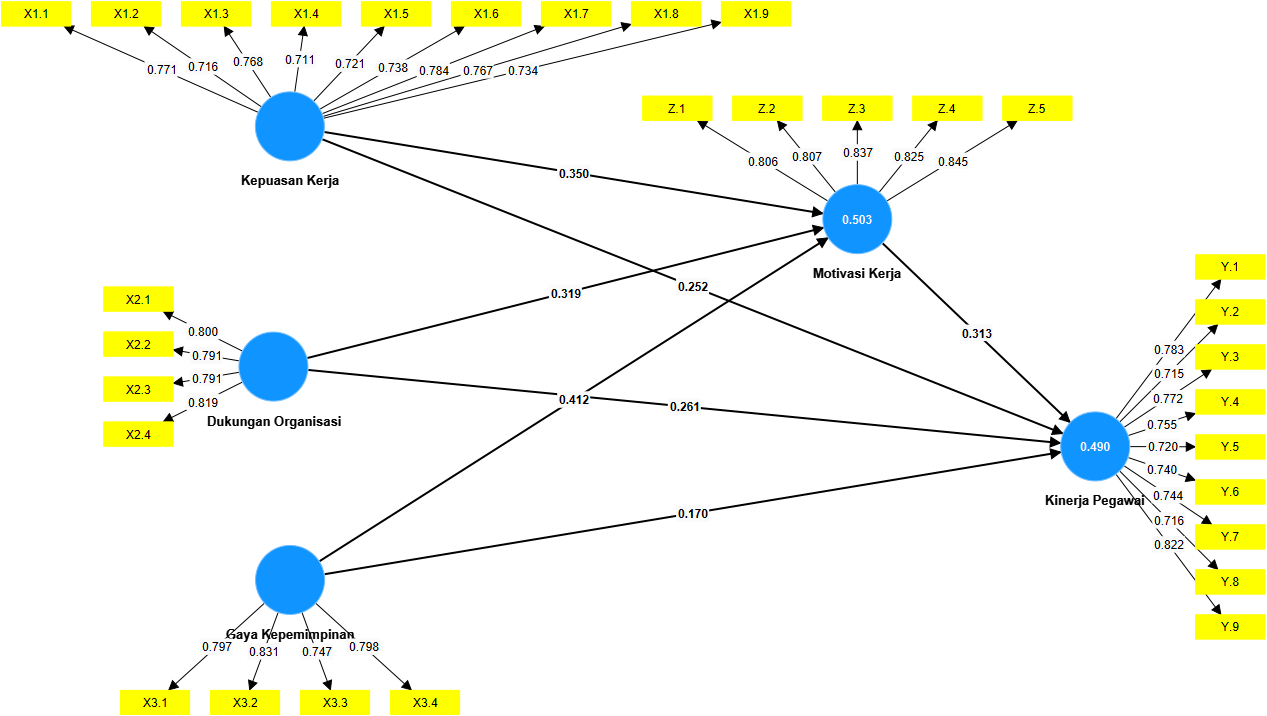
The path coefficients were computed to determine the strength and significance of the relationships between the constructs of the structural model. The results of the PLS-SEM analysis are provided in Table 3.
| Structural Path | O | M | STDev | T statistics | P |
| Perceived Organizational Support → Employee Performance | 0.261 | 0.270 | 0.080 | 3.257 | 0.001 |
| Perceived Organizational Support → Work Motivation | 0.319 | 0.321 | 0.066 | 4.844 | 0.000 |
| Leadership Style → Employee Performance | 0.170 | 0.171 | 0.084 | 2.033 | 0.042 |
| Leadership Style → Work Motivation | 0.412 | 0.409 | 0.060 | 6.886 | 0.000 |
| Job Satisfaction → Employee Performance | 0.252 | 0.259 | 0.072 | 3.497 | 0.000 |
| Job Satisfaction → Work Motivation | 0.350 | 0.351 | 0.061 | 5.735 | 0.000 |
| Work Motivation → Employee Performance | 0.313 | 0.300 | 0.097 | 3.220 | 0.001 |
Source: PLS-SEM analysis, 2026.
-
Job Satisfaction and Employee Performance: There exists a significant and positive impact of job satisfaction on employee performance (β = 0.252, t = 3.497, p < 0.001). From the positive value of the path coefficient, it shows that high levels of job satisfaction are related to improved performance by employees. Therefore, the hypothesis has been tested positively.
-
Perceived Organizational Support and Employee Performance: The results show that the relationship between perceived organizational support and employee performance is statistically significant and positive (β = 0.261, t = 3.257, p = 0.001). In other words, it means that the greater the perception of organizational support among employees, the higher their level of performance. Thus, the hypothesis about the positive impact of POS on employee performance is supported.
-
Leadership Style and Employee Performance: Leadership Style positively and significantly influences Employee Performance (β = 0.170, t = 2.033, p = 0.042). From the fact that the coefficient of leadership style is positive, it shows that better leadership style influences the performance of employees positively. Even though it is relatively small in magnitude, the statistical significance of the relationship means that it affects the performance of employees positively.
-
Work Motivation and Employee Performance: The influence of work motivation on employee performance is found to be positively and significantly correlated (β = 0.313, t = 3.220, p = 0.001). It can be seen from this result that work motivation leads to high performance of employees. In regard to all the direct predictors of employee performance considered in this study, work motivation has the highest path coefficient value.
-
Job Satisfaction and Work Motivation: Work motivation is positively and significantly influenced by job satisfaction (β = 0.350, t = 5.735, p < 0.001). This result implies that job-satisfied employees are likely to have higher levels of work motivation. Hence, the hypothesis suggesting that there is a positive influence of job satisfaction on work motivation holds true.
-
Perceived Organizational Support and Work Motivation: The perceived organizational support was found to have a significant positive impact on work motivation (β = 0.319, t = 4.844, p < 0.001). The finding indicates that the organization’s support in terms of appreciation of their efforts and care for their welfare increases the level of motivation among employees. Therefore, the formulated hypothesis stands justified.
-
Leadership Style and Work Motivation: There is a positive and significant relationship between leadership style and motivation to work (β = 0.412, t = 6.886, p < 0.001). This relationship is the strongest direct relationship in predicting work motivation from among all the predictors of motivation at work, showing how significant the role of leadership is in motivating employees.
In conclusion, the study provides evidence to show that job satisfaction, perceived organizational support, and leadership style have significant impacts on the work motivation and performance of employees. Moreover, the work motivation is a significant determinant of employee performance. These findings confirm the hypothesized structural relationship, and this suggests that work motivation may be an important mediating factor between the two variables.
Mediation Hypothesis Testing
Mediation analysis was performed to test the mediating role of work motivation in the associations between job satisfaction, perception of organizational support, leadership style, and employee performance. The indirect effect was tested through PLS-SEM bootstrapping. Findings are shown in Table 4.
| Indirect Effect | (O) | (M) | (STDEV) | T-Statistics | P |
| Job Satisfaction → Work Motivation → Employee Performance | 0.110 | 0.107 | 0.043 | 2.556 | 0.011 |
| Perceived Organizational Support → Work Motivation → Employee Performance | 0.100 | 0.095 | 0.034 | 2.909 | 0.004 |
| Leadership Style → Work Motivation → Employee Performance | 0.129 | 0.122 | 0.043 | 2.997 | 0.003 |
Source: PLS-SEM analysis, 2026.
From the results presented above, it can be observed that there is a strong mediation effect of work motivation between job satisfaction and employee performance (β = 0.110, t = 2.556, p = 0.011). The indirect effect is positive and statistically significant showing that job satisfaction leads to work motivation, hence improving employee performance. Consequently, the indirect effect hypothesis is validated.
In a similar fashion, work motivation acts as a strong mediator between perceived organizational support and employee performance (β = 0.100, t = 2.909, p = 0.004). This suggests that organizational support affects employee performance, at least partially through increasing motivation among employees. The more organizational support an employee perceives, the higher will be his/her level of work motivation, which would lead to better performance.
Fourthly, there is a very significant mediating influence of work motivation between the two constructs of leadership style and performance of employees (β = 0.129, t = 2.997, p = 0.003). This implies that an efficient leadership style has a positive indirect impact on work motivation of employees, which subsequently leads to better performance. Thus, the hypothesis about mediation role of work motivation is proved.
All in all, it can be concluded that the conducted mediation analysis proves that work motivation is a mediating variable which helps link job satisfaction, perceived organizational support, and leadership style to employee performance. Out of the three indirect effects, leadership style shows the highest indirect effect via work motivation (β = 0.129), while job satisfaction (β = 0.110) and perceived organizational support (β = 0.100).
5. Conclusion and Recommendations
Conclusion
The conclusions that may be inferred based on the empirical results and discussion include the following. Firstly, from the description above, it can be observed that there are positive perceptions from the employees concerning job satisfaction, perceived organizational support, leadership style, motivation, and performance at the Department of Trade, Cooperatives, and SMEs, and Bappeda of Pidie Regency.
Secondly, the structural model shows that job satisfaction, perceived organizational support, and leadership style positively influence motivation and performance of employees. It implies that good job atmosphere, sufficient organizational support, and effective leadership are some of the organizational variables necessary for improving motivation and performance of employees in the public sector.
Third, work motivation has been found to be an important mediator of the relationship between job satisfaction, organizational support, leadership style, and performance of employees. Mediation results indicate that job satisfaction, organizational support, and leadership style have a potential role in improving performance of employees through motivating them. Since direct effect of the above mentioned variables on employee performance is also significant, it indicates partial mediation in this case. It appears that both organizational variables and motivational factors of employees need to be considered for enhancing public sector performance.
Recommendations
Job Satisfaction and Work Motivation. The leadership of the Department of Trade, Cooperatives, and Small Medium Enterprises as well as Bappeda in the Regency of Pidie must improve both intrinsic and extrinsic aspects of job satisfaction and work motivation of its employees. These could consist of giving due recognition to accomplishments, career development, involvement in organization’s affairs, and utilizing the potential of the employees. These will help in fostering intrinsic motivation and performance.
Perceived Organizational Support. The leaders of an organization should foster among the employees the perception that their efforts are appreciated and their well-being is taken care of. This can be done through the enhancement of accessibility of work facilities, provision of equal access to training and development programs, and effective support to employees while performing their duties. Policy making and implementation could help further build up this trust among employees.
Leadership style. The leaders at these organizations are urged to use participative and situational styles of leadership. Communication in two ways, giving useful feedback, involving employees in decision-making processes, and delegating authority properly could foster a better working environment. These are expected to boost work motivation and improve performance of the employees.
References
- Cahyono, B., & Suharto. (2005). Pengaruh Budaya Organisasi, Kepemimpinan dan Motivasi Kerja Terhadap Kinerja Sumber Daya Manusia di Sekretariat DPRD Propinsi Jawa Tengah. JRBI, 1(1). DOI ↗ Google Scholar ↗
- Dewi, D. P., & Harjoyo. (2019). Manajemen Sumber Daya Manusia. Unpam Press. Google Scholar ↗
- Eliyana, A., Ma’arif, S., & Muzakki. (2019). Job satisfaction and organizational commitment effect in the transformational leadership towards employee performance. European Research on Management and Business Economics, 25(3), 144–150. DOI ↗ Google Scholar ↗
- George, J., & Jones, G. (2011). Understanding and Managing Organizational Behavior (6th ed.). Pearson. DOI ↗ Google Scholar ↗
- Gomes, F. C. (2021). Manajemen sumber daya manusia (Reguler). Andi. Google Scholar ↗
- Hartono, R., & Anggraini, S. (2023). Job satisfaction as a mediator of work environment and employee performance in service sectors. International Journal of Human Resource Studies, 13(1), 78–91. Google Scholar ↗
- Herzberg, F., Mausner, B., & Snyderman, B. B. (2011). The Motivation to Work. Transaction Publishers. DOI ↗ Google Scholar ↗
- Kamaluddin, L. A., Agunawan, & Sanusi, M. (2024). Pengaruh Kompensasi Dan Motivasi Terhadap Kinerja Pegawai. Economics and Digital Business Review, 5(1). Google Scholar ↗
- Kotler, P., & Armstrong, G. (2018). Principles of Marketing (17th ed.). Pearson Education. Google Scholar ↗
- Locander, W. B., Hamilton, F. E., Ladik, D. M., & Stuart, J. (2002). Developing a Leadership-Rich Culture: The Missing Link to Creating a Market-Focused Organization. Journal of Market-Focused Management, 5(2), 149–163. DOI ↗ Google Scholar ↗
- Mangkunegara, A. P. (2021). Manajemen Sumber Daya Manusia Perusahaan. Remaja Rosdakarya. Google Scholar ↗
- Mangundjaya, W. (2016). Psikologi Dalam Perubahan Organisasi. Swasthi Adi Cita. Google Scholar ↗
- Nanjundeswaraswamy, T. S., & Swamy, D. R. (2014). Leadership styles. Advances In Management, 7(2), 57–62. Google Scholar ↗
- Prasetyo, F. I. (2024). Manajemen Sumber Daya Manusia: Teori dan Kasus dari Sudut Pandang Individu dan Organisasi. Penerbit NEM. Google Scholar ↗
- Priyono, & Marnis. (2014). Manajemen Sumber Daya Manusia. In Journal of Chemical Information and Modeling (Vol. 53, Issue 9). ZIFATAMA PUBLISHER. DOI ↗ Google Scholar ↗
- Putra, T., Santoso, H., & Wibowo, A. (2023). Perceived organizational support and employee performance: The mediating effect of job satisfaction in Indonesian SMEs. Asian Journal of Management Studies, 12(3), 215–229. Google Scholar ↗
- Rahman, F., & Putri, D. A. (2024). Job satisfaction as a predictor of employee performance: Evidence from the public sector. International Journal of Human Resource Management, 35(1), 89–105. Google Scholar ↗
- Riantoko, R., Sudibya, G. A., & Sintaasih, D. K. (2017). Pengaruh Dukungan Organisasi Terhadap Motivasi Kerja Dan Kinerjaanggota Polsek Kuta Utara. E-Jurnal Udayana, 6(3), 1–15. Google Scholar ↗
- Rini, E. S., Retnowati, N., & Rosyafah, S. (2024). Pengaruh Motivasi, Lingkungan terhadap Efektifitas Kerja dan Kinerja Pegawai di Biro Pemerintahan Otonomi Daerah Provinsi Jawa Timur. Indonesian Journal of Management Science, 3(1), 23–32. DOI ↗ Google Scholar ↗
- Riono, S. B., & Indriyani, A. (2023). Pengaruh Dukungan Organisasi terhadap Komitmen Organisasional dan Kinerja. Jurnal Analisis Manajemen, 3(2), 215–232. Google Scholar ↗
- Robbins, S. P., & Judge, T. A. (2023). Organizational Behavior (19th ed.). Pearson. Google Scholar ↗
- Sari, M. P., Yulianto, A., & Hidayat, R. (2023). The influence of competence on employee performance: The mediating role of training in manufacturing industries. Journal of Business and Management, 25(4), 342–356. Google Scholar ↗
- Sari, N. K. (2019). Pengaruh Persepsi Dukungan Organisasi dan Keadilan Organisasi Terhadap Kepuasan Kerja. Psikoborneo: Jurnal Ilmiah Psikologi, 7(1), 120–128. http://dx. DOI ↗ Google Scholar ↗
- Seema, Choudhary, V., & Saini, G. (2021). Effect of Job Satisfaction on Moonlighting Intentions: Mediating Effect of Organizational Commitment. Europan Research on Management and Business Economics, 27, 1–11. DOI ↗ Google Scholar ↗
- Sekaran, U., & Bougie, R. (2019). Research Methods For Business A Skill Building Approach (7th Ed.). John Wiley & Sons. Google Scholar ↗
- Sugiyono. (2022). Metode penelitian kuantitatif, kualitatif, dan R&D. Alfabeta. Google Scholar ↗
- Suryani, N., Wibowo, A., & Prasetyo, D. (2024). The impact of job satisfaction on employee performance: Evidence from Indonesian manufacturing firms. Journal of Organizational Behavior, 45(2), 123–135. Google Scholar ↗
- Susanto, N. (2019). Pengaruh Motivasi Kerja, Kepuasan dan Disiplin Kerja Terhadap Kinerja Pegawai pada Divisi Penjualan PT. Rembaka. Agora, 7(1), 1–6. Google Scholar ↗
- Thoha, M. (2012). Perilaku Organisasi : Konsep Dasar dan Aplikasinya. Rajawali Pers. Google Scholar ↗
- Timmreck, T. C. (2001). Managing motivation and developing job satisfaction in the health care work environment. The Health Care Manager, 20(1), 42–58. DOI ↗ Google Scholar ↗
- Untari, N. M. R., Sujana, I. W., & Novarini, N. N. A. (2021). Pengaruh Kecerdasan Emosional, Motivasi Ekstrinsik, Dan Dukungan Organisasional Terhadap Kinerja Karyawan Pada Perumda Tirta Amertha Buana Kabupaten Tabanan. Jurnal EMAS, 2(3), 1–9. Google Scholar ↗
- Wibowo. (2019). Perilaku Dalam Organisasi (2nd ed.). Raja Grafindo Persada. Google Scholar ↗
- Wijaya, C., & Rifa’i, M. (2016). Dasar-Dasar Manajemen Mengoptimalkan Pengelolaan Organisasi Secara Efektif dan Efisien. PERDANA PUBLISHING. Google Scholar ↗
- Yammarino, F. J., Spangler, W. D., & Bass, B. M. (1993). Transformational leadership and performance: A longitudinal investigation. The Leadership Quarterly, 4(1), 81–102. DOI ↗ Google Scholar ↗