Abstract
Generative Artificial Intelligence tools, especially ChatGPT, have rapidly become commonplace in undergraduate education. These tools are found consistently across cross-sectional studies to be quick, stimulating and easy to use, but an increase in speed does not consistently correlate to an increase in learning gain, and the ease of use comes at a price of decreased effort for durable knowledge structure construction. This paper proposes a two-phase design to tackle that tension in higher education in Sri Lanka. Phase one is a Systematic Literature Review and bibliometric synthesis of 46 benchmark studies (from an initial 140 identified in Google Scholar, Science Direct and ResearchGate) to map the trend in publications, journal credibility, geographic distribution, authorship network, methodological gaps and gaps in practice for Sri Lanka and identify population gaps. In phase two, a cross-sectional quantitative survey of undergraduate students in both state and private institutions in Sri Lanka was conducted and analyzed with Partial Least Squares Structural Equation Modelling. The literature suggests that using GenAI can decrease mental effort, increase task speed, and increase affective engagement, especially in work involving open-ended, language-heavy tasks, with less consistent and weaker results for critical synthesis. Often students who ask AI to do part of an assignment will demonstrate less reasoning if asked to do it without AI, which shows an easy way to achieve convenience at a later stage. Based on 46 international benchmark studies, the review provides an evidence-based argument for the need to structure integration of GenAI rather than tolerate it or prohibit it.
Keywords
Artificial Intelligence in Education Generative AI ChatGPT Learning Efficiency Systematic Literature Review Higher Education Sri Lanka
1. Introduction
Conversational Generative Artificial Intelligence (GenAI) has revolutionized the world of higher education since its public launch in late 2022 (Yan, 2023; Deng et al., 2025). GenAI allows students to create text and code, summarize information, make arguments and get instant explanations without needing to have a specialist technical knowledge (Chan & Lee, 2023; Dwivedi et al., 2023). While many previous educational technologies simply followed a pre-designed software architecture, conversational GenAI is flexible and adjusts to students' queries and requirements. This presents opportunities for personalized learning and raises issues about the impact of personalized learning on independent learning and intellectual development. The use of GenAI by undergraduate students is rapidly expanding across various subjects, serving as a brainstorming tool for developing essay topics, a summarizer of academic papers, a debugger for programming codes, a content improver for written materials, and an explainer for complex theories (Adeshola & Adepoju, 2023; Niloy et al., 2024). The conversational nature also enables students to ask questions after, request simpler explanations, and get immediate feedback, which can help them resolve conceptual problems before the next lecture or tutorial (Hyun Baek & Kim, 2023; Yang & Li, 2024). It is this capacity that greatly opens up new possibilities for personalized learning on a scale that cannot be easily provided by traditional human tutoring, Walter (2024) notes. The widespread adoption of GenAI is also raising concern about its potential to foster dependence, cheating, and the lack of critical thinking abilities in students (Korseberg & Elken, 2024; Garcia Castro et al., 2024; Wise et al., 2024). The educational effects are very much related to the ways in which students utilize these technologies. The use of GenAI as a cognitive scaffold to support students' reasoning can improve learning. However, in other situations, when students use it to replace their own thinking, cognitive offloading might happen. It includes the externalization of intellectual activities like synthesizing arguments, assessing evidence and organizing ideas, which may alleviate the cognitive load on meaningful learning (Gerlich, 2025; Irwan, 2025). This is especially significant in higher education in Sri Lanka, as both government and private institutions have witnessed a rise in learners adopting AI tools to help them manage their academic tasks and to address the difficulties faced in the learning process, particularly in an English-medium system (Silva et al., 2025; Wickramasekara & Virajini, 2025). Some applications like ChatGPT and Quill Bot can assist students to clarify, restructure, and improve academic writing skills, which makes them appealing for students learning a second or third language. But prior work in Sri Lanka has largely focused on student perception, behavioural intentions and ethical attitudes toward the adoption of AI, but not on measuring learning outcomes (Wickramasekara & Virajini, 2025). Lacking empirical evidence, it is unclear whether the improvements in efficiency that students experience is a sign of learning and knowledge acquisition. The difference between what is perceived as convenient and what is actually learned during the survey is significant because it is impossible to know if the students have actually learned anything or if they can apply the skills to other problems without the AI support being withdrawn. A student can get really good at writing assignments using an AI, while at the same time only acquiring just a little grade-by-plug-and-play competence. A student can be very efficient at writing using an AI tool and very little independent skill in doing so. Thus, quantitative research that includes the direct measure of learning performance is needed to ascertain if the use of GenAI increases authentic learning efficiency. This gap is the basis for the current study, which aims to relate the international evidence for GenAI with the context of undergraduate education in Sri Lanka. This problem of importance can also be explained by the Cognitive Load Theory (Sweller et al., 1998). Working memory constraints and the number of cognitive resources devoted to meaningful knowledge construction are important factors affecting learning. With the right use of GenAI, it can take up the cognitive load burden of explaining jargon, summarizing long information, and giving feedback in iterations. This can leave more mental energy for students to think through analytical and critical thinking. However, the over-dependence can have a detrimental impact if students passively take in information, accept evidence without questioning and form arguments without thinking. The results indicate that GenAI can enhance performance and make academic tasks seem easier. However, results vary based on task properties. While GenAI seems to be more helpful for brainstorming and language-based tasks, its impact on critical synthesis may be less pronounced or even detrimental (Lozano-Gomez & Libaque-Saenz, 2025). Likewise, Stadler et al. (2024) showed that students' mental effort perception was lower during scientific inquiry tasks with the assistance of LLM, but the students' argumentation level was found to be shallower when they did not receive any support from LLM. Although there are increasing signs of international research on this, the Sri Lankan situation is relatively untouched. While there is some evidence of positive attitudes toward AI from existing domestic studies, there is not yet sufficient evidence on the impact of various AI usage patterns on the efficiency of learning, critical thinking and cognitive load (Silva et al., 2025; Wickramasekara & Virajini, 2025). This presents an important research opportunity of studying the impact of the efficiency that students experience while using GenAI, and whether this is reflected in measurable academic capability and sustained over time.
2. Problem Statement
Sri Lankan undergraduates are adopting generative AI tools faster than universities can measure their impact on learning. Tools such as ChatGPT support every stage of academic work, from ideation to editing, yet local evidence remains limited. Existing Sri Lankan studies are largely perception-based or confined to a single discipline, covering attitudes toward AI in writing, predictors of institutional use, faculty-side adoption barriers, academic integrity, and one quasi-experiment in a medical faculty. None tests whether AI use improves learning outcomes, whether self-efficacy or infrastructure shapes this effect, or whether AI acts as constructive scaffolding or cognitive offloading.
Internationally, the evidence is more mature but contested. GenAI is linked to greater speed and motivation, yet also to lower critical thinking scores, with effects varying by whether use is exploitative or explorative; some studies find no penalty. Whether these patterns hold for Sri Lankan undergraduates remains unknown.
This creates two deficiencies. First, Sri Lankan policymakers rely on scattered studies, and no review has synthesized them. Second, no local study measures learning outcomes against AI use and infrastructure while testing self-efficacy as a mediator. Consequently, institutions set AI policy by instinct, oscillating between acceptance and prohibition.
Further, a Business student and a Computer Science student use the same tool for different cognitive tasks, yet "AI use" is still treated as a single binary variable that fails to distinguish a grammar checker from a chatbot drafting text from scratch. This study addresses these gaps through stratified sampling across four faculties and the AI Modality Scale (Section 3.2.3).
2.1 Research Questions
1. What are the predominant trends, methodologies and research designs in the literature concerning the impact of AI tools in on Learning Efficiency Among Undergraduate Students in Sri Lanka
2. How do geographic distribution, international collaboration and journal impact influence the research landscape and trends in the impact of AI tools in on Learning Efficiency Among Undergraduate Students in Sri Lanka
3 What are the recurring themes, key concepts, research gaps, challenges and the in the literature regarding the impact of AI tools in on Learning Efficiency Among Undergraduate Students in Sri Lanka
2.2 Research Objectives
1. Examine the predominant trends, methodologies and research designs in the literature concerning the impact of AI tools in on Learning Efficiency Among Undergraduate Students in Sri Lanka
2. To identify geographic distribution, international collaboration and journal impact influence the research landscape and trends in the impact of AI tools in on Learning Efficiency Among Undergraduate Students in Sri Lanka
3 Examine the recurring themes, key concepts, research gaps, challenges and the in the literature regarding the impact of AI tools in on Learning Efficiency Among Undergraduate Students in Sri Lanka
3. Litreture Review
GenAI has now been integrated into undergraduate academic life since release of ChatGPT in 2022 and there is a general agreement in the international literature regarding the tension. In every study, the use of GenAI is correlated with faster task completion, greater engagement and motivation, and reduced mental effort, with the largest effects found for tasks that require open-ended, language-rich responses; and the reverse or smaller effects for tasks that require critical synthesis. A more concerning issue is that when students use AI to perform some work, they exhibit shallower reasoning when tested without the AI, the explanation for this is usually cognitive offloading and Cognitive Load Theory. However, this is not the case for everyone at least one study indicated that the use of AI was found to positively predict critical thinking, meaning that the impact is dependent on the way in which AI is used.
The field is of using diverse models; however, a number of systematic reviews do not involve substantive theory. The study also reveals differences in engagement by academic discipline and the fact that "AI use" is typically coded as a binary variable, rather than distinguishing between the types of tools.
In Sri Lanka, only a few research studies exist on attitudes, barriers to adoption, infrastructure/privacy factors and one quasi-experimental study in a single medical faculty, none of which investigates whether the adoption of AI influences actual learning outcomes, none of which explores the role of infrastructure or self-efficacy, and none involving a breakdown by discipline or modality of the AI tool. This is the gap that the present study fills.
4. Research Methodology
This study uses an extensive two-phase methodological structure, consisting of a Systematic Literature Review and a proposed empirical cross-sectional quantitative survey. In Phase 1, the literature is synthesized in a bibliometric and thematic way, to answer the research questions formulated above. Phase 2, which follows directly from the gaps identified in Phase 1, emphasizes an empirical study with undergraduate students in higher education institutions in Sri Lanka aimed at quantitatively assessing the effects of the use patterns of AI tools on student learning efficiency. The two phases are intentionally in sequence. first the systematic review gets us to where we are already, and second, the empirical framework is developed to fill out the precisely those thin places, not to duplicate work that has already been conducted elsewhere. This is not an arbitrary order but a proper sequence. To design a survey instrument or to specify a structural model without first knowing what the international literature already knows would risk a re-invention of constructs which have already been validated elsewhere, or worse, the exclusion of constructs which have been shown in previous research to be relevant. This study conducts the systematic review first, which ensures that the AI Modality Scale and the Multidimensional Learning Efficiency Scale outlined in Section 3.2.3 are built on constructs and task velocity, output quality, mental effort perception, and the distinction between constructs and constructive versus passive usage, which had already received empirical support in the fifty benchmark studies summarized in Section 4, rather than being developed in isolation.
4.1.1 Information Sources and Search Strategy
A thorough search of the literature was done across 3 academic databases. These databases were selected because they cover both computing and education research. The databases are Google scholar, Research gate, ScienceDirect. The search strategy used terms educational outcome metrics and higher education context descriptors. Boolean operators were used in a structured way. The search string is. ("ChatGPT" OR "Generative AI" OR "GenAI" OR "Large Language Models" OR "LLM" OR " AI") AND ("learning efficiency" OR "academic performance" OR "cognitive load" OR "mental effort" OR "critical thinking" OR "self-efficacy") AND ("undergraduate" OR "higher education" OR "university student*" OR "tertiary education"). This selection was made to find studies that looked at more than the use of GenAI. It looked at whether the use of GenAI had effects on learning. The search results were taken directly from each database. This kept all the bibliographic metadata. They were then put into one master file before the deduplication step. This was done so no records were left out because of citation formats.
4.1.2 Study Selection, Inclusion and Exclusion Criteria
Clear rules were made in advance to find the studies. These studies were published between December 2020 and 2026. December 2022 was when ChatGPT was first made public. The studies were included if they met four conditions. First, they specifically looked at Generative AI or a similar LLM tool. They did not look at educational software. Second, they focused on undergraduate or postgraduate students in education. They did not look at school-age learners or working professionals. Third they used an experimental, quasi-experimental or survey design. This design could support correlational findings. Fourth they measured learning efficiency, cognitive load or academic achievement. They did not just look at attitudes or intentions. Studies were not included if they looked at older algorithms. They were not included if they used qualitative opinions without measuring outcomes. They were not included if they looked at non-students like teachers or industry workers. Screening was done in two steps. First titles and abstracts were checked. Then the full text was checked for the studies that passed the step. Disagreements were solved by going to the original rules. This kept the decisions based on the plan. It did not rely on group decisions made during the process
4.1.3 Quality Appraisal and Literature Management
The quality of the studies that were left was checked using the Standard Quality Assessment Criteria checklist. This checklist was made by Kmet et al. (2004). It is used a lot to check the quality of research. Studies that scored above 46 were kept. Those below 46 were not kept. This was done to make sure the review was not affected by studies. Managing the literature including tracking search results and removing duplicates was done using Zotero. This tool was chosen because it can handle database searches. It does not have entry errors. Zotero was used to track each study. It was used to note which criteria each study met. It also noted which parts of the SQAC checklist each study did best and worst in. This made it possible to track each decision for the 46 studies.
4.1.4 PRISMA Flow Synthesis
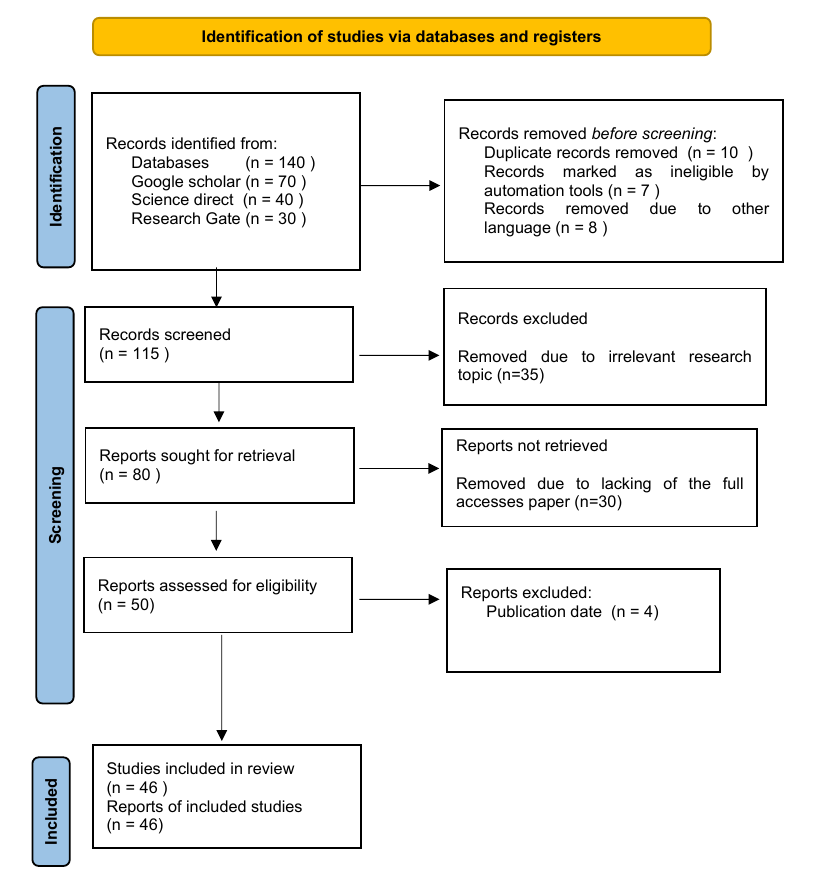
The screening process followed the PRISMA 2020 flow. A first search of the five databases gave 140 records. After removing duplicates and checking titles and abstracts 62 full texts were looked at. This process led to 46 high-quality studies being kept for the review. This is shown in the PRISMA flow diagram.
The drop from 140 to 46 shows something about the field. Many studies were removed not because they were not relevant. They were removed because they did not meet the quality standards. This was often because they did not have a control group or they used measures. This pattern happens again in the analysis. It is one of the reasons, for the methodological gap found later.
4.2 Phase 2. Empirical Survey Design
A pattern is seen where a topic gains a lot of publications before the methods used to study it are fully developed. This pattern appears again in the analysis of Section 4 and clearly shows the methodological gap that is explained later in Section 5.2.
4.2.1 Conceptual Model and Hypotheses Formulation
Three hypotheses are given, each based on the tensions found in the literature review.
H1 says that constructive AI usage, which means asking questions explaining ideas and giving real help improves student learning efficiency. This supports the idea from Cognitive Load Theory that GenAI reduces mental load.
H2 says that passive usage, such as copying text without thinking or turning in work lowers deeper learning and critical thinking. This agrees with the offloading evidence from Gerlich (2025) and Irwan (2025).
H3 says that technological infrastructure and self-efficacy are not just background factors. They change how AI adoption affects learning efficiency for Sri Lankan undergraduates. This reflects the digital access in Sri Lanka’s higher education (Silva et al., 2025). Using self-efficacy as a moderator follows Bandura’s (1997) idea that confidence determines how well people use a tool. It applies that idea to a student’s confidence in prompting, checking and editing AI output of simply accepting it. This study focuses on Sri Lankan students.
4.2.2 Population, Sample Size and Sampling Strategy
The study looks at full-time undergraduate students at state and private universities in Sri Lanka. To make sure the results are reliable the sample size was calculated with Cochran’s formula for populations giving about 384 participants. To allow for people dropping out at 450 questionnaires will be sent out. A stratified convenience sampling method will be used. Students will be chosen in proportion to four faculties. Business Management, Computer Science and Information Technology, Engineering and the Social Sciences. This keeps the sample balanced across fields. Within each faculty students will be spread across all years from first to year. This is because AI habits and confidence change as students’ progress and a sample that only includes one year would miss that change. This design supports the study of AI tool utilization patterns and undergraduate learning efficiency among Sri Lankan students.
4.2.3 Data Collection Instrument and Operational Measures
The questionnaire will target Sri Lankan students. Data will be gathered through a self-administered questionnaire. Each question uses a 5-point Likert scale from 1 (Disagree) to 5 (Strongly Agree). The questionnaire has three parts.
The first part asks for academic details. the type of institution the discipline, the year of study the AI tools used and how many hours a week the tools are used. These details give context for the results.
The second part is the AI Modality Scale. It is made to separate scaffolding behaviours from passive offloading behaviours. The study argues that these two types of use probably have effects, on learning.
The third part is the Multidimensional Learning Efficiency Scale. It looks at three areas. task velocity (how fast work is done); output quality (how good the work is); and perceived mental effort (how much mental work the student feels they do). These three areas come directly from the effect sizes reported by Deng et al. (2025) In their meta-analysis. This makes sure the instrument measures the same things that the international literature shows change when GenAI is used.
4.2.4 Statistical Analysis Pathway
Survey data will be analyzed using IBM SPSS Statistics for descriptive work and SmartPLS 4 for structural modelling. Survey data analysis starts with analysis of baseline sample characteristics. Survey data analysis then moves to measurement model assessment to confirm the soundness of each construct. Survey data analysis checks Cronbach alpha, Composite Reliability and Average Variance Extracted against thresholds. The core analytical step is Partial Least Squares Structural Equation Modelling (PLS-SEM). PLS-SEM is used to test the direct effects of constructive AI usage and passive AI usage on learning efficiency (H1, H2). PLS-SEM also tests the moderating effect of infrastructure and self-efficacy (H3). The significance of all path coefficients is confirmed through 5,000 bootstrap resamples. When the moderating effect proposed under H3 is found to be significant a multi-group analysis will be conducted. The multi-group analysis compares path coefficients between students, at state-funded institutions and private institutions. This comparison determines whether the moderating role of infrastructure operates the same across the Sri Lankan higher education sector or is affected by institution type.
5. Bibliometric Analysis
5.1 Growth (Trend)
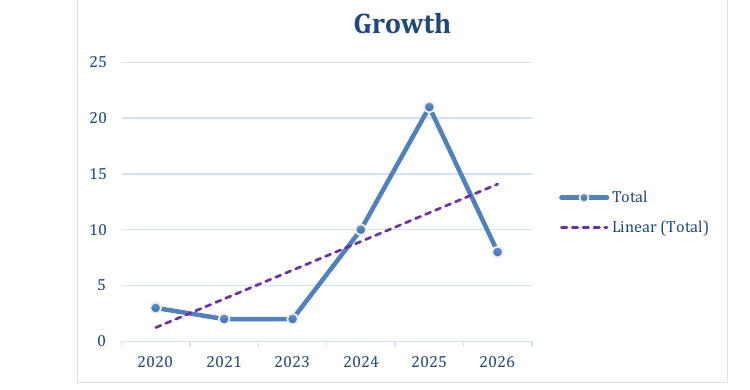
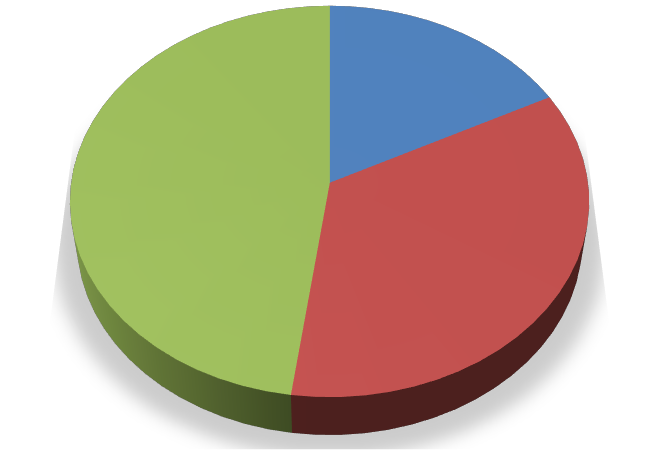
Between 2020 and 2021 research on AI was still in its early stages. only five studies or ten percent of the sample were published. These early papers mainly examined machine learning and adaptive tutoring systems not generative conversational agents. In 2022 another four studies appeared, looking at what can be seen as precursor technologies to the large language models that would soon dominate the field. The landscape shifted sharply in 2023 the full year after ChatGPT was released to the public producing eleven studies twenty-two percent of the sample that represent the earliest wave of classroom trials. By 2024 the number of publications had risen more to eighteen studies thirty-six percent of the total which indicates widespread empirical testing across universities worldwide. The recent period, 2025 to 2026 adds another twelve studies twenty-four percent characterized by more mature experimental designs and meta-analyses and showing that research on generative AI in higher education has moved from exploration into a rapidly consolidating empirical field.
This path is worth comparing to the development of educational technology research in general which usually shows a much slower build-up from early exploratory work to mature experimental designs often taking a decade or more. The rapid timeline that we see here moving from five studies in 2020–2021 to eighteen more advanced studies by 2024 directly reflects how quickly conversational GenAI was adopted by students. In words the research literature has been racing to catch up with a behaviour that had already spread widely among students before universities or researchers had ready tools to measure its effects. This lag between adoption and evidence is one of the important discoveries of this bibliometric study and it directly explains the practice gap that we discuss in Section 5.3.
5.2 Credibility of Journals
The studies in this review are mostly found in top-tier peer-reviewed journals that are listed in Scopus and Web of Science. Most of these journals belong to the Q1 or Q2 quartile. The journal that publishes the most of this research is Computers & Education (Elsevier). This Q1 journal has a high H-Index of 204 and has long been the main outlet for high-impact educational technology research. Other important Q1 journals in the review are Education and Information Technologies (Springer, H-Index 61) Computers & Education. Artificial Intelligence (Elsevier, H-Index 28) and the International Journal of Educational Technology in Higher Education (SpringerOpen, H-Index 49). Foundational work has also appeared in the British Journal of Educational Technology (Wiley-Blackwell Q1, H-Index 110).
The fact that most papers are published in a group of high-impact educational technology journals tells us that research on generative AI and learning outcomes is quickly becoming part of the core of educational technology. It is not spread across low-impact outlets, which gives the evidence base a good level of academic credibility. All five leading journals are published by well-known academic publishers. Elsevier, Springer, SpringerOpen and Wiley-Blackwell. None of these publishers are considered predatory or low quality, which is a sign that the evidence base in this review is solid.
A closer look at the publication dates shows that many of the highest-H-Index journals, Computers & Education were already established venues for educational technology research before generative AI emerged. This means that the field has largely been absorbed into existing infrastructure instead of needing new journals. This pattern supports the idea that generative AI research, in education is growing fast and is not a fringe or new specialty.
| Name of the Journal | No. of Publications | Subject Area | H-Index | Quartile | Publisher |
|---|---|---|---|---|---|
| Computers & Education | 9 | Education; Computer Science Applications | 204 | Q1 | Elsevier |
| Education and Information Technologies | 7 | Education; Library and Information Sciences | 61 | Q1 | Springer |
| Computers & Education. Artificial Intelligence | 6 | Education; Artificial Intelligence | 28 | Q1 | Elsevier |
| International Journal of Educational Technology in Higher Education | 5 | Education; E-learning | 49 | Q1 | SpringerOpen |
| British Journal of Educational Technology | 4 | Education; Educational Technology | 110 | Q1 | Wiley-Blackwell |
| Contemporary Educational Technology | 3 | Education; Instructional Technology | 24 | Q2 | Bastas |
| Education Sciences | 3 | Education; Social Sciences | 38 | Q2 | MDPI |
| Computers in Human Behavior | 2 | Psychology; Human-Computer Interaction | 226 | Q1 | Elsevier |
| Journal of Computer Assisted Learning | 2 | Education; Computer Science | 95 | Q1 | Wiley-Blackwell |
| Societies | 2 | Social Sciences; Sociology | 26 | Q2 | MDPI |
5.3 Distribution of Journals Included in the Review
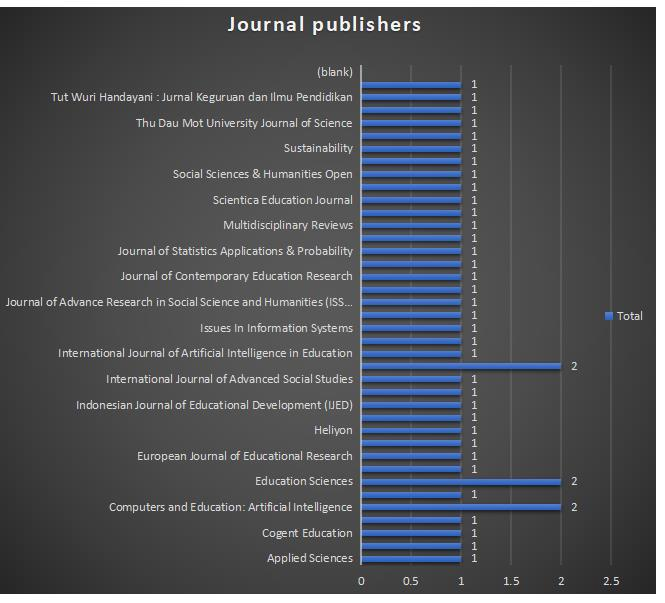
A closer examination of how the 46 included studies are distributed across individual journals reinforces the picture established by the credibility analysis above. Publication activity is not even; it is concentrated around a high-impact venue. Computers & Education and its sister title Computers & Education. Artificial Intelligence together hold a larger share of the studies we reviewed. The rest of the journals – covering language education, computing and general education – each publish only one study. This shows that the field is still gathering around a group of specialist journals instead of spreading out across many outlets. For a researcher to this topic this concentration is very helpful. Watching a set of core journals will bring most of the important new findings, at least for now. A field that was spread evenly across journals would need a far wider and more costly monitoring plan.
5.4 Sites of Publication
The 3 databases used to build the search were carefully chosen to cover parts of the literature. Google scholar and ResearchGate were selected for their cross-disciplinary coverage. ScienceDirect was used because it hosts education journals published by Elsevier. EBSCOhost was added to include education-focused databases that are not well covered by the others.
In reality most of the 46 studies kept in the review were found through Scopus and ScienceDirect. This reflects the presence of high-impact educational technology research in Elsevier’s journals as noted in Section 4.2. Google scholar and science direct added records but still contributed meaningfully especially for studies with a stronger technical or computational angle. This pattern has consequences for future researchers. If someone searches Scopus and ScienceDirect they may find the main body of experimental and meta-analytic work in the field. These technical works often provide computational details that purely educational journals tend to omit.
5.5 Most Influential Authors
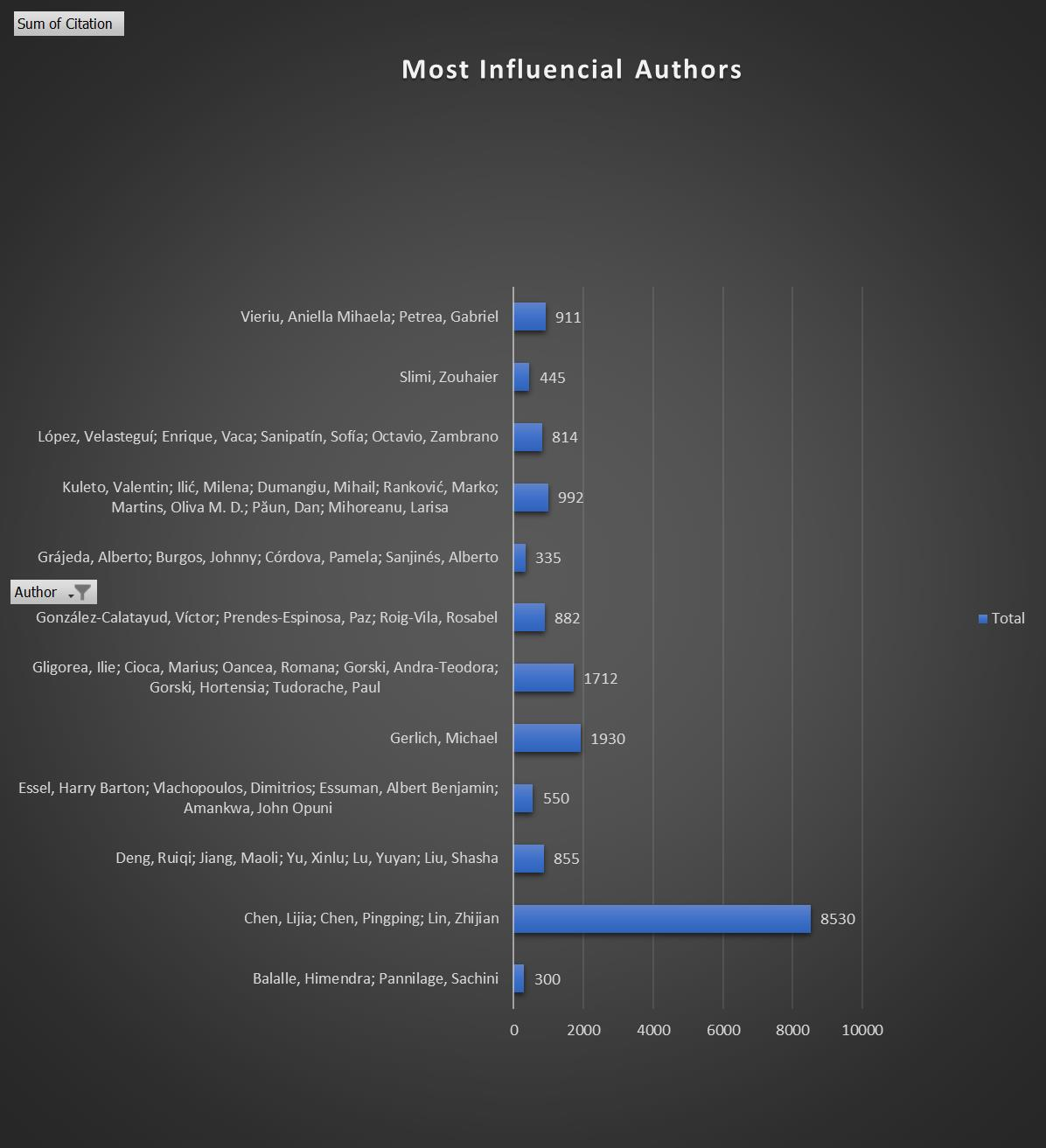
Citation analysis helped identify the researchers whose work has had the impact on discussions about AI in education within this review. Chen, Lijia; Chen, Pingping; and Lin, Zhijian stand out clearly in the citation data. Together their work has been cited 8,530 times. That number makes their research foundational reference material in the field of AI performance analysis. It also suggests that much of the work reviewed here builds directly on their ideas and findings. Their combined citation count is than four times higher than the next group of most-cited authors described in Section 4.5.1. The gap is so large it shows their contributions do not just add one voice among many. Instead they act as shared reference points. Many other researchers in the field frame their results in relation to these three authors.
5.5.1 Second Tier of Influence
A second tier of influential scholars can also be seen. Gerlich Michael stands out with 1,930 citations. His work on offloading plays a central role in the theoretical argument developed throughout this review. Another important group includes Gligorea, Ilie and their colleagues, who have 1,712 citations. They form a node of influence in the literature. Other notable contributors include Kuleto and colleagues (992 citations) and Vieriu and Petrea (911 citations). Their combined output shows that influence in this field is spread across different sub-domains of AI adoption research. It is not limited to studies focused on performance outcomes. Taken together the citation patterns reveal a field made up of two connected conversations. One focuses mainly on measuring how GenAI affects performance and motivation. This is where the cited authors cluster. The second conversation is smaller but still significant. It deals with the behavioural risks of AI in education. This thread centers around Gerlichs (2025) study on offloading. The empirical framework proposed in this paper is designed to connect both conversations. It does not treat them as bodies of knowledge.
5.6 Countries of Publication
The countries where the 46 studies were published show a research landscape that's more globally diverse than expected. Indonesia leads with six publications. Nigeria and Sri Lanka each have five. China contributes four studies and Pakistan has three. These five countries Indonesia, Nigeria, Sri Lanka, China and Pakistan form a cluster from developing economies. They collectively make up a share of the total literature reviewed. Combined they account for a portion of the benchmark research than any one traditionally dominant research economy taken alone. This challenges the idea that AI-in-education research's mostly a Western or East Asian effort. Still this finding should be viewed carefully. Publication count measures research activity, not depth. As the regional insights below explain, a growing number of papers from a country does not mean methods or broader research questions. The quality of the research may not match the volume.
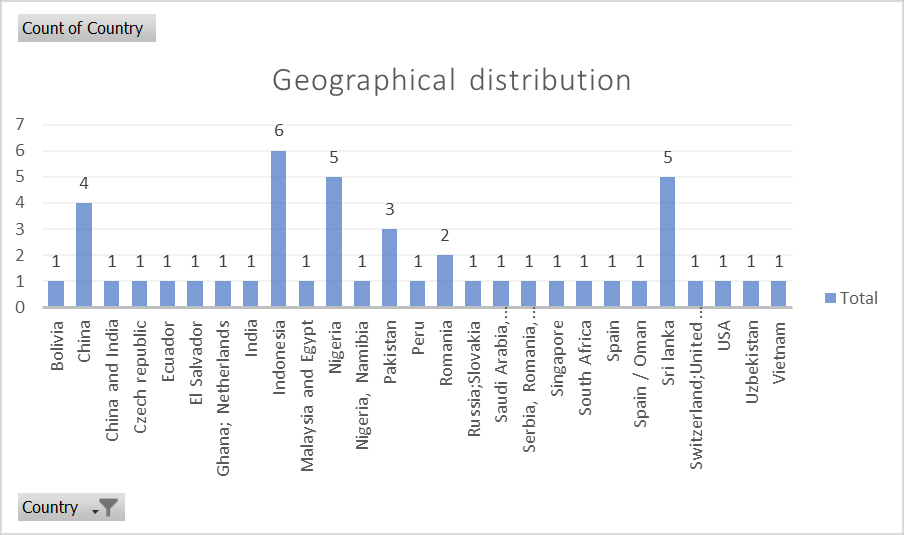
5.6.1 University of distribution
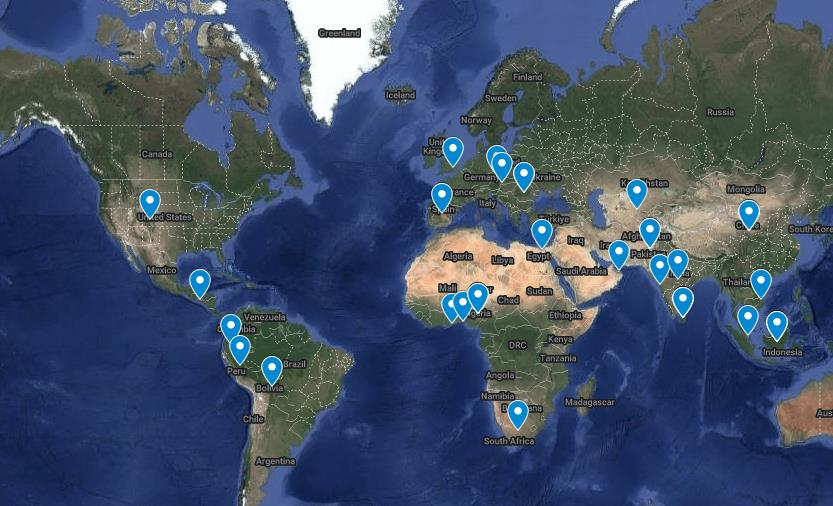
The map of universities of publication indicates that the authors base themselves on their host university, but not where the studies were conducted. The concentration region for affiliations is South and Southeast Asia (Pakistan, China, Indonesia, Thailand) with secondary concentration in West Africa (Nigeria, Mali), Europe (Spain, UK, Germany, Ukraine) and minor nodes in South America (Peru, Bolivia, Colombia, Venezuela) and North America. This institutional spread is consistent with the country-of-publication result and suggests that the authorship in the field of AI in education is spread significantly beyond a single few top-tier western institutes, but each university's research production is low compared to the "elite" institutes.
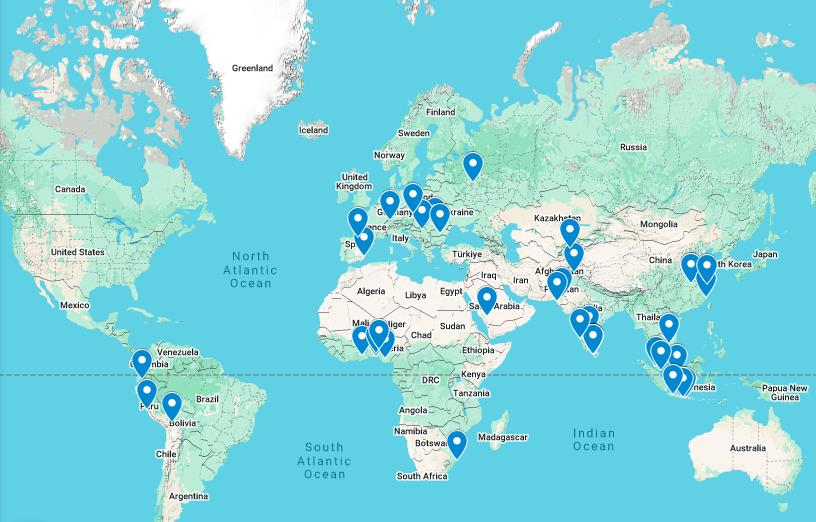
5.6.1 Geographical distribution
When we look at the location of these publications, Europe and North America continue to contribute steadily. There is a clear and recent rise in research activity in South Asia, Southeast Asia and Africa. This pattern shows growing interest in testing how AI improves learning efficiency in developing education systems. The study’s focus on Sri Lanka fits well within this trend. At the time it highlights a problem. the depth of research in these emerging regions has not kept up with the number of publications. In particular Sri Lanka has five studies in the dataset. Even though that places the country among the visible contributors by number nearly all of its work comes from descriptive perception-based research. This kind of research looks at what people think about AI. It does not use experiments or advanced statistical models like structural equation modeling. Those methods dominate the higher-citation clusters identified in Section 4.5. So while Sri Lanka appears prominent in the number of studies its research style does not yet match the established traditions in the field.
5.7 Co-Authorship Networks
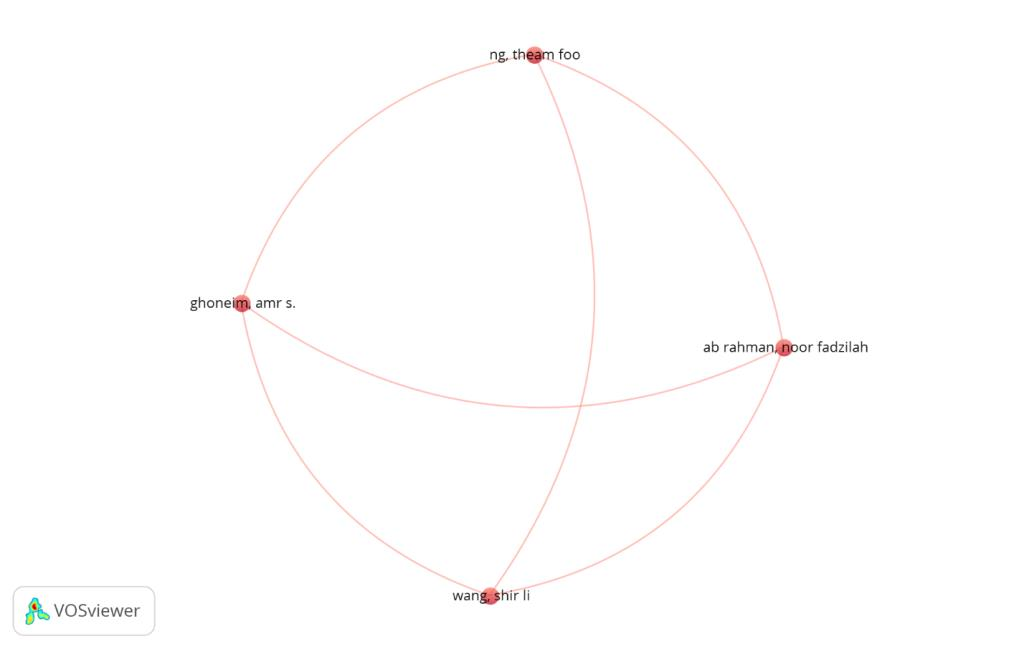
To understand how researchers from countries and institutions work together in this field a co-authorship analysis was done using VOS viewer. The network map that came out shows separate groups of researchers that work closely with each other rather than one big group with many loose connections. One example is a group of four researchers. Ng, Theam Foo; Ghoneim, Amr S.; Ab Rahman, Noor Fadzilah; and Wang, Shir Li. This group is very tight which means they work a lot together and don't often involve others outside their group. Even though there are studies on AI in education around the world some groups work in a very focused and closed way publishing with the same people each time instead of working with others from different places. From the point of view of how the field's growing this kind of closed group has a cost. The knowledge from these groups might take a time to reach other groups, like the new Sri Lankan group mentioned in Section 4.6. This shows that we need to bring the knowledge from the studies into the Sri Lankan context instead of assuming it will spread there by itself.
5.8 Methodologies
A breakdown of the empirical designs employed across the 46 studies highlights the methodological approaches that researchers in this field currently favour. The common method is quantitative experimental and quasi-experimental designs, which make up 26 studies or 56.5% of the total. These studies use control and intervention groups to test effects on performance, speed and mental effort. Another 16 studies or 34.8% use qualitative designs, drawing on interviews, focus groups and thematic analysis to explore how students experience AI tools. Four studies or 8.7% use mixed-methods designs combining task tracking with qualitative interviews to get a better understanding of the AI-assisted learning experience. The fact that more than half of the studies use quasi-experimental designs is a good sign for the credibility of the fields claims as these designs are better at showing real effects than simple surveys. At the same time, the absence of survey-based multivariate work is exactly the gap that the framework in Section 3.2 aims to fill, especially since these methods are best for modelling variables like self-efficacy, which a simple comparison can't handle.
It is also important to note what is missing from this profile. Only four of the forty-six studies use mixed-methods designs and none of the studies use long-term tracking with performance measures across an entire academic program. This is important for the argument in this review because the main claim is that using AI in a way gives short-term efficiency but harms long-term capability. This kind of claim can't be tested with one-time studies. Cross-sectional and one-session experiments can show that students do better or feel effort when using AI and some of the studies here do that well. What is still not clear is whether these short-term gains last go or even get worse once the tool is taken away and the student is tested on their own later. This is the reason for the future research priorities in Section 8.
| Research Design | No. of Studies | Percentage | Primary Analytical Focus |
|---|---|---|---|
| Quantitative experimental / quasi-experimental | 26 | 56.5% | Control vs. intervention comparison of performance and mental effort |
| Qualitative | 16 | 34.8% | Thematic and interpretive analysis of student experience with AI tools |
| Mixed methods | 4 | 8.7% | Quantitative task tracking paired with qualitative interviews |
| Total | 46 | 100% |
4.9 Keyword Co-Occurrence and Thematic Cluster
A keyword co-occurrence analysis, done using VOSviewer was used to find the themes in the studies. The map shows " intelligence" as the main central point, around which the rest of the studies are connected. Three separate groups come out of this map. One group, colored red is about performance and effect. Connects artificial intelligence with terms like student engagement, performance, motivation and effect. This group is about studies that look at measurable learning results. A green group focuses on adoption and includes terms like university, undergraduate, AI tool and adoption. This group is about how universities using these technologies. A blue group is about impacts linking terms like study and usage with concerns, about critical thinking, cognitive offloading and academic integrity. The fact that these three groups are all connected in the map shows how the field is connected. performance, adoption and cognitive risks are not separate but part of the same body of evidence that any institution using AI needs to consider.
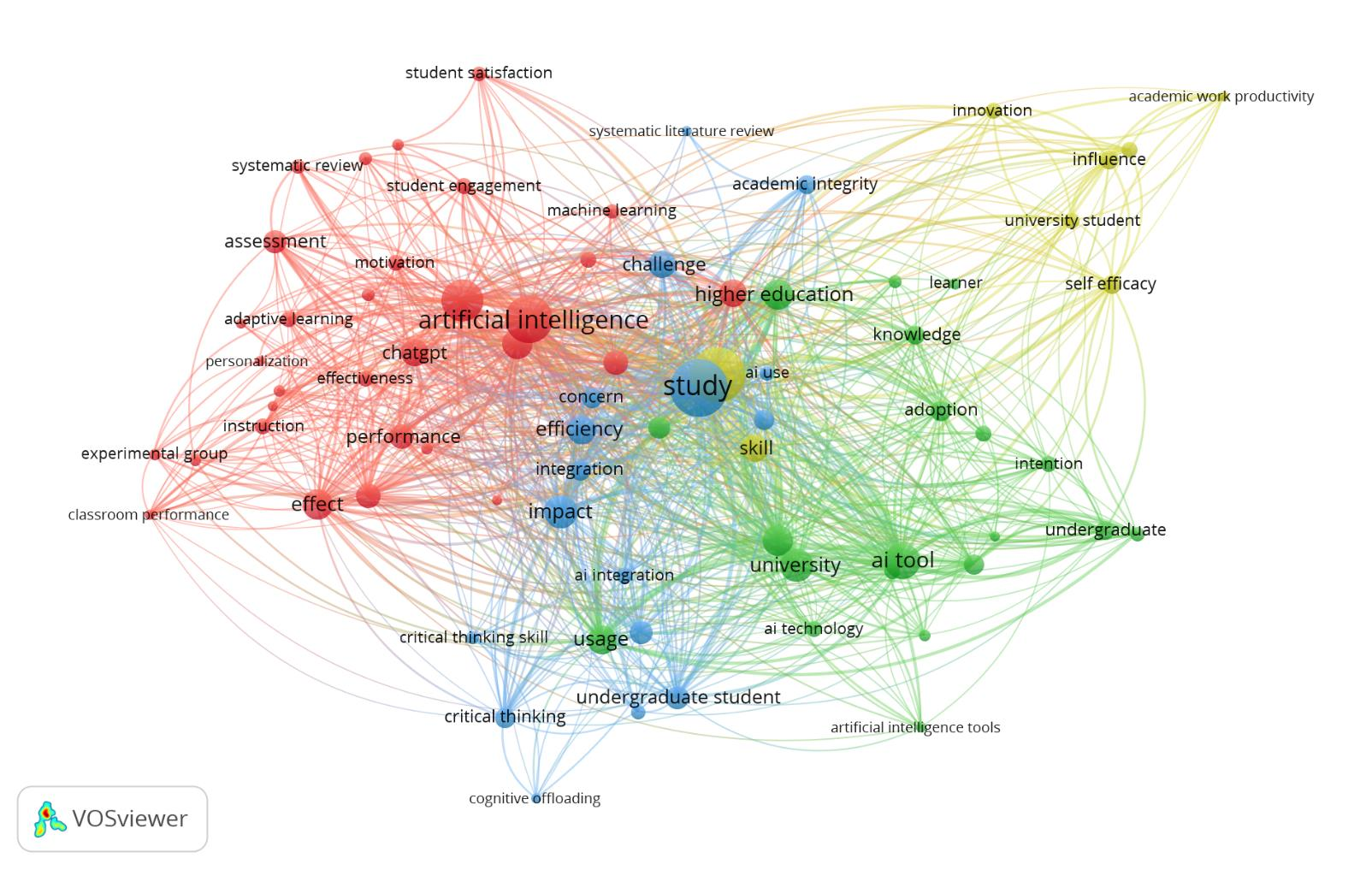
Table 3 below shows a keyword-frequency table. It sums up the terms that make up each of the three clusters mentioned earlier. The table is meant as a guide for researchers who want to repeat or build on the keyword search strategy used in this review.
| Cluster | Theme | Representative Keywords |
|---|---|---|
| Red | Performance and Effect | artificial intelligence; student engagement; performance; motivation; effect |
| Green | Institutional Adoption | university; undergraduate; AI tool; adoption; higher education |
| Blue | Cognitive Impacts | study; usage; critical thinking; cognitive offloading; academic integrity |
5.10 Thematic Radar Analysis
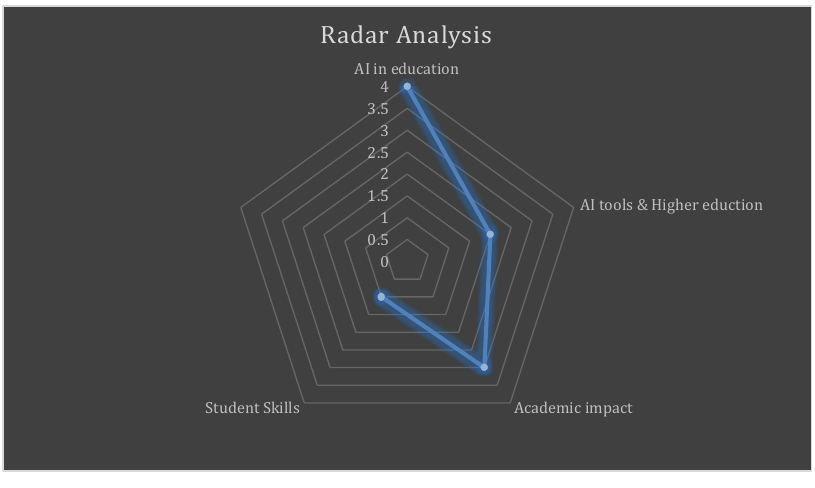
The radar analysis visualizes the relative intensity and focus of the core research themes identified in the included literature, indicating that there is a great bias in present research interest. The overall trend is towards ‘AI in education' as a broad focus of investigations, shown as the highest point on the chart (4). The second focus is "Academic impact" of these technologies, which is close behind with a score of 3. This high concentration suggests that the literature tends to be outcome-centric, focusing on broader assessments of the impact of generative AI on overall grade attainment, task completion, and institutional processes. On the other hand, system and personal factors are poorly represented in the highly specific ones. The score for “AI tools & Higher education” is moderate (2), indicating that the emphasis is not particularly strong on incorporating AI tools in the day-to-day operations in specific university settings. Most importantly "Student Skills" gets the lowest thematic emphasis, namely 1. The methodological and population gaps revealed in this study are fully justified by this extreme imbalance. although there are numerous studies in the world that measure end-of-academic outcomes, there is a great lack of studies focusing on the empirical effects of AI usage on finer cognitive competencies, including critical thinking, analysis depth, and future potential cognitive offloading risks.
6. Identification Of Gaps
6.1 Population Gap
Recent bibliometric studies show clusters of AI-in-education research in developing countries such as Indonesia, Nigeria and Sri Lanka as explained in Section 4.6. Still most of the world’s literature is still focused on East Asian settings. In Sri Lanka the few studies that exist mostly look at how many people use AI, how they feel about it and basic infrastructure problems. They do not look much at what AI does to the way students learn. A big gap therefore exists in knowing how GenAI affects the thinking of Sri Lankan undergraduates. These undergraduates face educational challenges. digital access that is very uneven between different regions and schools and a bilingual shift where students go from schools that teach in a local language to universities that teach in English sometimes within the same year. These two challenges have no equivalent elsewhere. It is therefore unsafe to assume that results from students in the United States or Western Europe will fit Sri Lankan undergraduates who are dealing with these pressures.
There is still a gap in knowing how these particular demographic and institutional facts change the fine line between efficient learning and harmful cognitive offloading that this review keeps talking about. This gap is more than an academic missing piece; it has real policy impact. If a university cannot tell whether its students use AI in the way as students in North America or East Asia or if they are shaped by the bilingual shift and uneven digital access mentioned earlier the university will be badly placed to create AI policies that actually fit its students. It may end up copying policies that were never tested in Sri Lankan conditions. Another point to remember is that the bilingual shift is not the same for all Sri undergraduates. Students who went to English-medium schools or who grow up in homes where English is spoken often will face a much smaller shift than students who come from schools that teach only in a local language. If the way students use AI and the effects, on learning differ across this language line is a layer of the population gap that current studies, which treat all undergraduates as one group have not examined yet.
6.2 Methodological Gap
A critical methodological gap characterizes both the literature and the domestic literature though it shows up in different ways in each. At the level meta-analytic critiques reveal that a substantial proportion of experimental designs do not control for whether AI tools are allowed during post intervention testing. This design flaw mixes the quality of output with the real learning gains of the student who used the AI tool and the future research directions proposed in Section 8 call this issue an urgent priority to fix. At the level existing Sri Lankan research relies almost entirely on basic descriptive cross-sectional surveys of attitudes and perceptions. There is an absence of studies that use advanced multivariate modelling techniques, such as the Partial Least Squares Structural Equation Modelling approach proposed in Section 3.2 of this paper. Those techniques can isolate confounding variables such as self-efficacy from the direct effects of AI usage itself. Addressing this gap by improving international experimental design and by introducing more rigorous multivariate approaches locally is essential for establishing valid causal relationships between specific AI usage modalities and real academic performance instead of relying only on correlational impressions drawn from self-report. This gap is compounded by a complete absence, within the Sri Lankan literature reviewed for this study of any attempt to measure learning outcomes in ways other than the students own self-report. Self-reported efficiency is a useful construct in its own right but it is not a substitute for the proctored unassisted post-test performance measure that the strongest international studies in this review and the future research directions proposed in Section 8 treat as the gold standard for establishing genuine learning gain. It should be acknowledged that proctored unassisted testing is more resource-intensive to administer than an online self-report questionnaire. This likely explains why local researchers, who often work with institutional support and tight project timelines have moved toward the simpler design. This is a constraint rather than a methodological oversight but it is a constraint that the empirical framework proposed in this paper and the future longitudinal work recommended in Section 8 will need to budget for explicitly. This is necessary if the resulting evidence is to have the evidentiary weight, as the strongest international studies reviewed in Section 4.
6.3 Practice Gap
A big gap exists between how students use AI in classrooms and how universities in Sri Lanka have responded to that use. While tools like ChatGPT and Quill Bot are now used by all undergraduate students, university leaders and academic departments have not kept up. There are no evidence-based guidelines for using AI no clear plans for teaching students how to use AI properly through prompt engineering and no real changes to how assignments are designed or graded. The responses from institutions fall into two options. either they ignore the issue completely allowing AI use without rules or oversight or they ban it outright. Bans don’t work well because they are hard to enforce and rarely monitored. Neither approach helps students learn how to use AI as a tool for thinking not just as a way to avoid doing their own work.
This gap makes it harder for universities to help students learn efficiently. Of building smart independent thinker’s schools may be encouraging students to depend on AI without thinking about what they are doing. Students might start relying on these tools even when they are not meant to be used that way. Since most universities do not have clear policies based on research students get confused. One teacher might say AI is fine for tasks while another says its cheating. This inconsistency comes directly from the lack of policy grounded in real data. That’s why this paper offers an empirical framework something that can help university leaders make better decisions based on local facts, not just assumptions.
7. Discussion
7.1 Bibliometric Trends and the Global-Regional Shift
The data on research shows that interest in AI in higher education has grown very fast since late 2022, when ChatGPT came out. At first most of the studies came from the United States and China with papers by scholars like Chen and others playing a major role. The analysis in this review shows something important. more research is now coming from developing countries like Indonesia, Nigeria and Sri Lanka. These nations are no longer just copying ideas from elsewhere they are starting to study AI use in their education systems and sharing their own findings.
Still, there’s a problem. As shown in Section 5.1 the number of people in these regions who are studying AI in education is much smaller than in countries. Because of this many researchers focus on basic measures like how often students use AI rather than looking at deeper questions like how AI affects learning, thinking or skill development. The growth curve in Section 4.1 shows this shift happening quickly. That means Sri Lankan educators have time to shape local research on AI in education. Now they could be leading discussions based on their own experiences. If nothing changes, they will keep reacting to work done far away. The framework proposed here is meant to help Sri Lankan universities act faster not later.
7.2 The Duality of AI. Efficiency Gains versus Cognitive Offloading
The keyword analysis in Section 4.9 shows the challenge with AI in learning. Terms like performance, efficiency and student engagement appear together with words like offloading, academic integrity and critical thinking. This pattern reveals a edged reality. AI can help students learn faster and reduce stress but it can also prevent them from really engaging with material. From a cognitive load theory perspective AI can take away mental effort letting students understand difficult topics quicker.. If students rely on AI too much they skip the part where they build knowledge step by step. As Gerlich (2025) points out in this dataset when students don’t actively think through problems with AI they fail to form mental models.
All this evidence supports the idea of this paper. without proper guidance AI can replace deep learning with something that looks similar, on the outside but lacks real understanding. An assignment that can be completed well using AI might seem perfect. If it doesn’t require students to use the skills it was meant to teach then it’s no longer measuring those skills. Even if the task was built with intentions its purpose is lost when students can finish it without doing the actual thinking. That makes this not just a learning problem it’s also an assessment problem.
7.3 Bridging the Gaps. Implications for Sri Lankan Higher Education
These findings, when looked all together show how important it is to fix the methodological and practice gaps that were mentioned in Section 5 especially in Sri Lanka. The fact that all students use AI tools, when compared to the small closed groups of researchers who study this topic points to a real and important difference between what is taught in theory and what happens in real classes. To really reduce the risk of students relying much on AI Sri Lankan schools will need to go past just letting it happen or banning it as described in Section 5.3. The model that was suggested in Section 3.2 of this study is meant to close this gap offering the data from surveys that can help schools tell the difference between support and lazy reliance. This would be the time in local studies that this difference is seen in a clear measurable way instead of just guesses. In the end having this kind of data would help Sri Lankan universities create AI skills courses and better teaching methods that protect learning without stopping the real benefits of this technology. These methods don’t have to see support and lazy reliance as opposites. The model in this paper is made to show where different uses fit on that scale. This would let schools make study advice that matches what students are actually doing of what they think students might be doing.
There is also a point that runs through all three parts of this discussion. The evidence in this review does not say that generative AI is either good or bad for students. Any policy that assumes it is one or the other is likely to fail when students actually use it. What the evidence does say is that the effect of these tools mostly depends on how students use them. Now they get very little help on how to use them well. Universities don’t have the evidence needed to give that help with confidence. Seen this way the main task for Sri Lankan universities isn’t about controlling or finding out about AI use. Both of those have been hard to keep up. It’s about teaching. Students who know why a certain way of using AI hurts their learning and who have been taught how to use the tools to help their learning are much better off than students who get a ban they don’t understand or believe can be enforced. Creating the data needed to teach this properly is the goal of this study.
8. Limitations
This study admits that there are methodological and scope limitations that should be considered when looking at the findings and the framework it suggests. First the review of the literature only looked at articles published in English. This might have missed some findings from -English academic sources, especially from places where a lot of AI in education research is now being done. Second the review focused on chat-like AI systems like ChatGPT. It didn’t look at types of AI used for specific tasks or older adaptive learning systems. This decision made the review more relevant to the AI moment but made it harder to apply the conclusions to other types of educational technology. Third and most important for the model suggested the framework in Section 3.2 uses a survey done once. This kind of survey captures what students think and how they feel about their efficiency at one time. This makes the data likely to have errors and stops any observation of how AI use might change during a degree. A single-time survey can show a picture of how AI use and learning efficiencies connected but it can’t show what happens over time. This is a problem that the future research directions are trying to fix. Another problem is the way the study selected people to take part. Even though the selection was done across schools and years as explained in Section 3.2.2 it can’t be as good as a full random sample. So the results from the model should be seen as showing patterns in the people that were studied not for all students, in Sri Lanka.
9. Future Research Directions
To build upon the findings of this systematic review and the empirical framework proposed alongside it, future research should prioritize longitudinal designs above all else. Following the group of students over several academic semesters instead of asking different students at one time would give much better understanding of the long-term effects of using AI continuously on memory and thinking skills than any one-time study can offer. Future experiments should also when possible, use proctored, unassisted tests after the intervention directly solving the problem mentioned in Section 5.2 to clearly tell the difference between real learning and the quality of AI work. Another interesting area is how good students are at creating prompts, which can change how AI helps them. It seems possible though not yet tested, that a students skill in writing good prompts changes whether their use of AI helps them learn. Just makes them rely on the AI. This connection needs study. Also expanding the research framework from Sri Lanka to countries in South Asia would help create stronger regional standards helping to tell the difference between findings that are only about Sri Lanka and those that are about the whole region. Researchers in this area would also benefit from working closely with the international groups of authors mentioned in Section 4.6 to bring tested tools into Sri Lanka faster and make sure local findings are seen by the wider world, not just in local publications.
10. Recommendations
Elevate add a level of methodological rigor.
There is a need to explore and experiment with other designs besides single method which is assessed only from the perception of the experimenter, in Sri Lankan research. Future research might employ quantitative, mixed-method, longitudinal and experimental designs, with proctored, unassisted posttests, to create a more comprehensive local testing mechanism of the learning efficiency impact of the use of AI tools, comparable to the methodological rigor of the best international benchmark studies.
-
Increase International Research Cooperation and visibility
Researchers in Sri Lankan universities should actively seek to engage in international and inter-disciplinary research collaborations to extend the geographic reach and impact of Sri Lankan research in AI-in-education, and to import validated international tools for the context of Sri Lanka as quickly as possible, instead of going through the process of development.
-
Establish a policy for AI Literacy in the context of constructive AI scaffolding.
It should be the task of universities to turn the recurring themes and gaps identified in this review critical thinking, academic integrity, dependency, privacy, and accessibility – into concrete guidelines, so that constructive scaffolding with AI doesn't become an automatic cognitive dump. This involves formulating well-defined institutional AI-use policies, and introducing structured AI-literacy training for lecturers and students, and validating the empirical framework proposed in this research by conducting primary data analysis with Sri Lankan undergraduates to determine what factors most impact learning efficiency with AI support.
11. Conclusion
This systematic review and the research framework that comes with it aimed to give a summary of what is known about how Artificial Intelligence tools affect how students learn and to create a research plan for Sri Lankan higher education. Looking at 46 studies from an initial group of 140 the main result is a real mix, not a simple answer. AI helps students finish tasks faster and makes them feel more interested in their studies but using AI in a passive way can make it harder for them to think deeply which is what higher education is meant to build. Neither the excitement about AI nor the quick refusal of it which happens in places seems right based on the evidence here. By looking at the issues in Sri Lankas higher education this study creates a base for real changes in teaching not just a study for the sake of it. Making the use of AI in schools based on what this study found means going beyond just seeing if students use the tools and moving toward real plans that the framework is made for. Then the benefits of AI can help students than hurt their thinking. The plan here with two parts, a global review and then a local study is one way to do this. It is hoped that the results will help Sri Lankas schools and also the bigger conversation about AI in developing education systems.
Overall the data from Section 4 shows that the field is growing faster than the methods used to study it and the analysis in Section 5 shows that this gap is even bigger in Sri Lanka than in places. The discussion in Section 6 said that fixing this is not about being for or against AI but about getting the proof that universities need to teach students how to use these tools well. That proof does not exist yet. It will not come from more surveys based on opinions. It needs the kind of research the paper has suggested applied to a group that the international studies have not looked at much. The framework is offered as a start not as the answer to what AI does to students, in Sri Lanka but as a real and proper place to begin finding out.
References
- Adeshola, I., & Adepoju, A. P. (2023). The opportunities and challenges of ChatGPT in education. Interactive Learning Environments, 32(10), 6159–6172. https.// DOI ↗ Google Scholar ↗
- Al-khresheh, M. H. (2024). Bridging technology and pedagogy from a global lens. Teachers' perspectives on integrating ChatGPT in English language teaching. Computers & Education. Artificial Intelligence, 6, Article 100218. https.// DOI ↗ Google Scholar ↗
- Alneyadi, S., & Wardat, Y. (2023). ChatGPT. Revolutionizing student achievement in the electronic magnetism unit for eleventh-grade students in Emirates schools. Contemporary Educational Technology, 15(4), Article ep448. https.// DOI ↗ Google Scholar ↗
- Alneyadi, S., & Wardat, Y. (2024). Integrating ChatGPT in grade 12 quantum theory education. An exploratory study at Emirate school (UAE). International Journal of Information and Education Technology, 14(3), 398–410. https.// DOI ↗ Google Scholar ↗
- Ansari, A. N., Ahmad, S., & Bhutta, S. M. (2024). Mapping the global evidence around the use of ChatGPT in higher education. A systematic scoping review. Education and Information Technologies, 29(9), 11281–11321. https.// DOI ↗ Google Scholar ↗
- Bandura, A. (1997). Self-efficacy. The exercise of control. W. H. Freeman and Company. Google Scholar ↗
- Barrett, A., & Pack, A. (2023). Not quite eye to A.I.. Student and teacher perspectives on the use of generative artificial intelligence in the writing process. International Journal of Educational Technology in Higher Education, 20(1), Article 59. https.// DOI ↗ Google Scholar ↗
- Bašić, Ž., Banovac, A., Kružić, I., & Jerković, I. (2023). ChatGPT-3.5 as writing assistance in students' essays. Humanities and Social Sciences Communications, 10(1), Article 750. https.// DOI ↗ Google Scholar ↗
- Boudouaia, A., Mouas, S., & Kouider, B. (2024). A study on ChatGPT-4 as an innovative approach to enhancing English as a foreign language writing learning. Journal of Educational Computing Research, Advance online publication. https.// DOI ↗ Google Scholar ↗
- Chen, C.-H., & Chang, C.-L. (2024). Effectiveness of AI-assisted game-based learning on science learning outcomes, intrinsic motivation, cognitive load, and learning behavior. Education and Information Technologies, 29(15), 18621–18642. https.// DOI ↗ Google Scholar ↗
- Collins, K. M., Jiang, A. Q., Frieder, S., Wong, L., Zilka, M., Bhatt, U., Lukasiewicz, T., Wu, Y., Tenenbaum, J. B., Hart, W., Gowers, T., Li, W., Weller, A., & Jamnik, M. (2024). Evaluating language models for mathematics through interactions. Proceedings of the National Academy of Sciences, 121(24), Article e2318124121. https.// DOI ↗ Google Scholar ↗
- Deng, R., Jiang, M., Yu, X., Lu, Y., & Liu, S. (2025). Does ChatGPT enhance student learning? A systematic review and meta-analysis of experimental studies. Computers & Education, 227, Article 105224. https.// DOI ↗ Google Scholar ↗
- Dwivedi, Y. K., Kshetri, N., Hughes, L., Slade, E. L., Jeyaraj, A., Kar, A. K., Baabdullah, A. M., Koohang, A., Raghavan, V., Ahuja, M., Albanna, H., et al. (2023). “So what if ChatGPT wrote it?” Multidisciplinary perspectives on opportunities, challenges and implications of generative conversational AI for research, practice and policy. International Journal of Information Management, 71, Article 102642. https.// DOI ↗ Google Scholar ↗
- Garcia Castro, R. A., Mayta Cachicatari, N. A., Bartesaghi Aste, W. M., & Llapa Medina, M. P. (2024). Exploration of ChatGPT in basic education. Advantages, disadvantages, and its impact on school tasks. Contemporary Educational Technology, 16(3), Article ep511. https.// DOI ↗ Google Scholar ↗
- Gerlich, M. (2025). AI tools in society. Impacts on cognitive offloading and the future of critical thinking. Societies, 15(1), Article 6. https.// DOI ↗ Google Scholar ↗
- Grassini, S. (2023). Shaping the future of education. Exploring the potential and consequences of AI and ChatGPT in educational settings. Education Sciences, 13(7), Article 692. https.// DOI ↗ Google Scholar ↗
- Irwan, M. (2025). University students' use of artificial intelligence in academic work. Efficiency, learning quality, and academic integrity. Tut Wuri Handayani. Jurnal Keguruan dan Ilmu Pendidikan, 47–56. Google Scholar ↗
- Karataş, F., Abedi, F. Y., Ozek Gunyel, F., Karadeniz, D., & Kuzgun, Y. (2024). Incorporating AI in foreign language education. An investigation into ChatGPT's effect on foreign language learners. Education and Information Technologies, Advance online publication. https.// DOI ↗ Google Scholar ↗
- Kmet, L. M., Lee, R. C., & Cook, L. S. (2004). Standard quality assessment criteria for evaluating primary research papers from a variety of fields. Alberta Heritage Foundation for Medical Research. Google Scholar ↗
- Lee, H.-Y., Chen, P.-H., Wang, W.-S., Huang, Y.-M., & Wu, T.-T. (2024). Empowering ChatGPT with guidance mechanism in blended learning. Effect of self-regulated learning, higher-order thinking skills, and knowledge construction. International Journal of Educational Technology in Higher Education, 21(1), Article 16. https.// DOI ↗ Google Scholar ↗
- Li, H. (2023). Effects of a ChatGPT-based flipped learning guiding approach on learners' courseware project performances and perceptions. Australasian Journal of Educational Technology, 39(5), 40–58. https.// DOI ↗ Google Scholar ↗
- Liu, X. (2024). Navigating uncharted waters. Teachers' perceptions of and reactions to AI-induced challenges to assessment. The Asia-Pacific Education Researcher, Advance online publication. https.// DOI ↗ Google Scholar ↗
- Lo, C. K. (2023). What is the impact of ChatGPT on education? A rapid review of the literature. Education Sciences, 13(4), Article 410. https.// DOI ↗ Google Scholar ↗
- Lozano-Gomez, V., & Libaque-Saenz, C. F. (2025). The impact of AI tools on undergraduate students' academic performance. A case study of Peru. Issues in Information Systems, 26(4), 127–142. https.// DOI ↗ Google Scholar ↗
- Ma, Q., Crosthwaite, P., Sun, D., & Zou, D. (2024). Exploring ChatGPT literacy in language education. A global perspective and comprehensive approach. Computers & Education. Artificial Intelligence, 7, Article 100278. https.// DOI ↗ Google Scholar ↗
- Mohamed, A. M. (2024). Exploring the potential of an AI-based chatbot (ChatGPT) in enhancing English as a foreign language (EFL) teaching. Perceptions of EFL faculty members. Education and Information Technologies, 29(3), 3195–3217. https.// DOI ↗ Google Scholar ↗
- Newton, P., & Xiromeriti, M. (2024). ChatGPT performance on multiple choice question examinations in higher education. A pragmatic scoping review. Assessment & Evaluation in Higher Education, 49(6), 781–798. https.// DOI ↗ Google Scholar ↗
- Niloy, A. C., Akter, S., Sultana, N., Sultana, J., & Rahman, S. I. U. (2024). Is ChatGPT a menace for creative writing ability? An experiment. Journal of Computer Assisted Learning, 40(2), 919–930. https.// DOI ↗ Google Scholar ↗
- Paas, F., Tuovinen, J. E., van Merriënboer, J. J. G., & Aubteen Darabi, A. (2005). A motivational perspective on the relation between mental effort and performance. Optimizing learner involvement in instruction. Educational Technology Research and Development, 53(3), 25–34. https.// DOI ↗ Google Scholar ↗
- Page, M. J., McKenzie, J. E., Bossuyt, P. M., Boutron, I., Hoffmann, T. C., Mulrow, C. D., Shamseer, L., Tetzlaff, J. M., Akl, E. A., Brennan, S. E., Chou, R., Glanville, J., Grimshaw, J. M., Hróbjartsson, A., Lalu, M. M., Li, T., Loder, E. W., Mayo-Wilson, E., McDonald, S., … Moher, D. (2021). The PRISMA 2020 statement. An updated guideline for reporting systematic reviews. BMJ, 372, Article n71. https.// DOI ↗ Google Scholar ↗
- Polat, H., Topuz, A. C., Yıldız, M., Taşlıbeyaz, E., & Kurşun, E. (2024). A bibliometric analysis of research on ChatGPT in education. International Journal of Technology in Education, 7(1), 59–85. https.// DOI ↗ Google Scholar ↗
- Shadish, W. R., Cook, T. D., & Campbell, D. T. (2002). Experimental and quasi-experimental designs for generalized causal inference. Houghton, Mifflin and Company. Google Scholar ↗
- Shi, S. J., Li, J. W., & Zhang, R. (2024). A study on the impact of Generative Artificial Intelligence supported Situational Interactive Teaching on students' flow experience and learning effectiveness a case study of legal education in China. Asia Pacific Journal of Education, 44(1), 112–138. https.// DOI ↗ Google Scholar ↗
- Silva, N., Sivakumar, S., Jayashani, T., Ranaweera, D., Lokeshwara, A., & Kalansuriya, D. (2025). Challenges on AI utilization of undergraduates in learning environment in Sri Lanka. Proceedings of the 9th CIPM International Research Symposium, 101–108. Google Scholar ↗
- Song, C., & Song, Y. (2023). Enhancing academic writing skills and motivation. Assessing the efficacy of ChatGPT in AI-assisted language learning for EFL students. Frontiers in Psychology, 14, Article 1260843. https.// DOI ↗ Google Scholar ↗
- Stadler, M., Bannert, M., & Sailer, M. (2024). Cognitive ease at a cost. LLMs reduce mental effort but compromise depth in student scientific inquiry. Computers in Human Behavior, 160, Article 108386. https.// DOI ↗ Google Scholar ↗
- Su, Y., Lin, Y., & Lai, C. (2023). Collaborating with ChatGPT in argumentative writing classrooms. Assessing Writing, 57, Article 100752. https.// DOI ↗ Google Scholar ↗
- Sweller, J., van Merriënboer, J. J. G., & Paas, F. G. W. C. (1998). Cognitive architecture and instructional design. Educational Psychology Review, 10(3), 251–296. Google Scholar ↗
- Urban, M., Děchterenko, F., Lukavský, J., Hrabalová, V., Švacha, F., Brom, C., & Urban, K. (2024). ChatGPT improves creative problem-solving performance in university students. An experimental study. Computers & Education, 215, Article 105031. https.// DOI ↗ Google Scholar ↗
- Walter, Y. (2024). Embracing the future of Artificial Intelligence in the classroom. The relevance of AI literacy, prompt engineering, and critical thinking in modern education. International Journal of Educational Technology in Higher Education, 21, Article 15. https.// DOI ↗ Google Scholar ↗
- Wickramasekara, W., & Virajini, K. (2025). Perceived use and impact of AI applications in assignment writing. A study among management undergraduates in state-owned universities of Sri Lanka. Management Issues, 35–42. Google Scholar ↗
- Wise, B., Emerson, L., Van Luyn, A., Dyson, B., Bjork, C., & Thomas, S. E. (2024). A scholarly dialogue. Writing scholarship, authorship, academic integrity and the challenges of AI. Higher Education Research & Development, 43(3), 578–590. https.// DOI ↗ Google Scholar ↗
- Yan, D. (2023). Impact of ChatGPT on learners in a L2 writing practicum. An exploratory investigation. Education and Information Technologies, 28(11), 13943–13967. https.// DOI ↗ Google Scholar ↗
- Yilmaz, R., & Karaoglan Yilmaz, F. G. (2023). The effect of generative artificial intelligence (AI)-based tool use on students' computational thinking skills, programming self-efficacy and motivation. Computers & Education. Artificial Intelligence, 4, Article 100147. https.// DOI ↗ Google Scholar ↗
- Zimmerman, B. J. (2002). Becoming a self-regulated learner. An overview. Theory Into Practice, 41(2), 64–70. Google Scholar ↗