Abstract
Digitalisation has become an important instrument for reforming human resource management (HRM) in public organisations, particularly in developing-country contexts where administrative inefficiency, fragmented employee records and delayed access to HR services remain persistent concerns. In Tanzania, the Human Capital Management Information System (HCMIS) has been introduced to support employee data management, payroll administration, communication, workforce planning and related HR functions. Nevertheless, empirical evidence concerning the relationship between HCMIS and public service at local-government level remains limited. This study assessed the impact of e-HRM (HCMIS) on the public service in Dodoma City Council, Tanzania. A mixed-methods approach was employed using a descriptive research design. Quantitative data were collected through closed-ended questionnaires from 351 public servants selected by simple random sampling, while qualitative data were obtained through unstructured interviews with purposively selected heads of departments and units. Quantitative data were analysed using descriptive statistics, Pearson correlation and simple linear regression in SPSS. Interview data were analysed through content analysis. Respondents reported that HCMIS had improved employee data management (mean = 4.30), access to HR documents and services (mean = 4.05), communication between employees and HR (mean = 4.15), data accuracy (mean = 4.00), and management of HR functions (mean = 4.00). HCMIS was positively and significantly associated with public service (r = .199, p < .001). Regression results indicated that HCMIS significantly predicted public service (B = .192, t = 3.792, p < .001), although the model explained 4.0% of the variance in public service. The null hypothesis that e-HRM/HCMIS has no significant impact on public service in Dodoma City Council was therefore rejected. Interview evidence reinforced the quantitative findings by highlighting improved accessibility, reduced paperwork, strengthened accountability, better workforce planning and more responsive service delivery. The study concludes that HCMIS contributes positively to public service, but its effects are contingent on system reliability, user competence, data governance, infrastructure and continuing managerial support.
Keywords
e-HRM HCMIS public service delivery employee data local government Tanzania digital government
1. Introduction
1.1. Background
Human resource management is central to the functioning of public organisations because government services are delivered through employees whose deployment, motivation, development and performance must be effectively managed (Kamel, 2023). Historically, many public institutions have relied on paper-based personnel files, manual payroll procedures and highly centralised administrative communication (Tshabalala et al., 2022). Such arrangements can generate delays, duplication, inaccurate records and limited visibility of workforce information (Naveed et al., 2024). The increasing use of information and communication technologies has therefore encouraged public organisations to digitise HR processes and to develop human resource information systems (HRIS), electronic human resource management (e-HRM) platforms and broader human capital management information systems (HCMIS) (Ngulugulu et al., 2023; Riabets, 2025).
e-HRM generally refers to the use of web-based and digital technologies to deliver, support or transform HR activities (Twinamasiko, 2026). It encompasses administrative applications such as employee records, payroll and leave management, relational applications such as employee communication and self-service, and transformational applications such as workforce analytics, performance management and strategic planning (Aityassine, 2022). The distinction is important because digital HR should not be understood merely as the conversion of paper records into electronic form (Riabets, 2025). Rather, its significance lies in how information, processes and decision-making are reorganised around accessible and reliable digital systems (Al Khamis, 2025).
Research on HR information systems suggests that technology can reduce routine administrative work (Ngulugulu et al., 2023), improve access to information (Al Khamis, 2025), support communication (Twinamasiko, 2026) and enable HR departments to perform more strategic functions (Al-Hayani & Al-Wattar, 2024).
In public-sector settings, technology has been used in job information collection, recruitment, selection and other personnel decisions, although implementation is often constrained by institutional, technical and human factors (Cronin et al., 2006). Similarly, HRIS can reduce time spent on mundane activities and create opportunities for HR departments to make a more strategic contribution, although public organisations have not always realised the full potential of such systems (Beadles et al., 2015).
In Tanzania, the public sector has progressively adopted digital systems to improve the management of public employees. HCMIS has become particularly important for maintaining employee information, supporting payroll reliability and facilitating HR-related decision-making. Evidence from Tanzanian public universities indicates that HCMIS is useful when it ensures information integrity, ease of use, accountability and availability (Masele & Kagoma, 2021). A wider review of the Tanzanian public sector found that HCMIS applications extend beyond payroll to employee information management, recruitment and selection, performance management, training and development, benefits administration, analytics and reporting, and succession planning (Matimbwa & Olatokun, 2024).
The existence of a system does not necessarily mean that it produces meaningful public value. Digital systems may be affected by inadequate ICT infrastructure, weak user competence, system downtime, poor data quality, resistance to change and limited integration across organisational functions. Studies of HR information systems in Tanzania have identified inadequate computer skills, unsatisfactory ICT infrastructure, difficulties in obtaining baseline HR information and the challenge of securing stakeholder consensus as important implementation concerns (Ishijima et al., 2015). Research involving Tanzanian local government authorities has further shown that user IT skills, commitment and experience significantly affect the completeness, accuracy and timeliness of HCMIS information (Matimbwa & Kamala, 2024). These findings indicate that the impact of HCMIS must be examined empirically within specific organisational settings.
Although digital HR systems are often presented as instruments for improving efficiency, transparency and service quality, the benefits of e-HRM are neither automatic nor uniform (Naveed et al., 2024; Theres & Strohmeier, 2023). A meta-analysis of digital HRM confirms that performance gains are only medium-sized and conditional on context, not intrinsic to the technology itself (Theres & Strohmeier, 2023), while a case study of a Pakistani public organisation found that the expected benefits were never realised in practice (Naveed et al., 2024). Public organisations in developing countries frequently operate under conditions of resource constraint, uneven digital capability and complex bureaucratic procedures, with barriers such as inadequate ICT skills, scarce financial resources and weak supporting policies repeatedly identified across East African and Tanzanian public services (Kyebyala & Rutenge, 2024; Twinamasiko, 2026). Consequently, a system may be formally adopted while being only partially used, as seen where manual and automated processes continue to run in parallel (Naveed et al., 2024), poorly integrated because infrastructure and interoperability remain weak (Twinamasiko, 2026), or insufficiently trusted where user confidence in ease of use and security has not been built (Amoako et al., 2023).
A recent study of public institutions in Dodoma and elsewhere in Tanzania found that HCMIS moderately improved employee record management, particularly personal-information tracking and retrieval speed, but continued to face problems involving performance monitoring, training records, payroll integration, system downtime, resistance to change and inadequate training (Lugaimukamu & Semlambo, 2025). Evidence from another Tanzanian public institution similarly showed that HCMIS supported rewards management but only partially supported recruitment and selection, while performance management and training modules remained inactive (Marcel & Tefurukwa, 2025).
Existing studies provide useful information about HCMIS adoption, implementation challenges and individual HR functions. Nevertheless, three gaps remain. First, relatively little evidence directly links HCMIS to public service outcomes at the local-government level. Second, studies often focus on system adoption or administrative efficiency without combining employee perceptions with managerial explanations of how digital HR affects service delivery. Third, there is a need for context-specific evidence from Dodoma City Council, where public servants interact with HCMIS within the operational realities of a Tanzanian local authority.
This study addresses these gaps by assessing whether HCMIS is associated with public service in Dodoma City Council and by examining the mechanisms through which it may influence service delivery. The study does not assume that digitalisation automatically causes improved services. Instead, it evaluates the relationship using survey evidence and supplements that evidence with interviews with heads of departments and units.
2. Literature Review
2.1. Conceptualising e-HRM and HCMIS
e-HRM is commonly understood as the application of digital technologies to HR transactions, relationships and strategic activities (Aityassine, 2022). Its administrative dimension includes electronic employee records, payroll, leave, attendance and benefits (Al-Hayani & Al-Wattar, 2024). Its relational dimension includes employee self-service, online communication and access to HR documents (Publishers, 2024). Its transformational dimension involves workforce planning, performance monitoring, analytics, recruitment and development (Khan & Talib, 2023). This multidimensional understanding is preferable to a narrow definition focused only on automation, because research shows that operational, relational and transformational e-HRM practices have distinct effects on HR service effectiveness (Aityassine, 2022), and because it recognises that the value of technology depends on how it changes organisational processes (Al-Hayani & Al-Wattar, 2024).
Employee self-service illustrates the relational dimension of e-HRM (Publishers, 2024). Employees can access HR information and services without relying entirely on HR officers, potentially reducing processing time and increasing transparency (Gbadebo, 2025). A case study of a public-sector organisation found that electronic HR and employee self-service can provide real-time access to information, improve employee communication and reduce administrative processing (Hawking et al., 2004). In the public sector, these benefits may be especially important where administrative procedures are formalised and employees are geographically dispersed (Al-Hayani & Al-Wattar, 2024), and where self-service portals that manage leave, attendance and benefits give employees around-the-clock access to their own HR data (Gbadebo, 2025; Publishers, 2024).
HCMIS is a broader information system for managing human capital data and processes (Matimbwa & Olatokun, 2024). It typically brings together employee information, payroll, recruitment, promotion, training, performance, benefits and reporting (Marcel & Tefurukwa, 2025). In Tanzania, HCMIS has been used primarily for payroll management but has wider potential across HR functions (Hadija Matimbwa & Olatokun, 2024), a pattern confirmed by a systematic review of the public sector showing HCMIS usage centred on payroll while applications in recruitment, training and analytics remained comparatively underdeveloped (Matimbwa & Olatokun, 2024). The system therefore represents both a technological infrastructure and an organisational arrangement through which HR data are captured, verified, stored, retrieved and used (Majwala et al., 2026), though realising its full potential depends on user competencies and on activating modules that remain dormant in practice (Marcel & Tefurukwa, 2025; Matimbwa & Kamala, 2024).
2.2. Theoretical Review
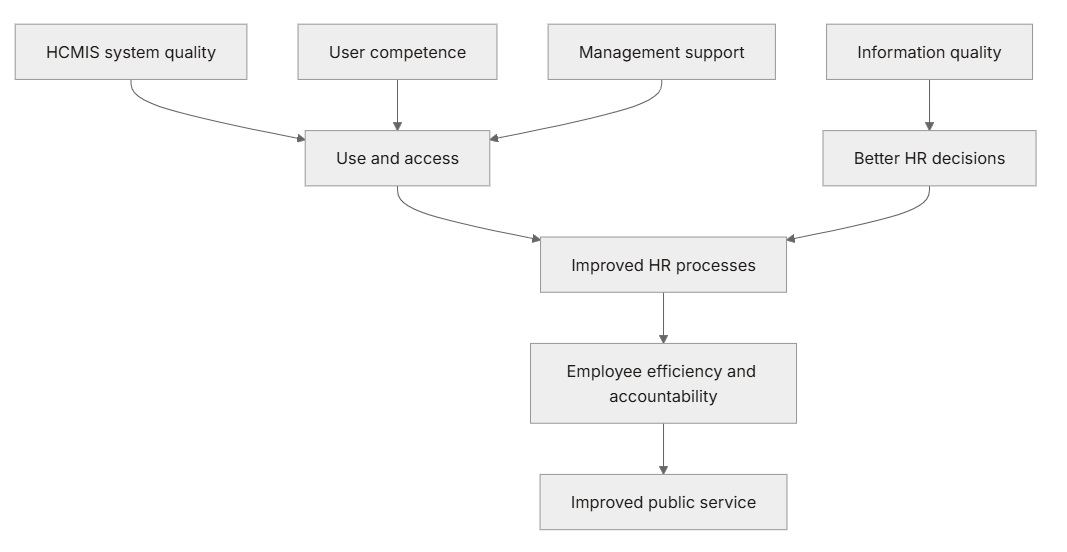
The study draws on three complementary theoretical perspectives: the Technology Acceptance Model (TAM), the DeLone and McLean information-systems success model, and public value theory.
TAM proposes that perceived usefulness and perceived ease of use influence users’ attitudes, intentions and actual use of technology. This framework is relevant because employees are more likely to use HCMIS when they believe that it improves their work and is not excessively difficult to operate. Evidence from public organisations in an emerging economy shows that perceived simplicity of use, perceived usefulness, self-efficacy, compatibility and facilitating conditions positively influence e-HRM implementation intentions (Amoako et al., 2023). Similarly, research in Tanzania has identified user competence as a significant determinant of HCMIS performance (Matimbwa & Kamala, 2024). TAM therefore helps explain why the same system may produce different outcomes across organisations or user groups.
The DeLone and McLean model conceptualises information-system success through dimensions including system quality, information quality, service quality, use, user satisfaction and net benefits. HCMIS outcomes are likely to depend not only on whether the system is available but also on whether it produces accurate, timely and complete information, whether it is reliable and whether users receive adequate technical support. Tanzanian research on payroll reliability indicates that information integrity, ease of use, accountability and availability are important conditions for HCMIS usefulness (Masele & Kagoma, 2021). The model is therefore useful for connecting system characteristics with employee and organisational outcomes.
Public value theory extends the analysis beyond internal efficiency. Public organisations create value when their activities produce outcomes that citizens and service users regard as legitimate, useful and desirable. e-HRM may create public value indirectly by improving the capacity of public servants to deliver services, enhancing accountability and strengthening trust in administrative processes. Studies in Kenya have reported significant positive relationships between operational, relational and transformational e-HRM practices and public value creation (Kamau & Mwangi, 2024). A mixed-methods study in a Kenyan county government similarly linked e-HRM, quality public services, desirable outcomes and trust to public value creation (Mwangi & Kamau, 2024). In this study, public service is therefore understood as an organisational outcome that may be influenced by improved internal HR processes.
2.3. Empirical Reviews
2.3.1. Employee Data Management
Accurate and accessible employee data are a foundation for effective HRM. Digital systems can reduce duplicate records, facilitate retrieval and provide managers with current information for workforce decisions. The literature on HR information systems identifies employee-record maintenance as a core operational function that supports higher-level management decisions (Tripathi, 2011). In Tanzania, HCMIS has been associated with more reliable payroll and improved management of HR information when information integrity and availability are maintained (Masele & Kagoma, 2021). The national rollout of HR information systems for health also demonstrated the importance of high data coverage, user involvement, training and routine data utilisation (Ishijima et al., 2015).
Nevertheless, digitisation does not eliminate data-quality problems. If information is entered inaccurately, not updated or poorly integrated with other systems, the electronic record can reproduce or amplify administrative errors. The Dodoma-focused study of public institutions found improvement in personal-information tracking and retrieval speed but continuing weaknesses in performance, training and payroll-related records (Lugaimukamu & Semlambo, 2025). Employee data management must therefore be assessed in terms of completeness, timeliness, accuracy, accessibility and actual use.
2.3.2. Access to HR documents and Services
e-HRM may decentralise HR service provision by allowing employees and managers to access information electronically. This can reduce dependence on physical files and repeated visits to HR offices. Employee self-service systems are intended to provide continuous access to HR information and to reduce processing time (Hawking et al., 2004). In Tanzania, HRIS adoption has been reported to support HR functions and reduce the cost of HR operations in district settings (Ngulugulu et al., 2023). Similar findings from the Tanzania Airports Authority indicate that digital employee data storage, automated payroll and streamlined recruitment can improve HR service delivery, although access to technology and infrastructure remain constraints (Mollel & Rutenge, 2024).
Access is also a transparency issue as when employees can view relevant documents, submit requests and follow administrative processes, uncertainty may decline and trust may improve. However, access must be balanced with confidentiality, authorisation controls and data protection. A system that is technically available but inaccessible because of poor connectivity, insufficient skills or limited user permissions cannot generate its intended benefits.
2.3.3. Data Accuracy
Information accuracy is central to personnel administration, payroll, workforce planning and accountability. Inaccurate employee records can result in incorrect payments, delays in promotion or leave decisions, and poor deployment of staff. Evidence from Tanzanian LGAs shows that user skills, commitment and experience significantly affect the accuracy, completeness and timeliness of HCMIS information (Matimbwa & Kamala, 2024). The Tanzanian health-sector experience further demonstrates that system operation and data-utilisation training were important to successful implementation (Ishijima et al., 2015).
The relationship between digitisation and accuracy is therefore socio-technical. Automated validation, standardised fields and electronic audit trails may improve accuracy, but only where users understand the system and managers monitor data quality. The evidence from public institutions in Dodoma suggests that reliability and integration are especially important, as poor integration with payroll can increase errors (Lugaimukamu & Semlambo, 2025). Data accuracy is consequently both a system-quality outcome and a management responsibility.
2.3.4. Management of HR Functions
HCMIS can support multiple HR functions, including recruitment, payroll, training, performance management, benefits administration and reporting. Its strategic potential lies in connecting these functions and generating information for workforce planning. A review of Tanzanian public-sector HCMIS applications found that the system is used across several HR activities, although implementation remains concentrated on payroll (Hadija Matimbwa & Olatokun, 2024). Research in Tanzanian public institutions found that HCMIS supported rewards management but did not fully support performance management, recruitment or training because some modules had not been activated (Marcel & Tefurukwa, 2025).
The literature therefore presents a qualified account. HRIS can reduce administrative work and allow HR professionals to engage more strategically (Beadles et al., 2015). Public-sector technology interventions can improve personnel processes, but public institutions also face distinctive obstacles involving regulation, organisational complexity and implementation capability (Cronin et al., 2006). In Bangladesh, the benefits of e-HRM were accompanied by barriers and risks arising from technology and human agency (Rahman & Aydin, 2020). The management of HR functions is thus likely to improve where systems are comprehensive, integrated and actively used rather than merely installed.
2.3.5. Communication
Digital HR systems can improve communication by creating formal channels for sharing HR information, responding to employee requests and coordinating between departments. Electronic access can reduce delays and make HR procedures more transparent. The employee self-service literature links e-HR with improved employee communication and satisfaction (Hawking et al., 2004). Studies of government e-HRM implementation have also identified communication processes as important organisational conditions for successful adoption (Rahman & Aydın, 2019).
In Tanzania, digital HR systems have supported coordination and information utilisation where users were involved in system development and provided with training (Ishijima et al., 2015). However, communication benefits may be limited where employees lack access to devices, connectivity or digital skills. The evidence from the Tanzania Airports Authority identifies limited technology access, unreliable electricity, skills gaps and resistance to change as continuing barriers (Mollel & Rutenge, 2024). Communication should therefore be understood as both a technical and organisational process.
2.3.6. Accountability and Public Service Delivery
The ultimate justification for public-sector digitalisation is not merely administrative convenience but improved public performance and public value. HCMIS may support accountability by producing traceable records, strengthening workforce monitoring, reducing opportunities for payroll fraud and improving managerial decisions. A Tanzanian university study found that accountability and information integrity were among the conditions underpinning payroll reliability (Masele & Kagoma, 2021). Broader e-government research associates digital platforms with improved transparency, monitoring and accountability, while also identifying digital exclusion and data-security concerns (Setyarto et al., 2025).
Studies from African public-sector contexts support a positive relationship between digital HR and service outcomes. Electronic HR training in Kenyan public universities significantly influenced service-quality delivery (Namasaka et al., 2020). Digital technologies in Ghanaian public organisations were reported to affect organisational structures and decision-making in ways that improved service delivery (Iddrisu & Fuseini, 2025). However, the relationship is not necessarily large or automatic. A systematic review concluded that e-HRM effectiveness in public service depends on conditions including task-technology fit, organisational fit, strategic public-service value and feedback (Mozgovoy & Mettler, 2018). The present study consequently evaluates both the direction and magnitude of the relationship between HCMIS and public service.
3. Methodology
The study adopted a pragmatic research philosophy which was appropriate because the research question concerned both the measurable relationship between HCMIS and public service and the organisational experiences through which that relationship was understood. Quantitative evidence was used to estimate patterns and test the hypothesis, while qualitative evidence was used to explain how heads of departments and units perceived the effects of HCMIS. To sum up, the study employed a mixed-methods approach.
The study used a descriptive research design, which was regarded as suitable for describing respondents’ perceptions of HCMIS and examining the statistical association between HCMIS and public service without manipulating the organisational environment. The population consisted of public servants at Dodoma City Council. From this population, a sample of 351 respondents was selected for the questionnaire survey.
Simple random sampling was used to select questionnaire respondents. This procedure gave members of the target population an opportunity to participate and reduced the risk that the quantitative findings would be determined solely by the views of a particular department or occupational group.
Purposive sampling was used to select heads of departments and units for the qualitative interviews. These participants were selected because of their knowledge of HR processes, staff administration and the operational consequences of HCMIS. The interviews were unstructured, allowing participants to describe perceived changes and challenges in their own terms.
Quantitative data were collected using a closed-ended questionnaire while qualitative data were collected through unstructured interviews.
Quantitative data were analysed through descriptive and inferential analysis using the Statistical Package for the Social Sciences (SPSS). Descriptive statistics comprised means and standard deviations. Pearson correlation was used to examine the relationship between HCMIS and public service. Simple linear regression was used to estimate the predictive effect of HCMIS on public service. The inferential analysis tested the following null hypothesis:
H₀: Electronic Human Resource Management (e-HRM/HCMIS) has no significant impact on public service in Dodoma City Council, Tanzania.
Qualitative interview data were analysed through content analysis. Responses were read, coded and organised into themes corresponding to the study objective and the quantitative indicators.
4. Results
4.1 Descriptive Findings
Table 1 presents the descriptive statistics for the five HCMIS-related indicators. All variables had 351 valid observations and no missing values. The highest mean was recorded for improved management of employees’ data (mean = 4.30), followed by improved communication between employees and the HR department (mean = 4.15). The lowest means were recorded for improved accuracy of HR data and improved management of HR functions, both of which were 4.00. The standard deviations indicate some variation in respondents’ views, particularly concerning HR data accuracy.
| Statement | N Valid | Mean | Std. Deviation |
| The e-HRM (HCMIS) has improved the management of employees' data | 351 | 4.30 | .859 |
| The e-HRM (HCMIS) has enhanced my access to HR related documents and services | 351 | 4.05 | .968 |
| The e-HRM (HCMIS) has improved the accuracy of HR data in my organization | 351 | 4.00 | 1.073 |
| The e-HRM (HCMIS) has improved management of HR functions | 351 | 4.00 | .997 |
| The e-HRM (HCMIS) has improved communication between employees and the HR department | 351 | 4.15 | .881 |
The results suggest that respondents generally perceived HCMIS positively. The particularly high score for employee data management indicates that the most visible benefit was the organisation and accessibility of personnel information. The relatively high score for communication suggests that the system also supported interaction between employees and HR. The lower, though still positive, scores for data accuracy and management of HR functions may indicate that these areas depend more heavily on data-entry practices, integration and the availability of functional modules.
4.2. Pearson Correlation
The Pearson correlation between HCMIS and public service was positive and statistically significant.
| Variables | HCMIS | PS |
| HCMIS | 1 | .199*** |
| PS | .199*** | 1 |
| Sig. (2-tailed) | — | <.001 |
| N | 351 | 351 |
***. Correlation is significant at the 0.001 level (2-tailed).
The coefficient, r = .199, indicates a positive but modest relationship. As perceptions of HCMIS improved, perceptions of public service also tended to improve. The significance level of p < .001 indicates that the observed association is statistically significant.
4.3 Regression Analysis
A simple linear regression model was estimated with HCMIS as the predictor and public service (PS) as the dependent variable. The model summary is presented in Table 3.
| Model | R | R Square | Adjusted R Square | Std. Error of the Estimate |
| 1 | .199ᵃ | .040 | .037 | .50317 |
ᵃ Predictors: (Constant), HCMIS.
The model produced R = .199 and R Square = .040. Thus, HCMIS accounted for 4.0% of the variance in public service, while the remaining variation was attributable to other factors not included in the model. The adjusted R Square was .037.
The analysis of variance is shown in Table 4.
| Model | Sum of Squares | df | Mean Square | F | Sig. |
| Regression | 3.640 | 1 | 3.640 | 14.376 | <.001 |
| Residual | 88.360 | 349 | .253 | ||
| Total | 92.000 | 350 |
Dependent Variable: PS.
The regression model was statistically significant, F = 14.376, p < .001. This result indicates that the model containing HCMIS predicted public service significantly better than a model containing only the constant.
| Model | Unstandardised B | Std. Error | Standardised Beta | t | Sig. |
| (Constant) | 2.769 | .209 | 13.241 | <.001 | |
| HCMIS | .192 | .051 | .199 | 3.792 | <.001 |
Dependent Variable: PS.
The coefficient for HCMIS was positive and statistically significant (B = .192, standard error = .051, standardised beta = .199, t = 3.792, p < .001). This means that a one-unit increase in the HCMIS measure was associated with a .192-unit increase in the predicted public-service score. Since the p-value was below .001, the null hypothesis that e-HRM/HCMIS has no significant impact on public service in Dodoma City Council was rejected.
4.4. Hypothesis Testing and Decision
The null hypothesis tested in this study was stated verbatim as follows:
“Electronic Human Resource Management (e-HRM/HCMIS) has no significant impact on public service in Dodoma City Council, Tanzania”.
The decision was based on three convergent statistical results. First, the Pearson correlation showed a positive and statistically significant relationship between HCMIS and public service (r = .199, p < .001). Secondly, the regression coefficient for HCMIS was positive and significant (t = 3.792, p < .001). Thirdly, the overall regression model was statistically significant (F = 14.376, p < .001). These results provide sufficient evidence against the null hypothesis.
Accordingly, the null hypothesis is REJECTED, and the alternative hypothesis is accepted: e-HRM (HCMIS) has a statistically significant positive impact on public service at Dodoma City Council. The fitted model nevertheless explains only 4.0% of the variance in public service (R² = .040). This modest explanatory power means that HCMIS is a statistically significant contributor, but it is not the only determinant of public service. Other organisational, managerial, financial, infrastructural and contextual factors also account for variation in service outcomes.
4.5. Qualitative Findings
The content analysis produced three closely related themes: improved employee data management and efficiency; enhanced communication, transparency and access to HR services; and strengthened accountability, workforce planning and responsiveness.
4.5.1. Employee Data Management and Efficiency
The first Head of Department emphasised the effect of HCMIS on employee records:
“The introduction of HCMIS has significantly improved the management and accessibility of employee records. The respondent explained that automated HR processes reduce paperwork, minimize errors, and allow managers to make timely and informed decisions, which ultimately improves employee efficiency and service delivery.”
This quotation indicates that the perceived benefit extended beyond storage. HCMIS was viewed as reducing paperwork, minimising errors and improving the timeliness of managerial decisions.
4.5.2. Access, Communication and Transparency
The second Head of Department highlighted the relational effects of e-HRM:
“e-HRM systems have enhanced communication and coordination between employees and the HR department. The respondent noted that staff can now access HR services and documents electronically, which saves time and promotes transparency, thereby improving employees' focus on service delivery tasks.”
This account complements the descriptive results, particularly the mean scores for access to HR-related documents and services and communication between employees and HR. It also connects administrative access with employees’ ability to concentrate on their service-delivery responsibilities.
4.5.3. Accountability, Workforce Planning and Responsiveness
A further head of department linked HCMIS to accountability and organisational performance:
“e-HRM systems play a critical role in strengthening accountability and efficiency in public service management. The Director explained that reliable HR data and automated systems improve workforce planning, performance monitoring, and decision-making, resulting in improved productivity and responsiveness to citizens' needs.”
The quotation suggests that HCMIS influenced public service indirectly through workforce planning, performance monitoring and decision-making. It also provides a managerial explanation for the positive statistical relationship between HCMIS and public service.
5. Discussion of Findings
The study found that HCMIS had a positive and statistically significant relationship with public service in Dodoma City Council. The correlation was modest (r = .199, p < .001), and HCMIS explained 4.0% of the variance in public service. These findings should therefore be interpreted as evidence of a meaningful contribution rather than proof that HCMIS is the sole or dominant determinant of service delivery. The qualitative evidence helps explain the relationship by showing how digital HR affects administrative processes that support public service.
5.1. Employee Data Management
Employee data management was the strongest descriptive dimension, with a mean of 4.30 and a standard deviation of .859. This result indicates broad agreement that HCMIS improved the management of employee data. The interview evidence reinforces this interpretation: the first Head of Department reported that HCMIS improved the management and accessibility of employee records, reduced paperwork and minimised errors.
This finding is consistent with the established role of HR information systems in maintaining employee records as the operational foundation for wider HR decision-making (Tripathi, 2011). It also aligns with evidence from Tanzanian public universities that HCMIS contributes to HR information management and payroll reliability when information integrity and availability are secured (Masele & Kagoma, 2021). The national Tanzanian experience with HR information systems similarly showed the importance of comprehensive data coverage, user involvement and routine use of information for planning and management (Ishijima et al., 2015). In addition, the recent study of Tanzanian public institutions found that HCMIS particularly improved personal-information tracking and retrieval speed (Lugaimukamu & Semlambo, 2025). Research on public-sector technology more broadly also identifies improved personnel information collection as a key benefit of digital HR systems (Cronin et al., 2006).
The present finding nevertheless differs from the more qualified evidence reported in the Dodoma-focused study, where record management was only moderately improved and weaknesses remained in performance and training records (Lugaimukamu & Semlambo, 2025). It also contrasts with evidence from NM-AIST, where some HCMIS modules were not activated and therefore did not support performance management or training and development (Marcel & Tefurukwa, 2025). The likely explanation is that employees in Dodoma City Council experienced the system’s core record-management functions more directly than its more advanced modules. Thus, HCMIS appears to be most effective where it performs routine and clearly structured data-management tasks.
The result also supports the DeLone and McLean perspective: system usefulness depends on the quality and accessibility of the information produced. A digital file is valuable only when it is current, complete and retrievable. The qualitative evidence suggests that managers perceived HCMIS as improving the timeliness of decisions, which is an important mechanism linking data management to service delivery. However, the study’s cross-sectional design does not establish whether records objectively became more accurate or whether respondents’ perceptions improved. Regular audits, data-quality checks and integration with payroll and establishment systems are therefore necessary.
5.2. Access to HR Documents and Services
Respondents reported enhanced access to HR-related documents and services, with a mean of 4.05 and a standard deviation of .968. The second Head of Department explained that staff could access HR services and documents electronically, saving time and promoting transparency. This finding indicates that HCMIS was perceived not only as a back-office database but also as a mechanism for employee interaction with HR.
The finding is consistent with research on employee self-service, which shows that electronic HR systems can provide real-time access to information, reduce processing time and improve communication and employee satisfaction (Hawking et al., 2004). It is also compatible with evidence from district-level Tanzanian public organisations that HRIS has been useful in managing HR functions and reducing operational costs (Ngulugulu et al., 2023). The Tanzania Airports Authority study similarly reported that digital storage of employee data, automated payroll and streamlined recruitment supported HR service delivery (Mollel & Rutenge, 2024). Research on public-sector HR technology has further argued that reducing routine administrative work can enable HR units to devote more attention to strategic issues (Beadles et al., 2015). Finally, public-value studies in Kenya associate relational e-HRM practices with public value creation, suggesting that improved interaction and access can contribute to broader organisational outcomes (Kamau & Mwangi, 2024).
At the same time, the result should not be interpreted as evidence that access is universal or equally effective for all employees. The Tanzania Airports Authority study identified limited access to technology, unreliable power, skills gaps and resistance to change as barriers (Mollel & Rutenge, 2024). The Tanzanian health-sector rollout also encountered inadequate computer skills and ICT infrastructure challenges (Ishijima et al., 2015). Consequently, electronic access may improve services for connected and capable users while leaving others dependent on HR officers or manual procedures.
The relatively higher standard deviation compared with employee data management suggests some variation in experiences of access. This may reflect differences in departmental connectivity, user permissions, digital literacy or familiarity with the system. DCC should therefore treat employee self-service as an inclusion issue. Providing access credentials alone is insufficient; employees need functional devices, reliable connectivity, clear procedures and assistance when the system is unavailable.
5.3. Data Accuracy
The statement that HCMIS improved HR data accuracy had a mean of 4.00 and a standard deviation of 1.073. The mean indicates a generally favourable perception, but the relatively high standard deviation reveals greater disagreement among respondents than for the other indicators. This result is theoretically important because digitalisation can improve accuracy through standardisation and validation, but it can also reproduce inaccurate data when users enter incomplete or outdated information.
The finding is supported by Tanzanian research showing that user IT skills, commitment and experience influence the accuracy, completeness and timeliness of HCMIS information (Matimbwa & Kamala, 2024). It also reflects the Tanzanian payroll study, which emphasised information integrity as a condition of HCMIS usefulness (Masele & Kagoma, 2021). The HRHIS and TIIS rollout demonstrated that system-operation training and data-utilisation training were important for creating usable HR information (Ishijima et al., 2015). Evidence from Rwanda further links effective electronic records management, regular filing and monitoring controls with better HRM effectiveness, transparent recruitment and informed decision-making (Jean Claude, 2024). In the broader information-systems literature, information quality is a key component of system success because organisational benefits depend on the reliability of outputs rather than on technology alone.
The result contrasts with an overly technological interpretation in which the system is assumed to guarantee accurate data automatically. The study of public institutions in Dodoma found that poor integration with payroll increased errors and that HCMIS remained weak in performance and training records (Lugaimukamu & Semlambo, 2025). The NM-AIST study likewise showed that inactive modules limited the system’s capacity to provide comprehensive HR information (Marcel & Tefurukwa, 2025). These findings suggest that DCC’s positive assessment of accuracy may be strongest for core employee records and weaker for linked or specialised modules.
The qualitative evidence offers a possible explanation. The first Head of Department stated that automated processes “minimize errors” and allow timely decisions. Yet this is a perception of improved process quality, not an independent audit of error rates. DCC should therefore institutionalise data-quality governance through periodic reconciliation, correction workflows, responsibility assignment and audit trails. Data accuracy should be measured using objective indicators such as duplicate records, unresolved discrepancies, correction rates and processing delays.
5.4. Management of HR Functions
Management of HR functions recorded a mean of 4.00 and a standard deviation of .997. Respondents therefore perceived a positive effect, but the result was less strong than the score for employee data management. This pattern is consistent with the literature, which generally finds that public-sector HCMIS is more mature in payroll and employee records than in strategic HR activities.
The Tanzanian systematic review found that HCMIS applications include employee information, recruitment, performance management, training, benefits, analytics and succession planning, but also identified the need to expand the scope of applications and improve interdepartmental coordination (Hadija Matimbwa & Olatokun, 2024). Research at NM-AIST found that HCMIS supported rewards management but only partially supported recruitment and selection and did not support performance management or training because modules had not been activated (Marcel & Tefurukwa, 2025). The Tanzanian public-sector HRIS study in Mwanza reported that HRIS was useful in managing HR functions and practices (Ngulugulu et al., 2023). International evidence similarly argues that HRIS can reduce administrative costs and allow HR departments to play more strategic roles (Beadles et al., 2015). Public-sector technology research also shows that HR technology can support recruitment, selection and other personnel decisions, while noting distinctive public-sector obstacles (Cronin et al., 2006).
The current finding therefore supports the proposition that HCMIS contributes to HR-function management, but it also indicates that the contribution is moderate rather than transformative. The qualitative interview with a head of department mentioned workforce planning and performance monitoring, suggesting that managers are beginning to use HCMIS for functions beyond record keeping. However, the relatively lower mean compared with data management may indicate that not all functions are equally digitised or equally familiar to employees.
This finding also aligns with evidence from Laos, where e-HRM acceptance supported strategic HRM and organisational performance through factors such as facilitating conditions, clarity of goals, job relevance, ease of use and service quality (Meunluang & Ugaddan, 2015). It is further consistent with evidence from Bangladesh that e-HRM implementation is influenced by benefits, barriers, risks, human capability and structural conditions (Rahman & Aydin, 2020). In practical terms, DCC’s future gains are likely to depend on activating and integrating modules for performance, learning, recruitment and analytics rather than simply improving the existing records function.
5.5. Communication between Employees and HR
Communication between employees and the HR department received a mean of 4.15 and a standard deviation of .881. This was the second-highest mean, indicating that respondents regarded communication as a prominent benefit of HCMIS. The second Head of Department confirmed that e-HRM improved communication and coordination and enabled staff to obtain services and documents electronically.
This finding corresponds with the employee self-service literature, which identifies improved employee communication as a major benefit of e-HR (Hawking et al., 2004). It is also supported by research on public-sector e-HRM implementation, where communication processes are part of the organisational conditions shaping adoption (Rahman & Aydın, 2019). The Tanzanian HRHIS rollout found that involvement of system users, local expertise and training helped create user-friendly systems and improve sustainability (Ishijima et al., 2015). Research on transparent HR communication further highlights the role of dialogue, trust and employee engagement in HR governance (Raza et al., 2023). Public-value studies also suggest that relational e-HRM practices can contribute to trust and desirable public outcomes (Mwangi & Kamau, 2024).
However, digital communication should not be equated with communication quality in every respect. Electronic systems can standardise messages and make documents available, but they may not resolve ambiguity, delayed responses or disputes concerning HR decisions. Qualitative evidence from Bangladesh shows that e-HRM implementation can create organisational challenges involving communication processes, role conflict and change management (Rahman & Aydın, 2019). The benefits identified at DCC should therefore be understood as improvements in access and coordination rather than a complete replacement for human interaction.
A balanced communication model is particularly important in public organisations. Employees may need electronic channels for routine enquiries, leave applications and document retrieval, while complex matters require direct engagement with HR officers and supervisors. DCC should develop service standards for responding to digital enquiries, publish clear guidance and retain assisted channels for employees who face technological barriers.
5.6. Accountability and Service Delivery
The inferential results provide the central finding of the study. HCMIS was positively correlated with public service (r = .199, p < .001), and the regression coefficient was positive and significant (B = .192, t = 3.792, p < .001). The null hypothesis was rejected. The qualitative evidence explains this relationship through accountability, workforce planning, performance monitoring, productivity and responsiveness to citizens.
The finding is consistent with evidence that HCMIS can strengthen accountability and payroll reliability when information integrity, availability and transparency are present (Masele & Kagoma, 2021). It also accords with research showing that digital government platforms can improve transparency, monitoring and accountability, although digital literacy and security remain barriers (Setyarto et al., 2025). Studies from Kenya have found positive relationships between e-HRM practices and public value creation (Kamau & Mwangi, 2024) and between quality public services, trust and public value (Mwangi & Kamau, 2024). Evidence from Ghana indicates that digital technologies can affect organisational structures and decision-making in ways that improve service delivery (Iddrisu & Fuseini, 2025). Finally, research on electronic HR training in Kenyan public universities found a significant positive influence on service-quality delivery (Namasaka et al., 2020).
The present result also differs from accounts that treat e-HRM benefits as necessarily substantial. The explained variance was only 4.0%, demonstrating that public service depends on many factors beyond HCMIS, including staffing levels, financial resources, leadership, service processes, infrastructure, professional competence and citizen demand. The systematic review of e-HRM effectiveness makes a similar point by arguing that public-sector benefits depend on task-technology fit, organisational fit, strategic public-service value and feedback (Mozgovoy & Mettler, 2018). The modest effect size should therefore encourage a realistic interpretation: HCMIS is a supporting capability, not a substitute for wider administrative reform.
The third interview quotation provides a direct mechanism. Reliable HR data and automated systems improve workforce planning, performance monitoring and decision-making, which in turn can improve productivity and responsiveness. This is consistent with public value theory because internal HR improvements become publicly valuable when they enhance the capability, accountability and responsiveness of the organisation. The result also has a managerial implication that DCC should use HCMIS information actively in staffing decisions, performance reviews and service planning. If the system is used merely for compliance or payroll processing, its contribution to public service will remain limited.
6. Conclusion and Recommendations
6.1. Conclusion
This study assessed the impact of e-HRM (HCMIS) on public service in Dodoma City Council, Tanzania. The findings indicate that respondents perceived HCMIS as improving employee data management, access to HR documents and services, data accuracy, management of HR functions and communication between employees and HR. Employee data management received the highest mean score, while data accuracy and management of HR functions received the lowest, although still positive, scores among the measured indicators.
The inferential findings demonstrated a positive and statistically significant relationship between HCMIS and public service (r = .199, p < .001). Simple linear regression further showed that HCMIS had a positive and significant coefficient (B = .192, t = 3.792, p < .001). The model explained 4.0% of the variance in public service. The null hypothesis that e-HRM/HCMIS has no significant impact on public service in Dodoma City Council was therefore rejected.
The qualitative evidence supported the statistical results that heads of departments and units described improvements in employee records, reduced paperwork, better accessibility, enhanced communication, transparency, accountability, workforce planning, performance monitoring and responsiveness to citizens. Taken together, the findings suggest that HCMIS creates value through the gradual improvement of administrative capability. Its contribution is positive but modest, and it depends on implementation conditions rather than technology alone.
6.2. Recommendations for Dodoma City Council
First, DCC should strengthen employee-data governance. Regular data audits, reconciliation procedures, correction protocols and clearly assigned responsibilities should be introduced to maintain complete, accurate and current records.
Secondly, DCC should expand employee self-service and access to HR documents while maintaining assisted support for employees who have limited digital skills or unreliable access to technology. Clear service standards should specify how quickly digital HR requests should be acknowledged and resolved.
Thirdly, DCC should provide continuous HCMIS training for HR officers, managers and general employees. Training should cover both system operation and the interpretation and use of HR information for workforce planning and decision-making.
Fourthly, DCC should improve system integration. Employee records, payroll, recruitment, performance management, training and benefits information should be connected where technically and institutionally feasible. Integration should be accompanied by access controls, audit trails and procedures for resolving inconsistencies.
Fifthly, management should use HCMIS information strategically. Heads of departments should receive regular reports on staffing, vacancies, attendance, skills, training, performance and employee movements. This would help convert HCMIS from a record-keeping tool into a workforce-planning instrument.
Sixthly, DCC should strengthen communication around HCMIS. Employees should receive clear information about available services, user responsibilities, data-security requirements and procedures to follow during system downtime.
6.3. General Recommendations
Tanzanian MDAs and LGAs should develop a coordinated national approach to HCMIS implementation. This should include consistent standards for data quality, interoperability, user access, information security, technical support and system performance.
Adequate and consistent budgets should be provided for hardware, connectivity, power backup, maintenance and software improvement. The Tanzanian literature identifies budget limitations, infrastructure problems, inadequate user competence and incomplete system functionality as significant constraints. Capacity-building programmes should therefore be institutionalised rather than offered only during initial implementation.
The government should also expand HCMIS beyond payroll and basic records. Functional modules for performance management, learning and development, recruitment, workforce analytics and succession planning would allow digital HR to contribute more directly to organisational performance and public value. At the same time, system expansion should be guided by task-technology fit and the practical realities of MDAs and LGAs.
6.4. Suggestions for Future Research
Future studies should focus on comparative research across LGAs, MDAs and public institutions. Further research could test mediating mechanisms, such as whether HCMIS improves public service through HR efficiency, employee motivation, workforce planning, accountability or managerial decision-making. Finally, qualitative research involving employees, HR officers, ICT staff and service users would provide a broader account of how digital HR contributes to public value in Tanzania.
References
- Aityassine, F. L. Y. (2022). The effects of operational, relational, and transformational e-hrm practices on HR service effectiveness: The mediating role of user training. International Journal of Data and Network Science, 6(4), 1107–1114. DOI ↗ Google Scholar ↗
- Al-Hayani, R. F., & Al-Wattar, A. H. (2024). Elevating public sector HR: A comprehensive exploration of e-hrm adoption drivers. International Research Journal of Innovations in Engineering and Technology, 08(03), 64–73. DOI ↗ Google Scholar ↗
- Amirova, A., Iskendirova, S., Daueshova, A., Zhanseitov, A., & Abylasimov, M. (2025). The impact of digital HRM implementation on public sector performance: A quantitative analysis of service delivery efficiency. Economics, 13(3), 303–318. DOI ↗ Google Scholar ↗
- Amoako, R., Jiang, Y., Adu-Yeboah, S. S., Frempong, M. F., & Tetteh, S. (2023). Factors influencing electronic human resource management implementation in public organisations in an emerging economy: An empirical study. South African Journal of Business Management, 54(1). DOI ↗ Google Scholar ↗
- Beadles, N. A., Lowery, C. M., & Johns, K. (2015). The impact of human resource information systems: An exploratory study in the public sector. Communications of the IIMA, 5(4). DOI ↗ Google Scholar ↗
- Bondarouk, T., Ruël, H., & van der Heijden, B. (2009). e-HRM effectiveness in a public sector organization: a multi-stakeholder perspective. The International Journal of Human Resource Management, 20(3), 578–590. DOI ↗ Google Scholar ↗
- Cronin, B., Morath, R., Curtin, P., & Heil, M. C. (2006). Public sector use of technology in managing human resources. Human Resource Management Review, 16, 416–430. DOI ↗ Google Scholar ↗
- Gbadebo, A. D. (2025). Electronic-Human resource management and organizational performance. International Journal of Applied Research in Business and Management, 6(5). DOI ↗ Google Scholar ↗
- Hawking, P., Stein, A., & Foster, S. (2004). e-HR and employee self service: A case study of a victorian public sector organisation. InSITE Conference. DOI ↗ Google Scholar ↗
- Iddrisu, I., & Fuseini, I. (2025). The impact of digital technologies on public service delivery: the role of organizational structures and decision-making. International Journal of Organizational Analysis, 33(10), 3783–3805. DOI ↗ Google Scholar ↗
- Ishijima, H., Mapunda, M., Mndeme, M., Sukums, F., & Mlay, V. S. (2015). Challenges and opportunities for effective adoption of HRH information systems in developing countries: national rollout of HRHIS and TIIS in Tanzania. Human Resources for Health, 13(1). DOI ↗ Google Scholar ↗
- Jean Claude, K. (2024). The impact of records management on the effectiveness of human resource management in the public sector. International Journal of Research and Innovation in Social Science, VIII(V), 1040–1060. DOI ↗ Google Scholar ↗
- Kamel, T. S. (2023). The role of electronic human resource management in improving public administration performance. Zenodo (CERN European Organization for Nuclear Research). DOI ↗ Google Scholar ↗
- Kamau, G., & Mwangi, G. (2024). E-HRM practices and public value creation. a case of county government in Kenya. 2024 IST-Africa Conference (IST-Africa), 1–8. DOI ↗ Google Scholar ↗
- Khan, K. A., & Talib, N. (2023). e-HRM practices with transformational e-hrm outcomes: The mediating role of proximal outcomes. Journal of Workplace Behavior., 4(2), 1–25. DOI ↗ Google Scholar ↗
- Kyebyala, E. E., & Rutenge, M. M. (2024). Factors affecting the adoption of e-hrm practices in public service organizations in tanzania: A case study of the Tanzania judicial service commission headquarters. African Journal of Empirical Research, 5(4), 25–34. DOI ↗ Google Scholar ↗
- Lugaimukamu, S., & Semlambo, A. A. (2025). Assessing the effectiveness of human capital management information systems (HCMIS) in employee record-keeping: A case study of public institutions in Dodoma, Tanzania. East African Journal of Business and Economics, 8(1), 472–484. DOI ↗ Google Scholar ↗
- Majwala, A., Swai, I., Linje, A., & Anasel, M. (2026). The influence of electronic payroll management information system on the performance of local government authorities (LGAs) in Tanzania. MUST Journal of Research and Development., 86. DOI ↗ Google Scholar ↗
- Marcel, N. S., & Tefurukwa, O. W. (2025). Human capital management information systems at the Nelson Mandela African institution of science and technology, Tanzania. The UONGOZI Journal of Management and Development Dynamics, 34(1), 74–99. DOI ↗ Google Scholar ↗
- Martin, B. M. (2025). Influence of Electronic Human Resource Management on the Performance of Public Organizations with Special Reference to Arusha City Council. The Open University of Tanzania Repository (The Open University of Tanzania). DOI ↗ Google Scholar ↗
- Masele, J. J., & Kagoma, R. S. (2021). Usefulness of human capital management information systems on payroll reliability among public universities in Tanzania. Public Money & Management, 43(2), 165–173. DOI ↗ Google Scholar ↗
- Matimbwa, H. M., & Olatokun, W. (2024). Human capital management information system: scope of application and challenges facing the public sector in Tanzania. Regional Journal of Information and Knowledge Management, 9(1), 29–46. DOI ↗ Google Scholar ↗
- Matimbwa, H., & Kamala, M. (2024). The Influence of System Users’ Competencies on The Performance of Human Capital Management Information Systems in Tanzanian. African Journal of Applied Research, 10, 130–146. DOI ↗ Google Scholar ↗
- Meunluang, V., & Ugaddan, R. G. (2015). e-HRM to HRM Effectiveness Towards Organizational Performance in the Public Sector: The Case of Lao PDR1. International Journal of Policy Studies, 6, 23–50. DOI ↗ Google Scholar ↗
- Mollel, H. L., & Rutenge, M. M. (2024). Adoption and use of electronic human resources management systems for service delivery in Tanzania: A case to Tanzania Airports Authority. African Journal of Empirical Research, 5(4), 617–626. DOI ↗ Google Scholar ↗
- Mozgovoy, V., & Mettler, T. (2018). Effectiveness of Electronic Human Resource Management in Public Service: A Systematic Literature Review. SERVAL (Université de Lausanne). DOI ↗ Google Scholar ↗
- Mwangi, G., & Kamau, G. (2024). Public Value Creation Through Electronic Human Resource Management in Public Sector: A Mixed Methods Approach. International Journal of Science Technology & Management, 5, 566–575. DOI ↗ Google Scholar ↗
- Namasaka, D. B., Koech, C. S., & Monari, F. (2020). Electronic human resource training and service quality delivery in public universities in western Kenya. The International Journal of Business & Management, 8(10). DOI ↗ Google Scholar ↗
- Naveed, S., Suhail, A., & Rana, N. S. (2024). Adoption of HRIS in the Public Organizations. DOAJ (DOAJ: Directory of Open Access Journals). DOI ↗ Google Scholar ↗
- Ngulugulu, M. M., Rwela, E. G., & Mkwizu, N. Y. (2023). Adoption of Human Resource Information Systems on Public Sectors in Tanzania. East African Journal of Information Technology, 6, 66–76. DOI ↗ Google Scholar ↗
- Publishers, K. (2024). Employee self-service (ESS) portal in the information technology sector in the digital era. Zenodo (CERN European Organization for Nuclear Research). DOI ↗ Google Scholar ↗
- Rahman, M., Mordi, C., & Nwagbara, U. (2018). Factors influencing e-hrm implementation in government organisations. Journal of Enterprise Information Management, 31(2), 247–275. DOI ↗ Google Scholar ↗
- Rahman, M., & Aydın, E. (2019). Organisational Challenges and Benefits of E- HRM Implementations in Governmental Organisations: Theoretical Shift From Toe Model. Uluslararası İktisadi ve İdari İncelemeler Dergisi, 127–142. DOI ↗ Google Scholar ↗
- Rahman, M., & Aydin, E. (2020). Benefits, barriers and risks – the role of technology in e-hrm implementations in public sector organisations: evidence from bangladesh. International Journal of Human Resources Development and Management, 20(3/4), 252. DOI ↗ Google Scholar ↗
- Raza, M., Khokhar, M. F., Zubair, M., & Rubab, M. (2023). Impact of Transparent Communication in HR Governance: Fostering Employee Trust and Engagement. Bulletin of Business and Economics (BBE), 12, 558–566. DOI ↗ Google Scholar ↗
- Riabets, K. (2025). Legislative support for digitalization of personnel management as a tool to enhance the effectiveness of public administration. Pressing Problems of Public Administration, 1(66), 401–415. DOI ↗ Google Scholar ↗
- Setyarto, D. B., Alimuddin, A., Mulyaningsih, M., & Judijanto, L. (2025). The role of e-government in increasing transparency and accountability of public administration in the digital era. Edelweiss Applied Science and Technology, 9(2), 1771–1783. DOI ↗ Google Scholar ↗
- Theres, C., & Strohmeier, S. (2023). Met the expectations? a meta-analysis of the performance consequences of digital HRM. The International Journal of Human Resource Management, 34(20), 3857–3892. DOI ↗ Google Scholar ↗
- Tripathi, K. P. (2011). A study of information systems in human resource management “HRM.” International Journal of Computer Applications, 22(8), 9–13. DOI ↗ Google Scholar ↗
- Troshani, I., Jerram, C., & Hill, S. R. (2011). Exploring the public sector adoption of HRIS. Industrial Management & Data Systems, 111, 470–488. DOI ↗ Google Scholar ↗
- Tshabalala, M. P., Plaatjies, A. B., & Nyawo, J. C. (2022). E-HRM Usefulness Perceived by Johannesburg Officials at the Department of Employment and Labor. Journal of Southwest Jiaotong University, 57(5), 729–739. DOI ↗ Google Scholar ↗
- Twinamasiko, F. (2026). Electronic human resource management in the East African public sector: Implementation challenges and implications for HR practice. East African Journal of Business and Economics, 9(1), 394–409. DOI ↗ Google Scholar ↗