Abstract
This qualitative case study examined how adolescents in one private secondary school in Abuja Municipal Area Council, Nigeria, make sense of peer influence and family unpredictability in relation to delinquent behaviour. Much Nigerian research on adolescent delinquency has relied on quantitative measures that show associations but do not capture how young people themselves interpret these influences. The study was guided by Bronfenbrenner and Morris's bioecological model and Agnew's general strain theory. Data were collected through ten individual interviews and three focus groups of five students each, involving twenty-five students aged 11 to 18 who were purposively selected with the help of school counsellors and teachers. Sessions were audio-recorded and transcribed, and the data were analysed using thematic analysis informed by Braun and Clarke. Four themes were developed: peers as a setting for restraint or contagion; the stable family as a secure base; emerging autonomy and self-directed reasoning; and multiple pathways to risk and restraint. Strong peer influence did not by itself predict behaviour, as some students described deliberately refusing risky peer behaviour while others described adopting it. Stable homes were linked to protection, yet stability did not guarantee restraint and instability did not guarantee risk. Compounding of peer and family strain was the clearest route to high risk but was seen in only two participants. Others described risk through peer influence alone or through interest they did not attribute to peers or family, and some resisted through their own reasoning. The findings are illustrative of one school and are not statistically generalisable. They suggest that support for adolescents should strengthen family stability, peer environments and young people's capacity for reasoning together, rather than addressing any single factor.
Keywords
peer influence family unpredictability adolescent delinquency adolescent development qualitative case study Nigeria
Introduction
Background of the Study
Adolescence is a developmental stage during which individuals are especially responsive to their social surroundings, particularly the influence of peers and the stability of the family environment [1]. It is often during this period that patterns of delinquent behaviour first take shape, not as isolated incidents but as responses shaped by the everyday relationships and environments adolescents navigate. In Nigeria, juvenile delinquency among secondary school students remains a visible social concern, expressed through truancy, substance use, theft, and, in more severe cases, violence [2].
Peer influence has consistently been identified as a significant factor in adolescent delinquency. Fehintola et al. [3], studying in-school adolescents in Ibadan, found peer pressure to be significantly associated with delinquent behaviour, a finding echoed by Yusuf et al. [4] among adolescents in government remand homes in Lagos State. Gao et al. [5] extended this line of inquiry beyond Nigeria, finding that the relationship between deviant peer affiliation and delinquency among Chinese adolescents was shaped by the quality of family functioning.
Family unpredictability, understood as inconsistency in household routines, caregiving, and rule enforcement, is conceptually distinct from family structure and appears, to the researcher's knowledge, to have received limited attention in Nigerian delinquency research despite growing international evidence of its relevance. Koss et al. [6] found that childhood unpredictability was associated with adolescent delinquency, impulsivity, and both internalising and externalising problems by age 15, while Doom et al. [7] showed that early unpredictability predicted externalising behaviour and substance use in adolescence independent of economic hardship. Bosick and Fomby [8] found that instability in family relationships during childhood was associated with delinquent and externalising behaviour that persisted into early adulthood.
These findings can be situated within Agnew's [9] general strain theory, which holds that the disruption of positively valued stimuli, such as stable caregiving, generates strain that increases the likelihood of delinquent adaptation, particularly when compounded by association with delinquent peers.
This study therefore focuses on secondary school students in Abuja Municipal Area Council, Federal Capital Territory, Nigeria, exploring their perceptions and experiences of peer influence and family unpredictability in relation to delinquent behaviour.
The study is situated within developmental research on adolescence, broadly the years from ten to eighteen, and focuses on how young people themselves interpret the two settings in which much of their social development occurs: the family and the peer group. Rather than treating delinquency only as a problem to be explained by risk factors, it also attends to restraint, reasoning and resilience, in line with a strengths-based view of adolescent development [10].
Statement of the Problem
Delinquent behaviour among secondary school students in Nigeria continues to undermine academic performance, classroom discipline, and long-term developmental outcomes [2]. Existing Nigerian research has established that peer influence relates to delinquency [3,4], while international research has identified family unpredictability as a distinct and meaningful risk factor [6][7].
However, much of this research has relied on quantitative measures that establish statistical associations without capturing how adolescents themselves experience and interpret these influences. Little is known about how secondary school students understand the role of peer relationships and inconsistent family environments in shaping their behaviour, or how these two forces interact from their own perspectives, particularly in rapidly urbanising Nigerian contexts such as Abuja Municipal Area Council. This gap limits the ability of schools, counsellors, and families to design interventions grounded in young people's actual experiences. The present study addressed this gap through a qualitative case study of students' lived experiences in Abuja Municipal Area Council, offering context-rich insights that may be transferable to similar urban school settings.
Objectives of the Study
1. To explore how secondary school students in Abuja Municipal Area Council experience and perceive peer influence in relation to delinquent behaviour.
2. To explore how secondary school students in Abuja Municipal Area Council experience and perceive family unpredictability in relation to delinquent behaviour.
3. To understand, from students' own perspectives, how peer influence and family unpredictability interact in shaping delinquent behaviour.
4. To consider what students' accounts suggest about developmental processes, including peer sensitivity, family security and emerging autonomy, in adolescents' responses to peer and family conditions.
Research Questions
1. How do secondary school students in Abuja Municipal Area Council describe the influence of their peers on delinquent behaviour?
2. How do secondary school students in Abuja Municipal Area Council describe the role of unpredictability in their family life in relation to delinquent behaviour?
3. In what ways, according to students, do peer influence and family unpredictability interact to shape delinquent behaviour?
4. What do students' accounts suggest about the developmental processes through which peer and family contexts shape adolescents' behaviour?
Significance of the Study
This study offers something the existing quantitative literature does not: a grounded, first-person account of how students themselves make sense of peer and family influences on delinquency. Parents and guardians stand to benefit from a clearer understanding, in students' own words, of how inconsistency in family life is experienced and connected to behaviour.
School counsellors and administrators may draw on these accounts to design interventions that reflect students' actual realities rather than assumptions imposed from outside. Policymakers within the Federal Capital Territory may use the findings to inform youth development programmes grounded in lived experience.
The study also contributes a Nigerian qualitative perspective to a literature that has relied heavily on quantitative evidence from Western and East Asian contexts [5][7].
This study contributes to adolescent research in three ways. It offers a developmental reading of Nigerian adolescents' own accounts of peer and family influence, a context in which such accounts appear to be rare. It shows how unpredictability, which has mostly been studied in early childhood, is interpreted by adolescents themselves. It also gives weight to young people's reasoning and restraint, in line with a strengths-based view of adolescent development.
Scope of the Study
This study was limited to secondary school students within Abuja Municipal Area Council, Federal Capital Territory, Nigeria, and was conducted as a qualitative case study of one selected private secondary school within the area.
The selected school was purposively chosen primarily on the basis of access: it was willing to grant ethical and administrative approval for repeated engagement with minors, a practical consideration that shaped case selection given the study's requirement for sustained contact with participants over a one-month period. Beyond accessibility, the school also met the criteria of an information-rich case for this study's purposes [11]: it enrolled a mixed-gender student population spanning the full secondary range from Junior Secondary School 1 to Senior Secondary School 3, corresponding to the study's target age range of 11 to 18, and its counsellors and teachers were able to identify students with a range of relevant peer and family experiences and social dispositions. The single-school design therefore reflects a combination of access and case suitability rather than a claim that the school is representative of Nigerian secondary schools generally; this trade-off between depth and breadth is discussed further under Limitations.
The study drew on a purposively selected sample of twenty-five (25) participants whose experiences were explored through in-depth interviews and focus group discussions. It examined students' perceptions and experiences of peer influence and family unpredictability in relation to delinquent behaviour and did not attempt to produce statistical generalisations beyond the case studied.
Theoretical Framework
This study is guided by two complementary frameworks. Bronfenbrenner and Morris's [12] bioecological model provides the developmental framework for understanding how peer and family settings shape adolescents' development, and Agnew's [9] general strain theory (GST) explains how stressful experiences may be channelled into delinquent coping.
The Bioecological Model
The bioecological model proposes that development is driven by proximal processes, which are enduring and increasingly complex interactions between a developing person and the people, objects and symbols in their immediate environment. The strength and direction of these processes depend on four components: process, person, context and time [12]. In this study, the family and the peer group are treated as two microsystems in which proximal processes occur. Family unpredictability concerns the reliability of interactions in one microsystem, and peer influence concerns the interactions in the other. The connection between them is where compounding would be expected.
The person component, including adolescents' reasoning, values and self-regulation, allows for the possibility that young people shape their own development rather than only receiving influence. Time is represented by school level, from JSS1 to SS3, which spans early to late adolescence. Because individual students were not followed across years, school level is a cross-sectional proxy for time and not a measure of change. Three developmental concepts guided interpretation: the secure base concept [13], which informed the reading of family predictability; identity exploration and autonomy development [14,15], which informed the reading of students' self-directed reasoning; and positive youth development [10], which directed attention to restraint and strengths alongside risk.
General Strain Theory
Agnew's theory expands earlier perspectives on strain by identifying three major sources of strain: failure to achieve positively valued goals, removal of positively valued stimuli, and presentation of negative or harmful stimuli. Family unpredictability fits most directly within the second category because inconsistent caregiving, household routines, and rule enforcement may represent the disruption of a valued stable environment.
According to GST, strain produces negative emotions such as anger, frustration, and resentment, creating pressure for individuals to seek coping responses. Delinquency represents one possible response when adolescents attempt to manage these emotions through available behavioural pathways.
However, Agnew does not argue that strain automatically produces delinquency. Instead, the relationship depends on conditioning factors, including coping resources, social support, and peer associations. Association with delinquent peers may increase the likelihood that adolescents experiencing strain will adopt delinquent responses by providing models, opportunities, and social reinforcement for such behaviours.
For this study, GST provides a framework for understanding family unpredictability not merely as a background circumstance but as an experience that may generate emotional strain, while also explaining why peer relationships may influence how adolescents respond to that strain. Read together with the bioecological model, the two frameworks divide the explanatory work: the bioecological model indicates where and between whom influence occurs and how adolescents' own characteristics and age shape it, while GST indicates how strain arising in one setting may be expressed in behaviour shaped in another.
Literature Review
Introduction
This section reviews existing literature relevant to peer influence, family unpredictability, and adolescent delinquency. It begins with a conceptual review clarifying the key concepts used throughout the study, followed by a review of the theoretical frameworks guiding the research and of developmental perspectives on adolescence. It then examines empirical studies under three major themes: peer influence and adolescent delinquency, family unpredictability and adolescent delinquency, and the interaction between peer and family factors.
Conceptual Review
Juvenile Delinquency
Juvenile delinquency refers to illegal or antisocial behaviour committed by individuals who have not reached the age of legal adulthood. It includes both status offences, which are behaviours considered unlawful because of the individual's age, such as truancy, and offences that would be considered criminal regardless of age [16].
Within the Nigerian secondary school context, juvenile delinquency includes behaviours such as truancy, substance use, theft, vandalism, violence, and other forms of antisocial conduct that harm students' academic performance and mental health [2]. Although delinquent behaviours vary in severity, they share the common feature of violating social expectations and institutional norms.
Peer Influence
Peer influence refers to the process through which adolescents' attitudes, values, and behaviours are shaped by their relationships with individuals of similar age or social status. It operates through mechanisms such as behavioural modelling, reinforcement, social approval, and pressure to conform [17].
Adolescence is widely recognised as a period of heightened sensitivity to peer relationships because young people increasingly seek acceptance, identity, and independence outside the family environment. Consequently, peer groups can serve either as protective influences that encourage positive behaviour or as risk factors when they normalise or reinforce delinquent activities [17].
Family Unpredictability
Family unpredictability refers to inconsistency and instability in the patterns of a child's home environment, including caregiving practices, household routines, emotional availability, and rule enforcement [7]. It focuses on the reliability and predictability of family experiences rather than the structure of the family itself.
This concept is distinct from family composition, such as single-parent or two-parent households, and from socioeconomic conditions. A family may experience unpredictability regardless of its structure or economic status when adolescents encounter inconsistent expectations, changing routines, or unreliable caregiving responses.
Theoretical Review
As discussed earlier, this study is guided by Bronfenbrenner and Morris's [12] bioecological model and Agnew's [9] general strain theory (GST). The bioecological model treats the family and the peer group as interacting developmental settings, while GST explains delinquency as one possible response to strain arising from negative experiences, including the disruption or removal of valued conditions such as stable family relationships.
Adolescents experiencing strain may be more likely to engage in delinquent behaviour when they are exposed to peers who provide models, encouragement, and justification for such actions [18]. This theoretical position provides the basis for examining peer influence and family unpredictability as interconnected rather than independent influences.
Developmental Perspectives on Adolescence
Adolescence as a Developmental Context
Adolescence is a period in which young people's social world is reorganised. Time with peers increases, parental authority is renegotiated rather than simply accepted, and young people begin asking who they are and what they value [14,15]. These shifts do not make families less important; they change what families do. Caregivers remain a reference point against which adolescents judge their choices, while peers become a setting in which new roles and values are tried out [15]. Peer and family influences are therefore best understood as operating together within one developing person rather than as separate causes.
Research on adolescent brain and behaviour helps explain why peers matter so much at this age. In an experimental study of 306 participants in three age groups, Gardner and Steinberg [19] found that people took more risks and made riskier decisions when with peers than when alone, and that this effect was stronger among adolescents and young adults than among adults. Steinberg [1] links this sensitivity to a developmental gap between heightened reward-seeking and self-regulation that matures more slowly. Moffitt [20] offered a complementary account, proposing that much adolescent antisocial behaviour is temporary and arises from the gap between biological maturity and social independence, with young people imitating behaviours that appear to signal autonomy.
Peers are not only a source of risk. Dishion and Tipsord [21] review evidence that deviancy training, in which peers reward rule-breaking talk and behaviour, is one route through which problem behaviour spreads. The same review identifies adult monitoring, supervision, positive parenting, structure and self-regulation as protective factors. This two-sided picture is directly relevant to the present study, because some students described peers as a source of temptation while others described resisting peers they knew to be engaged in risky behaviour.
Unpredictability as a Developmental Experience
Family unpredictability draws on developmental work that separates two dimensions of environmental risk: harshness and unpredictability [22]. Belsky et al. [23] measured harshness through the income-to-needs ratio and unpredictability through residential moves, paternal transitions and parental job changes during the first five years of life, and found that the two dimensions related differently to parenting and later development. This distinction matters here because it treats inconsistency itself, rather than poverty or family structure, as a developmental condition.
Most of this evidence concerns early childhood and relies on quantitative measures. Less is known about how adolescents interpret unpredictability in the present, as young people who can reflect on their parents' availability and decide how to respond. From an attachment perspective, consistently available caregivers serve as a secure base from which adolescents explore the wider world [13]. When home life is inconsistent, that base may be weakened, and the support young people need while becoming more independent may be harder to find. This study examines how adolescents themselves describe that experience.
A Strengths-Based Perspective
Developmental science has increasingly moved from asking what goes wrong in adolescence to asking how young people develop positively through supportive relationships and settings. The positive youth development approach holds that young people have strengths and that positive development is more likely when those strengths are matched with supportive contexts [10]. Applied to delinquency research, this perspective directs attention to restraint, resistance and reasoning as well as risk. It is particularly useful here because much of the Nigerian work reviewed in this study has focused on risk factors rather than on how adolescents manage exposure to them.
Several further perspectives help interpret the autonomy and agency that adolescents describe. Self-determination theory emphasises autonomous motivation and internalised values [24], research on identity status examines how young people explore and commit to values [25], resilience research asks why some adolescents sustain positive adjustment despite adversity [26], and social cognitive theory stresses human agency, the capacity to act intentionally and to reflect on and regulate one's own actions [27]. These perspectives sit alongside the person component of the bioecological model and inform the interpretation of students' self-directed reasoning.
Empirical Review
Peer Influence and Adolescent Delinquency
A substantial body of research has established an association between peer influence and adolescent delinquency. In Nigeria, Fehintola et al. [3] examined the influence of peer pressure, community factors and gender on delinquent behaviour among in-school adolescents in Ibadan. Their findings showed a significant relationship between peer pressure and delinquent behaviour among students.
Similarly, Yusuf et al. [4] investigated adolescents in government remand homes in Lagos State and found that peer relationships played an important role in adolescents' involvement in delinquent behaviours, including fighting and bullying. These findings suggest that peer groups may provide environments where delinquent behaviours are learned, encouraged, or normalised.
International research supports these findings. Gao et al. [5] found that deviant peer affiliation was associated with delinquency among Chinese adolescents, demonstrating that peer relationships represent an important social context in understanding adolescent offending.
However, most existing studies have examined peer influence through quantitative measures of association, providing limited insight into how adolescents themselves experience peer pressure, acceptance, rejection, or encouragement in relation to delinquent behaviour.
Family Unpredictability and Adolescent Delinquency
Although family factors have long been examined in delinquency research, family unpredictability as a distinct construct appears to have received comparatively less attention, particularly within Nigerian research.
Doom et al. [7], using a life history perspective, found that early environmental unpredictability predicted adolescent externalising behaviour and substance use, even after accounting for economic hardship. Their findings suggest that inconsistency in early environments may influence behavioural development beyond traditional measures of family disadvantage.
Similarly, Bosick and Fomby [8] examined family instability during childhood and found that disruptions in family relationships were associated with delinquent and externalising behaviour extending into early adulthood. These findings highlight the possibility that unstable family experiences may have lasting implications for adolescent adjustment.
Koss et al. [6] further demonstrated that childhood environmental unpredictability was associated with adolescent delinquency, impulsivity, and both internalising and externalising difficulties. Together, these studies indicate that unpredictability within family environments represents an important developmental risk factor.
Despite this evidence, Nigerian research on adolescent delinquency has largely focused on factors such as parenting practices, family structure, socioeconomic challenges, and parental supervision. Family unpredictability as an independent experience appears to remain insufficiently explored within the Nigerian context.
Interaction Between Peer Influence and Family Factors
Research increasingly suggests that peer influence and family conditions operate together rather than separately in shaping adolescent delinquency.
Gao et al. [5] provided evidence of this interaction by demonstrating that family functioning moderated the relationship between deviant peer affiliation and delinquency among Chinese adolescents. Adolescents from healthier family environments showed a weaker association between deviant peer relationships and delinquent behaviour, suggesting that supportive family contexts may reduce vulnerability to negative peer influence.
Agnew and White [18] similarly demonstrated that the effects of strain on delinquency were influenced by association with delinquent peers. Within the framework of GST, this suggests that adolescents experiencing family-related strain may be particularly vulnerable when they are also embedded within peer networks that encourage delinquent coping responses.
In Nigeria, Adimora et al. [28] studied adolescents in secondary school class two in Enugu State and reported that adolescents from chaotic, unstimulating homes showed more disruptive behaviour. Sensitivity to negative peer pressure was linked with disruptive and risky sexual behaviour, while sensitivity to positive peer pressure was linked with compliant behaviour. The authors concluded that home environment and peer group may interact. The study is quantitative and cannot show how students themselves explain these links.
Although existing research provides evidence that peer and family factors interact, most studies have examined this relationship through statistical models such as moderation analysis. Such approaches identify patterns of association but do not explain how adolescents themselves understand and describe these experiences.
Effects of Delinquency on Educational Outcomes
Delinquent behaviour among secondary school students has important implications for educational development. Ola-Williams, Ola-Williams, and Ogbaini [2] found that juvenile delinquency was associated with poorer mental health outcomes and reduced academic performance among Nigerian students.
Students involved in delinquent behaviours may experience difficulties with concentration, school attendance, classroom participation, and academic achievement. Understanding the factors contributing to delinquency is therefore important not only for behavioural management but also for improving educational outcomes.
Summary and Gap in the Literature
Taken together, this literature shows that peers and families matter during adolescence, that unpredictability is a distinct developmental condition, and that the two settings probably interact. Three gaps remain. Developmental theory has seldom been used to interpret Nigerian adolescents' own accounts. Unpredictability has been studied mainly in early childhood rather than as adolescents currently experience it. The strengths that lead some young people to resist both peer and family risk have received little attention. The present study addresses these gaps.
Methodology
Research Design
This study employed a qualitative case study design to explore how secondary school students in Abuja Municipal Area Council experienced and interpreted peer influence and family unpredictability in relation to delinquent behaviour. A qualitative case study approach was considered appropriate because it allows for an in-depth examination of a contemporary social phenomenon within its real-life context [11]. Unlike quantitative approaches that focus primarily on relationships between variables, qualitative case studies provide opportunities to understand how individuals interpret and construct meaning from their lived experiences [29].
The case study design was suitable for this research because adolescent behaviour is influenced by social relationships and environmental contexts. Examining students within a specific school setting enabled the study to capture the complexity of peer relationships, family experiences, and the meanings students attach to these experiences. The study aims to understand how students make sense of their own lives and not to measure variables.
Population and Sampling
The population comprised secondary school students enrolled in a private secondary school within Abuja Municipal Area Council, Federal Capital Territory, Nigeria.
A purposive sampling technique was used to select twenty-five (25) participants. Purposive sampling is appropriate in qualitative research because it allows researchers to identify participants who possess experiences relevant to the phenomenon under investigation rather than seeking statistical representation [30].
A sample of twenty-five participants was set in advance, reflecting the scope agreed with the researcher's institution and the practical demands of engaging each participant on three separate occasions, with minors, within a one-month data collection window. This sample size falls within the range generally considered adequate for an in-depth qualitative case study of this kind [29]. Consistent with a reflexive approach to thematic analysis [31], sample adequacy was judged by the richness and relevance of participants' accounts and not by a formal saturation criterion. The researcher observed that by the later interviews and focus groups, participants' accounts increasingly reiterated patterns already identified in earlier data rather than introducing substantially new codes, suggesting the sample was sufficient to capture the range of experiences relevant to the study's objectives.
Participants were identified with the assistance of school counsellors and class teachers, who were familiar with students' backgrounds and experiences. Students were eligible to participate when parental or guardian consent was obtained, when they voluntarily agreed to participate, and when they fell within the study's age range of 11 to 18 years.
The participants consisted of male and female students from Junior Secondary School 1 (JSS1) to Senior Secondary School 3 (SS3). Ten participants took part in individual semi-structured interviews. The remaining fifteen participated in three focus groups of five students each, purposively composed to capture a range of social dispositions: Group A comprised students identified by teachers and counsellors as generally quiet and reserved; Group B comprised students identified as socially vibrant; and Group C comprised students identified as highly talkative and socially active. This composition was intended to ensure the sample captured a broad range of social styles rather than a single behavioural profile.
Research Instruments
Data were collected using two complementary qualitative instruments: semi-structured individual interview guides and semi-structured focus group discussion guides.
The individual interview guide consisted of open-ended questions developed from the study objectives, theoretical framework, and concepts identified in previous literature, including peer influence, family unpredictability, and adolescent delinquency. The interviews allowed participants to describe their personal experiences and perspectives in their own words.
The focus group discussion guide was designed to explore shared experiences, similarities, and differences among participants. Focus group discussions provided an opportunity for students to reflect on peer relationships and family experiences within a group setting.
The semi-structured nature of the instruments allowed flexibility for participants to elaborate on issues that were meaningful to them while ensuring consistency across the research questions [32].
Data Collection Procedure
Data collection began after ethical approval was obtained and was completed over a period of one month.
Each participant was engaged on three separate occasions. For interview participants, the first occasion was used to build rapport and conduct the main interview, the second to follow up and clarify earlier responses, and the third for member checking and further elaboration. Each focus group met three times, giving nine focus group sessions in total. These repeated engagements allowed participants to clarify earlier responses and elaborate on their experiences, which supported a deeper understanding of their perspectives.
The first interview occasion, which combined rapport-building with the main interview, lasted approximately 30 minutes. The follow-up and member-checking sessions typically lasted 10 to 15 minutes each. Focus group sessions lasted approximately 30 minutes each. Across the three occasions, total contact time was approximately 60 minutes per interview participant and approximately 90 minutes per focus group participant.
All interviews and focus group discussions were conducted in English and audio-recorded with participants' consent. The recordings were transcribed by members of the research team for analysis.
Ethical Considerations
Ethical approval for this study was obtained prior to data collection (reference NEU/SS/2023/1593). Permission was also obtained from the participating school before data collection.
Since the participants were secondary school students, parental or guardian consent was obtained through the school, and students provided voluntary assent before participation. Participants were informed about the purpose of the study, confidentiality measures, and their right to withdraw at any time without penalty. Participants were also informed that confidentiality would be maintained except where there was a risk of serious harm to themselves or others, and focus group participants were asked to respect one another's privacy.
To protect participants' identities, pseudonyms were used during analysis and reporting. Audio recordings and transcripts were securely stored and were accessible only to the research team.
Research Team
Because the study involved secondary school students in Abuja Municipal Area Council, Nigeria, data collection was supported by a local research team based in Nigeria. The team consisted of five researchers: three with doctoral-level qualifications and two with master's-level qualifications in psychology, forensic psychology, clinical psychology, criminology, and related fields. All members had received training in interviewing minors. The team assisted with communication with the school, participant recruitment, scheduling, and administration of the interviews and focus groups in line with the approved ethical procedures. This arrangement maintained institutional ethical oversight while drawing on local familiarity with the research setting.
Data Analysis
Data were analysed using thematic analysis following Braun and Clarke's [33] six-phase framework: familiarisation with the data, generation of initial codes, searching for themes, reviewing themes, defining and naming themes, and producing the final analytic account.
Braun and Clarke [31] later described their approach as reflexive, treating coding as an interpretive process in which neither saturation nor inter-coder agreement is a measure of quality. The present analysis combined that reflexive orientation with a more structured coding scheme, used so that participants could be compared across cases. The operational definitions and the supervisor's review described below are therefore consistency checks and not evidence of objectivity, and the coding is offered as one defensible reading of the data.
The analysis involved repeated reading of transcripts to identify patterns, meanings, and recurring ideas within participants' accounts. Coding was conducted manually using Microsoft Word, where significant statements were identified, labelled, and organised into categories and themes.
Both deductive and inductive approaches were used. Deductive coding was initially informed by Agnew's [9] general strain theory, particularly concepts relating to strain, emotional responses, and peer conditioning. In a later phase of analysis, the existing codes and draft themes were reviewed through the bioecological model [12], attending to proximal processes in the family and peer settings, connections between the two settings, person characteristics such as reasoning and values, and time, operationalised as school level. Each theme was then interpreted in relation to the developmental process it appeared to reflect (see Table 3). Themes relating to self-directed agency were developed inductively from students' descriptions of their experiences.
To support systematic comparison across the sample, and drawing on the established mixed-methods technique of quantitizing, or converting qualitative data into ordinal or nominal categories to support structured comparison while retaining the underlying qualitative narrative [34], three related but analytically distinct constructs were coded for each participant based on the content of their transcribed accounts: peer influence (PI); family stability, meaning the stable or unstable character of the home as the participant described it; and a risk outcome, coded separately for the peer pathway (Risk, peer) and for the family (Family outcome), since the two did not always correspond.
Peer influence was coded on a single four-point ordinal descriptive scale (Low, Mild, Moderate, and High, in ascending order) reflecting the strength of the influence or pressure a participant described receiving from peers: minimal or absent influence (Low); peer behaviour the participant noticed without being pressured to join (Mild); pressure the participant described actively managing (Moderate); and strong, sustained pressure or influence that the participant described as difficult to ignore (High). This four-point scale is applied consistently across Tables 1 and 2.
The scale records the strength of peer influence, not what the participant did in response. Whether a participant took up peer behaviour is captured separately by the peer-pathway risk outcome (Risk, peer). Strong peer influence did not necessarily lead to adoption: participants such as Grace and Zainab described strong pressure and chose not to act on it, and they were coded High on peer influence and not High on risk. Claims about adoption in this paper therefore rest on participants coded High on both peer influence and the peer-pathway risk outcome (Table 4), and not on peer influence level alone.
Family stability was coded as Stable, Unstable or Unclear. A home was coded Stable when the participant described it as stable and emotionally consistent, Unstable when the participant described parental conflict, inconsistency, absence or neglect, and Unclear, in two cases, when too little detail was given. Family unpredictability, as defined in the Literature Review, concerns inconsistency in routines, caregiving and rule enforcement. Participants rarely described routines or rules directly; they described parental conflict, parents' travel or absence, and shared religious practice. The coding therefore captures stability and parental presence as participants described them, and these accounts are treated as expressions of family unpredictability in the home. Prayer and church attendance were offered by participants as one sign of a reliable home but were not treated as a measure of it. Family stability is therefore used here as a participant-described proxy for family unpredictability and not as a direct measure of inconsistent routines or rules. The findings on family unpredictability should be read as findings about how students described stability, conflict and parental presence in their homes.
Risk outcomes were coded in two ways. For the peer pathway, the outcome (Risk, peer) used the same Low-to-High scale as peer influence and recorded how far a participant described taking part in, or being drawn toward, risk behaviour. For the family, the Family outcome was coded Protective, Risk-increasing or Unclear, according to whether the participant's account linked their family circumstances to a protective or a risk-increasing outcome; this is an interpretive code and not a measure of delinquency, and because it records how participants linked their homes to their behaviour it can differ from the peer-pathway risk outcome, as with Tunde and Chukwuemeka, who were coded Protective on family outcome and High on risk because their risk behaviour was described as coming from peers and from an adult’s example and not from their homes. The peer-pathway code covers both behaviour that is clearly delinquent (smoking, tramadol use, betting, fighting, returning home late) and described interest in norm-breaking or risky activities (such as clothing, relationships, 'trending' activities and 'carelessness'). For Ifeoma, Precious and Chiamaka the High code reflects described interest, and it should be read as risk orientation and not as confirmed delinquent behaviour. Participants also varied in how far they let influence shape them, and some described choosing a moderate level of involvement regardless of the pressure around them.
These codes were applied by the researcher based on close reading of each transcript and were used to construct the summary tables presented in the Results section, supporting the subsequent thematic narrative.
To support consistency in the application of these codes, the researcher developed brief operational definitions for each category on the peer-influence and family-stability scales prior to coding (for example, distinguishing "Low" from "Mild" peer influence by whether a participant described peer behaviour as absent from their experience versus noticed without pressure to join), and applied these definitions across the transcripts of all twenty-five participants (ten individual interviews and three focus groups). Because the sample was small, a research supervisor independently reviewed the coding assigned to all twenty-five participants against these definitions, and no discrepancies were identified. This single-primary-coder approach, common in exploratory qualitative case studies of this scale, is consistent with a reflexive orientation in which the coding is the researcher's interpretation.
To compare participants across the two settings, each participant was assigned to one of seven pathways using fixed rules applied in order (Table 4). Participants coded High on both peer influence and the peer-pathway risk outcome were classed as compounding if their home was coded unstable and as peer-led if it was coded stable. Participants with a stable home who were coded High on the risk outcome despite Low or Mild peer influence, or whose account showed risk interest that was self-generated rather than attributed to peers or family, were classed as self-generated risk, except where the account attributed the behaviour to an adult's example, in which case the participant was classed under other patterns. Participants who faced an unstable home or high peer influence without a high risk outcome, and whose family outcome was coded protective, were classed as restraint despite exposure or strain. Participants with an unstable home, a risk-increasing family outcome and no high risk outcome were classed as family strain with little peer influence. Participants coded Low, Stable and Protective throughout formed the low-exposure protective pathway, and the remaining participants, together with the one participant whose behaviour followed an adult's example, were grouped as other patterns.
These pathways describe how peer influence, home circumstances and outcomes related in participants' own accounts. They are not predictions: strong peer influence or family unpredictability did not determine a particular outcome, and participants whose accounts did not fit a rule, including those coded Unclear, were read case by case under other patterns.
Trustworthiness
The trustworthiness of the study was addressed using Lincoln and Guba's [35] criteria of credibility, transferability, dependability, and confirmability.
Credibility was supported through repeated contact between the local research team and participants during the one-month data collection period, which allowed participants to clarify and expand on earlier responses. Because the researcher was not on site and the interviews were short, this does not amount to prolonged engagement in the sense of Lincoln and Guba [35]; credibility rests mainly on the repeated contacts, the supervisor's review of the coding for all twenty-five participants, and the grounding of themes in participants' own words.
Transferability was supported through detailed descriptions of the research context, participants, and procedures, allowing readers to assess the relevance of the findings to similar settings.
Dependability was strengthened through maintaining clear records of the research process, including data collection procedures, coding decisions, and theme development.
Confirmability was supported by grounding interpretations in participants' accounts, recording coding decisions, and the supervisor's review of the coding for all twenty-five participants. It is limited by the use of a single primary coder.
Reflexivity and Researcher Positionality
As a postgraduate researcher, I was not based on site in Abuja for day-to-day data collection; recruitment, scheduling, and the administration of interviews and focus groups were carried out with the support of a local research team based in Nigeria. My own direct engagement with participants' accounts therefore took place primarily through the transcribed record rather than through sustained in-person presence at the school. I coded the transcripts personally, guided initially by the general strain theory framework and, in a later phase, by the bioecological model set out earlier in this study, which shaped the categories I looked for and the emphasis placed on peer influence and family unpredictability specifically. To guard against this theoretical starting point narrowing the interpretation of the data, a supervisor independently reviewed the coding for all twenty-five participants, and I sought throughout the analysis to ground each interpretive claim directly in participants' own words rather than in inference beyond what they reported.
Results
This study explored how secondary school students in Abuja Municipal Area Council experienced peer influence and family unpredictability in relation to delinquent behaviour, drawing on ten individual interviews and three focus group discussions (five participants each). Thematic analysis, following Braun and Clarke's [33] six-phase framework, generated four major themes: (1) peers as a setting for restraint or contagion, (2) the stable family as a secure base, (3) emerging autonomy and self-directed reasoning, and (4) multiple pathways to risk and restraint. Table 3 links each theme to its developmental theoretical anchors, and Table 4 groups all twenty-five participants by pathway. All excerpts below are participants' own firsthand accounts, reported directly to the research team; they represent students' own interpretations of their behaviour and circumstances rather than independently verified causal claims. Tables 1 and 2 constitute the full coded record for all twenty-five participants, summarising the coded pattern of peer influence (PI), family stability, and risk outcome using the coding scale defined in the Data Analysis section; the narrative sections that follow illustrate each theme with representative excerpts, and some coded cases, such as Chukwuemeka and the family codes for Emeka and Abdullahi, appear in the tables only.
| Participant | Class | Gender | PI Level | Risk (Peer) | Family stability | Family outcome |
|---|---|---|---|---|---|---|
| Ngozi | JSS1 | F | Low | Low | Stable | Protective |
| Emeka | JSS1 | M | Low | Moderate | Stable | Risk-increasing |
| Suleiman | SS1 | M | Low | Low | Unstable | Risk-increasing |
| Chidi | SS3 | M | High | High | Unstable | Risk-increasing |
| Aisha | SS2 | F | Low | Low | Stable | Protective |
| Zainab | JSS2 | F | High | Moderate | Unstable | Protective |
| Halima | JSS2 | F | Low | Low | Unstable | Protective |
| Tunde | SS2 | M | High | High | Stable | Protective |
| Ikenna | JSS3 | M | Low | Low | Unclear | Unclear |
| Blessing | JSS3 | F | Moderate | Moderate | Unclear | Unclear |
| Group | Participant | Class | Gender | PI Level | Risk (Peer) | Family stability | Family outcome |
|---|---|---|---|---|---|---|---|
| A (quiet) | Amaka | JSS2 | F | Mild | Low | Unstable | Risk-increasing |
| A (quiet) | Musa | SS1 | M | Low | Low | Unstable | Risk-increasing |
| A (quiet) | Grace | SS3 | F | High | Mild | Stable | Protective |
| A (quiet) | Yakubu | SS2 | M | High | High | Unstable | Risk-increasing |
| A (quiet) | Chukwuemeka | JSS3 | M | Mild | High | Stable | Protective |
| B (vibrant) | Ifeoma | JSS3 | F | Mild | High | Stable | Risk-increasing |
| B (vibrant) | Comfort | JSS2 | F | Low | Low | Stable | Protective |
| B (vibrant) | Bashir | SS1 | M | High | High | Stable | Protective |
| B (vibrant) | Adaeze | SS2 | F | High | High | Stable | Risk-increasing |
| B (vibrant) | Segun | SS3 | M | Low | Mild | Stable | Risk-increasing |
| C (talkative) | Fatima | SS3 | F | Mild | Low | Unstable | Protective |
| C (talkative) | Precious | JSS2 | F | Low | High | Stable | Risk-increasing |
| C (talkative) | Obinna | JSS1 | M | Low | Low | Stable | Protective |
| C (talkative) | Abdullahi | SS3 | M | Low | Low | Stable | Risk-increasing |
| C (talkative) | Chiamaka | SS3 | F | Low | High | Stable | Risk-increasing |
| Theme | Developmental concept | Theoretical anchors |
|---|---|---|
| 1. Peers as a setting for restraint or contagion | Peer microsystem; conditional peer influence | Bronfenbrenner & Morris [12]; Dishion & Tipsord [21]; Gardner & Steinberg [19] |
| 2. The stable family as a secure base | Family microsystem; predictability as a developmental resource | Bowlby [13]; Belsky et al. [23]; Ellis et al. [22] |
| 3. Emerging autonomy and self-directed reasoning | Person component; identity, autonomy and values | Erikson [14]; Smetana et al. [15]; Ryan & Deci [24]; Masten [26]; Bandura [27]; Lerner et al. [10] |
| 4. Multiple pathways to risk and restraint | Connection between microsystems; strain conditioned by peers | Bronfenbrenner & Morris [12]; Agnew [9]; Agnew & White [18]; Adimora et al. [28] |
Theme 1: Peers as a Setting for Restraint or Contagion
Peer influence was coded High for seven of the 25 students, Mild or Moderate for five, and Low for thirteen (Tables 1 and 2), but strong peer influence alone did not predict behaviour. Across both individual interviews and focus groups, students distinguished sharply between peers who engaged in risky behaviour and their own willingness to join in. Ngozi (female, JSS1) reported: "My friends eat tramadol and use bleaching powder, but I don't feel like doing it with them." Emeka (male, JSS1) reported: "My friends play football and sometimes wait for girls after school, but I don't do it." Emeka's case shows that refusing peer pressure does not rule out some personal interest in risk: he said he did not join his friends, yet he was coded Moderate on risk, and his family outcome was coded Risk-increasing. Grace (female, SS3) reported: "My friends don't live a good life, but it doesn't affect me." She described friends who go to nightclubs, wear makeup and dress to impress boys, none of which she joined in. Zainab (female, JSS2), who reported very high peer pressure, grounded her restraint in a principle: "I see life as normal — you should make the right decisions." These students treated peers' behaviour as information about others rather than as an invitation, a stance consistent with adolescents' growing capacity to evaluate group norms [15].
In contrast, other participants reported direct behavioural contagion. Chidi (male, SS3) reported: "My friends smoke, and I feel like smoking too." Tunde (male, SS2) reported joining friends in sports betting, stating he sometimes used part of his school fees to play. Bashir (male, SS1) reported: "My friends lure me to smoke." Yakubu (male, SS2) reported high peer influence extending to betting and returning home late. Adaeze (female, SS2) was likewise coded High on both peer influence and the peer-pathway risk outcome (Table 2). These accounts resemble the modelling and deviancy-training processes described in peer-contagion research, in which group behaviour becomes attractive through social reward [21].
A further subset of participants reported little or no peer pressure. Suleiman (male, SS1) and Aisha (female, SS2) reported no meaningful peer pressure at all, as did Ikenna and four of the five students in Group C, who described peer influence as something that did not meaningfully feature in their daily experience. Two participants occupied a related but distinct position: Blessing's peer influence was coded Moderate, reflecting pressure she described actively managing, and Fatima's was coded Mild, reflecting peer behaviour she noticed without feeling pressured to join. High peer influence was concentrated in the senior years: six of the seven students coded High were in SS1 to SS3, against one of twelve students in JSS1 to JSS3. The pattern is clearer for adoption than for the strength of peer influence: all five students coded High on both peer influence and the peer-pathway risk outcome (Chidi, Tunde, Yakubu, Bashir and Adaeze) were in SS1 to SS3, whereas the two students coded High on peer influence without a high risk outcome (Zainab and Grace) described restraint. This is consistent with research showing that peers raise risk-taking more in adolescence than in adulthood [19] and that resistance to peer influence changes across mid adolescence [36]. In bioecological terms, the difference lies in the proximal process: for some students peer interaction was a setting for testing and rejecting norms, and for others it was a route into them.
Theme 2: The Stable Family as a Secure Base
Participants consistently linked stable, predictable family routines with a sense of protection from delinquent behaviour, and unstable, neglectful, or conflict-heavy homes with the opposite. Fifteen students described stable homes, eight described unstable ones, and two (Ikenna and Blessing) gave too little detail to code (Tables 1 and 2). Ngozi reported: "My parents pray together and we go to church — it's pushing me to become a better person." Aisha similarly reported coming from a good home that helps her "live her life well," and Comfort credited a good, prayerful home with helping her resist negative influence.
Conversely, Chidi reported: "My parents fight a lot, they don't pray together" — a circumstance he directly linked to his own involvement in fighting. Amaka and Musa, a female and male participant from the same focus group, both independently reported that parental fighting affected their relationships with others. Yakubu reported a starker form of unpredictability: parents who "don't care" and are frequently absent through travel, which he linked to living "anyhow he wants."
Family unpredictability was also linked to relational, rather than strictly delinquent, difficulties. Suleiman reported that his parents travel often and rarely check on him, and stated that this makes him feel reluctant to trust people, describing his relationships with others as poor. This suggests family unpredictability may shape adolescents' broader interpersonal functioning, not only their likelihood of delinquent behaviour specifically. These accounts are consistent with the idea that consistently available caregivers act as a secure base for adolescents [13] and that unpredictability is a developmental condition distinct from harshness [23].
The pattern was not uniform. Several participants reported stable home environments (prayer, attentive parenting) that did not correspond to lower reported risk behaviour. Ifeoma, Adaeze, Precious, and Chiamaka reported good, prayerful homes alongside continued interest in risk-taking behaviour — wearing certain clothes, staying out late, pursuing relationships, or engaging in "trending" activities. Across the sample, seven of the fifteen students from stable homes were coded risk-increasing on the family pathway (Emeka, Ifeoma, Adaeze, Segun, Precious, Abdullahi and Chiamaka), and three of the eight from unstable homes were coded protective (Zainab, Halima and Fatima). A stable home, in other words, did not guarantee protection, and an unstable one did not guarantee risk. Prayer and church attendance appeared repeatedly as the way students signalled a predictable home, which suggests that in this setting shared ritual may be one way adolescents recognise family reliability; because this indicator reflects religious practice, it may not apply equally to families of other faiths and should not be read as a measure of predictability. This divergence is explored further under Theme 3.
Theme 3: Emerging Autonomy and Self-Directed Reasoning
A distinct theme emerged in which participants described personal reasoning or self-generated motivation — toward either risk or restraint — that operated independently of the peer and family conditions they reported. Two contrasting patterns fell under this theme.
First, some participants reported low or mild peer pressure and stable homes, yet still described a personal, internally driven pull toward risk. Segun reported no peer pressure and a good home, but stated a personal pull toward "carelessness." Ifeoma, Precious, and Chiamaka reported a similar self-generated interest in trending activities, clothing choices, or relationships despite reporting stable, prayerful family environments. Self-generated here means only that participants did not attribute the interest to peers or family; it does not rule out influences they did not name, such as social media or wider norms, and descriptions of activities as 'trending' point in that direction. For these three students the High code reflects described interest in risk-related or norm-breaking activities and not confirmed delinquent behaviour. Chukwuemeka (male, JSS3) followed a different route. His peer influence was coded Mild and his home stable, yet he was coded High on the risk outcome (Table 2). In a summary of his account, he picked up behaviour from observing his father's friend, behaviour he recognised as inappropriate but found difficult to stop. His account points to an adult's example, rather than to peers or self-generated interest, as the source of his behaviour.
Second, and conversely, several participants described neglectful or unstable homes that did not translate into negative outcomes, because they attributed their behaviour to personal values rather than family or peer conditions. Zainab reported a home where her parents "only care about money and politicians," but stated: "I understand that life should be well lived," and described resisting negative influence through her own reasoning. Halima reported a nearly identical home environment and stated: "Every action in life has consequences," explaining that this understanding guided her toward living well despite the absence of parental attentiveness. Fatima (female, SS3), whose home was coded unstable, was also coded protective on the family pathway (Table 2).
Together, these accounts suggest that for some adolescents, both risk-seeking and restraint may be shaped by an autonomous, identity- or values-driven process that is not fully captured by either peer influence or family strain. In developmental terms, autonomy and identity exploration [14,15] can operate alongside, and sometimes against, peer and family conditions, leading toward restraint or toward risk. All three students coded High through self-generated interest (Ifeoma, Precious and Chiamaka) were female, and Segun, the male student in this group, was coded Mild. Because these High codes rest on described interest in activities such as clothing choices and relationships, which may be judged differently for girls and boys, this may reflect how risk was defined and coded and not a gender difference, and it is not interpreted further. This theme is addressed further in the Discussion, as it sits partly outside the explanatory boundaries of general strain theory.
Theme 4: Multiple Pathways to Risk and Restraint
The coded record shows more than one route to a high risk outcome (Table 4). Compounding was the clearest route but not the commonest: it was seen in two of the 25 participants, against three with peer influence alone and three with risk-taking they did not attribute to peers or family (Ifeoma, Precious and Chiamaka). Segun, coded Mild on risk, is grouped with them on the basis of described interest and not a high risk outcome. The clearest, though limited, consistency with the compounding pattern anticipated by general strain theory came from the two participants who reported both high peer influence and family unpredictability simultaneously. Chidi remains the clearest case: friends who smoke, combined with a conflict-marked home, corresponded with his own reported engagement in smoking and fighting. Yakubu showed a similar compounding pattern — high peer influence toward betting and late nights, paired with emotionally absent, frequently travelling parents. However, Tunde, Bashir, and Adaeze combined high peer influence with stable homes and reached the same peer-related outcome, which suggests that for some students peer influence was sufficient on its own.
Other students faced one or both risks without a high risk outcome. Zainab (high peer influence, unstable home) reported only moderate rather than high engagement in risk behaviour, attributing this to her own values, and Halima and Fatima, who also reported unstable homes, were coded protective on the family pathway. Amaka and Musa (family conflict without notable peer pressure) reported low outcomes rather than high engagement. In bioecological terms, the connection between the family and peer settings mattered, but so did the person: students' own reasoning shaped how both settings were taken up [12]. This pattern is consistent with the proposition that delinquent peer association and family unpredictability can compound one another in shaping, rather than independently determining, adolescent delinquent behaviour, while also pointing to individual agency, and to peer influence acting alone, as factors general strain theory alone does not fully account for. Participants did not describe anger, frustration or other negative emotions as the link between family conditions and behaviour, so the emotional mechanism at the centre of general strain theory was not evidenced in these accounts.
| Pathway | Participants | n |
|---|---|---|
| Compounding: High peer influence with an unstable home | Chidi, Yakubu | 2 |
| Peer-led risk: High peer influence with a stable home | Tunde, Bashir, Adaeze | 3 |
| Restraint despite exposure or strain | Zainab, Grace, Halima, Fatima | 4 |
| Self-generated risk with a stable home | Precious, Chiamaka, Ifeoma, Segun | 4 |
| Family strain with little peer influence | Amaka, Musa, Suleiman | 3 |
| Low exposure, stable home, protective outcomes | Ngozi, Aisha, Comfort, Obinna | 4 |
| Other patterns | Emeka, Ikenna, Blessing, Abdullahi, Chukwuemeka (adult-modelled risk) | 5 |
Note. Pathway assignments are based on the coded peer influence, family stability and risk-outcome patterns in Tables 1 and 2 and on participants' accounts. Each participant appears once.
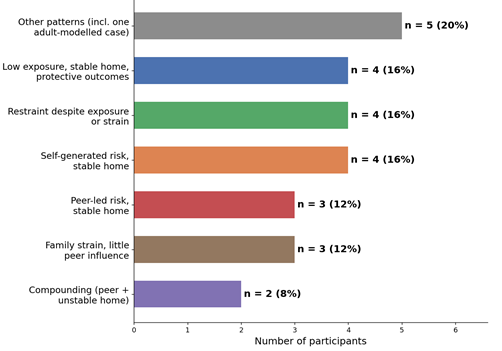
Interviews and Focus Groups
The two data sources produced similar levels of reported peer influence and family unpredictability but different levels of reported risk outcomes. Peer influence was coded High for three of the ten interview participants and four of the fifteen focus group participants, and unstable homes were coded for four of ten and four of fifteen. A High peer-pathway risk outcome, however, was coded for two of the ten interview participants (Chidi and Tunde) and seven of the fifteen focus group participants (Yakubu, Chukwuemeka, Ifeoma, Bashir, Adaeze, Precious and Chiamaka). Within the focus groups, a High risk outcome appeared in all three groups: two of five in Group A (the quiet group), three of five in Group B and two of five in Group C. Group discussion may have made it easier for some students to talk about risk behaviour, or the groups may simply have included more such students.
Discussion
This study explored how secondary school students in Abuja Municipal Area Council experienced and made sense of peer influence and family unpredictability in relation to delinquent behaviour, and how these two forces interacted from students' own perspectives. The findings are discussed below in relation to each of the four research questions, situated within the bioecological model [12], Agnew's [9] general strain theory, and the wider empirical literature. Table 3 maps each theme to the developmental concepts used to interpret it.
Research Question 1: How do students describe the influence of their peers on delinquent behaviour?
The findings show that students' accounts of peer influence were not uniform; rather, participants described a spectrum ranging from active resistance to direct behavioural adoption. Several participants — including Ngozi, Emeka, Grace, and Zainab — reported clear awareness of peer risk behaviour (substance use, early relationships, clothing and nightlife) alongside deliberate personal refusal to participate. This finding complicates a purely additive reading of peer influence, in which exposure to delinquent peers is assumed to translate directly into delinquent behaviour.
At the same time, a substantial subset of participants — Chidi, Tunde, Yakubu, Bashir, and Adaeze — described direct behavioural contagion, in which peer modelling of smoking, betting, or returning home late corresponded with their own adoption of the same behaviours. This finding aligns closely with existing Nigerian evidence. Fehintola, Sinabio, and Samaila [3] found a significant relationship between peer pressure and delinquent behaviour among in-school adolescents in Ibadan, while Yusuf, Daud, Arshat, and Sakiru [4] similarly reported that peer relationships played an important role in fighting and bullying among adolescents in Lagos State remand homes. The present findings extend this evidence qualitatively: where prior Nigerian studies established that peer influence correlates with delinquency, the present accounts illustrate the mechanism students themselves describe — direct modelling ("my friends smoke, and I feel like smoking too"), social participation (joining betting groups), and, conversely, conscious self-exemption from peer behaviour despite exposure.
This distinction between exposure and adoption is consistent with Brown and Larson's [17] conceptualisation of peer influence as operating through modelling, reinforcement, and social approval rather than through pressure alone; several participants in this study appeared to experience high peer exposure without the reinforcement or approval mechanisms that would translate exposure into behaviour. This suggests that, from students' own perspectives, peer influence functions less as a uniform risk factor and more as a conditional one, dependent on the individual's own evaluation of and relationship to peer behaviour.
This conditional pattern also had a developmental shape. High peer influence was concentrated in the senior secondary years, with six of the seven students coded High, and all five coded High on both peer influence and the peer-pathway risk outcome, in SS1 to SS3, which is consistent with research showing that the presence of peers raises risk-taking more strongly in adolescence than in adulthood [1,19]. At the same time, restraint appeared in students at every level, including students in the first year of secondary school, so exposure to peers should not be read as a fixed developmental risk.
The accounts also show why exposure to peer behaviour should be distinguished from adoption of it. The scale used here records the strength of peer influence, and adoption is coded separately through the risk outcome, which allows the two to be compared directly and shows when strong peer influence did and did not become behaviour.
Research Question 2: How do students describe the role of family unpredictability in relation to delinquent behaviour?
Participants' accounts of family unpredictability were similarly nuanced, and extended beyond a simple predictability/delinquency relationship. Consistent with Doom, Vanzomeren-Dohm, and Simpson's [7] finding that early environmental unpredictability predicts adolescent externalising behaviour independent of economic hardship, several participants in this study — most notably Chidi — directly linked inconsistent, conflict-marked home environments to their own engagement in fighting. Yakubu's account of emotionally absent, frequently travelling parents corresponding with living "anyhow he wants" similarly echoes Bosick and Fomby's [8] finding that instability in family relationships during childhood is associated with delinquent and externalising behaviour. These accounts concern family unpredictability as participants described it, chiefly parental conflict and absence; participants rarely described the inconsistent routines and rules that define unpredictability in the literature, so the comparison with Doom et al. [7] and Koss et al. [6] is indicative only.
However, the present findings also extend the construct of family unpredictability beyond delinquency outcomes specifically. Suleiman's account — in which parental absence and lack of attentiveness were linked not to delinquent behaviour but to difficulty trusting others and poor peer relationships — suggests that family unpredictability may shape adolescents' broader relational functioning, a dimension not fully captured by prior quantitative measures focused narrowly on delinquency, impulsivity, and externalising symptoms [6].
Importantly, the data do not support a straightforward, uniform relationship between family unpredictability and delinquency. Several participants (Ifeoma, Adaeze, Precious, Chiamaka) reported stable, prayerful home environments that did not correspond to reduced risk-related interest, while Zainab and Halima reported unstable or neglectful homes that did not translate into elevated delinquent behaviour, by their own account. This divergence indicates that family predictability, while protective in many accounts, was not uniformly protective across the sample. Rather than contradicting the existing literature, this pattern nuances it, suggesting that family unpredictability functions as one contributing condition among several rather than a determinative one — a distinction the present qualitative design was able to surface precisely because it did not treat family unpredictability as an isolated variable. This finding is taken up further below in relation to Research Question 3.
Research Question 3: How do peer influence and family unpredictability interact to shape delinquent behaviour?
The coded record shows that peer influence and family unpredictability combined in more than one way. Compounding was clearest for Chidi and Yakubu. Chidi's account — friends who smoke, combined with a conflict-marked, non-cohesive home — corresponded with his own reported engagement in both smoking and fighting, and Yakubu showed a comparable pattern of compounding peer and family risk. This is consistent with Agnew and White's [18] finding that the effects of strain on delinquency are conditioned by association with delinquent peers, and with Gao, Yu, and Ng's [5] demonstration that family functioning moderates the relationship between deviant peer affiliation and delinquency among Chinese adolescents. Nigerian quantitative evidence points in a similar direction: Adimora et al. [28] reported that adolescents in Enugu State from chaotic homes showed more disruptive behaviour and that negative peer pressure was linked with disruptive and risky sexual behaviour, concluding that the two may interact. Yet three further students with high peer influence and stable homes (Tunde, Bashir, and Adaeze) also reported a high risk outcome, so in this sample peer influence did not depend on family strain. The present findings therefore add qualitative, first-person evidence of compounding within an Abuja Municipal Area Council sample, while showing that compounding was one route among several.
Conversely, some students faced one or both risks without high delinquency. Zainab, despite reporting high peer influence and an unstable family environment, reported only moderate engagement in risk behaviour, which she attributed to her own reasoning rather than either external factor. This points to a third dimension not fully anticipated by general strain theory: several participants (Zainab, Halima, Segun, Ifeoma, Precious, Chiamaka) described personal values or self-generated motivation operating largely independently of both peer influence and family unpredictability, whether as a source of resilience despite risk exposure or as a source of risk-seeking despite protective conditions. Agnew's [9] general strain theory accounts for coping resources and social support as conditioning factors, but does not explicitly theorise an autonomous, identity-driven motivational pathway of the kind students described here. The bioecological model accommodates this through its person component, which treats adolescents' own characteristics as part of the developmental process rather than as background [12]. Read together, the two frameworks are consistent with the compounding route (GST) and with the role of the developing person in how both settings are taken up (bioecological model), although the emotional mechanism of GST was not evidenced.
This pattern of autonomous, values-driven behaviour resonates with further perspectives that sit alongside the study's two frameworks and may help interpret the person component of the bioecological model. Self-determination theory's emphasis on autonomous motivation and internalised values [24] offers one possible lens for participants such as Zainab and Halima, who explicitly framed their restraint in terms of personal understanding rather than compliance with peer or family expectations. Resilience frameworks, which examine why some adolescents sustain positive adjustment despite adverse conditions [26], may similarly help explain participants who maintained low-risk outcomes despite unstable home environments. For participants who described risk-seeking despite stable conditions, such as Segun, perspectives on adolescent identity development, particularly the exploration of values and behaviours as part of forming a coherent sense of self [25], may offer a complementary explanation to strain-based accounts. Agency, understood as the capacity to act intentionally and to reflect on and regulate one's own actions [27], is also consistent with participants' own framing of their choices in terms of understanding consequences and how life should be lived. Future research could examine whether one or a combination of these frameworks, alongside the bioecological model and GST, better accounts for the self-directed dimension of adolescent behaviour identified in the present study.
Research Question 4: What do students' accounts suggest about the developmental processes through which peer and family contexts shape adolescents' behaviour?
The findings carry several implications for understanding adolescent development. First, students' accounts suggest that susceptibility to peers is not a fixed trait of adolescence but a process that depends on how young people evaluate what peers do. Students who resisted peers they knew to be engaged in risky behaviour treated those behaviours as information about others rather than as an invitation, consistent with the idea that adolescents increasingly judge group norms rather than simply absorb them [15]. This qualifies accounts that treat peer sensitivity in adolescence mainly as a source of risk [19], and the concentration of high peer influence in the senior years suggests that age differences in resistance to peers merit closer attention [36].
Second, the family emerged as a secure base whose reliability students linked to their own restraint, and whose absence was linked in at least one account to difficulty trusting others. A developmental reading suggests that unstable caregiving may affect not only whether adolescents engage in delinquent behaviour but also how they form relationships beyond the family, which are central tasks of this life stage [13,14].
Third, students who explained their choices through personal values and an understanding of consequences, whether toward restraint or toward risk, point to autonomy and identity development as processes that operate alongside, rather than only in response to, peer and family conditions. Adolescents in this study were active interpreters of their circumstances, which supports a strengths-based view in which young people's own reasoning is treated as a resource to be supported [10].
Finally, the design, which compares students at different school levels over a single one-month period, cannot show whether these patterns persist into emerging adulthood. A developmental reading suggests following whether students who relied on self-directed reasoning in adolescence continue to do so, and whether the compounding pattern lessens as young people gain independence from family and peer settings [20].
Broader Implications
Taken together, these findings suggest that peer influence and family unpredictability are best understood, from students' own perspectives, not as independent risk factors but as conditions that sometimes compound and sometimes operate separately, and whose effects are further shaped by individual reasoning and personal values. This has practical implications consistent with the study's stated significance: school counsellors designing interventions around peer influence alone, or family stability alone, may be addressing only part of what students themselves describe as shaping their behaviour. Given that delinquent behaviour has been linked to reduced academic performance and poorer mental health outcomes among Nigerian students [2], interventions informed by the multiple pathways identified here — attending simultaneously to peer environment and family stability, while also supporting adolescents' own capacity for independent reasoning — may be better positioned to address delinquency risk than single-factor approaches.
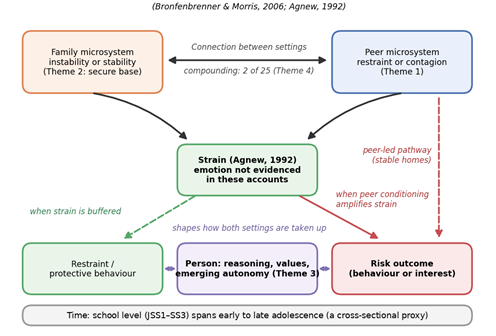
These findings also extend the largely Western and East Asian evidence base on family unpredictability [6][7] into a Nigerian qualitative context, offering a grounded, first-person account that complements the statistical associations established in prior Nigerian peer-influence research [3][4].
These implications should, however, be read in light of the study's scope and methodological limitations, discussed in full below. In brief, the patterns identified here — including the multiple pathways central to Research Question 3, the patterns by school level and gender, and the self-directed agency identified under Theme 3 — are illustrative of how this particular group of students experienced and interpreted peer and family influences, rather than fixed or statistically generalisable relationships [11].
Conclusion
Students described peer influence and family unpredictability as shaping delinquent behaviour in several different ways, with neither setting settling the outcome alone and their own reasoning playing a part, so support should work on peers, family and young people’s judgment together, though findings from one school cannot be generalised.
Limitations
This study is subject to several limitations. The findings are drawn from twenty-five students within a single secondary school in Abuja Municipal Area Council and are not intended to be statistically generalisable to secondary school students in Nigeria more broadly [11]; they should instead be understood as illustrative of how this particular group of students experienced and interpreted peer and family influences. Because the participating school was a private secondary school selected partly on the basis of access, the findings may not transfer directly to public secondary schools, where resource levels, class sizes, and school-based support structures often differ, or to rural school settings, where family and community dynamics may differ from those observed in this Federal Capital Territory context; future comparative research across private and public, and urban and rural, Nigerian secondary schools would help clarify how far the patterns identified here extend beyond this case. Similarly, coding was carried out primarily by a single researcher, with a supervisor independently reviewing the coding for all twenty-five participants; future studies could use independent double-coding of the full dataset to deepen interpretation through dialogue between coders. As a qualitative case study relying on self-report, the findings reflect participants' own interpretations of their behaviour and circumstances rather than independently verified causal relationships. The counter-patterns identified in the data — stable homes that did not prevent risk-related interest, and unstable homes that did not produce elevated delinquency — further indicate that family unpredictability, like peer influence, functioned as a conditional rather than deterministic factor within this sample, and this variability should be considered when interpreting the study's conclusions. The cross-case patterns by school level and gender reported here rest on small numbers of participants in each group and should be treated as hypotheses for future work rather than as findings. Because students at different school levels were compared at a single point in time over one month, the study cannot show how these patterns change as adolescents grow older. A high risk outcome was also more common among focus group participants than among interview participants, and the design cannot show whether group discussion, sampling or other factors explain this. The peer influence scale records the strength of influence and not what participants did in response, which is coded separately through the risk outcome; the interpretations offered here stay close to what participants said and avoid attributing motives that their accounts do not support. Future research employing larger and more varied samples across multiple schools, and potentially combining qualitative and quantitative approaches, would help establish the extent to which the patterns identified here hold across other Nigerian secondary school settings.
Several further limitations concern measurement and fieldwork. Interviews were short, with a main interview of about 30 minutes and follow-up sessions of 10 to 15 minutes, and were conducted by a local team and not by the researcher, so interviewer effects and the depth of the accounts may all have shaped the data; repeated contact does not fully offset these. Participants were recruited with the help of teachers and counsellors, which may have shaped who took part. Family stability was coded from participants' descriptions of parental conflict, absence and shared prayer, which captures family unpredictability as participants described it and is broader than the inconsistency in routines and rules defined in the Literature Review, and prayer and church attendance as an indicator of a reliable home may not apply equally across faiths. Because family stability was coded from conflict, absence and shared prayer, the study speaks to family unpredictability only as students described it. The risk outcome code combines described behaviour with described interest, so some High codes (notably Ifeoma, Precious and Chiamaka) reflect risk orientation and not confirmed delinquent behaviour, and two family outcome codes (Emeka and Abdullahi) are not illustrated by excerpts. Participants' accounts did not address the negative emotions central to general strain theory, so the study cannot test that mechanism. Finally, coding combined a reflexive thematic approach with a structured scheme for cross-case comparison, and the reliability checks are consistency checks and not proof of objectivity.
Declarations
Ethics approval and consent to participate: Ethical approval for this study was obtained prior to data collection (reference NEU/SS/2023/1593). Permission was obtained from the participating school. Parental or guardian consent was obtained through the school, and students provided voluntary assent before participation.
Conflict of interest: The authors declare that they have no conflicts of interest.
Funding: The authors received no financial support for this research.
Author contributions
Chinwendu Enechi contributed to conceptualisation, research design, data analysis, supervision, and writing and editing. Chiamaka Ezeribeaku and Brandeline Siewe contributed with Chinwendu Enechi to the literature review. Data collection was carried out by the local research team in Nigeria; the authors were not on site. All authors reviewed and approved the final manuscript.
References
- Steinberg L. A social neuroscience perspective on adolescent risk-taking. Dev Rev. 2008;28(1):78–106. doi: DOI ↗ Google Scholar ↗
- Ola-Williams MC, Ola-Williams A, Ogbaini CA. Juvenile delinquency and its effects on students' mental health and academic performance in Nigeria. Suluh: Jurnal Bimbingan dan Konseling. 2024;9(2):99–108. doi: DOI ↗ Google Scholar ↗
- Fehintola VA, Sinabio DS-S, Samaila H. The triad of influence: peer pressure, community factors, and gender as determinants of delinquent behaviour among school-attending adolescents in Ibadan, Nigeria. J Theor Empir Stud Educ. 2025;10(1):372–91. DOI ↗ Google Scholar ↗
- Yusuf SA, Daud MN, Arshat Z, Sakiru OK. The role of peer influence on juvenile delinquency among adolescents in the government remand homes, Lagos State Nigeria. Int J Acad Res Bus Soc Sci. 2021;11(11):2530–45. doi: DOI ↗ Google Scholar ↗
- Gao Y, Yu Y, Ng TK. A study on the moderating effect of family functioning on the relationship between deviant peer affiliation and delinquency among Chinese adolescents. Adv Appl Sociol. 2013;3(3):178–85. doi: DOI ↗ Google Scholar ↗
- Koss KJ, Kronaizl SG, Brown R, Brooks-Gunn J. Childhood environmental unpredictability and adolescent mental health and behavioral problems. Child Dev. 2025. doi: DOI ↗ Google Scholar ↗
- Doom JR, Vanzomeren-Dohm AA, Simpson JA. Early unpredictability predicts increased adolescent externalizing behaviors and substance use: a life history perspective. Dev Psychopathol. 2016;28(4):1505–16. doi: DOI ↗ Google Scholar ↗
- Bosick SJ, Fomby P. Family instability in childhood and criminal offending during the transition into adulthood. Am Behav Sci. 2018;62(11):1483–504. doi: DOI ↗ Google Scholar ↗
- Agnew R. Foundation for a general strain theory of crime and delinquency. Criminology. 1992;30(1):47–88. doi: DOI ↗ Google Scholar ↗
- Lerner RM, Lerner JV, Almerigi JB, Theokas C, Phelps E, Gestsdottir S, et al. Positive youth development, participation in community youth development programs, and community contributions of fifth-grade adolescents: findings from the first wave of the 4-H Study of Positive Youth Development. J Early Adolesc. 2005;25(1):17–71. doi: DOI ↗ Google Scholar ↗
- Yin RK. Case study research and applications: design and methods. 6th ed. Thousand Oaks (CA): SAGE Publications; 2018. DOI ↗ Google Scholar ↗
- Bronfenbrenner U, Morris PA. The bioecological model of human development. In: Damon W, Lerner RM, editors. Handbook of child psychology: Vol. 1. Theoretical models of human development. 6th ed. Hoboken (NJ): Wiley; 2006. p. 793–828. DOI ↗ Google Scholar ↗
- Bowlby J. A secure base: parent-child attachment and healthy human development. New York (NY): Basic Books; 1988. DOI ↗ Google Scholar ↗
- Erikson EH. Identity: youth and crisis. New York (NY): W. W. Norton; 1968. DOI ↗ Google Scholar ↗
- Smetana JG, Campione-Barr N, Metzger A. Adolescent development in interpersonal and societal contexts. Annu Rev Psychol. 2006;57:255–84. doi: DOI ↗ Google Scholar ↗
- Siegel LJ, Welsh BC. Juvenile delinquency: theory, practice, and law. 13th ed. Boston (MA): Cengage Learning; 2018. DOI ↗ Google Scholar ↗
- Brown BB, Larson J. Peer relationships in adolescence. In: Lerner RM, Steinberg L, editors. Handbook of adolescent psychology. 3rd ed. Hoboken (NJ): Wiley; 2009. doi: DOI ↗ Google Scholar ↗
- Agnew R, White HR. An empirical test of general strain theory. Criminology. 1992;30(4):475–500. doi: DOI ↗ Google Scholar ↗
- Gardner M, Steinberg L. Peer influence on risk taking, risk preference, and risky decision making in adolescence and adulthood: an experimental study. Dev Psychol. 2005;41(4):625–35. doi: DOI ↗ Google Scholar ↗
- Moffitt TE. Adolescence-limited and life-course-persistent antisocial behavior: a developmental taxonomy. Psychol Rev. 1993;100(4):674–701. doi: DOI ↗ Google Scholar ↗
- Dishion TJ, Tipsord JM. Peer contagion in child and adolescent social and emotional development. Annu Rev Psychol. 2011;62:189–214. doi: DOI ↗ Google Scholar ↗
- Ellis BJ, Figueredo AJ, Brumbach BH, Schlomer GL. Fundamental dimensions of environmental risk: the impact of harsh versus unstable environments on the evolution and development of life history strategies. Hum Nat. 2009;20(2):204–68. DOI ↗ Google Scholar ↗
- Belsky J, Schlomer GL, Ellis BJ. Beyond cumulative risk: distinguishing harshness and unpredictability as determinants of parenting and early life history strategy. Dev Psychol. 2012;48(3):662–73. doi: DOI ↗ Google Scholar ↗
- Ryan RM, Deci EL. Self-determination theory and the facilitation of intrinsic motivation, social development, and well-being. Am Psychol. 2000;55(1):68–78. doi: DOI ↗ Google Scholar ↗
- Marcia JE. Development and validation of ego-identity status. J Pers Soc Psychol. 1966;3(5):551–8. doi: DOI ↗ Google Scholar ↗
- Masten AS. Ordinary magic: resilience processes in development. Am Psychol. 2001;56(3):227–38. doi: DOI ↗ Google Scholar ↗
- Bandura A. Social cognitive theory: an agentic perspective. Annu Rev Psychol. 2001;52:1–26. doi: DOI ↗ Google Scholar ↗
- Adimora DE, Akaneme IN, Aye EN. Peer pressure and home environment as predictors of disruptive and risky sexual behaviours of secondary school adolescents. Afr Health Sci. 2018;18(2):218–26. doi: DOI ↗ Google Scholar ↗
- Creswell JW, Poth CN. Qualitative inquiry and research design: choosing among five approaches. 4th ed. Thousand Oaks (CA): SAGE Publications; 2018. DOI ↗ Google Scholar ↗
- Etikan I, Musa SA, Alkassim RS. Comparison of convenience sampling and purposive sampling. Am J Theor Appl Stat. 2016;5(1):1–4. doi: DOI ↗ Google Scholar ↗
- Braun V, Clarke V. Reflecting on reflexive thematic analysis. Qual Res Sport Exerc Health. 2019;11(4):589–97. doi: DOI ↗ Google Scholar ↗
- Kallio H, Pietilä A-M, Johnson M, Kangasniemi M. Systematic methodological review: developing a framework for a qualitative semi-structured interview guide. J Adv Nurs. 2016;72(12):2954–65. doi: DOI ↗ Google Scholar ↗
- Braun V, Clarke V. Using thematic analysis in psychology. Qual Res Psychol. 2006;3(2):77–101. doi: DOI ↗ Google Scholar ↗
- Sandelowski M, Voils CI, Knafl G. On quantitizing. J Mix Methods Res. 2009;3(3):208–22. doi: DOI ↗ Google Scholar ↗
- Lincoln YS, Guba EG. Naturalistic inquiry. Beverly Hills (CA): SAGE Publications; 1985. DOI ↗ Google Scholar ↗
- Steinberg L, Monahan KC. Age differences in resistance to peer influence. Dev Psychol. 2007;43(6):1531–43. doi: DOI ↗ Google Scholar ↗