Abstract
Parents are the first and lifelong teachers of every child. Parents have an immense impact on their children’s personality especially on thinking and regulation of behavior. The Secondary stage of education serves as a gateway to higher education. In secondary level, parental involvement in a child’s education is very important which helps child’s academic achievement as well as the all-rounder development of the students. The present study has focused on the level of parental involvement of secondary school students and compare the level of parental involvement in respect to gender. The study was conducted among class X students of Government Provincialized Co-Educational secondary school in Nalbari District of Assam. A Descriptive survey method was adopted. The sample comprised 100 secondary school students, including 50 boys and 50 girls. Data were collected using the parental involvement scale developed by Dr. Vijay laxmi Chouhan and Mrs. Gunjan Ganotra Arora, which was adapted by the investigator. Statistical analysis was performed using SPSS software, Mean, percentage and independent sample t-test were applied to test the hypotheses and find out the objectives. The result indicates that a majority of the students (41%) exhibited an average level of parental involvement. Further, Statistical analysis indicated there exists significant difference between boys and girls regarding parental involvement among secondary school students.
Keywords
Parental Involvement Secondary School Students Gender
Introduction
Education forms the cornerstone of individual growth and societal advancement. It empowers individuals, promote critical thinking, and provide opportunities for personal and professional development. Quality education equips learners with the knowledge and skills they require to address contemporary challenges, develop creativity and adaptability, and contribute meaningfully to economic development and social equity. Education, as a discipline, focuses on teaching and learning processes in formal settings such as schools. It functions as a medium of transmitting knowledge, cultural values and traditions from one generation to another, thereby shaping responsible individuals and cohesive communities.
The term parental refers to individuals who undertake responsibilities of parenting. This includes Father, Mother, Grandparents, and other members of the family, and legal guardians who actively participate in a child’s upbringing. Parenting is the system of behavior, learning, and development of the children by which they can live socially desirable life, adapt to their environment as per needs, and pursue their own goals. Parental involvement has consistently as a crucial factor influencing students’ academic success across various stages of education. From early childhood to adolescence, how parents engage in their children’s education such as monitoring homework, fostering motivation, or attending school activities has shown measurable effects on academic outcomes (Fan & Chen, 2001).
As we know the Secondary stage of education serves as a gateway to higher education while coinciding with adolescence- a period marked by rapid cognitive, emotional, physical and social development of the children. During this stage, adolescents face increasing academic and developmental challenges, parental support continues to exert influence, often through nuanced forms such as academic socialization and motivational guidance (Wang & Sheikh Khalil, 2014). Family is the child’s world where his personality and character are formed. The training provided in family is practical rather than theoretical. Parent-child relationship significantly contributes to a child’s social, emotional, moral, and communicative developments.
Extensive research indicates that students with actively involved parents tend to achieve higher grades, perform better on standardized assessments, earn higher grades, and maintain more positive attitudes toward education (Shute, Hansen, & Underwood, 2011). Globally, the urgency of this issue is underscored by UNESCO’s report that nearly 250 million children fail to achieve minimum proficiency in basic skills, with insufficient home-school collaboration identified as a contributing factor (UNESCO, 2016). So, Parents should inculcate good habits of their child. The Quality of learning is closely linked to students psychological and emotional well-being. Parental involvement whether directly or indirectly affects the success of child in education. If parents are enthusiastic about child’s education, then the child has positive attitude towards their schooling and is more receptive to learning.
Literature Review
Mabanag, A. et al. (2025) investigated the parental involvement, learning Behavior and its effects on the Academic Performance of the Grade 12 students. The study was conducted a San Isidro College, Malaybalay city, Bukidnon, Philippines, during the academic year 2024 -2025. The main objective of the study was to find out the relationship between parental involvement, students learning behaviour and academic performance among grade 12 students, A descriptive- correlational research design was used for the study. The research was carried out on a sample of 97 grade 12 students and using stratified random sampling. The study concluded that no significant correlation between parental involvement, learning behavior and academic performance. While parental support fosters positive study habits and motivation.
Gautam, B. and Sharma, V. (2024) explored a study on effect of parental involvement on academic stress among adolescents. The main objective of the study was parental involvement would significantly affect the level of academic stress among adolescents. Study was done with 200 students between 14-17 years age from K. V School, Delhi. Two- way analysis of variance was used to analysis the data. The final results indicated that high parental Involvement affects the level of academic stress significantly and positively among adolescents. The result also revealed that females were experiencing significantly more academic stress in comparison to male students.
Singh, K. A. (2022) conducted a research study on effect of parental involvement on study habits and Secondary School Tribal students od Madhya Pradesh. The main objective of the study was to find out the effect of parental involvement on study habits among secondary school Tribal students. The researcher was used Descriptive survey method and random sampling technique for the study. Tool was used self-constructed parental involvement scale and aspirational scale by the researcher for the study. For analysis data percentage, bar diagram, pie chart, mean, SD were used for describing the status of variables and t-test, ANOVA etc. The result shows that there is a significant positive effect of parental involvement on study habits and aspiration level among secondary school tribal students.
Kishor, N. (2021) explored research on study habit and attitude in relation to parental involvement of national institute of open school (NIOS) students”. The objective of the study to study the relationship between study habits & attitude and parental involvement of National Institute of Open School Students. The total sample of 200 Secondary School students was selected from Ludhiana District of Punjab to collect the requisite data for the study. The tool was used Study Habits and Attitude Scale (TSHA) Developed by C.P. Mathur and the parental involvement scale (TPIS) by Chauhan and Arrora. Mean, standard Deviation, t -Test statistical techniques were employed to find out the mean difference between different variables, coefficient of correlation and Z- ratio computed & graphical representation. In conclusion there will be no significant relation between study habits and attitude in Relation to parental involvement of National Institute of Open School Students.
Singh, D. et al. (2021) The study was conducted on Parental Attachment Psychological Wellbeing in Adolescents: Mediating Role of Self- esteem”. The participants were 292 adolescents with age ranging from 13 to 18 Years. Inventory for parents and peer attachment (IPPA)by Armsden and Greenberg self -esteem scale by Rosenberg and psychological wellbeing scale by Ryff were used to measure the parental attachment, self-esteem, and psychological wellbeing in adolescents. The result indicated that the correlation value of parental attachment and psychological wellbeing was found be 0. 306.The value of correlation value for self – esteem and psychological wellbeing was found to be 0. 342.In conclusion significant positive relationship was found between parental attachment, self-esteem and psychological wellbeing. The mediation analysis has shown that self-esteem partially mediates that relationship between parental attachment and psychological wellbeing among adolescents.
Priya C, K. (2021) carried out a research study on parental involvement, parental expectation and academic self-regulation of students with hearing and visual impairment. Main objective of the study parental involvement, parental expectation and academic self-regulation of students with hearing and visual impairment. By applying purposive sampling techniques 223 sample disable students were selected on the basis of different disability category, belonging to age group 13 to 14 years. With the help of descriptive survey method data were analyzed. The study proved that parents of students with hearing impairment have reported significantly more parental involvement, more parental expectation and more academic self-regulation than students with visual impairment.
Objectives
-
To study the level of parental involvement of secondary school students.
-
To find out the level of parental Involvement in respect to boys and girls.
Hypothesis:
H01: There exists no significant difference in parental Involvement between Boys and Girls.
Delimitation of the study:
The present study has been delimited as follows-
-
In the present study, the Nalbari District, Assam has been considered as the study area.
-
In the present study, the Government Provincialized Co- Educational Secondary Schools under Board of Secondary Education, Assam (SEBA) have been considered.
-
In the present study, the students who are studying in class X (Boys and Girls) in the Government Provincialized Co-Educational Secondary Schools have been selected as sample for the academic year (2025-26).
Research Methodology
Method:
The Descriptive Survey Method was used in this study. It describes the current position of the research work and involves interpretation, comparison, measurement, classification, evaluation and generalization. All these aspects contribute to a proper understanding of the solution to significant educational problems. The present study attempts to study the parental involvement of secondary school in Nalbari District, Assam." Considering the nature of the study, the descriptive survey method was deemed the most suitable.
Population:
The present study has been conducted in the Nalbari District of Assam. The population of the present Study includes all the Class X students studying in Nalbari Government Provincialized Co- Educational Secondary Schools Under Secondary Education Board of Assam (SEBA).
Sample:
The sample consists of a small number of representative individuals from the population. The researcher has selected 5 Government Provincialized Co- Educational Secondary school in Nalbari District, Assam under SEBA and 100 sample students were taken by using Simple Random Sampling technique for the study, among 100 students 50 boys and 50 girls’ student were selected.
Sources of Data Collection
● Primary data: Primary data is collected through adapted parental Involvement Scale by the investigator.
● Secondary data: Secondary data is collected through various Published Govt. report, journals, books, dissertations, office records etc.
Tool used in the study:
For the present study following tool has ben adapted for data collection.
Parental Involvement Scale (PIS)
The parental Involvement scale, originally developed by Dr. Vijaya Laxmi Chouhan and Mrs. GunjanGanotraArora (2022), was adapted and utilized the present study. The original scale consisted of 25 items- 14 positively worded and 11 negatively worded. To enhance the stability and precision of the instrument, the researcher added 5 additional items. Following this adaptation, the scale comprised 30 items in total, including 19 positively worded and 11 negatively worded statements. It is a five-point scale with responses “Always, Often, Sometimes, Rarely and Never. The scale is intended for use with secondary school students age group 13 to 18years. To evaluate face validity and content validity, the scale was reviewed by five experts who assessed its relevance and appropriateness for the target population. The Cronbach co- efficient Alpa analysis was done to check the reliability of the scale on 100 sample students. The computed value of Cronbach coefficient alpha is 0.82 which reflects a high level of internal consistency.
Analysis and Interpretation of Data
Objective No. 1: To study the level of Parental Involvement of Secondary School Students.
The sample descriptive statistics has been calculated shows the Mean and SD of parental Involvement of Secondary School Students. The descriptive statistics of Secondary School Students are shown in table no. 1
| N | Mean | SD | Minimum | Maximum |
| 100 | 116.21 | 10.66 | 89 | 137 |
Table no 1. Shows that the mean score of Parental Involvement level of Secondary School Students is 116.21 and the SD is 10.66. The level of Parental Involvement was assessed by determining the frequency of the data in order to determine the objective no.1
| Level of Parental Involvement | Rangeof Z Score | Range of Raw Score | Total No | Percentage |
| Very High | + 1.45 & above | 130 & Above | 3 | 3% |
| High | +0.49 to +1.45 | 124 – 129 | 28 | 28% |
| Average | -0.48 to + 0.48 | 117 – 123 | 41 | 41% |
| Low | -0.49 to – 1.45 | 111 – 116 | 19 | 19% |
| Very Low | -1.46 to Below | 110 & Below | 9 | 9% |
| Total | 100 | 100% |
Interpretation
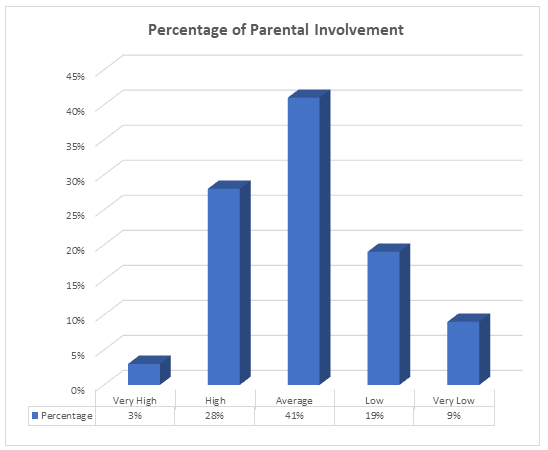
Table 2 and Chart no. 1, Show the prevalence distribution of Parental Involvement of the Secondary School Students in different levels of Very High, High, Average, Low and Very Low. The data reveal that out of 100 students, 3% fall under the Very High levels of Parental Involvement, while 28% are categorized under High level of Parental Involvement. A majority of students, 41% are placed in the Average level category. Additionally, 19 % of students fall under the Low level and 9 % are classified under Very Low level of Parental Involvement. It is evident from the data that most of the students have average rate of Parental Involvement.
| Level of Parental Involvement | No. ofBoys | Percentage | No. ofGirls | Percentage | Total No ofStudents | Percentage |
| Very High | 2 | 2% | 1 | 1% | 3 | 3% |
| High | 20 | 20% | 8 | 8% | 28 | 28% |
| Average | 19 | 19% | 22 | 22% | 41 | 41% |
| Low | 8 | 8% | 11 | 11% | 19 | 19% |
| Very Low | 1 | 1% | 8 | 8% | 9 | 9% |
| Total | 100 | 100% |
Interpretation
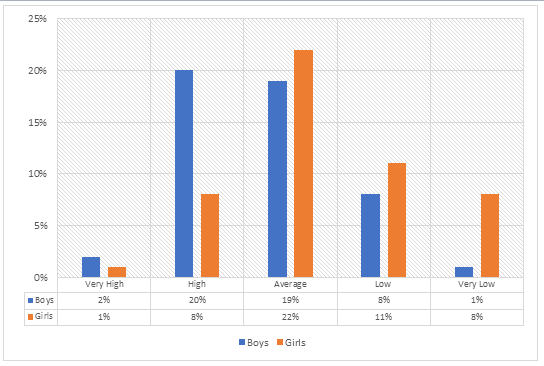
Table no. 3 and Chart no. 2 showed the prevalence distribution of Parental Involvement of Secondary School Students in the different categories of Very High, High, Average, Low and Very Low. On the basis of gender (Boys and Girls). The data revealed that, it has been Observed that for the Boys students 2% of students belonged to the Very High category of Parental Involvement, 20% boys’ students belonged to High category, 19% boys come under Average and 8% are under Low and 1% Boys are comes under Very Low level of Parental Involvement. The finding clearly indicate that maximum boys’ students have high level of Parental Involvement.
From the table, it has been observed that for the girls 1% of students belonged to Very High level of Parental Involvement, 8% of total Girl’s students fall under High level of Parental Involvement, 22% of students were having average level of Parental Involvement, 11% students can be categorized under Low level of Parental Involvement and 8% of Girls comes under Very Low level of Parental Involvement. The finding clearly indicate that maximum girls’ students have Average level of Parental Involvement.
Objective 2: To find out the level of parental Involvement in respect to Boys and Girls.
Ho1= There exists no significant difference on parental Involvement between Boys and Girls.
| Gender | No | Mean | SD | p- value | .05 level of Significance |
| Boys | 50 | 122.26 | 5.31 | .001 | Significant |
| Girls | 50 | 117.74 | 6.91 |
Significant at the .05% level of significant
Interpretation
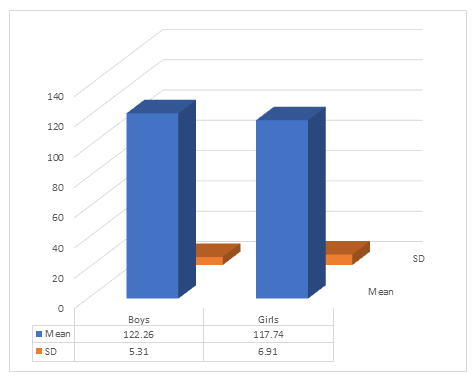
From the Table no.4 and Chart no. 3, it has been observed that the mean score of Boys and Girls is 122.26 and 117.74 respectively. The p- value is found .001 which is significant at the .05 level. Thus, there exists significant difference between boys and girls on Parental Involvement of Secondary School students. This indicates that boys and girls are not same on the level of Parental Involvement. It leads to rejection of null hypothesis Ho1, there exists significant different between boys and girls on Parental Involvement of Secondary School Students. Again, it observed that the mean performance of boys is 122.26 with SD 5.31 which is found to be higher than that of girl’s students 117.74 with SD 6.91. It indicates that the overall status of Parental Involvement of boy’s students is comparatively better than of girl’s students.
Findings and results
The findings of the present study on Parental Involvement among Secondary School Students of Nalbari District align with several previous research studies reviewed. The result evident from the study that majority of the students experience an average level of Parental Involvement. It was further observed that most of the boys’ students under have high level of Parental Involvement, whereas most of the girls’ students fall under average level of category. Previous studies support similar observation, (Dr. k. Vijayalakshmi & k. Muniappan,2016) reported that majority of the students (62%) of secondary school students exhibited an average level of parental involvement. (Dheivemania & Venkatarman S, 2021) found that parental involvement significantly contributes to students’ academic achievement, social and emotional wellbeing, and educational aspirations of secondary level students, however, there are various factors that can influence the effectiveness of parental involvement. (Sibi K. B, Dr. Meera k. P, 2022) there is no significant difference in the level of Parental involvement between male and female coastal area students. (Gogoi,B & Rajkhua, P, 2021) It was evident from the findings of the study that there is a significant difference in parental involvement as perceived by Secondary School students of Sivasagar District with respect to their gender and locality. According to the current study, boys and girls are not same on the level of Parental Involvement. It leads to rejection of null hypothesis Ho1, there exists significant different between boys and girls on Parental Involvement of Secondary School Students. Again, it observed that the mean performance of boys is 122.26 with SD 5.31 which is found to be higher than that of girl’s students 117.74 with SD 6.91. It indicates that the overall level of Parental Involvement is relatively higher among male students.
Conclusion
The study demonstrate that parental involvement is a strong predicator of Secondary School students. Based on study majority of the students experience an average level of parental involvement. Moreover, a statistically significant difference was observed between boys’ and girls’, boys receiving comparatively higher parental involvement than girls. This gender-based disparity may reflect underlying socio-cultural factors that may influence parental attitudes, expectations, and educational support practices within the district. To reduce gender disparities in parental involvement, targeted efforts must be undertaken to promote equal academic support for both boys and girls. The significant difference observed in the study indicates the need for parental awareness regarding gender equity in education. Schools should organize regular parent–teacher interactions and sensitization programs emphasizing balanced encouragement and monitoring of children’s academic progress irrespective of gender. Encouraging equitable parental practices will contribute to ensuring equal educational opportunities and fostering the holistic development for all students.
References
- Banerjee, S. (2022). Effect of parental involvement on study habit and aspiration level among secondary school Tribal students of Madhaya Predesh. [ Doctoral Thesis, Indira Gandhi National Tribal University, Amarkantak]. http://hdl.handle.net/10603/412963 DOI ↗ Google Scholar ↗
- Baruah, B. (2021). The Impact of Parent Involvement and Education Level on Secondary School Students Academic Achievement in District Sivasagar, Assam. The International Journal of Indian Psychology, Vol.9, DOI: DOI ↗ Google Scholar ↗
- Deka, P.P. (2016). A Study on Parental involvement in higher level of education: voice of parents and students in Pub Kamrup College and Patidarrang College, Kamrup District. International Multidisciplinary Journal, Vol.5, DOI: DOI ↗ Google Scholar ↗
- Gautam, B. & Sharma, V. (2024). Effect of parental involvement on academic stress among adolescents. The International Journal of Indian Psychology ,ISSN 2348-5396 (Online) ,Volume 12, Issue 4, DOI: DOI ↗ Google Scholar ↗
- Gogoi, B. (2017). Impact Of Parental Involvement on The Academic Achievement of Adolescents Of Sonowal Kachari Tribes of Hapjan Educational Block in Tinsukia District, Assam. International Education & Research Journal [IERJ], Vol.3, E-ISSN No: 2454-9916 DOI ↗ Google Scholar ↗
- Gagoi, B. & Rajkhuwa, P.(2021). Perceived Parental Involvement of Secondary School Students of Sivasagar District. International Journal of Early Childhood Special Education (INT-JECSE), DOI: ISSN: 1308-5581 Vol 13, Issue 02 DOI ↗ Google Scholar ↗
- K. Vijaylakshmi .,& K, Muniappan. (2016) . Parental Involvement & Achievement of Secondary School Students.The International Journal of Indian Psychology [IJIP], Vol.3,issue,4 No,65 ISSN 2348- 5396 DOI ↗ Google Scholar ↗
- Makkar , N. (2025). Parental involvement and student achievement in secondary schools: A correlational study. International Journal of Psychology Research[IJPR], 7(2): 108-114, ISSN Online: 2664-8911,DOI: DOI ↗ Google Scholar ↗
- Mabanag, A. et al. (2025). Parental Involvement, Learning Behavior and Its Effects on the Academic Performance of the Grade 12 Students. Asian Journal of Education and Social Studies 51 (5):210-26. DOI ↗ Google Scholar ↗
- Singh, D. et al. (2021) . Parental Attachment Psychological Wellbeing in Adolescents: Mediating Role of Self- esteem. Indian Journal of Youth and Adolescent Health, Vol ,8(1),ISSN-2349-2880 DOI ↗ Google Scholar ↗