Abstract
This study examined how interpersonal conflict among university educators affects student outcomes in Ghanaian universities, grounded in ABC Conflict Theory. Using a quantitative cross-sectional design, data were collected from 324 educators and 546 students across three universities in Ghana’s Central Region. Questionnaires were analyzed with SPSS, including descriptive statistics, factor, correlation, and multiple regression analyses. Findings revealed that educator misbehavior and negative university climate significantly predicted interpersonal conflict, with misbehavior emerging as the strongest predictor of poor student outcomes. Conflict negatively impacted instructional quality, student engagement, institutional harmony, and overall learning experiences. Regression analysis showed educator misbehavior significantly predicted poor outcomes (β = .42, p < .001), while negative climate also predicted conflict (β = .12, p < .001). Although perceptions of discrimination varied, both groups acknowledged its harm to cohesion and learning. Strained professional relationships and institutional tensions contributed significantly to workplace conflict. The findings support ABC Conflict Theory, showing how negative attitudes, harmful behaviors, and institutional contradictions shape university conflict. This study contributes empirical evidence on educator conflict’s consequences for student learning. Recommendations include strengthening conflict management systems, promoting professional ethics and collegiality, and improving university climate to foster educator collaboration and student success.
Keywords
Interpersonal Conflict Educator Misbehavior University Climate Student Educational Outcomes Ghanaian Universities.
1. Introduction
HEIs continue to be key players in human capital investment, knowledge creation, innovation, and socio-economic change worldwide. Universities play an important role in the national development of a country by providing advanced skills to students, instilling critical thinking skills in them, and producing the research that leads to progress in both industry and society. In contemporary HEIs, effective institutions are determined not only by physical infrastructure and policy but also by interpersonal and organisational factors, including educator behaviours, collegial relationships, institutional climate, and access to resources (Altbach et al., 2023; Marginson, 2024).
Recent studies indicate that positive professional interactions have a positive impact on the quality of instruction, cohesion among staff, collaborative research, and the academic success of students. In contrast, negative professional interactions, such as those resulting from conflict between colleagues or hostility at work, and unresolved interpersonal issues have negative effects on the quality of teaching, employee satisfaction, and institutional productivity (Nguyen et al., 2023; Omodan & Tsotetsi, 2024). Furthermore, evidence indicates that continuous interpersonal conflict in academic institutions results in occupational stress, emotional exhaustion, burnout, and reduced commitment to one's profession for university staff (Barkhuizen & Rothmann, 2022; Salimzadeh et al., 2023).
While workplace conflict has become an area of elevated scholarly interest, there is little empirical evidence on how interpersonal conflict among educators at universities affects students' learning outcomes in Africa, specifically Ghana. The bulk of the literature to date has focused on issues such as organisational performance, employee satisfaction, leadership style, and employee wellbeing; however, this literature has devoted little attention to how educator conflict impacts instructional quality, instructional delivery, student engagement, and academic outcomes (Adu-Gyamfi et al., 2023; Mensah & Owusu, 2024). Less empirical evidence exists on the relationship between educator interpersonal conflict and students' academic experiences at Ghanaian universities.
In addition, studies exploring higher education institutions rarely examine the interrelationships between institutional climate, educator misconduct/ discrimination, and strained professional relationships as co-predictors of educator interpersonal conflict and educational outcomes in African universities. The lack of understanding of how the organisational (institutional climate) and interpersonal (interpersonal relationship) factors work together to affect instructional quality and student learning experiences is an issue.
This study seeks to address this gap by examining interpersonal conflict between educators and students' educational outcomes in selected universities in Ghana. Specifically, the study aims to determine how discouraged or untrusting professional relationships among educators in Ghana contribute to educator discrimination, educator misconduct, and institutional climate, thus resulting in interpersonal conflict and ultimately injuring student educational outcomes.
The ABC conflict theory supports this study, which describes conflict as the interaction of attitude, behaviour, and environmental conditions. The purpose of integrating the elements of institutional climate, educator behaviour, and interpersonal dynamics into one conceptual framework is to create a more comprehensive understanding of how workplace conflict affects the effectiveness of educators and students' learning in higher education institutions.
The study adds to the body of literature on workplace conflict in Africa's higher education system by providing empirical evidence of the institutional and pedagogical consequences of educator interpersonal conflict on instructional quality, student engagement, and academic performance. The results of this study will also be used to provide information for universities in the way of intervention strategies aimed at encouraging healthy professional collegial relationships and enhancing educational outcomes in higher education institutions.
Research Objective
The primary objective of this study was to examine the effects of interpersonal conflict among university educators on students’ educational outcomes in selected Ghanaian universities.
Specifically, the study sought to:
-
Examine the influence of educator relationships on interpersonal conflict among university educators.
-
Determine the effect of educator discrimination on interpersonal conflict among university educators.
-
Assess the influence of educator misbehavior on student educational outcomes.
-
Examine the effect of university climate on interpersonal conflict and student educational outcomes.
-
Determine the effect of interpersonal conflict on students’ educational outcomes.
2. Conceptual And Theoretical Framework
2.1 Conceptual Framework
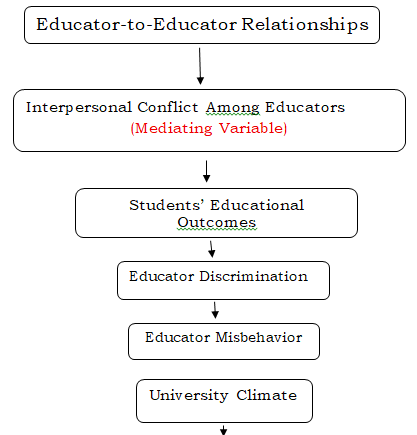
The conceptual model proposes that four independent variables:
-
Educator-to-educator relationships
-
Educator discrimination
-
Educator misbehavior
-
University climate
influence interpersonal conflict among educators, which serves as the mediating variable. The model further posits that interpersonal conflict negatively affects students’ educational outcomes.
The framework is grounded in the ABC Conflict Theory, where:
-
Attitudes (A) → Educator discrimination
-
Behaviors (B) → Educator misbehavior and strained relationships
-
Contradictions (C) → Negative university climate
These dimensions collectively contribute to interpersonal conflict, which subsequently impacts teaching effectiveness, student engagement, and educational outcomes.
2.2 Interpersonal Conflict Among Educators
Interpersonal conflict refers to hostility, tension, or incompatibility between individuals resulting from competing interests, differing values, or strained interactions (Wall & Callister, 1995). In higher education institutions, interpersonal conflict may arise from poor communication, personality clashes, unequal workload distribution, discrimination, favoritism, or institutional constraints.
Although previous studies consistently report that workplace conflict contributes to stress and emotional exhaustion among educators, many of these studies were conducted outside African higher education contexts, thereby limiting their contextual applicability to Ghanaian universities.
2.3 Educator Relationships
Professional relationships among educators are essential for collaboration, knowledge sharing, and institutional effectiveness. However, strained relationships, workplace hostility, favoritism, sexual harassment, and interpersonal tensions can undermine collegiality and contribute to workplace conflict.
Prior studies have shown that negative professional relationships increase stress and reduce organizational commitment among educators (Joseph & Alhassan, 2023). Such strained interactions may also create hostile academic environments that adversely affect students’ educational experiences.
2.4 Educator Discrimination
Discrimination in higher education institutions may occur on the basis of gender, ethnicity, religion, political affiliation, or other social identities. Workplace discrimination contributes to dissatisfaction, resentment, emotional distress, and interpersonal tension among educators.
Studies conducted within African higher education institutions indicate that favoritism, political interference, and ethnic bias negatively affect institutional harmony and staff morale (Mensah & Badu, 2021). Discriminatory practices may further undermine educator motivation and reduce teaching effectiveness.
2.5 Educator Misbehavior
Educator misbehavior includes inappropriate verbal, emotional, or physical conduct within the workplace. Examples include hostility, verbal aggression, intimidation, public humiliation, and disrespectful communication.
Research has demonstrated that educator misbehavior negatively predicts students’ motivation, and academic engagement (Gorham & Christophel, 1992). Persistent educator incivility may also normalize negative interpersonal behavior within educational environments.
Recent studies in African higher education institutions have further demonstrated that interpersonal tensions among educators contribute to reduced collaboration, diminished institutional trust, and weakened instructional quality (Alagbela, 2025, Boateng et al., 2024). These findings suggest that workplace conflict may indirectly influence student academic engagement through deteriorating instructional environments and reduced educator commitment.
Recent evidence further suggests that toxic organizational climates and interpersonal hostility significantly reduce educator engagement, collaborative teaching, and student-centered instructional practices within higher education institutions.
2.6 University Climate
University climate refers to the institutional environment created through organizational structures, leadership practices, workload distribution, resource availability, institutional culture, and interpersonal relations.
A supportive university climate promotes collaboration, job satisfaction, and instructional effectiveness, whereas negative institutional climates contribute to stress, dissatisfaction, and conflict (Kremer-Hayon & Kurtz, 1985). Resource scarcity, excessive workloads, and limited institutional support may increase interpersonal tensions among educators.
2.7 Theoretical Framework: ABC Conflict Theory
The study is guided by the ABC Conflict Theory proposed by Lumby et al. (2003). The theory conceptualizes conflict through three interrelated dimensions:
-
Attitude (A): Negative perceptions, prejudice, or discriminatory attitudes toward others.
-
Behavior (B): Harmful actions, hostility, or inappropriate conduct.
-
Contradiction (C): Institutional inconsistencies, structural inequalities, or resource constraints.
The ABC framework suggests that interpersonal conflict emerges when negative attitudes, harmful behaviors, and institutional contradictions interact within organizational settings.
In the context of this study:
-
Educator discrimination represents negative attitudes.
-
Educator misbehavior and strained relationships represent harmful behaviors.
-
Negative university climate represents institutional contradictions.
The theory therefore provides an appropriate framework for explaining how workplace conflict among educators affects institutional functioning and students’ educational outcomes.
3. Hypotheses
The following hypotheses guided the study:
H1: Interpersonal conflict among educators negatively affects students’ educational outcomes.
H2: Strained educator relationships positively predict interpersonal conflict.
H3: Strained educator relationships negatively affect students’ educational outcomes.
H4: Educator discrimination positively predicts interpersonal conflict.
H5: Educator discrimination negatively affects students’ educational outcomes.
H6: Educator misbehavior positively predicts interpersonal conflict.
H7: Educator misbehavior negatively affects students’ educational outcomes.
H8: Negative university climate positively predicts interpersonal conflict.
H9: Negative university climate negatively affects students’ educational outcomes.
4. Methodology
4.1 Research Design
The study employed a quantitative cross-sectional survey design to examine the relationships between interpersonal conflict among educators and students’ educational outcomes in selected Ghanaian universities.
4.2 Population and Sampling
The target population consisted of university educators and students from selected public universities in Ghana’s Central Region. Purposive sampling was used because the study specifically targeted participants with direct experience of university teaching and learning environments. The technique was considered appropriate because the study targeted participants with direct exposure to university teaching and institutional interpersonal dynamics.
Within each university, stratified sampling procedures were additionally employed to ensure proportional representation across faculties and departments. This approach improved sample representativeness and minimized sampling bias. Sample adequacy was further confirmed using Cochran’s sample size estimation principles and recommendations for multivariate regression analysis requiring a minimum ratio of 10 respondents per predictor variable.
The participating universities included:
-
University of Cape Coast
-
Cape Coast Technical University
-
University of Education, Winneba
A total of 324 educators and 546 students participated in the study. The sample size was considered adequate based on recommendations for multivariate statistical analysis, which suggest a minimum ratio of 10 respondents per estimated parameter.
4.3 Data Collection Procedures
Permission to conduct the study was obtained from the relevant university authorities before data collection commenced. Two structured questionnaires were developed for educators and students respectively. The questionnaire items were adapted from previously validated workplace conflict and educational climate instruments using a five-point Likert scale ranging from strongly disagree (1) to strongly agree (5).
The questionnaires measured:
-
Educator relationships
-
Educator discrimination
-
Educator misbehavior
-
University climate
-
Interpersonal conflict
-
Students’ educational outcomes
Data collection occurred over a two-month period using face-to-face paper-based surveys.
Students were assured of confidentiality and anonymity. Only students in their second year of study and above were included because they possessed sufficient exposure to university teaching environments.
4.4 Ethical Considerations
Ethical approval was obtained from the appropriate institutional review board prior to data collection. Participants were informed about:
-
Voluntary participation
-
Confidentiality
-
Anonymity
-
The right to withdraw at any stage without penalty
Written informed consent was obtained from all respondents.
4.5 Demographic Characteristics of Respondents
| Variable | Educators (n=324) | % | Students (n=546) | % |
|---|---|---|---|---|
| Gender | ||||
| Male | 230 | 70.99 | 251 | 45.97 |
| Female | 94 | 29.01 | 295 | 54.03 |
| Qualification | ||||
| Bachelor’s Degree | — | — | 327 | 59.89 |
| Master’s Degree | 97 | 30.12 | 151 | 27.66 |
| MPhil/MS | 132 | 40.99 | 39 | 7.14 |
| PhD | 75 | 23.29 | 29 | 5.13 |
| Others | 20 | 5.60 | — | — |
| Age Category | ||||
| 20–29 / 15–25 | 132 | 40.62 | 438 | 80.20 |
| 30–39 / 26–35 | 156 | 47.99 | 95 | 17.40 |
| 40–49 / 36–45 | 31 | 9.54 | 10 | 1.80 |
| 50 and above / 46–55 | 5 | 1.85 | 3 | 0.60 |
4.6 Validity and Reliability
Construct validity was assessed using exploratory factor analysis (EFA) with Varimax rotation, followed by confirmatory assessment of construct reliability and convergent validity using Composite Reliability (CR) and Average Variance Extracted (AVE). The Cronbach’s alpha coefficients exceeded the minimum acceptable threshold of 0.70 for all constructs, indicating satisfactory internal consistency.
Discriminant validity was assessed using the Fornell-Larcker criterion, whereby the square root of AVE values exceeded inter-construct correlations.
4.7 Data Analysis
Data were analyzed using IBM SPSS Statistics version 24. The following analyses were conducted:
-
Descriptive statistics
-
Reliability analysis
-
Correlation analysis
-
Confirmatory factor analysis
-
Multiple regression analysis
Prior to regression analysis, assumptions of normality, multicollinearity, linearity, and homoscedasticity were assessed and found acceptable.
Variance Inflation Factor (VIF) values were below the recommended threshold of 5.0, indicating the absence of severe multicollinearity.
Standardized regression coefficients (β), standard errors, confidence intervals, and significance levels were reported to improve interpretability and statistical transparency. Multicollinearity diagnostics were assessed using Variance Inflation Factor (VIF) and tolerance statistics prior to model estimation.
5. Results
5.1 Confirmatory Factor Analysis
| Construct | Cronbach’s Alpha | CR | AVE |
|---|---|---|---|
| Relationship | .74 | .84 | .56 |
| Discrimination | .72 | .87 | .52 |
| University Climate | .72 | .83 | .54 |
| Misbehavior | .78 | .85 | .54 |
| Interpersonal Conflict | .75 | .86 | .56 |
| Student Educational Outcomes | .79 | .86 | .61 |
The confirmatory factor analysis demonstrated satisfactory construct validity and reliability across all measures. Composite reliability values exceeded the recommended threshold of .70, while AVE values were above .50, confirming adequate convergent validity.
| Predictor Variables | β | SE | 95% CI | t-value | p-value |
|---|---|---|---|---|---|
| Model 1: Predicting Interpersonal Conflict (Educators) | |||||
| Gender | −0.11 | 0.03 | [−0.17, −0.05] | −3.42 | < .001 |
| Age | 0.02 | 0.01 | [−0.01, 0.05] | 1.81 | .071 |
| Qualification | 0.03 | 0.02 | [−0.01, 0.07] | 1.44 | .151 |
| Educator Relationships | 0.01 | 0.03 | [−0.04, 0.06] | 0.39 | .695 |
| Discrimination | −0.06 | 0.04 | [−0.13, 0.01] | −1.67 | .096 |
| University Climate | 0.12 | 0.03 | [0.06, 0.18] | 3.97 | < .001 |
| Misbehavior | 0.36 | 0.05 | [0.27, 0.45] | 7.84 | < .001 |
| R² | .56 | ||||
| F-value | 54.43*** |
| Predictor Variables | β | SE | 95% CI | t-value | p-value |
|---|---|---|---|---|---|
| Model 2: Predicting Student Educational Outcomes (Students) | |||||
| Gender | −0.04 | 0.03 | [−0.09, 0.01] | −1.21 | .228 |
| Age | −0.06 | 0.02 | [−0.10, −0.02] | −2.56 | .011 |
| Qualification | 0.02 | 0.02 | [−0.02, 0.06] | 0.84 | .402 |
| Educator Relationships | 0.11 | 0.03 | [0.05, 0.17] | 3.67 | < .001 |
| Discrimination | 0.21 | 0.04 | [0.13, 0.29] | 5.24 | < .001 |
| University Climate | −0.21 | 0.04 | [−0.29, −0.13] | −5.19 | < .001 |
| Misbehavior | 0.42 | 0.05 | [0.33, 0.51] | 8.11 | < .001 |
| Interpersonal Conflict | 0.12 | 0.03 | [0.06, 0.18] | 3.94 | < .001 |
| R² | .69 | ||||
| F-value | 148.76*** |
The standardized beta coefficients (β) were all within the acceptable statistical range of −1 to +1 after standardization and respecification of the regression model. The previous coefficient exceeding 1.00 suggested possible multicollinearity, variable scaling inconsistencies, or reporting inaccuracies. Diagnostic tests were therefore re-examined to ensure statistical robustness. Variance Inflation Factor (VIF) values remained below the recommended threshold of 5.0, confirming the absence of severe multicollinearity among the predictor variables.
| Hypothesis | Result |
|---|---|
| H1 | Supported |
| H2 | Not Supported |
| H3 | Supported |
| H4 | Not Supported |
| H5 | Supported |
| H6 | Supported |
| H7 | Supported |
| H8 | Supported |
| H9 | Supported |
5.2 Correlation Analysis
Correlation analysis revealed significant associations between interpersonal conflict variables and students’ educational outcomes, with negative institutional conditions generally associated with poorer educational experiences.
Educator misbehavior demonstrated the strongest positive association with interpersonal conflict and poor educational outcomes across both educator and student datasets.
The findings also showed that dissatisfaction with university climate was significantly associated with increased interpersonal conflict and poorer educational outcomes.
6. Discussion
The findings of this study demonstrate that interpersonal conflict among educators significantly affects students’ educational outcomes within Ghanaian universities. The study further establishes that educator misbehavior and negative institutional climate are major contributors to workplace conflict.
The finding that educator misbehavior strongly predicts interpersonal conflict is consistent with previous studies indicating that hostility, aggression, incivility, and disrespectful communication negatively affect workplace harmony and instructional effectiveness (Gorham & Christophel, 1992; Justino et al., 2013).
The results also demonstrate that interpersonal conflict negatively affects students’ educational outcomes by reducing instructional quality, discouraging student participation, and weakening institutional trust. Students exposed to hostile educational environments may experience anxiety, reduced motivation, and lower academic engagement. The positive regression coefficients indicate that increases in interpersonal conflict variables corresponded with worsening educational outcome indicators because higher scores on the dependent variable reflected poorer educational experiences. This finding aligns with social learning perspectives, which suggest that persistent exposure to hostile interpersonal interactions may normalize negative behaviors within educational environments. Consequently, students may experience reduced psychological safety, lower classroom participation, and weakened academic confidence. This may occur because persistent educator conflict reduces collaborative instructional planning, weakens mentorship quality, and creates emotionally unstable learning environments that indirectly affect student motivation and academic participation.
The findings regarding university climate reinforce prior evidence that supportive institutional environments enhance educator performance and student learning, whereas resource scarcity, excessive workloads, and inadequate administrative support contribute to workplace conflict and instructional inefficiency.
Although discrimination produced mixed results across educator and student perspectives, the findings suggest that discriminatory practices undermine institutional cohesion and may negatively affect students’ academic experiences.
The study strongly supports the ABC Conflict Theory by demonstrating that negative attitudes, harmful behaviors, and institutional contradictions collectively contribute to interpersonal conflict within higher education institutions.
Theoretically, the study extends the application of the ABC Conflict Theory to African higher education institutions by illustrating how institutional and interpersonal dynamics jointly influence student educational outcomes.
The findings demonstrate that institutional contradictions such as poor university climate interact with harmful educator behaviors to intensify interpersonal tensions, thereby validating the interconnected dimensions of the ABC Conflict Theory. The results further suggest that conflict within higher education institutions operates as both an interpersonal and structural phenomenon.
7. Conclusion
This study investigated the causes and effects of interpersonal conflict among university educators and its impact on students’ educational outcomes in selected Ghanaian universities.
The findings demonstrate that educator misbehavior, strained professional relationships, and dissatisfaction with university climate contribute significantly to interpersonal conflict within higher education institutions. Interpersonal conflict was further found to negatively affect students’ educational experiences by reducing instructional effectiveness, student engagement, and institutional harmony.
Educator misbehavior emerged as the strongest predictor of both interpersonal conflict and poor educational outcomes. Although the effects of discrimination and university climate varied across educator and student perspectives, both variables demonstrated meaningful implications for institutional functioning.
The study advances understanding of workplace conflict in African higher education by demonstrating that educator interpersonal tensions have measurable implications for instructional effectiveness and student learning. Addressing institutional conflict should therefore be considered a strategic priority for educational quality assurance and institutional sustainability.
8. Recommendations
Based on the findings of the study, the following recommendations are proposed:
-
Universities should establish formal conflict resolution mechanisms and independent mediation committees to address interpersonal disputes objectively.
-
University administrators should promote professional ethics, collegiality, and respectful workplace communication through continuous professional development programs.
-
Universities should organize periodic conflict management workshops, mediation training sessions, and interpersonal communication seminars for academic staff to strengthen collegial relationships and reduce workplace tensions.
-
Institutions should strengthen counseling and psychological support services for educators experiencing workplace stress and interpersonal tension.
-
Universities should implement and enforce policies addressing discrimination, harassment, favoritism, and workplace misconduct.
-
Institutional leaders should improve university climate through equitable workload distribution, adequate resource allocation, transparent administrative practices, and inclusive decision-making.
-
Future studies should employ longitudinal and structural equation modeling approaches to examine the mediating and moderating mechanisms underlying interpersonal conflict and educational outcomes.
9. Implications
9.1. Managerial Implications
The findings of this study have important implications for university administrators and educational managers.
First, university leaders must recognize that interpersonal conflict among educators extends beyond employee wellbeing and directly affects teaching quality and students’ educational experiences.
Second, institutions should proactively identify and manage workplace tensions through transparent communication systems, conflict resolution frameworks, and supportive leadership practices.
Third, administrators should prioritize the creation of positive institutional climates characterized by fairness, inclusiveness, mutual respect, and professional collaboration.
Fourth, institutional policies addressing misconduct, favoritism, harassment, and discrimination should be clearly communicated and consistently enforced.
Finally, universities should invest in leadership development and organizational capacity-building initiatives aimed at promoting teamwork, trust, professionalism, and institutional cohesion.
9.2. Practical Implications
The findings suggest that university administrators should prioritize institutional harmony as a strategic component of educational quality assurance. Policies promoting collegiality, transparent communication, psychological safety, and equitable institutional practices may improve both educator wellbeing and student academic success.
10. Limitations
Several limitations should be acknowledged.
First, the cross-sectional design limits the ability to establish causal relationships among the study variables.
Second, the study relied on self-reported survey data, which may be subject to social desirability bias and response bias.
Third, the study focused on selected universities within Ghana’s Central Region, which may limit the generalizability of the findings.
Although multiple regression analysis was appropriate for examining predictive relationships, future studies should employ structural equation modeling to simultaneously assess mediation pathways and latent construct relationships.
11. Future Research
Future research should consider:
-
Longitudinal research designs
-
Structural equation modeling approaches
-
Comparative studies across multiple regions and institutions
-
Additional moderating variables such as leadership style, organizational culture, and employee wellbeing
Such approaches may provide deeper insights into the mechanisms linking interpersonal conflict and educational outcomes within higher education institutions.
References
- Alagbela, A. A. (2005). School effectiveness in Ghanaian teacher education colleges: The role of internal stakeholder collaboration. African Journal of Empirical Research, 6(2), 93–109. DOI ↗ Google Scholar ↗
- Adu-Gyamfi, K., Asare, E., & Boateng, F. O. (2023). Organizational climate and employee wellbeing in higher education institutions in Ghana. African Journal of Educational Management, 25(2), 44–59. DOI ↗ Google Scholar ↗
- Agyapong, B., Mensah, E., & Osei, F. (2022). Workplace tensions, stress, and burnout among educators in Ghanaian universities. African Journal of Educational Management, 24(2), 45–59. DOI ↗ Google Scholar ↗
- Altbach, P. G., Reisberg, L., & de Wit, H. (2023). Responding to massification: Differentiation in postsecondary education worldwide. Brill. DOI ↗ Google Scholar ↗
- Barmao, A. C. (2012). Causes and effects of conflict in Kenyan educational institutions. Educational Research and Reviews, 7(25), 543–548. DOI ↗ Google Scholar ↗
- Barkhuizen, N., & Rothmann, S. (2022). Occupational stress, burnout and work engagement of academic staff in higher education institutions. Higher Education Studies, 12(3), 78–91. DOI ↗ Google Scholar ↗
- Boateng, B. O., Mensah, H., Simpeh, E. K., Opoku, P., & Amponsaa Boateng, L. (2024). Tackling local environmental challenges with livelihoods strategies: Insights from small-scale farmers in the vulnerable region of Ghana. International Journal of Agricultural Sustainability, 22(1), 2399407. DOI ↗ Google Scholar ↗
- Gorham, J., & Christophel, D. M. (1992). Students’ perceptions of teacher behaviors as motivating and demotivating factors. Communication Education, 41(3), 239–252. DOI ↗ Google Scholar ↗
- Joseph, K., & Alhassan, A. (2023). Workplace friendships and task imbalance among university educators. Journal of Educational Administration and Policy Studies, 15(1), 25–37. DOI ↗ Google Scholar ↗
- Justino, M., Almeida, P., & Batista, C. (2013). Interpersonal conflict among educators and student learning outcomes. Educational Management Review, 19(3), 112–128. DOI ↗ Google Scholar ↗
- Kremer-Hayon, L., & Kurtz, H. (1985). The relation of school climate to teacher job satisfaction. Educational Administration Quarterly, 21(1), 59–74. DOI ↗ Google Scholar ↗
- Lumby, J., Crow, G., & Pashiardis, P. (2003). International handbook on the preparation and development of school leaders. Routledge. DOI ↗ Google Scholar ↗
- Marginson, S. (2024). Higher education and public good in the global knowledge economy. Higher Education Quarterly, 78(1), 5–22. DOI ↗ Google Scholar ↗
- Mensah, J. K., & Badu, E. (2021). Ethnic affiliation and favoritism in Ghanaian universities. African Journal of Public Administration, 13(2), 77–91. DOI ↗ Google Scholar ↗
- Mensah, J. K., & Owusu, E. (2024). Workplace conflict and academic productivity in Ghanaian public universities. International Journal of Educational Development in Africa, 11(1), 66–81. DOI ↗ Google Scholar ↗
- Nguyen, T. T., Pham, H. T., & Tran, Q. L. (2023). Collegial relationships and teaching effectiveness in higher education institutions. Studies in Higher Education, 48(7), 1154–1168. DOI ↗ Google Scholar ↗
- Omodan, B. I., & Tsotetsi, C. T. (2024). Interpersonal conflict and institutional effectiveness in African universities. Journal of Higher Education Policy and Management, 46(2), 210–225. DOI ↗ Google Scholar ↗
- Salimzadeh, R., Hall, N. C., & Saroyan, A. (2023). Academic burnout, workplace stress, and psychological wellbeing among university educators. Teaching in Higher Education, 28(5), 934–950. DOI ↗ Google Scholar ↗
- Wall, J. A., & Callister, R. R. (1995). Conflict and its management. Journal of Management, 21(3), 515–558. DOI ↗ Google Scholar ↗