Abstract
Artificial Intelligence (AI) is increasingly reshaping the nature of work and redefining the role of Human Resources (HR) in contemporary organizations. As HR functions transition from administrative processing to strategic people management, AI has emerged as both an enabler of efficiency and a source of ethical and workforce complexity. This paper examines how AI is influencing the future of HR in two contrasting contexts: Fiji, a Pacific Island nation with developing digital capability, and Australia, a technologically advanced economy with growing adoption of HR analytics and automation. Drawing on a comparative review of academic literature, policy documents, and industry reports, the study explores how AI is transforming recruitment, workforce planning, performance management, and learning and development. The findings indicate that while AI supports data-driven decision-making and operational effectiveness, it also raises critical challenges related to bias, transparency, skills readiness, job redesign, and the preservation of human judgement in people management. The paper argues that the future of HR lies not in replacing human roles with algorithms, but in integrating AI in ways that enhance human capability, ethical governance, and sustainable workforce outcomes in both Fiji and Australia.
Keywords
Artificial Intelligence Human Resource Management AI Governance Ethical AI Workforce Transformation Human-Centred AI Digital Readiness Policy Frameworks Future of Work HR Analytics.
Introduction
Artificial Intelligence (AI) has emerged as a transformative force reshaping the nature of work, organisational decision-making, and the practice of Human Resources (HR) worldwide. Broadly defined as computational systems capable of performing tasks that traditionally require human intelligence such as learning, prediction, pattern recognition, and automated decision-making. AI is increasingly embedded within core HR functions. Recruitment screening algorithms, predictive workforce analytics, chatbots for employee services, and AI-enabled performance management systems are now commonplace in many organizations, promising efficiency, consistency, and data-driven insights .
However, the implications of AI adoption in HR are highly context-dependent and shaped by national economic capacity, institutional maturity, and governance structures. In developed economies such as Australia, AI integration in HR has been accompanied by the establishment of policy frameworks, ethical guidelines, and regulatory oversight aimed at mitigating risks such as algorithmic bias, privacy violations, and unfair labour outcomes (Australian Government, 2023; Deloitte, 2023). Australia’s approach reflects a growing recognition that responsible AI deployment must balance technological innovation with transparency, accountability, and human-centred design, particularly in employment decision-making.
In contrast, Fiji and other Pacific Island developing states are still coming to terms with the implications of AI in the workplace. While digitalization efforts are increasing, AI adoption in HR remains uneven and largely unregulated, constrained by limited technical capacity, skills shortages, and the absence of comprehensive governance frameworks . As a result, organizations in Fiji face heightened risks related to ethical misuse, data protection, workforce displacement, and the erosion of trust if AI systems are implemented without appropriate safeguards. These challenges underscore the need for contextually appropriate governance models that reflect local labour markets, cultural values, and institutional realities.
This paper adopts a comparative perspective to examine how AI is reshaping HR practices in Fiji and Australia, moving beyond efficiency narratives to focus on people, ethics, and organisational responsibility. By contrasting Fiji’s emergent engagement with AI governance against Australia’s more mature policy landscape, the study contributes to a nuanced understanding of how HR can harness AI in ways that enhance human capability, equity, and sustainable workforce outcomes .
Literature Review
The growing body of literature on Artificial Intelligence (AI) in Human Resources (HR) highlights its transformative potential across recruitment, workforce analytics, performance management, learning and development, and employee engagement. Scholars broadly agree that AI enhances efficiency, consistency, and predictive decision-making by enabling organisations to process large volumes of workforce data more accurately than traditional HR systems . In advanced economies, AI-driven HR tools are increasingly viewed as strategic enablers that shift HR from administrative functions to value-creating roles .
Recruitment and selection remain the most extensively studied applications of AI in HR. Research suggests that algorithmic screening and assessment tools can reduce time-to-hire and improve candidate matching . However, concerns regarding algorithmic bias and discrimination are consistently raised, particularly when AI systems replicate historical inequities embedded within training datasets (Raghavan et al., 2020). These concerns have prompted calls for ethical oversight, transparency, and human-in-the-loop decision-making in HR systems.
In the Australian context, literature reflects a more mature discourse on responsible AI adoption in HR. Government policy papers and industry studies emphasize ethical principles such as fairness, accountability, explainability, and privacy protection . Australian organisations are increasingly embedding AI governance frameworks and aligning HR practices with national data protection and workplace relations legislation, reflecting a proactive approach to managing ethical and legal risks .
Conversely, research on AI in HR within Fiji and the broader Pacific region remains limited. Existing studies focus largely on digital readiness, skills gaps, and the challenges of technology adoption in small island developing states . The absence of comprehensive AI governance frameworks in Fiji heightens risks related to workforce displacement, data misuse, and inequitable employment outcomes. Scholars argue that without contextualized policy guidance, AI adoption in developing economies may exacerbate existing institutional and capacity constraints
Overall, the literature reveals a clear divergence between developed and developing contexts in AI-driven HR transformation. While Australia demonstrates structured governance and best practices, Fiji remains at an early stage of engagement, underscoring the need for adaptive, people-centred AI strategies that balance innovation with ethical responsibility and workforce wellbeing.
Methodology
This study adopted a mixed-method research design, integrating both qualitative and quantitative approaches to examine the implications of Artificial Intelligence (AI) on Human Resources practices in Fiji and Australia. A mixed-method approach was selected to enable a comprehensive understanding of both measurable trends in AI adoption and the contextual, experiential insights of HR practitioners operating within distinct economic and regulatory environments .
Research Design
The quantitative component focused on identifying patterns, levels of AI adoption, perceived benefits, and challenges across organisations, while the qualitative component explored deeper insights into governance, ethical considerations, workforce readiness, and strategic HR transformation. This complementary design allowed for triangulation of findings, strengthening the validity and reliability of the study.
Sample and Participants
The study involved 20 large organisations, comprising 10 Fijian companies and 10 Australian companies, selected through purposive sampling based on organisational size, sectoral diversity, and evidence of AI or digital HR system usage. Participants were members of senior and middle-level HR teams, including HR Managers, Directors, and HR Business Partners, who possessed direct knowledge of workforce systems, policy development, and technology adoption within their organisations.
Data Collection Methods
Data were collected using multiple instruments. Semi-structured interviews were conducted with HR representatives from all participating organisations to capture qualitative insights into strategic decision-making, ethical governance, workforce impacts, and future readiness. These interviews allowed flexibility for participants to elaborate on context-specific challenges, particularly in relation to regulatory maturity and cultural considerations.
In parallel, structured questionnaires were administered to collect quantitative data on AI usage, perceived efficiency gains, risks, and skill preparedness. The questionnaires utilized Likert-scale items and closed-ended questions to facilitate statistical comparison between Fiji and Australia. Additionally, online polls and surveys distributed through professional LinkedIn networks were used to broaden the respondent base and capture broader practitioner perspectives, particularly from HR professionals not directly involved in the interview phase.
Data Analysis
Data analysis was conducted using a combination of statistical software tools and qualitative analysis frameworks to systematically analyse and interpret the quantitative and qualitative datasets generated in this study.
Quantitative Data Analysis
Quantitative data collected through structured questionnaires and online polls were analysed using Statistical Package for the Social Sciences (SPSS). The primary analytical technique employed was descriptive statistical analysis, including frequencies, percentages, means, and standard deviations. These measures were used to summarize organisational AI adoption levels, perceived benefits, risks, and workforce readiness across participating organisations in Fiji and Australia.
Comparative analysis between the two countries was facilitated through cross-tabulation and comparative mean analysis, enabling the identification of similarities and differences in AI utilization, governance maturity, and ethical preparedness. Visual representations such as bar charts and tables were generated to enhance interpretability and highlight emerging trends. Given the exploratory nature of the study and the limited sample size, inferential statistical tests were not prioritized; instead, emphasis was placed on pattern identification and contextual comparison to support qualitative findings.
Qualitative Data Analysis
Qualitative data obtained from semi-structured interviews and open-ended questionnaire responses were analysed using thematic analysis, guided by the six-phase model proposed by Braun and Clarke (2006). This approach enabled a systematic and flexible examination of participants’ experiences and perspectives.
Interview transcripts were initially subjected to open coding, where meaningful units of text were identified and labelled. These codes were then grouped into broader categories through axial coding, leading to the development of key themes such as ethical governance, algorithmic bias, workforce displacement, skills readiness, and human-centred AI adoption. To support rigor and transparency, the qualitative data were managed and coded using NVivo qualitative data analysis software, which facilitated efficient organisation, retrieval, and comparison of data across cases and countries.
Integration of Quantitative and Qualitative Findings
In line with the mixed-method research design, findings from both datasets were integrated during the interpretation phase using a convergent analysis model. Quantitative trends were compared with qualitative themes to identify areas of convergence, divergence, and complementarity, thereby strengthening the credibility and depth of the study’s conclusions.
Ethical Considerations
Ethical approval was obtained prior to data collection. Participation was voluntary, confidentiality was assured, and organisational identities were anonymized to protect participants and ensure candid responses.
Discussion
The findings of this study underscore the transformative potential of Artificial Intelligence (AI) within Human Resources (HR), while simultaneously highlighting the contextual, ethical, and strategic challenges that organisations face in its adoption. Across both Fiji and Australia, AI is increasingly recognised as a tool for enhancing efficiency, accuracy, and data-driven decision-making in HR functions such as recruitment, workforce planning, performance management, and learning and development . However, the extent of adoption and the preparedness to integrate AI ethically and strategically vary considerably between the two national contexts.
In Australia, AI adoption within HR appears to be advanced and well-integrated into organisational strategy. Survey data revealed that 75% of Australian organisations have active AI systems embedded in recruitment, workforce analytics, and learning management, reflecting findings in the literature regarding developed economies where digital maturity and governance infrastructure facilitate adoption . Australian HR leaders expressed confidence that AI tools enhance operational efficiency and strategic workforce planning, mirroring research by Boudreau and Jesuthasan (2021) which argues that AI can free HR professionals from administrative burdens to focus on strategic value creation. Furthermore, Australian organisations demonstrated the presence of formal governance frameworks addressing algorithmic bias, transparency, accountability, and data privacy, aligning with best practice recommendations outlined by the Australian Human Rights Commission . These frameworks reinforce trust in AI systems and ensure that human oversight remains central, particularly in decisions affecting recruitment, promotions, and disciplinary processes.
By contrast, Fiji presents a markedly different context, reflecting the challenges associated with AI adoption in developing economies. Only 30% of Fijian organisations surveyed reported limited AI adoption, primarily confined to applicant tracking and payroll automation, consistent with observations by the International Labour Organization (2022) and that small island developing states often face infrastructural and capacity constraints. Interviews revealed that Fijian HR leaders were concerned about workforce displacement, skills shortages, and the potential misuse of AI systems. Governance mechanisms were largely ad hoc, and organisations relied heavily on external vendors for AI solutions without fully understanding algorithmic decision-making processes. This situation highlights the vulnerability of emerging markets to ethical, operational, and regulatory risks if AI adoption occurs without careful planning and workforce readiness initiatives .
The comparative analysis between Fiji and Australia underscores the critical role of governance and institutional readiness in determining the success of AI integration. While access to technology is a necessary condition for adoption, it is insufficient on its own. Ethical frameworks, regulatory clarity, and human-centric policies are equally essential for ensuring that AI enhances rather than undermines organisational effectiveness and workforce wellbeing . The findings reinforce the assertion by Boudreau and Jesuthasan (2021) that AI should augment human capability rather than replace human judgement, particularly in roles requiring nuanced interpersonal understanding, ethical reasoning, and cultural sensitivity.
A notable convergence across both countries is the emphasis on human-centred AI adoption. Both Fijian and Australian HR practitioners stressed the importance of retaining human oversight in key decisions related to recruitment, performance evaluation, and employee relations. This aligns with research advocating that AI should act as a tool to support human judgement, foster critical thinking, and encourage ethical and inclusive workforce practices . In Australia, this human-centric approach is operationalized through formal review committees, audit mechanisms, and ethical guidelines, whereas in Fiji, it remains aspirational, dependent on HR leaders’ discretion and organisational culture.
The findings also reveal the importance of capacity building and skill development in both contexts. Australian organisations demonstrated ongoing training and upskilling programs to ensure employees can effectively interact with AI systems and interpret analytics outputs. Fijian organisations, by contrast, face a gap in digital literacy and AI competency among HR professionals, suggesting an urgent need for structured training programs and professional development initiatives tailored to local contexts. Without such capacity-building efforts, the adoption of AI risks reinforcing existing inequalities, creating distrust in HR processes, and limiting the strategic value of technology .
Finally, the study highlights the interplay between technology, ethics, and organisational culture. In Australia, mature governance structures and a clear regulatory framework create an environment where AI adoption is guided by both operational efficiency and ethical responsibility. Fiji, however, is still grappling with the integration of ethical oversight into HR practices, reflecting broader national and regional challenges in technology governance. These differences underscore the necessity of context-specific AI policies that balance innovation with ethical safeguards, workforce inclusivity, and social responsibility.
In conclusion, the study demonstrates that AI adoption in HR is not merely a technological challenge but a multidimensional process involving strategy, ethics, workforce capability, and governance. While Australia exemplifies a model of structured, ethically guided AI integration, Fiji represents an emerging context where deliberate policy intervention, capacity building, and human-centric practices are critical to ensuring that AI supports sustainable workforce outcomes, equity, and organisational resilience.
Results
This study examined the adoption, perceptions, and governance of Artificial Intelligence (AI) in Human Resources (HR) across Fijian and Australian organisations. Findings are presented using quantitative survey data, interview insights, and graphical representations to highlight adoption trends, workforce concerns, and governance readiness.
AI Adoption Levels
Figure 1 below shows the extent of AI adoption in HR functions in Fiji and Australia. Australian organisations demonstrate substantially higher integration of AI across recruitment, workforce analytics, learning systems, and payroll administration. Specifically, 75% of Australian organisations that participated in the research use AI in recruitment compared to 30% in Fiji, while workforce analytics adoption reaches 68% in Australia versus 20% in Fiji. Payroll and administrative automation is adopted by 70% of Australian companies, compared to 25% of Fijian organisations.
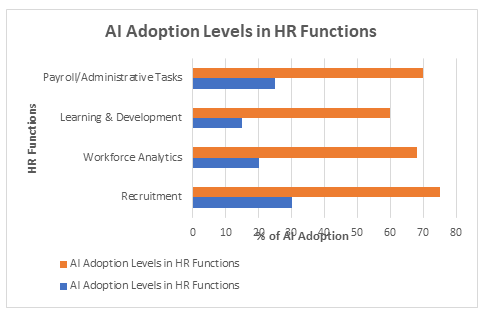
These results suggest a positive correlation between national digital maturity and AI adoption. Australia’s advanced infrastructure and access to AI expertise enable broader and deeper adoption, while Fiji’s limited digital infrastructure and skills capacity constrain implementation.
Perceived Benefits of AI
Survey responses on perceived benefits of AI reveal that Australian HR practitioners report higher efficiency, strategic planning, and decision-making gains compared to their Fijian counterparts. As shown in Figure 2 below, 68% of Australian respondents strongly agree that AI improves operational efficiency, compared to 35% in Fiji. Similarly, 70% of Australian respondents see AI as enhancing strategic workforce planning versus 30% in Fiji, and 65% versus 25% in decision-making accuracy.
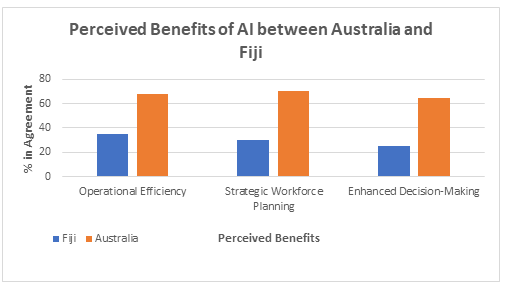
These findings reinforce that organisations with more mature AI adoption perceive greater operational and strategic benefits, highlighting the importance of infrastructure, governance, and training in realizing AI’s value.
Workforce Concerns
Figure 3 presents workforce concerns associated with AI adoption. Fijian respondents reported higher anxiety regarding workforce displacement (62%), skills readiness (55%), and algorithmic bias (50%), compared to 41%, 35%, and 30% in Australia. Interview data suggest that limited skills development, reliance on external vendors, and informal oversight exacerbate these concerns in Fiji.
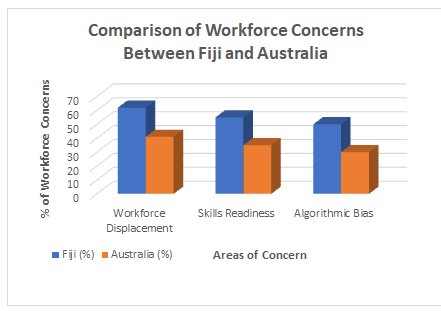
The correlation indicates that lower governance maturity and limited capacity amplify workforce apprehension, whereas Australia’s structured policies and skill development initiatives mitigate these risks.
Governance Readiness
Figure 4 highlights governance readiness differences. 85% of Australian organisations have formal AI governance frameworks covering ethical use, accountability, and transparency, compared to 20% of Fijian organisations. Interviews reveal that Australian organisations actively monitor algorithmic bias and data privacy, while Fiji relies primarily on discretionary practices by HR leadership.
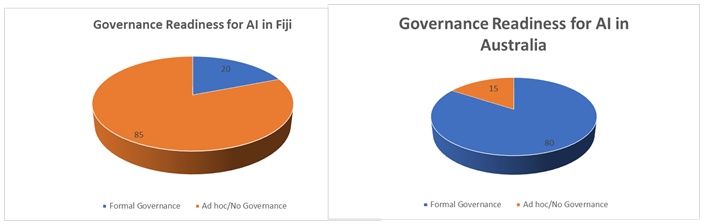
These findings demonstrate that governance maturity is a critical enabler for ethical, responsible, and human-centred AI adoption.
Human-Centred Oversight
Figure 5 compares the integration of human-centred oversight in HR functions. Australian organisations score higher across recruitment, performance management, and learning systems, reflecting policies that ensure AI supports rather than replaces human decision-making. Fiji demonstrates moderate scores due to limited governance and AI maturity.
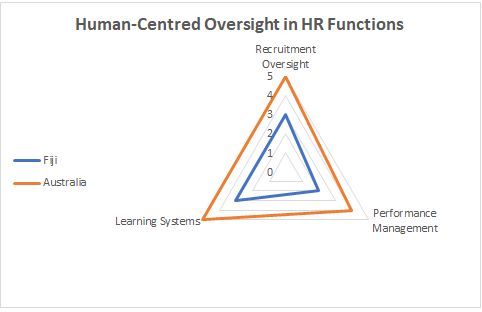
The results indicate a strong correlation between governance structures and effective human-centred AI integration, suggesting that ethical oversight and workforce preparedness are essential for building trust in AI-driven HR practices.
Integrated Insights
Overall, the data illustrate that Australia’s mature infrastructure, governance, and human-centred approaches facilitate more effective and responsible AI adoption. Fiji, however, remains in an early adoption phase, with adoption constrained by policy gaps, capacity limitations, and limited governance mechanisms. The findings confirm that AI’s benefits are maximized when governance, ethics, and human oversight are embedded alongside technological deployment, reinforcing the need for context-specific interventions and regional collaboration to strengthen AI readiness in Fiji.
Recommendations
This study has explored the transformative role of Artificial Intelligence (AI) in Human Resources (HR) and its implications for workforce management in Fiji and Australia. The comparative analysis demonstrates that while AI adoption in Australian HR functions is advanced, supported by robust governance frameworks, regulatory clarity, and structured ethical guidelines, Fiji remains at an early stage of engagement. Fijian organisations face infrastructural limitations, digital skill gaps, and limited institutional policies to guide AI adoption, resulting in heightened risks related to workforce displacement, algorithmic bias, and ineffective governance.
The study reinforces that AI adoption in HR is not merely a technological initiative, but a complex socio-technical challenge that requires alignment of strategy, human capability, ethics, and governance. In both contexts, HR practitioners emphasised the importance of human-centric AI, retaining human oversight in recruitment, performance evaluation, and employee engagement to foster trust, fairness, and accountability. Australian organisations exemplify how structured governance and ethical frameworks can balance efficiency with workforce wellbeing, while Fiji’s emerging AI landscape highlights the need for targeted interventions to ensure equitable, responsible, and contextually appropriate adoption.
Recommendations for Fiji
-
Policy and Governance Development: Establish national and organisational AI policies for HR that integrate ethical standards, fairness, transparency, and accountability. These should align with labour regulations and consider the unique socio-cultural and workforce realities of Fiji.
-
Capacity Building and Skills Development: Invest in structured training programs for HR professionals to develop AI literacy, data analytics skills, and understanding of algorithmic decision-making. This will empower HR teams to leverage AI effectively while maintaining human oversight.
-
Ethical Framework Implementation: Introduce organisational mechanisms for ethical oversight, such as AI audit committees or review boards, to monitor bias, privacy, and employee impact in AI-enabled HR processes.
-
Regional Collaboration through Vuvale Partnership: Explore partnerships with Australian organisations under the Vuvale framework to access technical infrastructure, policy guidance, and ethical best practices. This collaboration can provide mentorship, joint training, and governance templates to accelerate AI readiness in Fijian HR.
Recommendations for Australia
-
Continuous Ethical Review: Maintain adaptive governance structures to evaluate emerging AI tools, ensuring they remain compliant with evolving ethical, legal, and privacy standards.
-
Human-Centric AI Innovation: Continue to integrate AI in ways that augment human capability, particularly in decision-making processes requiring judgment, critical thinking, and cultural sensitivity.
-
Knowledge Sharing and Mentorship: Extend expertise to regional partners like Fiji through structured knowledge transfer, sharing best practices in AI governance, policy development, and capacity-building initiatives.
-
Strategic Workforce Planning: Leverage AI to anticipate skill gaps, design learning interventions, and align workforce planning with organisational strategic objectives while monitoring social and ethical impacts.
Conclusion
In conclusion, Artificial Intelligence (AI) presents a profound opportunity to transform Human Resources (HR) practices by enhancing efficiency, enabling data-driven decision-making, and supporting strategic workforce management. However, the findings of this study underscore that the potential benefits of AI can only be fully realized when its adoption is embedded within robust governance structures, ethical oversight, and human-centred principles. AI should not be treated as a purely technological intervention; rather, it must be approached as a socio-technical system that interacts with organisational culture, workforce capabilities, and broader labour market dynamics.
For Fiji, the study highlights both the promise and the challenges of AI adoption in HR. While there is growing awareness of AI’s potential to improve administrative efficiency and strategic HR decision-making, the country is still grappling with infrastructural limitations, digital skills gaps, and a lack of formal policy and governance frameworks. Addressing these gaps requires policy formulation at both national and organisational levels, including standards for ethical AI use, transparency in decision-making, and protections against algorithmic bias. Capacity-building initiatives are equally essential, ensuring that HR professionals possess the necessary skills to implement, monitor, and interpret AI systems responsibly. In addition, regional collaboration, particularly through initiatives such as the Vuvale partnership with Australia, presents a valuable avenue for Fiji to access technical infrastructure, policy guidance, and mentorship in ethical AI governance, accelerating its readiness for responsible adoption.
In Australia, the focus is on continuous refinement of governance frameworks, ensuring that AI systems align with evolving ethical, legal, and societal expectations. Australian organisations have demonstrated best practices in embedding AI within HR while maintaining human oversight, and these practices provide a model for emerging economies. Furthermore, knowledge-sharing initiatives can extend Australia’s expertise beyond its borders, strengthening regional workforce resilience and promoting equitable technology adoption.
Ultimately, this study underscores that the future of HR lies in responsible AI integration, where technology augments rather than replaces human judgement. When guided by governance, ethics, and human-centred approaches, AI can create HR ecosystems that are not only efficient and data-driven but also fair, inclusive, and sustainable. The comparative analysis of Fiji and Australia illustrates that equitable and effective AI adoption is a function of governance, capacity, and collaboration, highlighting the critical importance of strategic policy interventions and international partnerships in realizing the full potential of AI in the workplace.
References
- Australian Government. (2023). Australia’s artificial intelligence ethics principles. . Canberra: Department of Industry, Science and Resources. DOI ↗ Google Scholar ↗
- Bankins, S., & Formosa, P. (2023). When AI meets HR: Ethical implications and the need for human-centric design. Journal of Business Ethics, 44-46. DOI ↗ Google Scholar ↗
- Boudreau, J. W., & Jesuthasan, R. (2021). Work without jobs: How to reboot your organization’s work operating system. Melbourne: MIT Press. DOI ↗ Google Scholar ↗
- Chelliah, J. (2023). Various contributions regarding management and organizational development in the South Pacific. Suva: Fiji National University on ResearchGate. DOI ↗ Google Scholar ↗
- Deloitte. (2023). Global human capital trends 2023. New York: Deloitte Insights. DOI ↗ Google Scholar ↗
- Dwivedi, Y. K. (2021). Artificial intelligence (AI): Multidisciplinary perspectives on emerging challenges, opportunities, and agenda for research. International Journal of Information Management, 57. DOI ↗ Google Scholar ↗
- European Commission. (2021). Ethics guidelines for trustworthy AI. Paris: European Commission. DOI ↗ Google Scholar ↗
- Gong, Q., Fan, D., & Bartram, T. (2024). Integrating artificial intelligence and human resource management: a review and future research agenda. The International Journal of Human Resource Management, 12-14. DOI ↗ Google Scholar ↗
- International Labour Organization (ILO). (2022). Digitalization and the future of work in the Pacific. Sydney: ILO Regional Office . DOI ↗ Google Scholar ↗
- Nguyen, T. M., & Patel, K. (2024, June 15). Automating administrative tasks to enhance team culture and stakeholder relationships in Australian sectors. Leveraging AI in HRM., pp. 13-17. DOI ↗ Google Scholar ↗
- Russell, S., & Norvig, P. (2021). Artificial intelligence: A modern approach (4 ed.). New York. DOI ↗ Google Scholar ↗
- Tambe, P., Cappelli, P., & Yakubovich, V. (2019). Artificial intelligence in human resources management: Challenges and a path forward. . California Management Review, 61(4), 15–42. DOI ↗ Google Scholar ↗
- Upadhyay, A. K., & Khandelwal , K. (2018). Applying artificial intelligence: Implications for recruitment. Strategic HR Review, 17(5), 255–258. DOI ↗ Google Scholar ↗
- White, S., & Carter, L. (2024). Leveraging Artificial Intelligence in Human Resource Management: A Study of Adoption and Impact in the Australian Commercial Media Industry. Sydney: Preprints.org. DOI ↗ Google Scholar ↗
- Wiley . (2025). Special Issue: The transformative impact of AI on HRM practices in the Asia-Pacific. Asia Pacific Journal of Human Resources. DOI ↗ Google Scholar ↗
- Williams, P., Kummer, T. F., Maskor, M., & Kennon. (2024). The State of AI in Australian Human Resources. Melbourne: Australian HR Institute & QUT ePrints. DOI ↗ Google Scholar ↗