Abstract
The rapid growth of e-commerce has made digital platforms the primary channel for purchasing skincare products. However, behind this convenience, issues such as product inconsistencies, health risks, and low trust due to inconsistent information have emerged. Therefore, consumers tend to rely on two main sources influencer marketing and online customer reviews as the basis for their purchase decision-making. The purpose of this study is to analyze the effect of influencer marketing and online customer reviews on skincare purchase decisions in e-commerce, both directly and through perceived value. In addition, this study aims to examine the role of perceived value as a mediating variable in the relationship between these variables and purchase decisions. This study uses a quantitative, causal approach to analyze cause and effect relationships between variables using numerical data collected through questionnaires. The sample consists of 180 respondents in Denpasar selected through purposive sampling. Data were gathered using questionnaires, interviews, literature review, and documentation, and analyzed using SEM-PLS. Influencer marketing, Online customer reviews and Perceived value have a positive and significant effect on skincare purchase decisions in e-commerce. Influencer marketing and online customer reviews have a positive and significant effect on perceived value. Perceived value partially mediates the effect of online customer reviews on purchase decisions. The higher the quality of influencers more positive and trustworthy customer reviews, the greater the likelihood that consumers will make a purchase. Skincare purchase decisions in e-commerce are influenced through the enhancement of consumers’ perceived value of the product.
Keywords
Influencer marketing Online customer reviews Perceived value Purchase Decisions
Introduction
The advancement of time and modernization has driven significant changes in people’s lifestyles, particularly in terms of self-care. Awareness of the importance of skin health and appearance has increased, making skincare products increasingly popular. This trend is not only observed among professionals but has also spread to millennials and Generation Z, who view a healthy and well-maintained appearance as part of their identity and self-confidence in social life.
Over time, skincare has evolved into an essential need for many individuals, particularly due to various skin problems such as acne, dullness, and dark spots that can reduce self-confidence. This condition has driven the increasing use of skincare products as part of a modern lifestyle. In general, skincare functions not only to maintain the skin but also to improve its condition from within, thereby enhancing skin health and appearance.
Based on a survey conducted by ZAP Clinic in collaboration with the MarkPlus Institute in 2023, the main benefits sought by Indonesian female consumers in skincare products were identified. The results show that 60.5% of respondents prefer skincare that can moisturize the skin, followed by 48.3% who expect products to brighten the skin, and 46.2% who want skincare that can treat acne. In addition, 35.7% of respondents hope that skincare can prevent signs of premature aging, while 29.4% want products that can even out skin tone. These findings indicate that consumers not only focus on aesthetic aspects but also prioritize skincare functions that support overall skin health.
Currently, skincare products have evolved into an essential need for society, particularly for women, as awareness of the importance of skin care in supporting appearance and skin health continues to increase. This shift in preferences is reflected in the Indonesia Consumer Trend on Beauty Industry 2024 report released by JakPat in March 2024. Based on a survey involving more than 2,000 respondents, the report reveals that the majority of Indonesian consumers tend to prioritize the use of skincare over makeup products. The findings show that 86% of Generation Z consumers, 76% of millennials, and 76% of Generation X consider skincare to be more important than makeup. These results indicate a shift in beauty consumption patterns, where consumers place greater emphasis on long-term skin care rather than solely relying on makeup products.
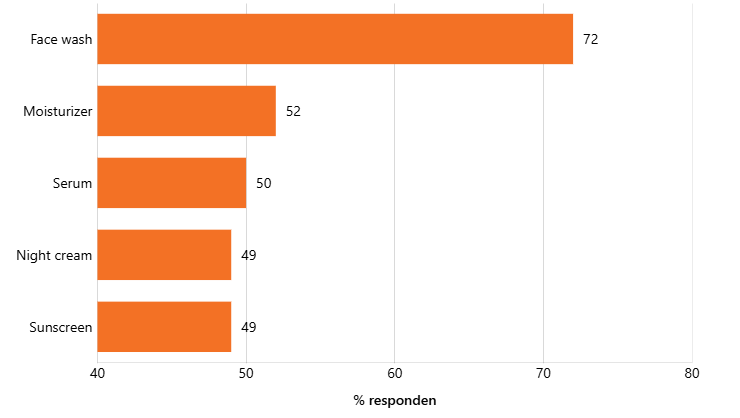
Based on Figure 1.1, it can be seen that facial cleanser (face wash) is the most frequently used skincare product by women, with a usage rate of 72%. This is followed by moisturizer, used by 52% of respondents, while serum ranks third with a usage rate of 50%. Night cream and sunscreen are each regularly used by 49% of respondents. In addition, the survey results also show that eight out of ten respondents, both women and men, consider facial skincare as a long-term investment that can help boost self-confidence.
The development of skincare trends cannot be separated from technological advancements and changes in people’s lifestyles in the digital era. The progress of information technology has had a significant impact on consumption patterns, including how people obtain skincare products. Previously, skincare purchases were mostly made directly at cosmetic stores or shopping centers, but now transactions have increasingly shifted toward online purchases through the internet, e-commerce platforms, and social media.
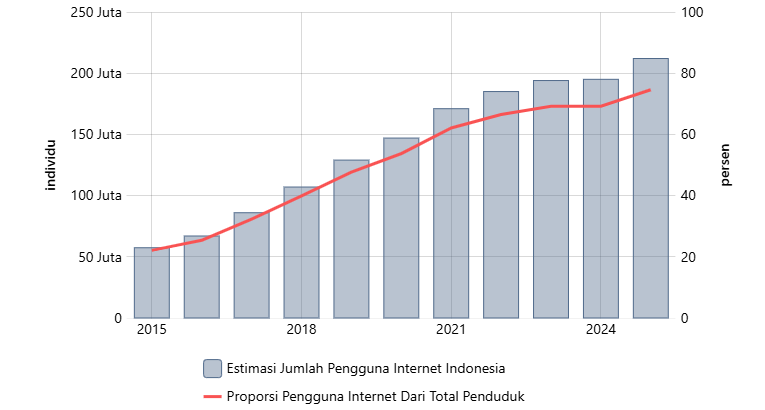
According to data compiled by We Are Social, the number of internet users in Indonesia reached approximately 212 million individuals in January 2025. This figure represents a significant increase compared to previous years and further confirms Indonesia’s position as one of the countries with the largest number of internet users in Asia.
The internet plays an important role in the business world, not only by facilitating communication between companies and consumers but also by serving as the foundation for the growth of digital business and e-commerce. The ease of access and wide reach of the internet have driven an increase in online transactions that are more practical and efficient. This has led to the emergence of online shopping trends, marked by the rapid growth of e-commerce platforms in Indonesia. With the number of internet users continuing to rise, Indonesia has become a highly promising market for e-commerce businesses. E-commerce is the activity of buying and selling goods, services, or data through the internet, allowing transactions to be conducted without direct face-to-face interaction. In addition to serving as a transaction platform, e-commerce also functions as an effective digital promotional medium to reach consumers more widely and efficiently.
The development of e-commerce in Indonesia has grown rapidly alongside the increase in internet users and the digitalization of lifestyles. Platforms such as Shopee, Tokopedia/TikTok Shop, Lazada, and Bukalapak are increasingly used by consumers and businesses as strategic tools to reach wider markets. E-commerce not only functions as a transaction medium but also plays an important role in enhancing business competitiveness and driving the growth of the digital economy.
Based on the Indonesia E-commerce Market Data 2024 report, the value of e-commerce transactions in Indonesia reached approximately US$75 billion, with a projected annual growth of 19% for the 2024–2027 period. Furthermore, the Indonesia E-commerce & Payments Trends 2025 report estimates that the digital payments market will reach US$115.34 billion in 2025, with a compound annual growth rate (CAGR) of around 17.33%, driven by increasing adoption of digital payment methods and growing consumer trust in online transactions(PaymentsCMI, 2024). Indonesian consumers have become increasingly accustomed to using e-commerce as the main platform for shopping across various needs, including beauty and personal care products. The trend of online purchasing, particularly for skincare, continues to grow as it is considered more practical, time-saving, and offers more competitive prices. In fact, more than 60% of Indonesians prefer to buy products such as skincare and fashion through e-commerce platforms rather than physical stores (SWA.co.id, 2024).
These conveniences have contributed to the growing interest among consumers in purchasing personal care products, including skincare, through e-commerce platforms. In general, the Province of Bali has shown significant growth in e-commerce activities. Although specific statistical data on skincare purchases by district or city in Bali has not yet been released, a report by ANTARA News, referring to Tokopedia’s internal data, states that transactions of beauty and personal care products in Bali increased by nearly 1.5 times through the Beli Lokal campaign, indicating a high level of consumer interest in purchasing beauty products online(ANTARA News, 2024).
The purchase decision process is not carried out directly but involves a relatively long consideration process to ensure the product’s safety and suitability for the consumer’s skin needs. Consumers generally rely on two main sources of information, namely influencer marketing and online customer reviews. Influencers are used as an initial source of information because they are perceived to have experience and knowledge about the products, with factors such as credibility, trustworthiness, and expertise influencing consumer trust . However, differences in opinions among influencers can create confusion and uncertainty, making consistency and transparency important. In addition, customer reviews on e-commerce platforms also serve as a primary consideration because they are perceived as more honest and reflective of real experiences. Consumers pay attention to aspects such as review valence (positive/negative), credibility, and quality of information. Negative reviews, product inconsistencies, and adverse experiences such as irritation increase perceived risk and reduce purchase intention. Conversely, detailed and consistent reviews enhance consumer trust. In consumer behavior theory, this is closely related to the concept of perceived risk, where the higher the risk perceived from negative reviews, the lower the likelihood that consumers will make a purchase .
There are several studies that have found a significant effect of influencer marketing on purchase decisions, such as , , Evania et al. (2023), , and . Meanwhile, studies that found no significant effect include and . Previous research on the effect of online customer reviews on purchase decisions is also not entirely consistent. Several studies report a significant influence, including , , , , and Sudirjo et al. (2024). However, other studies such as and found no significant effect. Although the influence of influencer marketing and online customer reviews on purchase decisions has been widely studied, there is still a gap that needs further exploration, particularly in the context of skincare products. The relationship between these independent variables and the dependent variable (purchase decision) is not always direct; therefore, a mediating mechanism is needed to explain the underlying psychological process. In this context, the concept of perceived value becomes highly relevant to examine. Studies that integrate these variables into a single model, especially by incorporating perceived value as a mediating variable, are still relatively limited, particularly in the Indonesian skincare market. Understanding the relationship among these variables is crucial to addressing business challenges in developing effective and efficient digital marketing strategies.
The purpose of this study is to analyze the effect of influencer marketing and online customer reviews on skincare purchase decisions in e-commerce, both directly and through perceived value. In addition, this study aims to examine the role of perceived value as a mediating variable in the relationship between these variables and purchase decisions.
Method
This study uses a quantitative approach, which explains phenomena through the collection and analysis of numerical data using statistical methods. The data are obtained through questionnaires to measure social reality numerically. The research design employed is causal, aiming to analyze cause-and-effect relationships between independent and dependent variables . The population in this study consists of individuals living in Denpasar City who have purchased skincare products through e-commerce. The sampling technique used is non-probability sampling with a purposive sampling method. Considering that there are 18 indicators, the required sample size for this study is 180 respondents. The data in this study were collected using questionnaires, interviews, literature review, and documentation methods. The analytical technique used is Structural Equation Modeling (SEM) based on variance, also known as component-based SEM, specifically Partial Least Squares (PLS).
Result and Discussion
Result
In this study, inferential analysis is conducted using the Partial Least Squares (PLS) method, utilizing the SmartPLS 4.0 software. The steps involved in this analysis are as follows:
a. Convergent Validity
Convergent validity is a criterion used to assess the validity of reflective indicators. An indicator is considered valid if the outer loading coefficient is greater than 0.70 . In this study, it is presented in Table 1 as follows:
| Variable | Instrument | Outer loadings |
|---|---|---|
| Influencer Marketing (X1) | X1.1 | 0.794 |
| X1.2 | 0.860 | |
| X1.3 | 0.856 | |
| X1.4 | 0.824 | |
| Online Customer Review (X2) | X2.1 | 0.781 |
| X2.2 | 0.880 | |
| X2.3 | 0.830 | |
| X2.4 | 0.827 | |
| X2.5 | 0.826 | |
| Perceived Value (Y1) | Y1.1 | 0.820 |
| Y1.2 | 0.887 | |
| Y1.3 | 0.863 | |
| Y1.4 | 0.732 | |
| Purchase Decision (Y2) | Y2.1 | 0.868 |
| Y2.2 | 0.808 | |
| Y2.3 | 0.824 | |
| Y2.4 | 0.877 | |
| Y2.5 | 0.878 |
The results Table 1 show that the outer loading calculations for each indicator of the constructs influencer marketing, online customer reviews, perceived value, and purchase decision have outer loading coefficients greater than 0.70. This indicates that the indicators forming the latent variables are valid and have adequately met the requirements of convergent validity.
b. Discriminant Validity
According to Fornell and Larcker (1981), discriminant validity is tested by comparing the AVE value of each construct with the relationships between constructs. If the AVE value is greater than its correlations with other constructs, then the construct is considered to have good discriminant validity.
| Variable | X1 | X2 | Y1 | Y2 |
| X1 (Influencer Marketing) | 0.834 | |||
| X2 (Online Customer Review) | 0.581 | 0.829 | ||
| Y1 (Perceived Value) | 0.582 | 0.516 | 0.828 | |
| Y2 (Purchase Desicion) | 0.583 | 0.608 | 0.701 | 0.852 |
The results Table 2 of the discriminant validity test using the Fornell-Larcker criterion show that the square root of the AVE for each construct is higher than its correlations with other constructs. This indicates that all variables are able to distinguish themselves well, thus meeting the criteria for discriminant validity.
c. Composite Reliability
A measurement is considered reliable if the composite reliability and Cronbach’s alpha values are greater than 0.70. The results of the composite reliability and Cronbach’s alpha calculations are presented in Table 3 as follows:
| Variable | Cronbach's alpha | Composite reliability (rho_c) | Result |
| Influencer Marketing (X1) | 0.854 | 0.901 | Reliabel |
| Online Customer Review Marketing (X2) | 0.886 | 0.917 | Reliabel |
| Perceived Value (Y1) | 0.845 | 0.896 | Reliabel |
| Purchase Decision (Y2) | 0.905 | 0.929 | Reliabel |
Based on Table 3, the results show that all constructs Influencer Marketing, Online Customer Review, Perceived Value, and Purchase Decision have values greater than 0.70. This indicates that all variables meet the reliability criteria based on Composite Reliability and Cronbach’s Alpha, and can therefore be considered reliable with good internal consistency.
2. Structural Model Evaluation (Structural Model/Inner Model)
Structural model evaluation aims to predict the relationships among latent variables. In PLS, these relationships can be assessed through the R-square (R²) value for each endogenous latent variable as an indicator of the model’s predictive power. The structural model can also be evaluated using Q² predictive relevance, also known as predictive sample reuse.
a. Structural Model Test using R-Square (R²)
Latan and Ghozali (2015) state that an R-Square (R²) value of 0.67 indicates a strong model, 0.33 indicates a moderate model, and 0.19 indicates a weak model. The R² results can be seen in the table below:
| Variable | R-square | R-square adjusted |
| Purchase Decision | 0.586 | 0.579 |
| Perceived Value | 0.386 | 0.379 |
Table 4 presents the R-square and adjusted R-square values for each endogenous variable in the research model. The Purchase Decision variable has an R-square value of 0.586 and an adjusted R-square of 0.579. This indicates that 58.6% of the variation in Purchase Decision can be explained by the exogenous variables included in the model. Based on the criteria proposed by , this value falls into the moderate category, as it is around 0.33. Furthermore, the Perceived Value variable has an R-square value of 0.386 and an adjusted R-square of 0.379. This means that 38.6% of the variability in Perceived Value can be explained by the exogenous variables in the model. This value also falls into the moderate category, indicating that the model has sufficient predictive ability in explaining this variable.
b. Structural Model Test using f-square (f²)
This measurement is used to assess the individual contribution of each exogenous variable to the endogenous variable. The f² value specifically evaluates the effect of each causal relationship in the model, allowing researchers to understand the relative influence of each construct on the targeted construct. The calculation results are presented in Table 5.
| Variable | Purchase Decision (Y2) | Perceived Value (Y1) |
| Influencer Marketing (X1) | 0.029 | 0.196 |
| Online Customer Review (X2) | 0.116 | 0.078 |
| Perceived Value (Y1) | 0.330 | - |
Based on Table 5., the f-square test results show that Influencer Marketing has a small effect on purchase decisions but a moderate effect on perceived value, indicating that it plays a greater role in shaping consumers’ perceived value. Online Customer Reviews have a small to nearly moderate effect on purchase decisions and a small effect on perceived value. Meanwhile, Perceived Value has a strong effect on purchase decisions, indicating that this variable is the main factor driving consumers to make purchasing decisions.
c. Structural Model Test using Q-Square
The strength or weakness of the model is measured based on Q-Square Predictive Relevance (Q²). According to Latan and Ghozali, the criteria are as follows: 0.35 (strong model), 0.15 (moderate model), and 0.02 (weak model).
| Variable | R-square | R-square adjusted |
| Purchase Decision | 0.586 | 0.579 |
| Perceived Value | 0.386 | 0.379 |
| Q² = 1 – (1 – R₁²)(1 – R₂²) Q² = 1 – [(1 – 0,586)(1 – 0,386)]Q² = 1 – (0,414 × 0,614)Q² = 1 – 0,254Q² = 0,746 |
Q² value of 0.746 indicates that the model has strong predictive capability, as it is well above the minimum threshold of 0.35. This means that the variables Influencer Marketing and Online Customer Review are able to effectively explain the variation in Perceived Value and Purchase Decisions.
3. Hypothesis Testing
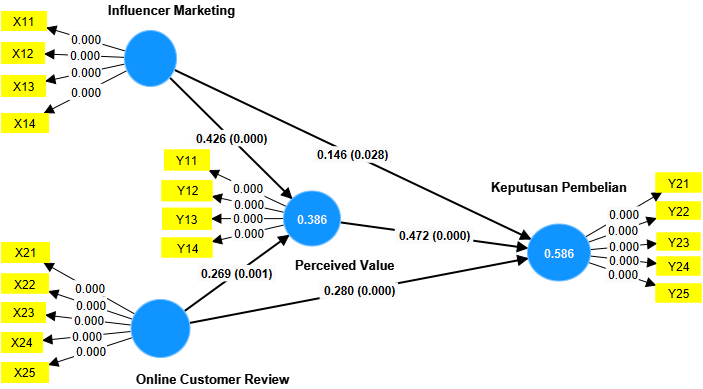
At this stage, each hypothesis that has been previously formulated is tested using a statistical approach based on Partial Least Squares (PLS). The results of the hypothesis testing are obtained through data processing using SmartPLS version 4.0 software in the form of a diagram, as shown in Figure 4 below:
The summary of the relationships among these variables is presented in Table 7 below:
| Construct | Hypotesa | Original sample (O) | T statistics (|O/STDEV|) | P values | Result |
|---|---|---|---|---|---|
| Direct Effect | |||||
| Influencer Marketing -> Purchase Decision | H1 | 0.347 | 5.332 | 0.000 | Accept |
| Online Customer Review -> Purchase Decision | H2 | 0.406 | 5.442 | 0.000 | Accept |
| Influencer Marketing -> Perceived Value | H3 | 0.426 | 6.156 | 0.000 | Accept |
| Online Customer Review -> Perceived Value | H4 | 0.269 | 3.521 | 0.001 | Accept |
| Perceived Value -> Purchase Desicion | H5 | 0.472 | 7.246 | 0.000 | Accept |
| Indirect Effect | |||||
| Influencer Marketing -> Perceived Value -> Purchase Desicion | H6 | 0.201 | 4.545 | 0.000 | Accept |
| Online Customer Review -> Perceived Value -> Purchase Desicion | H7 | 0.127 | 3.247 | 0.001 | Accept |
The analysis results in Table 7 show a path coefficient of 0.347, a t-statistic of 5.332, and a significance value of 0.000 < 0.05, indicating that influencer marketing has a positive and significant effect on purchase decisions. A path coefficient of 0.406, a t-statistic of 5.442, and a significance value of 0.000 < 0.05 indicate that online customer reviews have a positive and significant effect on purchase decisions. Furthermore, a path coefficient of 0.426, a t-statistic of 6.156, and a significance value of 0.000 < 0.05 indicate that influencer marketing has a positive and significant effect on perceived value. A path coefficient of 0.269, a t-statistic of 3.521, and a significance value of 0.001 < 0.05 indicate that online customer reviews have a positive and significant effect on perceived value.
In addition, a path coefficient of 0.472, a t-statistic of 7.246, and a significance value of 0.000 < 0.05 indicate that perceived value has a positive and significant effect on purchase decisions. A path coefficient of 0.201, a t-statistic of 4.545, and a significance value of 0.000 < 0.05 indicate that influencer marketing has a positive and significant effect on purchase decisions through perceived value. Finally, a path coefficient of 0.127, a t-statistic of 3.247, and a significance value of 0.001 < 0.05 indicate that online customer reviews have a positive and significant effect on purchase decisions through perceived value.
Discussion
1. The Effect of Influencer Marketing on Purchase Decisions
The analysis results show that influencer marketing has a positive and significant effect on skincare purchase decisions in e-commerce. This indicates that the more effective the influencer marketing strategy, the higher the likelihood of consumers making purchase decisions. This suggests that influencers serve as both a source of information and a trusted reference in the consumer decision-making process.
Based on descriptive analysis, the Influencer Marketing variable obtained an average score of 3.94, categorized as “Good.” This indicates that influencer marketing activities are perceived positively by consumers. Influencers are able to attract audience attention, increase interest in promoted skincare products, and make consumers feel satisfied with their purchase decisions. Influencers with strong authority and credibility can enhance consumer trust, leading to higher purchase confidence and willingness to recommend the product.
Influencers’ expertise in explaining product benefits, ingredients, and usage also helps consumers understand product suitability, increasing satisfaction. Informative content further facilitates decision-making and encourages repeat purchases. This finding aligns with the Theory of Planned Behavior (TPB) (Ajzen, 1991), where consumer behavior is influenced by attitudes, subjective norms, and perceived behavioral control. Influencers shape positive attitudes and strengthen subjective norms. It is also supported by the Stimulus-Organism-Response (SOR) theory, where influencer marketing acts as a stimulus that influences internal consumer processes, resulting in purchase decisions. These results are consistent with prior studies , Melianto et al., 2024; ; ;.
2. The Effect of Online Customer Reviews on Purchase Decisions
The analysis shows that online customer reviews have a positive and significant effect on purchase decisions. Better reviews lead to higher purchase likelihood. Reviews serve as trusted information sources. The variable scored an average of 4.28 (Very Good), indicating highly positive consumer perception. Reviews are seen as credible, useful, and informative. They reduce uncertainty and increase satisfaction. Positive and negative reviews help consumers evaluate products, while a large number of reviews strengthens trust and encourages repeat purchases. This aligns with the Theory of Reasoned Action (TRA), TPB, and SOR, where reviews shape attitudes, perceived control, and behavioral responses. Supported by studies such as and .
3. The Effect of Influencer Marketing on Perceived Value
Influencer marketing has a positive and significant effect on perceived value. Effective influencer strategies increase consumers’ perceived product value. Influencers enhance trust, understanding, and perceived benefits, helping consumers evaluate product worth. This is supported by TRA, TPB, and SOR theories, where influencer communication shapes beliefs, evaluations, and perceptions. Consistent with studies by , , , and .
4. The Effect of Online Customer Reviews on Perceived Value
Online customer reviews significantly influence perceived value. Better reviews increase perceived product value. Credible, detailed, and informative reviews help consumers assess product quality and benefits. Supported by TRA, TPB, and SOR theories. Consistent with Amalia & Nurlinda (2022) and .
5. The Effect of Perceived Value on Purchase Decisions
Perceived value has a positive and significant effect on purchase decisions. Higher perceived value leads to stronger purchase intention. Consumers evaluate product benefits, quality, and price fairness. High perceived value leads to satisfaction, recommendations, and repeat purchases. Supported by TRA, TPB, and SOR theories. Consistent with, , and .
6. The Mediating Role of Perceived Value in Influencer Marketing
Perceived value partially mediates the effect of influencer marketing on purchase decisions. Influencers influence decisions both directly and indirectly through perceived value. Supported by TRA, TPB, and SOR theories. Consistent with and .
7. The Mediating Role of Perceived Value in Online Customer Reviews
Perceived value also partially mediates the effect of online customer reviews on purchase decisions. Reviews influence decisions directly and indirectly by shaping perceived value. Supported by TRA, TPB, and SOR theories. Consistent with .
Conclusion
Influencer marketing has a positive and significant effect on skincare product purchase decisions in e-commerce. The better the quality of influencers in terms of credibility, attractiveness, and expertise, the higher the likelihood of consumers making purchase decisions. Online customer reviews also have a positive and significant effect on skincare purchase decisions in e-commerce. The more positive, informative, and trustworthy the reviews provided by other consumers, the greater the likelihood that consumers will make a purchase.
Influencer marketing has a positive and significant effect on perceived value, indicating that the role of influencers can enhance consumers’ perceived value of the product. Likewise, online customer reviews have a positive and significant effect on perceived value, meaning that better quality reviews lead to higher perceived value. Perceived value has a positive and significant effect on skincare purchase decisions in e-commerce. This indicates that the higher the value perceived by consumers, the greater the likelihood of making a purchase decision.
Perceived value is able to partially mediate the effect of influencer marketing on purchase decisions. This means that purchase decisions will increase when influencer marketing enhances consumers’ perceived value of skincare products in e-commerce. Similarly, perceived value partially mediates the effect of online customer reviews on purchase decisions. This indicates that purchase decisions will increase when online customer reviews enhance consumers’ perceived value of skincare products in e-commerce.
For companies, it is recommended to select credible influencers and encourage honest customer reviews to enhance trust and purchase decisions. For future researchers, it is suggested to expand the scope of the study, increase the sample size, and include additional variables and different methods to obtain more comprehensive results. Meanwhile, for academics, this study is expected to serve as a reference in the development of marketing knowledge, particularly regarding consumer behavior in the digital era.
References
- Ahdiat, A. (2024). 5 E-Commerce dengan Pengunjung Terbanyak Sepanjang 2023. Https://Databoks.Katadata.Co.Id/. DOI ↗ Google Scholar ↗
- Amalia, K., & Nurlinda, R. (2022). Pengaruh Influencer Marketing dan Online Customer Review Terhadap Purchase Intention Melalui Perceived Value Produk Serum Somethinc. SIBATIK JOURNAL: Jurnal Ilmiah Bidang Sosial, Ekonomi, Budaya, Teknologi, Dan Pendidikan, 1(11), 2383–2398. DOI ↗ Google Scholar ↗
- Anggraini, F., & Ahmadi, M. A. (2024). Pengaruh Influencer Marketing terhadap Keputusan Pembelian Produk Kecantikan di Kalangan Generasi Z : Literature Review. Journal of Management and Creative Business, 3(1), 62–73. DOI ↗ Google Scholar ↗
- Azzahra, A., Afwa, A., & Moniko, M. (2024). The Influence of Influencer Marketing and Online Customer Reviews on Purchase Intention Through the Perceived Value of Cosmetic Products on Tiktok Shop (An Empirical Study on Students in the City of Pekanbaru). EKOMBIS REVIEW: Jurnal Ilmiah Ekonomi Dan Bisnis, 12(1), 12. DOI ↗ Google Scholar ↗
- Bahtiarz, R. A. (2020). Potensi, Peran Pemerintah, dan Tantangan dalam Pengembangan e-Commerce di Indonesia. Jurnal Ekonomi Dan Kebijakan Publik, 11(1), 25. DOI ↗ Google Scholar ↗
- Barkatullah, A. H. (2019). Hukum Transaksi Elektronik di Indonesia: sebagai pedoman dalam menghadapi era digital Bisnis e-commerce di Indonesia. Nusamedia. DOI ↗ Google Scholar ↗
- Christiana, I., Pratama, R., & Kapten Mukhtar Basri No, J. (2024). Online Customer Review, Online Customer Rating and its Influence on Online Purchasing Decisions Mediated By Trust. Proceeding 2 Nd Medan International Economics and Business. DOI ↗ Google Scholar ↗
- Duli, N. (2019). Metodologi Penelitian Kuantitatif: Efek Domino dan Metode Penelitian Ilmiah. Deepublish. DOI ↗ Google Scholar ↗
- Ghozali, I. (2020). 25 Plus Konsep Dasar dan Aplikasi Struktur Equation Modeling dengan SmartPLS 3.2.9. Badan Penerbit Universitas Diponegoro. DOI ↗ Google Scholar ↗
- Hanifah, B., Ramdan, A. M., & Jhoansyah, D. (2024). Analysis of Social Media Influencers on Purchase Intention Through Perceived Value as a Mediating Variable. Dinasti International Journal of Economics, Finance & Accounting (DIJEFA), 5(4), 2364–2371. DOI ↗ Google Scholar ↗
- Khaerunisa, R., & Husain, F. (2025). Experience dan Persepsi Perempuan Terhadap Dampak Kesehatan Kulit dalam Keputusan Penggunaan Produk Skincare. SOSIOGLOBAL : Jurnal Pemikiran Dan Penelitian Sosiologi, 9(2), 113–132. DOI ↗ Google Scholar ↗
- Kotler, P., & Keller, K. L. (2016). Marketing Management. Pearson Pretice Hall, Inc. DOI ↗ Google Scholar ↗
- Kusuma, I. S. H. (2023). Pengaruh Online Customer Review terhadap Keputusan Pembelian pada Marketplace Shopee di Kalangan Mahasiswa Kota Bandung. International Journal Administration Business and Organization, 4(2), 31–39. DOI ↗ Google Scholar ↗
- Lou, C., & Yuan, S. (2019). Influencer Marketing: How Message Value and Credibility Affect Consumer Trust of Branded Content on Social Media. Journal of Interactive Advertising, 19(1), 58–73. DOI ↗ Google Scholar ↗
- Maharani, Y. (2025). Pengaruh Influencer Marketing dan Content Marketing terhadap Purchase Decision dengan Brand Awareness dan Perceived Value sebagai Variabel Mediasi. In AKADEMIK: Jurnal Mahasiswa Ekonomi & Bisnis (Vol. 5, Number 1). DOI ↗ Google Scholar ↗
- Melianto, D., & Endah Fajariana, D. (2024). Dampak Penggunaan Influencer, Pemasaran Media Sosial, dan Inovasi Produk terhadap Keputusan Pembelian Produk Kecantikan di Jakarta. Jurnal Ekonomi Dan Kewirausahaan West Science, 2(04), 457–468. DOI ↗ Google Scholar ↗
- Nurhabibah, S., Savitri, C., Pramudita, S., & Faddila. (2022). The Effect Of Online Customer Review And Online Customer Rating On Purchase Decisions. Jurnal Ekonomi, 11(01). http://ejournal.seaninstitute.or.id/index.php/Ekonomi DOI ↗ Google Scholar ↗
- Sudaryono, Rahwanto, E., & Komala, R. (2020). E-Commerce Dorong Perekonomian Indonesia, Selama Pandemi Covid 19 Sebagai Entrepreneur Modern Dan Pengaruhnya Terhadap Bisnis Offline. 2(2), 110–124. DOI ↗ Google Scholar ↗
- Pratama, A. S., Ilham, R., Hermawan, A., & Wisnu Wardhana, L. (2024). The Effects Of Social Media Content, Influencer Marketing And Customer Reviews On Purchasing Decisions. International Journal of Science, 5(2), 485–489. http://ijstm.inarah.co.id485 DOI ↗ Google Scholar ↗
- Prisilia, G. R. (2025). The Influence of Influencer Marketing and Product Quality on Purchase Decisions at The Don’s House in Bandar Lampung. Journal of Advances in Accounting, 2(3). DOI ↗ Google Scholar ↗
- Putri, P., Dewi, R. K., & Silvia, S. A. (2025). Pengaruh Perilaku Fear Of Missing Out (Fomo) dan Aplikasi Tiktok Terhadap Keputusan Pembelian Daviena Skincare Palembang. Institut Agama Islam Negeri (IAIN) Curup. DOI ↗ Google Scholar ↗
- Rahmawati, A. I. (2022). Pengaruh Online Customer Review, Online Customer Rating Dan Kepercayaan Terhadap Keputusan Pembelian Online (Studi Kasus Pada Mahasiswa Feb Universitas Pgri Semarang). Jurnal Ilmiah Manajemen, Bisnis Dan Ekonomi Kreatif, 1(1), 18–23. DOI ↗ Google Scholar ↗
- Regina, R., Rini, E. S., & Sembiring, B. K. F. (2021). The Effect of Online Customer Review and Promotion through E-Trust on the Purchase Decision of Bukalapakin Medan City. International Journal of Research and Review, 8(8), 236–243. DOI ↗ Google Scholar ↗
- Schiffman, L. G., & Wisenblit, J. L. (2015). Consumer Behaviour. Pearson Education. DOI ↗ Google Scholar ↗
- Siregar, B. G., & Hardana, H. A. (2022). Metode Penelitian EKonomi dan Bisnis. Merdeka Kreasi Group. DOI ↗ Google Scholar ↗
- Trihudiyatmanto, M., Prima Manggala, R., & Prawoto, E. (2023). Efek Life Style dan Influencer Marketing Terhadap Keputusan Pembelian. Jamasy: ISSN: 28Jurnal Akuntansi, Manajemen & Perbankan Syariah, 3(2). DOI ↗ Google Scholar ↗
- Wilis, R. A., & Faik, A. (2022). Effect of Digital Marketing, Influencer Marketing and Online Customer Review on Purchase Decision: A Case Study of Cake Shop “Lu’miere.” Petra International Journal of Business Studies, 5(2), 155–162. DOI ↗ Google Scholar ↗
- Yane, N. W. A. P. A., & Sharif, O. O. (2021). The Effect of Influencer on Engagement, Expected Value, and Purchase Intention. Jurnal Riset Bisnis Dan Manajemen, 14(2), 53–57. DOI ↗ Google Scholar ↗
- Zahid, F., & Ruswanti, E. (2024). Electronic Word Of Mouth, Brand Image, Purchase Intention And Customer Purchase Decisions For Skinceuticals Users. Jurnal Ilmiah Manajemen Kesatuan, 12(1), 229–244. DOI ↗ Google Scholar ↗
- ZAP Clinic, & MarkPlus Institute. (2023). ZAP Beauty Index 2023: Consumer Behavior in Beauty Industry. DOI ↗ Google Scholar ↗