Abstract
The rapid expansion of generative artificial intelligence has created new pedagogical possibilities for Islamic higher education, including Tasawuf education, which traditionally depends on direct spiritual guidance and teacher-student companionship. This study aimed to develop and evaluate an AI-assisted Tasawuf curriculum framework that integrates ChatGPT without weakening the authentic spiritual dimensions of Sufi pedagogy. A mixed-methods design was employed by combining design-based research, quasi-experimental evaluation, interviews, focus groups, classroom observation, reflective journals, and learning analytics. The study involved 156 students and 24 educators from three Islamic higher education institutions in Central Java. The findings produced the AI-Murshid Framework, consisting of four differentiated domains: foundational knowledge delivery, reflective dialogue facilitation, spiritual practice guidance, and transformative experience. Quantitative results showed that students in the AI-integrated group achieved higher conceptual understanding than those in the comparison group, with an adjusted post-test effect size of d = 0.78. Qualitative findings indicated that ChatGPT improved accessibility, reduced hesitation in asking conceptual questions, and enabled educators to focus more on spiritual guidance. The study concludes that ChatGPT can support Tasawuf education as a bounded pedagogical tool for conceptual learning and preliminary reflection, while murshid-guided practice, suhbah, and spiritual transformation must remain human-centered.
Keywords
ChatGPT Tasawuf education AI-Murshid Framework digital curriculum Islamic pedagogy spiritual formation
Introduction
Artificial intelligence has become one of the most disruptive forces in contemporary education because it changes not only how students access information, but also how teachers organize knowledge, feedback, and interaction. Generative AI tools such as ChatGPT have expanded the possibility of personalized explanation, dialogic learning, adaptive feedback, and student-centered inquiry across disciplines (Kasneci et al., 2023; Baidoo-Anu & Ansah, 2023; Holmes et al., 2023). This transformation, however, should not be understood as a purely technical matter. In religious education, and especially in Tasawuf education, the central question is whether digital tools can support learning without reducing spiritual formation into information retrieval.
The global debate on educational technology often moves between two weak assumptions: that technology automatically improves learning or that technology necessarily damages tradition. Both assumptions are analytically inadequate. The more defensible position is to examine how tools function within specific pedagogical cultures, epistemic authorities, and moral objectives (Selwyn, 2023; Brynjolfsson & McAfee, 2022; Luckin et al., 2022). In Islamic higher education, AI integration must be assessed not only by efficiency, engagement, or accessibility, but also by its implications for adab, teacher authority, epistemic discipline, and the integrity of religious knowledge.
Tasawuf education presents a particularly sensitive case because it is not merely a curriculum of doctrines and historical concepts. It is a mode of tarbiyah ruhiyyah that connects knowledge, discipline, ethical refinement, and inner transformation. Classical and contemporary Sufi scholarship consistently distinguishes between knowledge that can be explained discursively and spiritual states that require disciplined practice, companionship, and qualified guidance (al-Ghazali, 2021; al-Qushayri, 2022; Knysh, 2023; Chittick, 2023; Schimmel, 2022). This distinction is decisive for the present study because ChatGPT can explain concepts such as fana’, maqamat, ahwal, muraqabah, dzikir, and muhasabah, but it cannot verify spiritual readiness, transmit adab, or accompany the murid through the existential struggle of tazkiyah.
The Indonesian context gives this issue practical urgency. Islamic higher education and pesantren-based learning environments are increasingly exposed to digital platforms, while students use AI tools informally even when institutions have not provided pedagogical guidance or ethical boundaries (Ministry of Religious Affairs, 2024; Azra, 2022; Raihani, 2023). When students consult AI without supervision, the risk is not simply plagiarism or dependency. A deeper risk is the formation of false epistemic authority, where generated religious explanations are treated as equivalent to teacher-guided interpretation. This problem is more acute in Tasawuf because spiritual concepts often carry layered meanings across textual, ethical, and experiential registers.
Previous research has shown that AI can support personalized learning, formative feedback, content generation, and student engagement when embedded in sound pedagogical design (Kasneci et al., 2023; Holmes et al., 2023; Luckin et al., 2022). Studies on Islamic education and digital learning also indicate that technology adoption depends on institutional leadership, religious legitimacy, educator readiness, and alignment with Islamic values (Wekke et al., 2022; Hashim & Rossidy, 2023; Zawawi, 2024). Yet the existing literature remains insufficient for Tasawuf education because it tends to discuss AI in Islamic education broadly, including Qur’anic learning, Arabic support, digital literacy, or learning management systems, rather than the boundary between conceptual knowledge and spiritual transformation.
The conceptual foundation of this study is located at the intersection of AI education theory, Islamic educational ethics, and Sufi pedagogy. From AI education theory, ChatGPT may function as a tutor, tool, or limited collaborator depending on the learning objective (Kasneci et al., 2023; Baidoo-Anu & Ansah, 2023). From Islamic ethics, technological adoption may be evaluated through maslahah and maqasid, provided that benefit does not undermine religious integrity or moral formation (Auda, 2022; Kamali, 2023). From Tasawuf pedagogy, however, human guidance remains indispensable because spiritual formation requires embodied example, affective correction, disciplined companionship, and spiritual authority (Frager, 2022; Lings, 2021; Ernst, 2022; Sells, 2023; Nasr, 2021; Murad, 2022).
The research gap is therefore both theoretical and practical. Theoretically, existing AI education frameworks have not sufficiently accounted for forms of learning where transformation of the self is more central than acquisition of information. Practically, Islamic educational institutions increasingly face AI use among students without clear boundaries for religious and spiritual learning. This study responds to that gap by developing and evaluating the AI-Murshid Framework, a bounded model for integrating ChatGPT into Tasawuf curriculum while preserving the irreplaceable role of the murshid.
This study aims to develop, implement, and evaluate a digital Tasawuf curriculum framework that integrates ChatGPT as an AI-assisted learning tool while maintaining the authenticity of Sufi spiritual education. The study is guided by four research questions: What pedagogical principles should guide AI integration in Tasawuf education? How can ChatGPT support specific components of a Tasawuf curriculum? What boundaries are required to protect spiritual authenticity? How do students and educators experience AI-integrated Tasawuf learning in Islamic higher education?
Method
This study employed a mixed-methods research design that combined design-based research, quasi-experimental evaluation, and qualitative inquiry. The design-based research component was used to develop and refine the AI-integrated Tasawuf curriculum in authentic educational settings, while the quasi-experimental component was used to examine differences in learning outcomes between students who experienced the AI-integrated curriculum and those who followed the traditional curriculum. The qualitative component was used to understand how students and educators interpreted the role, benefit, and limitation of ChatGPT in Tasawuf learning (Creswell & Clark, 2023; McKenney & Reeves, 2022).
The participants consisted of 156 undergraduate students and 24 educators from three Islamic higher education institutions in Central Java: Universitas Sains Al-Qur’an Wonosobo, IAIN Pekalongan, and UIN Walisongo Semarang. The institutions were selected to represent different types of Islamic higher education, including a private Islamic university, a state Islamic institute, and a state Islamic university. Student participants were enrolled in Tasawuf-related courses during the semester of implementation. They were divided into a treatment group of 78 students and a comparison group of 78 students based on course sections.
The curriculum development process was conducted through five stages. The first stage involved synthesis of literature on AI in education, Islamic educational ethics, and Tasawuf pedagogy. The second stage involved expert consultation with Tasawuf scholars and educational technology specialists to determine which learning activities were appropriate for AI support and which had to remain under human guidance. The third stage involved prototype development, including ChatGPT-assisted learning prompts, reflective journaling tasks, classroom discussion formats, and ethical AI-use guidelines. The fourth stage involved pilot testing with a small student group, and the fifth stage produced the final semester-long AI-integrated Tasawuf curriculum.
Quantitative data were collected using three instruments: a Tasawuf Knowledge Assessment, a Spiritual Practice Engagement Scale, and an AI Integration Perception Survey. Learning analytics were also collected from treatment group interactions with ChatGPT, including frequency of use, duration, and categories of inquiry. Qualitative data were collected through semi-structured interviews, focus group discussions, reflective journals, and classroom observation.
Quantitative data were analyzed using descriptive statistics, independent-samples t tests, ANCOVA, Cohen’s d, and correlation analysis between AI interaction frequency and knowledge gain. Qualitative data were analyzed using thematic analysis following the stages of familiarization, initial coding, theme construction, theme review, theme definition, and interpretive reporting (Braun & Clarke, 2022). Trustworthiness was strengthened through triangulation across survey data, interviews, focus groups, journals, and classroom observations.
Ethical considerations were addressed throughout the study. All participants received information about the research objectives, the role of ChatGPT in the treatment curriculum, the types of data collected, and the confidentiality procedures. Participation was voluntary, and students were informed that their academic standing would not be affected by participation or non-participation. ChatGPT interaction logs were collected only with participant consent and were anonymized before analysis.
Results
The study involved 156 student participants divided equally between treatment and comparison groups. The two groups were broadly comparable in terms of gender, age, prior AI use, pesantren background, and baseline knowledge score. This comparability is important because the study aimed to evaluate the effect of curriculum integration rather than differences that already existed before implementation. Prior AI tool use was already high in both groups, indicating that the intervention formalized and guided practices that many students had already begun independently.
| Characteristic | Treatment Group (n = 78) | Comparison Group (n = 78) |
| Male students | 42 (53.8%) | 45 (57.7%) |
| Female students | 36 (46.2%) | 33 (42.3%) |
| Mean age | 20.4 | 20.1 |
| Standard deviation of age | 1.8 | 1.7 |
| Prior AI tool use | 61 (78.2%) | 58 (74.4%) |
| Pesantren background | 52 (66.7%) | 49 (62.8%) |
| Baseline knowledge score | 54.2 | 55.1 |
| Standard deviation of baseline score | 12.3 | 11.8 |
The educator participants consisted of 24 lecturers with teaching experience ranging from 5 to 28 years. The mean teaching experience was 12.4 years. All educator participants held at least a master’s degree in Islamic studies or a related field, and 16 educators reported having formal Sufi training or recognized spiritual learning experience. This educator profile was relevant because the AI-Murshid Framework depends on human capacity to distinguish conceptual instruction from spiritual guidance.
The first major result was the development of the AI-Murshid Framework. The framework emerged from literature synthesis, expert consultation, pilot testing, and implementation data. It consists of four domains with different degrees of AI involvement. These domains differentiate AI-primary, AI-supported, human-primary, and human-essential dimensions of Tasawuf education.
| Domain | Main Educational Function | AI Role | Human Role |
| Foundational knowledge delivery | Understanding concepts, terms, history, and basic texts | Primary support | Contextual validation |
| Reflective dialogue facilitation | Initial tafakkur and journaling | Supportive prompt generator | Interpretive and spiritual guidance |
| Spiritual practice guidance | Dzikir, muraqabah, muhasabah, and adab practice | Supplementary information only | Primary guidance and correction |
| Transformative experience | Suhbah, hal, ijazah, and spiritual progress | Excluded | Essential and irreplaceable |
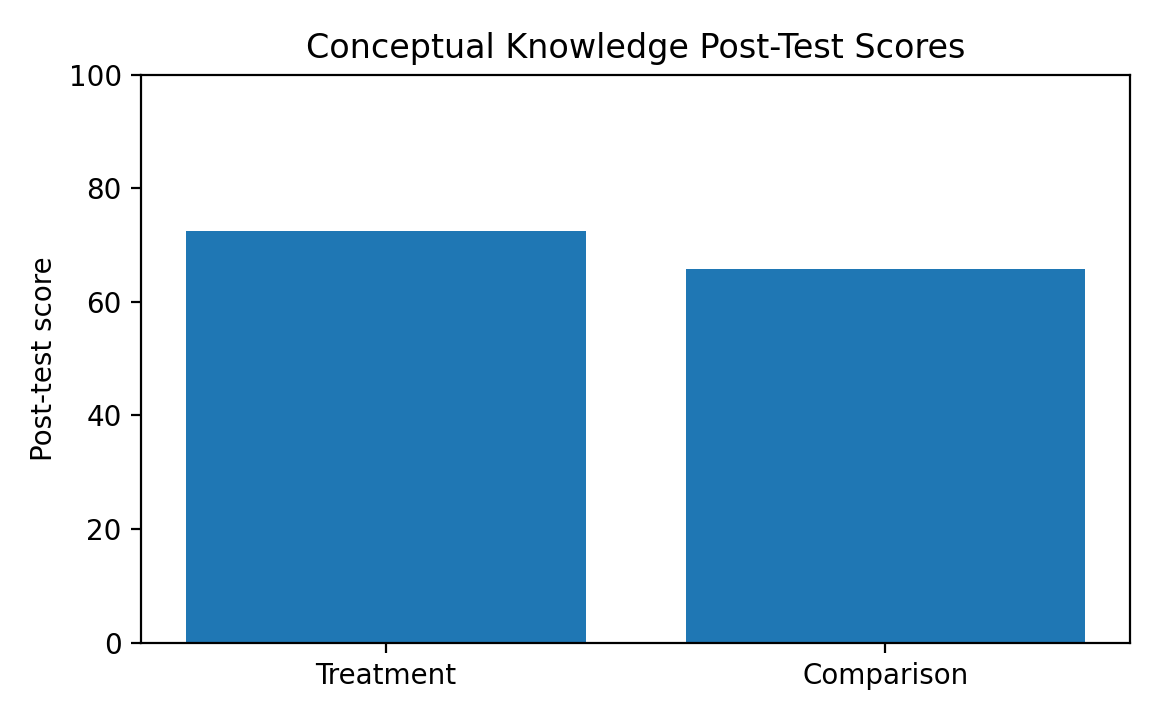
The second major result concerned conceptual knowledge. Students in the treatment group achieved higher post-test scores than students in the comparison group. The mean post-test score of the treatment group was 72.4, while the mean post-test score of the comparison group was 65.8. After controlling for baseline knowledge scores, the adjusted post-test score of the treatment group increased to 73.1, while the comparison group obtained an adjusted score of 65.2. The effect size was d = 0.78, indicating a medium-to-large educational effect.
| Measure | Treatment Group (n = 78) | Comparison Group (n = 78) | t | p | Cohen’s d |
| Post-test score | 72.4 | 65.8 | 3.82 | < .001 | 0.61 |
| Standard deviation | 10.2 | 11.4 | |||
| Adjusted post-test score | 73.1 | 65.2 | 4.89 | < .001 | 0.78 |
| Adjusted standard deviation | 9.8 | 10.9 |
The third major result concerned spiritual practice engagement. Unlike conceptual knowledge, spiritual practice engagement did not differ significantly between the treatment and comparison groups. These results indicate that AI integration improved conceptual learning but did not directly increase or reduce spiritual practice engagement. The absence of decline is important because it suggests that bounded AI integration did not weaken the student-educator relationship or displace human-guided spiritual practice.
| Measure | Treatment Group (n = 78) | Comparison Group (n = 78) | t | p |
| Practice frequency | 3.42 | 3.38 | 0.28 | .78 |
| Practice quality | 3.56 | 3.51 | 0.35 | .73 |
| Connection with educator | 3.89 | 3.94 | -0.43 | .67 |
The fourth major result came from the AI Integration Perception Survey administered to the treatment group. Most students perceived AI as helpful for conceptual understanding, while also affirming that AI could not replace the human teacher. These findings show that students did not interpret ChatGPT as a replacement for the murshid or lecturer. Instead, they positioned it as an accessible learning companion for preliminary understanding.
| Survey Item | Mean | Standard Deviation | Agree/Strongly Agree |
| AI was helpful for understanding concepts | 4.21 | 0.72 | 87.2% |
| AI cannot replace the human teacher | 4.56 | 0.61 | 94.9% |
| Clear boundaries are important | 4.42 | 0.68 | 91.0% |
| I would recommend AI integration | 3.98 | 0.84 | 79.5% |
| AI enhanced my learning | 4.08 | 0.79 | 82.1% |
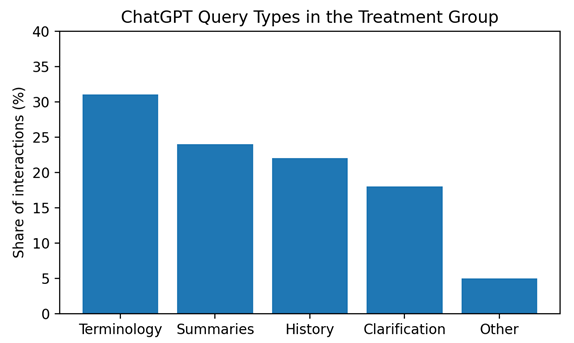
Learning analytics showed that treatment group students interacted with ChatGPT an average of 34.6 times during the semester. The average duration of interaction was 8.4 minutes. The correlation between interaction frequency and knowledge gain was r = .42 with p < .001. This result suggests a positive association between structured AI use and conceptual improvement, although it should not be interpreted as definitive proof that frequency alone caused knowledge gains.
| Query Type | Percentage of Total Interactions |
| Terminology explanation | 31% |
| Text summarization | 24% |
| Historical information | 22% |
| Concept clarification | 18% |
| Other uses | 5% |
The qualitative findings generated five major themes. The first theme was enhanced accessibility. Students reported that ChatGPT allowed them to ask questions outside formal class hours, especially when they encountered difficult Arabic terms, unfamiliar Sufi concepts, or complex textual explanations. The second theme was recognition of AI limitations. Students and educators consistently emphasized that ChatGPT could explain the meaning of a concept but could not guide spiritual transformation.
The third theme was pedagogical transformation. Educators reported that AI-assisted preparation changed classroom dynamics because students came to class with better preliminary understanding of terms and concepts. Lecturers consequently spent less time explaining basic definitions and more time facilitating discussion, correcting misunderstanding, and deepening reflective engagement. The fourth theme was ethical concern, especially the possibility that instant answers might weaken patience, mujahadah, and epistemic humility. The fifth theme was institutional variation, because AI integration was received differently across institutions depending on academic culture, prior exposure to digital learning, and the presence of senior scholars who were skeptical of AI use.
Classroom observations supported the survey and interview findings. In treatment sessions, educators spent less time on conceptual explanation and more time on discussion, reflection, and spiritual practice guidance. These patterns indicate that AI-supported preparation created more room for dialogic and reflective classroom engagement.
| Observation Category | Treatment Sessions (n = 18) | Comparison Sessions (n = 18) |
| Time on conceptual explanation | 25.4% | 42.1% |
| Time on discussion/reflection | 38.2% | 28.6% |
| Time on spiritual practice guidance | 31.8% | 24.3% |
| Mean student questions per session | 12.4 | 8.7 |
| Mean student-initiated discussion instances | 8.2 | 4.6 |
The implementation also revealed several limitations. The one-semester duration was sufficient to evaluate conceptual learning and classroom interaction, but not sufficient to measure long-term spiritual development. The measurement of spiritual practice engagement depended partly on self-report, which may not fully capture the quality, sincerity, or consistency of practice. The intervention was also implemented in Central Java, where Islamic higher education is shaped by specific cultural and institutional traditions.
Discussion
The findings indicate that ChatGPT can contribute positively to Tasawuf education when it is embedded in a clear pedagogical and ethical framework. The strongest quantitative effect appeared in conceptual knowledge, where the treatment group outperformed the comparison group with an adjusted effect size of d = 0.78. This result is consistent with broader studies showing that generative AI can support explanation, feedback, personalized inquiry, and student engagement in educational settings (Kasneci et al., 2023; Holmes et al., 2023; Baidoo-Anu & Ansah, 2023). However, the present study extends this literature by showing that AI support is not equally appropriate for all learning domains.
The AI-Murshid Framework operationalizes the classical Sufi distinction between ‘ilm and hal. The study found that AI is useful when the learning objective concerns definitions, historical background, conceptual clarification, and preliminary reflection. However, the cultivation of hal, the discipline of riyadhah, and the ethical transformation of the self require human presence, guided practice, and spiritual authority. This finding supports classical and contemporary Sufi scholarship that emphasizes the irreducibility of inner transformation to conceptual mastery (al-Ghazali, 2021; al-Qushayri, 2022; Knysh, 2023; Chittick, 2023; Schimmel, 2022; Sells, 2023).
The absence of significant differences in spiritual practice engagement is theoretically important. On one hand, it shows that AI integration did not directly intensify students’ practice frequency or perceived practice quality. On the other hand, it also shows that bounded AI integration did not diminish practice engagement or weaken the student-educator relationship. This finding qualifies concerns from studies of digital contemplative practice, where digital tools can sometimes produce superficial engagement or spiritual bypassing when they replace guided discipline (Gleig, 2022; Thurston, 2023).
The qualitative findings refine current theories of AI in education. Existing frameworks commonly discuss AI as tutor, tool, collaborator, or adaptive learning system (Luckin et al., 2022; Kasneci et al., 2023). These categories are useful but incomplete for religious and spiritual education because they focus mainly on cognitive, interactive, and performance-based learning. Tasawuf education introduces a different category of learning: transformation of being. This type of learning requires moral exemplarity, disciplined companionship, affective correction, and authority rooted in lived practice (Frager, 2022; Nasr, 2021; Murad, 2022).
The study also contributes to Islamic educational philosophy by showing that technological integration can be evaluated through maslahah and maqasid rather than through uncritical adoption or total rejection. If AI improves access to beneficial knowledge, supports student understanding, and frees educators to focus on higher-order guidance, then its use can serve educational benefit. Yet if AI is allowed to assume religious authority, replace suhbah, or generate unverified spiritual advice, it may produce harm by weakening adab and epistemic discipline (Auda, 2022; Kamali, 2023).
The comparison with previous studies on digital Islamic education shows both continuity and difference. Technology adoption in pesantren and Islamic higher education depends on institutional leadership, religious legitimacy, educator readiness, and alignment with Islamic values (Wekke et al., 2022; Hashim & Rossidy, 2023; Zawawi, 2024). The present study confirms this pattern because acceptance of AI varied across institutional cultures and increased when educators saw that AI was positioned as a support tool rather than a replacement for tradition.
The pedagogical transformation experienced by educators is one of the most significant practical implications. In the treatment group, classroom time shifted away from basic explanation and toward discussion, reflection, and spiritual practice guidance. This does not diminish the teacher’s role. Instead, it potentially restores a more meaningful role for the teacher as guide, interpreter, and ethical model. In conventional classroom settings, lecturers often spend substantial time explaining basic terminology. When AI supports that preliminary layer, educators can devote more attention to misinterpretation, moral formation, and contextualization.
The most defensible interpretation is that ChatGPT can improve conceptual access in Tasawuf education, but only under a framework that protects human spiritual authority. The AI-Murshid Framework is therefore not a claim that AI can become a murshid. Rather, it is a curriculum boundary model that prevents such confusion. Its contribution lies in differentiating what AI may support, what it may assist only indirectly, and what it must not replace.
Conclusion
This study developed and evaluated the AI-Murshid Framework as a bounded model for integrating ChatGPT into Tasawuf education. The findings show that AI integration can significantly improve students’ conceptual understanding of Tasawuf while maintaining the centrality of human-guided spiritual formation. The strongest effect was found in foundational knowledge delivery, where ChatGPT helped students clarify terminology, summarize difficult materials, and ask repeated conceptual questions outside formal classroom time. At the same time, the study found no significant difference in spiritual practice engagement between the treatment and comparison groups, indicating that AI did not directly transform practice but also did not weaken the human relationship central to Tasawuf learning.
The main contribution of this study is the formulation of a four-domain framework that differentiates AI-appropriate, AI-supported, human-primary, and human-essential components of Tasawuf education. Foundational knowledge delivery can be supported strongly by AI. Reflective dialogue can be supported by AI but must remain guided by educators. Spiritual practice can only receive supplementary AI support and must remain under human guidance. Transformative experience must be excluded from AI mediation because suhbah, hal, ijazah, and spiritual progress cannot be produced or assessed by a machine.
Practically, Islamic higher education institutions should not respond to AI merely by prohibiting or permitting its use. They need curriculum-level guidelines that define when AI use is appropriate, how students should evaluate AI-generated content, and which aspects of religious learning must remain under qualified human teachers. Tasawuf educators should be trained not only in the technical use of AI, but also in designing reflective prompts, identifying AI errors, correcting shallow interpretations, and protecting the adab of religious learning.
Future research should examine the long-term effects of AI-integrated Tasawuf education on spiritual discipline, ethical formation, and student-teacher relationships across multiple semesters or academic years. Comparative studies across different Muslim educational cultures would also be valuable to test whether the AI-Murshid Framework can be adapted beyond Central Java. The central implication of this study is that artificial intelligence can assist Tasawuf education when it is placed within clear boundaries, but the heart of Tasawuf remains human, relational, disciplined, and spiritually guided.
References
- al-Ghazali, A. H. (2021). Ihya ulum al-din: The revival of the religious sciences. Islamic Texts Society. DOI ↗ Google Scholar ↗
- al-Qushayri, A. (2022). Al-Risalah al-Qushayriyyah: Principles of Sufism. Islamic Texts Society. DOI ↗ Google Scholar ↗
- Auda, J. (2022). Re-envisioning Islamic scholarship: Maqasid methodology as a new approach. International Institute of Islamic Thought. DOI ↗ Google Scholar ↗
- Azra, A. (2022). Pesantren and digital transformation: Challenges and opportunities post-pandemic. Studia Islamika, 29(1), 1-28. DOI ↗ Google Scholar ↗
- Baidoo-Anu, D., & Ansah, L. O. (2023). Education in the era of generative artificial intelligence: Understanding the potential benefits of ChatGPT in promoting teaching and learning. Journal of AI, 7(1), 52-62. DOI ↗ Google Scholar ↗
- Braun, V., & Clarke, V. (2022). Thematic analysis: A practical guide. SAGE Publications. DOI ↗ Google Scholar ↗
- Brynjolfsson, E., & McAfee, A. (2022). The second machine age: Work, progress, and prosperity in a time of brilliant technologies. W. W. Norton. DOI ↗ Google Scholar ↗
- Chittick, W. C. (2023). Sufism: A beginner's guide. Oneworld Publications. DOI ↗ Google Scholar ↗
- Creswell, J. W., & Clark, V. L. P. (2023). Designing and conducting mixed methods research. SAGE Publications. DOI ↗ Google Scholar ↗
- Ernst, C. W. (2022). The Shambhala guide to Sufism. Shambhala. DOI ↗ Google Scholar ↗
- Frager, R. (2022). Heart, self, and soul: The Sufi psychology of growth, balance, and harmony. Quest Books. DOI ↗ Google Scholar ↗
- Gleig, A. (2022). Digital dharma: Buddhism, technology, and the question of authentic practice. Journal of Global Buddhism, 23(1), 45-68. DOI ↗ Google Scholar ↗
- Hashim, R., & Rossidy, I. (2023). Artificial intelligence in Islamic education: Opportunities and ethical considerations. Intellectual Discourse, 31(1), 23-45. DOI ↗ Google Scholar ↗
- Holmes, W., Bialik, M., & Fadel, C. (2023). Artificial intelligence in education: Promises and implications for teaching and learning. Center for Curriculum Redesign. DOI ↗ Google Scholar ↗
- Howell, J. D. (2022). Sufism and Islamic education in contemporary Indonesia. Journal of Islamic Studies, 33(2), 178-205. DOI ↗ Google Scholar ↗
- Kamali, M. H. (2023). Principles of Islamic jurisprudence. Islamic Texts Society. DOI ↗ Google Scholar ↗
- Kasneci, E., Seßler, K., Küchemann, S., Bannert, M., Dementieva, D., Fischer, F., Gasser, U., Groh, G., Günnemann, S., Hüllermeier, E., Kruber, S., Kuber, G., Leutner, D., Lienkamp, M., Nerdel, C., Pfeffer, J., Poquet, O., Sailer, M., Schmidt, A., & Kasneci, G. (2023). ChatGPT for good? On opportunities and challenges of large language models for education. Learning and Individual Differences, 103, 102274. DOI ↗ Google Scholar ↗
- Knysh, A. (2023). Sufism: A new history of Islamic mysticism. Princeton University Press. DOI ↗ Google Scholar ↗
- Lings, M. (2021). What is Sufism?. Islamic Texts Society. DOI ↗ Google Scholar ↗
- Luckin, R., Holmes, W., Griffiths, M., & Forcier, L. B. (2022). Intelligence unleashed: An argument for AI in education. Pearson. DOI ↗ Google Scholar ↗
- Lukens-Bull, R. (2023). Islamic higher education in Indonesia: Continuity and conflict. Palgrave Macmillan. DOI ↗ Google Scholar ↗
- McKenney, S., & Reeves, T. C. (2022). Conducting educational design research. Routledge. DOI ↗ Google Scholar ↗
- Ministry of Religious Affairs, (2024). Statistical data on Islamic education institutions in Indonesia 2024. Government of Indonesia. DOI ↗ Google Scholar ↗
- Murad, A. H. (2022). Travelling home: Essays on Islam in Europe. Quilliam Press. DOI ↗ Google Scholar ↗
- Nasr, S. H. (2021). The garden of truth: The vision and promise of Sufism. HarperOne. DOI ↗ Google Scholar ↗
- Raihani, R. (2023). Digital literacy and AI use among Indonesian Islamic university students. Indonesian Journal of Islam and Muslim Societies, 13(1), 1-28. DOI ↗ Google Scholar ↗
- Schimmel, A. (2022). Mystical dimensions of Islam. University of North Carolina Press. DOI ↗ Google Scholar ↗
- Sells, M. A. (2023). Early Islamic mysticism: Sufi, Qur'an, Mi'raj, poetic and theological writings. Paulist Press. DOI ↗ Google Scholar ↗
- Selwyn, N. (2023). Education and technology: Key issues and debates. Bloomsbury Academic. DOI ↗ Google Scholar ↗
- Thurston, B. (2023). Digital contemplation: Meditation apps and the transformation of spiritual practice. Journal of Religion, Media and Digital Culture, 12(1), 34-56. DOI ↗ Google Scholar ↗
- Wekke, I. S., Yusuf, M., & Busyro, B. (2022). Digital transformation in Indonesian pesantren: Challenges and adaptations. Cogent Education, 9(1), 2087456. DOI ↗ Google Scholar ↗
- Zawawi, A. (2024). Integrating artificial intelligence in Islamic religious education: A systematic review. British Journal of Religious Education, 46(1), 45-62. DOI ↗ Google Scholar ↗