Abstract
This study aims to analyze the characteristics of the development of the Jemaah Islamiyah network in West Nusa Tenggara, the deradicalization model through a humanist approach, and the deradicalization strategy for Jemaah Islamiyah members who refuse to re-pledge allegiance to the Unitary State of the Republic of Indonesia. This study is a normative-empirical legal study using the Statute Approach , conceptual ( Conceptual Approach ), and sociological ( Sociological Approach ) approaches. Data were obtained through literature studies, interviews, and questionnaires, then analyzed descriptively-analytically with deductive reasoning. The results of the study indicate that the Jemaah Islamiyah network in West Nusa Tenggara has shifted from open violence to closed strengthening of ideology and social networks. The deradicalization model through a humanist approach is the implementation of non-penal policies combined with penal policies, and is effective in encouraging behavioral changes, reducing attachment to networks, and strengthening social reintegration, even though ideological changes occur gradually. The deradicalization strategy for members who refuse to pledge allegiance is carried out through an adaptive approach based on the level of risk, ongoing development, socio-economic empowerment, and strengthening the role of families, religious leaders, and the community, while still enforcing the law against individuals who are proven to have committed acts of terrorism again.
Keywords
Deradicalization Terrorism Jamaah Islamiyah Humanist Approach West Nusa Tenggara
Introduction
Terrorism is even seen as a threat to state security and public order, so it requires a countermeasure approach that is not only oriented towards law enforcement, but also takes into account the social, ideological and cultural aspects that underlie it.
In the development of law in Indonesia, counter-terrorism efforts have been strengthened through various regulations, particularly with the enactment of Law Number 5 of 2018, which amends Law Number 15 of 2003. This law not only emphasizes the aspect of action against perpetrators, but also regulates a more comprehensive approach through prevention and development, including deradicalization programs. This indicates a paradigm shift in the Indonesian criminal law system, from a solely repressive approach to a more integrative approach that combines penal and non-penal aspects in counter-terrorism.
In many cases, individuals who have served their sentences retain their ideological beliefs, potentially reconnecting with their previous networks. This situation demonstrates that counterterrorism efforts that rely solely on a penal approach are incapable of comprehensively addressing the problem.
This gap is important to examine from an empirical legal perspective, as it demonstrates that the existence of legal norms does not always equate to the effectiveness of their implementation in society. The primary problem lies not only in the unlawful acts themselves, but also in the ideology that underpins their justification. Therefore, an approach is needed that can address ideological and social aspects not directly addressed by positive law, enabling a more comprehensive counterterrorism approach.
In a study by the National Counterterrorism Agency (BNPT), the success of a deradicalization program is not only determined by guidance provided by law enforcement officers, but is also greatly influenced by family support, community acceptance, and the individual's social and economic conditions upon returning to society. Without such support, former members of terrorist groups potentially face obstacles in the social reintegration process, which can increase the risk of re-exposure to radical ideology. Therefore, deradicalization is not only understood as a process of individual change, but also as a social process that requires the involvement of family, community, religious leaders, and the government. Based on this, this study focuses on a deradicalization model through a humanist approach as part of a non-penal policy in combating acts of terrorism, particularly against the Jemaah Islamiyah network in West Nusa Tenggara.
The development of terrorist networks in Indonesia shows significant changes in patterns over time. Networks are no longer centralized and rigidly hierarchical, but have become more flexible and based on strong social relations. This pattern makes them more difficult to detect, as their activities are often integrated into everyday life. In such circumstances, formal law enforcement approaches are often unable to capture all the dynamics within these networks.
The development of Jemaah Islamiyah in West Nusa Tenggara (NTB) is also characterized by a non-confrontational approach to the state. Jemaah Islamiyah in NTB tends to avoid open conflict with security forces and places greater emphasis on strengthening the organization's internal operations. IPAC noted that this strategy aims to maintain the network's long-term sustainability while awaiting the right momentum for expanding its ideological influence.
The rooted nature of Jemaah Islamiyah in local communities demands a deradicalization approach based on local wisdom, the involvement of religious leaders, and a strengthened role for local governments. Daniel Koehler asserts that "deradicalization that is not tailored to the local social context risks failing to substantively dismantle extremist networks."
This situation also demonstrates that mapping the Jemaah Islamiyah network in NTB is not merely a police activity, but rather the fact that social network-based extremist ideology has taken root and developed through informal education, internal mu'ahadah (oaths of allegiance), closed spiritual guidance, and the reproduction of religious doctrine modified to legitimize violence. Therefore, deradicalization in NTB is not only a matter of training terrorist convicts, but also of preventing radicalization through social communities and community educational institutions.
Although a national legal framework for deradicalization is in place through Law No. 5 of 2018 and Presidential Regulation No. 7 of 2021 concerning the National Action Plan for the Prevention and Countermeasures of Violent Extremism Leading to Terrorism (RAN PE), its implementation in West Nusa Tenggara still faces limitations at the regional regulatory level. At the time of this research, no Regional Regulations, Gubernatorial Regulations, or technical policies had been found specifically regulating the implementation of deradicalization, coordination patterns between regional government organizations and relevant stakeholders, or guidance mechanisms for former terrorist convicts and their families. This has resulted in the implementation of deradicalization programs in the regions relying largely on initiatives from central government agencies, particularly the National Counterterrorism Agency (BNPT) and the National Police's Densus 88 Anti-Terror Squad.
This situation demonstrates the gap between national norms and local realities, where deradicalization is carried out within a national framework without strengthening regional legal instruments. Yet, the nature of deradicalization is highly dependent on local socio-cultural approaches, especially given NTB's distinct ideological and cultural characteristics compared to other regions in Indonesia.
The effectiveness of deradicalization policies in West Nusa Tenggara (NTB) also faces implementation challenges. Differences in local characteristics, limited resources, and ideological resistance from individuals exposed to extremist ideologies influence policy outcomes. Therefore, this research is crucial to critically examine counterterrorism efforts as part of deradicalization, with a focus on the effectiveness of policies in addressing the dynamics of the Jemaah Islamiyah network in West Nusa Tenggara. This research is expected to contribute to the development of more adaptive, proportional, and long-term prevention-oriented criminal law and national criminal policies.
Research Methods
To solve a problem that is the main topic of discussion, this research uses empirical normative legal research. Empirical normative legal research is conceptualized as Legal research that examines positive legal provisions related to countering criminal acts of terrorism and deradicalization (normative), and assesses the effectiveness of their implementation in practice through empirical data in the field related to the Jemaah Islamiyah network . The sources of normative legal research are only secondary data, consisting of primary legal materials, secondary legal materials, and tertiary legal materials.
Discussion
1. Characteristics Of The Islamic Congregation Network In West Nusa Tenggara
The internal characteristics of the Jemaah Islamiyah network, encompassing recruitment mechanisms, the process of ideological internalization, and the formation of group cohesion as the basis for organizational resilience, are manifested in broader structures, territorial distribution patterns, and the institutional base that supports the network's sustainability. This shift in focus is crucial to demonstrate that the strength of Jemaah Islamiyah lies not only in the internal dynamics of its members but also in the structural configuration that enables the network to continue functioning collectively within the broader social space.
The network's configuration is reflected not only in the distribution of members across various regions, but also in the division of organizational functions that support the development and dissemination of ideology. Based on primary research data, the da'wah (Islamic outreach) sector is a crucial element in the organizational structure of Jemaah Islamiyah, serving as a medium for development, delivering religious material, and strengthening relationships among members through systematic mechanisms. The structure of the da'wah sector can be seen in the following chart.
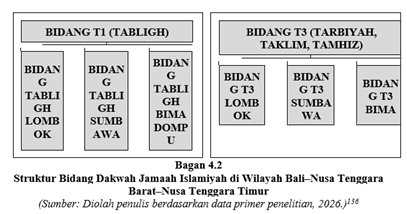
The diagram shows that the da'wah division has a structure based on the division of functions and work areas. Da'wah is implemented through several divisions, each with its own duties, which are then passed on to regional coordinators in Lombok, Sumbawa, Bima, and Dompu. This structure demonstrates that the organization's activities are not centralized, but rather through a division of responsibilities, allowing for a hierarchical process of development and coordination. Thus, the organizational configuration of Jemaah Islamiyah in West Nusa Tenggara demonstrates a systematic working mechanism for maintaining communication, development, and network continuity at the regional level.
An organization cannot be understood solely through the relationships between individuals, but also through the patterns of connectivity that shape the system as a whole. Marc Sageman explains that "modern terrorist networks tend to operate in flexible and distributed structures, where relationships between members are not always rigidly hierarchical, but still involve coordination based on ideology and leadership." Jemaah Islamiyah demonstrates the characteristics of a network capable of combining formal structures with informal social relations, thus remaining adaptive to external pressures.
Primary research data shows that the Jemaah Islamiyah network in West Nusa Tenggara Province has a distribution pattern that is not random, but rather follows the social and cultural characteristics of the communities in each region. Based on the results of the identification of 128 former members of Jemaah Islamiyah in West Nusa Tenggara Province, the network is spread across Lombok, Sumbawa, as well as Bima and Dompu. This distribution not only illustrates the network's geographical presence, but also indicates the interconnectedness between regions built through social, religious, and ideological relationships. This condition indicates that the Jemaah Islamiyah network in West Nusa Tenggara Province did not develop separately in each region, but rather formed a system that is interconnected and integrated through ideological ties and social relationships between members.
The organizational structure of Jemaah Islamiyah in West Nusa Tenggara (NTB) also demonstrates a relatively clear division of functions, although this is not always formally apparent. To clarify the configuration of Jemaah Islamiyah's organizational structure, the following network diagram illustrates the hierarchical and functional relationships within the organization.
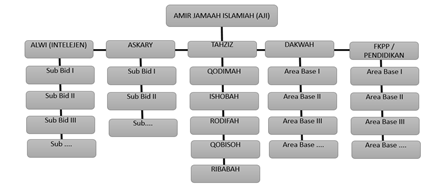
The diagram shows that the structure of Jemaah Islamiyah cannot be fully understood as a conventional hierarchical organization, but rather as a network configuration that combines elements of centralized command with flexible relations between units. The existence of an amir as the holder of the highest authority indicates the existence of a center of ideological legitimacy and decision-making, but at the same time, the division of functions into areas such as da'wah (tabligh) , FKPP (Islamic Boarding School Communication Forum) JI affiliated education center, cadre formation to militaristic (Tajhiz) which reflects the existence of role differentiation that allows the organization to operate effectively without having to always rely on direct instructions from the center.
If examined further, the structure shows characteristics as a semi-hierarchical network , namely a form of organization that still has a chain of command and leadership, but its implementation does not always take place rigidly in daily activities. This condition is reflected in the statement conveyed by Kombes Pol. Lili Warli, SIK, MH, who explained that relationships between members of Jamaah Islamiyah are built more through social interactions, family relationships, and informal communication, although their implementation remains within the framework of obedience to the leader ( amir ) and the applicable organizational structure. Thus, the organizational structure does not only function as a formal coordination tool, but also as a normative framework that regulates the behavior of members through the values of obedience (ito'ah) and ideological loyalty.
Furthermore, the diagram indicates that the network's sustainability does not rely solely on a single structural pathway, but is supported by multiple, complementary layers of functions. The tarbiyah (Islamic education) sector, for example, plays a role in forming and reproducing cadres through ideological education, while the tabligh (Islamic outreach) sector serves to expand its influence through da'wah activities. This division of functions demonstrates that Jemaah Islamiyah is oriented not only toward organizational existence but also toward the long-term sustainability of the network through a systematic cadre development process.
This structure offers a strategic advantage in the form of high adaptability. When one part of the structure experiences pressure or disruption, other parts can continue to function because they are not entirely dependent on a single central point. This explains why the Jemaah Islamiyah network tends to survive despite legal action, as its structure is not rigid, but rather flexible and distributed. Marc Sageman calls this pattern a resilient network, one that remains viable despite fragmentation.
When related to the West Nusa Tenggara region, these structures do not always appear in the form of visible formal organizations, but often transform into social relations that are embedded in community life. This suggests that organizational structure diagrams cannot be understood literally as forms that are always visible on the ground, but rather as a basic framework that operates latently through interpersonal relationships, religious activities, and social institutions such as Islamic boarding schools (pesantren) and foundations.
Information obtained from Police Commissioner Lili Warli, SIK, MH shows that the organizational structure of Jemaah Islamiyah is not always implemented in a formal, easily recognizable form, but rather is often mixed in with the daily social activities of its members. According to her, relationships between members do not always show a rigid command pattern, but are still based on obedience to the leader ( amir ) and the established organizational mechanisms. This condition indicates that the organizational structure of Jemaah Islamiyah has a semi-formal character, where control and coordination functions continue to run effectively even though they are not always explicitly visible in an open organizational form. IPAC noted that Jemaah Islamiyah strategically utilizes educational institutions as a means to maintain organizational sustainability without having to be directly involved in violent activities .
The horizontal and personal trust-based network configuration found in this study can be explained through a contemporary criminological perspective that emphasizes the role of group identity in maintaining individual attachment to the organization.
This situation indicates that Jemaah Islamiyah has adopted a hybrid network model, a combination of hierarchical and social networks. This model allows the organization to maintain direction and coordination while remaining flexible in the face of external pressures. Muhammad Mustofa explained that criminal networks with high flexibility tend to be more difficult to eradicate because they do not rely on a single structure that is easily identified and destroyed. In terrorism literature, this condition is known as distributed network resilience, which is the network's ability to survive despite fragmentation.
The existence of these distributed, relation-based networks presents a unique challenge for law enforcement. Positive law tends to operate on formal structures and concrete evidence, while networks like Jemaah Islamiyah often operate in social spaces that cannot be fully categorized as direct violations of the law. Susan Silbey emphasizes that law must be understood as part of social practice, so its effectiveness depends heavily on understanding the social context in which it is applied.
Thus, an analysis of the structural configuration and distribution patterns of the Jemaah Islamiyah network in West Nusa Tenggara shows that the network's strength lies not only in its formal organizational structure, but also in its ability to integrate social relations, institutions, and adapt to local conditions. This makes the network not merely an organization but a complex and adaptive social system capable of surviving under various stressful conditions.
2. A Humanist Deradicalization Model for the Jamaah Islamiyah Network in West Nusa Tenggara
The humanist deradicalization model in this study is understood as an analytical construct that stems not only from a normative policy framework but also from empirical practices developing in the field. This approach places the individual at the center of the change process, so that deradicalization is not simply interpreted as an effort to change ideology, but rather as a transformation process that simultaneously touches on cognitive, emotional, social, and structural dimensions.
This model does not emerge in a uniform form, but rather develops contextually, reflecting individual and network characteristics. Interviews indicate that the approach used by officials is not a single approach, but rather adapts to the individual's background, including organizational experience, level of involvement, and surrounding socioeconomic conditions.
This demonstrates that individual involvement in networks cannot be understood simply as a result of ideological factors alone. Rather, such involvement results from the interaction of ideological factors, social experiences, community relationships, and individual psychological needs. Therefore, an effective deradicalization model must be able to address all of these dimensions simultaneously .
Approaches that focus solely on ideological change tend to produce temporary changes. As various studies have shown, deradicalization that is not accompanied by changes in social and psychological aspects has a low level of sustainability. In this context, a humanist approach is relevant because it can integrate these various dimensions into a coherent framework.
In this research, the humanist deradicalization model can be understood through several interrelated dimensions. These dimensions do not stand alone but form an integrated system within the individual's transformation process. To understand the model's construction more comprehensively, it is necessary to analyze each of its constituent dimensions.
a. Cognitive Transformation as a Basis for Change
The cognitive dimension is the primary foundation of the deradicalization model, as it directly relates to how individuals perceive reality. Research data shows that the majority of respondents experienced changes in their perspectives on the state, the law, and the legitimacy of violence after participating in the deradicalization program.
This change does not occur through re-indoctrination, but rather through dialogue that allows individuals to reflect on their beliefs. This reflective process is important because it produces more stable change than forced change.
However, this change is not always complete. Some respondents still retained certain elements of their previous beliefs, indicating that deradicalization is a gradual, non-linear process. This is in line with the concept of disengagement, where individuals can disengage from networks without completely changing their beliefs.
b. Affective Approach and Emotional Relations
In addition to cognitive aspects, changes also occur in the affective dimension, which relates to emotions and interpersonal relationships. Interviews indicate that a humanistic approach can create closer relationships between officers and individuals undergoing deradicalization programs.
This approach differs from repressive methods, which tend to generate resistance. Instead, an approach based on empathy and respect for the individual can open up a more effective dialogue, allowing individuals to feel valued as human beings, not as objects of treatment.
This condition relates to the fulfillment of an individual's basic needs, such as security and social acceptance. Individuals who feel secure tend to be more open to change than those under stress.
c. Social Reintegration as a Determining Factor
The social dimension is a crucial element in ensuring the sustainability of individual change. Data shows that most communities are receptive to former members of the Jamaah Isamiyah (JI) network, although stigma remains, presenting challenges to reintegration.
Social acceptance is a key factor because it provides space for individuals to rebuild their identities outside of their social networks. Without adequate social support, individuals can potentially experience isolation, which can lead them to reintegrate into old networks. The role of religious and local community leaders is crucial in this process. They serve not only as supporters but also as mediators, helping rebuild trust between individuals and the community.
d. Economic Stability and Individual Independence
The economic aspect is a crucial factor in the deradicalization model, particularly in the context of sustainable change. Economic empowerment programs provide individuals with more stable alternatives, thereby reducing dependence on old networks.
Economic change is not always accompanied by immediate ideological change. This suggests that economic aspects must be integrated with other approaches to achieve comprehensive change.
In humanistic deradicalization studies, fulfilling basic needs is a prerequisite for deeper change. When basic needs are met, individuals have greater room for reflection and change.
e. The Role of the State and Policy Framework
The humanist deradicalization model cannot be separated from the role of the state as the primary actor in counterterrorism. The National Counterterrorism Agency (BNPT) and Densus 88 play a strategic role in designing and implementing deradicalization programs.
The perspective of a modern criminal justice system no longer places the success of counterterrorism solely on the state's ability to apprehend and convict perpetrators. Counterterrorism efforts must also consider the impact on victims, particularly long-term psychological disorders such as post-traumatic stress disorder (PTSD). Therefore, deradicalization and law enforcement need to be understood as part of a criminal policy that balances punishment of perpetrators, community protection, and comprehensive victim recovery.
Protecting victims of terrorism is an integral part of the state's responsibility. Victim recovery encompasses not only medical and psychological assistance, but also compensation and restitution through mechanisms coordinated by the National Counterterrorism Agency (BNPT) and the Witness and Victim Protection Agency (LPSK). The existence of these mechanisms demonstrates that Indonesia's counterterrorism policy is built within a framework that emphasizes not only security but also restorative justice for those affected.
The approach used demonstrates a shift from a repressive security model to a more humanistic one. This is reflected in field practices that emphasize development rather than mere enforcement.
In a policy context, this approach is in line with the National Action Plan for Violence Against Women (RAN PE), which emphasizes the importance of multi-stakeholder involvement in combating violent extremism.
Conclusion
Characteristics of the Jamaah Islamiyah network in West Nusa Tenggara, Based on the research results, the characteristics of the Jamaah Islamiyah network in West Nusa Tenggara show a structural transformation from open violence patterns to the strengthening of latent ideologies and social networks. The network is no longer embodied in an explicit organizational structure, but rather persists through religious, kinship, and local community relations that enable the reproduction of ideology to take place continuously. From a criminal law perspective, this condition confirms that counter-terrorism based on Law Number 5 of 2018 cannot only rely on repressive action, but must be accompanied by prevention and deradicalization efforts to break the process of reproduction of violent ideology that is now moving latently and adaptively.
The deradicalization model through a humanist approach to the Jemaah Islamiyah network in West Nusa Tenggara is an implementation of a non-penal policy in combating criminal acts of terrorism that is implemented in an integrated manner with a penal approach through law enforcement against perpetrators who continue to commit terrorist crimes. The implementation of the non-penal approach is carried out through ideological development, dialogue, ongoing mentoring, socio-economic empowerment, and strengthening the role of families, religious leaders, and communities in the social reintegration process. The results of the study indicate that the model is effective in encouraging behavioral change ( disengagement ) and reducing the attachment of former Jemaah Islamiyah members to the network, although ideological change occurs gradually and has not yet fully occurred in all individuals. Therefore, the humanist deradicalization model in this study places behavioral change, strengthening local social networks, and community empowerment as key elements in realizing a sustainable social reintegration process.
Suggestion
The government needs to strengthen its counter-terrorism policy through a more effective integration of penal and non-penal approaches. While penal law enforcement remains necessary for individuals found guilty of terrorism, the implementation of non-penal policies, as stipulated in Law Number 5 of 2018, still needs to be strengthened, particularly in the areas of post-deradicalization development, socio-economic empowerment, social reintegration, and program sustainability evaluation mechanisms. This strengthening is necessary so that deradicalization does not stop at stopping terrorist activities, but also ensures behavioral change and the continued reintegration of former members of terrorist groups into society. The current deradicalization model needs to be developed to accommodate the local characteristics of the Jemaah Islamiyah network in West Nusa Tenggara. The Local Network-Based Humanist Deradicalization Model (MDHBJL) developed in this study can be an alternative for developing a deradicalization model through strengthening community-based approaches, involving families, religious leaders, and community leaders, as well as sustainable socio-economic empowerment. The development of this model is expected to strengthen the effectiveness of non-penal policies in building behavioral change, accelerating social reintegration, and reducing the risk of re-involvement in terrorist networks.
References
- BNPT, National Strategy for Countering Extremism , 2021. DOI ↗ Google Scholar ↗
- Coordinating Ministry for Political, Legal and Security Affairs of the Republic of Indonesia, RAN PE , 2021. DOI ↗ Google Scholar ↗
- Daniel Koehler, Understanding Deradicalization: Methods, Tools and Programs for Countering Violent Extremism , Routledge, London, 2015, p. 156–162. DOI ↗ Google Scholar ↗
- Greg Fealy and Anthony Bubalo, Joining the Caravan The Middle East, Islamism and Indonesia , Sydney: Lowy Institute for International Policy, 2005, p. 90. DOI ↗ Google Scholar ↗
- Institute for Policy Analysis of Conflict (IPAC), Jemaah Islamiyah's Long Game: Rebuilding and Reorganizing , IPAC Report No. 60, Jakarta, 2020, p. 9–13. DOI ↗ Google Scholar ↗
- Institute for Policy Analysis of Conflict (IPAC), The Evolution of Jemaah Islamiyah , 2018 DOI ↗ Google Scholar ↗
- International Crisis Group, Indonesia Backgrounder: Jemaah Islamiyah , Asia Report No. 43, International Crisis Group, Brussels, 2002, pp. 10–18. DOI ↗ Google Scholar ↗
- Interview with Senior Commissioner of Police Lili Warli, SIK, MH, Head of the West Nusa Tenggara Regional Task Force, Densus 88 Anti-Terror Police, at the West Nusa Tenggara Regional Task Force Headquarters, Densus 88 Anti-Terror Police, Mataram City, Wednesday, May 13, 2026, at 13.00 WITA. DOI ↗ Google Scholar ↗
- Interview with Senior Commissioner of Police Lili Warli, SIK, MH, Head of the West Nusa Tenggara Task Force, Densus 88 Anti-Terror Police, at the residence of the Head of the NTB Task Force, Densus 88 Anti-Terror Police, Mataram District, Mataram City, West Nusa Tenggara Province, Wednesday, May 13, 2026, at 13.00 WITA. DOI ↗ Google Scholar ↗
- Interview with Senior Commissioner of Police Lili Warli, SIK, MH, Head of the West Nusa Tenggara Regional Task Force, Densus 88 Anti-Terror Police, at the residence of the Head of the NTB Regional Task Force, Densus 88 Anti-Terror Police, Mataram District, Mataram City, West Nusa Tenggara Province, Wednesday, May 13, 2026, at 13.00 WITA DOI ↗ Google Scholar ↗
- Law Number 5 of 2018 concerning Amendments to Law Number 15 of 2003 concerning the Eradication of Criminal Acts of Terrorism. DOI ↗ Google Scholar ↗
- M. Hasan Syamsudin, “Radicalism and Law Enforcement in Indonesia”, Journal of Islamic Political Thought , 2018, pp. 185–187. DOI ↗ Google Scholar ↗
- Marc Sageman, Turning to Political Violence: The Emergence of Terrorism , University of Pennsylvania Press, 2017, p. 69–72. DOI ↗ Google Scholar ↗
- Marc Sageman, Understanding Terror Networks , 2004. DOI ↗ Google Scholar ↗
- Muhammad Mustofa, Understanding Terrorism: A Criminological Perspective , Kencana, Jakarta, 2018, p. 25. DOI ↗ Google Scholar ↗
- Muhammad Najib, Community-Based Radicalization in West Nusa Tenggara , National Security Journal, Vol. 7 No. 1, 2021, pp. 62–63. DOI ↗ Google Scholar ↗
- Nafi' Muthohirin, Radicalism in Indonesia , Jakarta, 2017, p. 88. DOI ↗ Google Scholar ↗
- National Counterterrorism Agency (BNPT), Mapping Areas Prone to Radicalism in Indonesia , Jakarta, 2022, pp. 40–42. DOI ↗ Google Scholar ↗
- National Counterterrorism Agency (BNPT), Technical Guidelines for the Implementation of Deradicalization , Jakarta: BNPT Republic of Indonesia, 2021, pp. 3–6. DOI ↗ Google Scholar ↗
- National Counterterrorism Agency of the Republic of Indonesia, Deradicalization Report 2022 , Jakarta: National Counterterrorism Agency of the Republic of Indonesia, 2022, p. 45. DOI ↗ Google Scholar ↗
- NTB Field Research Data, 2025. DOI ↗ Google Scholar ↗
- Primary research data, the results of distributing questionnaires using Google Forms to 50 former members of Jemaah Islamiyah in West Nusa Tenggara Province, May 2026. DOI ↗ Google Scholar ↗
- The primary research data was obtained from the results of identifying the distribution of 128 former members of Jemaah Islamiyah in West Nusa Tenggara Province based on data from the West Nusa Tenggara Regional Task Force, Densus 88 Anti-Terror Police, 2026. DOI ↗ Google Scholar ↗
- Ufran, "Victimization and Post-traumatic Stress Disorder of Victims of Terrorism in Indonesia," Medico-Legal Update , Vol. 21, no. 2, 2021, p. 1224–1228. DOI ↗ Google Scholar ↗
- United Nations Office on Drugs and Crime (UNODC), Handbook on Counter-Terrorism and Organized Crime , 2019, p. 55–58. DOI ↗ Google Scholar ↗
- Yaumi Ramdhani and Ufran, “Restitution for Foreign Citizens Who Are Victims of Terrorism in Indonesia,” Iuris Notitia: Jurnal Ilmu Hukum , Vol. 2, No. 1, 2024, pp. 28–31. DOI ↗ Google Scholar ↗
- Zulfi Mubarak, “The Phenomenon of Terrorism in Indonesia”, Journal of Islamic Society Studies, 2019, p. 245. DOI ↗ Google Scholar ↗