Abstract
Increasing attention to sustainability issues has encouraged hospitals to implement the green hospital concept as part of efforts to improve service quality and organizational image. This study aims to analyze the effect of hospital readiness towards a green hospital on the image of hospital services from the perspective of Generation Z patients. The study used a quantitative approach with an explanatory research design and a cross-sectional approach. The study sample consisted of 160 Generation Z patients who had used the services of Hospital “X”, selected using a purposive sampling technique. Data were collected through questionnaires and analyzed using Structural Equation Modeling–Partial Least Squares (SEM-PLS) with the help of SmartPLS. The results showed that hospital readiness towards a green hospital had a positive and significant effect on the image of hospital services with a path coefficient of 0.775, a t-statistic value of 25.250, and a p-value of 0.000. The R² value of 0.601 indicates that hospital readiness towards a green hospital can explain 60.1% of the variation in hospital service image. Furthermore, the effect size (f²) of 1.507 indicates a very strong influence. This finding suggests that environmental sustainability has become a key factor considered by Generation Z in shaping their perceptions of hospital services. Therefore, implementing a green hospital concept not only supports environmental sustainability goals but can also be a strategy to strengthen the image of hospital services.
Keywords
green hospital organizational readiness hospital service image Generation Z SEM-PLS.
Introduction
Climate change and environmental degradation have become global challenges that also impact the healthcare sector. Hospitals are institutions with high energy and water consumption and produce significant amounts of medical waste and carbon emissions. (Scott et al., 2019) reports that the healthcare sector contributes approximately 4.4% of global carbon emissions . According to data from the National Waste Management Information System (SIPSN), Indonesia's national waste generation reached 33.79 million tons in 2024. Furthermore, thousands of active hospitals have the potential to generate medical waste and significantly impact the environment (Gutama & Iresha, 2023) . This situation demonstrates the importance of sustainability-oriented hospital management.
One emerging approach is the concept of a green hospital, which is a hospital management approach that integrates energy efficiency, waste management, resource conservation, and sustainable healthcare services. From the perspective of Sustainable Development Theory, healthcare institutions are responsible not only for medical services but also for environmental sustainability and community well-being. (Mehra & Sharma, 2022; Sijm-Eeken et al., 2024) . Therefore, the implementation of green hospitals is seen as part of the strategic transformation of modern healthcare services.
Previous research has shown that implementing sustainability principles can improve public perception of healthcare institutions. (Nurfikri et al., 2024)found that public awareness, attitudes, behaviors, and social norms positively influence the strengthening of the image of green hospitals. Furthermore, the quality of the service environment ( servicescape ) has been shown to influence perceptions of service quality, patient comfort, and hospital image (An & Lee, 2023). These findings indicate that environmental aspects impact not only operational efficiency but also patient experiences and perceptions of healthcare services.
In Indonesia, the implementation of green hospitals is beginning to receive attention along with the increasing commitment to the Sustainable Development Goals (SDGs). However, most hospitals are still in the early stages of implementing sustainability principles and face various obstacles, such as limited resources, organizational culture, and managerial support (Dolcini et al., 2025; Intarti & Khan, 2024; Nurfikri et al., 2026). This situation highlights the importance of organizational readiness in supporting the transformation towards a green hospital.
Hospital "X" is a healthcare institution developing a sustainability program through improving service quality and environmental management. However, there has been no empirical study measuring the hospital's readiness to become a green hospital and its impact on service image from the perspective of patients, particularly Generation Z. Therefore, Hospital "X" is considered relevant as a research location.
According to Organizational Readiness Theory, the success of implementing change is influenced by resource readiness, organizational commitment, work culture, and the institution's ability to adopt innovation (Weiner, 2009) . Meanwhile, Corporate Image Theory explains that an organization's image is formed through experiences, perceptions, service quality, and values presented to the public (Nguyen & Leblanc, 2001). The integration of these two theories shows that an organization's readiness to implement sustainability principles has the potential to influence the image of hospital services.
Generation Z was chosen as the focus of this research because they have a relatively high level of concern for environmental issues and organizational social responsibility. Research (Kerem & Gör, 2025)shows that Generation Z has a relatively high level of awareness of the concept of sustainable hospitals, making this group relevant for evaluating the image of sustainability-based services.
Although various studies have examined green hospitals from the perspective of environmental management and organizational culture, research linking hospital readiness to become a green hospital with service image from the patient's perspective is still limited. In addition, the perspective of Generation Z patients is still rarely used in green hospital research in Indonesia. Therefore, this study offers three novelties, namely: (1) examining hospital readiness to become a green hospital as a factor influencing service image; (2) integrating Organizational Readiness Theory and Corporate Image Theory in the context of sustainable healthcare; and (3) providing empirical evidence from the perspective of Generation Z patients in hospitals in Indonesia.
Based on this description, this study aims to analyze the influence of hospital readiness towards a green hospital on the image of services from the perspective of Generation Z patients at Hospital “X”.
Based on Organizational Readiness Theory and Corporate Image Theory, hospital readiness toward green hospital implementation is expected to influence hospital service image. The conceptual relationship between the variables is presented in Figure 1.
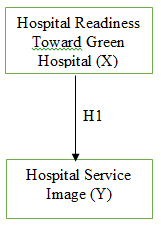
Based on the conceptual framework and previous research findings, organizational readiness, reflected in management support, resource availability, environmental management, and a culture of sustainability, is expected to enhance patients’ positive perceptions of hospital service quality and organizational reputation. Therefore, the following hypothesis is proposed:
H1: Hospital readiness toward green hospital implementation has a positive and significant effect on hospital service image from the perspective of Generation Z patients.
Research Methodology
This study uses a quantitative approach with an explanatory research design and a cross-sectional approach to analyze the effect of hospital readiness towards a green hospital on the image of services in the eyes of Generation Z patients. The study was conducted from January–April 2026 at Hospital “X”, which was chosen because it has characteristics relevant to the development of the green hospital concept. The name of the hospital in this study is disguised as Hospital “X” at the request of the hospital management to maintain the confidentiality of the institution's identity. A quantitative approach was used to measure respondents' perceptions and empirically test the relationships between variables. An explanatory research design was chosen because the study aimed to explain the causal relationship between hospital readiness towards green hospitalization and patient-perceived service image. While the cross-sectional approach allowed for data collection over a specific time period to describe the respondents' actual conditions (Rachman et al., 2024; Sijm-Eeken et al., 2024) .
The study population was Generation Z patients (born 1997–2012) who had received healthcare services at Hospital “X.” The sampling technique used purposive sampling, which is a sampling technique based on certain criteria set according to the research objectives (Rachman et al., 2024). Respondent criteria included Generation Z patients who had used services at Hospital “X” at least once and were willing to complete the research questionnaire. Determination of the sample size refers to SEM-PLS recommendations (Hair et al., 2021), which state that the sample size must be adequate to estimate the relationships between constructs in the research model. In models with low to moderate complexity, SEM-PLS requires a minimum sample size of 100 respondents for adequate parameter estimation. Therefore, the minimum sample size in this study was set at 100 respondents. During the data collection process, 160 respondents were obtained who met the research criteria and all data were used in the analysis process.
Primary data was obtained by distributing questionnaires to respondents who met the research criteria, both in person and online. Meanwhile, secondary data was obtained from scientific literature, hospital documents, and other sources relevant to the study. The research instrument used a five-point Likert scale to measure respondents' level of agreement with each statement, with a score of 1 indicating "Strongly Disagree" and a score of 5 indicating "Strongly Agree."
| Score | Answer Categories |
|---|---|
| 1 | Strongly Disagree |
| 2 | Don't agree |
| 3 | Neutral |
| 4 | Agree |
| 5 | Strongly agree |
The independent variable of the study was hospital readiness to become a green hospital, measured through the dimensions of organizational readiness, resource readiness, environmental management, and sustainability culture. The dependent variable was hospital service image, measured through perceptions of service quality, organizational reputation, patient satisfaction, and perceptions of sustainability. The research instrument was adapted from Organizational Readiness for Implementing Change (Weiner, 2009), the green hospital concept (Nurfikri et al., 2026), and Corporate Image Theory (Nguyen & Leblanc, 2001). All respondents provided informed consent, and data confidentiality was guaranteed in accordance with research ethics principles.
| Variables | Dimensions | Indicator |
|---|---|---|
| Hospital Readiness Towards Green Hospital (X) | Organizational readiness | Management commitment to green hospitals, support for sustainability policies, integration of green hospital programs in hospital development |
| Resource readiness | Availability of green hospital supporting facilities, efficient use of technology, and human resource concern for the environment | |
| Environmental management | Waste management, hospital environmental cleanliness, energy and water use efficiency | |
| Culture of sustainability | Education on environmentally friendly behavior, provision of environmental program information, application of sustainable values in services | |
| Hospital Service Image (Y) | Perception of service quality | Comfort of service, suitability of service to patient expectations, quality of hospital service |
| Organizational reputation | Hospital reputation, patient trust level, positive impression of the hospital | |
| Patient satisfaction | Satisfaction with services, service experience, intention to reuse hospital services | |
| Perception of sustainability | Hospital concern for the environment, the influence of the environmentally friendly concept on patient perception, the contribution of green hospitals to the image of hospital services |
Source: Adapted from Weiner (2009), Nguyen & Leblanc (2001), and Nurfikri et al. (2026).
Data analysis was performed using Structural Equation Modeling–Partial Least Squares (SEM-PLS) with the help of SmartPLS. Model evaluation included testing the outer model through convergent validity, discriminant validity, Cronbach's Alpha, and Composite Reliability, as well as testing the inner model using the path coefficient, R-square, and effect size values. Hypothesis testing was conducted through a bootstrapping procedure of 5,000 subsamples with a significance level of 5% (α = 0.05). The hypothesis was accepted if the p-value <0.05 and the t-statistic >1.96 (Hair et al., 2021).
Research Result
This section presents the results of data analysis obtained from 160 Generation Z respondents who have used the services of Hospital “X.” The analysis was conducted using the SEM-PLS approach through SmartPLS software, which includes evaluation of the measurement model (outer model), evaluation of the structural model (inner model), and testing of the research hypothesis.
1. Respondent Characteristics
| Characteristics | Frequency (n=160) | Percentage (%) |
|---|---|---|
| Gender | ||
| Man | 70 | 43.8 |
| Woman | 90 | 56.2 |
| Age | ||
| 14–19 years | 59 | 36.9 |
| 20–24 years | 55 | 34.4 |
| 25–29 years | 46 | 28.7 |
| Education | ||
| SeniorhighSchool | 101 | 63.1 |
| Diploma | 41 | 25.6 |
| S1 | 18 | 11.3 |
| Type of Service | ||
| Outpatient | 128 | 80.0 |
| Inpatient | 32 | 20.0 |
Source: Processed primary data (2026).
Based on Table 3, the majority of respondents were female, 90 people (56.2%), while male respondents numbered 70 people (43.8%). Based on age groups, respondents were dominated by the 14–19 age group, 59 people (36.9%), followed by the 20–24 age group, 55 people (34.4%) and the 25–29 age group, 46 people (28.7%). In terms of education, the majority of respondents had a high school education, 101 people (63.1%), followed by a diploma, 41 people (25.6%) and a bachelor's degree, 18 people (11.3%). Based on the type of service received, the majority of respondents were outpatients, 128 people (80.0%), while inpatients were 32 people (20.0%).
The respondent characteristics indicate that the majority of Generation Z patients participating in the study were female, aged between late adolescence and early adulthood, and had a secondary education. The predominance of respondents in outpatient services indicates that this group interacts more with healthcare services through routine visits than intensive care. These characteristics are considered relevant to the research objectives because they can provide insight into Generation Z's perceptions of the implementation of the green hospital concept and the image of hospital services.
2. Evaluation of the Measurement Model (Outer Model)

Source: SmartPLS processing results (2026).
Figure 2 shows the results of the research model estimation using the SEM-PLS method. All indicators in the constructs of hospital readiness towards green hospitals (X) and hospital service image (Y) have outer loading values above 0.70, thus meeting the convergent validity criteria. Furthermore, the path coefficient of 0.775 indicates a positive relationship between hospital readiness towards green hospitals and hospital service image.
The model also shows that the hospital readiness variable towards green hospital has a significant contribution to the formation of hospital service image, as reflected in the path coefficient value of 0.775 and the R² value of 0.601. These results indicate that the hospital readiness variable towards green hospital is able to explain 60.1% of the variation in hospital service image in the research model.
-
Convergent Validity
| Construct | Outer Loading Range |
|---|---|
| Green Hospital | 0.714–0.805 |
| Service Image | 0.705–0.815 |
Source: SmartPLS processing results (2026).
Based on Table 4, all indicators have outer loading values above 0.70, with a range of 0.705–0.815. These values meet the convergent validity criteria, which require a factor loading value greater than 0.70. Therefore, all indicators are considered valid and capable of representing the construct being measured (Hair et al., 2021).
-
Reliability and Construct Validity
| Construct | Cronbach's Alpha | Composite Reliability | AVE |
|---|---|---|---|
| Green Hospital Readiness (X) | 0.885 | 0.909 | 0.555 |
| Service Image (Y) | 0.932 | 0.941 | 0.572 |
Source: SmartPLS processing results (2026).
The results of the reliability and construct validity tests indicate that all variables meet the recommended criteria in SEM-PLS. The Cronbach's Alpha and Composite Reliability values for each construct were above 0.70, while the Average Variance Extracted (AVE) value was above 0.50. Thus, the research constructs were declared reliable and had adequate convergent validity (Hair et al., 2021).
-
Discriminant Validity
| Construct relationship | HTMT |
|---|---|
| Green Hospital ↔ Service Image | 0.850 |
Source: SmartPLS processing results (2026).
The Heterotrait-Monotrait Ratio (HTMT) value of 0.850 is below the maximum threshold of 0.90. These results indicate that the constructs of hospital readiness toward green hospital implementation and hospital service image demonstrate adequate discriminant validity, suggesting that the two constructs are empirically distinct (Hair et al., 2021; Henseler et al., 2015).
In addition, a full collinearity assessment was conducted using the Variance Inflation Factor (VIF). All VIF values ranged from 1.656 to 2.532, which are below the threshold of 3.3 suggested by (Kock, 2015) and well below the recommended collinearity threshold in PLS-SEM (Hair et al., 2021). Therefore, common method bias and multicollinearity were unlikely to affect the findings of this study.
-
Fit Model
| Indicator | Mark |
|---|---|
| SRMR | 0.049 |
| NFI | 0.900 |
Source: SmartPLS processing results (2026).
The Standardized Root Mean Square Residual (SRMR) value of 0.049 indicates that the model has a good level of fit because it is below the limit of 0.08. Furthermore, the Normed Fit Index (NFI) value of 0.900 indicates that the research model has met the goodness of fit criteria recommended in SEM-PLS analysis (Hair et al., 2021).
3. Structural Model Evaluation (Inner Model)
| Variables | R² |
|---|---|
| Service Image | 0.601 |
Source: SmartPLS processing results (2026).
| Connection | f² |
|---|---|
| Green Hospital → Service Image | 1,507 |
Source: SmartPLS processing results (2026).
An R-square value of 0.601 indicates that the hospital readiness variable for green hospitalization explains 60.1% of the variation in hospital service image. Meanwhile, 39.9% is influenced by other factors not included in the research model. According to (Hair et al., 2021), an R² value of 0.601 is considered moderate to strong, indicating that the model has good explanatory power for endogenous variables.
Furthermore, the effect size (f²) value of 1.507 indicates that the hospital's readiness to become a green hospital has a significant impact on the hospital's service image. This value far exceeds the 0.35 threshold, which indicates a large effect size (Hair et al., 2021).
4. Hypothesis Testing
| Connection | Path Coefficient (β) | t-statistic | p-value | CI 95% |
|---|---|---|---|---|
| X → Y | 0.775 | 25,250 | 0,000 | 0.715–0.834 |
Source: SmartPLS processing results (2026).
The results of the hypothesis testing indicate that hospital readiness towards green hospital has a positive and significant effect on the image of hospital services. The path coefficient value of 0.775 indicates a positive relationship, while the t-statistic value of 25.250 is greater than 1.96 and the p-value of 0.000 is less than 0.05. In addition, the 95% confidence interval is in the range of 0.715–0.834 and does not cross the zero value. Thus, the research hypothesis is accepted.
These findings indicate that a hospital's readiness to become a green hospital plays a significant role in shaping a positive service image in the eyes of Generation Z patients. The higher the organization's readiness to implement sustainability principles, the more positive patient perceptions of the hospital's service quality and reputation. These results indicate that environmental management, resource efficiency, and an organizational culture that supports environmentally friendly practices are contributing factors in improving the hospital's service image. Therefore, the implementation of the green hospital concept not only impacts the environmental aspect but also provides strategic added value to the hospital by improving patient perceptions and trust in the services provided.
Discussion
The results of the study indicate that a hospital's readiness to become a green hospital has a positive effect on the image of hospital services among Generation Z patients. Based on Corporate Image Theory, an organization's image is formed through public perception of the values and commitments demonstrated by the organization. In this context, the implementation of the green hospital concept can be perceived as a form of environmental responsibility and hospital professionalism. For Generation Z who are concerned about sustainability issues, this condition can strengthen the image of hospital services. Thus, the higher the hospital's readiness to become a green hospital, the more positive the image of services formed in the eyes of patients.
These findings indicate that environmental sustainability is no longer viewed as an additional activity in hospital operations, but has become part of patients' perceptions of service quality. Generation Z, who are highly concerned about environmental issues, tends to evaluate organizations that demonstrate a commitment to sustainable practices positively (Dragolea et al., 2023; Javier et al., 2024). This suggests that sustainability practices can serve as a signal of organizational quality, influencing how patients evaluate hospital services. These findings align with those of (Cerasi, 2024; Lopes et al., 2024), who explain that sustainability values and environmental responsibility increasingly influence the attitudes, preferences, and perceptions of organizations among younger generations. Therefore, the implementation of the green hospital concept can be a factor in strengthening a hospital's reputation and image.
The quality of a hospital's physical environment, oriented toward sustainability, has been shown to positively impact patient experience. (Untaru et al., 2023)demonstrated that a green and environmentally friendly hospital environment can improve patient satisfaction, emotional well-being, and engagement with healthcare facilities. These findings indicate that a comfortable, healthy, and sustainably oriented service environment can improve patient perceptions of the quality of care received. These findings are also supported by (Muzakir et al., 2024)and (Nurfikri et al., 2024), who explain that green hospital practices are associated with improved service quality, patient satisfaction, and a strengthened image of healthcare institutions. Thus, the implementation of environmentally friendly practices not only provides ecological benefits but also creates added value that can be directly felt by patients.
The results of this study also support the Organizational Readiness Theory proposed by Weiner (2009), which explains that the successful implementation of organizational change is influenced by resource readiness, organizational member commitment, and the institution's ability to adopt innovation. In the context of this study, hospital readiness to become a green hospital is reflected through management support, resource availability, environmental management, and a culture of sustainability implemented within the organization. When these various aspects of readiness can be implemented consistently, patients will more easily feel the benefits through a comfortable, clean service environment that supports better service quality. These findings indicate that organizational readiness not only plays a role in supporting the successful implementation of a green hospital but also contributes to the formation of a positive service image in the eyes of patients.
The R² value of 0.601 indicates that the hospital's readiness to become a green hospital can explain 60.1% of the variation in the image of hospital services. This finding indicates that the hospital's readiness to implement the green hospital concept is a factor that has a major contribution in shaping the image of services in the eyes of patients. However, there is still 39.9% of the variation in service image that is influenced by other factors outside the research model, such as the quality of medical services, the competence of health workers, hospital facilities, communication of health workers, and patient experiences during receiving services. In addition, the effect size (f²) value of 1.507 indicates that the hospital's readiness to become a green hospital has a very strong influence on the image of hospital services. These results confirm that increasing organizational readiness in implementing sustainable practices has the potential to have a significant impact on patient perceptions of hospitals.
Conceptually, the results of this study reinforce the view that the transformation towards a sustainable hospital not only aims to reduce environmental impact but also enhances the organization's value from the perspective of service users. The application of green hospital principles can be a strategy that supports the creation of a positive service image by improving the quality of the service environment and patient experience. These findings indicate that sustainability is no longer viewed solely as an operational dimension but has become part of the factors influencing patient perceptions of the hospital. Thus, the green hospital concept can be positioned as a strategy that supports the achievement of environmental goals while strengthening the organization's service image.
For Hospital “X”, the results of this study provide practical implications that investing in a green hospital program can be a strategy that not only supports environmental sustainability, but also improves the image of services in the eyes of Generation Z patients. With increasing public awareness of environmental issues, hospitals that are able to demonstrate a commitment to sustainable practices have the potential to gain a higher level of trust from patients. Therefore, the implementation of a green hospital can be seen as an effort that provides dual benefits, namely supporting sustainability goals while strengthening the image of hospital services.
This study was limited to Generation Z patients at a single hospital and employed a cross-sectional design. Future studies are encouraged to expand the research scope by involving multiple hospitals, different patient demographic groups, and additional variables that may influence hospital service image, in order to provide a more comprehensive understanding of green hospital implementation.
Conclusion
Based on the research results, it can be concluded that hospital readiness towards green hospitals has a positive and significant effect on the image of hospital services from the perspective of Generation Z patients. The higher the hospital's readiness in implementing green hospital principles, the more positive the image of services formed in the eyes of patients. This finding indicates that environmental sustainability aspects have become one of the factors considered by Generation Z in assessing hospital services. In addition, the R² value of 0.601 indicates that hospital readiness towards green hospitals has a significant contribution in explaining variations in hospital service image. Therefore, the implementation of green hospitals not only supports environmental sustainability goals but can also be a strategy to strengthen the image of hospital services.
References
- An, S., & Lee, P. (2023). Effects of Servicescapes on Interaction Quality , Service Quality , and Behavioral Intention in a Healthcare Setting. 1–16. DOI ↗ Google Scholar ↗
- Cerasi, C. C. (2024). administrative sciences Bridging Generations and Values : Understanding Generation Z ’ s Organizational Preferences and the Mediating Role of Sustainability and Innovation Attitudes in Turkey. DOI ↗ Google Scholar ↗
- Dolcini, M., Ferrè, F., Brambilla, A., & Capolongo, S. (2025). Integrating environmental sustainability into hospitals performance management systems : a scoping review. DOI ↗ Google Scholar ↗
- Dragolea, L., Butnaru, G. I., Kot, S., Gabriela, C., Nu, A., Nu, F., & Cristea, S. (2023). Determining factors in shaping the sustainable behavior of the generation Z consumer. January, 1–21. DOI ↗ Google Scholar ↗
- Gutama, H., & Iresha, F. M. (2023). Evaluation of solid waste management effectiveness in Indonesia from 2019-2021 : a geographic information system analysis. DOI ↗ Google Scholar ↗
- Hair, Hult, G. T. M., Ringle, C. M., Sarstedt, M., Danks, N. P., & Soumya Ray. (2021). Partial Least Squares Structural Equation Modeling ( PLS-SEM ) Using R. DOI ↗ Google Scholar ↗
- Henseler, J., Ringle, C. M., & Sarstedt, M. (2015). A new criterion for assessing discriminant validity in variance-based structural equation modeling. 115–135. DOI ↗ Google Scholar ↗
- Intarti, W. D., & Khan, M. U. (2024). The Literature and Policy Review of the Implementation of Green Hospital Concept in Indonesia. 1(2), 36–46. DOI ↗ Google Scholar ↗
- Javier, I., Michilena, J., Eugenia, M., & Molina, R. (2024). Pro ‑ environmental behaviours of generation Z : A cross ‑ cultural approach. International Review on Public and Nonprofit Marketing, 21(3), 595–623. DOI ↗ Google Scholar ↗
- Kerem, H., & Gör, H. O. Ş. (2025). A Study on Generation Z ’ s Knowledge and Awareness Levels Regarding Sustainable ( Green ) Hospitals. 7(1), 17–28. DOI ↗ Google Scholar ↗
- Kock, N. (2015). Common method bias in PLS-SEM : A full collinearity assessment approach. 1–10. DOI ↗ Google Scholar ↗
- Lopes, J. M., Gomes, S., Suchek, N., & Nogueira, S. (2024). The hidden reasons behind generation Z ’ s green choices. Discover Sustainability, December. DOI ↗ Google Scholar ↗
- Mehra, R., & Sharma, M. K. (2022). Sustainability Analytics and Modeling Measures of Sustainability in Healthcare. Sustainability Analytics and Modeling, 1(January 2021), 100001. DOI ↗ Google Scholar ↗
- Muzakir, M., Wahyuningsih, W., & Ponirin, P. (2024). International Journal of Sustainable Development and Planning Measurement Model of Sustainable Servicescape and Service Quality on Green Space and Environmental Satisfaction. 19(10), 3989–3994. DOI ↗ Google Scholar ↗
- Nguyen, N., & Leblanc, G. (2001). Corporate image and corporate reputation in customers ’ retention decisions in services. 8, 227–236. DOI ↗ Google Scholar ↗
- Nurfikri, A., Danial, D., Wu, M., Roselina, E., & Hidayat, A. (2024). Public awareness , attitudes , behavior and norms building green hospitals ’ power. Heliyon, 10(20), e39336. DOI ↗ Google Scholar ↗
- Nurfikri, A., Purwana, R., Edhi, T., Soesilo, B., & Kesa, D. D. (2026). Sustainability Assessment and Sustainable Management Scenarios as a Green Hospital Model in West Java , Indonesia : A Multi-Aspect Method. 1–24. DOI ↗ Google Scholar ↗
- Rachman, A., Yochanan, E., Samanlangi, A. I., & Purnomo, H. (2024). METODE PENELITIAN KUANTITATIF, KUALITATIF DAN R&D. DOI ↗ Google Scholar ↗
- Scott, S., Karliner, J., Boyd, A. R., Ashby, B., & Steele, K. (2019). HEALTH CARE ’ S CLIMATE FOOTPRINT HOW THE HEALTH SECTOR CONTRIBUTES. September. DOI ↗ Google Scholar ↗
- Sijm-Eeken, M., Ossebaard, H. C., Čaluković, A., Temme, B., & Peute, L. W. (2024). Linking theory and practice to advance sustainable healthcare : the development of maturity model version 1 . 0. 8. DOI ↗ Google Scholar ↗
- Untaru, E.-N., Han, H., Ba˘la˘sxescu, S., Kim, B., & Ariza-Montes, A. (2023). Green Atmospherics as Nature-Based Solutions and Patient Responses and Behaviors in Healthcare Establishments From Romania. March, 1–15. DOI ↗ Google Scholar ↗
- Weiner, B. J. (2009). A theory of organizational readiness for change. 9, 1–9. DOI ↗ Google Scholar ↗
Appendix
Outer Loading Value Table
| Indicator | Loading |
|---|---|
| X1 | 0.761 |
| X11 | 0.742 |
| X12 | 0.729 |
| X4 | 0.741 |
| X5 | 0.749 |
| X6 | 0.805 |
| X8 | 0.714 |
| X9 | 0.714 |
| Y1 | 0.705 |
| Y2 | 0.815 |
| Y3 | 0.757 |
| Y4 | 0.803 |
| Y5 | 0.756 |
| Y6 | 0.789 |
| Y7 | 0.718 |
| Y8 | 0.760 |
| Y9 | 0.737 |
| Y10 | 0.765 |
| Y11 | 0.741 |
| Y12 | 0.721 |
Source: SmartPLS processing results (2026).
VIF Table
| Indicator | VIF |
|---|---|
| X1 | 1.867 |
| X11 | 1.769 |
| X12 | 1.732 |
| X4 | 1.807 |
| X5 | 1.988 |
| X6 | 2.185 |
| X8 | 1.656 |
| X9 | 1.746 |
| Y1 | 1.773 |
| Y2 | 2.532 |
| Y3 | 2.031 |
| Y4 | 2.432 |
| Y5 | 2.095 |
| Y6 | 2.238 |
| Y7 | 1.932 |
| Y8 | 2.214 |
| Y9 | 1.995 |
| Y10 | 2.256 |
| Y11 | 2.074 |
| Y12 | 1.974 |
Source: SmartPLS processing results (2026).
Variable X => Hospital Readiness to Become a Green Hospital
Dimension 1. Organizational Readiness
| Code | Statement |
|---|---|
| X1 | Hospital "X" shows a clear commitment to implementing the green hospital concept. |
| X2 | Hospital policy supports environmentally friendly service programs. |
| X3 | Efforts towards a green hospital are part of hospital development. |
Dimension 2. Resource Readiness
| Code | Statement |
|---|---|
| X4 | The hospital has facilities that support the implementation of the green hospital concept. |
| X5 | The technology used by hospitals supports efficient use of resources. |
| X6 | Staff and healthcare workers demonstrate concern for the environment. |
Dimension 3. Environmental Management
| Code | Statement |
|---|---|
| X7 | The hospital manages waste well. |
| X8 | The hospital environment looks clean and well-maintained. |
| X9 | The hospital is making efforts to save energy and water. |
Dimension 4. Culture of Sustainability
| Code | Statement |
|---|---|
| X10 | The hospital encourages patients to behave in an environmentally friendly manner. |
| X11 | Information about environmental programs is easy to find in hospitals. |
| X12 | Sustainability values are reflected in hospital services. |
Variable Y => Hospital Service Image
Dimension 1. Perception of Service Quality
| Code | Statement |
|---|---|
| Y1 | I feel comfortable receiving services at Hospital "X". |
| Y2 | The service provided by the hospital met my expectations. |
| Y3 | The hospital provides quality services. |
Dimension 2. Organizational Reputation
| Code | Statement |
|---|---|
| Y4 | Hospital "X" has a good reputation in the community. |
| Y5 | I believe in the quality of service of Hospital "X". |
| Y6 | I have a positive impression of Hospital "X". |
Dimension 3. Patient Satisfaction
| Code | Statement |
|---|---|
| Y7 | I am satisfied with the services provided by the hospital. |
| Y8 | My experience during receiving the service was quite satisfactory. |
| Y9 | I am willing to use this hospital's services again if needed. |
Dimension 4. Perception of Sustainability
| Code | Statement |
|---|---|
| Y10 | The hospital appears to care about the environment. |
| Y11 | The implementation of the environmentally friendly concept increased my positive impression of the hospital. |
| Y12 | Green hospital efforts to improve the service image of Hospital "X". |
Questionnaire Results Table