Abstract
There is a frustrating paradox at the heart of the global climate conversation. The nations that contributed almost nothing to the atmospheric conditions now threatening the planet are the ones absorbing the sharpest consequences. Malawi is a landlocked Southern African country of roughly 22 million people and it sits squarely inside that paradox. Season after season, communities face droughts that kill harvests, floods that erase infrastructure, and a degree of climate unpredictability that makes even basic livelihood planning feel like a gamble. This article examines the persistent gap between environmental resilience policy or what climate policy promises, and community-level protection in Malawi, situating the country’s experience within the broader structural inequities of the global climate system. Drawing on national policy documents, international climate assessments, field experience in community resilience programming, and the UNITAR framework on integrating poverty, environment, and development planning, it argues that closing this gap is fundamentally a governance challenge: a question of whether the planning systems, financing mechanisms, communication infrastructure, institutions, and monitoring frameworks of a country are genuinely aligned around the outcomes it says it wants to achieve. The article reviews Malawi’s policy architecture, identifies the structural barriers to implementation, draws comparative lessons from Kenya, Bangladesh, and Nepal, and sets out actionable recommendations for policymakers, practitioners, and international partners working to translate climate commitments into lived resilience.
Keywords
climate resilience environmental governance climate adaptation Malawi adaptation finance poverty-environment integration locally-led adaptation sustainable development
1. Introduction
I first encountered the concrete meaning of climate vulnerability not in a report, but in a community meeting in Mchinji District. Farmers were discussing what to plant ahead of the coming season, and the conversation kept circling back to the same uncertainty: they did not know what the rains would do. They had heard forecasts vague, distant-sounding things that did not quite match the reality of their fields and they were making high-stakes decisions with inadequate information. That moment has stayed with me because it captures something essential about the climate challenge in Malawi: the knowledge exists somewhere, the policy exists somewhere, but neither had reliably reached the people who needed it most.
That distance between a well-worded strategy document and a farming community in Nsanje or Kasungu making decisions under pressure is what this article is fundamentally about. Climate change is no longer a future scenario. It is restructuring livelihoods and landscapes in real time, and Malawi provides one of the clearest illustrations of what this looks like for a low-income country with a large agricultural population, limited institutional buffers, and a deep structural dependence on a natural environment that is itself under pressure.
Malawi has policies and it also has international commitments and dedicated institutions. What it often lacks is the connective tissue that turns those things into protection for communities when the floods come, or practical guidance for smallholders when the rains are three weeks late. Understanding why that connective tissue is so hard to build and what would be needed to strengthen it is the purpose of this article.
Three questions organise the discussion:
-
What does Malawi’s formal policy framework for environmental resilience actually contain, and where does it fall short?
-
What structural barriers prevent that framework from delivering consistent protection at the community level?
-
What does the international evidence from comparable countries, global institutions, and integrated development frameworks suggest about how to close that gap?
A substantial body of scholarship addresses the policy-practice gap in climate adaptation and environmental governance in low-income countries. Scholars such as Berrang-Ford et al. (2021) have documented that while adaptation policy has proliferated globally, documented implementation remains limited and unevenly distributed, with the greatest gaps concentrated in Sub-Saharan Africa. Dodman and Mitlin (2013) identify a structural tendency for adaptation planning to be captured by national bureaucracies and donor frameworks, leaving community-level actors with little decision-making authority. Tompkins and Adger (2004) argue that effective local adaptation requires not just technical resources but the social capital and governance conditions that translate knowledge into collective action a finding echoed more recently by Brockhaus et al. (2014) in their analysis of why national adaptation planning so rarely produces change at the local level. In the Malawi context specifically, Pauw et al. (2016) and Chinsinga and Poulton (2014) have shown that fragmented institutional arrangements and poor vertical coordination between national and district levels are primary drivers of implementation failure. This article builds on that scholarship by integrating a practitioner’s analytical lens with the UNITAR framework for poverty-environment-climate integration a combination that illuminates the governance and communication dimensions of the policy-practice gap that purely structural analyses tend to understate.
A note on methodology and positionality is warranted. This article is a practitioner-informed policy analysis and it synthesises evidence from national policy documents, international climate assessments, peer-reviewed literature, and institutional reports, and interprets that evidence through direct field experience in Malawi. The author spent two years coordinating climate resilience and communications programmes with YASD in Mchinji District, including leading the communications strategy for the Food Forest Project in partnership with the Permaculture Paradise Institute. Prior to that, the author worked within the Mchinji District Council supporting administrative coordination, community liaison, and development data collection. Subsequently, as a United Nations Volunteer researcher with UNOPS, the author contributed to resilience policy research for the SIDS 10-Year Programme of Action. This combination of roles community programme implementer, local government practitioner, and international policy researcher shapes the analysis in ways the reader should be aware of.
2. The Global Picture: Climate Risk and the Inequality of Consequences
Understanding Malawi’s situation requires placing it in a wider frame. What the country experiences is not just a local problem. It is the local expression of a structural inequity embedded in the global climate system.
A Continent Carrying a Disproportionate Weight
Africa generates a fraction of the greenhouse gas emissions that drive global warming, yet it is consistently ranked among the regions most exposed to climate impacts (IPCC, 2022). The reasons go beyond geography. Across the continent, most livelihoods depend on rain-fed agriculture which is a sector with almost no cushion against weather variability. Poverty constrains what households can spend on protective measures. Natural systems that once buffered communities against climate variability, forests, wetlands, perennial rivers have been degraded by decades of pressure, and in many countries, the institutional capacity to measure, forecast, and respond to climate hazards has never been adequately built.
Temperatures are rising faster across Africa than the global average, and extreme events cyclones, multi-season droughts, and flash flooding in previously unaffected areas are occurring with greater frequency and severity (IPCC, 2022). When they strike countries without financial reserves or shock-absorbing infrastructure, the effects spill far beyond the immediate event: growth stalls, government borrowing increases, and development gains accumulated over years are undone in weeks (World Bank, 2025).
The Development Planning Trap
What makes this particularly difficult to address is how the problem is embedded in the structure of national development planning itself. Most low-income country development plans are built around economic growth, poverty reduction, and employment creation, objectives that are measurable, politically legible, and easy to communicate. What is far less visible in those plans, but just as consequential, is the relationship between pursuing those objectives and what happens to the natural environment in the process (UNITAR, 2023).
When a government sets targets for GDP growth and agricultural expansion, it is also setting in motion decisions about land use, water allocation, forest management, and carbon emissions. Those decisions are rarely labelled as environmental decisions. But their cumulative effect shapes whether a country’s natural resource base is strengthened or eroded and that shapes whether the next generation of poverty reduction strategies has a functioning ecosystem to work with.
There is also a self-reinforcing economic logic to climate vulnerability that policymakers in low-income countries often underestimate. Climate shocks reduce agricultural productivity, which reduces household incomes, which reduces the tax base, which constrains the government’s capacity to invest in adaptation. Less adaptation investment means greater exposure to the next shock, producing greater economic damage. Breaking this cycle requires external support at a scale that current international climate finance flows have not yet achieved (UNEP, 2023). That context is essential for understanding anything that follows about Malawi.
3. Malawi: A Country Profile
Malawi occupies the southern end of the East African Rift Valley and is a landlocked nation of plateaus, highland massifs, and the remarkable expanse of Lake Malawi, which dominates the country’s eastern edge and holds a significant share of the world’s freshwater fish diversity. With a population approaching 22 million across roughly 118,000 square kilometres, Malawi is one of the more densely settled countries in sub-Saharan Africa. Lilongwe is the capital; Blantyre anchors commerce in the south; Mzuzu serves the north. The climate follows a subtropical rhythm rains from November through April, followed by a dry season that can be harsh in the low-lying southern districts.
Economic Realities
The economic indicators tell a story of persistent structural fragility. Growth projections for 2025 sit around 2.4 percent which, adjusted for population growth, means living standards are barely moving. Inflation running near 29 percent erodes household purchasing power faster than incomes can recover. The government’s fiscal position is constrained by a deficit close to ten percent of GDP and a public debt burden serious enough to qualify as external debt distress (World Bank, 2025). More than three-quarters of Malawians live below the international three-dollar-a-day poverty line. Food insecurity is not a seasonal anomaly for many families it is the structural condition of the lean months before each harvest.
Malawi does have genuine assets and the agricultural sector has room for modernisation and value chain development, particularly in legumes and horticultural products. The lake and surrounding landscapes offer real tourism potential. The long-term Malawi 2063 development vision provides a strategic framework centred on structural transformation and resilience. The question is whether those assets can be developed faster than a destabilising climate erodes the base they depend on.
Agriculture, Climate, and a Dangerous Overlap
Farming is not simply one sector in Malawi’s economy. It is the primary livelihood for more than four out of five people. Tobacco, tea, sugar, and legumes drive export earnings, and because almost all of this farming depends on rainfall rather than irrigation, every fluctuation in the rainy season its timing, distribution, and total volume translates directly into decisions about household nutrition, school attendance, and economic survival. When I was based in Mchinji coordinating programmes with YASD and the Permaculture Paradise Institute, this was not a statistic. It was the context of every programme conversation we had.
Overlaid on this agricultural dependence is a legacy of environmental degradation. Deforestation has accelerated soil erosion across many districts. Siltation is reducing the storage capacity of rivers and reservoirs. Groundwater recharge is declining in areas where tree cover has been stripped. When forests are cleared for charcoal production because alternative livelihoods are unavailable, it is not a failure of environmental consciousness but it is a rational response to poverty in the absence of better options. When those deforested slopes then accelerate runoff, cause flooding downstream, and reduce the water table on which smallholders depend, the cost of that environmental decision is borne by people who had no part in making it (UNITAR, 2023). Development planning that fails to map these connections does not eliminate them. It simply ensures their consequences will be addressed later, at greater cost.
4. The Policy Framework: Solid Foundations, Uneven Ground
Malawi’s environmental and climate governance architecture has been built over three decades of policy work. The National Environmental Action Plan (1994) established the foundational principle that development and environment are inseparable. The current framework includes:
-
National Climate Change Management Policy (2016): Establishing cross-sectoral coordination mandates and a government-wide commitment to mainstreaming climate risk
-
National Resilience Strategy (2018–2030): This a twelve-year framework spanning food security, water, energy, and disaster risk management
-
National Adaptation Plan (NAP) Framework: This is a guiding medium and long-term sectoral adaptation planning
-
Updated Nationally Determined Contribution (2021): Malawi’s enhanced Paris Agreement commitment, submitted to the UNFCCC
-
Disaster Risk Management Act (revised 2023): Modernising legal provisions for preparedness, response, and recovery
-
Sectoral strategies: Covering water resources, agriculture, energy, gender, environment, and forestry
This is a real body of work that reflects serious institutional effort and genuine political commitment. The critical problem, however, is that strong policy does not automatically produce strong implementation particularly where policies remain isolated from the mainstream planning systems and budget processes that govern how public money is actually spent. As the UNITAR (2023) framework observes, thematic strategies that exist outside the main planning cycle have limited ability to influence the decisions that actually determine development outcomes. A National Adaptation Plan not reflected in the national budget is not really a plan. It is a statement of aspiration.
Malawi’s own planning experience illustrates how this can be addressed. Practical tools that embed poverty-environment integration into all stages of the public planning cycle structured checklists assessing the social and environmental implications of policy options have contributed to stronger integration in areas such as the national agriculture policy, which now navigates more explicitly the tension between maximising agricultural output and managing the environmental costs that poorly planned production carries (UNITAR, 2023).
Two further structural weaknesses undermine the framework’s reach. The first is the inequality of environmental justice: in rural Malawi, disputes over land and natural resources are almost always resolved through customary channels that frequently disadvantage women, young people, and those with insecure tenure, driving informal practices, charcoal production, forest encroachment, that accelerate the environmental deterioration the policies seek to reverse. The second is the weakness of participatory governance in practice: Environmental Impact Assessment consultations, observed both in Mchinji and in local government coordination work, are frequently designed to satisfy procedural requirements rather than generate genuine community input, eroding the public trust on which effective environmental governance depends (Kachiwala, 2018).
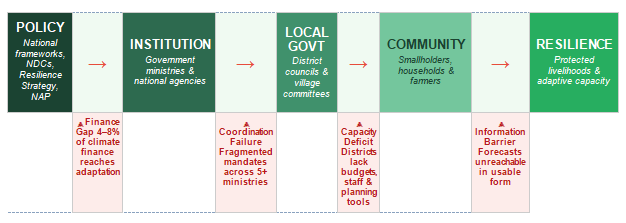
Source: Author’s analysis based on field experience in Mchinji District and Mchinji District Council (2021–2024); UNITAR (2023); UNEP (2023); IPCC (2022); World Bank (2025). Red break points represent structural barriers documented throughout this article.
5. Where the Framework Breaks Down: The Implementation Gap
The Problem Is Not Data — It Is Usability
One of the most persistent misconceptions about climate adaptation in Malawi is that the primary constraint is a lack of data. The volume of climate information available has grown considerably over the past decade. The more fundamental problem is that most of it is inaccessible to the people whose decisions it is meant to inform.
A smallholder farmer in Balaka deciding when to plant, which variety to use, and whether fertiliser makes sense this season is making a climate risk management decision. But if the only forecast available is a probabilistic seasonal outlook published in a government technical document, it might as well not exist. What works and what evidence from Malawi increasingly supports is a participatory model in which climate information is co-interpreted with communities, translated into practical guidance, and delivered through trusted local voices. Participatory Scenario Planning exercises trialled in several Malawian districts demonstrate this: when farmers work through forecast data alongside climate specialists in structured community conversations, the advisories produced are better understood, more trusted, and more consistently acted upon, with measurable effects on yield stability during difficult seasons (Tembo-Nhlema et al., 2019).
This is not merely a technical observation. Poverty and environment issues are often complex and invisible to decision-makers at every level (UNITAR, 2023). Effective communication does not simply transmit information; it connects stakeholders, builds shared understanding, and makes abstract consequences tangible enough to act on. During my time at YASD, the gap between technical climate information and farmer decision-making was something I navigated constantly. The farmers we worked with were not short of intelligence or adaptability, they were short of information in a form they could use.
Governance Too Fragmented to Function
Climate resilience in Malawi is everybody's mandate and nobody's clear responsibility. Accountability is spread across agriculture, natural resources, energy, health, local government, and disaster management departments, each operating on its own planning cycles and reporting lines. The absence of effective horizontal coordination where, for example, the Ministry of Agriculture pursues productivity targets without adequate coordination with Natural Resources on soil management, with the Ministry of Health on climate-sensitive disease risks, or with the Ministry of Finance on the budget implications of environmental degradation produces individually rational decisions that are collectively counterproductive (UNITAR, 2023).
The consequences of this fragmentation extend beyond environmental degradation and agricultural productivity. According to the World Health Organisation (2023), Climate-related disasters such as floods and cyclones frequently trigger secondary public health crises, including cholera outbreaks, displacement, disruptions to health services, and heightened vulnerability among already at-risk populations. Building climate resilience therefore requires stronger coordination across environmental, agriculture, health, water and sanitation, disaster risk management, and local government institutions. Resilience cannot be built in sectoral silos (Government of Malawi, 2023).
At district level, the constraints are more severe. Working within the Mchinji District Council, supporting coordination between the District Commissioner's Office, traditional leaders, and community representatives, I observed directly how stretched local government capacity is. District councils operate with minimal discretionary budgets, insufficient technical personnel, and limited access to data and planning tools. The gap between a national policy and its practical effect in a rural district is not simply a communication problem; it is a chronic capacity and resourcing problem. A third institutional weakness is the pace at which legal and regulatory frameworks adapt: sustainable development challenges evolve faster than most legislative systems, and where the law cannot keep pace, enforcement gaps emerge (UNITAR, 2023). (UNITAR, 2023).
Financing That Consistently Falls Short
Only an estimated four to eight percent of global climate finance currently reaches adaptation a proportion that, given the scale of adaptation needs across Africa, represents a serious misalignment between global commitments and the reality of where climate harm is occurring (UNEP, 2023). Adaptation in Malawi relies on a combination of external donor support and limited domestic allocation, and neither comes close to what is needed. International climate finance carries complex eligibility requirements, slow disbursement cycles, and procedural demands that smaller implementing organisations struggle to navigate. The result is that communities remain exposed to hazards that are manageable with modest investment, but go unaddressed because the money does not reach them in time or in usable form.
Technical Systems That Are Ageing
Malawi’s meteorological and climate monitoring infrastructure is uneven in coverage and increasingly outdated. The human capacity to operate, maintain, and interpret these systems has been constrained by years of under-investment in technical training and retention. A country that cannot reliably measure its own climate cannot plan effectively for it. Without reliable baseline data, it is also difficult to build the evidence base needed to demonstrate to international climate finance institutions that domestic commitment is real and that additional resources would be used effectively (UNITAR, 2023).
Knowledge That Does Not Travel
Perhaps the most quietly damaging form of the implementation gap is informational. Early warning systems exist but are not universally accessible. Climate-smart practices are documented in research but do not consistently reach extension workers or the farmers they serve. Working on climate communications at YASD, and later as a United Nations Volunteer researcher contributing to the SIDS 10-Year Programme of Action, I encountered this pattern repeatedly: the analysis is often good. What is missing is the institutional infrastructure to move it from expert to practitioner to community. Monitoring and evaluation systems that track activity outputs meetings held, trees planted, communities trained, without connecting those outputs to changes in environmental condition, household income, or community resilience are measuring the wrong things (UNITAR, 2023).
6. Between Commitment and Delivery: An Honest Assessment
Malawi’s engagement with climate resilience is not superficial. The policy development has been serious, the international engagement has been active, and there are genuine pockets of effective practice across the country. But the system as a whole has not yet produced the consistent, community-level protection that the challenge demands.
When poverty and environment objectives are not embedded in mainstream planning cycles, budget processes, and institutional mandates, they tend to remain at the margins of decision-making regardless of how well the standalone strategies are designed (UNITAR, 2023). This is precisely the pattern observed in Malawi strong policy documents that are not consistently reflected in budget allocations, institutional incentives, or the day-to-day decisions of line ministries. Three factors are particularly decisive: first, financing is chronically underfunded and reliant on slow, procedurally demanding external sources; second, technical capacity for evidence-based adaptation planning is under-resourced and deteriorating; third, and most fundamentally, climate resilience is treated as a sectoral concern rather than embedded in the economic planning, budget allocation, and institutional incentive structures that actually govern how resources flow and decisions are made.
7. What Other Countries Have Built: Lessons Worth Borrowing
Malawi’s constraints are real, but they are not unique. Countries facing comparable challenges have found workable approaches, and their experience offers practical lessons.
Kenya: Restoration as a Community Economic Strategy
Across several regions of Kenya, agroforestry has emerged as one of the most practically effective and financially accessible forms of climate resilience. Farmers integrate trees into existing smallholding systems, planting along boundaries, on hillsides, and beside water sources. The environmental returns accumulate over time improved soil structure, better water infiltration, reduced runoff intensity during heavy rainfall. Research confirms that integrating trees into smallholder systems consistently strengthens food security and reduces climate exposure in rain-dependent farming contexts (Mbow et al., 2014). Crucially, restoration has been developed as an economic intervention as much as an ecological one: tree nurseries, seedling production networks, and restoration cooperatives have created local income streams directly tied to environmental recovery. Initiatives like TerraFund for AFR100 provide financial scaffolding while leaving the ownership structure genuinely local (World Resources Institute, 2023).
Bangladesh: Engineering Resilience Into the Fabric of Communities
Bangladesh faces some of the most severe climate exposure of any country in the world: a low-lying coastal geography, intensifying cyclones, chronic flooding, and the compounding pressure of sea-level rise. Its response has been to build resilience into the physical and social infrastructure of communities simultaneously. Elevated housing designs developed through BRAC-government partnerships now protect thousands of coastal households from storm surges and floodwaters (BRAC, 2022). These structures are practical: built with locally available materials, they integrate rainwater collection, solar provision, and livestock space, and can serve as community shelters during emergencies. The Cyclone Preparedness Programme is one of the most established community-based early warning networks in the developing world and it ensures that built assets are backed by human networks capable of mobilising communities before a storm arrives (Paul, 2009). The combination has demonstrably reduced cyclone mortality over several decades (Haque et al., 2012).
Nepal: Meeting Farmers Where They Are
Nepal’s agricultural communities have confronted the same climate stress that Malawian farmers face: monsoon unpredictability, soil degradation, and the erosion of seasonal certainties that traditional farming knowledge was built around. The response channelled through farmer cooperatives, NGO partnerships, and government extension systems is a knowledge-first approach: farmer-to-farmer exchange, locally validated crop diversification, soil conservation, and small-scale water management including drip irrigation and rainwater harvesting. Drought-tolerant and early-maturing varieties have been introduced where they make agronomic sense. Evaluations show measurable improvements in yield stability and household income during seasons of high rainfall variability (Khatri-Chhetri et al., 2017; Regmi & Adhikari, 2020).
The common thread across all three cases is the design principle: resilience measures built around the realities, knowledge, and decision-making authority of local communities work better than those designed for communities from a distance. That principle is as applicable in Malawi as it is in Kenya, Bangladesh, or Nepal.
| Country | Climate Challenge | Approach | Key Mechanism & Evidence | Transfer | Relevance to Malawi |
|---|---|---|---|---|---|
| Kenya | Soil degradation, erratic rainfall, deforestation pressure on smallholder farms | Community-led agroforestry integrated into existing smallholding systems | TerraFund/AFR100; local tree nurseries & restoration cooperatives as income enterprises (Mbow et al., 2014; WRI, 2023) | HIGH | Directly applicable as Malawi faces identical soil erosion and deforestation dynamics in Mchinji and surrounding districts |
| Bangladesh | Intensifying cyclones, chronic flooding, sea-level rise, low-lying coastal geography | Climate-resilient elevated housing paired with community early warning volunteer networks | BRAC-government housing; Cyclone Preparedness Programme (Paul, 2009; BRAC, 2022; Haque et al., 2012) | MEDIUM | Housing design & CPP model transferable to flood-prone southern districts like Nsanje and Chikwawa |
| Nepal | Monsoon unpredictability, soil degradation, erosion of traditional farming knowledge | Knowledge-first climate-smart agriculture through farmer cooperatives & NGO networks | NACCFL cooperatives; farmer-to-farmer exchange; drought-tolerant varieties; drip irrigation (Khatri-Chhetri et al., 2017; Regmi & Adhikari, 2020) | HIGH | Malawi’s rain-fed farming context is closely analogous; YASD Food Forest Project already demonstrates this model’s viability |
Sources: Mbow et al. (2014); World Resources Institute (2023); BRAC (2022); Paul (2009); Haque et al. (2012); Khatri-Chhetri et al. (2017); Regmi & Adhikari (2020). Transferability assessments based on author’s field experience in Mchinji District, Malawi.
8. What the International Community Is Saying
The institutions shaping the global climate agenda have been increasingly direct in their assessments of what is required. What is notable is not the divergence between their positions, but the consistency and the persistent gap between what they call for and what the system actually delivers.
UNEP — Inger Andersen
“The adaptation financing gap is widening, and efforts to build resilience are not keeping pace.”
UNEP has documented that the difference between what developing countries need for adaptation and what they receive has been growing, not shrinking. The magnitude of that gap estimated at five to ten times current flows for the most exposed countries puts the scale of the problem in sharp relief (UNEP, 2023).
UNFCCC — Simon Stiell
“Adaptation must be given the money and attention it deserves.”
The UNFCCC Executive Secretary has been consistent in pressing this point: mitigation has dominated the international climate agenda for decades, while adaptation the work that actually protects people from impacts already locked in has been consistently underfunded and deprioritised. For countries like Malawi that are past the point of preventing significant climate impacts, this ordering of priorities is a direct threat to development continuity (UNFCCC, 2023).
UNDP — Achim Steiner and Fenella Frost
“Climate change has become the defining development challenge of our time.”
UNDP’s work in Malawi, including support for early warning infrastructure and catchment management reflects an understanding that climate resilience is not a specialised environmental programme but the condition that makes other development investments sustainable. UNDP Resident Representative Fenella Frost has articulated that supporting Malawi’s climate transition is a central institutional priority, not a peripheral concern (UNDP, 2023).
World Bank — Ajay Banga
“Climate change is a crisis multiplier that is pushing millions back into poverty.”
The Bank’s framing of climate as a development crisis positions adaptation investment not as humanitarian response but as economic necessity. For Malawi, Country Manager Firas Raad has made clear that resilience investment and long-term economic stability are not separate agendas but the same agenda (World Bank, 2025).
Green Climate Fund — Mafalda Duarte
“We must overhaul how we scale up adaptation finance and ensure vulnerable countries are at the centre.”
The GCF is the principal external source of adaptation finance for Malawi. The call to fundamentally restructure how that finance is mobilised and accessed speaks directly to the procedural complexity that currently slows or prevents disbursement to countries that need it most.
Adaptation Fund — Lucas di Pietro
“Locally-led adaptation must be backed by faster, more predictable financing.”
The Adaptation Fund’s advocacy for direct, faster disbursement to communities addresses a real operational problem: village development committees and district councils cannot plan resilience investments around financing that may not arrive, and that when it does, arrives late.
9. COP30 in Belém: Progress Made, Distance Remaining
The COP30 summit in Belém represented a genuine shift in how the international climate process positions vulnerable countries, not simply as recipients of decisions made elsewhere, but as active contributors to the frameworks governing the global response. For countries like Malawi, that shift matters.
Contributing as co-lead in the Capacity-Building thematic area reflected recognition that the countries with the most constrained implementation environments have the most practical insight into what building capacity actually requires. In Malawi’s case, the limiting factor in climate policy delivery has rarely been a shortage of strategy. It has been the shortage of people trained to carry it out, institutions resourced to sustain it, and systems functioning reliably enough to make implementation consistent.
The review of the Global Goal on Adaptation (GGA) at COP30 strengthened its framework around measurable, community-grounded indicators moving the conversation in a more useful direction than broad aspirational commitments that have not driven financing flows in practice. The consolidation of the Loss and Damage Fund’s operational framework was perhaps the most tangible outcome for countries in Malawi’s position. The economic losses from Cyclone Freddy alone were significant enough to materially worsen an already fragile public finance situation. A functional, simplified-access Loss and Damage mechanism provides a pathway to address climate-induced harm that did not previously exist in any reliable form.
Simon Stiell’s characterisation of the summit as marking the end of the era of voluntary progress captured a shift in political register that was broadly felt. The practical question is whether that shift drives changed behaviour by institutions and governments with the resources to make a difference. The gap between declaration and delivery is not closed at a conference. It is closed in district councils, in farmers’ fields, and in the decisions of finance ministries about where to allocate scarce resources.
10. Key Lessons: What the Evidence Tells Us
The evidence reviewed across this article points toward several conclusions that hold consistently across Malawi and comparable low-income countries.
-
Policy frameworks are necessary but not self-implementing. A country can build a sophisticated architecture of climate strategies without those strategies reliably reaching the communities they are meant to protect. The journey from a well-designed policy to a resilient household is made not by documents but by institutions, resources, relationships, and trust. Policies not integrated into mainstream planning cycles and budget processes tend to remain at the margins of decision-making, regardless of their technical quality (UNITAR, 2023).
-
Usable information is the foundation of practical adaptation. Climate data that does not reach decision-makers in a form they can act on is not useful data. Participatory approaches that co-produce seasonal guidance with communities are not supplementary to climate services, they are the product. Organisations with existing trust in agricultural communities are natural delivery channels for this kind of information if properly resourced and oriented toward it (Tembo-Nhlema et al., 2019).
-
Community ownership is not just a value — it is a delivery mechanism. Resilience initiatives designed with communities, rather than for them, achieve stronger and more durable results. This is a practical observation about what drives sustained behaviour change and local investment, not only an ethical principle. Resolving the underlying tensions over land, water, and natural resource access that undermine community cohesion is a prerequisite for resilience, not a separate concern.
-
The financing system is not working at the required scale. Less than one in ten dollars of global climate finance currently reaches adaptation. Countries like Malawi cannot close the implementation gap on domestic resources alone, and the international system has not yet delivered the reformed, simplified, faster-disbursing finance architecture that its own leading institutions have called for (UNEP, 2023).
-
Resilience is a cross-cutting condition, not a sectoral programme. When climate risk management is treated as the responsibility of an environment ministry, it remains peripheral to the decisions that actually shape exposure: infrastructure investment, agricultural policy, urban planning, fiscal strategy. Embedding climate risk into economic planning processes as a permanent feature of national governance is what shifts a country from reactive to resilient (UNITAR, 2023).
For countries such as Malawi, the challenge is often not the absence of policies but the gap between policy formulation and effective implementation. While the country has developed numerous policies on environmental management, climate change adaptation, agriculture, and other development sectors, implementation continues to be hindered by governance challenges, corruption, limited institutional capacity, and a growing public debt burden. These constraints often undermine the ability of government institutions and development partners to translate policy objectives into meaningful outcomes for communities.
The lessons from Malawi's experience highlight the critical importance of effective leadership in environmental and agricultural initiatives. Communities across the country are generally eager to adopt new knowledge and practices that can improve agricultural productivity, strengthen environmental resilience, improve health and livelihoods, and reduce poverty. However, low literacy levels, inadequate financing, and limited access to technical support frequently constrain these efforts. Consequently, environmental leadership must be adaptive, inclusive, and capable of responding to complex local challenges. Strengthening leadership capacity at all levels of government and community structures is essential to ensuring that development projects are sustainable, resilient, and capable of delivering long-term benefits to vulnerable populations.
During my time with YASD, I led communications for the Food Forest Project in partnership with the Permaculture Paradise Institute in Mchinji District which is a climate-smart agriculture programme integrating agroforestry, soil regeneration, and diversified cropping into a landscape where monoculture and soil erosion had created genuine vulnerability. Community meetings translated technical ideas into practical local language; storytelling connected individual farmer experiences to broader food security narratives; digital outreach extended the conversation beyond Mchinji to wider audiences. By programme end, over 80 percent of participating farmers reported improved yields and household income. More than 500 trees were planted through joint community exercises with local leaders, youth groups, and media partners. But the more durable output was a shared language around what climate resilience meant locally, and who was responsible for it.
The gap between policy and practice is not primarily technical. In my experience, it is relational. It is about whether the people designing interventions trust the people they are designing them for enough to hand over real decision-making authority. When that trust is present, things work. When it is absent, even well-resourced programmes produce disappointing results.
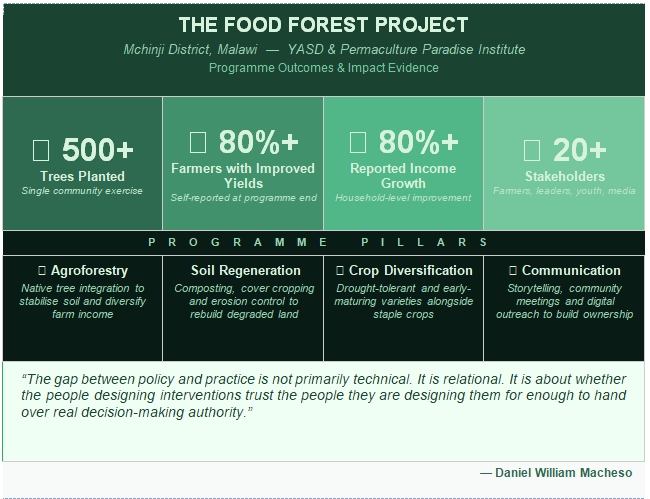
Source: Author’s primary programme data, Youth Alliance for Sustainable Development (YASD) & Permaculture Paradise Institute (PPI), Mchinji District, Malawi (2023–2024). Yield and income data self-reported by participating farmers at programme close.
11. Recommendations
The following recommendations are grounded in the evidence reviewed throughout this article, direct programme experience, and the UNITAR framework for integrating poverty, environment, and development planning. They are intended to be actionable rather than aspirational.
1. Integrate Climate and Environment Into Mainstream Planning
Standalone climate strategies that sit outside the main national planning cycle have limited ability to influence the decisions that actually determine outcomes. Malawi should embed poverty-environment integration tools, practical checklists, appraisal criteria, and impact assessment requirements which directly into the public planning cycle, ensuring every sectoral plan is evaluated for its climate and environmental implications before resources are committed (UNITAR, 2023). Spatial and land use planning frameworks should be strengthened to protect poor communities’ resource rights and guide development toward environmentally sustainable locations.
2. Tag and Track Climate Budget Allocations
Rwanda’s model in which all sectors and districts include an environmental and climate budget statement alongside annual plans, and environmental compliance is used as a criterion for public investment approval offers a directly applicable template for Malawi (UNITAR, 2023). Climate budget tagging would make resource flows visible, identify gaps between allocation and expenditure, improve accountability, and generate the domestic commitment evidence needed to access additional international financing.
3. Invest in Climate Information That Reaches Farmers
The more urgent investment, beyond expanding weather station coverage, is in the last mile of delivery: training extension workers and community facilitators to translate seasonal forecasts into practical, localised guidance on planting decisions, water management, and pest control. The African Development Bank’s ADRiFi programme offers a financing framework for exactly this kind of investment.
4. Simplify and Expand Access to Adaptation Finance
The near-term priority is reducing the transaction costs of accessing available finance: building robust project pipelines, strengthening the accreditation capacity of national implementing entities, and advocating at the Green Climate Fund and Adaptation Fund for procedural simplification. Increasing the domestic allocation of public resources toward adaptation, even modestly, with transparent tracking builds the domestic commitment case that international finance institutions evaluate when considering access requests.
5. Strengthen District-Level Delivery Capacity
The LIFE-AR programme’s model is a combining training, operational adaptation grants, and accountability frameworks for district councils and village development structures, should be embedded as a recurrent feature of decentralised climate governance, not a time-limited project. Parliamentary committees with a dedicated mandate on poverty-environment linkages would strengthen accountability from the top of the system downward (UNITAR, 2023).
6. Build Coordination That Functions in Practice
Making cross-ministerial coordination function requires something more operational than a committee mandate: a dedicated climate delivery unit with cross-ministerial authority, sufficient staffing, and clear performance accountability. Aligning donor-funded climate projects with national planning cycles would reduce fragmentation and duplication. Local institutions beyond government cooperatives, women’s associations, savings and loan groups should be formally recognised as part of the resilience governance ecosystem (UNITAR, 2023).
7. Strengthen Monitoring, Evaluation, and Learning
Effective M&E starts with the right question: what are we actually trying to measure? Systems that track activity outputs without connecting them to changes in environmental condition, household income, or community resilience are measuring the wrong things. M&E frameworks should be designed from the outset with clear theories of change, baseline measurements, and indicators spanning both poverty and environmental dimensions simultaneously.
8. Put Communities in the Role of Decision-Makers
Consultation is not the same as ownership. Village-level resilience committees with genuine resource authority, local adaptation planning tools that integrate traditional ecological knowledge with technical data, and transparent community-level M&E are the building blocks of a genuinely locally-led approach.
12. Conclusion
Malawi has done the policy work and that is worth acknowledging: it represents years of institutional effort, genuine political commitment, and engagement with international frameworks that many countries of comparable size and resource constraints have not developed. But a country cannot shelter behind a National Resilience Strategy when the rains fail, and communities cannot recover from a cyclone on the strength of a well-drafted Nationally Determined Contribution.
The argument of this article is not that the policies are wrong. It is that they are not yet reaching the people they were written for, and that the reasons for that are structural, well-documented, and importantly addressable. The planning integration challenge can be met with practical tools. The financing gap can be narrowed through budget coding, domestic commitment, and reformed access procedures. The coordination failures can be corrected through dedicated delivery structures. The information can be made more usable through investment in last-mile delivery. The communities that have been consulted rather than empowered can be given genuine decision-making authority.
What I have learned from working across different dimensions of this challenge is at the community level in Mchinji, within local government structures at the District Council, through international research on climate policy for small island developing states, and in communications work aimed at making this subject legible to public audiences is that the distance between policy and practice is rarely about intent. It is almost always about whether the systems, resources, and relationships are in place to carry the intent forward. Building those systems is the work. Everything else is preparation.
Developing countries facing climate change are not merely victims of a problem they did not create. They are, increasingly, the source of some of the most grounded and practical thinking about what resilience actually requires. The task for governments, donors, and international institutions is to catch up with that knowledge, fund it properly, and trust the communities closest to the problem to lead.
A Note on Citations
This article draws on a range of published sources and is written in accordance with the author’s own original analysis and field experience. Where ideas are attributed to UNITAR, this refers to the conceptual framework for poverty-environment-climate integration from the programme on Sustainable Development: Climate Change, Poverty and Environment, delivered by UNITAR through UNFCCC-Learn (cited as UNITAR, 2023). The correct citation format for this source is: UNITAR. (2023). Sustainable development: Climate change, poverty and environment [Online course]. UNFCCC-Learn. https://www.unitar.org. The author completed this programme and has applied its framework to the Malawi context independently. No direct quotations from course materials are reproduced; all references represent the author’s own interpretation and synthesis.
References
- African Development Bank. (2023). African disaster risk financing initiative (ADRiFi): Building climate resilience in Africa. AfDB. DOI ↗ Google Scholar ↗
- Berrang-Ford, L., Biesbroek, R., Ford, J. D., Lesnikowski, A., Tanabe, A., Wang, F. M., ... & Heymann, S. J. (2021). Tracking global climate change adaptation among governments. Nature Climate Change, 11(4), 308–317. DOI ↗ Google Scholar ↗
- BRAC. (2022). Climate resilient housing for vulnerable communities in Bangladesh. Dhaka: BRAC. DOI ↗ Google Scholar ↗
- Biermann, F., Pattberg, P., van Asselt, H., & Zelli, F. (2010). The fragmentation of global governance architectures: A framework for analysis. Global Environmental Politics, 10(4), 14–40. DOI ↗ Google Scholar ↗
- Brockhaus, M., Di Gregorio, M., & Carmenta, R. (2014). REDD+ policy networks: Exploring actors and power inside an emerging policy domain. Ecology and Society, 19(1), 29. DOI ↗ Google Scholar ↗
- Chinsinga, B., & Poulton, C. (2014). Beyond technocratic managerialism: Political incentives, decentralisation and local government performance in Malawi. Journal of Development Studies, 50(9), 1230–1246. DOI ↗ Google Scholar ↗
- Conway, D., & Vincent, K. (2021). Climate risk in Africa: Adaptation and resilience. Washington, DC: World Bank. DOI ↗ Google Scholar ↗
- Dodman, D., & Mitlin, D. (2013). Challenges for community-based adaptation: Discovering the potential for transformation. Journal of International Development, 25(5), 640–659. DOI ↗ Google Scholar ↗
- Haque, U., Hashizume, M., Kolivras, K. N., Overgaard, H. J., Das, B., & Yamamoto, T. (2012). Reduced death rates from cyclones in Bangladesh: What more needs to be done? Bulletin of the World Health Organization, 90(2), 150–156. DOI ↗ Google Scholar ↗
- Intergovernmental Panel on Climate Change. (2022). Sixth Assessment Report: Impacts, adaptation, and vulnerability: Working Group II contribution. Cambridge University Press. DOI ↗ Google Scholar ↗
- International Fund for Agricultural Development. (2024). Scaling adaptation finance in low-income countries. Rome: IFAD. DOI ↗ Google Scholar ↗
- Folke, C., Carpenter, S. R., Walker, B., Scheffer, M., Chapin, T., & Rockström, J. (2010). Resilience thinking: Integrating resilience, adaptability and transformability. Ecology and Society, 15(4), 20. DOI ↗ Google Scholar ↗
- Kachiwala, A. (2018). Environmental governance and public participation in Malawi [Thesis]. Lilongwe. DOI ↗ Google Scholar ↗
- Khatri-Chhetri, A., Aggarwal, P. K., Joshi, P. K., & Vyas, S. (2017). Farmers’ prioritization of climate-smart agriculture (CSA) technologies. Agricultural Systems, 151, 184–191. DOI ↗ Google Scholar ↗
- Mbow, C., Van Noordwijk, M., Luedeling, E., Neufeldt, H., Minang, P. A., & Kowero, G. (2014). Agroforestry solutions to address food security and climate change challenges in Africa. Current Opinion in Environmental Sustainability, 6, 61–67. DOI ↗ Google Scholar ↗
- Oza, S., et al. (2025). Climate resilience and public health outcomes in low-income countries. BMC Global and Public Health, 3(1), 45–59. DOI ↗ Google Scholar ↗
- Paul, S. K. (2009). Vulnerability concepts and its application in various fields: A review on geographical perspective. Journal of Life and Earth Science, 4, 63–68. DOI ↗ Google Scholar ↗
- Pauw, W. P., et al. (2016). NDC explorer. German Development Institute (DIE). DOI ↗ Google Scholar ↗
- Poverty-Environment Initiative. (2017). Integrating poverty and environment into planning and budgeting: A guidance note. New York: UNDP/UN Environment. DOI ↗ Google Scholar ↗
- Regmi, B. R., & Adhikari, A. (2020). Community-based adaptation to climate change in Nepal: Experiences from the field. Kathmandu: LI-BIRD/HELVETAS Swiss Intercooperation. DOI ↗ Google Scholar ↗
- Tembo-Nhlema, D., Tall, A., Kamoto, J., & Mkwambisi, D. (2019). Participatory scenario planning and climate services in Malawi. Climate Services, 15, 100–112. DOI ↗ Google Scholar ↗
- Tompkins, E. L., & Adger, W. N. (2004). Does adaptive management of natural resources enhance resilience to climate change? Ecology and Society, 9(2), 10. DOI ↗ Google Scholar ↗
- United Nations Development Programme. (2023). Climate resilience and sustainable development in Malawi. Lilongwe: UNDP. DOI ↗ Google Scholar ↗
- United Nations Environment Programme. (2023). Adaptation gap report 2023: Underfinanced, underprepared. Nairobi: UNEP. DOI ↗ Google Scholar ↗
- United Nations Framework Convention on Climate Change. (2023). National adaptation plans and climate finance flows in Africa. Bonn: UNFCCC Secretariat. DOI ↗ Google Scholar ↗
- UNITAR. (2023). Sustainable development: Climate change, poverty and environment [Online course]. UNFCCC-Learn. DOI ↗ Google Scholar ↗
- World Bank. (2025). Global economic prospects: January 2025. Washington, DC: World Bank Group. DOI ↗ Google Scholar ↗
- World Resources Institute. (2023). TerraFund for AFR100: Landscape restoration in Africa. Washington, DC: WRI. DOI ↗ Google Scholar ↗
- World Health Organization. (2023). Climate Change and Health. Geneva: WHO. DOI ↗ Google Scholar ↗