Abstract
This study focuses on evaluating the impact covering intellectual resources and the implementation of good corporate governance, and sustainability performance influencing corporate worth. Firm value is an important parameter that signifies market perceptions of the enterprise’s operational outcomes and prospects. In the modern business era, non-financial factors such as knowledge capital, adherence to governance principles, and corporate sustainability have an important role in creating competitive advantage and increasing firm value. This study adopts a quantitative research framework, employing multiple linear regression analysis complemented by sensitivity analysis to ensure robustness of results. The research draws upon information presented in the annual and sustainability reports of publicly listed companies on the Indonesia Stock Exchange. The research model includes intellectual capital, good corporate governance, and sustainability performance as independent variables, while firm value serves as the dependent variable. Profitability, proxied by Return on Assets, serves as a control variable to adjust for its prospective influence on firm worth. The results showed that: (1) Intellectual capital contributes positively and meaningfully to enhancing corporate value; (2) good corporate governance has a positive but insignificant effect on firm value; and (3) sustainability performance has a positive and significant effect on firm value. This evidence corroborates signal theory which states that non-financial information that is effectively managed and conveyed can be a reinforcing signal that enhances investor confidence and market perception as well as as articulated by agency theory, which holds that good corporate governance, in this in this instance, the independent board fulfills its supervisory role over management to protect the interests of shareholders, but it is not the number of commissioners that is important but the effectiveness in carrying out the supervisory function.
Keywords
Intellectual Capital Good Corporate Governance Sustainability Performance Firm Value
Introduction
Firm value shows how high the market provides an assessment of a company, which is not only based on its current financial condition, but also includes its growth potential, profitability, and business sustainability in the future . When making investment decisions, information related to stock prices plays an important role . Factors that influence company value are financial factors and non-financial factors . When companies seek to grow their tangible assets, they must pay equal attention to the productivity, efficiency, and growth of their intangible assets Previous studies have shown that firm value is an important factor in financial literature because it reflects the financial condition of a company, its sustainability, and the welfare of its shareholders, making it an important consideration for investors .
In its development, the factors that influence firm value are not limited to financial aspects, such as profitability, capital structure, and dividend policy, cash flow, and other financial factors that can reflect the financial health and efficiency of the company and its ability to generate profits . However, it can also be influenced by non-financial factors, including elements that are not directly visible in financial statements, such as intellectual capital, governance, and sustainability performance, each of which can create value for the company in both the short and long term .
Intellectual capital is a resource for companies in creating corporate value because it includes important made up of human, structural, and relational capital, which together can increase corporate value in the long term . Companies that have intellectual capital are considered to be able to help stakeholders (shareholders, investors) understand the company's condition because it can improve financial performance and competitiveness as well as enable better decision-making . As explored by suggests that non-financial industries around the world utilize intellectual capital and technology to the maximum extent possible to maximize shareholder wealth. Therefore, effective and efficient intellectual capital management is essential for operating competitively . In line with this, applying good corporate governance produces an important role in enhancing company transparency, maintaining investor confidence, and protecting shareholder interests. Overall, this has the potential to increase the attractiveness of the company in the eyes of the market . In contrast, firms that prioritize sustainability performance generally exhibit greater adaptability to evolving regulatory requirements and shifting consumer expectations. Additionally, by mitigating long-term business risks associated with environmental and social challenges, these firms are able to generate sustainable value and strengthen their reputation among stakeholders . These three factors are relevant given the global trend that requires companies to not only pursue profits, as well as integrating social and environmental dimensions into their strategies .
Previously, carried out an empirical study comparing the impact of intellectual capital on company value in Pakistan and India, showing that the financial performance of companies with strong intellectual capital will be boosted due to their ability to manage assets more effectively and efficiently. In a study comparing developed and developing countries (the United States, Egypt, Argentina, Australia, and Brazil) with different legal systems, it was found related to how good corporate governance contributes to firm value can be seen from two main aspects, namely the reduction of agency conflicts and increased transparency, which boosts investor confidence by strengthening fiduciary responsibility and board oversight, which in turn can increase a company's market value. Research in China shows that corporate sustainability performance improves stock market performance by reducing information risk and operational risk. Companies with good sustainability performance can provide more transparent information to investors, increase their confidence, and encourage greater investment. In addition, companies with strong performance tend to have lower capital costs and a better reputation among investors Given the significance and important role of these three factors and the limited research that integrates these three variables (intellectual capital, good corporate governance, and sustainability performance) as factors that influence company value, especially in Indonesia, this research is important to conduct.
Literature Review
Intellectual capital is information and knowledge applied by the company in creating value . Intellectual capital can be a factor that supports the improvement of the company's competitiveness if managed effectively. Firms that possess a high degree of intellectual capital generally demonstrate greater competitiveness, thereby contributing substantially to the enhancement of overall business performance. Based on signal theory, high intellectual capital disclosure can signal that the company has the ability to innovate, operational efficiency, and strong competitiveness . Previous findings presented by , , and concluded that intellectual capital exerts a positive and significant influence on firm value. In light of this explanation, the following hypothesis is formulated:
H1 : Intellectual capital positively and significantly contributes to firm value.
The term Independent Board of Commissioners denotes the number or proportion of board members who are independent within a company’s oversight board. Their primary acts to reinforce the principles of good corporate governance by carrying out effective oversight and offering recommendations to the board of directors in cases of managerial misconduct or irregularities. A higher proportion of independent commissioners enables the board of commissioners to perform its supervisory and coordination roles more effectively. Consequently, an increased presence of independent commissioners strengthens the monitoring of management’s actions and performance, ensuring that broader stakeholder interests—not solely those of the majority shareholders—are represented. This ultimately contributes positively to the enhancement of firm value ; ; and . In signal theory, it is explained that the presence of independent commissioners may act as a positive signal to investors and other stakeholders about the company’s governance quality and internal control effectiveness. A higher proportion of independent commissioners indicates the enterprise’s resolve to maintaining transparency, accountability, and integrity in its management practices. This, in turn, can enhance investor confidence and positively influence firm value. Drawing upon this reasoning, the subsequent hypothesis is formulated:
H2 : Good Corporate Governance ositively and significantly contributes to the enhancement of firm value.
Corporate sustainability performance reflects the extent to which an organization integrates environmental integrity, social welfare considerations, and robust governance practices into its strategic operations, thereby creating sustainable value for its shareholders ; . Sustainability performance is seen as a combination of social, economic, and environmental objectives in corporate activities that can contribute to increasing the value of the company . Sustainability performance can also increase company value by strengthening the company's relationship with stakeholders . Research by and shows that sustainability performance can yield a significant and beneficial impact on firm value, there are also empirical evidence that indicate a significant negative effect. However, this does not mean that companies need to ignore the principle of sustainability, considering that the implementation of governance, environmental, social and other aspects remains relevant in supporting long-term business value and sustainability. Based on the explanation above, the hypothesis is proposed:
H3 : Sustainability performance has a positive and significant effect on firm value.
Methodology
Quantitative strategies are used to examine non-financial factors on firm value. The quantitative approach involves the dominance of data, starting from the process of collecting, processing, to presenting research results. The collected data employed as part of this investigation consist of quantitative archival data extracted from companies’ statutory financial documents, sustainability reports, and annual reports. These data sources were sourced from the Indonesia Stock Exchange’s official portal, ensuring the credibility and validity of the information used in the analysis. This study applies a quantitative methodological design, aiming to empirically examine the relationships between intangible assets, effective governance structures, and sustainability performance on firm value. Furthermore, the methodological procedures applied in this research, including the operational definitions of variables, data acquisition procedures, along with analytical techniques—is described in detail in the following sections to provide transparency and replicability of the study.
The observed population targeted in the context of this research consists of all non-financial sector entities included in the main listing of the IDX during the 2024 period, totaling 214 companies. The focus on non-financial companies aims to avoid structural differences in financial reporting standards and business models that typically exist between financial and non-financial sectors, which could otherwise introduce bias into the analysis.
To derive the research sample from this population, the research employed a purposive sampling strategy, a type of non-probability sampling, to ensure that only companies meeting specific, theoretically and empirically justified criteria were included in the study. Such criteria are intended to enhance the reliability and validity of the results by ensuring the selected sample possesses adequate and comparable data for all variables examined. The sampling criteria applied within the scope of this study are described below:
-
Companies that remained continuously registered as issuers on the IDX throughout the 2024 fiscal year, to ensure consistency and comparability of data.
-
Companies that published audited financial statements, as audited reports enhance the credibility and reliability of the financial data used in the analysis.
-
Companies that issued sustainability reports, reflecting the company's commitment to transparency in disclosing non-financial performance indicators relevant to stakeholders.
-
Companies that provided comprehensive annual reports, which serve as essential sources of qualitative and quantitative information regarding corporate governance practices, strategic initiatives, and operational performance.
Based on these criteria, 190 companies were obtained that met the criteria for determining the sample. Then, data outliers were carried out with the monte carlo method, thus obtaining a sample of 154.
Data is collected by library techniques by collecting data from books articles, and journals related to this research and documentation techniques by collecting data by reviewing and reviewing those acquired obtained through the official IDX database covering data for the 2024 fiscal year.
The indicator serving as a metric for evaluating firm value is Tobins Q.
The indicator used to measure intellectual capital is the VAIC scale.
Good corporate governance is assessed by utilizing the ratio representing the proportion of independent commissioners to the overall number of board members.
The indicators used to measure sustainability performance are environmental and social.
Environmental Aspects:
Social Aspects:
The indicator used to measure Profitability is Return on Assets.
In the present research, the regression equation is constructed as:
Y = α + β1X1 + β2X2 + β3X3 +b4X4 + e
The present research applies data analysis methods in this study was conducted with the aid of IBM SPSS version 26, which facilitated the execution of diagnostic tests for classical assumptions, estimation through multiple linear regression, and testing of research hypotheses, evaluation of the measure of explained variance, and sensitivity analysis to ensure the robustness and the study’s validity findings.
Results and Discussion
Classical Assumption Test
-
1. Normality Test
-
Figure 1Normality Test
-
Source: SPSS 26 Processed Data, 2025
Referring to Figure 1, the Kolmogorov-Smirnov test yielded a significance level of 0.000, falling below the 0.05 cutoff point. This indicates that the residuals in the model do not satisfy the normality assumption. To overcome this problem and ensure that the data meets the requirements of the normality test, outliers are handled through a data normalization procedure using the Monte Carlo method (Dwi Resita et al., 2020). So as to normalize the data, outliers are carried out by reducing the data that does not match compared to other data. In addition, it also uses monte carlo, which is a method that refers to random data. The following is the normality test after outliers with the monte carlo method:
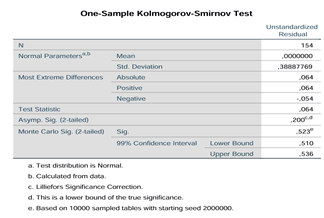
Source: SPSS 26 Processed Data, 2025
As depicted in Figure 2, the normality test performed after addressing outliers resulted in a reduction of the dataset from an initial 190 observations to 154, indicating the exclusion of 36 data points identified as extreme values that contributed to deviations from normality. Subsequent to the removal of these outliers and the application of the Monte Carlo simulation, the Kolmogorov-Smirnov test yielded a statistic of 0.064 with a probability value of 0.523. Given that this significance value exceeds the conventional threshold of 0.05, it can be inferred that the residuals of the model conform to the assumption of normal distribution.
-
2. Multicollinearity Test
| Model | Collinearity Statictics | |
| Tolerance | VIF | |
| (Constant) | ||
| Intellectual Capital | ,976 | 1,024 |
| Good Corporate Governance | ,979 | 1,022 |
| Sustainability Performance | ,952 | 1,051 |
| Return On Assets | ,973 | 1,027 |
Source: SPSS 26 Processed Data, 2025
Referring to the results presented in Table 1, it is observed that All independent variables in this study exhibit tolerance values exceeding 0.1, coupled with Variance Inflation Factor (VIF) scores below the critical limit of 10, indicating the absence of multicollinearity among the predictors. These results suggest that the regression model employed in this study does not suffer from multicollinearity issues. The absence of multicollinearity enhances the validity of the estimated coefficients and reinforces the robustness and credibility of the subsequent inferential analyses.
-
3. Heteroscedasticity Test
-
Figure 3Heteroscedasticity Test
-
Source: SPSS 26 Processed Data, 2025
Based on observations in Figure 3, the scatterplot of residuals reveals that the data are scattered in a random manner around the origin line on the vertical axis and do not exhibit any systematic or recognizable pattern. This observation provides evidence that the regression model fulfills the premise of homoscedasticity, suggesting the absence of heteroscedasticity and thereby supporting the consistency and reliability of the estimated coefficients. Thus, the model is considered to meet the assumption of homoscedasticity, which is important to ensure the stability of the residual variance and increase the reliability and validity of the regression estimation results obtained.
-
Autocorrelation Test
| Model Summaryb | |||||
| Model | R | R Square | Adjusted R Square | Std. Error of the Estimate | Durbin-Watson |
| 1 | ,998a | ,995 | ,995 | ,39406 | 1,878 |
| a. Predictors: (Constant), Return On Assets, Sustainability Performance, Intellectual Capital, Good Corporate Governance | |||||
| b. Dependent Variable: Company Value |
Source: SPSS 26 Processed Data, 2025
The DW test produces a quantified result of 1.878. Given that this value falls within the range of 1.7953 (du) < 1.878 < 2.2047 (4 − du), it satisfies the criterion of du < DW < 4 − du. This outcome suggests that the results reveal that autocorrelation is not present within the regression model, thereby supporting the validity of the model’s assumptions regarding the independence of residuals.
Analysis Using Multiple Linear Regression Models
| Model | Unstandardized Coefficients | Standardized Coefficients | t | Sig. | ||
| B | Std. Error | Beta | ||||
| 1 | (Constant) | ,226 | ,105 | 2,141 | ,034 | |
| Intellectual Capital | ,009 | ,002 | ,021 | 3,679 | ,000 | |
| Good Corporate Governance | ,381 | ,219 | ,010 | 1,741 | ,084 | |
| Sustainability Performance | ,020 | ,008 | ,014 | 2,408 | ,017 | |
| Return On Assets | ,125 | ,001 | ,995 | 172,874 | ,000 |
Source: SPSS 26 Processed Data, 2025
According to the calculation observations listed in Table 3, the constant value and regression coefficient for each independent variable are obtained, which are then formulated into the analytical model is formulated as:
Y = 0.226 + 0.009X1 + 0.381X2 + 0.020X3 + 0.125X4 + e
The estimated constant term of 0.226 reveals that if intellectual capital, good corporate governance, and sustainability performance are zero, then the firm value is estimated at 0.226. This finding underscores the importance of the contribution of non-pecuniary considerations to the formation of firm value.
The analysis also shows that intellectual capital displays a pronounced and significant influence regarding firm value, indicating a coefficient of 0.009 (t = 3.679; sig. = 0.000). The significance value that is far below 0.05 strengthens the reliability of empirical evidence that an increase in intellectual capital, albeit on a small scale, has the potential to significantly enhance increasing firm value. Therefore, the initial assumption which posits that there is a meaningful and beneficial impact can be accepted statistically.
In contrast, although good corporate governance presents a positive coefficient equal to 0.381, its effect is not statistically significant (t = 1.741; sig. = 0.084). This finding reflects that good corporate governance practices, in the context of this study, have not been able to translate directly into a significant increase in firm value. This may indicate that there are limitations in the adoption of proper corporate governance measures principles that have not been optimized or not fully responded positively by the market. Therefore, the second hypothesis does not hold.
Meanwhile, sustainability performance is proven to display a significant and advantageous influence over firm value, which presents a coefficient of 0.020 (t = 2.408; sig. = 0.017). The significance value that is below 0.05 indicates that sustainability initiatives undertaken by companies can be an important factor appreciated by the market, while strengthening the relevance of sustainability performance as a determinant of firm value. Therefore, the third hypothesis can be accepted.
In addition, the control variable return on assets also reveals a pronounced and positive influence with respect to firm value, producing a coefficient of 0.125 (t = 172.874; sig. = 0.000). This finding suggests that profitability remains the dominant internal factor in explaining variations in firm value, reinforcing the notion that fundamental financial performance remains essential even though non-financial factors are also relevant.
Sensitivity Analysis
| COMPANY NAME | Δ TOBINS Q / Δ MI | Δ TOBINS Q / Δ KB | Δ TOBINS Q / Δ ROA |
| Aneka Tambang Tbk. | 12.03 | 0.81 | (0.09) |
| Bumi Resources Minerals Tbk. | 1,681.29 | (3.68) | 18.26 |
| ESSA Industries Indonesia Tbk. | 82.20 | (0.31) | (0.41) |
| Vale Indonesia Tbk. | 6.58 | (11.14) | 0.02 |
| Indocement Tunggal Prakarsa Tbk. | (53.62) | (0.76) | (51.51) |
| Steel Pipe Industry of Indonesia Tbk. | 4.95 | (0.14) | (2.06) |
| Lautan Luas Tbk. | (0.66) | (0.06) | (0.14) |
| Semen Baturaja Tbk. | (2.20) | 0.52 | (1.89) |
| Semen Indonesia (Persero) Tbk. | (7.43) | (0.16) | 0.16 |
| Timah Tbk. | 8.34 | 0.54 | 0.03 |
| Pabrik Kertas Tjiwi Kimia Tbk. | 1.77 | 0.50 | (0.05) |
| Unggul Indah Cahaya Tbk. | 0.11 | (0.01) | 0.06 |
| Wijaya Karya Beton Tbk. | 13.36 | 0.01 | (0.11) |
| Panca Budi Idaman Tbk. | (3.09) | 6.02 | 0.17 |
| Saraswanti Anugerah Makmur Tbk. | 93.46 | 0.78 | 1.78 |
| Cemindo Gemilang Tbk. | (6.49) | (0.12) | 0.02 |
| Avia Avian Tbk. | 35.77 | 0.08 | (1.58) |
| Trimegah Bangun Persada Tbk. | 3.49 | 0.25 | 0.65 |
Source: SPSS 26 Processed Data, 2025
It is evident that the firm’s worth (Tobin's Q) shows a different level of sensitivity to each variable tested. The outcomes derived from this calculation imply that the firm’s valuation of the company is quite sensitive to changes in the independent variables. This level of sensitivity indicates that small changes in the strategic aspects of the company can have a real impact on market perceptions and overall company value. Therefore, it is important for management to continuously monitor these indicators, as even small fluctuations is capable of producing a notable effect on the sustainability and competitiveness relating to the organization in the market.
Conclusion and Recommendations
The empirical analysis indicates that intangible assets and knowledge resources exerts an advantageous and statistically considerable effect on the firm’s financial valuation. This evidence reinforces the theoretical proposition that intellectual capital, as a key intangible asset, contributes not only to strengthening a firm’s competitive positioning but also to enhancing its perceived value in the market. The finding suggests that investments in resources rooted in intellectual capital, such as human, structural, and relational assets —can translate into superior market performance and prolonged enhancement of shareholder interests creation. The significance of this effect highlights the importance of systematically managing and leveraging intellectual capital to create long-term shareholder value.
In contrast, the analysis shows that effective corporate governance mechanisms produce a constructive but statistically insignificant effect on firm value. Although the relationship is directionally positive, the lack of statistical significance suggests that, within the observed context, the implementation of GCG principles may not have been sufficiently robust or consistently perceived by the market to translate into measurable gains in firm value. This result opens space for further inquiry into the quality and depth of GCG practices, rather than their mere formal adoption.
Furthermore, sustainability performance demonstrates a constructive and substantial impact concerning the firm’s financial value, indicating that corporate commitment to sustainability initiatives is increasingly recognized and valued by stakeholders. This suggests that companies embedding environmental, social, and governance aspects within their strategic business framework are likely to benefit from enhanced reputational capital and market trust, both of which contribute positively to firm value.
Finally, the control variable is also found to exert a favorable and statistically meaningful influence on firm valuation. This result reaffirms the persistent importance of profitability as a core driver in determining a firm's market valuation. Collectively, these findings highlight the interplay between financial performance and non-financial factors—particularly intellectual capital and sustainability efforts—in shaping the firm’s market perception and overall value.
This research is expected to make theoretical and practical contributions by identifying the strategic role of non-financial elements in enhancing firm value and encouraging sustainable business practices.
References
- Aboud, A., & Diab, A. (2018). The impact of social, environmental and corporate governance disclosures on firm value: Evidence from Egypt. Journal of Accounting in Emerging Economies, 8(4), 442–458. DOI ↗ Google Scholar ↗
- Aditya Lutfi, A., & Panuntun, B. (2024). Analisis Pengaruh Rasio Profitabilitas ROA, ROE, dan NPM terhadap Nilai Perusahaan yang Tercatat dalam IDX-MES BUMN (Vol. 03). DOI ↗ Google Scholar ↗
- Agustina D. (2017). Pengaruh Corporate Governance Dan Variabel Keuangan Terhadap Nilai Perusahaan. Jurnal Bisnis dan Akuntansi, 19(1), 13–26. DOI ↗ Google Scholar ↗
- Ahmad, H., Yaqub, M., & Lee, S. H. (2024). Environmental-, social-, and governance-related factors for business investment and sustainability: a scientometric review of global trends. Environment, Development and Sustainability, 26(2), 2965–2987. DOI ↗ Google Scholar ↗
- Al-Hadi, A., Chatterjee, B., Yaftian, A., Taylor, G., & Monzur Hasan, M. (2019). Corporate social responsibility performance, financial distress and firm life cycle: evidence from Australia. Accounting and Finance, 59(2), 961–989. DOI ↗ Google Scholar ↗
- Ali, M. A., Abed, I. A., Othman, R., Hussin, N., & Qahatan, N. (2020). Systematic Review of Intellectual Capital and Firm Performance Systematic Review of Intellectual Capital and Firm Performance Corresponding author: 1* (Vol. 62). Diambil dari DOI ↗ Google Scholar ↗
- Ali, S., Murtaza, G., Hedvicakova, M., Jiang, J., & Naeem, M. (2022). Intellectual capital and financial performance: A comparative study. Frontiers in Psychology, 13. DOI ↗ Google Scholar ↗
- Alifian, D., & Susilo, D. E. (2024). Pengaruh Profitabilitas, Likuiditas, Ukuran Perusahaan Dan Struktur Modal Terhadap Nilai Perusahaan. Owner, 8(1), 46–55. DOI ↗ Google Scholar ↗
- Anwar, K. (2023). Volume . 19 Issue 2 ( 2023 ) Pages 282-288 INOVASI : Jurnal Ekonomi , Keuangan dan Manajemen ISSN : 0216-7786 ( Print ) 2528-1097 ( Online ) Pengaruh Good Corporate Governance Terhadap Nilai Perusahaan. Jurnal Ekonomi, Keuangan dan Manajemen, 2(2), 282–288. DOI ↗ Google Scholar ↗
- Asif, J., Ting, I. W. K., & Kweh, Q. L. (2020). Intellectual Capital Investment and Firm Performance of the Malaysian Energy Sector: A New Perspective From a Nonlinearity Test. Energy Research Letters, 1(3). DOI ↗ Google Scholar ↗
- Aulia, A. R., & Darniaty, W. A. (2021). Pengaruh Modal Intelektual terhadap Kinerja Perusahaan pada Perusahaan yang Terdaftar di Bursa Efek Indonesia. Jurnal Ekonomi, Manajemen dan Perbankan (Journal of Economics, Management and Banking), 3(2), 67. DOI ↗ Google Scholar ↗
- Bashiru, M., Hashim, F., & Ganesan, Y. (2022). Corporate Sustainability Performance and Firm Value: Examining Listed Nigerian Petroleum Companies From Stakeholder and Agency Theories Perspectives. Global Journal Al-Thaqafah, (Special Issue), 13–22. DOI ↗ Google Scholar ↗
- Beretta, V., Demartini, C., & Trucco, S. (2019). Does environmental, social and governance performance influence intellectual capital disclosure tone in integrated reporting? Journal of Intellectual Capital, 20(1), 100–124. DOI ↗ Google Scholar ↗
- Berliani, C., & Riduwan, A. (2017). Pengaruh Good Corporate Governance, Kinerja Keuangan, dan Ukuran Perusahaan Terhadap Nilai Perusahaan. Jurnal Ilmu dan Riset Akuntansi, 6(2), 176–193. DOI ↗ Google Scholar ↗
- Boubakri, N., El Ghoul, S., Guedhami, O., & Wang, H. (Helen). (2021, Maret 1). Corporate social responsibility in emerging market economies: Determinants, consequences, and future research directions. Emerging Markets Review. Elsevier B.V. DOI ↗ Google Scholar ↗
- Buallay, A. (2019). Is sustainability reporting (ESG) associated with performance? Evidence from the European banking sector. Management of Environmental Quality: An International Journal, 30(1), 98–115. DOI ↗ Google Scholar ↗
- Buallay, A., Hamdan, A., & Zureigat, Q. (2017). Corporate governance and firm performance: evidence from Saudi Arabia. Australasian Accounting, Business and Finance Journal, 11(1), 78–98. DOI ↗ Google Scholar ↗
- Cahyati, A. D. (2012). Intellectual Capital: Pengukuran, Pengelolaan Dan Pelaporan. JRAK: Jurnal Riset Akuntansi dan Komputerisasi Akuntansi, 3(1), 45–56. DOI ↗ Google Scholar ↗
- Chen, R. (Ryan), Guedhami, O., Yang, Y., & Zaynutdinova, G. R. (2020). Corporate governance and cash holdings: Evidence from worldwide board reforms. Journal of Corporate Finance, 65. DOI ↗ Google Scholar ↗
- Das, S. (2019). Cash flow ratios and financial performance: A comparative study. Accounting, 5, 1–20. DOI ↗ Google Scholar ↗
- Dewantari, N. L. S., Cipta, W., & Susila, G. P. A. J. (2020). Pengaruh Ukuran Perusahaan Dan Leverage Serta Profitabilitas Terhadap Nilai Perusahaan Pada Perusahaan Food and Beverages Di Bei. Prospek: Jurnal Manajemen dan Bisnis, 1(2), 74. DOI ↗ Google Scholar ↗
- Dewi, H. R., Mutiara, L., & Dewi, C. (2020). Modal intelektual dan nilai perusahaan pada industri jasa dan pertambangan di Indonesia, 2, 132–143. DOI ↗ Google Scholar ↗
- Dewi Rahmawati, Dirvi Surya Abbas, & Djenny Sasmita. (2023). Pengaruh Intellectual Capital, Good Corporate Governance dan Ukuran Perusahaan Terhadap Nilai Perusahaan. Akuntansi, 2(4), 101–113. DOI ↗ Google Scholar ↗
- Eccles, R. G., Ioannou, I., & Serafeim, G. (2014). The impact of corporate sustainability on organizational processes and performance. Management Science, 60(11), 2835–2857. DOI ↗ Google Scholar ↗
- Edvinsson, L., & Michael, M. (1999). Intellectual Capital: Realizing Your Company’s True Value by Finding Its Hidden Brainpower. Maxima. DOI ↗ Google Scholar ↗
- Fajriyanti, N., Sukoharsono, E. G., & Abid, N. (2021). Examining the effect of diversification, corporate governance and intellectual capital on sustainability performance. International Journal of Research in Business and Social Science (2147- 4478), 10(2), 12–20. DOI ↗ Google Scholar ↗
- Fatemi, A., Glaum, M., & Kaiser, S. (2018). ESG performance and firm value: The moderating role of disclosure. Global Finance Journal, 38, 45–64. DOI ↗ Google Scholar ↗
- Fauziah, F. (2021). Organum: Jurnal Saintifik Manajemen dan Akuntansi. DOI ↗ Google Scholar ↗
- Firdausya, Z. S., Swandari, F., & Effendi, W. (2013). Pengaruh Mekanisme Good Corporate Governance (Gcg) Pada Nilai Perusahaan (Studi Pada Perusahaan Yang Masuk Indeks LQ45 Di Bursa Efek Indonesia). Jurnal Wawasan Manajemen, 1(3), 407–424. DOI ↗ Google Scholar ↗
- Frederick, C., & Susanti, M. (2023). Analysing the Factors that Impact Manufacturing Companies’ Financial Performance in Indonesia. International Journal of Application on Economics and Business, 1(1), 472–480. DOI ↗ Google Scholar ↗
- Gupta, A. K., & Gupta, N. (2020). Effect of corporate environmental sustainability on dimensions of firm performance – Towards sustainable development: Evidence from India. Journal of Cleaner Production, 253. DOI ↗ Google Scholar ↗
- Hamdan, A. M., Buallay, A. M., & Alareeni, B. A. (2017). The Moderating Role of Corporate Governance on the Relationship between Intellectual Capital Efficiency and Firm. International Journal of Learning and Intellectual Capital, 1(1), 1. DOI ↗ Google Scholar ↗
- Inrawan, A., & Lie, D. (2024). The Role Of Profitability In Mediating Determinants Of Firm Value. JAS (Jurnal Akuntansi Syariah), 8(2), 389–413. DOI ↗ Google Scholar ↗
- Jihan Fairus, & Etty Murwaningsari. (2023). Pengaruh Kinerja Keberlanjutan Perusahaan dan Ekoefisiensi Terhadap Nilai Perusahaan. Jurnal Ekonomi Trisakti, 3(2), 3059–3072. DOI ↗ Google Scholar ↗
- Jin, Y. (2023). An Empirical Study on the Impact of Corporate Governance Level on Investor Confidence Under the Supply Chain Finance. BCP Business & Management EMFRM (Vol. 2022). DOI ↗ Google Scholar ↗
- Khotimah, H., Ruhiyat, E., & Hakim, D. R. (2024). The Effect of Green Intellectual Capital, Good Corporate Governance, and Growth Options on Sustainability Performance. Journal of Economics, Business, and Accountancy Ventura, 27(1), 113–129. DOI ↗ Google Scholar ↗
- Laskar, N., & Gopal Maji, S. (2018). Disclosure of corporate sustainability performance and firm performance in Asia. Asian Review of Accounting (Vol. 26). DOI ↗ Google Scholar ↗
- Li, Y., Gong, M., Zhang, X. Y., & Koh, L. (2018). The impact of environmental, social, and governance disclosure on firm value: The role of CEO power. British Accounting Review, 50(1), 60–75. DOI ↗ Google Scholar ↗
- Luque-Vílchez, M., Gómez-Limón, J. A., Guerrero-Baena, M. D., & Rodríguez-Gutiérrez, P. (2023). Deconstructing corporate environmental, social, and governance performance: Heterogeneous stakeholder preferences in the food industry. Sustainable Development, 31(3), 1845–1860. DOI ↗ Google Scholar ↗
- Mira Diyanty, M. W. Y. (2019). Pengaruh Mekanisme Good Corporate Governance terhadap Kinerja Keuangan pada Perbankan yang Terdaftar di Bursa Efek Indonesia (BEI). Jurnal Wawasan Manajemen, 7, 49–65. DOI ↗ Google Scholar ↗
- Naciti, V. (2019). Corporate governance and board of directors: The effect of a board composition on firm sustainability performance. Journal of Cleaner Production, 237. DOI ↗ Google Scholar ↗
- Nasseri, A. (2019). An Empirical Investigation of the Relation between Corporate Sustainability Performance (CSP) and Corporate Value: Evidence from Iran. International Journal of Finance and Managerial Accounting, 4(14), 27–37. DOI ↗ Google Scholar ↗
- Nazir, N., Ali, A., & Sabir, H. (2014). Impact of Dividend Policy on Stock Price Volatility:A Case Study of Pakistani Capital Market. European Journal of Business and Management www.iiste.org ISSN (Vol. 6). Online. Diambil dari www.iiste.org DOI ↗ Google Scholar ↗
- Nur utami, C., & Widati, L. W. (2022). Pengaruh Profitabilitas, Likuiditas dan Kepemilikan Manajerial terhadap Nilai Perusahaan. Owner, 6(1), 885–893. DOI ↗ Google Scholar ↗
- Ousama, A. A., Al-Mutairi, M. T., & Fatima, A. H. (2020). The relationship between intellectual capital information and firms’ market value: a study from an emerging economy. Measuring Business Excellence, 24(1), 39–51. DOI ↗ Google Scholar ↗
- Pramesti, W. C., Sudarma, M., & Ghofar, A. (2024). Environmental, Social, And Governance (ESG) Disclosure, Intellectual Capital And Firm Value: The Moderating Role Of Financial Performance. Jurnal Reviu Akuntansi dan Keuangan, 14(1), 103–121. DOI ↗ Google Scholar ↗
- Ramadhani, A., Handayani, P. W., Pinem, A. A., & Sari, P. K. (2023). The Influence of Conversation Skills on Chatbot on Purchase Behavior in E-Commerce. Jurnal Manajemen Indonesia, 23(3), 287. DOI ↗ Google Scholar ↗
- Robiyanto, R., Putra, A. R., & Lako, A. (2021). The effect of corporate governance and intellectual capital toward financial performance and firm value of socially responsible firms. Contaduria y Administracion, 66(1). DOI ↗ Google Scholar ↗
- Roca, A., Williams, A. M., & Ford, P. R. (2012). Developmental activities and the acquisition of superior anticipation and decision making in soccer players. Journal of Sports Sciences, 30(15), 1643–1652. DOI ↗ Google Scholar ↗
- Safitri, T. N., Athaya, N. S., Miranda, A., & Maisyarah, R. (2025). Analysis of Good Corporate Governance in Increasing Investor Trust. Jurnal Akuntansi, Manajemen, dan Perencanaan Kebijakan, 2(4), 10. DOI ↗ Google Scholar ↗
- Saidu, S. (2019). CEO characteristics and firm performance: focus on origin, education and ownership. Journal of Global Entrepreneurship Research, 9(1). DOI ↗ Google Scholar ↗
- Sardo, F., & Serrasqueiro, Z. (2018). Intellectual capital, growth opportunities, and financial performance in European firms: Dynamic panel data analysis. Journal of Intellectual Capital, 19(4), 747–767. DOI ↗ Google Scholar ↗
- Sari, D. P. K., & Riki, S. (2018). Pengaruh Good Corporate Governance dan Karakteristik Perusahaan Terhadap Nilai Perusahaan. Jurnal Bisnis dan Akuntansi, 20(1), 21–32. DOI ↗ Google Scholar ↗
- Sawarjuwono, T., D. a. P. Kadir. (2016). ”Intellectual Capital: Perlakuan, Pengukuran dan Pelaporan”. Akuntansi dan Keuangan, 5(1), 35–37. DOI ↗ Google Scholar ↗
- Setiawati, C., Orbaningsih, D., & Muawanah, U. (2024). Financial Performance And Company Value: Good Corporate Governance As Moderation. JAS (Jurnal Akuntansi Syariah), 8(2), 341–363. DOI ↗ Google Scholar ↗
- Sondokan, N. V., Koleangan, R. A. M., & Karuntu, M. M. (2019). Pengaruh Dewan Komisaris Independen, Dewan Direksi, dan Komite Audit terhadap Nilai Perusahaan yang Terdaftar di Bursa Efek Indonesia Periode 2014-2017. Jurnal EMBA, 7(4), 5821–5830. DOI ↗ Google Scholar ↗
- Subagio, D. I., & Januarti, I. (2022). Pengaruh Modal Intelektual Terhadap Nilai Perusahaan Dengan Manajemen Laba Sebagai Variabel Moderasi. Journal of Applied Managerial Accounting, 6(1), 102–114. DOI ↗ Google Scholar ↗
- Susanto, E. E., & Suryani, Z. (2024). Pwngaruh Ukuran Perusahaan, Leverage, dan Profitabilitas terhadap Nilai Perusahaan. Jurnal Cakrawala Ilmiah, 3(9), 2413–2426. DOI ↗ Google Scholar ↗
- Thanh, B. A., Sang, N. M., & Khuong, N. V. (2024). Corporate governance mechanism and firm value: evidence from an emerging economy. Cogent Business and Management, 11(1). DOI ↗ Google Scholar ↗
- Wang, L., Verousis, T., & Zhang, M. (2025). Market value of R&amp;D, patents, and CEO characteristics. Financial Innovation, 11(1), 8. DOI ↗ Google Scholar ↗
- Wardoyo, & Veronica, T. M. (2013). Pengaruh Good Corporate Governance, Corporate Social Responsibility, Kinerja Keuangan, Dan Ukuran Perusahaan Terhadap Nilai Perusahaan. Jurnal Dinamika Manajemen, 4(2), 132–149. DOI ↗ Google Scholar ↗
- Widianingsih, D. (2018). Kepemilikan Manajerial, Kepemilikan Institusional, Komisaris Independen, serta Komite Audit pada Nilai Perusahaan dengan Pengungkapan CSR sebagai Variabel Moderating dan Firm Size sebagai Variabel Kontrol. Jurnal Akuntansi dan Pajak, 19(1), 38. DOI ↗ Google Scholar ↗
- Yang, Y. (2023). Corporate Sustainability and Firm Value: Evidence from China. DOI ↗ Google Scholar ↗
- Yuliawati, R., & Alinsari, N. (2022). Pengaruh Modal Intelektual Terhadap Nilai Perusahaan Dengan Profitabilitas Sebagai Variabel Moderasi. Owner, 6(3), 1698–1708. DOI ↗ Google Scholar ↗
- Zuhdi, A. M., Syachyadi, I., Astuti, C. D., Akuntansi, P. S., Trisakti, U., Keuangan, K., & Reporting, S. (2024). Pengaruh Pengungkapan Green Intellectual Capital dan Sustainability Reporting Disclosure terhadap Kinerja Keuangan, 5(2), 1425–1440. DOI ↗ Google Scholar ↗