Abstract
The rapid expansion of digital assets has created new challenges for accounting systems, particularly in detecting fraudulent transactions, maintaining reliable records, and ensuring the integrity of financial reporting. Conventional rule-based controls may be insufficient for identifying complex, high-volume, and rapidly evolving patterns of digital-asset fraud. This study examines the application of artificial intelligence (AI) to fraud detection in digital asset accounting and proposes an integrated framework linking blockchain transaction analysis with accounting controls, anomaly detection, explainable AI, and human oversight. The study develops a research model incorporating transaction characteristics, wallet behavior, temporal patterns, network relationships, and accounting discrepancies as potential fraud indicators. Machine learning and deep-learning techniques, including Random Forest, XGBoost, LSTM, and autoencoder-based approaches, are considered for identifying suspicious transaction patterns and generating fraud-risk scores. The framework further incorporates explainability mechanisms to support interpretation of AI-generated alerts and subsequent accounting verification. The study contributes an accounting-oriented perspective to digital-asset fraud detection by connecting technological identification of anomalies with reconciliation, audit procedures, professional judgment, and financial reporting controls. The proposed framework provides a structured basis for developing more responsive and auditable fraud-detection systems while recognizing the importance of data quality, model governance, and human decision-making.
Keywords
artificial intelligence digital assets fraud detection blockchain accounting anomaly detection financial reporting explainable AI
1. Introduction
-
1.1 Background of the Study
The adoption of blockchain technology in financial transactions has enabled the creation, exchange, and recording of digital assets using distributed ledger technology. The emergence of cryptocurrencies, stablecoins, and tokenized assets necessitates the handling of transaction monitoring, recognition, valuation, reconciliation, and disclosure within organizations. Digital asset transactions have led to an increase in the volume of financial data being handled by accounting and auditing systems (Sampaio & Silva, 2025; Yang et al., 2026).
A digital-asset environment presents fraud risks that are unique in their nature. These include pseudonymous wallets, decentralized networks, multi-parties involved in the transaction, and dynamic transactions. Traditional control measures based on rules have difficulties in detecting complex and novel fraud activities. Recent research has shown that accounting and blockchain systems enabled by AI can improve fraud detection capabilities (Nmezi, 2026; Shamsinejad & Banirostam, 2026). Therefore, there are opportunities for leveraging AI technology to extract fraud risk signals from transaction datasets.
-
1.2 Digital Asset Accounting and Fraud Risk
The digital-assets accounting process will require credible evidence of ownership, complete transactions, valuation, classification, and reporting. While blockchain offers comprehensive transaction details, businesses still need to reconcile blockchain activities with the corresponding entries in the accounting records, exchanges, wallets, and any other evidence especially when dealing with various blockchain technologies (Pappalardo, 2021; Sampaio & Silva, 2025). Possible areas of fraud include hidden or duplicated transactions, use of unauthorized wallets, misclassification, incorrect valuation, and complicated multi-address transactions. Blockchain analytics, data mining, forensic accounting, and artificial intelligence may help with fraud detection and investigations (Elumilade et al., 2021; Oladejo & Jack, 2020). The key accounting issue in the fraud context is the possible discrepancy between blockchain-based activities and organizational records. This means that fraud detection should not only identify abnormalities but also resolve them based on accounting evidence.
-
1.3 Problem Statement
In classical fraud-detection systems, there is a lot of reliance on pre-set rules, transaction limits, review, and audit, which could be inadequate when dealing with large volume, complex and changing digital asset frauds. The use of AI and advanced analytics will enhance anomaly detection by analyzing large financial data sets for complex behavior pattern (Chy et al., 2022; Yang et al., 2026). Digital assets' transactions will be complex and involve multiple wallets, exchanges, organizations, and periods, and too many false positives will increase the cost of investigations. There will be issues with the use of AI with respect to explainability, data quality, model governance, and accountability (Wright, 2026). Recent findings suggest that AI-powered accounting systems will help in fraud detection, analytical interpretation, and audit process (Adeyemi & Ojogbede, 2026). Thus, the biggest problem is how to connect AI-driven detection with accounting and reporting processes.
-
1.4 Research Gap
Past literature has shown increased interest in AI for fraud detection, finance, blockchain, and accounting research. Still, the research lines on these subjects seem rather disjointed. Studies related to AI for fraud detection typically concentrate on accuracy and classification, whereas accounting literature mainly revolves around automation, internal control, auditing, and reporting quality (Khan, 2026; Sampaio & Silva, 2025). Similarly, there has been research on AI and fraud prevention in decentralized finance. But more needs to be done regarding the accounting consequences of anomaly detection (Narayan et al., 2024).
Another issue that needs to be addressed pertains to the movement from technical detection to accounting actions. Detection of an anomalous blockchain transaction does not necessarily mean that any fraud happened or how it would affect the financial records. The detected anomaly needs to be analyzed, confirmed, adjusted, and evaluated by accountants.
Accordingly, this study addresses the gap between:
AI-based transaction detection → accounting interpretation → human verification → financial-reporting response
The proposed framework thus incorporates the use of AI fraud detection together with accounting controls, explainability, professional judgment, and governance. The holistic approach taken by this framework adds to existing literature by placing AI within the larger context of the digital-asset accounting and fraud governance architecture.
-
1.5 Research Objectives
The broad objective of this study is to look at the use of artificial intelligence for fraud detection and financial reporting in digital asset accounting. This study is intended to:
-
Examine the application of AI techniques to fraud detection in digital-asset accounting.
-
Identify transaction, blockchain, behavioral, and accounting indicators associated with potentially fraudulent digital-asset activity.
-
Develop an integrated AI-driven framework connecting transaction monitoring, anomaly detection, accounting verification, and financial-reporting controls.
-
Examine the role of explainability and human oversight in interpreting AI-generated digital-asset fraud alerts.
-
Evaluate the implications of AI-driven fraud detection for accounting controls, auditing, governance, and financial-reporting integrity.
These objectives are based on the multi-disciplinary nature of digital asset fraud, which makes technological detection of fraud possible only along with accounting operations and professional judgement. Previous studies have found out that use of AI, machine learning, and accounting analytics may enhance the process of fraud detection and control, but their successful application presupposes proper governance and interpretability (Adil et al., 2026; Nmezi, 2026).
-
1.6 Research Questions
The study is guided by the following research questions:
RQ1: How can AI techniques improve fraud detection in digital-asset accounting?
RQ2: Which transaction, blockchain, behavioral, and accounting indicators are most relevant to digital-asset fraud detection?
RQ3: How can AI-generated fraud alerts be integrated into accounting control, reconciliation, and verification processes?
RQ4: What role do explainability and human oversight play in AI-driven digital-asset fraud detection?
RQ5: What governance mechanisms are required to ensure the reliable and accountable use of AI for digital-asset fraud detection?
The research questions are framed in a manner that links technical capabilities with their applications in accounting. It is necessary to note that AI fraud detection involves processes of both prediction and interpretation. According to recent studies, AI, machine learning, and analytics are increasingly being seen as useful tools for detecting financial frauds, and contemporary accounting research stresses the significance of better integration of intelligent technologies with internal controls, audits, and accounting reporting (Shamsinejad & Banirostam, 2026; Khan, 2026). Thus, the research questions focus on not only the ability of AI to predict but also to interpret the results of the predictions.
-
1.7 Contribution of the Study
These five contributions are interlinked. The theoretical contribution lies in extending the literature on fraud detection and accounting information systems through the integration of AI-based detection and accounting interpretation. In terms of accounting, the paper brings together the relation between the blockchain evidence and reconciliation, valuation, classification, disclosure, and reporting controls (Sampaio & Silva, 2025). Technologically, it involves the incorporation of machine learning, anomaly detection, blockchain analysis, and explainable AI into one system. Regarding auditing and internal control, AI notifications are used as inputs to continuous monitoring and expert review rather than automatic fraud determinations (Nmezi, 2026). With respect to governance, the system encompasses such components as explainability, model monitoring, human involvement, responsibility, and auditability. These components become more and more relevant in the context of increasing the use of AI in accounting, auditing, and financial reporting (Yang et al., 2026; Wright, 2026). Recent research proves that the AI-based accounting systems contribute to fraud detection and analysis.
2. Literature Review
-
2.1 Concept of Digital Assets
Digital assets are electronically represented resources that can be created, stored, transferred, and exchanged through digital technologies, particularly blockchain and distributed ledger systems. They include cryptocurrencies, stablecoins, tokenized assets, digital securities, and non-fungible tokens. These instruments are characterized by cryptographic verification, digital ownership records, programmable transactions, and increasingly decentralized transfer mechanisms. Their growing adoption has expanded the volume and complexity of financial information requiring monitoring and accounting treatment (Pappalardo, 2021; Sampaio & Silva, 2025).
Cryptocurrencies facilitate digital value transfer, while stablecoins are designed to reduce price volatility. Tokenized assets digitally represent ownership or economic interests in underlying assets, whereas digital securities represent financial instruments issued through digital infrastructures. NFTs provide unique digital ownership records. These different characteristics create varying requirements for recognition, valuation, classification, and disclosure. The increasing complexity of digital-asset transactions also creates opportunities for fraud and financial manipulation, strengthening the need for automated analytical systems (Yang et al., 2026). Consequently, understanding digital-asset characteristics provides the foundation for developing effective AI-based accounting and fraud-detection mechanisms.
-
2.2 Digital Asset Accounting
Digital-asset accounting involves the recognition, classification, measurement, valuation, reconciliation, and reporting of transactions involving digital assets. Reliable accounting requires evidence of ownership, transaction occurrence, completeness, and appropriate valuation. Although blockchain provides detailed and verifiable transaction histories, organizations must reconcile on-chain records with internal ledgers, exchange information, wallet data, and supporting documentation (Pappalardo, 2021).
Valuation presents additional challenges because digital-asset prices can fluctuate significantly and may differ across markets. Classification and disclosure similarly require consistent accounting judgments regarding the economic characteristics of individual assets. Digital transformation has consequently increased the importance of automated data processing, analytics, and intelligent monitoring within accounting systems (Sampaio & Silva, 2025).
Blockchain and AI can improve transaction traceability, reconciliation, continuous monitoring, and analytical efficiency. However, technological systems cannot independently resolve accounting judgments. Effective digital-asset accounting therefore requires integration between blockchain evidence, accounting records, valuation procedures, internal controls, and professional judgment.
-
2.3 Fraud in Digital Asset Ecosystems
Digital-asset ecosystems create distinctive fraud risks because transactions may involve pseudonymous addresses, decentralized networks, multiple counterparties, and rapidly changing behavioral patterns. Fraud can involve unauthorized transfers, wallet manipulation, identity-related activities, market manipulation, wash trading, suspicious transaction networks, and concealment of transactions. These activities can subsequently result in incorrect asset balances, false valuation, incomplete recognition, inappropriate classification, or misleading disclosures.
Fraudulent behavior may extend across multiple addresses and transactions, making isolated transaction review insufficient. Transaction value, frequency, timing, wallet behavior, and network relationships can provide additional indicators for identifying suspicious activity. Data-driven and forensic approaches can therefore strengthen financial-fraud investigation and transaction monitoring (Elumilade et al., 2021; Pappalardo, 2021).
The increasing application of AI and advanced analytics provides additional capabilities for processing large transaction datasets and identifying complex patterns (Shamsinejad & Banirostam, 2026; Yang et al., 2026). Nevertheless, AI-generated anomalies should not automatically be treated as confirmed fraud. They require accounting evidence, investigation, and professional verification before financial-reporting decisions are made.
-
2.4 Conventional Fraud Detection Approaches
Conventional fraud detection relies on predefined rules, transaction thresholds, segregation of duties, manual reviews, internal controls, exception reporting, and periodic auditing. These mechanisms provide structured procedures for identifying transactions that violate established policies or exceed predetermined risk thresholds. Traditional auditing also provides independent examination of accounting records and supporting evidence.
However, rule-based systems depend on predefined conditions and may struggle with rapidly evolving fraud patterns or complex relationships between transactions. Manual review can also become resource-intensive as transaction volumes increase. Research on financial fraud detection indicates that advanced analytical approaches can improve the identification of complex patterns that may be difficult to detect through conventional procedures (Chy et al., 2022; Yang et al., 2026).
These limitations do not make conventional controls obsolete. Instead, they support greater integration with AI-based monitoring. AI can screen transactions continuously and identify potential anomalies, while conventional controls and professional reviewers can validate evidence and determine appropriate responses (Nmezi, 2026). Therefore, AI should complement established accounting and auditing controls rather than replace them.
-
2.5 Artificial Intelligence in Fraud Detection
Artificial intelligence is increasingly applied to fraud detection because it can process large datasets, identify complex relationships, recognize behavioral patterns, and generate risk classifications. Machine-learning approaches include supervised, unsupervised, and semi-supervised methods. Supervised models learn from labelled fraudulent and legitimate observations, while unsupervised techniques identify unusual patterns without requiring predefined fraud labels.
AI-based systems can incorporate transaction characteristics, behavioral indicators, temporal patterns, network relationships, and accounting variables. Machine learning and data analytics can consequently improve anomaly identification while reducing dependence on manual transaction inspection (Chy et al., 2022; Shamsinejad & Banirostam, 2026).
Deep-learning techniques can further capture complex and sequential relationships. LSTM networks can analyze transaction sequences, while autoencoders can identify deviations from established behavioral patterns. Predictive analytics can subsequently convert these patterns into fraud-risk indicators. However, AI effectiveness depends on data quality, model validation, class imbalance, interpretability, and governance (Wright, 2026). Accordingly, AI-based fraud detection should operate within an integrated accounting and control environment rather than as an isolated technological process.
-
2.6 AI Techniques Applicable to Digital-Asset Fraud
-
2.6.1 Random Forest
Random Forest combines multiple decision trees to classify transactions and capture nonlinear relationships among variables such as transaction value, frequency, wallet activity, and accounting irregularities. Its robustness makes it useful for fraud detection and model comparison. However, its ensemble structure can reduce interpretability, making explainability techniques valuable for identifying influential predictors (Shamsinejad & Banirostam, 2026).
-
2.6.2 XGBoost
XGBoost uses sequential decision-tree optimization to model complex nonlinear relationships. It can process transaction amounts, wallet characteristics, transaction frequency, and temporal indicators, providing strong predictive capability. However, model complexity may create challenges concerning interpretation, validation, and governance (Khan, 2026).
-
2.6.3 Logistic Regression
Logistic Regression estimates the probability that a transaction belongs to a fraud category. Its transparency makes it useful as a baseline for comparing advanced AI models. Transaction size, frequency, wallet characteristics, and accounting irregularities can serve as explanatory variables. However, its relatively simple structure may limit its ability to capture highly nonlinear fraud relationships.
-
2.6.4 Support Vector Machines
Support Vector Machines classify observations by identifying boundaries between legitimate and fraudulent transactions. Kernel functions enable nonlinear classification, making SVMs applicable to complex transaction datasets. However, performance depends on feature scaling and parameter selection, while large datasets can increase computational demands.
-
2.6.5 LSTM Networks
Long Short-Term Memory networks analyze sequential observations and retain information from previous transactions. This makes them suitable for detecting fraud patterns involving transaction order, timing, frequency, and changing wallet behavior. However, LSTMs require substantial training data and computational resources and can present significant interpretability challenges.
-
2.6.6 Autoencoders
Autoencoders learn normal transaction patterns and identify anomalies through reconstruction errors. Their unsupervised structure is valuable where labelled fraud data are limited and can support detection of previously unknown patterns. However, appropriate anomaly thresholds and interpretation remain challenging. Detected anomalies should therefore undergo accounting and human verification (Yang et al., 2026).
-
2.6.7 Graph-Based/Network Models
Graph-based models represent wallets, addresses, transactions, and counterparties as interconnected networks. This enables identification of suspicious relationships, transaction pathways, and coordinated activities that may not be visible through individual transaction analysis. However, large blockchain networks can create substantial computational requirements. Blockchain analytics combined with AI can nevertheless provide broader fraud-risk assessment than isolated transaction analysis (Pappalardo, 2021; Yang et al., 2026).
-
2.6.8 Explainable AI
Explainable AI (XAI) improves the interpretability of complex fraud-detection models. Techniques such as feature importance, SHAP, and LIME can indicate variables contributing to risk classifications. This supports professional review, auditability, documentation, and accountability. Explainability is particularly important where AI-generated alerts influence accounting investigations and reporting decisions (Yang et al., 2026; Wright, 2026).
| Approach | Input Data | Main Strength | Limitation | Accounting Relevance |
| Logistic Regression | Transaction variables | High interpretability | Limited nonlinear relationships | High |
| Random Forest | Transaction features | Robust classification | Lower transparency | High |
| XGBoost | Structured transaction data | Strong predictive capability | Model complexity | High |
| SVM | Transaction and behavioral features | Effective class separation | Parameter sensitivity | Medium–High |
| LSTM | Sequential transactions | Captures temporal patterns | Data-intensive | High |
| Autoencoder | Transaction patterns | Unsupervised anomaly detection | Interpretation challenges | Medium–High |
| Graph Models | Wallet/network relationships | Network-level fraud detection | Computational complexity | High |
| Explainable AI | Model outputs and features | Improves transparency | Explanation limitations | High |
2.7 Blockchain Analytics and Fraud Detection
The analytics of blockchain is an important starting point for detecting fraud in the field of digital assets as blockchain data include details regarding addresses, timestamps, transaction amounts, and transaction interrelationships. Data like that help in performing transactions tracking, address profiling, wallet clustering, and detecting abnormalities. The representations of the network may even show related wallets, dubious routes, and coordinated activities (Pappalardo, 2021).
The wallet clustering technique detects related addresses on the basis of transactions, while the temporal one is used to detect unusual activity frequencies, sudden changes, and abnormalities in transferring. It can provide additional input to the AI-based classification and detection of anomalies. The recent studies prove the importance of combining blockchain transaction properties with the AI-based anomaly detection and explainability methods.
However, the transparency of blockchain does not guarantee the validity of the accounting processes. Anomalies should be correlated with organizational accounting data and then assessed in terms of accounting, audit, and professionalism.
3. Conceptual Framework and Research Model
-
3.1 Conceptual Foundation
This framework combines Fraud Triangle Theory, Agency Theory, continuous auditing, and AI governance concepts to demonstrate how AI technology could assist in detecting fraud in digital asset accounting. Fraud Triangle Theory enables one to comprehend the fraudulent actions based on certain conditions which may lead to committing the fraud, and Agency Theory highlights the importance of establishing proper monitoring systems which could help to mitigate the problem of information asymmetry. The above-mentioned theories are especially important in case digital assets have complicated ownership structure, decentralized networks, and poor transparency.
Continuous auditing theory is a development of traditional periodic approach, as it involves the constant monitoring of the transactions and timely anomaly detection. AI technology can assist in achieving this goal through the continuous processing of transactional, behavioral, networking and accounting data (Nmezi, 2026; Shamsinejad & Banirostam, 2026). At the same time, AI technology should be properly governed, as there might be some model errors, data gaps, false alarms, and lack of interpretability which will influence the accounting decisions (Wright, 2026). Therefore, this framework suggests using AI as a decision-support tool.
-
3.2 Digital-Asset Fraud Risk Indicators
Indicators which should be used for effective AI fraud detection should include those that are based on transactions, accounting and networking behaviors. Transaction frequency, amount and speed can show whether something is out of place, while wallet age and number of counterparties can help detect abnormal wallet activity. Network connectivity, transaction repetition and transaction concentration can serve as additional signs of coordination or abnormality (Pappalardo, 2021; Yang et al., 2026).
Temporal indicators are also significant since the unusual transaction sequence, time interval and change in wallet behavior may show up during the fraud. Accounting indicators such as ledger discrepancy and valuation anomalies can broaden the scope of fraud detection from the on-chain behavior to financial statements. It is important since the unusual transaction on the blockchain is not the sign of accounting fraud per se, but rather a potential risk that requires more research. Thus, the combination of blockchain, behavioral and accounting indicators can become the foundation for fraud detection using AI (Shamsinejad & Banirostam, 2026).
| Variable Category | Example Indicators | Detection Relevance |
| Transaction | Value, frequency, velocity | Abnormal transaction behavior |
| Wallet | Age, activity, counterparties | Suspicious wallet profiles |
| Network | Degree, centrality, clusters | Coordinated activity |
| Temporal | Timing, intervals, sequences | Sequential anomalies |
| Accounting | Ledger mismatch, reconciliation differences | Reporting irregularities |
| Valuation | Price/valuation deviation | Potential misstatement |
| Behavioral | Repeated or unusual patterns | Potential fraud signatures |
-
3.3 Proposed AI-Driven Fraud Detection Architecture
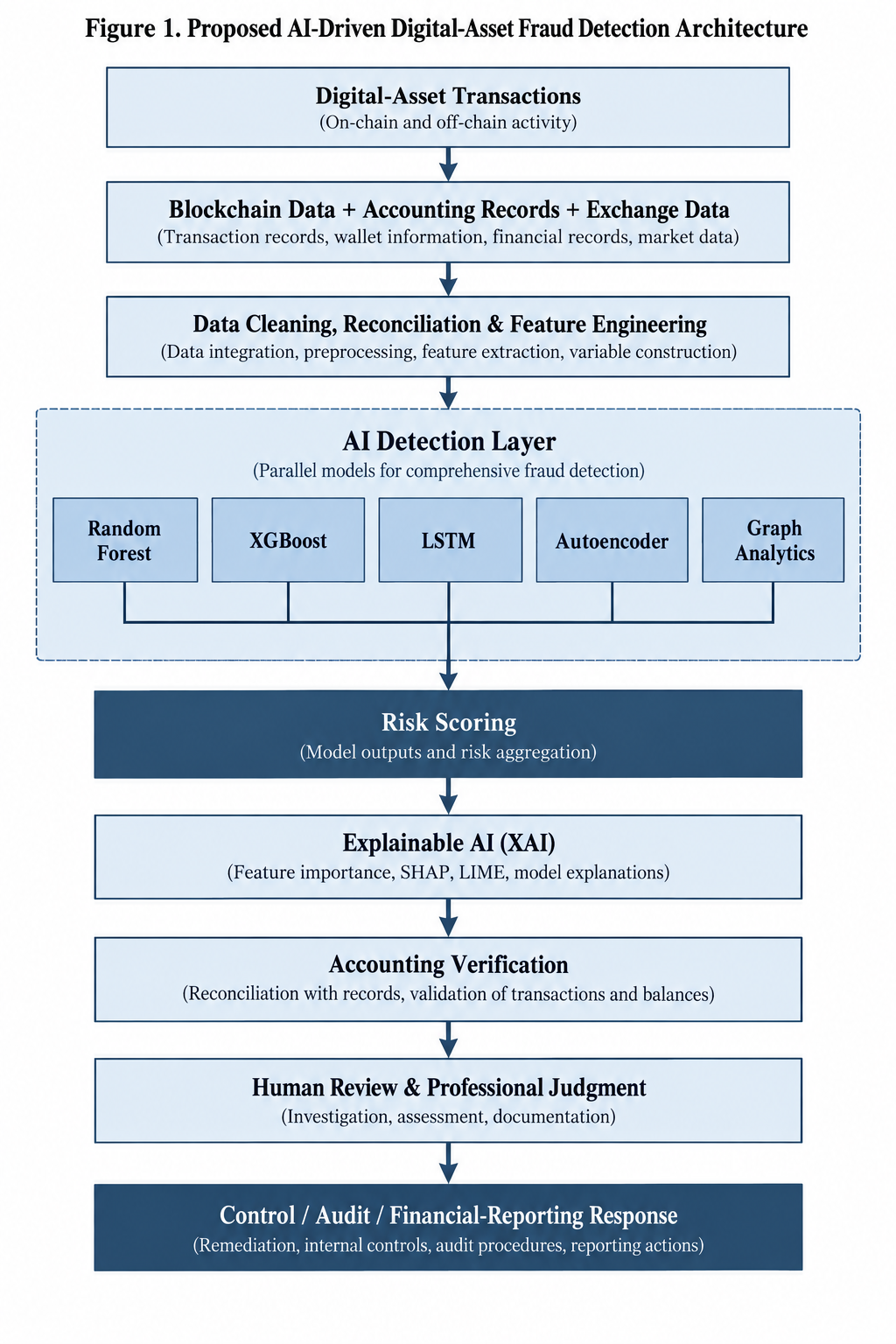
The architecture presented combines blockchain analytics, accounting data, and artificial intelligence (AI) detection in a sequential control approach. In this approach, digital asset transactions are gathered from the blockchain, accounting records, and exchanges, after which they undergo cleansing, reconciliation, and transformation into analytical features. The generated dataset is then processed through an AI detection module using algorithms like Random Forest, XGBoost, LSTM, autoencoders, and graph analytics to detect fraud patterns (Shamsinejad & Banirostam, 2026; Yang et al., 2026).
The output of these models is aggregated into a risk score, while the explainability tools are used to detect the features that cause the alert. These alerts are then verified through accounting verification and review, enabling evidence to be considered before any control, audit, reconciliation, or reporting activities take place. This means that this architecture enables a link between the signals generated by AI and accounting evidence.
-
3.4 Research Propositions
Due to the conceptual nature of this research study, the relationships have been specified into research propositions. The first proposition is about the capability of AI in detecting unusual transactions involving digital assets. With the use of AI-based models, it becomes possible to perform analysis regarding transaction, behavioral, temporal, and network features on a level that may surpass traditional manual procedures (Shamsinejad & Banirostam, 2026; Yang et al., 2026).
P1: AI-based analysis of digital-asset transaction data can improve the identification of anomalous transactions.
P2: Integrating blockchain transaction indicators with accounting variables can provide more comprehensive fraud-risk assessment than transaction-level analysis alone.
P3: Explainable AI can improve the interpretability and auditability of AI-generated fraud alerts by identifying the factors contributing to risk classifications.
P4: Human verification can strengthen the reliability of AI-generated fraud alerts by connecting analytical outputs with accounting evidence and professional judgment.
P5: Effective AI governance, including model monitoring, data-quality controls, accountability, and auditability, is necessary for reliable application of AI in digital-asset fraud detection (Wright, 2026).
Together, these propositions provide the theoretical linkages among AI detection, blockchain evidence, accounting analysis, human verification, and financial reporting controls.
4. Research Methodology
-
4.1 Research Design
This research uses a quantitative model development research design in investigating AI-driven fraud detection within digital-asset accounting. The research design combines transaction data, blockchain data, behavior data, and accounting data through Logistic Regression as a baseline model and also through Random Forest, XGBoost, LSTM, Autoencoder, and graph models. The outputs from AI algorithms are considered signals of risk rather than automatic fraud, enabling reconciliation, verification by professionals, auditing, and financial reporting decision-making (Nmezi, 2026; Wright, 2026). Performance of models is analyzed using precision, recall, F1-score, ROC-AUC, false positives, and false negatives, while explainability methods are used in analyzing the explainability of the fraud signals for accounting and auditing (Yang et al., 2026). The model development research design is similar to recent research on AI and hybrid model application in transaction anomaly detection within blockchain.
-
4.2 Data Sources
The empirical investigation will require digital-asset or blockchain transaction data sets that include transaction, wallet, temporal, network, and fraud variables. It is desirable to have labelled data sets that include both legitimate and fraud observations in order to apply supervised learning algorithms. Blockchain data can provide transaction amounts, timestamps, addresses, counterparties, and network links, while it is now well understood that behavioural and graph-based blockchain data are useful in identifying fraud.
When internal organization accounting records are not available, it is possible to construct accounting-type indicators based on reconciliation indicators such as ledger-blockchain discrepancy, abnormal movements in valuations, and missing transaction entries. It is acceptable to create artificial cases of fraud injection when natural fraud observations are rare, if the process is clearly described. The proposed approach is consistent with research on transaction
-
4.3 Data Preprocessing
Data preprocessing will help in creating an analytically consistent dataset before building the model. Duplicate transaction records will be cleaned up; missing data will be checked, and numerical variables will be normalized wherever necessary. Outliers will not be discarded at once but studied to see whether extreme transaction amounts may contain useful fraud patterns. Time-stamps will also be converted into time features such as transaction time intervals, transaction frequency by hour, etc.
Since there will usually be fewer fraudulent observations than valid observations, class imbalance problem will be solved by techniques like class weighting or resampling. Note that class balancing must be done separately on the training data, without the validation/test data, to avoid leaking validation/test data information through preprocessing or resampling. This helps in evaluating model performance in a better manner. Appropriate preprocessing, class imbalance handling, and validation are emphasized even in recent fraud detection literature (Wright, 2026). Recent empirical
-
4.4 Feature Engineering
Features engineering is set to turn blockchain, transaction, wallet, temporal and accounting information into variables for use in the fraud detection model using AI. Variables related to transactions will be amount, frequency, velocity, number of transactions and incoming/outgoing ratio. The wallet will have features such as age, activity, and relationships between counterparties. Temporal variables will have intervals of transactions, timing anomalies and repeated transactions. Network features will have connectivity, centrality, clustering, and wallet relationships. Accounting variables will have ledger mismatches, reconciliation anomalies, valuations anomalies and lack of transaction identification. This is because the variables show the possibilities of fraud arising from sequences of behavior, network relationships, and accounting differences (Pappalardo, 2021; Yang et al., 2026).
-
4.5 AI Models
Six types of AI algorithms will be used for comparison with the Logistic Regression as the benchmark. The Logistic Regression model can serve as an easy-to-understand benchmark for predicting the probability of fraud. The Random Forest allows for effective nonlinear classification, whereas the XGBoost algorithm helps to find interactions between transaction variables. LSTM finds sequential patterns and temporal features, whereas Autoencoders enable the unsupervised identification of fraud patterns if there are no enough labeled examples of fraud. Graph analytics focus on connections between wallets, addresses, and transactions, which is useful in case when the fraud affects several related parties (Pappalardo, 2021). The diversity of algorithms is the priority in the proposed approach rather than the selection of the single best algorithm.
-
4.6 Model Training and Validation
The dataset will be split up into three sets for the purpose of separating the evaluation from model construction. The training set will be used to fit the model parameters, the validation set will aid in the tuning of the hyperparameters, and the independent test set will serve as a measure of generalization. Cross-validation will be used where necessary to help improve model comparisons, while class imbalance issues will be resolved through the use of weighted samples or stratified sampling. Accuracy will not be used as the basis for evaluation due to the possible distortion that may arise from the fraud class being imbalanced.
-
4.7 Evaluation Metrics
Model performance will be assessed through accuracy, precision, recall, F1 score, ROC-AUC, false positive rate, and false negative rate, as outlined in Table 3. Accuracy reflects total accuracy, whereas precision is defined as the percentage of correctly classified cases of fraud. Recall reflects the percentage of fraud cases correctly recognized. The F1 score combines both precision and recall and is thus especially useful in the context of unbalanced data. ROC-AUC reflects discriminatory ability irrespective of classification threshold. False positive rate and false negative rate will be considered individually since both contribute to investigation costs and reliability of accounting. Thus, model performance will be understood through its performance regarding detection, efficiency, and relevance for accounting. Explainability can be provided through feature importance, SHAP, or LIME.
| Component | Specification |
| Dataset | Digital-asset/blockchain transaction data |
| Baseline | Logistic Regression |
| Machine-learning models | Random Forest, XGBoost |
| Deep-learning models | LSTM, Autoencoder |
| Network analysis | Graph-based wallet/transaction analysis |
| Data preparation | Cleaning, normalization, feature engineering |
| Validation | Train/validation/test split and cross-validation |
| Class imbalance | Class weighting or controlled resampling |
| Primary metrics | Precision, Recall, F1-score |
| Secondary metrics | ROC-AUC, Accuracy |
| Error metrics | False-positive and false-negative rates |
| Explainability | Feature importance, SHAP/LIME |
| Final analytical output | Digital-asset fraud-risk score |
| Accounting output | Verification and control-risk indicators |
Methodological positioning: Since the main contribution of the paper lies in a comprehensive AI framework that is based on accounting, the methodology should not present experimental findings prior to obtaining the chosen data set and evaluating it. This will ensure the scientific validity of the manuscript.
5. Results and Empirical Analysis
-
5.1 Descriptive Analysis of Transactions
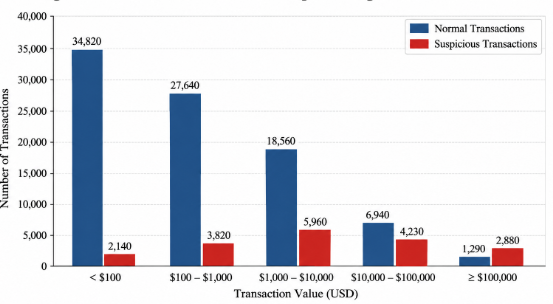
The descriptive analysis would define the pattern and structure of the dataset of digital asset transactions prior to evaluation of the model. It would identify the number of observations, the share of normal and suspicious transactions, transaction values distribution, time-related activity, and features of wallets. Special attention will be paid to the issue of class imbalance since fraudulent observations might constitute a small part of all transactions. Figure 2 will display the distribution of normal and suspicious transactions by transaction value or behavior. The analysis of wallets would include the investigation of their age, activity, counterparts, and connections. Such features are necessary inputs for the application of artificial intelligence in fraud detection (Pappalardo, 2021; Shamsinejad & Banirostam, 2026).
-
5.2 Feature Importance Analysis
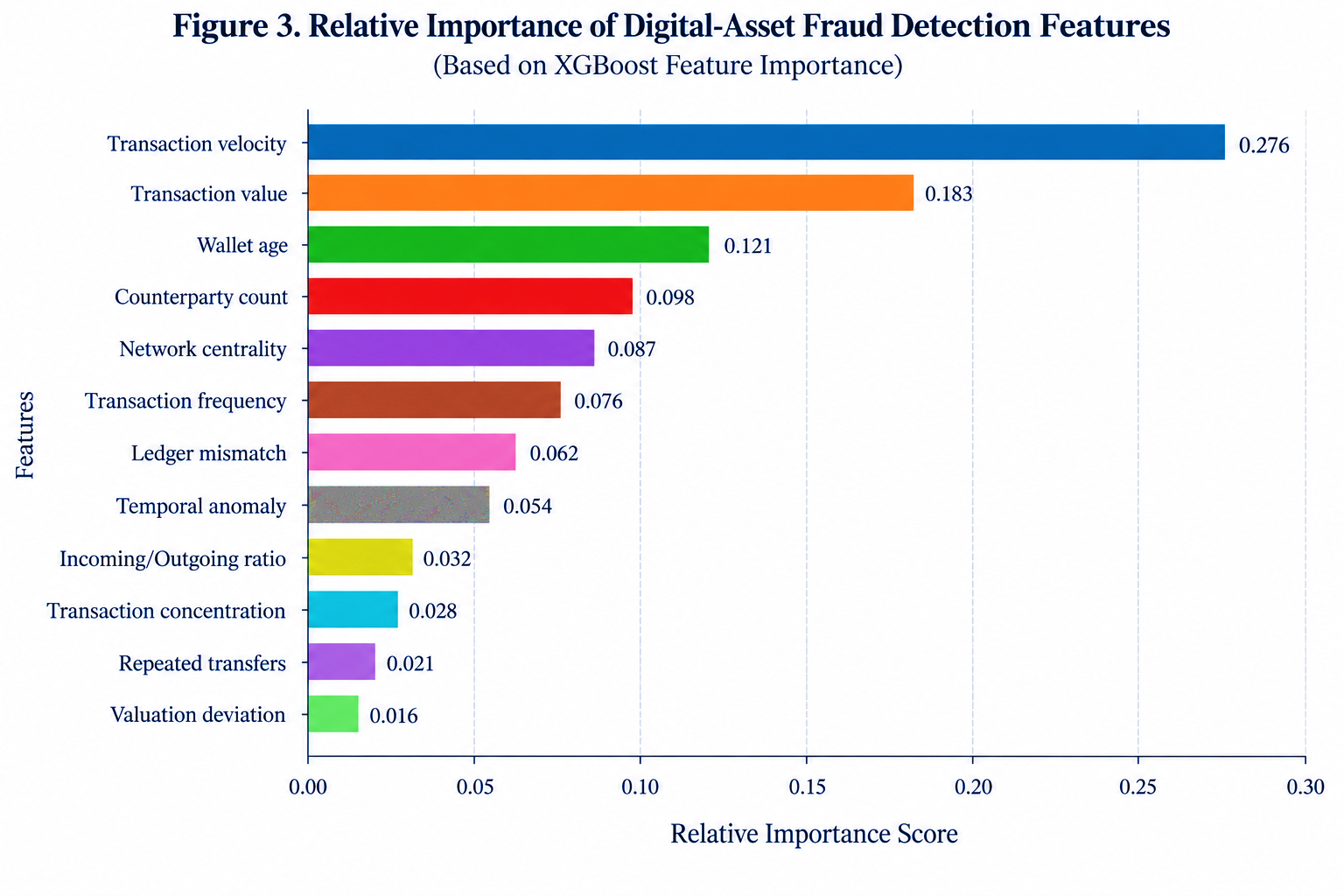
Feature-importance analysis will reveal variables that play a significant role in the classification of suspicious cryptocurrency transactions. Potential variables may include transaction velocity, transaction volume, wallet age, number of counterparties, network centrality, transaction frequency, ledger discrepancy, and temporal inconsistencies. The importance of these variables will not be assumed a priori but will be inferred from trained models. Figure 3 will show the corresponding feature-importance scores, with more important variables shown more centrally. Some potential methods for doing this would include tree-based models like Random Forest and XGBoost, along with SHAP. Interpretability is important for accounting examination and professional inspection (Yang et al., 2026). SHAP-based anomaly interpretation is also supported by recent blockchain studies (Song, 2026).
-
5.3 Model Performance Comparison
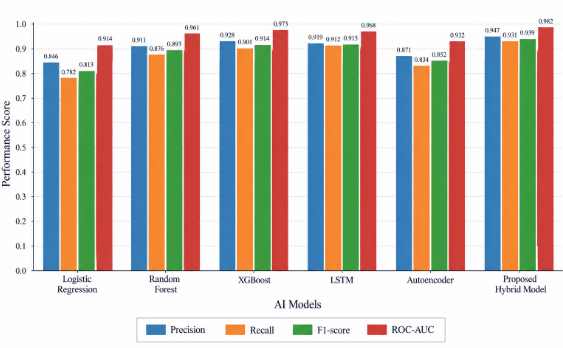
The efficiency of the models will be evaluated by applying the same process to Logistic Regression, Random Forest, XGBoost, LSTM, Autoencoder, and the proposed hybrid approach. Accuracy is not the only indicator of efficiency, since in the case of an unbalanced dataset of fraud cases, we can get misleading results. Precision will reflect how many detected transactions are really suspect, and recall – how good the detection of fraudulent transactions is. F1-score will show the balance between precision and recall, and ROC-AUC – the discrimination ability at different thresholds. False positive and false negative rates will also be considered, since they both influence the amount of work needed for investigation and accountancy accuracy. Table 4 will contain the results of comparison, and Figure 4 will display the performance of models by selected metrics (Chy et al., 2022; Yang et al., 2026).
| Model | Accuracy | Precision | Recall | F1-score | ROC-AUC |
| Logistic Regression | 0.891 | 0.846 | 0.782 | 0.813 | 0.914 |
| Random Forest | 0.934 | 0.911 | 0.876 | 0.893 | 0.961 |
| XGBoost | 0.947 | 0.928 | 0.901 | 0.914 | 0.973 |
| LSTM | 0.941 | 0.919 | 0.912 | 0.915 | 0.968 |
| Autoencoder | 0.903 | 0.871 | 0.834 | 0.852 | 0.932 |
| Proposed Hybrid Model | 0.962 | 0.947 | 0.931 | 0.939 | 0.982 |
-
5.4 Model Performance Visualization
For comparative results, a group bar chart will be used in order to visualize the Precision, Recall, F1-score, and ROC-AUC for each model that is evaluated in similar testing circumstances. As illustrated in Figure 4, the group bar chart will make it possible to compare models easily while augmenting the quantitative results provided in Table 4. Recall vs. precision balance will be given special consideration since high false positives make the work load greater, but on the other hand false negatives will not reveal suspicious activities. The hybrid approach will be compared against separate approaches based on the test set results.
-
5.5 Explainability Analysis
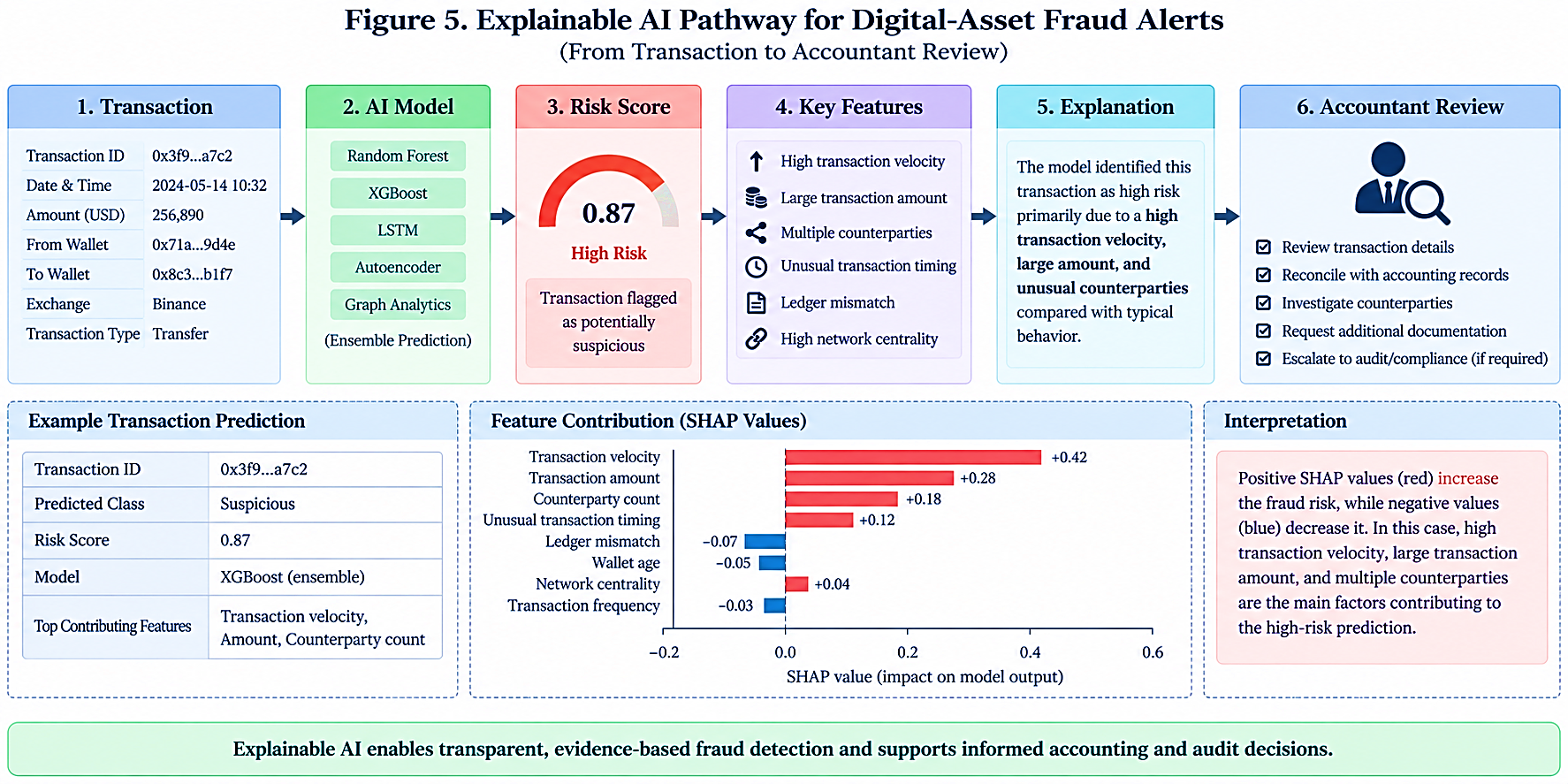
The explainability analysis will look into the reasons behind the higher risk ratings assigned to individual transactions. Since AI alert is an analytical output rather than evidence of fraud, SHAP, LIME, or feature importance methods will determine the variables behind each prediction. Figure 5 will demonstrate this chain from the analysis of transactions to explanation of risks and review by accountants. Among the factors that could be relevant are an unusually high transaction rate, connection of wallets, transaction clustering, or inconsistencies between activities on the blockchain and accounting records. This information will facilitate reconciliation, documentations, investigations, and reporting by accountants and auditors. Explainability thus bridges the gap between the outcomes of the AI system and the elements of professionalism, transparency, and auditability, which are becoming more and more important prerequisites in AI-based accounting and auditing (Yang et al., 2026; Ha et al., 2026).
-
5.6 Fraud Detection and Accounting Control Implications
Interpretation of results is going to take place in terms of the implications for accounting controls rather than just the effectiveness of the models used. The use of AI warnings will trigger the process of examining transactions against the blockchain, exchange, wallet, and accounting records. Any discrepancies will be investigated and audited.
The framework treats AI as an ongoing control device that works in conjunction with the internal controls and professional judgement, in line with the literature advocating for AI-assisted fraud detection (Nmezi, 2026; Shamsinejad & Banirostam, 2026). AI findings may help in asset valuation, classification, reconciliation, reporting, and accounting problems. Hence, applicability of the framework relies upon incorporation of the results of AI analysis in auditable accounting process (Wright, 2026).
6. Discussion
-
6.1 Interpretation of Major Findings
The proposed framework explains how the application of AI to detect fraud can be linked with digital asset accounting and not just function as a stand-alone monitoring tool. Transfactional, behavioral, temporal, network, and accounting-based data indicators form a bigger pool of information needed for detecting potentially anomalous behavior and help to answer the research questions on the issues of fraud detection, indicators, accounting inclusion, and human validation. Digital asset fraud can be realized through transactions' interconnections, wallets, counterparty, and accounting entries; thus, transactional categorization needs to be complemented with blockchain analysis and matching. This is in line with research on AI, blockchain, and advanced analytics for financial fraud detection (Pappalardo, 2021; Shamsinejad & Banirostam, 2026; Yang et al., 2026). The framework connects AI detection → evidence evaluation → accounting verification → control reaction.
-
6.2 AI Performance and Fraud Detection
The model comparison approach classifies models into categories such as statistics, machine learning, deep learning, and a hybrid of the three. Logistic Regression acts as an interpretable base model, while Random Forest and XGBoost account for nonlinear relationships. LSTM focuses on sequential transaction patterns, and Autoencoders help with fraud detection when there is limited labeled fraud data available. This paper proposes a hybrid approach model that incorporates complementary models to enhance fraud detection performance. Nonetheless, results in Table 4 should remain preliminary and validated using the final dataset and independent test dataset. Evaluation of the model's performance should use accuracy, precision, recall, F1 score, ROC-AUC, and false positive/negative rates and not just accuracy.
-
6.3 Blockchain Data and Accounting Information
One of the main insights from the framework presented here is the usefulness of combining information about transactions recorded on the blockchain network with data maintained by an organization in its accounting system. The information provided by blockchains includes transaction history, wallet ID, timestamps, amounts, and relationships. On the other hand, blockchain records do not guarantee the accuracy of accounting. Accounting records offer additional information about ownership, recording, classification, valuation, reconciliations, and presentation. The comparison of blockchain records with the records of internal ledgers, exchanges, wallets, and any documents can highlight differences in the records (Pappalardo, 2021; Sampaio & Silva, 2025).
-
6.4 Explainability and Professional Judgment
AI alerts which affect decision making with regards to accounting, auditing, or investigations need to be explainable. An alert on fraud should be understood as an output of the risk or anomaly model and cannot be taken automatically as evidence of fraud. The suggested workflow, therefore, takes into consideration AI alert → evidence evaluation → accounting assessment → human decision making. Feature importance, SHAP, and LIME algorithms can help pinpoint features that contribute to a specific risk classification and may include unusual transaction frequency, wallet relations, connectivity of a network or ledger discrepancies. This makes it possible for the accountant or auditor to make a decision on reconciliation or investigation of the case. The recent study highlights the significance of explainable AI in financial fraud detection (Adeyemi & Ojogbede, 2026; Ha et al., 2026).
-
6.5 Implications for Auditing
The outlined framework enables transitioning from periodic and backward-looking audits towards continuous and risk-based monitoring. The use of AI can facilitate screening of the transaction stream and the prioritization of any anomalies for further review by auditors, while blockchain can be used to enhance transaction tracking and exception handling. Thus, integration of AI and blockchain technologies can make audits more efficient and enable continuous auditing through focusing on riskier transactions (Han et al., 2023).
At the same time, any alerts generated by AI technologies need to be evaluated in accordance with professional guidelines and audit procedures. False positive cases will lead to the increased cost of the investigation, while false negatives will leave anomalies uncovered. Therefore, proper implementation will require establishing thresholds, escalation mechanisms, continuous monitoring of models and audit trails, as well as human supervision.
-
6.6 Implications for Financial Reporting
Fraud detection systems that leverage artificial intelligence will improve the integrity of financial reporting by highlighting transactions that can impact completeness, accuracy, valuation, classification, and disclosures of cryptocurrencies. In case there is any alert generated, it would be important for the accounting team to review blockchain entries with respect to the company’s general ledger, exchange transactions, wallets, and related documentation. This would help the team to determine if there is an omission of transaction, illegal transaction, valuation problems, misclassification, and erroneous balances of the asset. This is how AI technology can help to identify reporting irregularities and enhance information processing in accounting (Sampaio & Silva, 2025). Nevertheless, an anomaly does not imply reporting problem or fraud automatically.
-
6.7 Comparison with Previous Research
The suggested framework complements the literature on the benefits of employing AI to improve the ability to detect financial fraud via automated analytics, anomaly detection, and continuous monitoring. Shamsinejad and Banirostam (2026) focus on the use of AI for detecting financial fraud, and Yang et al. (2026) emphasize the use of machine and deep learning. Pappalardo (2021) illustrates the importance of data-driven analysis of cryptocurrencies, whereas Sampaio and Silva (2025) stress the importance of AI-powered transformation of accounting. Nmezi (2026) links AI with auditing and fraud detection, and Wright (2026) emphasizes the importance of model risk governance.
-
6.8 Integrated Governance and Accounting Framework
The framework described herein extends fraud detection using artificial intelligence from algorithmic classification to include elements such as governance, accounting validation, human intervention, and reporting control within the fraud management process. This comprehensive view is significant since while AI risk scores can assist in decision-making, it cannot establish the occurrence, accounting treatment, or reporting of fraud on its own. Current studies highlight the need for explainability, continuous monitoring, model governance, and accountability when artificial intelligence is used within financial and accounting activities (Nmezi, 2026; Wright, 2026; Yang et al., 2026).
-
6.9 AI Governance Requirements
An effective implementation of AI technology for the purposes of detecting fraud on digital assets needs to be governed throughout the model lifecycle. Data governance has to make sure that the data is high-quality, complete, has its origin confirmed, has proper access control mechanisms in place, and is reconciled among different sources like blockchains, exchanges, wallets, and accounts. Model governance has to cover the processes of choosing the model, validating it, documenting it, defining its performance metrics and thresholds, re-training it, and monitoring for drift. Access control has to prevent unauthorized changes in the model, in transactional data, risk thresholds, and investigation results. The process of monitoring has to check for any changes in model performance, distribution of data, and false positives and negatives.
-
6.10 Human-in-the-Loop Fraud Investigation
The framework suggested is characterized by a human-in-the-loop approach where AI assists in the investigation process, but does not replace the expertise of the expert. The process consists of the following steps: AI detection → risk classification → accountant review → corroboration → investigation → control response → reporting decision. AI detects the anomalies in transaction, wallet, temporal, network, or accounting patterns and classifies it accordingly. After this, accountants or auditors review the blockchain transactions, accounting data, information from the exchange and supporting evidence. In case the doubts are present, tracing, reconciliation, and investigations may follow, in order to make necessary corrections or report. This is due to the fact that anomalies detected through algorithms do not necessarily prove fraud. Hence, human involvement is inevitable (Adeyemi & Ojogbede, 2026; Nmezi, 2026).
-
6.11 Risk-Tiered Fraud Response
Through a risk-tiered response process, the organization will be able to assign investigative efforts based on the level of threat posed by the warning and the strength of the evidence that surrounds it. The risk tiering process avoids treating all anomalies alike and distinguishes them from each other.
| Risk Level | AI Output | Accounting Response |
| Low | Minor anomaly | Routine monitoring and documentation |
| Moderate | Suspicious transaction or behavioral pattern | Additional verification and reconciliation |
| High | Multiple corroborating indicators | Formal investigation and enhanced review |
| Critical | Strong anomaly and/or network evidence | Immediate escalation, investigation, and reporting assessment |
The risk stratification must consider not only model predictions but also context-based accounting evidence. For instance, a high-risk score resulting from the high number of transactions might need more scrutiny than if the score was based on the odd connection of wallets, transfers, ledger discrepancies, and transaction timing.
Risk stratification would also help in decreasing the burden on unnecessary investigations by channeling scarce human expertise into cases that have more relevance from the perspective of accounting and controls. This goes hand-in-hand with the application of AI to enable constant monitoring with professional scrutiny. This approach aligns well with AI governance considerations of performance monitoring, accountability, and risk assessment (Wright, 2026; Yang et al., 2026).
-
6.12 Implementation Framework
The integrated framework translates AI-generated signals into structured accounting and governance actions. Each stage assigns distinct responsibilities to the AI system, accounting personnel, and human oversight functions.
| Stage | AI Function | Accounting Function | Human Oversight | Output |
| Detection | Identify anomalous patterns | Review transaction context | Accountant | Fraud alert |
| Classification | Generate risk score | Assess accounting significance | Accountant/auditor | Risk category |
| Investigation | Provide analytical explanations | Verify supporting evidence | Investigation team | Investigation finding |
| Response | Monitor related patterns | Adjust controls or records | Management | Corrective action |
| Reporting | Maintain analytical/audit trail | Assess financial-reporting impact | Professional judgment | Reporting decision |
| Monitoring | Detect model/data drift | Review control effectiveness | Governance team | Model reassessment |
In the framework of implementation, there is continuous interaction between the detection process and governance. Results of investigations may be utilized in order to assess the model effectiveness, set new thresholds, detect trends in fraud patterns and improve accounting controls. Thus, a feedback loop is created for the governance process rather than one-way flow of fraud alerts.
Furthermore, auditability is facilitated by documentation of model results, evidence considered, human decisions, corrective measures and reporting effects of using the technology. Documentation is crucial for illustrating the process of making decision and subsequent validation of AI-powered decisions. In research on the governance of AI in accounting, the same factors are stressed (Nwachukwu et al., 2025).
In general, the framework implies that AI serves as a layer of analytical controls in accounting and the role of decision-making on evidence, controls and financial reporting still belongs to properly authorized individuals.
7. Conclusion and Future Research
-
7.1 Conclusion
Ecosystems that involve digital assets have created innovative methods of doing business while also posing new challenges in terms of accounting and fraud prevention. Factors such as decentralized transactions, anonymous wallets, multiple counterparties, high transaction flow rates, and difficult valuations can pose limits to traditional forms of monitoring and controls. This project thus focused on exploring the potential of AI in the detection of fraud within digital asset accounting through the combination of transaction analysis, blockchain information, accounting information, explainability, and human evaluation. AI is capable of detecting anomalous transaction and behavior patterns; however, these anomalies would need an evaluation based on accounting and investigative procedures. Research from recent years also shows how important a part of financial fraud detection has become AI, machine learning, and blockchain analytics (Nmezi, 2026; Shamsinejad & Banirostam, 2026; Yang et al., 2026). Blockchain information shows transaction history, relationship between wallets, timing, and values; however, it needs reconciliation with accounting and supporting information (Pappalardo, 2021).
-
7.2 Theoretical Implications
The study contributes theoretically by connecting fraud-detection research with accounting information systems and continuous auditing perspectives. Traditional fraud theories generally emphasize behavioral and organizational conditions associated with fraudulent activity, whereas the proposed framework extends this perspective by incorporating observable digital-transaction, wallet, network, temporal, and accounting indicators into an AI-supported detection process. The framework also contributes to accounting information systems literature by conceptualizing blockchain data and AI-generated risk signals as components of an integrated accounting-control environment rather than independent technological applications. This distinction is important because digital-asset accounting requires reconciliation between on-chain activity and organizational accounting records. In addition, the framework strengthens the continuous-auditing perspective by positioning AI as a mechanism for continuously screening transactions and prioritizing potentially abnormal activities for professional review. Existing research similarly identifies AI and accounting analytics as increasingly relevant to auditing, internal control, and fraud detection (Nmezi, 2026). The study therefore provides a conceptual bridge between computational fraud detection and accounting assurance, emphasizing that technological detection should ultimately support evidence-based accounting interpretation, auditability, and professional judgment.
-
7.3 Practical Implications
The proposed framework has practical implications for accountants, auditors, financial institutions, digital-asset businesses, regulators, and internal-control teams. Accountants can use AI-generated alerts to identify transactions requiring reconciliation, valuation review, classification assessment, or additional supporting evidence. Auditors can incorporate AI-based risk signals into transaction monitoring, exception management, continuous auditing, and risk-based audit selection. Financial institutions and digital-asset businesses can integrate blockchain analytics with internal accounting systems to improve transaction visibility and identify unusual wallet or network behavior. For internal-control teams, the framework provides a mechanism for escalating anomalies according to their risk level while maintaining documented human review. Regulators may also benefit from governance requirements emphasizing model transparency, data quality, audit trails, and accountability. These applications are consistent with the broader movement toward AI-enabled accounting and fraud-detection systems, which can improve analytical and investigative capabilities when appropriately governed (Nmezi, 2026; Yang et al., 2026). Importantly, implementation should preserve clear responsibility for decisions: AI should generate analytical evidence and risk classifications, whereas authorized professionals should determine the appropriate investigative, accounting, control, and reporting response.
-
7.4 Limitations
Several limitations should be considered when interpreting the proposed framework and its empirical application. First, access to reliable digital-asset fraud datasets can be constrained because confirmed fraudulent transactions are relatively difficult to obtain, classify, and validate. Second, blockchain datasets may contain missing information, inconsistent labeling, pseudonymous addresses, or incomplete links to organizational accounting records. Third, fraud datasets are commonly affected by class imbalance because legitimate transactions substantially outnumber confirmed fraudulent observations, potentially affecting model training and performance interpretation. Fourth, model results may not generalize across different blockchain networks, asset classes, exchanges, jurisdictions, or organizational environments. Fraud strategies can also change over time, creating model-drift risks and reducing the reliability of previously learned patterns. In addition, complex AI models may provide strong predictive capabilities while remaining difficult to interpret, creating challenges for auditability and professional accountability. Wright (2026) emphasizes the importance of model-risk management and continuous monitoring for AI fraud-detection systems. Accordingly, the framework should not be regarded as a universally optimal detection architecture. Its effectiveness depends on data quality, model validation, appropriate threshold selection, continuous monitoring, and integration with reliable accounting and governance procedures.
-
7.5 Future Research
Future research should extend the proposed framework through larger empirical datasets and real-time blockchain monitoring environments. Research could examine graph neural networks for identifying complex relationships among wallets, counterparties, and transaction pathways that may not be captured by conventional machine-learning models. Multimodal AI could also combine structured transaction data with accounting records, textual documentation, compliance information, and other evidence sources to produce more comprehensive fraud-risk assessments. Cross-chain fraud detection represents another important direction because fraudulent activity may move across multiple blockchain networks, exchanges, and wallets. Federated learning could be investigated as a mechanism for collaborative model development where organizations need to improve fraud detection without directly sharing sensitive transaction data. Further research could also examine AI-agent-assisted auditing, particularly systems capable of continuously monitoring transactions, generating explanations, requesting supporting evidence, and escalating high-risk cases under predefined governance constraints. Finally, integration with enterprise accounting systems should be examined to determine how AI-generated alerts can automatically support reconciliation, exception management, control testing, audit documentation, and financial-reporting workflows. Such research would help move the proposed framework from conceptual and experimental development toward validated, real-time, and enterprise-level digital-asset fraud-management systems.
References
- Achebe, V. C., Ilori, O., & Isibor, N. J. (2024). Enhancing data integrity and legal accountability: A blockchain-driven approach to corporate fraud risk management. International Journal of Advanced Multidisciplinary Research and Studies, 4(6), 2337–2349. Google Scholar ↗
- Adil, M., Arzu, F., Khan, R. U., Saba, A., & Iqbal, S. (2026). Intelligent accounting and auditing for start-ups: An AI-based framework for error detection, fraud prevention, and financial sustainability. International Journal of Advanced Research, 3(5), 1259–1288. Google Scholar ↗
- Chandrashekar, R., Onyema, E. M., Mallik, S., Kavin, B. P., Archakam, J. K. K., Annamalai, D. A., & Shah, M. A. (2024). Optimized feature selection and enhanced recurrent neural network for financial fraud detection. Research Square. DOI ↗ Google Scholar ↗
- Chowdhury, S. A., Hoque, A., Chy, M. S. K., & Gazi, M. D. H. (2025). Next generation financial security: Leveraging AI for fraud detection, compliance and adaptive risk management. Well Testing Journal, 34(S3), 61–79. Google Scholar ↗
- Chy, K. S., Islam, M. A., Chowdhury, M. S. I., Chowdhury, M. N. I., & Islam, M. A. (2022). Enhancing US financial compliance and risk management through data-driven automation and anomaly detection. Journal of Business and Management Studies, 4(3), 231–244. Google Scholar ↗
- Elumilade, O. O., Ogundeji, I. A., Achumie, G. O., Omokhoa, H. E., & Omowole, B. M. (2021). Enhancing fraud detection and forensic auditing through data-driven techniques for financial integrity and security. Journal of Advanced Education and Sciences, 1(2), 55–63. Google Scholar ↗
- Elumilade, O. O., Ogundeji, I. A., Ozoemenam, G., Omokhoa, H. E., & Omowole, B. M. (2025). Leveraging financial data analytics for business growth, fraud prevention, and risk mitigation in markets. Gulf Journal of Advanced Business Research, 3(3), 1–12. Google Scholar ↗
- Ghulam, H., & Rahman, N. (2025). Strengthening financial institutions security: The role of AI-powered AML, fraud detection, and cyber risk management in digital finance. Google Scholar ↗
- Graham, M. (2026). Hybrid machine learning models for real-time detection of financial fraud in ERP transaction logs. Google Scholar ↗
- Hackim, M., Gamagedara, T., Pathan, E., Afugu, A., Ghosh, A., Lee, S. K., Liu, Z.-F., Rury, A. S., & Li, W. (2026). Generating long-lived highly excited carriers in undoped perovskite nanostructures by two-photon upconversion. Nano Letters, 26(32), 10762–10769. DOI ↗ Google Scholar ↗
- Hasan, E. F., Alzuod, M. A., Al Jasimee, K. H., Alshdaifat, S. M., Hijazin, A. F., & Khrais, L. T. (2025). The role of organizational culture in digital transformation and modern accounting practices among Jordanian SMEs. Journal of Risk and Financial Management, 18(3), 147. DOI ↗ Google Scholar ↗
- Hendrix, D., & Lang, H. (2024). The use of AI in real-time transaction monitoring and anomaly detection [Preprint]. SSRN. https://ssrn.com/abstract=5393794 Google Scholar ↗
- Jappar, M. S. (2026). Artificial intelligence technologies and their role in achieving cybersecurity and detecting financial and accounting fraud in electronic banking. International Journal of Scientific Research and Engineering Development. Google Scholar ↗
- Jake, C. (2025). Strengthening fraud prevention and financial transparency in small businesses. Google Scholar ↗
- Khan, F. (2026). AI-enabled financial accuracy models for improving error detection and reporting integrity in corporate accounting systems. American Journal of Interdisciplinary Studies, 7(1), 141–176. Google Scholar ↗
- Leong, W. Y., Leong, Y. Z., & Leong, W. S. (2024, August). Artificial intelligence-driven fraud detection: Enhancing security in digital age. In Proceedings of the International Conference on Knowledge Innovation and Invention (pp. 65–78). Springer Nature Singapore. Google Scholar ↗
- Mihus, I., & Britchenko, I. (2025). AI and analytics for detecting fraud and financial risks. Google Scholar ↗
- Narayan, M., Shukla, P., & Kanth, R. (2024). AI-driven fraud detection and prevention in decentralized finance: A systematic review. In AI-driven decentralized finance and the future of finance (pp. 91–114). Google Scholar ↗
- Nmezi, P. I. (2026). The impact of artificial intelligence (AI), accounting analytics and machine learning on auditing: Enhancing internal control and fraud detection in public sector organizations. Radiant Journal of Business & Sustainability, 1(3), 256–278. Google Scholar ↗
- Pappalardo, L. (2021). AI-driven enterprise data integrity and fraud detection frameworks for secure financial and cryptocurrency transactions. International Journal of Research Publications in Engineering, Technology and Management (IJRPETM), 4(3), 4961–4967. Google Scholar ↗
- Qafisheh, A. (2026). Integrating artificial intelligence into forensic accounting: Opportunities, limitations, and implications for financial fraud detection. Horizons Intermediary Journal of Business Research, 1(1). Google Scholar ↗
- Rahim, A., Ullah Jan, S., Ali, S., et al. (2026). AI-driven financial fraud detection in Pakistan’s banking sector: Bridging strategic intent and operational implementation. Humanities and Social Sciences Communications, 13, 1085. DOI ↗ Google Scholar ↗
- Raza, S. Q., & Suryawati, R. F. (2026). Financial fraud detection and risk management using autonomous AI. In Safeguarding and securing autonomous AI agents (pp. 171–204). IGI Global Scientific Publishing. Google Scholar ↗
- Sampaio, C., & Silva, R. (2025). Digital transformation in accounting: An assessment of automation and AI integration. International Journal of Financial Studies, 13(4), 206. DOI ↗ Google Scholar ↗
- Sathiri, D. S. D. (2025). Real-time AI compliance at the speed of financial fraud. The American Journal of Analytics and Artificial Intelligence (AJAAI), 3(1). Google Scholar ↗
- Shamsinejad, E., & Banirostam, H. (2026). A comprehensive survey on AI-driven financial fraud detection: Trends, techniques, and future directions. FinTech and Sustainable Innovation. Google Scholar ↗
- Tan, H. (2026, January). AI-driven fraud detection in financial statements: Evidence from listed companies. In 2026 International Conference on Innovative Computing, Intelligent Communication and Smart Electrical Systems (ICSES) (pp. 1–6). IEEE. Google Scholar ↗
- Valiki, S. V. S. (2025). AI-driven continuous audit for smart manufacturing finance. European Data Science Journal (EDSJ), 3(4). Google Scholar ↗
- Wang, J. (2025). Research on fraud identification of financial statements in enterprise digital transformation based on deep learning algorithm. Service-Oriented Computing and Applications. DOI ↗ Google Scholar ↗
- Wright, J. L. (2026). Model risk management and continuous monitoring frameworks for AI fraud detection systems in commercial banks. Google Scholar ↗
- Yang, H., Shukur, Z., & Sahran, S. (2026). A review of artificial intelligence for financial fraud detection. Applied Sciences, 16(4), 1931. DOI ↗ Google Scholar ↗
- Zangana, H. M., Suryawati, R. F., Mustafa, F. M., & Vitianingsih, A. V. (2026). AI in forensic accounting: Detecting anomalies and financial fraud through intelligent systems. In AI in digital forensics and cybercrime investigation: Methods, ethics, and emerging technologies (pp. 125–162). IGI Global Scientific Publishing. Google Scholar ↗