Abstract
Avocado (Persea americana Mill.) is a plant that can thrive in tropical areas such as Indonesia. Avocados have many health benefits, but people tend not to use avocado seeds for medicine and more often make them waste. Avocado seeds have chemical content, namely alkaloids, triterpenoids, tannins, flavonoids, and saponins. These chemical compounds are known to have strong antibacterial, antioxidant, and anticancer effects. Antioxidants are chemical compounds that can donate one or more electrons to free radicals, so that these free radicals are suppressed Antioxidants are able to eliminate, cleanse, resist the effects of radicals, can stabilize free radicals by completing the electron shortages that free radicals have, and inhibit the occurrence of chain reactions from the formation of free radicals. The antioxidant activity produced by a plant extract is caused by the content of secondary metabolite compounds of the alkaloid group, phenolic compounds and flavonoids found in plant extracts. Antioxidant compounds are able to prevent various types of diseases caused by UV radiation, Flavonoids are one of several groups of antioxidant compounds that have been reported to have the ability to protect from UV rays This study aims to utilize avocado seed waste (persea americana mill.) by identifying the content of chemical compounds contained in modified samples of avocado seed extraction (Persea americana Mill) by using a color reagent and by looking at the chromatogram profile by gas chromatography and to determine the potential of avocado seed extract as a sunscreen. The experimental research method began with the preparation of simplicia from avocado seeds, modified the extraction using a shaker and blender, then identification was carried out using a color reagent and chromatogram profile analysis using the GC-MS instrument and determined the potential as a sunscreen by UV-VIS spectrophotometryFrom the results of the study, the positive shaker and blender extracts were obtained with flavanoid compounds, polyphenols, alkaloids, saponins, tannins from the results of the GC-MS test on the shaker extract, the most extensive area was obtained and the area was suspected to be Avocadene acetate compound with an area of 11435891. From the results of the sunscreen potential, blender extract and shaker extract have the ability to be sunscreen from the minimum to ultra protection category (SPF 3.95 – 19.14)It can be concluded that avocado seed shaker extract and blender have the potential to be a sunscreen
Keywords: avocado seeds; sunscreen; shaker; GC-MS; Extraction modifications
Introduction
The Avocado Plant (Persea americana Mill) is a plant that originated in the Central American region that came to Indonesia in the 18th century. Avocado plants are able to develop well in tropical regions such as Indonesia has a variety of avocado types that vary in each region.
Avocado seeds are known to contain flavonoids that have the potential to be used as antioxidants and protectants. The flavonoid content in avocado seeds is 1.90 mg per 100 grams of avocado seeds. These compounds have an important role in health benefits, including as a protective ingredient from the sun.
The active components contained in sunscreen are flavonoid compounds. This component has chromophores that are able to absorb various forms of UV exposure, including UVA and UVB rays. Thus, the ingredients effectively reduce the strength of UV rays that can penetrate the skin. Flavonoids exhibit exceptional photoprotective qualities in protecting against UV rays. These protective compounds can be found in a variety of plant organs, cells, and plant components (10). Flavonoids have a group of chromophores that are able to absorb UV rays at wavelengths of 290 to 320 nm, so they have the potential to be active ingredients in sunscreens
Seeing the potential of avocado seeds, it is necessary to identify compounds and find out what compounds are contained in avocado seed ethanol extract by using a chromatogram profile. Chromatogram profiles can be used for identification because they can reveal the compounds to be analyzed. A fingerprint chromatogram is a chromatographic pattern that shows some pharmacologically active chemical components and characteristic compounds of an extract. In addition, fingerprint compounds are a unique pattern that can indicate the presence of chemical markers in samples of medicinal plants.
Phytochemical screening is a simple method for qualitative identification of chemical content in plants. Phytochemical screening in this study was carried out by observing color testing using a color reagent, foam formation, and deposition reaction test on avocado seed extract. The screening test that will be carried out on avocado seed extract, includes polyphenol test, alkaloid test, flavonoid test, saponin test and triterpenoid steroid test.
One method that can be developed in identifying compounds in a sample is by using GC-MS (Gas Chromatography-Mass Spectrometry). GC-MS is an analysis method that combines gas chromatogy and mass spectrometry to identify different compounds in a sample. The advantages of this method are efficient, the analysis is fast, the sensitivity is high so that it can separate various compounds that are mixed with each other and is able to analyze various compounds even in low levels/concentrations.Sunscreen protects the skin from UV exposure by two mechanisms: absorbing UV rays or reflecting UV rays. Today, many sunscreens are developed with active substances derived from nature in various forms of preparations. Sunscreen protection is stated using photoprotector claims in the form of SPF values and other supporting claims. The use of sunscreen is one of the efforts that can be made to protect the skin from the adverse effects caused by UV radiation. The ability of a sunscreen to protect the skin by delaying erythema is expressed by Sun Protection Factor (SPF). Sunscreen can be sourced from natural ingredients and the result of chemical synthesis.
Research Methods
Materials and tools
The tools used are a blender (Miyako), shaker, chopper, analytical scale, chemical cup (Pyrex ®), measuring cup (Pyrex ®), funnel (Pyrex ®), a set of rotary evaporator tools test tubes, tube racks, drip pipettes, water baths, wooden tongs. The ingredients used were avocado seed samples (Persea americana Mill), aquadest, 70% ethanol, 96% ethanol, FeCl 3 1%, HCl 2 N, HCl 5 M, NaCl 10%, Mayer reagent, Wagner reagent, Dragendorff reagent, Liberman-Burchard reagent, 1% Gelatin solution
Shaker Extraction
5 g of dried avocado seeds are soaked for 15 minutes with 50 mL of 70% ethanol solvent. Then the sample is shaken using a shaker for 1 hour at 160 rpm, and filtered. Three repetitions were carried out, the three filtrate results were mixed and the solvent was evaporated using a rotary evaporator with a temperature of 50°C.
Blended Extraction
5 g of dried avocado seeds are soaked for 15 minutes with 50 mL of 70% ethanol solvent, then the sample is blended for 3 minutes and filtered, three repeats. The three filtrate results are then mixed and then the solvent is evaporated using a rotary evaporator with a temperature of 50°C.
Screening Phytochemistry
Shaker extract and 0.5 grams of avocado seed blender extract were dissolved in 96% ethanol, then magnesium powder and HCl 5 M were added.
1 gram of shaker extract and avocado seed blender extract was put in the test tube, methanol was added. The solution is added 2-3 drops of 1% FeCl3 solution. The black color indicates positive results of polyphenols.
Shaker extract and blender extract 1 gram of avocado seeds is dissolved with 96% ethanol and added 5 drops of HCl 2 N. The extract is heated over a water bath for 2 minutes, then cooled and filtered the filtrate. The obtained filtrate is divided into 3 parts. The first tube plus 3 drops of Mayer reagent produces white precipitation if positive for alkaloids, the second tube is added of 3 drops of Wagner reagent will produce orange to red-brown deposits containing alkaloids, with Dragendorff reagent producing orange to red-brown precipitation.
Shaker extract and blender extract 0.5 grams of Avocado seeds are dissolved with 96% ethanol, aquades are added and heated for 10 minutes. The filtrate is filtered and beaten vigorously for 5 minutes. If foam is formed 1 cm to 10 cm high after scrubbing. showed the presence of saponins and the addition of 1 drop of HCl 2 N foam did not disappear.
Shaker extract and blender extract 0.5 grams of Avocado seeds are dissolved in 96% ethanol, aquadest is added and heated over a water bath for 10 minutes and filtered. Filtrate added 1% gelatin solution in 10% NaCl will form white deposits if the extract contains tannins.
The measurement of the sample extract solution was measured using a gas chromatography (GC) instrument.
Gas Chromatography-Mass Spectrometry(GC-MS) with the following equipment conditions: GC-MS analysis with Thermo Trace 1310 Sciencitic type, the maximum temperature of the oven is 3500C with a maximum initial temperature setting of 800C with a multi-stage increase of 100C / minute to 3500C. The phase of motion used is helium, the injection method uses an injector with a size of 1 μL, using split injection, injection temperature: 2500C, gaseous water rate: 19 mL/min, injector type (split injection), where the injected sample is vaporized with a hot injector then a capillary column used Thermo Trace 1310 Sciencitic. And detector = MS (MassSpectrometry). A total of 50 mg of shaker extract is dissolved in 5 mL of 96% ethanol then put in a vial bottle then the sample is taken as much as 1 μL and injected into the injection chamber through a special valve, the sample will be carried through the column. The sample will be separated in a column then the detector in the form of a recorded signal and several peaks are recorded (Sumajaya et al, 2008). A spectrum of known compound components will be stored in the NIST library. Then the name of the compound is determined based on its molecular weight.
Determination of SPF Value
Avocado seed extract is made into a sample solution with concentrations of 500 ppm, 1000 ppm, and 1500 ppm in a 96% ethanol solvent. The absorbance of each sample solution was measured in the wavelength region of 290-320 nm at 5 nm intervals using a UV-Vis spectrophotometer. 96% ethanol is used as a blank.
Determination of the sun protection factor (SPF) value using the Mansur equation
| Wavelength (nm) | EE x I |
| 290295300305310315320 | 0,0150,08170,28740,32780,18640,8390,018 |
SPF = CF \sum_{290}^{320} EE(\lambda) \times I(\lambda) \times Abs(\lambda)
where: EE = Erythema effect spectrum, I = Beam Spectrum Intensity, Abs = Sample absorbance, CF = Correction Factor (by 10). The EE X I value is constant and is shown in table 1.
Results And Discussion
The sample used was avocado seeds, extracted using a modified maceration method using a shaker and a blender. Maceration using a shaker is a modification of conventional maceration using mechanical agitation to increase the diffusion of active compounds into solvents without heating, making it suitable for thermobilingual compounds. Maceration using a shaker, faster maceration time, solvent contact and materials are more optimal. Maceration using a blender is a non-thermal extraction method that utilizes mechanical disruption by the blender as a pre-treatment stage or extraction stage to increase the release of bioactive compounds from the plant matrix. The use of blenders causes the destruction of the cell wall and the reduction of particle size, so that the contact surface area is increased and the solvent penetration becomes more effective. The first stage is phytochemical screening. Phytochemical screening aims to find out the components of the active compounds or secondary metabolites present in the extract. The phytochemical screening carried out includes phenol, flavonoids, alkaloids, tannins, saponins and terpenoids tests. The results of phytochemical screening of avocado seed extract can be seen in Table 2.
| No | KandunganChemistry | Reagents | ResultsExtract Shaker | ResultsExtract Blender | Ket. | Comparator |
| 1. | Alkaloid | Dragendrof | Orange Sediment | Orange Sediment | (+) | Larutan bening |
| 2. | Flavonoid | HCl 5N + MG | Larutan Merah | Larutan Merah | (+) | Larutan bening |
| 3. | Saponin | Whipped + HCl 2N | Larutan Berbuih | Larutan Berbuih | (+) | Larutan Bening |
| 4. | Tannins | FeCl 3 | Dark Green Solution | Dark Green Solution | (+) | LarutanClear |
| 5. | Polyphenols | FeCl 3 | Dark Green Solution | Dark Green Solution | (+) | LarutanClear |
GC-MS Chromatogram Profile Results
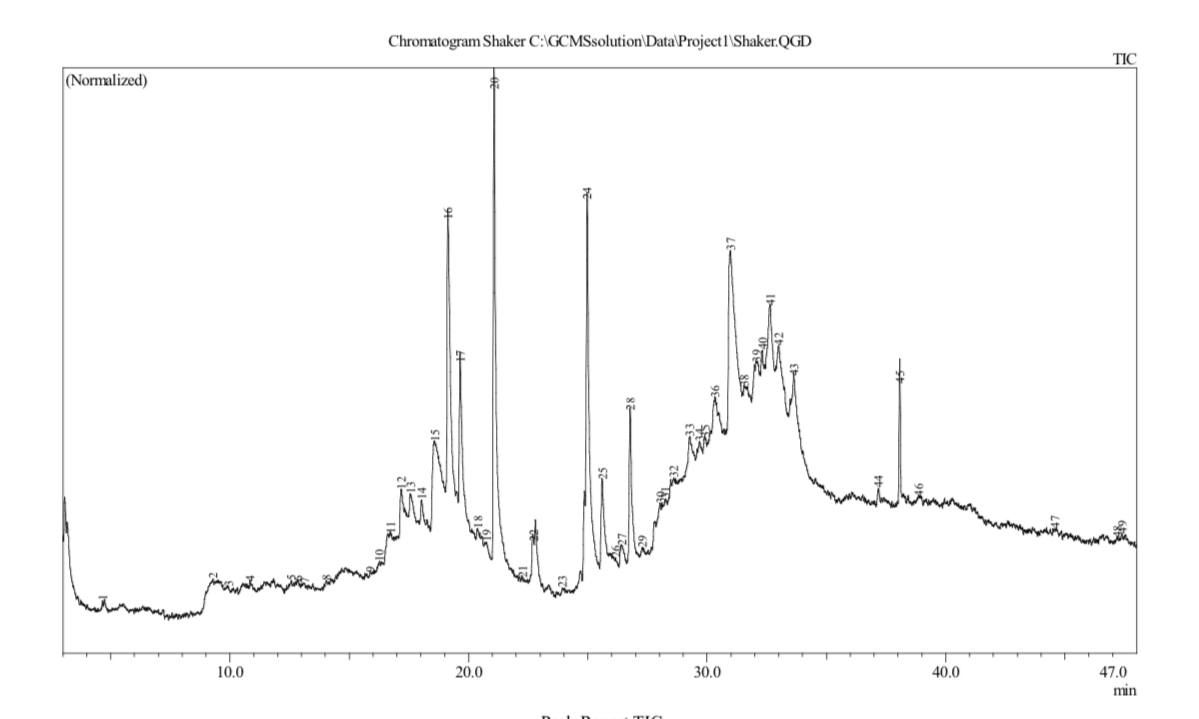
A spectrum of known compound components will be stored in the NIST library. The results of the analysis using GC-MS (Gas Chromatography-Mass Spectrometry) can be seen on the GC-MS chromatogram profile (Figure 1).
From the results of the GC-MS analysis, there are 49 compounds identified in avocado seed extract. Of all the compounds read on GC-MS (Gas Chromatography-Mass Spectrometry) that the compound with the widest area is suspected to be the compound Avocadene acetate at peak number 37, with the synonym name avocadene 1-acetate, the IUPAC name 2,4-dihydroxyheptadec-16-enyl acetate, the chemical name 1-acetoxy-2,4-dihydroxy-n-heptadeca-16-ene; 1-acetoxy-heptadec-16-ene-2,4-diol; 2,4-dihydroxy-HDEAc. Avocadene acetate is one of the components of Avocatin A, which is a lipid mixture derived from avocados that contains avocadene acetate and avocadyne acetate. This compound belongs to the class of long-chain fatty alcohols with the molecular formula C19H36O4. Then the mass spectra is measured where the mass spectrum is the flow of the relative abundance of different positive charge fragments versus the mass per charge (m/z or m/e) of the fragments. The ion charge of most particles detected on a mass spectrometer is + 1; then the value of m/z is equal to the mass of the molecule (M).
The mass spectrometer is displayed as a bar graph. Each peak in the spectrum expresses a fragment of a molecule. These fragments are arranged in such a way that the peaks are arranged according to the rise of m/z from left to right in the spectrum. The intensity of the peaks is proportional to the creative abundance of the fragments depending on their relative stability. The highest peak in the spectrum is called the base peak, sometimes the base peak is caused by molecular ions, but it often comes from smaller fragments.
Based on the mass spectra of Avocadene acetate compounds, the structural formula that is formed is a long-chain structure formula that has 1 carbonyl group and 1 double bond. Based on the determination of the value of the Index of Hydrogen Deficiency (IHD), the compound Avocadene acetate (C19H36O4) has an IHD= 2 value.
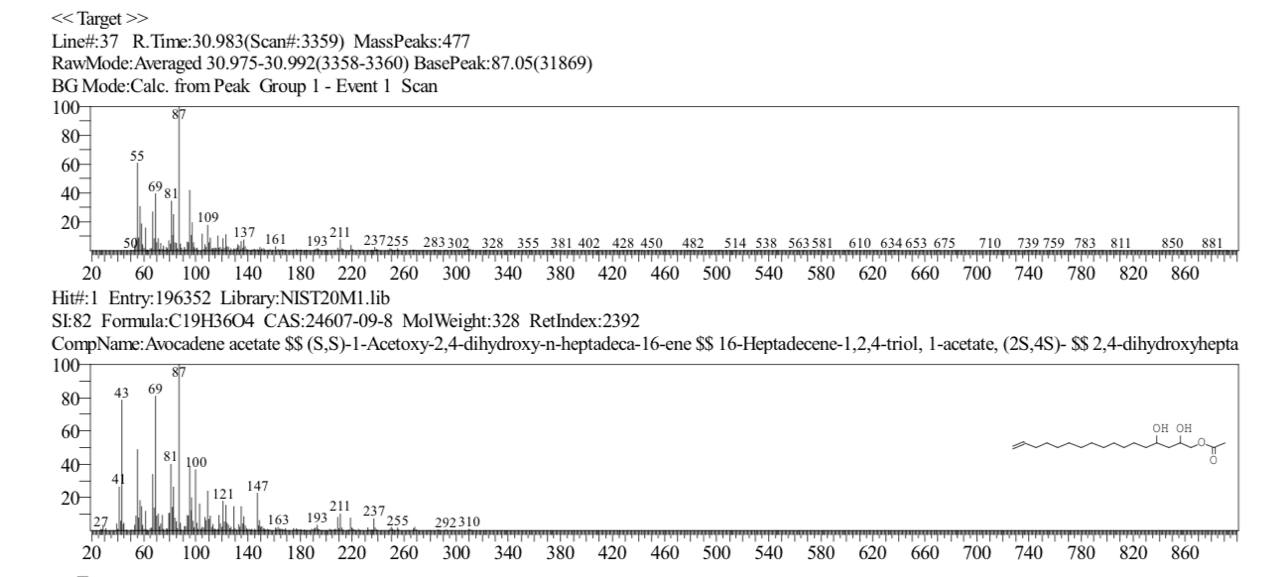
From the structural formula formed above (figure 2), compound 1 Avocadene acetate (C19H36O4) there is a possibility of fragment ions:
Sunscreen is a preparation used on the skin to protect the skin from the harmful effects of UV rays by reflecting, absorbing or scattering some or all of those UV rays. UV light is an electromagnetic wave that is separated into long-wave UVA (315–400 nm), medium-wave UVB (280–315 nm), and short-wave UVC (100–280 nm). The ability of sunscreen to protect the skin from UV rays is measured through the SPF (Sun Protection Factor) value. The higher the SPF value, the better the protection, especially if the SPF value is above 15. The chemicals in sunscreen not only absorb sunlight, but also reflect it. Rays that enter the skin can cause quite serious damage.
| Wavelength(nm) | Concentration (ppm) | ||
| 500 | 1000 | 1500 | |
| 290295300305310315320 | 0,0130,0470,1280,1410,0760,0330,006 | 0,0370,1300,3590,3830,1980,0890,017 | 0,0350,1070,2750,2781,1480,0630,012 |
| Wavelength(nm) | Concentration (ppm) | ||
| 500 | 1000 | 1500 | |
| 290295300305310315320 | 0,0160,0450,1200,1210,0630,0250,005 | 0,0190,0560,1450,1480,0820,0320,006 | 0,0270,0940,2580,2871,1480,0600,012 |
| Sample Concentration (ppm) | SPF value | Kategoti SPF |
| Shaker50010001500 | 4,4412,1319,14 | MediumMaximum:Ultra |
| Blender50010001500 | 3,954,8818,86 | MinimalMediumUltra |
The results of the calculation of the Sun Protection Factor (SPF) value of avocado seed ethanol extract by the UV-Vis spectrophotometry method calculated using the Mansur equation can be seen in the appendix (table 5). The effectiveness of sunscreen based on the results of calculations from avocado seed ethanol extract samples is greatest at a concentration of 1000 ppm. The SPF value at this concentration is 8.02. With this value, its potential is included in maximum protection. SPF values are classified as potential for minimal protection (1-4), medium protection (4-6), extra protection (6-8), maximum protection (8-15), and ultra protection (>15).
References
- Agusta, A. (2000). Indonesian tropical plant essential oil. Bandung: ITB Press. Google Scholar ↗
- 2. Ambarwati, R., & Rustiani, E. (2022). Formulation and evaluation of nanoparticles of avocado seed extract (Persea americana Mill.) with PLGA polymer. Majalah Farmasetika, 7(4), 305. DOI ↗ Google Scholar ↗
- 3. Azzahra, F., Sari, I. S., & Ashari, D. N. (2022). Determination of yield value and active compound content of avocado seed extract (Persea americana) based on differences in extraction solvents. Jurnal Farmasi Higea, 14(2). https://www.jurnalfarmasihigea.org Google Scholar ↗
- 4. Azwanida, N. N. (2015). A review on extraction methods used in medicinal plants: Principles, strengths, and limitations. Medicinal & Aromatic Plants, 4(3), 1–6. Google Scholar ↗
- 5. B, M. (2019). Phytochemical screening of secondary metabolite compounds from pomegranate ethanol extract (Punica granatum L.) using color test methods. Media Farmasi, 13(2), 36. DOI ↗ Google Scholar ↗
- 6. Dalimunthe, N. F., Al Fath, M. T., Taslim, Ginting, S., Alifia, F. N., & Berta, G. A. (2024). Determination of flavonoid levels and phytochemical content of onion peel extract (Allium cepa L.) assisted by microwave as a potential sunscreen active ingredient. Jurnal Teknik Kimia USU, 13(2), 131–137. DOI ↗ Google Scholar ↗
- 7. Hendayana, S., et al. (2001). Chemical analysis of instruments. Semarang: IKIP Semarang Press. Google Scholar ↗
- 8. Holib, I., et al. (2007). Chemical pharmaceutical analysis. Yogyakarta: Pustaka Belajar. Google Scholar ↗
- 9. Majid, T., Razak, R., & Abidin, Z. (2023). Determination of phenolic content of ethanol extract of avocado seeds (Persea americana Mill.) using UV–Vis spectrophotometry. BULLET: Journal of Multidisciplinary Science, 2(2). Google Scholar ↗
- 10. Pavia, D. L., Lampman, G. M., & Kriz, G. S. (2006). Introduction to spectroscopy (3rd ed.). United States: Brooks Cole/Thomson. Google Scholar ↗
- 11. Samurno. (2001). Chromatography: Basic theory and practicum guidelines. Yogyakarta: Faculty of Pharmacy, Gadjah Mada University. Google Scholar ↗
- 12. Suhaenah, A., Tahir, M., & Nasra. (2019). Determination of SPF (Sun Protecting Factor) value of ethanol extract of button mushroom (Agaricus bisporus) in vitro using UV–Vis spectrophotometry. As-Syifa: Journal of Pharmacy, 11(1), 82–87. Google Scholar ↗
- 13. Suhaenah, A., Widiastuti, H., & Arafat, M. (2019). The potential of ethanol extract of avocado seeds (Persea americana Mill.) as a sunscreen. Ad-Dawaa: Journal of Pharmaceutical Sciences, 2(2). Google Scholar ↗
- 14. Supratman, U. (2010). Structural elucidation of organic compounds. Bandung: Widya Padjadjaran. Google Scholar ↗
- 15. Wikandita, K. A., Harjanti, R., & Nilawati, A. (n.d.). Effect of variation in triethanolamine concentration on sunscreen lotion activity of pineapple peel extract (Ananas comosus (L.) Merr.). Media Farmasi Indonesia, 17(2). DOI ↗ Google Scholar ↗
- 16. Yu, Z. W., Zheng, M., Fan, H. Y., Liang, X. H., & Tang, Y. L. (2024). Ultraviolet (UV) radiation: A double-edged sword in cancer development and therapy. Molecular Biomedicine, 5(1). DOI ↗ Google Scholar ↗
- 17. Zhang, Q. W., Lin, L. G., & Ye, W. C. (2018). Techniques for extraction and isolation of natural products: A comprehensive review. Chinese Medicine, 13, 20. Google Scholar ↗