Abstract
Tourism development in Tanjungsari Village, Ciamis Regency, has strategic potential as a pioneering nature tourism destination. However, efforts to optimise this potential face structural obstacles in the form of low digital competence among managers (Pokdarwis) and a gap between infrastructure facilities and the implementation of sustainable governance. This study aims to analyse the role of the Tanjungsari Village Government in accelerating the improvement of digital competence in tourism management through the perspective of government functions. This study uses a qualitative method with a case study design. Data collection was conducted through in-depth interviews, participatory observation of the implementation of the Virtual Office, and documentation, which were then analysed using the interactive model of Miles, Huberman, and Saldana. The results show that the Tanjungsari Village Government has carried out four strategic functions in the digital transformation of tourism, including: First, as a stabiliser, the village government creates a conducive climate through legality and facilitation of transparent governance. Second, as an innovator, the village adopts the Virtual Office Framework to overcome the limitations of manual management. Third, as a moderniser, the village government facilitates the improvement of technological literacy and operational efficiency of tourism human resources. Fourth, as a pioneer, the village government initiates the principle of sustainable tourism based on community empowerment. This study concludes that the structural intervention of the village government is a determining factor in realising professional, accountable, and competitive tourism governance in the digital era.
Keywords: Village Government, Digital Competence, Sustainable Tourism, Virtual Office, Tanjungsari Village.
Introduction
Present the scientific or scholarly background, identify the problem or knowledge gap, and clearly articulate the rationale for the study. State the overall aim and, where appropriate, specific objectives or hypotheses. Support the introduction with current and relevant literature.
Digital transformation has become a key factor in the management of sustainable and competitive village tourism, in line with increasing demands for service efficiency, destination promotion, and community participation. In the context of Tanjungsari Village, tourism development depends not only on natural and cultural resources but also on the ability of village officials and communities to master digital competencies, such as information management, digital media-based marketing, and the use of tourism technology platforms. The village government plays a strategic role as a driving force through policy formulation, provision of digital infrastructure, and facilitation of training and assistance for local tourism actors. A study on the role of the village government in improving digital competencies in tourism management in Tanjungsari Village, Sadananya District, Ciamis Regency, is important to understand the extent to which the village's digital governance capacity can drive the optimisation of tourism potential and improve community welfare. The data on local tourist visits to this tourist village is as follows:
| No. | Year | Tourists | Total per Year (persons) | |
| Male (persons) | Women (persons) | |||
| 1. | 2021 | 750 | 650 | 1,400 |
| 2. | 2022 | 850 | 700 | 1600 |
| 3. | 2023 | 950 | 850 | 1800 |
| 4. | 2024 | 1100 | 1000 | 2100 |
| 5. | 2025 | 1550 | 1500 | 3100 |
| Total | 5,200 | 4,800 | 10,000 |
Source: PokdarwisTanjungMekar, Tanjungsari Village, 2026
The tourist visitation data shows an increase in the number of tourists as part of the positive development of tourism villages. This is in line with the concept of tourism villages in island regions as an important tourism potential for Indonesia. However, the development of island tourism villages requires an important role from the government as the main manager and regulator. Historically, the management of village tourism in Indonesia has developed since the era of regional autonomy after the 1998 Reformation, when villages began to be empowered to utilise local potential such as nature tourism. In Tanjungsari Village, tourism potential such as CurugPanganten, LeuwiPamipiran, beaches, waterfalls, and hills has existed for a long time, but its management has only been optimal after the Covid-19 pandemic through sustainable ecotourism synergy in 2025. Research data from the village website recorded a 25% increase in tourist visits in 2025 thanks to the village government's initial initiatives, even though the digital competence of the managers was still low .
The role of the village government is based on sustainable tourism management, which emphasises improving community skills through digitalisation, such as online platforms and ICT literacy. The concept of a smart tourism village integrates digital technology for management efficiency, as implemented in other tourist villages such as Bi'ih and Sumbermujur, where websites and e-commerce have increased income by 30-40%. Researchers processed data from the Ministry of Tourism and Creative Economy (2024), which recommends digital tourism for tourist villages, with a focus on creative content and website innovation for the competence of tourist village managers .
Law No. 6 of 2014 on Villages (Articles 10-11) requires village governments to manage local economic potential, including tourism, with the authority to coordinate participatory development, manage public recreation, and recommend tourism permits. The Ciamis Regency Regulation and related Regency Regulations (e.g. Wakatobi Regency Regulation No. 7/year as an analogy) reinforce this mandate, including the empowerment of Pokdarwis through village funds for digitalisation. Research data from the Southeast Sulawesi Audit Board (2024) shows that 80% of tourism villages are successful due to legal compliance. In Tanjungsari Village, the TanjungMekarPokdarwis faces digital competency challenges such as a lack of village website updates (last updated in August 2025) and remote internet access, despite digital literacy training by the village government that has increased resident participation by 60%. Researchers analysed data from the village website: free Wi-Fi infrastructure, free modems, and ICT training achieved 70% coverage in 2025, but tourist visits only increased by 15% due to weak digital promotion. A 2025 journal noted an increase in tourism for PokdarwisTanjungsari via a virtual office, but a stronger role for the village government is needed to achieve the target of 50,000 annual tourists. This reality drives this research towards a sustainable digital intervention model.
The principle of good governance in tourism village management is an important prerequisite for realising sustainable, accountable tourism governance that is oriented towards community welfare . The principle of transparency is realised through openness of information related to planning, budget management, and village tourism performance, while accountability is reflected in the clarity of the roles and responsibilities of the village government, Pokdarwis, and other stakeholders . Community participation is a key element by actively involving residents in the decision-making process, destination management, and utilisation of tourism economic benefits . In addition, the principles of effectiveness and efficiency are implemented through the use of digital technology to improve service quality and resource management, while the principles of fairness and the rule of law ensure that tourism village management is carried out in accordance with regulations and provides equitable benefits .
However, the Tanjungsari Village Government acts as a catalyst for good governance, revealing several major gaps that have not been fully addressed. These gaps arise from the imbalance between initial village facilitation support and the challenges of long-term implementation of village tourism digitalisation. As a result, the role of the village government is not yet fully optimal in supporting the improvement of digital competencies in village tourism management.
Methodology
This study uses a qualitative approach with a case study design that focuses on the Tanjungsari Village Government and the TanjungMekar Tourism Awareness Group (Pokdarwis) as the unit of analysis. The research informants consisted of 10 Pokdarwis members and 2 Tanjungsari Village officials who were purposively selected based on their involvement in tourism management and digital innovation implementation. Primary data was collected through in-depth interviews and participatory observation of the implementation of the Virtual Office in village tourism management.
In-depth interviews covered aspects of social media-based marketing and reservation management. Secondary data was obtained from official village documents, including the 2024 Village Development Index (IDM) and tourist visit statistics. Data analysis was conducted thematically by applying source triangulation to enhance the validity of the findings. Data collection techniques referred to observation, in-depth interviews, documentation, and field notes.
The stages of data collection, data condensation, data presentation, and conclusion drawing. The collected data then underwent a data condensation process, which involved selecting, focusing, simplifying, and abstracting raw data to make it relevant to the research objectives without losing its substantive meaning. Next, the condensed data is presented in the form of descriptive narratives, matrices, tables, or charts to make it easier for researchers to understand the patterns, relationships, and trends of the findings. The final stage is drawing conclusions and verification, which is carried out iteratively from the beginning of data collection to the end of the research to ensure that the conclusions produced are consistent, logical, and supported by valid empirical evidence.
Results and Discussion
Regional government is a system of governance run by the regional government together with the Regional Representative Council as representatives of the executive and legislative functions at the local level. This governance is based on the principles of regional autonomy and assistance, which provide space for regions to regulate and manage their own interests within the framework of the Unitary State of the Republic of Indonesia. The principle of broad autonomy as mandated in Article 18 paragraph (5) of the 1945 Constitution of the Republic of Indonesia emphasises that regions have broad authority in resource management, public services, and regional development, as long as they remain in line with national legislation.
Thus, regional autonomy is positioned as a strategic instrument to promote government efficiency, community participation, and equitable development without neglecting the principles of national legal and political unity. In addition to implementing autonomy, regional governments also carry out assistance tasks as an extension of the central government in implementing national programmes in a decentralised manner, such as in the fields of education, health, and socio-economic development. The legal framework regarding the division of government affairs is comprehensively regulated in Law No. 23 of 2014 on Regional Government and its amendments, which distinguishes between mandatory affairs, concurrent affairs, and general authorities. In practice, village governments, as part of local government, can utilise this autonomy to develop local development innovations, including strengthening digital capacity in the tourism sector . These efforts, such as facilitating programmes to improve the competence of village communities through collaboration with universities, reflect the role of village governments as catalysts for good governance, as long as their implementation remains in line with sustainable development policies and national development directions .
Based on this, there are four main factors, namely the role of the government as a stabiliser, innovator, moderniser and pioneer . Based on field data obtained in Tanjungsari Village, an analysis of the role of the village government in improving digital competence in tourism management was examined through the perspective of government function theory. The government's role falls into four main functions: as a stabiliser, innovator, moderniser, and pioneer. The following is an in-depth analysis of the implementation of these four functions in the context of tourism digitalisation in Tanjungsari Village. Regarding the digital framework developed by the Tanjungsari Village Government, namely the Virtual Office Framework as a support for the Tourist Information Centre (TIC). The design of the digital platform development framework is as follows:
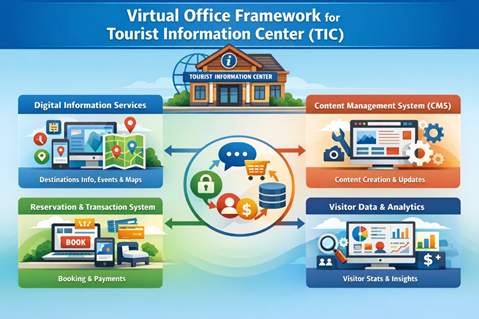
Source: PokdarwisTanjungMekarDesa Tanjungsari, 2026.
1. The Role of the Village Government as a Stabiliser
The role of stabiliser requires the government to create a conducive, orderly, and safe environment to support sustainable development . In Tanjungsari Village, this role is evident in the village government's efforts to facilitate the legality and basic infrastructure for the TanjungMekar Tourism Awareness Group (Pokdarwis). Field findings indicate that prior to digital intervention, the management of pioneering tourist attractions such as CurugPanganten and LeuwiPamipiran was prone to management conflicts due to conventional and non-transparent administrative systems. In this case, the Village Government acted as a stabiliser by:
Facilitating Dialogue and Policy Space
The village government provided the Village Hall as a centre for coordination and training, giving political legitimacy to the fact that digital transformation is an official village agenda to support the status of an Independent Village (IDM 0.83571).
Strengthening Governance
By encouraging the implementation of the Virtual Office Framework, the village government minimises the potential for administrative errors and financial uncertainty, which are often sources of internal instability within management groups. A structured visitor reservation and data recording system creates transparency, which is a key element of organisational stability .
2. The Role of the Village Government as an Innovator
As innovators, village governments are required to find and implement new ways of solving public problems. In Tanjungsari Village, the main challenges are the low Economic Resilience Index (IKE) and the lack of effective marketing strategies. The Tanjungsari Village Government is fulfilling its role as an innovator by adopting a new tourism management model that integrates technology with the principles of sustainable tourism, namely:
Adoption of the Virtual Office Framework
The village government no longer relies on manual management but supports the implementation of a virtual office. This is an innovative breakthrough at the village level where administration, communication, and promotion are carried out in a single digital ecosystem .
Digital Promotion Strategy
Moving away from the old (conventional) ways, the village government encourages the creation of creative and informative video content (covering routes, facilities, ticket prices) as the main promotional tool. This innovation has changed the way villages promote their tourism potential to a wider market through social media and website-based Tourist Information Centres.
3. The Role of the Village Government as a Moderniser
The function of modernisation relates to the government's efforts to lead the community towards a more advanced life through the use of science and technology. In this context, the Tanjungsari Village Government acts as an agent of change that transforms the mindset and technical competencies of Pokdarwis. Field evidence shows a significant transformation in the human resource competencies of tourism managers through a series of interventions supported by the village government:
Improving Digital Literacy
The village government facilitated intensive training on digital marketing and social media management. This transformed the competencies of Pokdarwis members, who were previously technologically illiterate, into being able to independently manage tourism management information systems .
Technology-Based Operational Efficiency
Modernisation is evident in the shift in work systems. The management of visitor data, ticket reservations, and financial reports, which was previously manual and slow, has now shifted to a real-time and efficient digital system. This step confirms the position of the village government in bringing its community to adapt to the demands of the digital era .
4. The Role of the Village Government as a Pioneer
As pioneers, village governments must dare to take the initiative and set an example by taking concrete actions that no one else has taken yet. This role is crucial considering that the natural tourism potential of Tanjungsari Village is still in its infancy. The pioneering role of the Tanjungsari Village Government is identified through:
a. Initiating Sustainable Tourism
The village government does not only focus on short-term profits but also pioneers the application of the Sustainable Tourism concept. They direct Pokdarwis to use technology not only for economic gain but also to monitor environmental carrying capacity and social sustainability .
b. Community-Based Empowerment (CBR)
The village government has pioneered the implementation of a participatory approach (Community Based Research). They actively involve the community from problem identification to evaluation. This pioneering attitude builds a strong sense of belonging among Pokdarwis members, ensuring that digitalisation is not merely a top-down instruction but a movement that grows from community awareness triggered by the village government.
Comprehensive data related to digitalisation in the development of tourism villages in Tanjungsari Village is as follows:
| No | Virtual Office Framework Components | Function Description | Contribution to Improving the Digital Competence of Tourism Managers |
| 1 | Digital Information Services | Providing real-time information on tourist destinations, event schedules, digital maps, and web-based or app-based information services | Enhancing the digital literacy of village officials and tourism working groups in managing, presenting, and updating tourism information online, as well as improving digital communication skills with tourists |
| 2. | Content Management System (CMS) | A content management system for the creation, updating, and publication of tourism information in a structured and integrated manner | Developing the technical competencies of managers in digital content management, website management, and the use of digital media as a means of promoting village tourism destinations |
| 3. | Reservation System and Transaction Services | Facilities for booking tickets, tour packages, homestays, and integrated digital payment services | Enhancing managers' capabilities in using digital transaction platforms, online reservation management, and understanding non-cash payment systems in village tourism management |
| 4 | Visitor Database and Analytics | A system for collecting, processing, and analysing visitor data and preferences | Strengthening managers' competencies in digital data management, basic statistical analysis, and data-driven decision-making for the sustainable development of tourism in Tanjungsari Village |
Source: Research Findings, 2026.
From the above discussion, this research presents a significant original contribution to the study of village development administration by applying the conventional theory of government functions used for macro-level government analysis to the micro-level context of digital transformation in pioneering village tourism. Unlike previous studies that predominantly focused on the technical aspects of smart tourism villages or the evaluation of digital infrastructure in general, this study is unique in that it systematically describes how the Tanjungsari Village Government integrates four strategic functions (stabiliser, innovator, moderniser, pioneer) as a unified orchestration in overcoming the digital competency gap of the TanjungMekar Tourism Awareness Group (Pokdarwis).
The theoretical novelty lies in the reconceptualisation of Siagian's theory in the digital era, where the stabiliser function no longer merely maintains physical order but encompasses digital good governance through the legitimacy of the Virtual Office Framework. The innovator has evolved from merely being a solution provider to becoming an architect of an integrated tourism management ecosystem that combines administration, communication, and promotion in a single platform. Meanwhile, the roles of modernisersand pioneers are expanded with the dimension of community-based sustainable digital tourism (CBR), offering a hybrid model that has not been explored in depth in domestic or international literature.
Empirically, this research is the first case study to measure the effectiveness of village government interventions in improving the digital competence of tourism managers in West Java, particularly in Ciamis Regency, with triangulation of pre-post test data on digital competence (Likert scale) integrated with observations of actual implementation. This research also fills a methodological gap by adapting Miles, Huberman, and Saldana's interactive analysis to unravel the dynamics of the facilitation-implementation gap, which has so far only been described narratively without in-depth structural analysis.
Conclusion
Based on the results of the study, digital transformation in the management of tourism initiatives in Tanjungsari Village has proven to be impossible without the structural role of the village government. The Tanjungsari Village Government has gone beyond its administrative functions by acting as a key player in increasing the digital capacity of PokdarwisTanjungMekar. Through the initiation of the Virtual Office Framework, the village government has successfully performed the functions of stabiliser, innovator, moderniser, and pioneer simultaneously, as described in Siagian's theory of government functions. The role of stabiliser is realised through the creation of orderly, legitimate, and accountable governance, while the function of innovator is evident in the courage to adopt a virtual office system as a solution to the geographical and infrastructural limitations of the village.
In addition, the role of moderniser is reflected in the facilitation of continuous training and mentoring that encourages the improvement of tourism human resource competencies without neglecting local wisdom. The village government also acts as a pioneer by instilling the principles of technology-based sustainable tourism, which is not only oriented towards increasing visits but also towards social and ecological balance. These findings confirm that the success of digitalisation at the village level is largely determined by the capacity of local government leadership to translate macro policies into concrete practices. The synergy of these four functions has resulted in tangible impacts in the form of more professional governance, effective promotion, improved human resource quality, and the emergence of a sustainable village economy.
References
- Afriza, L., Darmawan, H., & Riyanti, A. (2020). Management of Tourism Villages in West Java Province. In Journal of Applied Tourism Sciences (Vol. 5, Issue 3). https://journal.polteksahid.ac.id/index.php/jstp/article/view/148 Google Scholar ↗
- Ariesmansyah, A., Hari, R., Ariffin, B., & Respati, L. A. (2023). Collaborative Governance in the Development of Tourism Villages. https://doi.org/http://dx.doi.org/10.24014/jel.v14i1.25060 Google Scholar ↗
- Diah, A., Utami, M., Hariani, D., & Sulandari, S. (2021). Collaborative Governance in the Development of Kemetul Tourism Village, Susukan District, Semarang Regency. https://doi.org/https://doi.org/10.14710/jppmr.v10i3.31412 Google Scholar ↗
- Endrawati, H., & Widiastuti, D. U. (2022). Recommendations for the Implementation of a Web-Based Management Information System for Tourist Attractions in Tegal Regency. 8(2), 22–27. https://doi.org/10.33084/restorica.v8i2 Google Scholar ↗
- Galasca, S. A., & Yahfizham, Y. (2024). Designing the C'HeTi Project Management Information System: Mobile-Based Cultural Heritage Technology Virtual Tour Guide. Hello World Journal of Computer Science, 3(1), 28–36. https://doi.org/10.56211/helloworld.v3i1.509 Google Scholar ↗
- Garis, R. R., Nursetiawan, I., Sidiq, M., Sultan, M., Rengganis, N. D., Andriani, S. N., Aprilia, I. A., Syaori, G. R., & Nurdiana, D. (2025). Enhancing Digital Competence and Tourism Awareness of Tourism-Conscious Groups Through a Virtual Office Framework Based on Sustainable Tourism in Tanjungsari Village. JURNAL ABDIMAS INDONESIA, 5(4), 2318–2329. https://doi.org/https://doi.org/10.34697/jai.v5i4.2081 Google Scholar ↗
- Hapsoro, N. A., & Bangun, K. (2020). The Development of Sustainable Development from an Economic Perspective in Indonesia. Lakar Jurnal Arsitektur, 3, 88–96. https://doi.org/http://dx.doi.org/10.30998/lja.v3i2.7046 Google Scholar ↗
- Indrayani, I. A. D., Prabawatia, N. P. A., & Yudarthaa, I. P. D. (2024). Collaborative Governance Based on Pentahelix in the Development of Sustainable Tourism Villages (Case Study: Taro Tourism Village, Tegallalang District, Gianyar Regency). Ethics and Law Journal: Business and Notary, 33–47. https://journals.ldpb.org/index.php/eljbn/article/view/151 Google Scholar ↗
- Maulina, L., Kuswandi, D., Irani, S. Y., Daniati, H., & Rosiana, E. (2022). Management of Pandanrejo Tourism Village Towards Desapreneur. Media Wisata, 20(2), 233–248. https://doi.org/10.36275/mws Google Scholar ↗
- Noviarita, H., Kurniawan, M., & Nurmalia, G. (2021). Management of Tourism Villages with the Green Economy Concept in an Effort to Increase Community Economic Income During the Covid-19 Pandemic (A Study of Tourism Villages in Lampung and West Java Provinces). https://jurnal.stie-aas.ac.id/index.php/jap/article/view/3761 Google Scholar ↗
- Nugroho, B. E., & Pradana, G. W. (2021). The Role of the Government in Improving the Quality of Life of the Community through the Social Rehabilitation Programme for Uninhabitable Houses in Surabaya City. https://doi.org/https://doi.org/10.26740/publika.v9n3.p155-166 Google Scholar ↗
- Nuraini Syafitri, N. S., & Sadad, A. (2022). The Role of Village Government in Realising Independent Villages in Sungai Pinang Village, Tambang District, Kampar Regency. PUBLIKA: Journal of Public Administration, 8(1), 81–91. https://doi.org/10.25299/jiap.2022.vol8(1).9301 Google Scholar ↗
- Nurhasanah Purba, N., & Ivanna, J. (2024). The Role of Village Government in Public Services, Empowerment Development, and Protection in Kuta Pinang Village. Citizenship Journal, 8(1), 497–506. https://doi.org/https://doi.org/10.31316/jk.v8i1.6291 Google Scholar ↗
- Puriati, N. M., & Darma, G. S. (2021). Testing the Readiness of Modern Management-Based Tourism Village Management as a Driver of the People's Economy. Bisma: Journal of Management, 7(2), 319–330. https://doi.org/https://doi.org/10.23887/bjm.v7i2.34162 Google Scholar ↗
- Putri, M. R., & Rodiyah, I. (2018). Public-Private Partnerships in Corporate Social Responsibility Programmes in Pasuruan Regency. JKMP (Journal of Public Policy and Management), 4(2), 117–134. https://doi.org/10.21070/jkmp.v4i2.689 Google Scholar ↗
- Rattu, P. N., Pioh, N. R., & Sampe, S. (2022). Optimising Performance in the Social, Cultural and Governance Sectors in Development Planning (A Study at the Office of the Regional Development Planning, Research and Development Agency of Minahasa Regency). Journal of Governance, 2(1). https://ejournal.unsrat.ac.id/index.php/governance/article/view/40264 Google Scholar ↗
- Rochmatin, L., & Muchsin, S. (2025). Collaborative Governance in Sustainable Tourism Management in Kertosari Tourism Village. Journal of Administrative Science, 16(2), 74–89. https://doi.org/https://doi.org/10.23969/kebijakan.v16i02.16741 Google Scholar ↗
- Sado, J. C., & Sahdan, G. (2025). Tourism Management in Detusoko Barat Tourism Village, Ende Regency. Journal of Social Studies Education Innovation, 5(2), 466–473. https://doi.org/https://doi.org/10.51878/social.v5i2.5737 Google Scholar ↗
- Saidah, I. N., Torry, A., & Kusumo, S. (2022). Legal Review of Sustainable Tourism Regulations in Indonesia in the Context of Environmental Carrying Capacity. https://doi.org/https://doi.org/10.20961/shes.v8i2.105221 Google Scholar ↗
- Situmeang, I. V. O., Kencana, W. H., Meisyanti, M., Rahmawati, K. J., Nugroho, H. S., & Lubis, A. Y. (2023). Assistance with Smart Government Applications in the Integrated Digital Village Ecosystem in Ambulu Village, Cirebon. Warta LPM, 26(3), 355–362. https://doi.org/10.23917/warta.v26i3.1262 Google Scholar ↗
- Tri, A., Cahyandari, S., & Pradana, G. W. (2022). The Role of Local Government in the Implementation of Mandatory Environmental Affairs (A Study of Hazardous Waste Management Efforts in Sidoarjo Regency). https://doi.org/https://doi.org/10.26740/publika.v10n1.p159-174 Google Scholar ↗
- Wibowo, A., Sakaria, S., & Melamba, B. (2022). The Role of Local Government in the Development of MSMEs (Batik Village) in Sukun Malang District (Vol. 2, Issue 2). https://journal.unwim.ac.id/index.php/sadeli/article/view/482/0 Google Scholar ↗
- Zainal Abidin, A. (2025). Information Services at the Malang Tourist Information Centre (MTIC) (Vol. 19, Issue 2). https://jim.unisma.ac.id/index.php/rpp/article/view/27082 Google Scholar ↗