Abstract
As a result of a massive digital transition in education, it has become necessary to incorporate marketing into the structure of Moroccan higher educational institutions. This paper is aimed at the effect of personalized ethical marketing content and its distribution frequency on loyalty of students with the use of engagement as a mediation variable. It applies a quantitative method based on the sample of students of the National School of Commerce and Management located in Casablanca. It is built on the hypothesis that relevant content personalized to the needs of students and properly distributed will contribute to increased engagement and development of a long-term relationship with educational institution. However, an excess of distribution can create information overload and have a negative impact on the image of the institution. The expected results will prove that personalization and distribution frequency used ethically have a positive influence on the engagement and loyalty of students. Conclusion: From a managerial perspective, the research can help higher educational institutions develop a strategy of responsible content creation. The uniqueness of the research lies in the analysis of the impact of personalization, distribution frequency, engagement, and loyalty in a Moroccan higher education setting.
Keywords
Marketing Content Personalization Distribution Frequency Loyalty Engagement.
Introduction
When educational organizations are compelled to respond to a highly competitive world, the efficiency of content marketing depends on several key factors like marketing personalization of content and its regular distribution. Such aspects should be handled in an ethical way both not to overwhelm the audience with too much information and not to spoil the confidence in institutions. Nowadays, content marketing is very important for the Moroccan educational sector helping higher education institutions raise their visibility, attract new students, and engage their students. Creating valuable content, educational organizations can showcase their professionalism, values, and most importantly, build up a connection of trust with their audience (Chauhan & Pillai, 2013). In addition, content marketing is beneficial for future students since it allows them to receive useful and inspiring information influencing their desire to become part of an organization (Waqas et al., 2021).
The concept of content marketing involves the creation, distribution, and management of high-quality content to attract, engage, and retain a certain audience, with the main goal being to add value for the consumer and contribute to the development of a positive relationship with the brand and increase awareness, and thus indirectly generate sales (Hadiyati, 2024; Plessis, 2017). In using different approaches on social networks, platforms, or organizational web pages, content marketing helps organizations to differentiate from the competition and enhance customer loyalty and engagement (Puligadda et al., 2021; Shen, 2023). Therefore, marketing content personalization through the use of analytical tools and big data has become very important. This approach helps organizations to tailor content to the likes and particular needs of consumers, which improves engagement and loyalty (Johnson et al., 2019; Koob, 2021). The other element that plays an important role for marketing campaigns is the distribution frequency of marketing content. Frequent distribution adjusted to the expectations of the target audience improves brand visibility and contributes to continuous engagement (Nieves-Casasnovas & Lozada-Contreras, 2020; Vlachvei et al., 2021). However, excessive distribution can lead to saturation, thereby reducing effectiveness and harming brand perception.
Under these circumstances, the below-mentioned research problem is considered: How marketing content personalization and distribution frequency influence students’ engagement and their loyalty towards the institution? The key objective of the research would be to examine the influence of ethical marketing content personalization and distribution frequency on students’ loyalty through the mediation of engagement among the students of the National School of Commerce and Management of Casablanca in Morocco using the quantitative approach. Through this research, it would be possible to add to the knowledge about the relationship between personalization, distribution frequency, engagement, and loyalty in the educational sector of Morocco with an emphasis on the ethical perspective on the implementation of these factors. It would help to enhance the attractiveness of the institutions and develop their relationships with the students.
Theoretical Framework
Concept definitions
Content marketing
Content marketing, although often used interchangeably with the term marketing content, may also refer to a broader approach that encompasses the creation of content with the aim of building a relationship with the public. This involves not only content creation, but also distribution strategy and results analysis in order to optimize engagement and conversion.
However, only after the emergence of the Internet in the 2000s did content marketing become successful. According to Fleischer, content marketing is even older than advertising because the first advertisements were forms of content used for bringing together people through common values. Similarly, Baer (2014) points out that content marketing has always existed, highlighting its importance for human communication. Therefore, despite the fact that content marketing seems to be a recent phenomenon, it is actually quite old and has just developed to fit the needs of consumers and technologies. The concept of content marketing was invented in 2001, according to Rebecca Lieb, author of the book Content Marketing. No reference to this notion existed before. Therefore, it can be said that content marketing is a strategy consisting in creation, distribution, and sharing of valuable content in order to reach a target audience. In general, such a strategy involves the production of content meant to trigger profitable actions on the part of consumers (Pažėraitė & Repovienė, 2018). There are three major themes emphasized in different definitions of content marketing that researchers pay attention to. They are the purpose of digital content, the stress on providing valuable information, and the goal of engaging and motivating customers during the purchasing process (Wang & McCarthy, 2020; Alamäki & Korpela, 2021).
Despite the similarities between marketing content and content marketing, the difference between them is associated with the objectives and approach. In the case of marketing content, the goal is to create it in order to obtain immediate effects. Content marketing implies more than just creating it since its objective is to create relationships with people through creating valuable and relevant content (M.N., 2023; R. Hadiyati, 2024; A. Saputra, D. Utari, & M. Furqon, 2023). Thus, content marketing is important in the contemporary marketing strategies since it helps create valuable and relevant marketing content that engages target audiences. According to Godin (2008), content is the only marketing left now since it attracts consumers without bothering them.
Loyalty
This is the customer's pledge to continually utilize the products of the same market, making loyalty a very valuable resource for any brand. In the current market environment, the acquisition and retention of loyal customers have increasingly become a challenge for many brands. The reason for this is the existence of various technologies that customers use to connect with the brands (Tjandra and Wono, 2024). There are various ways in which customers use such technologies including the physical presence of the brand, websites, apps, and social media platforms. Companies are constantly creating new procedures aimed at ensuring that customers have flexible lines of communication and integration of the brand experience (Tjandra and Wono, 2024). According to Guillen (2019), delivering an exceptional customer experience requires dedicated and precise attention to creating memorable moments for each customer, giving rise to the Customer Loyalty Loop. This implies that something naturally embedded tends to be memorized more effectively, as in acronyms such as STICK or LOOP. Noah Flemming also argues that the entire process rests on the principle that customers begin to form opinions about someone or something long before they engage in the loyalty process. The customer journey begins with their first encounter with the name or brand in marketing campaigns.
Engagement
Following Day (1969) and Jacoby and Kyner (1973), the literature has often defined engagement as a positive attitude toward a brand, or as the attitudinal side of loyalty (Robertson, 1976; Amine, 1998; Quester and Lim, 2003; Terrasse, 2003). The conceptualization of engagement went through two major phases (Brodie et al., 2011). The first dates back to the seventeenth century and includes concepts related to social science, management, and business practices (Brodie et al., 2011). Engagement has been addressed in several different disciplines, such as sociology with civic engagement, political science with national engagement, psychology with social engagement, education with student engagement, and finally business, including management with employee engagement and business practices with stakeholder engagement (Brodie et al., 2011). A second phase relates to the marketing literature (Brodie et al., 2011). Although marketing has been interested in the concept of engagement for several years, it has only recently appeared in the literature (Gambetti and Graffignia, 2010). In marketing, engagement is conceptualized as who is committed to what (Angeles Oviedo-Garcia et al., 2014). Thus, the subject of engagement may refer to a customer, consumer, or user, while the object may be a company, brand, product, company activity, or medium (Hollebeek, 2011). On the other hand, engagement does not yet have a universal definition, and most of its definitions adopt a multidimensional perspective including the following dimensions: cognitive, emotional, behavioral, and social (Islam and Rahman, 2016).
Personalization
Personalization is a concept that has been studied in various disciplines for years; it is defined and explained differently (Fan and Poole, 2006), and its operationalization is also highly variable (Wang et al., 2017). Personalization is defined, on the one hand, as a strategic tool used for differentiation in competitive environments (Ho, 2006; Kwon & Kim, 2012; Tam & Ho, 2006), and also as delivering the right content in the right format to the right person at the right time (Tam & Ho, 2006, p. 867). In this study, we focus on the implications of personalization within a marketing practice. Therefore, consumer-related definitions were examined, and we found that the phenomenon is defined as a customer-centered and relationship-building marketing strategy, including the recognition and treatment of customers as individuals with unique needs, characteristics, and behaviors through personalized value offerings (Imhoff et al., 2001; Tam & Ho, 2006; Aguirre et al., 2015; Nyheim et al., 2015; Kotras, 2020).
From this perspective, we define personalization as an essential marketing strategy activity that plays a vital role in today's data-driven business world and aims to provide value based on personal information obtained from the first contact with customers. Today, technology-mediated or technology-enabled personalization stems from the creation of personalized interactions and services based on user databases and application software. As a result, the emergence of recent cognitive technologies, including big data analytics, machine learning, and artificial intelligence, has further strengthened the phenomenon of personalization at more significant levels and in virtually all commercial contexts (Huang and Rust, 2017). Thus, to fully understand this concept with its unique aspects and to clearly conceptualize and operationalize users' perceptions of it, it is first necessary to emphasize that personalization is generally used as a broader term and is considered one of the many methods for implementing a unique experience for each user (Fan & Poole, 2006). In addition, agents and recommendation systems are essentially specific applications of personalization across different technological platforms and should not be considered as reflecting all forms of personalization (Komiak & Benbasat, 2006; Zhang & Curley, 2018).
Distribution frequency
Distribution frequency of content is defined as the rate at which the organization publishes its messages across its different social media channels and hence affects consumer perception and engagement. As explained by Brodie et al. (2011), frequency is one of the vital components in customer relationship management that enables one to be always present without being too much. Frequency, according to Holliman and Rowley (2014), is the systematic pattern of sending or posting of contents that helps in creating a trusting and interactive relationship with the audience. Frequency, in Balio (2017), is described as the time element of the content strategy and is crucial in creating consistency in communication and especially loyalty. Phan et al. (2020) also consider the frequency to be a vital aspect that determines the visibility of the brand since it influences engagement and receptiveness. In conclusion, distribution frequency can be termed as a strategic tool that, if well used, ensures the creation of a durable relationship between the brand and its customers without exhausting or boring the audience.
Ethics in content marketing
Ethics is an essential component in the practice of content marketing as it is the basis of trust and credibility that should be established by a brand with its customers. As Smith (2019) underlines, trust is the foundation of any successful business relationship, and respect for ethics is indispensable to maintain it. Indeed, transparency, honesty and respect for one's privacy are principles that should inspire the creation and distribution of marketing content. As Kant (1785) stated, responsibility consists in respecting each person's autonomy and integrity, including obtaining their consent to collect and use personal data according to GDPR (2018). Moreover, spreading misinformation or manipulating the message may have a detrimental effect on brand's credibility, as some researches remind us. In addition to this, promoting inclusive and respectful marketing content is also an important social responsibility, as Martin and Schouten (2012) mention when they highlight how ethics distinguishes the brand and helps building authentic relations with consumers. In sum, an ethical approach to content marketing is not only a regulatory requirement but also an essential strategy for maintaining a long-term relationship of trust, enabling the organization to stand out in a digital environment that is increasingly demanding and sensitive to social responsibility (Keller, 2013).
Hypotheses and conceptual model
In this part of our paper, we discuss the formulation of the hypothesis and the conceptual framework of our study about the effects of personalization and frequency of marketing content distribution on student engagement and loyalty within higher educational institutions. With this in mind, we have come up with seven hypotheses based on past studies done in relation to these two variables, while considering how each element affects the key variables such as engagement and loyalty of students. The suggested model shows the possible relationships among the variables, allowing us to test the direct effects of each variable and their interaction in relation to loyalty as the dependent variable.
Personalization and Engagement
According to Brodie et al. (2011), marketing content personalization is very important in enhancing relevance and interaction for customers, which is in line with the engagement theory. Hence, in accordance with the uses theory, content may assume diverse shapes, depending on what it seeks to achieve, for example entertainment and informative videos or podcasts. Brands use content to lure and engage consumers through provision of value (Katz, E., & Foulkes, D., 1962). Thus, through the personalization of content to match the consumers’ preference and behavior, while taking into account issues of ethics and confidentiality, an organization can build a strong relationship with its customers. This makes the engagement to be more sustainable as the customers would feel valued and understood. The following hypothesis was formulated:
H1. Marketing content personalization significantly influences student engagement.
Distribution frequency and Engagement
The findings of the research by Trong Nhan Phan et al. (2020) performed on Instagram emphasize the important role played by the distribution frequency in terms of users' engagement. It can be stated that both a too low frequency and an excessive one can negatively influence the effectiveness of content distribution. Thus, it is suggested to develop a balanced distribution strategy considering users' behavior and preferences. The findings of the research by Trong Nhan Phan et al. (2020) performed on Instagram emphasize the important role played by the publication frequency in terms of users' engagement. It can be stated that a too low frequency and an excessive one can result in limiting content visibility and information overload, respectively, which in turn can result in subscribers' disengagement. Thus, it is suggested to develop a balanced distribution strategy considering users' behavior and preferences. Such strategy not only allows maintaining their interest but also promoting sustainable and meaningful interaction within the community. Based on this, it is reasonable to suggest the following hypothesis:
H2. Marketing content distribution frequency has a significant impact on student engagement.
Engagement and loyalty
According to brand engagement theory, it should be mentioned that loyalty is regarded as an important outcome of consumer engagement (Aaker, 1991). Moreover, Heere and Dickson (2008) also state that brand loyalty is often researched in marketing, and there was already proved that brand engagement affects this loyalty. According to Warrington and Shim (2000), it is worth saying that although there is some relationship between brand engagement and loyalty, they are different concepts. In this regard, Oliver (1999) describes loyalty as a commitment of a consumer which is reflected in the regular purchase of his/her favorite brand. The same definition was provided by Oliver (1997), who defines loyalty as commitment of a consumer to purchase favorite products or services regardless of any external factors. According to this hypothesis, brand loyalty is caused by brand engagement:
H3. Student engagement has a significant effect on their loyalty.
Personalization and loyalty
According to Phan et al. (2020), content personalization on platforms like Instagram is correlated with the rise of customers' engagement. Through personalizing the message, the company will not only boost its instant engagement but will also be able to develop long-term relationships with its customers. In other words, through personalization, the company can build the relationship with the customer and thus offer a better experience to the user, resulting in the development of lasting relationships with the brand and the possibility of meeting the expectations of the audience. Therefore, it is assumed that content personalization will be a key lever in building loyalty among students attending higher education institutions:
H4. Marketing content personalization plays a role in student loyalty.
Engagement, personalization, and loyalty
Savitha et al. (2023) emphasize that content personalization, by responding precisely to customers' expectations and needs, plays a crucial role in building a relationship of engagement and loyalty. This personalized approach fosters deeper customer engagement, which results in increased loyalty. Customers feel valued and understood, thereby strengthening their attachment to the brand. In addition, personalization enables organizations to create tailor-made content that responds to individual preferences, which not only improves the relationship with the customer but also establishes a strong emotional bond. This can also apply to our case. Accordingly, we suggest the existence of a mediating role of engagement between marketing content personalization distributed by higher education institutions and the loyalty of their students:
H5. Student engagement acts as a mediator between marketing content personalization and their loyalty.
Distribution frequency and Loyalty
Holliman and Rowley (2014) emphasize in their study that regularity in content distribution is necessary to establish a relationship of trust with the audience. They warn against significant gaps in distribution frequency, which may harm customer loyalty. Indeed, a well-planned marketing content strategy that respects an appropriate distribution frequency contributes to creating a strong and reliable brand image, thereby fostering customer loyalty. In this regard, we propose the hypothesis that the distribution frequency of marketing content by higher education institutions can affect the loyalty of their students:
H6. Marketing content distribution frequency affects student loyalty.
Engagement, distribution frequency, and loyalty
According to the literature review, engagement is vital as a mediator between content distribution frequency and brand loyalty. As stated by Brodie et al. (2011), customer engagement caused by valuable interaction with the brand increases engagement and leads to loyalty. Well-selected frequency of the distribution can make the engagement higher by keeping the interest of customers and forming their emotional connection. On the contrary, too frequent distribution of marketing material can be informationally overloaded and reduce the engagement and customer loyalty in the result. Thus, it is necessary to have balance in the marketing content distribution strategy. Overall, appropriate distribution frequency causes the engagement, which serves as a key vector of the customer loyalty, as suggested by Brodie and Hollebeek (2011). The last hypothesis assumes the mediator effect of engagement between marketing content distribution frequency and student loyalty:
H7. Student engagement mediates the relationship between marketing content distribution frequency and their loyalty.
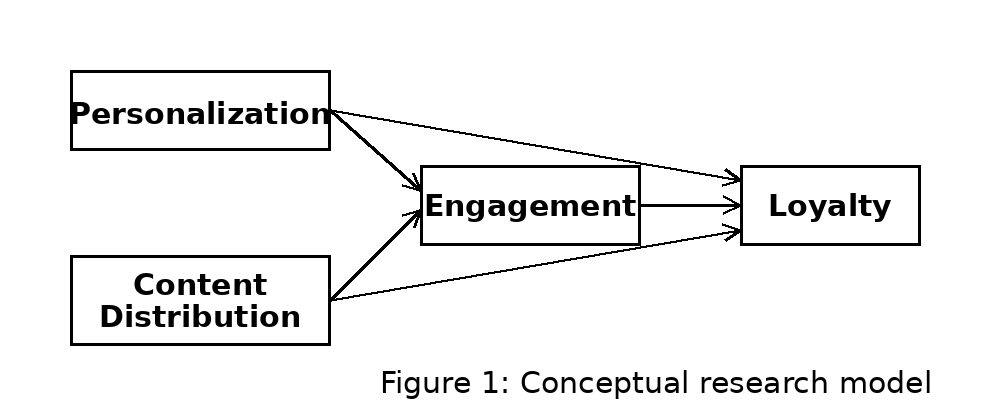
Source: Authors
Materials And Methods
Measurement scales
The measurement scales were drawn from previous literature; personalization measures were adapted from Haris and Goode (2010). Engagement measures were adapted from the scales developed by Lourenço et al. (2022). Loyalty measures were adapted from the additive scale of Ting Pong and Tang Pui Yee (2001). Finally, distribution frequency was measured using a normal frequency scale ranging from never to always. The items related to personalization and loyalty were assessed using a 5-point Likert scale based on the following criteria: (1) strongly disagree and (5) strongly agree. Engagement was assessed using a 7-point Likert scale based on the following criteria: (1) strongly disagree and (7) strongly agree. All the adopted measurement scales had already been validated in their field of application. The questionnaire was administered in French, and therefore these measurement scales were translated from English into French. Finally, responses were collected from a sample of 184 students from the National School of Commerce and Management of Casablanca. To ensure that there was no ambiguity and that each item statement was properly understood, the questionnaire was submitted to content validation by expert researchers.
Before conducting the PLS-SEM analysis, preliminary analyses were performed using SPSS to assess the reliability and factorial structure of the different scales. The initial Cronbach's alpha coefficient for each construct was greater than 0.7 (PERS: 0.916; ENG: 0.951; LOY: 0.909), indicating good internal consistency. Principal component analysis (PCA) was performed to explore the factorial structure of the items, and sample adequacy was confirmed by a KMO of 0.939 (above 0.9, indicating excellent adequacy) and a significant Bartlett's test of sphericity (χ² = 3105.717, df = 171, p < 0.001). The three constructs were retained, corresponding to the theoretical constructs (Personalization, Engagement, and Loyalty).
Results
This section will provide the results of the analysis of the measurement model (tests for reliability and validity), structural model evaluation, and hypothesis testing.
According to Danks and S. Ray (2021), Cronbach's alpha should be more than 0.70, composite reliability more than 0.70, and AVE (Average Variance Extracted) should be higher than 0.50 to assure internal consistency of items, construct reliability, and sufficient common variance between indicators. The results of the analysis of Cronbach's alpha, composite reliability, and AVE are provided in the table below. All constructs demonstrate high reliability; Cronbach's alpha values vary from 0.912 to 0.952, which shows good internal consistency of constructs. Composite reliability (rho_c) values are satisfactory, which confirms the reliability of constructs. Rho_a values are higher than 0.7, and finally, convergent validity is confirmed by AVE values above 0.50.
| Construct | Cronbach's alpha | Rho_a / Composite reliability (rho_c) | Average Variance Extracted (AVE) |
| PersonalizationPers1Pers2Pers3Pers4 | 0.923 | 0.924 / 0.945 | 0.812 |
| EngagementEngcog1Engcog2Engcog3Engemo1Engemo2Engemo3Engcomp1Engcomp2Engcomp3 | 0.952 | 0.955 / 0.959 | 0.724 |
| LoyaltyLoy1Loy2Loy3Loy4Loy5 | 0.912 | 0.920 / 0.935 | 0.743 |
Source: Authors, based on SPSS
To confirm discriminant validity, the Fornell-Larcker criterion was used, and the results are presented in this table. The results show that each construct is greater than its correlations with the other constructs.
| ENG | LOY | FREQ | PERS | |
| Engagement (ENG) | 0.851 | |||
| Loyalty (LOY) | 0.760 | 0.867 | ||
| Distribution frequency (FREQ) | 0.474 | 0.260 | 1.000 | |
| Personalization (PERS) | 0.672 | 0.500 | 0.507 | 0.901 |
Source: Authors, based on SmartPLS
Discriminant validity is confirmed according to the Fornell-Larcker criterion, which states that the square root of the AVE of a construct must be greater than its correlations with other constructs. In our case, the square root of the AVE for loyalty (LOY) is 0.867, which is greater than its correlation with engagement, which is 0.760; the same applies to all other constructs, as shown in Table 2. This indicates that each construct is distinct and does not overlap with the others.
Table 3 presents the values of the explanatory factors (R²). The value is 0.475 for engagement, indicating that personalization and distribution frequency explain 47.5% of engagement. In addition, the value is 0.591 for loyalty, meaning that both explain 59.1% of loyalty.
| Construct | R square |
| Engagement | 0.475 |
| Loyalty | 0.591 |
Source: Authors, based on SmartPLS
Direct effects were tested using the bootstrap procedure (5000 subsamples) to assess the significance of the relationships between constructs, as presented in Table 4. Among the five hypotheses relating to direct effects, only Hypothesis 4, which assumed that marketing content personalization plays a role in student loyalty, was rejected (β = 0.028, T = 0.420, p = 0.675). In contrast, Hypothesis H1, which proposes that marketing content personalization significantly influences student engagement, was confirmed (β = 0.581, T = 7.696, p = 0.000). Similarly, Hypothesis H2, proposing that marketing content distribution frequency has a significant impact on student engagement, was confirmed (β = 0.180, T = 2.335, p < 0.001). Hypothesis H3, which postulates that student engagement has a significant effect on their loyalty, is confirmed (β = 0.806, T = 13.036, p = 0.000). Likewise, H6, which states that marketing content distribution frequency affects student loyalty, is supported (β = 0.137, T = 2.315, p < 0.001). Therefore, it was found that no significant direct link existed between the personalization of marketing content distributed by higher education institutions and the loyalty of their students.
| Relationship | Original sample (O) | Sample mean (M) | Standard deviation (STDEV) | T statistics (|O/STDEV|) / P values |
| Engagement -> Loyalty | 0.806 | 0.804 | 0.062 | 13.036 / 0.000 |
| Distribution frequency -> Engagement | 0.180 | 0.180 | 0.077 | 2.335 / 0.020 |
| Distribution frequency -> Loyalty | 0.137 | 0.139 | 0.059 | 2.315 / 0.021 |
| Personalization -> Engagement | 0.581 | 0.582 | 0.075 | 7.696 / 0.000 |
| Personalization -> Loyalty | 0.028 | 0.034 | 0.068 | 0.420 / 0.675 |
Source: Authors, based on SmartPLS
Effect sizes (f²) were calculated to evaluate the importance of each predictor in explaining the variance of the endogenous constructs. The results are presented in Table 5. For engagement, loyalty has a strong effect (f² = 0.833), as does personalization on engagement (f² = 0.477), indicating a strong effect. For frequency, the effect on engagement is medium (f² = 0.046), and on loyalty as well (f² = 0.032), indicating a moderate effect. For personalization and loyalty, the value is below 0.02 (f² = 0.001), indicating a very weak effect. These results indicate that engagement plays an important role in loyalty and confirm the rejection of Hypothesis 4, due to the weakness of the effect of personalization on loyalty.
| ENG | LOY | |
| ENG | 0.833 | |
| LOY | ||
| FREQ | 0.046 | 0.032 |
| PERS | 0.477 | 0.001 |
Source: Authors, based on SmartPLS
Indirect effects were examined to test mediation relationships through brand attachment (Table 6), using the bootstrap procedure (5000 subsamples) to assess their significance. The indirect effect of engagement between personalization and loyalty was confirmed (β = 0.468, p = 0.000), confirming Hypothesis 5, which assumes that student engagement acts as a mediator between marketing content personalization and their loyalty. Similarly, the indirect effect of engagement between distribution frequency and loyalty was also validated (β = 0.145, p = 0.021), and therefore Hypothesis 7, according to which student engagement mediates the relationship between marketing content distribution frequency and their loyalty, is also supported. Thus, engagement is a mediating variable in the relationship between the two independent variables and loyalty.
| Relationship | Original sample (O) | Sample mean (M) | Standard deviation (STDEV) | T statistics (|O/STDEV|) / P values |
| Distribution frequency -> Engagement -> Loyalty | 0.145 | 0.144 | 0.063 | 2.311 / 0.021 |
| Personalization -> Engagement -> Loyalty | 0.468 | 0.469 | 0.079 | 5.936 / 0.000 |
Source: Authors, based on SmartPLS
Discussion
The results presented highlight the crucial importance of engagement in the construction of student loyalty. More specifically, engagement was shown to have a significant effect on loyalty. This finding, which is consistent with several previous studies, is based on the definition of loyalty as a persistent positive attitude toward a brand or institution, often referred to as the attitudinal dimension of loyalty (Robertson, 1976; Amine, 1998; Quester and Lim, 2003; Terrasse, 2003). In other words, when a student becomes more engaged with the institution to which he or she belongs, the student expresses not only an intention to continue belonging to it and using its various services, but also a lasting favorable attitude. This engagement can take different forms, such as participation in events, sharing positive information, or recommending the institution to others, thereby strengthening long-term loyalty.
The relationship between engagement and loyalty is seen as a cause-and-effect relationship in the literature on marketing and customer relationship management. As Morgan and Hunt (1994) pointed out, engagement is seen as an important mediating variable when talking about the loyalty of the customers, particularly in the case of long-term relationships. This study supports this point of view, in that engagement is not seen only as a dependent variable but as a mediator between the dimensions of marketing support (personalization and frequency of content distribution) and loyalty.
Nonetheless, an interesting finding from the research is that there was no direct connection between personalized marketing content and student loyalty. This shows that personalization cannot ensure loyalty on its own. In essence, personalization might enhance the perception or immediate satisfaction of the students but it cannot lead to loyalty unless it is followed by a process of increasing engagement. This is in line with previous research showing the significance of the role played by engagement in developing a psychological connection between the student and the brand. Thus, the connection between personalization and loyalty is an indirect one or a mediated connection.
Another key point mentioned in this regard refers to the role of the frequency of marketing content distribution. According to the findings from the collected data, frequency is crucial for not only better visibility but also higher engagement and, hence, increased loyalty of the students. Such findings coincide with the results of the study conducted by Brodie et al. (2011), where it was found out that frequency of content distribution is one of the key factors that determine engagement and, thus, loyalty in the digital environment.
Another thing which sets apart our research is the revelation of the mediator effect of engagement in the connection between distribution frequency and loyalty. Thus, the findings prove that engaged students are more likely to develop loyalty towards their institutions if the frequency of content distribution is appropriate for them. Specifically, when the frequency of the distribution is too low, the student stays indifferent to the process, while a very high frequency might cause saturation or even frustration. In turn, the optimum frequency generates engagement, which acts as the main source of loyalty. Such indirect connection is in full correspondence with the assertion of Brodie and Hollebeek (2011) regarding the importance of engagement as one of the major mechanisms that converts marketing into loyalty. Engagement, thus, can be defined as a dynamic mediator of the process, where constant and adequate communication along with ethical considerations create a bond with the student.
To sum up, the main results revealed in our study are the following:
- Engagement constitutes a determining factor and an important mediating variable in the relationship between different dimensions of marketing content, namely personalization and distribution frequency, and student loyalty.
- Content personalization, although initially perceived as a potentially effective element, does not show a significant direct effect on loyalty, indicating that its impact must mainly pass through engagement to become more significant.
- Distribution frequency directly influences loyalty as long as this frequency generates engagement. An adapted, regular, and relevant distribution therefore becomes ideal for developing loyalty, in line with the work of Brodie et al. (2011).
- Finally, understanding that engagement is a key mediating variable in the student loyalty process enables marketers from different higher education institutions in Morocco to design more effective strategies, while emphasizing the quality, regularity, and authenticity of marketing content intended to create and strengthen student engagement in order to subsequently make them loyal.
Conclusion
By conducting this study, we have sought to investigate the links between the marketing content personalization and the marketing content distribution frequency on the loyalty of the students attending higher education institutions in consideration of the engagement as mediator. In theory, this research has added value to the current literature on the subject by stressing the significance of the personalization and the marketing content distribution frequency as two factors affecting the loyalty of the students attending higher education institutions in Morocco. In recognizing the significant part played by the engagement both as mediator and as a predictor, the research shows how the adaptation of the content strategy could not only catch students' attention, but also create an emotional attachment to their institution.
Therefore, in practice, the study would help build a good understanding of the loyalty and institutional involvement of the students in Moroccan universities in terms of ethical distribution of personalized marketing messages. As a result, these higher education institutions would be able to create better marketing plans tailored to the peculiarities and expectations of their students. Through implementing the personalization element into communication processes, higher education institutions could enhance their attractiveness and responsiveness to the requirements of students.
Considering the limitation of the dimensions being limited to only two, as well as the focus on one mediator, it will be possible to get more insights about student loyalty among higher education institutions in Morocco. For instance, future studies can consider other mediators like motivation and satisfaction. It will also be possible to consider the effect of other dimensions of marketing content, and this way, it will be possible to gain more insights into the concept of student loyalty. This way, it will be possible to come up with more specific content marketing strategies which will be able to address current challenges facing the education industry.
Acknowledgement
No specific acknowledgement was declared by the authors.
Conflict Of Interest Statement
The authors declare no conflict of interest.
References
- Brodie et al. Customer engagement: conceptual domain and implications. 2011. DOI ↗ Google Scholar ↗
- Chen X, Xu J. Relationship between content marketing and brand loyalty of the new-china-chic brand based on nationalism. International Journal of Research in Business and Social Science. 2022;11(5):556-578. 3. Cretin-Pirolli R. Digital serious games as tools to support education: information practices of teachers, integration perspectives and challenges of their preservation at the French National Library (BNF). s. d. 4. Danieli A. Consumers' perception of personalized marketing content and its impact on their engagement. s. d. DOI ↗ Google Scholar ↗
- Efthimiadou E. Se former au numérique: vers une approche multimodale et digitale pour co-construire des environnements d'apprentissage. Analele Universității din Craiova, Seria Psihologie-Pedagogie / Annals of the University of Craiova, Series Psychology-Pedagogy. 2022;44(1):7-15. Google Scholar ↗
- Evania S, Listiana E, Wendy R, Rosnani T, Fahruna Y. The effect of influencer marketing and content marketing on customer engagement and purchase decisions among followers. Asian Journal of Economics, Business and Accounting. 2023:12-20. Google Scholar ↗
- Hadiyati R. From content to commerce: investigating the role of content marketing in driving sales and brand engagement. Management Studies and Business Journal (Productivity). 2024;1(3):355-368. DOI ↗ Google Scholar ↗
- Hair JF, Hult GTM, Ringle CM, Sarstedt M, Danks NP, Ray S. Partial least squares structural equation modeling (PLS-SEM) using R: a workbook. Cham: Springer International Publishing; 2021. 9. Julienne E. Les facteurs d'engagement à la marque: vers une approche intégrative. s. d. 10. Kant I. Fondements de la métaphysique des mœurs. 1785. Google Scholar ↗
- Kędzierska-Szczepaniak A, Minga Z. Content marketing as an innovative solution for crowdfunding platforms: the example of Patronite platform. Procedia Computer Science. 2022;207:4318-4327. Google Scholar ↗
- Keller KL. Strategic brand management: building, measuring, and managing brand equity. Pearson Education; 2013. Google Scholar ↗
- Kumar V, Aksoy L, Donkers B, Venkatesan R, Wiesel T, Tillmanns S. Undervalued or overvalued customers: capturing total customer engagement value. Journal of Service Research. 2010;13(3):297-310. Google Scholar ↗
- Lavie T, Sela M, Oppenheim I, Inbar O, Meyer J. User attitudes towards news content personalization. International Journal of Human-Computer Studies. 2010;68(8):483-495. DOI ↗ Google Scholar ↗
- Lin MH, Chen HC, Liu KS. A study of the effects of digital learning on learning motivation and learning outcomes. Eurasia Journal of Mathematics, Science and Technology Education. 2017;13(7):3553-3564. 16. Macedo-Rouet M, Perron JM. Contenu et utilité des scénarios pédagogiques de la base pratique. s. d. Google Scholar ↗
- Mahamat A, Hassana H. Intégration pédagogique des technologies de l'information et de la communication (TIC) et développement des compétences numériques des élèves des établissements secondaires publics de l'arrondissement de Kousseri au Cameroun. European Scientific Journal. 2025;21(7):132. Google Scholar ↗
- Maryam H, Shanthi V. Unlocking customer engagement through strategic content marketing. Tuijin Jishu / Journal of Propulsion Technology. 2023;44(3):4488-4498. DOI ↗ Google Scholar ↗
- Martin K, Schouten J. Ethics of socially responsible marketing. Journal of Business Ethics. 2012;109(2):155-170. 20. Morgan RM, Hunt SD. The commitment-trust theory of relationship marketing. s. d. Google Scholar ↗
- Nusantara MD, Pardede R. Influence social media marketing, content marketing, and event marketing towards purchase intention mediated by customer engagement. Jurnal Indonesia Sosial Sains. 2023;4(11):1154-1167. Google Scholar ↗
- Odier Guedj D, Sansegundo-Moreno O, Moulin F. La formation continue à distance: conditions propices pour répondre aux besoins des enseignantes et des enseignants. Étude de portée et perspective pour des formations à l'éducation à visée inclusive. International Journal of E-Learning & Distance Education / Revue internationale de l'e-learning et de la formation à distance. 2023;38(1). Google Scholar ↗
- Ouajdouni A. Massive open online courses: learning frontiers and novel innovations. In: Goundar S, editor. Massive open online courses: learning frontiers and novel innovations. IntechOpen; 2024. DOI ↗ Google Scholar ↗
- Pupion PC, Pyun HO, Yun KJ, Dorbaire P, Huron D, Park J, Guo Y. De la motivation à l'engagement pour le service public: étude comparative entre la France, la Chine et la Corée du Sud. Management International. 2018;21(2):60-79. Google Scholar ↗
- Qian W, Mao J. Exploring the influential factors of personal media bloggers on followers' continuous following intention based on relationship marketing theory. Behavioral Sciences. 2023;13(5):416. Google Scholar ↗
- Raïes K, Gavard-Perret ML. Intention de fidélité à la marque des participants à une communauté virtuelle de marque: le rôle dual de l'engagement. Recherche et Applications en Marketing. 2011;26(3):23-43. Google Scholar ↗
- Rani A. The role of content marketing in the era of digitalization. International Journal of Advanced Research. 2022;10(2):1355-1362. Google Scholar ↗
- RGPD. Règlement général sur la protection des données. Commission européenne; 2018. Google Scholar ↗
- Rizkia AR, Akbar MA, Lina R. Customer engagement mediates the effect of content marketing on purchase intention. Advances in Business & Industrial Marketing Research. 2024;2(3):123-137. DOI ↗ Google Scholar ↗
- Saputra A, Utari D, Furqon M. Analisis strategi content marketing dalam menciptakan customer engagement (studi pada umkm manda cake). Jembatan (Jurnal Ekonomi, Manajemen, Bisnis, Auditing, dan Akuntansi). 2024;8(2):122-130. DOI ↗ Google Scholar ↗
- Savitha et al. Effect of content marketing on customer engagement concerning Nike. 2023. 32. S'hail M, Benabdelouahed R. Le marketing de contenu au Maroc: état des lieux et perspectives. s. d. Google Scholar ↗
- Shahzad TS. Role of internal marketing in employee engagement leading to job satisfaction of employees in private banks of Pakistan. IOSR Journal of Business and Management. 2013;8(2):62-68. DOI ↗ Google Scholar ↗
- Smith J. Trust and ethical standards in content marketing. Journal of Digital Marketing Strategies. 2019;5(2):45-58. Google Scholar ↗